Annals of Hepatology 6(3) 2007: 156-160
156
medigraphic.com
Annals of Hepatology 2007; 6(3): July-September: 156-160Annals of Hepatology
Original Article
Geographical distribution of HCV
genotypes in Mexico
Juan Francisco Sánchez-Ávila;1 Elizabeth González;2 Victoria Vázquez;2 Susana Suárez;3 Misael Uribe1
1 Departamento de Gastroenterología. Instituto Nacional de
Ciencias Médicas y Nutrición Salvador Zubirán. México, D.F., México.
2 Facultad de Medicina, Universidad Autónoma de México,
México D.F., México.
3 Medicina Interna. Hospital Ángeles del Pedregal. México.
México, D.F., México. Address for correspondence: Juan Francisco Sánchez-Ávila M.D. Departamento de Gastroenterología.
Instituto Nacional de Ciencias Médicas y Nutrición Salvador Zubirán.
Vasco de Quiroga Núm. 5. Col. Sección XVI. Del. Tlalpan. 14000. Distrito Federal
México.
Fax: (52) 55 56 55 09 42 E-mail: [email protected]
Manuscript received and accepted: 20 February and 26 June 2007
Abstract
Chronic hepatitis C (CHC) is the second cause of end-stage liver disease in our country and one of the main indications of liver transplantation. Hepatitis C virus (HCV) genotype is the principal prognostic factor and the determinant of the therapeutic scheme. In our coun-try few data exist regarding the prevalence of HCV in-fection and genotype distribution in the Mexican Re-public has not been determined. The aim of this study was to characterize the prevalence of the different HCV genotypes and to explore their geographical distribu-tion. Methods: Mexican patients with hepatitis C infec-tion, detected throughout the country between 2003 and 2006, were included. All samples were analyzed by a central laboratory and Hepatitis C genotype was iden-tified by Line Immuno Probe Assay in PCR positive samples (Versant®®®®® Line Probe Assay Quest Diagnostics Nichols Institute, San Juan Capistrano CA). Data were analyzed according to the four geographical areas in Mexico. Results: One thousand three hundred and nine-ty CHC patients were included. The most frequent gen-otype detected was gengen-otype 1 (69%) followed by geno-type 2 (21.4%) and genogeno-type 3 (9.2%). Genogeno-type 4 and 5 were infrequent. There was no subject infected with genotype 6. Genotype 1 and 2 exhibit very similar dis-tribution in all geographical areas. Genotype 3
infect-ed patients were more frequent in the North region (52%) compared with other areas: center-western (30%), center (17%), South-South east (1%) (p < 0.001). Conclusions: The most prevalent HCV genotype in Mexico is genotype 1. Geographical distribution of HCV genotypes in the four geographical areas in Mex-ico is not homogenous with a greater frequency of gen-otype 3 in the north region. This difference could be re-lated to the global changes of risk factors for HCV in-fection.
Key words: Hepatitis C, genotype, epidemiology, México.
Introduction
Liver cirrhosis and related disorders are a common cause of morbidity and mortality in Mexico. In fact, he-patic diseases have shown an incremental tendency dur-ing the last decades and in the last report of mortality of the National Statistics and Geographical Institute (INE-GI) of 2005 they correspond to the fifth leading cause of general mortality and the fourth in men aged between 30 to 65 years, causing 30.209 deaths in this year.1 One
study explored the trends in liver disease prevalence in Mexico from 2005 to 2050 through mortality data and found that an important increase will be expected during next decades.2 Hepatitis C infection is one of the most
frequent etiologies of end-stage liver disease requiring liver transplantation around the world,3-5 and in Mexico
it is the second most frequent cause of liver cirrhosis in the third level hospitals.6 In basis of several
epidemiolog-ical studies it has been estimated that around 700,000 to 1.5 million of Mexicans are infected with hepatitis C vi-rus.6-15 Hepatitis C genotype has been identified as the
most important predictive factor of antiviral treatment re-sponse and current therapy is guided according to the in-fecting genotype.16 Information related to the virological
characteristics of hepatitis C infection in our country is limited. The aim of the present study is to characterize the prevalence of different HCV genotypes and their geo-graphical distribution in our population.
Methods
Patients with hepatitis C infection, identified as po-tentially candidates for antiviral treatment around our
Artemisa
medigraphic.com
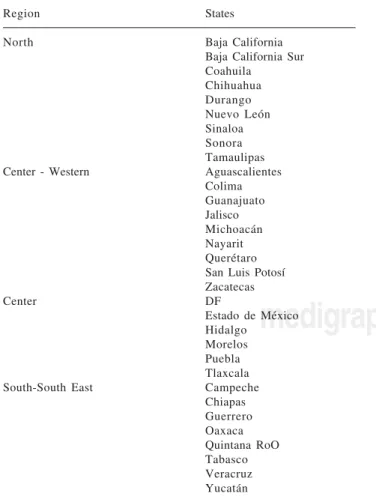
country detected between 2003 and 2006, were includ-ed. All samples were analyzed by a central laboratory (Quest Diagnostics Nichols Institute, San Juan Capistra-no CA). Hepatitis C geCapistra-notype was identified by Line Immuno Probe Assay in PCR positive samples (Ver-sant® Line Probe Assay Quest Diagnostics Nichols Insti-tute, San Juan Capistrano CA). Data were analyzed by political and geographical distribution according to the four geographic areas in Mexico: North region (in-cludes Baja California Norte, Baja California Sur, Coahuila, Chihuahua, Durango, Nuevo León, Sonora and Tamaulipas), Centre-Western region (includes Aguascalientes, Colima, Guanajuato, Jalisco, Micho-acán, Nayarit, Querétaro, San Luis Potosí and Zacate-cas), Central region (includes Distrito Federal, Hidalgo, México, Morelos, Puebla and Tlaxcala) and South-southeast region (includes Campeche, Chiapas, Guerre-ro, Oaxaca, Quintana Roo, Tabasco, Veracruz and Yucatán) (Table I). Descriptive data were presented as a percentage or mean with standard deviation and range.
The χ2 test was used to compare homogeneity between
groups per region and genotype.
Results
One thousand three hundred and ninety patients with a mean age of 47.8 ± 12.9 years (range 17-83) were in-cluded. Fifty nine percent of them were females and the mean of body weight was 70.6 kg ± 13.2 kg (range: 35.6-123 kg). The most frequent genotype infecting Mexican patients was genotype 1 accounting for 69% of the cases, and among them subgenotype b was the most prevalent with 33.8% (Table II). Around one fourth of our study population was genotype 2 (21.4%), followed by fre-quency by genotype 3 (9.2%). Genotype 4 and 5 were in-frequent. In our group there was no patient with geno-type 6.
Distribution of genotypes according to the four geo-graphical areas in Mexico is shown in Table III. The per-centage of patients with genotype 1 was very homoge-nous in the country, being between 64 to 71%. Similarly, genotype 2 was distributed in all areas with percentages of 15.3 to 33.9%. When we divided the population by genotype and observed their distribution we noticed that most of genotype 3 patients are located in north area with 52% of infected subjects (p < 0.001) (Table III and Figure 1). To confirm that this difference was due to area and genotype and not to the different sample size in each region we selected the three most prevalent genotypes and a χ2 was performed obtaining consistent results
(Ta-ble IV).
Discussion
Hepatitis C virus (HCV) is a major cause of liver dis-ease worldwide with a large spectrum including cirrhosis and hepatocellular carcinoma and a potential cause of substantial morbidity and mortality in the future.3-5 The World Health Organization (WHO) estimates a preva-lence of 3% with the virus affecting 170 million people around the world.17 The complexity and uncertainty re-lated to the geographic distribution of HCV infection and chronic hepatitis C, determination of its associated Table I. The four geographical areas of Mexico.
Region States
North Baja California
Baja California Sur Coahuila
Chihuahua Durango Nuevo León Sinaloa Sonora Tamaulipas
Center - Western Aguascalientes
Colima Guanajuato Jalisco Michoacán Nayarit Querétaro San Luis Potosí Zacatecas
Center DF
Estado de México Hidalgo
Morelos Puebla Tlaxcala
South-South East Campeche
Chiapas Guerrero Oaxaca Quintana RoO Tabasco Veracruz Yucatán
Table II. HCV genotype in 1,390 Mexican patients with chronic hepatitis C.
Genotype Frequency Percentage (%)
1 100 7.2
1a 369 26.5
1a/1b 2 0 1.4
1 b 470 33.8
2 108 7.8
2a/2c 8 4 6.0
2 b 105 7.6
3a 128 9.2
4c/4d 5 0.4
5 1 0.1
medigraphic.com
risk factors, and evaluation of cofactors that accelerate its progression, underscore the difficulties in global preven-tion and control of HCV and makes global disease bur-den estimation a difficult issue.4,18 At present moment, in our country accurate population statistics and national survey studies are lacking. The prevalence of 0.7 to 1.5% has been estimated according to the WHO data and based on multiple epidemiological reports, however they
repre-sent selected populations and specially volunteer blood donors.6-15 Although accurate HCV epidemiological data are missing, there is no doubt that end stage liver disease constitutes the fifth leading cause of global mortality in
Mexico.1 One recent publication suggest that chronic
hepatitis C is the second most frequent etiology of liver cirrhosis making CHC a real public health issue in our population.6 Because the direct measurement of HCV in-fection incidence is impractical, researchers have relied upon mathematical models to infer trends in incidence, morbidity and mortality. In Mendez-Sanchez et al study, mathematical projection based on mortality data sug-gests that liver disease will be an increasing cause of mortality in Mexico during next decades.2
HCV is divided among six genotypes with numerous
subtypes.19 These genotypes show a difference up to
30% from each other in nucleotide sequence. According Table III. HCV genotypes in 1,390 Mexican chronic hepatitis c patients according to geographical area.
No (%) of chronic hepatitis C patients by genotype
No 1 2 3 4 5
North 431 297 6 6 6 6 2 0
(68.9%) (15.3%) (15.3%) (0.5%) (0%)
Center-western 386 259 8 8 3 9 0 0
(67.1%) (22.8%) (10.1%) (0%) (0%)
Center 514 365 123 2 2 3 1
(71%) (23.9%) (4.3%) (0.6%) (0.2 %)
South-South east 5 9 3 8 2 0 1 0 0
(64.4%) (33.9%) (1.7%) (0%) (0%)
Total 1,390 959 297 128 5 1
(68.99%) (21.36%) (9.2%) (0.36%) (0.07%)
Figure 1. Distribution of HCV genotypes according to geogra-phic areas in Mexico (values are expressed as percentage)
Table IV. Statistic analysis for HCV genotypes homogeneity per region.
χ2 test Value DF * P value (two tails)
Pearson’s χ2 49.325 6 <0.001
51.711 6 < 0.001
9.076 1 0.003
medigraphic.com
ESTE DOCUMENTO ES ELABORADO POR MEDI-GRAPHIC
to HCV genotype, length of treatment and dosage of anti-viral therapy can differ.16 Alpha-interferon based therapy achieve sustained virological response with less success in genotype 1b compared to genotypes 2 and 3. It is therefore important to track the different genotypes of the HCV virus. In the United States, the NHANESIII study report that 56.7% of the infected patients were classified as 1a, 17% as 1b, 3.5% as 2a, 11.4% as 2b, 7.4% as 3a, 0.9% as 4, 3.2% as type 6.20 In England 50% of all HCV infected subjects were genotype 1 with a higher percent-age of genotype 3 among the IVDU population.21 In fact genotype 1b was the predominant genotype in Chile, Ja-pan and in most of western countries.3,4,22,23 In contrast genotype 2 and 3 are prevalent in the Indian subconti-nent and China, genotype 4 is the most common geno-type in Africa and the Middle East, genogeno-type 5 can be found in South Africa and genotype 6 in south-east Asia.3,4,24
This study constitutes the largest series published in chronic hepatitis C infected Mexican patients. It con-firms, as expected for our geographical situation, that the most prevalent genotype infecting our CHC subjects is genotype 1 with almost 70%, followed by genotype 2 and 3. The frequency of genotype 4 and 5 was very low and we didn’t detect any case with genotype 6. One re-markable finding is that genotype distribution in our country is different among the four geographical regions (division stated by our National Statistics and Geograph-ical Institute) with more than half of genotype 3 in the North area. This situation could have an explanation in the well known change in epidemiology risk factors oc-curring worldwide. Most epidemiological studies con-ducted in Mexico concluded that history of blood -or de-rivates- transfusion before 1995 was the main risk factor for HCV infection. One recent multicentric study form Vera de León et al, although support past blood transfu-sion as the leading probable cause of HCV acquisition in 64.2% of patients, stress intravenous illicit drug usage (IDUs) as an important risk factor for HCV infection in persons who live in north Mexico states, factor that was
present in 54.2% of them and 69% of male cases.25 In
many other studies, HCV infection with genotype 3 has been identified with high prevalence within IDUs spe-cially in developed countries.25-27 According to National Council against addictions (CONADIC) there has been an increase in illicit drug usage among Mexicans, more important in male gender, in the Mexico-United States border and in large cities.28 This increasing IDUs in the north of our country could be related with the high HCV genotype 3 prevalence found in present study. Since 1994 our national regulation adopted HCV testing as mandatory in the screening for blood transfusion and the risk of HCV infection related to transfusion has dropped to levels considered as low as in most of developed coun-tries; excluding those patients with transfusion history before this year, transfusion could account for less than
5% of HCV infected population that receives medical at-tention in many Mexican hospitals.25,29 These observa-tions suggest that HCV epidemiological pattern is evolv-ing and implications related to this change should be considered in our future medical attention and public health policies.
Conclusions
In this large study conducted in Mexican patients with chronic hepatitis C we found that genotype 1 was the most prevalent. There was a non-homogenous distri-bution of genotypes among the four geographical areas of our country, with a high proportion of genotype 3 in-fected subjects in the north of the Mexican Republic. It suggest that, similarly in other countries, risk factors re-lated to HCV infection acquisition are changing, pat-terns that could implicate relevant modifications in our future medical and public policies focused in the im-provement of the attention of HCV infected patients.
This study was performed with an unrestricted support of Schering Plough S.A de C.V. México.
References
1. Instituto Nacional de Estadística Geografía e Informática.
Información estadística. Porcentaje de defunciones generales por
sexo y principales causas. http://www.inegi.gob.mx/est/contenidos/
espanol/rutinas/ept.asp?t=mpob45&c=3222. accessed february 10, 2007.
2. Mendez-Sanchez N, Villa AR, Chavez-Tapia NC,
Ponciano-Rodriguez G, Almeda-Valdes P, Gonzalez D, Uribe M. Trends in liver disease prevalence in Mexico from 2005 to 2050 through
mortality data. Ann Hepatol 2005; 4: 52-5.
3. Sy T, Jamal MM. Epidemiology of hepatitis C virus (HCV)
infec-tion. Int J Med Sci 2006; 3: 41-6.
4. Shepard CW, Finelli L, Alter MJ. Global epidemiology of
hepa-titis C virus infection. Lancet Infect Dis 2005; 5: 558-67.
5. Pellicano R, Mladenova I, Dimitrova SM, Bruno CM, Sciacca C,
Rizzetto M. The epidemiology of hepatitis C virus infection. An
update for clinicians. Minerva Gastroenterol Dietol 2004; 50: 1-7.
6. Mendez-Sanchez N, Aguilar-Ramirez JR, Reyes A, Dehesa M,
Juarez A, Castaneda B, Sanchez-Avila F, et al; Grupo de Estudio, Asociación Mexicana de Hepatología. Etiology of liver cirrhosis
in Mexico. Ann Hepatol 2004; 3: 30-3.
7. Chiquete E, Panduro A. Low prevalence of anti-hepatitis C virus
antibodies in Mexico: A systematic review. Intervirology 2007;
50: 1-8.
8. Mendez-Sanchez N, Motola-Kuba D, Zamora-Valdes D,
Sanchez-Lara K, Ponciano-Rodriguez G, Uribe-Ramos MH, Vasquez-Fernandez F, et al. Risk factors and prevalence of hepatitis virus B and C serum markers among nurses at a tertiary-care hospital in
Mexico City, Mexico: a descriptive study. Ann Hepatol 2006; 5:
276-80.
9. Benitez-Arvizu G, Cortez-Gomez R, Novelo-Garza BA,
Malagon-Martinez A, Guerra-Marquez A, Alvarado-Maldonado M del C, Rodriguez-Bartolo M, et al. Prevalence of hepatitis C virus in the
blood bank at Centro Médico Nacional La Raza. Rev Med Inst
Mex Seguro Soc 2006; 44: 227-33.
medigraphic.com
asymptomatic people in a checkup unit in Mexico city. Dig Dis
Sci 2005; 50: 733-7.
11. Rivera-Lopez MR, Zavala-Mendez C, Arenas-Esqueda A. Preva-lence for seropositivity for HIV, hepatitis B and hepatitis C in
blood donors. Gac Med Mex 2004; 140(6): 657-60.
12. Lopez RA, Romero-Estrella S, Infante-Ramirez L, Mendez-Aquino JS, Berron-Ruiz P, Morales-Alfaro NA, Vivar R, Carrada E, Rivera-Rendon Mdel R, Sanchez-Guerrero SA. Hepatitis C
seroprevalence in accepted versus deferred blood-donor
candi-dates evaluated by medical history and self-exclusion form.
Trans-fusion 2004; 44: 1344-9.
13. Gongora-Biachi RA, Castro-Sansores CJ, Gonzalez-Martinez P, Lara-Perera DM, Garrido-Palma J, Lara-Perera V. Frequency of antibodies against the hepatitis C virus in patients with
he-patic cirrhosis in Yucatan, Mexico. Salud Publica Mex 2003;
45: 346-50.
14. Vivas-Arceo C, Benavides SA, De Jesus Trujillo J, Panduro A, Rivas-Estilla AM. Hepatitis C virus: prevalence and routes of
infection among blood donors of West Mexico. Hepatol Res
2003; 25: 115-123.
15. Carreto-Velez MA, Carrada-Bravo T, Martinez-Magdaleno A. Seroprevalence of HBV, HCV, and HIV among blood donors in
Irapuato, Mexico. Salud Publica Mex 2003; 45: S690-3.
16. Dienstag JL, McHutchison JG. American Gastroenterological Association medical position statement on the management of
hepatitis C. Gastroenterology 2006; 130: 225-30.
17. WHO. Global surveillance and control of hepatitis C. Report of a WHO Consultation organized in collaboration with the Viral
Hepatitis Prevention Board, Antwerp, Belgium. J Viral Hepat
1999; 6: 35-47.
18. The Global Burden Of Hepatitis C Working Group. Global
bur-den of disease (GBD) for hepatitis C. Clin Pharmacol 2004; 44:
20-9.
19. Weck K. Molecular methods of hepatitis C genotyping. Expert
Rev Mol Diagn 2005; 5: 507-20.
20. Alter MJ, Kruszon-Moran D, Nainan OV, McQuillan GM, Gao F, Moyer LA, Kaslow RA, Margolis HS. The prevalence of hepatitis
C virus infection in the United States, 1988 through 1994. N Engl
J Med 1999; 341: 556-62.
21. Mohsen AH, Trent HCV study group. The epidemiology of
hepa-titis C in a UK health regional population of 5.12 million. Gut
2001; 48: 707-713
22. Soza A, Arrese M, Gonzalez R, Alvarez M, Perez RM, Cortes P, Patillo A, Riquelme A, Riquelme A. Clinical and epidemiological
features of 147 Chilean patients with chronic hepatitis C. Ann
Hepatol 2004; 3: 146-51.
23. Yamada G, Tanaka E, Miura T, Kiyosawa K, Yano M, Matsushima T, Tsubouchi H, Ishikawa K, Kohara M, Hino K, et al. Epidemi-ology of genotypes of hepatitis C virus in Japanese patients with
type C chronic liver disease; a multi-institution analysis. J
Gastroenterol Hepatol 1995; 10: 538-545.
24. Nguyen MH, Keeffe EB. Prevalence and treatment of hepatitis C
virus genotypes 4, 5, and 6. Clin Gastroenterol Hepatol 2005; 3:
S97-S101.
25. Vera de Leon L, Juarez-Navarro JA, Diaz-Gomez M, Mendez-Navarro J, Chirino-Sprung RA, Dehesa-Violante M, Casillas-Davila L, et al. Epidemiologic and situational panorama of
hepa-titis C in Mexico. Rev Gastroenterol Mex 2005; 70: 25-32.
26. Dore GJ, Thomas DL. Management and treatment of injection drug users with hepatitis C virus (HCV) infection and HCV/human
immu-nodeficiency virus coinfection. Semin Liver Dis 2005; 25: 18-32.
27. Payan C, Roudot-Thoraval F, Marcellin P, Bled N, Duverlie G, Fouchard-Hubert I, Trimoulet P, et al. Changing of hepatitis C virus genotype patterns in France at the beginning of the third
millenium: The GEMHEP GenoCII Study. J Viral Hepat 2005;
12: 405-13.
28. Informe de vigilancia epidemiológica de las adicciones (SISVEA)
México 2002. Consejo Nacional contra las adicciones. http://
w w w . c o n a d i c . g o b . m x / i n t e r i o r / m e n u _ s u p e r i o r / investigacion_y_estadistica/enc_nal_adicciones_2002.html ac-cessed january 10, 2007.
28. Vazquez-Flores JA, Valiente-Banuet L, Marin y Lopez RA, Sanchez-Guerrero SA. Safety of the blood supply in Mexico