Internacional Conference
20th CENTURY NEW TOWNS
ARCHETYPES AND UNCERTAINTIES
3RUWR(6$3$XGLWRULXP0D\
&HQWURGH(VWXGRV $UQDOGR $UD~MR ĚĞƉĂƌƚĂŵĞŶƚŽ
20th CENTURY NEW TOWNS
Archetypes and Uncertainties
Conference proceedings
Edited by
Paolo Marcolin and Joaquim Flores
DARQ| Departamento de Arquitectura
CEAA| Centro de Estudos Arnaldo Araújo (uID 4041 da FCT) Escola Superior Artística do Porto (ESAP), Porto, Portugal
Title:
20th Century New Towns. Archetypes and Uncertainties. Conference Proceedings.
Editors:
Paolo Marcolin & Joaquim Flores
© of the authors and CESAP/ESAP/CEAA, 2014
Grafic design:
Joana Couto
Design of the cover:
Paolo Marcolin
Edition:
CEAA | Centro de Estudos Arnaldo Araújo DARQ | Departamento de Arquitectura Escola Superior Artística do Porto
Property:
CESAP | Cooperativa de Ensino Superior Artístico do Porto
Impressão e acabamento:
CEAA | Centro de Estudos Arnaldo Araújo Porto, Portugal
1st edition, Porto, May 2014
Print: 200 CD Rom copies ISBN: 978-972-8784-57-7
CEAA | Centro de Estudos Arnaldo Araújo DARQ | Departamento de Arquitectura Escola Superior Artística do Porto Largo de S. Domingos, 80 4050-545 PORTO – PORTUGAL Telef: 223392130 / Fax: 223392135
e-mail: [email protected] ; [email protected]
20th CENTURY NEW TOWNS
Archetypes and Uncertainties
The planning and settlement of new towns were originated by different reasons. In twentieth century cities perhaps the largest reason was to determine new territorial and urban planning structures that would allow a better organization of the territory, ensuring the development of more efficient and balanced socio-economic models.
In some cases the construction of these cities was inspired by the principles of the nineteenth century English utopias, reflecting a strong concern in integrating the urban and natural components and highlighting the role of the natural landscape, understood as a city matrix on which articulates the urban structures.
In other cases the inspiration come from the rationalist ideals of the modern movement, seeking to personify the idealistic and democratic spirit of a new world order, producing rational and functional solutions and even if sometimes they do not fully overcome certain obstacles, an important contribution to the urban and architectural theory and practice advance was made.
Furthermore, other cases relate to the post-modernism and the emergence of critical views of the modern movement. These towns were born to give an answer to the problem posed by the large settlements deindustrialization and de-urbanization, assuming the role of organized urban extensions needed for controlling the sprawl of existing cities which was made through a process of unordered and peripheral urbanization.
Some focused mainly on a completely physical, economic and administrative independency in relation to major urban centres. Others, even if based partially on these principles of independence and geographical isolation, were planned as secondary structure networks dependent from a main urban conurbation. Many of these experiments have already been object of diversified studies addressing more or less specific thematic areas, seeking to define and apply critical and analytical methodologies to better understand and decode the processes and design criteria that were the basis of their urban and architectural morphologies.
Opting for an analytical prospective directed to re-contextualizing the urban and architectural contributions of these experiences, the conference 20th century new towns – archetypes and uncertainties aims to discuss their real effects in the present being especially welcome papers focusing on the following two aspects:
recognize them as meaningful and timeless, distant from temporal gestures which respond only to contemporary needs.
II. Uncertainties | Parts or components of the urban system that
remained incomplete, leading to realities that persisted “open” or that were completed through different intentions, appropriation processes or intervention criteria from those planned in their original design. The nature of these uncertainties could be a further indicator of the effects produced by these archetypes in the city development.
Contents
20th Century New Towns. Archetypes and Uncertainties Contents
KEYNOTE ADRESSES
ÁLVAREZ MORA, Alfonso – New Towns as fragmentary urban projects. From ‘Barcelona’s
Ensanche’ to ‘Madrid’s Linear City’ / p. 9
BUTINA-WATSON, Georgia – Transferable Lessons from the British New Towns / p. 23
MORPURGO, Guido – Foundations and Fundamentals. Urban centralities for european suburbs and
new towns: a comparison of case studies from chinese post-metropolis to north-african “pure desert” /
p. 43
TOSTÕES Ana – The 20th Century New Towns. The Searching for an Ideal City / p. 45
PAPERS
BADIEE, Azadeh – An investigation on landscape structures in Iranian New Town development – The
case of Fuladshahr New Town (1963-2013) / p. 49
BLASCO SÁNCHEZ, Carmen; MARTÍNEZ PÉREZ, Francisco, DELTORO SOTO, Julia – British New
Towns through compared examples. Three examples: Harlow, Thamesmead and Milton / p. 67
BORDIN, Micaela – Towns-villages-hamlets: new foundation city in Italy during the fascism period / p.85
CAPRESI, Vittoria – The piazza as the core of the Italian rural settlements in colonial Libya: a theatre
for fascist power, the obvious answer to local town planning requirements, or just a place to meet? /
p.99
CHEN, Zhen; TAN, Zhu – Colonial archetype and national rebirth. Railway stations and 20th century
new cities in China / p. 115
DESPONDS, Didier – The New towns around Paris. What have they become forty years later: new
centralities or ordinary suburbs? / p. 130
FERNANDES, Eduardo – Life versus Architecture. Rationalist ideals facing popular taste, from
Pessac to Malagueira / p. 146
FERNANDES, Eduardo; SILVA, Ana Carina – From Moore to Calvino. The invisible cities of 20th
Century planning / p. 161
MARCOLIN, Paolo; FLORES, Joaquim Moura – 20th Century New Towns – From Archetypes to
Uncertainties / p. 241
MOCCI, Silvia – Modern habitat in Casablanca. Appropriation and re-use / p. 230
MOREIRA, Bruno – Uncertainty in contemporary urban planning concepts and methods. What we
(still) can learn from garden cities and new towns / p. 245
MOREIRA, César Machado – Hydroelectric Towns in Portugal / p. 263
MUÑOZ SANZ, Victor – Between global turbulences and local manners: the multiple lives of the Bata
Shoe Company satellite towns / p. 277
OLIVEIRA, Maria Manuel – (in) The invention of the City of Brasília Modeling the Ground / p. 298 PETERS, Walter – Sasolburg, a South African New Town, 1951. The ‘Sasolburg pattern’ at a
crossroads / p. 318
RINCON BORREGO, Ivan – Mat buildings – Gated cities. Critical, change and paradoxical
phenomenon in last 20th century new towns / p. 334
ROLAND, Lee Christopher – When archetypes produce uncertainty: the case of the scattered
metropolis / p. 350
SILVA, Filipe – The landscape in Le Corbusier plans for Chandigarh. Nature and symbol / p. 367 SULTSON, Siim – Stalinization of Estonian city space: development, typology and perspectives / p.368
TAN, Zhu; CHEN, Zhen – The experience of the communist settlement. The Danwei dayuan and the
evolution of urban fabric of Chinese cities / p. 385
TERLINDEN, Bertrand – Prospective approach. A topographical linear town in Wallonia. Learning
from an in-depth analysis of the initial Louvain-la-Neuve planning experience / p. 402
TREVISAN, Ricardo – An overview of Brazilian New Cities in the 20th century / p. 411
VIANA, David Leite – Cities’s Structural Matrix From 1950’s Till Today – Between Superlative and
Palliative / p. 426
VIKSTRAND, Ana Micro – Vällingby. Sweden’s first satellite town / p. 441
VIMAL, Sunita – Chandigarh. The city beautiful. One of the greatest examples for modern planning / p. 456
WALKER, Paul; NICHOLS, David; GRANT, Jane – Monarto: learning from the past / p. 470
Conference organization
334
MAT BUILDINGS – GATED CITIES.
Critical, change and paradoxical phenomenon in last 20th century new towns
Iván I. Rincón Borrego
Higher School of Architecture, University of Valladolid, Spain
Abstract
The paper aims to revalue and to compare two urban phenomena of growth and change during the second half of the 20th century: the Mat Building and the Gated City.
On the one hand, Mat Building is analysed as a modern strategy of spatial and formal organization in architecture, which is related to the concept of Mat Urbanism. This idea is rooted in the interest of TEAM X in the traditional cities of North Africa, Japan and China, among others, during the late 1950s and 1960s. In 1974 Alison Smithson defined this urban structure using the model of Arab fortresses called Kasbah: “where the functions come to enrich the fabric, and the individual gains new freedoms of action through a new shuffled order, based on interconnection, close knit patterns of association and possibilities for growth, diminution and change.” Alison Smithson formulated an alternative to the functional city described in the CIAM´s Athens Charter. But she also proposed a new urban form, closed and opened at the same time, a kind of urban structure based on the necessity of identity and mobility.
On the other hand, the phenomenon of the Gated City is also closely related to the idea of urban identity. The CIDs (Common-Interest-Developments) began to emerge at the end of the 1970s, but actually, that idea was put into practice during the 19th century, as a reaction of utopian socialism to environmental and social consequences of the Industrial Revolution. In the context of the sprawling city, during second half of the 20th century, the New Urbanism also established its criticism to the urban ideology of the Modern Movement, as the TEAM X had done before them. However, unlike the previous one, this current used the paradigm of the walled medieval city, or Gated City, which was indebted to the anti-industrial manifesto of Rob and Leon Krier. They wrote: “function follows form”, and not the opposite, as Louis Sullivan had said. Therefore, a purely picturesque approach to urban form was adopted, against the rationalism of the modern post-war planning.
The paper compares both strategies through European and North American urban developments. It analyses their spatial and social structures pointing their own relevance in contemporary urban discourse, and it provides a critical relationship between them, which is full of paradoxes and contradictions for the sustainable urbanism and the land-use planning challenges.
Iván I. Rincón Borrego, Mat Buildings – Gated Cities
335 1.
During the second half of the 20th century, urban planning has faced one of the periods of major change and growth of cities. Initially, the requirements of European post-war reconstruction caused the application of functionalist guidelines of the Athens Charter during the 50s. Then, as reaction during the 1960s, groups of younger architects, as the Team 10, led to a fertile and intelligent review with alternatives to the doctrine of the CIAM. At the same time, in parallel to these events of urban theory and critique, the reality was conducted by a rapid stretch of large cities. Especially in the United States, this period saw the emergent of a radically horizontal urbanism, driven by the enhancement of motorway and the suburban ideal of private housing. Meanwhile, in Europe, part of the debate focused on the role of the modern city and its relationship to the existing city.
From the contemporary point of view, our paper tries to revalue two urban process of growth and change of the late twentieth century: the Mat-Building
and the Gated City, in order to analyse their spatial and social structures and to point their own relevance in contemporary urban discourse.
2.
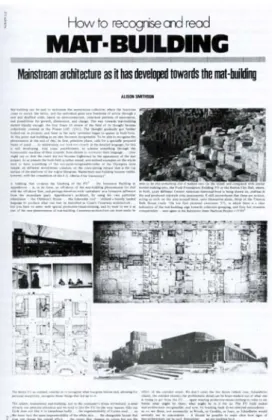
In September 1974, coinciding with the 15 years since the founding meeting of the 10 Team in Otterlo, Alison Smithson publishes How to recognise and read to
mat-building. Following the death of Shadrach Woods on July 31, 1973, the
article makes a first assessment of the achievements of the group and it presents a sort of manifesto of a new emerging urban organization called
Mat-building. This idea comes in the middle of the debate on the role of the modern
20th Century New Towns. Archetypes and Uncertainties Conference Proceedings. Oporto, May 22-24, 2014
336
flows of Louis Kahn developed for the Mid-Town Plan of Philadelphia (1953).
Figure 1. Smithson, A. (1974). How to Recognize and read
Mat-Building. Mainstream architecture as it developed towards mat-building. Source: Architectural Design, no. 9.
Iván I. Rincón Borrego, Mat Buildings – Gated Cities
337
Figure 1. Competition for Golden Lane, 1952. Source :
Smithson and Smithson, 2005.’
In 1974 Alison Smithson explains this urban structure outright, `mat-building can be said to epitomize the anonymous collective; where the functions come to enrich the fabric, and the individual gains new freedoms of action through a new shuffled order, based on interconnection, close knit patterns of association and
possibilities for growth, diminution and change.´ (Smithson, 1974) Her words
claim a multi-nuclear urban model that fosters social activity through control of urban density, a model that is able to grow and integrate large areas of public green space, and transform the chaos caused by the growing presence of the automobile into an ordered structure. Stan Allen has also insisted in these principles of mat-building: “Its job is not to articulate or represent specific functions, but rather to create an opened field where the fullest range of
possible events might take place”. (Allen, 2001, p. 122).
However, the term mat-building has different nuances and annotations by the Smithsons, who did not give a single clear and unambiguous definition of it, as Carles Muro has studied. In one hand, Peter Smithson talks about “networks
plans - so called mat buildings” in ILAUD 1980 in Urbino, definition that stresses
20th Century New Towns. Archetypes and Uncertainties Conference Proceedings. Oporto, May 22-24, 2014
338
net plan”. In the other hand, in the original document Alison Smithson proposes
an earlier meaning: “Mat-Building: a newly invented connective urban
arrangement”, emphasizing the planning aspects and the idea of urban
landscape (Muro, 2011, p.45).
In fact, the term mat-building may represent the idea of building as mat, in the identification of the substantive character of 'building' or, conversely, if 'building' is understood as a verb, we would be talking about a way of create architecture, a formal system. The ambiguity of the term, together with the guidelines used by Shadrach Woods at the Free University of Berlin, “groundscraper”, reaffirms the mat-building as horizontal extension system that promotes the exchange and the feeling of belonging to a community, a concept between building autonomy and connectivity in the city. The most importance projects of Team 10 as the Frankfurt-Römerberg centre (1963) and the Berlin Free University (1963) by George Candilis, Alexis Josic y Shadrach Woods seem to demonstrate that the ambivalence of the term. Their flexibility makes syncretism between architectural design and city project thoughts easier. This strategy provides potentially enriching exchanges for both architecture and city, linking the genetic identity of growth and change of the built form. In that sense, the ambiguity of the term mat building, has served to stimulate the imagination of many architects since then. Examples such as the Agadir Convention Centre (1990), Rem Koolhaas or the Yokohama International Port Terminal (1995-2002), Foreign Office Architects have used that ambivalence although do not represent themselves a mat-building. The suggestive flexibility of the architectural form together with the patterns of association, have revitalized interest in Alison Smithson´s article.
Mat-buildings are strongly influenced by the dense historical tissue of traditional cities. According to Alison Smithson, “The systems will have more than the usual
three dimensions. They will include a time dimension". (A. Smithson. 1974). So
Iván I. Rincón Borrego, Mat Buildings – Gated Cities
339
mind and the in-roads of time” (Smithson, 1974). A kind of urban structure
whose spatial qualities became condensed into continuous structures of interlinked stems.
Apart from Kasbah, many other traditional urban tissues are quoted by the Team 10´s interest. Alison Smithson´s text weaves words and images of several historical cities and buildings. She goes back to pictures and descriptions of Villa Katsura, the necropolis of Saqqara, Deir-el-Bahari, Sinan, Honan, Fatehpur Sikri and the vaulted constructions of Greek and Arabic architecture, suggesting that architects should create together with ancient architectures and cities. Her text does not distinguish between chronologies or styles, between small and large scale. But it seems that it tries to build a kind of conscious lineage of mat-buildings in which the project for the Berlin Free University (1963), together with their own proposal for the reconstruction of Berlin-Hauptstadt (1957), are the main characters.
The project of Berlin-Hauptstadt is one of the best examples to understand the multifaceted character of the notion of mat-building. The project illustrates the Smithsons’ ideas about mobility networks in post-war cities. According to the English authors, “the urban forms of Berlin Hauptstadt have as their basis the idea of mobility, of absolute maximum mobility, achieved by a layered movement pattern that separates the various means of expression and gives to
each its own geometry, its own formal expression.” (Smithson and Smithson,
20th Century New Towns. Archetypes and Uncertainties Conference Proceedings. Oporto, May 22-24, 2014
340
Figure 3. Competition for Berlin Haupstadt, 1958. Source : Smithson and Smithson, 2005.’
Iván I. Rincón Borrego, Mat Buildings – Gated Cities
341
in all directions. Under certain point of view, it is actually more like the examples of historical cities described by the Smithsons, a defensive city protected by walls, or buildings in our case.
Nevertheless, the ideas of Team 10 have a clear integrative intention. Berlin-Hauptstadt is not based on the traditional continuity with the existing urban fabric, but it is based on a strategy that gives continuity to the landscaped and topographic elements. It produces an artificial urban carpet that adds to the existing layer as a palimpsest. It conceives the city as public free space per se, open space and uncrowded, in which the network of elevated roads and park together form a unitary whole. It does not distinguish between city and green space integrating both of them.
Moreover, the value of the proposal for Berlin lies in the design of a strategy of city that will allow the development and growth not in terms of planning, but in terms of adaptation to the changing patterns of human associations. It represents an alternative to the Rationalist and American models of New Towns, unsuccessful attempts of a new urbanism based on responses contrary to the traditional city; centre of low density versus centre of high density built in height; integration of green spaces versus sprawl city; specialized ways versus hegemony of cars over pedestrians; multi-nuclear centres versus unique centre with radial growth.
Therefore, the ideology of the 10 Team, in general, and of the Smithsons, in particular, is built as a thought in permanent evolution where the gaze to the past plays a key role. Their ideas conceive the History of Architecture as the history of anonymous shared problems, expanding architecture temporally and geographically, which they qualify endowed with enormous capacity to adapt to change, regardless of use, location or appearance.
3.
dead-20th Century New Towns. Archetypes and Uncertainties Conference Proceedings. Oporto, May 22-24, 2014
342
ended, others have become more evident mainly because of the inevitably raises questions of scale and speed of movement. Stan Allen studies the contradictions that emerge when mat-building projects –Berlin Free University, Venice Hospital, Smithson´s Kuwait Ministries- move up in scale from architecture to urbanism through Mat Urbanism: The Thick 2d (2001). Instead of the `cellular´ aggregates of the earlier examples, a new spatial structure based on `stem´ or `cluster´ patterns appears. These new organizational principles imply the necessity of transportation systems in a bigger scale, so it tends to spread out laterally dispersing density. According to Stan Allen `if on the one hand, the Smithson were among the first to recognize the potential of infrastructure to influence the future development of the city, they also unwittingly endorse the
conceptual apparatus of modern sprawl´. (S. Allen, 2001, p. 124).
Today, a new city form has developed, more extensive and less controlled than the post-war English suburbs that inspired Smithsons´ work. Cities like Los Angeles have developed as vast as mat like field. Orange County in California, with 2000 square km, initially appears as an appendix to the big city, but eventually forms a homogeneous and indefinite monotonous urban region of streets, office complexes and shopping centres that spread out endlessly without identity. In that context, the phenomenon of CID (Common-Interest-Developments) or Gated Cities begin to emerge at the end of the 1970s. A CID is in fact an ancient urban form. Jill Grant precisely defines “a gated community is a housing development on private roads closed to general traffic by a gate across the primary access. The developments may be surrounded by fences,
walls, or other natural barriers that further limit public access. (…) Gated
developments have an inside and an outside.” (Jill Grant, 2004, p. 913). These
kind of fortified developments have become an increasingly common feature of contemporary suburban building patterns, especially in the United States1
1 By 2000, over 15 % ofthe US housing was contained within these common interest
developments, and the number of units in these privately governed residential schemes rose from 701,000 in 1970 to 16.3 million in 1998. In 2002 the Community Association of America estimated that 47 million Americans were living in 231,000 community associations and that 50% of all new homes in major cities belonged to community associations. (Le Goix, R. & Webster, Chris J., 2006).
Iván I. Rincón Borrego, Mat Buildings – Gated Cities
343
enclosed and private realm, which is a real challenge for space, organization and institutional order that shapes modern cities.
Figure 4. Orange County around Los Angeles. Source : Google Earth.
From an historical point of view, the idea of CID was put into practice during the 19th century, as a reaction of utopian socialism to environmental and social consequences of the Industrial Revolution. It is possible to find previous historical antecedents in examples of ideal cities of the Illustration. The city of Chaux, proposed by Claude-Nicolas Ledoux, a ville sociale partially built in the Royal Saltworks of Chaux (1775-79), near Besançon, would be a model for contemporary ghettos. Paradoxically, postmodern cities are becoming more defended, and more defensible, tan were industrial cities.
Considering the complexity of some CID because of their size, as it is Hot
Springs Village in Arkansas, with more than 10,500 hectares, there are smaller
20th Century New Towns. Archetypes and Uncertainties Conference Proceedings. Oporto, May 22-24, 2014
344
professors in the University of Miami, design the urban plan of Seaside according to the ideology of the New American Urbanism. This is based on the recovery of characteristic morphologies of urban historical developments, such as Ebenezer Howard´s City Garden, and also based on the use of vernacular typologies for suburban areas. These architects reject the uncontrolled growth of large American cities and argue for models with recognizable identity as Oak Park, in Chicago, or Coral Glabes, in Miami, that inspire them. Mainstream is also indebted to the anti-industrial manifesto of Rob and Leon Krier of the 60s, due to their exclusively artisanal approach for the generation of urban form against the militant rationalism of modern urbanism in post-war. According to them
`function follows form´, and not the opposite, as Louis Sullivan had said.
Therefore, The New American Urbanism also establishes its criticism to the urban ideology of the Modern Movement, as the TEAM 10 had done before them.
Figure 5. Seaside, as a film set called Seahaven. Source: Peter Weir (1998), The
Truman Show.
Iván I. Rincón Borrego, Mat Buildings – Gated Cities
345
The regional diffusion of gated communities is related to suburban growth, an endemic anti-fiscal posture, and municipal fragmentation. (…) Although urban sprawl has generated an increased need for infrastructural development, property tax limits and fragmentation have reduced local governments financial resources. As a result, gated communities, which bring wealthy taxpayers at minimal cost, have become the perfect cash cow for local municipalities (…) By providing their own security, infrastructure and services; these developments reduce public financial responsibility. As compensation, homeowners are granted exclusive access to their neighbourhoods; a condition which enhances location rent and positively affects property values. Thus, these developments are instrumental in transferring the cost of urban sprawl from public authorities to private developers and homeowners. (…) This illustrates the point we have already made - that the club neighbourhood is an institution that can help sustain city growth by unlocking more resources for collective goods and services. (Le Goix & Webster, 2006)
However, these supposed economic gains are not made without social costs and spillovers. Thinking that opened cities are land-use systems consisting of interpenetrated private and public spaces governed by complex patterns of property rights; to break down municipal management into smaller gated cities might bring clear urban and social risks. In one hand, without planning supervision, private transactions generate spillover effects, such as material and auditory pollution, road congestion, and underused land. In other hand, resident filtering occurs often when restrictive covenants and property values limit potential candidates to join the CID. The result is social fabric homogenization by wealth, age, race and status. So this micro regulation through private covenants and exclusionary zoning further increases social segregation.
20th Century New Towns. Archetypes and Uncertainties Conference Proceedings. Oporto, May 22-24, 2014
346
the phenomenon. They identify three types of gated community according to: lifestyle, prestige, and security zone communities, with their own circumstances.
Lifestyle communities focus on leisure activities with recreational facilities,
common amenities, and shared services at their core. Prestige communities
serve as symbols of wealth and status for image-conscious residents. And
Security zone communities close off public streets to non-residents. Other
authors as Jill Grant in Types of gated communities (2004) have further provided a wider range of types of gated cities including new parameters as functions of enclosure; kind of security features and barriers; kind of amenities and facilities included; type of residents; tenure; location; size; and policy context. His work gives the key indicator that not all CIDs are solutions for economic and social elites, but they are also employed by public institutions as instruments of urban and social control. Thus, it is increasing the number of CIDs that due to the promise of a cheap housing, they finally confine disadvantaged groups into their own urban enclosure.
Iván I. Rincón Borrego, Mat Buildings – Gated Cities
347
of the III century BC. The example is a new step forward for the New Urbanism and the principles of gated city.
Despite of the wide range of CID´s requirements, there are two parameters shared by all of them. First, they have proliferated motivated by the effects of the uncontrolled sprawl city. Second, they have taken advantage of the paradigm of the medieval walled city to solve their problems. The new-gated communities are remarkably like medieval fortress, constructed to keep the hordes at bay. Perhaps the most important function of medieval gates was to control access to the city to collect taxes and manage trade. Concern about controlling traffic and pedestrian access remains a key issue for the inhabitants of gated enclaves. The gate provides part of what might have called the
architecture of control, both for those inside and those outside: it reinforces the
need for surveillance and the importance given to a social order, even if it is discriminatory.
4.
By exposing the evolution and characteristics of mat-buildings and gated cities, this paper has tried to outline advantages and deficits of them that may offer renewed interest for contemporary architecture and urbanism. The very essence of mat-buildings and gated cities is represented by their common interest about architecture of relationships rather than architecture of forms. Stan Allen´s notion of mat-urbanism shares aspects with the idea underneath them, `their form is governed more by the internal connection of part to part than by any overall geometric figure. They operate as fieldlike assemblages, condensing and redirecting the patterns of urban life, and establishing extended webs of
connectivity both internally and externally.´ (Allen, S., 2001, p. 122). Both
strategies take advantage of urban organizations like cluster, stem and mat, but with remarkably different results due to issues of scale and identity. Alison Smithson wrote: `The systems will present, in their beginning, an even over-all
intensity of activity, in order not to compromise the future´. (Smithson, 1974)
20th Century New Towns. Archetypes and Uncertainties Conference Proceedings. Oporto, May 22-24, 2014
348
Team 10´s mat-building relocates modern architecture within the tradition of urban form, breaking with the functionalist isolation of the guidelines of the Modern Movement and CIAM. Structural aspects found in the mat-buildings (overlay, continuity, identity, flexibility) are shared with the historical urban fabric. Therefore, they represent a certain return to the old city, after the urban ostracism of the avant-garde. But while those ingenious proposals arise, it would have been plausible to wonder about the critical size that the growth of mat-building may have. In the one hand, the Smithsons were among the first to recognize the potential of infrastructure to influence the future development of the city -under certain point of view, Le Corbusier also shares that merit- nevertheless, in the other hand, they have also unwittingly endorsed the conceptual apparatus of modern sprawl.
According to Jaime Ferrer “In theory, the mat typology offers a flexible framework for relating to a site through, an uninterrupted continuation of the
urban fabric into its own spatial network”. (Ferrer, J. 2011) But in practise,
today, it seems that the notion of urban mat and cluster, understood as a link in a chain of urban spaces, has been replaced by the idea of fortress, in response to the uncontrolled sprawl of the contemporary city without identity. Mat-buildings and gated cities demonstrate that architecture´s mediating role becomes increasingly difficult to maintain in a sprawling urban context; so new strategies are required.
Acknowledgments
This paper is developed at CEAA | Centro de Estudos Arnaldo Araújo da ESAP, with FEDER funds by the Operational Competitiveness Programme – COMPETE and national funds by FCT – Fundação para a Ciência e Tecnologia, within the project PEst-OE/EAT/UI4041/2014.
References
Allen, S. (2001). Mat Urbanism: The Thick 2-D. In Sarkis, S., Allard, P. and Hyde, T. (ed), Case:Le Corbusier’s Venice Hospital and the Mat Building Revival. New York: Prestel.
Iván I. Rincón Borrego, Mat Buildings – Gated Cities
349 Ferrer, J. (2011) Mat Urbanism: Growth and Change. Projections n. 10, MIT Journal of Planning, Massachusetts Institute of Technology
Grant, J. (2004) Types of gated communities. Environment and Planning B: Planning and Design, volume 31, pp. 913-930
Le Goix, R. & Webster, Chris J. (2006) Gated communities, sustainable cities and a tragedy of the urban common. Critical Planing, n. 13.
Lerup, L. (2003). La ciudad abierta. Estrías y homogeneidades en la metrópolis suburbana. Arquitectura Viva, 88, pp. 58-61.
Muro, C. (2011) Siguiendo la trama. Notas sobre el mat-building. Mat-Building. DPA 27/28 , pp. 36-45.
Risselada M. and Heuvel D. (ed.). (2005). Team 10: 1953-81: in search of a utopia of the present, Rotterdam: NAI Publishers.
Smithson, A. (1974). How to Recognize and read Mat-Building. Mainstream architecture as it developed towards mat-building. Architectural Design, no. 9.
Smithson, A. and Smithson, P. (2005). The charged void: Urbanism. New York: The Monacelli Press.
Verdú V. (2003) Ficciones metropolitanas. De la lección de las Vegas al modelo Celebration. Arquitectura Viva, 88, pp. 54-57.
489 ORGANIZATION
SCIENTIFIC COMMITTEE
Alfonso Álvarez Mora
Instituto de Urbanística
Universidad de Valladolid, Spain
Ana Tostões
DOCOMOMO
Instituto Superior Técnico, Portugal
Axel Fisher
HABITER: Centre d’Études en
Développement, Territoire et Paysages Faculté d’Architecture La Cambre Horta / Université Libre de Bruxelles, Belgium
Georgia Butina Watson
Oxford Brookes University, UK
Guido Morpurgo
Politecnico di Milano, Italy
Joaquim Flores
DARQ | Departamento de Arquitectura Escola Superior Artística do Porto, Portugal
Maria Castrillo
Instituto de Urbanística
Universidad de Valladolid, Spain
Maria Helena Maia
CEAA | Centro de Estudos Arnaldo Araújo Escola Superior Artístico do Porto, Portugal
Paolo Marcolin
DARQ | Departamento de Arquitectura Escola Superior Artística do Porto, Portugal
Vincenzo Riso
Universidade do Minho, Portugal
ORGANIZING COMMITTEE
Dulce Margarida Gonçalves
CEAA | Centro de Estudos Arnaldo Araújo Escola Superior Artístico do Porto, Portugal
Joana Couto
CEAA | Centro de Estudos Arnaldo Araújo Escola Superior Artístico do Porto, Portugal
Joaquim Flores
DARQ | Departamento de Arquitectura Escola Superior Artística do Porto, Portugal
Maria Helena Maia
CEAA | Centro de Estudos Arnaldo Araújo Escola Superior Artístico do Porto, Portugal
Paolo Marcolin
DARQ | Departamento de Arquitectura Escola Superior Artística do Porto, Portugal
Rosa Marcolin
Universidade do Minho, Portugal
EXECUTIVE COMMITTEE
Joaquim Flores
DARQ | Departamento de Arquitectura Escola Superior Artística do Porto, Portugal
Paolo Marcolin
DARQ | Departamento de Arquitectura Escola Superior Artística do Porto, Portugal
ORGANIZATION