Telecommunications and Economic Growth: An Empirical Analysis of Sub-Saharan Africa♣♣♣♣
Sang H. Lee♠
Associate Professor of Economics Department of Business Administration
Southeastern Louisiana University Hammond, LA 70402
John Levendis
Assistant Professor of Economics Department of Economics Loyola University New Orleans
New Orleans, LA 70118 [email protected]
Luis Gutierrez
Associate Professor of Economics Universidad del Rosario
Bogota, Colombia
Abstract
We examine the effect on economic growth of mobile cellular phones in sub-Saharan Africa where a marked asymmetry is present between land-line penetration and mobile telecommunications expansion. This study extends previous ones along two important dimensions. First, we allow for the potential endogeneity between economic growth and telecommunications expansion by employing a special linear generalized method of moments (GMM) estimator. Second, we explicitly model for varying degrees of substitutability between mobile cellular and land-line telephony, so that greater expansion of mobile telecommunications can have a different impact whenever the level of land-line penetration differs. We find that mobile cellular phone expansion is an important determinant of the rate of economic growth in Sub-Saharan Africa. Moreover, we find that the contribution of mobile cellular phones to economic growth has been growing in importance in the region, and that the marginal impact of mobile telecommunication services is even greater wherever land-line phones are rare. Given the low cost of mobile telecommunications technology relative to other broad infrastructure projects, especially land-line infrastructure, we advocate that mobile telecommunication services be encouraged in the area.
♣
The findings, recommendation, interpretation and conclusion expressed in this paper are those of the authors and not necessarily reflects the view of the Department of Economics of the Universidad del Rosario
♠
Corresponding author: Sang H. Lee, Department of Business Administration: SLU-10813, Southeastern
Louisiana University, Hammond, LA 70402, U.S.A., E-mail: [email protected], (Office) 3728, (Fax)
1. Introduction
Mobile and land-line (fixed-line) telephones offer great promise for improving economic
wellbeing in Africa. When a farmer in a remote village can get quicker information of the prices
of his products in two different towns, he can put resources where they are most needed and most
valued. Resources can be better coordinated between sectors and across geographies. Better
information also allows for better long-term planning, as local producers can better assess global
resource demands.
The two technologies, however, are imperfect substitutes, offering different types of
services. Clearly, mobile phones offer most, and possibly all, of the services of land-line
telephones. The opposite statement is less true. Land-line telephones do not offer text message
services or mobile internet access. Often, all that is required for an efficient decision to be made
is a price quote. In this regard, a simple text message is far more cost-effective.
In this paper, we investigate the different effects that mobile and land-line phones may
have on economic development, accounting for the possibility that causation may run in both
directions.
Since a seminal paper by Hardy (1980) investigated the impact of telephones per capita
on economic growth, a growing number of studies have attempted to identify
telecommunications as an essential component of the economic infrastructure, fostering
productivity and economic growth. The received implications of telecommunications
infrastructure for economic development have evolved out of both direct and indirect benefits to
information reduces communication and transaction costs, and accelerated information diffusion
enhances market efficiency and competition as well as the potential for technological catch-up.1
In the literature, the relationship between telecommunications investment and economic
growth has been examined in various ways. Several studies have employed time series analysis
such as Granger causality tests and modified Sims tests, and have focused on the strength and
direction of the causal relationship between telecommunication infrastructure investment and
economic growth. For instance, Cronin et al (1991, 1993b) and Wolde-Rufael (2007) confirmed
a two-way causal relationship in the U.S. between telecommunications infrastructure investment
and economic growth. In a similar study, however, Beil et al. (2005) conducted Granger-Sims
causality tests for a time series of 50 years in the U.S., and suggested a one-way causality from
economic growth to telecommunications investment. Dutta (2001) applied Granger causality
tests for a cross section of 30 developing and industrialized countries in three different years, and
found a bi-directional causality for both developing and industrialized countries. Perkins et al
(2005) also identified a bi-directional causality in South Africa using a PSS F-test (Pesaran et al.,
2001).
On the other hand, a few studies have attempted to quantify the impact of
telecommunications on economic growth by incorporating telecommunications infrastructure
investment explicitly into a macro (aggregate) production function or a cross-country growth
framework. Madden and Savage (2000) extended Mankiw et al. (1992) to develop a supply-side
growth model where teledensity (the number of main telephone lines per 100 persons) and the
share of telecommunications investment in national income were controlled for as
telecommunications capital proxies. Their results from data on 43 countries over 1975-1990
1
suggested a significant positive cross-country relationship between telecommunications capital
and economic growth. In another study, Roller and Waverman (2001) endogenized
telecommunications infrastructure into aggregate economic activity. They first specified a micro
model of the demand for and supply of telecommunications infrastructure, and jointly estimated
the micro model with the macro production function. They found a significant causal relationship
between telecommunications infrastructure and aggregate output. More recently, Datta and
Agarwal (2004) extended the cross-country growth framework of Barro (1991) and Levine and
Renelt (1992) to examine the effects of telecommunications infrastructure on economic growth.
In a dynamic panel model built upon Islam (1995), they controlled for lagged real gross domestic
product (GDP) per capita to test for convergence while testing separately the direction of
causality between the teledensity and economic growth using the first-lagged values of
teledensity.
While previous studies attested the fact that telecommunications infrastructure
investment is positively correlated with economic growth, far fewer studies have investigated
how mobile telecommunications specifically have played a role in economic growth, especially
in a region where a disproportionate rate of growth of mobile telecommunications is present
relative to the level of land-line telephony. The growth of mobile telephony in Africa, especially
in sub-Saharan Africa, epitomizes such a case. Due to the highly investment-intensive nature of
land-line telecommunications infrastructure deployment, Africa accounted for less than two
percent of the main telephone lines worldwide in 2006 while Asia had a 48 percent share
(International Telecommunication Union (ITU), 2007). However, the breakthroughs in mobile
phone technology in the last decade, combined with relatively cheap mobile phone infrastructure,
instance, the number of mobile subscribers in Africa passed the number of land-lines in 2001
(Gray, 2006) and the number of mobile subscribers in the region increased by 46.2 percent
between 2001 and 2005 (ITU, 2007). In addition, mobile penetration in Africa by the end of
2006 was 22.0 subscribers per 100 persons while Asia had 29.3, and Africa was the only region
where mobile telephone services generated more revenues than land-line telephone services in
2005, accounting for more than 60 percent of total telecommunications revenues in the region
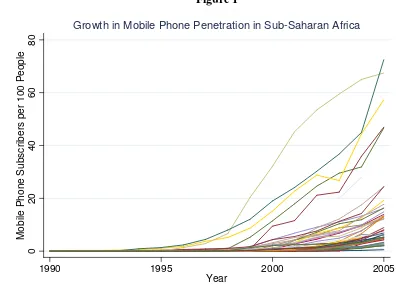
(ITU, 2007). The growth in mobile telephone subscriptions in sub-Saharan countries is shown in
Figure 1.
In the countries of sub-Saharan Africa, mobile telecommunications services emerged as
practical means of communication recently, relative to land-line telecommunications. Such
marked asymmetry in the deployment of mobile and land-line telephones2 in the region thus
requires the use of more efficient econometric corrections as the observations in the region
produces a panel data of both mobile and land-line telecommunication variables with only a few
time periods and a large number of sample countries. This study draws upon recent
developments in estimation methods such as a linear generalized method of moments (GMM)
estimator designed for fixed-effects as well as potentially endogenous regressors in situations
with small time periods and large individuals (Roodman, 2006).
To reiterate, this paper departs from the existing studies in the literature in the following
ways. First, we focus on the sub-Saharan countries - where cellular phones have expanded
quickly, while the number of land-lines has remained low - and investigate any causal links
between these two different types of phones and economic growth in the region. Second,
2
controlling for cellular and land-line phones separately, we attempt to examine the extent to
which the effect on economic growth of cellular phones is pronounced when countries have
relatively few land-lines. Third, for methodological improvement, this study employs the linear
generalized method of moments (GMM) estimator of Arellano-Bover (1995) and Blundell-Bond
(1998) that has become increasingly popular in situations where panel data is made up of few
time periods and large number of individuals.
The rest of this paper is organized as follows. In Section 2, we introduce a
macroeconomic growth model that accounts separately for the effects of cellular phones and
land-lines. In section 3 we explain the data and estimation procedure. We discuss the
econometric approach, a two-step difference generalized method of moments (GMM) estimator.
In section 4 we report the estimation results. We conclude with a discussion of the results and
their policy implications.
2. A Macroeconomic Growth Model
In this study we closely follow the cross-country growth framework of Datta and Agrwal
(2004), which was built upon Barro (1991) and Levine and Renelt (1992) as follows:
, GDPPCGR
GDPPCGR / i it
t i 1 t i t
i = − +X + +
where / =
t i
X [GDPPCit-1, TRADE/GDPit, GDI/GDPit, GC/GDPit, POPGRit, LANDPHONES100it, CELLPHONES100it,
LANDPHONES100itCELLPHONES100it],
and 0 ] [ E ] [ E ] [
In the above growth equation, i and it are the unobserved country-specific effects and
idiosyncratic shocks, respectively. GDPPC is GDP per capita, and GDPPCGR is the growth rate
of GDP per capita. Assuming a dynamic process in which the current value of the dependent
variable may be influenced by past ones, the lagged value of GDPPCGR is controlled for on the
right-hand side. As a standard measure to test for convergence, the lagged value of GDPPC is
also included. TRADE/GDP is a country’s trade volume as a share of its GDP and is a proxy for
the degree of openness of a country’s economy. POPGR is the growth rate of population and
GDI/GDP is gross domestic investment as a share of GDP. GC/GDP is a government
consumption expenditure for goods and services as a share of GDP. GC/GDP is included to
estimate the effect on economic growth of the proportion of government consumption
expenditure relative to GDP. As widely evidenced in the economic growth literature, negative
coefficients are expected for POPGR, the lagged values of GDPPCGR, and GDPPC while
positive coefficients for TRADE/GDP and GDI/GDP. LANDPHONES100 is the number of
main telephone lines per 100 people and serves as an indicator of the penetration of conventional
land-line telephony. Similarly, CELLPHONES100 is defined as the number of mobile phone
subscribers per 100 people. Both LANDPHONES100 and CELLPHONES100 are expected to be
positively correlated with economic growth. Lastly, we include an interaction term between
LANDPHONES100 and CELLPHONES100. The interaction term is included in order to allow
the marginal impact of cellular phones to vary with the level of land-lines that are already in
place. In a region like sub-Saharan Africa where cellular phone penetration far exceeds that of
land-lines, a negative coefficient is expected. This implies that the impact on economic growth of
mobile telecommunications is more pronounced when the penetration of land-lines is relatively
3. The Data and Estimation Procedure
Examining the relationship between the telecommunications infrastructure investments
and economic growth, this study focuses on 44 sub-Saharan countries as marked asymmetry has
been witnessed between the conventional land-line penetration and mobile phone service
expansion in the region. All the data are from the World Development Indicators 2008 of the
World Bank. The data cover 44 sub-Saharan countries over the years 1975-2006. The sample
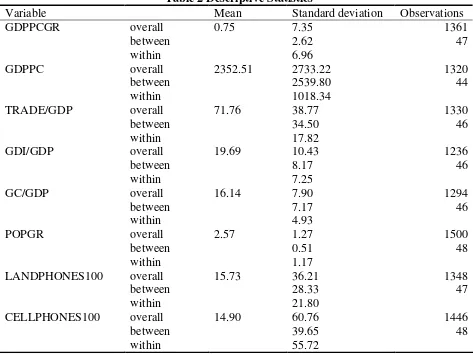
countries in the sub-Saharan Africa are listed in Table 1 and the descriptive statistics of the panel
data used in this study are summarized in Table 2.
An issue of the uttermost pertinence is whether there is a causal relationship between
telecommunications infrastructure and economic growth. Although many early-cited time-series
studies of causality found evidence of a one-way or two-way causation between
telecommunications investment and economic growth, such evidence does not necessarily imply
that a change in telecommunications investment will cause a subsequent change in the rate of
economic growth and vice versa. Some studies attempted to identify a causal link by controlling
for either the initial year's stock of land-line phones (Norton, 1992) or the previous year's
teledensity as a proxy for telecommunications investment (Datta and Agarwal, 2004).
In order to address the issue of reverse-causality, this study uses the two-step difference
generalized method of moments (GMM) estimator of Arellano-Bover (1995)/Blundell-Bond
(1998). The Arellano-Bover (1995)/Blundell-Bond (1998) difference GMM estimator allows the
modification of several key assumptions of panel data approach.3 First, the estimator is designed
3
to accommodate not only (potentially) endogenous independent variables but also independent
variables that are not strictly exogenous. In fact, this study assumes that all telecommunications
variables are potentially endogenous, meaning that higher economic growth can be the result of
higher telecommunications infrastructure investments and vice versa. In the Arellano-Bover
(1995)/Blundell-Bond (1998) difference GMM estimator, (potentially) endogenous independent
variables are treated as follows. Applying the first-difference transform to the previous
cross-country growth framework, we obtain
. GDPPCGR
GDPPCGRit = it 1+ i/t + it
− X
Let xjit, the j-th variable in X, be an endogenous regressor. While the first-difference purges out the fixed-effects, xjit in xjit=xjit–xji t-1 still correlates with it in it= it- i t-1. To work around this
dynamic panel bias, the Arellano-Bover (1995)/Blundell-Bond (1998) two-step difference GMM
estimator instruments levels with differences. Thus, for an endogenous variable xjit, xji t-2 can be
used as an instrument if it is not serially correlated of order 1 since xji t-2=xji t-2-xji t-3 is not
correlated with it= it- i t-1. If, however, it is serially correlated of order 1, xji t-2 is no longer
a valid instrument and thus a proper instrument needs to be restricted to the third lagged values
or more ( xji t-s for s 3). In this study, we assume that telecommunications variables are
potentially endogenous and thus valid instruments are determined according to the
Arellano-Bond (1991) test for autocorrelation.
Furthermore, this study differs from the previous studies in the literature that typically
impose the assumption of strict exogeneity on other independent variables such as the growth
rate of population, gross domestic investment, and gross government consumption expenditure.
Instead this study assumes that those commonly-assumed-to-be-exogenous independent variables
may not be strictly exogenous. Then E[xit is] 0 for s<t while E[xit is]=0 for s t (Stata, 2005). For
instance, the error term i t-1 might have some impact on the subsequent realization of xkit but not
vice versa. Thus, following the standard treatment in the Arellano-Bover (1995)/Blundell-Bond
(1998) difference GMM estimator, we use xki t-1= xki t-1- xki t-2 as instruments since xki t-1 in xki
t-1= xki t-1- xki t-2 is potentially correlated only with errors i t-s for s 2, but not with it= it- i t-1.
4. Estimation Results
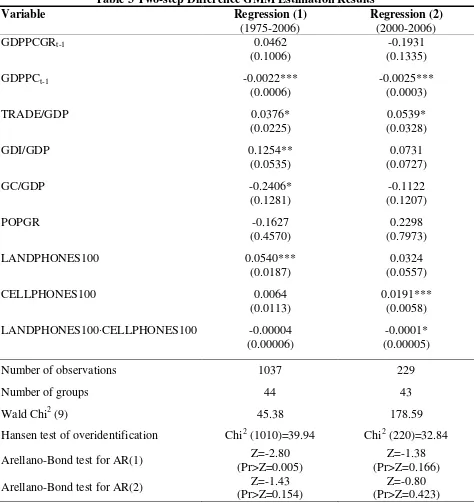
Table 3 reports two sets of the Arellano-Bover (1995)/Blundell-Bond (1998) two-step
difference GMM dynamic panel data estimation results. Although the panel data in use was
constructed for 1975-2006, as an asymmetric pattern in growth between the conventional
land-line penetration and mobile phone service expansion has become most conspicuous in the 2000s,
we estimated the cross-country economic growth model for the entire observation period of
1975-2006 and for the cropped data from 2000 to 2006, respectively.
As a principal issue of this study, we first focus on the estimation results of the
telecommunications variables. In Regression (1) for the observations from 1975 to 2006, the
Arellano-Bond autocorrelation test statistic indicates that there is a first-order autocorrelation in
the idiosyncratic error term ( it). Thus, following the standard treatment in the Arellano-Bover
(1995)/Blundell-Bond (1998) difference GMM estimator, we instrumented the third lagged
values of all potentially endogenous telecommunications variables. Among the
telecommunications variables, LANDPHONES100 (the number of main telephone lines per 100
persons) is positively correlated with the growth rate of GDP per capita and the estimated
coefficient is statistically significant. The estimated coefficient of CELLPHONES100 (the
insignificant. This finding, as Regression (2) will show, is attributable to the fact that differences
in the number of cellular phones were miniscule in much of the rest of the world, and especially
in the sub-Saharan Africa, before the turn of the millennium. It appears that the impact of these
small, seemingly random, changes in the telecomm variables were overwhelmed by the more
powerful forces at work in the region such as the amount of gross domestic investment as a share
of GDP (GDI/GDPP), the degree of openness of a country’s economy (TRADE/GDP), and large
presence of the government expenditure relative to a country's GDP (GC/GDP).
In contrast to Regression (1), the Arellano-Bond test for AR(1) in Regression (2) suggests
that we do not reject the null hypothesis of no first-order autocorrelation in the first-differenced
residuals, validating the second lagged values of all telecommunications variables as the
instruments. The estimated coefficients and statistical significance of LANDPHONES100 and
CELLPHONES100 in Regression (2) suggest quite different evidence. When the same empirical
specification is estimated using a cropped panel data from 2000 to 2006, land-line telephone
penetration no longer has a significant impact on economic growth and its estimated coefficient
is much smaller than in Regression (1). On the other hand, cellular phone penetration appears to
have more evident impact on economic growth, both economically and statistically. The
estimated coefficient of CELLPHONES100 in Regression (2) is much larger than one in
Regression (1). This finding is consistent with the fact that cellular phone technology is less
capital-intensive than land-line telecommunications, and thus its direct impact on economic
growth has become more significant in the 2000s as the deployment of the mobile
telecommunications infrastructure is relatively easy to fund. Furthermore, the indirect benefits of
cellular phone penetration to economic growth could be quite substantial as it has recently
competitive cellular telecommunications markets in the region (ITU, 2007). Another interesting
finding is that the impact on economic growth of mobile telephone penetration is more
pronounced when land-line telephone expansion is low. The negative coefficient of the
interaction term confirms the finding.
Among other determinants of economic growth, the coefficient of lagged GDP per capita
is negative and significant at the 1% significance level in both regressions, supporting the
convergence hypothesis that GDP per capita tends to grow at a slow rate in countries with higher
level of GDP per capita. The share of trade in GDP (TRADE/GDP) as a proxy for the level of
openness of a country’s economy is positively correlated with the growth rate of GDP per capita
and its coefficient is significant at the 10% level in both regressions. The results indicate that
countries with greater global interaction achieve higher growth rate of GDP per capita. The
coefficient of gross domestic investment as a share of GDP (GDI/GDP) is positive and
significant at the 5% level in Regression (1), but insignificant in Regression (2). The impact on
economic growth of the share of gross domestic investment in GDP appears to be insignificant as
the sample data is cropped to 2000-2006 time periods. Compared to other regions in the world,
the countries in the sub-Sahara region have long experienced the lack of capital for domestic
investment. The estimated coefficient of the share of government consumption expenditure in
GDP (GC/GDP) is negative and significant at the 10% level in Regression (1), but insignificant
in Regression (2), suggesting that the government consumption expenditure is no longer a
population (POPGR) does not appear to have a significant association with the growth rate of
GDP per capita in either regression.4
5. Conclusions and Policy Implications
Traditionally, development economists paid much attention to the usefulness of
infrastructure as proper roads and electrical grids are considered a prerequisite to strong
economic growth. After all, one must be able to produce the goods and bring them to the market.
Since Hardy's seminal paper (1980), development economists have broadened their view to
include telecommunications infrastructure among the variables conducive to growth. The
efficiency of a market, and thus its rate of growth, depends upon the minimization of trading
costs, including those associated with the use of, and knowledge of, the relevant market prices.
Where should an African fisherman sell his fish today, up-coast or in-land? Growth rates in
average incomes in Africa, and everywhere, depend crucially upon whether people have access
to such information.
The most recent development studies have treated all phones - cellular and land-line
phones - as equal, as they both serve to connect people to market information. But cellular
phones are different in several important aspects. First, the up-front infrastructure costs are
substantially different. Cellular phones are significantly less costly to install, as opposed to
stringing together physical telephone wires. So, a dollar invested in cellular phone infrastructure
yields many more phones, and much more information, than a dollar invested in land-lines.
4
As is standard in GMM estimation, the joint validity of the instruments is tested. The Hansen test of
Second, cellular phones are portable, so remote villagers can use them, and just as importantly,
they can use them while en route to markets.
Our paper differs from others in that we treat cellular phones and land-line phones as
separate, though not completely dissimilar technologies. More importantly, we explicitly model
the degree of substitutability between cellular phones and land-line phones by including an
interaction term. This allows the marginal contributions of cellular phones on growth to vary
with the level of land-line phones already in place.
Our final improvement is methodological. Previous studies have focused on the potential
endogeneity of telecommunications and GDP growth along Granger-causal lines. But this is
done at the cost of having to treat all other variables as strictly exogenous. We, on the other hand,
allow for our variables not to be strictly exogenous, by employing the Arellano-Bover (1995)
and Blundell-Bond (1998) GMM estimator.
We find the current importance of traditional land-line phones for economic growth to be
negligible in the sub-Saharan region. On the other hand, the contribution of cellular phones to
economic growth has been growing in importance. While it is obvious that cellular phone use has
been growing, we document that the impact itself of a single cellular phone has also been
growing. Moreover, we find that the marginal impact of cellular phones is greater wherever
land-line phones are rare. Combining these two results with the fact that cellular phone infrastructure
is comparatively cheap, and the policy implication is clear – more cellular phone infrastructure
should be encouraged in the sub-Saharan region, as it is the more cost-effective and beneficial
Figure 1 0 2 0 4 0 6 0 8 0 M o b ile P h o n e S u b s c ri b e rs p e r 1 0 0 P e o p le
1990 1995 2000 2005
Year
Growth in Mobile Phone Penetration in Sub-Saharan Africa
Table 1 List of the Sample Countries
Angola Congo (Rep.) Lesotho Senegal
Benin Cote d'Ivoire Madagascar Seychelles
Botswana Equatorial Guinea Malawi Sierra Leone
Burkina Faso Eritrea Mali South Africa
Burundi Ethiopia Mauritania Sudan
Cameroon Gabon Mauritius Swaziland
Cape Verde Gambia Mozambique Tanzania
Central African Rep. Ghana Namibia Togo
Chad Guinea Niger Uganda
Comoros Guinea-Bissau Nigeria Zambia
[image:16.612.65.546.447.606.2]Table 2 Descriptive Statistics
Variable Mean Standard deviation Observations
GDPPCGR overall 0.75 7.35 1361
between 2.62 47
within 6.96
GDPPC overall 2352.51 2733.22 1320
between 2539.80 44
within 1018.34
TRADE/GDP overall 71.76 38.77 1330
between 34.50 46
within 17.82
GDI/GDP overall 19.69 10.43 1236
between 8.17 46
within 7.25
GC/GDP overall 16.14 7.90 1294
between 7.17 46
within 4.93
POPGR overall 2.57 1.27 1500
between 0.51 48
within 1.17
LANDPHONES100 overall 15.73 36.21 1348
between 28.33 47
within 21.80
CELLPHONES100 overall 14.90 60.76 1446
between 39.65 48
Table 3 Two-step Difference GMM Estimation Results
Variable Regression (1)
(1975-2006)
Regression (2) (2000-2006)
GDPPCGRt-1 0.0462
(0.1006)
-0.1931 (0.1335)
GDPPCt-1 -0.0022***
(0.0006)
-0.0025*** (0.0003)
TRADE/GDP 0.0376*
(0.0225)
0.0539* (0.0328)
GDI/GDP 0.1254**
(0.0535)
0.0731 (0.0727)
GC/GDP -0.2406*
(0.1281)
-0.1122 (0.1207)
POPGR -0.1627
(0.4570)
0.2298 (0.7973)
LANDPHONES100 0.0540***
(0.0187)
0.0324 (0.0557)
CELLPHONES100 0.0064
(0.0113)
0.0191*** (0.0058)
LANDPHONES100 CELLPHONES100 -0.00004
(0.00006)
-0.0001* (0.00005)
Number of observations 1037 229
Number of groups 44 43
Wald Chi2 (9) 45.38 178.59
Hansen test of overidentification Chi2 (1010)=39.94 Chi2 (220)=32.84
Arellano-Bond test for AR(1) Z=-2.80
(Pr>Z=0.005)
Z=-1.38 (Pr>Z=0.166)
Arellano-Bond test for AR(2) Z=-1.43
(Pr>Z=0.154)
Z=-0.80 (Pr>Z=0.423) Windmeijer finite-sample corrected standard errors are reported in parentheses.
References
Antonelli, C. (1991) The Diffusion of Advanced Technologies in Developing Countries, Organization for Economic Cooperation and Development, Paris.
Arellano, M. and S. Bond (1991) "Some Tests of Specification for Panel Data: Monte Carlo Evidence and an Application to Employment Equations," Review of Economic Studies, Vol.58, No.2, 277-297.
Arellano, M. and O. Bover (1995) "Another Look at the Instrumental Variables Estimation of Error-Components Models," Journal of Econometrics, Vol.68, No.1, 29-51.
Barro, R. (1991) "Economic Growth in a Cross Section of Countries," Quarterly Journal of Economics, Vol.106, No.2, 407-443.
Beil, R., G. Ford, and J. Jackson (2005) "On the Relationship between Telecommunications Investment and Economic Growth in the United States," International Economic Journal, Vol.19, No.1, 3-9.
Blundell, R. and S. Bond (1998) "Initial Conditions and Moment Restrictions in Dynamic Panel Data Models," Journal of Econometrics, Vol.87, No.1, 115-143.
Cronin, F., E. Colleran, P. Herbert, and S. Lewitzky (1993a) "Telecommunications and Economic Growth: The Contribution of Telecommunications Infrastructure Investment to Aggregate and Sectoral Productivity," Telecommunications Policy, Vol.17, No.9, 677-690.
Cronin, F., E. Parker, E. Colleran, and M. Gold (1991) "Telecommunications Infrastructure and Economic Growth: An Analysis of Causality," Telecommunications Policy, Vol.15, No.6, 529-535.
Cronin, F., E. Parker, E. Colleran, and M. Gold (1993b) "Telecommunications Infrastructure Investment and Economic Development," Telecommunications Policy, Vol.17, No.6, 415-430.
Datta, A. and S. Agarwal (2004) "Telecommunications and Economic Growth: A Panel Data Approach," Applied Economics, Vol.36, No.15, 1649-1654.
Dutta, A. (2001) "Telecommunications and Economic Activity: An Analysis of Granger Causality," Journal of Management Information System, Vol.17, No.4, 71-95.
Greenstein, S. and P. Spiller (1995) "Modern telecommunications Infrastructure and Economic Activity: An Empirical Investigation," Industrial and Corporate Change, Vol.4, No.4, 647-665.
Hardy, A. (1980) "The Role of the Telephone in Economic Development," Telecommunications Policy, Vol.4, No.4, 278-286.
International Telecommunication Union (2007) Telecommunication/ICT Markets and Trends in Africa, Geneva, Switzerland.
Islam, N. (1995) "Growth Empirics: A Panel Data Approach," Quarterly Journal of Economics, Vol.110, No.4, 1127-1170.
Leff, N. (1984) "Externalities, Information Costs, and Social Benefit-Cost Analysis for
Economic Development: An Example from Telecommunications," Economic Development and Cultural Change, Vol.32, No.2, 255-276.
Levine, R. and D. Renelt (1992) "A Sensitivity Analysis of Cross-Country Growth Regressions," American Economic Review, Vol.82, No. 4, 942-963.
Madden, G. and S. Savage (2000) "Telecommunications and Economic Growth," International Journal of Social Economics, Vol.27, No.7, 893-906.
Mankiw, N., D. Romer, and D. Weil (1992) "A Contribution to the Empirics of Economic Growth," Quarterly Journal of Economics, Vol.107, No.2, 407-437.
Norton, S. (1992) "Transaction Costs, Telecommunications, and the Microeconomics of
Macroeconomic Growth," Economic Development and Cultural Change, Vol.41, No.1, 175-196.
Perkins, P., J. Fedderke, and J. Luiz (2005) "An Analysis of Economic Infrastructure Investment in South Africa," South African Journal of Economics, Vol.73, No.2, 211-228.
Pesaran, M., Y. Shin, and R. Smith (2001) "Bounds testing Approaches to the Analysis of Level Relationships," Journal of Applied Econometrics, Vol.16, No.3, 289-326.
Roodman, D. (2006) "How to Do xtabond2: An Introduction to Difference and System GMM in Stata," Working Paper 103, Center for Global Development, Washington, D.C.
Stata (2005) Longitudinal/Panel Data: Reference Manual Release 9, A Stata Press Publication, College Station, Texas.
Röller, L. and L. Waverman (2001) "Telecommunications Infrastructure and Economic
Development: A Simultaneous Approach," American Economic Review, Vol.91, No.4, 909-923.