Data Transmission Strategies for Event Reporting and Continuous Monitoring
Applications in Wireless Sensor Networks
Israel Leyva-Mayorga, Mario E. Rivero-Angeles∗, Claudia C. Gutierrez-Torres, Jose A. Jimenez-Bernal†,
Rams´es Rodr´ıguez‡and Alma Torres-Rivera§ ∗UPIITA/ESCOM
National Polytechnique Institute, Mexico City, Mexico E-Mail: [email protected], [email protected] †LABINTHAP SEPI ESIME Zacatenco, Mexico City, Mexico
Email: [email protected], [email protected] ‡SEPI ESIA-UZ, Mexico City, Mexico
Email: [email protected] §SEPI, Mexico City, Mexico Email: [email protected]
Abstract—Wireless Sensor Networks (WSNs) can be typi-cally used to achieve Continuous Monitoring (CM) or Event-Detection inside the supervised area. In CM applications each sensor node transmits periodically its sensed data to the sink node while in Event-Detection Driven (EDD) applications, once an event occurs, it is reported to the sink node by the sensors within the event area. Applications using both continuous monitoring and event driven reporting can also be considered. In this paper, we investigate such hybrid WSNs. Specifically, we propose two different strategies that explicitly assign a time period for the event reporting data by means of the NP-CSMA random access protocol. Both strategies take advantage of the clustered based architecture which assign a TDMA schedule for the continuous monitoring data transmission. By doing so, the continuous monitoring clusters are also used for the event reporting. Hence, no extra energy is consumed for separate event clusters. The performance of these strategies is analyzed for low and high event rate occurrence. These strategies are compared to both continuous monitoring protocols (such as LEACH) and event driven reporting protocols (such as TEEN).
Keywords-Wireless sensor networks, clustering, event detec-tion, continuous monitoring.
I. INTRODUCTION
Wireless Sensor Networks (WSNs) are typically designed for either continuous monitoring (CM) or event-detection driven (EDD) applications. EDD WSNs are deployed over a target area to supervise certain phenomena of interest. Once an event occurs, it is reported to the sink node by the sensors within the event area. Each node takes readings from the local environment, processes and transmits the sensed data to the sink node. In this type of WSNs, communications are only triggered by the occurrence of a pre-specified type of events. As opposed to EDD applications, CM WSNs are deployed in order to examine the evolution of certain parameters, which are refreshed periodically at the sink
node. Applications where both CM and EDD are required have been largely overlooked.
To illustrate these applications, let us consider the fol-lowing network to be applied in a sustainable habitat de-signed for a research project (SIP-20120107) at the National Polytechnique Institute in Mexico City. In this project it is required an EDD WSN for temperature control where the sensor nodes are configured to report only alarms when the sensed temperature exceeds a pre-specified threshold. This is because beyond this temperature, the system is considered to be uncomfortable or even dangerous. On the other hand, a CM WSN is also implemented where the sensor nodes are configured to transmit the sensed temperature periodically, i.e., eachdseconds, regardless of the registered temperature values. As such, with EDD WSNs, the end user does not need and can not know the exact temperature in the area of interest at any time. The end user only cares that the current temperature in the supervised area does not exceed a certain threshold. In contrast, with CM WSNs, the end user requires all the time to be aware of the current temperature in the supervised region. It is then required that the end user knows both the evolution of the temperature and also have a fire alarm detection system.
minimizing the energy consumption of the sensor nodes is an important design objective in WSNs in order to extend the network lifetime to acceptable levels. To achieve this, we propose two strategies for the event reporting using a Time Division Multiple Access (TDMA) protocol in a clustered based architecture. Both strategies are based on assigning an specific period for the event related data through the already formatted clusters for the continuous monitoring applications. As such, there is no extra energy drain for the formation of separate clusters for the event reporting. In this study, we show that by assigning this event driven period, the performance of the network, in terms of energy consumed, is improved compared to other protocols that are specifically design either for continuous monitoring only or event driven reporting only applications.
For both strategies, the LEACH algorithm [3] is used for the continuous monitoring data transmission. Also, both strategies consider the transmission of the event related data using the Non Persistent Carrier Sense Multiple Access (NP-CSMA) random access protocol. In the first proposed strategy, the nodes inside the event area report their data at the end of the continuous monitoring transmissions. The second strategy considers the transmission of event related data at the beginning of each TDMA slot assigned to each cluster member for continuous monitoring transmissions.
To evaluate the gain introduced by our event-aware clus-tering scheme, we compare the energy consumption of both proposals to the following two networks. The LEACH algorithm where additional TDMA time slots are assigned for the event reporting data. And the TEEN protocol [5], which is designed mainly for EDD reporting, where con-tinuous monitoring transmissions are also considered. The mechanisms are evaluated for low and high event rate occurrence. As it is shown and unlike other works, the proposed strategies are suitable for any event rate. Hence, it represents a general solution for applications where CM and EDD data are required.
The rest of the paper is organized as follows: Section II reviews the previous works related to clustered-based WSNs. Then, section III specifies the system model and assumptions, including the random access protocol. Section IV describes the proposedevent period assignmentconcept used to increase the network’s life time. Simulations have been performed in order to evaluate the proposed mechanism in section V. The article concludes with a summary of our conclusions and contributions.
II. RELATEDWORK
The problem of clustering has been addressed before in WSNs in order to reduce or eliminate three sources of energy wastage: collisions, overhearing (when a node receives an unintended packet), and idle listening (lost energy while listening to the medium to receive possible traffic that is not
sent) [2]. A scheduled MAC protocol, such as in the cluster-based architectures, addresses all of these issues inherently since it coordinates transmission among sensor nodes. Once the clusters are formed, each node will be assigned an exclusive time slot, preventing thus collisions. Moreover, since each node knows when to transmit, it does not need to be awake during the complete TDMA frame but only at its specific time slot. As such, there is neither overhearing nor idle listening. However, these benefits compared to the basic unscheduled model come at the cost of coordination message overhead during the cluster formation phase. In this work, we consider a clustered WSN for both continuous monitoring and event reporting data.
Two well known clustering protocols are LEACH [3] and HEED [4]. The objective of LEACH is to achieve a balanced energy consumption inside the network. This is done by rotating the Cluster Head (CH) role among all sensor nodes. CHs are selected in a fully distributed manner, without needing the exchange of signaling messages for the CH announcement. The local decision to become a CH takes into account when the node served as a CH for the last time. As such, a sensor node that has not been a CH for a long period is more likely to become a CH in the next round. On the other hand, the HEED protocol aims to achieve a better distribution of the CHs in the WSN. This is done at the cost of more complexity and increased overhead compared to LEACH, which does not guarantee a good distribution of the CHs inside the WSN. The main difference between our work and the protocols presented in [3] and [4] is that these works do not consider explicitly the data report of both continuous monitoring and event data. As such, the main mechanism presented in this paper aims to reduce the energy consumption in the network by assigning an specific period for the event reporting transmission in such a way as to use the cluseters already stablished for the continuous monitoring data transmission. In this work we consider the LEACH protocol as the basic cluster protocol because it is much simpler than the HEED protocol. Also, the energy consumed by the proposed mechanisms is independent of the basic clustering protocol. Hence, this mechanism can be easily implemented in any other clustering protocol, including HEED.
our work presents a basic framework for the data handling in such networks.
Finally, in [7], the concept of anevent clusteris presented. The basic idea is to form a separate cluster where the cluster members are the nodes inside event area. By doing this, the compression algorithm used [8] takes advantage of the spacial correlation of the event data in order to increase the compression ratio. However, this protocol is only suited for applications where the event rate (number of events per unit of time) is low, since the separate cluster formation consumes an important amount of energy. Also, it is only suited for single events, i.e., only one event can occur in the supervised area since multiple events generate a high collision probability in the separate cluster formation procedure. As opposed to [7], the proposed strategies in our work focuses on general event rates and number of events in the network. Since the occurrence of events in the system do not entails separate clusters, no extra energy is consumed when an event is detected. This is done by taking advantage of the already formed clusters for the continuous monitoring data transmission. As such, these proposed strategies can be used for any system’s conditions. Also, the proposed strategies presented in this work can be benefited by the introduction of compression algorithms, such as the one presented in [8] which is considered for future work.
III. NETWORKPARAMETERS ANDASSUMPTIONS
In this section, the main network parameters and assump-tions considered throughout the paper are shown. Also the random access protocol used at the set-up phase for all the clustering protocols is described.
A. Random Access Protocol
In this paper, the NP-CSMA technique is used at the cluster formation phase. The basic idea is that a sensor node listens to the medium before transmission. If the medium is sensed idle, the node starts transmission. Otherwise, the node draws a random waiting time (backoff period) before attempting to transmit again. During this time, the sensor does not care about the state of the medium. Whenever a collision occurs, sensor nodes must retransmit their packet according to a uniform backoff (UB) policy. As such, when a node enters to the backoff state, it draws a uniform value in the range [0,w] which corresponds to the backoff counter (expressed in terms of time slots). This counter is decre-mented each time slot duration until it reaches zero. at this point, the node attempts a retransmission. For the continuous monitoring application, all sensor nodes in the supervised area transmit f1data packets per second using the LEACH protocol described in this section. The LEACH protocol [3] groups sensors into clusters in order to conserve energy. To balance the energy consumption inside the network, the CH role is rotated among all sensor nodes. CHs are selected in a fully distributed manner, without needing the exchange
of signaling messages, which are required, however, for the CH announcement. The local decision to become a CH takes into account when the node served as a CH for the last time. As such, a sensor node that has not been a CH for a long period is more likely to become a CH in the next round. Each sensor node selected as a CH, transmits an accepting message to the remaining sensor nodes. Cluster members (ClMs) that receive multiple CH announcements select the CH that requires the lowest energy for communication by sending a cluster join message. Once a CH received all the ClM announcements, it computes its schedule and assigns time slots to the different ClMs. Hence, a TDMA frame shared among ClMs is formed. Each ClM can enter the sleep mode during the TDMA frame and wakes up only at its associated slots. Conversely, the CH never enters the sleep mode and at the end of each TDMA frame it transmits the compressed data to the sink node.
The LEACH operation is composed therefore of two phases: set-up and steady state phases. While the set-up phase refers to cluster formation, the steady phase corre-sponds to the TDMA operation. The duration of the steady phase is fixed by the network administrator. It is generally preferred that the steady phase lasts much longer than the set-up phase in order to limit the energy consumption due to coordination message overhead. However, rotation of the CH role among the sensor nodes is needed to balance the energy consumption inside the WSN. As satiated before, the data reporting due to the occurrence of an event is transmitted using the cluster-based architecture of LEACH and is explained in detail in the following section.
B. Network Model
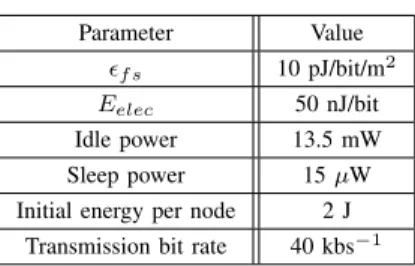
The following assumptions and system parameters are considered: The total number of sensor nodes in the system is N = 100. Sensor nodes are uniformly distributed in an area between (0,0) and (100,100) meters (i.e., square
Table I PARAMETERSSETTING
Parameter Value
fs 10 pJ/bit/m2
Eelec 50 nJ/bit Idle power 13.5 mW Sleep power 15μW Initial energy per node 2 J
Transmission bit rate 40 kbs−1
of the packetland the distance between the transmitter and receiver nodesd. Specifically:
Etx(l, d) =l×Eelec+l×fs×d2 (1)
whereEelecis the electronics energy,fs×d2is the amplifier energies that depends on the distance to the receiver. The energy to receive a packet depends only on the packet size, then:
Erx(l) =l×Eelec (2)
Each CH dissipates energy in receiving and transmitting the signals received from the ClMs. Unlike [3], the CHs do not perform ideal data aggregation. The steady state phase is considered to be of 20 seconds. The backoff window is considered to be w = 15 time slots. The rest of the parameters are listed in Table I.
IV. PROPOSEDPROTOCOLS FOREVENTREPORTING AND
CONTINUOUSMONITORING
In this section, the two proposals for the event reporting and continuous monitoring data are described in detail. The main idea of both proposals is to take advantage of the clustered architecture established for the continuous monitoring transmissions in order to also transmit data of possible events. By doing so, there is no need to form different clusters for the event reporting as it is done in [7]. As it is shown in [7], the extra energy consumed in order to formevent clusters(clusters specifically formed in order to transmit event data reporting) can lead to an excessive energy drain specially when events occur with a high rate even if data compression is enabled.
By using the already formed clusters for both the con-tinuous monitoring and event driven data transmission, the network’s life time is extended as oppose to using a separate protocol for each application, for instance, LEACH for continuous monitoring data and TEEN for event driven reporting. Indeed, the event reporting of the nodes inside the event area by means of the NP-CSMA random access protocol, avoids the extra energy consumption drained for separate clusters or multi hop transmissions in case of a non-clustered architecture. As mentioned earlier, the LEACH protocol is considered as the protocol for the continuous
Figure 1. Proposal 1 for CM and EDD applications
monitoring data transmission. In the following, the two proposals for the event reporting are described in detail.
A. Proposal 1
Figure 2. Proposal 2 for CM and EDD applications
B. Proposal 2
As in the previous strategy, the clusters formed by the LEACH protocol are also used for the event reporting. However, the difference consists basically in that the event reporting is performed at each TDMA slot in the steady phase. Specifically, at the beginning of each TDMA slot, the nodes inside the event area transmit their data to their respective CHs using the RA protocol. Then the nodes in their continuos monitoring activities transmit their packet in a collision-free manner. By doing this, the nodes reporting the event data do not have to wait until the end of theCM pe-riod. However, if there are many nodes that sensed the event in a given cluster, it is possible that the collision probability is high, in which case, the nodes have to retransmit in further time slots. This is explained in Fig. 2.
V. SIMULATIONRESULTS
In this section, we evaluate the efficiency of our proposed mechanisms for event reporting in continuous monitoring WSNs. We study the gain introduced by using the different proposals compared to LEACH and TEEN for similar event rates in order to have a fair comparison. Since LEACH is mainly used for continuous monitoring applications and TEEN is manly used for event driven reporting, it is shown in this section that the proposed strategies outperform these protocols when both continuous monitoring and event re-porting are present in the same network. For all results presented in this section, the WSNs system was implemented as a discrete event simulation. Also, it is considered that events occur uniformly in the complete supervised area. Hence, all nodes in the network have the same probability of detecting a given event. It is assumed that there are 100 nodes in the network
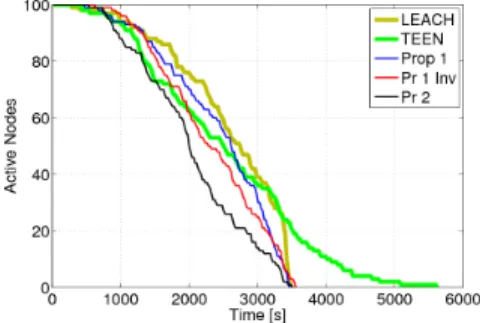
First, the system performance is studied for a high event rate generation in the system. Figures 3 and 4 show the network life time and total energy consumption in the network per second respectively for an event rate of 22.5 events per second in the supervise area. As mentioned earlier, the proposed strategies are compared to LEACH and TEEN for the transmission of continuous monitoring and event reporting data. Specifically, LEACH allows the formation of 5 clusters (5% of the nodes becomes CHs in each cluster formation phase). Since there are 100 nodes in the network, then, there are in average 19 cluster members
Figure 3. Network lifetime for high event generation rate
Figure 4. Energy consumption for high event generation rate
per cluster. Hence, considering the event rate of 22.5, it can be considered that in average, each node in the cluster reports an event. As such, there are 40 transmissions per cluster. Then, the CH schedules 45 time slots in the TDMA structure in order to accommodate all possible transmissions. Conversely, since TEEN does not have a structure for the continuous monitoring transmission, and in order to have a fair comparison in terms of the number of transmissions per second in the system, it is consider a transmission rate of 45 events per second (20 transmissions correspond to the continuous monitoring information and 25 transmissions correspond to the event reporting). As for the proposed strategies, there are also 20 continuous monitoring transmis-sions and 22.5 event reporting transmistransmis-sions in the respective transmissions:CM andEV respectively.
From these results, it can be seen that LEACH and TEEN have a very similar behavior. In this case, the ED periods of the proposed mechanisms experience a high collision probability which leads to a higher energy drain. Note that LEACH has a very good behavior since all transmissions are well scheduled and there are no retransmissions due to collisions. TEEN on the other hand consumes a high amount of energy at the beginning of the system operation but as time goes by, there are less nodes colliding among each other, which extends the life of the protocol at the end of the simulation.
Figure 5. Network lifetime for low event generation rate
Figure 6. Energy consumption for low event generation rate
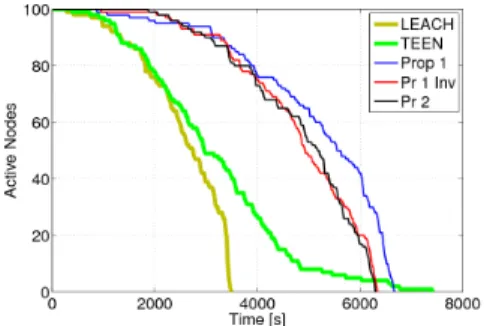
rate of 0.2 events per second in the supervise area with can be considered as a low event generation rate. Again, there are in average 19 cluster members per cluster and 5 clusters in the supervised area. Hence, considering the event rate of 0.2 events per second, it considers that in average, less than a node in the cluster reports an event. As such, there are 20 transmissions per cluster. Then, the CH schedules 20 time slots in the TDMA structure in order to accommodate all possible transmissions. Conversely, since TEEN does not have a structure for the continuous monitoring transmission, and in order to have a fair comparison in terms of the number of transmissions per second in the system, it considers a transmission rate of 23 events per second (20 transmissions correspond to the continuous monitoring information and 3 transmissions correspond to the event reporting). As for the proposed strategies, there are also 20 continuous monitoring transmissions and 3 event reporting transmissions in the respective transmissions:CM andEV respectively.
From these results, it is clear that the proposed strategies achieve a longer life time compared to LEACH and TEEN in the same conditions. Furthermore, Proposal 1 achieves slightly better results. This is because both proposals con-sider a separate time interval for the transmission of the event reports by means of a random access protocol. Since the event rate is low, the collision probability is not high. Hence, the energy consumption due to retransmissions is kept also low. LEACH on the other hand, assigns a particular number of time slots for the event reporting. As such, the
CHs listen to many time slots that are not used, due to the low event rate. Finally, TEEN consumes more energy since the continuous monitoring data is transmitted using the random access protocol, which is not suited for this type op applications due to the high collision probability.
VI. CONCLUSION
In this work, a WSN with both continuous monitoring and event reporting capabilities is considered. While continuous monitoring is performed using the well known LEACH protocol, event reporting is achieved through the assignment of special time periods where event reporting are based on NP-CSMA with uniform backoff. The benefits of such assignment have been studied.
Using a discrete simulation tool, a number of experiments were performed in order to evaluate the characteristics of the aforementioned systems for low and high event rates. Through these experiments, the potential performance gains of applying the proposed strategies have been quantified. It has been verified that the use of the random access protocol for the event reporting can improve the life time of the system compared to LEACH where all transmissions are achieved using the TDMA structure (an many slots are unoccupied in case of a low event reporting rate) or TEEN where also the continuous monitoring data transmissions use the random access protocol.
It is worth noting that the proposed strategies perform bet-ter for a low event rate generation. However, for high event rates, these mechanisms have a comparable performance to the LEACH and TEEN protocols. Also, these strategies are studied only for the energy consumption performance but the delay and reporting accuracy issues are still an open research topic for future works.
ACKNOWLEDGMENT
This work was partially founded by proyect IPN-SIP-20120107
REFERENCES
[1] I. Akiyldiz, W. Su, Y. Sankarasubramaniam and E. Cayirci,A survey on sensor networks, IEEE Communications Magazine, Vol. 40, Issue 8, pp. 102–114, August 2002.
[2] K. Kredo II, P. Mohapatra,Medium access control in wireless sensor networks, Computer Networks, Volume 51, Issue 4, 14, pp. 961–994, March 2007.
[3] W. B. Heinzelman, A. P. Chandrakasan, H. Balakrishnan, An application-specific protocol architecture for wireless mi-crosensor networks, IEEE Transactions on Wireless Commu-nication, vol. 1, no. 4, pp. 660–670, Oct. 2002.
[5] Arati Manjeshwar y Dharma P. Agrawal, TEEN: A Routing Protocol for Enhanced Efficiency in Wireless Sensor Networks, In Proc. IEEE 15th International Parallel and Distributed Processing Symposium, 2002, pp. 2009-2015, Apr. 2002.
[6] Haining Shu y Qilian Liang,Fundamental Performance Anal-ysis of Event Detection in Wireless Sensor Networks,In Proc. IEEE Wireless Communications and Networking Conference (WCNC), pp. 2187-2192 Apr. 2006.
[7] M. Rivero-Angeles, N. Boubdallah, Event reporting on con-tinuous monitoring wireless sensor networks, In Proc. IEEE GlobeCom 2009, Honolulu, Hawaii, Dic. 2009.