Tyrosinemia type I:
clinical and biochemical analysis of patients in Mexico
Cynthia Fernández-Lainez,* Isabel Ibarra-González,** Leticia Belmont-Martínez,*Susana Monroy-Santoyo,* Sara Guillén-López,* Marcela Vela-Amieva*
* Laboratorio de Errores Innatos del Metabolismo y Tamiz del Instituto Nacional de Pediatría, Secretaría de Salud. México. ** Unidad de Genética de la Nutrición, Instituto de Investigaciones Biomédicas, UNAM-Instituto Nacional de Pediatría. México.
ABSTRACT
Introduction. Hepatorenal tyrosinemia (HT1) is a treatable, inherited, metabolic disease characterized by progressive liver failure with pronounced coagulopathy. The aim of this study is to describe the clinical, biochemical, and histopathological findings in a group of Mexican HT1 patients and their outcome. Mate-rial and methods. Medical records of HT1 patients diagnosed between 1995 and 2011 were analyzed. The diagnosis of HT1 was confirmed by detection of succinylacetone in urine or blood. Results. Sixteen non-related HT1 cases were analyzed. Mean age at clinical onset was 9 months, and the mean age at diagnosis was 16.3 months. Main clinical findings were hepatomegaly, splenomegaly, cirrhosis, liver failure, tubulopa-thy, nephromegaly, Fanconi syndrome, seizures and failure to thrive. Histopathological findings were cirrhosis, fibrosis and steatosis. The HT1 group had a mortality rate of 78%. Patients who received supportive care or nutritional treatment had a 3-year survival rate of 10%. For those who underwent liver transplanta-tion, the 6-year survival rate was 60%. In most cases pharmacological treatment with nitisinone and special dietary products were not available. The leading causes of death were fulminant liver failure, metastatic hepatocellular carcinoma, and porphyria-like neurologic crisis. Newborn screening programs in combina-tion with the availability of orphan drugs, proper monitoring, genetic counseling, and clinical practice gui-delines are needed to enable physicians to identify the disease, delay its progression, and improve patients’ quality of life. Conclusion. The devastating natural history of HT1 is still observed in Mexican pa-tients because they are not diagnosed and treated during the early stages of the disease.
Key words. Inborn errors of metabolism. Acute liver failure. Liver cirrhosis. Nitisinone. Tyrosine.
Correspondence and reprint request: Marcela Vela-Amieva, M.D.
Laboratorio de Errores Innatos del Metabolismo y Tamiz, Instituto Nacional de Pediatría, Secretaría de Salud, México.
Av. del Imán, No. 1, Torre de Investigación, piso 9, Col. Insurgentes-Cuicuilco, Coyoacán, C.P. 04530, México, D.F.
E-mail: [email protected]
Manuscript received: July 17, 2013. Manuscript accepted: November 18, 2013. INTRODUCTION
Tyrosine (Tyr) is a non-essential aromatic amino acid derived from phenylalanine hydroxylation. Tyr metabolism takes place mainly in the cytoplasm of hepatocytes, but also in the kidney to a minor extent.1,2 The Tyr degradation pathway includes five
enzymatic reactions, and metabolic disorders have been identified in four of these steps (Figure 1). The genetic tyrosinemias cause Tyr accumulation in biological fluids and tissues. Tyrosinemia type I or hepatorenal tyrosinemia (HT1 OMIM® 276700) due
to deficiency of fumarylacetoacetate hydrolase (FAH EC 3.7.1.t.) is the most severe disorder described in Tyr metabolism; biochemically, patients develop hypertyrosinemia and accumulation of succinyla-cetone (SA) and its precursors, fumarylacetoacetate (FAA) and maleylacetoacetate (MAA). The toxicity of these compounds is thought to be responsible for the pathogenesis and its clinical signs and symptoms; some mechanisms such as increased hepatocyte apoptosis and oxidative stress might also be involved.3-5
The FAH gene maps to human chromosome 15q25.1, where it spans 35 kb and has 14 exons, and encodes a 419 amino acid protein. To date, 71 FAH
mutations have been associated with HT1.6 The
in-cidence of HT1 is estimated at 1:100,000 live newborns worldwide; however, in Quebec, Canada, the reported frequency is as high as 1:1846 newborns.7
The incidence in Mexico is unknown.
the age of onset of symptoms.8 Classically, the infant
develops progressive liver failure within the first months of life with pronounced coagulopathy and signs of hypophosphatemic rickets secondary to renal tubulopathy. Another complication of HT1 is the porphyria-like neurologic crises caused by inhi-bition of heme synthesis by SA. SA is the most potent inhibitor of the enzyme 5-aminolevulinic acid dehydratase known, resulting in increased produc-tion of 5-aminolevulinic acid9 (Figure 1).The
meta-bolic profile is indicative of hepatocellular dysfunction, showing high amino acid plasma levels, mainly Tyr, methionine (Met), and phenyla-lanine (Phe). There is a marked increase in alpha-fetoprotein (AFP), hepatic transaminases, and prolonged clotting times. Phosphaturia, glycosuria, aminoaciduria, and increased excretion of 5-aminole-vulinic and phenolic acids are common.3,10
There is no other known biochemical pathway where SA is produced; therefore, it is considered as the pathognomonic marker of HT1, and SA has be-come the primary marker for detecting HT1 in new-born screening programs.11 The ultimate treatment
for HT1 consists of a combination of pharmacologi-cal, nutritional, and surgical interventions. The orphan drug (2-[2-nitro-4-trifluoromet hybenzoyl]-1,3-cyclohexadione), known as NTBC or nitisinone, is a potent 4-hydroxyphenylpyruvate dioxygenase inhibitor. It prevents the synthesis of the toxic me-tabolite and effectively reduces the risk of progressive liver failure and development of hepatocellular carci-noma, which cannot be avoided only with restricted Tyr dietary intake. Nevertheless, the maximal bene-fit of the drug is achieved when the treatment is started in the early stages of life. Liver transplanta-tion can prevent the hepatic and neurological com-plications of HT1, but its effects on renal function are unclear.12-14
In Mexico, where universal expanded newborn screening is not mandatory, diagnosis of these pa-tients still relies heavily on clinical suspicion and subsequent investigations. The aim of this work is to describe the clinical, biochemical, and histopatho-logical findings in a group of Mexican patients with HT1 and their outcome.
MATERIAL AND METHODS
This retrospective, descriptive study was conduc-ted at the National Institute of Pediatrics in Mexico City. The medical records of HT1 patients diagnosed at the Inborn Errors of Metabolism and Screening Laboratory between January 1995 and December
2012 were analyzed. HT1 diagnosis was determined by urinary organic acid profile, and SA detection was performed by gas chromatography/mass spectro-metry. Since 2010, quantification of SA in dried blood spots by tandem mass spectrometry and plas-ma amino acid quantitation by high perforplas-mance li-quid chromatography was also performed. None of the studied patients were screened at birth for HT1.
The data collected included demographic informa-tion, gender, age at clinical symptom onset, age at diagnosis, consanguinity, number of siblings affec-ted by HT1 or with suggestive symptoms, and clini-cal and biochemiclini-cal data at the time of diagnosis. When available, the histopathological findings from liver biopsies were recorded and their concordance with the definitive biochemical diagnosis was analy-zed. Some records were incomplete because the pa-tients were treated at other institutions. For the mortality rate analysis, patients were grouped into two categories according to the modality of treat-ment received (group 1: those who underwent liver transplantation; group 2: those who did not under-go liver transplantation).
RESULTS
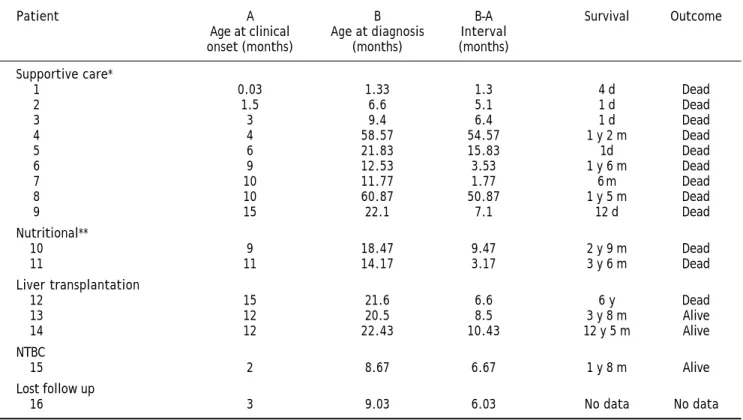
A total of 16 non-related HT1 patients from 16 fa-milies were studied, and included 7 males and 9 fe-males. Consanguinity was documented in 3/16 families. A history of a deceased sibling with a simi-lar clinical picture was recorded in 5 families. Clini-cal outcome of 15/16 patients according to type of treatment is shown in Table 1; patient 16 was lost to follow up after diagnosis. Nine patients received only supportive care (transfusions, diuretics, pain management, between others); five patients received nutritional therapy (restricted dietary Phe and Tyr) and three of these patients underwent liver trans-plantation. Only one patient underwent pharmacolo-gical treatment with NTBC (1 mg/kg daily) as well as Phe/Tyr dietary restriction beginning at 8 mon-ths of age. Age at clinical onset varied from 1 day in a patient who presented hypoglycemia to 15 months, with a mean of 9 months; 14/16 patients were young infants when diagnosed, and two patients were five-year-olds. The mean age at diagnosis was 16.3 months, with a minimum age of 1 month and a maximum age of 5 years. Mean time between clinical onset and definitive diagnosis was 6.6 months (Table 1).
Table 1. Clinical course of HT1 Mexican patients according to their treatment.
Patient A B B-A Survival Outcome
Age at clinical Age at diagnosis Interval onset (months) (months) (months) Supportive care*
1 0.03 1.33 1.3 4 d Dead
2 1.5 6.6 5.1 1 d Dead
3 3 9.4 6.4 1 d Dead
4 4 58.57 54.57 1 y 2 m Dead
5 6 21.83 15.83 1d Dead
6 9 12.53 3.53 1 y 6 m Dead
7 10 11.77 1.77 6 m Dead
8 10 60.87 50.87 1 y 5 m Dead
9 15 22.1 7.1 12 d Dead
Nutritional**
10 9 18.47 9.47 2 y 9 m Dead
11 11 14.17 3.17 3 y 6 m Dead
Liver transplantation
12 15 21.6 6.6 6 y Dead
13 12 20.5 8.5 3 y 8 m Alive
14 12 22.43 10.43 12 y 5 m Alive
NTBC
15 2 8.67 6.67 1 y 8 m Alive
Lost follow up
16 3 9.03 6.03 No data No data
NTBC: nitisinone. d: days. m: months. y: years. *Transfusions, diuretics, pain management, between others. **Restricted dietary Phe and Tyr.
markers found included anemia, abnormal clotting times, hyperbilirubinemia, aminoaciduria, and hypo-glycemia (Table 2).
Hepatic biopsy was performed in 11/16 patients. The histopathological results were consistent with a HT1 biochemical diagnosis in 8/11 patients. The main findings were cirrhosis, fibrosis, and steatosis, and only one biopsy documented dysplastic changes. In the other 3 cases, diagnoses other than HT1 were suggested, such as neonatal hepatitis, hemo-chromatosis, and Wilson disease (Table 3).
The mortality rate in the HT1 group was 78%. In those patients who only received supportive treat-ment, the mean time of death after diagnosis was 12 days. The group of patients who received supportive or nutritional treatment had a 3-year survival rate of 10%. The 6-year survival rate of patients who un-derwent liver transplantation was 60% (Figure 2).
The leading causes of death were fulminant liver failure (8/11), metastatic hepatocellular carcinoma (2/11), and porphyria-like neurologic crisis (2/11).
DISCUSSION
The present retrospective study is the first des-cription of a cohort of Mexican patients with HT1,
documenting their clinical and biochemical findings and the causes that led to their death. Three other HT1 patients were previously reported in Mexi-co.15,16 Our study compiles information for 16
fami-lies, 3 with consanguinity and 5 with a precedent of a deceased sibling that can be assumed to be HT1 be-cause of the identical clinical picture. In this cohort, hepatocellular dysfunction with coagulopathy was predominant. This hepatic syndrome was characteri-zed by hepatomegaly, splenomegaly, cirrhosis, and liver failure accompanied by tubulopathy, nephrome-galy, and Fanconi syndrome. The neurological signs presented as porphyria-like crises and were accom-panied by seizures, irritability, and hyperextension of trunk and neck. Failure to thrive and rickets were also present (Table 2). The clinical picture ob-served in this HT1 cohort is similar to the classic description of the natural history of HT1.1,10
Con-trasting with the report by Couce, et al., where symptom onset occurred between 2 and 6 months of age,17 most of the patients in our cohort reported
Table 2. Biochemical markers and clinical data observed at diagnosis (n = 16).
Frequency
Biochemical
markers Anemia 12
Abnormal 11
clotting times
Conjugated 11
hyperbilirubinemia
Amino aciduria 11
Hypoglycemia 9
Transaminasemia 7
High alkaline 4
phosphatase
Hyperammonemia 4
Acidosis 3
Liver and Hepatomegaly 16
gastrointestinal Splenomegaly 14
Cirrhosis 13
Jaundice 11
Liver failure 10
Ascites 7
Gastrointestinal 3 bleeding
Refusal to eat 7
Diarrhea 4
Ileus 1
Portal 1
hypertension
Kidney Rickets 10
Tubulopathy 8
Renal enlargement 6 Fanconi Syndrome 3
Renal failure 2
Nervous system Seizures 7
Irritability 6
Head and trunk 2
hyperextension
Encephalopathy 2
Other Failure to thrive 12
Dehydration 2
Tachypnea 2 Table 3.
Main histopathological findings of HT-1 Mexican patients.
Patients
Age at
Cirrhosis
Steatosis
Fibrosis
Nodules
Cholestasis
Dysplastic
Giant cell
Other
Final diagnostic
biopsy
changes
transformation
findings
interpretation
(months)
carried out by the pathologist
1
1.27
++
Hemosiderin
Hemochromatosis
deposits*; Leukocyte infiltrates
2
3.27
++
+
Hemosiderin
Neonatal hepatitis
deposits*
15
7.23
++
Tyrosinemia
16
8.73
++
+
+
Tyrosinemia
3
9.47
++
+
Tyrosinemia
7
11.77
+
Tyrosinemia
11
13.53
++
+
Tyrosinemia
10
15.7
++
+
Tyrosinemia
9
16.03
++
+
Wilson’s disease
13
20.73
++
+
Tyrosinemia
12
29.17
++
+
+
Tyrosinemia
* In hepatocytes and macrophages.
however, it is possible that the initial symptoms might have been overlooked by the parents or the fa-mily physician.
The delay in the clinical diagnosis of HT-1 pa-tients has been recognized by other authors, despite the early onset of symptoms.17-19 In this report, we
Figure 1. Tyrosine me-tabolic pathway. 1. Phen-ylalanine hydroxylase. 2. Tyrosine aminotransfe-rase. 3. 4-hydroxyphenyl-pyruvic acid dioxygenase. 4. Homogentisic acid oxi-dase. 5. Maleylacetoace-tic acid isomerase. 6. Fumarylacetoacetic acid hydrolase.
Disorder associated with elevated Tyr in plas-ma. 5-ALA: 5-aminolevu-linic acid.
sibling. The initial clinical picture of HT1 is usually nonspecific and cannot be distinguished from other infectious or toxic hepatic syndromes. Because of its low prevalence, health personnel do not consider HT1 at first glance, leading to its being one of the last differential diagnosis options, which can cause diagnosis delay or misdiagnosis. This is one of the reasons why newborn screening is an invaluable tool for pre-symptomatic diagnosis.
HT1 is included in the newborn screening panel recommended by the American College of Medical Genetics and by the American Academy of Pedia-trics, where SA is established as the primary mar-ker of the disease.20 In contrast, the isolated use of
blood Tyr has poor specificity and sensitivity becau-se it can also be elevated in other pathologies or clinical conditions such as fasting, use of total parenteral nutrition, bleeding, transfusions, and neo-natal transient hypertyrosinemia among others.1,21
In the present study, patients showed high plasma Tyr, Met, and Phe, which are secondary to the hepatic impairment.22 Tyr values were raised in all patients,
and were highly variable; some patients had levels as high as 7 fold normal values, whereas others had levels that were only borderline elevated (Figure 3).
Micro- and macro-nodular cirrhosis, fibrosis, and steatosis are the main histopathological findings suggestive of HT1; however, these changes are not pathognomonic, as they are shared by a wide variety of infantile liver diseases.23-26 Especially in young
children, a hepatitis-like picture appears to be nons-pecific in response to several metabolic insults; therefore, HT1 diagnosis must be established based on clinical, morphological, and biochemical data. In
all but 3 cases, the histopathological interpretation was consistent with the biochemical diagnosis. Of these 3, 2 showed iron storage, marked cholestasis, and giant cell transformation; however, the final diagnoses were neonatal hemochromatosis and he-patitis, respectively. Of note, biopsies were perfor-med in the youngest patients at 1 and 3 months of age, respectively. Such findings could be present in HT1 patients, especially during earlier stages.26
Figure 3. Amino acid concentrations at diagnosis.
Maxi-mum normal value.
Figure 2. Kaplan-Meier survival curve of HT1 Mexican
pa-tients.
Group who underwent transplantation
Group who did not undergo transplantation
n = 11
0 20 40 60 80 100 120 140 160 180 Time (months)
Survival probability (%)
100
80
60
40
20
0
n = 3
800 700 600 500 400 300 200 100 0
Tyrosine (
μ
M)
0 1 2 3 4 5 6 7 8 9 10 11 12 13 14 Patients
108 μM
1200 900 800 600 250 200 150 100 50 0
Methionine (
μ
M)
0 1 2 3 4 5 6 7 8 9 10 11 12 13 14 Patients
42 μM
300
250
200
150
100
50
0
Phenylalanine (
μ
M)
0 1 2 3 4 5 6 7 8 9 10 11 12 13 14 Patients
The findings in the third case were reported as probable Wilson’s disease or environmental toxic cirrhosis (Table 3).
Twenty three percent of the liver biopsies were not conclusive for HT1. This confirms the robust-ness of the biochemical analysis, which is currently considered as the gold standard method for HT1 diagnosis.26,27 Excess SA in plasma or urine is the
pathognomonic metabolite for the confirmation of HT1.1,22,28 SA can be detected in all biological fluids
of untreated HT1 patients.22 The analyses must be
considered part of the diagnostic approach in chil-dren with liver disease.
The mortality rate in this cohort was very high (78%) and occurred at an early age, although we ob-served differences in survival rates related to treat-ment modalities (Figure 2). Survival rates were higher in the group that underwent hepatic trans-plantation.
Unlike other reports where hepatocellular carcinoma is the leading cause of death,1,27 the
main cause in our group was fulminant liver failure, which can be explained by the late diagnosis and the lack of specific pharmacological therapy (NTBC).
Most patients did not receive specific treatment and were only treated with supportive care. Again, we emphasize that nearly all patients were diagno-sed late, when their clinical condition was so critical that some died before any therapy could be started. The 3 patients who underwent liver transplantation were treated at another Health Institute of the Mexican Ministry of Health, which has a children’s liver transplant program.29,30 The patient who
recei-ved NTBC is currently aged 2 years 11 months and the pharmacological treatment resulted in correction of the coagulopathy and the anemia, and decreased SA and alpha-fetoprotein levels; however, it did not prevent the development of macronodular cirrhosis at 14 months. She is awaiting transplantation.
There is some evidence that support the benefits of NTBC administration in late diagnosed patients, but the risk of developing hepatocellular cancer re-mains a concern.31
Persistent urinary SA excretion following liver transplantation in HT1 patients appears to be a fquent finding and may contribute to progressive re-nal dysfunction in some patients.32-34
Current treatment of HT1 must be comprehensive and coupled with early diagnosis through newborn screening in order to start pharmacological treat-ment with NTBC as soon as possible along with nu-tritional therapy to control Tyr and Phe levels and, when necessary, liver transplantation.
Transplantation should be restricted to those ex-hibiting acute liver failure that cannot be reverted by NTBC, and in patients with suspected hepato-cellular carcinoma.34 Some authors recommend that
NTBC should still be administered in HT1 trans-planted patients at low doses (up to 0.2 mg/kg daily) to minimize the excretion of SA in order to preserve glomerular filtration rate.32
The devastating natural history of HT1 is still ob-served in Mexican patients because they are not diag-nosed and treated at early stages of the disease. Our results are consistent with previous reports; all pa-tients had progressive liver failure associated with high mortality. Clearly, newborn screening programs combined with the availability of orphan drugs (NTBC), proper monitoring, genetic counseling, and clinical practice guidelines are much needed to allow physicians to suspect the disease, delay its progres-sion, and improve the quality of life of patients. If ni-tisinone and Tyr/Phe restricted special formula become available for Mexican patients, especially if tyrosinemia is added to the neonatal screening panel, the outcome is expected to improve rapidly.
ABBREVIATIONS
• HT1: hepatorenal tyrosinemia. • 5-ALA: 5-aminolevulinic acid. • AFP: alpha-fetoprotein • EC: enzyme code number • FAA: fumarylacetoacetate • FAH: fumarylacetoacetate gene • FAH: fumarylacetoacetate hydrolase • MAA: maleylacetoacetate
• Met: methionine
• NTBC 2: -[2-nitro-4-trifluoromethybenzoyl]-1,3-ciclohexadione; nitisinone.
• OMIM®: Online Mendelian Inheritance in Man. • Phe: phenylalanine.
• SA: succinylacetone. • Tyr: tyrosine.
REFERENCES
1. Mitchell GA, Grompe M, Lambert M, Tanguay RM. Hyper-tirosinemia. In: Scriver CR, Beaudet AL, Valle D (eds.). The Metabolic and Molecular Basis of Inherited Disease. Volume II. 8th ed. New York: McGraw-Hill; 2001, p. 1777-805.
2. Held PK. Disorders of tyrosine catabolism. Mol Genet Me-tab 2006; 88: 103-6.
3. Russo PA, Mitchell GA, Tanguay RM. Tyrosinemia: a review. Pediatr Dev Pathol 2001; 4: 212-21.
5. Bliksrud YT, Ellingsen A, Bjørås M. Fumarylacetoacetate inhibits the initial step of the base excision repair pa-thway: implication for the pathogenesis of tyrosinemia type I. J Inherit Metab Dis 2012. DOI 10.1007/s10545-012-9556-0.
6. Mak CM, Lam CW, Chim S, Siu TS, Ng KF, Tam S. Biochemi-cal and molecular diagnosis of tyrosinemia type I with two novel FAH mutations in a Hong Kong chinese patient: re-commendation for expanded newborn screening in Hong Kong. Clin Biochem 2013; 46: 155-9.
7. Bartlett DC, Preece MA, Holme E, Lloyd C, Newsome PN, McKiernan PJ. Plasma succinylacetone is persistently rai-sed after liver transplantation in tyrosinaemia type 1. J Inherit Metab Dis 2013; 36: 15-20.
8. van Spronsen FJ, Thomasse Y, Smit GP, Leonard JV, Cla-yton PT, Fidler V, Berger R, et al. Hereditary tyrosinemia type I: a new clinical classification with difference in prognosis on dietary treatment. Hepatology 1994; 20: 1187-91.
9. Puy H, Gouya L, Deybach JC. Porphyrias. Lancet 2010; 375: 924-37.
10. Kitagawa T. Hepatorenal tyrosinemia. Proc Jpn Acad Ser B Phys Biol Sci 2012; 88: 192-200.
11. Dirbashi OY, Rashed MS, Jacob M, Ahaideb LY, Al-Amoudi M, Rahbeeni Z, Al-Sayed MM, et al. Improved me-thod to determine succinylacetone in dried blood spots for diagnosis of tyrosinemia type 1 using UPLC-MS/MS. Bio-med Chromatogr 2008; 22: 1181-5.
12. Holme E, Lindstedt S. Nontransplant treatment of tyrosi-nemia. Clin Liver Dis 2000; 4: 805-14.
13. McKiernan PJ. Nitisinone in the treatment of hereditary tyrosinaemia type 1. Drugs 2006; 66: 743-50.
14. Arnon R, Annunziato R, Miloh T, Wasserstein M, Sogawa H, Wilson M, Suchy F, et al. Liver transplantation for heredi-tary tyrosinemia type I: analysis of the UNOS database. Pediatr Transplant 2011; 15: 400-5.
15. Morán-Vázquez JO, Sánchez-Corona J, Pérez-Molina J, Viruete-Alcaraz M, Venegas-Mecina R. Chronic hereditary Tyrosinemia. Bol Med Hosp Infant Mex 1987; 44: 540-5 [article in Spanish].
16. Gutiérrez-Camacho C, Villalpando-Carrión S, Escobar-Sánchez MA, Valadez-Reyes T. Tyrosinemia type I and Fanconi syndrome. Bol Med Hosp Infant Mex 2007; 64: 182-191 [article in Spanish].
17. Couce ML, Dalmau J, del Toro M, Pintos-Morell G, Aldámiz-Echevarría L Manzanares J, Bueno MA, et al. Tyrosinemia type 1 in Spain: mutational analysis, treatment and long-term outcome. Pediatr Int 2011; 53: 985-9.
18. Raimann E, Cornejo V, Arias C, Cabello JF, Castro G, Fer-nández E, de la Parra A. Clinical follow up of Chilean pa-tients with tyrosinemia type 1 treated with 2-(2-nitro-4-trifluoromethylbenzoyl)-1,3-ciclohexanedione (NTBC). Rev Med Chil 2012; 140(2): 169-75 [article in Spa-nish].
19. El-Karaksy H, Fahmy M, El-Raziky M, El-Koofy N, El-Sayed R, Rashed MS, El-Kiki H, et al. Hereditary tyrosinemia type 1
from a single center in Egypt: clinical study of 22 cases. World J Pediatr 2011; 7: 224-31.
20. Watson AS, Mann MY, Lloyd-Puryear MA, Rinaldo P, Howell RR. Newborn screening: toward a uniform panel and sys-tem. Executive summary. Genet Med 2006; 8: S1-S11. 21. Fernández-Lainez C, Aguilar-Lemus JJ, Vela-Amieva M,
Iba-rra-González I. Tandem mass spectrometry newborn scree-ning for inborn errors of intermediary metabolism: abnormal profile interpretation. Curr Med Chem 2012; 19: 4511-22. 22. Scott CR. The genetic tyrosinemias. Am J Med Genet Part
C Semin Med Genet 142C: 121-6.
23. Yu JS, Walker-Smith JA, Burnard ED. Neonatal hepatitis in premature infants simulating hereditary tyrosinosis. Arch Dis Child 1971; 46: 306-10.
24. Halvorsen S, Pande H, Loken AC, Gjessing LR. Tyrosinosis. A study of 6 cases. Arch Dis Childh 1966; 41: 238-49. 25. Dehner LP, Snover DC, Sharp HL, Ascher N, Nakhleh R, Day
D. Hereditary tyrosinemia type I (chronic form): patholo-gic findings in the liver. Hum Pathol 1989; 20: 149-58. 26. Russo, S. O’Regan. Visceral pathology of hereditary
tyro-sinemia type I. Am J Hum Genet 1990; 47: 317-24. 27. Chakrapani A, Holme E. Disorders of Tyrosine metabolism.
In: Fernandes J, Saudubray JM, Van den Berghe G, Walter JH (eds.). Inborn Metabolic Diseases diagnosis and treat-ment. 4th ed. Heidelberg: Springer; 2006, p. 233-43. 28. Allard P, Grenier A, Korson MS, Zytkovicz TH. Newborn
screening for hepatorenal tyrosinemia by tandem mass spectrometry: analysis of succinylacetone extracted from dried blood spots. Clin Biochem 2004; 37: 1010-5.
29. Varela-Fascinetto G, Dávila-Pérez R, Nieto-Zermeño J, Bracho-Blanchet E, Fuentes-García V, Castañeda-Martí-nez P, Abarca-García MA, et al. Experience of a successful pediatric liver transplant program in Mexico. Transplant Proc 2005; 37: 1201-2.
30. Varela-Fascinetto G, Hernández-Plata JA, Nieto-Zermeño J, Alcántar-Fierros JM, Fuentes-García V, Castañeda-Mar-tínez P, Valencia-Mayoral P, et. al. Pediatric liver trans-plant program at Hospital Infantil de Mexico Federico Gomez. Rev Invest Clin 2011; 63(Suppl. 1): 57-61 [article in Spanish].
31. Larochelle J, Alvarez F, Bussières JF, Chevalier I, Dallaire L, Dubois J, Faucher F, et al. Effect of nitisinone (NTBC) treatment on the clinical course of hepatorenal tyrosine-mia in Québec. Mol Genet Metab 2012; 107: 49-54. 32. Pierik LJ, van Spronsen FJ, Bijleveld CM, van Dael CM. Renal
function in tyrosinaemia type I after liver transplantation: a long-term follow-up. J Inherit Metab Dis 2005; 28: 871-6. 33. van Spronsen FJ, Bijleveld CM, van Maldegem BT, Wijburg
FA. Hepatocellular carcinoma in hereditary tyrosinemia type I despite 2-(2 nitro-4-3 trifluoro-methylbenzoyl)-1, 3-cyclohexanedione treatment. J Pediatr Gastroenterol Nutr 2005; 40: 90-3.