Curcumin in Hepatobiliary Disease:
Pharmacotherapeutic Properties and
Emerging Potential Clinical Applications
Robert W. Hu,* Elizabeth J. Carey,† Keith D. Lindor,†,‡ James H. Tabibian§,|| * Department of Biology, College of Arts and Sciences, University of Pennsylvania, Philadelphia, PA, USA.
† Division of Gastroenterology and Hepatology, Mayo Clinic, Scottsdale, AZ, USA. ‡ Executive Vice Provost and Dean, College of Health Solutions, Arizona State University, Phoenix, AZ, USA. § Division of Gastroenterology, Department of Medicine, Hospital of the University of Pennsylvania, Philadelphia, PA, USA. || Division of Gastroenterology, Department of Medicine, Olive View-UCLA Medical Center, Sylmar, CA, USA.
November-December, Vol. 16 No. 6, 2017: 835-841
The Official Journal of the Mexican Association of Hepatology, the Latin-American Association for Study of the Liver and
the Canadian Association for the Study of the Liver
Manuscript received: Manuscript received:Manuscript received:
Manuscript received:Manuscript received: March 27, 2017. Manuscript accepted:Manuscript accepted:Manuscript accepted:Manuscript accepted:Manuscript accepted: April 17, 2017.
DOI:10.5604/01.3001.0010.5273
A B S T R A C T A B S T R A C T A B S T R A C T A B S T R A C T A B S T R A C T
Curcumin, an aromatic phytoextract from the turmeric (Curcuma longa) rhizome, has been used for centuries for a variety of purpos-es, not the least of which is medicinal. A growing body of evidence suggests that curcumin has a broad range of potentially therapeu-tic pharmacological properties, including anti-inflammatory, anti-fibrotherapeu-tic, and anti-neoplastherapeu-tic effects, among others. Clinical applications of curcumin have been hampered by quality control concerns and limited oral bioavailability, although novel formulations appear to have largely overcome these issues. Recent in vitro and in vivo studies have found that curcumin's cytoprotective and other biological activities may play a role in an array of benign and malignant hepatobiliary conditions, including but not limited to non-alcoholic fatty liver disease, cholestatic liver disease (e.g. primary sclerosing cholangitis), and cholangiocarcinoma. Here we provide an overview of fundamental principles, recent discoveries, and potential clinical hepatobiliary applications of this pleiotropic phytocompound.
Key words. Key words. Key words. Key words.
Key words. Phytotherapy. Complementary medicine. Liver diseases. Antioxidants.
INTRODUCTION
Curcumin is a naturally-occurring phytocompound ex-tracted from the turmeric rhizome Curcuma longa, a mem-ber of the ginger (Zingimem-beraceae) family. For centuries, it has been used as a dye, culinary spice, ceremonial sub-stance, and traditional medicine in many cultures and countries, particularly in Southern Asia and the Indian subcontinent, where it grows naturally. A primary ration-ale for its use in traditional (e.g. Ayurvedic) medicine has been its putative anti-inflammatory and consistency prop-erties.1 More recently, curcumin has been appreciated in
modern biomedical studies as having various potentially therapeutic properties, including anti-oxidant, anti-fibrot-ic, anti-senescent, and anti-neoplastic.2-8
Despite its long history and well-tolerated nature, cur-cumin has arguably not yet realized its full therapeutic po-tential in the prevention and treatment of human disease.
This has in part been due to concerns regarding quality control (e.g. safety, purity, and other chemical attributes), poor oral bioavailability, and ostensibly a degree of skepti-cism toward traditional (i.e. alternative) medicine. How-ever, several well-characterized, more bioavailable, novel formulations of curcumin have helped facilitate its grow-ing study and emerggrow-ing (though to date off-label) compli-mentary use in Western medicine. The potential applications thus far include, but are not limited to, pre-vention and treatment of hepatobiliary, digestive tract, car-diovascular, neurodegenerative, and dermatologic diseases as well as various systemic inflammatory and malignant conditions.1,2,8-10
The goals of this review are to:
• Summarize the relevant in vitro and in vivo experimental data supporting its beneficial properties.
• Present recent findings and perspectives regarding the potential clinical role of curcumin as a pharmacothera-py in the context of hepatobiliary disease and chemo-prevention.
PHYSICAL AND
CHEMICAL PROPERTIES OF CURCUMIN
Curcumin [1,7-bis (4-hydroxy-3- methoxyphenyl)-1,6-heptadiene-3,5-dione] is a unique biphenolic molecule containing two ferulic acid residues joined by a methylene bridge (Figure 1). It has three key molecular functionali-ties: an aromatic o-methoxy phenolic group, an α, β -un-saturated β-diketone moiety, and a seven carbon linker. Accordingly, there are several important physicochemical features associated with the biological activity and effects of curcumin. For example, the o-methoxyphenol group and methylenic hydrogen are responsible for the antioxi-dant activity of curcumin, and curcumin donates an elec-tron/hydrogen atom to reactive oxygen species (ROS). Curcumin interacts with a number of biomolecules through non-covalent and covalent binding; the hydrogen bonding and hydrophobicity of curcumin, arising from the aromatic functional ends and keto-enol tautomerism of the central portion along, account for the non-covalent inter-actions. The α, β-unsaturated β-diketone moieties cova-lently interact with protein thiols through Michael reaction (i.e. Michael nucleophilic addition). The β -dike-to group chelates transition metals, thereby decreasing metal-induced toxicity and rendering some metal com-plexes with antioxidant activity as enzyme mimics. These nuanced molecular characteristics are reviewed in greater detail elsewhere.8,11 Notably, new analogues of curcumin
have been and continue to be developed with chemical modifications to specific functional groups in order to
po-tentiate or increase specificity of particular molecular in-teractions and downstream biological effects.11
FORMULATIONS OF CURCUMIN
The clinical application of native curcumin has been limited due to its poor bioavailability (largely due to low solubility), physicochemical instability, and pharmacoki-netics (in particular rapid metabolism), as mentioned ear-lier;12 however, these issues can be largely mitigated by
utilization an efficient delivery system. Therefore, various formulations of curcumin have been developed, including nanoparticles, liposomal encapsulation, and emulsions, in addition to more conventional delivery systems such as tablets and powders. These novel formulations have been found to improve curcumin’s pharmacokinetics, especial-ly its oral bioavailability, as well as its pharmacodynamics, with resultant enhanced biological activity.13-15
PHARMACOTHERAPEUTIC EFFECTS AND GENERAL APPLICATIONS
The various potentially therapeutic pharmacological properties of curcumin have shown promise in effectuat-ing several important cytological and biological effects; these include induction of cell apoptosis, inhibition of abnormal cell proliferation, and angiogenic and anti-microbial activities, among others.16 The molecular
mech-anisms implicated are pleiotropic, including regulation of ROS production, LPS-mediated signaling, cell survival signaling pathways by nuclear factor kappa-light-chain-enhancer of activated B cells (NF-κB) and Akt, and cell survival-associated proteins such as Bcl-2 and Bcl-Xl, as illustrated in figure 2,17-22 and it is therefore not surprising
that the use of curcumin has been investigated for a variety of indications.8,23
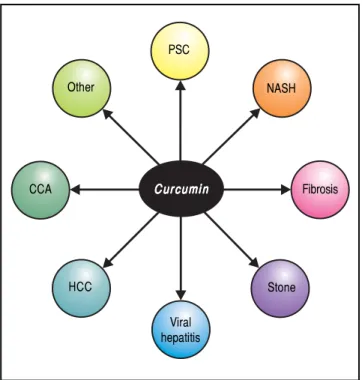
Although this review focuses on hepatobiliary applica-tions (Figure 3), it is worth noting that curcumin has been examined in in vitro and animal models as well as in clinical
Figure 2. Figure 2. Figure 2.
Figure 2. Figure 2. Proposed mechanisms of pharmacotherapeutic action of curcu-min. ROS: Reactive oxygen species. NF-kβ: Nuclear factor kappa B. TGFβ: Transforming growth factor beta. TLR: Toll-like receptor. Acyl-CoA: Acyl-coenzyme A.
Figure 1. Figure 1. Figure 1. Figure 1.
Figure 1. Molecular structure of curcumin emphasizing key functional groups and chemical properties. Yellow ovals depict hydrogen bonding sites (not shown on right side of molecule), green octagons depict Michael accep-tor sites, and light blue circle depicts hydrophobic moieties (not shown on left side of molecule). In addition, keto-enol tautomerism occurs between the central portion of the molecule (di-keto tautomer shown).
HO
O-CH3
O O
OH
O-CH3
Curcumin
ROS NF- kβ TGFβ TLR2/4 Acyl-CoA
studies of a wide array of human conditions, including benign or malignant neurodegenerative, cardiovascular, re-nal, and metabolic diseases as well as their associated com-plications.11 Two phase I clinical trials concluded that
curcumin is safe and not toxic to humans, even at very high dosage.5,24,25 In a minority of patients, side-effects such as
nausea, diarrhea, headache, somnolence, and contact der-matitis (with topical use) have been reported; these have typically been mild and self-limited. Considering the rela-tively low cost and favorable safety profile of curcumin, a therapeutic impact on these diseases with this agent, even if requiring long-term treatment or as an adjuvant, repre-sents an exciting prospect.
CURCUMIN IN NON-MALIGNANT CHRONIC HEPATOBILIARY DISEASE
Preclinical data
A large body of preclinical literature has suggested pharmacotherapeutic properties of curcumin relevant to non-malignant (or pre-malignant) hepatobiliary disease. For example, in vitro studies using different cell lines such as human HSC-16 and Hep2G cells have shown signifi-cant antifibrotic effects through transforming growth fac-tor-beta (TGFβ) signaling.22,26,27 In addition, it has also
been shown in vitro that curcumin has potent antioxidant
effects through inducing the activity of glutathione, glu-tathione peroxidase, superoxide dismutase, and catalase as well as dose-dependent induction of HO-1. Moreover, curcumin can inhibit NF-κB activation, thereby prevent-ing secretion of pro-inflammatory cytokines such as tu-mor necrosis factor alpha (TNF-α), interleukin 1β), and interleukin 6.22,28
With respect to animal model data, there is a considera-ble body of evidence to support potential applications of curcumin in chronic, non-malignant liver disease. For ex-ample, using a model such as CCl4 or bile duct ligation-induced hepatic fibrosis, curcumin has been shown to significantly attenuate fibrogenesis.22,29,30 Similar effects
were seen in the mdr2 knockout murine model of sclero-sing cholangitis with 3% curcumin chow.31 Extending the
mdr2 knockout model findings, our group recently found curcumin to inhibit cellular senescence and the senes-cence-associated secretory phenotype (unpublished data), which may be fundamentally linked to the pathogenesis of primary sclerosing cholangitis (PSC), in cultured human cholangiocyte models.32,33 Second, curcumin
supplemen-tation appears to reduce hepatocyte lipid accumulation at-tenuate nonalcoholic steatohepatitis (NASH) in rats,34,36
with similar findings in hamster35 and rabbit37 models.
These benefits of curcumin appear to be mediated through mitochondrial protection and inhibition of apoptosis and are further supported by studies in a methionine and choline deficiency diet murine model demonstrating a protective role of curcumin against oxidative stress through reduced CYP2E1 and Prx1 expression and upregulated Prx6 expression.38 Collectively, these and other studies39,40
suggest that curcumin can decrease hepatic cholesterol, triglyceride, and free fatty acid accumulation and resultant hepatic injury and thus may have a promising role in treat-ing or preventtreat-ing NASH. Third, hepato-protective effects of curcumin have been evaluated and shown in non-NASH animal models. For example, curcumin appears to inhibit CYP2E1 activity,41 thus abrogating ROS
produc-tion, and activate NF-E2-related factor 2 (Nrf2) transloca-tion to the nucleus, thereby increasing expression of antioxidant enzymes.42,43 Fourth, the recently identified
ef-fect of inhibiting hepatitis C virus entry in a hepatoma cell line and in primary human hepatocytes44 as well as
anti-hepatitis B virus activity in the HepG2 cell line45 suggest
that curcumin may have preventive and/or therapeutic ef-fects in viral hepatitis. Lastly, several studies have demon-strated significant anti-lithogenic effects of curcumin in murine experimental cholesterol cholelithiasis models, thus supporting a role in gallstone disease.46,47
These in vitro and in vivo data suggest that curcumin has therapeutic potential in benign chronic liver disease mer-iting further investigation and improved mechanistic un-derstanding.
Figure 3. Figure 3. Figure 3.
Figure 3. Figure 3. Potential applications of curcumin in hepatobiliary disease. CCA: Cholangiocarcinoma. HCC: Hepatocellular carcinoma. NASH: Nonalcoholic steatohepatitis. PSC: Primary sclerosing cholangitis.
C u r c u m i n C u r c u m i nC u r c u m i n C u r c u m i nC u r c u m i n
PSC
NASH
Fibrosis
Stone
Viral hepatitis HCC
Clinical applications
A small but growing number of clinical trials have ex-amined the effects of curcumin on chronic liver diseases, including antituberculosis treatment-induced hepatotox-icity,48 gallstone disease (e.g. gallbladder
hypocontractili-ty),49 and biliary dyskinesia.50 To date, however, curcumin
has not become a mainstream or approved therapy for these indications. Of note, we recently received approval of an investigational new drug application to conduct a clinical trial of curcumin in patients with PSC based on promising pre-clinical findings; study enrollment is planned for later this year.
CURCUMIN IN
MALIGNANT HEPATOBILIARY DISEASE
Preclinical data
Preclinical data, both in vitro and in vivo, suggest that cur-cumin has anti-neoplastic effects with regard to hepato-cellular carcinoma (HCC). Several in vitro studies using murine hepatoma51 or HepG2 cancer cell lines52 have
demonstrated that its effect are likely through activation of ER stress and apoptosis or mediating MMP turnover53 as
well as through NF-κB signaling.54In vivo, curcumin has
similarly exhibited anti-properties in several animal mod-els of hepatocellular carcinoma, as demonstrated in the N-bis-(2-hydroxypropyl) nitrosamine induced liver ade-noma model,38 HepG2 xenografts,55-57 orthotopic
implan-tation model of HCC CBO140C12 cells.58 Curcumin also
has been shown to mitigate oxidative tissue damage during chemically induced hepatocarcinogenesis in N-nitrosodi-ethylamine -initiated and phenobarbital-promoted hepa-tocarcinogenesis in Wistar rats.59-61 Moreover, a recent
breakthrough study revealed that curcumin not only inhib-ited the proliferation and invasion of HCC cell lines in vit-ro, but also drastically suppressed primary tumor growth and lung metastases in vivo. Furthermore, in combination with sorafenib, curcumin induced HCC cell apoptosis and cell cycle arrest by synergistically down-regulating the expression of MMP9 via NF-κB/P65 signaling pathway. This highlights the potential neo-adjuvant application of curcumin in the treatment of HCC.62
Curcumin may also have promise in the treatment of cholangiocarcinoma (CCA), a lethal malignancy for which effective pharmacotherapy remains lacking. Several in vitro
studies using different CCA cell lines have shown anti-tu-morigenic effects on cholangiocarcinoma, which appear to be via suppressing proliferation and inducing apoptosis in malignant cells through modulating multiple cell signal-ing pathways.63,64 Similar effects were also observed in in
vivo hamster65 and nude mouse xenograft models.66
Collectively, these data suggest that curcumin may have potential therapeutic implications in hepatobiliary malig-nancies.
Clinical applications
Although there are no published clinical trials to date on malignant hepatobiliary disease with curcumin, the in vivo and in vitro data thus far may inform clinical studies of curcumin in treating such conditions.
CURCUMIN AS A HEPATOPROTECTIVE AGENT
Preclinical data
Numerous in vivo studies have found that curcumin has potent antioxidant and anti-inflammatory properties, which may account for its hepatoprotective effect. These properties may be mediated by inhibiting NF-κB signal-ing and by inhibitsignal-ing production of nitric oxide and
TNF-α by activated Kupffer cells, among other mechanisms, and as mentioned earlier.8,67,68 This has been shown in various
models of hepatobiliary injury, including D-galactos-amine-, thioacetamide-, and CCl4-, iron-, and ethanol- in-duced acute liver injury.8,69,70 It is interesting to note that
experimental liver steatosis induced by TNF-α injection in mice also showed significant attenuation after curcu-min treatment as indicated by decreased oxidative stress and neutrophil infiltration and improved hepatic his-topathological features.71 Curcumin also has been shown
to decrease hepatocyte lipid storage in various animal models.34,35,39,40,72
Clinical applications
There are only limited data, much of which is related to pharmacokinetic and toxicity evaluation, with regard to clinical studies assessing the hepatoprotective (i.e. pri-mary preventive) properties of curcumin.73 Given the
progress made to pharmacologically improve the bioavail-ability of curcumin and its demonstrable safety profile, preliminary clinical application has been thus far success-ful in healthy human volunteers using a nanoparticle for-mulation for anti-cancer (preventive or therapeutic) purposes.74 The findings appear promising but require
further study.
FUTURE DIRECTIONS
treatment of disease and potential applications to clinical medicine will continue to expand. Given its low negligi-ble toxicity and relatively low cost, it would reason to be-lieve that its role in human disease, be it preventive or for treatment of benign or malignant disorders, will draw in-creasing medical and pharmaceutical attention. Further study with well-designed clinical trials are needed to as-certain appropriate indications, dispel potential positive publication bias, and determine optimal formulations, doses, and other regimen-related factors. In addition, epi-demiological data from regions of high dietary curcumin intake (e.g. India) may shed additional light on chemopre-ventive properties; for example, it is suggested that may in part be related to high curcumin consumption the low in-cidence of colorectal and small intestinal cancer in India,75
but data regarding hepatobiliary disease are lacking.
CONCLUSIONS
Curcumin is a phytocompound which has been used as a vital traditional medicinally for centuries. Pharmacologi-cal advances, including significantly improved oral bioa-vailability, and curcumin's favorable adverse effect profile and low cost have helped garner growing interest in its molecular properties and biological effects as well as its possible applications in the prevention and treatment of hepatobiliary and other (e.g. pancreatobiliary) diseases. The data thus far regarding its potential role as an adjunc-tive or primary pharmacologic agent appears promising. Future research is expected and eagerly awaited in this regard and to better and gauge clinical efficacy and utility elucidate mechanisms of action.
ABBREVIATIONS
• CCA: cholangiocarcinoma. • HCC: hepatocellular carcinoma. • NASH: nonalcoholic steatohepatitis.
• NF-κκκκκB: nuclear factor kappa-light-chain-enhancer of activated B cells.
• PSC: primary sclerosing cholangitis. • ROS: reactive oxygen species. • TNF-αααααtumor necrosis factor alpha. • TGFβββββ: transforming growth factor-beta.
CONFLICTS OF INTEREST, DISCLOSURES
None.
REFERENCES
1. Gupta SC, Patchva S, Koh W, Aggarwal BB. Discovery of
curcumin, a component of golden spice, and its miraculous
biological activities. Clin Exp Pharmacol Physiol 2012; 39:
283-99.
2. Aggarwal BB, Sundaram C, Malani N, Ichikawa H. Curcumin:
the Indian solid gold. Adv Exp Med Biol 2007; 595: 1-7.
3. Chandran B, Goel A. A randomized, pilot study to assess
the efficacy and safety of curcumin in patients with active
rheumatoid arthritis. Phytother Res 2012; 26: 1719-25.
4. Goel A, Boland CR, Chauhan DP. Specific inhibition of
cyclooxy-genase-2 (COX-2) expression by dietary curcumin in HT-29
hu-man colon cancer cells. Cancer Lett 2001: 172: 111-8.
5. Cheng AL, Hsu CH, Lin JK, Hsu MM, Ho YF, Shen TS, Ko JY,
et al. Phase I clinical trial of curcumin, a chemopreventive
agent, in patients with high-risk or pre-malignant lesions.
An-ticancer Res 2001; 21: 2895-900.
6. Singh S, Aggarwal BB. Activation of transcription factor
NF-kappa B is suppressed by curcumin (diferuloylmethane)
[corrected]. J Biol Chem 1995; 270: 24995-5000.
7. Maiti K, Mukherjee K, Gantait A, Saha BP, Mukherjee PK.
Cur-cumin-phospholipid complex: Preparation, therapeutic
evalu-ation and pharmacokinetic study in rats. Int J Pharm 2007;
330: 155-63.
8. Pulido-Moran M, Moreno-Fernández J, Ramírez-Tortosa C,
Ramírez-Tortosa M. Curcumin and Health. Molecules 2016;
21: 264.
9. Lam P, Cheung F, Tan HY, Wang N, Yuen MF, Feng Y.
Hepatoprotective Effects of Chinese Medicinal Herbs: A
Fo-cus on Anti-Inflammatory and Anti-Oxidative Activities. Int J
Mol Sci 2016; 17:465.
10. Vera-Ramírez L, Pérez-López P, Varela-López A, Ramírez-Tortosa M, Battino M, Quiles JL. Curcumin and liver disease.
Biofactors 2013; 39: 88-100.
11. Priyadarsini KI. Chemical and structural features influencing
the biological activity of curcumin. Curr Pharm Des 2013;
19: 2093-100.
12. Anand P, Kunnumakkara AB, Newman RA, Aggarwal BB.
Bi-oavailability of curcumin: problems and promises. Mol
Pharm 2007; 4: 807-18.
13. Gupta SC, Patchva S, Aggarwal B. Therapeutic roles of
Cur-cumin: lesions learned from clinical trials. The AAPS Journal
2013; 15: 195-218.
14. Yallapu MM, Nagesh PK, Jaggi M, Chauhan SC. Therapeutic
Applications of Curcumin Nanoformulations. AAPS J 2015;
17: 1341-56.
15. Prasad S, Tyagi AK, Aggarwal BB. Recent developments in delivery, bioavailability, absorption and metabolism of
curcu-min: the golden pigment from golden spice. Cancer Res
Treat 2014; 46: 2-18.
16. Fan X, Zhang X, DB Liu, Yan J, Liang HP. The clinical
appli-cations of Curcumin: Current state and the future. Curr Phar
Des 2013; 19: 2011-5.
17. Shishodia S, Sethi G, Aggarwal BB. Curcumin: getting back to the roots. Ann N Y Acad Sci 2005; 1056: 206-17. 18. Singh S, Aggarwal BB. Activation of transcription factor
NF-κB is suppressed by curcumin (diferuloylmethane). J Biol
Chem 1995; 270: 24995-5000.
19. Shih SC, Claffey KP. Role of AP-1 and HIF-1 transcription
factorsin TGF-β activation of VEGF expression. Growth
Fac-tors 2001; 19: 19-34.
20. Bachmeier BE, Nerlich AG, Iancu CM, Cilli M, Schleicher E, Vene R, Dell'Eva R, et al. The chemopreventive polyphenol Curcumin prevents hematogenous breast cancer
metastas-es in immunodeficient mice. Cell Physiol Biochem 2007; 19:
137-52.
21. El-Azab F, Hishe H, Moustafa Y, El-Awady E. Anti-ang-iogenic effect of resveratrol and curcumin in ehrlich ascites
22. Bassiouny AR, Zaky A, Fawky F, Kandeel K. Alteration of AP-endonuclease1 expression in curcumin-treated fibrotic
rats. Ann Hepatol 2011; 10: 516-30.
23. Lang A, Salomon N, Wu JC, Kopylov U, Lahat A, Har-Nov O, Ching JY, et al. Curcumin in Combination With Mesalamine In-duces Remission in Patients With Mild-to-Moderate Ulcerative
Colitis in a Randomized Controlled Trial. Clin Gastroenterol
Hepatol 2015; 13: 1444-9.
24. Sharma RA, Euden SA, Platton SL, Cooke DN, Shafayat A, Hewitt HR, Marczylo TH, et al. Phase I clinical trial of oral curcumin: biomarkers of systemic activity and compliance.
Clin Cancer Res 2004; 10: 6847-54.
25. Epstein J, Sanderson IR, Macdonald TT. Curcumin as a thera-peutic agent: the evidence from in vitro, animal and human
studies. Br J Nutr 2010; 103: 1545-57.
26. Lin YL, Lin CY, Chi CW, Huang YT. Study on antifibrotic
ef-fects of curcumin in rat hepatic stellate cells. Phytother Res
2009; 23: 927-32.
27. Nakayama N, Nakamura T, Okada H, Iwaki S, Sobel BE, Fujii S. Modulators of induction of plasminogen activator inhibitor
type-1 in HepG2 cells by transforming growth factor-b.
Cor-onary Artery Dis 2011; 22: 468-78.
28. Ghosh N, Ghosh R, Mandal V, Mandal SC. Recent advances
in herbal medicine for treatment of liver diseases. Pharm
Biol 2011; 49: 970-88.
29. Reyes-Gordillo K, Segovia J, Shibayama M, Tsutsumi V, Ver-gara P, Moreno MG, Muriel P. Curcumin prevents and revers-es cirrhosis induced by bile duct obstruction or CCl4 in rats:
role of TGF-beta modulation and oxidative stress. Fundam
Clin Pharm 2008; 22: 417-27.
30. El Swefy S, Hasan RA, Ibrahim A, Mahmoud MF. Curcumin and hemopressin treatment attenuates cholestasis-induced
liver fibrosis in rats: role of CB1 receptors. Naunyn
Schmiedebergs Arch Pharmacol 2016; 389: 103-16. 31. Baghdasaryan A, Claudel T, Kosters A, Gumhold J, Silbert D,
Thuringer A, Leski K, et al. Curcumin improves sclerosing cholangitis in Mdr2-/- mice by inhibition of cholangiocyte in-flammatory response and portal myofibroblast proliferation.
Gut 2010; 59: 521-30.
32. Tabibian JH, Trussoni CE, O’Hara SP, Splinter PL, Heimbach JK, LaRusso NF. Characterization of cultured cholangi-ocytes isolated from livers of patients with primary
scleros-ing cholangititis. Lab Invest 2014; 94: 1126-33.
33. Tabibian JH, O’Hara SP, Splinter PL, Trussoni CE, LaRusso NF. Cholangiocyte senescence by way of N-ras activation is
a characteristic of primary sclerosing cholangititis.
Hepatol-ogy 2014; 59: 2263-75.
34. Rao DS, Sekhara NC, Satyanarayana MN, Srinivasan M. Ef-fect of curcumin on serum and liver cholesterol levels in the
rat. J Nutr 1970; 100: 1307-15.
35. Jang EM, Choi MS, Jung UJ, Kim MJ, Kim HJ, Jeon SM, Shin SK, et al. Beneficial effects of curcumin on hyperlipidemia
and insulin resistance in high-fat-fed hamsters. Metabolism
2008; 57: 1576-83.
36. Wang L, Lv Y, Yao H, Yin L, Shang J. Curcumin prevents the non-alcoholic fatty hepatitis via mitochondria protection
and apoptosis reduction. Int J Clin Exp Pathol 2015; 8:
11503-9.
37. Ramirez-Tortosa MC, Ramirez-Tortosa CL, Mesa MD, Grana-dos S, Gil A, Quiles JL. Curcumin ameliorates rabbit's steato-hepatitis via respiratory chain, oxidative stress, and
TNF-alpha. Free Radic Biol Med 2009; 47: 924-31.
38. Lee SJ, Kang JH, Iqbal W, Kwon OS. Proteomic analysis of mice fed methionine and choline deficient diet reveals
mark-er proteins associated with steatohepatitis. PLoS One
2015; 7: 10.
39. Rukkumani R, Sri Balasubashini M, Vishwanathan P, Menon VP. Comparative effects of curcumin and photo-irradiated curcumin onalcohol- and polyunsaturated fatty acid-induced
hyperlipidemia. Pharmacol Res 2002; 46: 257-64.
40. Rukkumani R, Aruna K, Varma PS, Viswanathan P, Rajas-ekaran KN, Menon VP. Protective role of a novel
curcumin-oid on alcohol and PUFA-Induced hyperlipidemia. Toxicol
Mech Methods 2005; 15: 227-34.
41. Guangwei X, Rongzhu L, Wenrong X, Suhua W, Xiaowu Z, Shizhong W, Ye Z, et al. Curcumin pretreatment protects against acute acrylonitrile-induced oxidative damage in rats.
Toxicology 2010; 267: 140-6.
42. Charoensuk L, Pinlaor P, Prakobwong S, Hiraku Y, Laothong U, Ruangjirachuporn W, Yongvanit P, et al. Curcumin induces a nuclear factor-erythroid 2-related factor 2-drivenresponse against oxidative and nitrative stress after praziquantel
treatment in liver fluke-infected hamsters. Int J Parasitol
2011; 41: 615-26.
43. Farombi EO, Shrotriya S, Na HK, Kim SH, Surh YJ. Curcumin attenuates dimethylnitrosamine-induced liver injury in rats
through Nrf2-mediated induction of heme oxygenase-1. Food
Chem Toxicol 2008; 46: 1279-87.
44. Anggakusuma, Colpitts CC, Schang LM, Rachmawati H, Frentzen A, Pfaender S, Behrendt P, et al. Turmeric curcu-min inhibits entry of all hepatitis C virus genotypes into
hu-man liver cells. Gut 2014; 63: 1137-49.
45. Waiyaput W, Payungporn S, Issara-Amphorn J, Panjaworayan NT. Inhibitory effects of crude extracts from some edible Thai plants against replication of hepatitis B virus and human liver
cancer cells. BMC Complement Altern Med 2012; 12: 246.
46. Shubha MC, Reddy RR, Srinivasan K. Antilithogenic influ-ence of dietary capsaicin and curcumin during experimental
induction of cholesterol gallstone in mice. Appl Physiol Nutr
Metab 2011; 36: 201-9.
47. Li Y, Li M, Wu S, Tian Y. Combination of curcumin and piper-ine prevents formation of gallstones in C57BL6 mice fed on lithogenic diet: whether NPC1L1/SREBP2 participates in this
process? Lipids Health Dis 2015; 14: 100.
48. Adhvaryu MR, Reddy N, Vakharia BC. Prevention of hepato-toxicity due to anti-tuberculosis treatment: a novel integrative
approach. World J Gastroenterol 2008; 14: 4753-62.
49. Rasyid A, Lelo A. The effect of curcumin and placebo on
hu-man gall-bladder function: an ultrasound study. Aliment
Pharmacol Ther 1999; 13: 245-9.
50. Niederau C, Gopfert E. The effect of chelidonium- and tur-meric root extract on upper abdominal pain due to functional disorders of the biliary system. Results from a
placebo-con-trolled double-blind study. Med Klin (Munich)1999; 94: 425-30.
51. Chuang SE, Kuo ML, Hsu CH, Chen CR, Lin JK, Lai GM, Hsieh CY, et al. Curcumin-containing diet inhibits
diethylnitro-samine-induced murine hepatocarcinogenesis.
Carcinogen-esis 2000; 21: 331-5.
52. Xiao J, Chu Y, Hu K, Wan J, Huang Y, Jiang C, Liang G, et al. Synthesis and biological analysis of a new Curcumin ana-logue for enhanced anti-tumor activity in HepG 2 cells.
Oncol Rep 2010; 23: 1435-41.
53. Jia L, Wang H, Qu S, Miao X, Zhang J. CD147 regulates vas-cular endothelial growth factor-A expression, tumorigenicity, and chemosensitivity to curcumin in hepatocellular carcino-ma. IUBMB Life 2008; 60: 57-63.
54. Notarbartolo M, Poma P, Perri D, Dusonchet L, Cervello M, D’Alessandro N. Antitumor effects of curcumin, alone or in combination with cisplatin or doxorubicin, on human hepatic cancer cells. Analysis of their possible relationship to
changes in NF-κB activation levels and in IAP gene
55. Yoysungnoen P, Wirachwong P, Bhattarakosol P, Niimi H, Patumraj S. Antiangiogenic activity of curcumin in
hepatocel-lular carcinoma cells implanted nude mice. Clin Hemorheol
Microcirc 2005; 33: 127-35.
56. Yoysungnoen P, Wirachwong P, Bhattarakosol P, Niimi H, Patumraj S. Effects of curcumin on tumor angiogenesis and biomarkers, COX-2 and VEGF, in hepatocellular carcinoma
cell-implanted nude mice. Clin Hemorheol Microcirc 2006;
34: 109-15.
57. Yoysungnoen P, Wirachwong P, Changtam C, Suksamrarn A, Patumraj S. Anti-cancer and anti-angiogenic effects of Curcumin and tetrahydrocurcumin on implanted
hepatocellu-lar carcinoma in nude mice. World J Gastroenterol 2008; 14:
2003-9.
58. Ohashi Y, Tsuchiya Y, Koizumi K, Sakurai H, Saiki I. Preven-tion of intrahepatic metastasis by curcumin in an orthotopic
implantation model. Oncology 2003; 65: 250-8.
59. Piper JT, Singhal SS, Salameh MS, Torman RT, Awasthi YC, Awasthi S. Mechanisms of anticarcinogenic properties of curcumin: the effect of curcumin on glutathione linked
de-toxification enzymes in rat liver. Int J Biochem Cell Biol
1998; 30: 445-56.
60. Sreepriya M, Bali G. Chemopreventive effects of embelin and curcumin against N-nitrosodiethylamine/phenobarbital
in-duced hepatocarcinogenesis in Wistar rats. Fitoterapia
2005; 76: 549-55.
61. Sreepriya M, Bali G. Effects of administration of Embelin and Curcumin on lipid peroxidation, hepatic glutathione Antioxi-dant defense and hematopoietic system during N-nitrosodi-ethylamine/Phenobarbital-induced hepatocarcinogenesis in
Wistar rats. Mol Cell Biochem 2006; 284: 49-55.
62. Hu B, Sun D, Sun C, Sun YF, Sun HX, Zhu QF, Yang XR, et al. A polymeric nanoparticle formulation of curcumin in com-bination with sorafenib synergistically inhibits tumor growth and metastasis in an orthotopic model of human
hepatocellu-lar carcinoma. Biochem Biophys Res Commun 2015; 468:
525-32.
63. Prakobwong S, Gupta SC, Kim JH, Sung B, Pinlaor P, Hiraku Y, Wongkham S, et al. Curcumin suppresses proliferation and induces apoptosis in human biliary cancer cells through
modulation of multiple cell signaling pathways.
Carcinogene-sis 2011; 32: 1372-80.
64. Suphim B, Prawan A, Kukongviriyapan U, Kongpetch S, Buranrat B, Kukongviriyapan V. Redox modulation and
hu-man bile duct cancer inhibition by curcumin. Food Chem
Toxicol 2010; 48: 2265-72.
65. Prakobwong S, Khoontawad J, Yongvanit P, Pairojkul C, Hiraku Y, Sithithaworn P, Pinlaor P, et al. Curcumin decreas-es cholangiocarcinogendecreas-esis in hamsters by supprdecreas-essing
inflammation-mediated molecular events related to multistep
carcinogenesis. Int J Cancer 2011; 129: 88-100.
66. Plengsuriyakarn T, Viyanant V, Eursitthichai V, Picha P, Ku-pradinun P, Itharat A, Na-Bangchang K. Anticancer activities against cholangiocarcinoma, toxicity and pharmacological
activities of Thai medicinal plants in animal models. BMC
Complement Altern Med 2012; 12: 23.
67. Lukita-Atmadja W, Ito Y, Baker GL, McCuskey RS. Effect of curcuminoids as anti-inflammatory agents on the hepatic
mi-crovascular response to endotoxin. Shock 2002; 17:
399-403.
68. Yun SS, Kim SP, Kang MY, Nam SH. Inhibitory effect of cur-cumin on liver injury in a murine model of endotoxemic shock.
Biotechnol Lett 2010; 32: 209-14.
69. Shapiro H, Ashkenazi M, Weizman N, Shahmurov M, Aeed H, Bruck R. Curcumin ameliorates acute thioacetamide-induced
hepatotoxicity. J Gastroenterol Hepatol 2006; 21: 358-66.
70. Bisht S, Khan MA, Bekhit M, Bai H, Cornish T, Mizuma M, Rudek MA, et al. A polymeric nanoparticle formulation of cur-cumin (NanoCurcTM) ameliorates CCl4-induced hepatic injury and fibrosis through reduction of pro-inflammatory cytokines
and stellate cell activation. Lab Invest 2011; 91: 1383-95.
71. Mouzaoui S, Rahim I, and Djerdjouri B. Aminoguanidine and curcuminattenuated tumor necrosis factor (TNF)-a-induced
oxidative stress, colitis and hepatotoxicity in mice. Int
Immu-nopharmacol 2012; 12: 302-11.
72. Asai A, Miyazawa T. Dietary curcuminoids prevent high-fat diet-induced lipid accumulation in rat liver and epididymal
adi-pose tissue. J Nutr 2001; 131: 2932-5.
73. He SM, Chan E, Zhou SF. ADME properties of herbal
medi-cines in humans: evidence, challenges and strategies. Curr
Pharm Des 2011; 17: 357-407.
74. Kanai M, Imaizumi A, Otsuka Y, Sasaki H, Hashiguchi M, Tsu-jiko K, Matsumoto S, et al. (2012) Dose-escalation and phar-macokinetic study of nanoparticle curcumin, a potential anticancer agent with improved bioavailability, in healthy
hu-man volunteers. Cancer Chemother Pharmacol 2012; 69:
65-70.
75. Mohandas KM, Desai DC. Epidemiology of digestive tract
cancers in India. V. Large and small bowel. Indian J
Gastro-enterol 1999; 18(3): 118-21.
Correspondence and reprint request:
James H. Tabibian, M.D., Ph.D. Olive View-UCLA Medical Center
14445 Olive View Dr., 2B-182. Sylmar, CA 91342, USA Tel.: (747) 210-4627