Hepatitis B virus infection has no significant role on
lymphoproliferative disorders post liver transplantation: PTLD.
int survey
Morteza Izadi,* Saeed Taheri**,***
* Health Research Center; Baqiyatallah University of Medical Sciences, Tehran, Iran.
** Dr Taheri Medical Research Group, Tehran, Iran. *** International Travel Medicine Center of Iran; Tehran, Iran.
ABSTRACT
Introduction. Based on very limited data, it has been recently suggested that hepatitis B virus infection can play significant roles in post transplantation lymphoproliferative disorders. In the current study pooling data of PTLD in HBV positive liver recipients gathered from the existing literature, we sought to analyze and compare characteristics, behavior and prognosis of PTLD arising in HBV positive liver graft re-cipients. Methods. A comprehensive search for the available data though PubMed and Google Scholar for reports of PTLD and HBV infection in liver recipients was conducted. Data of 18 different studies were pooled and analyzed. Results. Liver recipients with HBV positive-PTLD were comparable to their HBV nega-tive counterparts in gender, age at transplantation, time from transplantation to PTLD development, lym-phoma cell type, histopathology of lesions, remission episodes, mortality rate, multi-organ involvement, and disseminated PTLD (p > 0.1 for all). HBV positive PTLD patients were significantly less likely to complicate spleen (0 vs. 23%, respectively; p = 0.015). Survival of the two patient groups were comparable (p = 0.8).
Conclusion. HBV infection has no significant impact on inducing some distinct types of PTLD and repre-sents no survival effect in PTLD setting. Future prospective studies are needed for confirming our findings.
Key words. Hepatitis B. Lymphoproliferative disorders. Liver transplantation.
Correspondence and reprint request: Dr. Morteza Izadi Floor 3; Headquarters’ Building. Baqiyatallah Hospital Mollasadra st, Vanak sq. Tehran, Iran
Manuscript received: March 04, 2011 Manuscript accepted:March 21, 2011
INTRODUCTION
During the past two decades, due to enhance-ments in preventive and therapeutic methods, the organ transplantation practice has witnessed subs-tantial improvements in the outcome of organ reci-pients, especially within their early post transplantation period.1 These advantages have
re-sulted in an increase in the survival of transplant patients; and expression of some newly emerged com-plications adversely affecting the outcome of the practice.
Lymphoproliferative disorders after solid organ transplantation (PTLD) is one of the most prevalent malignancies that develops in organ recipients, and remains a challenging diagnostic and therapeutic
problem in the context of transplantation. PTLD is characterized by lymphoid proliferation of B- or T-cell origin and was first reported by Penn, et al.,2 in
1969, in a patient who had undergone living related kidney transplantation. Since then, several reports have been published indicating a high incidence of PTLD among recipients of all types of organs, inclu-ding liver. The incidence of lymphomas after trans-plantation is quite higher than that in the general population.3-8 Reported reasons for this high
inci-dence include greater levels of immunosuppression, antibody induction therapy including OKT3, anti-lymphoblast globulin (ALG) and antithymocyte glo-bulin (ATG) and viral infections especially Epstein-Barr virus (EBV) infection.6-8
Evidence suggests that hepatitis B virus (HBV) can act as a lymphotropic virus in the normal popu-lation and has been implicated as a risk factor for the development lymphoproliferative disorders.9,10
demonstrated that chronic HBV infection is associa-ted with a higher incidence of NHL in non-trans-plant population9 and patients with B cell NHL
reportedly represent higher prevalence of HBV infec-tion.10 The first evidence indicating a potential
asso-ciation between HBV infection and PTLD development has been published in 2008 as a series of three;12 and one year later in 2009, Zhang, et al.13
published another report confirming a possible asso-ciation between HBV infection and PTLD. Taken to-gether, existing data suggests that HBV can play a pathogenic role in inducing NHL both in the gene-ral population and organ transplant patients.
Although there are some evidences indicating the impact of HBV on the development of PTLD, howe-ver as mentioned above, the existing data are based on very limited number of case reports or small se-ries; moreover, there is no mention whether PTLD arising in HBV positive patients represents any spe-cial features and prognosis. Due to the limited num-ber of reports, there is almost no data on any potential specificity for HBV induced PTLD. In fact, such cases are only included in bigger series and have not received enough attention. Pooling data of PTLD in HBV positive liver recipients from the exis-ting literature, we sought to analyze and compare characteristics, behavior and prognosis of PTLD arising in HBV positive liver graft recipients.
MATERIALS AND METHODS
Approach to the study
We conducted a comprehensive search for the available data though PubMed and Google Scholar for reports of PTLD and HBV infection. Search terms used were:
• Lymphoproliferative disorders + transplantation + liver + hepatitis B virus.
• Lymphoproliferative disorders + transplantation + liver + HBV.
• PTLD + liver + hepatitis B virus. • PTLD + liver + HBV.
In cases where we were not able to obtain the full text of the article, emails were sent to correspondent authors requesting the article. Of the full texts ob-tained, we only included studies in which data on each patient was presented separately. To minimize selection bias, HBV negative PTLD controls were included only from the same studies, cases were en-rolled from. A standard questionnaire was developed
to collect data from different published studies. The time between transplantation and PTLD onset was defined as the periodbetween the engraftment and the first signs of PTLD or diagnosis, depending on the study’s approach.
Study population
Eighteen international published studies12-29 were
found that met our criteria. A total of 151 cases of PTLD liver transplant patients were included in the analysis; of whom 42 (28%) were HBV positive-PTLD and the remaining 109 (72%) patients had de-veloped HBV negative-PTLD. EBV status was documented in 107 (71%) patients, of whom 73 (68%) were reported positive.
Because methodologies differed among the publis-hed studies, not all our measures were available for all patients. We recorded disseminated PTLD when it was reported by the study authors or if at least three different organs were involved by the PTLD (different lymph node areas were excluded from analysis due to lack of knowledge on how to catego-rize; unless they were concomitant with other or-gans involvements; or other authors specifically presented them as having disseminated disease). Ac-cording to the abovementioned, disseminated disease was reported for 20 patients (23%; 64 missing data). Multi-organ involvement, defined as involvement of more than one organ (the second organ could be a lymphatic region), was available in 36 patients (40%; 61 missing data).
At PTLD onset, all patients were under immu-nosuppressive regimens consisting of varying combinations of azathioprine, prednisone, cyclospo-rine, mycophenolate mofetil, ATG/ALG and OKT3. A rather uniform approach was used to manage most of the included PTLD liver recipients. On diag-nosis of PTLD, the first step in almost all reports was to decrease or discontinue immunosuppressive therapy; various regimens of chemotherapy with or without surgical interventions were also used for some patients.
Response to treatment
months after PTLD onset (because all reported ca-ses meeting this criterion had at least one confirmed remission episode) and no remission as when a pa-tient died within the first month after PTLD onset (because there were no patients dying at the first post-transplant month that was reported to have any remission episodes). According to these criteria, data on remission was available for 70 patients (47%), of whom 58 (83%) had at least one response to treatment, irrespective of their future disease course. Data on mortality was available for 100 patients (67%), of whom 39 (39%) died. We defined death due to PTLD when the authors stated it, death was within 6 months after onset, or death was reported to be due to PTLD treatment complications. Based on these criteria, 17 patients (44% of reported deaths, 29% of patients for whom mortality data was reported) died due to PTLD.
Statistical analysis
SPSS v.13.0 software was used for data analyses. Statistical comparisons between patient subgroups were performed using chi-square and Fisher’s exact tests for proportions, and the Student’s t-test for continuous data. Survival analysis was done with life tables, Kaplan-Meier method and log-rank test. A p-value of 0.05 was taken as the threshold for sig-nificance.
RESULTS
Overall, 151 cases of PTLD were found. There were 96 (64%) male and 51 (36%) female patients (4 missing data). Mean age at onset was 45.4 ± 15.0 years. The mean interval between transplantation and the onset of PTLD was 38.0 ± 37.5 months and the mean follow up time after onset of PTLD was 23.5 ± 31.2 months.
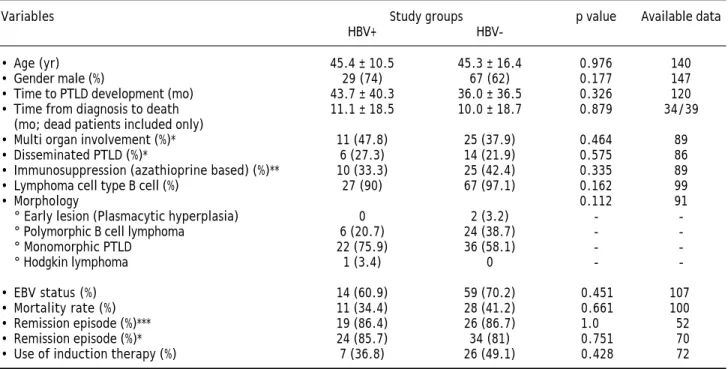
Characteristics of PTLD patients with and without HBV infection are summarized in table 1. Chi-square test showed that HBV positive-PTLD pa-tients were comparable to HBV negative-PTLD in gender (p = 0.18), age at transplantation (p = 0.976), time from transplantation to PTLD develop-ment (p = 0.326), lymphoma cell type (p = 0.16), re-mission (p = 0.75), mortality rate (p = 0.66), multi-organ involvement (based on our definition; p = 0.46); and disseminated PTLD (based on our defi-nition; p = 0.57). Histopathological evaluations were also not significantly different between the two groups (p = 0.11).
Table 2 compares HBV-positive vs. HBV-negative PTLD respecting organ involvements by the PTLD. HBV positive PTLD patients were significantly less likely to complicate spleen (0 vs. 23%, respectively; p = 0.015); but no other differences were seen for the two patient groups. At the last follow up, 39 pa-tients (39% of reported; 50 missing data) were dead.
Table 1. Characteristics of liver transplant recipients.
Variables Study groups p value Available data
HBV+
HBV-• Age (yr) 45.4 ± 10.5 45.3 ± 16.4 0.976 140
• Gender male (%) 29 (74) 67 (62) 0.177 147
• Time to PTLD development (mo) 43.7 ± 40.3 36.0 ± 36.5 0.326 120
• Time from diagnosis to death 11.1 ± 18.5 10.0 ± 18.7 0.879 34/39
(mo; dead patients included only)
• Multi organ involvement (%)* 11 (47.8) 25 (37.9) 0.464 89
• Disseminated PTLD (%)* 6 (27.3) 14 (21.9) 0.575 86
• Immunosuppression (azathioprine based) (%)** 10 (33.3) 25 (42.4) 0.335 89
• Lymphoma cell type B cell (%) 27 (90) 67 (97.1) 0.162 99
• Morphology 0.112 91
° Early lesion (Plasmacytic hyperplasia) 0 2 (3.2) -
-° Polymorphic B cell lymphoma 6 (20.7) 24 (38.7) -
-° Monomorphic PTLD 22 (75.9) 36 (58.1) -
-° Hodgkin lymphoma 1 (3.4) 0 -
-• EBV status (%) 14 (60.9) 59 (70.2) 0.451 107
• Mortality rate (%) 11 (34.4) 28 (41.2) 0.661 100
• Remission episode (%)*** 19 (86.4) 26 (86.7) 1.0 52
• Remission episode (%)* 24 (85.7) 34 (81) 0.751 70
• Use of induction therapy (%) 7 (36.8) 26 (49.1) 0.428 72
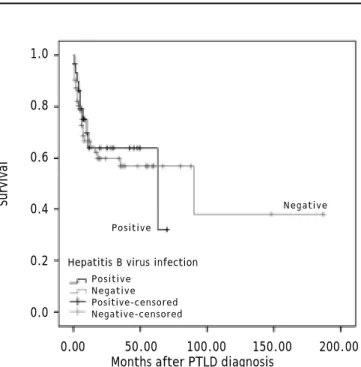
Using death by any cause as the final outcome, log-rank test did not show any difference between the two groups in survival (p = 0.78) (Figure 1). Nor was any difference seen between the two groups when only death due to PTLD (based on our defini-tion) was used as the final outcome (p = 0.36). Five-year survival rate for HBV-positive PTLD patients was 64% compared to 56% for HBV-negative PTLD patients.
DISCUSSION
PTLD is a potentially fatal complication of trans-plantation in all types of organ recipients. The inci-dence, features and prognosis of PTLD varies Figure 1. Survival curves of HBV-positive and –negative PLTLD patients (death of anuy cause as the outcome).
Survival
1.0
0.8
0.6
0.4
0.2
0.0
0.00 50.00 100.00 150.00 200.00
Months after PTLD diagnosis
Positive Negative Positive-censored Negative-censored Hepatitis B virus infection
Negative
Positive
Table 2. Frequency of involved organs in 168 liver transplant recipients with early or late onset PTLD.
Involved organs HBV infection p value Available data
HBV+
HBV-Orbital 0 1(1.8) 1.0 79
Skin 1(4.5) 0 0.278 79
Genitalia 2(9.1) 0 0.075 79
CNS 1(4.5) 3(5.3) 1.0 79
Spleen 0 13(22.8) 0.015 79
Colon 2(9.5) 3(5.5) 0.612 76
Small intestine 3(14.3) 4(7.1) 0.383 77
Renal involvement 1(4.5) 1(1.8) 0.482 79
Liver involvement 11(45.8) 45(54.4) 0.349 101
Respiratory system 4(20) 11(22.4) 1.0 69
Bone marrow 4(18.2) 10(17.5) 1.0 79
between different organ transplant patients due to several interfering factors including the transplan-ted organ, doses of immunosuppression used, the use of antibody induction, and viral infections most notably EBV infection.31-33 In non-transplant
setting, hepatophil viruses are shown to have pro-vocative roles in inducing lymphoproliferative disor-ders. Recently, it has been suggested that HBV reactivation after transplantation is a risk factor for the development of PTLD.12,13 One reason for
this risk enhancement is reportedly the immunosu-ppressive treatment in these patients due to preven-ting rejection episodes leading to reactivation of chronic infections including HBV.
In this study of international data, we gathered the existing data from HBV infected liver transplant recipients who had developed PTLD in their disease course to analyze and search any potential associa-tions between HBV infection in PTLD patients and PTLD features, behavior and prognosis in liver graft recipients. The unexpected finding of this stu-dy is that we found almost no difference between HBV positive and negative PTLD patients. Al-though, there might be some criticisms on the me-thodology of our study which would be later discussed, we think that this finding is not only due to the limited number of included patients because to the best of our knowledge, there is no other study that has investigated even a comparable number of HBV positive patients in PTLD setting.
Moreover, this topic has not been previously dis-cussed except for a series of 3 cases12 and one case
re-port13 and they have provided the first evidence for a
in several cases. For example, if HBV infection could have a provocative role for development of PTLD, at least we should expect a shorter time from transplan-tation to PTLD development in HBV positive PTLD patients compared to HBV negative controls; as we can observe it in EBV positive patients in transplan-tation setting.32,33 Moreover, no disparities were also
found in the behavior of the PTLD between HBV-po-sitive and -negative liver recipients including remis-sion rates and survival rates. This finding suggests that, even if HBV has any role in the development of the PTLD, it does not induce a more malevolent or fatal form of the disease than that in non-infected subjects. An interesting observation was that HBV positivity was not associated with a hepatic localiza-tion of the PTLD; the only disparity found between the two groups was a less likelihood of HBV positive PTLD lesions to complicate the spleen. In fact, none of HBV positive subjects represented a spleen compli-cation while 23% of HBV negative controls developed splenal involvement by PTLD. Although we have no explanation for this observation, the considerable di-fference observed cannot be simply disregarded as an incidence.
To exclude any simultaneous messing effects of hepatitis C virus infection on our results (5 cases), we reanalyzed our data after excluding these cases. No change has been observed after the adjustment (data not shown). Rituximab has also been reported to reactivate HBV infection and as a consequence it might play as a stimulating factor for the develop-ment of lymphoma.34-36 Unfortunately, we only had
data of our patients after the development of the PTLD; so, we were not able to investigate a poten-tial impact of rituximab on HBV-associated PTLD.
Nevertheless, we analyzed data of our HBV posi-tive PTLD liver recipients with respect to having (10; 24%) or not having (32; 76%) a history of ri-tuximab treatment after PTLD emergence. We found that patients under rituximab treatment significant-ly had higher rate of multi-organ disease (data not shown); but it probably was the rationale for which rituximab was employed for these patients. Mo-reover, we found no survival difference between HBV positive patients who had or had not used ri-tuximab; this can confirm current study’s findings that HBV has no prominent role in the prognosis of the PTLD; since despite its HBV activating role, ri-tuximab had no deteriorating impact on the outcome of HBV positive PTLD patients. Due to the very li-mited number of cases with a history of antiviral therapy, we were not able to evaluate potential im-pact of antiviral agents on the PTLD outcome.
Potential criticisms may arise over our study. First, our study population was gathered from diffe-rent reports with inconsistent approaches. We also believe that this is the unique major limitation for this study leading to substantial missing data for some of study variables and thus, decreasing the power of our analyses. This limitation was most prominent for special data that are not typically included in reports on PTLD patients. Another limi-tation due to the inconsistencies available between the included studies was that results of different studies were not presented in the same way. For example, report of any response to treatment was presented very dissimilarly in different studies; whi-le in one study partial and compwhi-lete remission was used to translate the results, in another only “res-ponse to treatment” was used and in some others no specific terminology was employed. So, we ought to invent new methods to cumulate the existing data for analysis.
We conclude that, HBV infection has no signifi-cant impact on inducing some distinct types of PTLD and represents no survival effect in PTLD setting. Future prospective studies are needed for confirming our findings.
REFERENCES
1. Pourfarziani V, Ramezani MB, Taheri S, Izadi M, Einollahi B. Immunogenicity of pneumococcal vaccination in renal transplant recipients and hemodialysis patients: a compa-rative controlled trial. Ann Transplant 2008; 13(3): 43-7. 2. Penn I, Hammond W, Brettschneider L, Starzl TE.
Malig-nant lymphomas in transplantation patents. Transplant Proc 1969; 1(1): 106-12.
3. Levy M, Backman L, Husberg B, et al. De novo malignancy following liver transplantation: a single-center study.
Transplant Proc 1993; 25(1, Pt. 2): 1397-9.
4. Nalesnik MA, Jaffe R, Starzl TE, et al. The pathology of posttransplant lymphoproliferative disorders occurring in the setting of cyclosporine A-prednisone immunosuppres-sion. Am J Pathol 1988; 133(1): 173-92.
5. Stieber AO, Boillot O, Scotti-Foglieni C, et al. The surgical implications of the posttransplant lymphoproliferative di-sorders. Transplant Proc 1991; 23(1, Pt. 2): 1477-9. 6. Malatack JF, Gartner JC Jr, Urbach AH, Zitelli BJ.
Orthoto-pic liver transplantation, Epstein-Barr virus, cyclospori-ne, and lymphoproliferative disease: a growing concern. J Pediatr 1991; 118(5): 667-75.
7. Renard TH, Andrews WS, Foster ME. Relationship between OKT3 administration, EBV seroconversion, and the lym-phoproliferative syndrome in pediatric liver transplant re-cipients. Transplant Proc 1991; 23(1, Pt 2.): 1473-6. 8. Cox KL, Lawrence-Miyasaki LS, Garcia-Kennedy R, et al. An
increased incidence of Epstein-Barr virus infection and lym-phoproliferative disorder in young children on FK506 after liver transplantation. Transplantation 1995; 59(4): 524-9. 9. Ulcickas YM, Quesenberry CP Jr, Guo D, et al. Incidence
10. Wang F, Xu RH, Han B, et al. High incidence of hepatitis B virus infection in B-cell subtype non-Hodgkin lymphoma compared with other cancers. Cancer 2007: 109: 1360. 11. Kim JH, Bang YJ, Park BJ, et al. Hepatitis B virus
infec-tion and B-cell non-Hodgkin’s lymphoma in a hepatitis B endemic area: a case-control study. Jpn J Cancer Res
2002: 93: 471.
12. Luo Y, Zhang AB, Huang H, Zheng SS. Is hepatitis B virus reactivation a risk factor in the development of post-transplant lymphoproliferative disorder following liver transplantation? Chin Med J 2008; 121(13): 1237-40. 13. Zhang A, Zhang M, Shen Y, Wang W, Zheng S. Hepatitis B
virus reactivation is a risk factor for development of post-transplant lymphoproliferative disease after liver transplantation. Clin Transplant 2009; 23(5): 756-60. Epub 2009 Aug 2.
14. McCormack L, Hany TI, Hübner M, Petrowsky H, Mullhaupt B, Knuth A, et al. How useful is PET/CT imaging in the ma-nagement of post-transplant lymphoproliferative disease after liver transplantation? Am J Transplant 2006; 6(7): 1731-6.
15. Aseni P, Vertemati M, De Carlis L, Sansalone CV, Bonacina E, Minola E, et al. De novo cancers and post-transplant lymphoproliferative disorder in adult liver transplantation.
Pathol Int 2006; 56(11): 712-5.
16. Nagarsheth NP, Kalir T, Rahaman J. Post-transplant lym-phoproliferative disorder of the cervix. Gynecol Oncol
2005; 97(1): 271-5.
17. Dhillon MS, Rai JK, Gunson BK, Olliff S, Olliff J. Post-trans-plant lymphoproliferative disease in liver transPost-trans-plantation.
Br J Radiol 2007; 80(953): 337-46. Epub 2007 Mar 28. 18. Burra P, Buda A, Livi U, Rigotti P, Zanus G, Calabrese F, et
al. Occurrence of post-transplant lymphoproliferative di-sorders among over thousand adult recipients: any role for hepatitis C infection? Eur J Gastroenterol Hepatol
2006; 18(10): 1065-70.
19. Cano B, Sanchez G, Montoliu G, Insa S, Masb F, Calderero V, et al. Imaging of liver-localized post-transplantion lym-phoproliferative disease as complication of liver trans-plantion. Eur J Radiol Ext 2004; 49: 61-6.
20. Baccarani U, Piselli P, Serraino D, Adani GL, Lorenzin D, Gambato M, et al. Comparison of de novo tumours after li-ver transplantation with incidence rates from Italian can-cer registries. Dig Liver Dis 2010; 42(1): 55-60. Epub 2009 Jun 3.
21. Lemoine A, Pham P, Azoulay D, Saliba F, Emile JF, Saffroy R, et al. Detection of gammopathy by serum protein elec-trophoresis for predicting and managing therapy of lym-phoproliferative disorder in 911 recipients of liver transplants. Blood 2001; 98(5): 1332-8.
22. Lorenzini S, Andreone P, Gramenzi A, et al. Posttransplant lymphoproliferative disorders in liver transplanted pa-tients: a report of four cases. Transplant Proc 2006; 38: 1477-80.
23. Nuckols JD, Baron PW, Stenzel TT, Olatidoye BA, Tuttle-Newhall JE, Clavien PA, Howell DN. The pathology of
liver-localized post-transplant lymphoproliferative disease: a report of three cases and a review of the literature. Am J Surg Pathol 2000; 24(5): 733-41. Review.
24. De Diego JI, Prim MP, Hardisson D, Verdaguer JM, Jara P. Post-transplant lymphoproliferative disease in tonsils of children with liver transplantation. Int J Pediatr Otorhino-laryngol 2001; 58(2): 113-8.
25. Zimmermann T, Hoppe-Lotichius M, Tripkovic V, Barreiros AP, Wehler TC, Zimmermann A, et al. Liver transplanted patients with preoperative autoimmune hepatitis and im-munological disorders are at increased risk for Post-Transplant Lymphoproliferative Disease (PTLD). Eur J Intern Med 2010; 21(3): 208-15.
26. Norin S, Kimby E, Ericzon BG, Christensson B, Sander B, Söderdahl G, Hägglund H. Posttransplant lymphoma-a sin-gle-center experience of 500 liver transplantations. Med Oncol 2004; 21(3): 273-84.
27. Capello D, Cerri M, Muti G, Berra E, Oreste P, Deambro-gi C, et al. Molecular histogenesis of posttransplanta-tion lymphoproliferative disorders. Blood 2003; 102: 3775-85.
28. Avolio AW, Agnes S, Barbarino R, Magalini SC, Frongillo F, Pagano L, et al. Posttransplant lymphoproliferative disor-ders after liver transplantation: analysis of early and late cases in a 255 patient series. Transplant Proc 2007; 39(6): 1956-60.
29. Rohr JC, Wagner HJ, Lauten M, Wacker HH, Jüttner E, Hanke C, et al. Differentiation of EBV-induced post-trans-plant Hodgkin lymphoma from Hodgkin-like post-transpost-trans-plant lymphoproliferative disease. Pediatr Transplant 2008; 12(4): 426-31.
30. Opelz G, Henderson R. Incidence of non-Hodgkin lymphoma in kidney and heart transplant recipients. Lancet 1993; 342: 1514-6.
31. Izadi M, Taheri S. Features, predictors and prognosis of lymphoproliferative disorders post-liver transplantation regarding disease presentation time: Report from the PTLD.Int survey. Ann Transplant 2011; 16(1): 39-47. 32. Khedmat H, Alavian SM, Taheri S. Significance of
Epstein-Barr virus infection in the outcome of renal transplant pa-tients with lymphoproliferative disorders. Ann Transplant
2010; 15(2): 40-4.
33. Izadi M, Taheri S. Significance of in situ hybridization re-sults for EBV-encoded RNA in post-transplantation lympho-proliferative disorder setting: Report from the PTLD.Int survey. Ann Transplant 2010; 15(4): 102-9.
34. Dervite I, Hober D, Morel P. Acute hepatitis B in a patient with antibodies to hepatitis B surface antigen who was re-ceiving rituximab [Letter]. N Engl J Med 2001; 344: 68-9. 35. Ng HJ, Lim LC. Fulminant hepatitis B virus reactivation