Comparison of results of combined
liver-kidney transplantation
vs.
isolated liver transplantation
Victoria Aguilera,*,† Isabel Ferrer,* Marina Berenguer,*,†,‡ Jairo Rivera,§
Ángel Rubín,* Ángel Moya,§ Eugenia Pareja,§ Jaime Sánchez,|| Martín Prieto,*,† José Mir||
* Hepatology Unit. Hospital Universitario La Fe, Valencia, Spain.
† Centro de Investigación Biomédica en Red de Enfermedades Hepáticas y Digestivas (CIBERehd). Spain. ‡ Faculty of Medicine, University of Valencia, Spain. § Surgery and Liver Transplantation Unit. Hospital La Fe, Valencia Spain.
|| Nephrology Service, Hospital Universitario La Fe, Valencia, Spain.
ABSTRACT
Introduction. Combined liver-kidney transplantation (LKT) is the best therapeutic option for patients with end-stage liver and kidney disease. Objectives. To analyze baseline characteristics and clinical outcome of LKT compared to isolated liver transplantation (LT). Material and methods. The study included 16 LKT per-formed between 1998 and 2006 and 32 LT matched by age, sex, date and indication for transplantation. De-mographic, pretransplant, post-transplant and survival variables were analyzed. Results. As planned by the study design, mean age, distribution by sex and indication for LT were similar between groups. The most common indication for LT was HCV- and/or alcohol-induced cirrhosis. The most common indication for KT was renal failure, in most cases secondary to glomerulonephritis. Twelve patients (69%) were on dialysis before LKT. Hepatocellular carcinoma and diabetes mellitus pre-transplantation were similar between groups. However pretransplant arterial hypertension (AHT) was higher in LKT than LT (50% vs. 19%; p = 0.02). In the post-transplant: reoperation due to bleeding, bacterial infections, liver rejection, AHT and median creatinine levels at 1st and 3rd years were similar in LKT and LT. In contrast, early post-transplant dialysis was higher in LKT than LT (31% vs. 3%; p = 0.01). Survival rates at 1st, 3rd, 5th and 7th years were similar in both groups (87.5%, 74%, 74% and 66% vs. 81%, 75%, 75% and 75% in LT and LKT, respectively).
Conclusions. LKT is an effective therapeutic option in patients with end-stage liver and kidney disease. Most early and late complications and long-term survival are similar to those observed with LT.
Key words. Kidney transplantation. Liver transplantation. Outcome. Metabolic complications.
Correspondence and reprint request: Victoria Aguilera, M.D. Hepatology Unit, Hospital Universitario La Fe, Valencia, Spain Boulevar Sur /S/N
E-mail: [email protected]
Manuscript received: June 27, 2012. Manuscript accepted: August 18, 2012. INTRODUCTION
Liver-kidney transplantation (LKT) is the best therapeutic option for patients with end-stage liver
and kidney disease.1 Despite the fact that results in
terms of long-term post-transplant survival are comparable to those of liver transplantation (LT)
and kidney transplantation (KT) alone,2-8 the
growing demand associated with the organ short-age requires a correct selection of candidates for combined transplantation. Increased post-LT morbidity and mortality has been reported in
patients with pre-LT renal dysfunction.9-11 However,
the optimal moment to perform a simultaneous combined transplantation is not well defined and there are no clinical guidelines on this topic. Furthermore, it is difficult to predict which candi-dates for LT with renal dysfunction will improve their renal function after transplant. In recent years, with the introduction of the MELD system for organ allocation, the number of combined LKT
has progressively increased.12,13
The first transplant performed in our institution was in 1998. Since then, the number has increased over the last years. The objective of this study was to review our experience in combined LKT from the point of view of survival and post-transplant compli-cations and to compare it with a control group of LT alone.
MATERIAL AND METHODS
our institution. This group of LKT was compared to a control group of LT matched by date and indica-tion for liver transplantaindica-tion, age and sex in a ratio of 2:1 (n = 32).
The indication of LKT was established by the liver and kidney transplant selection committees of our hospital. Candidates for LKT were patients with an indication for liver transplantation due to end stage
of liver disease with Child-Pugh ≥ B9 or
symptoma-tic portal hypertension with or without hepatocelu-llar carcinoma (within the Milan criteria) and with concomitant chronic renal failure: < 30 mL/min in the glomerular filtration rate or > 30% of glomeru-losclerosis or fibrosis on hemodialysis for more than 8 weeks, or with a glomerular filtration rate less than 30 mL/min. Moreover, patients with polycystic liver-kidney disease with criteria of simultaneous li-ver-kidney transplantation and patients with hipe-roxaluria were also considered candidates for combined LKT.
The number of LKT performed was analyzed by periods and compared with total isolated LT.
The data analyzed were collected retrospectively by review of patient medical records. The data collected included:
• Recipient demographic data (age, sex) and indica-tion for liver and kidney transplantaindica-tion.
• Pretransplant data related to the liver were (pre-sence of cirrhosis, Child-Pugh stage, MELD (model of end stage liver disease) score pretrans-plantation, presence of hepatocellular carcinoma) and kidney (pretransplant need for dialysis, crea-tinine clearance calculated by the abbreviated Modification of Diet in Renal Disease (MDRD) formula.
• Pretransplant diabetes mellitus (DM) or arterial hypertension (AHT).
• Donor demographic data (age, sex), cold and warm ischemia times of the kidney and liver. • Immediate post-transplant data (surgical data,
cross-match, days of intensive care unit (ICU) stay and days of hospitalization, need for reoperation due to bleeding, creatinine at 1 month, post-transplant need for dialysis and development of bacterial infections in the first month.
• Induction and maintenance immunosuppression. • Late post-transplant data (incidence of liver and
kidney rejection, incidence of DM defined as the need of insulin therapy, oral antidiabetics or die-tetic treatment to mantain fasting glucose levels below 120 mg/dL and AHT defined as systolic
blood pressure ≥ 140 mmHg and a diastolic
pres-sure ≥ 90 mmHg at 1st and 3rd years, late
car-diovascular complications (ischemic heart disease, cerebrovascular accidents), development of de novo tumors, creatinine at 1st and 3rd years), and
• Survival rates in both patient groups.
The standard induction immunosuppression used at our center in LKT is three-drug-based therapy [calcineurin inhibitor (target levels between 250-350 ng/mL), mycophenolate mofetil (1,000 mg tid) and steroids (prednisone 20 mg/day)] and the mainte-nance immunosuppression is based on two-drug the-rapy [calcineurin inhibitor (100-200 ng/mL) and mycophenolate mofetil (1,000 mg tid)] with low doses of steroids. In isolated LT induction is usually based on calcineurin inhibitors and steroids and maintenance with calcineurin inhibitor monotherapy when possible.
Combined LKT was always performed with a cadaveric donor and the same donor for both grafts. The standard surgical technique for liver transplan-tation was orthotopic liver transplantransplan-tation with pre-servation of the vena cava, followed by implantation of the renal allograft, usually in the right iliac fossa.
The SPSS 19 statistical package was used for sta-tistical analysis. Categorical variables were
compa-red using the χ2 test or Fisher’s exact test when
appropriate. Continuous variables were expressed as mean ± SD if they followed a normal distribution, and compared using Student’s t test. If these varia-bles did not follow a normal distribution, they were expressed as median and range, and compared using
the Mann-Whitney test. A p-value ≤ 0.05 was
consi-dered significant.Kaplan-Meier curves were used for survival analysis and the log-rank test to compare survival curves.
RESULTS
Sixteen LKT patients (15 adult and 1 pediatric) were performed from January 1998 to December 2006 and were matched to 32 isolated LT by date, age, sex and indication for liver transplantation.
Rate of LKT over time
Baseline characteristics
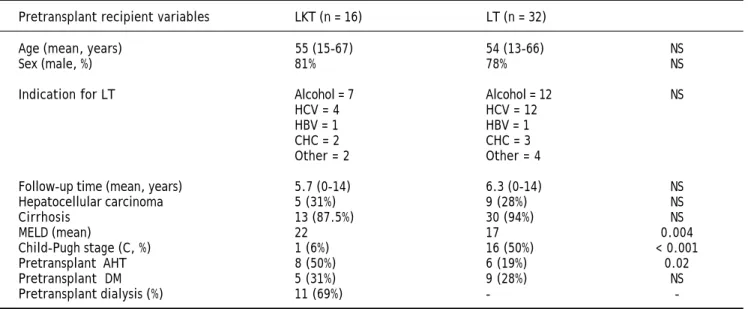
Table 1 shows the demographic characteristics and indications for LKT. The main indication for LT was HCV- and/or alcohol-induced cirrhosis. In turn, the main indication for KT was chronic renal failure, and this chronic renal failure was
associa-ted with chronic glomerulonephritis in most of our cases.
Comparison between LKT and LT
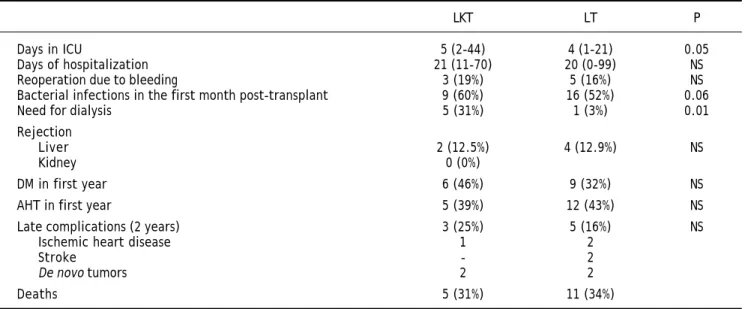
Tables 2 and 3 show recipient demographic cha-racteristics, indications for transplantation and
pre-Table 1. Indications for liver and kidney transplantation (n = 16).
Age (years)/ Date Indication for LT Indication for KT Follow-up
Sex of LKT
1 42/M 1998 HCV + alcohol C Chronic GN Alive
2 40/F 1999 Polycystic liver disease Polycystic kidney disease Dead (sepsis)
3 55/F 1999 Polycystic liver disease Polycystic kidney disease Dead (sepsis)
4 15/M 2001 Hyperoxaluria type 1 Hyperoxaluria type 1 Alive
5 48/M 2002 HCV + alcohol C Diabetic nephropathy Dead
(Haemorrhage)
6 65/M 2003 Alcohol C Glomerulopathy (90% sclerosis) Alive
7 49/M 2003 HCV C + HCC IgA GN Alive
8 42/M 2004 HCV + Alcohol C Proliferative GN Death
(Decompensated cirrhosis)
9 65/M 2004 Alcohol C Mesangial IgA GN Alive
10 58/M 2005 Alcohol C + HCC Diffuse glomerulosclerosis Alive
11 54/M 2005 HCV + alcohol C + HCC Cryoglobulinemic GN Death
(Lung neoplasia)
12 44/M 2005 Alcohol C Hypocomplementemic glomerular nephropathy Alive
13 67/M 2005 Alcohol C Extracapillary proliferative GN Alive
14 59/F 2006 HCV C Membranoproliferative GN Alive
15 57/M 2006 HBV C Mesangial IgA GN Alive
16 55/M 2006 Alcohol C Chronic GN Alive
HCC: hepatocellular carcinoma. GN: glomerulonephritis. C: cirrhosis. CRF: chronic renal failure. HRS: hepatorenal syndrome. LT: isolated liver transplanta-tion. LKT: liver and kidney transplantatransplanta-tion. HCV: hepatitis C virus. HBV: hepatitis B virus. M: male. F: female.
Table 2. Pretransplant patient characteristics.
Pretransplant recipient variables LKT (n = 16) LT (n = 32)
Age (mean, years) 55 (15-67) 54 (13-66) NS
Sex (male, %) 81% 78% NS
Indication for LT Alcohol = 7 Alcohol = 12 NS
HCV = 4 HCV = 12
HBV = 1 HBV = 1
CHC = 2 CHC = 3
Other = 2 Other = 4
Follow-up time (mean, years) 5.7 (0-14) 6.3 (0-14) NS
Hepatocellular carcinoma 5 (31%) 9 (28%) NS
Cirrhosis 13 (87.5%) 30 (94%) NS
MELD (mean) 22 17 0.004
Child-Pugh stage (C, %) 1 (6%) 16 (50%) < 0.001
Pretransplant AHT 8 (50%) 6 (19%) 0.02
Pretransplant DM 5 (31%) 9 (28%) NS
Pretransplant dialysis (%) 11 (69%) -
transplant and post-transplant variables in both pa-tient groups. The percentage of papa-tients with Child-Pugh stage C was higher in patients with isolated LT (56% vs. 6% in LKT; p = 0.001). MELD score before LT was 22 in LKT vs. 17 in LT (p = 0.004). Of pa-tients with LKT, 11 (69%) were on hemodialysis more than three months before transplantation and in the rest, the glomerular filtration rates were < 30 mL/min. Pretransplant DM was present in 31% of LKT and 28% of LT patients (p = ns). Pretransplant arterial hypertension was present in 50% of LKT vs. 19% of LT patients (p = 0.02).
Table 4 shows donor and surgical variables, with no significant differences between both groups.
Survival
With a median follow-up of 6.1 years (range: 0-13.9), LKT survival was 81% and 75% at 1st and
3rd,5th and 7thyearsrespectivelyand LT survival
was 87.5%, 74%, 74% and 66% at 1st, 3rd, 5th and 7th years respectively.
InLKT group, 3 patients (19%) died in the first
year (during the first month post-LKT) and five pa-tients (31%) during the overall follow-up vs. 4 (12.5%) patients in the first year and 11 patients (34%) during the overall follow-up in the LT group. Causes of death in the LKT group were: septic shock in three patients and subsequent multiorgan failure, all after post-transplant bleeding. Particularly, the two patients that were transplanted due to polycys-tic liver and kidney disease died during the first month due to sepsis. One LKT patient died in the 6th year post-LKT due to recurrent hepatitis C cir-rhosis and kidney renal failure and the other pa-tient died due to metastatic lung neoplasia two years after LKT. In the LT group, causes of death were sepsis (n = 1), multiorgan failure (n = 2), recurrence of hepatocellular carcinoma (n = 1) chronic rejection (n = 1), primary recurrent disease Table 3. Post-transplant complications.
LKT LT P
Days in ICU 5 (2-44) 4 (1-21) 0.05
Days of hospitalization 21 (11-70) 20 (0-99) NS
Reoperation due to bleeding 3 (19%) 5 (16%) NS
Bacterial infections in the first month post-transplant 9 (60%) 16 (52%) 0.06
Need for dialysis 5 (31%) 1 (3%) 0.01
Rejection
Liver 2 (12.5%) 4 (12.9%) NS
Kidney 0 (0%)
DM in first year 6 (46%) 9 (32%) NS
AHT in first year 5 (39%) 12 (43%) NS
Late complications (2 years) 3 (25%) 5 (16%) NS
Ischemic heart disease 1 2
Stroke - 2
De novo tumors 2 2
Deaths 5 (31%) 11 (34%)
ICU: intensive care unit. DM: diabetes mellitus. AHT: hypertension. LT: liver transplantation. LKT: liver-kidney transplantation. Table 4. Baseline donor and surgical characteristics.
LKT (n = 16) LT (n = 32) P
Age (years) 40.5 (17-69) 44.5 (14-81) NS
Sex (% male) 10 (63%) 22 (69%) NS
CIT (mean) (liver) (min) 370 (125-650) 302 (105-710) NS
WIT (mean) (liver) (min) 35 (20-65) 40 (20-80) NS
CIT (mean) (kidney) (min) 408 (180-600) -
-WIT (mean) (kidney) 0 -
-Positive cross-match 0% -
(n = 3) and others (n = 3). Survival in the first 3 months post-transplant was lower in the LKT group (81% vs. 97% in LT). No differences were observed between groups after the third month post-trans-plantation (p = ns) (Figure 1).
Liver graft survival was the same as no patients were re-transplanted. Kidney graft survival was si-milar at 1, 3, 5th year post-kidney transplant. Only
Figure 1. Survival of combined liver-kidney transplant and
isolated liver transplant. LKT: liver-kidney transplantation. LT: liver transplantation. Survival of LKT vs. LT. LKT survival: 81%, 75%, 75%, 75% at 1st, 3rd, 5th and 7th year. LT survival: 87%, 74%, 74% and 66% at 1st, 3rd, 5th and 7th year.
Cumulative survival (%)
1.0
0.8
0.6
0.4
0.2
0.0
0 1 2 3 4 5 6 7 8 9 10 11 12 13 14
Follow-up (years)
one patient lost his kidney the 7th year post-LKT and died four months later because of decompensa-ted cirrhosis and renal failure.
Post-transplant complications
• ICU stay was longer in LKT [5 (2-44) days vs. 4 (1-21) days; p = 0.05] and bacterial infection nearly reached the statistical significance (60 vs. 52%, p = 0.06). In contrast, hospital stay, reoperations due to bleeding in the first month were similar in both groups. Five patients (31%) in the LKT group required temporary hemodialysis after transplantation versus 1 patient (3%) in the LT group (p = 0.01). The incidence of liver rejection was similar in both groups (12.5% in LKT vs. 12.9% in LT), and there was no case of kidney rejection. The incidence of DM and AHT at 1st and 3rd years was similar in both groups.
• Induction and maintenance immunosuppression showed differences between isolated LT and LKT because of the standard practice in our hospital. Induction immunosuppression was based on cyclosporine in 25% and tacrolimus in 75% of LKT, whereas cyclosporine was used in 62% and tacrolimus in 38% of LT (p = 0.03). Mycophenolate use was greater in LKT than LT both in the induction and maintenance phase (87% vs. 6%; p = 0.1) and (83% vs. 41%; p = 0.01), respectively. Prednisone duration was greater in LKT [579 (246-1,286) days vs. 364 (32-2,510) days in LT; p = 0.4). • Median creatinine at 1 and 3 years
post-trans-plant was similar in both groups.
Table 5. Glomerular filtration rates after LKT calculated by MDRD 4 (modification of Diet in Renal Disease).
Date of LKT GF 1st month GF 1st year GF 3rd year GF 5th year
1 1998 81 77 85 62
2 1999 Dead Dead Dead Dead
3 1999 Dead Dead Dead Dead
4 2001 98 105 83 74
5 2002 Dead Dead Dead Dead
6 2003 103 64 89 70
7 2003 35 30 33 54
8 2004 193 97 69 63
9 2004 18 49 46 42
10 2005 6 91 120 145
11 2005 124 93 Dead Dead
12 2005 43 43 Not available Not available
13 2005 64 53 94 89
14 2006 68 54 50 59
15 2006 66 72 71 71
16 2006 93 66 66 81
• Glomerular filtration rates calculated by MDRD 4 in LKT are shown in table 5 with a mean fil-trate at five years of 72 mL/min.
DISCUSSION
Simultaneous LKT is an appropriate therapeutic option for patients with end-stage liver and kidney disease. Since the first LKT was performed by Mar-greiter in 1983, outcomes in terms of morbidity and mortality have improved mainly as a result of refi-nements in the surgical technique, with long-term survival rates comparable to those for LT and KT
alone.2-8 Survival rates at 3 and 5 years vary
depen-ding on the series and range from 72-82% and 62-78%, respectively, percentages similar to ours. Moreover, although LKT still represents a very small proportion of total LT and KT, the number of LKT has increased over time, coinciding with the in-troduction of the MELD system in most centers.
The indications for LKT are:
• Hereditary diseases affecting both organs, of which the most common is hepatorenal polycys-tic disease, especially when there is renal insuf-ficiency and symptomatic incapacitating hepatomegaly.
• Metabolic diseases, such as primary type I hype-roxaluria; and
• Coexisting liver and kidney diseases which are the more frequent indications.
Functional renal disorders concomitant to liver disease, such as hepatorenal syndrome or pre-renal acute renal failure are generally not indications for LKT, except in cases that do not improve after 3
months on hemodialysis.1,14 While the number of
si-multaneous LKT has increased, there are not many studies dealing with this special population. We have decided to perform a case-controlled study com-paring our series of LKT control patients undergo-ing LT alone. The main findundergo-ings of our study can be summarized as follows:
• Patient and graft survival are similar in patients undergoing LKT compared to patients undergo-ing LT alone.
• Early complications including stay in ICU, bac-terial infections and need of dialysis are more fre-quent in LKT patients.
• Late complications are comparable in both groups.
In our series, the most common indications for liver and kidney transplantation in LKT were HCV associated cirrhosis and alcoholic cirrhosis as the indication for LT and chronic glomerulonephritis as the indication for KT. Hepatorenal polycystic dis-ease accounted in two patients (12.5%) LKT, and there was only one LKT for hyperoxaluria because most LKT were performed in adults. These results are in agreement with other series reported in the
li-terature.15-18 One limitation of our case-controlled
study is that Child-Pugh was different between groups. This is likely explained by the fact that the presence of cirrhosis is currently considered a con-traindication for isolated kidney transplantation and hence LKT indication usually takes place in pa-tients with better liver function. However MELD score was higher in LKT than in isolated LT due to the weighting of serum creatinine in the model. Al-though, at our center the MELD system for LT alo-cation was fully implemented in 2007, the increase in the number of LKT performed after 2004, repor-ted as well in other series, could be a consequence that the implementation of the MELD system was being introduced at those years in our center.
Although patients who underwent LKT spent more days in the ICU, possibly due to the greater complexity of the surgical procedure, the overall hospital stay and the rate of immediate postoperative complications, and need for reoperation (variables related to early mortality in other series), were
simi-lar in both groups.4 Bacterial infections were more
frequent in the LKT patients, even though with no statistical significance. This finding might be related to a more potent immunosuppressive treatment in LKT patients. Steroids were with draw in LT during the 6th and 12th month post-liver transplant but in LKT, low doses of steroids are maintained in the long term.
It is interesting to note that there were no signifi-cant differences in the incidence of metabolic compli-cations, such as hypertension, diabetes, long-term development of cardiovascular problems or occurrence of de novo tumors. These complications are gene-rally more frequent in kidney transplant patients due to the typical arteriosclerotic complications of
chronic renal failure,19,20 but generally appear
during long-term follow-up.
Factors that have been associated with a poorer short-term survival in LKT are infections in the immediate postoperative period, intraabdominal hemorrhage and a more advanced liver disease
(Child-Pugh stage C).4,21 Our series confirmed a poorer
and intraabdominal hemorrhage. However, al-though the percentage of bacterial infections were higher in the LKT group, it did not reach statistical significance and the percentage of reoperations due to bleeding was similar between groups. It should be noted that the indication for transplantation in 2 of 5 patients who died in the LKT group was hepatore-nal polycystic disease, a condition that is sometimes accompanied by severe malnutrition and has been
associated with poorer survival rates after LKT.22
In our series, the two patients with polycystic disease died in the post-operative period due two sepsis. Malnutrition and a more potent immunosuppression may have been contributing factors. From the second year post-transplant, survival was similar in both groups, with good rates being achieved after 3 and 5 and 7 years of follow-up.
Numerous articles have reported the advantage of combined LKT in providing immunological
protec-tion to the renal graft.23,24 Possible mechanisms to
explain this effect are the trapping of HLA anti-bodies in the liver graft and the passage of lympho-cytes with the liver graft, resulting in a greater microchimerism and consequently greater toleran-ce.25-27 This advantage is more evident in
simulta-neous combined transplants, and less evident in
transplants performed sequentially.21,24 In our
series, there were no kidney graft rejections and the incidence of liver graft rejection was very low, results that are consistent with those previously reported in the literature.
In more than a third of patients who un-derwent LKT, the indication for LT was HCV-induced cir-rhosis. Although post-transplant protocol biopsies are performed in our center in patients whose indication for LT is HCV-induced cirrhosis, they are not routinely performed in patients with LKT due to the a priori absolute contraindication for interferon treatment to avoid
the risk of inducing renal rejection.28,29 To date, 3
of 6 patients are alive and have no evidence of advanced liver disease, however the histologic situation is unknown.
In conclusion, LKT is an effective therapeutic op-tion in patients with end-stage liver and kidney disease. Late complications as well as medium-term survival are comparable to those obtained with iso-lated LT and although two organs are used in the same recipient, the good results should not dis-courage this practice in patients in need of both or-gans. The difficulty in clinical practice remains in when to decide in each patient when she/he actually needs a simultaneous LKT.
FUNDING SOURCES
CIBERehd is funded by the Instituto de Salud Carlos III. All authors declare that they have no conflict of interest to disclosure.
REFERENCES
1. Davis CL, Gonwa TA, Wilkinson AH. Identification of pa-tients best suited for combined liver-kidney transplanta-tion: part II. Liver Transpl 2002; 8: 193-211.
2. Fong TL, Bunnapradist S, Jordan SC, Selby RR, Cho YW. Analysis of the United Network for Organ Sharing databa-se comparing renal allografts and patient survival in com-bined liver-kidney transplantation with the contralateral allografts in kidney alone or kidney-pancreas transplanta-tion. Transplantation 2003; 76: 348-53.
3. Moreno-Gonzalez E, Meneu-Diaz JC, García G, Jimenez Romero C, Loinaz Segurola C, Gomez Sanz R, Abradelo M, et al. Simultaneous liver-kidney transplant for combined renal and hepatic end-stage disease. Transplant Proc 2003; 35: 1863-5.
4. Baccaro ME, Pépin MN, Guevara M, Martín-Llahí M, Terra C, Torregrosa V, Mas A, et al. Evolución del doble trasplan-te de hígado y riñón en pacientrasplan-tes con cirrosis, estudio caso-control. Gastroenterol y Hepatol 2007; 30(Supl. 1): 184.
5. Simultaneous liver-kidney versus liver transplantation alone in patients with end-stage liver disease and kidney dysfunc-tion not on dialysis. Transplant Proc 2011; 43: 2669-77. 6. Chopra A, Cantarovich M, Bain VG. Simultaneous liver and
kidney transplants: optimizing use of this double resour-ce. Transplantation 2011; 91: 1305-9.
7. Sit B, Schilsky M, Moini M, Cartiera K, Arvelakis A, Kulkarni S, Formica R, et al. Combined liver kidney transplantation: critical analysis of a single-center experience. Transplant Proc 2011; 43: 901-4.
8. González MR, Ramírez P, Cascales P, Domingo J, López MD, Rios A, Sánchez F, et al. Thirteen cases of liver-kidney transplantation. Transplant Proc 2010; 42: 3162-3. 9. Davis CL. Impact of pretransplant renal failure: when is
listing for kidney-liver indicated? Liver Transpl 2005; 11(Suppl. 2): S35-S44.
10. Cuervas-Mons V, Millan I, Gavaler JS, Starzl TE, Van Thiel DH. Prognostic value of preoperatively obtained clinical and laboratory data in predicting survival follo-wing orthotopic liver transplantation. Hepatology 1986; 6: 922-7.
11. Nair S, Verma S, Thuluvath PJ. Pretransplant renal func-tion predicts survival in patients undergoing orthotopic liver transplantation. Hepatology 2002; 35: 1179-85. 12. Gonwa TA. Combined kidney liver transplant in the MELD
era: where are we going? Liver Transpl 2005; 11: 1022-5. 13. Bloom RD, Bleicher M. Simultaneous liver-kidney
transplan-tation in the MELD era. Adv Chronic Kidney Dis 2009; 16: 268-77 [Review].
14. Ruiz R, Hiro K, Wilkinson AH, Danovitch GM, Douglas GF, Ghobrial RM, Yersiz H, et al. Long-term analysis of combi-ned liver and kidney transplantation at a single center. Arch Surg 2006; 141: 735-42.
16. Mosconi G, Scolari MP, Feliciangeli G, D’Arcangelo GL, Bus-caroli A, D’Addio F, Conte D, et al. Combined liver-kidney transplantation-S. Orsola experience: nephrological as-pects. Transplant Proc 2006; 38: 1122-4.
17. Zanus G, Carraro A, Vitale A, Boccagni P, Brolese A, Neri D, Srsen N, et al. Combined liver and kidney transplanta-tion: analysis of Padova experience. Transplant Proc 2007; 39: 1933-5.
18. Kiberd B, Skedgel C, Alwayn I, Peltekian K. Simultaneous li-ver kidney transplantation: a medical decision analysis. Transplantation 2011; 91: 121-7.
19. Vanrenterghem YF, Claes K, Montagnino G, Fieuws S, Maes B, Villa M, Ponticelli C. Risk factors for cardiovascular events after successful renal transplantation. Transplan-tation 2008; 85: 209-16.
20. Johnston SD, Morris JK, Cramb R, Gunson BK, Neuberger J. Cardiovascular morbidity and mortality after orthotopic liver transplantation. Transplantation 2002; 73: 901-6. 21. Demirci G, Becker T, Nyibata M, Lueck R, Bektas H, Lehner
F, Tusch G, et al. Results of combined and sequential liver-kidney transplantation. Liver Transpl 2003; 9: 1067-78. 22. Faenza A, Fuga G, Nardo B, Varotti G, Faenza S, Stefoni S,
D’Arcangelo GL, et al. Combined liver-kidney transplanta-tion: the experience of the University of Bologna and the case of preoperative positive cross-match. Transplant Proc 2006; 38: 1118-21.
23. Creput C, Durrbach A, Samuel D, Eschwege P, Amor M, Kriaa F, Kreis H, et al. Incidence of renal and liver rejec-tion and patient survival rate following combined liver and kidney transplantation. Am J Transplant 2003; 3: 348-56. 24. Simpson N, Cho YW, Cicciarelli JC, Selby RR, Fong TL.
Comparison of renal allograft outcomes in combined li ver-kidney transplantation versus subsequent kidney transplantation in liver transplant recipients: Analysis of UNOS Database. Transplantation 2006; 82: 1298-303.
25. Summimoto R, Kamada N. Specific supression of allograft rejection by soluble class I antigen and complexes with mo-noclonal antibody. Transplantation 1990; 50: 678-82. 26. Theise ND, Nimmakayalu M, Gardner R, Illei PB, Morgan G,
Teperman L, Henegariu O, et al. Liver from bone marrow in humans. Hepatology 2000; 32: 11-6.
27. Starlz TE, Demetris AJ, Murase N, Ildstad S, Ricordi C, Trucco M. Cell migration, chimerisme and graft acceptan-ce. Lancet 1992; 339: 1579-82.
28. Cerny A. Hepatitis C after simultaneous liver-kidney transplantation. J Hepatol 2009; 51: 839-41 [Epub 2009 Aug 18].