Cherenkov resonances in vortex dissipation in superconductors
B. I. Ivlev and S. Mejı´a-RosalesUniversidad Auto´noma de San Luis Potosı´, Instituto de Fı´sica, A. Obrego´n 64, 78000 San Luis Potosı´, SLP, Mexico
M. N. Kunchur
Department of Physics and Astronomy, University of South Carolina, Columbia, South Carolina 29208 共Received 12 May 1999兲
When the velocity of vortices in a superconductor in the free flux flow regime exceeds the velocity of sound, each vortex produces Cherenkov radiation of sound waves. The velocity field of the lattice ions is localized on the Cherenkov cone, but the forces acting on the lattice are localized on the vortex positions. When the Cherenkov cone coincides with certain directions in the moving vortex lattice, the dissipation exhibits maxima. Since the direction of the Cherenkov cone is determined by the vortex velocity共electric field兲one can expect a series of resonant peaks in the current-voltage characteristic at particular values of electric field.
关S0163-1829共99兲02638-7兴
I. INTRODUCTION
In type-two superconductors the magnetic flux is carried by vortices. If the transport electric current greatly exceeds the pinning critical current jc the current-voltage character-istic (I-V curve兲becomes linear and one might expect such a linearity to hold up to the depairing current j0. Nevertheless such a free flux flow regime共FFF兲does not extend up to the depairing current. Even with the perfect removal of Joule heat, the finite rate of energy relaxation between the electron system and the lattice leads to a non-equilibrium state. As Larkin and Ovchinnikov1 共LO兲 have shown, such a state, created by a big constant electric field, results in enhance-ment of superconductivity like under action of microwaves.2 The increase of the order parameter is equivalent to a reduc-tion of the vortex core size which, in turn, leads to a devia-tion of the I-V curve from linearity observed experimentally.3–6
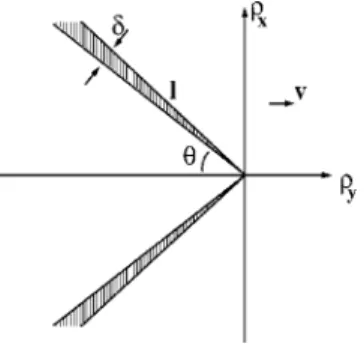
The LO effect is not a unique mechanism for producing a deviation of the I-V curve from linearity. If the vortex ve-locity exceeds the speed of sound in the crystal the dissipa-tion increases due to Cherenkov emission of sound waves. Each moving vortex creates an electric field acting on the crystal lattice and produces a shock wave 共the Cherenkov cone兲. In a thin film with a magnetic field perpendicular to it the situation is two dimensional and the cone reduces to two lines. The velocity of a crystal lattice is localized on the shock wave but the force acting on the lattice is localized on the vortex positions. The Cherenkov contribution to the total dissipation is proportional to the product of the velocity and the force and hence the dissipation is enhanced when there is a match between vortex positions and the shock wave. If moving vortices are arranged into a vortex lattice then the matching condition can be easily reached when a direction of the shock wave coincides with some direction of the vortex lattice. Since the direction of the shock wave is determined by vortex velocity 共electric field兲maxima of dissipation can be reached at some particular values of the electric field. According to this, the I-V curve should have a series of maxima as a function of voltage. This is the origin of the
Cherenkov resonances under vortex motion.
A necessity for sharp resonances is the existence of a relatively perfect lattice of moving vortices. At high vortex velocities this is indeed the case, through the well-known process of dynamic crystallization.7–9Thus in the regime of highly driven flux flow the resonances ought to be observ-able.
II. CRYSTAL LATTICE DYNAMICS
Consider a three-dimensional superconductor in which B is directed along the z axis. At sufficiently high transport current density j there is a free flow of vortices with the velocity
v⫽cE
B. 共1兲
Ifvexceeds the speed of sound one can expect the Cher-enkov effect resulting in some peculiarities in the current-voltage characteristics. The equation of motion for a lattice displacement uជ has the form
2uជ t2⫹␥
uជ
t⫺s 2
冉
2uជ
x2⫹ 2uជ y2
冊
⫽1
0 f
ជ共rជ⫺vជt兲, 共2兲
where fជ is a force density acting on a crystal lattice from electrons and0is a crystal density. fជwill be specified later. uជ is the longitudinal displacement and s is the velocity of longitudinal sound.共As we will show below, the effect of the longitudinal part of fជ(rជ) is more important than the trans-verse one.兲
The sound attenuation is represented phenomenologically in Eq.共2兲through the coefficient␥. In the Fourier represen-tation ␥⫽␣sk, where␣⯝s/vF.
10
With the new variableជ⫽rជ⫺vជt one can find a solution of Eq. 共2兲taking vជ to be along x and v⬎s:
PRB 60
uជ共ជ兲⫽⫺ 1 20s2
冕
d2R fជ共ជ⫹Rជ兲⌽共Rជ兲, 共3兲
where
⌽共Rជ兲⫽
冕
⫺⬁ ⬁ dky
ky
exp
冉
⫺ikyRy⫺
兩ky兩Rx
冊
⌰共Rx兲 共4兲 and⫽(v2/s2⫺1)1/2 and 2⫽␣v2/(v2⫺s2).If f (ជ)⬃␦(ជ) the solution 共3兲 corresponds to a Cheren-kov cone propagating in the x direction with the velocityv. In the limit of small attenuation →0, uជ(ជ)
⯝⌰关兩y兩(v2/s2⫺1)1/2⫺x兴. The Cherenkov cone produced by a single vortex is shown in Fig. 1. The crystal lattice displacement u⫽0 to the right of the cone and to the left is
u⬃ ប pF
s
vF
v
冑
v2⫺s2. 共5兲Of course, far to the left of the cone there is the boundary condition u⫽0 since the crystal does not move as a whole. This boundary condition does not affect the solution in the vicinity of the cone. The width of the shock wave due to sound attenuation is
␦⬃ ␣s
冑
v2⫺s2l, 共6兲 where l is the length along the cone.The additional dissipation density due to shock wave mo-tion is
w⫽
冕
d 2S ជf
uជ
t, 共7兲
where S is the surface area of the sample. Since uជ/t ⫽⫺vuជ/x, it follows from Eqs.共7兲and共3兲
w⫽⫺ v
20s2
冕
d2R⌽共Rជ兲
冕
d 2S fជ共ជ兲
fជ共ជ⫹Rជ兲
Rx . 共8兲
The total force density is
f
ជ共ជ兲⫽
兺
if
ជ(0)共ជ⫺rជ
i兲, 共9兲
where rជi are coordinates of vortices and fជ(0) corresponds to the force from a single vortex. According to this, Eq.共8兲has the form
w⫽ v
20s2
冕
d2RS ⌽共Rជ兲
⫻
冕
d2k
共2兲2ikxe
⫺ikជRជជf k (0)fជ
⫺k (0)
兺
i, j
eikជ(rជi⫺rជj). 共10兲 If moving vortices are organized into a vortex lattice then
w⫽ v
20s2
冉
B ⌽0冊
2
兺
b ibxជfb(0) f ជ⫺(0)b
冕
d2R⌽共Rជ兲e⫺ibជRជ,
共11兲
where bជ is a reciprocal vector of the vortex lattice and ⌽0 ⫽បc/e is the flux quantum.
Making the R integration in Eq.共11兲, one can obtain
w⫽ 1
0S
冉
B ⌽0冊
2
兺
bx⫽0 f ជb(0)
f
ជ⫺(0)b ibx
共bx⫹i兩by兩兲2⫺by2. 共12兲
III. FORCE ON A CRYSTAL LATTICE
The force acting on a crystal lattice by the electronic sys-tem can be written as
f
ជ(0)⫽enEជ, 共13兲
where n is the crystal density and Eជ is the electric field produced by vortex motion.11–13We ignore the Lorentz force since it does not contribute to dissipation and we omit the drag force on the crystal lattice due to impurities. We also neglect the drag force on vortices due to pinning14 since we are concerned with vortex motion in the free flux flow limit. The longitudinal part of Eជ (ⵜ⫻Eជlongitudinal⫽0) is local-ized within a distance much less than the London penetration depth. In this region the electric field has the form15
Eជ⫽ ប
2eⵜ˙⫺ⵜ⌽, ⵜ共ជ兲⫽ 1
2
冉
⫺yx
冊
, 共14兲
where is the singular vortex phase and ⌽ is the gauge invariant scalar potential. ⌽(ជ) is screened on the distance lE which is the penetration depth of the longitudinal electric field in superconductors. For simplicity we take the Bardeen-Stephen approach and put lE⬃, where is the coherence length. According to this, on the distance bigger than from the vortex core one can use the expression Eជ⫽(ប/2e)ⵜ˙ and since ˙⫽⫺v/xin the Fourier components,
Eជk⫽v⌽0 c
kx
k2
冉
ky ⫺kx冊
, kⰆ1
. 共15兲
IV. THE CHERENKOV DISSIPATION
Substitution of Eq. 共15兲into Eq.共12兲yields
FIG. 1. Schematic representation of the Cherenkov cone. The
width ␦ is given in the text. The angle is determined by the
w⫽ v 3
4s3
冉
BHc2
冊
2n
冉
n0 ប2 2
冊
s
2
⫻
兺
bx⫽0 1
b2
ibx3
共bx⫹i兩by兩兲2⫺by 2
冉
1
1⫹b22/2
冊
, 共16兲where Hc2⫽⌽0/22 is the upper critical field. The last bracket term in Eq.共16兲is introduced according to cutoff at k⬃1/.
To calculate the b sum in Eq. 共16兲 let us suppose that moving vortices are arranged into a square lattice 兵bx,by其 ⫽2兵m,n其
冑
B/⌽0. Then the b sum in Eq.共16兲has the form
冑
Hc2 2Bs2
v2 m
兺
⫽0im
1⫹共v2/s2兲共B/Hc2兲m2
⫻
兺
n⫽0
1
2共m⫹i兩m兩兲2⫺n2. 共17兲 The n summation can be done easily. Considering ␣ to be a small parameter one can write by means of Eq. 共16兲 and expression共17兲
w⫽ s
␣v
冑
2冉
BHc2
冊
3/2n
冉
n0 ប
2
冊
sY
冉
v
s
冊
, 共18兲 whereY共x兲⫽ 1 x2 n
兺
⫽1⬁ 1
n
冉
1
1⫹n2x2B/Hc2
冊
⫻ 1
1⫹共2/␣兲2关tan共n
冑
x2⫺1兲兴2共x2⫺1兲/n2x4. 共19兲Equation 共19兲 is valid under the condition x2⫺1Ⰷ␣2n2x4. For xⲏ1, typical n is of the order
冑
Hc2/B and for xⰇ1 one should take n⫽1. According to this, the applicability condi-tion of Eqs.共18兲and共19兲is1
␣2 Hc2
B ⬍
冉
v
s⫺1
冊
;v
sⰆ 1
␣. 共20兲
Equations共16兲and共18兲relate to the casev⬎s. In the oppo-site case v⬍s one can easily show that instead of Eq. 共16兲 we have
w⫽␣ 4
冉
v
s
冊
5冉
B Hc2冊
2 n
冉
n0 ប2 2
冊
s
2
⫻
兺
bx⫽0
兩bx兩bx 4
b2关b y 2⫹共1⫺
v2/s2兲b x 2兴2
1
1⫹b22/2. 共21兲
The main contribution at (1⫺v2/s2)Ⰶ1 comes from terms with by⫽0. The result is
w⫽ ␣
4
冑
2冉
BHc2
冊
3/2冉
lnHc2 B冊
s4 共s2⫺v2兲2n
冉
n
0 ប2 2
冊
s
关0⬍共1⫺v/s兲Ⰶ1兴. 共22兲 Equations 共18兲and 共22兲give the Cherenkov dissipation for moving vortices arranged in a lattice.
V. CURRENT-VOLTAGE CHARACTERISTIC
The total dissipation jជEជ consists of two parts:
j
ជEជ⫽Hc2 B
Eជ2
⫹w. 共23兲
The first term in the right-hand side of Eq. 共23兲is the con-ventional dissipation under vortex motion which occurs mainly close to the vortex core. We have used the Bardeen-Stephen approximation for this dissipation. The second term in the right-hand side of Eq. 共23兲is the Cherenkov dissipa-tion calculated above. We omit here the distordissipa-tion of the I-V curve by the LO effect since away from LO instability the non-Cherenkov part of current-voltage characteristic is linear.1 Since the vortex velocity obeys Eq.共1兲, where E is the mean electric field, the current-voltage characteristics has the form
j⫽Hc2 B
E
⫹
冑
2B
Hc2 en
冉
បM
冊
⫻
冦
␣
16共1⫺E/E0兲2 lnHc2
B ; 0⬍共E0⫺E兲ⰆE0
1
␣Y
冉
E
E0
冊
; E0⬍E.
共24兲
Here E0⫽Bs/c and M⫽0/n is the average ion mass. One can use the following estimates M⯝m(vF/s)2, where m is the electron mass, ⯝15 Å, ⯝10⫺4 ⍀cm, and vF/s
⯝102. This gives a current-voltage characteristic close to E0 of the form
10⫺7j共A/cm2兲
⫽1⫹10⫺21
冑
B Hc2n共cm⫺3兲
⫻
再
10⫺5
冉
E0 E0⫺E冊
2 lnHc2
B ; 0⬍共E0⫺E兲ⰆE0
Y
冉
E E0冊
; E0⬍E.
共25兲
VI. UNCORRELATED VORTEX SYSTEM
In the previous section we have considered the motion of vortices arranged in a perfect lattice, leading to the resonant behavior shown in Fig. 2. However, a violation of the trans-lational invariance of the vortex lattice leads to a smearing of the peaks. The physical origin of peaks is the inclusion of a large number of other vortices within the Cherenkov cone width. In reality a moving vortex system will not be a perfect lattice, due to the effects of thermal and quenched共pinning兲 disorders. Rather than analyzing the smearing of peaks in a quantitative manner, we consider instead the opposite limit-ing case of a completely uncorrelated 共amorphous/liquid兲 vortex system. Although this limiting case is not physical,7–9 it nevertheless establishes a useful limit. The real situation, and the corresponding current-voltage curve, will lie be-tween the two limiting cases of perfect lattice and uncorre-lated vortices.
In the case of uncorrelated vortices the average of Eq. 共10兲reads
冓
兺
i, jeikជ(rជi⫺rជj)
冔
⫽ B ⌽0S. 共26兲
Equations共16兲and共21兲become modified by the substitution 兺→兰d2k/(2)2. The kជ integration is simple and the result for uncorrelated vortices is
j⫽Hc2 B
E
⫹en
冉
ប M
冊
冦
␣ g
冉
E
E0
冊
; E⬍E0
E0
E
冑
E2⫺E02;E0⬍E, 共27兲
where
g共x兲⫽3⫹ x 2
1⫺x2⫺
3⫺4x2
x共1⫺x2兲3/2arcsinx
⫽
冦
2 1
共1⫺x2兲3/2 共1⫺x兲Ⰶ1 16x4
15 xⰆ1.
共28兲
Close to E0 the current-voltage characteristic can be pre-sented as the following:
10⫺7j共A/cm2兲⫽1⫹10⫺23n共cm⫺3兲
⫻
冦
␣
4共1⫺E/E0兲3/2
; E⬍E0
1
冑
E/E0⫺1;E0⬍E.
共29兲
The crossover between two cases occurs at 兩E/E0⫺1兩 ⬃␣/4⬃10. Here there is only one peak at E⫽E0. At B/Hc2⫽0.1 the curve for uncorrelated vortices is represented by the dashed line in Fig. 2.
VII. CONCLUSIONS
The Cherenkov effect can be observed at sufficiently high voltage across a sample. Equation 共1兲 with v⯝s gives an estimate E⯝Bs/c for observation of the Cherenkov effect. For a typical sound velocity in metals s⯝105 cm/s the nec-esary electric field is E(V/cm)⯝10B(T). In a current-biased measurement, the series of resonances become replaced by a single step in dissipation at v⯝s. Preliminary evidence of this has been observed recently in connection with the study of low-temperature flux flow in YBa2CuO7 films.16
AKNOWLEDGMENTS
We are grateful to D. Christen for valuable discussions. M.N.K. acknowledges support from the U.S. Department of Energy through Grant No. DE-FG02-99ER45763.
1A.I. Larkin and Yu.N. Ovchinnikov, Zh. E´ ksp. Teor. Fiz. 68,
1915共1975兲 关Sov. Phys. JETP 41, 960共1976兲兴.
2
B.I. Ivlev, S.G. Lisitsyn, and G.M. Eliashberg, J. Low Temp. Phys. 10, 449共1973兲.
3L.E. Musienko, I.M. Dmitrenko, and V.G. Volotskaya,
Pis’ma Zh. E´ ksp. Teor. Fiz. 31, 603共1980兲 关JETP Lett. 31, 567 共1980兲兴.
4W. Klein, R.P. Huebener, and J. Parisi, J. Low Temp. Phys. 61,
413共1985兲.
5
S.G. Doettinger, R.P. Huebener, R. Gerdemann, A. Kuhle, S. Anders, T.G. Trauble, and J.C. Villegier, Phys. Rev. Lett. 73, 1691共1994兲.
6M.N. Kunchur, B.I. Ivlev, D.K. Christen, and J.M. Phillips共
un-published兲.
FIG. 2. The plot of the function Y (E/E0) which determines,
according to Eqs.共24兲and共25兲, the I-V characteristic in the case of
the moving vortex lattice. Parameters are chosen as B/Hc2⫽0.1 and
␣⫽10⫺2. The dashed line, corresponding to the unphysical case of
7P. Thorel, R. Kahn, Y. Simon, and D. Cribier, J. Phys.共Paris兲34,
447共1973兲.
8U. Yaron, P.L. Gammel, D.A. Huse, R.N. Kleiman, C.S. Oglesby,
E. Bucher, B. Battlogg, D.J. Bishop, K. Mortensen, K. Clausen, C.A. Bolle, and F. De La Cruz, Phys. Rev. Lett. 73, 2748 共1994兲.
9A. Duarte, E. Fernandez Righi, C. A. Bolle, F. de la Cruz, P.L.
Gammel, C.S. Oglesby, B. Bucher, B. Batlogg, and D.J. Bishop, Phys. Rev. B 53, 11 336共1996兲.
10A.A. Abrikosov, Fundamentals of the Theory of Metals共
North-Holland, Amsterdam, 1988兲.
11V.M. Kontorovich, Zh. E´ ksp. Teor. Fiz. 45, 1638共1963兲 关Sov.
Phys. JETP 18, 1125共1964兲兴.
12D.P. Belozorov and E.A. Kaner, Zh. E´ ksp. Teor. Fiz. 55, 642
共1968兲 关Sov. Phys. JETP 28, 334共1969兲兴.
13I.E. Bulyzhenkov and B.I. Ivlev, Zh. E´ ksp. Teor. Fiz. 71, 1172
共1976兲 关Sov. Phys. JETP 44, 613共1976兲兴.
14J. Pankert, G. Marbach, A. Comberg, P. Lemmens, P. Froning,
and S. Ewert, Phys. Rev. Lett. 65, 3052共1990兲.
15L.P. Gorkov and N.B. Kopnin, Zh. E´ ksp. Teor. Fiz. 65, 396
共1973兲 关Sov. Phys. JETP 38, 195共1974兲兴.
16