,661
%RUUDGRUHVGHO&,(
(OD
&HQWURGH,QYHVWLJDFLRQHV(FRQyPLFDV 8QLYHUVLGDGGH$QWLRTXLD
&HQWURGH,QYHVWLJDFLRQHV(FRQyPLFDV
8QLYHUVLGDGGH$QWLRTXLD
0HGHOOtQ&RORPELD
La serie Borradores del CIE está conformada por documentos de carácter provisional en los que se presentan avances de proyectos y actividades de investigación, con miras a su publicación posterior en revistas o libros nacionales o internacionales. El contenido de los Borradores es responsabilidad de los autores y no compromete a la institución
1
0DU]RGH
(FRQRPLF*URZWK&RQVXPSWLRQ
DQG2LO6FDUFLW\LQ&RORPELD
$5DPVH\PRGHOWLPHVHULHVDQGSDQHOGDWDDSSURDFK
Elaborado por:
Danny García Callejas
(&2120,&*52:7+&2168037,21$1'2,/6&$5&,7<,1&2/20%,$ $5$06(<02'(/7,0(6(5,(6$1'3$1(/'$7$$3352$&+
Danny García Callejas1
5HVXPHQ este artículo muestra la relación que existe entre el crecimiento económico, del
consumo y de la disponibilidad de petróleo en Colombia. Primero se realiza un análisis
teórico modificando el modelo de crecimiento de Ramsey para incluir una variable que
represente la disponibilidad de petróleo, llegando a la conclusión que la tasa de crecimiento
del consumo está directamente relacionada con la tasa de crecimiento de la producción de
petróleo. Luego, por medio de un modelo de series de tiempo y panel de datos se verifica
este resultado teórico y se muestra que la disponibilidad de petróleo contribuye al menos en
un 13% en la tasa de crecimiento económico de Colombia.
3DODEUDV FODYHconsumo, crecimiento económico, escasez, reservas y producción de
petróleo.
$EVWUDFW this paper shows the existing relation between economic growth, consumption
and oil availability growth rate in Colombia. Firstly a theoretical analysis using a modified
Ramsey growth model in which a variable that represents oil availability is performed,
concluding that consumption’s growth rate is directly related with oil production growth
rate. Later, this theoretical result is verified using a time series and panel data analysis
which shows that oil availability provides at least a 13% of Colombia’s economic growth.
.H\ZRUGVconsumption, economic growth, scarcity, oil production and reserves.
-(/FODVVLILFDWLRQQ01, Q32, Q38, Q43.
1
Professor of the Economics Department at the University of Antioquia —Medellín, Colombia— and member of the Enviromental Economics Research Group —GEMA, for its Spanish abbreviation— at the Economics Research Center —CIE, for its Spanish abbreviation— at the same university.
,QWURGXFWLRQ
The Ramsey (1928), Harrod (1939) Domar (1946) and Solow (1956) Swan growth
models represent economist’s concerns about economic growth and their possible
determinants, however, new difficulties and the importance of natural resources on growth
generate new questions that should be answered and that can still be analyzed using their
theoretical approaches. This paper takes advantage of the Ramsey (1928) growth model and
modifies it to include a non-renewable resource as oil. After solving the model an
interpreting its outcomes, the main conclusion is that consumption growth rate is directly
related with oil production growth rate or oil reserves, that is, if an economy has oil scarcity
and cannot obtain it from other sources, for example imports or input substitution, then its
future consumption can be jeopardized.
The economic data and statistics on oil, consumption and economic growth present a
direct association that entails Latin America to have a constant source of this input. Even
though this region possesses important reserves the amount they demand is also high and
according to Jones (2003) this estimate of reserves could exceed the true available quantity.
Such a situation would put Latin-American countries in a complicated position that would
require, in order to surpass it, substitutes of this input or other energy sources different from
those provided by oil. This paper evidences through a panel data and time series analysis
that a reduction in oil availability could reduce Colombia’s growth rate in at least 13%.
Developing countries have been demanding more oil and require it every time more and
more. According to Gately and Streifel (1997) world oil demand in the 1971 – 1993 period
has increased in 18.3 million barrels per day and for that increase developing countries are
the most responsible since they participated with 14.2 million barrels per day from the
quoted increase. Therefore, future research must not be disregarded because developing
countries like Latin-American ones require more oil every year and the effects of oil shocks
on these economies and the microeconomic effects and between sector impacts of this
possible situation using a general equilibrium frame should be studied.
This paper is divided in three sections: firstly an interpretation of statistic and
descriptive data using bar and time series graphs is made; secondly a modified Ramsey
economic interpretation will be encountered. Thirdly, an empirical approach using time
series and panel data analysis that proves the theoretical and model’s statements is
presented. Finally, the most relevant conclusions and references used in this paper will be
detailed.
,2LODVD6FDUFH5HVRXUFH
The planet can run out of oil in any moment because the available quantity of oil on
earth is practically fixed and reserves are lesser than expected (Jones, 2003). Oil is
produced by the earth, but its renewal rate is very low and near to zero making it a
non-renewable resource but current extraction levels will not allow oil to renew, therefore it will
disappear. “As geologists make clear, there is an embarrassingly limited amount of
conventional oil in the earth’s crust, and it is QRW wise to suppose that these assets can be
greatly augmented” (Banks, 1997, p. 2).
Even if it is thought that the fixed quantity is very big and high oil sector productivity
will save us (Rauch, 2001), it can be quoted that “Although some economists still find it
possible to claim that oil is inexhaustible, geological authorities are increasingly expressing
the belief that this resource is painfully finite in an economic sense, because eventually it
might become too costly to produce in amounts supplied earlier” (Banks, 1997, p. 1), and
this shows how the production, of this resource, will have to decline in some moment of
time.
As Graph 1 illustrates, the Colombian case will not be as different as the one predicted
by the theory and the results of the modified Ramsey Model in section 2. This South
American country might see its consumption possibilities reduced in the future if it does not
search for a commodity that substitutes its oil needs or if new reserves are not discovered.
Graph 1 warns on this possibility: there is a positive relation between consumption and oil
reserves, therefore if oil reserves reduce consumption will follow the same pattern; this idea
will be confirmed through the time series and panel data econometric models.
*UDSK. Colombia: Oil Reserves and Consumption, 1950-1995
0 500 1.000 1.500 2.000 2.500 3.000 3.500 4.000
0 100.000 200.000 300.000 400.000 500.000 600.000 700.000 Oil reserves versus consupmtion Polinómica (Oil reserves versus consupmtion)
6RXUFH: Autor’s calculation. Ecopetrol (2004), DNP (2004) and Dane (2004).
The concerning problem is that duration of oil reserves in Colombia have been
diminishing in an important way. Graph 2 shows this tendency that seems to sustain in the
long run. This problem is not despicable since it could generate a consumption and
production abridgement. As Halvorsen and Smith (1986) show, the possibility of reducing
the effects that the scarcity of a natural resource can cause on the economy is through a
substitute that does not have a high price. The problem is that a high price of a natural
resource can be a signal of its depletion (Hotelling, 1931), nevertheless, this could appear
only towards the end of its exhaustion what does not allow this variable to control demand
and secure its future availability (Reynolds, 2004).
*UDSK. Colombia: Oil Reserves Useful Life
0 5 10 15 20 25 30 35 40
1950195219541956195819601962196419661968197019721974197619781980 198219841986198819901992 1994 Year
Y
ea
rs
Reserves useful life Lineal (Reserves useful life)
The Latin American and World economies are oil dependant. As graphs 3 and 4 present,
there is a positive relation between production and oil energy use. Modern economies can
not move without fuel that is why oil price increases affect economic growth and can even
generate recessions, they are simple too oil dependant (Irons, 2000). Recessions will bring
low income and thus will add consumption abridgement worsening the situation and
obliging economies to find cheaper and more reliable energy alternatives.
*UDSK. Latin America: GDP at 1995 Prices and Energy produced
from Oil (kt of oil), 1971-2001
700.000.000.000 900.000.000.000 1.100.000.000.000 1.300.000.000.000 1.500.000.000.000 1.700.000.000.000 1.900.000.000.000 2.100.000.000.000
0 100.000 200.000 300.000 400.000 500.000 600.000 700.000 Latin America’s Energy Oil Use (kt of oil)
L
at
in
A
m
er
ic
a’
s
G
D
P
Latin America Energy produced from oil and GDP, at 1995 prices Lineal (Latin America Energy produced from oil and GDP, at 1995 prices)
6RXUFH: Author’s calculations. World Bank (2004).
*UDSK. Earth: GDP at 1995 prices and Energy Oil Use (kt of oil), 1971-2001
10.000.000.000.000 15.000.000.000.000 20.000.000.000.000 25.000.000.000.000 30.000.000.000.000 35.000.000.000.000
0 2.000.000 4.000.000 6.000.000 8.000.000 10.000.000 12.000.000 World Energy Oil Use (kt of oil)
W
o
rl
d
G
D
P
World GDP and Energy Oil Use, at 1995 prices Lineal (World GDP and Energy Oil Use, at 1995 prices)
25.000
20.000
15.000
10.000
5.000
0
-5.000
-10.000 25.000
20.000
15.000
10.000
5.000
0
-5.000
-10.000
Japan Middle
East
Africa FSU NAFTA
Other Asia*
China Latin
America Europe
Production Net exports
The Latin American case discloses a positive relation between GDP production and
energy production since the later is an important input of the former. The outlook is far
worse than expected. Latin-American reserves account for almost 10% of worldwide oil
availability and according to a recent —2003— study made by Sweden’s Uppsala
University, oil reserves are at least 80% lesser than predicted and production levels will
peak in the next ten years (Jones, 2003).
*UDSK. Share of World Crude Oil Reserves and Production by Region
6RXUFH: Carvahlo and Suni (2002, p. 56).
The Latin-American and Colombian scenario worsen when the net exports are
examined in Graph 6, not only the region does not have a high reserve level but it is
increasingly importing crude oil and in the near future will become a net importer that will
depend directly on its international providers that do not have as much as it was thought
(Jones, 2003). As Olson (1988) arguments, oil shocks can aggravate GDP recessions,
contribute to diminish productivity and generate macroeconomic instability, problems that
can exacerbate distribution and poverty problems in the region.
*UDSK. Crude Oil Production and Net Exports in Selected Regions, 1000 barrils per day
6RXUFH: Carvahlo and Suni (2002, p. 56).
%
60
50
40
30
20
10 0
NAFTA
%
60
50
40
30
20
10
0 Other Asia*
Latin America
Europe FSU Middle East Africa China Japan Production
Japan Other Pacific
Asia 90
80
70
60
50
40
30
20
10
0
Mexico Canada Others Latin USA Australia Europe China World Africa
America
90
80
70
60
50
40
30
20
10
0
The dependency on Middle East Crude Oil is a key factor that can bring difficulties for
all economies in the future. In 2000 40.2% of the World’s total oil supply was met by the
Organization of Petroleum Exporting Countries —OPEC— (Perry, 2001) and in 2003 the
Middle East —which includes part of the OPEC members— produced 30% of the World’s
consumption (Esser, 2004). Graph 7 shows a difficult prospect for Japan which imports
from the Middle East more than 80% of the oil it requires. Even though Latin America
appears to be in the last places in this category, it does need to import at least 25% from this
Arab region. The problem is that reserves are estimated to hold until 2050 or, in the best
scenario, until 2080 (Vozza, 2003), situation that will bring yield complications and
generate incentives to countries intensive in oil as an input to search for a substitute.
*UDSK. Dependency on Middle East crude oil in selected regions,
share in total oil imports, in percentage
6RXUFH: Carvahlo and Suni (2002, p. 56).
Perhaps one of the alternatives is international commerce and the discovery of new
reserves that will satisfy world oil demands —improbable according to Jones (2003)—.
The first one will reduce recession possibilities of Developing countries only if they can
trade with big oil producers and not find that these only sell to Developed countries as
Lawrence and Levy (1982) show. If price does correct demand due to resource
exhaustibility as Hotelling (1931) explains then the risk of a major crash appears to be real
if there are no available substitutes. That impossibility of price to correct demand is more
plausible than Hotelling’s (1931) idea (Aldeman, 1990, p. 9) since price can rise at a high
point when agents think that the resource is scarce but as it is exploited and demand
increases its price elevates lesser. Krautkraemer (1998, pp. 2066) also exhibits how in the
,,5DPVH\¶V*URZWK0RGHODQG2LO
Ramsey’s growth model was developed in 1928 and, since then, it has been applied to
different economical situations. In this case, we will apply such model to the oil sector in
order to try to establish the theoretical relation between oil supply’s growth and economical
growth. The idea, then, is to see the long run consequences on growth of oil supply
changes; for this a Ramsey model with oil as a natural resource that generates utility to
economic agents will be introduced in order to determine the new variable’s consequences
to growth.
We will assume that this economy produces two goods: the first one is a “generic” good
that can be consumed or saved and that only requires of capital (K) and labor (L) to be
supplied; the second one will be oil (P) that is only available in a fixed quantity, therefore,
it is treated as a non-renewable resource. We will also assume that economical agents have
a utility function in which they include these two goods from which they obtain satisfaction
when they are consumed (C). This economy’s production pattern will be represented
through a Cobb Douglas production function (1).2
Y = F(K, L) = Akβ (1)
Utility hill have positive but diminishing marginal utility returns (2).
U’(c, p) > 0 y U’’(c, p) < 0. (2)
It will also be assumed that this economy has a population that represents entirely its
labor force that grows at a fixed rate called Q. We can describe the mass of workers at any
moment in time by the equation L = ent, where Wrepresents the different periods of this
economy.
The agent’s utility function in this economy will be the combination of the proposed
function by Cash and Koopmans and the utility function that agents would have if the only
good in the economy were oil. The latter is going to be an exponential function like this
one: Pα, where α< 1 is a parameter. Hence, supposing that these two functions can be
united in one that is using the separability and adding-up properties, then the following
expression can be obtained:
2
α θ
θ
P 1 1 ) ( 1 + − −=F−
F
8 (3)
In this way, the consumption side of this economy has been showed, however, agents
can save their goods and this is essential in the economy’s growth because it will be
through savings that capital will grow and, therefore, production. This is observed in
equation (1) where production has a positive relation with capital’s per capita amount. In
consequence, the condition for capital growth is given by:
. & / . ) W
.( ) = ( , )− −δ (4)
Thus, it is clear that the economy’s problem is to maximize economical agent’s utility
subject to their saving capacity but taking in account the depreciation rate (δ) because
the latter is the principal long run growth cause; and, they are aware, specially
policymakers, of the positive capital growth influence and the initial capital stock k(0) > 0.
Since these agents are rational, they will search to get the highest utility as possible so they
solve the following problem:
∫
∞ − − − + − − = 0 ) ( 1 P 1 1 ) p , (Max.8 F F H ✁ GW
ρ α θ
θ
p ) ( ) ( t.r. NW = $Nβ −F− Q+δ N− (5)
As observed, this is a dynamical optimization problem; for solving it, Hamilton’s
maximizing method will be used in order to establish the optimum growth path. But that θ,
the inverse intertemporal substitution elasticity, is greater than zero must be kept in mind
and that ρ > n represents the temporal preference parameter. Thus, knowing the fixed
values of equation (5), Hamilton’s method in order to optimize utility is used; this is given
by the following expression:
) p ) ( ( P 1 1 ) , , p , ( ( ) 1 − + − − + + − −
= F − H− − $N F Q N
N F + ✂ ✄ δ λ θ λ θ α ρ β (6)
From equation (6) the equations for the maximum’s principle that are key in
determining the maximum values of the variables will be obtained; then following
equations will appear:
0 ) ( c
H = ( ) − =
∂ ∂ − − − W H F ☎ ✆
λ
ρ θ (7) 0 ) ( P pH -1 ( )
= − =
∂
∂ H− − ✝ W
✞
λ
α α ρ
) ( )) ( )( ( k H 1 W Q $N
W
β
δ
λ
λ
β − + =−= ∂
∂ −
(9)
Taking logarithm to equations (7) and (8), deriving respect to time and having in mind
equation (9) the following two equations that solve this maximization problem will be
acquired:3 ) ( 1 ) ( )
(
β
1ρ
δ
θ
β − − = − $N W F W F (10) ) ( 1 1 ) ( p ) (p β 1 ρ δ
α
β − −
− −
= $N −
W W
(11)
But, it must be taken in account that in the long run the economy will tend to the steady
state and in this period of time the aggregated variable’s growth is fixed and per capita’s
variables growth is none, therefore, from equations (10) and (11) can be concluded that in
such moment, the following must be true:
) ( p ) ( p ) ( ) ( W W W F W F =
(12)
Equation (12) shows a direct relation between consumption growth rate and oil production
growth rate or reserves. An economy that does not have the sufficient oil to attend its needs
and to use as an input in its production process will have difficulties in increasing its
consumption patterns because production will be jeopardize due to the unavailability of an
important resource —oil— and due to this income will not grow and therefore consumption
possibilities will be abridged.
,,,'DWDDQGUHVXOWV
Using information gathered by Dane (2004), DNP (2004) and Ecopetrol (2004),4 a time
series and panel data analysis was performed in order to establish the veracity of the
conclusions proposed by the theoretical model in Section II and described through
statistical indicators in Section I, that is, it will be shown that growth and consumption have
a direct pattern with oil availability and production.
3
For more details on the model’s mathematical development please refer to Appendix A.
4
Firstly, a time series analysis will be developed. In order to do such analysis the first step
according to Enders (1995) is to check if the variables are stationary, that is if they do not
have a unit root. In doing so, two unit root tests are applied for the logarithmic variables.
The statistics of the Philips Perron and Augmented Dickey Fuller tests are shown in Table
1.
7DEOHColombia:Augmented Dickey Fuller and Philips Perron
Unit Root Tests, 1950 – 1995
9DULDEOH $XJPHQWHG'LFNH\)XOOHU 3KLOLSV3HUURQ
Statistic Critical Value Statistic Critical Value
*'3DWSULFHOHYHO Level
1st Difference
0.569881 -3.784810 -3.5162b -3.5189b 0.812558 -3.266357 -3.1854c -3.1868c , &RQVXPSWLRQDW SULFHOHYHO Level 1st Difference
-0.545829 -3.237905 -3.1868c -3.1898c -0.745764 -5.248398 -4.1728a -4.1781a , &DSLWDODWSULFHOHYHO Level
1st Difference
-0.882294 2.026386
-1.9483b -1.9486b
6.666018 -3.5814a
,
(FRQRPLFDOO\DFWLYH SRSXODWLRQ
Level 1st Difference
1.967797 3.082803
-2.6182a -2.6196a
29.27399 -2.6143a
,
$FFXPXODWHGRLO SURGXFWLRQ Level 1st Difference
1.881455 2.009950
-1.9514b -1.9492b
12.28847 -2.6143a
,
$QQXDORLOSURGXFWLRQ Level
1st Difference
-0.387507 -3.677514 -3.5348b -3.5162b 0.063431 -4.191675 -3.5112b -3.5136b , $QQXDORLOUHVHUYHV Level
1st Difference
-0.502108 -4.551428 -4.1781a -4.1837a -0.532772 -7.270790 -4.1728a -4.1781a , 5HVHUYHVXVHIXOOLIH Level
1st Difference
-2.073557 -4.870828
-4.1781a -4.1837 a
-2.679154 -6.019963
-4.1728a -4.1781a
,
For the Augmented Dickey Fuller test, the Durbin Watson was always near or equal to two as the test requires it.
a, b, c correspond to 1%, 5% and 10% rejection levels.
The theoretical model analyzed in Section I, specifically in Equation 12, proposes a direct
relation between consumption and oil production growth rates indicating that the
econometric model should not be estimated in level but using a differenced form. This
the differenced variables —first difference. Consequently a differenced translog model was
estimated including capital, labor force and accumulated oil production as a proxy of oil
exhaustibility. Since the differenced variables did not have a unit root, a cointegration
analysis was not required nor using second difference variables. The theoretical model
pointed a direct relation between differenced variables, therefore, if a cointegration analysis
would be to be met the differenced variables —first difference— must have a unit root
recommending as shown by Enders (1995, p. 219) an estimation of a second difference
model or a cointegration process.
Most papers that have estimated production functions use Cobb-Douglas functional forms,5
however, as Greene (2000, p. 217) points out this is a nested model that should be
estimated only after proving a hypothesis test that sustains that the Translog model can be
reduced to a Cobb-Douglas form. The Translog functional form relating GDP growth —Y,
labor —L— and accumulated production of oil or oil exhaustibility —P— and including a
constant term — 0— and a proxy for technological progress or time trend —T— can be
expressed econometrically as:
lnY = 0 + 1lnK + 2lnL + 3lnP + 4(lnK)2 + 5(lnL)2 + 6(lnP)2 + 7(lnK)(lnL)
+ 8(lnK)(lnP) + 9(lnL)(lnP) + 10T + t
(13)
The results of estimating the Differenced Translog model using data for the period
1951-1995 —45 observations— and performed through Least Squares is presented in Table 2.
However estimation results were not satisfactory since capital presented a negative relation
with GDP growth which is against neoclassical growth functions theoretical proposition but
resulted to be not significant indicating that it is highly probable that its value is zero. Oil
exhaustibility did not result significant nor two of the three interactions involved in the
regression. These outcomes can be evidence of an inadequate functional form advising that
the Cobb-Douglas model could be an admissible form.
5
7DEOH.Colombia:Estimating a Differenced Translog Model
with Stationary Variables, 1950 – 1995
'HSHQGDQWYDULDEOH&RORPELD¶V*'3JURZWKUDWH
9DULDEOH &RHIILFLHQW 9DULDEOH &RHIILFLHQW
Capital growth rate -0.232667 (-0.101589)
0.5 * Capital growth rate * Accumulated oil production growth rate
54.15918 (1.084017) Capital growth rate squared -11.64963
(-0.967802)
0.5 * Capital growth rate * Economically active population growth rate
40.74926 (0.355626) Accumulated oil production
growth rate
6.836699 (1.363128)
0.5 * Accumulated oil production growth rate * Economically active population growth rateb
-390.5678 (-1.984131) Accumulated oil production
growth rate squared
-14.47131 (-0.563804)
Constantb -0.567482
(-1.847754) Economically active population
growth ratea
26.42297 (2.220786)
Trendb -0.000668
(-1.961823) Economically active population
growth rate squareda
-248.9895 (-2.247359)
R-squared 0.485404 Durbin-Watson statistic 1.841908
Adjusted R-squared 0.334052 F-statistic 3.207126
a, b are significant at 5% and 10% respectively. T-Statistics in parenthesis.
Due to the results in Table 1 and the suspicion of a nested model, specifically a
Cobb-Douglas, a Wald Coefficient test was performed. The results are presented in Table 3 and
clearly show the viability and adequacy of estimating a Cobb-Douglas with the variables
included in the prior econometric analysis. Its functional form would be:
lnY = 0 + 1lnK + 2lnL + 3lnP + 107 t
(14)
7DEOHWald Test for Coefficient Equality: Proving if the Translog Model
can be treated as a Cobb-Douglas
1XOO+\SRWKHVLV 4 = 0 5 = 0 6 = 0 7 = 0 8 = 0 9 = 0
F-statistic 1.118729 Probability 0.372226 Chi-square 6.712373 Probability 0.348268
Thanks to the results achieved with the Wald coefficient test in Table 2, the Cobb-Douglas
functional form is validated and estimated in Table 3. Outcomes are satisfactory and
predicted by theory and other growth production related papers like Douglas (1976).
Dornbusch, Fisher and Startz (2002, p. 47) find that labor is three times more important
than capital in U. S. production after estimating a Cobb-Douglas. In this case —Table 4—
labor force growth rate represents almost five times the growth rate that capital can
experiment and which would contribute to GDP growth, nevertheless, a oil exhaustibility is
a variable that is not included in regular production function analysis subtracting weight or
importance to capital since oil can be accounted as an input required by capital goods in
tasks such as the production of energy for the economy or in industrial processes. So if
capital growth rate and accumulated oil production growth rate are united labor force
growth rate will answer for more than double of the GDP’s growth rate adjusting more to
other papers conclusions.
7DEOH. Colombia: Cobb Douglas Model, 1950 – 1995
'HSHQGDQWYDULDEOH&RORPELD¶V*'3JURZWKUDWH
9DULDEOH &RHIILFLHQW
Capital growth rate 0.461745 (2.643312) Accumulated oil
production growth rate
0.551862 (2.905878) Economically active
population growth rate
2.391183 (4.211328)
Constant -0.053178
(-2.360238)
Trend -0.000805
(-3.234322)
R-squared 0.383811
Adjusted R-squared 0.322192 Durbin-Watson statistic 1.854780 F-statistic 6.228790 T-Statistics in parenthesis.
All variables in Table 4 are significant and additional tests that are presented in Appendix 3
show the model’s reliability. But, what does this result mean? Firstly it shows that GDP
growth is positively impacted by oil availability so if oil exhaustibility comes to happen the
import oil and search for energy substitutes and the former will only be possible if there are
still world reserves or if those reserves where to be sold to Colombia because developed
nations would compete for this input and would have the upper hand card in the deal; the
latter, a technological improvement or substitute, would be possible if enough research and
development is done by private and public entities but this requires a state policy for this
matter that is not available in Colombia because government and private resource must be
dedicated to more important and urgent issues; therefore the only possibility is that such
technology or oil substitutes becomes available on the world market and Colombia has the
resources for buying it. This important resource and its availability should not be despised
since it accounts for 13% or more Colombia’s growth rate, according to the econometric
model and by adding up all the other effects and dividing the impact of oil by this sum.
The reduction in oil availability clearly affects an oil dependant economy like Colombia,
but would this affect consumption as predicted by the theoretical model proposed in
Section 1? The answer is yes and this should be clear theoretically. If production reduces so
does income and if that happens consumption will be abridged also due to lower revenue.
Empirically, a differenced Cobb-Douglas is estimated having as dependant variable
consumption growth rate and including oil exhaustibility and a proxy of technology. The
signs and results that appear in Table 5 are as expected and show the direct relation
between oil accumulated production growth rate and technology; indeed, if technology
improves then the possibility of oil substitutes is more possible, however, the first impact
caused by oil is much higher than technology specially when no research and development
are made in this field.
7DEOH. Colombia: Consumption and Resource Availability estimated
with a Differenced Cobb Douglas, 1950 – 1995
'HSHQGDQWYDULDEOH&RORPELD¶VFRQVXPSWLRQJURZWKUDWH
9DULDEOH &RHIILFLHQW
Oil accumulated production growth ratea
0.713802 (5.887904)
Trendb 0.000380
(1.706178)
R-squared 0.154518
Adjusted R-squared 0.116150 Durbin-Watson statistic 1.760608
F-statistic 59.17940
a, b significant at 1% and 10%. T-Statistics in parenthesis.
Even though theprior analysis satisfies the theoretical backgrounds from which it is taken,
the data availability on oil production and consumption in each region —state— is
sufficient for a panel data approach. Can there be differences among states and time that
cannot be perceived with the time series analysis and that can affect seriously our
conclusions? The best way to answer this question is through panel data. This methodology
gives the possibility of controlling non-observed heterogeneity invariant in time. In this
case we cannot observe the efficiency with which each region produces, its need for oil and
machines that work with this input, their substitution capacity between resources and their
geographical conditions for obtaining oil from their terrain or producing energy by means
different to oil sources. These reasons entice a panel data analysis specified as follows:
cit =
✟
✠✡
[ + i + it, i = 1, …, 16 and t = 1, …, 10 (15)
Where cit represents consumption growth rate, GDP growth rate or GDP per capita growth
rate; xit constitute the characteristics of each region —state— that can include invariant
columns in time, and specifically, will be composed by oil production growth rate and oil
production growth rate squared or oil accumulated production growth rate and oil
accumulated production growth rate squared and a time trend that represents technology
In order to avoid panel data spurious regressions in the above suggested model, Baltagi
(2001) suggests applying at least one panel data unit root test. In this case, the variables
included in the panel data will be tested with the Im Pesaran Shin (1997) and Levin Lin
Chu (2002) tests. The null hypothesis in these tests is that each series in the panel contains a
unit root (H0 i = 1, for all i) and the alternative is that at least one of the series is
stationary (H1 i < 1, for at least one i); the results, that all variables are stationary or that
reject the null hypothesis, are presented in Table 6.
7DEOH.Colombia:Im Pesaran Shin and Levin Lin Chu Unit Root Tests
for variables from 16 regions, 1991 – 2001
,P3HVDUDQ6KLQ /HYLQ/LQ&KX
9DULDEOH 7VWDWLVLWLFIRU
WHVWLQJ+☛ ☞
&RQFOXVLRQ 7VWDWLVLWLFIRU WHVWLQJ+☛ ☞
&RQFOXVLRQ
Accumulated oil production growth rate -3.367 Reject H0 -12.181 Reject H0
Annual oil production growth rate -3.247 Reject H0 -10.980 Reject H0
Consumption growth rate -2.822 Reject H0 -10.865 Reject H0
GDP growth rate -2.790 Reject H0 -10.908 Reject H0
GDP SHUFDSLWD growth rate -2.565 Reject H0 -10.515 Reject H0
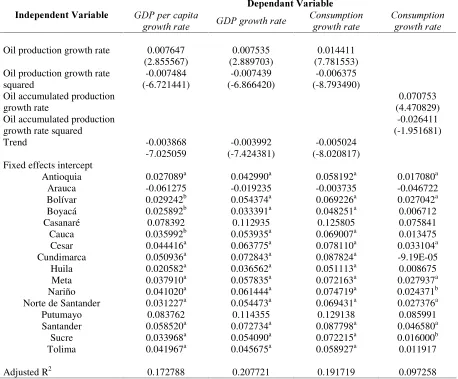
After confirming that all variables are stationary, a panel data analysis was made and
presented in Table 7. Four fixed effects models were estimated, after making checking with
different panel data models —between, population averaged and random effects, the best
results are presented only. Different intercepts were dealt with and in the four cases a
marginal decreasing returns of scale are encountered showing that oil exhaustibility has an
important impact at the beginning but the effect’s growth diminishes each time allowing to
infer that even though this energy resource is important its losing relevance in the long run.
This could be related with additional energy resources that these regions possess like
hydroelectric plants, coal plants and the use of other inputs different from oil or the
possibility of substituting this need with other resources or having the advantage of
producing good and services that do not heavily require oil and its derivatives.
7DEOHColombia:Panel data estimations with different intercepts relating GDP and per
capita’s growth rate and consumption’s growth rate with oil exhaustibility
for 16 regions, 1991 – 2001
'HSHQGDQW9DULDEOH ,QGHSHQGHQW9DULDEOH *'3SHUFDSLWD
JURZWKUDWH *'3JURZWKUDWH
&RQVXPSWLRQ JURZWKUDWH
&RQVXPSWLRQ JURZWKUDWH
Oil production growth rate 0.007647 (2.855567)
0.007535 (2.889703)
0.014411 (7.781553) Oil production growth rate
squared
-0.007484 (-6.721441)
-0.007439 (-6.866420)
-0.006375 (-8.793490) Oil accumulated production
growth rate
0.070753 (4.470829) Oil accumulated production
growth rate squared
-0.026411 (-1.951681)
Trend -0.003868
-7.025059
-0.003992 (-7.424381)
-0.005024 (-8.020817) Fixed effects intercept
Antioquia 0.027089a 0.042990a 0.058192a 0.017080a Arauca -0.061275 -0.019235 -0.003735 -0.046722
Bolívar 0.029242b 0.054374a 0.069226a 0.027042a
Boyacá 0.025892b 0.033391a 0.048251a 0.006712
Casanaré 0.078392 0.112935 0.125805 0.075841 Cauca 0.035992b 0.053935a 0.069007a 0.013475 Cesar 0.044416a 0.063775a 0.078110a 0.033104a Cundimarca 0.050936a 0.072843a 0.087824a -9.19E-05
Huila 0.020582a 0.036562a 0.051113a 0.008675 Meta 0.037910a 0.057835a 0.072163a 0.027937a Nariño 0.041020a 0.061444a 0.074719a 0.024371b Norte de Santander 0.031227a 0.054473a 0.069431a 0.027376a Putumayo 0.083762 0.114355 0.129138 0.085991 Santander 0.058520a 0.072734a 0.087798a 0.046580a Sucre 0.033968a 0.054090a 0.072215a 0.016000b Tolima 0.041967a 0.045675a 0.058927a 0.011917
Adjusted R2 0.172788 0.207721 0.191719 0.097258
a, b, c represent intercepts significant at a 1%, 5% and 10% respectively. T-Statistics in parenthesis.
[image:19.612.82.540.150.529.2]
Table 8 presents the result of estimating the fixed effects model with a common intercept
providing similar outcomes to the ones appearing in Table 7. A positive but marginal
decreasing relation is disclosed as in the above estimation, nevertheless, the positive
relation between GDP growth rate, GDP per capita growth rate and consumption growth
rate and oil exhaustibility concerns since reserves might disappear before than expected
(Jones, 2003); regions, therefore, should entice policies that orient their economy towards
its derivates. Public transport and private car owners should use and adopt more efficient
vehicles that require less gallons of fuel per mile or that run on fuels not derived from oil.
7DEOHColombia:Panel data estimations with common intercept relating GDP and per
capita’s growth rate and consumption’s growth rate with oil exhaustibility
for 16 regions, 1991 – 2001
'HSHQGDQWYDULDEOH ,QGHSHQGHQW9DULDEOH GDP per capita
growth rate GDP growth rate
Consumption growth rate
Consumption growth rate
Oil production growth rate 0.008240 (3.185754)
0.007355 (2.983831)
0.014453 (7.047456) Oil production growth rate
squared
-0.005865 (-6.103572)
-0.005345 (-5.861186)
-0.004453 (-6.754321) Oil accumulated
production growth rate
0.082945 (3.977070) Oil accumulated
production growth rate squared
-0.042468 (-2.244263)
Trend -0.003789
(-6.910835)
-0.003956 (-7.327766)
-0.004678 (-7.653015) Common intercept 0.034304
(10.31101)
0.053362 (16.41124)
0.066629 (16.25258)
0.021169 (5.408523)
Adjusted R2 0.127140 0.187675 0.197181 0.126222
T-Statistics in parenthesis.
&RQFOXVLRQV
Oil is a scarce resource that will last shorter than expected (Jones, 2003) and Colombia, as
many other countries, depends on this resource as an input, energy source and export
product. Such is the dependency that production and energy provided by oil are directly
related and output requires the latter in order to yield goods and services. The problem is
that the region consumes a great part of its oil production but, in the future, will have to
import from other countries specially those from the Middle East because Latin America’s
reserves are below this regions amount.
Scarcity becomes a problem because the whole world depends on oil in order to move and
generate energy and high prices do not appear as constraints for oil consumption as
Hotelling (1931) predicted because the uncertainty in the exact reserves amount and the
exports show a difficult scenario for Latin American countries. Also if the impossibility to
pay as much for oil as developed nations and their negotiation power is added, it will be
found, as shown by Lawrence and Levy (1982) that developed countries have the upper
hand and first option for buying this scarce resource so countries as Colombia will have to
wait and see if they can import at least a fraction of this black gold.
The econometric analysis using a time series and panel data approach both confirm for
Colombia a positive relation between GDP growth, consumption growth and oil
exhaustibility. The first method uses the idea of a neoclassical production function that
allows encountering the importance of oil in production, concluding that this scarce
resource contributes for at least 13% of output growth. Therefore, if Colombia’s oil
reserves do not satisfy national demand and imports become difficult to obtain, growth will
be affected and production and energy generation through this fossil fuel will be at risk.
This problem might be met in the near future because Colombia’s reserves useful life
present a diminishing tendency. The second approach confirms this result for Colombian
regions but conveys a better scenario where oil dependency, in the long run, is abridged and
its impact is lesser every time.
Future research should be oriented to determine the impact of oil scarcity at a
microeconomic level and determining the best market organization and produce output that
gives the optimum response to oil shocks and that allows the economy to minimize oil
shocks. This would require analyzing specific sectors and their interrelations, ideas that
would be better treated with a general equilibrium model for the regional and national
5HIHUHQFHV
Adelman, M. A., 1990. “Mineral Depletion, with Special Referente to Petroleum”, 7KH
5HYLHZRI(FRQRPLFVDQG6WDWLVLWLFV, 72, 1, pp. 1-10.
Azofeifa, Ana Georgina; Villanueva, Marlene, 1996. “Estimación de una función de producción: caso de Costa Rica” [internet paper], Banco Central de Costa Rica, http://www.bccr.fi.cr/ndie/Documentos/PI-06-1995-R-ESTIMACION%20DE%20UN A%20FUNCION%20DE%20PRODUCCION.PDF. Access: august 12th 2004.
Banks, Ferdinand, 1997. “Economic Theory and the Supply of Oil”, :RUNLQJ 3DSHU
8SSVDOD8QLYHUVLW\, 22.
BARRO, Robert; SALA-I-MARTIN, Xavier. (FRQRPLF*URZWK, McGraw Hill, 1995.
Carvahlo, Anthony de; Suni, Paavo, 2002. “War, Oil and Economic Growth” [internet
paper], The Resaearch Institutute of Finnish Economy, )(6, 4,
www.etla.fi/files/913_FES_02_4_war_oil.pdf, pp. 52-62
Colombia, Departamento Nacional de Planeación —DNP—, 2004. “Series históricas”, [internet data base], DNP, http://www.dnp.gov.co/03_PROD/PUBLIC/1p_ee.asp. Access: august 12th 2004.
Colombia, Departamento Administrativo Nacional de Estadística —Dane—, 2004.
“Estadísticas para Colombia” [internet data base], Dane, http://www.dane.gov.co. Access: august 12th 2004.
Colombia, Empresa Colombiana de Petroleos —Ecopetrol—, 2004, “Estadísticas de la industria”, [internet data base], Ecopetrol, http://www.ecopetrol.com.co. Access: august 12th 2004.
Douglas, Paul, 1976. “The Cobb-Douglas Production Function Once Again: Its History, Its Testing, and Some New Empirical Values”, 7KH -RXUQDORI3ROLWLFDO(FRQRP\, 84, 5, pp. 903-916.
Domar, Evsey, 1946. “Capital Expansion, Rate of Growth, and Employment”,
(FRQRPHWULFD, 14, 2, pp. 137-147.
Enders, Walter, 1995. $SSOLHG(FRQRPHWULF7LPH6HULHV, New York, John Wiley and Sons.
Esser, Charles, 2004. “Brief Non-OPEC fact sheet” [internet paper],
http://www.eia.doe.gov/emeu/cabs/nonopec.html . Access: august 12th 2004.
Gately, Dermot; Streifel, Shane, 1997. “The Demand for Oil Products in Developing
Countries”, :RUOG%DQN:RUNLQJ3DSHU, 359.
Greene, William H., 2000. (FRQRPHWULF$QDO\VLV, New Jersey, Prentice Hall.
Halvorsen, Robert; Smith, Tim, 1986. “Substitution Possibilities for Unpriced Natural Resources: Restricted Cost Functions for the Metal Mining Industry”, 7KH 5HYLHZ RI (FRQRPLFVDQG6WDWLVWLFV, 68, 3, pp. 398 – 405.
Harrod, Sir Roy, 1939. “An Essay in Dynamic Theory”, (FRQRPLF-RXUQDO, 49, pp. 14-33. Hotelling, Harold, 1931. “The Economics of Exhaustible Resources”. -RXUQDORI3ROLWLFDO (FRQRP\. 39, 2, pp. 137 - 175.
Im, K. S., Pesaran, M. H. and Y. Shin. “Testing for Unit Roots in Heterogeneous Panels”
-RXUQDORI(FRQRPHWULFV July 2003, 115(1); pp. 53-74.
Jones, Graham, 2003. “World Oil and Gas Running Out” [internet paper], CNN
International World, http://edition.cnn.com/2003/WORLD/europe/10/02/global.
warming/, Access: august 13th of 2004.
Krautkraemer, J. A. 1998. “Nonrenewable resource scarcity”. -RXUQDO RI (FRQRPLF
Lawrence, Colin; Levy, Victor, 1982. “On Sharing the Gains from International Trade: The Political Economy of Oil Consuming Nations and Oil Producing Nations”,
,QWHUQDWLRQDO(FRQRPLF5HYLHZ, 23, 3, pp. 711-721.
Levin, Andrew; Chien-FuLin; and Chia-Shang J. Chu. “Unit Root Tests in Panel Data:
Asymptotic and Finite-Sample Properties” -RXUQDO RI (FRQRPHWULFV, May 2002,
108(1); pp. 1-24.
Olson, Mancur, 1988. “The Productivity Slowdown, The Oil Shocks, and the Real Cycle”,
7KH-RXUQDORI(FRQRPLF3HUVSHFWLYHV, 2, 4, pp. 43-69.
Perry, George, 2001. “The War on Terrorism, the World Oil Market and the U.S. Economy” [internet paper], Analysis Paper, 7, http://www.brook.edu/views/papers/ perry/20011024.htm. Access: august 12th of 2004.
Ramsey, Frank P., 1928. “A Mathematical Theory of Saving”, (FRQRPLF-RXUQDO, 38, 152,
pp. 543-559.
Rauch, Jonathan. “The New Old Economy: Oil, Computers, and the Reinvention of the
Earth”, [internet paper], The Atlantic Online, January 2001,
http://www.theatlantic.com/issues/2001/01/rauch.htm. Access: February 24th of 2002. Reynolds, Douglas, 2004. “The Mineral Economy: How Prices and Costs Can Falsely
Signal Decreasing Scarcity” [internet paper], http://www.hubbertpeak.com/reynolds/
MineralEconomy.htm. Access: February 24th of 2004.
Solow, Robert M., 1956. “A Contribution to the Theory of Economic Growth”, 4XDUWHUO\
-RXUQDORI(FRQRPLFV, 70, pp. 65-94.
Vozza, Tyson, 2003. “OPEC’s Role in Future Development: Increased Investments for Domestic Economic Growth and Increased Aid for Poor Developing Countries”
[internet paper], http://www.stanford.edu/class/e297c/OPEC's%20Role%20in%20
$SSHQGL[$Expansion of the Theoretical Model
Below the necessary steps for obtaining equation 10 will be described. For this purpose,
equations 7 and 9 will be used.
0 ) ( c
H = ( ) − = ∂
∂ F− H− − ✌ W
✍
λ
ρ θ
ln(c−θe− ( ρ− n ) t = ln(λ (t))
−θ ln c − (ρ− n) t = ln(λ (t))
t )) ( (ln t t) n)) ( c) ln (( ∂ ∂ = ∂ − − −
∂ θ ρ λ W
• • = + − − λ λ ρ
θ n ( )
c(t) c(t) W n ) ( 1 c(t)
c(t) =− + +
• • ρ λ λ θ W
And from 9, λ(t)/λ can be obtained and replacing it in the above equation and adding up
terms it can be disclosed:
)) ( ( 1 c(t) c(t) 1 δ β θ β − + = − • Q $N
In a similar way equation 11 can be demonstrated but, for doing so, equations 8 and 9 are
$SSHQGL[%Descriptive Statistics of the Variables Used in the Econometric Analysis
7DEOH%Descriptive Statistics
Variable Mean Standard Deviation
GDP at 1975 constant prices
405,228.53 233,742.87
Consumption at 1975 constant prices
288,656.70 158,806.70
Capital at 1975 constant prices
1,162,072.77 684,607.80
Economically active population
8,004,960.23 3,363,439.44
Accumulated oil production
1,834.27 959.63
Annual oil production 77.14 44.73
Oil reserves 1,179.76 741.80
Borradores del CIE
1R 7tWXOR $XWRUHV )HFKD
01 Organismos reguladores del sistema de saludo colombiano: conformación, funcionamiento y responsabilidades.
Durfari Velandia Naranjo Jairo Restrepo Zea Sandra Rodríguez Acosta
Agosto de 2002
02 Economía y relaciones sexuales: un modelo económico, su verificación empírica y posibles recomendaciones para disminuir los casos de sida.
Marcela Montoya Múnera Danny García Callejas
Noviembre de 2002
03 Un modelo RSDAIDS para las
importaciones de madera de Estados Unidos y sus implicaciones para Colombia
Mauricio Alviar Ramírez Medardo Restrepo Patiño Santiago Gallón Gómez
Noviembre de 2002
04 Determinantes de la deserción estudiantil en la Universidad de Antioquia
Johanna Vásquez Velásquez Elkin Castaño Vélez
Santiago Gallón Gómez Karoll Gómez Portilla
Julio de 2003
05 Producción académica en Economía
de la Salud en Colombia, 1980-2002
Karem Espinosa Echavarría Jairo Humberto Restrepo Zea Sandra Rodríguez Acosta
Agosto de 2003
06 Las relaciones del desarrollo económico con la geografía y el territorio: una revisión.
Jorge Lotero Contreras Septiembre de 2003
07 La ética de los estudiantes frente a los exámenes académicos: un problema relacionado con beneficios
económicos y probabilidades
Danny García Callejas Noviembre de 2003
08 Impactos monetarios e institucionales de la deuda pública en Colombia 1840-1890
Angela Milena Rojas R. Febrero de 2004
09 Institucionalidad e incentivos en la educación básica y media en Colombia
David Fernando Tobón Germán Darío Valencia Danny García
Guillermo Pérez
Gustavo Adolfo Castillo
Febrero de 2004
10 Selección adversa en el régimen contributivo de salud: el caso de la EPS de Susalud
Johanna Vásquez Velásquez Karoll Gómez Portilla
Marzo de 2004
11 Diseño y experiencia de la regulación en salud en Colombia
Jairo Humberto Restrepo Zea Sandra Rodríguez Acosta
Marzo de 2004
12 Economic Growth, Consumption and
Oil Scarcity in Colombia: A Ramsey model, time series and panel data approach
Danny García Callejas Marzo de 2005
&HQWURGH,QYHVWLJDFLRQHV(FRQyPLFDV )DFXOWDGGH&LHQFLDV(FRQyPLFDV 8QLYHUVLGDGGH$QWLRTXLD
&RUUHRHOHFWUyQLFRFLH#DJXVWLQLDQRVXGHDHGXFR 7HO7HO)D[
$$