FACULTAD de FILOSOFÍA Y LETRAS
DEPARTAMENTO de FILOLOGÍA INGLESA
Grado en Estudios Ingleses
TRABAJO DE FIN DE GRADO
An Ecofeminist Critical Discourse Analysis
María Sanz Santos
Vº Bº, 19 de junio del 2017
ABSTRACT
The present paper examines ideological persuasion in discourses and reflects the importance of linguistics for society. By following a Critical Discourse Analysis, the aim of this study is to analyze a persuasive discourse whose linguistic mechanisms lead to the transmission of an ecofeminist ideology. This movement is indeed grounded in the existing relation between domination over women and nature (Gaard 1), conceiving the fight against patriarchy as a suitable solution (Warren, Ecofeminist Philosophy 64). In order to achieve this socio-linguistic connection, the discourse under study is delivered by a victim of patriarchy, Malala Yousafzai, who overtly claims educational equity before the United Nations Youth Takeover in 2013. The analysis is based on Fairclough’s approach to CDA (57), where he states that meaning in discourses arises from the combination of the text, its discourse practice and socio-cultural practice.
Keywords: Critical Discourse Analysis; ecofeminism; domination; patriarchy; Malala Yousafzai; educational equity.
RESUMEN
El análisis se basa en el planteamiento de Fairclough sobre el ACD (57), donde afirma que el significado de los discursos surge de la combinación del texto, su práctica discursiva y su práctica socio-cultural.
TABLE OF CONTENTS
1. Introduction……….1
2. Literature review……….5
3. Cultural background………9
4. Methodology……….11
5. Results………...15
5.1. Text in a specific discourse practice………..15
5.1.1. Cohesion………..15
5.1.1.1. References………....15
5.1.1.2. Substitutions……….16
5.1.1.3. Ellipses……….17
5.1.1.4. Conjunctions………17
5.1.1.5. Repetitions………...18
5.1.1.6. Synonyms and antonyms……….19
5.1.1.7. Hyperonyms and meronyms………21
5.1.1.8. Collocations……….23
5.1.2. Coherence………...24
5.1.2.1. Thematic structure………...24
5.2. Socio-cultural practice………...26
5.2.1. Modality……….26
5.2.2. Metaphors………...29
6. Discussion……….31
7. Conclusion………35
8. Works cited………...37
1
1. INTRODUCTION
Persuasive discourses can change the world engaging people to take action on relevant social issues (Keith and Lundberg 4). Lakoff and Sutton (186) describe this kind of discourse as the nonreciprocal pursuit of persuasion or in other words, as the change of behavior, feelings or intentions that one of the parts involved in this linguistic practice seeks to produce on the other through communicative means. The effect generated on audience can be crucial for the development of society, since persuasion can extend to the resolution of worldwide issues. In view of this assertion, the present paper follows a socio-linguistic approach by which socio-linguistics is applied to social matters, as for instance the right of education for all.
Education is nowadays recognized as a basic human right and consequently, it seems inconceivable that, in midst of the 21st century, a person would be deprived of educational access. In fact, the Universal Declaration of Human Rights already asserted in
1948 that “Everyone has the right to education” (United Nations General Assembly art. 26.1). Nonetheless, reality is far different, since this right continues to be violated, especially in Third World countries as Pakistan.
As stated in a report filed by UNESCO (1), it is in Pakistan where one of the worst educational indicators globally is perceived, owing in large part to wide social inequalities
that place women as the most affected. Hence, Pakistan’s educational background can be
2 patriarchy as the main source of supremacy not only dominating women, but also nature (Warren, Ecofeminist Philosophy 64). In brief, this paper is focused on ecofeminist ideology, which attempts to explain female discrimination along with the subsequent lack
of rights, placing special emphasis on Pakistan’s educational sphere.
In line with the aforementioned focus of attention, the revolutionary figure of a Pakistani girl named Malala Yousafzai adjusts perfectly to both ecofeminism and advocacy of educational rights for women. Importantly, she delivers a persuasive discourse (see
‘Appendix’) before the Youth Takeover of the United Nations on July 12, 2013, in which she fights overtly for achieving gender equality in educational terms (Theirworld, “Malala
Yousafzai’s Speech”). Therefore, this study performs a Critical Discourse Analysis of this
discourse by following a socio-linguistic application, namely the examination of the link established between the linguistic mechanisms used and ecofeminism.
This paper is then organized as follows. Section 2 introduces the field under study, i.e. Critical Discourse Analysis, although targeted towards the relatively novel approach of an ecofeminist CDA. Within the same section 2, the foundations for the ecofeminist ideology are also laid, highlighting the figure of Karen Warren as one of the most influential ecofeminists this paper considers. In section 3, the situation of Pakistan and the case of Malala are detailed in order to understand the reasons for Malala’s position as patriarchal victim and for the delivery of her discourse (included in the appendix of this paper). Afterwards, section 4 describes the methodology followed, adopting Fairclough’s approach to CDA (57) by which the text in a specific discourse practice and its socio-cultural practice provide meaning to discourse. Moreover, this fourth section also specifies each of the linguistic mechanisms that is going to be studied. The paper adopts next an analytical approach by presenting the research findings in section 5. These results are further subdivided into 2 main sections (included within this section 5) according to
5
2. LITERATURE REVIEW
Critical Discourse Analysis (CDA) considers language “as a form of social practice” whose context becomes especially relevant (Fairclough and Wodak 258). In line with this approach, discourses are understood as uses of language organizing social lives (Wodak and Meyer 6). Hence, they are aimed at producing ideological effects within societies, for instance portraying inequalities between different social classes, women and men or ethnic majorities and minorities (Fairclough and Wodak258). Thereby, the present paper follows a CDA, although with a deeper analysis, i.e. an ecofeminist Critical Discourse Analysis.
Ecofeminism – or ecological feminism – can be defined as the connection established between the ideology that explores the domination over women and the ideology that studies the degeneration of nature (Gaard 1). The term “ecofeminism” was
originally coined by the feminist Françoise D’Eaubonne and, as its name indicates, it
combines the tenets of both environmentalism and feminism (Sakas 1-2). Regarding environmentalism, ecofeminism is based on the need for changing the mode in which humans interact with nature due to their mistreatment (Sakas 2). Similarly, the need for changing extends to the treatment of women which is also inappropriate, adopting thus a feminist approach (Sakas 2-3). Both feminism and ecofeminism share the notion of patriarchy as their initial point of departure (Warren, Ecofeminist Philosophy 63). Nonetheless, the former movement emphasizes the end of racism, classicism, heterosexism, ageism, anti-Semitism and ethnocentrism, since they are the burdens which women are not
6 It is important to remark the heterogeneity of ecofeminist theory due to the existence of several perspectives within the same ecofeminist movement (Twine 1). However, as Twine (1) affirms, all of them agree on the association between Western domination over women and over nature. Following Merchant’s classification (184), it is possible to distinguish the following ecofeminist perspectives: liberal, cultural, social and socialist.
7 restructuration is needed to remove these two dominations (Merchant 184). The philosophy of Plumwood fits with this perspective, criticizing that
The very idea of a feminine connection with nature seems to many to be regressive and insulting,
summoning up images of women as earth mothers, as passive, reproductive animals . . . immersed in
the body and in the unreflective experiencing of life. (20)
Apart from these perspectives, ecofeminist theory is further composed of other approaches, for instance the one of Karen Warren who follows more closely “a
philosophical perspective” (Cuomo 1). She (“Empirical Data” 4) continues to defend the main ecofeminist tenet, i.e. the connection between the treatment of women and environment. Nevertheless, she explains this women-nature domination by emphasizing the
role that cultures or contexts play in the interpretation of sexism (Warren, “Ecofeminist
Ethic” 151). Since Warren is considered one of the main influential figures in the development of ecofeminism (Cuomo 1), the present paper is going to concentrate on her philosophy.
One of the central basis of Warren (Ecofeminist Philosophy 64) and thus, of ecofeminism is the fight against patriarchy. This is largely due to the fact that Western cultures usually tend to stereotype women negatively, as less rational and more emotional than men (Warren, Ecofeminist Philosophy 193). As a consequence, Warren (Ecofeminist
Philosophy2) states that “. . . among white people, people of color, poor people, children,
the elderly, colonized people, so-called Third World people, and other human groups harmed by environmental destruction, it is often women who suffer disproportionately
higher risks than men.” This suffering is based on the idea of supremacy and for this reason, Warren explores several kinds of domination over women, as for example in the fields of economics, politics or linguistics (Ecofeminist Philosophy 2). Yet, since the
present paper focuses on ecofeminist CDA, the one fitting with this paper’s goal is the linguistic one. Within this linguistic field, Warren remarks that “the language one uses mirrors and reflects one’s concept of oneself and one’s world” (Warren, Ecofeminist
Philosophy 27). Hence, this assertion reinforces the importance of analyzing language and
9
3. CULTURAL BACKGROUND
Nowadays, the access to education has become a global issue (“Right to
Education”). Indeed, the situation in Pakistan stands out, where the right of education for all is often violated (UNESCO 1). This is reflected in a report generated by UNESCO,
stating that “Pakistan has some of the worst education indicators globally” with “the second
highest number of children out of school” (1). Within the amount of children who do not
attend school, two-thirds of them are girls (UNESCO 1). These data justify the importance of analyzing the current gender inequalities in terms of education.
In this sense, the case of a Pakistani girl called Malala Yousafzai deserves special
recognition. She was born in Swat District, Pakistan, (Yousafzai, “Malala’s Story”) a place where only one out of three girls attends school (UNESCO 1). Despite this background,
following her father’s steps as a supporter of education in Pakistan, Malala loved learning and attending school (Yousafzai, “Malala’s Story”). In 2009, since the dominance of the Taliban increased, Malala became a writer in a blog narrating the feelings of those students
who felt under constant threat to be attacked by the Taliban (Yousafzai, “Malala’s Story”). Thanks to her defense of education, she won the first National Youth Peace Prize of
Pakistan (Yousafzai, “Malala’s Story”). However, her situation changed dramatically in 2012 when she was shot by a man on her way home from school, being critically injured
(Yousafzai, “Malala’s Story”). This issue caused a huge impact throughout all countries and made Malala become an advocate for girls’ education (Yousafzai, “Malala’s Story”). After her recovery, her success was so strong that Malala founded “The Malala Fund” together with her father in order to urge changes in the situation of women (Yousafzai,
“Malala’s Story”). All her defense finally turned out in the win of the Nobel Peace Prize
10
Remarkably, this paper is going to focus on Malala’s most important period of life,
the one in which she became completely an activist for rights and a greater media success around her was created. This favorable outcome made Malala become an influential figure with a higher power of persuasion. Within this period, one of her most persuasive defenses
of girls’ education took place during her discourse at the Youth Takeover of the United
11
4. METHODOLOGY
In order to analyze the aforementioned discourse, this paper follows Fairclough’s
approach to CDA (57) consisting of three elements to create meaning, i.e. the text, discourse practice and socio-cultural practice. In other words, the meaning of discourse arises from the combination of the text itself, its context and society where it is produced (Fairclough 57). Consequently, this ecofeminist CDA will probably reveal the usage of persuasive linguistic mechanisms under this particular context that lead to the transmission of sociocultural ideologies, as an ecofeminist.
By applying Fairclough’s approach (57), the first element under study is the discourse in itself – the text – uttered in a specific discourse practice, namely Malala addressing the United Nations Youth Assembly in the Youth Takeover of the United
Nations, on July 12, 2013 (Theirworld, “Malala Yousafzai’s Speech”). In order to achieve
the persuasion of audience, textual cohesion and coherence become the key to understand and capture the message of discourse (Allan 87, 93).
According to Halliday and Hasan (4-6), cohesion can be defined as the semantic relations that create unity in text, expressed by means of grammatical and lexical cohesion. The former type cohesion covers various kinds of ties as endophoric references, substitutions, ellipses and conjunctions; whilst the latter kind of cohesion includes reiterations – achieved in turn through the presence of repetitions, synonyms, antonyms, hyperonyms and meronyms – and collocations (Halliday and Hasan 274-293).
12 connects different text segments (Sanders and Maat 592) and specifically, on thematic structure as one of the main components providing coherence to discourse (Njobvu 9). In fact, the distinction between the central element of clauses (theme) and predicate (rheme) is used to achieve audience’s memory and attention (Dijk et al. 84). Within themes, this study is going to follow Halliday and Matthiessen’s division of themes (79) into topical, interpersonal and textual types.
The usage of certain linguistic devices results in the analysis of a third element that creates meaning in discourse, namely the socio-cultural practice (Fairclough 57). These linguistic choices make discourse become a tool of ideological persuasion, being necessary to analyze those strategies transmitting the view of the speaker. This is the case of modality
which constitutes a strategy for expressing speaker’s comments about the necessity or
possibility of actions (Depraetere and Reed 269). The modality analyzed in this study refers to those linguistic realizations by which Malala positions herself as regards the issue addressed. For this reason, modal verbs are not the single structure considered, but also other linguistic realizations as modal adjuncts or adjectives, lexical verbs displaying the
speaker’s view and conditional structures. Thus, the difference between deontic and epistemic modality provided by Depraetere and Reed (275-276) becomes crucial for the notion of ecofeminism. Indeed, the presence of deontic modality, with modal verbs as must
or should, will indicate the obligation or possibility of actions (Depraetere and Reed 276),
implying hence the reassertion of female authority and the subsequent fight against patriarchy. On the other hand, epistemic modality, e.g. the modal verb may, will reflect the
degree of speaker’s certainty towards an action which is usually a low one (Depraetere and Reed 275-276). As a result, this lack of certainty will be caused by the ecofeminist dogma of patriarchy that provokes women to feel uncertain and subordinated to men (Warren,
Ecofeminist Philosophy 64).
15
5. RESULTS
5.1. TEXT IN A SPECIFIC DISCOURSE PRACTICE
5.1.1. Cohesion
The sense of unity in Malala’s discourse is created at both grammatical and lexical
levels, corresponding to the so-called grammatical and lexical cohesion respectively.
5.1.1.1. References
Beginning with grammatical cohesion, results show a large amount of endophoric references, being all of them anaphoric except one cataphoric. Interestingly, their usage is thematically connected to the broad structure of discourse. That is, the anaphoras and cataphoras used echo the basic ideas that Malala covers to achieve audience’s persuasion. Thereby, the first part encompassing a group of anaphoras is that of acknowledgements.
Since Malala’s recovery had already become a reference for all female victims when she delivers her discourse, she seizes the opportunity to acknowledge people the support received by means of several anaphoras as whom, whose antecedent is God or the anaphora them pointing at the thousands of good wish cards and gifts from all over the world she has received. Within this group, the anaphoras them and they whose antecedents are Mr. Ban
Ki-moon and Mr. Gordon Brown are crucial, since their work of leadership makes them
become the textual link with the next group, i.e. the lack of education for all.
16 women’s inferiority in her country. The discourse includes in fact a total of 16 anaphoric references to them, for instance they or them and besides, other references in singular form to mention a specific Talib, illustrated in who, he or him. Moreover, Malala does not only mention all victims in general by means of anaphoras as them referring to thousands of
people . . . killed by the terrorists and millions . . . injured, but also points out directly the
female figure as the main sufferer. This is shown in the presence of anaphoras as they or
themselves and other inclusive references, e.g. the anaphora myself and the only cataphoric
reference I. In contrast to this large amount of female references, Malala simply refers twice to men through the anaphoras who and he, because she does not view them as direct victims.
Finally, the last group indicates solutions for this issue by using it and they, whose references are respectively stand up for their rights and books and pens.
5.1.1.2. Substitutions
Within these grammatical structures, the device consisting in substituting one item in terms of another is also analyzed (Sanders and Maat 591). This discourse only contains clausal substitutions, i.e. the replacement of entire clauses, with the goal of avoiding a constant repetition of those ideas that due to their key importance Malala constantly addresses. The reason behind their repetition lies in the attempt to emphasize those ideas based on the achievement of women equality and as a result, the most common substitution is this to replace diverse clauses, e.g. Weakness, fear and hopelessness died, I would not
shoot him and be peaceful and love everyone. Furthermore, three instances of that express a
17
5.1.1.3. Ellipses
On the contrary, ellipsis does not include different words to refer the same item, but omits the item directly (Sanders and Maat 591). In this case, ellipsis provides a higher degree of persuasion to discourse because sentences are in turn more direct and easier to remember. Hence, it is possible to perceive four omitted samples of the clause Those who
have fought for and a verb omission in Education First, which could have contained a verb
as for example goes. In the former omitted sample, Malala remarks a series of rights they are usually deprived for and in the latter, she emphasizes education as her solution for gender-biased prejudices.
5.1.1.4. Conjunctions
The last structure that creates grammatical cohesion is conjunction, allowing the emergence of unity and progression in the text due to the link established amongst different ideas (Sanders and Maat 591). The entire discourse is composed of 107 conjunctions of which 83 are paratactic, whereas the remaining 24 are hypotactic. Tables 1 and 2 represent in detail the diverse types of conjunctions belonging to each group.
PARATACTIC CONJUNCTIONS
and or but then neither…nor both…and rather not
only…but
in the
same way
73 1 2 2 1 1 1 1 1
Table 1: Paratactic conjunctions
HYPOTACTIC CONJUNCTIONS
when if but now even if so that because even rather so
6 1 4 1 1 3 3 1 1 3
18 From table 1, the great amount of the additive conjunction and stands out and makes the whole group of paratactic conjunctions reach a higher quantity than the one of the hypotactic group. In this latter type of conjunctions, the highest amount peaked is 6 in the case of when, followed secondly by a total of 4 samples of but. This overuse of and along with the higher quantities of when and but could be largely due to women linguistic inferiority. In other words, the fact of being a woman provokes that Malala feels the need to create a reliable and persuasive diction, achieved by adding further ideas through the conjunction and, detailing to circumstances with when or clarifying – by means of but – that despite of suffering, achievements are possible.
Except for these remarkable values, the remaining quantities in both types of conjunctions are homogenous due to values in the range of 1-3. Although it is necessary to clarify that the conjunctions but and rather are included in both groups, since some samples show a simple relation between sentences (i.e. paratactic conjunctions) and others reflect a subordinate one (hypotactic conjunctions).
5.1.1.5. Repetitions
19
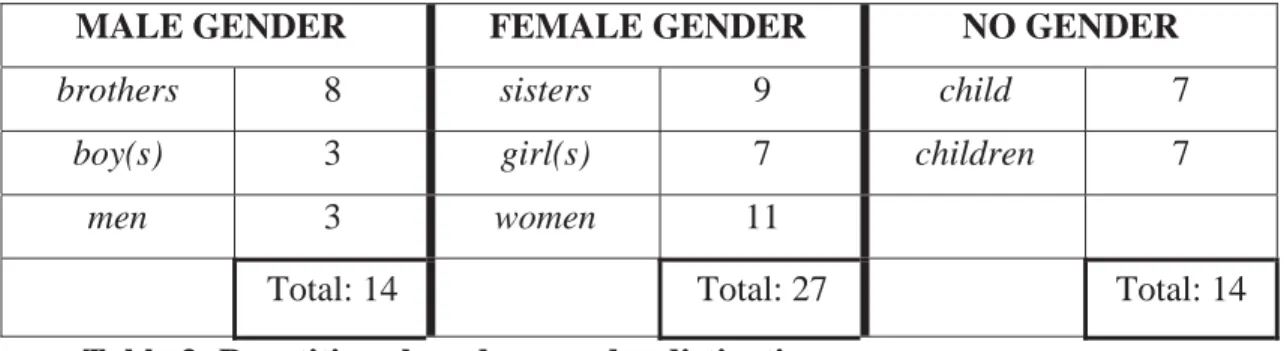
MALE GENDER FEMALE GENDER NO GENDER
brothers 8 sisters 9 child 7
boy(s) 3 girl(s) 7 children 7
men 3 women 11
Total: 14 Total: 27 Total: 14
Table 3: Repetitions based on gender distinctions
Results evidence a clear predominance of words referring to female gender (in particular, 27 words) over the rest, justifying then the focus of Malala on women as the most affected by this issue. To a lesser degree, she extends the issue to men and moreover, universalizes it through a non-gender lexicon.
Within the amount of brothers and sisters repetitions, some of them belong to longer phrases that are in turn repeated. This is the case of dear brothers and sisters (with 4 samples) against dear sisters and brothers (7 samples) that continue to reflect a clear-cut distinction between male and female genders.
Apart from these repetitions, the basis of discourse – the right to education – leads to the repetition of right(s) and education with 17 instances each. This basis is similarly enhanced by repeating its source, terrorism (3 instances) or the Taliban (4 instances), along with its solutions by the linguistic means of peace (9 instances), voice(s) (7 instances),
book(s) (6 instances) or pen(s) (6 instances) and expressions as we call upon (7 instances).
5.1.1.6. Synonyms and antonyms
The next mechanisms studied are synonymy and antonymy. On the one hand,
synonyms are mainly used for depicting the optimistic connotations of Malala’s discourse,
20
shield and protect, speak up and raise up my voice, encouraged and strengthened and
finally, get better and recover.
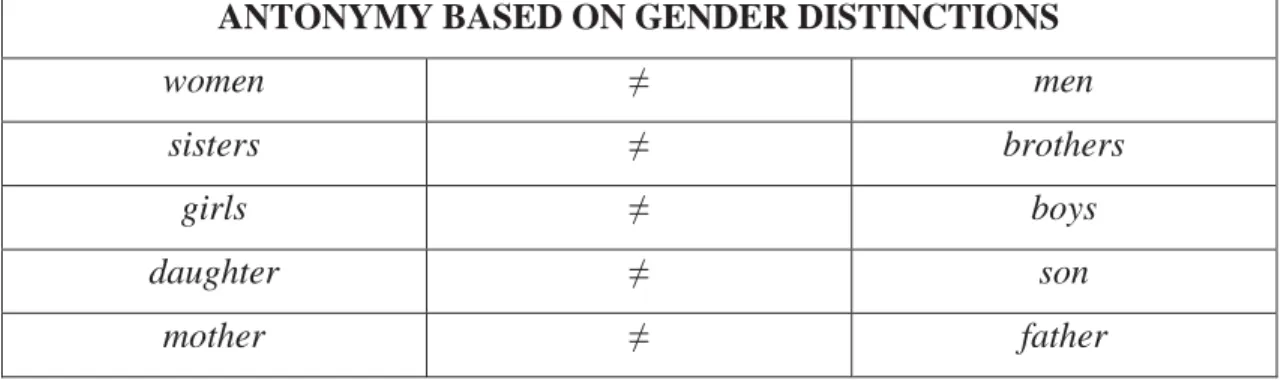
On the other hand, antonymy is reduced to the setting of gender differences already mentioned in the present paper. This is clearly exemplified in the reference to each gender separately instead of using a generic designation including both. As a result, the table below displays many contrary designations presented throughout the discourse.
ANTONYMY BASED ON GENDER DISTINCTIONS
women ≠ men
sisters ≠ brothers
girls ≠ boys
daughter ≠ son
mother ≠ father
Table 4: Gender distinctions in antonymy
This table 4 contrasts with the presence of other two pairs of antonyms in the discourse lacking gender differences, specifically children against elders and everyone against no one.
21
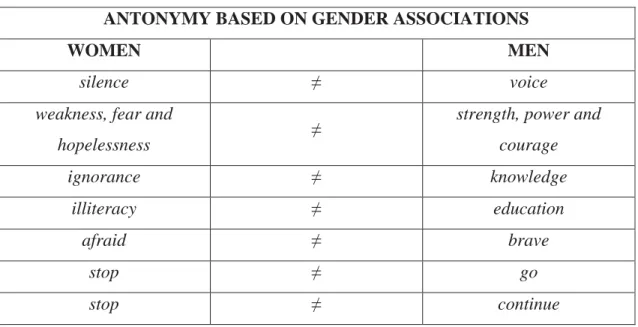
ANTONYMY BASED ON GENDER ASSOCIATIONS
WOMEN MEN
silence ≠ voice
weakness, fear and
hopelessness ≠
strength, power and
courage
ignorance ≠ knowledge
illiteracy ≠ education
afraid ≠ brave
stop ≠ go
stop ≠ continue
Table 5: Antonymy in relation to gender associations
5.1.1.7. Hyperonyms and meronyms
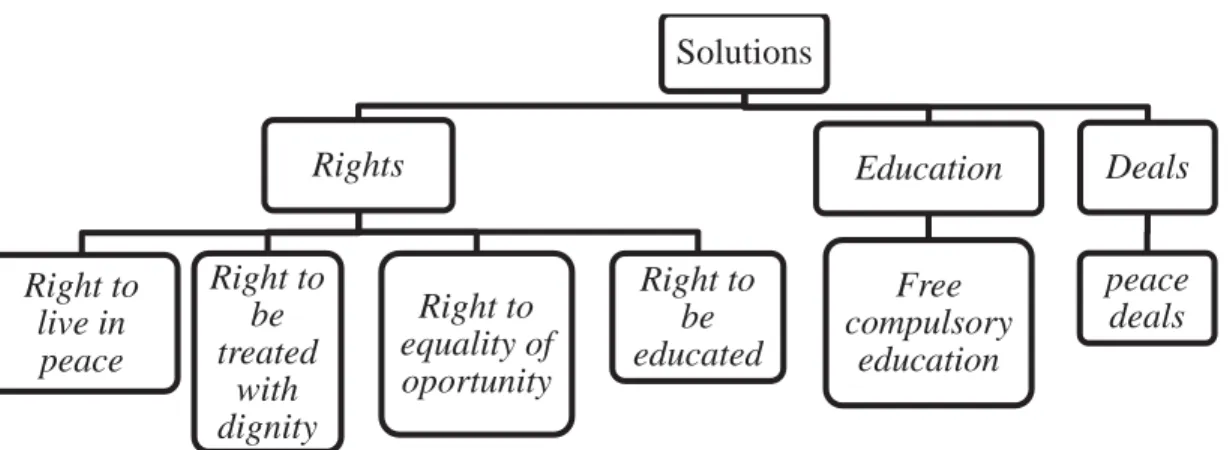
Hyperonyms and meronyms are the following devices considered in this paper. Both are focused to a larger extent than the previous devices on the right of education whereby Malala denounces the lack of equality. In the case of hyperonymy, a specific-general relation is expressed (Dias et al. 199) which is only concentrated on women, particularly on the two thematic groups of their problems and solutions. They are visually represented in figures 1 and 2, where the third level (that is, the third branch) is considered a specific type of the second level, the generic item. For instance, Islam is a specific type of religion.
Figure 1: Hyperonymy of problems
22
Figure 2: Hyperonymy of solutions
Notice that in figure 1 the lexical items of Taliban, Pashtun society and Islam are
considered problems from Malala’s perspective. This assertion is inferred from Malala’s
own words in her discourse affirming that they are misinterpreted:
The terrorists are misusing the name of Islam and Pashtun society for their own personal benefits.
Pakistan is peace-loving democratic country. Pashtuns want education for their daughters and sons.
And Islam is a religion of peace, humanity and brotherhood. Islam says that it is not only each child's
right to get education, rather it is their duty and responsibility. (Yousafzai)
Furthermore, the relation denoted by meronymy, i.e. a part-whole relation (Winston et al. 418), also belongs to the group of solutions, as figure 3 below indicates. In this case, the third level represents the part of the whole, which is contained in the second level. For example, book, pen and teacher are part of education.
Figure 3: Meronymy of solutions
Solutions Rights Right to live in peace Right to be treated with dignity Right to equality of oportunity Right to be educated Education Free compulsory education Deals peace deals Solutions education
book pen teacher
hospitals
23 In addition, it is possible to perceive a group of relations elaborated upon the notion of victims (see figure 4). As it is depicted below, the third level covers the parts of the whole, which is presented in the second level. Remarkably, Pakistan and its corresponding parts or areas are personified and as such, viewed as victims with the purpose of reflecting their hard situation for women in terms of education.
Figure 4: Meronymy of victims
5.1.1.8. Collocations
The last mechanism providing cohesion to this discourse is collocation. In accordance with the central basis of discourse, many lexical items are distributed around the concept of education, as teacher, pen, book, school, Global Education First Initiative,
free compulsory education, educational opportunities, medical students or right of
education. Moreover, the current inequality of women is displayed through collocations
highlighting the hardships they have to face, for example silence, weakness, fear, hopelessness, terrorism, wars, poverty, ignorance, injustice or brutality.
Yet, the effort of Malala to destroy these problems becomes apparent and thus, she starts associating women with other collocations without neither stereotypes nor subordination. This is the case of the following qualities brave, independent or peaceful and abilities as voice, strength, power, courage, ambitions or hopes. The claim for women’s rights results in the presence of other collocation urging to take action, e.g. struggling, shout, raise up, fight, call upon, empower or speak up.
Victims
person
hand soul voice
Pakistan
Khyber
24
5.1.2. Coherence
5.1.2.1. Thematic structure
Malala’s discourse is also characterized by a logical sense and connection between
all ideas. Hence, one suitable mechanism to prove coherence is thematic structure. Focusing on themes as the central element of clauses (Dijk et al. 84), their identification reaches to a total of 244 samples, as table 6 shows.
TOPICAL THEMES
TEXTUAL THEMES
INTERPERSONAL
THEMES TOTAL
124 107 13 244
Table 6: Topical, interpersonal and textual themes
Out of the total quantity, it is noteworthy the higher amount of topical themes followed by the one of textual themes and finally, by the lowest number corresponding to interpersonal ones. Since this latter type presents the lowest usage, it is briefly mentioned that this theme reflects the relationship established between Malala and her audience. This relation is chiefly based on the affection of Malala towards her audience, reflected in themes with the emotional item dear, for example dear brothers and sisters, dear friends or
dear fellows. Concerning textual themes, they do not require further explanations since they
have been previously described in the section of ‘Conjunctions’. For these reasons, the analysis is going to be concentrated on topical themes.
25
fought for their rights. Next, a background about Malala’s personal suffering with the
Taliban is outlined, making the following themes become the inevitable upshot of her pain:
I, my ambitions, my hopes, my dreams and the terrorists or they (i.e. the Taliban). The
fourth part of discourse advances to a clear claim for education and peace by means of I and this (referring to the fact that she would not shoot the Talib who shot her). The discourse returns anew the concern addressed thanks to the usage of diverse themes, in particular the extremists, they (namely the Taliban), Pashtuns or Islam. The last part, in contrast, comprises numerous themes, as peace, a deal that goes against the dignity of
women and their rights or one child, one teacher, one pen and one book, which prove her
urge for resolution.
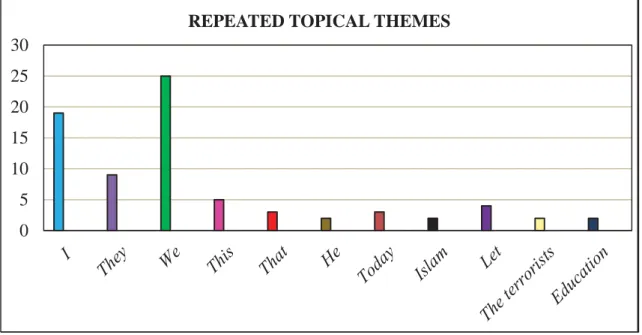
As these results suggest, a high quantity of distinct themes are contained, yet the majority of them are reduced to a single sample. Consequently, it deserves special mention those repeated themes that are considered exceptional cases in this study due to their high presence. The following graph represents in detail these repeated topical themes with a vertical axis including their total quantities and one horizontal axis specifying each type.
Figure 5: Repeated topical themes
0 5 10 15 20 25 30
26 Interestingly, the graph depicts that the highest use correspond to the theme we with
25 instances. Its presence could be due to Malala’s attempt to create a sense of inclusion
when solving the issue. Furthermore, the theme I shows a fairly high value, since her account is narrated from her own perspective and thus, considering herself as an example of overcoming for all women. Aside from these elevated values, the topical constituent of
education– included in the last two sentences –needs to be pointed out notwithstanding its
low repetition. Considering that this repetition appears at the end of her discourse, it becomes decisive in capturing and memorizing the message.
5.2. SOCIO-CULTURAL PRACTICE
5.2.1. Modality
Apart from the above linguistic selection providing cohesion and coherence to discourse, other devices as modality and metaphors are intended to transmit the evaluation of the speaker and thus, providing discourse with subjectivity (Depraetere and Reed 269; Littlemore 355-336).
27
Examples 1: Deontic modality
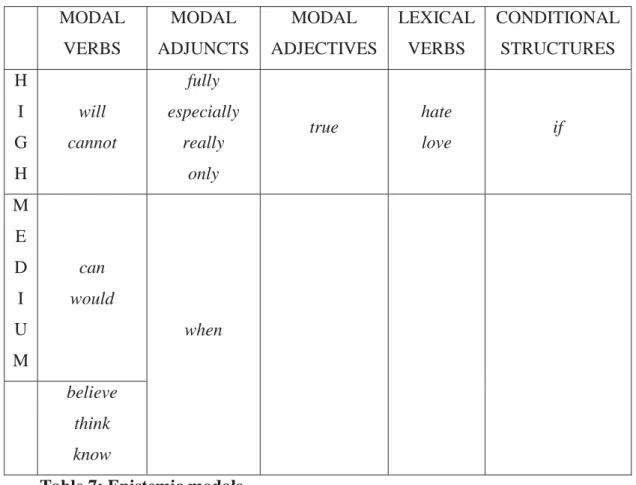
Despite of the low amount of deontic modality, epistemicity is not used for transmitting her uncertainty, but quite the reverse. She in fact fights against patriarchy by means of a high or medium certainty in epistemicity. This confidence is demonstrated in all different types of epistemic modals, illustrated in table 7. Notice that the modal verbs of this table appear in non-finite forms with the purpose of facilitating the analysis of all different types, yet each form represents the corresponding variants in number, person or tense that the discourse includes.
. . . peace is necessary for education.
We call upon the world leaders that all the peace deals must protect women
and children’s rights.
We call upon our sisters around the world to be brave . . .
We must not forget that millions of people are suffering from poverty,
28 MODAL VERBS MODAL ADJUNCTS MODAL ADJECTIVES LEXICAL VERBS CONDITIONAL STRUCTURES H I G H will cannot fully especially really only
true hate
love if
M E D I U M can would when believe think know
Table 7: Epistemic modals
Notably, the verbs believe, think and know are set apart from the rest, since they are not grammatically recognized as modal verbs. Nonetheless, modality arises from their modal meaning in the sense that they are other linguistic realization intended to transmit
Malala’s position. Hence, their evaluative meaning leads them to be analyzed in this study.
The modal verb know also needs special mention, since it is the single case in which there is no certainty because of its negative form. This is exemplified in these sentences I
don't know where to begin my speech and I don't know what people would be expecting me
to say. In addition to the kinds displayed in the table, the discourse is also composed of the
verb to be as a lexical form in 44 cases. This verb can be interpreted as another instance of
Malala’s evaluation because of its high usage in facts. As a consequence, she tries to make
29
5.2.2. Metaphors
The last device studied in this analysis is the one of metaphor. Malala expresses the typical women-nature ecofeminist relation by means of the metaphor they can flourish, contained in the sentence To ensure freedom and equality for women so that they can
flourish. This finding fits perfectly with the “naturalization of women” promoted by GAO
(37), as it has been mentioned in the ‘Methodology’ of this paper. Indeed, the fact that
women are able to flourish leads to the assertion that they are symbolically considered as flowers (GAO 37). Although the aim of this naturalization could be a positive one, i.e.
expressing women’s success, its ecofeminist interpretation becomes negative. In line with
31
6. DISCUSSION
On the basis of these results, it is important to highlight the underlying inferences revealed from this analysis. Findings do not only reflect the persuasiveness of discourse, but also a pioneering ecofeminist nature that causes worldwide sensation.
A persuasive and effective discourse is achieved through a compelling usage of the elements Fairclough proposes (57) to create meaning in discourse. Concerning the text in a particular discourse practice, the analysis has shown that all linguistic devices, suggested in this paper as tools for promoting cohesion and coherence, are both present and used strategically in discourse to persuade. Hence, its cohesive and coherent nature is highly
proved along with Malala’s importance of elaborating a correct, direct and clear text for the audience. For this reason, it is possible to assert that this discourse is based on the basic premise of understanding the message, otherwise audience could not be persuaded. Within all devices under study, this is most evident in the case of ellipses and substitutions. They make key ideas more concise, easier to understand and remember, achieving thus the status
of slogans as “Education First” (Yousafzai).
32 appears explicitly in the discourse, whereas the latter movement rises in an implicit sense. Environmentalism appears in fact as result of the need to find an explanation for the domination over women and therefore, this reasoning could be the following:
(1) woman’s body and its functions . . . place her closer to nature, in contrast to man’s physiology, which frees him more completely to take up the projects of culture; (2) woman’s body and its
functions place her in social roles that in turn are considered to be at a lower order of the cultural
process than man’s and (3) woman’s traditional social roles, imposed because of her body and its
functions, in turn give her a different psychic structure, which, like her physiological nature and her
social roles, is seen as being closer to nature. (Ortner 73-74)
Consequently, both movements shape ecofeminism which does appear in this discourse. In accordance with the above justification, each device used transmits an ecofeminist ideology. That is, all devices studied in this paper can be interpreted by means of ecofeminism owing to the subversive presence of this ideology.
Following with this socio-cultural practice, one of the most outstanding inferences is its ground-breaking ecofeminist essence. In view of the fact that Malala has become a direct victim of patriarchy, there could be a strong possibility of thinking that her discourse would mostly reflect her inferiority, anxiety and suffering for fear of repercussions. Nonetheless, she breaks this traditional trend and focuses more on her role as example of overcoming in order to encourage other women to take action. This assertion is demonstrated in the results of this paper, where all except 3 of the linguistic devices analyzed display by some means or other the supremacy of women. These 3 linguistic devices – including conjunctions, the verb to be in modality and metaphors – are considered exceptions, since they follow an opposed tendency when compared to the majority of them. The usage of both conjunctions and the verb to be is a consequence of women inferiority by which she has to make an extra effort to create a reliable account. Similarly, the metaphor encountered reflects this female inferior position naturalizing them as beautiful, perfect and delicate flowers. Yet, these three samples constitute a tiny amount which does not alter the overall tendency to convey women equality. Therefore, it can be
33
ecofeminist idea that “the language one uses mirrors and reflects one’s concept of oneself and one’s world” (Ecofeminist Philosophy 27).
As a consequence, the innovative ecofeminist nature of discourse caused immediately such a great impact that numerous worldwide mass media echoed her advocacy. This importance is endorsed in descriptions of her discourse as “. . . a rousing
speech . . .” (Fantz) in the CNN, “. . . a defiant riposte to Taliban militants with speech . . .”
by Independent or “. . . her speech was immediately hailed for its power” (Cowan) in the ABC News. In addition, several organizations as for instance the non-governmental organization Human Rights Watch describes accurately the discourse as “A Speech that
Moves the World”.
35
7. CONCLUSION
The present paper evidences the importance of the CDA that has been conducted, since it is notable for adopting a highly novel approach not very explored in linguistics, that is, an ecofeminist CDA. Within this analysis, discourses are therefore conceived as tools for transmitting the typical ecofeminist fight against patriarchy, which is considered the oppressive force against women and nature (Warren, Ecofeminist Philosophy 64).
The aim of this paper, consisting of analyzing Malala’s discourse and connecting the linguistic devices employed with ecofeminism, has been successfully fulfilled through
the application of Fairclough’s approach to CDA (57). Results have indeed demonstrated
that the text under study stands for its cohesive and coherent nature and more importantly, for its socio-cultural practice that allows to justify the usage of each linguistic mechanism through ecofeminism. This study has departed from the basic premise belonging to one of the major ecofeminist proponents, Karen Warren, who defends that language echoes the perception hold about oneself and the world (Ecofeminist Philosophy 27). In agreement
with Warren’s assertion, Malala’s own account is not depicted in view of solely changing
her own personal situation, but worldwide values. She, in her role of victim, really demonstrates the current existence of patriarchy and the resulting crisis of values she tries to overcome. For this reason, Malala expresses in an overt way her disagreement in relation to the education system (particularly the one of Pakistan), although this disagreement can be considered the medium for reaching her major complaint about male dominance. Ecofeminism becomes crucial to shed light on her basis of discourse, arguing that male supremacy is so high that tries to dominate women and nature and thus, being necessary a
fight against patriarchy as solution. Malala’s own struggle and her respective contribution
36 lack of real reasons to create gendered-biased prejudices. Thereby, she uses her discourse to raise awareness about the current need to construct new values grounded on gender equality and as a result, no one would lose any basic right as the access to education.
Since Malala conceives this fight against patriarchy as a plausible fact, she transfers her ideas to the language employed. Accordingly, the vast majority of linguistic devices analyzed transmit the sufficient female empowerment to reach the gender equality sought by ecofeminism. This paper can thus conclude that Malala does not only try to react against women inferiority and subordination through the content expressed, but also through the strategic use of linguistic devices free from male dominance. In other words, she does not only convince the audience by what it is said, but also by the manner it is said. Hence, the discourse becomes doubly persuasive due to this semantic and linguistic breakdown with women inferiority.
In short, the whole ecofeminist CDA of this paper constitutes an attempt at raising awareness about the importance of language and accordingly, about linguistics, defined by
the Oxford English Dictionary as the science that studies language and its structure. It is
through language use that persuasion about certain ideologies emerges unexpectedly. Hence, this paper seeks to foster critical thinking about language, since deeper studies will disclose crucial persuasions, as for instance the end of patriarchy. However, when delivering a discourse, audience usually captures the overt message, being totally unaware of the real persuasion that guides each linguistic device employed. In order to solve this issue, education can be considered a suitable option to achieve the understanding of covert persuasion, establishing thus a link with the overt claim of Malala’s discourse: the right of education. She in fact approaches education as the solution to stop patriarchy and this paper also suggests the need of education as the required basis to analyze language critically. In
37
8. WORKS CITED
Allan, Keith. Concise Encyclopedia of Semantics. Elsevier, 2009.
Cowan, Jane. “Malala Yousafzai, Pakistani Schoolgirl Shot by Taliban, Addresses United
Nations.” ABC News, http://www.abc.net.au/news/2013-07-13/malal-yousafzai-makes-first-public-speech-at-united-nations/4817988. Accessed 9 Mar. 2017.
Cuomo, Chris. “On Ecofeminist Philosophy.”Ethics and the Environment, vol. 7, no. 2, 1 Oct. 2002, pp. 1–11. JSTOR, www.jstor.org/stable/10.2307/40339033?ref=search-gateway:44c2e5a7cb9416c5fb9b9418fc4faa44 . Accessed 12 Dec. 2016.
Depraetere, Ilse, and Susan Reed. “Mood and Modality in English.”The Handbook of
English Linguistics, 2006, pp. 269–290.
Dias, Gaël, et al. “Mapping General-Specific Noun Relationships to WordNet
Hypernym/Hyponym Relations.”Knowledge Engineering: Practice and Patterns
Lecture Notes in Computer Science, pp. 198–212. ResearchGate,
doi:10.1007/978-3-540-87696-0_19. Accessed 3 Feb. 2017.
Dijk, Teun A. van, et al. “Discourse Semantics.”Discourse as Structure and Process, vol. 1, SAGE, London, 1997, pp. 63–112.
Fairclough, Norman, and Ruth Wodak. “Critical Discourse Analysis.” Discourse as Social
Interaction, edited by Teun van Dijk, SAGE Publications, 1997, pp. 258-284.
38
Fantz, Ashley. “Malala at U.N.: The Taliban Failed to Silence US.” CNN,
http://edition.cnn.com/2013/07/12/world/united-nations-malala/. Accessed 11 Mar. 2017.
Gaard, Greta. “Living Interconnections with Animals and Nature.” Ecofeminism: Women,
Animals, Nature, edited by Greta Gaard, Temple University Press, 1993, pp. 1-12.
GAO, Xiuxue. “Critical Analysis of ‘Nature-Women’ Metaphor from Ecofeminism.”
Psychology Research, no. 16, 2015, pp. 35–38. The Index of Science & Engineering
Database, doi:10.5503/J.PR.2013.13.008.
Halliday, M. A. K., and Christian Matthiessen. An Introduction to Functional Grammar. Hodder Arnold, 2004.
Halliday, M. A. K., and Ruqaiya Hasan. Cohesion in English. Routledge, 1976.
Human Rights Watch. “On Malala Day, a Speech that Moves the World.” Human Rights
Watch, https://www.hrw.org/news/2013/07/12/malala-day-speech-moves-world.
Accessed 9 Mar. 2017.
Independent. “The Full Text: Malala Yousafzai Delivers Defiant Riposte to Taliban
Militants with Speech to the UN General Assembly.”Independent, 12 July 2013,
www.independent.co.uk/news/world/asia/the-full-text-malala-yousafzai-delivers-defiant-riposte-to-taliban-militants-with-speech-to-the-un-8706606.html. Accessed
3 Mar. 2017.
Keith, William, and Christian O. Lundberg. “Public Speaking.” Public Speaking: Choice
and Responsibility, Wadsworth, 2016, pp. 1–26.
Lakoff, Robin Tolmach, and Laurel A. Sutton. “Persuasive Discourse and Ordinary
Conversation, with Examples from Advertising.”Context Counts: Papers on
39
Littlemore, Jeannette. “The Use of Metaphor in University Lectures and the Problems that It Causes for Overseas Students.”Teaching in Higher Education, vol. 6, no. 3, 2001, pp. 333–349. ResearchGate, doi:10.1080/13562510120061205.
Merchant, Carolyn. Radical Ecology: The Search for a Livable World. Routledge, 1992. Njobvu, Naomi. The Relationship between Thematic Progression and English Discourse
Coherence: an Investigation Based on Some University of Zambia Students’ Written
Discourse. Dissertation, University of Zambia, 2010. UOZ, 2010.
Ortner, Sherry B. “Is Female to Male as Nature Is to Culture?”Women, Culture, and
Society, 1974, pp. 68–87.
Plumwood, Val. Feminism and the Mastery of Nature. Routledge, 1993.
“Right to Education: Situation of Children's Right to Education Worldwide.”Humanium Together for Children’s Rights, www.humanium.org/en/world/right-to-education/. Accessed 14 Dec. 2016.
Sakas, Karlena Mariel. “Ecofeminism in the United States and Germany.” Sweet Briar
College, 2003, www.sbc.edu/. Accessed 10 Dec. 2016.
Sanders, T., and H. Pander Maat. “Cohesion and Coherence: Linguistic Approaches.”
Encyclopedia of Language & Linguistics, 2006, pp. 591–595. WorldCat,
doi:10.1016/b0-08-044854-2/00497-1.
Theirworld. “Malala Yousafzai’s Speech at the Youth Takeover of the United Nations.”
Theirworld, www.theirworld.org/. Accessed 5 Oct. 2016.
Twine, Richard. “Ecofeminism in Process.” Ecofeminism.org–the Journal, 2001,
40
UNESCO. “Education in Pakistan.” Education for All Global Monitoring Report, 2012,
es.unesco.org/gem-report/sites/gem-report/files/EDUCATION_IN_PAKISTAN__A_FACT_SHEET.pdf. Accessed 13 Dec. 2016.
United Nations General Assembly. “Universal Declaration of Human Rights.” United Nations, 217 (III) A, 1948, Paris, art. 26, http://www.un.org/en/universal-declaration-human-rights/. Accessed 30 Apr. 2017.
Warren, Karen. Ecofeminist Philosophy: a Western Perspective on What It Is and Why It
Matters. Rowman & Littlefield, 2000.
– – -. “Taking Empirical Data Seriously: An Ecofeminist Philosophical Perspective.”
Ecofeminism: Women, Culture, Nature, Indiana University Press, 1997, pp. 1-20.
– – -. “Toward an Ecofeminist Ethic.” Studies in the Humanities 15, 1988, pp. 140-156.
Winston, M, et al. “A Taxonomy of Part-Whole Relations.”Cognitive Science, vol. 11, no. 4, 1987, pp. 417–444. Wiley Online Library, doi:10.1016/s0364-0213(87)80015-0. Accessed 8 Feb. 2017.
Wodak, Ruth, and Michael Meyer. “Critical Discourse Studies: History, Agenda, Theory and Methodology.” Methods of Critical Discourse Studies, edited by Ruth Wodak and Michael Meyer, SAGE Publications, 2016, pp. 1-22.
Yousafzai, Malala. “Malala's Story.”The Malala Fund, https://www.malala.org/malalas-story. Accessed 20 Dec. 2016.
41
9. APPENDIX
Yousafzai, Malala. Youth Takeover, 12 July 2013, New York, United Nations Headquarters, United Nations, www.un.org/News/dh/infocus/malala_speach.pdf. Accessed 2 Oct. 2016.
In the name of God, The Most Beneficent, The Most Merciful. Honourable UN Secretary General Mr Ban Ki-moon,
Respected President General Assembly Vuk Jeremic
Honourable UN envoy for Global education Mr Gordon Brown, Respected elders and my dear brothers and sisters;
Today, it is an honour for me to be speaking again after a long time. Being here with such honourable people is a great moment in my life.
I don't know where to begin my speech. I don't know what people would be expecting me to say. But first of all, thank you to God for whom we all are equal and thank you to every person who has prayed for my fast recovery and a new life. I cannot believe how much love people have shown me. I have received thousands of good wish cards and gifts from all over the world. Thank you to all of them. Thank you to the children whose innocent words encouraged me. Thank you to my elders whose prayers strengthened me.
42 Dear brothers and sisters, do remember one thing. Malala day is not my day. Today is the day of every woman, every boy and every girl who have raised their voice for their rights. There are hundreds of Human rights activists and social workers who are not only speaking for human rights, but who are struggling to achieve their goals of education, peace and equality. Thousands of people have been killed by the terrorists and millions have been injured. I am just one of them.
So here I stand... one girl among many.
I speak – not for myself, but for all girls and boys.
I raise up my voice – not so that I can shout, but so that those without a voice can be heard. Those who have fought for their rights:
Their right to live in peace.
Their right to be treated with dignity. Their right to equality of opportunity. Their right to be educated.
Dear Friends, on the 9th of October 2012, the Taliban shot me on the left side of my forehead. They shot my friends too. They thought that the bullets would silence us. But they failed. And then, out of that silence came, thousands of voices. The terrorists thought that they would change our aims and stop our ambitions but nothing changed in my life except this: Weakness, fear and hopelessness died. Strength, power and courage was born. I am the same Malala. My ambitions are the same. My hopes are the same. My dreams are the same.
Dear sisters and brothers, I am not against anyone. Neither am I here to speak in terms of personal revenge against the Taliban or any other terrorists group. I am here to speak up for the right of education of every child. I want education for the sons and the daughters of all the extremists especially the Taliban.
43 Khan and Mother Teresa. And this is the forgiveness that I have learnt from my mother and father. This is what my soul is telling me, be peaceful and love everyone.
Dear sisters and brothers, we realise the importance of light when we see darkness. We realise the importance of our voice when we are silenced. In the same way, when we were in Swat, the north of Pakistan, we realised the importance of pens and books when we saw the guns.
The wise saying, “The pen is mightier than sword” was true. The extremists are afraid of
books and pens. The power of education frightens them. They are afraid of women. The power of the voice of women frightens them. And that is why they killed 14 innocent medical students in the recent attack in Quetta. And that is why they killed many female teachers and polio workers in Khyber Pukhtoon Khwa and FATA. That is why they are blasting schools every day. Because they were and they are afraid of change, afraid of the equality that we will bring into our society.
I remember that there was a boy in our school who was asked by a journalist, “Why are the Taliban against education?” He answered very simply. By pointing to his book he said,“A Talib doesn't know what is written inside this book.” They think that God is a tiny, little
44 Dear fellows, today I am focusing on women's rights and girls' education because they are suffering the most. There was a time when women social activists asked men to stand up for their rights. But, this time, we will do it by ourselves. I am not telling men to step away from speaking for women's rights rather I am focusing on women to be independent to fight for themselves.
Dear sisters and brothers, now it's time to speak up.
So today, we call upon the world leaders to change their strategic policies in favour of peace and prosperity.
We call upon the world leaders that all the peace deals must protect women and children's rights. A deal that goes against the dignity of women and their rights is unacceptable. We call upon all governments to ensure free compulsory education for every child all over the world.
We call upon all governments to fight against terrorism and violence, to protect children from brutality and harm.
We call upon the developed nations to support the expansion of educational opportunities for girls in the developing world.
We call upon all communities to be tolerant – to reject prejudice based on cast, creed, sect, religion or gender. To ensure freedom and equality for women so that they can flourish. We cannot all succeed when half of us are held back.
We call upon our sisters around the world to be brave – to embrace the strength within themselves and realise their full potential.
Dear brothers and sisters, we want schools and education for every child's bright future. We will continue our journey to our destination of peace and education for everyone. No one can stop us. We will speak for our rights and we will bring change through our voice. We must believe in the power and the strength of our words. Our words can change the world. Because we are all together, united for the cause of education. And if we want to achieve our goal, then let us empower ourselves with the weapon of knowledge and let us shield ourselves with unity and togetherness.
45 schools. We must not forget that our sisters and brothers are waiting for a bright peaceful future.
So let us wage a global struggle against illiteracy, poverty and terrorism and let us pick up our books and pens. They are our most powerful weapons.