
Essays on capital market imperfections, intergenerational mobility and economic development
136
0
0
Texto completo
(2) Essays on Capital Market Imperfections, Intergenerational Mobility and Economic Development Memoria presentada por Ana Hidalgo Cabrillana para optar al título de Doctor en Economía Advisor: Dr. Andrés Erosa Dr. José Vicente Rodríguez Mora Tutor: Dr. Jordi Caballé Vilella. Barcelona July 2003.
(3) « A mi hermano Miguel, y a esa sonrisa que estoy segura me hubiese ofrecido al ver impreso este trabajo ».
(4) Acknowledgm ents Se me hace difícil agradecer en unas cuantas líneas toda la ayuda prestada en estos años de trabajo con mi tesis. Si me permitís comenzaré los agradecimientos con un orden cronológico. En primer lugar quisiera dar las gracias a la gente del departamento de Economía de Málaga, y muy especialmente a mi profesora Chelo Gámez, pues ella fue la que “me lanzó a la piscina” y me abrió las puertas a ese nuevo mundo de la investigación. Era cierto que el agua estaba fría, pero una vez dentro la sensación de aprender a nadar fue espléndida. Una vez Barcelona, quiero agradecer al programa IDEA y a su gente que me han permitido poder hacerme de las “herramientas” necesarias para llevar a cabo este trabajo. Aunque lo cierto es que si hay alguien que realmente me han ayudado en el proceso de aprendizaje y mejora de mi trabajo esos son, sin lugar a dudas, mis dos directores Andrés y Sevi. A ellos les agradezco profundamente las muchas horas que me han prestado con los modelos, las pruebas, las intuiciones de las pruebas, etc. Sus continuas críticas me han enseñado mucho. No os podéis ni imaginar cuanto he aprendido de ellos y con ellos. Me han cargado de un bagaje grandísimo que espero poder desarrollar a lo largo de mi carrera profesional. Sin lugar a dudas, gracias en parte también a ellos vosotros ahora podéis “disfrutar” de esta lectura. También me gustaría agradecer los consejos y ayudas de gente como Stéphane Auray, Jordi Caballé, Antoni Calvó, Belén Jerez, Kaniska Dam, Timothy. iii.
(5) Acknowledgments. iv. Kehoe, Invanna Ferdinandova, Inés Macho, Pau Olivella, Víctor Ríos-Rull y Hugo Rodríguez. Mi gratitud también a la gente de la Universidad de Toulouse, que me recibieron en los últimos meses de trabajo. Me considero afortunada de haber tenido aquella acogida en esa espléndida ciudad. También se merecen, como no, sus agradecimientos las niñas con las que he tenido la suerte de compartir piso Beatriz, Begoña y Ariadna. Ellas han servido de compañeras (recuerdo con cariño las “discusiones” de economía), hermanas y amigas cuando mi familia estaba lejos. Quisiera agradecer muy especialmente con esta Tesis a mis padres y a mis hermanos Francisco, María y Miguel. Porque todos ellos, sin saberlo, han hecho “otra tesis paralela” a la mía. Se preocupaban cuando yo estaba agobiada, se cansaban cuando yo ya no podía con mi trabajo y estaban contentos cuando me oían por teléfono tan feliz. Eso sí que es hacer una tesis por devoción. Por ultimo, aunque no menos importante, me gustaria corresponder, aunque solo sea con unas pequeñas líneas en los agradecientos, a Pepe: con él no solo he aprendido economía, sino que él me ha enseñado a disfrutar más de mi trabajo, y eso sí que es importante..
(6) Contents Introduction . . . . . . . . . . . . . . . . . . . . . . . . . . . . . . . . . . . . . . . . . . . . . . . . . . . . . . . . . . . . . . . . . . . . . 1 1 Education, Inequality and M obility: D oes Inform ation M atter? . . . . 11 1.1 Introduction . . . . . . . . . . . . . . . . . . . . . . . . . . . . . . . . . . . . . . . . . . . . . . . . . . . . . . . . . . . . . . . . 11 1.2 The Economy . . . . . . . . . . . . . . . . . . . . . . . . . . . . . . . . . . . . . . . . . . . . . . . . . . . . . . . . . . . . . . 16 1.2.1 Individuals Human Capital Technology . . . . . . . . . . . . . . . . . . . . . . . . . . . . . . . 16 1.2.2 The Financial Contract . . . . . . . . . . . . . . . . . . . . . . . . . . . . . . . . . . . . . . . . . . . . . . . 21 1.2.3 Characterization of the Equilibrium. . . . . . . . . . . . . . . . . . . . . . . . . . . . . . . . . . . 24 1.2.4 Discussion of Modeling Assumptions. . . . . . . . . . . . . . . . . . . . . . . . . . . . . . . . . 26 1.3 The Equilibrium Contracts . . . . . . . . . . . . . . . . . . . . . . . . . . . . . . . . . . . . . . . . . . . . . . . . . . 27 1.3.1 Full Information . . . . . . . . . . . . . . . . . . . . . . . . . . . . . . . . . . . . . . . . . . . . . . . . . . . . . 27 1.3.2 Asymmetric Information . . . . . . . . . . . . . . . . . . . . . . . . . . . . . . . . . . . . . . . . . . . . . 28 1.3.3 Discussion . . . . . . . . . . . . . . . . . . . . . . . . . . . . . . . . . . . . . . . . . . . . . . . . . . . . . . . . . . 33 1.4 Education, Inequality and Mobility . . . . . . . . . . . . . . . . . . . . . . . . . . . . . . . . . . . . . . . . . . 36 1.4.1 Full Information . . . . . . . . . . . . . . . . . . . . . . . . . . . . . . . . . . . . . . . . . . . . . . . . . . . . . 36 1.4.2 Asymmetric Information . . . . . . . . . . . . . . . . . . . . . . . . . . . . . . . . . . . . . . . . . . . . . 41 1.4.3 Empirical Evidence on Credit Constraints . . . . . . . . . . . . . . . . . . . . . . . . . . . . . 45 1.5 Conclusion . . . . . . . . . . . . . . . . . . . . . . . . . . . . . . . . . . . . . . . . . . . . . . . . . . . . . . . . . . . . . . . . . 47 1.6 Appendix . . . . . . . . . . . . . . . . . . . . . . . . . . . . . . . . . . . . . . . . . . . . . . . . . . . . . . . . . . . . . . . . . . 48. v.
(7) Contents. vi. 2 O n C apital M arket Im perfections as an O rigin of Low TFP and Econom ic R ents . . . . . . . . . . . . . . . . . . . . . . . . . . . . . . . . . . . . . . . . . . . . . . . . . . . . . . . . . . . . 70 2.1 Introduction . . . . . . . . . . . . . . . . . . . . . . . . . . . . . . . . . . . . . . . . . . . . . . . . . . . . . . . . . . . . . . . . 70 2.2 The Economy . . . . . . . . . . . . . . . . . . . . . . . . . . . . . . . . . . . . . . . . . . . . . . . . . . . . . . . . . . . . . . 76 2.3 The Optimal Contract . . . . . . . . . . . . . . . . . . . . . . . . . . . . . . . . . . . . . . . . . . . . . . . . . . . . . . 86 2.3.1 Full Information . . . . . . . . . . . . . . . . . . . . . . . . . . . . . . . . . . . . . . . . . . . . . . . . . . . . . 87 2.3.2 Asymmetric Information . . . . . . . . . . . . . . . . . . . . . . . . . . . . . . . . . . . . . . . . . . . . . 89 2.4 General Equilibrium Implications of CMI . . . . . . . . . . . . . . . . . . . . . . . . . . . . . . . . . . . 95 2.4.1 Cross-industry Productivity Differences . . . . . . . . . . . . . . . . . . . . . . . . . . . . . 102 2.4.2 Taxation and CMI . . . . . . . . . . . . . . . . . . . . . . . . . . . . . . . . . . . . . . . . . . . . . . . . . . 109 2.5 Conclusion . . . . . . . . . . . . . . . . . . . . . . . . . . . . . . . . . . . . . . . . . . . . . . . . . . . . . . . . . . . . . . . . 111 2.6 Appendix . . . . . . . . . . . . . . . . . . . . . . . . . . . . . . . . . . . . . . . . . . . . . . . . . . . . . . . . . . . . . . . . . 112. R eferences . . . . . . . . . . . . . . . . . . . . . . . . . . . . . . . . . . . . . . . . . . . . . . . . . . . . . . . . . . . . . . . . . . . . 121.
(8) Introduction In traditional development economics, there were two schools of thought with sharply differing perspectives on the potential importance of nancial markets. Economist like Joseph Schumpeter (1911) and Goldsmith (1969), saw nancial markets as playing a key role in economic activity. They emphasizes the positive in uence of the development of a country’s nancial sector on the level and the rate of growth of its per capita income. In contrast, Robinsons’s (1952) view was that economic development creates demands for particular types of nancial arrangements, and the nancial system responds automatically to these demands. In part, this skeptical view is also derived from the mechanism of the neoclassical growth model: many believed that nancial systems had only minor effects on the rate of investment in physical capital and changes in investment were viewed as having minor effects on economic growth, as a result of the Solow’s analysis. As a consequence at that time, most of macroeconomic theory presumed that the nancial system functions smoothly, and smoothly enough to justify abstracting from nancial considerations. In light of these con icting views the preponderance of current theoretical and empirical evidence stress the importance of the nancial markets.1 Recently interest in exploring the possible links between the nancial system and aggregate economic behavior has been renewed. The literature in this area has taken two different directions. The rst one has identi ed the potential channels through which nancial development could possibly promote economic growth. A more or less common consensus has emerged that nancial 1. On the empirical side, researchers have shown that a range of nancial indicators are robustly positively correlated with economic growth, see for example King and Levine (1993), Levine (1997) and Ranjan and Zingales (1998).. 1.
(9) Introduction. 2. development may affect economic growth either by increasing the social productivity on investment, as in Greenwood and Jovanovic (1990)2 or by increasing the fraction of savings channelled to productive investment, as in Bencivenga and Smith (1991)3 . The second line of research analyzes nancial markets in the presence of informational asymmetries between borrowers and lenders. Instead of analyzing how nancial development promotes economic growth or viceversa, the focus of this literature has been to show how informational problems in nancial markets create frictions in transferring funds from lenders to borrowers and in turns how this affects the process of capital accumulation and the level of per capita income. Examples include Azariadis and Smith (1993), Tsiddon (1992), and Bencivenga and Smith (1993). This thesis attempts to shed some lights on these problems by examining the macroeconomic implications of imperfect credit markets. In particular, the two chapters analyze nancial markets in the presence of informational asymmetries at the micro level, so that borrowers and nancial intermediaries posse different pieces of information on the quality of the projects what may be nanced. Under this approach, nancial intermediation is a purely endogenous outcome which arises explicitly from the assumptions about the information structure. Along these two chapters we will show that nancial constraints are likely to have impact on the decisions of individuals and that nancial institutions, in overcoming this asymmetries of information, exert a fundamental in uence on capital allocation. 2. In Greenwood and Jovanovic intermediation arise endogenously, and the role of intermediation is to screen the projects. If the return is suf ciently high, the investment is realized otherwhise the intermediary invests only in the safe assets. In this way the existence of nancial intermediaries results in a better screening of projects, which fosters a higher rate of growth.. 3. The model of Bencivenga and Smith is more in line with the liquidity insurance models. Financial intermediation not only facilitates the allocation of savings to productive investments, but also leads to a lower rate of unnecesary project liquidation, which improves ef ciency and promotes growth..
(10) Introduction. 3. In a nutshell, the fundamental questions which we tried to address with this work are the following: in chapter one we would like to know to what extent and through what mechanism do asymmetries of information between borrowers and banks affect inequality and intergenerational mobility. That is, we would like to know if endogenous capital markets imperfections (CMI for short) are a barrier to intergenerational mobility and income inequality. By contrast, the second chapter analyzes why total factor productivity (TFP for short) is so different across countries, and how this differences in TFP can be explained by the existence of imperfections in the capital markets. The rst chapter of this Thesis studies the implication of asymmetries of information in the distribution of income and intergenerational mobility. A huge literature has analyzed CMI in connection with income distribution and intergenerational mobility (Becker and Tomes (1986), Maoz and Moav (1999), Mulligan (1996), Loury (1981), Owen and Weil (1998)). The bottom line of such a research strategy is that poor individuals, who are unable to borrow, cannot optimally invest in human capital or become entrepreneurs and as a consequence, they will remain stacked in a sort of poverty trap for generations. Therefore, this branch of the literature concludes that capital market imperfections lead to higher inequality and lower mobility. This line of research has received such widespread support that a recent survey on this work concludes: “In fact persistence of inequalities across generations is possible only if capital markets are imperfect” (Aghion and Bolton, (1992) p. 606). A careful reading of this literature suggest that most, if not all, of the existing literature in this area has been developed under the assumption that capital market imperfections.
(11) Introduction. 4. are “exogenous”. By exogenous CMI we mean two things. First, exogenous credit constraints where credit limit is xed and independent of the observable characteristics and decisions of individuals. In some cases this credit limit is taken at the extreme so that agents can not borrow.4 Alternatively, exogenous credit constraints are sometimes presented by an exogenous substantial wedge between the cost of borrowing and the return on lending5 , so that credit constraints among poor people are introduced without providing any micro-foundations. In contrast to these analyses the rst chapter argues that when we endogenize capital market imperfections, intergenerational mobility may be promoted among poor and talented agents. Recognizing that modern nancial markets are characterized by a wide variety of informational imperfections, we endogenize capital market imperfections by assuming an adverse selection problem between borrowers and banks where credit constraints are endogenous. To this end, we develop a growth model where agents are heterogeneous in two dimensions: inherited wealth and ability. There are two types of agents low ability agents and high ability ones. Young agents can attend private education and the investment in human capital, which is divisible, may be nanced by a loan market. Even though banks know the inherited wealth of each applicant they do not know the borrower’s ability. In our model the returns from the investment in education are random. Our central and, very reasonable assumption is that ability affects positively not only the success probabil-. 4. Becker and Tomes (1986), Mulligan (1996), Loury (1981), Owen and Weil (1998), Maoz and Moav (1999).. 5. Galor and Zeira (1993)..
(12) Introduction. 5. ity, which is also the probability of repay the debt, but also the return from the investment in education. When banks do not know the ability of the borrower they offer a menu of contracts, namely a pair of interest rate and a loan size, that satisfy the self-selection mechanism. In equilibrium, banks use the loan size to separate high from low ability borrowers. Indeed, they differentiate between agents by providing a high loan to talented borrowers. A force that helps poor and talented agents to become educated and to catch up with those rich agents. The major results of Chapter 1 might be summarized as follows: endogenous capital market imperfections may promote intergenerational mobility among talented individuals, since talented children from poor families get educated even more than they wish, so that both income mobility is larger than in the rst best world. In this way low ability individuals do not pose as high ability ones. Moreover, human capital investment is higher than in the rst best world in the steady state. When we study inequality of wealth, we nd that there are opposite effects making inequality ambiguous. On the one hand, there is a small number of people in the lower tale of the distribution. On the other hand, the middle class of talented borrowers is relatively poorer with respect to the rst best benchmark. In short, this rst chapter contributes to the theoretical understanding of the linkage between income distribution and CMI. Our results should be taken as a complement to existing studies, not only raising doubts about the “consistent message,” but also suggesting that further careful reassessment of the interaction between CMI and income distribution needs to be consider..
(13) Introduction. 6. In Chapter 2, which is joint with Andrés Erosa, we propose a theory which formalizes the recent empirical evidence suggesting that CMI may play an important role in generating low TFP.6 However, the mechanism for which these imperfections lead to low TFP is still not well understood. In this chapter, we propose a theory where different degrees of capital markets imperfections are the source of difference in TFP across countries.7 The bottom line of this second chapter tell us that not only poor countries have low aggregate TFP but that they are particularly inef cient in their production activities. Our ndings, therefore, formalize the evidence that poor countries are characterized by low TFP.8 In our model CMI cause that low productivity technologies, even when they are not socially ef cient, are used in equilibrium and that entrepreneurs extract economic rents. That is, CMI may remain in place in poor countries despite its tremendous negative effects because some entrepreneurs bene ts from it. To assess the importance of CMI in the determination of TFP across countries we develop a general equilibrium model where entrepreneurs need external funds in order to produce an intermediate good. Entrepreneurs form coalitions or nancial intermediaries as a mechanism to allocate resources among their members and organize production of intermediate goods. Contracts are given by the proportion of entrepreneurs that operate their technology (the others being workers), the output that entrepreneurs may produce, and the repayment to the coalition after production. However, the ability of coalitions to raise funds is weakened by two imperfections in the capital market. First, entrepreneurs 6. See Levine (1997) for a comprehensive survey of this empirical and theoretical work.. 7. These predictions are born out by facts since indicators of nancial development are positively correlated with productivity across countries (Levine (1997)).. 8. See Hall and Jones (1999), Prescott (1998)..
(14) Introduction. 7. have private information about productivity of their production technology. Second, there is an upper bound to how much entrepreneurs can commit to pay back once the returns of the project are realized namely, there is limited enforcement of loan contracts. We assume that countries are identical but they differ in their ability to enforce loan contracts.9 We study how the level of enforcement affects the allocation of aggregate resources as well as the provision of the production technology by the nancial intermediaries. Under asymmetric information, the way to provide incentives for low quality entrepreneurs to reveal their type depends on the enforcement parameter. Since the penalty if lying increases with the enforcement, low quality entrepreneurs have incentives to reveal their type only if enforcement is high. In fact, when enforcement is suf ciently high, the full information contract is incentive compatible and thus low productivity entrepreneurs, who are the one with a higher production cost, become workers. Indeed, only entrepreneurs with the highest productivity nd pro table to operate their technology in equilibrium. On the contrary, when the economy is characterized by a suf ciently low enforcement the only way low productivity entrepreneurs report their type is by assigning resources to operate their technology. As a result, low productivity technologies will be used in equilibrium, even when they are not pro table. This happen because low productivity entrepreneurs are subsidized in their business operation. Moreover we show that entrepreneurs extract rents when enforcement is low. Indeed, entrepreneurs make positive pro ts if and only if en-. 9. Laporta et al. (1998) examine empirically how laws protecting investors and how the quality of enforcement of these laws differ across countries. They show that the quality of law enforcement improves sharply with the level of income..
(15) Introduction. 8. forcement is limited so that they have a vested interest in maintaining a status quo with low enforcement. Another interesting nding of the second chapter is that our theory has implications for the allocation of resources across industries that differ in their needs of external funds and provide some insights into why poor countries face large differences in productivity across sectors. Recent literature on economic development stress the importance of differences in productivity across sectors for understanding the development process for those nations that are currently poor.10 Restuccia et al. (2003) show that poor countries are characterized by a low agricultural labor productivity and a high agricultural labor share. They conclude that one of the reasons of this current differences in the agricultural sector is due to the low use of intermediate inputs in agriculture11 and the second reason is “barriers to labor mobility.”12 Our theory points that CMI may play a key role in understanding both sectorial productivity differences and barriers to factor mobility. In our theory industries, which differ in their needs of external nancing, are affected differently by CMI.13 We nd that when enforcement is suf ciently high, labor productivity and TFP does not differ across sectors. When CMI are very high, however, productivity varies across industries. Intermediate sectors are characterized by a very low productivity under limited enforcement. With low enforcement, the inputs needed in the production of intermediate goods are. 10. See Hsieh and Klenow (2002), Golin et al. (2002) and Kutnez (1966).. 11. Distortions in the intermediate input market increase the cost of these inputs.. 12. Barriers to labor mobility between agricultural and non-agricultural sectors suppress wages in the agricultural sector, giving farmers greater incentives to substitute labor for intermediate inputs in production.. 13. Our conclusion supports the empirical evidence in Rajan and Zingales (1998). Using cross country data, they found that low levels of nancial development affect more negatively industries that rely particularly heavily on external nance..
(16) Introduction. 9. used very inef ciently and the amount of resources used in the production of intermediate goods are scarce. As a result, the price of intermediate goods increase. However, the rst and the second effects dominate the effects on prices, so that intermediate goods sectors exhibit low productivity in the presence of CMI. These effects become stronger for rms with a high xed production cost, since under CMI nancing problems are particularly severe in these rms. In fact prices increases more for rms that depend more on external funds, and thus relative productivity is higher for them. Moreover, factor inputs can not move to the most productive industries because of enforcement problems and thus inputs are combined in a very inef cient way. As a result, poor countries in our framework allocate a large fraction of its productive resources to industries with low productivity. Our theory also offers a potential rationale for reconciling the tax implications of economic theory with empirical evidence. The conventional wisdom based on the neoclassical model has been that taxation can be an important determinant of the level of output. However, in the empirical work of Easterly and Rebelo (1993) the link between these variables are statistically fragile. Our results suggest that CMI matter because the effects of taxes on economic activity vary across economies depending on the development of their capital markets. In our framework, in particular, the negative effect of labor income taxation on economic activity is much distortionary when capital markets do not function well. Easterly and Rebelo (1993) did not nd evidence for the positive correlation between taxation and economic activity, and they pointed out that this conclusion was in part due to multicolinearity problems because scal variables tend to be highly correlated with the level of income. Our model extends this view and concludes that neglecting CMI may prove mis-.
(17) Introduction. 10. leading in studying scal policy issues and that cross country regression analysis may face an omitted variable problem when abstracting CMI. The message that underlines this Thesis is that understanding the role of information constraints and incentives is vital for explaining the kind of nancial structures we observe. Moreover, this asymmetries of information are crucial to asses the different contributions on macroeconomics effects of nancial intermediation. The importance of nancial institutions on economic performance is still far from being well established, and like much of macroeconomics, crying out in need of re nement..
(18) Chapter 1 Education, Inequality and M obility: Does Inform ation M atter?. 1.1. Introduction. Do capital markets imperfections (CMI for short) increase inequality and intergenerational mobility? Are CMI a barrier to mobility? A huge literature has tried to address these questions.14 Nevertheless most, if not all this existing literature has been developed mainly under the “assumption” that CMI are exogenous. By exogenous CMI we mean two things. First, exogenous credit constraints where credit limit is xed and independent of the observable characteristics and decisions of individuals. In some cases this credit limit is taken at the extreme so that agents can not borrow (see, for instance, Becker and Tomes (1986), Loury (1981), Maoz and Moav (1999), Mulligan (1996), Owen and Weil (1998)). Alternatively, exogenous credit constraints are sometimes presented by an exogenous substantial wedge between the cost of borrowing and the return on lending (Galor and Zeira (1993)). These authors tell us that under exogenous CMI inequality becomes persistent since poor individuals do not have access to the same investment opportunities as rich agents. Therefore, exogenous CMI harm poor, and more speci cally lead to higher inequality and lower mobility. Certainly, both the economists and public policy literature have taken it for granted and based on this thought 14. Aghion and Bolton (1992) provide a selective review of the literature on endogenous evolution of income distribution with CMI.. 11.
(19) 1.1 Introduction. 12. they have developed different policy analysis (public education, education subsidies or taxation programs for example). This paper tries to address the question: To what extent and through what mechanism do asymmetries of information between borrowers and banks affect inequality and intergenerational mobility? Is the nature of CMI important for understanding inequality and mobility? That is, are these previous results sensitive to the way we model imperfections in the capital market? What we do in this chapter is study inequality and mobility in a model where CMI are endogenous. To this end we construct a growth model with adverse selection problems in the nancial sector.15 In contrast to the previous analysis this chapter argues that when we endogenize CMI we found the surprising result that intergenerational mobility may be promoted among poor and talented people. Moreover, endogenous CMI may increase the accumulation of human capital. However, the effects of CMI on income inequality are ambiguous. In this model agents are heterogeneous in two dimensions: inherited wealth and ability. Young agents can attend private education and the investment in human capital, which is divisible, may be nanced by a loan market.16 There are two types of agents low ability agents and high ability ones. Moreover, nancial markets are characterized by the presence of informational asymmetries between borrowers and banks. Even though banks know the. 15. In adverse selection models, the existence of equilibrium is an important issue. With perfect competition among banks existence are not ensure. See Rothschild, M. and Stiglitz, J. (1976) to illustrates this issue.. 16. An example of the importance of the amount borrowed in education is found in American law students. With rising tuitions, students have borrowed more to pay for their education. The sums that students are borrowing are much larger today than they were ten years ago, even after adjusting for the cost of living. For graduates at many schools, average cumulative debts of $40,000 in 1989-1990 from college and law school have become the norm (see Chambers (1994))..
(20) 1.1 Introduction. 13. inherited wealth of each applicant they do not know the borrower’s ability. In our model the returns from the investment in education are random. Ability affects positively not only the success probability, which additionally is the probability of repay the debt, but also the return from the investment in education.17 When banks can not identify borrowers’ ability, they offer a menu of contracts that satisfy the self-selection mechanism. That is, banks force borrowers to make a contract choice in such a way that both types reveal their characteristic. In equilibrium banks differentiate between agents by forcing talented borrowers to make an investment in human capital larger than they would have done in the rst best world. In this way low ability individuals do not pose as high ability ones. In equilibrium, talented children from poor families get educated even more than they wish, so that both income mobility and human capital accumulation are larger than in the rst best world. If we analyze inequality of wealth we found that there are opposite effects making inequality unambiguous. On the one hand, there is a small number of people in the lower bound of the income distribution. On the other, hand the middle class of high ability borrowers has a lower wealth. We can show that the mean of the distribution of wealth is higher under asymmetric information. The related literature can be classi ed in two different branches. The rst one is when CMI are exogenous and the second when they are endogenous.. 17. We assume that agents investing more in human capital receive a better quality of education. This helps the student’s outcomes, so that he is more likely to succeed, works as educated and earns a higher income than if he fails and becomes uneducated. The idea behind this assumption is that buying more education is equivalent to having a higher probability of nishing studies and becoming educated..
(21) 1.1 Introduction. 14. Most of the papers analyze exogenous CMI. This literature does not model the reasons for the imperfections. The underlying conclusion is that imperfections lead to lower mobility. The intuition of this result is that when borrowing is expensive, individuals with low wealth have no longer access to the same investment opportunities as individuals with high wealth. In this context, inequality becomes persistent and intergenerational mobility decreases. The literature above assumes that borrowers and external suppliers of funds have the same information about the borrower’s choice, investment opportunities, riskiness of projects, and output or pro ts. In practice, borrowers have signi cantly better information than outside investors about most aspects of the borrower’s investment and its returns. For that reason, the second branch of the literature endogenizes CMI by assuming asymmetries of information. To the best of our knowledge, such literature typically uses a moral hazard framework Aghion and Bolton (1997), Piketty (1997). None of these studies, however, introduce adverse selection in the capital market in order to analyze inequality and mobility.18 Aghion and Bolton (1997) and Piketty (1997) examine the interaction between wealth distribution and the equilibrium interest rate. Our model differs from theirs, both in structure and results. Even though both papers study inequality, they do not model explicitly mobility.19 Namely, both models assume that individuals do not differ in ability, steady 18. There is a good reason to be interested in this adverse selection problem. In our model, it implies that the borrower knows the expected return and risk of his investment project, whereas the bank knows only the expected return and the risk of the average investment project in the economy, and thus there may be no objective way to determine the likelihood of the loan repayment. In our credit markets the promised repayments on loans differ from the actual ones because of the uncertainty concerning the borrower’s ability, namely the quality of the investment. This creates the risk of borrower default.. 19. Aghion and Bolton (1997) focus on nding conditions under which there is a unique steady state distribu-.
(22) 1.1 Introduction. 15. state mobility is therefore random and independent of abilities. In contrast, in our paper, mobility is a result of individuals’ choices given their ex-ante heterogeneity. Another important difference in term of results is that in their models poor agents are credit rationed, while in our model the opposite occurs since there is overinvestment among talented borrowers. The intuition for this result is quite intuitive. In their papers agents invest in their own project and they can go to the capital market to get into debt if necessary. The source of CMI in their model is moral hazard with limited wealth constraints (or limited liability). The returns from the investments depend positively on the effort that agents supply and the contract need to be sing before the effort is supply by borrowers. Under full information, effort is observable and thus, banks can make sure at no cost that borrowers supply the rst-best level of effort just by making the contract contingent on it. However, when effort is not veri able, the contract can not be contingent on the effort level. The poor is the borrower the more his interest diverges from the interest of the bank. Namely, the more the agent has to borrow, the higher are the marginal returns to share with banks and consequently, the less effort the borrower will supply. Since poor agents have no incentives to supply too much effort, banks will react by rationing them. Thus, in this type of models CMI leads to lower social mobility. Our results, as we argue in more details in the next sections, are exactly the opposite. Namely, banks have incentives to overprovide loans since it is the way to reveal the borrower’s type. Accordingly, our paper contributes to the theoretical understanding of the. tion of wealth. However, in Piketty (1997) multiple stationary interest rates and wealth distribution can exist because higher initial rates are self-reinforcing through higher credit rationing and lower capital accumulation..
(23) 1.2 The Economy. 16. linkage between income distribution and CMI. Our results should be taken as a complement to existing studies, not only raising doubts about the “consistent message,” but also suggesting that further careful reassessment of the interaction between CMI and income distribution needs to be consider. The paper is organized as follows. We set up the model in Section 2. The equilibrium in the capital market is described in Section 3. The consequences of asymmetric information in terms of mobility, inequality and education are developed in Section 4. Section 5 concludes the paper. Finally, an appendix contains all omitted proofs.. 1.2. T he Econom y. The economy is populated by two-period-lived overlapping generations of agents. When individuals are young, they decide whether to go to school or not. Schooling is costly since it requires a cost (I) which is privately provided. There exist a loan market to get into debt if necessary which is characterized by the existence of an adverse selection problem. The capital market is competitive.. 1.2.1. Individuals H um an C apital Technology. The economy is populated by a continuum of families, indexed by j 2 (0; 1] : For simplicity, there is one member of each family born in each period t, so that there is no population growth the parent-child connection creates a dynasty. Individuals differ in their initial wealth inherited from their parents and in their ability..
(24) 1.2 The Economy. 17. Let µ denote an agent’s ability. Individuals can be either low ability named by µ type, or high ability named by µ, where µ > µ > 0. The proportions of low ability is given by ° and of high ability is 1 ¡ °; with ° 2 (0; 1). We assume that agents know their own ability while banks know only the proportion of individuals of each type, as well as the inherited bequest of each applicant. Individuals are risk neutral. When young, agents maximize utility which depends on their second period consumption, ct+1 and on their bequest given to their child, bt+1 : More ® ®¡1 ¡® speci cally, the utility function takes the form Ut = zc1¡® ® : t+1 bt+1 ; where z = (1 ¡ ®). According to this utility function, agents allocate the nal wealth between consumption, ct+1 = (1 ¡ ®)yt+1 and transfers to their children bt+1 = ®yt+1 . Hence, the indirect utility function is simply a linear function of the wealth realization Vt = yt+1 . The human capital technology, which is given by the function h(µ; It ), is stochastic at the individual level. In particular, human capital can take two different values depending on the realization of idiosyncratic shocks. We assume that in case of success agents become educated, in case of failure agents become uneducated. Banks are able to observe ex post and without any cost, whether the investment in human capital fails or succeeds. Hence, the returns from the investment are given by the common knowledge function, ½ e h Gµ if it succeeds with p(µ; I) j ht+1 = h(µ; It ) = hu if it fails with 1 ¡ p(µ; I);. (1.1). where µ = fµ; µg, I is the investment in education which takes values in the interval I 2 [0; 1): As we will see later on, since the amount of investment is divisible, it can be used to convey information about the borrower’s ability. The returns from the investment in human capital are such that educated agents accumulate higher human capital than uneducated.
(25) 1.2 The Economy. 18. agents since he > hu > 0 and Gµ > 1 hold: Notice that the human capital of educated agents is affected by talent through Gµ : Talented agents obtain more human capital since (Gµ > Gµ ). Ability affects the returns from the investment as well as the probability of success.20 A talented agent, by de nition, will succeed more frequently since p(µ; I) > p(µ; I) at any amount of investment I. It may be worthwhile to consider that even though we have con ned here to studying investment in education, we can think also this model as an investment project for becoming entrepreneurs. Ability is not the sole determinant of the success probability. Investment in education is the other factor that in uences it. More human capital investment results in a higher success probability but at a decreasing rate, pII < 0: Moreover, talented agents have higher marginal return in the successful state. We formalize this reasoning with the assumption that ability and the amount of investment are complementary factors in the production of human capital pµI > 0. So that high ability borrowers have higher total and marginal returns in the successful state. More speci cally, we use the probability function p(µ; I) = B(µ)(1 ¡ e¡I ) and 1 ¡ p(µ; I) = 1 ¡ B(µ)(1 ¡ e¡I );. (A1). where B(µ) < 1 and B(µ) > B(µ) > 0: Agents live for two periods. In the rst period, individuals learn their ability and receive an inherited wealth paid at the beginning of this period. The parental gift bt that an individual born in period t receives is publicly known. This inherited wealth can be 20. If ability were affecting only the returns from the investment, we would nd that full information contract is incentive compatible. If ability were affecting the probability of the investment, we would nd that agents are better off with a pooling contract and thus, the equilibrium does not exist. To understand this line of reasoning see subsection 1.3.2..
(26) 1.2 The Economy. 19. used either to nance education, since education is privately provided, or to invest in the capital market at the riskless interest rate R:21 Because of the properties of the investment probability it is always pro table to invest in education.22 Some agents will borrow to nance their investment in education from a bank if necessary. Banks offer contracts that we denote by » = (Ft+1 ; It ), where Ft+1 is the interest rate charged and It is the amount of investment in education. Some other agents have enough inherited wealth to nance all their investment in education and, thus they become lenders. Namely, they optimally decide to invest the excess of bequest in the capital market at the riskless rate of return (see the subsection First Best Investment bellow). In summary, individuals can either lend, borrow or not participate in the capital market. If they lend the nal wealth or similarly the second period wealth is yt+1 =. ½. he Gµ + R(bjt ¡ I) with p(µ; I) hu + R(bjt ¡ I) with 1 ¡ p(µ; I);. where R is the opportunity cost of funds. If they borrow when young, the nal wealth is yt+1 =. ½. he Gµ ¡ F (I ¡ bjt ) with p(µ; I) hu with 1 ¡ p(µ; I):. We are assuming that when projects succeeds agents become educated and earn an income high enough to repay the debt. By contrast, when projects fail borrowers are unable to repay the debt. 21. This model need to be interpreted for postsecondary education. For brevity, we refer to postsecondary education as educated and someone who fails the investment in education or decide do not go to the school as uneducated.. 22. It is so since limI!0 pI (µ; I)(he Gµ ¡ hu ) > R which implies that B(µ)(he Gµ ¡ hu ) > R:.
(27) 1.2 The Economy. 20. If they do not participate in the capital market they invest their inherited bequest, the nal income is yt+1 =. ½. he Gµ with p(µ; bt ) hu with 1 ¡ p(µ; bt ):. We will see later on that in equilibrium everybody will be lender or borrower, and thus there are no self- nanced agents of low wealth rejecting the contract. At the beginning of the second period of their life (when they are old), the uncertainty about the investment is resolved. Afterwards, banks receive pro ts and agents obtain their wealth. Agents allocate it between consumption, (1¡®)yt+1 and transfers to their children, ®yt+1 . First Best Investment: When ability is known by agents there is no problem of asymmetric information. The rst-best level of investment, which is denoted by I ¤ ; maximizes the expected returns net of the opportunity cost of the investment, I ¤ 2 arg max p(µ; I)he Gµ + (1 ¡ p(µ; I))hu ¡ RI: I¸0. The FOC is, dp(µ; I) e (h Gµ ¡ hu ) = R: dI. (1.2). It is worth noticing that the fundamental problem of the agent is to optimally decide how much of the inherited wealth is invested in human capital and how much is invested in the capital market. Eq. (1.2) represents the non arbitrage condition between human an physical capital. It tells us that the current gross interest rate R equals the expected marginal pro t of the investment in human capital. From Eq. (1.2) and A1 (which provides the functional.
(28) 1.2 The Economy. 21. form of p(µ; I)) we can derive the rst best level of investment, Iµ¤. µ. B(µ)(he Gµ ¡ hu ) = ln R. ¶. ;. (1.3). where µ = fµ; µg: It depends positively on the return gap (he Gµ ¡ hu ); and negatively on the return from saving R. Since talented borrowers have higher total and marginal returns in the successful state they decide to invest a higher level in education, i.e. Iµ¤ > Iµ¤ . When agents spend in human capital above the rst best, namely when there is overinvestment, the expected marginal pro ts of the investment are below the riskless interest rate R. This means that agents are not investing properly. By merely reducing human capital investment and putting the excess of bequest into the capital market; agents would increase their wealth. Accordingly, agents with an inherited wealth above Iµ¤ will invest the rst best amount and become lender. When agents invest bellow the rst best, namely when there is underinvestment, the expected marginal pro ts of the investment are above the riskless interest rate. It will be optimal for the agents to increase the investment in education (if they have the necessary inherited wealth) until both rates of return equates. Therefore, agents with the inherited wealth below the rst best investment, are the one who become borrower. In the next section we study the loan market for the applicants. We start by de ning the contract and then, we characterize the equilibrium.. 1.2.2. The Financial C ontract. Banks know the level of bequest of loan applicants. Being unable to observe µ, banks cannot discriminate among borrowers at a given level of inherited wealth. This means that.
(29) 1.2 The Economy. 22. there is a submarket for each level of bequest with banks offering a menu of contracts at each level of it. As a result, there are a continuum of contracts in the level of bequest and from now own we will analyze the contract conditional upon one level of bequest. After that we will see how this contract is modi ed when the inherited wealth changes. Banks compete in two dimensions: i) The rate of interest charged Ft+1 (one plus the interest rate on the loan). ii) The amount of investment in education, It , so that the extent of the loan is determined by the investment in education minus the intergenerational transfer received, (It ¡ bjt ): The contract will be contingent upon the borrowers’ inherited wealth. Therefore, bank’s offer consists of a vector » = (Ft+1(bt ); It (bt)) that speci es the interest rate Ft+1 ; and the amount of investment in education It , for any level of bequest. Under asymmetric information, agents with an inherited wealth bjt < Iµ¤ regardless of their talent become borrowers and banks are unable to distinguish among borrowers of different ability. Hence, banks offer the asymmetric information contract to those agents. As we have argued in the section above, low ability agents with bjt ¸ Iµ¤ become lenders investing the rst best amount Iµ¤. Similarly, high ability agents with bjt ¸ Iµ¤ become lenders investing the rst best amount Iµ¤: High ability agents with wealth Iµ¤. bjt. Iµ¤ ,. do not have enough funds to invest the rst best amount, and they thus apply to the capital market. Since only individuals of type µ apply, the bank offers the full information contract to all of them. Therefore, the asymmetric of information problem is only present for agents with bjt < Iµ¤ :.
(30) 1.2 The Economy. 23. Once agents invest in their education, the project could succeed or fail. In case of success, they become educated and earn an income high enough to repay their debt. In case of failure, agents become uneducated and earn an income so low that they can not repay the debt. Borrowers’ expected utility is thus given by their expected future wealth U = p(µ; I)[he Gµ ¡ F (I ¡ bjt )] + (1 ¡ p(µ; I))hu :. (1.4). [Insert Figure 1] Indifference curves Uµ;bt (I; F ) = U for the borrower are depicted in Figure 1. The interest rate (F ) is represented in the vertical axis and in the horizontal axis is represented the investment in human capital (I). Each gure is drawn conditional on a certain level of bequest.23 The indifference curves (denoted in the gures by Uµ ) are concave (see appendix B.1. for a proof of this property). Because ability and investment in human capital are complements, and the returns from the investment are higher for µ type, the marginal rate of substitution between investment and interest rate is an increasing function of ability. Hence, high type borrowers are inclined to accept higher increases in interest rate for a given increase in the amount of investment. As a result, the indifference curves of a borrower satisfy the “single crossing” property, i.e.. dF dI. jµ >. dF dI. jµ :24 This fact enables banks to offer a pair of different contracts,. where the loan size is used to reveal the ability of the borrower.. 23. We will see later on that the higher is the inherited wealth, the sharper is the slope of the indifference curve for both agents.. 24. It means that µ type borrowers will exhibit a higher marginal rate of substitution than µ type borrowers..
(31) 1.2 The Economy. 24. The utility increases in the southeast direction, when the quantity of the loan increases at a lower price. The dashed line Iµw gives us the rst best level of investment. As it was established in the previous section, Iµw is situated at the right of Iµw : We assume a competitive loan market, with risk neutral banks obtaining their funds in a perfect capital market at the exogenous interest rate R since we suppose a small and open economy. Because banks offer contracts with limited liability, the repayment is F (I ¡ bjt ) in case of success and zero in case of failure. The returns of the banks in expected terms are given by. ¦ = p(µ; I)F (I ¡ bjt ) ¡ R(I ¡ bjt ):. Since the loan market is competitive, in equilibrium bank’s pro ts are zero. The break-even line (denoted by ¼µ ) of the bank in the plane (F; I) is downward sloping (see appendix B.2. for a proof). Contracts above the break-even line will provide with positive pro ts for the bank, contracts below it will provide with losses. The zero iso-pro t contour shifts down for high ability agents (for a level of investment the interest rate is lower for them because they fail less).. 1.2.3. C haracterization of the Equilibrium. We look for a pure strategy Nash Equilibrium in a two-stage game. In the rst stage, each bank announces a pair of contracts f» µ ; » µ g = f(Fµ ; Iµ ); (Fµ ; Iµ )g; for each level of bequest. In the second stage, borrowers simply select their most preferred loan contract from the set of all contracts offered by banks..
(32) 1.2 The Economy. 25. We allow for “free entry” so that an additional bank could always enter if a pro table contracting opportunity existed. For simplicity, we assume that a borrower can apply to only one bank during the period under consideration. Because of perfect competition banks take other’s bank offers as given. Under these conditions, an equilibrium in a competitive market is a set of contracts such that: i) Each contract f» µ ; » µ g guarantees nonnegative pro ts for the bank. ii) Contracts announcements are incentive compatible in the presence of other announced contracts, that is,. p(µ; Iµ )[(he Gµ ¡ hu ) ¡ Fµ (Iµ ¡ bjt )] ¸ p(µ; Iµ )[(he Gµ ¡ hu ) ¡ F µ (I µ ¡ bjt )];. (1.5). p(µ; Iµ )[(he Gµ ¡ hu ) ¡ F µ (Iµ ¡ bjt )] ¸ p(µ; Iµ )[(he Gµ ¡ hu ) ¡ Fµ (Iµ ¡ bjt )]:. (1.6). iii) No banks have an incentive to offer an alternative set of pro table, incentive compatible contracts. In part ii) we have introduced as restrictions the incentive compatibility constraint. Banks are unable to distinguish borrowers. They can do so only by offering a pair (» µ ; » µ ) of different credit contracts that act as a self-selection mechanism. These restrictions force borrowers to make choices in such a way that they reveal their types..
(33) 1.2 The Economy. 1.2.4. 26. D iscussion of M odeling A ssum ptions. The model developed assumes that parents obtain utility from bequests. This simplify the dynamics of the model and allow us to have a close solution of the model. Assuming that parents were altruistic towards their children (in the sense that parents value the utility of their offspring) or assuming that ability were transmitted from father to son with some persistency would substantially complicate the model. Under either of these two assumptions our economy would need to be solved using a signalling framework. In our model, banks compete in price and in quantities. Bose and Cothren (1997) and Becivenga and Smith (1993) use as instruments of the nancial contract the interest rate, the amount of the loan, and the probability of rationing. In their models, lenders use credit rationing as a response to the adverse selection problem. The pivotal modeling difference between their analysis and ours is that in their models each borrower receives the same amount of investment: As a result, lenders can not discriminate in the amount of investment, nor in the interest rate (since there is perfect competition) and use credit rationing as the instrument to differentiate among agents. Notice that the possibility of introducing the probability of rationing as instrument could easily be incorporated in our paper. In fact, our results will not change since everybody will receive the loan, and the distortion is still given by the amount of investment. Besanko and Thakor (1987a), (1987b), Bester (1985) use as instruments the collateral. The only role of collateral is to allow for self-selection of borrowers. But in our model the loan size is variable and it helps us to separate them. Therefore, when loans are of vari-.
(34) 1.3 The Equilibrium Contracts. 27. able size, no collateral is required anymore. Observe that collateral requirement is similar in its economic effects to a rise in bt .25. 1.3. T he Equilibrium C ontracts. In the next subsections we analyze the behavior of banks and borrowers. To provide a benchmark against which to measure the effects of information asymmetries, we rst consider the equilibrium when there is full information.. 1.3.1. Full Inform ation. The equilibrium credit policy maximizes a borrower’s expected utility subject to Eq. (1.7) which represent the participation constraint for the bank. It holds with equality given the hypothesis of free entry and perfect competition among banks. Therefore, for any agent with an inherited wealth bjt < Iµ¤ the bank solves the following problem max p(µ; I)[he Gµ ¡ Fµ (Iµ ¡ bjt )] + (1 ¡ p(µ; I)hu ; fF;Ig. subject to p(µ; Iµ )Fµ (Iµ ¡ bjt ) = R(Iµ ¡ bjt );. (1.7). where µ = fµ; µg: It is straightforward to verify that for any high ability agent with wealth bjt < Iµ¤ and any less able applicant with bjt < Iµ¤ ; the equilibrium contract is given by » ¤ = f» ¤µ ; » ¤µ g with » ¤µ 25. =. (Fµ¤; Iµ¤). =. µ. µ ¶¶ R B(µ)(he Gµ ¡ hu ) ; ln ; p(µ; Iµ¤ ) R. Stiglitz and Weiss (1981) acknowledge this in footnote 8 on page 402..
(35) 1.3 The Equilibrium Contracts. 28. where µ = fµ; µg:26 The interest rates charged to borrowers are entirely determined by the opportunity cost of funds and success probabilities. The equilibrium contract » ¤ = f» ¤µ ; » ¤µ g is independent of the inherited wealth. This is so since there is perfect competition among banks and agents are risk neutral. The implication of this result is that independently of how wealth is distributed, banks provide the same amount of investment in human capital within each type. High ability borrowers are better off than the low ability ones at any bt : Since talented agents have high returns when they succeed and since they failure less often, banks provide better contracts to high ability applicants. Thus, it is not odd that under full information banks provide talented borrowers with more funds at a lower interest rate. The contract » ¤µ is not incentive compatible.27 Namely, if ability is private information the contract f» ¤µ ; » ¤µ g is not longer an equilibrium since the low ability borrowers are strictly better off accepting the contract » ¤µ . Therefore, if a bank offers f» ¤µ ; » ¤µ g under private information; there will be losses for the bank.. 1.3.2. A sym m etric Inform ation. The equilibrium contract must specify the pair (F , I) offered to each µ type. The equilibrium could be a separating equilibrium, where different types choose different contracts or a pooling one, where different types choose the same contract. Arguments identical to those. Notice that the only contract at which there is no pro table deviation is the Pareto optimal contract » ¤ = f» ¤µ ; » ¤µ g.. 26. 27. For a proof see appendix B.7..
(36) 1.3 The Equilibrium Contracts. 29. given in Rothschild and Stiglitz (1976) establish that Nash equilibria are never pooling and any offer induce self-selection of borrowers.28 Under asymmetric information the equilibrium contract is characterized by the following proposition. Proposition 1: F or any agent with bjt < Iµ¤ , the equilibrium under asymmetric 0. information (if it exists) is given by the credit contract » 0 = f» ¤µ ; » µ g where à µ ¶! e u B(µ)(h G ¡ h ) R µ ; ln ; » ¤µ = (Fµ¤ ; Iµ¤ ) = p(µ; Iµ¤ ) R and 0. 0. 0. » µ = (Fµ ; Iµ ) =. Ã. R 0 0 ; Iµ p(µ; Iµ ). !. (1.8). ;. 0. with Iµ given by 0. 0. 0. p(µ; Iµ¤)[(he Gµ ¡ hu ) ¡ Fµ¤ (Iµ¤ ¡ bjt )] = p(µ; Iµ )[(he Gµ ¡ hu ) ¡ Fµ (Iµ ¡ bjt )]:. (1.9). Proof. See appendix. [Insert Figure 2] Low type borrower receives the full information contract. The bank’s incentive problem is to deter µ type borrowers from claiming to be µ type borrowers. This incentive can be counteracted by making the µ contract less favorable to µ type borrowers, i.e. by “distorting” the rst-best contract of the µ type borrowers. This is the only way to ensure that the µ type will satisfy the self-selection mechanism and therefore, will not have incentives to choose the contract for the µ type. 28. If pooling contracts are offered, then there exists another credit offer that is pro table because it attracts only high ability type from the pooling contract. Hence, pooling contract is never viable against competition..
(37) 1.3 The Equilibrium Contracts. 30. The bank distorts the high type borrowers by providing overinvestment, namely the amount of investment is higher than the rst best. As a result, talented individuals are worse off under asymmetric information. The intuition behind this overinvestment result is that since the interest rate is the instrument used to ensure the zero pro t condition hence, the only way banks can sort out borrowers is by adjusting the investment level. Because pµI > 0 and ability affects positively the returns from the investment, the marginal rate of substitution between investment and interest rate is an increasing function of the ability, namely high ability borrowers are willing to pay more for an incremental amount of investment.29 Therefore, investment can be used to reveal the borrowers’ ability. And thus, a contract specifying a suboptimal high investment is relatively more attractive to talented borrowers. This overinvestment affects the debt repayment in two different ways. First, it in0. creases the amount of the loan (Iµ ¡ bt ). And second, since this overinvestment increases the success probability, banks react by lowering the interest rate charged to µ applicants 0. (Fµ =. R 0 ). p(µ;I ). Because the rst effect prevails, the debt repayment is higher than the one. µ. under full information for µ type borrowers. As a result, the high type is worse off under asymmetric information even though mobility (as we will see in the next section) will be higher among them (i.e. they have a better chance to become educated). In fact, the losses induced by private information can be measured by the debt repayment for µ type applicants, which is higher than with full information. [Insert Figure 3] 29. It makes sense, since it is precisely the µ type, the one with a higher success probability and higher returns from the investment..
(38) 1.3 The Equilibrium Contracts. 31. If a borrower has stronger balance sheet positions the distortion of the contract will be lower. The more a borrower invests in his own project the less his interest will diverge from the interest of the bank. This greater compatibility of interest reduces the informational problem associated with the investment process. Thus ceteris paribus, the distortion is lower when the inherited wealth increases. This can be observed by comparing Figures 2 and 3, where in Figure 3 the borrower has a higher inherited wealth than in Figure 2: The equilibrium amount of investment Iµ¶in Figure 3 (rich agent) is closer to Iµ¤ than it is Iµ¶ (poor agent) in Figure 2. It is important to emphasize that the indifference curves move with bequest. In fact, as the inherited wealth increases the indifference curves become steeper. Clearly, since µ type borrowers receive the rst best contract they will prefer to borrow rather than to not participate in the capital market. Because talented borrowers are the one who are distorted, they could prefer to refuse the contract and to not participate in the capital market. However, high ability agents will choose to borrow rather than to fully self- nance their investment. The intuition of this result is as follows. As we have seen, the contract is written such that the distortion will be higher for poorer and talented borrowers. Moreover, borrower with high inherited wealth will be the one with more incentives to refuse the loan (if they refuse they will invest in education their own wealth), namely agents who will prefer not to participate in the capital market are the ones with the level of inherited wealth close to Iµ¤; and these borrower are precisely the less distorted in equilibrium.30. 30. For a proof see Appendix B.8..
(39) 1.3 The Equilibrium Contracts. 32. Once we have characterized the candidate separating equilibrium we need to be completely sure that there is no way to distort our proposed equilibrium. Namely, we need to check that no banks have an incentive to offer an alternative set of pro table, incentive compatible contracts. By construction, no bank has incentive to offer any other contract which attracts only one type of borrower. Thus, there is no loan contract that low ability borrowers prefer to » ¤µ which earns non-negative pro ts when only low type accepts it. 0. Similarly, there is no incentive compatible loan contract that high type prefers to » µ which earns non-negative pro ts when it is taken by high ability individuals only. As a consequence, an equilibrium exists if no bank has an incentive to offer a pooling contract. Since Nash equilibrium is never pooling we need to check under which conditions pooling contracts are never offered. If we nd these conditions, our equilibrium exists and it is the one characterized by Proposition 1. In a pooling contract the losses that banks make with the contract offered to µ type are offset by the pro ts of µ type. Therefore, when the probability of being low type is very small, the incentives to have a pooling contract increase. Proposition 2 tells us that in order to have the separating equilibrium, the proportion of low ability agents needs to be high enough. e be the pooling contract of fered by the bank; V P (:) Proposition 2: Let (Fe; I) µ. the indirect utility f unction of a talented borrower applying to the pooling contract and VµS (:) the indirect utility when he applies to the separating contract. If ° > ° (bt = b); with b being the lowest possible level of inherited wealth; the following e. inequality holds :. 0. 0. 0. e e VµP (Fe(°); I(°); p(µ; I(°)); bjt ) < VµS (Fµ ; Iµ (bjt ); p(µ; Iµ ); bjt );.
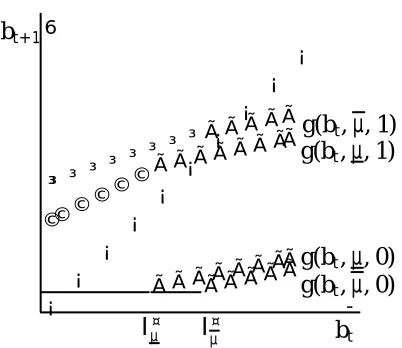
(40) 1.3 The Equilibrium Contracts. 33. f or bjt 2 [b; Iµ¤ ) and thus; the equilibrium is the separating one: Proof. See appendix. Notice that this proposition extends the result found by Rothschild and Stiglitz (1976). In their model all agents have the same amount of initial wealth. They show that when the proportion of low ability borrowers is higher than a certain threshold level, the separating equilibrium exists. By contrast, in our model agents differ also in the inherited wealth which is endogenously provided. Consequently, our threshold level of low ability borrowers depends on the inherited wealth, °e(bt ). Moreover, this threshold level decreases with. the inherited wealth.31 Therefore, if we guarantee the existence of equilibrium for the lowest level of bequest we have equilibrium for higher levels.. 1.3.3. D iscussion. Our result of having overinvestment is in contrast to the conventional underinvestment outcome implicit in the microeconomic literature that analyses adverse selection between banks and borrowers. It is worthwhile to consider the differences in terms of assumptions and results between the work by Stiglitz and Weiss (1981) and our paper. In their paper credit rationing appears since the expected return received by the bank does decrease at some point with the rate of interest charged to borrowers. It is due to adverse selection effect which occurs when a rise in interest rate change the mix of applicants adversely since safe potential borrowers drop out of the market, lowering the average borrowers quality. In our model by. 31. See appendix B.6. for a proof..
(41) 1.3 The Equilibrium Contracts. 34. contrast, an increase in interest rates will decrease (instead of increase) the average risk (or similarly increase the average ability) of the population of borrowers. The reason is that in our model the marginal project nanced (which is given by the borrower being indifferent between applying to the capital market or becoming self nanced) has the lowest success probability, while in the Stiglitz and Weiss model he has the highest: Therefore, in Stiglitz and Weiss’ model the bank may prefer to reject some borrowers instead of increasing the interest rate. They obtain a pure credit rationing since some individuals receive loans, while apparently identical individuals, who are willing to borrow at precisely the same terms, do not. One crucial assumption in order to obtain the underinvestment result is that in Stiglitz and Weiss all borrowers have the same expected pro ts but the dispersion of the pro ts is different, whereas in our model the expected pro ts differ between borrowers (in fact, talented borrowers have higher expected utility than less able ones at any bt ). Another important assumption for having credit rationing is that in their model debt contracts are imposed exogenously and then the contract does not allow for any sorting mechanism constructed in such a way that each type of borrower will choose a speci c type of contract. By contrast, in our model self-selection of borrowers will result from product differentiation because the loan size differs among agents, and thus it could be used to separate out agents. And if separation is complete, rationing can no longer occur. Our overinvestment result depends on a number of assumptions but, if there is a central presumption, it appears to be the complementarity between ability and the investment as well as the assumption that ability affects positively the returns from the investment in.
(42) 1.4 Education, Inequality and Mobility. 35. education. There are some papers where borrowers obtain overinvestment in equilibrium. Besanko and Thakor (1987a) nd that lower risk borrowers get more credit in equilibrium than they would with full information. Their basic assumption obtaining this result is that the marginal rate for substitution between investment and interest rate is an increasing function of the success probability. Our fundamental assumptions imply exactly the same. De Meza and Webb (1987) also obtain that borrowers invest in excess of the socially ef cient level. They assume that banks cannot determine whether an individual consumer holds loans from other banks, as a consequence the equilibrium will be a pooling equilibrium rather than a separating one.32 Overinvestment is obtained because in their model an increase in interest rate would decrease the average risk of the population of borrowers, and consequently credit rationing would never occur at the equilibrium interest rate. We have characterized the equilibrium and we have found under which conditions this equilibrium exists. Concerning the existence problems another two paths have been followed in the literature. One approach followed by Dasgupta and Maskin (1986) allows for the presence of mixed strategies. The other approach followed by Wilson (1997), Riley (1979), and Hellwig (1987) highlight the need of dynamic reactions to new contact offers. Wilson adds the requirement that banks are able to withdraw unpro table contracts from the market, in order to make deviations less attractive. They show that introducing this kind of reactions eliminates the nonexistence problem. 32. The Rothschild and Stiglitz’s (1976) proof that there can not be a pooling equilibrium depends on the assumption that borrowers can buy only one contract (assumption which of course holds also in our model). The implication of this assumption is, in effect, that the bank speci es both the prices and quantities in the contract. There exists, therefore, price and quantity competitions among banks. As Rothschild and Stiglitz point out the assumption that borrowers can buy only one contract is an objectionable one. By arguing that there is absence of monitoring puchases from banks De Meza and Webb use a price competion framework, and thus borrowers are allowed to buy arbitrary multiples of contracts offered..
(43) 1.4 Education, Inequality and Mobility. 1.4. 1.4.1. 36. E ducation, Inequality and M obility. Full Inform ation. The distribution of bequest in period t is given by Gt (b). As we have normalized the mass of population to one, Gt (b) also represents the fraction of the population with current wealth below b. We will show that the distribution of wealth converges to a unique steady state distribution, independently of the initial conditions. So historical endowments do not matter in the long run. In order to do that, we need to de ne the way how bequests evolve. The agent’s optimal decisions (see subsection 1.3.1) and the stochastic process for the shocks (ability and investment shocks) determine the Markov process for bequest. With full information the bequest follows a linear Markov process taking the form bt+1 = ®yt+1 , where the realized income is given by the equations written below. The investment in education can be successful (an event that occurs with probability p = p(µ; Iµ¤ ) if agents are of high ability), or can be unsuccessful (that occurs with probability 1 ¡ p = (1 ¡ p(µ; Iµ¤)) if agents are of high ability). The law of motion for bequest is given by the following equations. If the agent is of high ability and succeeds bt+1 = g(bt ; µ; p) =. ½. ®[he Gµ + R(bjt ¡ Iµ¤ )] if bjt ¸ Iµ¤ with (1 ¡ °)p ®[he Gµ ¡ Fµ¤ (Iµ¤ ¡ bjt )] if bjt < Iµ¤ with (1 ¡ °)p:. (1.10). where the third argument in the function g() indicates that the agent has succeeded. If the agent is of high ability and defaults, he obtains bt+1 = g(bt ; µ; 1 ¡ p) =. ½. ®[hu + R(bjt ¡ Iµ¤ )] if bjt ¸ Iµ¤ with (1 ¡ °)(1 ¡ p) ®hu if bjt < Iµ¤ with (1 ¡ °)(1 ¡ p): (1.11).
(44) 1.4 Education, Inequality and Mobility. 37. where the third argument in the function g() indicates that the agent has not succeeded. If the agent is of low ability and has succeeded, the bequest to his child is bt+1 = g(bt ; µ; p) =. ½. ®[he Gµ + R(bjt ¡ Iµ¤ )] if bjt ¸ Iµ¤ with °p ®[he Gµ ¡ Fµ¤ (Iµ¤ ¡ bjt )] if bjt < Iµ¤ with °p;. (1.12). and low ability agent who defaults, he bequeaths bt+1 = g(bt ; µ; 1 ¡ p) =. ½. ®[hu + R(bjt ¡ Iµ¤ )] if bjt ¸ Iµ¤ with °(1 ¡ p) ®hu if bjt < Iµ¤ with °(1 ¡ p):. (1.13). Notice that the functions g are time independent. [Insert Figure 4] The graph of the law of motion of the bequest with full information is given in Figure 4. We have drawn the transition function for a high (Eqs. (1.10) and (1.11)) and a low type agent (Eqs. (1.12) and (1.13)). In the horizontal axis we have the inherited wealth, bt and in the vertical axis the bequest given to the child, bt+1: We assume that ®R < 1: The highest sustainable wealth for a high type is b =. (A2) ® [he Gµ 1¡®R. ¡ RIµ¤ ]:33 The lowest. sustainable wealth is given by b = ®hu : Because A2 holds, if the inherited wealth is smaller or equal to b it can never exceed b at any time. Likewise, if the inherited wealth is greater or equal to b the dynasty wealth will become less or equal to b: Therefore, we restrict our analysis to the interval ¯ = [b; b] and de ne the support of the distribution of bequest in this interval. ® Similarly, the highest bequest for a low type is bµ = 1¡®R [he Gµ ¡ RIµ¤ ]: Notice that in order to have bµ > Iµ¤ and bµ > Iµ¤ ; we need that ®he Gµ > Iµ¤ and ®he Gµ > Iµ¤ hold:. 33.
Figure


+4



Documento similar
After the Spanish withdrawal from the territory in 1975, Morocco waged a brutal military campaign against the Polisario, and large numbers of people fled to refugee camps, where
Recent observations of the bulge display a gradient of the mean metallicity and of [Ƚ/Fe] with distance from galactic plane.. Bulge regions away from the plane are less
(hundreds of kHz). Resolution problems are directly related to the resulting accuracy of the computation, as it was seen in [18], so 32-bit floating point may not be appropriate
In addition, given the widespread use of prescription benzodiazepines in society, and their diversion to the illicit drug market, the increase in new benzodiazepines might also
The expansionary monetary policy measures have had a negative impact on net interest margins both via the reduction in interest rates and –less powerfully- the flattening of the
Jointly estimate this entry game with several outcome equations (fees/rates, credit limits) for bank accounts, credit cards and lines of credit. Use simulation methods to
In our sample, 2890 deals were issued by less reputable underwriters (i.e. a weighted syndication underwriting reputation share below the share of the 7 th largest underwriter
Increasing THI produces an increase in general activity, changes in feeding patterns and a decrease in rumination and resting behaviors, which is detrimental to animal welfare..
