High-power, fiber-laser-pumped
frequency conversion sources for the
ultraviolet
Enrique Sánchez Bautista
Universitat Politècnica de Catalunya
Doctorate Program
:
Photonics
Duration
:
2011-2015
Thesis advisor
:
Prof. Dr. Majid Ebrahim-Zadeh
Thesis co-advisor
:
Dr. Chaitanya Kumar Suddapalli
Thesis submitted in partial fulfillment of the requirements
for the degree of Doctor of Philosophy of the
Universitat Politècnica de Catalunya
Declaration
I hereby declare that the matter embodied and presented in the thesis
entitled,
“High-power, fiber-laser-pumped frequency conversion sources for
the ultraviolet”
is the result of investigations carried out by me at the ICFO –
The Institute of Photonic Sciences, Castelldefels, Barcelona, Spain, under the
supervision of Prof. Dr. Majid Ebrahim-Zadeh and Dr. Chaitanya Kumar
Suddapalli, and that it has not been submitted elsewhere for the award of any
degree or diploma. In keeping with the general practice in reporting scientific
observations, due acknowledgment has been made whenever the work described
is based on the findings of other investigators.
———————————
Certificate
I hereby certify that the matter embodied and presented in this thesis
entitled, “
High-power, fiber-laser-pumped frequency conversion sources for
the ultraviolet
” has been carried out by Mr. Enrique Sánchez Bautista at the
ICFO – The Institute of Photonic Sciences, Castelldefels, Barcelona, Spain, under
my supervision, and that it has not been submitted elsewhere for the award of any
degree or diploma.
——————————————
Prof. Dr. Majid Ebrahim-Zadeh
(ICFO, Research supervisor)
——————————————
Dr. Chaitanya Kumar Suddapalli
Acknowledgements
It is impossible to describe and condensate in few lines what I lived in four years. All this period has been a continuous learning process, both academically and personally, in which I have dealt with diverse circumstances and goals that were completely out of my imagination that had made this period the richest in experiences and learning of my life.
First and foremost, I want to express my sincere gratitude to Prof. Majid Ebrahim-Zadeh for giving me the opportunity to pursue doctoral studies under his supervision. He always knows how to create a perfect environment for working in the research group. He gave me the opportunity and freedom to be right and to be wrong; he knows my path here has had bright and dark spots, and he always gave me truthful advices on any topic. Moreover, I want to express my very best gratitude to Dr. Chaitanya Kumar Suddapalli who has been my thesis co-supervisor. This thesis will not be possible without his help, perseverance and sincere advices. I will always remember our conversations and his hard-working-oriented personality is an example to me that I will remember forever. Chaitanya imprints a character, and I am taking that with me. Additionally, this thesis is the fruit of collaboration with very bright people from my group: Kavita, Adolfo, Ossi, Shahrzad, Josep, and Junxiong. Ramaiah have been almost a second mentor and my best roomie. Really, thank you!
(management, IT, HR, logistics, etc.) facilitated our daily work, allowing us really focus in top research and cutting-edge technology. But not only research and technology; are the leadership techniques, the personal development courses and the entrepreneurial spirit that everyday involves to each and every ICFOnian what makes the difference between a great place and a top place. I am embedded in this philosophy and I truly believe ICFO is addressed to create new world leaders in the future. Additionally, I would also like to thank the KTT unit for giving me the possibility of organizing outreach activities parallel to my daily work. I also thank to my peers at ICONS with whom I could learn and develop many activities. I surely believe top-profile people are broadband-profile people and both –KTT and ICONS–, are key elements to make better researchers, better leaders and better people. Lluís, thank you for creating this wonderful place!
I would also want to thank to my teachers from Universidad Complutense de Madrid, where I had the pleasure to study my degree in Physics, learn and become an adult. And my condolences to Prof. Paz Godino Gómez, who I had the pleasure to work with and who passed away few months ago.
During my time in Barcelona I have got the opportunity to meet many wonderful people from different countries and continents. Special thanks to these people that has been part of my time here, from which I could learn, share different visions about politics, society, enjoy moments and a very long etcetera. Particular thanks to Alejandro, Salva, Michael, Miriam, José and Katy, who helped me with the corrections into English. I am also grateful to all those who stayed back when I came to Barcelona to pursue for my doctoral studies. It is a pleasure to thank to all my friends from Madrid. Edu, Rupe, Iván, Jorge, Busta, Felipe and Anita. Special thanks to my samba band, Samba Da Rua. I still remember the farewell surprise you made me when I came here. To all of you, thank you!
me along all this time. Special thanks to my mum and my dad. You know better than anyone how has been this path today I am finishing and I am very proud of you. It is a pleasure to remember and thank to my tía Carola, because she recommended me one day to study physics. And my very best thank and gratitude to Jennifer, not only for helping me in the translation into Catalan. You have been the best surprise I could have during these four years and I am very grateful for your unconditional support. Really, thank you!
Abstract
High-power, stable, high-repetition-rate, picosecond ultraviolet (UV) sources are of crucial importance for a variety of applications, such as atmospheric sensing, spectroscopy or optical data storage. Further, precise material processing or laser patterning requires high energy sources with ultrashort pulses for increased accuracy.
Nonlinear, single-pass, frequency conversion sources present a highly effective and simplified approach to cover the UV spectral regions inaccessible to lasers, offering potential solutions for many of the applications mentioned above. The development of high-average-power UV sources through third- and fourth-harmonic generation (THG and FHG, respectively) of 1064 nm fiber lasers in nonlinear crystals is of particular importance due to their compact footprint, high efficiency, long lifetime, excellent stability and cost-effective design. The features of these sources are strongly dependent on the choice of the nonlinear crystal. For UV generation, this choice is particularly challenging when low-intensity picosecond pulses at high repetition rates are involved. Borate-based birefringent crystals are the most viable candidates for UV generation in the absence of suitable periodically-poled nonlinear materials, and are readily available.
This thesis presents the development of high-power frequency conversion sources for the UV spectral range, employing different experimental configurations and nonlinear crystals, making them compact, reliable and low cost designs. In particular, the nonlinear crystals β-BaB2O4 (BBO) and BiB3O6, (BIBO), with better optical, thermal and
high-power Yb-fiber laser at 1064 nm has been exploited as the pump source in the work presented in this thesis.
Firstly, we have demonstrated a simple, inexpensive and novel UV source at 355 nm comprising two stages in an innovative multicrystal scheme. This involved two BIBO crystals efficiently addressing the effects induced by the birefringence of the material while implementing optimal focusing techniques. This source was capable of simultaneously generating the second- and third-harmonic of a high-power, picosecond Yb-fiber laser at 1064 nm, delivering excellent stability and high quality beam profile.
Moreover, efforts to refine the THG efficiency led to a successful improvement of the aforementioned fiber-based source at 355 nm. This was achieved by deploying a single-pass second-harmonic generation (SHG) under noncritical phase-matching in LiB3O5 (LBO) crystal, which considerably enhanced the output power and improved the
overall performance with regard to stability and beam quality in the green, that are technologically important for a diverse range of technological applications. The obtained results at 355 nm confirm the viability of BIBO as a highly attractive material for efficient generation of low-intensity, high-average-power picosecond pulses in the UV.
Resumen
Las fuentes estables de luz pulsada en el ultravioleta (UV) en el régimen de picosegundos con altas frecuencias de repetición y de alta potencia juegan un papel crucial en gran cantidad de aplicaciones. Alguno de estos ejemplos son la detección atmosférica de gases, técnicas de espectroscopia o el almacenamiento óptico de datos. Además, las nuevas técnicas de procesado de materiales y de grabado láser requieren estas fuentes de pulsos ultracortos de alta potencia para conseguir los más altos niveles de precisión.
En este sentido, las fuentes no lineales de radiación basadas en la conversión de frecuencias de paso único presentan las mejores características para cubrir dicha región espectral a día de hoy inaccesible a los láseres convencionales, ofreciendo un amplio abanico de soluciones para todas las aplicaciones anteriormente mencionadas. El desarrollo de estas fuentes de luz de alta potencia basadas en la generación del tercer y cuarto armónico (THG y FHG de sus siglas en inglés) de láseres de fibra de 1064 nm son de gran interés gracias a su compacto diseño, alta eficiencia, larga vida, excelente estabilidad y buena relación calidad-precio. Las características de estas fuentes están fuertemente determinadas por la elección del cristal no lineal que se utilice. La generación de radiación UV presenta particulares dificultades cuando se trata de pulsos de picosegundos a baja intensidad con altas frecuencias de repetición. En estos casos, los cristales birrefringentes de la familia de los boratos son los candidatos más atractivos para la generación de esta radiación dada la ausencia de materiales no lineales periódicamente polarizados adecuados para este fin.
basadas en la conversión de frecuencias, empleando diferentes configuraciones experimentales así como distintos cristales no lineales, construyendo diseños compactos, fiables y de bajo coste. En concreto, se escogieron los cristales relativamente nuevos, β -BaB2O4 (BBO) y BiB3O6, (BIBO), para nuestras fuentes de UV. Estos presentan mejoras
sustanciales en las propiedades ópticas, térmicas y de ajuste de fases para THG y FHG. Por otro lado, en los trabajos presentados en esta tesis se utilizó un láser de fibra de iterbio a 1064 nm como fuente de bombeo.
En primer lugar, se demostró una novedosa fuente de UV de 355 nm comprendida por dos etapas en un simple e innovador esquema multicristal. Este incluye dos cristales BIBO que amplifican eficientemente los efectos inducidos por su propia birrefringencia. Esta fuente generó simultáneamente el segundo y tercer armónico de un láser de fibra de iterbio a 1064 nm de alta potencia, presentando una excelente estabilidad con un perfil en el haz de alta calidad. Además, se depuraron al máximo las técnicas para un óptimo enfoque y el consiguiente aumento de la eficiencia.
En segundo lugar, gracias a los esfuerzos para incrementar la eficiencia del THG se obtuvieron mejoras sustanciales respecto a la anterior fuente de UV de 355 nm. La generación del segundo armónico (SHG de sus siglas en inglés) se realizó implementando un cristal LiB3O5 (LBO), que presenta ajuste de fases no crítico de paso único. Gracias a
ello, se incrementó la potencia y se mejoraron las características de salida de la fuente como la estabilidad y la calidad del haz de 532 nm, las cuales son importantes para diversas aplicaciones tecnológicas. Posteriormente se procedió, como en el caso anterior, a sumar las frecuencias –1064 nm y 532 nm–, obteniendo unos resultados a 355 nm que confirman la viabilidad del BIBO como un excelente material para generar eficientemente pulsos de picosegundos de baja intensidad en el UV.
Resum
Les fonts estables de llum polsada en l'ultraviolat (UV) en el règim de picosegons amb altes freqüències de repetició i d'alta potència, juguen un paper crucial en gran quantitat d'aplicacions. Algun d'aquests exemples són la detecció atmosfèrica de gasos, tècniques d'espectroscòpia o l'emmagatzemat òptic de dades. A més a més, les noves tècniques de processat de materials i de gravat làser requereixen aquestes fonts de polsos ultracurts d'alta potència per aconseguir els més alts nivells de precisió.
En aquest sentit, les fonts de radiació no lineal basades en la conversió de freqüències de pas únic presenten les millors característiques per cobrir aquesta regió espectral a dia d'avui inaccessible als làsers convencionals, oferint un ampli ventall de solucions per totes les aplicacions anteriorment esmentades. El desenvolupament d'aquestes fonts de llum d'alta potència basades en la generació del tercer i quart harmònic (THG i FHG per les seves sigles en anglès) del làser de fibra de 1064 nm són de gran interès gràcies al seu compacte disseny, alta eficiència, llarga vida, excel·lent estabilitat i bona relació qualitat-preu. Les característiques d'aquestes fonts estan fortament determinades per l'elecció del cristall no lineal que s'utilitzi. La generació de radiació UV presenta particulars dificultats quan es tracta de polsos de picosegons a baixa intensitat amb altes freqüències de repetició. En aquests casos, els cristalls birefringents de la família dels borats són els candidats més atractius per la generació d'aquesta radiació donada l'absència de materials no lineals periòdicament polaritzats adequats per aquesta finalitat.
potència basades en la conversió de freqüències, emprant diferents configuracions experimentals així com diferents cristalls no lineals, construint dissenys compactes, fiables i de baix cost. En concret, es van escollir els cristalls relativament nous, β-BaB2O4
(BBO) i BiB3O6, (BIBO), per les nostres fonts d'UV. Aquests presenten millores
substancials pel que fa a les propietats òptiques, tèrmiques i d'ajust de fases per THG i FHG. D'altra banda, en els treballs presentats en aquesta tesi es va utilitzar un làser de fibra d'iterbi a 1064 nm com a font de bombeig.
En primer lloc, es va demostrar una nova font d'UV de 355 nm que consta de dues etapes en un simple i innovador esquema multi-cristall. Aquest inclou dos cristalls BIBO que amplifiquen eficientment els efectes induïts per la seva pròpia birefringència. Aquesta font va generar simultàniament el segon i tercer harmònic d'un làser de fibra d'iterbi a 1064 nm d'alta potència, presentant una excel·lent estabilitat amb un perfil al feix d'alta qualitat. A més a més, es van fer servir al màxim les tècniques per un òptim enfocament i el consegüent augment de l'eficiència.
En segon lloc, els esforços per incrementar l'eficiència del THG van resultar en millores substancials respecte l'anterior font d'UV de 355 nm. La generació del segon harmònic (SHG per les seves sigles en anglès) es va realitzar mitjançant la implementació d'un cristall LiB3O5 (LBO), que presenta un ajust de fases no crític de pas únic. Gràcies a
aquesta acció, es va realçar la potència i es van millorar les característiques de sortida de la font com l'estabilitat i la qualitat del feix de 532 nm, les quals són importants per diverses aplicacions tecnològiques. Posteriorment es va procedir, com en el cas anterior, a sumar les freqüències –1064 nm i 532 nm–, obtenint uns resultats a 355 nm que confirmen la viabilitat del BIBO com un excel·lent material per generar eficientment polsos de picosegons de baixa intensitat en el UV.
Publications
1. S. Chaitanya Kumar, J. Canals Casals, E. Sánchez Bautista, K. Devi and M. Ebrahim-Zadeh: “1.8 W, 80 MHz, picoseconds, Yb-fiber-based ultraviolet sources at 266 nm using β-BaB2O4,” Optics Letters, 40(10), 2397-2400 (2015). 2. S. Chaitanya Kumar, E. Sánchez Bautista and M. Ebrahim-Zadeh: “Stable,
high-power, Yb-fiber-based, picosecond ultraviolet generation at 355 nm using
BiB3O6,” Optics Letters, 40(3), 403-406 (2015).
3. S. Chaitanya Kumar, E. Sánchez Bautista and M. Ebrahim-Zadeh: “Stable, high-power, Yb-fiber-based, picosecond ultraviolet generation at 355 nm using
BiB3O6,” Virtual Journal for Biomedical Optics, 10(3), (2015).
4. S. Chaitanya Kumar, J. Canals Casals, E. Sánchez Bautista, K. Devi and M. Ebrahim-Zadeh: “1.8 W, 80 MHz, picoseconds, Yb-fiber-based ultraviolet sources at 266 nm using β-BaB2O4”, CLEO-Europe, Munich, Germany, June 2015.
5. S. Chaitanya Kumar, E. Sánchez Bautista and M. Ebrahim-Zadeh, “1.2 W-average-power, Yb-fiber-pumped, picosecond ultraviolet source at 355 nm based on BiB3O6,” CLEO-USA, San Jose, 2015.
Simplicity is the ultimate form of sophistication.
High-power, fiber-laser-pumped
frequency conversion sources for the
Contents
1 Introduction
...
15
2 Basics of Nonlinear Optics
...
25
2.1 Second-order nonlinear processes ... 27 2.2 Nonlinear susceptibility ... 30 2.3 Coupled-wave equations for second-order nonlinear processes ... 34 2.4 Phase-matching ... 39 2.4.1 Birefringent phase-matching ... 40 2.4.2 Quasi-phase-matching ... 45 2.5 Second-harmonic generation ... 47 2.6 Sum-frequency generation ... 50 2.7 Phase-matching considerations ... 52
3 High-power, picosecond ultraviolet source at 355 nm based on BiB
3O
6...
57
3.1 Motivation ... 57 3.2 Design and optimization of the focusing... 62 3.3 Experimental setup ... 63 3.4 All-BIBO section: Single-pass, picosecond, all-BIBO ultraviolet source ... 65
4
3.4.1.1 Phase-matching ... 69 3.4.1.2 Acceptance bandwidths ... 69 3.4.1.3 Power scaling and efficiency ... 71 3.4.1.4 Power stability and spectrum ... 73 3.4.1.5 Output beam quality ... 73 3.4.2 Sum-frequency generation using BIBO crystal ... 74 3.4.2.1 Phase-matching ... 77 3.4.2.2 Acceptance bandwidths ... 77 3.4.2.3 Power scaling and efficiency ... 79 3.4.2.4 Power stability and spectrum ... 80 3.4.2.5 Output beam quality ... 82 3.5 LBO-BIBO section: Single-pass, picosecond UV source using a LBO and
BIBO crystals ... 83 3.5.1 Second-harmonic generation using LBO crystal ... 84 3.5.1.1 Power scaling ... 85 3.5.1.2 Temporal and spectral characterization ... 87 3.5.1.3 Power and temporal stability ... 87 3.5.2 Sum-frequency generation using BIBO crystal ... 89 3.5.2.1 Power scaling ... 89 3.5.2.2 Power and temporal stability and spectrum ... 91 3.5.2.3 Output beam quality ... 93 3.6 Conclusions ... 93
4 High-power, picosecond ultraviolet source at 266 nm based on
β
-BaB
2O
4...
95
Contents
4.3 Fourth-harmonic generation using BBO crystal ... 101 4.3.1 Phase-matching ... 102 4.3.2 Acceptance bandwidths ... 103 4.4 Power scaling and efficiency ... 104 4.5 Power and temporal stability and spectrum ... 106 4.6 Output beam quality ... 107 4.7 Conclusions ... 109
5 Summary and outlook
...
111
List of tables
1.1 Advances in nonlinear optics ... 18 2.1 Degeneracy factor, K, value for each second-order nonlinear process ... 32 2.2 Classification of crystal groups ... 37 3.1 Phase-matching properties of some nonlinear crystals for UV generation
through SFG ... 60 4.1 Phase-matching properties of some nonlinear crystals for 266 nm generation
List of figures
1.1 Spectral coverage of conventional UV lasers ... 20 2.1 Schematic of primary second-order nonlinear processes. (a) Represents
second-harmonic generation (SHG); (b) sum-frequency generation (SFG); (c) difference-frequency generation (DFG); and (d) optical parametric generation (OPG) ... 29 2.2 Waveforms associated with the atomic response when applying one field. (a)
represents the applied field; (b) represents the linear response; (c) the nonlinear response of a centrosymmetric material; and (d) the nonlinear response of a non-centrosymmetric material ... 33 2.3 Dipole displacement response under different incident electromagnetic field
strengths depending upon their symmetry group. (a) Represents the regime of linear optics under small incident electromagnetic fields; (b) the nonlinear response of centrosymmetric materials under strong incident electromagnetic fields; and (c) the nonlinear response of non-centrosymmetric materials under strong incident electromagnetic fields ... 35 2.4 Illustration of (a) perfectly birefringent phase-matching (∆k = 0), (b)
10
2.5 Normal index surface for positive (a) and negative (b) uniaxial crystals ... 42 2.6 Illustration of perfect (type-I) phase-matching for SHG in case of
extraordinary fundamental wave to generate ordinary second-harmonic wave ... 43 2.7 Representation of the SHG process in a QPM crystal with a schematic view of
the periodic inversion of the sign of the deff coefficient ... 46
2.8 Second-harmonic and fundamental intensities as functions of ΓL for phase-matched SHG including pump depletion ... 48 2.9 Spectral acceptance bandwidths of a 10-mm-long BIBO nonlinear crystal for
SHG with type-I interaction (ee→o) in the yz-plane ... 54 2.10 Angular acceptance bandwidths of a 10-mm-long BIBO nonlinear crystal for
SHG with type-I interaction (ee→o) in the yz-plane ... 54 3.1 Schematic view of the nonlinear processes in the experiment. “Crystal-1”
represents a BIBO crystal (all-BIBO configuration) or a LBO crystal (LBO-BIBO configuration) ... 61 3.2 Picture of the setup and of the UV beam ... 64 3.3 Schematic view of the all-BIBO configuration... 65 3.4 Schematic of the experimental setup for single-pass SHG and THG. :
half-wave-plate; PBS: polarizing beam-splitter; L: lens; HOW: high-order wave-plates; M1,2: plano-concave mirrors; MT: dichroic mirrors. Inset: schematic of
the action of the high-order wave-plates (HOW) providing simultaneous quarter-wave rotation at 532 nm and half-wave rotation at 1064 nm ... 66 3.5 Phase-matching curve for SHG for type-I (ee→o) interaction in the yz-plane ... 68 3.6 Angular acceptance bandwidth for SHG for type-I (ee→o) interaction in the
List of figures
3.8 Variation of the SH power and SHG efficiency as a function of fundamental power ... 71 3.9 Long-term power stability of the mode-locked Yb-fiber-laser used as pump
source over 11 hours ... 72 3.10 Long-term power stability of the green source over 11 hours. Inset: SHG
spectrum, presenting a FWHM of 1.1 nm broad ... 72 3.11 Variation of walk-off angle for type-I (ee→o) phase-matching in yz-plane in
BIBO crystal as a function of fundamental wavelength ... 74 3.12 Phase-matching curve for SFG for type-I (ee→o) interaction in the yz-plane ... 76 3.13 Angular acceptance bandwidth for SFG for type-I (ee→o) interaction in the
yz-plane ... 76 3.14 Spectral acceptance bandwidth for SFG for type-I (ee→o) interaction in the
yz-plane of the wave at 1.064 µm ... 78 3.15 Spectral acceptance bandwidth for SFG for type-I (ee→o) interaction in the
yz-plane of the wave at 0.532 µm ... 78 3.16 Variation of the UV power and efficiency as a function of fundamental power ... 79 3.17 Long-term power stability of the UV source over 11 hours. Inset: UV
spectrum, presenting a FWHM of 1.0 nm broad ... 80 3.18 Pointing stability of the UV measured over 1 hour ... 81 3.19 UV beam profile ... 81 3.20 Variation of walk-off angle for type-I (ee→o) phase-matching in yz-plane in
BIBO crystal as a function of fundamental wavelength ... 82 3.21 Variation of walk-off angle for type-I (ee→o) phase-matching in yz-plane in
12
3.23 Temperature phase-matching curve for type-I (oo→e) SHG in the xy-plane ... 85 3.24 Variation of the SH power and SHG efficiency as a function of fundamental
power ... 86 3.25 Typical autocorrelation trace of the SH at 532 nm with duration of 16.2 ps (x
1.414, assuming a Gaussian pulse shape). Inset: SH spectrum measured at a central wavelength of 532 nm with a FWHM bandwidth of 0.6 nm ... 86 3.26 Long-term power stability of the green source over 16 hours ... 88 3.27 Green beam pointing stability of the SH measured over 1 hour ... 88 3.28 Variation of the UV power and efficiency as a function of fundamental power ... 90 3.29 Long-term power stability of the UV source over 14 hours. Inset: (a) UV
spectrum, presenting a FWHM of 1.0 nm broad... 91 3.30 Pointing stability of the UV measured over 1 hour ... 92 3.31 UV beam profile measured using a scanning beam profiler ... 93 4.1 Schematic view of the FH generator using two consecutive SHG processes ... 97 4.2 Schematic of the experimental setup for single-pass SHG and FHG: λ/2:
Half-wave-plate, PBS: Polarizing beam-splitter, L1,2,3: lenses, MSH,FH:
High-reflective dichroic mirrors for 532 nm and 266 nm respectively ... 98 4.3 Picture of the SHG stage using a LBO crystal ... 100 4.4 Picture of the second SHG stage using a BBO crystal and the corresponding
UV beam ... 100 4.5 Phase-matching curve for SHG for type-I (oo→e) interaction ... 102 4.6 Angular acceptance bandwidth for SHG for type-I (oo→e) interaction ... 103 4.7 Spectral acceptance bandwidth for SHG for type-I (oo→e) interaction ... 104 4.8 Variation of the FH power and FHG efficiency as a function of fundamental
List of figures
4.9 Variation of the FH power as a function of the square of SH power... 105 4.10 Long-term power stability of the UV source over 14 hours. Inset: UV
spectrum, presenting a FWHM of 0.8 nm broad ... 107 4.11 Variation of walk-off angle for type-I (oo→e) phase-matching in BBO crystal
1 Introduction
The laser has become one of the key developments of the last century with widespread use in our daily life. Since the invention of the laser [1], it has experienced tremendous progress in the last few decades, becoming omnipresent in various industrial and medical techniques, communications, illumination and many other applications playing an irreplaceable role in different aspects of our society. The laser can provide the most spectrally pure light based on stimulated emission between quantized energy levels in the active medium within the laser device. This property, together with its direct generation and easy manipulation, has made the laser a remarkable tool in many applications. From reading bar codes to aerospace communications, our welfare and technological development of society requires laser at countless different levels in various practical applications. Some of them need high output power as well as high efficiency, stability and good beam profile. Broad wavelength tunability is also required for numerous applications [2].
16
Nonlinear optical techniques based on frequency conversion of laser light in second-order nonlinear materials offer a highly effective method to expand the spectral range of existing laser sources, overcoming the spectral limitations of lasers [3,4].
Nonlinear optics, and in particular nonlinear frequency conversion, has pushed the barriers of knowledge and technology, leading to the development of coherent light sources and enabling access to the above-mentioned spectral regions not covered by conventional lasers. Moreover, nonlinear frequency conversion provides a flexible capability of generating both single frequency photons or a wavelength tunability across extended spectral regions from a single device depending on our technological needs [5,6]. At the same time, the instantaneous nature of nonlinear gain allows frequency conversion processes to keep the temporal characteristics of the input pump laser, thus enabling wavelength generation in all temporal regimes from the continuous wave (cw) to ultrafast femtosecond time scales upon the choice of the pump laser [3]. These capabilities are of great interest for variety of applications such as spectroscopy, biomedicine, remote sensing and environmental monitoring [7].
The concept of the parametric processes was first reported at the beginning of the 20th century [8]. In 1926, S. Vavilov and V. L. Levishin, found a reduction in the light absorption by uranium doped glass as the intensity of light was increased [8].Afterwards, C. V. Raman in 1928 [9] discovered spontaneous scattering of photons into new frequencies passing through a transparent medium.
Chapter 1: Introduction
18
Table 1.1: Advances in nonlinear optics.
Event Authors Reference Year
First report of an optical nonlinearity effect S. Vavilov et al. [8] 1926
Discovery of the Raman scattering or Raman effect C. V. Raman et al. [9] 1928
Theoretical postulation of the concept of phase-matching in radio waves P. K. Tien [14,15] 1958
First demonstration of laser T. H. Maiman [1] 1960
First experimental demonstration of SHG P. Franken et. al. [12] 1961
Publication of the article “Interaction between light waves in a nonlinear dielectric” J. A. Armstrong et. al. [4] 1962 First demonstration of experimental observation of frequency mixing (SFG) M. Bass et. al. [13] 1962
First demonstration of the phase-matching condition J. A. Giordmaine et al. [16] 1962
Theoretical postulation of optical parametric generation (OPG) R. H. Kingston et al. [17] 1962 First theoretical proposal of optical parametric oscillator (OPO) N. M. Kroll [18] 1962
First observation of THG R. W. Terhune et al. [19] 1962
First demonstration of difference-frequency generation (DFG) A. W. Smith et. al. [20] 1963
First experimental demonstration of an OPO J. A. Giordmaine et al. [21] 1965
First demonstration of continuous-wave OPO
R. G. Smith et al. R. L. Byer et al.
[22]
[23] 1968 First implementation of periodic poling technology 40 years after its postulation S. Matsumoto et. at. [24] 1991
Chapter 1: Introduction
J. A. Giordmaine et al. [16], although phase-matching was also suggested by P. D. Maker et al. [25] in the same year. Right after, R. W. Terhune et al. [19], described the first observation of third-harmonic generation (THG) in May 1962, and later in 1963 A. W. Smith and N. Braslau demonstrated the first difference-frequency generation (DFG) experiment [20]. During the same period, the importance of parametric generation and amplification was highlighted as an important technique for the generation of tunable coherent radiation in new spectral regions [17,18,26], opening the possibility to the first corroboration of the optical parametric generation (OPG) processes. This led to the first experimental demonstration of a pulsed optical parametric oscillator (OPO) by J. A. Giordmaine and R. C. Miller in 1965 [21], followed independently by R. G. Smith et al. [22] and R. L. Byer et al. [23] with the first demonstration of continuous-wave OPOs in 1968. Table 1.1 shows some of the most important milestones in the field of nonlinear optics.
Although, since then, the basic principles behind frequency conversion processes have been well developed and understood, the unavailability of suitable pump lasers and proper nonlinear optical materials have hindered the extension of these techniques to different wavelength regions and time-scales [27]. For this reason, access to extended regions in the UV, visible and IR has remained difficult because of the absence of suitable solid-state gain materials [28]. Even today, after a period of well-established implementation of laser technology in our daily lives, wide regions of the optical spectrum in the UV remain inaccessible to conventional mode-locked laser sources [3]. Figure 1.1 shows the wavelength of some of the UV lasers commercially available.
20
Ene
rgy p
er puls
e (
J)
cfffff
Figure 1.1: Spectral coverage of conventional UV lasers.
the promising applications with a strong need for stable, coherent and high-beam-quality sources in the UV [29,30]. Previously, access to this spectral region was achieved with excimer lasers, however, their bulky complex and power-hungry gas gain media required massive installations, making them unviable for many applications. These facts kept the interest of researchers and industry in the development of high-repetition-rate UV sources at practical average power and efficiency, in simple, compact, cost-effective and practical architecture.
The advent of new optical materials, together with the development of new nonlinear optical techniques based on frequency conversion of laser light in second-order nonlinear materials, has paved the way to reach some of the inaccessible regions in the UV spectrum, offering a highly effective method to expand the wavelength range of existing laser sources. The above mentioned nonlinear frequency conversion techniques –SHG and SFG– can provide spectral extension of laser sources to shorter wavelengths,
Chapter 1: Introduction
making them a promising, but still challenging, method of coverage of the UV region at high efficiency and practical powers.
Any frequency conversion process is inherently correlated with the nonlinear optical material in which it is generated together with the input laser pump source. Both elements constitute the essential components in the practical development of any frequency conversion system. In the early 1980’s, a new generation of birefringent nonlinear crystals, primarily β-BaB2O4 (BBO) and LiB3O5 (LBO), with higher damage
thresholds than the previous classical nonlinear optical materials were developed. This fact, together with the advent of new crystalline solid-state and fiber lasers with improved spectral and spatial coherence as well as higher output powers, led to the development of a new family of frequency conversion sources with properties never achieved before operating in all temporal regimes, from the cw to the femtosecond time-scales. In 1991, a matured crystal growth technology for periodically poling the ferroelectric materials was achieved [24], bringing into action quasi-phase-matching (QPM) technique nearly three decades after its postulation in 1962 [4].
Today, there are well-established frequency conversion technologies for the generation of different frequencies, from mid-IR [2,7,31] to visible [32], down to the UV [33], using BBO and LBO, and the relatively new nonlinear material bismuth borate, BiB3O6 (BIBO), first described by H. Hellwig et al. [34,35] in 1999. Earlier reports
22
respectively. Additionally, a group of periodically poled crystals such as MgO-doped periodically poled lithium niobate (MgO:PPLN), periodically poled KTiOPO4 (PPKTP),
as well as MgO-doped periodically poled lithium tantalate (MgO:PPLT) constitute solid and reliable materials for the mid-IR generation [41-44]. Progress in the development of new frequency conversion techniques using these crystals has led to important advances in nonlinear optics as a whole, extending the wavelength range of existing laser sources to new regions in the UV. Despite the many advances, there still remain important challenges in this technology, which should be faced by a continued research for innovative design concepts, alternative new nonlinear materials, and different laser pump sources.
The context of the research work presented in this thesis is built on well-established frequency conversion methods, while significantly improving previous techniques, leading to improved results using simple and reliable concepts for the generation of UV wavelengths in the picosecond regime. All the devices presented here are based on fiber laser technology, making them compact, practical and robust. Moreover, the simplicity of the properties of the BIBO crystal, which has been used in most of the steps in the experiments, can provide most of its highlighted characteristics at room temperature, emphasizing in the simplicity of the setups presented in this thesis. A desirable implementation of this technology into more complex devices or systems for engineering applications such as aerospace industry require simplicity and robustness, where typically the complexity of the payloads constitutes a limiting factor for a successful prospective mission.
Chapter 1: Introduction
Chapter 2 provides a brief introduction to various nonlinear optical phenomena presented throughout this thesis, such as SHG and SFG, as well as a theoretical description of the phase-matching condition, which is crucial for effective amplification and macroscopic observation of any nonlinear effect. An in-depth analysis of the concepts of acceptance bandwidths is presented. A more extensive discussion of these concepts can be found in other References [45,46].
Chapter 3 is divided into two subsections, both of them based on the description of the highly reliable, high-power, picosecond UV sources at 355 nm, by exploiting the unique properties of the BIBO crystal. In the first subsection, we present a stable, compact, Yb-fiber-based, high-power, all-BIBO, picosecond UV source providing up to 164 mW. The compact UV source is based on a novel multicrystal scheme comprising two stages, both involving single-pass frequency conversion in BIBO. The generation of the UV was challenging due to the inherent phase-matching requirements of the SFG effect ( ) within the second crystal, for which the polarization of the
interacting waves needed a selective rotation. The source also simultaneously generates 4.9 W of picosecond green power at 532 nm. In the second subsection, we present an improved version of the previous setup. Also, we present a stable, compact, Yb-fiber-based, high-power, picosecond UV source based on the BIBO crystal. Nevertheless, in this case, we performed single-pass SHG using LBO to provide up to 9.1 W of average green power at 532 nm. This green radiation was then sum-frequency-mixed with the fundamental in a BIBO crystal, providing up to 1.2 W of average UV power at 355 nm.
24
2 Basics of Nonlinear Optics
2.1 Second-order nonlinear processes
26
(2.1)
(2.2) laser by T. Maiman in 1960 [1].
The electromagnetic response of a material to the applied field can be considered as the dependence of the dipole moment per unit volume, or polarization, , of the material upon the strength, , of the applied optical field [45,47]. If the applied field is not sufficiently intense, then the induced polarization depends linearly upon the electric field strength and can be described as,
where and are the polarization and the electric field vectors, respectively, is the linear susceptibility of the medium, and is the permittivity of free space. However, when the strength of the interacting field is comparable to the intra-atomic electric field in the material, the response of the material is no longer linear [5]. In this case, the optical response of the material becomes nonlinear, and can be described by generalizing the equation 2.1, by expressing the polarization as a power series in the applied electric field,
where and are the second- and third-order nonlinear susceptibilities, respectively. The induced polarization that depends linearly upon the electric field strength can be described , whereas corresponds to the induced polarization which
is nonlinearly dependent upon the strength of the incident electric field. The work presented in this thesis is mainly based on interactions involving second-order nonlinear processes, which are governed by the second-order nonlinear susceptibility, .
Chapter 2: Basics of Nonlinear Optics
(2.3)
(2.4)
(2.5) found on the treatment of other higher-order interactions in a multitude of References [4,45,46].
2.1 Second-order nonlinear processes
Any second-order optical process based on exhibits a mutual interaction of three waves of frequencies , and . The induced second-order nonlinear polarization dependent upon the strength of the three waves can be extracted from equation 2.2 as,
Considering an optical field consisting of two distinct frequency components, and , incident on a second-order nonlinear optical medium,
Subsequently, the second-order nonlinear polarization, using the equations 2.3 and 2.4, is given by,
(2.5
)
2.1 Second-order nonlinear processes
28
described schematically in Figure 2.1(a). It is the degenerate case of SFG in which a single pump wave, the fundamental at frequency , is incident on a nonlinear medium and generates a wave at the second-harmonic frequency . The general case of SFG involves two input waves at frequencies , and the result of its combination
is shown in Figure 2.1(b). In addition to these processes, DFG also involves two input waves at frequencies , with the result of the generation of a photon at a frequency , as shown in Figure 2.1(c). Another possible parametric process is OPG, also known as parametric down-conversion. In this process, only one input wave at frequency leads to the generation of two lower-energy waves at frequencies and . By convetion, the generated wave with the higher frequency is referred to as signal, and the wave at lower frequency is termed idler. This process, shown in Figure 2.1(d), both conservation laws: conservation of energy ( ) and momentum ( ) –also called phase-matching condition– must be satisfied. For efficient enhancement of the effect, and thus attainment of an appreciable conversion efficiency, it is possible to enclose the OPG system in a resonator, resulting in an OPO, which is generally used for many practical applications [48-50].
Chapter 2: Basics of Nonlinear Optics
(a)
(b)
(c)
(d)
[image:57.612.164.448.95.613.2]Figure 2.1: Schematic of primary second-order nonlinear processes. (a) Represents
second-harmonic generation (SHG); (b) sum-frequency generation (SFG);
(c) difference-frequency generation (DFG); and (d) optical parametric
generation (OPG).
2.2 Nonlinear susceptibility
30
2.2 Nonlinear susceptibility
Previously it was described how any second-order interaction exhibits mutual interaction of three waves of frequencies , and . A complete description of the interaction between these three waves requires an understanding of how the nonlinear polarizations of the waves interact with each other. In order to describe these interactions, it becomes necessary use the nonlinear susceptibility in a tensor form. Focusing our attention on the second-order nonlinear susceptibility, , a full description involves its representation as a tensor of 27 elements, , where the indices correspond to , and represent the polarization of the interacting waves. At this stage, it is important to describe another notation commonly used in second-order nonlinear optics [46]. Often, the susceptibility is represented as the so-called d-coefficient, where the d is a tensor described as,
Chapter 2: Basics of Nonlinear Optics (2.8) (2.9)
The matrix components, , are known as the nonlinear coefficients of the
material. After this consideration, introducing the matrix within the general
expression for the second-order nonlinear polarization, it is observed that,
with K being the degeneracy factor, which can take different values upon the represented second-order nonlinear process [45]. Therefore, the equation that represents SHG process in terms of results,
One of the symmetry properties present in some materials is the geometrical symmetry, inherent to the structural or spatial symmetry of the material. For those crystals that possess inversion of symmetry in their crystal structure (center of inversion), the nonlinear susceptibility, , vanishes identically [53]. All materials with this characteristic are denominated centrosymmetric materials.
2.2 Nonlinear susceptibility 32 (2.10) (2.11) (2.12) Second-order nonlinear process SHG
SFG DFG OPG Optical rectification
Degeneracy factor,
K 1/2 1 1 1 1/2
Table 2.1: Degeneracy factor, K, value for each second-order nonlinear process.
Physically, the inversion of symmetry implies that under a change in the sign of the applied electric field E(t), the sign of the induced polarization must also change. Therefore, the expression 2.3 should be replaced by,
Simple calculation arises that,
So, by combining both expressions 2.10 and 2.11, must be equal to , which can only happen under the consideration that vanishes identically and,
consequently, resulting in:
Therefore, to exhibit second-order nonlinearity, the medium must be a non-centrosymmetric material. According with their point group symmetry classification, out of the 32 crystals groups classified and presented in Table 2.2 [54,55], just 20 of the 21 accentric class exhibit quadratic susceptibility [5].
Chapter 2: Basics of Nonlinear Optics
(a)
(b)
(c)
(d)
[image:61.612.152.470.97.592.2]
Figure 2.2: Waveforms associated with the atomic response when applying one field.
(a) represents the applied field; (b) represents the linear response; (c) the
nonlinear response of a centrosymmetric material; and (d) the nonlinear
2.3 Coupled-wave equations for second-order nonlinear processes
34
do not present any distortion on the waveform associated with the polarization of the medium. The waveform associated to the induced polarization on a centrosymmetric material, Figure 2.2(c), and on a non-centrosymmetric material, Figure 2.2(d), shows a qualitative difference between the waveforms. The polarization of the centrosymmetric material is zero time-averaged, whereas the non-centrosymmetric material responds in a different manner under an upward-direction electric field than to a downward-direction electric field, and then generating a polarization different to zero time-averaged.
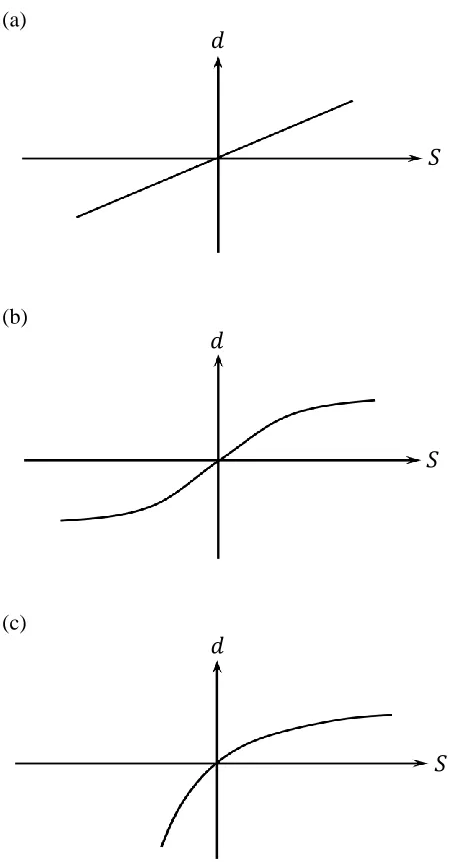
Moreover, for small incident electromagnetic field strengths, S, the induced polarization displacement, d, presents a linear response, as shown in Figure 2.3(a). However, the dipole displacement becomes increasingly nonlinear at larger field strengths and the shape of its response depends on their point group symmetry classification as mentioned before. For centrosymmetric crystals, the response is symmetric with respect to the field direction, as shown in Figure 2.3(b), whereas for non-centrosymmetric crystals, Figure 2.3(c), the responses asymmetric [56].
2.3 Coupled-wave equations for second-order nonlinear processes
In-depth analysis of the nonlinear interaction between the involved fields within the nonlinear medium and the generation of new frequencies can be described using Maxwell's wave equations, as follows,
(2.14)
Chapter 2: Basics of Nonlinear Optics
(a)
(b)
[image:63.612.206.433.96.527.2](c)
Figure 2.3: Dipole displacement response under different incident electromagnetic
field strengths depending upon their symmetry group. (a) Represents the
regime of linear optics under small incident electromagnetic fields; (b) the
nonlinear response of centrosymmetric materials under strong incident
electromagnetic fields; and (c) the nonlinear response of
2.3 Coupled-wave equations for second-order nonlinear processes
36
(2.16)
(2.17)
(2.18) with H being the magnetic field strength, the permeability of free space, and D the displacement vector defined as . Both equations 2.13 and 2.14 describe the light propagation within a non-magnetic and transparent (J = 0) nonlinear material. In other words, the driving polarizations generate in the nonlinear medium an electric field expressed by,
For a lossless, non-conducting, and nonmagnetic medium, an electric field, E, propagating along the x-axis and its associated polarization P are expressed as,
where j = 1, 2, 3 correspond to each of the three fields involved in the interaction, and are the frequency and wave number associated with each of the interacting fields. The wave number, , is given by,
where corresponds to the refractive index of the nonlinear material at frequency expressed as,
Chapter 2: Basics of Nonlinear Optics
Table 2.2: Classification of crystal groups. 3:
Optic axis Crystal class Cento-symmetric
point groups
Non-centrosymmetric point groups
Polar Non-polar
Biaxial
Triclinic 1 None
Monoclinic 2 or m 2 m None
Orthorhombic mmm mm2 222
Uniaxial
Tetragonal 4 or m 4 or mmm 4 4mm 2m 422
Trigonal m 3 3m 32
Hexagonal 6 or m 6 or mmm 6 6mm m2 622
Optically
isotropic Cubid m3 m3m None 432 m 23
2.3 Coupled-wave equations for second-order nonlinear processes
38
are expressed as a complex functions of the optical field. As the waves at three different frequencies are exchanging energy through process, as they propagate through the medium, the respective amplitudes will normally vary with position. Consequently, the complex field amplitudes are expressed as a function of x. Further, we assume that the amplitudes of the interacting fields vary slowly over distances comparable to a wavelength. This approximation – known as slowly varying amplitude approximation [45,57] – considerably simplifies our wave equations from second-order differential equations to first-order differential equations [5].
As a result, using the equations 2.3, 2.16, 2.17 and 2.18, we obtain,
where , and are the amplitudes of the electric fields of interacting waves, and
is the effective nonlinear coefficient. The three basic equations imply that the
amplitude of the newly produced waves is coupled to the incoming wave through the nonlinear coefficient, . These equations are commonly known as coupled wave
Chapter 2: Basics of Nonlinear Optics
(2.22) and and the field at frequency . Similarly, the inverse process will also take place, i.e. processes where the newly generated frequency mixes with one of the two incoming fields in a difference-frequency mixing process, such as [48]. Finally, is the wave vector mismatch between the interacting fields, also defining the phase-matching condition.
2.4 Phase-matching
Any nonlinear effect requires an efficient coupling between the interacting fields in the medium in order to undergo macroscopic amplification. Describing the coupled-wave equations (2.21a, 2.21b and 2.21c), we defined the wave vector mismatch
between the interacting fields. Physically, represents the mismatch in phase between the interacting fields when they propagate through the nonlinear medium. Only when there is perfect phase velocity matching between the interacting waves, we have,
The phase-velocity mismatch between the interacting fields could be offset and translate it into a macroscopic effect in a non-centrosymmetric nonlinear medium. In other words, this condition is necessary for achieving an efficient frequency conversion. This condition was proposed separately by J. A. Giordmaine [16] and P. D. Maker [25] in 1962, and it is known as phase-matching condition.
2.4 Phase-matching
40
constructively and destructively when they travel through the nonlinear medium, exchanging energy back and forth. As a result, the intensities of the generated fields experience oscillations along the propagation direction, as shown in Figure 2.4. Compensating phase mismatch can be done in several ways. The two most widely used methods to facilitate control over the phase mismatch are birefringent phase-matching (BPM) and quasi-phase-matching (QPM).
2.4.1 Birefringent phase-matching
Chapter 2: Basics of Nonlinear Optics
Output i
ntensit
y
d
eff- d
eff [image:69.612.146.521.110.346.2]5L
cFigure 2.4: Illustration of (a) perfectly birefringent phase-matching (∆k = 0), (b)
quasi-phase-matching and (c) non-quasi-phase-matching (∆k ≠ 0) conditions in a
second-order nonlinear process depending upon the crystal length and the
output intensity incident in the nonlinear crystal. 5
compensated through the birefringence. This technique is known as birefringent phase-matching (BPM).
Going back to the inherent properties of the materials that exhibit birefringence – known as birefringent materials –, they can be classified into two distinct categories. Optically uniaxial crystals, in which , and optically biaxial crystals in which . When an incident field enters in anuniaxial crystal, light might be divided into two orthogonal polarizations. One experiences the same refractive index, independently of the direction of propagation in the medium. This is known as ordinary index of refraction, , and this wave propagates with ordinary polarization
(a)
Perfect phase-matching
0
L
c2L
c3L
c4L
c(c) Non-phase-matched
(b) Quasi-phase-matching
2.4 Phase-matching
42
Figure 2.5: Normal index surface for positive (a) and negative (b) uniaxial crystals.6
(o-polarization). However, the second polarization experiences a different refractive index depending upon the direction of propagation. This is called as extraordinary index of refraction, , and this wave propagates with extraordinary polarization (e -polarization). The direction of propagation can be given by the angle, , relative to one of the principal axes of the medium, and it is given in [51] by the expression,
The difference between the ordinary and the extraordinary indices of refraction,
, provides information about the quantification of the birefringence. Depending of the value of , birefringent materials are divided into positive ( ) and negative ( ), as shown in the Figure 2.5 for uniaxial crystals. Further, depending of the polarization of the interacting fields, BPM can be classified in two types, known as type-I and type-II. In type-I phase-matching, the driving fields present the same polarization and the generated field is orthogonally polarized compared to the driving fields (ee→o or oo→e), whereas in type-II phase-matching, the driving fields are (2.23)
Chapter 2: Basics of Nonlinear Optics
(Optic Axis)
Figure 2.6: Illustration of perfect (type-I) phase-matching for SHG in case of
extraordinary fundamental wave to generate ordinary second-harmonic
wave. 7
orthogonally polarized (eo→e or oe→o). Figure. 2.6 shows the propagation direction at an angle of a positive uniaxial crystal, where the extraordinary index for the fundamental wave of frequency is equal to the ordinary index for second harmonic wave of frequency 2 , thus birefringence compensating the dispersion and resulting in perfect type-I phase-matching [5].
2.4 Phase-matching
44
Then, by combining 2.23 and 2.24, arises as,
The walk-off reduces the synchronization between the interacting e-field and o-field within the nonlinear crystal, and then limiting the interaction length of the nonlinear material. This effective crystal length is called aperture length and it is given by,
where is the input beam waist radius and is the spatial walk-off angle.
Looking in the expression 2.26, it comes up rapidly that the aperture length and is linearly proportional to the input beam waist radius, w0. Additionally, as it was stated at
the beginning of this chapter, nonlinear optical processes require high intensity, and hence small beam waist. This implies that for long interaction lengths large spot sizes should be used, which is a contradiction. To overcome with this situation there is a special case that arises when the phase-matching angle turns out to be 90º. This
technique is possible in some materials at a particular temperature and it is known as noncritical phase-matching (NCPM). On the other hand, when 90º the
Chapter 2: Basics of Nonlinear Optics
Besides, in NCPM configuration, as the spatial walk-off vanishes, the nonlinear crystal length becomes the effective interaction length of the nonlinear optical process.
2.4.2 Quasi-phase-matching
In any birefringent material, even though we have the major problem of walk-off, it is still possible to fulfill both the energy conservation and phase-matching under certain conditions since the refractive index depends on the polarization of the interacting waves in the nonlinear medium. Additionally, for efficient nonlinear frequency conversion, it is necessary to use materials with a large nonlinear optical coefficient, . Facing this problem, J. A. Armstrong et al. [4] postulated in 1962 an alternative technique to birefringent phase-matching called quasi-phase-matching (QPM). The lack of momentum conservation in QPM is compensated by adding an artificial momentum originated from the local periodicity of the structure of the nonlinear material, as shown in Figure 2.7. An example of a negative birefringent nonlinear crystal is the well-known lihitum-niobate (LiNbO3) [24,35]. Its largest nonlinear coefficient is , which implies that the
polarizations of the three interacting fields need to be in the same orientation. In birefringent phase-matching, this coefficient cannot be accessed either by I or type-II phase-matching. However this is possible using QPM.
In QPM, the nonlinear coefficient is modulated using a technique called periodical poling over the distance within the nonlinear crystal where the interacting fields are in phase. This is called the coherence length and is given by,
2.4 Phase-matching 46
z
x
z
z
x
x
y
y
y
x
x
x
y
z
y
z
y
z
deff -deff
Figure 2.7: Representation of the SHG process in a QPM crystal with a schematic view
of the periodic inversion of the sign of the deff coefficient. 8
Using this technique, the nonlinear coefficient is modulated with a period twice the coherence length and switches its direction after the waves travel one coherence length within the nonlinear medium. Thus, the polarization is turned 180º after each coherence length, making the interacting fields propagate in phase along the propagation direction within the material, and thus enhancing the nonlinear effect. The introduction of the additional phase is adjusted by modulating the nonlinear coefficient of the medium with a period . The quantity it is called grating period.
QPM process is generally more efficient than birefringent phase-matching, and does not present a limitation regarding the length of the crystal. The nonlinear coefficient in the QPM process is given by the relation,
where m is the order of the grating period and is called the duty cycle. Another (2.28)
Chapter 2: Basics of Nonlinear Optics
advantage is the QPM usually operates in the non-critical phase-matching regime. This implies that walk-off angle is zero as all the involved polarizations are the same. With the development of crystal growth technology of periodic poling since 90’s periodically poled lithiun niobate – better known as PPLN – is widespread and the most used nonlinear material for various frequency conversion process throughout its transparency range from ~400 nm in the visible region to ~5000 nm in the mid IR region [48].
2.5 Second-harmonic generation
The first demonstration of optical SHG was led by P. A. Franken et al. irradiating a quartz crystal with a rubi laser [12] defined the beginning of the field of nonlinear optics. From that moment until today, the published work about SHG has become the topic of some of the most advanced device technology developments in society [46]. SHG, described schematically in Figure 2.1(a), is a second-order nonlinear process that involves two photons at a given frequency , that interact in such a manner that generates an output photon at frequency 2 .
There are many parameters to be consider in order to obtain efficient SHG, however the most obvious is the amount of power from the incident electromagnetic field at frequency that is converted into radiation at frequency 2 . That is called conversion efficiency.