Investigating the Awareness of
Remembering
Ken A. Paller, Joel L. Voss, and Carmen E. Westerberg
Interdepartmental Neuroscience Program and Department of Psychology, Northwestern University
ABSTRACT—There is a marked lack of consensus concern-ing the best way to learn how conscious experiences arise. In this article, we advocate for scientific approaches that attempt to bring together four types of phenomena and their corresponding theoretical accounts: behavioral acts, cognitive events, neural events, and subjective experience. We propose that the key challenge is to comprehensively specify the relationships among these four facets of the problem of understanding consciousness without excluding any facet. Although other perspectives on consciousness can also be informative, combining these four perspectives could lead to significant progress in explaining a conscious experience such as remembering. We summarize some relevant findings from cognitive neuroscience investiga-tions of the conscious experience of memory retrieval and of memory behaviors that transpire in the absence of the awareness of remembering. These examples illustrate suitable scientific strategies for making progress in un-derstanding consciousness by developing and testing the-ories that connect the behavioral expression of recall and recognition, the requisite cognitive transactions, the neu-ral events that make remembering possible, and the awareness of remembering.
Determining the exact role of the brain in conscious experience is one of the Holy Grails of contemporary scientific research. Awareness is the focal point of our mental lives and is perhaps the one most highly valued component of our biological make-up. Many of the complex mental functions that guide our day-to-day activities, including perception, imagination, problem solving, volitional action, attention, and autobiographical memory, cannot be explained fully without a consideration of conscious awareness. Nonetheless, prospects for a thorough scientific understanding of consciousness often seem daunting.
In this article, we describe recent advances in the study of conscious memory experiences in order to exemplify how progress can be made in understanding consciousness. An es-sential part of our argument is that the investigation of con-sciousness must rely on a wide range of methods and theoretical strategies used together rather than in isolation. Methods for measuring human brain activity, for instance, provide powerful tools, but the application of neuroimaging to the problems of memory and consciousness can be most fruitful when one seeks evidence concerning four specific dimensions of the problem: cognitive, neural, behavioral, and subjective. Indeed, we must not settle for purely cognitive theories, purely behavioral theo-ries, purely neural theotheo-ries, or purely subjective theories of memory. All four dimensions are essential for understanding memory and consciousness.
Research on declarative and nondeclarative memory is par-ticularly instructive in this regard because a major distinction between these broad categories of memory phenomena is that declarative memory entails the potential for being aware of memory retrieval, whereas nondeclarative memory does not. This awareness of remembering may best be investigated by combining evidence pertinent to all four perspectives. We thus envision a comprehensive scientific analysis of conscious memory phenomena—an approach that may bring us closer to specifying the essential ingredients that yield conscious expe-rience and thus closer to solving long-standing mysteries about the human mind.
WHAT IS CONSCIOUSNESS?
One challenge in building an appropriate framework for studying consciousness is providing a suitable operational definition. Philosophers and scientists have not yet settled on a definition of consciousness, despite debate that can be traced back over 2 millennia. However, as noted by Farber and Churchland (1995), a final definition is not a prerequisite for today’s scientific progress. Rather, preliminary definitions may allow investigations to make useful contributions and foster the simultaneous evolution of multiple theories and conceptual-izations of consciousness.
The termconsciousnesscan be used in a variety of different ways. In a clinical setting, a person is said to be conscious if they are awake, in the sense of not being in a coma, in a trance, asleep, or under general anesthesia. In this context, con-sciousness refers to a person’s alertness or orientation to time and place. Consciousness can also be more generally likened to the mind, including volition and long-term intentions, such that thoughts can be allied with consciousness in this sense even when they are not currently prominent. For example, a student can have the conscious goal of completing all the requirements for graduation without necessarily being aware of this intention every second of every day. More restrictively, we will adopt a definition pertaining to the subjective experience of a percept, a thought, a memory, an emotion, or some other mental content. In this sense, consciousness (or synonymously, awareness) has been referred to variously as primary memory, the spotlight of attention, the stream of consciousness, the working-memory buffer, or the running span of subjective experience.
This description of the varied uses of the termconsciousness
follows that given by Zeman (2002). Zeman argues further that the etiology of the word conscious serves as an appropriate metaphor. The English term evolved from the Latin word cons-cius, meaning, ‘‘knowing with another.’’ This phrase conjures up a dialogue between two entities, as in to share knowledge with others or with one’s self. Today, we often use the closely related termself-consciousto refer to the instance when one has con-ceptualized one’s own self and its place in the world, and in some languages, a single word is used for both conscious and self-conscious. In one sense, a conscious thought inherently has a primal link to the self, in that a thought entails a thinker, and it belongs to one person rather than another (Dreyfus, 2009), whereas some memory experiences can provide a further, more elaborate sense of self in that they provide a set of autobio-graphical experiences from the past that have continuity with the present (Tulving, 1983). Interestingly, the Sanskrit word
smr
˙ti is often translated as mindfulness, which is a concept
closely related to consciousness in that it pertains to the quality of one’s awareness of the present. Butsmr
˙tiis also translated to
mean memory of the past, which has been explained with ref-erence to philosophical accounts portraying close connections between memory and mindfulness (Gyatso, 1992). Indeed, it may be essential for our understanding of memory to coevolve with our understanding of consciousness.
How should we develop a scientific framework for examining subjective awareness? In most circumstances, science relies on the third-person perspective, in which observations are objec-tive and available for verification by multiple observers. Sub-jective experiences do not easily conform to these notions but they are central to directly determining when and how con-sciousness is taking place. As others have also pointed out (e.g., Flanagan, 1992; Tulving, 1985), we argue that investigations should not avoid this important source of information, despite the difficulty of verifying reports of subjective experiences
across different individuals. Introspective evidence is essential, in concert with converging cognitive, behavioral, and neural descriptions, for a complete understanding of consciousness.
The opposing alternative is to keep one’s distance from in-trospection. Psychological research has occasionally adopted this approach, as in the strict emphasis on behavioral observa-tions in behaviorism. Today, closing the door on everything but behavioral observations is widely seen as detrimental to the development of suitable theories. Although the exclusionary approach central to behaviorism is uncommon, there are other attempts to exclude certain types of evidence. For instance, Lamme (2006) advocated building theories of consciousness on neural evidence, specifically disallowing introspective evi-dence. In contrast, some advocates of psychological or cognitive theories argue that neural evidence is unimportant. Others choose to rely only on introspective analyses.
We argue that all of these strategies are bound to come up short because they ignore essential aspects of the problem. Ig-noring consciousness, or pretending that it does not exist (cf. James, 1904), is no solution. Indeed, if science is charged with explaining the world, then it would be inconsistent to ignore the first-person perspective because it is a fundamental aspect of our ability to know the world.
Furthermore, the way a person conveys a first-person expe-rience, and the experience itself, may be influenced by many factors, including the person’s prior experiences, various cul-tural and developmental influences, instructions they receive in an experiment, and even their expertise in introspection. In memory research, various methods have been developed to enhance the use of first-person perspectives (Gardiner, 2001; Irish, Lawlor, O’Mara, & Coen, 2008; Mayes, Montaldi, & Migo, 2007; Tulving, 1985), and additional ways to train expertise in recollective introspection are conceivable. Indeed, there are multiple ways of allowing subjective experience into the realm of empirical analysis.
Cross-disciplinary perspectives are thus essential for devel-oping explanations of mental functions. In our conceptualiza-tion, several different perspectives can be emphasized to different degrees, but all must be included. Figure 1 illustrates this idea with a pyramid created from four sides, each repre-senting a different aspect of a comprehensive neurocognitive theory of a mental function. All four sides are constructs; they represent components of a theory rather than the observations used to develop the theory. Indeed, cognitive events are not measured directly—they are inferred. Neural events underly-ing memory are likewise often a few steps removed from the neural observations that we are able to make due to current technological limitations. Indirect evidence can thus be useful for understanding all four components, not just subjective experience.
the pyramid. The entry point for inquiry, in this case, is the behavioral phenomenon—recalling an autobiographical event and recognizing its constituents. Another side represents the neural events responsible for that behavior. The third side represents a description of the cognitive representations and processes that underlie the behavior. And the fourth side represents any subjective experiences that accompany the be-havior and that are directly available only to one observer. Although each side has a separate description (sometimes rel-egated to a separate scientific discipline), a theoretical frame-work is needed to relate the four perspectives together. In a sense, then, the four sides must be conceived as parts of the same whole.
The pyramid illustration also underscores the idea that a theoretical account entirely restricted to one side is inadequate. Although interesting scientific accounts can undoubtedly be generated from any one of the perspectives, ultimately such accounts are incomplete. Indeed, none of the perspectives are optional. The perspective from subjective experience, in par-ticular, is essential for a full understanding of a mental function like remembering, as it is unquestionably integral to the phe-nomenon that we wish to explain. Perhaps the most difficult and vital challenge in understanding a mental function is to generate an account of how each of the four perspectives relates to the others, thus cementing the four sides together.
It is important to note that the perspectives represented by two sides of the pyramid can be fundamentally intertwined in many cases. For instance, overt behaviors and the subjective aware-ness of those behaviors are often highly correlated, and theories of cognitive events are often developed on the basis of inferences made from both behavioral and subjective perspectives. On the other hand, some circumstances bring out intriguing
dissocia-tions, such as when behavior and subjective experience are out of sync (e.g., Tulving, 1981; Voss, Baym, & Paller, 2008; Weis-krantz, Barbur, & Sahraie, 1995) or when cognitive theories are not neurally plausible. In any case, we are not claiming that current theories that emphasize one perspective have been formulated in isolation from the other perspectives, or that they cannot be of great use, but rather we stress that further progress will result from the deliberate consideration of interrelation-ships among all four perspectives.
CONSCIOUS AND NONCONSCIOUS MEMORY EXPRESSIONS
Memory phenomena are typically subdivided into two broad categories, and although different terms have been used by different investigators, there is a solid consensus that the two categories differ in the degree to which they involve awareness of memory access.Declarative memoryrefers to the ability to remember prior autobiographical episodes and complex facts as assessed in recall and recognition tests (Squire, 1987). The ability to mentally reinstate facts and events from one’s own past allows for the development and stability of a self-identity. These memories serve as a basis for an individual’s life story. Other types of memory that do not provide this potential accessibility to conscious reflection are collectively referred to as nonde-clarative memory. This large category includes memory phe-nomena that shape how one behaves in various situations and includes phenomena such as skills, habits, conditioning, and priming. The same basic distinction is carried by the terms ex-plicit memoryandimplicit memory. The formulation of a border between declarative and nondeclarative memory, arguably one of the most theoretically powerful concepts in the study of Fig. 1.Scientific inquiry into mental function can be conceptualized using a pyramid metaphor.
memory, serves as a prime example of a consensus developed by merging the four perspectives illustrated by the pyramid. We will now review some of this evidence as a means of highlighting the usefulness of the pyramid metaphor.
When a person expresses memory behaviorally, he or she may also have the conscious experience of remembering, which we denote by the termrecollection, following Schacter (1989) and Tulving (1983). Although we define declarative memory as the behavioral recall and recognition of facts and episodes, the perspective from experience highlights one of the most impor-tant features of declarative memories. Recollection can also occur in the absence of any behavioral indication of remem-bering, but research aims are typically most feasible when be-havioral measures can be used. Recollection can occur either when memory retrieval is under intentional control or when retrieval is unintentional (i.e., incidental recollection). In con-trast, there is no awareness of remembering when nondeclara-tive memory is expressed unless declaranondeclara-tive memory can be concomitantly expressed. Furthermore, these two memory cat-egories have also been dissociated on a neural basis in patients with amnesia, as described below.
In considering the cognitive operations that support the ability to recollect an episode, two major steps are relevant: memory retrieval and metamemorial inference. First, the com-bination of perceptual features that together make up a per-sonally experienced episode must be retrieved. Successful retrieval depends on several processing stages, including initial encoding, storage, analysis of retrieval cues, control processes that enable strategic encoding and/or retrieval, search strate-gies, working memory for the results of retrieval, and so on. It is important to note that this typical memory experience includes one’s sense of self as an essential part of the retrieved episode, such that the memory experience is autobiographical (Tulving, 1983). Following the retrieval of a declarative memory (either an episode or fact), a further inference might be made. A meta-memory judgment, often based on recalling source- or context-specifying information, is necessary for one to come to the final realization: ‘‘I remember . . . .’’ This realization is not an es-sential defining feature of declarative memory; the inference is often not at the focus of attention. However, it would generally be possible to overtly or covertly declare that memory retrieval has occurred. Thus, the conscious experience of remembering goes one step beyond declarative memory retrieval per se, as it in-cludes the concurrent awareness that the information retrieved is the direct result of previous memory storage.
The example above illustrates the complexity of the rela-tionship between subjective experience and other facets of de-clarative memory. How can we approach the difficulty of integrating subjective experience into an objective scientific account of recollection? By contrast, first consider attempts at eliminative reductionism, which might focus all inquiry on the neural events that support behavioral memory phenomena, such that subjective experience itself would ultimately be excluded
(cf., Churchland, 1995). Accounting for awareness with refer-ence only to the other perspectives is inconceivable as a suitable outcome because the subjective experience should be ex-plained, not simply removed from the analysis. Whereas a the-oretical account of cognitive and neural events could conceivably function to explain how a declarative memory is retrieved, subjective experience cannot be disregarded if one is to fully understand remembering a declarative memory.
There are several possible starting points for researchers at-tempting to achieve a scientific understanding of the relation-ship between behavioral, neural, cognitive and subjective aspects of recollection. One might seek to determine the func-tion of a particular brain region, for example. An equally valid strategy, emphasized here, would be to start with behavior. Be-havioral manifestations of recall and recognition can be quan-tified from performance accuracy on declarative memory tests. Evidence on neural correlates of declarative memory can be gathered using neuroimaging techniques such as functional magnetic resonance imaging (fMRI), electroencephalography (EEG), magnetoencephalography, and so on, and using corre-lations between brain dysfunction and memory deficits. With the combination of behavioral and neural observations, we can ad-vance ideas about cognitive structures and processes that de-scribe relevant information processing steps. We can then attempt to link the subjective experience of remembering with the cognitive and neural accounts of memory processing and the behavioral signs of memory retrieval. In this way, we can also attempt to account for other types of memory and thus begin to see from each perspective what makes declarative memory distinctive.
CONTRASTING RECOLLECTION WITH OTHER MEMORY EXPRESSIONS
Neuropsychological investigations have provided useful in-sights into the different types of memory humans can exhibit. Although declarative memory is impaired in individuals with amnesia due to circumscribed damage to the hippocampus and surrounding cortex, other types of memory are preserved in these individuals (Gabrieli, 1998; Moscovitch, 2000; Schacter, 1987, 1996; Squire, 1987). A classic example of preserved nondeclarative memory in amnesia is Claparede`’s hidden-pin story (Claparede`, 1911/1951; Kihlstrom, 1995). The neurologist Claparede` extended his hand to greet an amnesic patient, but the patient withdrew and refused to shake hands. At their pre-vious meeting, Claparede` had secretly placed a pin in his hand just before the handshake, pricking the patient and causing discomfort. Although the patient could not recollect this pre-vious event, she did exhibit some memory for the meeting that influenced her behavior in an implicit way.
experienced before, but unlike recollection, familiarity does not include retrieval of contextual details of the initial learning episode or other source-specifying information. Rather, the current situation or stimulus seems familiar without specific knowledge of why it is familiar. A wealth of behavioral studies support the existence of these two distinct forms of declarative memory (see Yonelinas, 2002, for review), and neuropsycho-logical evidence suggests that recollection and familiarity may to some extent be neurally dissociable (Anderson et al., 2008; Baddeley, Vargha-Khadem, & Mishkin, 2001; Bowles et al., 2007; Holdstock et al., 2002; Westerberg et al., 2006). The earlier definition ofrecollectiondiscussed above (awareness of remembering) is nearly the same as the definition ofrecollection
within the recollection–familiarity framework, except that, in the latter case, awareness must concern specific aspects of a prior episode beyond awareness of memory retrieval per se. There are thus two aspects to the formal meaning of ‘‘awareness of remembering’’: (a) awareness that memory retrieval has oc-curred and (b) retrieval of specific memory features such as spatiotemporal context that identify a prior learning episode. The second will not occur without the first; a pure familiarity experience, however, would entail the first without the second. Neuroimaging provides another way to contrast recollection with other memory phenomena without necessarily relying on neurological patients with memory impairments. Recent in-vestigations have probed how recollection differs from implicit category learning (Reber, Gitelman, Parrish, & Mesulam, 2003), from cognitive skill learning (Poldrack, Desmond, Glover, & Gabrieli, 1998), from visual search facilitation (Greene, Gross, Elsinger, & Rao, 2007), and so on.
Although there is a large literature on such memory distinc-tions, here we will focus on studies that examined differences between recollection and priming—a type of nondeclarative memory wherein processing of a stimulus is facilitated due to prior experience with that same stimulus or a related stimulus. First, it is important to consider the theoretical constructs that
have been developed thus far concerning these two types of memory.
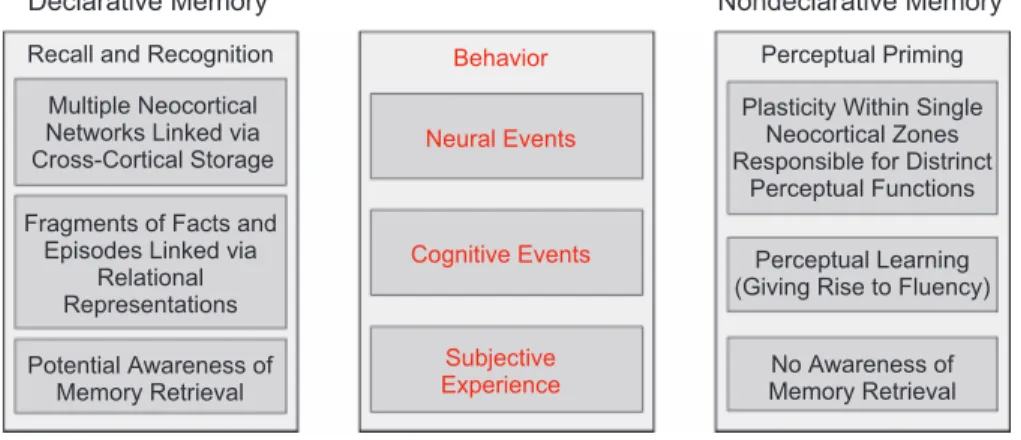
Figure 2 outlines the chief features in a theoretical concep-tualization of declarative memory. Declarative memory is ex-hibited through the recall and recognition of facts and events. Neural characterizations typically appeal to neocortical net-works that become linked together via cross-cortical storage mechanisms initiated by the hippocampus (e.g., Paller, 1997, 2002). Models based on both cognitive and neural foundations often describe declarative memories as composed of information fragments that are linked together by virtue of encoding pro-cesses that yield relational representations (e.g., Eichenbaum & Cohen, 2001; Shimamura, 2002). As discussed above, the re-trieval of a declarative memory is often accompanied by the awareness of memory retrieval.
Figure 2 also describesperceptual priming, a type of nonde-clarative memory that is exhibited through speeded or more accurate responses to a stimulus due to prior experience with that stimulus or a perceptually similar stimulus, and is based on facilitated processing of perceptual characteristics of the stim-ulus. Relevant neural plasticity may be confined to isolated neocortical zones responsible for distinct perceptual functions (Paller, 1997; Schacter & Buckner, 1998). At a cognitive level, these changes may be defined as perceptual learning or per-ceptual fluency (e.g., Wiggs & Martin, 1998).
Within the broad categories of declarative and nondeclarative memory, there are multiple memory phenomena that can be described fundamentally in terms of their behavioral expres-sions and the circumstances in which these behaviors are ex-hibited. In declarative memory, a recollective report evidences remembering a fact or episode with sufficient detail to recall the source of the memory. Familiarity in its purest form is demon-strated when a fact or episode is recognized without any knowledge of the source of the memory (Mandler, 1980). Within nondeclarative memory, perceptual priming is exhibited by fa-cilitated perceptual processing leading to a behavioral outcome
Declarative Memory Nondeclarative Memory
Perceptual Priming
Plasticity Within Single Neocortical Zones Responsible for Distrinct
Perceptual Functions
Perceptual Learning (Giving Rise to Fluency)
No Awareness of Memory Retrieval Behavior
Neural Events
Cognitive Events
Subjective Experience Potential Awareness of
Memory Retrieval Multiple Neocortical Networks Linked via Cross-Cortical Storage
Fragments of Facts and Episodes Linked via
Relational Representations Recall and Recognition
without any necessary awareness of the relation between the facilitation and prior learning. Similarly, conceptual priming is exhibited by facilitated conceptual processing leading to a be-havioral outcome without any necessary awareness of the rela-tion between the facilitarela-tion and prior learning.
According to this taxonomy, familiarity and priming clearly lie on different sides of the declarative–nondeclarative distinction. There is widespread agreement that familiarity and priming are behaviorally distinct phenomena, but there is continuing con-troversy over the extent to which they share common neural and cognitive mechanisms. Indeed, it has been suggested that fa-miliarity and conceptual priming are behavioral manifestations of the same underlying processes (Whittlesea, 1993; Wolk et al., 2004, 2005; Yonelinas, 2002). Such speculations are of great importance because they strike at the heart of the border be-tween declarative and nondeclarative memory and have impli-cations for understanding what is unique about memories accompanied by subjective awareness. Is this border permeable, or is there a sense in which its whole construction is misguided? We argue that additional neural evidence may be useful, and perhaps necessary, to sort out a way to conceptualize the border areas of the declarative–nondeclarative distinction and to pre-cisely classify the memory phenomena on either side.
ISOLATING NEURAL CORRELATES OF RECOLLECTION
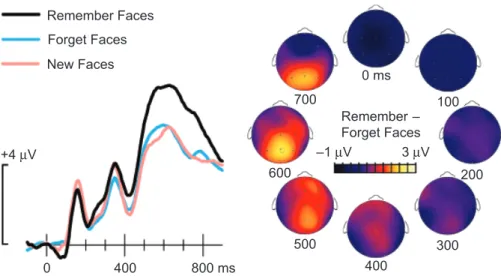
It is important to build up a neural perspective on recollection to complement the cognitive, behavioral, and phenomenological descriptions. Toward this end, neural correlates of recollection have been extensively studied using event-related potentials (ERPs), which are time-locked signals extracted from EEG re-cordings usually made from various scalp locations. In the ERP literature, the most consistently reported finding during recog-nition is that positive potentials to old items are greater than those to new items from approximately 400–800 ms. These so-called ‘‘old–new ERP effects’’ are typically evident at many scalp locations and often show a maximal difference over mid-line or left parietal locations. The amplitude of these differences generally increases with increasing memory strength, as evi-denced by behavioral indices such as recognition confidence. Potentials elicited by recognized items (hits) tend to be larger than those elicited by old items that are forgotten (misses) or those elicited by new items that are correctly identified (correct rejections).
Early investigations of these old–new ERP effects endorsed a variety of hypotheses concerning their functional significance, including associations with memory strength (Johnson, Pfeffer-baum, & Kopell, 1985), relative familiarity (Rugg, 1990), con-textual retrieval (Smith & Halgren, 1989), and processes that do not contribute to recognition judgments (Rugg & Nagy, 1989). There was thus a distinct lack of consensus about the meaning of these old–new ERPs. Nonetheless, many researchers (e.g.,
Halgren & Smith, 1987) speculated that the effects reflected a modulation of two previously characterized ERP components, namely, an N400 component, which is typically thought to reflect semantic processing (Kutas & Federmeier, 2000), followed by a subsequent late positive complex, (LPC) which is frequently associated with processing of unusual or unpredictable stimuli and may reflect multiple overlapping components (Linden, 2005). Although current views include an analogous two-part separation between early and late potentials and, sometimes other ERP components, it is unclear whether old–new ERP ef-fects correspond precisely to the same N400 and LPC potentials that have been observed in other experimental contexts.
One investigation that convincingly associated ERPs with recollection utilized a levels-of-processing manipulation at study (Paller & Kutas, 1992). Behavioral results showed that this manipulation influenced recall and recognition perfor-mance, in that memory accuracy was superior following se-mantic encoding that required visual imagery (‘‘deep’’ encoding) compared with memory accuracy following encoding that fo-cused attention on letter information (‘‘shallow’’ encoding). In contrast, equivalent priming for words from both encoding tasks was observed on an implicit memory test (perceptual identifi-cation with briefly flashed visual words followed by masking stimuli). ERPs recorded during the implicit memory test were compared across the two encoding conditions, and corre-sponding differences were interpreted as ERP correlates of recollection. The primary difference began at a latency of 500 ms and was only present for words that were successfully identified in the test phase. Unlike typical old–new ERP effects, this effect could not be attributed to differences in perceptual priming because perceptual priming was equivalent for the two encoding conditions (conceptual priming was not measured but is considered later in this article). Furthermore, postexperiment debriefing indicated that subjects noticed previously encoded words during the word-identification test, even though this was irrelevant to their task. In other words, subjects taking the word-identification test were cognizant of seeing words from the prior context of the study phase earlier in the experi-ment. The authors thus inferred that incidental recollection took place during the test phase, particularly when word meaning had been encoded deeply, and that late positive ERPs were sensitive to the differential processing associated with recollection.
thought to reflect recollection andknowresponses are thought to reflect familiarity, larger late positive ERPs have been consis-tently associated withrememberresponses (e.g., Curran, 2004; Du¨zel, Yonelinas, Mangun, Heinze, & Tulving, 1997; Smith, 1993). Similarly, correct source judgments, which presumably require recollection, elicit larger late positive ERPs than do incorrect source judgments (Senkfor & Van Petten, 1998; Trott, Friedman, Ritter, Fabiani, & Snodgrass, 1999; Wilding & Rugg, 1996). These ERPs can thus be taken as signals of the successful retrieval of episodic memories linked with conscious remem-bering (for reviews, see Friedman & Johnson, 2000; Voss & Paller, 2008).
Results from memory-disordered patients have also confirmed associations between successful episodic retrieval and late positive ERPs. Amnesic patients exhibit impaired conscious recognition as well as reduced or absent late positive amplitudes (Olichney et al., 2006, 2008, 2000). In addition, administration of benzodiazepine drugs to healthy subjects prior to encoding creates a temporary state of amnesia such that both subsequent recollection and concomitant late positive potentials are se-verely disrupted (e.g., Curran, DeBuse, Woroch, & Hirshman,
2006). Taken together, evidence from a variety of experimental paradigms converges on the conclusion that recollective ex-pressions of memory reliably occur with a particular ERP sig-nature (see Fig. 3).
NEURAL COMPARISONS BETWEEN RECOLLECTION AND PERCEPTUAL PRIMING
Neural perspectives on recollection can be valuable for aug-menting our understanding of recollection and for delineating how recollection differs from nonconscious forms of memory. In either case, it is essential that these neural measures accurately reflect the memory phenomena in question. This has been a pervasive problem in the field because multiple memory pro-cesses can be operative at the same time. For example, auto-matic processing that supports perceptual and conceptual priming may occur during recognition tests, even if behavioral measures of priming are not obtained, and this processing can potentially be reflected in neural measures interpreted as neural markers of recognition (Paller, Voss, & Boehm, 2007). In the prior section, we considered ways to obtain neural correlates of
Remember Faces
Remember – Forget Faces Forget Faces
New Faces
+4 µV
0 400 800 ms 400
300 200
500 600
700
0 ms
100
–1 µV 3 µV
recollection while minimizing possible contamination from priming. We emphasized contamination from perceptual prim-ing, and we will consider conceptual priming in the following section.
Likewise, the possibility of contamination must also be con-sidered when the research focus is on implicit memory. Exper-iments undertaken to isolate neural correlates of priming must allocate proper attention to possible contamination from de-clarative memory. Such contamination is problematic in many priming tests because of the tendency for subjects to recognize repeated stimuli or recall prior episodes while also following instructions for the priming test.
To isolate ERP correlates of perceptual priming, Paller, Hutson, Miller, and Boehm (2003) used a paradigm in which faces were minimally encoded such that perceptual priming occurred in the absence of recognition. Subjects viewed each face for 100 ms at a central location while one of two subtly different yellow crosses was simultaneously and unpredictably shown in one of four quadrants 1.81 from fixation. While maintaining central fixation, subjects attempted to identify which one of the two yellow crosses was present, and further stimulus processing was disrupted via backward masking.
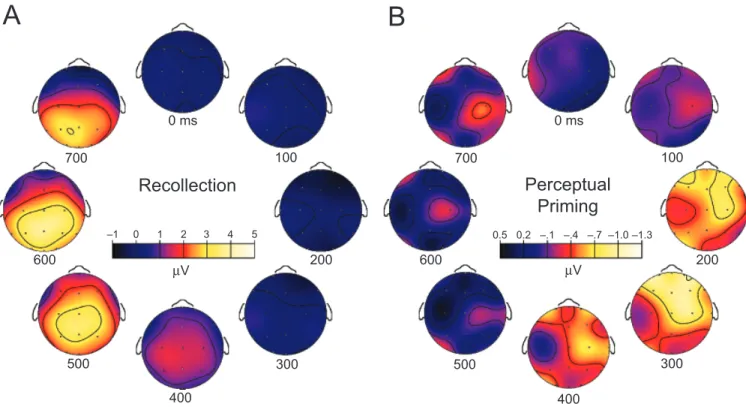
Yes–no recognition memory for these minimally processed fa-ces, tested subsequently, was not significantly better than chance, and forced-choice recognition was only slightly above chance. Reliable perceptual priming for these faces, however, was observed on two implicit memory tests. Therefore, ERPs elicited by these faces could conceivably reflect neural events responsible for perceptual priming, whereas contributions from recognition processes would be negligible (the number of faces endorsed as old was virtually the same for these faces and for new faces). A high level of recognition was found for another condition in the same experiment with faces presented at study for a longer duration and without disruptive parafoveal visual discriminations or backward masking. When these faces ap-peared in the test phase, they elicited typical ERP signatures of conscious memory, which could be directly compared with ERPs associated with perceptual priming (see Fig. 4). Neural corre-lates of recognition included late positive potentials that closely resembled potentials associated with face-cued recollection in other experiments (Paller et al., 1999; Yovel & Paller, 2004), whereas perceptual priming was associated with a relative ERP negativity over anterior sites from approximately 200–400 ms after face onset. These results indicate that spatiotemporally
Recollection
Perceptual
Priming
0 ms
700
600
500
400
300 200 100
0 ms
700
600
500
400
300 200 100
–1 0 1 2 3 4 5
µV µV
0.5 0.2 –.1 –.4 –.7 –1.0 –1.3
A
B
distinct ERPs of opposite polarities are associated with con-scious remembering and perceptual priming. Notably, ERP correlates of perceptual priming did not resemble reduced-amplitude versions of ERP correlates of recollection, providing further validation of the procedures. This pattern of results was replicated in a second experiment in which ERP recordings were made during an implicit memory test such that priming was concurrently observed (Paller et al., 2003, Experiment 2). Such findings complement neuroanatomical dissociations in amnesic patients and are consistent with the hypothesis that implicit access to memory is supported by neural processing that is qualitatively distinct from that supporting conscious access to memory.
Another way to examine possible neural distinctions between recollection and perceptual priming is to consider test-phase ERPs to studied items that subjects fail to recognize, because these ERPs could reflect implicit memory in the absence of recollection. In one study, recognized test items elicited late positive ERPs (similar to those described in the prior section as ERP correlates of recollection), whereas all studied test items (including both recognized and unrecognized items) elicited earlier positive ERPs (300–500 ms), and the spatial distribution of these effects was more posterior for unrecognized items than for recognized items. The latter results were interpreted as showing distinct neural correlates of priming (Rugg et al., 1998). However, results from investigations measuring ERPs to un-recognized items without a behavioral index of priming may be misleading; further evidence is needed to determine whether these ERPs are reliably associated with priming. For example, qualitative differences have been found between ERPs to items associated with priming measured during a priming task and ERPs to unrecognized items during a recognition task (Van Petten & Senkfor, 1996). Methods that make use of concomitant behavioral indices of priming are thus essential for substanti-ating putative neural markers of priming.
Differences between declarative and nondeclarative memory have also been examined by contrasting neural correlates of encoding associated with subsequent recollection and subse-quent perceptual priming. Schott, Richardson-Klavehn, Heinze, and Du¨zel (2002) accomplished this by using deep and shallow encoding conditions, followed by a two-stage memory test. First, three-letter word stems were presented in an explicit memory test (cued recall), but subjects were encouraged to guess if they could not remember a studied word so that priming might also occur. After each stem was completed, subjects in-dicated using strict criteria whether they recognized the word from the encoding phase. Encoding trials were categorized as showing priming if the subject produced the word at the com-pletion stage but failed to endorse it as an old word (i.e., priming-without-recognition). Trials were categorized as remembered when the correct response was made at both stages and cate-gorized as forgotten if the response was not produced at the completion stage. This method provides behavioral indications
of both explicit retrieval and priming and is thus preferable to methods that merely assume that priming transpires for all re-peated stimuli. Subsequent-memory analyses revealed an electrophysiological difference based on subsequent memory (Dm), as assessed in the stem-completion priming test, that took the form of a relative ERP negativity over central and fronto-central locations approximately 200–400 ms after word onset. Furthermore, Dm for priming was distinct from ERP differences for both deep and shallow encoding as well as from Dm for recognition, which both included relative positive potentials at later intervals with different topographies. Collectively, these results (along with those from a follow-up study using fMRI; Schott et al., 2006) constitute important early steps in charac-terizing how the neural events of memory formation differ for declarative memory versus perceptual priming.
CONSCIOUS FAMILIARITY AND NONCONSCIOUS CONCEPTUAL PRIMING
Another form of priming known asconceptual primingcan occur whenever concepts are repeatedly experienced. Note that the same concept can be engendered by perceptually identical or perceptually different stimuli. Behavioral measures of concep-tual priming are similar to those of percepconcep-tual priming in that they can be produced in the absence of awareness of memory retrieval and typically take the form of faster or more accurate responses to certain stimuli. These altered behavioral responses are thought to reflect facilitated processing of stimulus meaning, beyond processing of the basic physical features of a stimulus. Although the functional implications of conceptual priming are unclear, we speculate that this type of priming is allied with short-term mnemonic operations that are preserved in amnesic patients, as in their normal language comprehension.
been linked to long-term memory (Kutas & Federmeier, 2000). However, N400 potentials vary considerably in their topo-graphic distribution as a function of experimental variables, and so the relationship between N400 and the frontal N400 poten-tials observed in recognition experiments is not yet clear.
In a recent study that directly examined whether frontal N400 potentials may indeed reflect conceptual priming rather than familiarity, celebrity faces were used to elicit neural correlates of conceptual priming and explicit memory (Voss & Paller, 2006). Conceptual priming was manipulated by presenting as-sociated biographical information in conjunction with half of the celebrity faces. Later, electrophysiological recordings were obtained while subjects rapidly discriminated celebrity faces from other faces. Evidence for conceptual priming consisted of faster and more accurate responses to the faces previously presented with biographical information than to the other ce-lebrity faces, even though all the cece-lebrity faces had been viewed an equivalent number of times. ERPs during the famous– nonfamous discrimination test were characterized as a function of conceptual priming and also as a function of explicit memory ratings obtained in a final phase of the experiment. Conceptual priming was strongly associated with frontal N400 potentials, both by virtue of the specific contrast for priming provided by the experimental design and by cross-subject correlations between priming magnitude and ERP amplitudes (see Fig. 5). In contrast, explicit memory again was linked with late positive potentials at posterior locations. Note that explicit memory ratings for famous faces did not necessarily elicit the same memory processes as would traditional recognition tests of episodic familiarity for a study-phase episode, although both memory contrasts were used in a second study and both were associated with right parietal fMRI activations (Voss, Reber, Mesulam, Parrish, & Paller, 2007). Furthermore, conceptual priming was associated with repetition suppression effects in the left inferior prefrontal cortex. Neural dissociations between the two types of memory were thus demonstrated with both ERP and fMRI methods.
A subsequent set of studies sought to determine if FN400 correlates of conceptual priming can be identified during rec-ognition testing (Voss & Paller, 2007; Voss, Schendan, & Paller, 2009). For these studies, abstract line drawings (squiggles) were used in priming and recognition tests. Although these stimuli were not intended to represent common objects or entities, some of them were nonetheless meaningful to subjects. Evidence for conceptual priming was identified only for squiggles that an individual found to be relatively high in meaning, whereas perceptual priming did not vary according to perceived mean-ingfulness. Moreover, the magnitude of conceptual priming for meaningful squiggles was systematically related to the magni-tude of FN400 potentials. During recognition, familiarity-based responding was associated with FN400 potentials only for the meaningful squiggles. Later-onset positive potentials with a posterior distribution were associated with familiarity-based recognition irrespective of meaningfulness. Thus, conceptual
implicit memory was associated with FN400 potentials during a conceptual priming test and also during a recognition test, in-dicating that neuroimaging measures collected during recog-nition tests can reflect concomitant conceptual implicit memory processing.
These results have implications for a number of important issues. First, they attest to the likelihood that neural activity related to conceptual implicit memory has contributed to neural activity previously measured during declarative memory tasks using multiple neuroimaging techniques. A general conclusion is therefore that neural correlates of memory during recognition testing are conceivably either correlates of explicit memory or correlates of conceptual implicit memory.
On the basis of ERP findings such as those described above, and in conjunction with other arguments, it also appears that the prevalent hypothesis that frontal N400 potentials are unique neural signatures of familiarity must be called into question and considered with skepticism (Paller et al., 2007). FN400 poten-tials might partially (or entirely) reflect the operation of con-ceptual implicit memory. Given that concon-ceptual implicit memory with different types of stimuli might reflect different cognitive operations based in different brain regions, we are also undertaking further studies to investigate ERPs associated with conceptual priming and familiarity with other types of stimuli (Voss, Lucas, & Paller, 2009; Voss & Paller, 2009, in press).
At present, significant evidence suggests that ERP correlates of familiarity and recollection can be qualitatively similar, lending support to the hypothesis that these memory expressions represent different phenomenological manifestations of the same underlying retrieval processes (e.g., Squire, Wixted, & Clark, 2007). Much more work will be needed to accurately elucidate the neural substrates of these memory processes, but doing so is critical for understanding the neural substrates of familiarity and of priming. The approach described here high-lights the utility of employing multiple behavioral and phe-nomenological measures of implicit and explicit memory and of including suitable experimental manipulations. When these manipulations dissociate different types of memory, it is feasible to obtain valid and specific associations between neural mea-sures and memory functions. Such evidence can then be used to build an accurate characterization of the brain processes that support memory performance.
CONSCIOUSNESS AND MEMORY
Conceptual Priming
No Conceptual Priming LPC
Posterior Frontal
FN400
700 ms 700 ms
Explicit Memory
Conceptual Priming
Across-Subject Correlation
1.6
1.2
0.8
0.4
0 µV
3 µV 3 µV
FN400
LPC
500–750 ms 250–500 ms
r2
(8)=0.77, p<0.001 r2(8)=0.44, p=0.05
5
4
3
2
1
0
0 20 40 60 80
6 5 4 3 2 1 0
0 0.2 0.4 0.6
FN400
Amplitude
(
µ
V)
LPC
Amplitude
(
µ
V)
Conceptual Priming
Magnitude (ms) Explicit Memory Magnitude
A
B
C
1. Memory phenomena like recollection should be investigated with sufficient attention given to each of the four critical perspectives (behavioral, neural, cognitive, and subjective) displayed on the pyramid in Figure 1. A comprehensive analysis of such phenomena cannot neglect any of these perspectives, but rather must be devoted to understanding each of them as well as the relationships among them. 2. A fruitful avenue for investigating conscious memory
phe-nomena is to contrast them with other memory phephe-nomena that do not entail the same subjective experiences (e.g., perceptual and conceptual priming).
3. In studying specific memory phenomena and their neural characteristics, special attention is required to avoid cross-contamination, whereby neurocognitive processing respon-sible for one type of memory can occur during a paradigm designed to examine another type of memory. Various steps can be taken to minimize the possibility that behavioral and neural measures of one type of memory are not contaminated by another type of memory, and converging approaches can be used to validate such measures.
Notwithstanding the benefits of studying distinct memory functions by characterizing each in isolation, there are also drawbacks. These memory phenomena do not normally occur in a void—we usually engage combinations of multiple memory functions and other cognitive functions. Moreover, many mem-ory phenomena in everyday experience, and even some labo-ratory memory phenomena, may not fit cleanly within categories such as declarative–nondeclarative, recollection–familiarity, perceptual–conceptual, and so on. Some complex types of as-sociative priming and conditioning seem to have many charac-teristics in common with declarative memory, and thus are not so straightforwardly categorized. Yet, as argued by Tulving and Schacter, systematic classification of each form of memory is essential to fully understand memory processes and mecha-nisms, because ‘‘. . . facts discovered about one form of memory need not hold for other forms’’ (Tulving & Schacter, 1990, p. 305).
In addition to characterizing each form of memory in isolation, a complete understanding may not be fully realized without considering how these phenomena are related to each other and come to fruition in the context of the larger neurocognitive picture. A multiplicity of distinct memory processes likely contributes to everyday memory behavior.
Our standard mode in science is to isolate one phenomenon for study by holding other factors constant, or by removing the other factors entirely, if possible. By these means, a valid un-derstanding of the one phenomenon in question can be obtained. The scientific enterprise has been very productive in deriving knowledge of the world of external phenomena with this strategy. In analyses of the mind, the same approach has also been very effective. Yet, limitations of these methods should be explicitly acknowledged. It is possible that in some cases we may have
mistakenly subdivided phenomena or categorized them in the wrong way, in which case we have failed to ‘‘carve nature at her joints.’’ Even when we succeed in finding the appropriate divi-sions so as to carve exactly at each joint, we may still do violence by this carving. That is, the divisions that allow us to identify and study distinct phenomena can introduce some distortion. It seems that we must zero in and identify the parts to achieve any understanding, but we may neglect aspects of the whole that are out of focus when only analyzing the parts.
Conscious phenomena certainly provide prime examples of the limitations of carving nature at her joints, as we can lose sight of the many factors that come together to produce con-scious experience, not just in the individual’s brain activity but in social, cultural, and other influences that have accrued through an individual’s development and shaped the kinds of thoughts he or she experiences. Although carving is essential, the carving per se introduces distortion—isolating one type of mental event for study may obscure the place of an individual’s mental operations in a larger context. However, after taking the pieces apart in our analyses, we can attempt to remedy this situation by putting the parts back together in a way that calls attention to the interdependence among them.
We have argued that consciousness should feature promi-nently in scientific analyses of declarative memory, such that first-person perspectives remain essential elements of our ana-lyses (echoing the earlier argument by Tulving, 1985). Many concepts in memory research are inexorably tied to conscious-ness, including the distinction between declarative and non-declarative memory. Any systematic theory of human memory must thus take consciousness into account. Behavioral de-scriptions of different memory functions are just a starting point. To go beyond merely acknowledging these different types of memory, further research is needed to clarify each more com-pletely, respecting the four sides of the pyramid.
related events that followed, and so on. Models of declarative memory generally posit that these distinct features or fragments must become linked together for enduring memory storage to be successful. Retrieval, rehearsal, and consolidation would thus entail synchronous activation across dispersed cortical net-works, and this synchronous cross-cortical activity may be of the same type necessary for conscious experience more generally. The possibilities that such networks are linked through thalamo-cortical interactions, cortico-thalamo-cortical interactions, and/or gamma-frequency synchrony remain to be clarified.
We still wonder how people can possibly accomplish the ex-traordinary feat of bringing to mind an event from their past and consciously reexperiencing it in a way that approximates mental time travel. Determining how this is accomplished is a formi-dable scientific challenge, but many methodologies are cur-rently available to broaden our behavioral, cognitive, neural, and subjective perspectives. Research on this question makes contact with a variety of theories in cognitive neuroscience and psychology, covering topics such as strategic memory search, retrieval evaluation, working memory, metamemory, and atten-tion. We have an extensive empirical base with increasingly elaborate neurocognitive conceptualizations on many fronts. Considering the progress made thus far, there is reason to be optimistic that further exploration will lead to additional ad-vances in our scientific understanding of the first-person expe-rience of remembering.
Acknowledgments—We gratefully acknowledge research support from the National Science Foundation (BCS 0518800) and the National Institutes of Health (R01 NS34639, P30 AG13854, F32 MH073247, T32 NS047987, and T32 AG20506). We also thank the many researchers who contributed to the understanding of memory and consciousness in the past and thus supported the ideas presented here. Portions of this article also appear in Paller, Voss, and Westerberg (in press).
REFERENCES
Anderson, N.D., Ebert, P.L., Jennings, J.M., Grady, C.L., Cabeza, R., & Graham, S.J. (2008). Recollection- and familiarity-based memory in healthy aging and amnestic mild cognitive impairment. Neu-ropsychology,22, 177–187.
Baddeley, A., Vargha-Khadem, F., & Mishkin, M. (2001). Preserved recognition in a case of developmental amnesia: Implications for the acquisition of semantic memory?Journal of Cognitive Neu-roscience,13, 357–369.
Bowles, B., Crupi, C., Mirsattari, S.M., Pigott, S.E., Parrent, A.G., Pruessner, J.C., et al. (2007). Impaired familiarity with preserved recollection after anterior temporal-lobe resection that spares the hippocampus.Proceedings of the National Academy of Sciences, USA,104, 16382–16387.
Churchland, P.M. (1995).The engine of reason, the seat of the soul. Cambridge, MA: MIT Press.
Claparede`, E. (1951). Recognition and ‘‘me-ness.’’ In D. Rapaport (Ed.),Organization and pathology of thought(pp. 58–75). New
York: Columbia University Press. (Reprinted from Archives de Psychologie, 1911,11, 79–90.)
Crick, F., & Koch, C. (2003). A framework for consciousness.Nature Neuroscience,6, 119–126.
Curran, T. (2004). Effects of attention and confidence on the hypoth-esized ERP correlates of recollection and familiarity. Neuro-psychologia,42, 1088–1106.
Curran, T., DeBuse, C., Woroch, B., & Hirshman, E. (2006). Combined pharmacological and electrophysiological dissociation of famil-iarity and recollection.Journal of Neuroscience,26, 1979–1985. Curran, T., Tepe, K.L., & Piatt, C. (2006). ERP explorations of dual processes in recognition memory. In H.D. Zimmer, A. Mecklinger, & U. Lindenberger (Eds.),Binding in human memory: A neuro-cognitive approach (pp. 467–492). Oxford, United Kingdom: Oxford University Press.
Dreyfus, G. (2009). Selfless subjectivity: A middle-way approach to consciousness. Unpublished manuscript.
Du¨zel, E., Yonelinas, A.P., Mangun, G.R., Heinze, H.-J., & Tulving, E. (1997). Event-related potential correlates of two states of con-scious awareness in memory.Proceedings of the National Acad-emy of Sciences, USA,94, 5973–5978.
Edelman, G.M. (1992).Bright air, brilliant fire: On the matter of the mind. New York: Basic Books.
Eichenbaum, H., & Cohen, N.J. (2001).From conditioning to conscious recollection: Memory systems of the brain. Oxford, United King-dom: Oxford University Press.
Farber, I., & Churchland, P.S. (1995). Consciousness and the neu-rosciences: Philosophical and theoretical issues. In M.S. Gaz-zaniga (Ed.), The cognitive neurosciences (pp. 1295–1306). Cambridge, MA: MIT Press.
Flanagan, O. (1992).Consciousness reconsidered. Cambridge, MA: MIT Press.
Friedman, D., & Johnson, R. (2000). Event-related potential (ERP) studies of memory encoding and retrieval: A selective review.
Microscopy Research and Technique,51, 6–28.
Gabrieli, J.D. (1998). Cognitive neuroscience of human memory. An-nual Review of Psychology,49, 87–115.
Gardiner, J.M. (2001). Episodic memory and autonoetic conscious-ness: A first-person approach. Philosophical Transactions of the Royal Society London, Series B,356, 1351–1361.
Gonsalves, B., & Paller, K.A. (2000). Brain potentials associated with recollective processing of spoken words. Memory & Cognition,
28, 321–330.
Greene, A.J., Gross, W.L., Elsinger, C.L., & Rao, S.M. (2007). Hip-pocampal differentiation without recognition: An fMRI analysis of the contextual cueing task.Learning & Memory,14, 548–553.
Gyatso, J. (1992).In the mirror of memory: Reflections on mindfulness and remembrance in Indian and Tibetan Buddhism. Albany: State University of New York Press.
Halgren, E., & Smith, M.E. (1987). Cognitive evoked potentials as modulatory processes in human memory formation and retrieval.
Human Neurobiology,6, 129–139.
Holdstock, J.S., Mayes, A.R., Roberts, N., Cezayirli, E., Isaac, C.L., O’Reilly, R.C., & Norman, K.A. (2002). Under what conditions is recognition spared relative to recall after selective hippocampal damage in humans?Hippocampus,12, 341–351. Irish, M., Lawlor, B.A., O’Mara, S.M., & Coen, R.F. (2008).
James, W. (1904). Does ‘‘consciousness’’ exist?Journal of Philosophy, Psychology, and Scientific Methods,1, 477–491.
Johnson, R., Pfefferbaum, A., & Kopell, B.S. (1985). P300 and long-term memory: Latency predicts recognition performance. Psy-chophysiology,22, 497–507.
Kihlstrom, J.H. (1995). Memory and consciousness: An appreciation of Claparede` and recognition et moiite`.Consciousness & Cognition,
4, 379–386.
Kutas, M., & Federmeier, K.D. (2000). Electrophysiology reveals se-mantic memory use in language comprehension.Trends in Cog-nitive Sciences,4, 463–470.
Lamme, V.A.F. (2006). Towards a true neural stance on consciousness.
Trends in Cognitive Sciences,10, 494–501.
Linden, D.E. (2005). The P300: Where in the brain is it produced and what does it tell us?Neuroscientist,11, 563–576.
Mandler, G. (1980). Recognizing: The judgment of previous occur-rence.Psychological Review,87, 252–271.
Mayes, A., Montaldi, D., & Migo, E. (2007). Associative memory and the medial temporal lobes.Trends in Cognitive Sciences,11, 126–135. Moscovitch, M. (2000). Theories of memory and consciousness. In E. Tulving & F.I.M. Craik (Eds.),The Oxford handbook of memory
(pp. 609–625). Oxford, United Kingdom: Oxford University Press.
Olichney, J.M., Iragui, V.J., Salmon, D.P., Riggins, B.R., Morris, S.K., & Kutas, M. (2006). Absent event-related potential (ERP) word repetition effects in mild Alzheimer’s disease. Clinical Neuro-physiology,117, 1319–1330.
Olichney, J.M., Taylor, J.R., Gatherwright, J., Salmon, D.P., Bressler, A.J., Kutas, M., & Iragui-Madoz, V.J. (2008). Patients with MCI and N400 or P600 abnormalities are at very high risk for con-version to dementia.Neurology,70, 1763–1770.
Olichney, J.M., Van Petten, C., Paller, K.A., Salmon, D.P., Iragui, V.J., & Kutas, M. (2000). Word repetition in amnesia: Electrophysio-logical measures of impaired and spared memory. Brain, 123, 1948–1963.
Paller, K.A. (1997). Consolidating dispersed neocortical memories: The missing link in amnesia.Memory,5, 73–88.
Paller, K.A. (2002). Cross-cortical consolidation as the core defect in amnesia: Prospects for hypothesis-testing with neuropsychology and neuroimaging. In L.R. Squire & D.L. Schacter (Eds.),The neuropsychology of memory (3rd ed., pp. 73–87). New York: Guilford.
Paller, K.A., Bozic, V.S., Ranganath, C., Grabowecky, M., & Yamada, S. (1999). Brain waves following remembered faces index con-scious recollection.Cognitive Brain Research,7, 519–531. Paller, K.A., Hutson, C.A., Miller, B.B., & Boehm, S.G. (2003). Neural
manifestations of memory with and without awareness.Neuron,
38, 507–516.
Paller, K.A., & Kutas, M. (1992). Brain potentials during memory retrieval provide neurophysiological support for the distinction between conscious recollection and priming.Journal of Cognitive Neuroscience,4, 375–391.
Paller, K.A., Kutas, M., & McIsaac, H.K. (1995). Monitoring conscious recollection via the electrical activity of the brain.Psychological Science,6, 107–111.
Paller, K.A., Voss, J.L., & Boehm, S.G. (2007). Validating neural cor-relates of familiarity.Trends in Cognitive Sciences,11, 243–250. Paller, K.A., Voss, J.L., & Westerberg, CE. (in press) Memory and the awareness of remembering. In F. Ro¨sler, C. Ranganath, B. Ro¨der, & R.H. Kluwe (Eds.),Neuroimaging of human memory. Oxford, United Kingdom: Oxford University Press.
Poldrack, R.A., Desmond, J.E., Glover, G.H., & Gabrieli, J.D. (1998). The neural basis of visual skill learning: An fMRI study of mirror reading.Cerebral Cortex,8, 1–10.
Reber, P.J., Gitelman, D.R., Parrish, T.B., & Mesulam, M.-M. (2003). Dissociating explicit and implicit category knowledge with fMRI.
Journal of Cognitive Neuroscience,15, 574–583.
Rugg, M.D. (1990). Event-related brain potentials and recognition memory for low- and high-frequency words.Memory & Cognition,
18, 367–379.
Rugg, M.D., & Curran, T. (2007). Event-related potentials and rec-ognition memory.Trends in Cognitive Sciences,11, 251–257. Rugg, M.D., Mark, R.E., Walla, P., Schloerscheidt, A.M., Birch, C.S.,
& Allan, K. (1998). Dissociation of the neural correlates of im-plicit and exim-plicit memory.Nature,392, 595–598.
Rugg, M.D., & Nagy, M.E. (1989). Event-related potentials and rec-ognition memory for words.Electroencepholography and Clinical Neurophysiology,72, 395–406.
Schacter, D.L. (1987). Implicit memory: History and current status.
Journal of Experimental Psychology: Learning, Memory, and Cognition,13, 501–518.
Schacter, D.L. (1989). On the relation between memory and con-sciousness: Dissociable interactions and conscious experience. In H.L. Roediger III & F.I.M. Craik (Eds.),Varieties of memory and consciousness: Essays in honour of Endel Tulving(pp. 355– 389). Hillsdale, NJ: Erlbaum.
Schacter, D.L. (1996).Searching for memory: The brain, the mind, and the past. New York: Basic Books.
Schacter, D.L., & Buckner, R.L. (1998). Priming and the brain. Neu-ron,20, 185–195.
Schott, B., Richardson-Klavehn, A., Heinze, H.J., & Du¨zel, E. (2002). Perceptual priming versus explicit memory: Dissociable neural correlates at encoding. Journal of Cognitive Neuroscience, 14, 578–592.
Schott, B.H., Richardson-Klavehn, A., Henson, R.N., Becker, C., Heinze, H.J., & Du¨zel, E. (2006). Neuroanatomical dissociation of encoding processes related to priming and explicit memory.
Journal of Neuroscience,26, 792–800.
Senkfor, A.J., & Van Petten C, . (1998). Who said what? An event-related potential investigation of source and item memory.
Journal of Experimental Psychology: Learning, Memory, and Cognition,24, 1005–1025.
Shimamura, A.P. (2002). Relational binding theory and the role of consolidation in memory retrieval. In L.R. Squire & D.L. Schacter (Eds.),Neuropsychology of memory(3rd ed., pp. 61–72). New York: Guilford.
Smith, M.E. (1993). Neurophysiological manifestations of recollective experience during recognition memory judgments. Journal of Cognitive Neuroscience,5, 1–13.
Smith, M.E., & Halgren, E. (1989). Dissociation of recognition memory components following temporal lobe lesions. Journal of Experimental Psychology: Learning, Memory, and Cognition,15, 50–60.
Squire, L.R. (1987). Memory and brain. Oxford, United Kingdom: Oxford University Press.
Squire, L.R., Wixted, J.T., & Clark, R.E. (2007). Recognition memory and the medial temporal lobe: A new perspective.Nature Reviews Neuroscience,8, 872–883.
Tulving, E. (1981). Similarity relations in recognition. Journal of Verbal Learning and Verbal Behavior,20, 479–496.
Tulving, E. (1983). Elements of episodic memory. Oxford, United Kingdom: Clarendon Press.
Tulving, E. (1985). Memory and consciousness.Canadian Psychology,
26, 1–12.
Tulving, E., & Schacter, D.L. (1990). Priming and human memory systems.Science,247, 301–306.
Van Petten, C., & Senkfor, A.J. (1996). Memory for words and novel visual patterns: Repetition, recognition, and encoding effects in the event-related brain potential.Psychophysiology,33, 491–506. Voss, J.L., Baym, C.L., & Paller, K.A. (2008). Accurate forced-choice
recognition without awareness of memory retrieval.Learning & Memory,15, 454–459.
Voss, J.L., Lucas, H.D., & Paller, K.A. (2009).Distinct electrical sig-nals of conceptual priming and familiarity during word recogni-tion. Unpublished manuscript.
Voss, J.L., & Paller, K.A. (2006). Fluent conceptual processing and explicit memory for faces are electrophysiologically distinct.
Journal of Neuroscience,18, 926–933.
Voss, J.L., & Paller, K.A. (2007). Neural correlates of conceptual implicit memory and their contamination of putative neural cor-relates of explicit memory.Learning & Memory,14, 259–267. Voss, J.L., & Paller, K.A. (2008). Neural substrates of remembering:
Electroencephalographic studies. In J.H. Byrne (Ed.), Learning and memory: A comprehensive reference (pp. 79–98). New York: Academic Press.
Voss, J.L., & Paller, K.A. (2009). An electrophysiological signature of unconscious recognition memory. Nature Neuroscience, 12, 349–355.
Voss, J.L., & Paller, K.A. (in press). Remembering and knowing: Electrophysiological distinctions at encoding but not retrieval.
NeuroImage.
Voss, J.L., Reber, P.J., Mesulam, M.-M., Parrish, T.B., & Paller, K.A. (2007). Familiarity and conceptual priming engage distinct cor-tical networks.Cerebral Cortex,18, 1712–1719.
Voss, J.L., Schendan, H.E., & Paller, K.A. (2009).Brain potentials that track perceptual fluency, conceptual fluency, and episodic famil-iarity. Unpublished manuscript.
Weiskrantz, L. (1997).Consciousness lost and found: A neuropsycho-logical exploration. Oxford, United Kingdom: Oxford University Press.
Weiskrantz, L., Barbur, J.L., & Sahraie, A. (1995). Parameters affecting conscious versus unconscious visual discrimination with damage to the visual cortex (V1).Proceedings of the National Academy of Sciences, USA,92, 6122–6126.
Westerberg, C.E., Paller, K.A., Weintraub, S., Mesulam, M.-M., Holdstock, J.S., Mayes, A.R., & Reber, P.J. (2006). When memory does not fail: Familiarity-based recognition in mild cogni-tive impairment and Alzheimer’s disease. Neuropsychology, 20, 193–205.
Whittlesea, B.W.A. (1993). Illusions of familiarity. Journal of Experimental Psychology: Learning, Memory, and Cognition,19, 1235–1253.
Wiggs, C.L., & Martin, A. (1998). Properties and mechanisms of perceptual priming. Current Opinion in Neurobiology, 8, 227–233.
Wilding, E.L., & Rugg, M.D. (1996). An event-related potential study of recognition memory with and without retrieval of source.Brain,
119, 889–905.
Wolk, D.A., Schacter, D.L., Berman, A.R., Holcomb, P.J., Daffner, K.R., & Budson, A.E. (2004). An electrophysiological investi-gation of the relationship between conceptual fluency and fa-miliarity.Neuroscience Letters,369, 150–155.
Wolk, D.A., Schacter, D.L., Berman, A.R., Holcomb, P.J., Daffner, K.R., & Budson, A.E. (2005). Patients with mild Alzheimer’s disease attribute conceptual fluency to prior experience. Neuro-psychologia,43, 1662–1672.
Yonelinas, A.P. (2002). The nature of recollection and familiarity: A review of 30 years of research.Journal of Memory and Language,
46, 441–517.
Yovel, G., & Paller, K.A. (2004). The neural basis of the butcher-on-the-bus phenomenon: When a face seems familiar but is not re-membered.NeuroImage,21, 789–800.
Zeki, S., & Bartels, A. (1999). Toward a theory of visual consciousness.
Consciousness and Cognition,8, 225–259.