Learning Browsing Patterns
for Context-Aware Recommendation
Daniela Godoy and Anal´ıa Amandi
ISISTAN Research Institute, UNICEN University Campus Universitario, CP 7000, Tandil, Argentina
Also at CONICET, Argentina
{dgodoy,amandi}@exa.unicen.edu.ar
Abstract. The success of personal information agents depends on their
capacity to both identify relevant information for users and proactively recommend context-relevant information. In this paper, we propose an approach to enable proactive context-aware recommendation based on the knowledge of both user interests and browsing patterns. The pro-posed approach analyzes the browsing behavior of users to derive a semantically enhanced context that points out the information which is likely to be relevant for a user according to its current activities.
1 Introduction
The main goal of personal information agents is to present relevant information to users based on the knowledge of their interests. In order to enable the adap-tation and personalization of information delivered to users, personal agents learn and represent long-term interests into user profiles. Thus, user profiling addresses the issue of modeling interests to determine the relevance of a new, previously unseen piece of information.
In addition to merely choosing the right information, personal agents should also be aware of the user context in order to provide information in the time and in the place it is more relevant to users. User profiles are frequently seen as a way to disambiguate search topics. Even though this use of profiles supports interactive context-aware information retrieval in which relevant documents are gathered upon a direct user request, because of the lack of knowledge about the active goals, it fails at supporting proactive context-aware retrieval in which relevant documents are presented to users according to their activities [3].
In order to enable proactive context-aware information retrieval and rec-ommendation, user behavior patterns as regards interests have to be explicitly modeled into profiles. The extraction of such patterns is fostered by semantically enriched profiles which provide a hierarchical organized view of the concepts a user is interested in. Either ontology-based profiling [8] or conceptual cluster-ing [7] allow agents to obtain these hierarchies startcluster-ing from examples.
and adaptable behavior of personal agents which become able to predict and anticipate user information needs. Section 2 describes this approach. Experi-mental results are summarized in Section 3. Section 4 compares this work with related ones. Finally, concluding remarks are stated in Section 5.
2 Learning and Using Browsing Patterns
The browsing behavior of users is an important resource for inferring contextual information. It can be seen as a sequence of activities that are related to one another not only through evolving information interests that can be described at conceptual level, but also through proximity in time. By activity it is understood a page visit which takes place during the course of browsing, while groups of these activities can be referred to as sessions.
Information agents can take advantage of the knowledge gained from ob-serving user browsing in conjunction with long-term user interests to retrieve context-relevant information. If an agent detects the user is browsing through certain interest categories, it can anticipate the categories in the same session the user is likely to be interested in. The goal of activity-awareness is, therefore, to proactively retrieve Web pages matching the user interests and compute a set of recommendations for the current or active user session.
To accomplish this goal, browsing patterns referring to categories in the user profile that are usually accessed together serve as the basis for recommenda-tion and are mined starting from observarecommenda-tion of frequent associarecommenda-tions among browsing activities. For extracting navigational patterns, the existence of a con-ceptual hierarchy constituting the user profile is assumed, so that it can be used to characterize Web pages, i.e. to describe pages in terms of interest categories. A conceptual clustering algorithm that carries out incremental, unsuper-vised concept learning over Web documents was used in this work to obtain such hierarchical descriptions of user interests. However, other approaches can be applied within this framework. Hierarchies of concepts produced by this al-gorithm, named WebDCC [7], are classification trees in which internal nodes represent concepts and leaf nodes represent clusters of examples.
In user profiles, browsing habits are represented by association of the form
A⇒B, whereAandB are groups of categories and the association indicates that, if the user current activities include visiting pages about the categories in
A, the next activities are likely to include visiting pages aboutB.
2.1 Client-Side Sessionization
recorded in an activity log by applications monitoring Web browsers. Thus, the content of Web pages, the access time, the time spent on each page and other information is available for analysis. Furthermore, actions such as opening or closing the browser can be used to start and finish browsing sessions.
From client-side observation, it is possible to reliably recognize sessions in the user activity log to evaluate the user interests as well as to understand user frequent browsing patterns. A session Sj is a list of pages a user accessed to
ordered by time-stamp as follows:
Sj={(p1, time1),(p2, time2), . . . ,(pn, timen)}
where timei is the time the user accessed the page pi such thattimei ≤
timej,∀i ≤j. Then, the user browsing activities are partitioned into a set of
sessionsS={S1, S2, . . . , Sk}containing individual page references.
The process of segmenting the activity of a user into sessions is performed using a time-oriented heuristic in which a time-out establishes a period of in-activity that is interpreted as a signal that the session has ended. If the user did not request any page for a period longer thanmax time(30 min. is used as default time-out) subsequent requests are considered to be in another session. In addition, the active session is finished when the browser is closed and a new session is started when the browser is re-opened.
2.2 Transaction Identification
The notion of session can be further abstracted by selecting a subset of pages that are significant or relevant for analysis. Each semantically meaningful subset of pages belonging to a user session is referred to as a transaction. Transaction identification assumes that user sessions have already been identified. Hence, the input to this process consists in the page references for a given user session. In Web usage mining there is no convenient method of clustering page references into transactions smaller than an entire user session [6].
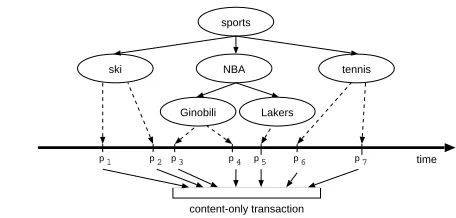
To identify semantically meaningful transactions, content pages are consid-ered as those belonging to one or more categories in the profile, unlike content pages in other approaches which are identified simply based on the time spent on a page or on backtracking during the user navigation [5]. Pages not belong-ing to any category in the profile are considered irrelevant for usage minbelong-ing since they do no entail information about the user habits regarding interests. Then, a content-only transaction is formed by all the content pages in a session. Figure 1 illustrates the formation of these transactions.
The resulting transactions are further divided using the time window ap-proach, which divides each transaction into time intervals no longer than a specified threshold. This approach assumes that meaningful transactions have an overall average length associated with them. For a large enough specified time window, each transaction will contain an entire user session. If W is the length of the time window, then two pagespiandpj are in the same session if:
tennis NBA
sports
Lakers Ginobili
ski
content-only transaction
[image:4.595.183.411.93.202.2]p1 p2 p3 p4 p5 p6 p7 time
Fig. 1. Example of a content-only transaction
In this way, the set of pagesP ={p1, p2, . . . , pn}, each with its associatedtimei,
appearing in the set of sessionsSare partitioned into a set ofmuser transactions
T ={t1, t2, . . . , tm} where eachti ∈T is a subset ofP. The problem of mining
association rules is defined over these collection of subsets from the item space where an item refers to an individual page reference.
To incorporate the knowledge of the user interests in pattern extraction, further processing of user activities is needed to map individual Web page ref-erences to one or more user interest categories. The enriched version of transac-tions leads to set of rules that includes categories. Thus, recommendatransac-tions can be broaden to include any Web page belonging to the involved categories. To in-tegrate content and usage data, each pagepiin a transactiontjis considered to
have an associated set of categories it belongs to, denotedCi ={c1, c2, . . . , cp},
where Ci is extensionally defined by all the categoriescj in the path from the
root of the hierarchy to the leaf cluster in which the pagepiwas classified into.
If only the cluster a page belongs to is used to describe sessions, the dis-covered association rules will relate clusters but not categories. Instead, the inclusion of the ancestors in the path from the cluster the page was classified into until the root, makes it possible to find rules at different levels. The result of replacing the elements of the transactions inT by categories in the user pro-file is a set of transactions T′ ={t′1, t′2, . . . , t′m} where each t′i ∈T′ is a subset
ofC. The algorithm for transaction identification can be outlined as follows:
1. For each sessionSi∈S, create a new transactionti inT
2. For each page pj ∈ Si, find the set Cj by classifying the page into the
current user interest hierarchy
3. IfCj 6=∅, addpj to the transactionti since the page is a content page
4. Repeat steps 2 and 3 until all page references have been either added to the transaction or discarded
5. Repeat steps 1 to 4 until all sessions inS have been processed
6. Use the time window approach to partition each ti ∈ T into transactions
smaller thanW
7. For each resulting transactionti∈T, create the transactiont′i inT′
2.3 Mining Association Rules
The association rule mining problem was stated in [1]. LetI ={I1, I2, . . . , Im}
be a set of literals called items, a subset X ⊆ I is called an itemset and a k -itemset is an -itemset that containsk items. LetDbe a database of transactions, where each transactionT is a set of items such thatT ⊆ I. Each itemset has a certain statistical significance called support such that an itemset hassupport s
in the transaction setDifs% of the transactions inDcontainX. An association rule is an implication of the formX ⇒Y, whereX⊂ I,Y ⊂ I, andX∩Y =∅. The ruleX ⇒Y holds in the transaction setDwith confidence c ifc% of the transactions inDthat containX also containY.
The problem of mining association rules in D consists in finding all rules
X ⇒ Y that have support greater than a user-specified minimum support, calledminsup, and confidence, calledminconf. For each rule, the support thresh-old describes the minimum percentage of transactions containing all items that appear in the rule, whereas the confidence threshold specifies the minimum probability for the consequent to be true if the antecedent is true.
In a hierarchical description of user interests, associations or access patterns may contain interesting regularities at different levels of abstraction including categories or clusters that are related according to the user habits. The problem of mining multiple-level or generalized association rules assumes a hierarchy or taxonomyT on the items instead of a flat itemsetI. A generalized association rule is an implication of the formX ⇒Y, whereX ⊂ I,Y ⊂ I,X∩Y =∅and no item inY is an ancestor of any item inX as this would be a trivially valid association. The ruleX ⇒Y holds in the transaction setD with confidencec
and supports if c% of the transactions in D that support X also support Y
ands% of transactions inDsupportX∪Y. These rules are called generalized association rules because bothX andY can contain items from any level of the taxonomyT.
If the problem of determining if a transaction T support an itemsetX is considered, for each item x ∈ X it is necessary to check whether x or some descendant of x is present in the transaction. To simplify this task, all the ancestors of each item inT are added to this transaction to form an extended transaction T′. A straightforward method to find generalized association rules is to run any association rule algorithm on the extended transactions sinceT
supports X if and only if T′ is a superset of X. For empirical evaluation of the proposed approach, we used theApriori algorithm over the set of extended transactions obtained as pages are classified in the concept hierarchy.
2.4 Activity-Based Recommendation
To gather a set of possible recommendations, an agent can perform a Web search to retrieve pages belonging to the concepts the user is interested in. For example, the agent can retrieve pages from some fixed sites (e.g. a newspaper Web site) or find the nearest neighbors of a page in the profile used as query.
A fixed-size sliding window is used over the active session to capture the cur-rent user activity. For a sliding window of sizen, the active session ensures that only the last n visited pages influence recommendation. The use of a window is important in discovering context since most users go back and forth while browsing to find the desired information so that earlier portions of the browsing history may refer to no longer valid information needs.
In the recommendation phase, the active session is compared with the dis-covered rules. If the active session matches the antecedent of an association rule, recommendations are finding by retrieving Web pages belonging to the categories in the rule consequent.
3 Experimental Results
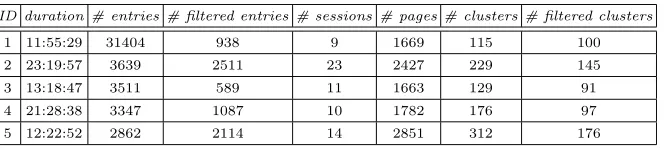
To evaluate the activity-base recommendation approach, a client-side log of visited Web pages in a number of topics a user is interested in and the location of the pages on the user interest hierarchy are needed. Unfortunately, available datasets belong to individual Web sites and record the accesses of several users. In the absence of client-side data, the content and logs of the Music Machines1 Web site were used for experimentation. In these logs users are anonymized with respect to originating machine, i.e. all hits from one machine on a particular day have the same label. Thus, the browsing behavior of individ-ual users can be interpreted respecting their interest categories within the site. Music Machines contains 4582 distinct pages about various kind of electronic musical equipment grouped by manufacturers.
Each access log consists of the user label, request method, accessed URL, data transmission protocol, access time and browser used to access the site. The server logs were filtered to remove those entries that are irrelevant for analysis and those referring to pages that do not exist in the available site copy.
From all users who entered the site after 20/8/98, when the copy of the site was made, the five users having the longest sessions were selected. Then, the experimental procedure simulates users browsing theMusic Machines site and obtaining recommendations. For each user a profile was built based on both the content of Web pages from the site and the user behavior regarding interest categories. Experiments for each user proceed as follows:
1. Identify the user entries in the log files
2. Extract the URLs of the visited pages and run WebDCC algorithm over these pages using the available copy of theMusic Machines site
3. Identify user sessions in the logs usingmax time=30 minutes
4. Partition user sessions into transactions and mapping Web page references to categories in the profile
ID duration # entries # filtered entries # sessions # pages # clusters # filtered clusters
1 11:55:29 31404 938 9 1669 115 100
2 23:19:57 3639 2511 23 2427 229 145
3 13:18:47 3511 589 11 1663 129 91
4 21:28:38 3347 1087 10 1782 176 97
[image:7.595.143.477.94.169.2]5 12:22:52 2862 2114 14 2851 312 176
Table 1.Summary of user data and experimental results
5. Divide the resulting set of transactions into a training (approx. 70%) and a testing set (approx. 30%) for experiments
6. Use the training set to mine association rules regarding categories
7. Use the testing set to simulate active session windows and recommend pages 8. Evaluate the recommendations in terms of precision and coverage
To assess quantitative values of recommendation performance, we used the adaptations of precision and coverage measures proposed by [9]. Given a trans-actiontand a set of recommendationsRproduced using a windowwsuch that
w⊆t, the precision and coverage ofR with respect totare defined as:
precision(R, t) =|R∩|(Rt−|w)| coverage(R, t) = |R∩|t(−t−ww|)|
Thus, precision measures the degree to which recommendations are accurate for the active session and coverage measures its ability to recommend all the items that are likely to be visited by the user in the active session.
For a given transactiontin the testing set and an active session window of sizen, we randomly chose |t| −n+ 1 groups of items, each having size n, from the transaction as the surrogate active session windows. For each of these active sessions, a set of recommendations are produced based on the extracted rules. The recommendations are compared to the remaining items in the transactions, i.e.t−w, to compute performance measures. For each measure, the final score of the transaction t is the average over all of the |t| −n+ 1 surrogate active sessions associated with this transaction.
W # transactions # items # rules # recom. precision coverage
3 120.20±92.96 13.85±3.62 247.20 ± 199.11 2.34 ±2.06 75.79±17.31 6.84 ± 6.85
15423.00±17533.67 3.87 ±3.61 68.94±20.90 10.13± 8.71
5 101.80±98.05 19.73±4.60 486.40 ± 409.05 4.87 ±5.24 66.15±21.81 8.67 ± 8.20
16135.80±15442.15 6.10 ±5.61 59.73±17.71 10.51± 8.49
10 45.60 ±31.19 32.97±6.41 920.00 ± 567.92 5.84 ±5.48 63.97±18.36 16.02±13.07
37223.60±39060.43 7.81 ±5.35 57.83±13.69 19.34±12.42
15 32.00 ±20.02 46.73±9.38 1255.60 ± 424.38 9.32 ±4.04 62.32±15.54 17.11± 6.90
[image:8.595.134.481.89.200.2]47948.40± 8319.91 11.44±2.71 55.96± 9.32 17.89± 4.08
Table 2.Effect of time window in recommendation
transactions and, in turn, the pages in each transaction were mapped into clus-ters obtaining a set of content-enhance transactions.
There are several parameters influencing the results of recommendation, including the size of the time windowW, the size of the sliding windown, the confidence threshold and the size of the itemsets.
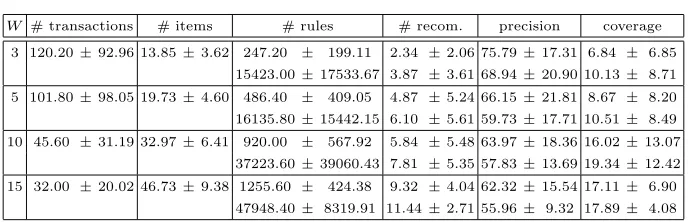
The length of the time window W affects primarily the number of trans-actions obtained from a given session and, consequently, the number of rules and the quality of recommendations. In the first experiment, we investigated the impact of different values ofW on the number of rules and the quality of the resulting recommendations for the five users by testing the values 3, 5, 10 and 15 minutes. In association rule mining, all rules having a support greater than 2% were extracted. For recommendation, we used a fixed active window of size 3 and a minimum confidence of 90%. Table 2 summarizes the average and standard deviation of values obtained for the five users in: number of transac-tions, items per transaction, extracted rules, recommendatransac-tions, precision and coverage of recommendations. For each value ofW in the table, the the results for rules having 1-itemsets and 2-itemsets are shown.
The higher the value W, the lower the number of transactions and the longer its size in terms of the average number of items. Fewer transactions lead to more rules since they are supported by the data, but the quality of these rules is inferior to the quality of rules extracted when more information is available. Indeed, the precision in recommendation decreases fromW = 3 toW = 15. For further experiments we setW = 3 min. since the dropping in precision for the immediately next valueW = 5 is significant (approx. 9%), but the improvement in coverage is rather small (approx. 2%).
The results of 1-itemsets and 2-itemsets, on the other hand, show the same relationship between precision and coverage. The values of precision diminish when 2-itemsets are considered, increasing the coverage of recommendations. In this case, not only the improvement in coverage can be considered small given the loss in precision, but also the number of rules rises drastically. The on-line analysis of such high number of rules becomes too expensive.
30 40 50 60 70 80 90 100
80 85 90 95 100
Precision
% of Confidence window size = 1 window size = 2 window size = 3 window size = 4 window size = 5 window size = 6
2 4 6 8 10 12 14 16 18 20
80 85 90 95 100
Coverage
% of Confidence
[image:9.595.144.465.107.222.2]window size = 1 window size = 2 window size = 3 window size = 4 window size = 5 window size = 6
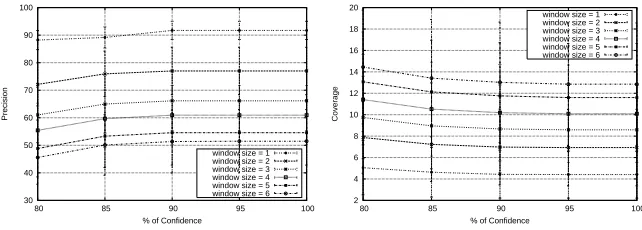
Fig. 2.Impact of window size on precision and coverage of recommendations
window sizes from 1 to 6. Figure 2 shows the impact of window size on precision and coverage of recommendations. In the figures, the results summarize the average and standard deviation of the scores achieved for the five users involved in the experiments varying the confidence threshold.
From both figures, it can be concluded that the smaller the size of the time window, the higher the precision of recommendation and the lower its coverage. Indeed, the best precision was obtained with a window of size one, but the coverage of recommendations was the poorer too. As the size of the window is enlarged, there are more rules matching the pages inside the window, increasing the number of recommendations and, consequently, their coverage.
There is a trade-off between enlarging enough the window size to recommend most of the pages that are relevant to the current activity context but not enlarge it too much to start recommending pages that were relevant to the previous context of the user in the browsing session. However, precision can be sacrificed in this decision for the sake of an increase in coverage since a lower precision means that the agent is recommending pages which are not contextually relevant but are still content relevant to the user interests.
4 Related Work
from recently consulted documents, our approach extracts information about how users tend to access documents regarding long-term interests to determine what kind of documents are likely to be interesting in a certain context.
The proposed approach differs from Web usage mining techniques in two aspects. First, server-side usage mining provides information about a specific Web site based on correlations among the pages that multiple users have vis-ited. By contrast, our approach extracts rules from the observation of a single user browsing the Web. Second, most Web usage mining approaches obtain as-sociation rules that relate single Web pages. By capturing navigational patterns at conceptual level our approach provides more flexibility in recommendation.
5 Conclusions
The user context is an important aspect to take into account in recommendation which, however, has received little attention in personal agents. Most agents are concerned with estimating the interest of new pieces of information, instead of trying to place the relevant information in the right contexts. In this paper, we have described an approach to consider the activity context during profiling to enable context-aware recommendation. Experimental results showed that the extraction of association rules describing browsing patterns at conceptual level helps to predict part of the interests which are relevant to the user in a session.
References
1. R. Agrawal, T. Imielinski, and A. Swami. Mining association rules between sets of items in large databases. InProceedings of the 1993 ACM SIGMOD International Conference on Management of Data, pages 207–216, 1993.
2. T. Bauer and D. Leake. WordSieve: A method for real-time context extraction. In Proceedings of the Third International and Interdisciplinary Conference on Model-ing and UsModel-ing Context, pages 30–44, 2001.
3. P. Brown and G. Jones. Context-aware retrieval: Exploring a new environment for information retrieval and information filtering. Personal and Ubiquitous Comput-ing, 5(4):253–263, 2001.
4. J. Budzik, K. Hammond, and L. Birnbaum. Information access in context. Knowl-edge based systems, 14(1-2):37–53, 2001.
5. M-S. Chen, J. S. Park, and P. Yu. Efficient data mining for path traversal patterns. IEEE Transactions on Knowledge and Data Engineering, 10(2):209–221, 1998. 6. R. Cooley, B. Mobasher, and J. Srivastava. Grouping web page references into
transactions for mining world wide web browsing patterns. In Proceedings of the IEEE Knowledge and Data Engineering Exchange Workshop, pages 2–9, 1997. 7. D. Godoy and A. Amandi. Modeling user interests by conceptual clustering.
In-formation Systems, 31(4-5):247–265, 2006.
8. S. Middleton, N. Shadbolt, and D. Roure. Ontological user profiling in recom-mender systems. ACM Transactions on Information Systems, 22(1):54–88, 2004. 9. B. Mobasher, H. Dai, T. Luo, and M. Nakagawa. Discovery and evaluation of