Reasoning with Inconsistent Ontologies in
Possibilistic Defeasible Logic Programming
Sergio A. G´omez†, Carlos I. Ches˜nevar†‡, and Guillermo R. Simari†
†Artificial Intelligence Research and Development Laboratory
Department of Computer Science and Engineering Universidad Nacional del Sur
Av. Alem 1253, (8000) Bah´ıa Blanca,Argentina Email:{sag,cic,grs}@cs.uns.edu.ar
‡Consejo Nacional de Investigaciones Cient´ıficas y T´ecnicas (CONICET), Argentina
Abstract. We present a preliminary framework for reasoning with pos-sibly inconsistent Description Logic ontologies in Possibilistic Defeasible Logic Programming. A case study is presented where we show how the proposed approach works. The proposal presented is apt for being used in the context of Semantic Web ontologies as it can be applied to the Web Ontology Language OWL.
1
Introduction
TheSemantic Web(SW) [1] is a vision of the Web where resources have precise meaning defined in terms of ontologies. The Web Ontology Language (OWL) [2] whose semantics is based onDescription Logics [3] is the de facto standard for the SW. Agents in the SW are supposed to reason over web resources by using standard reasoning systems, thus being able to compute an implicit hierarchy of concepts defined in an ontology and then checking the membership of indi-viduals to those concepts. Over the last few years an alternative approach to reasoning with ontologies calledDescription Logic Programming (DLP) [4] has gained interest. The DLP approach relies on translating DL ontologies into the language of logic programming, so standard Prolog environments can be used to reason on them.
Logics [6]). In this line of work, G´omezet al.[7] have applied defeasible argumen-tation (in particularDefeasible Logic Programming [8]) to reason with possibly inconsistent ontologies.
Possibilistic Defeasible Logic Programming (P-DeLP) [9] is a logic program-ming language which combines features from argumentation theory and logic programming, incorporating as well the treatment of possibilistic uncertainty and fuzzy knowledge at object-language level. In this article, we show a prelim-inary approach to reason with possibly inconsistent DL ontologies in P-DeLP. For this we define the concept of weighted DL ontology which is an ontology whose axioms have given numerical weights indicating their degree of certainty, then the ontology can be interpreted as a P-DeLP program.
Outline:In Section 2, we present the fundamentals of Description Logics. Sec-tion 3 reviews the fundamentals of Possibilistic Defeasible Logic Programming. In Section 4, we introduce a framework for reasoning with possibly inconsistent weighted ontologies in P-DeLP. Finally, Section 5 concludes.
2
Fundamentals of Description Logics
Description Logics (DL) [3] are a family of knowledge representation formalisms based on the notions of concepts (unary predicates, classes) and roles (binary relations) that allow to build complex concepts and roles from atomic ones. Let
C, D stand for concepts,Rfor a role and a, b for individuals. Concept descrip-tions are built from concept names using the constructors conjunction (C�D), disjunction (C�D), complement (¬C), existential restriction (∃R.C), and value restriction (∀R.C). To define the semantics of concept descriptions, concepts are interpreted as subsets of a domain of interest, and roles as binary relations over this domain. Further extensions are possible including inverse (P−) and tran-sitive (P+) roles. A DL ontology consists of two finite and mutually disjoint
sets: aTbox which introduces theterminologyand anAbox which contains facts about particular objects in the application domain. Tbox statements have the formC �D (inclusions) andC≡D(equalities), whereC andD are (possibly complex) concept descriptions. Objects in the Abox are referred to by a finite number of individual names and these names may be used in two types of as-sertional statements:concept assertions of the typea:C and role assertions of the type�a, b�:R.
A knowledge representation system based on DL is able to perform specific kinds of reasoning, its purpose goes beyond storing concept definitions and as-sertions. As a DL ontology has a semantics that makes it equivalent to a set of axioms of first-order logic, it contains implicit knowledge that can be made explicit through inferences. Inferences in DL systems are usually divided into Tbox reasoning and Abox reasoning. In this paper we are concerned only with Abox reasoning, more precisely with instance checking [3]. Instance checking consists of determining if an assertion is entailed from an Abox. For instance,
T ∪A |= a: C indicates that the individual ais a member of the concept C
3
Possibilistic Defeasible Logic Programming
The P-DeLP [9] languageLis defined from a set of ground fuzzy atoms (fuzzy propositional variables) {p, q, . . .} together with the conectives {∼,∧,←}. The symbol ∼ stands for negation. A literal L ∈ L is a ground (fuzzy) atom ∼q, whereq is a ground (fuzzy) propositional variable. Arule in Lis a formula of the formQ←L1∧. . .∧Ln, whereQ, L1, . . . , Ln are literals inL. Whenn= 0, the formulaQ←is called afact. The termgoal will refer to any literalQ∈ L. Facts, rules and goals are the well-formed formulas inL.
Definition 1 (Certainty-weighted clause). A certainty-weighted clause, or simply weighted clause, is a pair (ϕ, α), where ϕ is a wff in L and α ∈[0,1]
expresses a lower bound for the certainty ofϕin terms of a necessity measure.
The original P-DeLP language is based on Possibilistic G¨odel Logic or PGL, which is able to model both uncertainty and fuzziness and allows for a par-tial matching mechanism between fuzzy propositional variables. For simplicity, Ches˜nevar et al. [9] restrict themselves to the fragment of P-DeLP built on non-fuzzy propositions, and hence based on the necessity-valued classical propo-sitional Possibilistic logic. As a consequence, possibilistic models are defined by possibility distributions on the set of classical interpretations and the proof method for P-DeLP formulas, written �, is defined based on the generalized modus ponens rule:
(L0←L1∧. . .∧Lk, γ) (L1, β1), . . . ,(Lk, βk) (L0,min(γ, β1, . . . , βk))
which is a particular instance of the possibilistic resolution rule, and which pro-vides thenon-fuzzyfragment of P-DeLP with a complete calculus for determining the maximum degree of possibilistic entailment for weighted literals.
In P-DeLP certain and uncertain clauses can be distinguished. A clause (ϕ, α) is referred as certain ifα= 1 and uncertain otherwise. A set of clausesΓ
is deemed ascontradictory, denotedΓ � ⊥, wheneverΓ �(q, α) Γ �(∼q, β), with α > 0 and β > 0, for some atom in L. A P-DeLP program is a set of weighted rules and facts in L in which certain and uncertain information is distinguished. As an additional requirement, certain knowledge is required to be non-contradictory. Formally:
Definition 2 (Program).A P-DeLP programP (or just programP) is a pair
(Π, Δ), where Π is a non-contradictory finite set of certain clauses, andΔis a finite set of uncertain clauses.
Definition 3 (Argument. Subargument). Given a program P = (Π, Δ), a setA ⊆Δof uncertain clauses is an argument for a goalQwith necessity degree α >0, denoted�A, Q, α�, iff: (i)Π∪A �(Q, α); (ii)Π∪Ais non-contradictory, and (iii) there is noA1⊂ Asuch thatΠ∪ A1�(Q, β),β >0. Let�A, Q, α�and
Conflict among arguments is formalized by the notions of counterargument and defeat.
Definition 4 (Counterargument). LetP be a program, and let�A1, Q1, α1�
and�A2, Q2, α2�be two arguments inP. We say that�A1, Q1, α1�counterargues
�A2, Q2, α2� iff there exists a subargument (called disagreement subargument)
�S, Q, β�of �A2, Q2, α2�such that Π∪ {(Q1, α1),(Q, β)} is contradictory. The
literal(Q, β)is called disagreement literal.
Defeat among arguments involves apreference criterion on conflicting argu-ments, defined on the basis of necessity measures associated with arguments.
Definition 5 (Defeat). LetPbe a program, and let�A1, Q1, α1�and�A2, Q2, α2�
be two arguments inP. We will say that�A1, Q1, α1�is adefeaterfor�A2, Q2, α2�
iff�A1, Q1, α1�counterargues argument�A2, Q2, α2�with disagreement
subargu-ment �A, Q, α�, with α1 ≥ α. If α1 > α then �A1, Q1, α1� is called a proper
defeater, otherwise (α1=α) it is called a blocking defeater.
Definition 6 (Argumentation line).An argumentation lineλstarting in an argument�A0, Q0, α0�is a finite sequence of arguments [�A0, Q0, α0�,�A1, Q1, α1�,
. . . , �An, Qn, αn�, . . . ] such that every �Ai, Qi, αi� defeats �Ai−1, Qi−1, αi−1�,
for0< i≤n, satisfying certain dialectical constraints(see below). Every argu-ment �Ai, Qi, αi�inλhas level i. We will distinguish the sets
Sλk=�
i=0,2,...,2�k/2�){�Ai, Qi, αi� ∈λ}andI k λ=
�
i=1,3,...,2�k/2�+1){�Ai, Qi, αi� ∈λ}
associated with even-level (resp. odd-level) arguments inλ up to the k-th level
(k≤n).
An argumentation line can be thought of as an exchange of arguments be-tween two parties, a proponent (evenly-indexed arguments) and an opponent
(oddly-indexed arguments). In order to avoid fallacious reasoning, argumenta-tion theory imposes addiargumenta-tional constraints on such an argument exchange to be considered rationally acceptable w.r.t. a P-DeLP programP, namely:
1. Non-contradiction: given an argumentation line λ of length n the set Sn λ associated with the proponent (resp. In
λ for the opponent) should be
non-contradictory w.r.t.P.
2. No circular argumentation:no argument�Aj, Qj, αj�inλis a sub-argument of an argument�Ai, Qi, αi�inλ,i < j.
3. Progressive argumentation: every blocking defeater �Ai, Qi, αi� in λ is de-feated by a proper defeater�Ai+1, Qi+1, αi+1�inλ.
To determine whether a given argument is ultimately undefeated (or war-ranted) w.r.t. a program P, the P-DeLP framework relies on an exhaustive di-alectical analysis. Such analysis is modeled in terms of adialectical tree:
Definition 7 (Dialectical tree). LetP be a program, and let �A0, Q0, α0�be
an argument w.r.t. P. A dialectical tree for �A0, Q0, α0�, denoted T�A0, Q0, α0�,
1. The root node of T�A0, Q0, α0� is�A0, Q0, α0�.
2. �B�, H�, β��is an immediate child of�B, H, β�iff there exists an
argumenta-tion line λ = [�A0, Q0, α0�, �A1, Q1, α1�, . . . ,�An, Qn, αn�, . . . ] such that
there are two elements �Ai+1, Qi+1, αi+1� = �B�, H�, β�� and �Ai, Qi, αi�
=�B, H, β�, for somei= 0, . . . , n−1.
Nodes in a dialectical tree T�A0, Q0, α0� can be marked as undefeated and
defeated nodes (U-nodes and D-nodes, resp.). A dialectical tree will be marked as an and-or tree: all leaves in T�A0, Q
0, α0� will be marked U-nodes (as they have no defeaters), and every inner node is to be marked asD-nodeiff it has at least one U-node as a child, and asU-node otherwise.
Definition 8 (Warrant). An argument �A0, Q0, α0�is ultimately accepted as
valid (or warranted) with a necessity degreeα0w.r.t. a programPiff the root of
the treeT�A0, Q0, α0� is marked as U-node(i.e.,M ark(T�A0, Q0, α0�)= U).
4
Reasoning with DL Ontologies as P-DeLP Programs
In the presence of inconsistency, traditional DL reasoners issue an error message and stop further processing of ontologies. Thus the burden of repairing the ontol-ogy is on the knowledge engineer. However, the knowledge engineer is not always available and in some cases, such as when dealing with imported ontologies, he has neither the authority nor the expertise to correct the source of inconsistency. Therefore, we are interested in coping with inconsistencies such that the task of dealing with them is automatically solved by the reasoning system. We propose performing such a task by translating DL ontologies into P-DeLP programs. By doing so we gain the capability of reasoning with inconsistent ontologies. However we also lose some expressiveness in the involved ontologies. As Def. 11 shows, certain restrictions will have to be imposed on DL ontologies in order to be expressed in the P-DeLP language.
Our proposal is based in part in the work of [4] who show that the processing of ontologies can be improved by the use of techniques from the area of logic programming. In particular they have identified a subset of DL languages that can be effectively mapped into a Horn-clause logics.
Definition 9 (Weighted axiom. Weighted assertion). LetC, D stand for concept names,P, Qfor role names, anda, b for individual names. LetAbe an axiom of the form C � D, C ≡ D, � � ∀P.D, � � ∀P−.D, P � Q, P ≡ Q,
P ≡Q−, orP �P+. Letω be a real number such that 0≤ω≤1. Aweighted
axiom is pair (A, ω). Let B be an assertion of the form a :C or�a, b�: P. A
weighted assertionis a pair(B, ω).
Definition 10 (Weighted ontology). LetT be a set of weighted axioms and Abe a set of weighted assertions. A weighted ontology Σ is a pair (T, A). The set T is called weighted terminology (or just weighted Tbox) and A is called
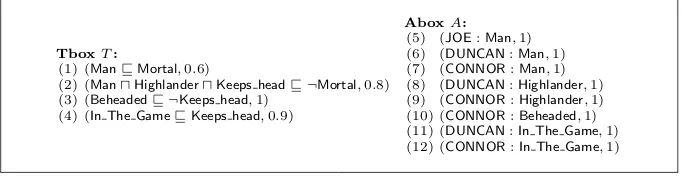
Example 1. In Fig. 1, we present a weighted ontologyΣ= (T, A) based on the fictional universe of theHighlander movies. The meaning of weighted terminol-ogy T is as follows: Axiom (1) says that a man is apparently a ——mortal; axiom (2) expresses that men from the Highlands that keep their heads on are supposed to be immortals; axiom (3) implies that every beheaded man does not keep his head on, and (4) says that immortals that still are known to bein the game have their heads on. The weighted assertional boxA expresses that Joe, Duncan and Connor are men; Duncan and Connor are Highlanders, Connor has been beheaded, and it is known that Connor and Duncan have been in the game.
TboxT:
(1) (Man�Mortal,0.6)
(2) (Man�Highlander�Keeps head� ¬Mortal,0.8) (3) (Beheaded� ¬Keeps head,1)
(4) (In The Game�Keeps head,0.9)
AboxA:
[image:6.595.131.475.284.372.2](5) (JOE:Man,1) (6) (DUNCAN:Man,1) (7) (CONNOR:Man,1) (8) (DUNCAN:Highlander,1) (9) (CONNOR:Highlander,1) (10) (CONNOR:Beheaded,1) (11) (DUNCAN:In The Game,1) (12) (CONNOR:In The Game,1)
Fig. 1.A weighted ontologyΣ= (T, A)
As noted by Grosofet al.[4], for DL sentences to be mapped into Horn-logic rules, they must satisfy certain constraints. Conjunction and universal restric-tions appearing in the right-hand side of inclusion axioms can be mapped to heads of rules (calledLh-classes). In contrast, conjunction, disjunction and exis-tential restriction can be mapped to rule bodies whenever they occur in the left-hand side of inclusion axioms (called Lb-classes). As equality axioms “C ≡D” are interpreted as two inclusion axioms “C � D” and “D � C”, they must belong to the intersection ofLh andLb (calledLhb classes).
Definition 11 (Lh, Lb and Lhb classes (adapted from [4])). Let A be an
atomic class name, C and D class expressions, and R a property. In the Lh
language,C�Dis a class, and∀R.Cis also a class. Class expressions inLhare
called Lh-classes. In theLb language,C�Dis a class, and ∃R.Cis a class too.
Class expressions inLbare called Lb-classes. TheLhblanguage is defined as the
intersection ofLhand Lb. Class expressions inLhb are called Lhb-classes.
Definition 12. (T mapping from DL sentences to logic programming rules (adapted from [4]))LetA, C, Dbe concepts,X, Y variables,P, Q prop-erties. The T mapping from the language of DL to the language of P-DeLP is defined in Fig. 2. Besides, intermediate transformations of the form “(H1∧
H2) ← B” will be rewritten as two rules “H1 ← B” and “H2 ← B”.
Sim-ilarly transformations of the form “H1 ← H2 ← B” will be rewritten as
“H1 ← B∧H2”, and rules of the form “H ← (B1∨B2)” will be rewritten as
T(C�D) =df Th(D, x) ← Tb(C, x),ifCis anLb-class andDanLh-class
T(C≡D) =df
�
T(C�D)
T(D�C),ifCandDareLhb-classes
T(� � ∀P.D) =df Th(D, y) ← P(x, y),ifDis anLh-class
T(� � ∀P−.D) =df Th(D, x) ← P(x, y),ifDis anLh-class
T(a:D) =df Th(D, a),ifDis anLh-class
T(�a, b�:P) =df P(a, b)
T(P�Q) =df Q(x, y) ← P(x, y)
T(P≡Q) =df
�
Q(x, y) ← P(x, y)
P(x, y) ← Q(x, y)
T(P≡Q−) = df
�
Q(x, y) ← P(y, x)
P(y, x) ← Q(x, y)
T(P+
�P) =df P(x, z) ← P(x, y)∧P(y, z)
where:
Th(A, x) =df A(x)
Th((C�D), x) =df Th(C, x)∧Th(D, x)
Th((∀R.C), x) =df Th(C, y) ← R(x, y)
Tb(A, x) =df A(x)
Tb((C�D), x) =df Tb(C, x)∧Tb(D, x)
Tb((C�D), x) =df Tb(C, x)∨Tb(D, x)
[image:7.595.131.471.147.335.2]Tb((∃R.C), x) =df R(x, y)∧Tb(C, y)
Fig. 2.Mapping from DL axioms to logic programming rules
Definition 13 (Interpretation of a weighted ontology).LetΣ= (T, A)be a weighted ontology such thatT ={(s1, α1), . . . ,(sn, αn)}andA={(a1, β1), . . . ,
(am, βm)}, then:
Trad(T) ={(T(s1), α1), . . . ,(T(sn), αn)}
Trad(A) ={(T(a1), β1), . . . ,(T(am), βm)}.
Besides, if the cardinal k of T(si) = {f1, . . . , fk} is greater than 1, then the
translation of (si, αi) is (fi, αi), . . . ,(fk, αi). Let Prop(·) be the
propositional-ization operator for a first-order theory (each propositional term “p(a)” gen-erated from a predicate “p(x)” and a constant “a” will be noted as “p a”). The interpretation of Σ, noted as Interpretation(Σ), is the P-DeLP program P= (Prop(Trad(T)),Prop(Trad(A)).
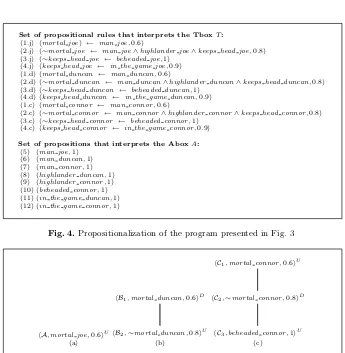
Example 2. Consider again the weighted ontologyΣ= (T, A) presented in Ex. 1. In Fig. 3 we present a logical programTrad(T)∪Trad(A). And in Fig. 4, we present the P-DeLP program P = Interpretation(Σ). Notice that as there are three constants (viz.,joe,duncan and connor), and three first-order rules (viz., (1)–(4)), twelve rules are generated in the propositional program, i.e. four for every instantiation of each rule with each one of the three constants.
Definition 14 (Instance checking). LetΣ = (T, A)be a weighted ontology. LetC be a concept name,aan individual name. Let �be real number such that
0 ≤ � ≤ 1. The individual a is a member of the concept C with strength � iff there is a warranted argument�A, C(a), ��w.r.t.Interpretation(Σ).
instance checking works in P-DeLP for deciding the membership of the indi-viduals Joe, Duncan and Connor to the concept Mortal. First, consider the
case of Joe: An argument �A,mortal joe,0.6� can be obtained, where A =
{(mortal joe ← man joe,0.6)}. This argument has no defeaters and is thus warranted, therefore we conclude that JOE is a member of the concept Man
with strength 0.6 (see Fig. 5.(a)). Second, consider the case of Duncan: As in the case of Joe, there is an argument �B1,mortal duncan,0.6�, with B1 =
{(mortal duncan ← man duncan,0.6)}. But this argument is defeated by�B2,∼
mortal duncan,0.8�, where
B2={(∼mortal duncan←man duncan∧
highlander duncan∧keeps head duncan,0.8),
(keeps head duncan←in the game duncan,0.9)}.
As this argumentB2is undefeated, we reach the conclusion that DUNCANis a
member of the concept¬Mortalwith strength 0.8 (see Fig. 5.(b)). Last, consider
the case of Connor: Yet again there is an argument expressing that Connor is mortal since he is a man:�C1,mortal connor,0.6�, with
C1={(mortal connor ← man connor,0.6)};
as in the case of Duncan, this argument is defeated by another that says that Connor in immortal because he is a Highlander, i.e.�C2,∼mortal connor,0.8�
where
C2={(∼mortal connor ←man connor∧
highlander connor∧keeps head connor,0.8),
(keeps head connor ←in the game connor,0.9)}.
However, in this case there is another (undefeated) argumentC3that defeatsC2,
namely�C3,∼keeps head connor,1�, where
C3={(∼keeps head connor ←beheaded connor,1)}.
In this way, the argument C1 gets undefeated again, and we conclude that
CONNORis a member of the conceptMortalwith strength 0.6 (see Fig. 5.(c)).
5
Conclusions and Future Work
Set of rulesT(T):
(1) (mortal(x) ← man(x),0.6)
(2) (∼mortal(x) ← man(x)∧highlander(x)∧keeps head(x),0.8) (3) (∼keeps head(x) ← beheaded(x),1)
(4) (keeps head(x) ← in the game(x),0.9)
Set of factsT(A):
[image:9.595.130.473.142.282.2](5) (man(joe),1) (6) (man(duncan),1) (7) (man(connor),1) (8) (highlander(duncan),1) (9) (highlander(connor),1) (10) (beheaded(connor),1) (11) (in the game(duncan),1) (12) (in the game(connor),1)
Fig. 3.First-order P-DeLP program that interprets ontologyΣ= (T, A)
membership of individuals to concepts. This approach continues previous work of ours [7] that translates DL ontologies into Defeasible Logic Programming and uses generalized specificity to compare arguments. One advantage of the approach presented in this paper is that it allows to better characterize the preference criterion between axioms and thus arguments that are built when considering them, since the comparison criterion is no longer syntactically de-termined by the form of the underlying program that represents the ontology. One drawback of our approach is that the propositionalization of a first-order theory produces lots of facts that are irrelevant (notice that given a knowledge base withp k-ary predicates and nconstants, there are possible pnk instanti-ations, see Ex. 2), impacting the computational efficiency of the method. As part of our current research work, we are interested in applying this proposal to ontology integration and studying what the intrinsic logical properties of the approach are.
Acknowledgments: This research is funded by Projects PIP 112-200801-02798 (CONICET, Argentina), PGI 24/ZN10, PGI 24/N006 (SGCyT, UNS, Argentina) and Universidad Nacional del Sur.
References
1. Berners-Lee, T., Hendler, J., Lassila, O.: The Semantic Web. Scientific American (2001)
2. McGuiness, D.L., van Harmelen, F.: OWL Web Ontology Language Overview (2004) http://www.w3.org/TR/owl-features/.
3. Baader, F., Calvanese, D., McGuinness, D., Nardi, D., Patel-Schneider, P., eds.: The Description Logic Handbook – Theory, Implementation and Applications. Cam-bridge University Press (2003)
Set of propositional rules that interprets the TboxT:
(1.j) (mortal joe) ← man joe,0.6)
(2.j) (∼mortal joe ← man joe∧highlander joe∧keeps head joe,0.8) (3.j) (∼keeps head joe ← beheaded joe,1)
(4.j) (keeps head joe ← in the game joe,0.9) (1.d) (mortal duncan ← man duncan,0.6)
(2.d) (∼mortal duncan ← man duncan∧highlander duncan∧keeps head duncan,0.8) (3.d) (∼keeps head duncan ← beheaded duncan,1)
(4.d) (keeps head duncan ← in the game duncan,0.9) (1.c) (mortal connor ← man connor,0.6)
(2.c) (∼mortal connor ← man connor∧highlander connor∧keeps head connor,0.8) (3.c) (∼keeps head connor ← beheaded connor,1)
(4.c) (keeps head connor ← in the game connor,0.9)
Set of propositions that interprets the AboxA:
[image:10.595.128.473.126.479.2](5) (man joe,1) (6) (man duncan,1) (7) (man connor,1) (8) (highlander duncan,1) (9) (highlander connor,1) (10) (beheaded connor,1) (11) (in the game duncan,1) (12) (in the game connor,1)
Fig. 4.Propositionalization of the program presented in Fig. 3
�A,mortal joe,0.6�U
�B1,mortal duncan,0.6�D
�B2,∼mortal duncan,0.8�U
�C1,mortal connor,0.6�U
�C2,∼mortal connor,0.8�D
�C3,beheaded connor,1�U
[image:10.595.132.464.378.481.2](a) (b) (c)
Fig. 5.Dialectical trees formortal joe,mortal duncanandmortal connor
5. Ribeiro, M.M., Wassermann, R.: Base Revision for Ontology Debugging. J. Log. Comput.19(5) (2009) 721–743
6. Huang, Z., van Harmelen, F., ten Teije, A.: Reasoning with Inconsistent Ontologies. In Kaelbling, L.P., Saffiotti, A., eds.: Proceedings of the Nineteenth International Joint Conference on Artificial Intelligence (IJCAI’05), Edinburgh, Scotland (August 2005) 454–459
7. G´omez, S.A., Ches˜nevar, C.I., Simari, G.R.: Reasoning with Inconsistent Ontologies Through Argumentation. Applied Artificial Intelligence24(1) (2010) 102–148 8. Garc´ıa, A., Simari, G.: Defeasible Logic Programming an Argumentative Approach.
Theory and Practice of Logic Programmming4(1) (2004) 95–138