THE WORLD WETLANDS DAY 2007
KENYA
PREPARED AND EDITED BY:
BERNARD OGWOKA SIRYA M. KARISA
KENYA WILDLIFE SERVICE – COAST CONSERVATION AREA
List of acronyms
GVI – Global Vision International
KEMFRI – Kenya Marine Fisheries and Research Institute KESCOM – Kenya Sea Turtle Conservation Committee KWS - Kenya Wildlife Service
WCK – Wildlife Clubs of Kenya NMK – National Museum of Kenya WWD – World Wetlands Day
Acknowledgements
We extend our heartfelt gratitude to all the schools, community groups and the donor fraternity, whose continued participation and support for the World Wetlands Day has created a special place for this memorable event each year. With their help, WWD continues to grow and improve indispensably.
Table of contents
List of acronyms……….2
Acknowledgement……….3
1.0 Introduction………..4
2.0 Event planning……….6
3.0 Event output……….7
3.1 Participation ………7
3.2 Presentations………7
3.3 Clean-up ……….7
3.4 Mangrove replanting…………..…,……….……7
4.0 WWD program and participants ………..……….8
5.0 Appendices……….…9
5.1 List of schools………....9
5.2 List of sponsors………..10
5.3 Evaluation Sheet………11
5.4 Waste Management Sheet………12
1.0 INTRODUCTION
The World Wetlands Day (WWD) is normally celebrated on 2nd February each year. The day marks the date when the convention on wetlands was signed on 2nd February 1971, in the Iranian city of Ramsar.
population increases. In addition, over 35 million people world wide are currently involved in the industry, 95% live in developing countries and the majority are small - scale fishers; their livelihoods depend on making sure that there will be fish for
tomorrow.
2. Project Goals
(a) Specific Goals
1. To enhance the level of awareness amongst school children and other stakeholders on the importance of conserving wetlands.
2. To create awareness and publicity on near shore coastal wetlands and inland marine fisheries.
3. Improving coordination and creating synergies among resource managers, researchers, users, and donors to address issues on coastal and marine resources.
4. Harness volunteer’s efforts and synergies with a view of increasing the level of their participation in conservation of coastal and marine wetlands
(b)How to accomplish these goals:
i) Dedicate efforts to bring together Kenyans from all walks of life to express themselves on the marine environment and resources therein during world wetlands day (WWD).
ii) Sensitizing young minds through competitive theme interpretation during the World Wetlands Day.
iii) Create a forum for exchange and /or transfer of contemporary science and expectations from the young to the old through modeling, poetry, debate, drama and dance during the World Wetlands Day.
iv) Share experiences from other countries with those who have had occasion to travel and experience different approaches.
3: Specific Benefits
.
Enhance a more focused coastal and marine education program among school children and local community..
Promote awareness towards increased benefits accruing from a healthy environment among the fisher community and general public..
Promote coordinated interaction between resource managers, educators, users and researchers..
Channels volunteer’s efforts and synergies towards coordinated objectives4: Significance
2.0 EVENT PLANNING
2.1 Organizing committee
The first 11th WWD planning meeting was held on the 6th January 2007. The organizing committee was composed of members from 6 members KWS- Coast Conservation Area, KESCOM, and Kisite Mpunguti Marine Park and Reserve. The committee consisted of 2 sub-committees - Publicity and Fundraising committees.
2.2 Publicity
Information about the WWD was passed to participants through stickers, posters, letters, banners and brochures.
2.3 Budget
The WWD budget requirements were as follows:
Item Amount (Kshs.)
Printing Publicity Material (4 pcs Banners and 100 pcs Brochures) 5,000.00
Hiring of Equipment (5 tents and PAS) 4,875.50
Refreshment for pupils and students (400 soft drinks, snacks) 12,000.00
Lunch for the VIPs 15,000.00
Photography and Video Coverage 11,500.00
Facilitation Costs (Local running fuel, stationery, postage, telephone and contingency)
8,500.00
Awards 300 certificates 3,000.00
Reports and dissemination 2,000.00
3.0 EVENT OUTPUT
3.1 Participation
WWD 2007 attracted more than 300 participants from primary schools, community based organizations (CBOs), government institutions, local NGOs, hoteliers and private water sports clubs.
Due to limited funding only five schools from Shimoni were involved in this years’ WWD.
3.2 Presentations
There were four categories of competitions for adjudication: performances (dramas, poems, songs and dances). Based on this years’ theme interpretation winners were awarded presents that included books and pens.
Fig 1: Art work display Fig 2: Poetry Fig 3: Song dance
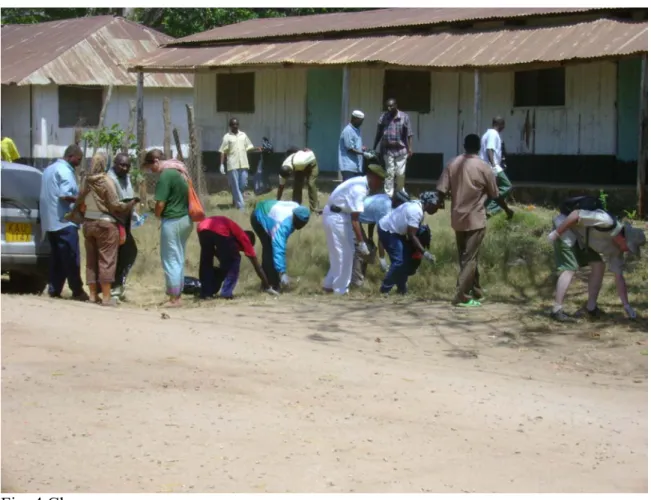
3.3 Clean up
Fig. 4 Clean up
3.4 Mangrove replanting
The season for mangrove replanting was offset. However, mangrove replanting will take place during the onset of rains targeting 4 main species including Rhizophora mucronata, Ceriops tagal, Avicennia marina and Sonneratia alba. This will be an ongoing program for the schools and communities in Shimoni area.
4. WWD Programme and Participants
The event was held on the 24th February 2007 from 9 am to 2 pm at the Kisite Mpunguti Marine Park and Reserve Headquarters – Shimoni. The chief guest was Mr. Hassan Mohamed Hassan; the education Officer National Museums of Kenya (Fort Jesus). The VIPs included Dr. James Kairo (KMFRI) who gave a keynote speech on the value and general importance of mangroves. Other institutions with key representatives in attendance included GVI, Colobus Trust, KESCOM and the Provincial administration.
In his closing speech, the Warden of Kisite Mpunguti Marine National Park and Reserve underscored the significant role that the coastal and marine resources continued to play not only in supporting local communities livelihoods but also contributing to the national economy. Noting that these resources are, however, facing diverse threats due to destructive and unsustainable exploitative practices, he stressed on the need for concerted efforts by all the governmental and non-governmental agencies and the community fraternity in addressing these trends.
Appendix 5.1: PARTICIPATING SCHOOLS
PRIMARY SCHOOLS
NAME NO. OF STUDENTS NO. OF PATRONS
1 Kag Primary School 13 2 2 Kichaka Mkwaju Primary 10 1 3 Mkwiro Primary Sschool 10 2 4 Shimoni Primary School 12 3 5 Wasini Primary School 10 3
OTHER PARTICIPANTS
NAME NUMBER
1. Community representatives 149
2. Local NGO’s representatives 18
3. Government Representatives 12
4. Guests 33
Appendix 5.2: SPONSORS
5.2.1 Cash Donations
Number Sponsor Amount (Kshs.) Activity
1. KWS Wetlands
Division 50,000.00
Facilitation
2. One earth Safaris 5,000.00 Facilitation
3. Kikambala Fish Station 3,000.00 Banner Production
5.2.2 Donations in Kind
Number Donor Donated
1. Paradise Divers 15 Cartons of Mineral Water
Appendix 5.3: WWD 2006 Evaluation sheet.
WORLD WETLANDS DAY 2007
EVALUATION SHEET
(To be filled by School Patron)
School’s name_____________________ School’s address____________________ School’s tel. No.____________________ Patrons’ name _____________________ No. Of participants__________________ Tick and fill where necessary:
1. What is your general view of this year’s Marine Environment Day?
A. Excellent B. Good C. Fair D. Poor
2. Did the day’s events done play any role in awareness creation in Marine conservation?
A. Yes B. No
If yes, which the events played this role sufficiently A. Performances.
B. Artwork. C. Sand art.
3. Briefly comment on this year’s WWD with regards to last year’s (if you took part last year)
5.4 Waste Management sheet
Waste Management Form
World wetland day 2007
Enhancing Community Participation in the Conservation and Management of Wetlands in the Kenyan Coast
Date: ……….. Name/reporters………
Beach(s)………
………. Location:………..
Items Collected:
NON-BIODEGRADABLE
ITEMS Number KGS Where Collected Distributed When How reused COMMENT
Flipflops
Plastic Bottles Water Plastic Bottles Other
Glass Bottles
Tin scrap
Iron Scrap
Hard Plastics: Buckets; boxes etc
Material/Cloth
Fishing nets/items
Fishing line
Bouys
Polysterene
Lighters
Light bulbs
Tin soldier men
BIO-DEGRADEABLE
ITEMS Number KGS Where collected Distributed When How reused COMMENT Hard wood pieces
Soft wood pieces
Bamboo
Mangrove wood
Other