
Vocabulary knowledge dimensions in ELF textbooks
8
0
0
Texto completo
(2) order, word distribution or the relation between input and uptake. Chart 1 displays a selection of studies distributed by focus, target language, language or educational level and method used in the analysis. As can be observed, most research on vocabulary in textbooks has focused on word frequency. Little attention has been paid to the analysis of dimensions of word knowledge underlying in vocabulary activities. Chart 1 Perspectives on the analysis of vocabulary in textbooks Study. Focus. language. Level. Method. López-Jiménez. Vocabulary. Spanish. Beginner. Content analysis. 2014. selection, organization. Intermediate and. Advanced. presentation Marmol 2011. Criado and. Word frequency. English. Beginner. Word type. 3 Primary. Word density. Education. Word frequency. Sánchez 2009. and distribution. Godev 2009. Word frequency. RANGE. rd. English. Intermediate. RANGE. nd. 2 Baccalaureate Spanish. College students. Vocabulary. Frequency dictionary. selection Word lists Jiménez-Catalán. Word type. English. 6th primary th. and Mancebo. 50 Top frequent. 10 secondary (4. 2008. words. ESO). WordSmith Tools. Distribution of word categories Shared and nonshared vocabulary Vocabulary input increase Donzelli 2007. Word frequency. English. Children. Vocabulary input. -course level not. Vocabulary uptake. specified. Range. Given the role played by textbooks and vocabulary in foreign language education it is important for teachers and researchers to examine vocabulary input in learners’ textbooks. The present study responds to this need. Likewise, it also aims to contribute to narrow the gap in the study of pedagogical dimensions, usually overlooked in vocabulary knowledge taxonomies. This is a preliminary step in this regard. Our objectives were twofold. The first one was to identify the main dimensions of vocabulary knowledge underlying in vocabulary activities in textbooks; the second one was to ascertain whether there were similarities or differences regarding the distribution of vocabulary knowledge dimensions in the targeted textbooks. 31 Vocabulary knowledge dimensions in EFL textbooks Susana Fernández Orío Encuentro 23, 2014, ISSN 1989-0796, pp. 30-37.
(3) 2. Method This preliminary study was based on a content analysis of vocabulary activities drawn from two English textbooks aimed at the last year of Spanish Compulsory Education: Challenge for ESO 4 (Burlington Books) and Switch 4 (Oxford). As a framework for our analysis we followed Jiménez Catalán’s (2002: 155) classification of vocabulary knowledge dimensions, our translation and adaption of this classification is included in the following chart. Chart 2: Vocabulary knowledge dimensions (adapted from Jiménez Catalán (2002:155) 1. Know the grammar, pronunciation and orthography of a word. 2. Know the morphology of a word. 3. Know the collocability of a word. 4. Know the syntactic restrictions of a word. 5. Know the frequency in oral and written language of a word. 6. Know the contexts where a word can be used. 7. Know a word semantic and syntactic relations with other words. 8. Recognise the word in its written and oral form. 9. Recover the word when it is needed. 10. Know the conceptual and referential meaning of a word. 11 Know the meanings that the word connotes 12 Know the pragmatic sense of a word. As can be observed in chart 2, each lexical dimension has been given a number. For the sake of clarity we will use those numbers to refer to the vocabulary knowledge dimensions summarized in the Results and Discussion sections. The steps adopted in the analysis were as follows. First, we identified the vocabulary activities and classified them according to the vocabulary knowledge dimensions displayed in Table 1. Second, we counted the vocabulary activities and the knowledge dimensions in each activity. This provided us with a basis for conducting a comparative analysis of the two textbooks under examination in the present study. In the process of identification and classification we found some problems that need to be mentioned here. One was the lack of correspondence between some activities and the dimensions in Jiménez Catalán’s (2002) framework. For instance, matching or translation did not seem to correspond with the dimensions in straightforward way. Our option was to introduce a new dimension: “Recognise the word in its visual form” (dimension 13). It could be argued that this is not different from “Recognise the word in its written and oral form” (dimension 8). However, in our view, the former includes pictures and words whereas the latter only refers to words. One example of vocabulary activity where learners are required to match words to pictures is the first exercise of Challenge for ESO 4 introductory unit (Addison and Pamela 2006: 6). Here they are provided with a number of words related to jobs together with six pictures of people standing for the jobs. Similarly, the exercises where learners have to translate words into their mother tongue cover a dimension not contemplated in Jiménez Catalán’s (2002) taxonomy. It is true that in order to translate a word the learner 32 Vocabulary knowledge dimensions in EFL textbooks Susana Fernández Orío Encuentro 23, 2014, ISSN 1989-0796, pp. 30-37.
(4) has to know its “conceptual and referential meaning” (dimension 10), but translation involves different cognitive processes, among them word recognition and word equivalence between the source and target language. Because of this we included another new dimension: “translation knowledge” (dimension 14). An example is found in the first exercise of unit 7 (Addison and Pamela 2006: 61). Here learners are required to say what the words in the box (sound, voice, hit, clip, text message, answer a call, download, compose and broadcast) mean in in their first language. Apart from that, another problem is the similar representation of dimensions 6 and 12. In our opinion both stand for the same concept as pragmatic knowledge presupposes knowledge of how to use the word in context. An example is found in filling the gaps activities where learners have to insert the words provided in a box into the appropriate blank.. 3. Descriptive analysis of vocabulary knowledge dimensions 3.1. Challenge for ESO 4 This textbook published by Burlington Books has an introductory unit (I), 10 content units; three extra units devoted to the review of vocabulary and grammar at the end of every three content units, with the exception of Review 2 that comprises the review of 4 units; and ten “Check your progress” sections devoted to the consolidation of the syllabus. Tables 1 and 2 below display the units of the book together with the resulting number of vocabulary activities per unit. For its part, Table 3 shows the number of vocabulary activities included in the introductory unit, the ten content units and the units that review the syllabus every each three/four content units. Finally, Table 4 provides a summary of the number of vocabulary activities included in the “Check your progress” units. The abbreviations in the first row should be read as follows: I stands for introductory unit, U for Unit, R for Review Unit, and CYP stands for the Check your progress units. Table 1: Distribution of vocabulary activities per unit in Challenge for ESO 4 I. U1. U2. U3. R1. U4. U5. U6. U7. R2. U8. U9. U10. R3. 5. 7. 6. 6. 1. 6. 5. 5. 6. 1. 5. 5. 6. 1. Table 2: Distribution vocabulary activities per unit in Challenge for ESO 4 “Check your progress” units CYP 1 CYP 2. CYP 3 CYP 4. CYP 5 CYP 6. CYP 7 CYP 8. CYP 9 CYP 10. 2. 2. 2. 2. 2. 2. 2. 2. 2. 2. The total number of vocabulary activities included in this textbook is 85. As can be observed there is an even distribution throughout the units. The vocabulary knowledge dimensions together with the number of activities in which they appear are illustrated in Table 3. A close analysis of the data points to the absence of six vocabulary knowledge dimensions: dimensions number 4, 5, 8, 9, 11 and 12.. 33 Vocabulary knowledge dimensions in EFL textbooks Susana Fernández Orío Encuentro 23, 2014, ISSN 1989-0796, pp. 30-37.
(5) Table3: Vocabulary knowledge dimensions in the vocabulary activities of Challenge for ESO 4. Vocabulary knowledge dimensions. No of activities. 1. Know the grammar, pronunciation and orthography of a word. 2. 2. Know the morphology of a word. 4. 3. Know the collocability of a word. 8. 6. Know the contexts where a word can be used. 30. 7. Know a word semantic and syntactic relations with other words. 45. 10. Know the conceptual and referential meaning of a word. 28. 13. Recognise the word in its visual form. 10. 14. Translation knowledge of a word.. 1. The figures indicate that the most frequent vocabulary knowledge dimension within Challenge for ESO 4 is “knowledge of the semantic and syntactic relations between words” (Dimension 4); this is followed by “knowledge of the context where a word can be used” (Dimension 6) and “knowledge of a word conceptual and referential meaning” (Dimension 10). The rest of vocabulary knowledge dimensions are either infrequent (Dimensions 1, 2, 3, 13 and 14) or absent in the vocabulary activities (Dimensions 4, 5, 8, 9, 11 and 12). In light of the figures it seems as this textbook gave more importance to semantic and syntactic relations and context and conceptual and referential meaning than to morphology, word frequency, recovering a word when needed, or orthography. 3.2. Switch 4 This textbook, published by Oxford, comprises an introductory unit, nine content units and three review units. Although it has fewer units than Challenge for ESO 4, every unit contains more vocabulary activities than Challenge for ESO 4. Table 4 displays the distribution of the number of vocabulary activities per unit. The abbreviations in the first row should be read as follows: I stands for introductory unit, U for Unit, and R for Review Unit. Table 4: Distribution of vocabulary activities per unit in Switch 4 Unit. I. U1. U2. U3. R1. U4. U5. U6. R2. U7. U8. U9. R3. N. 8. 14. 11. 15. 10. 12. 13. 14. 9. 14. 14. 13. 10. Therefore, the total number of vocabulary activities of Switch 4 is 157, a higher number than Challenge for ESO 4. Table 5 shows the dimensions underlying in the vocabulary activities of Switch 4: 1, 2, 3, 4, 6, 7, 8, and 10. And as can observed the number of activities in which each dimension is involved is higher in this textbook than in Challenge for ESO 4. This is down to the fact that Switch 4 contains a higher number of vocabulary activities. Furthermore there are two dimensions that did not appear in Challenge for ESO 4 but now do appear in Switch 4: dimensions 4 and 8. Likewise, some dimensions are absent in this textbook: dimensions number 5, 9, 11 and 12.. 34 Vocabulary knowledge dimensions in EFL textbooks Susana Fernández Orío Encuentro 23, 2014, ISSN 1989-0796, pp. 30-37.
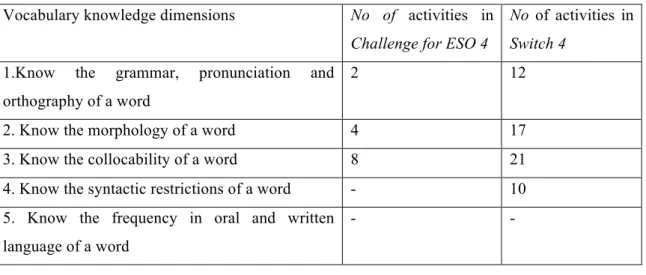
(6) Table 5: Knowledge dimensions in vocabulary activities within Switch 4 Vocabulary knowledge dimensions. No activities. 1. Know the grammar, pronunciation and orthography of a word. 12. 2. Know the morphology of a word. 17. 3. Know the collocability of a word. 21. 4. Know the syntactic restrictions of a word. 10. 6. Know the contexts where a word can be used. 41. 7. Know a word semantic and syntactic relations with other words. 58. 8. Recognise the word in its written and oral form. 26. 10. Know the conceptual and referential meaning of a word. 45. 13. Recognise the word in its visual form. 26. 14. Translation knowledge of a word. 2. As table 5 shows, the most frequent lexical dimensions within this textbook are, as in Challenge for ESO 4, dimensions number 7, 10 and 6. This coincidence suggests that vocabulary designers give more importance to the development of vocabulary skills related to dimensions, related to semantic and syntactic relations, conceptual and referential meaning and context than to morphology, the grammar of words, listening skills, etc. On the contrary, little attention is given to dimension 5 (know the frequency in oral and written language of a word), dimension 9 (recover the word when it is needed), dimension 11 (know the meanings that the word connotes) and dimension 12 (Know the pragmatic sense of a word). 3.3. Comparison of the two textbooks In this section we will focus on the similarities and differences that exist between the two textbooks in terms of the knowledge dimensions involved in their vocabulary activities. Table 6 below shows the differences and similarities between the two textbooks. The first column includes vocabulary knowledge dimensions out of Jiménez Catalan’s (2002) taxonomy plus the two included in this study (dimensions 13 and 14). The second and third columns display the distribution of vocabulary activities per textbook. Table 6: Vocabulary knowledge dimension in Challenge for ESO 4 and Switch 4 Vocabulary knowledge dimensions. No of activities in. No of activities in. Challenge for ESO 4. Switch 4. 2. 12. 2. Know the morphology of a word. 4. 17. 3. Know the collocability of a word. 8. 21. 4. Know the syntactic restrictions of a word. -. 10. 5. Know the frequency in oral and written. -. -. 1.Know. the. grammar,. pronunciation. and. orthography of a word. language of a word 35 Vocabulary knowledge dimensions in EFL textbooks Susana Fernández Orío Encuentro 23, 2014, ISSN 1989-0796, pp. 30-37.
(7) 6. Know the contexts where a word can be used. 30. 41. 7. Know a word semantic and syntactic relations. 45. 58. 8. Recognise the word in its written and oral form. -. 26. 9. Recover the word when it is needed. -. -. 10. Know the conceptual and referential meaning. 28. 45. 11. Know the meanings that the word connotes. -. -. 12. Know the pragmatic sense of a word. -. -. 13. Recognise the word in its visual form. 10. 26. 14. Translation knowledge of a word. 1. 2. with other words. of a word. The most frequent dimensions coincide in Challenge for ESO 4 and Switch 4: dimensions number 7 (Know a word semantic and syntactic relations with other words), 10 (Know the conceptual and referential meaning of a word) and 6 (Know the contexts where a word can be used). However, there are more differences than similarities between the two textbooks. The first difference is related to the quantity of vocabulary activities. Whereas Challenge for ESO 4 contains 85 vocabulary activities, Switch 4 comprises a total of 157 vocabulary activities. Consequently, the representation of vocabulary knowledge dimensions in the activities is bigger in Switch 4 than in Challenge for ESO 4. As said earlier, this is down to the fact that the number of activities of Switch 4 is much numerous than in Challenge for ESO 4. The second difference is that the range of dimensions represented in Switch 4 is wider than in Challenge for ESO 4. Switch 4 vocabulary activities involve the dimensions covered by Challenge for ESO 4 and two more lexical dimensions: dimensions 4 (Know the syntactic restrictions of a word) and 8 (Recognise the word in its written and oral form). Finally, further differences are observed: Whereas Challenge for ESO 4 gives no importance to the recognition of words in their written or oral form, Switch 4 contains listening activities where the learner has to recognise words in their oral form. These differences suggest that vocabulary learning plays a more important role in Switch 4 than in Challenge for ESO 4, as it has been demonstrated by the higher number of activities devoted to vocabulary and the wider range of vocabulary knowledge dimensions represented in the textbook. However, we should take into account the existing similarity as the most frequent dimension in both textbooks has to do with the syntactic and the semantic relations. From this stance, the distribution of knowledge dimensions in the vocabulary activities in the textbooks examined is rather poor and heterogeneous.. 4. Conclusions The present study set out to identify the vocabulary activities and vocabulary knowledge dimensions in two textbooks currently used in 4th year ESO, end of educational stage. Our analysis showed a high degree of similarity between both books regarding the representation of vocabulary knowledge dimensions. Basically they were the semantic and syntactic relations between words (Dimension 7), the conceptual and referential meaning of words (Dimension 10) and the context where words can be used (Dimension 6). Nevertheless, 36 Vocabulary knowledge dimensions in EFL textbooks Susana Fernández Orío Encuentro 23, 2014, ISSN 1989-0796, pp. 30-37.
(8) differences could also be observed between Challenge for ESO 4 and Switch 4 in the number of vocabulary activities and in the range of dimensions. Although both textbooks are used at the same course level (4th year ESO), the close analysis of their vocabulary activities reveals differences. This finding has educational implications and requires further research. In this preliminary study we have focused on the analysis of two textbooks used in the same year of secondary school. However, in order to have a round picture of the representation of vocabulary activities and dimensions the analysis should be expanded to more books from the same course. Similarly it would be convenient to expand the analysis to textbooks in lower and upper courses in order to see whether there is a gradation and an increase of vocabulary activities and dimensions. Furthermore, it would be also interesting to relate the vocabulary input in activities within textbooks to the vocabulary retrieved by students in a lexical availability task. This would provide us with information concerning the relation between vocabulary input, learners’ available lexicons and vocabulary uptake. References Addison, C. Pamela, F. 2006. Challenge for ESO 4. Limassol (Cyprus): Burlington Books. Benitez, P. Zebrowski, J. 1993. “El léxico español de los manuales polacos”. Actas del tercer congreso nacional de ASELE. El español como lengua extranjera: de la teoría al aula, 223-230. Criado, R. and Sánchez, A. 2009. “Vocabulary in EFL Textbooks. A Contrastive Analysis against Three Corpus-Based Word Ranges”. In A. Sánchez & P. Cantos (Eds.), A Survey on Corpus-based Research / Panorama de investigaciones basadas en corpus (862-875). Murcia: Editum (Servicio de Publicaciones de la Universidad de Murcia). Davies, A.P. Falla, T. 2010. Switch 4 Student’s Book. Oxford: Oxford University Press. Donzelli, G. 2007. “Foreign Language Learners: Words they Hear and Words they Learn: A Case Study”. Estudios de Lingüística Aplicada (ELIA). Godev, C. 2009. “Word Frequency and Vocabulary Acquisition: An Analysis of Elementary Spanish College Textbooks in the USA”. RLA, Revista de Lingüística Teórica y Aplicada, 47, 51-68. Jiménez Catalán, R. 2002. “El concepto de competencia léxica en los estudios de aprendizaje y enseñanza de segundas lenguas”. ATLANTIS XXIV, 149-162. Jiménez Catalán, R. Mancebo, R. 2008. “Vocabulary input in EFL textbooks”. Revista Española de Lingüística Aplicada, 21: 147-165. López-Jiménez, M.D. 2014. “A Critical Analysis of the Vocabulary in L2 Spanish Textbooks”. Porta Linguarum, 21: 163-181. Nation, I.S.P. 1990. “What is involved in learning a word?” Teaching and Learning Vocabulary. Rowley (Mass).: Newbury House, 29-50. Richards, J. 1976. “The role of vocabulary teaching”. TESOL Quarterly, 10/1, 77-89.. Susana Fernández-Orío is a PhD student of English Studies in the Department of Modern Philologies at the University of La Rioja. Member of GLAUR research group, she has conducted research on applied linguistics issues such as the effect of the lexical availability task and language programmes on EFL learners' vocabulary output. Her research interests are related to vocabulary input, vocabulary acquisition and lexical availability. She has given presentations on these issues at AESLA, AJL and ASELE.. 37 Vocabulary knowledge dimensions in EFL textbooks Susana Fernández Orío Encuentro 23, 2014, ISSN 1989-0796, pp. 30-37.
(9)
Figure


Documento similar
In Part I (Sections 2-7) we discuss applications of feasible dimension and other resource-bounded dimensions to questions about circuit-size complexity, polynomial-time degrees,
These limitations (excessive number of items, high specifity that prevents the generalization of results and lack of dimensions or essential factors in the service assessment) led
I will begin with the development and application of the Pragglejaz procedure for finding metaphorically used words in natural discourse, called MIP, which caters for the most
The algorithm detects clusters, complex relations, outliers, or reduces the dimensions of the dataset.. Prior knowledge
The results have been used to constrain the pair production of dark matter particles in models with a heavy mediator, and large extra dimensions in the context of the
In other words, different supercritical string theories living in different spacetime dimensions are connected to each other via a process of tachyon condensation.. Tachyon
Let us now explore the consequences of (6.10); we will take τ = 2π iβ in what follows, so that we have an ordinary partition function. In other words, in the high temperature
The examination is made against a number of dimensions of TQM including customer and supplier relationships, workforce management, process flow management and quality data
