Running head: LATINO MENTAL HEALTH SERVICE UTILIZATION
An Ecological Systems Theory Approach in Looking at Mental
Health Care Barriers in the Latino Community
Iran Barrera
University of Texas at Arlington
School of Social Work N
FONDO T E S I S
2 7 - 1 ^ 1
,C6>
F T S
CHAPTER 1
INTRODUCTION
A Micro Systems Examination of Barriers to Mental Health Care for Latinos
Mental illness in the Latino community can be viewed as a phenomenon that one has no
control of. In fact, for many Latinos mental illness can be looked upon as an event caused by an
individual to another whose goal is to cause ill will. Garcia and Zea (1997) summarize mental
illness in the Latino community by stating the following, "For many Latinos, emotional or
mental problems are a sign of weakness, lack of strength or character, bad luck, the result of a
spell or a similar supernatural event, or simply God's will" (p.99).
These types of perceptions have an effect on the quality of lives of Latinos in the United
States, as a result, this document discusses mental health care for Latinos in the United States.
The rapidly growing number of Latinos coupled with low utilization of mental health care
presents a challenge for all mental health professionals including the field of social work. The
National Association of Social Workers (NASW) (1996) Code of Ethics states:
The primary mission of the social work profession is to enhance human wellbeing and to
help meet the basic human needs of all people, with particular attention to the needs and
empowerment of people who are vulnerable, oppressed, and living in poverty, (p. 1)
Therefore, it is imperative that the field of social work assist in enhancing mental health care for
Latinos and examine barriers that Latinos encounter in accessing mental health care. As a result,
this paper investigates possible barriers using an Ecological Systems Theory approach to better
understand the phenomena.
The World Health Organization (WHO) defines mental health as "a state of wellbeing in
can work productively and fruitfully, and is able to make a contribution to his or her community"
(WHO, 2001, p. 2). The United States Department of Health and Human Services (USDHHS)
and its component, Substance Abuse and Mental Health Services Association (SAMHSA)
(2002), have defined mental health as follows:
How a person thinks, feels, and acts when faced with life's situations. Mental Health is
how people look at themselves, their lives, and the other people in their lives; evaluate
their challenges and problems; and explore their choices. This includes handling stress,
relation to other people, and making decisions, (p. 27)
The WHO and SAMHSA's definitions of mental health focus on individual abilities to recognize
their own abilities regarding mental health.
The Surgeon General defined mental health as
the successful performance of mental function, resulting in productive activities, fulfilling
relationships with other people, and the ability to adapt to change and to cope with
adversity; from early childhood until late life, mental health is the springboard of thinking
and communication skills, learning, emotional growth, resilience, and self-esteem.
(USDHHS, 1999, p. 29)
These definitions define mental health, and, no matter how it is defined, mental health is a
crucial aspect in every person's life and is critical to the well being of every individual.
Nevertheless, mental illness is a huge burden for the United States at all levels of government
(local, state, federal) and will be discussed in the next section of this document.
Impact of Mental Illness
According to the Surgeon General's report (1999), the burden of mental illness on U.S.
by a study called the Global Burden of Disease found that mental illness is ranked second,
following cardiovascular illnesses, in estimates of the level of burden of diseases in established
market economies. The study states that "mental illness emerged .. .as a surprisingly significant
contributor to the burden of disease" (p. 6).
Mental illness is especially burdensome for U.S. citizens, particularly for Latinos who
were estimated to be at 44.3 million as of July 1, 2006—14.8% of the total U.S. population. This
reflects a 3.4% increase between July 1, 2005, and July 1, 2006, making Latinos not only the
largest, but also the fastest-growing minority group in the U.S. (U.S. Census Bureau, 2007, p. 1).
Given the importance of mental health and the growing population of Latinos, it is essential to
examine the relationship between the two. This matter has been researched rather modestly; as a
result, it is the purpose of this manuscript to assist in understanding the barriers of mental health
care by Latinos.1
Statement of the Problem
The U.S. Latino population increased by approximately 22 million, from 22.3 million in
1990, to 44.3 million in 2006 (U.S. Census Bureau, 2001, U.S. Census Bureau, 2007). Estimates
project that by July 1,2050; Latinos will makeup almost one-fourth of the U.S. population (U.S.
Census Bureau, 2000). These numbers, coupled with the lower utilization of mental health care
by Latinos, present a national concern. According to the New Freedom Commission on Mental
Health (2003), approximately $79 billion are spent annually due to the indirect costs of mental
illnesses in the U.S. The majority of the money ($63 billion) was due to "loss of productivity as
a result of illnesses" (p. 4).
Key studies conducted during different decades have found that Latinos have a very low
rate of utilizing mental health care. In 1959 a study in Texas (Jaco, 1959) concluded that
Mexican Americans utilize mental health services much less than do Whites and African
Americans (Jaco). Another study conducted by Karno and Edgerton (1969) supported Jaco's
findings. According to the 1969 study by Karno and Edgerton, Mexican Americans accounted
for "2.2% of State Hospital admissions, 3.4% of State Mental Hygiene Clinic admissions, 0.9%
of Neuropsychiatric Institute outpatient admissions and 2.3% of inpatient admissions" (p. 233).
The researchers suggested that the expected numbers should have been closer to 9% and 10%.
The most recent data supporting underutilization of mental health care by Latinos is the
Los Angeles Epidemiological Catchment Area Study (LA-ECA Study) (Karno et al., 1987) and
the Mexican-American Prevalence and Services Study (MAPPS) (Vega, W. A., Kolody, B.,
Aguilar-Gaxiola, S., Alderate, E., Catalano, R., & Carveo-Anduaga, J., 1998). In the LA-ECA
study, Mexicans who spoke mostly Spanish were seven times less likely to use outpatient mental
health services compared to non-Hispanic Whites. Also, "Mexican Americans with a diagnosed
mental disorder were half as likely as non-Hispanic Whites to make a mental health visit"
(Guarnaccia, Martinez, & Acosta, 2005 p. 34,). The MAPPS study has similar findings as the
LA-ECA study, in which the researchers concluded that only 25% of Mexican Americans who
were identified as having a DSM disorder sought care for their mental health (Guarnaccia et al.,
2005).
However, it is possible that one reason for the underutilization of mental health care by
(2001), "Larger social networks composed of family and friends in Puerto Rico may keep
individuals out of formal mental health treatment, in sharp contrast to the 'classic' finding among
Whites, where social networks facilitate entry into psychotherapy" (p. 196). This explanation
could possibly help understand the low rates of utilizing mental health care amongst Latinos.
The underutilization of mental health care by Latinos is troublesome because Latinos
have been identified as being high-risk for developing mental illness, specifically, depression,
anxiety, and substance abuse (National Alliance on Mental Illness, 2003, p. 1). Furthermore,
48% of U.S. born Mexican Americans shows signs of mental illness or substance abuse (Sherer,
2002).
It is obvious that with Latinos being high risk for developing mental illnesses,
underutilizing mental health services, and being the largest minority group in the United States,
that it does not add up to be a good combination. In fact this presents a major challenge to U.S.
policy makers, practitioners, and others who try to meet the growing demand of mental health
care for Latinos. Therefore, a great need to address the underutilization of mental health care by
Latinos is present. Lopez (2002) reflects this concern:
The need for researchers to address the mental health needs of Latino persons who live in
the United States and its territories is urgent. The Latino population is not only growing
but is also spreading to new parts of the United States, (p. 1572)
The explanations for the underutilization of mental health care by Latinos have not been
substantial; few theories have been hypothesized to explain or shed light on the underutilization
of mental health care. Nevertheless, a need for further examination of other possible explanations
purpose of this study is to examine theories and current practices that affect service utilization of
mental health care by Latinos.
Latino's Utilization of Mental Health Services
Using Empirical Methods
Empirical studies such as the MAPPS (Vega et al., 1998) and the LA-ECA Study (Karno
et al., 1987) used large-scale surveys and interviews administered within public health. The
MAPPS study (Vega et al.) conducted face-to-face interviews (used a translated and culturally
adapted version of the Composite International Diagnostic Interview [CIDI]) with 3,012 adult
Mexican Americans (18-59 years of age) who were residents of Fresno County, California.
The LA-ECA Study (Karno et al., 1987) also sampled Mexican American adults In Los
Angeles, California. This study compared Mexican Americans' mental health with the White
sample in Los Angeles and in four other national study sites. The researchers used the
Diagnostic Interview Schedule (DIS) for interviewing and translated it into Spanish. Another
study interviewed 783 Mexican Americans residing in the El Paso Standard Metropolitan
Statistical Area. Face-to-face interviews were conducted in English and Spanish, depending on
the preference of the subject being interviewed (Briones et al. 1990). A large number of studies
that have found support for the underutilization of mental health care by Latinos have used
secondary data analysis from the MAPPS study and the LA-ECA study (Vega, Kolody, &
Aguilar-Gaxiola, 2001; Peifer, Hu, & Vega, 2000; Vega, Kolody, Aguilar-Gaxiola, & Catalano,
1999). Results have shown that additional funding to continue studying mental health care by
CHAPTER 2
LITERATURE REVIEW
Using Ecological Systems Theory
The problem of mental health care underutilization in Latinos is best understood by using
the theoretical framework of Ecological Systems Theory (Bronfenbrenner, 1979). This theory
contains four components—microsystem, mezzosystem, exosystem, and macrosystem. The
microsystem component includes individuals and their families, the mezzosystem component
includes neighborhoods, the exosystem component includes organizations (e.g., state
government), and the macrosystem includes overall culture (i.e., all with increasing levels of
intimate interaction with the individual) (Martin, 2007).
Therefore, according to the literature review the theoretical barriers that affect service
utilization in Latinos have been broken down into four components. The microsystem
component will cover the following barriers: (1) language, (2) self-reliant attitude, (3) religious
beliefs, (4) alternative treatments, (5) attitudes toward mental health services, (6) citizenship
status, (7) unfamiliarity with mental health services (8) stigma of mental illness, (9) inability to
recognize mental illness, (10) acculturation, and (11) cost/lack of insurance. The mezzosystem
component will cover the following barriers: (1) lack of bilingual/bicultural professionals, and
(2) location and accessibility of mental health services. The exosystem component will cover the
following barriers: (1) system bias, (2) lack of information, and (3) current practices. The
macrosystem component will cover the following barrier: (1) cultural barriers.
Barriers at the Microsystem Level
Language. According to Vega and Alegria (2001) language barrier plays a significant
solution in sight as the number of Spanish speaking people continues to increase, and the number
of bilingual mental health professionals is low. A census brief in 2003 "indicated that Spanish
speakers grew by about 60% and Spanish continued to be the non-English language most
frequently spoken at home in the United States from 1990 to 2000" (Shin & Brunno, 2003, p. 3).
Unfortunately, as the numbers of Spanish speakers increases so do the numbers of those who
have poor English speaking ability; in fact, approximately 8 million Spanish-speaking people
have poor English speaking skills (Shin & Brunno). Having poor English speaking abilities
presents challenges to those Latinos who want to seek mental health services. They are unable to
communicate their needs and as a result, the threat of their dropping out of treatment is a
probability. A study by Laval, Gomez, and Ruiz (1990) supported the view that
Spanish-speaking monolingual clients who have communication difficulties with English monolingual
mental health professionals tend to drop out early from treatment.
Even more disturbing is the high probability of misdiagnosing Latinos as a result of
English speaking deficiencies. Ruiz (2002) points out that some studies reveal the effects of
language barriers in assessment and diagnosis of Latino clients. These effects include Latino
clients being diagnosed with schizophrenia and other types of psychoses that are misdiagnosised.
In turn, the misdiagnosis of Latinos can have ripple effects in their families and their
communities, eventually leading to confirmation that the clients were indeed suffering from
locura.
Misdiagnoses can also lead to Latinos inappropriately medicating that can result in
serious side effects. If a misdiagnosis of schizophrenia is given to a Latino client and prescribed
tardive dyskinesia, which is "a condition marked by involuntary muscle spasms and twitches in
the face and body" (Physician's Desk Reference, 2002, p. 201).
Self- reliant attitude. In a recent study by Ortega and Alegria (2002) evidence was
gathered supporting that a self-reliant attitude could lead to the underutilization of mental health
care. The study conducted in Puerto Rico found that Puerto Ricans who were less likely to seek
mental health care felt that they could take care of their own mental health problems. The
self-reliant attitude can be attributed to other cultural constructs in the Latino male population, such
as machismo. Machismo demonstrates that one should be strong enough to cope with life's
problems and not need assistance from mental health professionals. Latino males are
significantly more likely to refuse substance abuse services because they feel that they can quit
abusing drugs on their own. (Lonshore, Hsieh, Anglin, & Annon, 1992).
Religious beliefs. Religious beliefs may represent a barrier to seeking mental health care
for Latinos who believe that their disability, whether it is physical or mental, is entirely in God's
hands, esta en las manos de dios (Smart & Smart, 1991). The underlying message is that only
GOD has the power to cure them from their disability; this thinking obstructs help seeking
behavior.
In 2004 about 23% of Latinos (9.5 million) identified themselves as Protestants or other
Christians (including Jehovah's Witnesses and Mormons). Thirty-seven percent (14.2 million) of
all Latino Protestants and Catholics state they have been born again or are evangelical (Espinosa,
Elizondo, & Miranda, 2005). In the 1970s about 95% of Mexican Americans considered
themselves to be Catholic (Acosta & Evans, 1982). It is important to note that the intention of
this author is to create awareness of the possibility that religion may act as a barrier to seeking
Alternative treatment. Latinos may seek other forms of treatment for their symptoms of
mental illness. One noted form of treatment is paying a visit to a curandero or esperitista who
perform folk healing using various methods of treatments that include "herbs, massage, diets,
advice, prayer, suggestion, and persuasion" (Acosta & Evans, 1982, p. 65). Curanderos have a
long history of working with Latinos, in particular Mexican Americans. Over generations
curanderos have established trusting relationships with the Latino community, and as a result,
curanderos are better able to understand cultural phenomena such as nervios, susto, and mal de
ojo.
As a result, visits to see a curandero increase because of the trusting (see confianza p. 29,
for further explanation) relationship that has been established between Latino clients and
curanderos. Cuellar et al. (1995) reports that making use of folk healers can lead to
underutilization of mental health care.
A study conducted in 2000 by Macias and Morales in South Los Angeles County,
concluded that 7.2% of the respondents reported using a folk healer for mental health care. More
recently, the U.S. DHHS (2001) stated that some studies have shown as many as 44% of the
respondents use "curanderos or other traditional healers for their general and mental health care"
(p. 22). Although the percentages vary across studies regarding usage of folk healers, it is
important that this barrier continues to be explored as a possibility for obstructing mental health
care in Latinos.
Attitudes toward mental health services. Latinos are known to have a long mistrust of
U.S. establishments. Researchers in the early 1970s (Torrey, 1972) postulated that Chicanos
viewed mental health institutions as alien, hostile and the White staff as cold. This impression is
'Anglo' as cold, exploitive, and insincere leads both to underutilization of available psychiatric
services among this group and to special problems in the treatment of those who do seek help"
(p. 88). Although these studies are outdated this author believes the strong possibility that the
findings continue to be a significant factor in Latinos underutilizing mental health care.
Citizenship status. It is not uncommon for undocumented immigrants to fear "la migra "
(immigration). Some undocumented immigrants fear seeking assistance in a government entity
because they fear that the agency and immigration are somehow connected, which would result
in revealing their citizenship status and the probability of being deported. Especially if children
are involved—not knowing if they would be deported and their children left behind or vice-versa
would ultimately be an overwhelming experience, and therefore help is not sought. As a result,
citizenship status is a major barrier to Latinos in accessing mental health care (Vega & Alegria,
2001)
Unfamiliarity with mental health services. It is highly probable that Latinos really do not
understand the role of a psychotherapist or any other mental health professional, and as a result,
seeks help in a medical setting. Karno, Ross, and Caper (1969) suggest that Latinos traditionally
have a tendency to seek help from family physicians for mental health issues. In addition, it can
be somewhat confusing to comprehend that mental health professionals can hold different
academic degrees but still are able to perform psychotherapy. For example, a psychologist and a
licensed clinical social worker are able to conduct psychotherapy, but being called a psychologist
compared to a licensed clinical social worker makes them sound like two different distinct areas
of practice. This leads to confusion and ultimately to a lack of understanding of the roles of
mental health professionals. In 1971 Knoll shared similar concerns stating that in her
Chicanos did not seek counseling from family service agencies because they were unfamiliar
with the services the agencies provided.
Furthermore, Latinos fear that if they are seen for services, their information might be
made public to their friends, family, and to the community. Latinos might be briefed on the issue
of confidentiality during the treatment process. However, when a child abuse report or some
other mandated reporting is involved, confidentiality no longer applies. As a result, a report is
made bringing about an investigation in which the community becomes aware of the situation,
and as a consequence the community no longer trusts the agency and fears being serviced by the
agency.
Stigma of mental illness. The stigma of mental illness is an influential one. In many
Latino communities mental illness is associated with people suffering from being "loco " or
experiencing locura (see appendix A for further explanation). Being loco has strong negative
implications. It implies that the person is often dangerous to the community and experiencing an
incurable disease (Guamaccia et al., 2005), which can lead to feelings of helplessness, so no help
is sought. The stigma of mental illness in the Latino community is very strong. Jenkins (1988)
found that many Mexican-American families label their relatives as suffering from nervios (see
appendix A for further explanation) and not schizophrenia, because this downplays the severity
of the illness and encourages family support.
Inability to recognize mental illness. In many Latino communities, mental or emotional
problems can be attributed to experiences out of their control (Q.%.,fatalismo, [discussed later],
supernatural phenomenon), and viewed as a weakness. Such phenomenona are susto, mal de ojo,
and nervios (see appendix A for further explanation). These phenomena have very similar
Many times Latinos state that they are experiencing susto or nervios and grumble about
somatic complaints. In a study by Barrio, Yamada, Hough, Hawthorne, and Jeste (2003) Latinos
reported a higher rate of somatic symptoms compared to Euro American and African American
patients diagnosed with schizophrenia. Another study by Guamaccia et al. (1993) suggested that
Puerto Rican women often associated feelings of powerless and interrupted societal relations as
ataques de nervios (nerve attacks). These studies demonstrate the possibility that Latinos do not
recognize symptoms of mental illness parallel to those of the mental health scheme in the United
States. As a result, Latinos' perception of mental illness is not congruent with mainstream
mental health, contributing to the underutilization of mental health care.
Acculturation. Acculturation also seems to have an impact on whether or not Latinos
seek mental health services. According to Wells, Golding, and Hough (1989) the more
acculturated the person is, the more willing he or she is to seek mental health services. This may
be due to the possibility that Latinos who are more acculturated are able to speak better English,
know where services are located, may have better employment that offers mental health
insurance, and may better understand the mental health treatment process which contributes to
higher frequencies of mental health visits.
Cost/lack of insurance. According to Woodward, Dwinell, and Arons (1992), cost has
been found to be one of the major barriers in accessing mental health care. This is troublesome
due to Latinos being more likely to be uninsured compared to any other ethnic or racial group.
In 2004, 1 in every 3 Latinos did not have insurance coverage (Moniz & Gorin, 2007).
According to Vega and Alegria (2001) lack of insurance is one of the major barriers in accessing
mental health care by Latinos. This could be attributed to the fact that Latinos are less likely to
insurance through their employers, compared to 70% of Whites (Moniz & Gorin, 2007). As a
result, Latinos would have to assume the medical debt, and this could become a huge financial
burden for them and their families. This is especially a concern since nearly 22% of Latino
families live under the poverty level line compared to 10% for the total population in the United
States (Ruiz, 2002; Lopez, 2002).
Barriers at the Mezzosystem Level
Lack of bilingual/biculturalprofessionals. A shortage of bilingual/bicultural mental
health professionals in the U.S exists. Latinos make up approximately 14.8% of the total
population in the U.S., yet account for only a fraction of health/mental health care professionals.
Latinos make up only 2% of the medical field with 5.4% physicians, 4.6% psychiatrists, 3%
nurses, 2.2% dentists, and 2.2% pharmacists (Ruiz, 2002).
This is troubling because "Spanish-monolingual Latinos are better serviced by health
professionals who know their culture and language" (Preciado & Henry, 1997, p. 239). This
notion is also shared by a study conducted by Sue et al. (1991) in which they found that Mexican
American patients who had Latino mental health professionals stayed in treatment longer and
their levels of functioning increased compared to those Mexican American patients who did not
have Latino mental health professionals. It is important that the number of bilingual/bicultural
professionals increase to assist with issues surrounding language, culture, and other barriers that
prevent Latinos in accessing mental health care.
Location and accessibility of mental health services. Mental health agencies are many
times not in Latino communities. This presents a major hurdle for Latinos who live in rural areas
and work in the agriculture industry. They would have to take time off from work to get to the
these workers). This would create a monetary cut in their check, and would ultimately affect the
income of the household. If a Latino client working in the fields goes to therapy once a week for
an hour, which would approximate 8-10 hours of missed work a month (e.g., including travel,
arranging family to take care of younger children) this would calculate to a reduction of
approximately 10% of the monthly salary (40hr/work week). Consequently, a Latino client will
stop coming. Moreover, the possibility that the Latino client will lose his/her job as a result of
missing hours at work.
Barriers at the Exosystem Level
System bias. Guarnaccia, Martinez, and Acosta (2005) state more evidence exists in the
medical setting regarding discrimination against Latinos trying to access mental health care;
however, a high probability exists that it is also occurring in the entire mental health setting as
well. An example of system bias deals with Mexican Americans in California being the targets
of only laws (Guarnaccia et al.). This in turn makes it more difficult for limited
English-speaking Latinos to access mental health care.
Lack of information. Most of the time mental health settings are not in the same location
as the medical setting. This can be somewhat confusing to Latinos, especially if the information
is written in English. Not having the correct information of where to seek mental health services
can be discouraging and eventually lead to not receiving mental health care (Guarnaccia et al.,
2005).
Current practices. Psychotherapy can be viewed as talk therapy and relies on clients'
ability to articulate their feelings (Preciado & Henry, 1997). Because of this it is crucial that
fatalismo) to be able to allow a strong therapeutic relationship to take place, and as a
consequence have Latino clients feel comfortable and continue treatment.
The American Psychiatric Association (APA) (2000) states that "it is important that the
clinician take into account the individual's ethnic and cultural context in the evaluation of each
of the DSM-IV axes" (p. 897). Even so, it is highly likely that many mental health professionals
diagnose a client without ever taking into consideration the client's culture. This can lead to
serious consequences and can actually exacerbate the symptoms a client is experiencing. For
example, it would not be surprising to hear Latino clients state that they have had some close
encounter with "La Virgeri" (Virgin Mary) or some other saint or prophet that belongs to their
respective religion. If a mental health professional does not take into consideration that La
Virgen is seen as a powerful and influential religious icon, this may lead to a serious
misdiagnosis and possible enhancing or creating false symptoms of mental illness that were not
present before. Burruel and Chavez (1974) give the following illustration:
Obviously, language is a basic tool in treatment, but how effective can treatment be when
words or terms can have different connotations? For example, a Mexican American
patient was referred by another agency with a diagnosis of paranoid schizophrenia. This
was based on her statements that her ex-husband's ex-wife was 'trying to get her' and
had put a hex on her. Discussion with the patient in her own language clearly indicated
that much of what she was saying was based on a very common folk belief related to
brujeria (witchcraft). Is it paranoia, or do we need to know more about the culture to
separate that which is common to a group from that which is more clearly individual? (p.
These practices provide a serious mismatch between Latino clients and mental health
professionals. In fact, these practices have been carried out for many years and have been a
significant factor in the low rates of mental health services used by Latinos. Torrey (1972)
highlights this issue:
One explanation for the underutilization of Anglo psychotherapists by Mexican
Americans is that Anglo psychotherapists utilize psychotherapy . . . geared for Anglo
culture and do not adapt them for the Mexican American patients. This is, I believe, the
most important explanation of why Mexican Americans underutilize mental health
services, (p. 117)
Overall, it is vital that mental health professionals take into account culture when working with
Latinos. If not, these practices will continue to act as barriers for Latinos seeking mental health
services.
Barriers at the Macrosystem Level
Cultural barrier. According to Vega and Alegria (2001), "the term 'cultural barriers'
was coined to describe how part of Latinos' underutilization of health and mental health services
could be attributed to stigma of mental illness or uncertainty about what the established medical
system could offer" (p. 195). As a result, cultural constructs such as familismo, fatalismo,
machismo, personalismo, and other cultural characteristics will be examined as barriers in
Latinos seeking mental health care.
• Familismo
Familismo is an important value that Latino families possess. Family
cohesiveness, family loyalty, harmony, and attachment among members, are central
as factors in seeking mental health care. In times of crisis or emergencies, family
members act as an emotional support system for the one in need and therefore no
outside help are sought. According to Keefe, Padilla, and Carlos (1978), the pattern
of using the family as a social support network can have an impact in seeking mental
health care. It is important to note that in many Latino communities, families are
composed of immediate family members as well as non-immediate members.
Examples include lifelong friends, relatives, and the acquiring of comadres
(godmothers) and compadres (godfathers) through religious baptismal customs
(Acosta & Evans, 1982).
When issues arise within la familia, especially mental health issues, these are
dealt with privately, within the family, and remain private. This demonstrates the
strong commitment and loyalty that members in the family have toward la familia. As
a result, seeking outside help could be viewed, as disloyalty to the family and mental
health care is not sought.
• Fatalismo
Cuellar et al. (1995, p. 341) define fatalismo as "the extent to which people feel
their destinies are beyond their control." Little evidence suggest that fatalismo can
have an effect on help-seeking behavior toward mental health care; however, this
concept goes hand-in-hand with the inability to recognize symptoms of mental illness
that can eventually lead to mental health care not being sought.
• Machismo
Machismo targets Latino males and refers to having manly traits (Martin, 1979).
traits include taking care of family, being respectful, honest, loyal, fair, trustworthy,
and strong. Unfortunately, being strong means not showing or displaying any
symptoms of weakness that can lead to feelings of emasculation, thus, asking for help
can imply not being strong. As an end result, mental health care would not be
wanted.
• Personalismo
Choca (1979, p. 63) defines personalismo as, "a warm and personal way of
relating to the client." Actions of personalismo may include appropriate touching of
clients when greeting takes place, sharing stories, or exchanging gifts. Personalismo
presents a contradictory scenario to the actions of many mental health agencies; in
fact, many institutions have policies that prohibit such actions as warranted by
personalismo. Many Latinos do not feel the "warmth and personal way" with mental
health professionals. Consequently, no rapport is made between Latinos and mental
health professionals resulting in discontinued mental health care (Choca, 1979).
Other cultural characteristics are respeto (respect), dignidad (dignity), and confianza
(trustworthiness). Respect is an important aspect of the Latino culture. Respect involves
associating elders with wisdom, from which consejos (advice) is usually sought after. These
occurrences can be challenging for elders to seek mental health treatment, especially if mental
health professionals are younger than elder Latino clients. It is not uncommon for Latino elders
to express themselves as, "C6mo me van a decir a mi de la vida, si yo ya vivi," translating into,
"How are they going to tell me about life, if I already have lived life," indicating that young
Many Latinos have a strong sense of dignidad (pride). As a result, Latinos may find
themselves being too proud to seek help, as it would jeopardize their dignity. In the meantime,
they repress their symptoms of mental illness and do not seek mental health care.
Confianza also has the possibility of affecting Latinos in seeking mental health care. If
Latinos are unable to establish a trusting relationship with mental health professionals, they are
unlikely to return for treatment and will possibly forfeit any future attempts to seek help.
Summary and Conclusions from the Literature Review
Overall, a great need for future research in understanding cultural components in Latinos
and its affects on the underutilization of mental health care exists. Few studies, if any, have
addressed the fit between the mental health system and Latinos. This reality leaves a huge gap in
comprehending how these cultural factors influence help-seeking behavior in Latino
communities.
Conclusion
Latino mental health care is facing a crisis in the United States. Understanding family
dynamics and culture in Latinos is complex but necessary for retention and treatment in mental
health care. Therefore, an urgent need of mental health professionals in the Latino community
who can assist in enhancing mental health services at all levels of social work practice, such as
therapists, researchers, policy advocates, and other key players.
Lopez (2002) also echoes this concern and goes on to state, "The continued failure to
address the significant unmet needs for mental health services among Latinos will result in an
Many Latinos have a strong sense of dignidad (pride). As a result, Latinos may find
themselves being too proud to seek help, as it would jeopardize their dignity. In the meantime,
they repress their symptoms of mental illness and do not seek mental health care.
Confianza also has the possibility of affecting Latinos in seeking mental health care. If
Latinos are unable to establish a trusting relationship with mental health professionals, they are
unlikely to return for treatment and will possibly forfeit any future attempts to seek help.
Summary and Conclusions from the Literature Review
Overall, a great need for future research in understanding cultural components in Latinos
and its affects on the underutilization of mental health care exists. Few studies, if any, have
addressed the fit between the mental health system and Latinos. This reality leaves a huge gap in
comprehending how these cultural factors influence help-seeking behavior in Latino
communities.
Conclusion
Latino mental health care is facing a crisis in the United States. Understanding family
dynamics and culture in Latinos is complex but necessary for retention and treatment in mental
health care. Therefore, an urgent need of mental health professionals in the Latino community
who can assist in enhancing mental health services at all levels of social work practice, such as
therapists, researchers, policy advocates, and other key players.
Lopez (2002) also echoes this concern and goes on to state, "The continued failure to
address the significant unmet needs for mental health services among Latinos will result in an
1572). This document should add to the literature and contain relevant information to help
further understanding of the barriers that exist between mental health care and Latinos.
Research Question and Hypotheses
As a result of the literature review regarding barriers in accessing mental health care by
Latinos, the following research question and hypotheses are as follows. Research Question:
What are the perceived barriers in the Latino community in accessing mental health care? What
effect do age, gender, education, and health demographics have to do with mental health care
barriers in Latinos?
Reasoning for hypotheses. In the beginning of this document this author stated that
issues pertaining to Latino mental health have been researched rather modestly, specifically
mental health care barriers. This is evident by the review of the literature for this document
which examines several barriers using the Ecological Systems Theory. However, only those
barriers from the data set that match the literature review coupled with evidence of support will
be examined in this study. Furthermore, only barrier variables at the microsystem level of the
Ecological Systems Theory will be assessed in this study; due to the unavailability of barrier
variables at the mezzosystem, exosystem, and macrosystem levels in the data set.
According to Vega et al.(2001), "The research literature on the phenomenology of mental
illnesses and improving access and quality of care for Mexican Americans, and other Latinos,
remains about where it stood 25 years ago" (p. 133). This document attempts to provide
important information to improve the research literature regarding mental health care for Latinos.
Therefore, it is important that the social work profession contribute to enhancing mental health
services for Latinos by conducting important research such as this document.
Hypothesis 1 (Microsystem Level): According to Lonshore, Hsieh, Anglin, & Annon
(1992), Latino males are significantly more likely to refuse substance abuse services because
they feel that they can quit abusing drugs on their own, displaying a "self-reliant attitude". As a
result, Hypothesis 1 proposes that men are more apt than women to have a "self-reliant attitude"
toward mental health services as a barrier in seeking mental health care. Specifically, an
association between gender and "self-reliant" attitude exists as a barrier in seeking mental health
care (see Figure 2.1).
Hypothesis 2 (Microsystem Level): According to Torrey (1972) and Kline (1969),
Latinos viewed mental health institutions as alien, hostile and the White staff as cold. Because
of the dates of these studies, and lack of recent research to conclude the same findings,
Hypothesis 2 proposes that older Latinos are more apt than younger Latinos to have an "attitude"
toward mental health services as a barrier in seeking mental health care. Specifically, an
association between age and "attitude" exists as a barrier in seeking mental health care (see
Figure 2.1).
Hypothesis 3 (Microsystem Level): Karno, Ross, and Caper (1969) suggest that Latinos
traditionally have a tendency to seek help from family physicians for mental health issues. This
could be as a result of not being familiar with mental health services. As a result, Hypothesis 3
proposes that Latinos who have less than a college education are more apt to have "unfamiliarity
with mental health services" as a barrier in seeking mental health care. Specifically, an
association between education and "unfamiliarity with mental health care" exists as a barrier in
seeking mental health care (see Figure 2.1).
Hypothesis 4 (Microsystem Level): According to Vega and Alegria (2001), lack of
Hypothesis 4 proposes that younger Latinos (25 years old and younger) are more apt than older
Latinos (26 years old and older) to have "cost/lack of insurance" as a barrier in seeking mental
health care. Specifically, an association between age and "cost/lack of insurance" exists as a
barrier in seeking mental health care (see Figure 2.1).
Hypothesis 5 (Microsystem Level): Guarnaccia et al. (1993) suggested that Puerto Rican
women often associated feelings of powerless and interrupted societal relations as ataques de
nervios (nerve attacks), demonstrating the possibility that Latinas do not recognize symptoms of
mental illness. As a result, Hypothesis 5 proposes that Latinas are more apt than men to have
"inability to recognize mental illness" as a barrier in seeking mental health care. Specifically, an
association between gender and the "inability to recognize mental illness" exists as a barrier in
CHAPTER 3
METHODOLOGY
Overview of the National Survey on Drug Use and Health (NSDUH)
Introduction. This dissertation utilized secondary data from the National Survey on Drug
Use and Health, 2005 (NSDUH) provided by the United States Department of Health and
Human Services (USDHHS) and the Substance Abuse and Mental Health Services
Administration (SAMHSA). The NSDUH is supported by the Office of Applied Studies (OAS)
within the SAMHSA and is carried out by RTI International, Research Triangle Park, North
Carolina. The 2005 NSDUH primary principle is to measure the occurrences of drug use in the
United States, however, the survey also covered questions concerning issues surrounding mental
health. This is the first in a coordinated 5-year sample design providing estimates for all 50
States plus the District of Columbia for the years 2005 through 2009 (Office of Applied Studies,
2005).
Sample. The target population for the 2005 NSDUH survey was the civilian,
noninstitutionalized (e.g., persons living in shelters, rooming/boarding houses, college
dormitories, migratory workers' camps, halfway houses) population of the 50 States plus the
District of Columbia who were 12 years of age or older at the time of the survey, including
civilians living on military bases. Person that were not included in this survey were active-duty
military personnel, persons with no permanent address (e.g., homeless person), and people who
were either in jails or hospitals (OAS, 2005). It is important to note that respondents that were
12 years or younger were not eligible to be asked questions regarding mental health service
Sample Design. The 2005 NSDUH utilized a multistage area probability sampling
procedure for each of the 50 states and the District of Columbia. The first step for the 50 State
design designated eight states (California, Florida, Illinois, Michigan, New York, Ohio,
Pennsylvania, and Texas) as large sample States. The sample sizes in these States varied from
3,562 to 3,699 and were large enough to support direct State estimates. The other 42 States and
the District of Columbia were used to support State estimates using small area estimation (SAE),
these States produced sample sizes ranging from 840 to 978 (OAS, 2005).
The second step stratified the States into 900 State sampling (SS) regions, which appointed
large states with 48 regions each and 12 regions for each small sample State. Using the 2000
census geography, these regions were adjacent areas designed to produce an equal number of
interviews. Next, was to select census tracts which according to Office of Applied Studies
(2005), "census tracts are relatively permanent statistical subdivisions of counties and provide a
stable set of geographical units across decennial census periods" (p.6). Each SS region was
assigned 48 census tracts that were selected with probability proportional to size. Within the 48
census tracts, neighboring census blocks were joined to form area sectors. Within each sampled
census tract one sector was chosen (OAS, 2005).
The sampled sectors were divided into four separate samples, assigning one sampled sector
a three-month period for the purpose of having the survey uninterrupted in the field. In each
sector a list of addresses was formed, as a result, 175, 958 addresses were selected, however,
only 146, 912 were determined to be eligible sample units. In the eligible sampling units, the
interviewer randomly selected eligible persons using an automated screening procedure via a
handheld computer. As a result, 68,308 persons were sampled which was representative of the
steps used to protect the identity of respondents. This survey oversampled youths and young
adults, therefore each State's sample was roughly equally distributed among the following age
groups: 12 to 17 years, 18 to 25 years, and 26 years and older. Furthermore, State samples were
representative of their respective State populations. It is also important to note that respondents
who completed a full interview were given an incentive payment of $30 dollars for their
participation (OAS, 2005).
Data Questionnaire. The National Survey on Drug Use and Health (NSDUH)
questionnaire (formerly titled National Household Survey on Drug Abuse) primarily measures
the prevalence and correlates of drug use in the United States. The 2005 NSDUH questionnaire
is put together by the Office of Applied Studies and is not standardized. The questionnaire
involved face-to-face interviews as well as self reporting responses by subjects.
Data Collection. Letters of introduction were sent out to sampled addresses and a field
interviewer followed for a visit. During the visit the field interviewer proceeded with a screening
procedure using a handheld computer that involved listing all of the members living in the
household as well as collecting their basic demographic data. The demographic data is used by a
preprogrammed selection algorithm to have the computer select zero to two sample persons,
taking into consideration the makeup of the household. This assisted in selecting the required
sample sizes for the individual population age sets (OAS, 2005).
If the computer selected people to be interviewed, the field interviewer immediately made
an effort to facilitate the NSDUH interview with those people in the home selected by the
computer. The field interviewer requested the people selected to a private area (away from other
interview proceeded with the respondents answering questions stemming from a
computer-assisted personal interviewing (CAPI), which the field interviewer read the questions and a
self-administered interview (ACASI). The average length of an individual interview was one hour
(OAS, 2005).
The questions that were administered by the field interviewer consisted of basic
demographic data as well as questions pertaining to immigration, current school enrollment,
employment and workplace issues, health insurance coverage, and income. The questions that
were self-administered consisted of use of tobacco, alcohol, marijuana, cocaine, crack cocaine,
heroin, hallucinogens, inhalants, pain relievers, tranquilizers, stimulants, sedatives, and
information regarding injection drug use, perceived risks of substance use, substance dependence
or abuse, arrests, treatment for substance use problems, pregnancy and health care issues, and
mental health issues (OAS, 2005).
In summary, the interview began with the field interviewer asking questions from the
computer and entering the responses into the computer. Next, the respondent answered
questions from the computer by themselves in which they had the option of reading the questions
to themselves or listening through headphones and entering their responses directly into the
computer. Then, the field interviewer concluded the interview by completing the interview
questionnaire. Finally, the respondent were given $30 dollars cash payment for their
participation (OAS, 2005). At the end of the work day, if the field interviewer had conducted
any interviews, the field interviewer transmitted the data via home telephone lines to RTI in
Research Triangle Park, North Carolina (OAS, 2005).
The 2005 NSDUH used in-person interviews with the people selected to assist in
issues. In fact, the Office of Applied Studies (2005) reported an interview response rate of 76
percent. Senior RTI staff members supervised and directed approximately 700 field interviewers
for the 2005 NSDUH (OAS, 2005).
Strict measures were used in ensuring respondents confidentiality, this included separating
respondents identifying information from survey responses. Respondents were also briefed that
their responses and identities would be held in accordance with Federal law rules and regulations
(OAS, 2005). As a result, participants were made fully aware of issues pertaining to
confidentiality and how their identities would be protected.
Sample for this Dissertation. This dissertation is concerned with barriers that Latinos
encounter in accessing mental health care services. As a result, the sample for this dissertation
consists only of the Latino respondents ages 18 years and older (n=5,468) from the 2005
NSDUH. This is a secondary data analysis of an existing posted dataset and is available for
public use.
Variables for this Dissertation. This study uses a category of questions from the adult
mental health utilization section for its variables that pertained to not receiving mental health
treatment or counseling Latinos needed, which will be considered "barriers" (n=284). The actual
question is as follows, " Which of these statements explains why you did not get the mental health
treatment or counseling you needed? "(Survey label ADMT27)
Barrier Variables. The following are possible answers ranging from 1-14 (categorical level
variable) the respondent could have entered into the computer. If a respondent entered one of the
fourteen possible choices for "not seeking mental health treatment or counseling," then that
variable was recoded as having "yes" for having that particular barrier. If a respondent did not
counseling," then that variable was recoded as having "no" for not having that particular barrier
in accessing mental health care (see figure 2). In summary, because it was a multiple response
question each possible response was treated as a different item in the analysis; either
respondent's chose a particular response and that response was coded as "yes," if respondent's
did not chose a particular response then the non-response was coded as "no."
Figure 2. Survey Questions and Barrier Variables from Dataset
Survey Question 1-14 Survey Label
You couldn't afford the cost AUUNCOST
You were concerned that getting mental health treatment or counseling might cuase your neighbors or community to have a negative opinion of you
AUUNBR
You were concerned that getting mental health treatment or counseling might have a negative
effect on your job AUUNJOB
Your health insurance does not cover any
mental health treatment or counseling AUUNNCOV Your health insurance does not pay enough for
mental health treatment or counseling AUUNENUF
You did not know where to go to get services AUUNWHER You were concerned that the information you
gave the counselor might not be confidential AUUNCFID You were concerned that you might be
committed to a psychiatric hospital or might
have to take medicine AUUNCMIT
You didn't think you needed treatment at the
time AUUNNOND
You thought you could handle the problem
without treatment AUUNHNDL
You didn't think treatment would help AUUNNHLP You didn't have time (because of job,
childcare, or other commitments AUUNBUSY
You didn't want others to find out that you
You had no transportation, or treatment was
too far away, or the hours were not convenient AUUNNTSP
Socio-Demographic Variables. Age: Age was categorized into the following grouping:
18-25 years old, and 26 years old or older (survey label CAT AG 2). Gender: All respondents
were either classified male or female based on the self-identified responses (survey label
IRSEX). Other responses were not allowed (i.e. transgender). Marital Status: Survey
respondents were classified into one of the following categories based on their current marital
status: Married, Widowed, Divorced or Separated, Never Been Married (survey label
IRMARIT). Education: This variable describes the highest level of education attained by the
respondent, which is divided into three parts: Less than high school, High school graduate,
Some college/ College graduate (survey label EDUCATHP). Health: This variable describes
their current overall health and categorized into four parts: Excellent, Very good, Good, Fair/
Poor (Survey label HEALTH2). Military: This variable describes if the respondent has ever
been in the armed forces and given two options to answer: Yes, No (survey label SERVICE).
Pregnancy: This variable describes whether the respondent was pregnant during the interview
and what age group the respondent was in: 15-17 years old, 18-25 years old, 26-44 years old,
and otherwise, which were for respondents 14 years and younger or respondents older than 44
(survey label PREGAGE2).
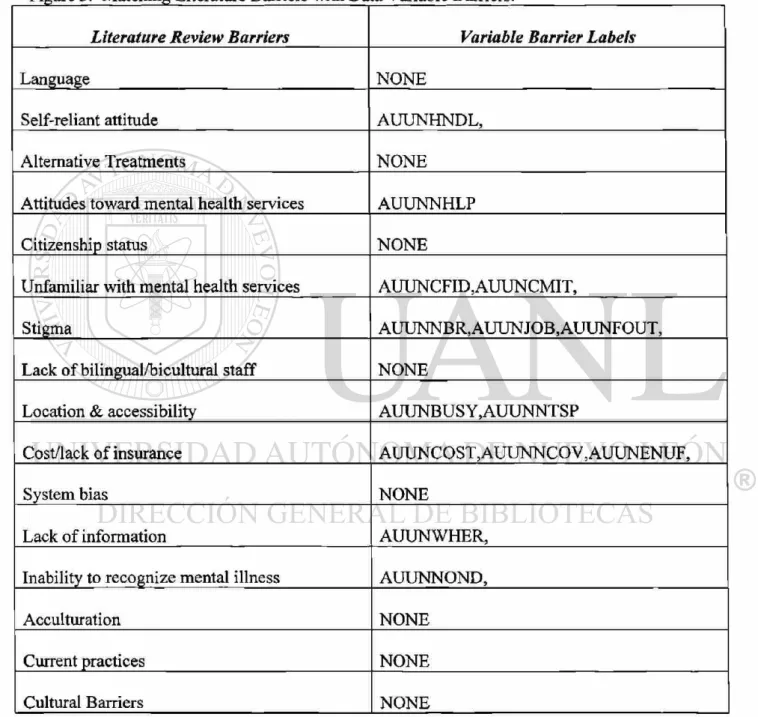
Matching Literature Review Barriers with Data Variable Barriers. In an effort to make
the reading easier for understanding the barriers Latinos encounter in accessing mental health
services, this author identified the barriers in the literature and matched them with the barriers in
the data set (see figure 3). Again, please note that only those barriers at the microsystem level
provided rationale for matching the barrier variables from the data set (respondent's responses)
with the literature review barriers (research variable).
Self-Reliant Attitude. According to Ortega and Alegria (2002) evidence was gathered
supporting that a self-reliant attitude could lead to the underutilization of mental health care. The
study conducted in Puerto Rico found that Puerto Ricans who were less likely to seek mental
health care felt that they could take care of their own mental health problems, thus displaying
that they could take care of their own issues and exhibiting a "self-reliant attitude" which is a
barrier in seeking mental health treatment. The respondent's response (data variable barrier)
from the questionnaire reads, "You thought you could handle the problem without treatment,"
which reflects a "self-reliant attitude" and a barrier in seeking mental health treatment.
Attitudes toward mental health services. Torrey (1972) postulated that Chicanos viewed
mental health institutions as alien, hostile and the White staff as cold, thus displaying that mental
health services would not help and exhibiting an "attitude toward mental health services" which
is barrier in seeking mental health treatment. The respondent's response (data variable barrier)
from the questionnaire reads, "You didn't think treatment would help," which reflects an
"attitude toward mental health services" and a barrier in seeking mental health treatment.
Unfamiliarity with mental health services. Knoll (1971) found that the majority of
Chicanos did not seek counseling from family service agencies because they were unfamiliar
with the services the agencies provided in Detroit, Michigan. Thus, displaying the possibility that
Chicanos are also unfamiliar with mental health services and exhibiting "unfamiliarity with
mental health services" which is a barrier in seeking mental health treatment. The respondent's
response (data variable barriers) from the questionnaire reads, "You were concerned that the
you might be committed to a psychiatric hospital or might have to take medicine," which reflects
"unfamiliarity with mental health services" and a barrier in seeking mental health treatment.
Due to the fact that mental health professionals address issues surrounding confidentiality and
having to take medication is voluntary. Also, being committed to a psychiatric hospital only
applies in severe circumstances and does not apply to issues surrounding non-severe mental
illness.
Cost/lack of insurance. According to Woodward, Dwinell, and Arons (1992), cost has
been found to be one of the major barriers in accessing mental health care. Also, Vega and
Alegria (2001) found that lack of insurance is one of the major barriers in accessing mental
health care by Latinos, thus displaying that cost and lack of insurance is a barrier in seeking
mental health treatment. The respondent's response (data variable barriers) from the
questionnaire reads, "You couldn't afford the cost," "Your health insurance does not cover any
mental health treatment or counseling," and "Your health insurance does not pay enough for
mental health treatment or counseling." These responses reflect "cost/lack of insurance" as a
barrier in seeking mental health care.
Inability to recognize mental illness. Guarnaccia et al. (1993) suggested that Puerto
Rican women often associated feelings of powerless and interrupted societal relations as ataques
de nervios (nerve attacks). These studies demonstrate the possibility that Latinos do not
recognize symptoms of mental illness parallel to those of the mental health scheme in the United
States, as a result, Latinos' perception of mental illness is not congruent with mainstream mental
health, thus, displaying the possibility that Latinos may think they do not need mental health
treatment and exhibiting "inability to recognize mental illness" which is a barrier in seeking
questionnaire reads, "You didn't think you needed treatment at the time" which reflects the
"inability to recognize mental illness" and a barrier in seeking mental health treatment.
Figure 3. Matching Literature Barriers with Data Variable Barriers.
Literature Review Barriers Variable Barrier Labels
Language NONE
Self-reliant attitude AUUNHNDL,
Alternative Treatments NONE
Attitudes toward mental health services AUUNNHLP
Citizenship status NONE
Unfamiliar with mental health services AUUNCFID,AUUNCMIT,
Stigma AUUNNBR,AUUNJOB,AUUNFOUT,
Lack of bilingual/bicultural staff NONE
Location & accessibility AUUNBUSY,AUUNNTSP
Cost/lack of insurance AUUNCOST,AUUNNCOV,AUUNENUF,
System bias NONE
Lack of information AUUNWHER,
Inability to recognize mental illness AUUNNOND,
Acculturation NONE
Current practices NONE
Cultural Barriers NONE
Statistical Analysis. Chi-square was used to determine association for age, gender, education,
researched. These statistical procedures were used in an effort to better understand mental health
care barriers in the Latino community.
Support For Using Chi-Square. According to Weinbach and Grinnell (2007), "Research articles
using chi-square analyses appear frequently in the professional literature . . . it is especially well
suited for social work research situations" (p. 190). However, the most important reasons that
chi-square was used is it assists in answering the research question and hypotheses.
CHAPTER 4
DATA ANALYSIS
This dissertation consists only of the Latino respondents 18 years or older (n=5,468) from
the 2005 NSDUH and only looked at barriers that Latinos encounter in accessing mental health
care services at the microsystem level. The 2005 NSDUH asked respondents questions
pertaining to mental health only if they were 18 years or older, therefore, in this study, data from
the original survey related to mental health care barriers and key demographics were considered
to determine their association for Latinos 18 years old and older.
Demographics Analysis
Age. In 2005, 5,468 Latinos 18 and older participated in the NSDUH study. The majority of
them were ages 18-25 years old (56.4%) and the remainder of the group was 26 years or older
(43.6%). Gender. The majority of respondents were female (52.6%) and males made up the
rest of the sample (47.4%). Marital Status. The majority of respondents reported never married
(50.3%) followed by those who reported being married (25.2%). Those reported being divorced
or separated accounted for 6.3% of the sample followed by those who reported being widowed at
(38.3%). Those that reported having a high school diploma accounted for 31.3% of the sample,
followed by those who reported having some college or being a college graduate (30.4%).
Health. The majority of respondents reported being in very good health (32.4%), followed by
those who reported being in good health (31.9%). Those who reported being in excellent health
made up 22.5% of the sample, followed by those reported in being in fair or poor health (13.3%).
Service. The majority of the respondents have never been in the United States armed forces
(67.6%), while those who have served in the armed forces accounted for 4.4%. Pregnancy. The
majority of the female respondents age 18-44 reported being pregnant at the time of the survey
(88.0%) (See Table 4.1).
Summary of Demographic Analysis. The majority of respondents for this study were pregnant
female's ages 18-25 years old. According to the Centers for Disease Control pregnancy rates for
Latinas ages 18-24 years old in 1999 averaged 154 per 1,000 (CDC, 1999). In addition the
majority have never been married with less than a high school education. The majority also
reported being in very good health with no service in the United States armed forces (see Figure
60 50 40 30 20 10 o
Summary of Demographic Analysis
56.4% 50.3%
38.3% 32.4%
52.6%
Health: Very Education: Less Marital Status: Gender: Female Age: 18-25 yrs
good than high school Never married old
Figure 4.1 - Summary of Demographic Analysis
Table. 4.1 - Demographic Analysis
AGE
Frequency Percent Valid Percent Percent Cumulative Valid 18-25 Years Old 3083 56.4 56.4 56.4
26 or Older 2385 43.6 43.6 100.0 Total 5468 100.0 100.0
G E N D E R
Frequency
Cumulative Percent Valid Percent Percent
Valid Male 2591 47.4 47.4 47.4
Female 2877 52.6 52.6 100.0 Total 5468 100.0 100.0
MARITAL STATUS
Valid Married 1377 25.2 30.2 30.2
Widowed 85 1.6 1.9 32.1
Divorced or Separated 346 6.3 7.6 39.7 Never Been Married 2749 50.3 60.3 100.0
Total 4557 83.3 100.0
Missing LEGITIMATE SKIP
Respondent is < = 14 years old 911 16.7
Total 5468 100.0
EDUCATION
Frequency Percent Valid Percent Cumulative Percent Valid Less than high school
(EDUCCAT2=1) 2095 38.3 38.3 38.3
High school graduate
(EDUCCAT2=2) 1709 31.3 31.3 69.6
Some College/College
Graduate (EDUCCAT2=3,4) 1664 30.4 30.4 100.0
Total 5468 100.0 100.0
HEALTH
Frequency Percent Valid Percent Cumulative Percent Valid Excellent (HEALTH=1) 1228 22.5 22.5 22.5
Very Good (HEALTH=2) 1770 32.4 32.4 54.8 Good (HEALTH=3) 1742 31.9 31.9 86.7 Fair/Poor (HEALTH=4,5) 728 13.3 13.3 100.0
Total 5468 100.0 100.0
SERVICE
Frequency Percent Valid Percent
Cumulative Percent
Valid Yes 243 4.4 6.2 6.2
No 3698 67.6 93.8 100.0
Total 3941 72.1 100.0
Missing LEGITIMATE SKIP 1527 27.9
Total 5468 100.0
PREGNANCY
Valid 18-25 Years Old 3083 56.4 56.4 56.4 26-44 Years Old 1727 31.6 31.6 88.0 Otherwise (12-14,45 or Older) 658 12.0 12.0 100.0
Total 5468 100.0 100.0
Hypotheses Analysis Hypothesis 1
Gender and Self-Reliant Attitude. No statistically significant difference exists between gender
and self-reliant attitude (chi square = .027; p=.498), therefore no association between gender and
self-reliant attitude exists. Men (24.7%) and women (25.6%) reported approximately the same in
terms of "not receiving mental health treatment due to thinking they could handle their problems
without mental health treatment." Large percentages of responses were not entered by
respondents for this barrier variable question by men (75.3%) and women (74.4%), indicating
that "not seeking treatment due to thinking that they could handle their problems on their own"
was not an issue for them. According to the literature review, men should have shown a higher
percentage as to having self-reliant attitude as a barrier in seeking mental health care.
Hypothesis 2
Age by Attitude toward Mental Health Services. No statistically significant difference between
age and attitude toward mental health services exists (chi square = 1.239; p=.186), therefore no
association between age and attitude toward mental health services exists. Respondents ages
18-25 accounted for 11.2% of reporting that mental health treatment would not help (attitude
toward mental health services), compared with respondents 26 years old and older accounted
6.9% of reporting that mental health treatment would not help. Large percentages of responses