Generating Ideas for Pictorial
Advertisements
Starting with Pictorial Metaphors
Ping Xiao
TESI DOCTORAL UPF / 2014
DIRECTOR DE LA TESI
Dr. Josep Blat
Acknowledgments
Till now, I still believe that Spain is a magic country. It is very different from or, in many aspects, at the contrary of my home country, China. This drastic difference expanded my views on life, including research. I would like to thank my supervisor, Prof. Josep Blat, who gave me the opportunity of coming to the magic country and has been continuously supporting my PhD research. I also would like to thank Prof. Xavier Ruiz, for your vigorous thoughts about advertising and those warm hugs.
While working on PhD, I spent some time in Orange iLab Spain, where I met and became friends with David Nieto, Julian Hernandez, Juan Luis Ayuso and Aitor Rubio. I would like to say thanks for the two years with you guys!
Doing a PhD might be one of the best ways of making friends, especially long-term ones. I would like to thank Dai Griffiths, for giving me the stage of ‘being me’; Esteban Maestre and Laura Igual, for your fierce and long friendship; Maarten Grachten, for the way you play guitar!
Doing a PhD might also be one of the best ways of becoming friends with department secretaries. Lydia Garcia, Judith Champion, Magda Castellnou, Vanessa Jimenez and Jana Safrankova, you are as wonderful as your names.
Last but not least, I would like to thank Rodrigo Roman, for being a noble friend, since many years.
Abstract
Behind every good advertisement there is a creative concept, a Big Idea. In contrast to the countless number of ads, a small number of patterns of effective communication (idea templates) have been uncovered, which are invariant across content and context. In this thesis, we investigate the formalization of idea templates and use it as the basis for building computational means of generating ideas. We present a computational approach of generating one type of ideas, pictorial metaphor. A two-stage approach is proposed and implemented: Stage 1 finds concepts that are salient in a given property; Stage 2 evaluates the aptness of the concepts found as metaphor vehicles. The ideas generated by our approach were evaluated against past successful ads.
Resumen
Detrás de cada buen anuncio publicitario hay un concepto creativo, una “Gran Idea”. En contraste con la innumerable cantidad de anuncios, se ha identificado un número limitado de patrones de comunicación efectiva (plantillas de ideas), invariantes respecto a los posibles contenidos y contextos.
Al darrere de cada bon anunci publicitari hi ha un concepte creatiu, una "Idea Excel·lent". En contrast amb la gran quantitat d'anuncis, s’ han identificat un nombre limitat de patrons d'idees de comunicació efectiva (plantilles d’idees), invariants respecte als possibles continguts i contextos.
Table of Contents
Acknowledgments ... iii
Abstract ... v
List of Figures ... x
List of Tables ... xii
1. INTRODUCTION ... 1
1.1 Contexts and Problem...1
1.2 Contributions...3
1.3 Methodology...8
1.4 Chapter Outline...9
2. IDEAS OF PICTORIAL ADVERTISEMENTS ... 11
2.1 Advertising as Communication...11
2.2 Advertising Effectiveness...12
2.3 Advertising Production Process...14
2.4 Evolution of Advertising Images...15
2.5 Research on Creative Expression in Pictorial Advertisement...18
2.6 Taxonomies of Idea Templates...20
a) Phillips and McQuarrie (2004) ... 21
b) Maes and Schilperoord (2008) ... 24
c) Creativity Templates ... 28
d) Comparison of the Three Taxonomies ... 33
2.7 Summary...34
3. GENERATING IDEAS FOR PICTORIAL ADVERTISEMENTS ... 35
3.1 Formalization of Idea Templates...35
3.2 Computing: Starting with the Conceptual Dimension of Pictorial Metaphor...40
3.3 Summary...41
4. METAPHOR IDEA AND ITS GENERATION ... 43
4.1 Metaphor: Phenomenon and Theories...43
4.4 Computational Approaches to Metaphor Generation...51
a) Goldenberg, Mazursky and Solomon (1999b) ... 51
b) Abe, Sakamoto and Nakagawa (2006) ... 52
c) Terai and Nakagawa (2009) ... 54
d) Sardonicus ... 56
4.5 An Approach of Generating Apt Metaphor Ideas for Pictorial Advertisements...57
4.6 Summary...61
5. FINDING VEHICLES OF PICTORIAL METAPHORS ... 63
5.1 Visual Representations for Abstract Concepts (VRAC)...64
a) Sources and Methods for Extracting Semantic Associations ... 65
- Word Associations ... 65
- ConceptNet ... 66
- Roget’s Thesaurus ... 67
b) Processing Before and After Searching in KBs ... 68
- Before Search: Query Expansion ... 68
- After Search: Retaining Concrete and Imageable Noun and Verb Concepts ... 69
· Estimating Concreteness and Imageability ... 69
c) Overview of VRAC Outputs ... 72
5.2 Connotation Dictionary of Visual Symbols (CDVS)...73
a) Requirements for Corpus ... 74
b) Constructing CDVS Corpus ... 74
- Characteristics of CDVS Corpus ... 75
c) Extracting Concepts Salient in a Given Property ... 76
- Clustering Algorithm ... 77
- Tag Filtering ... 79
- Determining the Optimal Number of Clusters ... 80
d) Overview of CDVS Outputs ... 81
5.3 Evaluation...82
a) Evaluation Dataset ... 82
b) Results and Analysis ... 84
5.4 Conclusions...86
5.5 Summary...87
6. EVALUATING THE APTNESS OF METAPHOR VEHICLES.. 89
a) Affect Polarity ... 89
b) Salience Imbalance ... 90
c) Secondary Properties ... 91
d) Similarity with Tenor ... 91
e) Semantic Relatedness Measures ... 92
6.2 Evaluation...93
a) Evaluation Dataset ... 94
b) Results and Analysis ... 96
6.3 Conclusions...100
6.4 Summary...102
7. CONCLUSIONS AND FUTURE WORK ... 103
7.1 Conclusions...103
7.2 Future Work...106
a) Computing More Types of Ideas ... 106
b) Constructing Idea Corpus ... 107
c) Generating Pictorial Advertisements ... 108
Fig. 2.1: Model of advertising communication. Adapted from Wells, Burnett and Moriarty (2003). ... 12
Fig. 2.2: Model of processing advertisements. ... 13
Fig. 2.3: Advertising production process. ... 14
Fig. 2.4: Top-left: ad for ready-cooked spaghetti in the 1930s; top-right: ad for ready-cooked spaghetti in the 1970s; bottom-left: ad for pasta in the 2000s, with tagline “energetic”; bottom-right: ad for pasta in the 2000s, with tagline “Happy Valentine’s Day”. ... 17
Fig. 2.5: Typology of visual rhetoric figures in advertising. Source: Phillips and McQuarrie (2004). ... 23
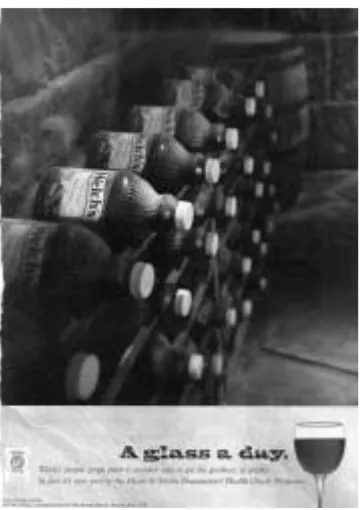
Fig. 2.6: Ad for grape juice. Source: Phillips and McQuarrie (2004). ... 24
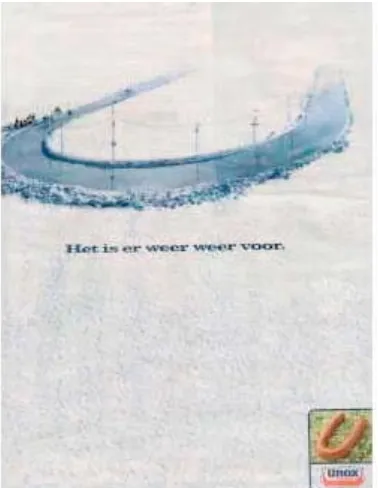
Fig. 2.7: Ad for smoked sausage. Source: Maes and Schilperoord (2008). ... 27
Fig. 2.8: Ad for insurance. Source: Maes and Schilperoord (2008). ... 27
Fig. 2.9: Interpretation heuristics and types of conceptual relations. X and Y denote two elements of a visual rhetorical figure. Source: Maes and Schilperoord (2008). ... 28
Fig. 2.10: Schema of the Replacement version of the Pictorial Analogy template. Source: Goldenberg, Mazursky and Solomon (1999a). ... 31
Fig. 2.11: Ad for the French Open Tennis Championship. Source:
Goldenberg, Mazursky and Solomon (1999a). ... 32
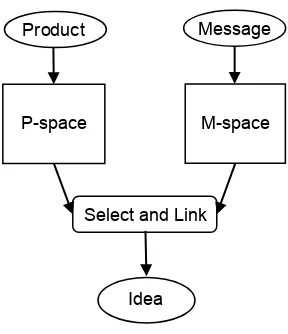
Fig. 2.13: General schema of creativity templates. ... 38
Fig. 2.14: Ad for fabric softener. Source: Phillips and McQuarrie (2004). ... 38
Fig. 2.15: Schema of the ad for fabric softener (Fig. 2.14). ... 39
Fig. 2.16: Ad for Canadian magazine industry. Source: Phillips and McQuarrie (2004). ... 39
Fig. 2.17: Schema of the ad for Canadian magazine industry (Fig. 2.16). 40
Fig. 4.1: Different kinds of non-literal comparisons. Source: Gentner and Markman (1997). ... 51
Fig. 4.2: Metaphor generation model. Source: Abe, Sakamoto and
Nakagawa (2006). ... 54
Fig. 4.3: An approach of generating apt metaphor ideas for pictorial advertisements. ... 61
Fig. 5.1: Processing components of VRAC and their outputs. ... 65
Fig. 5.2: Process of extracting concepts salient in a given concept from CDVS corpus. ... 77
Fig. 5.3: Concepts and pictures representing ‘peace’ provided by CDVS. ... 81
Fig. 6.1: Existent ads that conform to the pictorial metaphor template. First row: ad for the Volvo S80 car; Second row left: ad for The Economist newspaper; Second row right: ad for the National Museum of Science and Technology in Stockholm. ... 95
Table 2.1: Metrics of audience response. ... 13
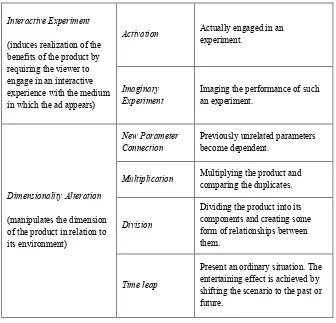
Table 2.2: Creativity Templates Taxonomy. ... 31
Table 5.1: ConceptNet relation types employed for noun properties. ... 67
Table 5.2: The forty paradigm words and the Pearson correlation on the training set. ... 72
Table 5.3: Concepts output by VRAC for ‘relief’. ... 73
Table 5.4: The concepts having ‘peace’ as one of their stereotypical properties. ... 82
Table 5.5: Visual representations of abstract concepts found in print ads and ‘hit’ by VRAC, CDVS and Thesaurus Rex. ... 86
Table 6.1: Information about the three real ads. ... 96
Table 6.2: Candidate vehicles sorted in the descending order of salience in ‘intelligence’. ... 97
Table 6.3: Candidate vehicles NOT contradictory to the secondary
properties of the tenors of the three ads respectively. ... 98
Table 6.4: Candidate vehicles not too different from the tenors of the three ads respectively. ... 99
1. INTRODUCTION
1.1 Contexts and Problem
“New ideas, not money or machinery, are the source of success today” (Howkins 2002) and creativity has become stereotypically accepted as a driving force of our society. Researchers have been more and more interested in using computational means to investigate and empower creativity, at mainly two fronts: constructing creative machines; building tools that enhance human creativity. This thesis belongs to the first area, i.e. the emerging field of Computational Creativity. “Computational creativity is the philosophy, science and engineering of computational systems which, by taking on particular responsibilities, exhibit behaviors that unbiased observers would deem to be creative” (Colton and Wiggins 2012). Researchers in this field ponder on what are the computational means to generate certain creative products; how to assess the usefulness or aesthetic value of the products generated; as well as the philosophical questions of what is creativity and what it means by being creative. A full-fledged autonomous creative system was imagined, which can create, criticize (its own creation and others’), learn (how to create), response to its inner self and the outside world (intuition, intention and imagination), communicate with its surroundings, and evolve.
in making pictorial ads is composing novel pictures that convey specific messages with persuasion power.
Behind every good ad there is a creative concept, a Big Idea that makes the message distinctive, attention getting, and memorable (Wells, Burnett and Moriarty 2003). Ideas of ads refer to the ways of expression, the ‘how to say’. Advertising expression has been studied in several disciplines, including communication, marketing, psychology, rhetoric, semiotics and literacy. What has been discovered and is generally agreed upon is that many ideas of pictorial ads, albeit for different selling premises, products, contexts and media, converge at a small number of general patterns. We call these patterns idea templates. Beyond identifying individual idea templates, researchers have been working on taxonomies of idea templates, which differentiate them on the basis of consistent standards that reflect the essentials of visual advertising communication. Several taxonomies of idea templates have been proposed (Durand 1987; Goldenberg, Mazursky and Solomon 1999a; McQuarrie and Mick 1999; Pricken 2002; Phillips and McQuarrie 2004; Maes and Schilperoord 2008).
Shortly speaking, the main research problem tackled in this thesis is building and validating a computational mechanism which generates the conceptual aspect of pictorial metaphors for advertisements.
Succeeding in this direction of research would enable computers to generate advertising ideas, in the first place. Computers may come up with good ideas that are not thought about by humans; computers may provide ideas where it is impossible for human effort, such as creating unique ads for each individual, i.e. large-scale personalization; computers may become a creative pal for humans in brainstorming sessions.
Secondly, the computational modeling presented in this thesis would provide either support or counter evidence to the theories and hypothesis it is based on (e.g. the theories of idea templates and pictorial metaphor), which may further inspire new theories or new directions of investigation.
Thirdly, the computational techniques used in our modeling are not dedicated to advertising. We found new applications for existing techniques; insufficiency of and improvements for existing techniques; new problems leading to new techniques which may be applied to other areas.
Last but not least, the generation mechanism of pictorial metaphors introduced in this thesis may shed light on computing other idea templates, considering the systematicity of the taxonomies of idea templates. It is also relevant to the computational modeling of other areas of communication, since metaphor does not only exit in adverting. Pictorial metaphors, or creative expressions in general, involve knowledge, perception, emotion, semantics and cognition. Researchers studying any of these topics, with or without computational means, may find interesting bits in this thesis.
1.2 Contributions
pictorial ad is the linking of two visual elements from different domains; and an idea of a pictorial ad involves two dimensions, structural and conceptual. However, the three taxonomies put different levels of emphasis on each of the structural and conceptual dimensions when classifying idea templates, and specify the operations of creating deviations in each of the two dimensions with different levels of granularity. Besides, Maes and Schilperoord (2008) propose the de-association of the structural and conceptual dimensions, that is, the operations in both dimensions do not need to be performed simultaneously to create an idea. A unique contribution of Goldenberg, Mazursky and Solomon (1999a) is formalizing idea templates using schemas. We further extended this line of formalizations to cover more templates and demonstrated that it is possible to reasonably decompose advertising ideas into a few steps of inference, involving a few types of semantic relations. Moreover, we distinguish two types of selection criteria in the schemas, compulsory and enhancive, and used this distinction to clarify some confusion, e.g. genre, in constructing taxonomies of idea templates in the literature.
Connine 1993; Gentner and Wolff 1997; Giora 1997; Turner and Katz 1997; Bowdle and Gentner 2005) and the familiarity of a topic-vehicle pair (Lakoff and Johnson 1980; Gibbs 1992; Chiappe and Kennedy 1999), are more relevant here than those models focusing on the relational structures of the tenor and vehicle domains, e.g. the structure-mapping (Gentner 1982) model.
We specified our metaphor generation problem as searching for concepts (vehicles), given the product (tenor), its selling premise (property) and some other information provided in a creative brief, in order to establish or strengthen the connection between the tenor and the property and create some other desirable effects as well.
After reviewing the major computational approaches to metaphor generation (Goldenberg, Mazursky and Solomon 1999b; Abe, Sakamoto and Nakagawa 2006; Terai and Nakagawa 2009; Veale and Hao 2007), we proposed a two-stage approach of generating metaphor ideas. These two stages are:
• Stage 1: Find concepts that are salient in the properties to be highlighted
• Stage 2: Evaluate the aptness of the concepts found as metaphor vehicles
Our approach targets at multiple properties to be highlighted by a metaphor. Two types of properties of different levels of importance are explicitly distinguished, properties (selling premise) and secondary properties. In stage 1, we use the selling premise to lead the search of candidate vehicles. In Stage 2, aptness criteria, including secondary properties, are applied to find the most apt vehicles for a specific advertising task. In this way, our approach avoids generating metaphors which are difficult to understand or not effective, as produced by other approaches considering multiple properties (Abe, Sakamoto and Nakagawa 2006; Terai and Nakagawa 2009).
advertising. We found two sources, of quite different nature, containing concepts and their stereotypical properties, especially connotations, and created two automatic knowledge extraction methods, namely VRAC and CDVS.
VRAC (Visual Representations for Abstract Concepts) first retrieves strong associations for a given property from four semantic KBs, including two word association databases (Kiss et al. 1973; Nelson, McEvoy and Schreiber 1998), a commonsense knowledge base called ConceptNet (Liu and Singh 2004) and Roget’s Thesaurus (Roget 1852). The association between a given property and a noun or verb concept is the relation of stereotypical property that we are looking for. Hence, noun or verb concepts are extracted from the concepts retrieved. The high concreteness and high imageability of vehicles contribute to metaphor aptness and pictorial ads need metaphor vehicles that can be directly visualized. In order to filter concepts that are low in concreteness and imageability, we utilize a list of abstractness ratings, obtained computationally, for 114,501 WordNet terms (Turney et al. 2011). We also estimated the imageability ratings for the same set of terms using the same method.
The other source of concepts and connotations we found is the textual descriptions of pictures. In building CDVS (Connotation Dictionary of Visual Symbols), we first constructed a large corpus of the annotations of stock photos that have broad topics, simple picture semantics and accurate annotation. With a given property, the photo annotations that include the property are retrieved from the corpus. We then use an agglomerative clustering algorithm with UPGMA (Unweighted Pair Group Method with Arithmetic Mean) as criterion function to capture the pairs of the given property and the word denoting the subject of a photo. We customized the chosen clustering algorithm in two aspects: filtering tags that are irrelevant to or interfere with the clustering process; and determining the optimal number of clusters.
on the consideration of involving diverse parts of speech and word frequency. A state-of-the-art KB of concepts and their stereotypical properties, Thesaurus Rex, was also included in the evaluation. VRAC achieved the highest average hit rate, 38.28%, followed by CDVS, which scored 28.97%, while Thesaurus Rex got the lowest, 27.68%.
The output of both VRAC and CDVS are concepts salient in a given property and have high concreteness and imageability. In stage 2, we apply other four aptness criteria, including affect polarity, salience imbalance, secondary properties and similarity with tenor. These criteria were constructed based on the general characteristics of metaphor and its specificity in advertisements. Affect polarity filters concepts with negative emotional valence. Salience imbalance requires a metaphor vehicle to be more salient in a given property than the tenor (product). An apt vehicle should not contradict the given secondary properties and its similarity with the tenor should be neither too big nor too small. We are the first to consider concreteness, imageability, salience imbalance and similarity with tenor in generating metaphors. Vehicles that are validated by all the criteria are considered apt. An affect lexicon, SemtiWordNet 3.0 (Baccianella, Esuli, and Sebastiani 2010), is used to calculate the affect polarity of a candidate vehicle. We interpret other three criteria, salience imbalance, secondary properties and similarity with tenor, as kinds of semantic relatedness. Two different semantic relatedness measures are employed, PMI-IR (Pointwise Mutual Information and Information Retrieval) (Turney 2001) and LSA (Latent Semantic Analysis) (Landauer, Foltz and Laham 1998) by Random Indexing (Kanerva, Kristofersson and Holst 2000), based on their different characteristics. Both measures are used with a large text corpus obtained from Wikipedia, and then indexed with Apache Lucene.
approach. Our aptness criteria together were effective in focusing on the most apt metaphor vehicle among thirty two candidate vehicles output by Stage 1. Besides, the values calculated by our aptness criteria provide support for the salience imbalance hypothesis.
1.3 Methodology
The main objective of this thesis is building a computational mechanism that generates pictorial metaphor ideas for advertisements, given some simple inputs, such as a product and the properties to be attributed to the product. A creative machine is intended. The method used to build such a machine is the formal modeling of the metaphor phenomenon, which has certain psychological and cognitive plausibility. It is based on neither the ideation process practiced by humans (modeling activities) nor the neurocognitive processes of metaphor generation (modeling brain), though both are valid means of constructing creative machines. The primary goal of this thesis is not building computer support for human ideation. However, the automatic idea generator developed can work as a ‘colleague’ (Lubart 2005), proposing ideas which may inspire humans. Also, humans may select and refine the proposed ideas.
Lastly, we point out that we took a truly interdisciplinary approach in this thesis work. As Boden (1998) suggested, building creative machines requires deep domain knowledge. Advertising ideation is the domain of copywriters and artists. The research on advertising expression is mostly in the fields of rhetoric, semiotics, communication and marketing. Our research drew nutrition from the relevant literature in these fields, as well as the study of metaphor from the psychological and cognitive perspectives. Our computing effort is trying to model the phenomenon of advertising communication as perfect as possible. We were open to all kinds of computational techniques and able to fill the gaps between theories and implementations on computers.
1.4 Chapter Outline
In Chapter 2, advertising, as a communication phenomenon, is introduced, as well as its effectiveness and the production process of advertisements. We also explain how meanings and emotional impacts are constructed in ads using examples. The literature on creative expressions in pictorial ads is reviewed. Three notable taxonomies of idea templates are introduced and compared.
In Chapter 3, our contribution to the formalization of idea templates is presented. We also lay out the scope of the computational work in this thesis.
In Chapter 4, the phenomenon, theories and models of metaphor are introduced. We state the metaphor generation problem to be solved and review computational approaches relevant to this problem. A two-stage approach of generating apt metaphor ideas for pictorial advertisements is proposed.
In Chapter 6, we present our work on the second stage of metaphor generation, that is, filtering the concepts found in the first stage using four aptness criteria, affect polarity, salience imbalance, secondary properties and similarity with tenor. An evaluation of our approach of generating metaphor ideas, including both stages, is also presented.
2. IDEAS OF PICTORIAL ADVERTISEMENTS
2.1 Advertising as Communication
Advertising is a mediated form of communication from an identified source, designed to persuade the receiver to take some action now or in the future (Richards and Curran 2002; Thorson and Duffy 2011). It is the most important marketing communication technique (Feuer 2001).
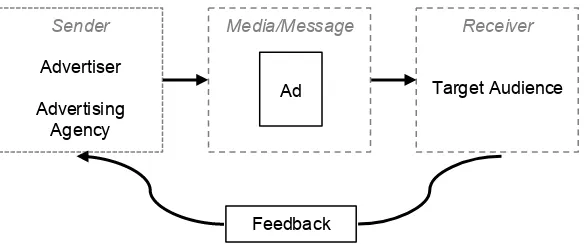
The diagram in Figure 2.1 gives a basic view of the participating parties, interaction flow and context of advertising communication. Advertisers have specific marketing objectives to be achieved. Advertisement is a message about the advertised product, brand or idea sent to the target audience. An advertising agency encodes this message in the representation of a chosen media. Ad is received and decoded by the audience. Feedback is the audience’s responses to an ad. Besides, advertising communication is sensitive to the time, place and social cultural context where an ad is published.
Fig. 2.1: Model of advertising communication. Adapted from Wells, Burnett and Moriarty (2003).
2.2 Advertising Effectiveness
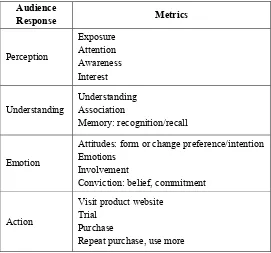
The effectiveness of advertising communication is evaluated by the responses of audience. Audience responses are considered as having three phases and involving four aspects (Lavidge and Steiner 1961; Wells 1997), which is illustrated in Figure 2.2. First, ads have to get the attention of audience in order to be perceived. Then, the audience attempt to understand an ad while there is also an emotional impact going on. What the audience think or feel about the advertised product or brand may be changed. Finally, the audience may try or buy the product. For each of the four aspects, perception, understanding, feeling and action, detailed metrics have been proposed to quantitatively evaluate the effectiveness of ads, as shown in Table 2.1.
Based on the above understanding of how ads influence audience, whether an ad is creative or not is judged according to two traits, divergence and relevance (Jackson and Messick 1965; Besemer and Treffinger 1981; Besemer and O'Quinn 1986; Marra 1990; Haberland and Dacin 1992; Heckler and Childers 1992; Jewler and Drewniany 1998; Ang and Low 2000; Yang and Smith 2009). “Divergence refers to the extent to which an ad contains elements that are novel, different, or unusual. Relevance refers to the extent to which the ad contains elements that are meaningful,
Time, place and social cultural context
Sender
Advertiser
Advertising Agency
Media/Message Receiver
Target Audience
appropriate, or valuable to the audience” (Yang and Smith 2009). Creative ads are high in both divergence and relevance.
Fig. 2.2: Model of processing advertisements.
Audience
Response Metrics
Perception
Exposure Attention Awareness Interest
Understanding
Understanding Association
Memory: recognition/recall
Emotion
Attitudes: form or change preference/intention Emotions
Involvement
Conviction: belief, commitment
Action
Visit product website Trial
Purchase
Repeat purchase, use more
Table 2.1: Metrics of audience response.
Action Perception
2.3 Advertising Production Process
Creating an ad begins with deciding the message strategy, then
translate the strategy into a creative concept, and finally use that
idea as the foundation for one or more executions (Fig. 2.3). In an
ad agency, a creative team, composed of a copywriter and an art
director, is responsible for developing the creative concept and
crafting the execution of an idea.
The major input received by the creative team is a document called
creative brief
, which is the outcome of some marketing research.
Most creative briefs consist of six sections: marketing objective,
product, target audience, selling premise and support, brand
personality and competitive environment, among which the selling
premise is the most important information.
Selling premise
is a
proposition that states a feature or attribute of a product or a benefit
of buying and using a product. The task of the creative team is to
find the most effective way of communicating the selling premise to
the target audience. The information provided in a creative brief,
other than the selling premise, helps the creative team to achieve
this goal.
Recall the two traits of creative ads, divergence and relevance,
mentioned in the previous section. The relevance of an ad depends
on the selling premise prescribed in the creative brief, while the
divergence of an ad comes from how the selling premise is
expressed, the
idea
, in the precise meaning defined in Chapter 1.
Fig. 2.3: Advertising production process. Marketing
2.4 Evolution of Advertising Images
Various media are employed in advertising, including press, television, radio, cinema, internet and mobile. Pictorial ads are pervasive in newspapers, magazines, billboards, websites and mobile displays.
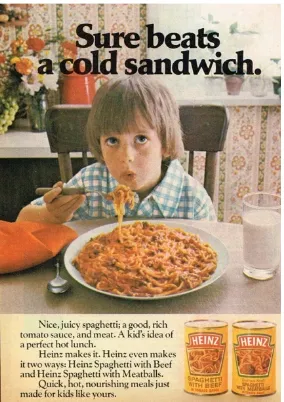
Following the evolution during the last century, pictures occupy more and more space and there are less and less words in consumer ads (Pollay 1983; Leiss, Kline and Jhally 1986; Phillips and McQuarrie 2002; McQuarrie and Phillips 2006; Pracejus, Olsen and O’Guinn 2006; McQuarrie and Phillips 2008). At the same time, advertising images become more elaborate, complex, open-to-interpretation and emotive. These changes are illustrated by the four ads of different time periods in Figure 2.4.
The two ads at the top of Figure 2.4 are from the 1930s and 1970s respectively. They both have a separate block of copy, which provides information about the product, including manufacturer or distributor, product attributes, usage, competitive advantages, price, place to buy, etc. In the two ads at the bottom, both from the 2000s, copy space disappeared. The entire ad is a picture, with tagline and brand logo on top of it.
strand of spaghetti with the spaghetti in their mouths. This staged photograph creates a link between the product and an enjoyable moment of life. Moreover, cutting a part, the couple, off the scene makes the picture a puzzle, which invites the audience to decipher it.
[image:29.499.272.414.101.302.2]
Fig. 2.4: Top-left: ad for ready-cooked spaghetti in the 1930s; top-right: ad for ready-cooked spaghetti in the 1970s; bottom-left: ad for pasta in the 2000s, with tagline “energetic”; bottom-right: ad for pasta in the 2000s, with tagline “Happy
2.5 Research on Creative Expression in Pictorial
Advertisements
An advertising image lies on a bounded portion of a two-dimensional plane. The building blocks of images include point, line, shape, form, space, color and texture, which have properties, such as size, direction, curvature, volume, hue, lightness/darkness and intensity. “Towering over all these individual elements was the composition, how part related to part and to whole” (Fry 1920; Taylor 1981), where perspective, movement, unity, harmony, variety, balance, rhythm, emphasis, contrast, proportion and pattern are considered (Arnheim 1974).
Images convey meanings and create emotional impact. At the level of individual elements or attributes, color red, for instance, evokes the concepts of ‘rose’, ‘blood’ or ‘danger’ in viewers’ mind and makes them feel ‘hot’, ‘energetic’ or ‘excited’. Taking an image as a whole, meanings and emotions arise from the interplay and synergy of the visual elements (Scott 1994; Moriarty 2005). For example, in the plate of pasta ad presented before, the foreground, the wallpaper in the background and the low and warm interior lighting, together suggest a pleasant private moment. Pictures, like words, are often being used in ads to pose arguments, raise questions, create fictions, present metaphors, or even mount a critique (Scott 1994).
specifies a particular method or manner of expressing propositions in order to achieve desired communicative objectives (Bonsiepe 1965; McQuarrie and Mick 2001).
The essence of a rhetorical figure is an artful deviation from normal usage (Corbett 1990). “A rhetorical figure occurs when an expression deviates from expectation, the expression is not rejected as nonsensical or faulty, the deviation occurs at the level of form rather than content, and the deviation conforms to a template that is invariant across a variety of content and contexts” (McQuarrie and Mick 1996). As regards to visual figures, deviation happens in either the appearance or the conceptual aspect of an image, or both. Taking the barbell ad in Figure 2.4 as an example, the pasta made barbell looks different from what people know about ordinary barbells. This departure triggers the audience to infer the advertiser’s intention behind this composition and possibly arrive at the conclusion that the advertiser wants to claim a causal relation between the pasta and being energetic. Moreover, in the conceptual dimension, pasta and barbell usually do not appear together. Another example is the plate of pasta ad, where cropping (presenting only part of a picture) is employed to transform a familiar ‘slice of life’ photo into a brain-teaser. Unlike these two ads, the other two ads in Figure 2.4 use pictures of products and objects closely related to them. These pictures give the audience no surprise. They are literal.
Applying visual rhetorical figures has been demonstrated to improve advertising effectiveness. Visual figures attract more attention and increase elaboration, recall, ad liking, brand liking and persuasion (Unnava and Burnkrant 1991; McQuarrie and Mick 1992; Peracchio and Meyers-Levy 1994; McQuarrie and Mick 1999; McQuarrie and Mick 2003; McQuarrie and Phillips 2005; Van Enschot, Hoeken and Van Mulken 2008; Delbaere, McQuarrie and Phillips 2011; Mzoughi and Abdelhak 2011). Shortly speaking, “creative ads are significantly more effective than noncreative ads across all of the processing and response measures” (Ang and Low 2000; Smith and Yang 2004; Huhmann 2007; Smith, MacKenzie, Yang, Buchholz and Darley 2007; Jeong 2008; Andrews 2011).
study of rhetorical figures belongs to the classical analysis. The other two types of analysis, Burkean and critical, investigate the involvement of myth, ritual, allegory, taboo and ideology (capitalism, liberty, equality, religion, racism, gender, environmentalism, etc.) in ads and the consequent influence on consumer response. However, the latter two types of analysis do not concern enough how to compose ads.
Advertising expression is also analyzed in terms of genre. Some examples are ‘tableaux’, ‘frozen narrative’, ‘fashion’, ‘before-after’, ‘problem-solution’ and ‘take it literally’. Some genres are defined by their emotional appeals, such as ‘shocking’, ‘absurd’, ‘humorous’, ‘disgust’ and ‘fear’. “A problem with genre as a tool for rhetorical differentiation is that conceptually speaking, it is list-like. As a simple list of possibilities, a set of genres has no internal structure, and hence it lacks generative power. Each genre discussed may seem reasonable, and distinct from the others; but there is no way to specify that there are n such genres, and only n” (McQuarrie 2007).
Through the time, there has always been an effort to systematize rhetoric figures (Corbett and Connors 1999). In contrast to the countless number of discourses, the number of figures is limited. A taxonomy of rhetorical figures would provide a coherent framework for analysis. It “should be generative, i.e., should allow the derivation of multiple interlinked differences”. It has to offer “a clear association between its different categories and corresponding differences in consumer responses” (McQuarrie 2007). In the next section, we introduce two most cited taxonomies of visual rhetorical figures and a taxonomy of creativity templates inferred from a sample of successful ads. We provide as well critical analysis and comparison of the three taxonomies.
2.6 Taxonomies of Idea Templates
figures … do not adequately capture important differentiations within the visual domain” (Phillips and McQuarrie 2004). The “generative framework must be discovered anew as the characteristic features of a new mode of expression emerge”. Then, arrived the second stage. The contribution in this stage include Phillips and McQuarrie (2004) and Maes and Schilperoord (2008), which are introduced in the following two subsections.
a) Phillips and McQuarrie (2004)
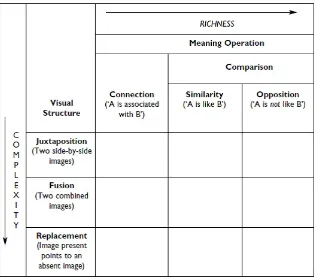
Phillips and McQuarrie (2004) claim that a visual rhetoric figure involves two elements and has two dimensions, namely visual structure and meaning operation (Fig. 2.5). Visual structure refers to the way two
elements of a visual figure are physically represented in an ad. Three possibilities are identified, juxtaposition (two elements side by side), fusion(two elements merged together) and replacement (only one element
is present, which occupies the usual place of the other element). Besides,
the authors argue that the complexity of visual structure, which positively correlates with the processing demand on consumers, increases from juxtaposition over fusion to replacement. Meaning operation concerns how two elements of a visual figure should be conceptually related in order to comprehend an ad. Three variations are recognized, connection
(two elements are in any kind of relation except being compared), comparison for similarity and comparison for opposition. Moreover,
meaning operations are ranked according to richness (the degree of ambiguity, polysemy or reference), ascending from connection over
comparison for similarity to comparison for opposition. In the end, the two dimensions, visual structure and meaning operation, are crossed,
which produces nine types of visual rhetorical figures.
As illustrated in the above example, the taxonomy proposed does provide sound explanation for certain types of pictorial ads. Now, we bring up a few thoughts on its weaknesses. First, the figure of connection via
juxtaposition may not involve any deviation, and hence, it would not be figurative. The mere juxtaposition of two objects might not deviate. Besides, the authors give a vague definition of the meaning operation
connection. The relation between a product and its usual consumers could
be in this category. Then, an ad image composed of product and consumers would qualify as an example of the figure of connection via
juxtaposition. However, this type of ads is literal, as we explained in the
previous section.
Secondly, the authors do not clarify whether the product has to be one of the two elements of a figure or not. Among the example ads in the paper, the product sometimes is part of the figure and sometimes not. When a product is not in the figure, the authors do not indicate how the figure relates to the product. Recall that the central content of an ad is a
Fig. 2.6: Ad for grape juice. Source: Phillips and McQuarrie (2004).
b) Maes and Schilperoord (2008)
2.8) is an ad for an insurance company. In the ad image, a figure skater sits with ice hockey players on a bench during a match. The figure skater holds an ice hockey stick in his hand, which implies he is part of the ice hockey team and prepared to play the game. On one hand, the image can be considered as a fusion of a figure skater and a scene of an ice hockey competition. On the other hand, it can be thought that a figure skater replaces an ice hockey player of the scene. After all, integration scale, as an upper construct, has a clearer relationship with consumer response than visual structure. Regarding the complexity of visual structure, the authors distinguish between analytical and perceived complexity. “Analytical complexity refers to formal and conceptual characteristics of the design of an image, which may range from more to less complex (i.e., the depiction of one or more objects, the number of pictorial details, visual richness, and the like). Perceived complexity, on the other hand, is a response variable as it refers to the cognitive demands placed on the viewer who processes the ad” (Maes and Schilperoord 2008). For instance, replacement may be more difficult to compose than juxtaposition, but easier to comprehend, due to stronger grouping of visual elements and richer context. This hypothesis is confirmed by the experiments conducted by the authors.
In addition to refining the classification of visual structure and meaning operation, the authors put forth a de-association view of the two dimensions in defining visual rhetorical figures. An advertising image is figurative if it has deviation in either visual structure or meaning operation, or both.
Maes and Schilperoord (2008) provide a remedy to the criticism on the figure of connection via juxtaposition proposed by Phillips and McQuarrie (2004), by suggesting the ‘deviated juxtaposition’ and the de-association of visual structure and meaning operation.
Besides, Maes and Schilperoord (2008) are more cautious about the position of the product in interpreting an ad. The authors mention that “a number of inferences” are necessary for comprehending some ads, which is different from the one-step reasoning (within a visual figure) implied by Phillips and McQuarrie (2004). Let us look again at Figure 2.8. The ad image is a schema of the ice hockey competition, which consists of schematic elements like teams, players, audience, rink, competing, injury, and so on. The deviation is brought in by the appearance of a figure skater in such a schema. Apparently, the figure skater does not fit into the schema of an ice hockey competition, which provokes consumers to think about why he is there. Bearing in mind that it is an ad for an insurance company (and the products and services it offers), consumers may get to the conclusion that the company claims their insurance enables people to participate in risky activities.
Fig. 2.7: Ad for smoked sausage. Source: Maes and Schilperoord (2008).
Schematic Interpretation heuristic
X fits in a particular relational schema Y
Categorical Interpretation heuristic X belongs to a particular category Y
As a result: a type of comparison between Y and X can be established
Mere association (similarity, causality, opposition, etc.) Contiguity relations Identity
Fig. 2.9: Interpretation heuristics and types of conceptual relations. X and Y denote two elements of a visual rhetorical figure. Source: Maes and Schilperoord
(2008).
c) Creativity Templates
Goldenberg, Mazursky and Solomon (1999a) derived six major creativity templates (including sixteen sub-versions) by inferring from a sample of two-hundred award-winning and finalist ads drawn from ad contests including NY, The One Show and USADREVIEW, for the years 1990-1995. The authors conducted three experiments to validate the taxonomy and found: 89% of another sample of two-hundred ads with similar quality can be explained by the six creativity templates; creativity templates appear significantly more frequently in award-winning and finalist ads than non-winning ones; laymen with training of creativity templates produced higher quality ideas than laymen with either training of free association or no training.
Apart from the description, the authors formalized creativity templates using schemas. As an example, the schema of the Replacement version of Pictorial Analogy template is shown in Figure 2.10. This template “portrays situations in which a symbol is transplanted into the product space” (Goldenberg, Mazursky and Solomon 1999a). The schema shows that the product and message (property to be attached to the product) are the starting points of conceptualizing an ad and the ad is an attempt to establish a connection between the product and the message (denoted by a line with a ‘?’ in the middle linking product and message in Figure 10). From the product, a product space is created with “the internal components of the product and the objects that interact with it” (P1, P2, P3 … in Fig. 2.10). From the message, a symbols set is populated with “the symbols that feature in the consumer’s representation of the message” (Symbol 1, Symbol 2, Symbol 3 … in Figure 10). Two elements, one chosen from each of the product space and the symbols set, “are then unified through a linking operator which matches their shape, color, or sound”. An example ad of this template (taken from the paper) is for the French Open Tennis Championship (Fig. 2.11), where a tennis ball has the shape of a croissant. Figure 12 shows the specific schema underlying this ad.
Creativity templates are, at the same time, about both the production and analysis of advertising ideas. From product and message to the content of an ad image, Goldenberg, Mazursky and Solomon (1999a) intend to capture every step of inference in the making of meaning and emotion. On the other hand, Phillips and McQuarrie (2004) and Maes and Schilperoord (2008) focus chiefly on the definition of visual rhetorical figures, though bearing in mind the context of advertising.
Creativity Template
(Description) Version Description
Pictorial Analogy
(portrays situations in which a symbol is introduced into the product space)
Replacement The symbol is transplanted.
Extreme Analogy The symbol is taken to the extreme.
Extreme Situation
(represents situations which are unrealistic in order to enhance the prominence of key attributes of a product or service)
Absurd Alternatives
Portrays situations in which the alternative is absurd and ridiculous.
Extreme Attribute
Portrays situations in which the attribute of a product (or service) is exaggerated to unrealistic
proportions.
Extreme Worth
Portrays situations in which the worth of a product (or service) is exaggerated to unrealistic proportions.
Consequences
(indicates the implications of either executing or failing to execute the
recommendation advocated in the ad)
Extreme Consequences
Presents an extreme consequence of an emphasized product attribute.
Inverted Consequences
Warns against the implications of not executing the recommendation of the ad.
Competition
(portrays situations in which the product is subjected to competition with another product or event from a different class)
Attribute in Competition
The competition pertains to a product attribute.
Worth in Competition
The competition challenges the worth of the product.
Uncommon Use
Interactive Experiment
(induces realization of the benefits of the product by requiring the viewer to engage in an interactive experience with the medium in which the ad appears)
Activation Actually engaged in an experiment.
Imaginary Experiment
Imaging the performance of such an experiment.
Dimensionality Alteration
(manipulates the dimension of the product in relation to its environment)
New Parameter Connection
Previously unrelated parameters become dependent.
Multiplication Multiplying the product and comparing the duplicates.
Division
Dividing the product into its components and creating some form of relationships between them.
Time leap
[image:43.499.82.418.68.391.2]Present an ordinary situation. The entertaining effect is achieved by shifting the scenario to the past or future.
Table 2.2: Creativity Templates Taxonomy.
[image:43.499.122.376.431.588.2]Fig. 2.11: Ad for the French Open Tennis Championship. Source: Goldenberg, Mazursky and Solomon (1999a).
Fig. 2.12: Schema underlying the French Open Tennis Championship ad. Source: Goldenberg, Mazursky and Solomon (1999a).
Tennis
tournament
Location - France
Product space Court Player Ball
…
Symbols set
Louvre, Eiffel Tower, Croissant … ?
[image:44.499.124.372.417.559.2]d) Comparison of the Three Taxonomies
The authors of the three taxonomies all hypothesize that the number of visual rhetorical figures or creativity templates is small. They all agree that the central proposition of an advertisement is connecting a product with certain qualification and a creative pictorial ad is the linking of two visual elements from different domains.
All the three taxonomies recognize both the structural and conceptual deviations in pictorial ads. The two taxonomies of visual rhetorical figures put equal weights on visual structure and meaning operation. However, the taxonomy of creativity templates classifies advertising expressions mostly based on the conceptual dimension. Maes and Schilperoord (2008) propose the de-association of the structural and conceptual dimensions, that is, the deviation in the structural and conceptual dimensions do not need to be considered simultaneously.
To systemize the conceptual dimension, Phillips and McQuarrie (2004) propose three classes of meaning operations between two elements of a visual rhetorical figure, connection, comparison for similarity and comparison for opposition. Maes and Schilperoord (2008) give a richer account by first distinguishing if a pictorial ad evokes a schema or a category and then identifying three types of inference, mere association, contiguity relations (similarity, causality, opposition, etc.) and identity. The taxonomy of creativity templates lies at a lower level of abstraction than these two taxonomies. It points to meaning operations like analogy, hyperbole and opposition; mentions basic semantic relations like symbol, situation, consequence and usage; also includes complex constructs, such as alternative. We think that the general and concrete accounts on the conceptual dimension of pictorial ads are complementary.
2.7 Summary
In this chapter, we introduced advertising as a communication phenomenon. Its effectiveness is evaluated through audience response, including perception, understanding, emotion and action. Creative ads, being both relevant and divergent, are significantly more effective than noncreative ads. Ideas of ads are the creative ways of expressing a selling premise.
Pictures have become dominant in ads, changing from illustration, over realistic photography, to computer edited graphics and staged photography. Meanings and emotions arise from the interplay and synergy of the visual elements in an advertising image.
In contrast to the countless number of ads, a small number of patterns of effective communication were uncovered, which are invariant across content and context. We call these patterns idea templates. Moreover, researchers have been working on systematizing idea templates, that is, providing a coherent framework of differentiating templates.
Three notable taxonomies of idea templates were introduced. Two of them come from the tradition of rhetorical analysis. Another, called creativity templates, is inferred from a sample of successful ads. We found that the three taxonomies agree with each other on the fundamentals of visual advertising expression, including the central proposition of ads, linking of two pictorial elements from different domains and the distinction between visual structure and meaning operation. Besides, visual rhetorical figures and creativity templates offer different levels of details about the operations in the structural and conceptual dimensions, which are complementary.
3. GENERATING IDEAS FOR PICTORIAL
ADVERTISEMENTS
In the previous chapter, we showed that a large portion of advertising ideas can be derived from a few idea templates. It is also possible to formalize idea templates, which is the foundation of realizing ideation on computers. In the next section, we explore more on the formalization of idea templates.
3.1 Formalization of Idea Templates
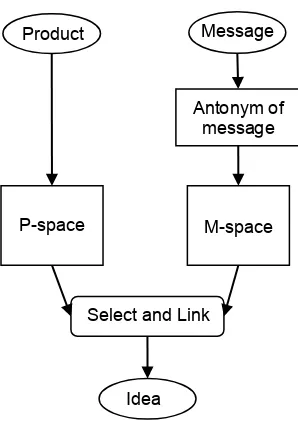
The paper of Goldenberg, Mazursky and Solomon (1999a) presents schemas of six sub-versions of creativity templates. We think a general schema can be derived from these individual schemas, as illustrated in Figure 2.13. Starting from the product and message, two sets of concepts are constructed. We call them P-space (originating from the product) and M-space (originating from the message). These two spaces are populated with concepts having various relations with the product and message respectively. The operation Select and Link chooses two concepts, each from P-space and M-space, and combines them to generate an idea.
Seeing from the general schema of creativity templates, both cases of the product is included in a figure or not are accommodated. For instance, if the product, as a member of the P-space, is chosen to link with a member of the M-space, the product will be part of the figure. Otherwise, if another member of the P-space, rather than the product, is selected to link, the product will not be part of the figure. However, the connection between the product and the figure remains clear.
Now we draw the schemas of a few idea templates that are not covered by the paper of Goldenberg, Mazursky and Solomon (1999a).
There is an ad for fabric softener in the paper of Phillips and McQuarrie (2004), where cacti and socks are juxtaposed (Fig. 2.14). The ad says that the fabric softener can make socks soft and comfortable, not like cacti, which are prickly and painful. The schema of this ad idea is shown in Figure 2.15. A distinguishing element of this idea is that something that has the property opposite to the message is sought after, rather than the usual case that something representing the message is looked for. The schema indicates first finding the antonym of the message and then the visual representations of the antonym. In Figure 2.15, we intentionally do not specify the semantic relations used to fill M-space, in order to be general, covering all idea templates which may fit into this schema.
Let us direct our attention to another ad, Figure 2.16, again taken from the paper of Phillips and McQuarrie (2004). It is an ad for the Canadian magazine industry. Huskies are replaced by French poodles, in order to convey that Canadian magazines suit Canadian consumers better than others (e.g. the magazines from the United States), just like poodles can not pull dogsleds. This ad idea is an analogy between (Canadian magazines vs. US magazines) and (huskies vs. poodles). It is a more complex kind of idea, since it involves the comparison of two relations, comparing to the more common cases that only involve attributes. This type of ideas is not included in the taxonomy of creativity templates, possibly due to its low frequency of appearance. We draw the schema of this ad idea in Figure 2.17. Suppose the message is ‘Canada’. We start with finding a set of concepts which are the representatives of Canada. Then, one among this set of concepts, e.g. the scene of huskies pulling a dogsled, is chosen. Next, we look for concepts opposing the selected scene in certain way, where poodle (vs. huskie) is one.
Using schemas, we have demonstrated that it is possible to reasonably decompose advertising ideas into a few steps of inference, involving a few types of semantic relations. Furthermore, we add some explanation about the function and effects of the Select operation.
acceptable expressions of a message and some of them are more effective than the others. The two taxonomies of visual rhetorical figures offer no account on this matter. They only deal with how to interpret an already made ad.
We distinguish two types of selection criteria, compulsory and enhancive. Compulsory selection criterion of an idea template means that the idea will not work without satisfying such criterion. For instance, in defining one of the creativity templates, the Absurd Alternatives version of the Extreme Situation template, the elements selected from the P-space and M-space have to be an unrealistic pair, which consequently transfer the message that choosing the alternative over the product is absurd. Another example is visual pun. In a pun, the product (or something related to it) has the meaning of the message. There is an existent ad using the picture of an owl to convey the message ‘zoo is a place to learn and gain wisdom’. As we all know, owl is both a member of the zoo and a symbol of wisdom. To produce a pun, the selection criterion is that the elements selected from the P-space and M-space have to be identical.
Enhancive selection criteria are not part of the central inference of any idea template. Without applying them, ideas still work. However, they add extra appeals to an ad, which makes it more effective. For instance, when selecting elements to compose an ad, novelty, taboo, parody, personification might be considered. These tactics can be used in combination of any idea template, when it is proper.
Fig. 2.13: General schema of creativity templates.
Fig. 2.14: Ad for fabric softener. Source: Phillips and McQuarrie (2004). Select and Link
Product Message
Idea
[image:50.499.105.396.334.523.2]Fig. 2.15: Schema of the ad for fabric softener (Fig. 2.14).
Fig. 2.16: Ad for Canadian magazine industry. Source: Phillips and McQuarrie Select and Link
Product Message
Idea
M-space P-space
[image:51.499.162.339.340.593.2]Fig. 2.17: Schema of the ad for Canadian magazine industry (Fig. 2.16).
3.2 Computing: Starting with the Conceptual
Dimension of Pictorial Metaphor
Our computing endeavor starts on a single template within the system of idea templates, for three reasons. Firstly, advertising ideation is a challenge for the knowledge and creativity of humans. We believe this task is no less demanding for computers. Even computing a single template is not trivial. Secondly, little work has been done in computing advertising ideas. We are aware that a lot of work has to be done from scratch. Thirdly, we believe that computing one idea template should shed light on computing other templates, considering the systematicity in their taxonomies.
We also adopt the de-association view of the conceptual and structural dimensions of pictorial ads, i.e. the deviation in the structural and conceptual dimensions do not need to be considered simultaneously
Link
Product Message
Idea
M-space
M-element Select
(Maes and Schilperoord 2008). We see that crafting deviations in the visual andconceptual domains raise quite different issues. In any of these two dimensions, computational creativity is not a trivial task. In this thesis, we are focusing on only one of the dimensions, the conceptual one.
The idea template we chose to compute is pictorial metaphor, which corresponds to the pictorial analogy template of the creativity templates (Goldenberg, Mazursky and Solomon 1999a) and the comparison for similarity figure of the taxonomies of visual rhetorical figures (Phillips and McQuarrie 2004; Maes and Schilperoord 2008). Pictorial metaphor has been studied by various authors (Kennedy 1982; Durden 1990; Kaplan 1991, 2005; Forceville 1996, 2002; Messaris 1997; Rozik 1997; McQuarrie and Mick 1999; Teng and Sun 2002; Phillips 2003; Mick et al. 2004). It is the most popular way of expression in creative advertising images (Goldenberg, Mazursky and Solomon 1999a).
The conceptual dimension of pictorial metaphors is not very different from verbal metaphors (Foss 2005). In the next chapter, we review the theories and models of metaphor and the computational approaches to metaphor generation.
3.3 Summary
4. METAPHOR IDEA AND ITS GENERATION
4.1 Metaphor: Phenomenon and Theories
Metaphor involves two concepts. One is called tenor (also target, principal subject, or topic), which is the subject to be described. The other concept is called vehicle (also source or subsidiary subject), which is used to help describing the tenor. The best acknowledged effect of metaphors is highlighting certain aspect of the tenor or introducing some new information about it.
In addition, metaphors have the following characteristics. First, metaphors are asymmetrical (Tversky 1977; Miller 1979; Ortony 1979a), that is, the order of the tenor and vehicle is irreversible, i.e. by reversing the roles, the meaning of a metaphor changes substantially. For instance, ‘the surgeon is a butcher’ means something quite different from ‘the butcher is a surgeon’. Second, only part of the attributes of the vehicle are transferred to the tenor, whilst other attributes are suppressed. Consider the metaphor ‘the lawyer is a shark’, where attributes from the shark, such as ‘aggressive’, ‘powerful’, ‘attack’ and so on, are rendered prominent in the lawyer, but not so for attributes like ‘has tail’, ‘lives in the sea’, ‘weights tons’, etc. Third, pre-existent similarity, or common attributes, is not always a necessary condition for a metaphor. Often, the tenor of a metaphor is barely known to the hearer. Finally, a metaphor may generate emergent attributes (which are salient for neither the tenor nor the vehicle) (Verbrugge and McCarrell 1977; Camac and Glucksberg 1984; Becker 1997).
metaphors. For this thesis, the language dimension, i.e. “the description of linguistic forms and conceptual structures” (Steen 2008) is the most pertinent. Therefore, in the rest of this section, we review the major theories of metaphor under this perspective and ignore the theories lying on the other two dimensions, such as Contemporary Theory of Metaphor (Lakoff and Johnson 1980; Lakoff 1993), Conceptual Blending Theory (Fauconnier and Turner 2002), Relevance Theory (Sperber and Wilson 1985/86, 1995) and Speech Act Theory (Searle 1979).
The earliest study on metaphors dates back to Aristotle, in his work on poetic language and rhetoric (350 BCa,b). Aristotle considers that a metaphor is the combination of widely different things, in order to introduce new ideas, attract, surprise and achieve brevity, liveliness, distinction and charm. According to Aristotle (350 BCb), making good metaphors is “the mark of genius”.
Since then, numerous theories have been proposed to account for how metaphor works. In his classical essay, Black (1962) delineated three general views underlying these theories of metaphor, including the substitution view, the comparison view and the interaction view.
The substitution view refers to “any view which holds that a metaphorical expression is used in place of some equivalent literal expression”. An objection to this view is that not every metaphor has a literal counterpart, for example, ‘the leg of a table’.
The comparison view poses that “a metaphor consists in the presentation of the underlying analogy or similarity”. It assumes that there are common attributes shared by the tenor and vehicle of a metaphor, which is not always true. Besides, the comparison view does not satisfy the asymmetric property of metaphor, since the change of the order of the terms in a comparison will not alter the results of the comparison. Black (1962) suggests that the comparison view is a special case of the substitution view, for “the metaphorical statement might be replaced by an equivalent literal comparison”.
resultant of their interaction … co-presence of the vehicle and tenor results in a meaning (to be clearly distinguished from the tenor) which is not attainable without their interaction”.
Following Richards, Black (1962) further developed the interaction view. According to Black, the principal and subsidiary subjects of a metaphor are regarded as two systems of “associated commonplaces” (commonsense knowledge about the tenor and vehicle). A metaphor works by applying the system of associated commonplaces of the subsidiary subject to the principal subject, “to construct a corresponding system of implications about the principal subject”. Any associated commonplaces of the principal subject that conform to that of the subsidiary will be emphasized, and those that does not will be suppressed. Shortly speaking, the subsidiary subject organizes / re-organizes our view of the principal subject. “We can say that the principal subject is “seen through” the metaphorical expression-or, if we prefer, that the principal subject is “projected upon” the field of the subsidiary subject”. Furthermore, our view of the subsidiary subject is also altered. For instance, the metaphor ‘men are wolves’ does not only make men more like wolves, but also wolves more like men.
In addition to the above three views of metaphor theories, Tourangeau and Sternberg (1982) point out another view, the anomaly view, that is, “metaphors are defined by the obvious dissimilarities between tenor and vehicle and the anomaly that results when the two are linked”. Metaphors, if taken literally, are false or absurd. Some metaphors involve a violation of grammatical rules, such as selection restriction (Katz 1972) and category membership. However, still many metaphors neither have any abnormality in grammar nor are irrelevant to the context (Cohen 1975). For example, fables, parables, allegories and other extended metaphors are self-contained.