Treatment of chronic HBV infection in
developing countries
Rosa Zampino,* Caterina Sagnelli,** Adriana Boemio,* Evangelista Sagnelli,*** Nicola Coppola****
* Internal Medicine and Hepatology, ** Department of Clinical and Experimental Medicine and Surgery “F. Magrassi e A. Lanzara”, *** Department of Mental Health and Public Medicine, Honorary Professor of Infectious Diseases, **** Department of Mental Health and Public Medicine, Section of Infectious Diseases. Second University of Naples, Naples, Italy.
A B S T R A C T A B S T R A C T A B S T R A C T A B S T R A C T A B S T R A C T
Due to virological, host and socio-economic factors, the clinical presentation and treatment of chronic hepatitis B (CHB) differs be-tween developing and developed countries and may differ bebe-tween one low-income country and another. National healthcare preven-tion and treatment policies, environmental factors, social habits and personal life-styles all influence HBV transmission and the clinical management and therapy of CHB. These factors can have a strong impact on the natural history of the disease and on ac-cess to treatment and may eventually determine substantial changes in disease progression and the development of serious compli-cations and hepatocellular carcinoma. In this review article, we analyze the clinical characteristics and access to antiviral treatment of CHB patients in low-income countries in Africa, Asia, Eastern Europe and Latin America.
Key words. Key words.Key words. Key words.
Key words. Chronic hepatitis B. Asia. Africa. Eastern Europe. Latin America.
November-December, Vol. 15 No. 6, 2016: 816-823
INTRODUCTION
Chronic hepatitis B virus (HBV) infection affects
near-ly 240 million people worldwide,
1with intermediate or
high endemicity levels in low-income countries in
sub-Saharan Africa, Eastern Europe and Asia. In these areas,
various political and socio-economic factors hamper the
prevention and control of HBV infection and the correct
follow-up and the most appropriate treatment of the
dis-ease. The data on the clinical presentation, course of the
disease and treatment of patients with chronic hepatitis B
(CHB) in low-income countries with an intermediate or
high HBV endemicity (HBsAg sero-prevalence over 2%)
will be presented and discussed in this review article.
CLINICAL PRESENTATION OF HBV INFECTION
HBV infection progresses to chronicity in 90% of
new-born babies new-born of HBeAg-positive mothers, in 80-90%
of infants infected during the first year of life,
1in 20-50%
of children under 6, in 6% of those aged 5–15 years and in
1-5% of subjects in the older population.
2The clinical
course of HBV infection varies from an asymptomatic,
si-lent progression over decades to a rapid evolution to liver
cirrhosis and hepatocellular carcinoma (HCC).
3-6Several factors have been associated with the severity
of CHB: virus-related factors (genotype, viral load,
length of infection), co-morbidities
(immunosuppres-sion of different nature, co-infection with hepatitis delta
virus, human immunodeficiency virus, hepatitis C
vi-rus), host-related factors (immune response) and
envi-ronmental factors (alcohol abuse).
7-16The majority of
CHB patients remain asymptomatic for years until liver
cirrhosis, an end-stage liver disease, or HCC develops.
17The factors associated with the development of HCC are
male gender, an older age, the reversion from anti-HBe
to HBeAg, being infected with HBV-genotype C, having
a core promoter mutation, or the presence of cirrhosis.
18-22In CHB patients who acquired HBV infection at birth or
in infancy, HBeAg positivity and high levels of HBV
DNA have been identified as independent predictors of
cirrhosis and HCC development.
23-27In western
coun-tries, HCC occurs in 2-3% of cirrhotic patients per year,
but in developing countries with a high HBV endemicity
it is more frequent and may even occur in CHB patients
without cirrhosis.
The Official Journal of the Mexican Association of Hepatology, the Latin-American Association for Study of the Liver and
the Canadian Association for the Study of the Liver
Manuscript received: Manuscript received: Manuscript received: Manuscript received:
Manuscript received: July 05, 2016. Manuscript accepted:Manuscript accepted:Manuscript accepted:Manuscript accepted:Manuscript accepted: September 07, 2016.
TREATMENT
Anti-HBV treatment favorably modifies the natural
his-tory of chronic hepatitis B and reduces HBV replication
and the rate of disease progression to liver cirrhosis, to an
end-stage liver disease and most probably to HCC.
28Sev-eral drugs have been extensively used to treat this disease:
standard and pegylated interferon (Peg-IFN), the
nucleo-side analogues (NUCs) lamivudine (LAM), telbivudine
(LdT) and entecavir (ETV) and the nucleotide analogues,
adefovir (ADV) and tenofovir (TDF).
Peg-IFN treatment is a finite treatment followed by a
sustained response in 25-40% of cases, by anti-HBe
sero-conversion in 30% of HBeAg-positive patients and a
long-term HBV suppression in nearly 20% of anti-HBe-positive
patients.
29,30Lamivudine has been widely used to treat CHB, with
an excellent antiviral action and relatively low cost. This
drug, however, has a low genetic barrier and its long-term
treatment is associated with a rate of viral resistance up to
70% of treated patients on a 5-year administration. In
par-ticular, the mutations conferring resistance to lamivudine
occur in the highly conserved YMDD (Y: tyrosine; M:
methionine; D: aspartic acid; D: aspartic acid) motif of
the catalytic domain (C domain) of the polymerase.
Sever-al studies have reported that this mutation can Sever-also occur
spontaneously.
31-36Although LAM has been extensively
used for years
37,38and the addition of ADV in the case of
LAM resistance has been demonstrated to be successful,
39the administration of ETV or TDF is recommended as a
first-line treatment.
29,40These two drugs are highly
effec-tive in suppressing HBV replication, are safe even if
ad-ministered for years and, due to their high genetic barrier,
rarely induce viral resistance.
41-43Recently, ETV has been
demonstrated to be superior to LAM in reducing the risk
of death and liver transplantation, but not the risk of HCC
development.
44Telbivudine is less effective than ETV and TDF
be-cause of its lower genetic barrier, particularly for patients
with a high HBV-DNA serum concentration at the
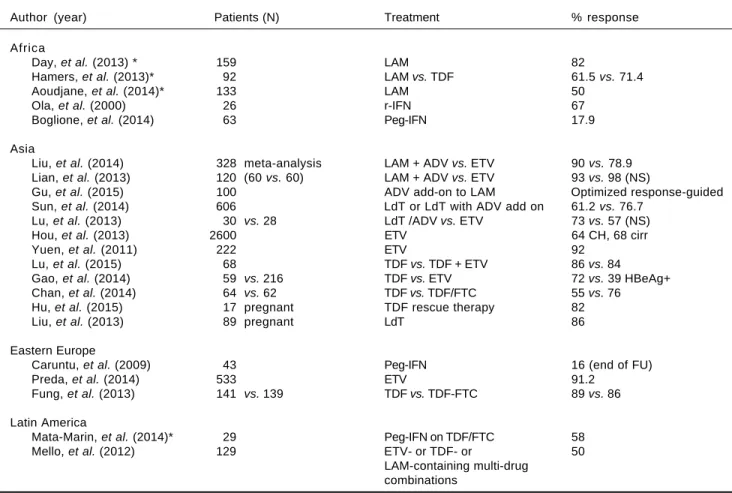
base-Table 1. Recent studies on HBV treatment in developing countries of the four continents studied.
Author (year) Patients (N) Treatment % response Africa
Day, et al. (2013) * 159 LAM 82
Hamers, et al. (2013)* 92 LAM vs. TDF 61.5 vs. 71.4 Aoudjane, et al. (2014)* 133 LAM 50
Ola, et al. (2000) 26 r-IFN 67 Boglione, et al. (2014) 63 Peg-IFN 17.9 Asia
Liu, et al. (2014) 328 meta-analysis LAM + ADV vs. ETV 90 vs. 78.9 Lian, et al. (2013) 120 (60 vs. 60) LAM + ADV vs. ETV 93 vs. 98 (NS)
Gu, et al. (2015) 100 ADV add-on to LAM Optimized response-guided
Sun, et al. (2014) 606 LdT or LdT with ADV add on 61.2 vs. 76.7 Lu, et al. (2013) 30 vs. 28 LdT /ADV vs. ETV 73 vs. 57 (NS) Hou, et al. (2013) 2600 ETV 64 CH, 68 cirr Yuen, et al. (2011) 222 ETV 92
Lu, et al. (2015) 68 TDF vs. TDF + ETV 86 vs. 84
Gao, et al. (2014) 59 vs. 216 TDF vs. ETV 72 vs. 39 HBeAg+ Chan, et al. (2014) 64 vs. 62 TDF vs. TDF/FTC 55 vs. 76
Hu, et al. (2015) 17 pregnant TDF rescue therapy 82
Liu, et al. (2013) 89 pregnant LdT 86 Eastern Europe
Caruntu, et al. (2009) 43 Peg-IFN 16 (end of FU) Preda, et al. (2014) 533 ETV 91.2
Fung, et al. (2013) 141 vs. 139 TDF vs. TDF-FTC 89 vs. 86 Latin America
Mata-Marin, et al. (2014)* 29 Peg-IFN on TDF/FTC 58 Mello, et al. (2012) 129 ETV- or TDF- or 50
LAM-containing multi-drug combinations
line and those still HBV-DNA-positive after 6 months of
treatment. It should be used only for patients with a low
baseline viral load.
29,30Currently, ETV and TDF are used singularly in
devel-oped countries, but their cost is a serious obstacle to their
use in low-income countries.
Recent studies on the treatment of chronic HBV
infec-tion in low-income countries are shown in table 1.
Treatment of CHB in Africa
In Africa, particularly in sub-Saharan countries, the
de-cision to treat a patient with CHB should be based on a
comprehensive evaluation of the stage of the liver disease,
the HBV load, the HBeAg/antiHBe status, the HBV
geno-type, the presence or absence of HIV coinfection, and the
socio-economic and cultural levels of the country where
the patient lives.
45Many African people are co-infected with chronic
HBV and HIV. For these patients, the current
internation-al guidelines strongly encourage the use of TDF as part of
the antiretroviral therapy (ART).
46Indeed, early
adminis-tration of ART including TDF for HBV-HIV co-infected
subjects is recommended as the treatment of choice,
47since it offers improved health benefits and reduces
mor-tality.
48Instead, most sub-Saharan patients have been
treat-ed with lamivudine
49-53and have experienced drug
resistance, a virological and clinical breakthrough and liver
disease progression. At present, replacing LAM with TDF
in the ART therapy is limited by the high cost, even
though governments or insurance companies
54take on a
large part of the costs.
Few data are available on standard or Peg-IFN
treat-ment in African populations. An old study on a small
group of Nigerian patients reported a 67% sustained
re-sponse to recombinant IFN with an HBsAg loss of 22%,
55whereas a recent Italian study on African immigrants
in-fected with HBV-genotype E found a 17.9% response to
Peg-IFN with HBsAg loss of 2.5%.
56Urgent coordination of the prophylactic and
therapeu-tic measures against HBV infection in countries of
sub-Sa-haran Africa is warranted to reduce the spread of the
infection and the rate of disease progression.
Treatment of CHB in Asia
It can be difficult to obtain a complete therapeutic
sup-pression of HBV-DNA replication in HBeAg-positive
CHB patients with a high viral load, a clinical condition
frequent in Asian CHB patients.
Although TDF and ETV are both considered
first-line therapies for CHB, in several Asian contexts they
are reputed to be too expensive and, consequently, are
not widely used, whereas LAM has been used
exten-sively. A virological and biochemical breakthrough during
LAM treatment has been observed more frequently in
patients with natural YMDD mutations than in those
without.
57The efficacy and safety of the de novo combination
LAM + ADV have been reviewed by Liu,
et al.
, who found
this combination superior to ETV monotherapy in
ob-taining a biochemical response, seroconversion to
anti-HBe in anti-HBeAg-positive cases and protection against
resistance development.
58In another study, the
combina-tion of LAM + ADV showed similar efficacy compared to
ETV in controlling viral replication, in improving liver
function tests and in reducing the occurrence of mortality
in patients with decompensated cirrhosis.
59In addition, a
multicenter study showed that also add-on therapy of ADV
to LAM maintains long-term suppression of HBV
replica-tion and improves liver funcreplica-tion in CHB patients with
compensated cirrhosis.
60Chinese clinical researchers carried out a randomized
trial on the efficacy of LdT to treat CHB. In the arm
in-cluding the addition of ADV for patients with a
sub-opti-mal response at week 24, they obtained a good virological
response in 76.7% of cases, low resistance emergence
(2.7%) and limited side effects.
61LdT has also been added
successfully to ADV in the case of ADV resistance in
pa-tients with HBeAg-positive chronic hepatitis, with a
sig-nificantly higher rate of HBeAg seroconversion than in
patients receiving Entecavir.
62Entecavir treatment has been found to be effective and
safe both in clinical trials
63and in real-world experience
on large cohorts of HBsAg-positive Asian patients.
64,65ETV treatment was followed by a rapid reduction in serum
HBV-DNA levels, which became undetectable in 75% of
cases by week 48. Response rates were lower in
HBeAg-positive than in HBeAg-negative patients. The efficacy of
ETV was similar in compensated and decompensated
cir-rhosis and therapy-naïve and experienced patients,
66with a
resistance rate estimated at approximately 1%.
63,65The
anti-viral efficacy of ETV has been demonstrated to be superior
to LAM, ADV or LdT.
66Tenofovir was found to be effective in patients with a
partial response to ETV
67and superior to ETV in
sup-pressing high HBV-DNA levels.
68,69The data from a
re-cent study suggest the combination embricitabine + TDF
for highly viremic HBeAg-positive patients with normal
ALT.
70Cohort studies have demonstrated that ETV
reduc-es in a period of 5 years the occurrence of HCC and death
in Asiatic patients with cirrhosis.
71,72A recent real-world
Tenofovir has been demonstrated to be safe and
effec-tive in reducing HBV-DNA serum concentration to low
or undetectable levels in pregnant women, and thereby in
reducing the risk of intra-uterine and perinatal
transmis-sion of HBV when combined with passive and active
im-munization of new-born babies.
74-77TDF has also been
demonstrated to be safe and effective in pregnant women
with LAM- or LdT-resistant HBV chronic infection.
78Despite having a low genetic barrier, LdT has also been
found to be safe and effective in pregnant women.
79Information on the effect of NUC therapy on the
HB-sAg serum concentration is scanty. However, it has been
demonstrated that both a low baseline HBsAg serum
con-centration and its consistent reduction under LAM
thera-py predict HBsAg sero-clearance,
80and that TDF
treatment of patients experienced for other NUCs
induc-es variable patterns of decline in the HBsAg serum
con-centration, a slow reduction being associated with low
baseline HBsAg serum values.
81Although NUC therapy has been shown to be safe and
effective in treating HBsAg-positive chronic hepatitis,
in-terferon therapy still maintains a role in treating CHB
pa-tients in Asia, because it is cheaper than NUCs and
provides an immune-mediated control of HBV
replica-tion with a finite course of treatment.
Treatment of CHB in Eastern Europe
A multicenter European study showed different
ap-proaches to CHB treatment in different countries of
East-ern Europe, but, in general, high ALT and/or HBV-DNA
serum concentrations were the most frequent drivers of
treatment initiation, whereas an unsatisfactory viral load
under treatment was the most frequent driver of a
treat-ment switch.
82Furthermore, in Poland and Romania,
pegylated interferon or LAM or ADV or LdT
monothera-py were more frequently used (about 70%) than ETV or
TDF (about 20%) compared to Germany, France and
Tur-key (about 30% and 65%, respectively), probably due to
cost and reimbursement issues.
83Other studies performed
on this topic in Eastern Europe are small and some present
structural problems. In 2013, however, practical
guide-lines for treating patients with HBsAg-positive chronic
hepatitis were published in Poland.
84Some studies in
Eastern Europe evaluated the effect of Peg-IFN and some
sought parameters predictive of a sustained virological
re-sponse (SVR). For example, in 43 HBsAg-positive patients
treated with Peg-IFN, Caruntu,
et al.
85observed a
signifi-cant reduction in the HBV-DNA and ALT serum values,
together with seroconversion to negative by the end of the
follow-up period in 11.6% of the HBeAg-positive cases. In
a Romanian study 38.6% of patients achieved SVR and a
decrease in HBsAg and HBV-DNA serum concentrations
were found to be predictive of SVR.
86These data show the
results of a less expensive finite treatment, but which are
inferior to those obtained by suppressing HBV replication
with NUCs.
At present, only a few studies have been performed on
the effectiveness of NUC treatment in Eastern Europe. In
a large Romanian study, ETV treatment achieved a
sup-pression of HBV replication in more than 90% of cases,
87whereas LAM therapy did not substantially affect survival
in a Serbian study.
88In the former study, a low fibrosis
score, low viral load, the HBeAg-negative status and being
naïve to antiviral treatment were predictive of a
virologi-cal response; ETV was administered also to LAM-resistant
patients, with a 15% rate of non-responders, possibly
be-cause of pre-existing cross-resistance to ETV.
87In a
multi-centre study involving many countries in Eastern Europe,
TDF, administered with or without emtricitabine to
LAM-resistant patients, was found to be highly effective,
and no case of TDF resistance was registered during the 96
weeks of treatment.
89Despite the marked diversities between Western and
Eastern European countries in managing several
HBV-re-lated problems, a recent investigation on a large number of
CHB patients in 5 European countries showed that
simi-lar schedules are in use in Germany, France, Poland,
Ro-mania and Turkey to monitor treated and untreated
patients.
90Also similar are the parameters used to monitor
the course of the diseases (ALT and HBV-DNA serum
concentrations) both in treated and untreated patients.
Treatment of CHB in Latin America
Most studies carried out in countries in South America
enrolled HBV/HIV co-infected patients and confirmed
the favorable effects of TDF, LAM and FTC in inhibiting
both HIV and HBV replication. Treatment with
PEG-IFN was shown to be well tolerated and effective
(HBV-DNA suppression obtained in 51.7% of the cases)
in HBV/HIV co-infected patients also receiving a
TDF/FTC-containing treatment against HIV.
91These
patients were infected with HBV genotypes H or G and
were HBeAg-positive.
91In HIV/HBV co-infected patients
with chronic hepatitis receiving LAM as part of antiretroviral
treatment, a significant reduction in the HBV-DNA
serum concentration was observed once ETV was added
to the treatment schedule.
92A study performed in Mexico showed that nearly 5% of
the HBV strains examined presented pre-treatment LAM
genotypic resistance.
93A Brazilian study
94showed that
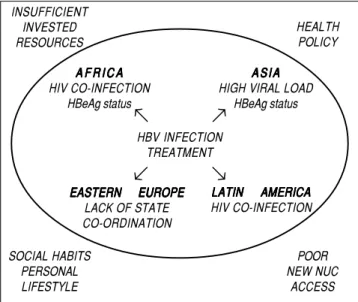
FINAL COMMENTS
There are several political, cultural and
socio-econom-ic obstacles hampering a correct approach for monitoring
and treating patients with CHB in low-income countries,
namely HIV co-infection, high HBV load, low economic
resources, patients’ poor adherence or insufficiency of the
healthcare system of some countries (Figure 1). These
fac-tors may favor the deterioration of CHB and the
progres-sion to cirrhosis or HCC. Correct management of chronic
HBV infection and the application of appropriate
treat-ment schedules in low-income countries could be
achieved by investing more resources to apply the
proce-dures suggested in the current international guidelines.
The healthcare system of each country should organize or
further promote screening programs for subjects who are
at risk of acquiring HBV infection, as well as nationwide
educational campaigns, universal vaccination campaigns
against HBV infection and access of HBV patients to a
clinical evaluation and possible treatment.
ABBREVIATIONS
•
ADV:
adefovir.
•
anti-HBe:
hepatits B virus e antibodies.
•
anti-HBs:
hepatits B virus surface antibodies.
•
ART:
antiretroviral therapy.
•
CHB:
chronic hepatitis B.
•
ETV:
entecavir.
•
HBeAg:
hepatits B virus e antigen.
•
HBsAg:
hepatits B virus surface antigen.
•
HBV:
hepatitis B virus.
•
HCC:
hepatocellular carcinoma.
•
LAM:
lamivudine.
•
LdT:
telbivudine.
•
NUCs:
nucleoside analogues.
•
Peg-IFN:
pegylated interferon.
•
TDF:
tenofovir.
REFERENCES
1. Available from: http://www.who.int/mediacentre/factsheets/ fs204/en/
2. Liaw YF, Chu CM. Hepatitis B virus infection. Lancet 2009; 14: 582-92.
3. Chu CM, Liaw YF. Hepatitis B virus-related cirrhosis: natural history and treatment. Semin Liver Dis 2006; 26: 142-52. 4. Fattovich G, Olivari N, Pasino M, D’Onofrio M, Martone E,
Do-nato F. Long-term outcome of chronic hepatitis B in Cauca-sian patients: mortality after 25 years. Gut 2008; 57: 84-90. 5. McMahon BJ. The natural history of chronic hepatitis B virus
infection. Hepatology 2009; 49: S45-S55.
6. Hadziyannis SJ. Natural history of chronic hepatitis B in Euro-Mediterranean and African countries. J Hepatol 2011; 55: 183-91.
7. Sagnelli E, Coppola N, Scolastico C, Filippini P, Santantonio T, Stroffolini T, Piccinino F. Virologic and clinical expressions of reciprocal inhibitory effect of hepatitis B, C, and delta viruses in patients with chronic hepatitis. Hepatology 2000; 32: 1106-10. 8. Kao JH, Chen PJ, Lai MY, Chen DS. Basal core promoter
mu-tations of hepatitis B virus increase the risk of hepatocellular carcinoma in hepatitis B carriers. Gastroenterology 2003; 124: 327-34.
9. Iloeje UH, Yang HI, Jen CL, You SL, Chen CJ. Predicting cir-rhosis risk based on the level of circulating hepatitis B viral load. Gastroenterology 2006; 130: 678-86.
10. Chen CJ, Yang HI, Su J, Jen CL, You SL, Lu SN, Huang GT, et al. Risk of hepatocellular carcinoma across a biological gradient of serum hepatitis B virus DNA level. JAMA 2006; 295: 65-73.
11. Puoti M, Torti C, Bruno R, Filice G, Carosi G. Natural history of chronic hepatitis B in co-infected patients. J Hepatol
2006; 44: S65-S70.
12. Hoffmann CJ, Thio CL. Clinical implications of HIV and hepati-tis B co-infection in Asia and Africa. Lancet Infect Dis 2007; 7: 402-9.
13. Fattovich G, Bortolotti F, Donato F. Natural history of chronic hepatitis B: special emphasis on disease progression and prognostic factors. J Hepatol 2008; 48: 335-52.
14. Kim BK, Revill PA, Ahn SH. HBV genotypes: relevance to natural history, pathogenesis and treatment of chronic hep-atitis B. Antivir Ther 2011; 16: 1169-86.
15. Thursz M, Yee L, Khakoo S. Understanding the host genet-ics of chronic hepatitis B and C. Semin Liver Dis 2011; 31: 115-27.
16. Dandri M, Locarnini S. New insight in the pathobiology of hepatitis B virus infection. Gut 2012; 61(Suppl. 1): 16-17. 17. Weissberg JI, Andres LL, Smith CI, Weick S, Nichols JE,
Gar-cia G, Robinson WS, et al. Survival in chronic hepatitis B. An analysis of 379 patients. Ann Intern Med 1984; 101: 613-6. 18. Mast EE, Ward JW. Hepatitis B vaccine. In: Plotkin SA,
Oren-stein WA, Offit PA (Eds.). Vaccines. 5th Ed. Philadelphia, PA: Saunders; 2008.
19. Yim HJ, Lok AS. Natural history of chronic hepatitis B virus infection: what we knew in 1981 and what we know in 2005. Hepatology 2006; 43: S173-S181.
Figure 1. Figure 1. Figure 1.
Figure 1. Figure 1. Common and different aspects of HBV treatment in developing countries in the four continents evaluated.
HBV INFECTION TREATMENT A F R I C A
A F R I C A A F R I C A A F R I C A A F R I C A HIV CO-INFECTION
HBeAg status
A S I A A S I A A S I A A S I A A S I A HIGH VIRAL LOAD
HBeAg status
EASTERN EUROPE EASTERN EUROPE EASTERN EUROPE EASTERN EUROPE EASTERN EUROPE
LACK OF STATE CO-ORDINATION
LATIN AMERICA LATIN AMERICA LATIN AMERICA LATIN AMERICA LATIN AMERICA HIV CO-INFECTION INSUFFICIENT
INVESTED RESOURCES
HEALTH POLICY
SOCIAL HABITS PERSONAL LIFESTYLE
POOR NEW NUC
ACCESS
→
→
→
20. McMahon BJ, Holck P, Bulkow L, Snowball MM. Serologic and clinical outcomes 1536 Alaska Natives chronically in-fected with hepatitis B virus. Ann Intern Med 2001; 135: 759-68.
21. Fattovich G, Giustina G, Schalm SW, Hadziyannis S, Sanchez-Tapias J, Almasio P, Christensen E, et al. Occur-rence of hepatocellular carcinoma and decompensation in western European patients with cirrhosis type B. The EU-ROHEP Study Group on Hepatitis B Virus and Cirrhosis.
Hepatology 1995; 21: 77-82.
22. Fattovich G. Natural history and prognosis of hepatitis B.
Semin Liver Dis 2003; 23: 47-58.
23. Yang HI, Lu SN, Liaw YF, You SL, Sun CA, Wang LY, Hsiao CK, et al. Hepatitis B e antigen and the risk of hepatocellular carcinoma. New Engl J Med 2002; 347: 168-74.
24. Harris RA, Chen G, Lin WY, Shen FM, London WT, Evans AA. Spontaneous clearance of high-titer serum HBV DNA and risk of hepatocellular carcinoma in a Chinese population. Cancer Causes Control 2003; 14: 995-1000.
25. Iloeje UH, Yang HI, Su J, Jen CL, You SL, Chen CJ. Predicting cirrhosis risk based on the level of circulating hepatitis B vi-ral load. Gastroenterology 2006; 130: 678-86.
26. Chen CJ, Yang HI, Su J, Jen CL, You SL, Lu SN, Huang GT, et al. Risk of hepatocellular carcinoma across a biological gradient of serum hepatitis B virus DNA level. JAMA 2006; 295: 65-73.
27. Yu MW, Yeh SH, Chen PJ, Liaw YF, Lin CL, Liu CJ, Shih WL, et al. Hepatitis B virus genotype and DNA level and hepato-cellular carcinoma: a prospective study in men. J Natl Can-cer Inst 2005; 97: 265-72.
28. Triolo M, Della Corte C, Colombo M. Impact of HBV therapy on the incidence of hepatocellular carcinoma. Liver Int 2014; 34(Suppl. 1): 139-45.
29. European Association for the Study of the Liver. EASL Clini-cal Practice Guidelines: management of chronic hepatitis B virus infection. J Hepatol 2012; 57: 167-85.
30. Sarin SK, Kumar M, Lau GK, Abbas Z, Chan HL, Chen CJ, Chen DS, et al. Asian-Pacific clinical practice guidelines on the management of hepatitis B: a 2015 update. Hepatol Int
2016; 10: 1-98.
31. Tipples GA, Ma MM, Fischer KP, Bain VG, Kneteman NM, Tyr-rell DL. Mutation in HBV RNA-dependent DNA polymerase confers resistance to lamivudine in vivo. Hepatology 1996; 24: 714-7.
32. Tsubota A. How do naturally occurring YMDD-motif mutants influence the clinical course of lamivudine-naïve patients with chronic hepatitis B virus infection? J Gastroenterol Hepatol 2006;21: 1769-71.
33. Lee SH, Kim HS, Byun IS, Jeong SW, Kim SG, Jang JY, Kim YS, et al. Pre-existing YMDD mutants in treatment-naïve pa-tients with chronic hepatitis B are not selected during lami-vudine therapy. J Med Virol 2012; 84: 217-22.
34. Yang J, Chen X, Zhang H, Chen G. HBV genotype C strains with spontaneous YMDD mutations may be a risk factor for hepatocellular carcinoma. J Med Virol 2014; 86: 913-7. 35. Yang JH, Zhang H, Chen XB, Chen G, Wang X. Relationship
between hepatocellular carcinoma and hepatitis B virus gen-otype with spontaneous YMDD mutations. World J Gastro-enterol 2013; 19: 3861-65.
36. Tan Y, Ding K, Su J, Trinh X, Peng Z, Gong Y, Chen L, et al. The naturally occurring YMDD mutation among patients chronically infected HBV and untreated with lamivudine: a systematic review and meta-analysis. PLoS One 2012; 7: e32789.
37. Liaw YF, Sung JJ, Chow WC, Farrell G, Lee CZ, Yuen H, Tanwandee T, et al. Lamivudine for patients with chronic
hepatitis B and advanced liver disease. N Engl J Med 2004; 351: 1521-31.
38. Eun JR, Lee HJ, Kim TN, Lee KS. Risk assessment for the development of hepatocellular carcinoma: according to on-treatment viral response during long-term lamivudine therapy in hepatitis B virus-related liver disease. J Hepatol 2010; 53: 118-25.
39. Lampertico P,Vigano’ M, Manenti E, Iavarone M, Lunghi G, Colombo M. Adefovir rapidly suppresses hepatitis B in HBeAg-negative. Patients developing genotypic resistance to Lamivudine. Hepatology 2005; 42: 1414-9.
40. Lok AS, McMahon BJ. Chronic hepatitis B: update 2009.
Hepatology 2009; 50: 661-2.
41. Chang TT, Lai CL, Kew Yoon SK, Lee SS, Coelho S, Carrilho FH, Poordad F, et al. Entecavir treatment for up to 5 years in patients with hepatitis B e antigen-positive chronic hepatitis B. Hepatology 2010; 51: 422-30.
42. Marcellin P, Heathcote EJ, Buti M, Gane E, de Man RA, Krastev Z, Germanidis G, et al. Tenofovir disoproxil fumarate versus adefovir dipivoxil for chronic hepatitis B. N Engl J Med 2008; 359: 2442-55.
43. Kitrinos KM, Corsa A, Liu Y, Flaherty J, Snow-Lampart A, Mar-cellin P, Borroto-Esoda K, et al. No detectable resistance to ten-ofovir disoproxil fumarate after 6 years of therapy in patients with chronic hepatitis B. Hepatology 2014; 59: 434-42. 44. Lim YS, Han S, Heo NY, Shim JH, Lee HC, Suh DJ. Mortality,
liver transplantation, and hepatocellular carcinoma among patients with chronic hepatitis B treated with entecavir vs lamivudine. Gastroenterology 2014; 147: 152-61.
45. Ive P, MacLeod W, Mkumla N, Orrell C, Jentsch U, Wallisa CL, Stevens W, et al. Low prevalence of liver disease but re-gional differences in HBV treatment characteristics mark HIV/HBV co-infection in a South African HIV clinical trial.
PLoS One 2013; 8: e74900.
46. World Health Organization (WHO). 2013 consolidated guide-lines on the use of antiretroviral drugs for treating and pre-venting HIV infection. Available at: http://www.who.int/hiv/ pub/guidelines/arv2013/en/index. html.
47. Martin NK, Devine A, Eaton JW, Miners A, Hallett TB, Foster GR, Dore GJ, et al. Modeling the impact of early antiretroviral therapy for adults coinfected with HIV and hepatitis B or C in South Africa. AIDS 2014; 28(Suppl. 1): 35-46.
48. Hawkins C, Christian B, Ye J, Nagu T, Aris E, Chalamilla G, Spiegelman D, et al. Prevalence of hepatitis B co-infection and response to antiretroviral therapy among HIV-infected patients in Tanzania. AIDS 2013; 27: 919-27.
49. Day SL, Odem-Davis K, Mandaliya KN, Jerome KR, Cook L, Masese LN, Scott J, et al. PLoS One 2013; 8: e59346. 50. Hamers RL, Zaaijer HL, Wallis CL, Siweale M, Ive P, Botes
ME, Sigaloff KC, et al. HIV-HBV coinfection in Southern Afri-ca and the effect of lamivudine- versus tenofovir-containing cART on HBV outcomes. J Acquir Immune Defic Syndr
2013; 64: 174-82.
51. Chadwick D, Ankcorn M, Sarfo F, Phillips R, Fox Z, Garcia A, Appiah L, et al. Outcomes of starting first-line antiretroviral therapy in hepatitis B virus/HIV-coinfected patients in Gha-na. J Antimicrob Chemother 2012; 67: 2939-42.
52. Kouanfack C, Aghokeng AF, Mondain AM, Bourgeois A, Ken-fack A, Mpoudi-Ngolé E, Ducos J, et al. Lamivudine-resistant HBV infection in HIV-positive patients receiving antiretroviral therapy in a public routine clinic in Cameroon. Antivir Ther
2012; 17: 321-6.
Re-sistance in HIV-Positive Adults Receiving First-line Antiretro-viral Therapy in Malawi. Clin Infect Dis 2014; 59: 1618-26. 54. Hatzakis A, Van Damme P, Alcorn K, Gore C, Benazzouz M,
Berkane S, Buti M, et al. The state of hepatitis B and C in the Mediterranean and Balkan countries: report from a summit conference. J Viral Hepat 2013; 20(Suppl. 2): 1-20. 55. Ola SO, Anomneze EE, Chukwuani CM, Ojo OS, Ndububa
DA, Onyenekwe B, Nasidi A. Interferon alfa-2a (Roferon-A) in the management of chronic hepatitis B infection: results of an open prospective study in Nigerian patients. West Afr J Med 2000; 19: 259-64.
56. Boglione L, Cusato J, Cariti G, Di Perri G, D’Avolio A. The E genotype of hepatitis B: clinical and virological characteris-tics, and response to interferon. J Infect 2014; 69: 81-7. 57. Tan TW, Ye Y, Ge GH, Zhao W, Gan JH, Zhao Y, Niu ZL, et
al. Natural YMDD motif mutants affect clinical course of lami-vudine in chronic hepatitis B. World J Gastroenterol 2015; 21: 2089-95.
58. Liu F, Wang X, Wei F, Hu H, Zhang D, Hu P, Ren H. Efficacy and resistance in de novo combination lamivudine and adefo-vir dipivoxil therapy versus entecaadefo-vir monotherapy for the treatment-naive patients with chronic hepatitis B: a meta-analysis. Virol J 2014; 11: 59.
59. Lian JS, Zeng LY, Chen JY, Jia HY, Zhang YM, Xiang DR, Yu L, et al. De novo combined lamivudine and adefovir dipivoxil therapy vs. entecavir monotherapy for hepatitis B virus-re-lated decompensated cirrhosis. World J Gastroenterol
2013; 19: 6278-83.
60. Gu EL, Yu YQ, Wang JL, Ji YY, Ma XY, Xie Q, Pan HY, et al. Respons-guided treatment of cirrhotic chronic hepatitis B pa-tients: multicenter prospective study. World J Gastroenterol
2015; 21: 653-60.
61. Sun J, Xie Q, Tan D, Ning Q, Niu J, Bai X, Fan R, et al. The 104-week efficacy and safety of telbivudine-besed optimi-zation strategy in chronic hepatitis B patients: a randomized, controlled study. Hepatology 2014; 59: 1283-92.
62. Lu JJ, Liu K, Ma YJ, Wang J, Chen EQ, Tang H. Efficacy and safety of telbivudine plus adefovir dipivoxil combination ther-apy and entecavir monotherther-apy for HBeAg-positive chronic hepatitis B patients with resistance to adefovir dipivoxil. J Viral Hepat 2013; 20(Suppl. 1): 40-5.
63. Yao G. Entecavir is a potent anti-HBV drug superior to lami-vudine: experience from clinical trials in China. J Antimicrob Chemother 2007; 60: 201-5.
64. Hou JL, Jia JD, Wei L, Zhao W, Wang YM, Cheng M, Tang X, et al. Efficacy and safety of entecavir treatment in a hetero-geneous CHB population from a ‘real-world’ clinical practice setting in China. J Viral Hepat 2013; 20: 811-20.
65. Yuen MF, Seto WK, Fung J, Wong DK, Yuen JC, Lai CL. Three years of continuous entecavir therapy in treatment-naive chronic hepatitis B patients: viral suppression, viral re-sistance, and clinical safety. Am J Gastroenterol 2011; 106: 1264-71.
66. Hou J, Jia J, Wei L. Entecavir versus other standard of care for up to 4 years in nucleos(t)ide-naive patients with CHB in Chinese clinical practice. Abstract presented at the Third Asian Pacific Association for Study of the Liver, June 6–10, 2013, Singapore.
67. Lu L, Yip B, Trinh H, Pan CQ, Han SH, Wong CC, Li J, et al. Tenofovir-based alternate therapies for chronic hepatitis B patients with partial virological response to entecavir. J Viral Hepat 2015; 22: 675-81.
68. Gao L, Trinh HN, Li J, Nguyen MH. Tenofovir is superior to entecavir for achieving complete viral suppression in HBeAg-positive chronic hepatitis B patients with high HBV DNA. Aliment Pharmacol Ther 2014; 39: 629-37.
69. Fung S, Gordon SC, Krastev Z, Horban A, Petersen J, Sperl J, Gane E, et al. Tenofovir disoproxil fumarate in Asian or Pa-cific Islander chronic hepatitis B patients with high viral load (≥ 9 log10 copies/mL). Liver Int 2015; 35: 422-8.
70. Chan HL, Chan CK, Hui AJ, Chan S, Poordad F, Chang TT, Mathurin P, et al. Effects of tenofovir disoproxil fumarate in hepatitis B e antigen-positive patients with normal levels of alanine aminotransferase and high levels of hepatitis B virus DNA. Gastroenterology 2014; 146: 1240-8.
71. Hosaka T, Suzuki F, Kobayashi M, Seko Y, Kawamura Y, Sezaki H, Akuta N, et al. Long-term entecavir treatment re-duces hepatocellular carcinoma incidence in patients with hepatitis B virus infection. Hepatology 2013; 58: 98-107. 72. Wong GL, Chan HL, Mak CW, Lee SK, Ip ZM, Lam AT, Iu HW,
et al. Entecavir treatment reduces hepatic events and deaths in chronic hepatitis B patients with liver cirrhosis.
Hepatology 2013; 58: 1537-47.
73. Lim YS, Han S, Heo NY, Shim JH, Lee HC, Suh DJ. Mortality, liver transplantation, and hepatocellular carcinoma among patients with chronic hepatitis B treated with entecavir vs lamivudine. Gastroenterology 2014; 147: 152-61.
74. Pan CQ, Mi LJ, Bunchorntavakul C, Karsdon J, Huang WM, Singhvi G, Ghany MG, et al. Tenofovir disoproxil fumarate for prevention of vertical transmission of hepatitis B virus in-fection by highly viremic pregnant women: a case series.
Dig Dis Sci 2012; 57: 2423-9.
75. Celen MK, Mert D, Ay M, Kaya S, Yildirim N, Gulsun S, Barcin T, et al. The efficacy and safety of tenofovir disoproxil in pregnancy for the prevention of vertical transmission of HBV infection. 23th Asian Pacific Association for the Study of the Liver (APASL). Hepatol Int Berlin 2013; 7(Suppl. 1): 216. 76. Greenup AJ, TanPK, Lawlor J, Glass A, Chatterjee U,
Davi-son S, Smith L, et al. Tenofovir use in pregnant women with chronic Hepatitis B: virological efficacy and mother and child safety. 23th Asian Pacific Association for the Study of the Liver (APASL). Hepatol Int Berlin 2013; 7 (Suppl. 1): S266. 77. Chen HL, Lee CN, Chang CH, Ni YH, Shyu MK, Chen SM, Hu
JJ, et al. Efficacy of maternal tenofovir disoproxil fumarate in interrupting mother-to-infant transmission of hepatitis B vi-rus. Hepatology 2015; 62: 375-86.
78. Hu YH, Liu M, Yi W, Cao YJ, Cai HD. Tenofovir rescue thera-py in pregnant females with chronic hepatitis B. World J Gastroenterol 2015; 21: 2504-9.
79. Liu M, Cai H, Yi W. Safety of telbivudine treatment for chron-ic hepatitis B for the entire pregnancy. J Viral Hepat 2013; 20(Suppl. 1): 65-70.
80. Seto WK, Wong DK, Fung J, Huang FY, Lai CL, Yuen MF. Re-duction of hepatitis B surface antigen levels and hepatitis B surface antigen seroclearance in chronic hepatitis B patients receiving 10 years of nucleoside analogue therapy. Hepatol-ogy 2013; 58: 923-31.
81. Seto WK, Liu K, Wong DK, Fung J, Huang FY, Hung IF, Lai CL, et al. Patterns of hepatitis B surface antigen decline and HBV DNA suppression in Asian treatment-experienced chronic hepatitis B patients after three years of tenofovir treatment. J Hepatol 2013; 59: 709-16.
82. Leblebicioglu H, Arama V, Causse X, Marcellin P, Ozaras R, Postawa-Klozinska B, Simon K, et al. Predictors associated with treatment initiation and switch in a real-world chronic hepatitis B population from five European countries. J Viral Hepat 2014; 21: 662-70.
83. Arama V, Leblebicioglu H, Simon K, Zarski JP, Niederau C, Habersetzer F, Vermehren J, et al. Chronic hepatitis B moni-toring and treatment patterns in five European countries with different access and reimbursement policies. Antivir Ther
84. Juszczyk J, Boroñ-Kaczmarska A, Cianciara J, Flisiak R, Gladysz A, Halota W, Kryczka W, et al. Therapeutic recom-mendations for 2013: antiviral treatment for chronic hepatitis B. Przegl Epidemiol 2013; 67: 287-95, 383-91.
85. Caruntu FA, Streinu-Cercel A, Gheorghe LS, Grigorescu M, Sporea I, Stanciu C, Andronescu D, et al. Efficacy and safe-ty of peginterferon alpha-2a (40KD) in HBeAg-positive chronic hepatitis B patients. J Gastrointestin Liver Dis 2009; 18: 425-31.
86. Gheorghiþa VI, Caruntu FA, Curescu M, Olaru I, Radu MN, Colþan G, Streinu-Cercel A. Use of quantitative serum HB-sAg for optimization of therapy in chronic hepatitis B pa-tients treated with pegylated interferon alfa-2a: a Romanian cohort study. J Gastrointestin Liver Dis 2013; 22: 27-32. 87. Preda CM, Baicus C, Negreanu L, Tugui L, Olariu SV, Andrei
A, Zambatu I, et al. Effectiveness of entecavir treatment and predictive factors for virologic response. Rev Esp Enferm Dig 2014; 106: 305-11.
88. Milosevic I, Delic D, Lazarevic I, Pavlovic IP, Korac M, Bojovic K, Jevtovic D. The significance of hepatitis B virus (HBV) genotypes for the disease and treatment outcome among pa-tients with chronic hepatitis B in Serbia. J Clin Virol 2013; 58: 54-8.
89. Fung S, Kwan P, Fabri M, Horban A, Pelemis M, Hann HW, Gurel S, et al. Randomized comparison of tenofovir disoproxil fumarate vs emtricitabine and tenofovir disoproxil fumarate in patients with lamivudine-resistant chronic hepatitis B.
Gastroenterology 2014; 146: 980-8.
90. Marcellin P, Arama V, Leblebicioglu H, Zarski JP, Zeuzem S, Mauss S, Sieklucki J, et al. Chronic hepatitis B treatment initi-ation and modificiniti-ation patterns in five European countries: a 2-year longitudinal, non-interventional study. Antivir Ther
2014; 19: 235-43.
91. Mata-Marín JA, Mata-Marín LA, Arroyo-Anduiza CI, Huerta-García G, Sandoval-Ramírez JL, Manjarrez-Tellez B, Gaytán-Martínez JE. Intensification of treatment with pegylated interferon alfa in patients coinfected with HIV and HBV gen-otype H or G being treated with a tenofovir/emtricitabine-containing regimen. Hepatogastroenterology 2014; 61: 1187-91.
92. Pessôa MG, Gazzard B, Huang AK, Brandão-Mello CE, Cas-setti I, Mendes-Corrêa MC, Soriano V, et al. Efficacy and safety of entecavir for chronic HBV in HIV/HBV coinfected patients receiving lamivudine as part of antiretroviral thera-py. AIDS 2008; 22: 1779-87.
93. Alvarado-Esquivel C, De la Ascensión Carrera-Gracia M, Conde-González CJ, Juárez-Figueroa L, Ruiz-Maya L, Agui-lar-Benavides S, Torres-Valenzuela A, et al. Genotypic re-sistance to lamivudine among hepatitis B virus isolates in Mexico. J Antimicrob Chemother 2006; 57: 221-3.
94. Mello FC, Fernandes CA, Gomes Sde A. Antiviral therapy against chronic hepatitis B in Brazil: high rates of lamivudine resistance mutations and correlation with HBV genotypes. Mem Inst Oswaldo Cruz 2012; 107: 317-25.
Correspondence and reprint request:
Rosa Zampino, M.D., Ph.D. Internal Medicine and Hepatology,
Second University of Naples Via Pansini, 5-Edificio 3; 80131 Naples, Italy Tel.: 0039 (081) 5666708. Fax: 0039 (081) 5666225