Hepatoprotective effect of the selective
mineralocorticoid receptor antagonist, eplerenone against
carbon tetrachloride-induced liver injury in rats
Ashraf Taye* and Ihab T. Abdel-Raheem**
* Departments of Pharmacology & Toxicology, Faculty of Pharmacy, Minia University, Egypt. ** Department of Pharmacology & Toxicology, Faculty of Pharmacy, Al-Azhar University, Assiut, Egypt. ABSTRACT
Background. Eplerenone is a selective mineralocorticoid receptor (MR) antagonist, and its potential pro-tective role in cardiovascular injury has been reported by several studies. However, whether and how this drug can ameliorate hepatic injury in rats is unknown. Material and methods. The present study was con-ducted to investigate effect of eplerenone against liver injury induced by carbon tetrachloride (CCl4) in rats. The biochemical liver function tests and oxidative stress parameters including malondialdehyde (MDA), reactive oxygen species (ROS), in addition to the reduced glutathione (GSH) levels were evaluated. Mo-reover, serum tumor necrotic factors (TNF-α) level and histopathological changes were examined. Results. Our results show that pre-treatment with eplerenone (4 mg/kg per day for 4 weeks) revealed attenuation in serum activities of alanine aminotransferase (ALT), aspartate aminotransferase, (AST), alkaline phosphata-se (ALP) and bilirubin levels that were enhanced by CCl4. Further, pre-treatment with eplerenone inhibi-ted the elevainhibi-ted hepatic MDA content and restored hepatic GSH to its normal level. The enhanced hepatic ROS production in CCl4-treated group was markedly decreased by eplerenone administration. Eple-renone pre-treatment significantly attenuated the inflammatory responses caused by CCl4 as evident by the decreased serum TNF-α level. Histopathological studies showed that eplerenone alleviated the liver damage and reduced the lesions caused by CCl4. Conclusion. Collectively, the present study provides a proof to hepatoprotective actions of eplerenone via reducing oxidative stress and inflammatory responses in CCl4-induced liver damage in rat model.
Key words. Eplerenone. Liver injury. Oxidative stress. TNF-α.
Correspondence and reprint request: Ashraf Taye Departments of Pharmacology & Toxicology Faculty of Pharmacy.
Minia University, Egypt Tel.: +2011862-5727
E mail: [email protected]
Manuscript received: September 09, 2011. Manuscript accepted: November 02, 2011.
INTRODUCTION
Aldosterone is the main effector peptides of the re-nin-angiotensin-aldosterone system and is known to play an important role in the development of hepatic fibrosis and portal hypertension.1-3 Aldosterone can
promote tissue inflammation and fibrosis and plays a crucial role in cell proliferation and apoptosis.4-6
In addition, oxidative stress and pro-inflammatory cytokines play essential roles in the development of cholestatic liver injury.7 It has been reported that
induction of oxidative stress and mineralocorticoid receptor (MR)-dependent transcription of proinflam-matory genes are some of the mechanisms account for the injurious effects of aldosterone.8-10
Accumu-lating evidences indicate that MR also mediates inflammation and fibrosis through the proinflamma-tory transcription factor NF-κB activation in liver, heart, and glomerular mesangial cells.11-13 Although
several reports stated that angiotensin ll type 1 re-ceptor blockers and angiotensin-converting enzyme inhibitors have been reported to prevent the develo-pment of hepatic fibrosis in numerous animal14,15
and human,16-18 little is known regarding role of
al-dosterone antagonist in liver injury.
Additionally, the results arising from these stu-dies have shown to be controversial.2,19,20 While one
report demonstrated that spironolactone prevented pig serum-induced hepatic fibrosis in rats,2 another
On the other hand, eplerenone has been shown to reveal a high specificity for MR.21,22 Several reports
demonstrated the efficacy and safety of eplerenone in the treatment of hypertension.23-25 However,
the-re is scanty information concerning both effect of eplerenone on liver injury and the mechanism (s) in-volved in this effect. The preventive action of CCl4 -induced liver damage has been widely used as an indicator of liver protective activity of drugs.26
The-refore, the present study was undertaken to exami-ne effect of eplerenoexami-ne on liver injury induced by CCl4 in rat model and underline its mechanism (s) in this setting.
MATERIAL AND METHODS
Drugs and chemicals
Eplerenone, Lucigenin, NADPH oxidase and SOD (Sigma-Aldrich, St. Louis, MO, USA); TNF-α kit (Koma Biotech. Inc., Korea); Carbon tetrachloride (BDH Chemicals, England). All other chemicals are of analytical grade.
Animals
Adult male Sprague-Dawley rats (150–180 g) were used throughout the experiments. Rats were fed a standard diet of commercial rat chow and tap water ad libitum and left to acclimatize to the environ-ment for at least one week prior to inclusion in the experiments. Experiments were conducted in accor-dance with the guidelines for animal care of the Uni-ted States Naval Medical Research Centre, Unit No. 3, Abbaseya, Cairo, Egypt.
The animals were divided into 4 groups each of 8 rats:
• Group 1. Rats of this group were injected withu normal saline, intraperitoneally and served as a control.
• Group 2. Rats were treated with (4.0 mg/kg,u orally) of eplerenone for 4 weeks.27
• Group 3. Hepatotoxicity was induced in rats ofu this group by administration of CCl4 (1 mL/kg ip; diluted 1:4 in olive oil; twice per week for 4 weeks).
• Group 4. Rats were pretreated with (4.0 mg/kg,up . orally, 4 week) of eplerenone 1 h before CCl4 (1 mL/kg, ip) administration.
After 4 weeks, blood samples were collected via cardiac puncture from the rats under anesthesia.
Then the rats were sacrificed by decapitation and liver tissues were isolated. The blood samples were centrifuged at 5,000 g for 10 min, and serum samples were collected for biochemical tests. All liver tissues were immediately dissected out and immediately dipped into liquid nitrogen. Other liver tissues were fixed in 10% neutral buffered formalin for subsequent sectio-ning and mounting on microscope slides. The remai-ning liver tissue and serum samples were stored at -80 °C until studied for other parameters. Thereafter, the liver tissues were homogenized in 0.25 M sucrose, 10 mM Tris-HCl, 1 mM EDTA medium, pH 7.4, centri-fuged at 10,000 g for 10 min and supernatants used for biochemical analysis. Total protein concentration was determined using a bicinchoninic acid (BCA) protein assay kit (Pierce Chemicals, USA).
Assessment of serum aminotransferases, alkaline phosphatase and bilirubin
Liver function tests in the serum such as AST, ALT were determined according to the method des-cribed by Reitman and Frankel.28 Serum ALP was
determined according to the method of Eaton RH29
using colorimetric kit obtained from Diamond Co., Egypt. Total or direct serum bilirubin was determi-ned spectrophotometrically according to the method of Merino, et al.30 using kits purchased from
Ran-dox, Laboratory. Ltd., UK.
Determination of hepatic malondialdehyde and GSH levels
Lipid peroxidation was determined in liver homo-genates as thiobarbituric acid reactive species (TBARS; sometimes referred to as MDA as a marker of oxidative stress according to the method described by Buege and Aust).31 Additionally, hepatic GSH was
determined spectrophotomerically at 412 nm. Hepatic GSH values were expressed as nmol/mg protein.
Measurement of ROS production in liver homogenates
ROS production of liver homogenates were mea-sured using lucigenin-enhancedchemiluminescence assay.32 Briefly, liver homogenates were
As major criteria for liver dysfunction, serum ALT and AST, ALP total and direct bilirubin levels in the serum of rats treated with CCl4 were found to be sig-nificantly higher than control. CCl4 produced dra-matic changes in these parameters. However, pre-treatment with eplerenone reduced these values significantly compared to that of the control group (Table 1).
Effects of eplerenone on oxidative stress biomarkers: MDA, GSH contents and
ROS production in liver homogenates
The biochemical marker of oxidative stress; hepatic MDA contents were significantly increased following to CCl4 treatment (P < 0.05) and pre-luminometer (Perkin-Elmer, Ltd.UK) and expressed
as mean arbitrary light units/min over 20 min. Each experimentwas performed in triplicate.To verify the specificity of chemiluminescence signals, some expe-riments using tissue homogenates were pre-incu-bated with superoxidedismutase (SOD, 200 U/mL) before measurement of chemiluminescence.
Determination of serum TNF-αα level
Serum TNF-α level was assessed in this study using enzyme-linked immunosorbent assay (ELISA) using a microplate reader (Spectra lll, Austria). Re-sults are expressed as pmol/mL.
Histopathological examination
Parts of liver samples were kept in 10% buffered formaldehyde for histophathological examinations. Sections were cut on glass slides (4-6 µm thick) and stained with hematoxylin and eosin (H & E) for routine histomorphology. The extent of liver damage was assessed.
Statistical analysis
All results are expressed as mean ± SEM. Bioche-mical parameters of groups were compared by ANOVA for repeated measures followed by Bonferroni’s test. P value < 0.05 was accepted as statistically signifi-cant. Statistical analysis was performed by Graph pad Prism, version 5.
RESULTS
Biochemical serum parameters (ALT, AST, ALP and bilirubin)
Biochemical results of serum ALT, AST, ALP, to-tal and direct bilirubins are summarized in table 1.
Table 1. Biochemical results of serum ALT, AST, ALP, total and direct bilirubin in rats treated with CCl4 in the presence or absen-ce of eplerenone.
Group/parameters ALT AST ALP Total-bilirubin Direct-bilirubin (IU/L) (IU/L) (IU/L) (µmol/L) (µmol/L) Control 41 ± 3.8 102 ± 9 200 ± 12 0.65 ± 0.05 0.25 ± 0.01 Eplerenone 50 ± 4.3 115 ± 10 222 ± 15 0.74 ± 0.01 0.30 ± 0.02 CCl4 190 ± 10** 320 ± 22** 334 ± 24** 2.10 ± 0.09** 0.71 ±.0.03 * Eplerenone + CCl4 70 ± 4.5* 150 ± 8* 257 ± 14* 0.92 ± 0.04 0.35 ± 0.01*
Each value represents the mean ± SEM, (n = 7-9/group). Data comparison was performed using ANOVA followed by Bonferroni’s test. *P < 0.05; **P < 0.01; compared with the initial value of control; *P < 0.05 compared with CCl4 group as indicated.
Figure 1. Hepatic MDA levels in the study groups: control and CCl4-treated groups, in the absence or presence of eple-renone. Values of each bar represent the mean ± SEM. The he-patic MDA contents were significantly increased following to CCl4 treatment (P < 0.05) and pre-treatment of rats with eplerenone significantly (P < 0.05) decreased these levels to that of control, *p < 0.05 compared with control value.
Hepatic MDA level (nmol/mg. protein)
(% of control)
300
200
100
0
Control Eplerenone CCI4
treatment of rats with eplerenone markedly (P < 0.05) decreased these levels to that of control (Figure 1).
Figure 2. Hepatic GSH content determination: control and CCl4-treated groups, in the absence or presence of eplereno-ne. Values of each bar represent the mean ± SEM. CCl4 showed a significant decrease in the hepatic GSH levels and eplerenone restored GSH almost to its control level restored GSH almost to its control level.
Figure 4. Determination of TNF-α level: CCl4 produced a significant increase in serum TNF-α level, while pretreatment with eplerenone inhibited this change. Values of each bar re-present the mean ± SEM, *P < 0.05; **P < 0.01 compared to control values.
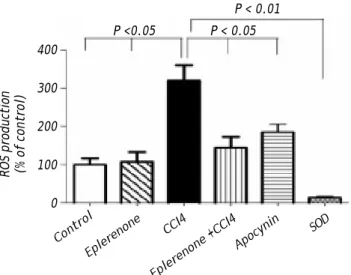
Figure 3. ROS production assessment: control and CCl4-treated groups, in the absence or presence of eplerenone. Va-lues of each bar represent the mean ± SEM. ROS production measured by lucigenin-enhanced chemiluminescence (5 µM) and expressed as arbitrary light unit (percentage of control). ROS production was markedly increased following to CCl4 treatment and eplerenone as well as apocynin inhibited this enhanced ROS generation. In a separate experiment tissue ho-mogenates were incubated with SOD (200 U/mL) for the indi-cated time, and the signal was completely inhibited. Values of each bar represent the mean ± SEM. *P < 0.05; **P < 0.01 com-pared to control values.
In addition, CCl4 showed a significant decrease in the hepatic GSH levels; however, eplerenone resto-red GSH almost to its control level (Figure 2).
Figure 3, this figure illustrates that eplerenone inhibited ROS production. ROS production was mea-sured by the chemiluminescence enhanced by lucige-nin (5 µM) and was marked in liver homogenates of rats treated CCl4. Additionally, apocynin as NADPH oxidase inhibitor, significantly inhibited ROS gene-ration in CCl4-induced liver injury nearly to the con-trol level. To verify the specificity of the chemiluminescence signals enhanced by lucigenin, separate series of experiments using tissue homoge-nates were performed by incubation with SOD (200 U/mL) for the indicated time, and the signal was completely inhibited.
Estimation of serum TNF-αα level
CCl4 produced a significant increase in serum TNF-a level, while pretreatment with eplerenone in-hibited this change (Figure 4).
Histopathological examination
Hematoxylin and eosin histological slides were evaluated by a blinded investigator and analyzed using a semi-quantitative score for inflammation. In control group, there were no pathological changes in healthy control livers which showed normal lobu-ROS production (% of control)
400
300
200
100
0
Control Eplerenone
CCI4
Eplerenone +CCI4 P <0.05 P < 0.05
Apocynin
SOD P < 0.01
Hepatic GSH level (nmol/mg. protein)
(% of control)
100
75
50
25
0
Control Eplerenone CCI4
Eplerenone +CCI4
P < 0.05 P < 0.05
Serum
TNF-α
level (pmol/ml)
(% of control)
400
300
200
100
0
Control Eplerenone CCI4
lar architecture with central vein and radiating he-patic cords (Figure 5).
The histological examination of the liver showed distorted architecture with distorted central vein and multifocal areas of coagulative necrosis along the hepatic parenchyma in CCl4-treated group. The lesions in the liver of CCl4 group pre-treated with eplerenone were attenuated except for congestion of some portal blood vessels, and few cells with vacuo-lated cytoplasm.
DISCUSSION
CCl4 has been widely used to induce experimental hepatic damage as it induces liver cell necrosis and apoptosis, and can be used to induce hepatic fibrosis or cirrhosis by its repetitive administration.33 We
verified the hepatotoxicity of CCl4 by the increased serum aminotransferases and decreased albumin le-vels compared to that of the control group. Raised serum enzyme levels in CCl4-injected rats can be at-tributed to the damaged hepato-cellular structural integrity.34 Here, we try to investigate the relevance
of using the MR antagonist, eplerenone in hepato-protection of CCl4-induced liver injury and the un-derlying mechanism of this protection. Of interest, eplerenone administration not only restored the
serum aminotransferases to that of control levels but also the serum albumin level as well.
It is noteworthy that oxidative stress and lipid pe-roxidation mediated by oxygen free radicals has been implicated as a common link between chronic liver damage and hepatic fibrosis.35 Reactive oxygen
me-tabolites are shown to mediate microvascular distur-bances by various chemical substances.36
During the initial phase of CCl4 toxicity following its administration, a large amount of CCl4 is conver-ted to trichloromethyl radical or other radicals, which in turn accelerate several metabolic pathways.37
These radicals appear to affect the adjacent lipids in the tissues and induce lipid peroxidation.
Hepatocytes are well recognized as being conti-nuously exposed to ROS in various liver diseases in-cluding cholestasis. Antioxidant molecules such as GSH and anti-oxidative enzymes such as SOD, and catalase, ordinarily provide hepatocytes with resis-tance to oxidative stresses.38 In the present study,
roxidation are involved in the pathogenesis of liver injury.39
On the other hand, aldosterone can increase oxi-dative stress by both increasing ROS production and reducing ROS scavenging capacity of the cells.40
A reduction in antioxidant capacity can also parti-cipate in the increase in oxidative stress induced by aldosterone since we have observed that eplerenone is able to increase glutathione levels in hypertensive rats, the most important systemic antioxidant agent.41 Interestingly, the current study revealed
that eplerenone was able to normalize the elevated biochemical oxidative stress markers, ROS produc-tion and restore GSH normal level that plays an im-portant role in the antioxidant defence mechanism in liver of CCl4–treated rats, suggesting antioxidant properties of eplerenone. Hence, the hepatoprotective effect of eplerenone appears to be due to the suppres-sion of oxidative stress and lipid peroxidation.
Recently, it has been demonstrated that spironola-ctone decreased aldosterone-induced oxidative stress via activation NADPH oxidase enzyme as a major source of ROS thereby reducing cardio-vascular-renal damage.42 According to this concept, an eligible
ex-planation to the inhibitory effect of eplerenone on ROS production may be, at least, owing to inhibition of NADPH oxidase enzyme. This assumption is evi-dent by the ability of the NADPH oxidase inhibitor, apocynin to inhibit ROS generation -induced by CCl4 in liver homogenates.
An increasing number of evidence indicates that activation of the MR has been implicated in media-ting the inflammation observed in vessels, heart and renal cortex of rodent models of diabetes and hyper-tension.43-45 MR blockages reduced expression of
pro-inflammatory and pro-thrombotic factors in adi-pose tissue and increased expression of adiponectin in heart and adipose tissue of obese, diabetic mice.46
Moreover, administration of spironolactone attenua-ted TNF-α level in chronic constriction injury may be due to its anti-inflammatory properties.47
Fur-ther, it has been reported that the central adminis-tration of spironolactone prevented the rise in TNF-α in the heart failure model.48 Because TNF-α
appears early in the cytokine cascade,49 it has been
suggested that other proinflammatory cytokines might also be reduced. Data from the present study support that concept we have shown that pretreat-ment with eplerenone to CCl4-induced liver injury group abrogated TNF-α level. This effect may be ac-counted for the anti-inflammatory properties of eple-renone. The present study demonstrates a potential role of MR blockage in attenuation of the
inflamma-tory process. This role is supported by the fact that the administration of MR antagonist reduced athe-rosclerotic lesion in different models of atherosclero-sis.50-52 This reduction in atherosclerotic process
was accompanied by a reduction of inflammatory markers.51,52
Noteworthy, the histopathological findings com-plemented the results of CCl4 on the liver as evident by the hepatic necrosis, diffuse fatty changes, portal fibrosis and mononuclear cell infiltration. Such le-sions were induced via the formation of free radi-cals, especially the ROS. Importantly, the damaging effects of CCl4 were subsided and attenuated on pre-treatment with eplerenone. Thus, anti-oxidative stress and anti-inflammatory properties of eplereno-ne appears to play a key role in the attenuation of inflammation, and then preserve the structural inte-grity of the hepatocellular membrane resulting in amelioration of liver enzyme functions such as ami-notransferases and ALP.
CONCLUSION
In conclusion, the present study demonstrated a potential protective effect of MR antagonist, eplereno-ne in liver injury-induced by CCl4. The corresponding mechanisms of this protection may be mediated via anti- inflammatory and anti-oxidative stress proper-ties of MR blockage by eplerenone. Thus, eplerenone might have promising beneficial anti-oxidative and anti-inflammatory effects thereby protecting against liver damage. Nevertheless, larger prospective clinical studies to determine the therapeutic effects of eplere-none in liver injury may be warranted.
ACKNOWLEDGMENT
We are grateful to Prof. Kawkaab A. Abd elaziz, Department of Pathology, Faculty of Veterinary Medicine, Cairo University for her kind help in per-forming histopathological studies and interpretation of the results.
REFERENCES
1. Struthers AD, MacDonald TM: Review of aldosterone- and angiotensin II-induced target organ damage and preven-tion. Cardiovasc Res 2004; 61: 663-70.
2. Fujisawa G, Muto S, Okada K, Kusano E, Ishibashi S. Mine-ralocorticoid receptor antagonist spironolactone pre-vents pig serum-induced hepatic fibrosis in rats. Transl Res 2006; 148: 149-56.
4. Marney AM, Brown NJ. Aldosterone and end-organ damage.
Clin Sci (Lond) 2007; 113: 267-78.
5. Mathew JT, Patni H, Chaudhary AN, Liang W, Gupta A, Chander PN, Ding G, et al. Aldosterone induces mesangial cell apoptosis both in vivo and in vitro. Am J Physiol Renal Physiol 2008; 295: F73-F81.
6. Ishizawa K, Izawa Y, Ito H, Miki C, Miyata K, Fujita Y, Ka-nematsu Y, et al. Aldosterone stimulates vascular smooth muscle cell proliferation via big mitogen-activated protein kinase 1 activation. Hypertension 2005; 46: 1046-52. 7. Lee BS, Kim NJ, Jeong HY, Lee HY, Kang DY, Noh SM:
Chan-ges in serum cytokine concentration: a morphological stu-dy of liver cirrhosis induced by common bile duct ligation in rats. Korean J Intern Med 2003; 18(1): 12-6.
8. Callera GE, Touyz RM, Tostes RC, Yogi A, He Y, Malkinson S, Schiffrin EL. Aldosterone activates vascular p38MAP ki-nase and NADPH oxidase via c-Src. Hypertension 2005; 45: 773-9.
9. Patni H, Mathew JT, Luan L, Franki N, Chander PN, Singhal PC. Aldosterone promotes proximal tubular cell apoptosis: role of oxidative stress. Am J Physiol Renal Physiol 2007; 293: F1065-F1071.
10. Nishiyama A, Kusaka T, Kitajima H. Role of aldosterone in oxidative stress and renal injury. Yakugaku Zasshi 2007; 127: 1331-7.
11. Li X, Meng Y, Wu P, Zhang Z, Yang X. Angiotensin II and Aldosterone stimulating NF-kappaB and AP-1 activation in hepatic fibrosis of rat. Regul Pept 2007; 138: 15-25. 12. Neves MF, Amiri F, Virdis A, Diep QN, Schiffrin EL. Role of
aldosterone in angiotensin II-induced cardiac and aortic inflammation, fibrosis, and hypertrophy. Can J Physiol Pharmacol 2005; 83: 999-1006.
13. Vallon V, Wyatt AW, Klingel K, Huang DY, Hussain A, Ber-chtold S, Friedrich B, et al. SGK1-dependent cardiac CTGF formation and fibrosis following DOCA treatment. J Mol Med (Berl) 2006; 84: 396-404.
14. Ueki M, Koda M, Yamamoto S, Matsunaga Y, Murawaki Y. Preventive and therapeutic effects of angiotensin II type 1 receptor blocker on hepatic fibrosis induced by bile duct ligation in rats. J Gastroenterol 2006; 41: 996-1004. 15. Remuzzi G, Cattaneo D, Perico N. The aggravating
mecha-nisms of aldosterone on kidney fibrosis. J Am Soc Nephrol
2008; 19: 1459-62.
16. Terui Y, Saito T, Watanabe H, Togashi H, Kawata S, Kama-da Y, Sakuta S. Effect of angiotensin receptor antagonist on liver fibrosis in early stages of chronic hepatitis C. He-patology 2002; 36(4 Pt. 1): 1022.
17. Yokohama S, Yoneda M, Haneda M, Okamoto S, Okada M, Aso K, Hasegawa T, et al. Therapeutic efficacy of an an-giotensin II receptor antagonist in patients with nonalco-holic steatohepatitis. Hepatology 2004; 40: 1222-5. 18. Ueki M, Koda M, Shimizu T, Mitsuta A, Yamamoto T,
Mu-rawaki Y. Effect of an angiotensin-II type-1 receptor blocker, candesartan on hepatic fibrosis in chronic hepa-titis C: a prospective study. Hepatogastroenterology
2009; 56: 1100-4.
19. Oberti F, Rifflet H, Maiga MY, Pilette C, Gallois Y, Douay O, et al. Prevention of portal hypertension by propranolol and spironolactone in rats with bile duct ligation. J Hepa-tol 1997; 26: 167-73.
20. Oberti F, Pilette C, Rifflet H, Maiga MY, Moreau A, Gallois Y, Girault A, et al.Effects of simvastatin, pentoxifylline and spironolactone on hepatic fibrosis and portal hypertension in rats with bile duct ligation. J Hepatol 1997; 26: 1363-71. 21. White WB, Carr AA, Krause S, Jordan R, Roniker B, Oigman
W. Assessment of the novel selective aldosterone blocker
eplerenone using ambulatory and clinical blood pressure in patients with systemic hypertension. Am J Cardiol 2003; 92: 38-42.
22. Flack JM, Oparil S, Pratt JH, Roniker B, Garthwaite S, Klei-man JH, Yang Y, et al. Efficacy and tolerability of eplere-none and losartan in hypertensive black and white patients. J Am Coll Cardiol 2003; 41: 1148-55.
23. Nehme J, Mercier N, Labat C, Benetos A, Safar ME, Delca-yre C, Lacolley P. Differences between cardiac and arte-rial fibrosis and stiffness in aldosterone-salt rats: effect of eplerenone. J Renin Angiotensin Aldosterone Syst
2006; 7: 31-9.
24. Rastogi S, Mishra S, Zaca V, Alesh I, Gupta RC, Goldstein S, Sabbah HN. Effect of long-term monotherapy with the al-dosterone receptor blocker eplerenone on cytoskeletal proteins and matrix metalloproteinases in dogs with heart failure. Cardiovasc Drugs Ther 2007; 21: 415-22.
25. Nishioka T, Suzuki M, Onishi K, Takakura N, Inada H, Yos-hida T, Hiroe M, et al. Eplerenone attenuates myocardial fibrosis in the angiotensin II-induced hypertensive mouse: involvement of tenascin-C induced by aldosterone-media-ted inflammation. J Cardiovasc Pharmacol 2007; 49: 261-8. 26. Weber T, Dalen H, Andera L, Negre-Salvayre A, Auge N, Sti-cha M, Lloret A, et al. Mitochondria play a central role in apoptosis induced by alpha-tocopheryl succinate, an agent with antineoplastic activity: comparison with re-ceptor-mediated pro-apoptotic signaling. Biochemistry
2003; 42: 4277-91.
27. Matono T, Koda M, Tokunaga S, Sugihara T, Ueki M, Murawaki Y. The effects of the selective mineralocorticoid receptor antagonist eplerenone on hepatic fibrosis induced by bile duct ligation in rat. Int J Mol Med 2010; 25: 875-82. 28. Reitman S, Frankel S. A colorimetric method for the
deter-mination of serum glutamic oxalacetic and glutamic pyru-vic transaminases. Am J Clin Pathol 1957; 28: 56-63. 29. Eaton RH. Plasma alkaline phosphatase assay:
intercon-version of results by two methods. Clin Chem 1977; 23: 2148-50.
30. Merino RA, Lalive J, Parga GL. Critical analysis of bilirubi-nemia and diagnostic value of direct bilirubin determina-tion by the Malloy-Evelyn method. RevMed Chil 1968; 96: 794-8.
31. Buege JA, Aust SD. Microsomal lipid peroxidation. Methods Enzymol 1978; 52: 302-10.
32. El-Sherbiny GA, Taye A, Abdel-Raheem IT. Role of ur-sodeoxycholic acid in prevention of hepatotoxicity caused by amoxicillin-clavulanic acid in rats. Ann Hepatol 2009; 8: 134-40.
33. Constandinou C, Henderson N, Iredale JP. Modeling liver fibrosis in rodents. Methods Mol Med 2005; 117: 237-50. 34. Xu Q, Shen YP, Xu AL. Cystic degeneration in liver injury
induced by CCl4 in SD rats. Zhongguo Zhong Yao Za Zhi
2006; 31: 1880-1.
35. Di Sario A, Bendia E, Omenetti A, De Minicis S, Marzioni M, Kleemann HW, Candelaresi C, et al. Selective inhibition of ion transport mechanisms regulating intracellular pH redu-ces proliferation and induredu-ces apoptosis in cholangiocarci-noma cells. Dig Liver Dis 2007; 39: 60-9.
36. Granger DN, Hollwarth ME, Parks DA. Ischemia-reperfusion injury. role of oxygen-derived free radicals. Acta Physiol Scand Suppl 1986; 548: 47-63.
37. Stoyanovsky DA, Cederbaum AI. Metabolism of carbon te-trachloride to trichloromethyl radical: An ESR and HPLC-EC study. Chem Res Toxicol 1999; 12: 730-6.
carpio L.) to the toxicity of microcystin-LR. Toxicon
2003; 42: 85-9.
39. Alptekin N, Mehmetcik G, Uysal M, Aykac-toker G. Eviden-ce for oxidative stress in the hepatic mitochondria of bile duct ligated rats. Pharmacol Res 1997; 36 (3): 243-7. 40. Li X, Meng Y, Yang XS, Wu PS, Zhang ZS. Aldosterone
stimu-lating PDGF-B expression in HSC via activation of EGR-1.
Zhonghua Gan Zang Bing Za Zhi 2005; 13: 567-70.
41. Sanz-Rosa D, Oubina MP, Cediel E, De las Heras N, Aragon-cillo P, Balfagon G, Cachofeiro V, et al. Eplerenone reduces oxidative stress and enhances eNOS in SHR: vascular func-tional and structural consequences. Antioxid Redox Signal
2005; 7(9-10): 1294-301.
42. Park YM, Lim BH, Touyz RM, Park JB. Expression of NAD(P)H oxidase subunits and their contribution to car-diovascular damage in aldosterone/salt-induced hyperten-sive rat. J Korean Med Sci 2008; 23: 1039-45.
43. Rocha R, Stier CT Jr., Kifor I, Ochoa-Maya MR, Rennke HG, Williams GH, Adler GK. Aldosterone. a mediator of myocar-dial necrosis and renal arteriopathy. Endocrinology 2000; 141: 3871-8.
44. Pitt B, Zannad F, Remme WJ, Cody R, Castaigne A, Perez A, Palensky J, et al. The effect of spironolactone on morbi-dity and mortality in patients with severe heart failure. Randomized Aldactone Evaluation Study Investigators. N Engl J Med 1999; 341: 709-17.
45. Pitt B, Reichek N, Willenbrock R, Zannad F, Phillips RA, Ro-niker B, Kleiman J, et al. Effects of eplerenone, enalapril, and eplerenone/enalapril in patients with essential
hyper-tension and left ventricular hypertrophy: the 4E-left ven-tricular hypertrophy study. Circulation 2003; 108: 1831-8. 46. Guo C, Ricchiuti V, Lian BQ, Yao TM, Coutinho P, Romero
JR, et al. Mineralocorticoid receptor blockade reverses obesity-related changes in expression of adiponectin, peroxisome proliferator-activated receptor-gamma, and proinflammatory adipokines. Circulation 2008; 117: 2253-61.
47. Jaggi AS, Singh N. Differential effect of spironolactone in chronic constriction injury and vincristine-induced neuro-pathic pain in rats. Eur J Pharmacol 2010; 648: 102-9. 48. Francis J, Weiss RM, Johnson AK, Felder RB. Central
mine-ralocorticoid receptor blockade decreases plasma TNF-al-pha after coronary artery ligation in rats. Am J Physiol Regul Integr Comp Physiol 2003; 284: R328-R335.
49. Chrousos GP. The stress response and immune function: clinical implications. The 1999 Novera H. Spector Lecture.
Ann N Y Acad Sci 2000; 38: 917-67.
50. Rajagopalan S, Duquaine D, King S, Pitt B, Patel P. Minera-locorticoid receptor antagonism in experimental atheros-clerosis. Circulation 2002; 105: 2212-6.
51. Takai S, Jin D, Muramatsu M, Kirimura K, Sakonjo H, Miya-zaki M. Eplerenone inhibits atherosclerosis in nonhuman primates. Hypertension 2005; 46: 1135-9.