Immunometabolic Effect of
Cholesterol in Hepatitis C Infection:
Implications in Clinical Management and Antiviral Therapy
Karina González-Aldaco, Luis A. Torres-Reyes, Claudia Ojeda-Granados, Alexis José-Ábrego, Nora A. Fierro, Sonia Román
Department of Molecular Biology in Medicine, Civil Hospital of Guadalajara, “Fray Antonio Alcalde” and Health Sciences Center, University of Guadalajara, Guadalajara, Jalisco, Mexico.INTRODUCTION
Hepatitis C virus (HCV) infection is one of the leading
causes of chronic liver damage worldwide, at least 180
mil-lion people are infected with the virus, and it causes
ap-proximately 399,000 deaths every year.
1Eradication of
HCV depends on several factors of the host and the virus
that influence both the natural and
pharmacologically-in-duced clearance of HCV in the infected patient. Among
these are the host immune system and body metabolism
which are continuously in communication to detect and
eradicate different types of pathogens.
2A delicate balance
between both systems is required to eliminate invading
pathogens effectively.
3HCV is a small virus that restrings
its infection to the liver, the metabolic organ by
excel-lence.
4The hepatitis C life cycle stages such as
transporta-tion, entry, replicatransporta-tion, translatransporta-tion, assembly, and release
are accomplished through hepatic lipid pathways,
5and to
meet the substrate and energy requirements that it
de-mands, HCV hijacks the hepatocytes metabolic
machin-ery.
6In consequence, patients with long-term infection
develop excessive fat accumulation in the hepatocytes; in
fact, steatosis is a histopathological feature typically found
in patients with hepatitis C.
7,8Chronic inflammation and
excess fat triggered directly by HCV are responsible for
fi-brosis, cirrhosis and eventually hepatocellular carcinoma.
9The first line of defense against HCV infection is
orches-trated by the innate immune response,
10which is carried
out by resident liver macrophages and dendritic cells that
establish an interferon (IFN) antiviral state.
11During this
The Official Journal of the Mexican Association of Hepatology, the Latin-American Association for Study of the Liver and
the Canadian Association for the Study of the Liver
Manuscript received: Manuscript received: Manuscript received: Manuscript received:
Manuscript received: July 07, 2018. Manuscript accepted:Manuscript accepted:Manuscript accepted:Manuscript accepted:Manuscript accepted: September 04, 2018.
DOI:10.5604/01.3001.0012.7191 A B S T R A C T A B S T R A C T A B S T R A C T A B S T R A C T A B S T R A C T
Hepatitis C virus (HCV) is a lipid-enveloped virion particle that causes infection to the liver, and as part of its life cycle, it disrupts the host lipid metabolic machinery, particularly the cholesterol synthesis pathway. The innate immune response generated by liver resident immune cells is responsible for successful viral eradication. Unfortunately, most patients fail to eliminate HCV and progress to chronic infection. Chronic infection is associated with hepatic fat accumulation and inflammation that triggers fibrosis, cirrhosis, and eventually hepatocellular carcinoma. Despite that the current direct-acting antiviral agents have increased the cure rate of HCV infection, viral genotype and the host genetic background influence both the immune response and lipid metabolism. In this context, recent evidence has shown that cholesterol and its derivatives such as oxysterols might modulate and potentialize the hepatic innate immune response generated against HCV. The impairment of the HCV life cycle modulated by serum cholesterol could be relevant for the clinical management of HCV-infected patients before and after treatment. Alongside, cholesterol levels are modulated either by genetic variations in IL28B, ApoE, and LDLR or by dietary components. Indeed, some nutrients such as unsaturated fatty acids have demonstrated to be effective against HCV replication. Thus, cholesterol modifications may be considered as a new adjuvant strategy for HCV infection therapy by providing a biochemical tool that guides treatment decisions, an improved treatment response and favoring viral clearance. Herein, the mechanisms by which cholesterol contributes to the immune response against HCV infec-tion and how genetic and environmental factors may affect this role are reviewed.
Key words. Key words.Key words. Key words.
stage, the immune response also targets lipid pathways as a
strategy for successful viral eradication.
12A strong but
con-trolled immune response allows that a small rate of patients
spontaneously clear the infection.
13Nevertheless, most
pa-tients cannot evade virus replication and develop chronic
disease.
14However, if they are treated with direct-acting
an-tiviral agents (DAAs) regimens, patients will achieve high
rates of sustained virological response (SVR).
15At current, there are several approved DAAs that have
reached high efficacy in treatment against HCV infection.
16-18Nonetheless, the management of HCV infection has
sev-eral caveats to defeat even with the new DDAs such as their
high costs,
19,20the regional prevalence of difficult-to-treat
genotypes such as genotype 1a
21,22and the emergence of
an-tiviral-resistant mutations.
23Consequently, a high
propor-tion of patients around the world who are treatment-naïve
are at risk to develop complications of chronic infection.
20Therefore, understanding the synergic interactions between
lipid pathways and innate immune response involved in the
HCV life cycle may provide novel host therapeutic targets
before and after treatment with DAAs. Also, host
therapeu-tic targets could have the potential to be applied in all
pa-tients independently of viral genotype.
Gene expression studies have revealed that host
im-mune and metabolic genes are differentially regulated
dur-ing the early stages of the infection and this expression
correlated with the clearance of the virus.
24-26Recent
in-vestigations have shown that cholesterol and cholesterol
derivatives play a central role in the activation and
orches-tration of the innate immune response against HCV
infec-tion.
27,28Therefore, cholesterol modulation represents a
promissory strategy for the clinical management of
chron-ic patients before and after treatment. Also, it has been
re-ported that cholesterol levels could be modulated either
by variations of
IL28B, ApoE,
and
LDLR
host genes or by
dietary components.
29Thus, cholesterol modifications
may provide a plausible biochemical tool for making
treat-ment decisions, improving treattreat-ment response and
favor-ing viral clearance. This review summarizes the different
mechanisms by which cholesterol and cholesterol
deriva-tives modulate the innate immune response against HCV
and how genetic and environmental factors affect this
in-teraction.
HCV LIFE CYCLE AND
UP-REGULATION OF CHOLESTEROL
AND FATTY ACID BIOSYNTHESIS
HCV is a lipid-enveloped, positive-sense,
single-stranded RNA virus belonging to the
Hepacivirus
genus
within the
Flaviviridae
family.
30HCV life cycle is mainly
restricted to the liver which plays a key role in cholesterol
homeostasis.
3,31Hepatocytes obtain cholesterol by
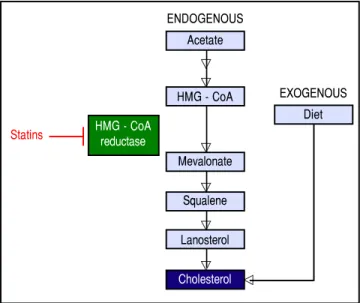
endog-enous synthesis via the mevalonate pathway or external
sources from the diet (Figure 1).
32In the latter,
cholester-ol is internalized into the liver by low-density lipoprotein
(LDL) ligated to the low-density lipoprotein cholesterol
receptor (LDLR).
33,34After infection, HCV enters the
bloodstream and binds to the lipoproteins rich in
choles-terol esters which contain surface apolipoproteins E and
B; this complex is termed lipoviroparticle (LVP).
35LVPs
make HCV undetectable to antibodies and serum
comple-ment.
36Also, apolipoproteins of the LVP play a key role
on virus attachment and entry into the hepatic cells, since
they are ligands of the LDLR and other hepatic
lipid-core-ceptors.
37,38The intrahepatic HCV life cycle is highly
de-pendant on hepatic cholesterol and lipogenesis pathways.
39During infection, HCV upregulates host lipid metabolism
by a variety of molecular mechanisms which may
eventu-ally contribute to the development of hepatic steatosis that
occurs in almost 55% of HCV-infected patients.
6In
gener-al, an intracellular environment rich in lipids including
cholesterol is necessary for a successful HCV life cycle.
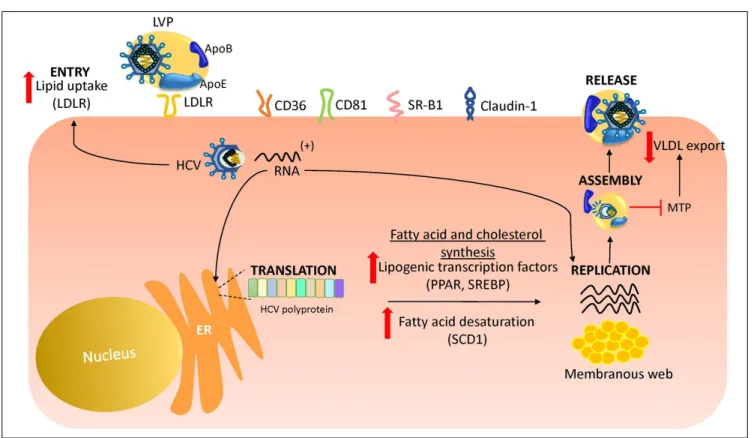
3As shown in figure 2, HCV uses LDLR and other lipid
re-ceptors expressed in hepatocytes surface (CD36, CD81,
SR-B1, claudin-1) on entry.
40,41Once inside, HCV
increas-es lipogenincreas-esis
de novo
and cholesterol biosynthesis via
acti-vation of the transcriptional factor sterol regulatory
element-binding protein (SREBP) and reduces lipid
ex-port via the very-low density lipoproteins (VLDL).
42,43SREBP is an endoplasmic reticulum membrane-bound
transcription factor that activates genes encoding enzymes
Figure 1.Figure 1.Figure 1. Figure 1.
Figure 1. Endogenous synthesis and exogenous acquisition of cholesterol. Schematic representation of endogenous cholesterol synthesis and exogenous cholesterol acquisition from the diet. Statins impairs cholesterol synthesis through the inhibition of HMG-CoA reductase enzyme activity. Statins indirectly impairs HCV genome replication. HMG-CoA: 3-hydroxy-3-methylglutharyl-coenzyme A.
ENDOGENOUS Acetate
HMG - CoA
Mevalonate
Squalene
Lanosterol
Cholesterol Statins
EXOGENOUS Diet
of cholesterol and fatty acid biosynthesis.
44,45During its
replication HCV induces the activity of stearoyl
coen-zyme A desaturase 1 (SCD1), an encoen-zyme that catalyzes the
synthesis of monounsaturated fatty acids such as oleic
acid.
46SCD1 is required for formation and regulation of
HCV replication complex as its inhibition blocks HCV
replication.
47Like other positive-sense RNA viruses,
HCV life cycle needs a membrane web folding in the
cyto-plasm.
48This membrane web formation is dependent on
the regulation of the cholesterol and unsaturated fatty acids
metabolism.
49Finally, HCV also reduces lipid export by
interfering VLDL excretion.
43Thus, low levels of total
cholesterol, LDL, VLDL and lipoproteins are found in the
serum of chronic HCV patients.
50Hepatocellular lipid
storage (steatosis) appears to be a direct consequence of
HCV genotype 3. However, other genotypes have been
as-sociated with metabolic syndrome and obesity.
51Interest-ingly, recent reports have shown that the immune
response stimulates specific metabolic pathways to
de-crease the rate of HCV replication,
52,53a finding that
high-lights the potential role of metabolism as a target for the
inhibition of HCV infection.
EFFECT OF CHOLESTEROL
AND CHOLESTEROL DERIVATIVES ON
INNATE IMMUNE RESPONSE
DURING HCV INFECTION
Total cholesterol and LDL
A strong innate immune response against HCV during
the acute phase is responsible for natural HCV clearance.
54Bench to bedside research has provided increasing
evi-dence about the cross-talk between cholesterol and
immu-nity.
2,55In the context of HCV infection, recently,
cholesterol and its derivatives have emerged as
immu-nomodulators that potentialize the innate immune
re-sponse and may favor the natural or treatment-induced
clearance of the virus.
28,56There is evidence that
cholester-ol promotes the formation of tcholester-oll-like receptor (TLR)
4-MD2 and TLR4-CD14 complexes, which are responsible
for recognizing lipopolysaccharides as part of the innate
immune response.
57A study performed in an
HCV-pro-ducing B-cell line derived from an HCV
+non-Hodgkin’s
lymphoma, demonstrated that activation of TLR4 by
Figure 2. Figure 2. Figure 2. Figure 2.
HCV infection triggers the expression of IFN-beta and
interleukin-6 (IL-6) in B cells.
58Since IL-6 leads
inflam-matory processes and IFN induces an antiviral state in
HCV infection,
59,60these findings suggest that cholesterol
can play an indirect role in HCV eradication by
con-tributing to the host’s innate immune response. Also,
through Vero cells culture infected with WNV
KUNstrain
MRM61C or WNV
NY99it was demostrated that changes in
the intracellular distribution of cholesterol could disrupt
lipid rafts and modulate the IFN JAK-STAT signaling
pathway during
Flavivirus
infections.
61Similarly, it has
been recently demonstrated in patients infected by
geno-type 1 that LDL increased interferon sensitivity.
62,63Also,
high LDL levels correlate with IFN activity; this finding
was demonstrated through the detection of
IFN-gamma-inducible protein 10 (IP10), a chemokine induced by IFN
and produced by T cells, monocytes and natural killer
cells after HCV infection.
64Thus, it is plausible that high
serum LDL levels could participate in inducing innate
immune response and favoring natural clearance. Another
plausible mechanism in which LDL can prevent HCV
in-fection is by direct competition with the attachment and
entry of the virus through the membrane surface
lipo-receptors on the hepatocyte, mainly LDLR.
27Lastly, gene
polymorphisms of cholesterol metabolism could be an
important factor in the variations of cholesterol and LDL
levels which can also affect the immunoregulatory effect
of cholesterol.
65Some of the most important
polymor-phisms in genes related to HCV outcome are described in
the next sections.
Oxidized-LDL
Oxidized-LDL (ox-LDL), a naturally occurring
deriva-tive of naderiva-tive LDL that has undergone oxidaderiva-tive
modifica-tion, is a potent endogenous inhibitor of HCV cell entry in
all genotypes.
66Ox-LDL inhibits in a non-competitive
manner the binding of HCV with class B scavenger
recep-tor I (SR-BI), an essential receprecep-tor for HCV attachment.
Thus, ox-LDL can inhibit cell-to-cell spread
in vitro
.
66Furthermore, it has been demonstrated that ox-LDL
di-rectly modifies viral particle morphology. However, the
exact mechanism has not been elucidated.
67The
participa-tion of ox-LDL in HCV cycle is evident since chronic
Figure 3. Figure 3.Figure 3.
HCV-patients have higher serum levels of ox-LDL than
control subjects
68and high ox-LDL before treatment has
demonstrated to have an impact on increasing the SVR of
treatment with peg-IFN plus Ribavirin.
69Also, it was
re-ported that 8.85 mU/L of ox-LDL is the optimal cutoff in
serum to reach adequate SVR.
69Besides, ox-LDL is engulfed by macrophages which
amplify the TLR-4 signaling.
70Increased TLR-4 activity
leads to the augmented production of cytokines,
chemok-ines and inflammasome activation. Thus ox-LDL could be
responsible for an increased immune response. However,
it is necessary to elucidate if it can trigger liver damage.
Given its potential involvement in the pathogenesis of
atherosclerosis, ox-LDL is an unlikely indirect
therapeu-tic component. Nonetheless, molecules that mimic its
anti-HCV mechanism would be an attractive indirect
ther-apeutic against HCV infection.
Oxysterols
Oxysterols are a family of metabolite derivatives of
cholesterol oxidation that present remarkable diverse
bio-logical activities.
28To date, three naturally occurring
oxys-terols, 24-hydroxycholesterol (HC), 25-HC and 27-HC
have been recognized. Of these, 25-HC plays a key role in
the regulation of different cellular process such as lipid
metabolism, modulation of immune response and
sup-pression of viral pathogenesis.
71It was recently reported
that 25-HC is part of the primary immune response
against HCV infection since it regulates IFN response.
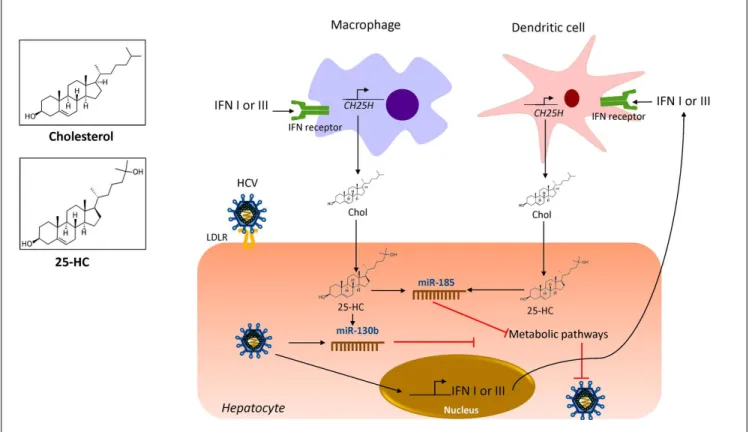
53As shown in figure 3, during HCV infection, IFN I or III
induce the production of 25-HC by dendritic cells and
macrophages residents of the liver.
72IFN induces the
ex-pression of the cholesterol 25-hydroxylase (CH25H)
en-zyme, which catalyzes the oxidation of cholesterol to
25-HC by the addition of a hydroxyl group on the side
chain.
73Once secreted, 25-HC may exert its antiviral effect in
an autocrine or paracrine manner. Inside the hepatocyte,
25-HC stimulates the secretion of two hepatic
microR-NAs (miRmicroR-NAs), miR130b and miR-185 (Figure 3).
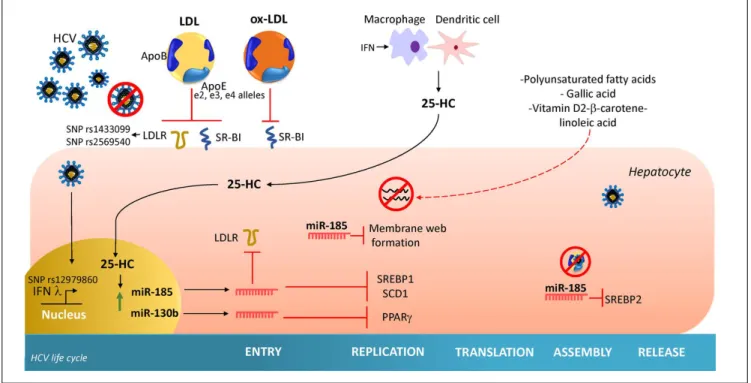
28miR-185 decreases mRNA expression of several lipid targets
known to encode proteins critical for different stages of
HCV life cycle such as, fatty acids and cholesterol
biosyn-thesis (SREBP), lipid uptake (LDLR, SR-B1) and fatty
acid desaturation (SCD1) (Figure 4).
74,75miR-185 can
in-hibit HCV replication through down-regulation of SCD1,
entry and cell transmission through SCARB1, replication,
and assembly through SREBP and entry and replication
through LDLR. Likewise, miR-130b can repress the
Figure 4. Figure 4. Figure 4. Figure 4.
expression of LDLR, and peroxisome
proliferator-activat-ed receptor gamma (PPAR
γ
).
28In addition to these
antivi-ral effects, CH25H and 25-HC may block membrane web
formation required for the successful HCV-replication
through miR-185 action. Also, using human hepatocellular
carcinoma cell line Huh7.5.1 and HCV-JFH1 strain
(geno-type 2a), it was demonstrated that CH25H inhibits
non-structural 5A (NS5A) dimer formation of the HCV
replication complex.
76Similarly, in Huh7.5 hepatoma cells
infected with JFH-1T and full-length genomic replicon
(genotype 1b) it was demonstrated that 25-HC might
in-hibit HCV replication in hepatocytes.
28Also, serum levels
of both CH25H and 25-HC were elevated in patients
in-fected with HCV.
77On the other hand, it has been
demon-strated that HCV counteracted 25-HC antiviral effects
through inhibition of miR-185 and miR130b expression.
28Collectively, this finding highlights the importance of
25-HC as a member of the immunometabolic process
gener-ated during HCV infection.
CHOLESTEROL EFFECT
ON THERAPY OF HCV INFECTION
The effect of baseline cholesterol levels on viral
clear-ance induced by antiviral treatment based on IFN +
riba-virin has been documented.
78Importantly, this effect also
remains with the new IFN-free DAAs.
62,79For example,
high levels of total cholesterol, LDL and body mass index
(BMI) were predictors of SVR and subsequent resolution
of liver damage on patients treated with peg-IFN or triple
therapy for genotype 1.
56,78,80,81Also, a rapid increment of
LDL in chronically-infected patients after the beginning
of IFN-free treatment was reported.
79This evidence
sup-ports the concept that suppression of HCV infection
would reduce the lipid droplets of infected hepatocytes
and rebound of serum LDL and total cholesterol in the
in-fected patient.
Statins were initially developed to treat patients with
hypercholesterolemia and its function at the molecular
level is to inhibit 3-hydroxy-3-metil-glutaryl-CoA
(HMG-CoA) reductase, the key regulatory enzyme of the
endogenous mevalonate pathway of cholesterol synthesis
(Figure 1).
82,83In this sense, HCV infected patients are at
risk of cardiovascular disease and statins utilization are
currently part of several guidelines to prevent
cardio-vascular events.
82Moreover, correlations between statins
and HCV life cycle has been reported. For instance,
in vitro
Fluvastatin impairs HCV genome replication through the
downregulation of CLDN-1 protein implicated in cell
en-try and in combination with IFN treatment its effect is
potentialized.
84In contracts, pravastatin showed a proviral
effect by upregulation the transcription of LDLR, then
fa-voring HCV infectivity.
85,86All those findings suggest that
modulation of metabolic machinery, specifically
choles-terol pathways, could be a reliable strategy to attack HCV
infection. In addition, this findings could be also extended
to another flavivirus members as, dengue and west Nile
viruses whose life cycles are also closely related with
cho-lesterol pathway.
61GENETIC MODULATION OF
CHOLESTEROL IN HCV INFECTION
The outcome of HCV infection is influenced by a
com-plex interaction between environmental, viral and host
fac-tors.
29Marked differences in HCV infection outcome have
been reported by ethnicity.
87-89Regarding genetic host
fac-tors, numerous single nucleotide polymorphisms (SNPs)
confer genetic susceptibility to chronic HCV infection or
clearance, worldwide (Figure 4).
90Thus, different grades of
association could be found between populations.
There-fore, genetic studies should be done to determine the
sus-ceptibility in each population to provide individualized
medicine.
91Genetic variants involved in cholesterol
home-ostasis that alter the expression and function of the proteins
may consequently influence HCV-infection result, some of
which are described below.
IL28B
Interleukin 28-B (IL28B) identified in 2003 belongs to
the interferon lambda family.
92This cytokine is released
by dendritic cells during HCV infection.
93The gene
en-coding IL28B is located at locus 19q13.13.
94Several
genome-wide association studies involving populations
with different ethnicities have demonstrated that SNP
rs12979860C/T in the promotor region is a variant highly
associated with clearance of the infection, naturally or
induced by treatment.
95-98This association have been
replicated in several individual studies carried out in
spe-cific populations around the world.
99-101Interestingly,
Li and coworkers in 2010, reported that rs12979860CC
genotype was associated with higher LDL, total cholesterol
and ApoB serum levels but low ApoE and LVP of patients
with chronic HCV infection.
102This association was
present only in subjects with active viremia whereas
patients who cleared the virus did not exhibit lipid
alterations.
102Although the exact mechanism of this
association remains unknown, we hypothesized that CC
genotype carriers in the presence of the virus could have
had lower IFN lambda activity or intrahepatic
interfer-on signaling; this hypothesis is reinforced by a study
showing that CC genotype carriers had low levels of
IP10 protein, an indirect chemokine marker of IFN
ac-tivity.
103However, the role that cholesterol plays in this
ApoE
HCV in serum is found attached to lipoproteins which
contain ApoE.
104HCV NS5A interacts with ApoE to bind
to the LVP. Indeed, silencing
ApoE
expression results in a
reduction of HCV infectivity, less entry and replication
processes.
105As shown in electron microscopy, ApoE is
abundant in the LVP surface and is the ligand of LDLR, thus
permitting the entry of HCV into the hepatocyte.
64,106ApoE
gene is located on chromosome 19, two SNPs rs429358C/T
and rs7412C/T located in exon 4 encode e2, e3, and e4
alle-les.
104The expression of these alleles produces the
corre-sponding e2, e3 and e4 isoforms which differ in an amino
acid residue. The e3 isoform presents cysteine at residue
112 (rs429358) and arginine at residue 158 (rs7412), while e2
contains a cysteine at both positions, and e4 has arginine at
both positions. The amino acid substitution changes the
af-finity of ApoE to the LDLR receptor. The isoform e2 shows
lower affinity for LDLR and decreases the entrance of HCV
into the hepatocyte compared to the e3 isoform that has a
natural affinity, whereas e4 isoform has higher affinity for
LDLR and allows a rapid entry into the hepatocyte. In
addi-tion to the different affinities, these isoforms show different
immune regulation.
107Low ApoE concentration is
associat-ed with early virological response in HCV patients and it
was demonstrated by the high expression of IP10.
62These
findings support the hypothesis that modulation of
choles-terol level could be used to limit HCV propagation. Also,
ApoE isoforms are related to different profiles of serum and
intrahepatic lipid levels.
108Some studies have reported the
association of e3 allele with chronic HCV infection,
109while the e4 allele has been associated with protection to
severe liver damage in HCV patients.
110However,
varia-tions of the
ApoE
alleles have been reported by ethnicity,
therefore, population studies are needed to clarify its
partic-ipation in HCV infection.
LDLR
Polymorphisms in the
LDLR
gene are associated with
familial hypercholesterolemia, atherosclerosis, and
obesi-ty.
111,112However, in the context of HCV infection, LDLR
recognizes the E2 viral protein and allows the HCV entry
to the cell.
33Two SNPs in the
LDLR
gene rs1433099A/G
and rs2569540G/C are associated with lower viral load and
lower levels of LDL and cholesterol in patients genotype 1
and 4.
113It has been reported an interaction between
IL28B and LDLR.
114Since IFN induces expression of
LDLR
gene that could be a reason why IFN treated
pa-tients have reduced serum cholesterol levels.
115Further-more, intracellular levels of HCV-RNA in primary
hepatocytes correlate with LDLR mRNA expression, and
the uptake of LDL particles.
33Since IFN can stimulate
soluble form of LDLR in cell culture and that soluble
LDLR can inhibit HCV infectivity, LDLR can exert an
an-tiviral effect against HCV infection.
116IMPACT OF DIETARY
COMPONENTS ON HCV REPLICATION
The effect of dietary components on the HCV life
cy-cle is mostly unknown. Since diet can modify serum lipid
levels, the study of their impact on HCV infection could
be considered as a strategy of HCV management. HCV
regulates by direct and indirect mechanisms the
expres-sion of several hepatic transcriptional factors involved in
lipid metabolism.
39At current, different nutrients have
demonstrated to down regulate the replication of HCV
in
vitro,
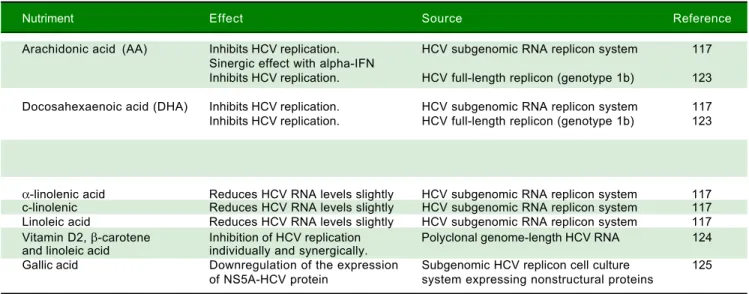
some of which are summarized in table 1 and figure 4.
Most of these nutrients are unsaturated fatty acids; in
con-trast, high levels of saturated fatty acids have been
re-ported to increases the rate of HCV replication
in vitro.
117Also, it has been reported that oxysterols might be
ac-quired through dietary animal fat. A recent
in vitro
study
demonstrated that exogenous 25-HC could also trigger
innate immune response.
118Thus, a diet composed of
nu-trients that have been related to inhibiting HCV
replica-tion could be considered as a therapeutic alternative
against host factors that promote HCV infection among
patients. However, more studies are needed in order to
evaluate their effect
in vivo.
Similarly, the importance of cholesterol diet
modifica-tions was demonstrated by a study performed in patients
with chronic hepatitis C. Chronic patients received a
nor-mocaloric low cholesterol diet for 30 days. The diet
re-stored the immune homeostasis and recovered the balance
between Th17 and Treg cells, subduing the exacerbation
that can induce chronic liver damage.
119As previously mentioned, high baseline levels of
cho-lesterol, triglycerides, and BMI are associated with high
rates of SVR in treatment with IFN and IFN-free
regi-mens. Both, cholesterol alterations and BMI are related to
obesity. Obesity prevalence has grown over the last
dec-ades worldwide. Obese adults are at high risk to present
high cholesterol and triglycerides level and decreased
high-density lipoprotein levels than normoweight
sub-jects.
120It has been hypothesized that in countries with
high rates of overweight and obesity like the United States
and Mexico, metabolic alterations could contribute to the
progression of the hepatitis C.
29In conjunction, dietary
CONCLUSIONS
In this review, the immunometabolic effect of
choles-terol in HCV infection was approached. In conjunction
with the pharmacological use of DDAs regimens, HCV
clearance may be enhanced by the immunoregulatory
ef-fect of cholesterol derivatives like 25-HC in the liver
resi-dent innate immune cells. The levels of cholesterol and
cholesterol derivatives may provide a potential tool for
making decisions on drug treatment and improve its
effi-cacy against HCV infection. LDL could be one of the
most promising pretreatment biochemical and metabolic
marker for predicting induced-SVR and natural HCV
clearance. The alterations of the host metabolic pathways
have the potential to define new strategies for the
develop-ment of aduyvant antiviral treatdevelop-ments.
However, it is important to keep in mind that the genes
encoding both the immune response
(IL28B)
and lipid
metabolic
(Apo E, LDLR)
pathways are host factors that
display adaptive structural variations (SNPs) that have a
heterogenic distribution throughout the populations
worldwide. On the other hand, the viral genotype also
dis-plays differences in lipid disruption, treatment response
and emergence of antiviral-resistant mutations.
Further-more, the modulatory effect of environmental factors such
as dietary composition on lipid abnormalities requires
at-tention. However, the food source and the amount of food
intake are parameters that may vary drastically by region.
Currently, the rising incidence of nutrition-related
diseas-es such as obdiseas-esity imposdiseas-es an additional risk factor that
can affect the course of the infection in HCV-infected
pa-tients with weight problems. Therefore, in the
implemen-tation of the novel strategies that have been reviewed it is
necessary to consider how these genetic and
environmen-tal factors modify the clinical management and the efficacy
of antiviral therapy of HCV infection. Further
investiga-tion based on these factors by populainvestiga-tion is needed to
achieve tailoring these strategies in an individualized
man-ner.
ABBREVIATIONS
• ApoE:
apolipoprotein E.
• BMI:
body mass index.
• CH25H:
cholesterol 25-hydroxylase.
• DAAs:
direct antiviral agents.
• HC:
24-hydroxycholesterol.
• HCV:
hepatitis C virus.
• IFN:
interferon.
• IP10:
IFN-gamma-inducible protein 10.
• LDL:
low-density lipoprotein.
• LDLR:
low-density lipoprotein cholesterol receptor.
• LVP:
lipoviroparticle.
• miRNAs:
microRNAs.
• ox-LDL:
oxidized-LDL.
• PPARγ:
peroxisome proliferator-activated receptor
gamma.
• SCD1:
stearoyl coenzyme A desaturase 1.
• SNPs:
single nucleotide polymorphism(s).
• SREBP:
sterol regulatory element-binding protein.
• SVR:
sustained virological response.
• TLR:
toll-like receptor.
• VLDL:
very-low density lipoprotein.
FINANCIAL SUPPORT
This work was supported by PRODEP-Universidad de
Guadalajara CA-478 to all authors.
Table 1. Nutrients with anti-HCV replicative activity.
Nutriment Effect Source Reference
Arachidonic acid (AA) Inhibits HCV replication. HCV subgenomic RNA replicon system 117 Sinergic effect with alpha-IFN
Inhibits HCV replication. HCV full-length replicon (genotype 1b) 123
Docosahexaenoic acid (DHA) Inhibits HCV replication. HCV subgenomic RNA replicon system 117 Inhibits HCV replication. HCV full-length replicon (genotype 1b) 123
Eicosapentaenoic acid (EPA) Inhibits HCV replication. HCV subgenomic RNA replicon system 117 Inhibits HCV replication. HCV full-length replicon (genotype 1b) 123
α-linolenic acid Reduces HCV RNA levels slightly HCV subgenomic RNA replicon system 117 c-linolenic Reduces HCV RNA levels slightly HCV subgenomic RNA replicon system 117 Linoleic acid Reduces HCV RNA levels slightly HCV subgenomic RNA replicon system 117 Vitamin D2, β-carotene Inhibition of HCV replication Polyclonal genome-length HCV RNA 124 and linoleic acid individually and synergically.
CONFLICT OF INTEREST
The authors declare no conflict of interest.
REFERENCES
1. WHO. Hepatitis C. 2018. Available from: http://wwwwhoint/ news-room/fact-sheets/detail/hepatitis-c
2. Hotamisligil GS. Inflammation and metabolic disorders. Na-ture2006; 444: 860-7.
3. Schertzer JD, Steinberg GR. Immunometabolism: the inter-face of immune and metabolic responses in disease. Immu-nol Cell Biol 2014; 92: 303.
4. Protzer U, Maini MK, Knolle PA. Living in the liver: hepatic in-fections.Nat Rev Immunol 2012; 12: 201-13.
5. Popescu CI, Riva L, Vlaicu O, Farhat R, Rouille Y, Dubuisson J. Hepatitis C virus life cycle and lipid metabolism. Biology (Basel) 2014; 3: 892-921.
6. Syed GH, Amako Y, Siddiqui A. Hepatitis C virus hijacks host lipid metabolism. Trends Endocrinol Metab 2010; 21: 33-40. 7. Modaresi Esfeh J, Ansari-Gilani K. Steatosis and hepatitis C.
Gastroenterol Rep (Oxf) 2016; 4: 24-9.
8. Dyal HK, Aguilar M, Bhuket T, Liu B, Holt EW, Torres S, Che-ung, R, et al. Concurrent Obesity, Diabetes, and Steatosis In-crease Risk of Advanced Fibrosis Among HCV Patients: A Systematic Review. Dig Dis Sci 2015; 60: 2813-24. 9. Vescovo T, Refolo G, Vitagliano G, Fimia GM, Piacentini M.
Molecular mechanisms of hepatitis C virus-induced hepato-cellular carcinoma. Clin Microbiol Infect 2016; 22: 853-61. 10. Horner SM. Activation and evasion of antiviral innate
immuni-ty by hepatitis C virus. J Mol Biol 2014; 426: 1198-209. 11. Li K, Lemon SM. Innate immune responses in hepatitis C
vi-rus infection. Semin Immunopathol 2013; 35: 53-72. 12. Grunfeld C, Feingold KR. Tumor necrosis factor, interleukin,
and interferon induced changes in lipid metabolism as part of host defense. Proc Soc Exp Biol Med 1992; 200: 224-7. 13. Westbrook RH, Dusheiko G. Natural history of hepatitis C. J
Hepatol 2014; 61(1 Suppl.): S58-S68.
14. Mengshol JA, Golden-Mason L, Rosen HR. Mechanisms of Disease: HCV-induced liver injury. Nat Clin Pract Gastroen-terol Hepatol 2007; 4: 622-34.
15. Cacoub P, Si Ahmed SN, Ferfar Y, Pol S, Thabut D, Hezode C, Alric L, et al. Long-Term Efficacy of Interferon-Free Anti-viral Treatment Regimens in Patients With Hepatitis C Virus-Associated Cryoglobulinemia Vasculitis. Clin Gastroenterol Hepatol 2018.
16. Rivero-Juarez A, Brieva T, Frias M, Rivero A. Pharmacody-namic and pharmacokinetic evaluation of the combination of daclatasvir/sofosbuvir/ribavirin in the treatment of chronic hepatitis C. Expert Opin Drug Metab Toxicol 2018: 1-10. 17. Flamm S, Reddy KR, Zadeikis N, Hassanein T, Bacon BR,
Maieron A, Zeuzem S, et al. Efficacy and Pharmacokinetics of Glecaprevir and Pibrentasvir With Concurrent Use of Acid-Reducing Agents in Patients With Chronic HCV Infec-tion.Clin Gastroenterol Hepatol 2018.
18. Das D, Pandya M. Recent Advancement of Direct-acting An-tiviral Agents (DAAs) in Hepatitis C Therapy. Mini Rev Med Chem 2018; 18: 584-96.
19. Rein DB, Wittenborn JS, Smith BD, Liffmann DK, Ward JW. The cost-effectiveness, health benefits, and financial costs of new antiviral treatments for hepatitis C virus. Clin Infect Dis 2015; 61: 157-68.
20. Panduro A, Roman S. Need of righteous attitudes towards eradication of hepatitis C virus infection in Latin America.
World J Gastroenterol 2016; 22: 5137-42.
21. Panduro A, Escobedo Meléndez G, Fierro NA, Ruiz Madrigal B, Zepeda-Carrillo EA, Román S. Epidemiology of viral hepa-titis in Mexico. Salud Publica Mex 2011; 53(Suppl. 1): S37-S45. Review. [Spanish].
22. Panduro A, Roman S, Khan A, Tanaka Y, Kurbanov F, Mar-tinez-Lopez E, Campollo O, et al. Molecular epidemiology of hepatitis C virus genotypes in west Mexico. Virus Res 2010; 151: 19-25.
23. Sun D, Dai M, Shen S, Li C, Yan X. Analysis of Naturally Oc-curring Resistance-Associated Variants to NS3/4A Protein Inhibitors, NS5A Protein Inhibitors, and NS5B Polymerase In-hibitors in Patients With Chronic Hepatitis C. Gene Expr
2018; 18: 63-9.
24. Holmes JA, Congiu M, Bonanzinga S, Sandhu MK, Kia YH, Bell SJ, Nguyen T, et al. The relationships between IFNL4 genotype, intrahepatic interferon-stimulated gene expres-sion and interferon treatment response differs in HCV-1 compared with HCV-3. Aliment Pharmacol Ther 2015; 42: 296-306.
25. Pezacki JP, Sagan SM, Tonary AM, Rouleau Y, Belanger S, Supekova L, Su AI. Transcriptional profiling of the effects of 25-hydroxycholesterol on human hepatocyte metabolism and the antiviral state it conveys against the hepatitis C virus.
BMC Chem Biol 2009; 9: 2.
26. Su AI, Pezacki JP, Wodicka L, Brideau AD, Supekova L, Thimme R, Wieland S, et al. Genomic analysis of the host re-sponse to hepatitis C virus infection. Proc Natl Acad Sci USA 2002; 99: 15669-74.
27. Fierro NA, Gonzalez-Aldaco K, Roman S, Panduro A. The immune system and viral hepatitis. In: Muriel P. Liver patho-physiology: therapies & antioxidants. Waltham, MA: Elsevier; 2017, pp. 129-39.
28. Singaravelu R, O’Hara S, Jones DM, Chen R, Taylor NG, Srinivasan P, Quan C, et al. MicroRNAs regulate the immu-nometabolic response to viral infection in the liver. Nat Chem Biol 2015; 11: 988-93.
29. Fierro NA, Gonzalez-Aldaco K, Torres-Valadez R, Martinez-Lopez E, Roman S, Panduro A. Immunologic, metabolic and genetic factors in hepatitis C virus infection. World J Gas-troenterol 2014; 20: 3443-56.
30. Suzuki T. Morphogenesis of Infectious Hepatitis C Virus Par-ticles.Frontiers in Microbiology 2012; 3.
31. Nguyen P, Leray V, Diez M, Serisier S, Le Bloc’h J, Siliart B, Dumon H. Liver lipid metabolism. J Anim Physiol Anim Nutr (Berl) 2008; 92: 272-83.
32. Goldstein JL, Brown MS. Regulation of the mevalonate path-way.Nature 1990; 343: 425-30.
33. Syed GH, Tang H, Khan M, Hassanein T, Liu J, Siddiqui A. Hepatitis C virus stimulates low-density lipoprotein receptor expression to facilitate viral propagation. J Virol 2014; 88: 2519-29.
34. Gabor KA, Fessler MB. Roles of the Mevalonate Pathway and Cholesterol Trafficking in Pulmonary Host Defense. Curr Mol Pharmacol 2017; 10: 27-45.
35. Syed GH, Khan M, Yang S, Siddiqui A. Hepatitis C Virus Lipoviroparticles Assemble in the Endoplasmic Reticulum (ER) and Bud off from the ER to the Golgi Compartment in COPII Vesicles. J Virol 2017; 91.
36. Grove J, Nielsen S, Zhong J, Bassendine MF, Drummer HE, Balfe P, McKeating JA. Identification of a residue in hepatitis C virus E2 glycoprotein that determines scavenger receptor BI and CD81 receptor dependency and sensitivity to neutral-izing antibodies. J Virol 2008; 82: 12020-9.
38. Fukuhara T, Matsuura Y. Roles of lipoprotein and apolipopro-tein in HCV infection. Uirusu 2015; 65: 269-76.
39. Felmlee DJ, Hafirassou ML, Lefevre M, Baumert TF, Schus-ter C. Hepatitis C virus, cholesSchus-terol and lipoproteins—impact for the viral life cycle and pathogenesis of liver disease. Vi-ruses 2013; 5: 1292-324.
40. Tong Y, Zhu Y, Xia X, Liu Y, Feng Y, Hua X, Chen Z, et al. Tupaia CD81, SR-BI, claudin-1, and occludin support hepati-tis C virus infection. J Virol 2011; 85: 2793-802.
41. Feneant L, Levy S, Cocquerel L. CD81 and hepatitis C virus (HCV) infection. Viruses 2014; 6: 535-72.
42. McRae S, Iqbal J, Sarkar-Dutta M, Lane S, Nagaraj A, Ali N, Waris G. The Hepatitis C Virus-induced NLRP3 Inflammas-ome Activates the Sterol Regulatory Element-binding Protein (SREBP) and Regulates Lipid Metabolism. J Biol Chem 2016; 291: 3254-67.
43. Huang H, Sun F, Owen DM, Li W, Chen Y, Gale M, Jr., Ye J. Hepatitis C virus production by human hepatocytes dependent on assembly and secretion of very low-density lipoproteins.
Proc Natl Acad Sci USA 2007; 104: 5848-53.
44. Horton JD, Goldstein JL, Brown MS. SREBPs: activators of the complete program of cholesterol and fatty acid synthesis in the liver. J Clin Invest 2002; 109: 1125-31.
45. Shimano H. SREBPs: physiology and pathophysiology of the SREBP family. FEBS J 2009; 276: 616-21.
46. Silbernagel G, Kovarova M, Cegan A, Machann J, Schick F, Lehmann R, Haring HU, et al. High hepatic SCD1 activity is associated with low liver fat content in healthy subjects un-der a lipogenic diet. J Clin Endocrinol Metab 2012; 97: E2288-E2292.
47. Lyn RK, Singaravelu R, Kargman S, O’Hara S, Chan H, Oballa R, Huang Z, et al. Stearoyl-CoA desaturase inhibition blocks formation of hepatitis C virus-induced specialized mem-branes.Sci Rep 2014; 4: 4549.
48. Chao TC, Su WC, Huang JY, Chen YC, Jeng KS, Wang HD, Lai MM. Proline-serine-threonine phosphatase-interacting protein 2 (PSTPIP2), a host membrane-deforming protein, is critical for membranous web formation in hepatitis C virus replication.J Virol 2012; 86: 1739-49.
49. Romero-Brey I, Merz A, Chiramel A, Lee JY, Chlanda P, Haselman U, Santarella-Mellwig, R, et al. Three-dimensional architecture and biogenesis of membrane structures associ-ated with hepatitis C virus replication. PLoS Pathog 2012; 8: e1003056.
50. Fabris C, Federico E, Soardo G, Falleti E, Pirisi M. Blood lipids of patients with chronic hepatitis: differences related to viral etiology.Clin Chim Acta 1997; 261: 159-65.
51. Hui JM, Kench J, Farrell GC, Lin R, Samarasinghe D, Liddle C, Byth K, et al. Genotype-specific mechanisms for hepatic steatosis in chronic hepatitis C infection. J Gastroenterol Hepatol 2002; 17: 873-81.
52. Tsalikis J, Croitoru DO, Philpott DJ, Girardin SE. Nutrient sensing and metabolic stress pathways in innate immunity.
Cell Microbiol 2013; 15: 1632-41.
53. Xiang Y, Tang JJ, Tao W, Cao X, Song BL, Zhong J. Identifi-cation of Cholesterol 25-Hydroxylase as a Novel Host Re-striction Factor and a Part of the Primary Innate Immune Responses against Hepatitis C Virus Infection. J Virol 2015; 89: 6805-16.
54. Fierro NA, Gonzalez-Aldaco K, Torres-Valadez R, Trujillo-Tru-jillo ME, Roman S, TruTrujillo-Tru-jillo-Ochoa JL, Panduro, A. Spontaneous hepatitis C viral clearance and hepatitis C chronic infection are associated with distinct cytokine profiles in Mexican patients.
Mem Inst Oswaldo Cruz 2015; 110: 267-71.
55. Simon A. Cholesterol metabolism and immunity. N Engl J Med 2014; 371: 1933-5.
56. Ogawa E, Furusyo N, Kajiwara E, Nomura H, Dohmen K, Takahashi K, et al. Influence of low-density lipoprotein cho-lesterol on virological response to telaprevir-based triple therapy for chronic HCV genotype 1b infection. Antiviral Res 2014; 104: 102-9.
57. Tall AR, Yvan-Charvet L. Cholesterol, inflammation and in-nate immunity. Nat Rev Immunol 2015; 15: 104-16.
58. Machida K, Cheng KT, Sung VM, Levine AM, Foung S, Lai MM. Hepatitis C virus induces toll-like receptor 4 expression, leading to enhanced production of beta interferon and inter-leukin-6.J Virol 2006; 80: 866-74.
59. Tanaka T, Narazaki M, Kishimoto T. IL-6 in inflammation, im-munity, and disease. Cold Spring Harb Perspect Biol 2014; 6: a016295.
60. Huang M, Jiang JD, Peng Z. Recent advances in the anti-HCV mechanisms of interferon. Acta Pharm Sin B 2014; 4: 241-7.
61. Mackenzie JM, Khromykh AA, Parton RG. Cholesterol manip-ulation by West Nile virus perturbs the cellular immune re-sponse.Cell Host Microbe 2007; 2: 229-39.
62. Townsend K, Meissner EG, Sidharthan S, Sampson M, Rema-ley AT, Tang L, Kohli A, et al. Interferon-Free Treatment of Hepatitis C Virus in HIV/Hepatitis C Virus-Coinfected Subjects Results in Increased Serum Low-Density Lipoprotein Concen-tration.AIDS Res Hum Retroviruses 2016; 32: 456-62. 63. Sheridan DA, Bridge SH, Felmlee DJ, Crossey MM, Thomas
HC, Taylor-Robinson SD, Toms GL, et al. Apolipoprotein-E and hepatitis C lipoviral particles in genotype 1 infection: evi-dence for an association with interferon sensitivity. J Hepa-tol 2012; 57: 32-8.
64. Grebely J, Feld JJ, Applegate T, Matthews GV, Hellard M, Sherker A, Petoumenos K, et al. Plasma interferon-gamma-inducible protein-10 (IP-10) levels during acute hepatitis C vi-rus infection. Hepatology 2013; 57: 2124-34.
65. Owen DM, Huang H, Ye J, Gale M, Jr. Apolipoprotein E on hepatitis C virion facilitates infection through interaction with low-density lipoprotein receptor. Virology 2009; 394: 99-108.
66. Westhaus S, Bankwitz D, Ernst S, Rohrmann K, Wappler I, Agne C, Luchtefeld M, et al. Characterization of the inhibition of hepatitis C virus entry by in vitro-generated and patient-derived oxidized low-density lipoprotein. Hepatology 2013; 57: 1716-24.
67. von Hahn T, Lindenbach BD, Boullier A, Quehenberger O, Paulson M, Rice CM, McKeating JA. Oxidized low-density li-poprotein inhibits hepatitis C virus cell entry in human hepatoma cells. Hepatology 2006; 43: 932-42.
68. Nakhjavani M, Mashayekh A, Khalilzadeh O, Asgarani F, Morteza A, Omidi M, Froutan H. Oxidized low-density lipo-protein is associated with viral load and disease activity in patients with chronic hepatitis C. Clin Res Hepatol Gastro-enterol 2011; 35: 111-6.
69. Solbach P, Westhaus S, Deest M, Herrmann E, Berg T, Manns MP, Ciesek S. Oxidized Low-Density Lipoprotein Is a Novel Predictor of Interferon Responsiveness in Chronic Hepatitis C Infection. Cell Mol Gastroenterol Hepatol 2015; 1: 285-94 e1.
70. Howell KW, Meng X, Fullerton DA, Jin C, Reece TB, Cleve-land JC, Jr. Toll-like receptor 4 mediates oxidized LDL-in-duced macrophage differentiation to foam cells. J Surg Res
2011; 171: e27-e31.
71. Russell DW. Oxysterol biosynthetic enzymes. Biochim Bio-phys Acta 2000; 1529: 126-35.
73. Lund EG, Kerr TA, Sakai J, Li WP, Russell DW. cDNA clon-ing of mouse and human cholesterol 25-hydroxylases, pol-ytopic membrane proteins that synthesize a potent oxysterol regulator of lipid metabolism. J Biol Chem 1998; 273: 34316-27.
74. Janowski BA, Willy PJ, Devi TR, Falck JR, Mangelsdorf DJ. An oxysterol signalling pathway mediated by the nuclear re-ceptor LXR alpha. Nature 1996; 383: 728-31.
75. Radhakrishnan A, Ikeda Y, Kwon HJ, Brown MS, Goldstein JL. Sterol-regulated transport of SREBPs from endoplasmic reticulum to Golgi: oxysterols block transport by binding to Insig. Proc Natl Acad Sci USA 2007; 104: 6511-8.
76. Chen Y, Wang S, Yi Z, Tian H, Aliyari R, Li Y, Chen G, et al. Interferon-inducible cholesterol-25-hydroxylase inhibits hep-atitis C virus replication via distinct mechanisms. Sci Rep
2014; 4: 7242.
77. Wu JM, Skill NJ, Maluccio MA. Evidence of aberrant lipid me-tabolism in hepatitis C and hepatocellular carcinoma. HPB (Oxford) 2010; 12: 625-36.
78. Ramcharran D, Wahed AS, Conjeevaram HS, Evans RW, Wang T, Belle SH, Yee LJ, et al. Associations between se-rum lipids and hepatitis C antiviral treatment efficacy. Hepa-tology 2010; 52: 854-63.
79. Hashimoto S, Yatsuhashi H, Abiru S, Yamasaki K, Komori A, Nagaoka S, Saeki A, et al. Rapid Increase in Serum Low-Density Lipoprotein Cholesterol Concentration during Hepati-tis C Interferon-Free Treatment. PLoS One 2016; 11: e0163644.
80. Economou M, Milionis H, Filis S, Baltayiannis G, Christou L, Elisaf M, Tsianos E. Baseline cholesterol is associated with the response to antiviral therapy in chronic hepatitis C. J Gastroenterol Hepatol 2008; 23: 586-91.
81. Cavalcante LN, Lyra AC. Predictive factors associated with hepatitis C antiviral therapy response. World J Hepatol
2015; 7: 1617-31.
82. Clement ME, Park LP, Navar AM, Okeke NL, Pencina MJ, Douglas PS, Naggie S. Statin Utilization and Recommenda-tions Among HIV- and HCV-infected Veterans: A Cohort Study.Clin Infect Dis 2016; 63: 407-13.
83. Illingworth DR, Bacon S. Hypolipidemic effects of HMG-CoA reductase inhibitors in patients with hypercholesterolemia.
Am J Cardiol 1987; 60: 33G-42G.
84. Ikeda M, Abe K, Yamada M, Dansako H, Naka K, Kato N. Dif-ferent anti-HCV profiles of statins and their potential for combination therapy with interferon. Hepatology 2006; 44: 117-25.
85. Blanchet M, Le QT, Seidah NG, Labonte P. Statins can exert dual, concentration dependent effects on HCV entry in vitro.
Antiviral Res 2016; 128: 43-8.
86. Evans MJ, von Hahn T, Tscherne DM, Syder AJ, Panis M, Wolk B, Hatziioannou T, et al. Claudin-1 is a hepatitis C virus co-receptor required for a late step in entry. Nature 2007; 446: 801-5.
87. Sugimoto K, Stadanlick J, Ikeda F, Brensinger C, Furth EE, Al-ter HJ, Chang KM. Influence of ethnicity in the outcome of hepatitis C virus infection and cellular immune response.
Hepatology 2003; 37: 590-9.
88. Su F, Green PK, Berry K, Ioannou GN. The association be-tween race/ethnicity and the effectiveness of direct antiviral agents for hepatitis C virus infection. Hepatology 2017; 65: 426-38.
89. Gonzalez-Aldaco K, Rebello Pinho JO, Panduro A, Martinez-Lopez E, Gleyzer K, Fierro N, Roman S. High Prevalence of ITPA Alleles Associated with Ribavirin-Induced Hemolytic Anemia Among Mexican Population. Ann Hepatol 2017; 16: 221-9.
90. Coppola N, Pisaturo M, Sagnelli C, Onorato L, Sagnelli E. Role of genetic polymorphisms in hepatitis C virus chronic infec-tion.World J Clin Cases 2015; 3: 807-22.
91. Roman S, Panduro A. Genomic medicine in gastroenterology: A new approach or a new specialty? World J Gastroenter-ol 2015; 21: 8227-37.
92. Kotenko SV, Gallagher G, Baurin VV, Lewis-Antes A, Shen M, Shah NK, Langer JA, et al. IFN-lambdas mediate antiviral protection through a distinct class II cytokine receptor com-plex. Nat Immunol 2003; 4: 69-77.
93. O’Connor KS, George J, Booth D, Ahlenstiel G. Dendritic cells in hepatitis C virus infection: key players in the IFNL3-geno-type response. World J Gastroenterol 2014; 20: 17830-8. 94. Donnelly RP, Dickensheets H, O’Brien TR. Interferon-lambda
and therapy for chronic hepatitis C virus infection. Trends Immunol 2011; 32: 443-50.
95. Ge D, Fellay J, Thompson AJ, Simon JS, Shianna KV, Urban TJ, Heinzen EL, et al. Genetic variation in IL28B predicts hep-atitis C treatment-induced viral clearance. Nature 2009; 461: 399-401.
96. Thomas DL, Thio CL, Martin MP, Qi Y, Ge D, O’Huigin C, Kidd J, et al. Genetic variation in IL28B and spontaneous clear-ance of hepatitis C virus. Nature 2009; 461: 798-801. 97. Tanaka Y, Nishida N, Sugiyama M, Kurosaki M, Matsuura K,
Sakamoto N, Nakagawa M, et al. Genome-wide association of IL28B with response to pegylated interferon-alpha and ribavirin therapy for chronic hepatitis C. Nat Genet 2009; 41: 1105-9.
98. Calisti G, Tavares A, Macartney MJ, McCormick A, Labbett W, Jacobs M, Dusheiko G, et al. IL28B genotype predicts re-sponse to chronic hepatitis C triple therapy with telaprevir or boceprevir in treatment naive and treatment-experienced pa-tients other than prior partial- and null-responders. Springer-plus 2015; 4: 357.
99. Gonzalez-Aldaco K, Rebello Pinho JR, Roman S, Gleyzer K, Fierro NA, Oyakawa L, Ramos-Lopez O, et al. Association with Spontaneous Hepatitis C Viral Clearance and Genetic Differentiation of IL28B/IFNL4 Haplotypes in Populations from Mexico.PLoS One 2016; 11: e0146258.
100.Lee MH, Yang HI, Lu SN, Lin YJ, Jen CL, Wong KH, Chan SY, et al. Polymorphisms near the IFNL3 Gene Associated with HCV RNA Spontaneous Clearance and Hepatocellular Carcinoma Risk. Sci Rep 2015; 5: 17030.
101.Carapito R, Poustchi H, Kwemou M, Untrau M, Sharifi AH, Merat S, Haj-Sheykholeslami A, et al. Polymorphisms in EGFR and IL28B are associated with spontaneous clear-ance in an HCV-infected Iranian population. Genes Immun
2015; 16: 514-8.
102.Li JH, Lao XQ, Tillmann HL, Rowell J, Patel K, Thompson A, Suchindran S, et al. Interferon-lambda genotype and low serum low-density lipoprotein cholesterol levels in patients with chronic hepatitis C infection. Hepatology 2010; 51: 1904-11.
103.Beinhardt S, Aberle JH, Strasser M, Dulic-Lakovic E, Maier-on A, Kreil A, Rutter K, et al. Serum level of IP-10 increases predictive value of IL28B polymorphisms for spontaneous clearance of acute HCV infection. Gastroenterology 2012; 142: 78-85 e2.
104.Phillips MC. Apolipoprotein E isoforms and lipoprotein metab-olism.IUBMB life 2014; 66: 616-23.
105.Benga WJ, Krieger SE, Dimitrova M, Zeisel MB, Parnot M, Lup-berger J, Hildt E, et al. Apolipoprotein E interacts with hepatitis C virus nonstructural protein 5A and determines assembly of infectious particles. Hepatology 2010; 51: 43-53.
hepatitis C virus particles and determination of their lipidome.
J Biol Chem 2011; 286: 3018-32.
107.Mahley RW, Rall SC, Jr. Apolipoprotein E: far more than a lip-id transport protein. Annu Rev Genomics Hum Genet 2000; 1: 507-37.
108.Roman S, Ojeda-Granados C, Ramos-Lopez O, Panduro A. Genome-based nutrition: An intervention strategy for the prevention and treatment of obesity and nonalcoholic stea-tohepatitis.World J Gastroenterol 2015; 21: 3449-61. 109.Price DA, Bassendine MF, Norris SM, Golding C, Toms GL,
Schmid ML, Morris CM, et al. Apolipoprotein epsilon3 allele is associated with persistent hepatitis C virus infection. Gut
2006; 55: 715-8.
110.Wozniak MA, Itzhaki RF, Faragher EB, James MW, Ryder SD, Irving WL. Apolipoprotein E-epsilon 4 protects against se-vere liver disease caused by hepatitis C virus. Hepatology
2002; 36: 456-63.
111.Lye SH, Chahil JK, Bagali P, Alex L, Vadivelu J, Ahmad WA, Chan SP, et al. Genetic polymorphisms in LDLR, APOB, PCSK9 and other lipid related genes associated with familial hypercholesterolemia in Malaysia. PLoS One 2013; 8: e60729.
112.Mattevi VS, Coimbra CE, Jr. Santos RV, Salzano FM, Hutz MH. Association of the low-density lipoprotein receptor gene with obesity in Native American populations. Hum Genet 2000; 106: 546-52.
113.Caruz A, Neukam K, Rivero-Juarez A, Herrero R, Real LM, Camacho A, Barreiro P, et al. Association of low-density li-poprotein receptor genotypes with hepatitis C viral load.
Genes Immun 2014; 15: 16-24.
114.Pineda JA, Caruz A, Di Lello FA, Camacho A, Mesa P, Neu-kam K, Rivero-juarez A, et al. Low-density lipoprotein re-ceptor genotyping enhances the predictive value of IL28B genotype in HIV/hepatitis C virus-coinfected patients. AIDS
2011; 25: 1415-20.
115.Schectman G, Kaul S, Mueller RA, Borden EC, Kissebah AH. The effect of interferon on the metabolism of LDLs. Arterio-scler Thromb 1992; 12: 1053-62.
116.Albecka A, Belouzard S, Op de Beeck A, Descamps V, Gou-eslain L, Bertrand-Michel J, Terce F, et al. Role of low-den-sity lipoprotein receptor in the hepatitis C virus life cycle.
Hepatology2012; 55: 998-1007.
117.Leu GZ, Lin TY, Hsu JT. Anti-HCV activities of selective pol-yunsaturated fatty acids. Biochem Biophys Res Commun
2004; 318: 275-80.
118.Poli G, Biasi F, Leonarduzzi G. Oxysterols in the pathogen-esis of major chronic diseases. Redox biology 2013; 1: 125-30.
119.Maggio R, Viscomi C, Andreozzi P, D’Ettorre G, Viscogliosi G, Barbaro B, Gori M, et al. Normocaloric low cholesterol diet modulates Th17/Treg balance in patients with chronic hepatitis C virus infection. PLoS One 2014; 9: e112346. 120.Klop B, Elte JW, Cabezas MC. Dyslipidemia in obesity:
mech-anisms and potential targets. Nutrients 2013; 5: 1218-40. 121.Ojeda-Granados C, Panduro A, Gonzalez-Aldaco K,
Sepulveda-Villegas M, Rivera-Iniguez I, Roman S. Tailoring Nutritional Advice for Mexicans Based on Prevalence Pro-files of Diet-Related Adaptive Gene Polymorphisms. J Pers Med 2017; 7.
122.Fuentes R, Uusitalo T, Puska P, Tuomilehto J, Nissinen A. Blood cholesterol level and prevalence of hypercholestero-laemia in developing countries: a review of population-based studies carried out from 1979 to 2002. Eur J Cardiovasc Prev Rehabil 2003; 10: 411-9.
123.Kapadia SB, Chisari FV. Hepatitis C virus RNA replication is regulated by host geranylgeranylation and fatty acids. Proc Natl Acad Sci USA 2005; 102: 2561-6.
124.Yano M, Ikeda M, Abe K, Dansako H, Ohkoshi S, Aoyagi Y, Kato N. Comprehensive analysis of the effects of ordinary nutrients on hepatitis C virus RNA replication in cell culture.
Antimicrob Agents Chemother 2007; 51: 2016-27.
125.Govea-Salas M, Rivas-Estilla AM, Rodriguez-Herrera R, Loz-ano-Sepulveda SA, Aguilar-Gonzalez CN, Zugasti-Cruz A, Salas-Villalobos TB, et al. Gallic acid decreases hepatitis C virus expression through its antioxidant capacity. Exp Ther Med 2016; 11: 619-24.
Correspondence and reprint request:
Sonia Román, Ph.D.
Department of Molecular Biology in Medicine, Civil Hospital of Guadalajara, “Fray Antonio Alcalde”,