Otras secciones de este sitio:
☞ ☞ ☞ ☞
☞ Índice de este número
☞ ☞ ☞ ☞
☞ Más revistas
☞ ☞ ☞ ☞
☞ Búsqueda
Others sections in this web site:
☞ ☞ ☞ ☞
☞ Contents of this number ☞
☞ ☞ ☞
☞ More journals ☞
☞ ☞ ☞ ☞ Search Artículo:
Peginterferon alfa-2a plus ribavirin for treating chronic hepatitis C virus infection: Analysis of Mexican patients included in a multicenter international clinical trial
Copyright © 2003: Mexican Association of Hepatology
ANNALS OF HEPATOLOGY
Number 3 July - September 2003 Volume 2
F. Bosques-Padilla et al. Peginterferon alfa-2a plus ribavirin for treating chronic hepatitis C virus infection 135
edigraphic.com
Annals of Hepatology 2003; 2(3): July-September: 135-139
Annals of Hepatology
Abstract
Treatment with polyethylene glycol-modified interfer-on alfa-2a (peginterferinterfer-on) alinterfer-one produces significantly higher sustained antiviral responses than treatment with interferon alfa-2a alone in patients with chronic hepatitis C virus (HCV) infection. We compared the efficacy and safety of peginterferon alfa-2a plus rib-avirin, interferon alfa-2b plus ribrib-avirin, and peginter-feron alfa-2a alone in the initial treatment of chronic hepatitis C. Thirty-two patients were randomly as-signed to treatment, and received at least one dose of medication consisting of 180 µg of peginterferon alfa-2a once weekly plus daily ribavirin (1,000 or 1,200 mg, depending on body weight) (n = 14), weekly peginter-feron alfa-2a plus daily placebo (n = 6), or three mil-lion units of interferon alfa-2b thrice weekly plus daily ribavirin for 48 weeks (n = 12). More patients who re-ceived peginterferon alfa-2a plus ribavirin had a sus-tained virologic response (defined as the absence of detectable HCV RNA 24 weeks after cessation of ther-apy) than patients who received interferon alfa-2b plus ribavirin (7/14 vs. 4/12) or peginterferon alfa-2a plus placebo (0/6). The overall safety profiles of the three treatment regimens were similar. In conclusion, for patients with chronic hepatitis C, once-weekly
Original Article
Peginterferon alfa-2a plus ribavirin for treating
chronic hepatitis C virus infection: Analysis of Mexican
patients included in a multicenter international clinical trial
Francisco Bosques-Padilla, MD,1 Rafael Trejo-Estrada, MD,2 Octaivio Campollo-Rivas, MD,3 Carlos
Cortez-Hernández, MD,1 Margarita Dehesa-Violante, MD,2 Héctor Maldonado-Garza, MD,1 Raúl Pérez-Gómez, MD,3
Armando Cabrera-Valdespino, MD1
1Departamento de Medicina Interna. Servicio de Gastroenterología. Hospital Universitario Dr. José E. González UANL. Monterrey NL México.
2Departamento de Gastroenterología. Hospital de Especialidades Centro Médico Nacional Siglo XXI IMSS. México DF. 3Antiguo Hospital Civil de Guadalajara. Centro Universitario
Ciencias de la Salud (CUCS). Universidad de Guadalajara. Guadalajara Jalisco México.
Address for correspondence:
Dr. Francisco Javier Bosques Padilla. Profesor Asociado. Servicio de Gastroenterología. Hospital Universitario Dr. José E. González. Facultad de Medicina. UANL.
Av. Frida Kahlo 180 Pte. Colonia Valle Oriente. San Pedro Garza García NL CP 66260
E-mail: [email protected]
peginterferon alfa-2a plus ribavirin was tolerated as well as interferon alfa-2b plus ribavirin and produced significant improvements in the rate of sustained viral reduction compared with interferon alfa-2b plus rib-avirin or peginterferon alfa-2a alone.
Key words: Chronic hepatitis C, Peginterferon alfa-2a efficacy, Early prediction response, Treatment security.
Introduction
Although the mechanism of action of ribavirin remains speculative,1 the current standard of care for patients with
chronic hepatitis C involves the addition of ribavirin to in-terferon-based therapies.2-7 Unfortunately, some patients,
particularly those with more resistant hepatitis C virus (HCV) genotypes, do not respond to these agents. Two types of polyethylene glycol-modified (pegylated) interfer-on, which differ in their pharmacokinetic and chemical properties, have been developed. Both have demonstrated significantly superior efficacy to non-pegylated interferons in several controlled clinical trials.8-12 Polyethylene
glycol-modified interferon alfa-2b (with a 12 kDa linear polyeth-ylene glycol moiety) plus ribavirin produced significantly improved sustained virologic responses compared with in-terferon alfa-2b plus ribavirin.13 Peginterferon alfa-2a (with
a 40-kDa branched polyethylene glycol moiety) has an ex-tended serum half-life that provides constant viral suppres-sion for seven days, thus allowing once-weekly dosing and enhanced clinical efficacy.8-10,14-17 We undertook the
present study as members of the Pegasys International Study Group to determine whether peginterferon alfa-2a plus ribavirin is more effective than interferon alfa-2b plus ribavirin or peginterferon alfa-2a alone for the treatment of chronic hepatitis C.
Experimental procedures
Patient selection
Annals of Hepatology 2(3) 2003: 135-139
136
edigraphic.com
sustraídode-m.e.d.i.g.r.a.p.h.i.c :rop odarobale FDP
VC ed AS, cidemihparG
arap
acidémoiB arutaretiL :cihpargideM
never received interferon and who had at least 2,000 copies of HCV RNA per milliliter of serum according to a poly-merase chain reaction (PCR) assay (Cobas Amplicor HCV Monitor Test, version 2.0; Roche Diagnostics, Pleasanton, CA, USA), serum alanine aminotransferase activity above the upper limit of normal within six months before entry into the study, and a liver biopsy result consistent with the diag-nosis of chronic hepatitis C. Patients were excluded from participation if they had neutropenia (fewer than 1,500 neu-trophils per cubic millimeter); thrombocytopenia (fewer than 90,000 platelets per cubic millimeter); anemia (less than 12 g of hemoglobin per deciliter in women and less than 13 g of hemoglobin per deciliter in men); human immunodefi-ciency virus (HIV) infection; decompensated liver disease; a serum creatinine level more than 1.5 times the upper limit of normal; poorly controlled psychiatric diseases; alcohol or drug dependence within one year before entry into the study; or substantial coexisting medical conditions.
Study design
This randomized, controlled clinical trial was conducted at 81 centers worldwide from February 1999 to April 2001. In our country were included patients of three centers in the cities of México DF, Guadalajara and Monterrey. The pa-tients were randomly assigned in a 2:1:2 ratio (with a block size of five) to receive subcutaneous, once-weekly injections of 180 µg of peginterferon alfa-2a, (Pegasys, Hoffmann-La Roche) plus daily ribavirin (Hoffmann-La Roche) or place-bo, or subcutaneous, thrice-weekly injections of 3 million units of interferon alfa-2b plus ribavirin (Rebetron, Scher-ing-Plough Corp., Kenilworth, NJ, USA) for 48 weeks. Rib-avirin was given orally at a dose of 1,000 mg per day for pa-tients weighing 75 kg or less or 1,200 mg per day for those weighing more than 75 kg. Randomization was stratified ac-cording to country and HCV genotype (HCV genotype 1 vs. other genotypes). Genotyping was performed by sequence analysis of a portion of the 5' untranslated region of the HCV genome.18 Participants were followed up for 24 weeks after
cessation of therapy. The sponsor (Hoffmann-La Roche), in-vestigators, and patients who received peginterferon alfa-2a were unaware of who received ribavirin or placebo. The in-stitutional review boards of the participating centers ap-proved the protocol, and all patients provided written in-formed consent. The study was designed by the sponsor in collaboration with expert hepatologists. Data were collected by the Pegasys alfa-2a International Study Group. The study was conducted according to the guidelines of the Declara-tion of Helsinki, the applicable provisions of Good Clinical Practice, or both.
Assessment of efficacy
The primary efficacy end point was sustained virolog-ic response, defined as the absence of detectable HCV RNA at the end of follow-up according to a PCR assay
(Cobas Amplicor HCV Test, version 2.0; lower limit of detection, 100 copies [50 IU] per milliliter). For patients with at least 20 weeks of follow-up, the last observed HCV RNA level was used in assessments of efficacy. All patients with follow-up of less than 20 weeks were con-sidered to have had no response to treatment.
Assessment of safety
Safety was assessed by laboratory tests and evaluation of adverse events at weeks 1, 2, 4, 6, and 8; monthly thereafter during treatment; and then at weeks 52, 60, and 72. Patients who discontinued therapy prematurely because of intoler-ance were encouraged to remain in the study. Stepwise re-ductions in the peginterferon alfa-2a dosages to 135, 90, or 45 µg per week and reductions in ribavirin dosages to 800 or 600 mg per day were allowed to manage adverse events or laboratory abnormalities that had reached predetermined thresholds of severity. If the adverse event resolved or im-proved, a return to initial dosing levels was permitted unless the patient had received the reduced dose for more than four weeks. Patients were withdrawn from treatment if they tinued to have viremia at week 24, if they missed four con-secutive doses, or at the discretion of the investigator.
Statistical analysis
The data are presented as means and standard devia-tions or relative frequency. Because the sample size in this subset of patients was so small (n = 32), we did not attempt statistical comparisons between the three treat-ments, or between global results and our experience to identify any differences in regard to efficacy and safety.
Results
Patient demographics
In the global study, of the 1,459 patients screened, 1,149 were randomly assigned to treatment and 1,121 were randomly assigned to treatment and received at least one dose of study medication. The patients who were ex-cluded from the study did not have elevated alanine ami-notransferase levels, refused to participate, or failed to meet other inclusion criteria. In the Mexican group, we included 32 patients. The pretreatment characteristics of both global and Mexican groups are shown in tables I
and II. We saw a higher proportion of cirrhosis in our
137
edigraphic.com
Viral reduction responseMore patients treated with peginterferon alfa-2a plus ribavirin had end-of-treatment viral responses than pa-tients treated with interferon alfa-2b plus ribavirin (7/14 patients vs. 4/12 patients) or peginterferon alfa-2a plus placebo (none of 6 patients) (Figure 1). In testing for pre-dictive factors of bad response, we analyzed the roles of genotype and viral load. We found that 6/11 of patients with HCV genotype 1 who received peginterferon alfa-2a plus ribavirin had a sustained virologic response, com-pared with 2/10 of those who received interferon alfa-2b plus ribavirin and 0/5 of those who received peginterfer-on alfa-2a plus placebo (Figure 2).
Among patients with HCV genotype 1 and high base-line viral RNA levels (more than 2 million copies per milliliter), 2/6 of the patients receiving peginterferon alfa-2a plus rib-avirin had a sustained virologic response, compared with 1/5 patients receiving interferon alfa-2b plus ribavirin.
Predictive value of early viral load reduction
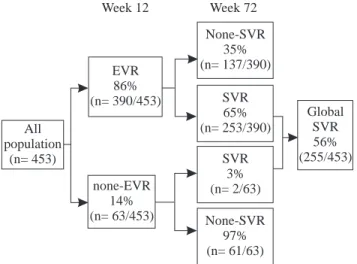
In the global group, by week 12,390 of 453 of patients (86%) treated with peginterferon alfa-2a plus ribavirin had achieved a significant viral reduction response, defined as a 2-log decrease from base-line HCV RNA levels (97 patients) or no detectable serum HCV RNA (293 patients) (Figure 3).
Of those with early responses, 65% subsequently had a sus-tained virologic response. Those with no detectable HCV RNA by week 12 were more likely to have a sustained viral load reduction than those who had only a 2-log decrease in HCV RNA (221 of 293 vs. 32 of 97). In contrast, among the 63 patients who did not have an early viral load reduction, 61 (97%) did not have a sustained response.
Similar results were seen in our Mexican patients treat-ed with peginterferon alfa-2a plus ribavirin. From a total of 14 patients in this group, we saw early significant viral load reductions in 10. Of these, six patients subsequently had a sustained virologic response (positive predictive value). Of the other four patients who did not have a 2-log drop or undetectable levels of HCV RNA at week 12, three did not show a sustained viral load reduction (nega-tive predic(nega-tive value) (Figure 4).
Safety
None of our patients were withdrawn from treatment because of laboratory abnormalities or other major
ad-Table I. Demographic data in the global group.
PEG-IFN α-2a IFN α-2b PEG-IFN α-2a
+ RBV + RBV + Placebo
(n = 453) (n = 444) (n = 224)
Age (years) 42.8 42.4 42.3
Gender (male) 71% 73% 68%
Weight (kg) 79.6 78.1 78.9
Genotype
1 66% 64% 64%
no-1 31% 33% 31%
HCV RNA levels
(106 copies/mL) 6.1 6.0 5.9
Incidence of cirrhosis 12% 12% 15%
Table II. Demographic data in the Mexican group.
PEG-IFN α-2a IFN α-2b PEG-IFN α-2a
+ RBV + RBV + Placebo
(n = 14) (n = 12) (n = 6)
Age (years) 46 45 45
Gender (female/male) 6/8 5/7 2/4
Weight (kg) 75 68 81
Genotype
1 11 10 5
no-1 3 2 1
HCV RNA levels
(106 copies/mL) 2.4 1.9 4.2
Incidence of cirrhosis 3 (21%) 3 (25%) 2 (33%)
Figure 1. Efficacy results at the end of follow-up as percentages, 24
weeks after the end of treatment (sustained virologic response). 0
10 20 30 40 50 60
PEG + ribavirine 56 50
Interferon alfa 2b 45 33
PEG + placebo 30 0
Global study Mexican group
Figure 2. Efficacy results as percentages at the end of follow-up, 24
weeks after the end of treatment (sustained virologic response) in pa-tients infected with genotype 1 and high viral load.
0 10 20 30 50 60
PEG + ribavirine 54
Interferon alfa 2b 20
PEG + placebo 0
Annals of Hepatology 2(3) 2003: 135-139
138
edigraphic.com
verse events. One patient in the interferon alfa-2b plus ribavirin group discontinued because of a psychiatric dis-order (depression-related event with suicide ideation).
Discussion
Peginterferon alfa-2a plus ribavirin was more effective than interferon alfa-2b plus ribavirin or peginterferon alfa-2a plus placebo alone for the treatment of chronic hepatitis C. Overall, the rate of sustained virologic response was similar to that reported with the use of peginterferon alfa-2b plus
ribavirin.13 In the present study, improved efficacy was seen
in subgroups of patients with disease generally considered to have treatment-resistant characteristics.13 In particular,
pa-tients with all HCV genotypes and those with high base-line levels of HCV RNA (more than 2 million copies per milli-liter) were more likely to have a sustained viral load reduc-tion response when treated with peginterferon alfa-2a plus ribavirin than when treated with interferon alfa-2b plus rib-avirin. Among patients considered to have the most treat-ment-resistant disease —that is, those with both HCV gen-otype 1 and high base-line viral levels— a higher propor-tion of those treated with peginterferon alfa-2a plus ribavirin had a sustained viral load reduction than of those treated with interferon alfa-2b plus ribavirin.
Early prediction of a viral load reduction response to interferon-based therapy can help identify patients who are unlikely to have a sustained response and allow clini-cians the option to discontinue treatment, saving patients the side effects and cost of additional therapy.19 In the
current sub-analysis, three of four patients who did not have an early viral load reduction response to peginterfer-on alfa-2a plus ribavirin by week 12 never developed a sustained viral load reduction. The incremental benefit of continuing therapy beyond 12 weeks for such patients must be considered for each patient individually.
Adverse events typically associated with the use of in-terferon (including influenza-like symptoms and depres-sion) occurred in all three treatment groups. As is usual with interferon-based therapy, there were reductions in neutrophil and platelet counts with all treatments. Al-though these decreases were equivalent in patients treated with peginterferon alfa-2a plus ribavirin and in those treated with interferon alfa-2b plus ribavirin, they did not appear to be associated with serious consequences and were effectively managed by dosage modifications.
The results seen in this Mexican population suggest that the information from the global study is applicable in our patients in regard to overall efficacy and the predict-ability at 12 weeks. Peginterferon alfa-2a offered signifi-cantly enhanced sustained viral load reduction responses in all patients, regardless of HCV genotype and viral load, and a once-weekly dosing schedule. We believe that the ability to predict the absence of sustained viral load reduction response from HCV RNA levels at week 12 will be a useful clinical tool. This study indicates that combination therapy with peginterferon alfa-2a plus rib-avirin provides a considerable clinical advantage over therapy with interferon alfa-2b plus ribavirin for the treat-ment of patients with HCV.
References
1. Thomas HC, Torok ME, Forton DM, Taylor-Robinson SD. Possible mechanisms of action and reasons for failure of antiviral therapy in chronic hepatitis C. J Hepatol 1999; 31 Suppl 1: 152–9.
2. EASL International Consensus Conference on hepatitis C: Paris, 26– 28 February, 1999: consensus statement. J Hepatol 1999; 30: 956–61.
Figure 3. Predictability of sustained virologic response.
At week 12, 390/453 (86%) the patients treated with peginterferon alfa-2a plus ribavirin either had a 2-log drop in HCV RNA levels or had undetectable levels of HCV RNA early virologic response [EVR]). Of these patients, 253/390 (65%) went on to have sustained virologic response (SVR). Of the 63 patients who did not have a 2-log drop or undetectable levels of HCV RNA at week 12, 61 (97%) did not have a sustained virologic response.
All population
(n= 453)
None-SVR 35% (n= 137/390)
Global SVR 56% (255/453) EVR
86% (n= 390/453)
none-EVR 14% (n= 63/453)
SVR 65% (n= 253/390)
SVR 3% (n= 2/63)
None-SVR 97% (n= 61/63)
Week 12 Week 72
Figure 4. Predictability of sustained virologic response.
At week 12, 10/14 of the patients treated with peginterferon alfa-2a plus ribavirin either had a 2-log drop in HCV RNA levels or had unde-tectable levels of HCV RNA. Of these patients, six went on to have a sustained virological response (positive predictive value). Of the four patients who did not have a 2-log drop or undetectable levels of HCV RNA at week 12, three did not have a sustained viral reduction (nega-tive predic(nega-tive value).
EVR (n= 10)
All population
(n= 14)
None-SVR (n= 4)
SVR (n= 6)
SVR (n= 1)
None-SVR (n= 3)
Global SVR
(7)
none-EVR (n= 4)
139
edigraphic.com
3 Booth JC, O’Grady J, Neuberger J. Clinical guidelines on the man-agement of hepatitis C. Gut 2001; 49 Suppl 1: I-1.
4. Canadian Association for the Study of the Liver. Canadian consen-sus conference on the management of viral hepatitis. Can J Gastroenterol 2000; 14 Suppl B: 5B–20B.
5. Lai MY, Kao JH, Yang PM, et al. Long-term efficacy of ribavirin plus interferon alpha in the treatment of chronic hepatitis C. Gastro-enterology 1996; 111: 1307–12.
6. Poynard T, Marcellin P, Lee SS, et al. Randomized trial of interferon alpha-2b plus ribavirin for 48 weeks or for 24 weeks versus inter-feron alpha 2b plus placebo for 48 weeks for treatment of chronic infection with hepatitis C virus. Lancet 1998; 352: 1426–32. 7. McHutchison JG, Gordon SC, Schiff ER, et al. Interferon alfa-2b
alone or in combination with ribavirin as initial treatment for chronic hepatitis C. N Engl J Med 1998; 339: 1485–92.
8. Reddy KR, Wright TL, Pockros PJ, et al. Efficacy and safety of pegylated (40-kd) interferon alpha-2a compared with interferon al-pha-2a in noncirrhotic patients with chronic hepatitis C. Hepatology 2001; 33: 433–8.
9. Zeuzem S, Feinman SV, Rasenack J, et al. Peginterferon alfa-2a in patients with chronic hepatitis C. N Engl J Med 2000; 343: 1666–72. 10. Heathcote EJ, Shiffman ML, Cooksley WG, et al. Peginterferon alfa-2a in patients with chronic hepatitis C and cirrhosis. N Engl J Med 2000; 343: 1673–80.
11. Lindsay KL, Trepo C, Heintges T, et al. A randomized, double-blind trial comparing pegylated interferon alfa-2b to interferon alfa-2b as ini-tial treatment for chronic hepatitis C. Hepatology 2001; 34: 395–403. 12. Pockros PJ, Carithers R, Desmond P, et al. Evaluation of two doses
of peginterferon alfa-2a for the treatment of chronic hepatitis C (CHC). In: Program and abstracts of the 41st Interscience Confer-ence on Antimicrobial Agents and Chemotherapy, Chicago,
Decem-ber 16–19, 2001. Washington, D.C.: American Society for Microbi-ology, 2002: 285 (abstract).
13. Manns MP, McHutchison JG, Gordon SC, et al. Peginterferon alfa-2b plus ribavirin compared with interferon alfa-alfa-2b plus ribavirin for initial treatment of chronic hepatitis C: a randomized trial. Lancet 2001; 358: 958–65.
14. Xu Z-X, Hoffman J, Patel I, Joubert P. Single-dose safety/tolerabil-ity and pharmacokinetics/pharmacodynamics (PK/PD) following ad-ministration of ascending subcutaneous doses of pegylated-interferon (PEG-IFN) and interferon α-2a (IFN α-2a) to healthy subjects. Hepatology 1998; 28: Suppl: 702A (abstract).
15. Nieforth KA, Nadeau R, Patel IH, Mould D. Use of an indirect phar-macodynamic stimulation model of MX protein induction to com-pare in vivo activity of interferon alfa-2a and a polyethylene glycol-modified derivative in healthy subjects. Clin Pharmacol Ther 1996; 59: 636–46.
16. Wills RJ. Clinical pharmacokinetics of interferons. Clin Pharmacokinet 1990; 19: 390–9.
17. Algranati NE, Sy S, Modi M. A branched methoxy 40 kDa polyeth-ylene glycol (PEG) moiety optimizes the pharmacokinetics (PK) of peginterferon α-2a (PEG-IFN) and may explain its enhanced effi-cacy in chronic hepatitis C (CHC). Hepatology 1999; 30 Suppl: 190A (abstract).
18. Germer JJ, Rys PN, Thorvilson JN, Persing DH. Determination of hepatitis C virus genotype by direct sequence analysis of products generated with the Amplicor HCV test. J Clin Microbiol 1999; 37: 2625–30.