Numerosity, Abstraction, and the Emergence of Symbolic Thinking
Author(s): Frederick L. Coolidge and Karenleigh A. Overmann
Reviewed work(s):
Source: Current Anthropology, Vol. 53, No. 2 (April 2012), pp. 204-225
Published by: The University of Chicago Press on behalf of Wenner-Gren Foundation for Anthropological
Research
Stable URL: http://www.jstor.org/stable/10.1086/664818
.
Accessed: 09/04/2012 22:16
Your use of the JSTOR archive indicates your acceptance of the Terms & Conditions of Use, available at
.
http://www.jstor.org/page/info/about/policies/terms.jspJSTOR is a not-for-profit service that helps scholars, researchers, and students discover, use, and build upon a wide range of content in a trusted digital archive. We use information technology and tools to increase productivity and facilitate new forms of scholarship. For more information about JSTOR, please contact [email protected].
The University of Chicago Press and Wenner-Gren Foundation for Anthropological Research are collaborating with JSTOR to digitize, preserve and extend access to Current Anthropology.
䉷2012 by The Wenner-Gren Foundation for Anthropological Research. All rights reserved. 0011-3204/2012/5302-0003$10.00. DOI: 10.1086/664818
CA
✩
FORUM ON THEORY IN ANTHROPOLOGY
Numerosity, Abstraction, and the Emergence
of Symbolic Thinking
by Frederick L. Coolidge and Karenleigh A. Overmann
In this paper we tentatively propose that one of the feral cognitive bases for modern symbolic thinking may be numerosity, that is, the ability to appreciate and understand numbers. We proffer that numerosity appears to be an inherently abstractive process, which is supported by numerous human infant and monkey studies. We also review studies that demonstrate that the neurological substrate for numerosity is primarily the intraparietal sulcus of the parietal lobes, the angular and supramarginal gyri in the inferior parietal lobes, and areas of the prefrontal cortex. We also speculate that the lower level of abstraction involved in numerosity may serve as a basis for higher-level symbolic thinking, such as number and letter symbolism and sequencing. We further speculate that these two levels of abstraction may give rise to highly sophisticated characteristics of modern human language, such as analogizing and metaphorizing.
Now, the first noticeable fact about arithmetic is that it applies to everything, to tastes and to sounds, to apples and to angels, to the ideas of the mind and to the bones of the body. The nature of the things is perfectly indifferent, of all things it is true that two and two make four. Thus we write down as the leading characteristic of mathematics that it deals with properties and ideas which are applicable to things just because they are things, and apart from any particular feelings, or emotions, or sensations, in any way connected with them. This is what is meant by calling mathematics an abstract science.(Whitehead 1911:9)
Paleoanthropologists have long sought to explain the origins of modernity and modern thinking. Debates about their or-igins usually include the terms “abstraction” and “symbolic thinking,” often proffered without clear or operational defi-nitions. It is our purpose here to help clarify these terms and tentatively propose that numerosity, the ability to think about and reason with numbers, may serve as one evolutionary cognitive basis for basic abstractive thinking and fully modern symbolic thinking.
Abstraction is generally considered the act or process of deciding that something has a general quality or characteristic
Frederick L. Coolidgeis Professor andKarenleigh A. Overmannis a graduate student in the Psychology Department at the University of Colorado, Colorado Springs (1420 Austin Bluffs Parkway, Colorado Springs, Colorado 80918, U.S.A. [[email protected]]). This paper was submitted 29 VII 10 and accepted 7 VII 11.
apart from its concrete realities or specific properties. Com-mon definitions of symbolic thinking (symbolization) are similar: something used for or regarded as representing some-thing else, where the symbol can be arbitrary (possess no qualities of the represented object). In this regard, symboli-zation can be viewed as a more concretized category of ab-straction, because abstraction is more often considered in the context of mental representations without external or physical referent, though there is certainly some kind of internal con-cept or referent. When anthropologists refer to symbolic be-havior, they most often refer to not only to the process of symbolization with external representations (e.g., the 77,000-year-old Blombos shell beads) but also to the process of ab-straction and thus the formation of mental concepts. How-ever, shell beads should not be too hastily accepted as a sine qua non of modern thinking or modern syntactical language (e.g., Henshilwood et al. 2004). Ancient beads may indeed be representative of such processes, but they are not necessarily or automatically so. As Botha (2008) so aptly noted, there are a series of inferential steps in the process of deciding whether shell beads represent “fully syntactic language” (Henshilwood et al. 2004:404).
struc-ture, and (4) shared with other species (Carey 2009; Cummins and Cummins 1999; Smith 2004). “Innateness” implies that ontogenetically, the trait should be evident early in humans when the influence of language and culture is minimal, and it should have some specifiable and demonstrable neurological substrate. “Sharedness” says something about a trait’s phy-logenetic age and adaptive value, and this in turn implies that there should be something about the trait that is both unique to our species and adaptive beyond simple reproductive sur-vival. The latter implies the trait should set an unambiguous foundation for modern thinking by connecting the world of sense perception to the domain of concepts and in turn con-necting concepts to their expression and shared meaning as signs in material culture and language. We propose that nu-merosity possesses these characteristics, and thus, we tenta-tively believe it may serve as one possible feral cognitive basis for basic abstractive and higher-level symbolic thinking.
Numerosity appears to be both innate and shared. It ap-pears early in human ontogeny, demonstrated in infants only a few months old (e.g., Ansari et al. 2005; Cantlon et al. 2006; Feigenson, Dehaene, and Spelke 2004; VanMarle and Wynn 2010). Many species—nonhuman primates (apes and mon-keys), birds (parrots and pigeons), and mammals (horses, dogs, raccoons, rats, and dolphins)—share with humans the nonverbal ability to recognize quantity (Ardila 2010; Cantlon and Brannon 2006; Cantlon, Platt, and Brannon 2008; De-haene, Dehaene-Lambertz, and Cohen 1998; Haun et al. 2010). Apes diverged from Old World monkeys about 25 million years ago (mya), birds from dinosaurs about 150 mya, and mammals from cynodonts about 200 mya (Bright 2009), time lines that may suggest numerosity is phylogenetically ancient and possibly an ancestral characteristic. While this assumes that primate numerosity is largely both homogeneous (the same process) and homologous (the same origin), an assertion for which the archaeological record may never pro-vide definitive proof, it nonetheless seems a more parsimo-nious explanation than independent and parallel evolution in diverse primate lineages. Numerosity is also evolutionarily adaptive. Ansari (2008) speculates that it was selected because the ability to evaluate the quantity of food, other resources, competitors, or predators would serve critically important survival functions. Certainly the ability to recognize and make correct decisions about relevant numerical information (i.e., that⽧⽧⽧is better than⽧when the subject is food but worse when it comes to predators) would bear directly on reproductive success, selecting an ability to appreciate and understand nonsymbolic numbers that is independent from any language or culture. Finally, numerosity has aspects of neurological uniqueness in Homo sapiens (e.g., Fias et al. 2007), and it is adaptive in a culturally material sense, thus positioning it as one possible feral cognitive basis for abstrac-tion and symbolic thinking.
Feigenson, Dehaene, and Spelke (2004) proposed that nu-merosity is made up of two core systems, “subitization” and “magnitude appreciation.” Subitization (derived from the
Latin word for “sudden” and connoting that the recognition of small numbers is performed quickly, accurately, and with confidence; Kaufman et al. 1949) provides a precise and dis-tinct appreciation for small quantities of individual objects. In infants, Feigenson, Dehaene, and Spelke (2004) noted that subitization is limited to three or four objects (a limit that also appears to constrain number terms as noted in historical linguistics). It is important to note that subitization is not synonymous with counting (i.e., counting requires ordinality or number sequencing; subitization does not), though subi-tization may serve as an important cognitive precursor to counting (e.g., Cantlon et al. 2006; Carey 2009). The second core system, magnitude appreciation, provides the ability to appreciate large but approximate numerical magnitudes. Fei-genson, Dehaene, and Spelke (2004) noted that magnitude appreciation can be demonstrated in children as young as 6 months old. They concluded that it is “noisy” (not exact) but captures clear interrelationships among different groups of large numbers. Interestingly, both core systems appear to be robust across various sense modalities. The latter finding pro-vides evidence for the hypothesis that numerosity is inherently an abstractive process.
An additional aspect of numerosity is “ordinality,” the abil-ity to construct ordered sequences. Unlike the small quantities in subitizing, integers are ordered according to their relative magnitude—2 is more than 1, 3 is more than 2, and so on. Ordinality, however, is not limited to relative quantities only in numbers; it is necessary for any ordered sequence, includ-ing letters of the alphabet, days of the week, months of the year, and so on. Ordinality is not entirely a learned conven-tion; the brain does it automatically (e.g., Hubbard et al. 2009). The neurological roots of ordinality appear to lie in spatial cognition: apparently the brain conceives of ordered sequences as spatial strings of discrete phenomena laid out in a spatial sequence. The number line for integers (1, 2, 3, . . ., n) is the best-known example of such a spatial string, but the spatial roots of ordering are true not just for numbers but for other ordered sequences as well, including letters.
Neurological Substrate of Ordered Sequences
and Numerosity: The Intraparietal Sulcus
2010), which poses the question of how nonlinguistic, non-symbolic numerosity in human infants develops into lin-guistic, symbolic numerosity in human adults.
While there are disparate theories about how children map the semantic meaning of number words onto their nonverbal representations of numbers, Cantlon et al. (2006) noted that the neurons of the IPS respond selectively to both nonsym-bolic and symnonsym-bolic numbers. Dehaene (2007) proposed that when numerosity detector neurons in the IPS have been ha-bituated to activation by nonsymbolic numbers, a habituation shared with other species and thus innate, the habituation transfers to adjacent neurons that support the recognition of associated symbolic notations. This transferred habituation may be unique toHomo sapiens, the only species known to use symbols and engage in symbolic thinking. These studies suggest the IPS helps to establish semantic associations be-tween numerical concepts and signs, thus providing an im-portant basis for connecting the world of sense perception to the domain of symbolic concepts.
Cantlon et al. (2006) also suggested that adult numerical cognition derives from numerical abilities present in children yet naive in regard to symbolic numbers (see also Carey 2009). They used functional magnetic resonance imaging (fMRI) to demonstrate nonsymbolic number activation in IPS neurons in children and noted that by the age of four, the IPS begins to respond more strongly to judgments of object number than to changes in object shape. Zamarian, Ischebeck, and Delazer (2009) found that as numerical competence is gained, brain activation shifts from the prefrontal cortex (PFC) to the IPS. Similarly, Ansari et al. (2005) found elevated PFC activity in children naive with regard to Arabic number symbols when dealing with number cardinalities (i.e., how many objects in a number symbol); however, once the task of memorizing Arabic number symbols had been mastered, only the IPS appeared to be activated. Intriguingly, when Cantlon et al. (2006) tested adults for symbolic numerosity, they found the IPS continues to be specifically activated but that additional number-specific neurons are recruited in adjacent areas as well. For example, multiplication tables and other mathe-matical operations appear to rely on the left angular gyrus (AG) and the supramarginal gyrus (SMG; Dehaene et al. 1999), which both lie in the inferior parietal lobes.
Zamarian, Ischebeck, and Delazer (2009) found that during arithmetic tasks, brain activation shifts from the IPS to the AG, which they ascribed to the retrieval of numerical infor-mation from memory or the development of mathematical expertise. Other evidence points to significant linkage between the IPS and AG, which seems to support the manipulation and expression of number concepts. For example, Gerstmann syndrome (e.g., Roux et al. 2003) links damage to the AG with acalculia (inability to process numbers), finger agnosia (inability to differentiate among one’s fingers or hands), and impaired finger counting (the IPS-AG link is important to the ability to express numbers in material phenomena and perform fine manipulations of technology). Thus, the IPS in
conjunction with the AG and SMG appears to facilitate not only basic number operations such as subitization and finger counting but also may support the higher-level mathematical operations requiring semantic mapping of number concepts to number terms. In summary, the IPS appears to be the core of a cerebral network that is critically important to the ap-preciation and understanding of both nonsymbolic and sym-bolic numbers.
How Numerosity May Set a Foundation for
Modern Symbolic Thinking
The IPS has also been implicated in appreciating and under-standing other, nonnumerical symbols. Fias et al. (2007) found that the IPS, particularly its horizontal segment (hIPS), is activated in tasks demanding ordinal relationships between numbers. In a study of human participants, they found, as hypothesized, that ordinal comparisons of letters activate the same neural networks involved in number-ordinality tasks, in particular, the hIPS and IPS. They suggested that similar activation patterns do not necessarily imply that the same neurons respond to numerical and nonnumerical order be-cause other evidence suggests that IPS neurons are highly specialized for number functions (e.g., Nieder and Miller 2004). Nonetheless, Fias et al. (2007) found clear evidence that the hIPS is activated in alphabetical-order tasks and, more importantly, that the level of abstraction “goes well beyond the levels of abstraction . . . so far established with number processing” (p. 8955). This is consistent with Dehaene’s (2007) proposal that the habituation of IPS neurons to non-symbolic numbers transfers to adjacent neurons to support the recognition of symbolic notations for numbers. Fias et al. (2007) also concluded that the higher-level abstraction real-ized by the hIPS in symbolic letter processing remains closely linked to the lower-level sensory-based abstractive neural mechanisms because of its grounding in the general ability to represent visuospatial information.
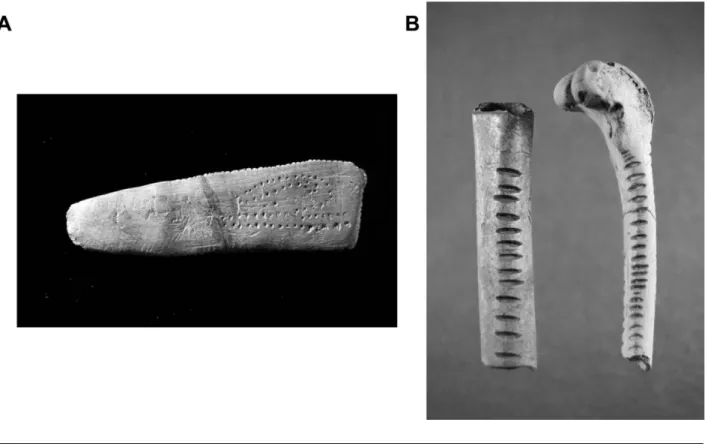
Figure 1. Blanchard and Cellier counting devices. The image of Abri Blanchard (A) is courtesy of the Peabody Museum of Archaeology and Ethnology, Harvard University (2005.16.318.38). The image of Abri Cellier (B) is courtesy of the Logan Museum of Anthropology, Beloit College (LMA 100180, 100181). A color version of this figure is available in the online edition ofCurrent Anthropology.
as signs in material culture and language, it may help set one of the foundations for modern symbolic thinking.
Is numerosity inherently abstractive? This question is fraught with debate. However, as has been recently noted (Cohen Kadosh and Walsh 2009), a consensus view has emerged over the past decade of research that numerosity is an abstractive process because number appreciation and dif-ferentiation occur regardless of the nature of input stimuli (visual dots and patterns, auditory and/or verbal sounds and tones, etc.), and this information can be reliably and validly transferred onto a variety of other stimuli and senses, thus meeting many common definitions for abstraction. Even those who challenge the default position that numerosity is inherently an abstractive process (Cohen Kadosh and Walsh 2009) note that it can be considered an abstractive process, but only under certain experimental task conditions (i.e., in-tentional but not automatic number processing); however, there is little agreement on the latter position (Cohen Kadosh and Walsh 2009).
The Expression of Numerical Signs in the
Archaeological Record
Numbers and the basic and higher-level mathematical op-erations they allow may be an important and possibly
Pirahaˆ and the Ceylonese Wedda (see Everett 2005; Menninger 1992, respectively). These prehistoric devices, along with stones, notched bones and sticks, knotted strings, and clay tokens appear to express embodied sensorimotor associations of numerical quantity in external material phenomena (Ma-lafouris 2010b), and perhaps they constitute the earliest known emergence of numerical signs.
Linguistic evidence suggests that subitization and magnitude appreciation continue to underlie number concepts in historic times. Linguistic terms for number concepts consistently emerge in an overall temporal sequence: ordering, grouping, grouped groupings, and graduated number sequences, with written symbols for number concepts always preceding lin-guistic ones (Menninger 1992). Menninger also proposed that number terms emerge in two major phases, an earlier phase consistent with subitization and a later phase consistent with magnitude appreciation. The earlier phase is limited to number terms up to three or four (a limit consistent with subitization rather than the number of fingers on a hand) and contains words for numbers as adjectives. During this phase, number terms seem to emerge in a sequence: “one,” “two,” and “many,” with the latter subsequently converting to “three” (intriguingly, number-concept development in modern children parallels this sequence [e.g., Carey 2009], implying that subitization may be the more primary and thus the more evolutionarily ancient of numerosity’s dual systems; however, see Piazza 2010). The emergence of “three” or “four” appears to break a conceptual barrier, leading to the later phase of number-term emergence. The later phase (consistent with magnitude appreciation) de-taches number adjectives from their physical referents to derive abstract number concepts and large-number concepts. This later phase includes the formation of new “ones” and “twos” now recast as “tens” and “twenties,” “one hundred,” “one thou-sand,” etc., terms that indicate magnitude approximations (numbers that cannot be grasped cognitively in the same way that small numbers can) and that are typically marked by ar-chaic forms signifying their formation subsequent to and on earlier phase (subitization) terms.
Numerosity may also provide a key mechanism for this process as follows: number concepts may be formed by the innate processes of numerosity from the sense perception of objects. As embodied concepts, numbers may have then been expressed through fingers and then external devices and only later in writing and speech, respectively. The physical ex-pression of concepts may have created a shared conceptual space in which concepts were used, imitated, taught and learned, and communicated as icons, indexes, and symbols in writing and speech. Embodied numerosity, then, may have been integral to the process whereby symbolic thinking emerged inHomo sapiens, raising the important question of what might have caused this to occur inH. sapiensand no other known species.
Recent work by Bruner (Bruner 2004, 2010; Bruner and Holloway 2010) supports the supposition that frontal-lobe widening and reshaping distinguish the brains of archaic
members of the genusHomofromH. sapiensand Neander-thal. However, Bruner also identified a second evolutionary trajectory inH. sapiensbut not in Neanderthals: the relative expansion of the parietal-lobe volume and a particular ex-pansion in the superior region of the parietal lobe, the IPS. Bruner wondered whether such parietal variation would be accompanied by relevant cognitive changes. His best guess for the nature of this possible cognitive change comes from the traditional understanding of parietal-lobe functions: vi-suospatial integration and simulation, sensorimotor integra-tion, and multimodal processing. The cognitive repercussions of IPS expansion are far from being understood, but as has been noted, it is a region linked to both numerical concept generation and symbolic grounding. In addition, Bruner noted an inferior displacement of the AG and SMG into Wernicke’s area (the posterior part of the superior temporal lobe), well established as the neural substrate for inner speech and language comprehension. This displacement might have provided these regions with the advantages of proximity: inter- and intraneuronal connectivity, greater neuronal den-sity, and adjacency during spreading activation, thus con-necting the functions of the IPS (numerosity, symbolic grounding) with those of the AG (higher-level cross-domain thinking, including metaphorizing; Ramachandran 2004), SMG (inner speech), and Wernicke’s area (speech compre-hension).
InH. sapiens, the anterior part of the IPS is evolutionarily new and appears to provide an advantage in the sophisticated manipulation of fingers and technology, as proposed by Orban et al. (2006), an advantage that we believe may come from the close linkage between the IPS and AG. They conducted a series of fMRI studies in the IPS of humans and rhesus monkeys. They found the human IPS has four regions visually sensitive to two-dimensional shape and three regions repre-sentative of central vision. In monkey IPS, they found only two shape-sensitive visual regions and one region devoted to central representation. They concluded that the anterior part of the human IPS has no homologue in the monkey IPS, indicating the anterior IPS in humans may be evolutionarily new. They also concluded that these new regions, by repre-senting additional aspects of visual stimuli, might allow a much more “detailed analysis of the object to be manipulated along many dimensions such as size, 3D orientation, 2D and 3D shape, etc., providing very sophisticated control of ma-nipulation” (Orban et al. 2006:2664). They proposed that the increased number of parietal regions in humans provides greater control of a much wider range of body movements and have suggested that it has some significance for the per-ception of “moving objects with moving parts” that might be typical of sophisticated tool handling and fabrication (Orban et al. 2006:2664).
sen-sorimotor interactions with the physical world. In contrast, Andres, Di Luca, and Pesenti (2008) argued that finger count-ing in childhood under cultural and motor constraints helps to instantiate core systems in numerosity and natural num-bers. They proposed that finger counting teaches the concept of a unique first element (the thumb or little finger, depending on the culture); that there is a unique and immediate suc-cessor for each element in the sequence; and that there is a unique, immediate predecessor for elements in the sequence (except for the first). Thus, finger-based representations may help to instantiate ordinality (sequencing) and cardinality (the measure of the number of elements of a set). Finger counting may also instantiate Feigenson, Dehaene, and Spelke’s (2004) dual core systems, as magnitudes of two sets may be compared (e.g., four fingers on one hand are greater than two fingers on the other), and the understanding of four “things” and two “things” may also be enhanced. Andres, Di Luca, and Pesenti (2008) disagreed with Rips, Bloomfield, and Asmuth (2008), who argued that finger counting is primarily mediated by these innate core systems of numerosity. However, the two positions are not necessarily at odds with each other: finger counting is obviously mediated by the core systems of nu-merosity, whether primarily or secondarily.
More important to the present hypotheses is the idea that finger counting and the manipulation of material phenomena may help to express the embodied core systems of numerosity. As Malafouris (2010b) suggested, the process of counting with fingers or clay tokens can be viewed as “an integrative pro-jection between mental—the basic biological ‘number sense’ . . . —and physical— . . . domains of experience” (8). In Malafouris’s opinion, the clay tokens do not stand for num-bers directly but rather facilitate the manipulation of their properties by making them visible and tangible. He believes, therefore, that a difficult and inherently meaningless concep-tual problem such as counting is transformed by way of pro-jection with stable material structures into a visuospatial do-main that is much easier to manipulate cognitively. It may be no mere coincidence, therefore, that the classic function ascribed to the parietal lobes has been somatosensory inte-gration, and it is provocative to think that the foundation of these integrative processes may rest on neurons that have a high specificity for number that also inform higher levels of cross-domain and symbolic thinking.
Numerosity and Higher-Level
Cross-Domain Thinking
Analogical reasoning involves mentally mapping one situation onto another, which often results in new sights and novel information. Metaphoric reasoning is largely synonymous with analogical reasoning, but more specifically, metaphors are figures of speech. As such, they often facilitate thinking across different conceptual domains, and thus they may be said to be representative of higher-level cross-domain think-ing. Metaphors involve similarities between two things that
appear to be different, often with one thing abstract and the other concrete. Metaphors share an important characteristic with numerosity in similarly expressing abstract concepts in more tangible forms to make them more accessible cogni-tively. Metaphors may thus provide insights into unknown or nonphysical subjects from familiar or physical subjects or things, perhaps extending or creating knowledge and enabling its communication (e.g., Chiappe and Chiappe 2007; Lakoff and Johnson 1999).
Metaphors consist of vehicle and target domains. In a met-aphor such as “love is a rose,” the metmet-aphoric vehicle “rose” transfers its attributes to the target, the abstract topic of “love.” An abstract topic provides relevant dimensions for attributes, while a concrete vehicle such as “rose” provides various erties for the attributes. In metaphor theory, the relevant prop-erties associated with the vehicle form a superordinate category. The category in this case is the class of “beautiful, ephemeral things.” The category is superordinate in the sense that the literal meaning of “rose” is simply a type of flower, so the literal meaning is transcended. People hearing the metaphor under-stand “rose” as referring to the superordinate category that includes “love” as a member. It is important to note that the literal category is not relevant to the metaphor except in helping to form the superordinate category.
Interestingly, the AG and PFC appear to be important in metaphor production. From studies of brain-damaged pa-tients, Ramachandran (2004) implicated the AG as critical to metaphor production and appreciation. Chiappe and Chiappe (2007) found that the ability to generate metaphors and the ability to understand increasingly complex metaphors is highly dependent on the inhibitory aspect of the executive functions of the PFC (see Coolidge and Wynn 2001 for a more detailed description of these functions in the archaeo-logical record and their role in the evolution of modern think-ing). Particular attributes of the vehicle may be irrelevant (e.g., the fact that rose roots contain nitrogen-fixing bacteria is not generally relevant to “love is a rose”), and those aspects must be inhibited. Reuland (2010) describes a similar inhibitory process occurring in linguistic recursion where particular at-tributes or thoughts must be at least temporarily suspended from realization (awareness) until subsequent phrasal attri-butes are realized. Other cognitive functions of the brain are certainly implicated in metaphors; for example, Chiappe and Chiappe found that metaphor aptness requires greater work-ing-memory capacity (see Baddeley 2007 for additional in-formation about working memory and see Coolidge and Wynn 2005 and Wynn and Coolidge 2005 for additional de-tails about its evolution).
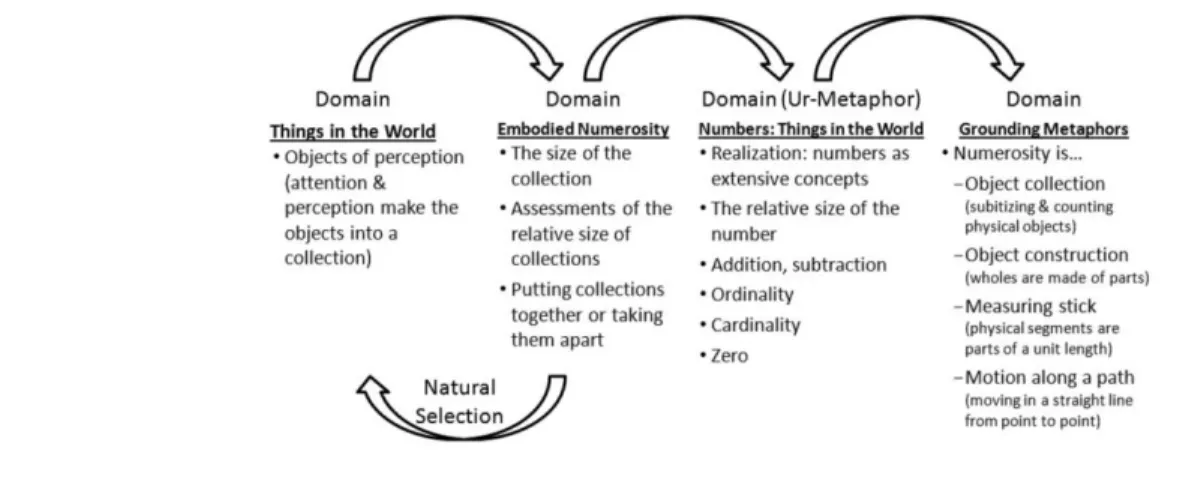
pro-Figure 2. Domains and levels of abstraction.
cess derived from the cross-domain mapping. Because every language has a system of spatial relationships supported by an inherent system of perceptual and spatial logic, they also believed that much of everyday abstract reasoning is derived from logical inferences based on embodied spatial reasoning and spatial logic. Indeed, it is an interesting and suggestive phenomenon that infants can subitize and judge the relative size of larger sets well before they have any coherent linguistic abilities, implying that they may have innate mathematical abilities independent not only of language but also relatively independent of meaning.
We therefore tentatively hypothesize that the dual systems of numerosity provide an intuitive basis for analogies and metaphors. So, pace Lakoff and Nu´n˜ez (2000), who argue that mathematics exapted preexisting nonnumerical cognitive abilities for metaphors, we propose that higher mathematical capabilities may have been built on the feral cognitive process of numerosity as follows: conceptual schemas for numbers (subitization and magnitude appreciation) were automatic and preattentive well before any facility with language or ex-posure to culture developed. The inferior displacement of the AG and its close linkage with the IPS enabledHomo sapiens
to express intangible numbers in tangible ways, making them easier to manipulate (Malafouris 2010b). This tangible ex-pression had sequelae that included both the creation of a shared conceptual space for symbol grounding to occur and the prepotent and intuitive cognitive environment for higher-level cross-domain thinking.
What is the cognitive environment for higher-level cross-domain thinking? According to Lakoff and Nu´n˜ez (2000), the simultaneous activation of two distinct areas of the brain results in the neurological process of “conflation,” the cognitive em-bodiment of two different aspects of experience that creates a single complex experience. They argue that such conflations generate cross-domain neural links, and these in turn may ultimately give rise to conceptual metaphors. Notably, the func-tion tradifunc-tionally ascribed to the parietal lobes, somatosensory integration, may be highly reflective of the cross-domain
con-flative mapping so characteristic of analogical reasoning and metaphorizing. Thus, numerosity, number-concept expression in tangible media, and number metaphors in language may have primed the cognitive environment for further higher-level cross-domain thinking independent of numbers.
Lakoff and Nu´n˜ez (2000) also proposed that the metaphor “numbers are things in the world” is a basic, unconscious metaphor. They stated that it arises from four “grounding” metaphors: (1) “object collection,” which involves subitizing and counting physical objects; (2) “object construction,” in which wholes are made up of parts; (3) “measuring stick,” in which physical segments are envisioned as parts of a unit length; and (4) “motion along a path,” which uses physical movement in a straight line to imagine numbers on a con-tinuum. We propose that it may have also developed in re-verse. First, we think the basic metaphor might be better characterized as the metaphor “things in the world are num-bers.” Second, we think that the ur-metaphor may give rise to any that follow (e.g., the four grounding metaphors for number concepts and nonnumerical metaphors as well). The relationships among these concepts—things in the world, em-bodied numerosity, the ur-metaphor, and the grounding met-aphors—are depicted in figure 2.
32,000-Figure 3. Hohlenstein-Stadel figurine, ca. 32,000 years old. Photo by Thomas Stephan (copyright Ulmer Museum). A color version of this figure is available in the online edition ofCurrent Anthropology.
year-old Hohlenstein-Stadel figurine (half human, half lion; fig. 3) may represent fully modern thinking because it may represent the symbolization of a conceptual metaphor: people are like lions, or lions are like people. The figurine was not only the creation of a superordinate category (lion people) but also the external referent and physical embodiment of a conceptual metaphor.
Neanderthal Speculations
It is also provocative to speculate how differences in parietal volume relative expansion, particularly in the IPS (Bruner 2004, 2010; Bruner, Manzi, and Arsuaga 2003), might have affected Neanderthal cognition. If nonhuman primates and other nonprimate species share numerosity with humans,
then Neanderthals would have possessed it as well. However, lacking the parietal expansion that characterizesHomo sapiens
More importantly, if Neanderthals lacked the higher-level symbolic capabilities associated with the IPS and inferiorly displaced AG, it might have implications for their capacity for the more sophisticated symbolic reasoning associated with language. This should not be interpreted, as some suggest (e.g., Tattersall 2009), that Neanderthals were prelinguistic. Provocatively, Zilha˜o et al. (2010) recently suggested that there were no cognitive differences between Neanderthals andH. sapiensabout 50,000–30,000 years ago. They based their claim on findings of pigment and shell necklaces associated with Iberian Neanderthals. However, as was previously noted about the Blombos beads, there is an inferential difference between claiming that shell necklaces were intentionally made and worn and assuming that shell necklaces reflect fully modern syntactic language and thinking (see Botha 2008; Wynn 2009 for more complete discussions of the steps in these inferential assumptions). Wadley, Hodgskiss, and Grant (2009) noted that archaeological artifacts are not necessarily imbued with symbolism, and Botha stated that being able to behave sym-bolically does not necessarily imply the ability to engage in fully syntactic language. Thus, it may be that Neanderthals intentionally made and wore shell-bead necklaces nearly 50,000 years ago. However, this may be behaviorally possible without the higher-level cognitive abilities associated with fully symbolic syntactic language. It is possible that Nean-derthals communicated through language but may have been denied particular sophisticated language capabilities, such as recursion, subjunctive pragmatics of speech (formation of hypotheticals), and—critical to our argument—analogical reasoning associated with metaphors.
Conclusions
We have proposed that the core systems of numerosity may have helped to instantiate the human cognitive ability for basic abstractive thinking and higher-level symbolic thinking such as analogical reasoning and metaphors in language. It is a provocative position, as there are some who argue numerosity is not inherently an abstractive process (e.g., Cohen Kadosh and Walsh 2009) and some who think language is the mental tool that informs numbers; that is, “Without language, no numeracy” (Hurford 1987:305). In suggesting that the neural and cognitive bases for numerosity may provide a model for understanding at least one basis for the evolution of modern symbolic thinking, we realize that our argument, as is invar-iable in any speculations about the origins of human cog-nition, becomes more tenuous as it progresses. For example, without unambiguous evidence that IPS damage entails an inability to process metaphors (to our knowledge, this has not been demonstrated), we cannot rule out that it may be the case that IPS-AG linkage is limited to number concepts and their physical and linguistic expression. Accordingly, we also cannot rule out the possibility that a different neural cognitive mechanism or a cultural mechanism supports the creation of nonnumerical analogies and metaphors. Similarly,
there are many hypotheses about why the Neanderthals be-came extinct, and indeed, recent DNA evidence suggests that their extinction was neither complete nor adversarial. None-theless, in view of numerosity’s many intriguing character-istics—its innateness, evolutionary and cultural adaptiveness, neurological uniqueness inHomo sapiens, explanatory power for symbolic grounding, consistency with the paleoanthro-pological and historical linguistic record, and so on—we be-lieve that it is a good candidate for one foundation of modern symbolic thought and higher-level cross-domain thinking.
Acknowledgments
Tom Wynn, professor of anthropology at the University of Colorado, Colorado Springs, and Misha Luzov, a student at the University of Colorado, Colorado Springs, contributed to an early draft of this article.
Comments
Daniel Ansari
Numerical Cognition Laboratory, Department of Psychology, Uni-versity of Western Ontario, Westminster Hall, Room 325, London, Ontario N6A 3K7, Canada ([email protected]). 15 XI 11
Why the “Symbol-Grounding Problem” for
Number Symbols Is Still Problematic
Humans, over the course of cultural history, have invented symbolic systems for the abstract representation of numerical magnitude. At the same time, there is abundant evidence demonstrating that humans share with nonhuman species the ability to process nonsymbolic representations of numerical magnitude (for a review, see Nieder and Dehaene 2009). This therefore raises the question of the nature of the relationship between cultural symbols and nonsymbolic representations of numerical magnitudes amounting to the “symbol-grounding problem” (Harnad 1990)—the question of how symbols are connected to their referents.
This paper by Coolidge and Overmann provides a broad interdisciplinary discussion of the symbol-grounding problem for numbers. Though I concur with many of the arguments put forward by Coolidge and Overmann, I am less confident about the current proposals for a solution to the symbol-grounding problem.
idea that symbols acquire their meaning by being mapped onto evolutionarily ancient systems for the representation of numerical magnitude is a dominant theoretical position in current cognitive neuroscience accounts of the origins of sym-bolic number processing (Dehaene 2007; Piazza 2010).
Despite this theoretical consensus, the empirical literature on the relationship between symbolic and nonsymbolic rep-resentation of number has thus far not supported a strong relationship between the two. For example, several studies have revealed that important measures of symbolic and non-symbolic number processing, such as the numerical distance effect, are not correlated with one another (Holloway and Ansari 2009; Maloney et al. 2010). If there were a strong connection between symbolic and nonsymbolic representa-tions of numerical magnitude, then the metrics used to mea-sure the features of these representations should be signifi-cantly related to one another.
Questions need to be urgently answered. At what level are symbolic and nonsymbolic magnitude representations con-nected with one another? And importantly, what role is played by development in this mapping process? In this context, one relevant debate in the literature that receives little attention in Coolidge and Overmann’s paper concerns the precise non-symbolic foundation for non-symbolic-nonnon-symbolic mappings. As Coolidge and Overmann point out, there is evidence on the one hand for a system for the precise representation of small sets (1–4) and on the other hand a system for the approximate representation of larger sets of numbers (Feigenson, Dehaene, and Spelke 2004). Currently, there is no consensus about which of these systems provides the nonsymbolic foundation for the symbolic-nonsymbolic mapping process. In studies of how children learn the meaning of counting, some evidence suggests that the acquisition of the meaning of number words is underlaid by the small-number system (Le Corre and Carey 2007), while other evidence points to the foundational role of approximate representations of large numbers (Wagner and Johnson 2011).
One of the fundamental problems in the present discourse is the assumption that nonsymbolic formats of number rep-resentation are equivalent to numerical magnitudes. However, even an array of dots is an external representation of nu-merical magnitude. In this vein, the use of the term “non-symbolic” may be misleading, because an array of six dots is a representation of 6 and is not isomorphic with the internal, psychological, and neuronal representation of 6 (though see Burr and Ross 2008). For the brain to process six dots nu-merically, processes need to ensue that transform the external nonsymbolic representation into an internal representation of numerical magnitude. Though we have some insights into how this transformation process might be realized (Roggeman et al. 2011; Santens et al. 2009), there are still many open questions about the relationship between internal and external representation of nonsymbolic number. I hypothesize that once we have a better handle on these processes, the precise nature of how symbols are mapped onto nonsymbolic
rep-resentations will become clearer. In view of this, I would advocate that it might be more useful to refer to “nonbolic” representations as “iconic” symbols and cultural sym-bols, such as Arabic digits and number words, as “noniconic” symbols.
In conclusion, the intuitively appealing notion that sym-bolic thinking in the domain of number is grounded in the mapping between symbolic and nonsymbolic representations of numerical magnitude represents an important pillar of the theoretical arguments put forward by Coolidge and Over-mann. In this commentary I have argued that while it is undeniable that evolutionary ancient systems for the repre-sentation of numerical magnitude must, at some level, provide the foundations of semantic processing of numerical symbols, there are many open questions that need to be answered to provide a solution to the symbol-grounding problem in the domain of number processing. The field needs to move be-yond assuming nonsymbolic-symbolic mapping toward a de-velopmentally plausible model of how symbols are connected to numerical magnitudes. When we have answers to these fundamental questions, the broader issues discussed by Coo-lidge and Overmann will rest on more solid foundations.
Alfredo Ardila
College of Nursing and Health Sciences, Communication Sciences and Disorders, Florida International University, 11200 SW 8th Street, AHC3-435, Miami, Florida 33199, U.S.A. ([email protected]). 26 IX 11
Is Numerosity an Evolutionary Basis for
Symbolic Thinking?
Coolidge and Overmann in their paper “Numerosity, Ab-straction, and the Emergence of Symbolic Thinking” propose that numerosity, understood as the ability to represent and use numbers, may be considered as one cognitive basis for abstract thinking in general and modern symbolic thinking in particular. That is a very interesting and well-analyzed pro-posal. As clearly explained in the paper, numerosity includes subitization (recognition of small quantities) and magnitude appreciation (global quantification; i.e., what collection is larger). But, as pinpointed toward the end of the paper, it may represent just one of the bases for the evolution of mod-ern symbolic thinking. Without a doubt, symbolic thinking requires other abilities in addition to the numerical-related abilities (e.g., executive function abilities), and numerosity follows a complex evolution leading to the development of arithmetic, calculation, and modern mathematics.
sequences. Ordinality has to be distinguished from cardinality (i.e., the last number in a sequence is the cardinal value of the sequence). Seemingly, from the historical point of view, both ordinality and cardinality have a different origin for small quantities (up to about three), considering that the names for ordinal and cardinal numbers do not have any relationship (e.g., one-first, two-second; see table 5 in Ardila and Rosselli 2002). Initially, “first” probably had the meaning of “initial” (e.g., “I go first”), whereas “second” was related to “later” or “after” (“you go second”). They had a temporal and also spatial meaning but not an evident cardinal meaning. For higher quantities there is an obvious correspondence between ordinality and cardinality (e.g., four-fourth, five-fifth).
Calculation ability under normal circumstances requires not only the comprehension of numerical concepts but also that of conceptual abilities and other cognitive skills. Cal-culation ability represents an extremely complex cognitive process. It has been understood to represent a multifactor skill including verbal, spatial, memory, and executive function abilities (Ardila and Rosselli 2002). Its association with body knowledge is evident in counting, originally associated with finger sequencing. Counting, finger gnosis, and even lateral spatial knowledge may present a common historical origin. Seemingly, calculation abilities were derived from finger se-quencing (Ardila 2010). On the other hand, there is an evident and significant association between calculation abilities and general intellectual performance (Ardila, Galeano, and Ross-elli 1998). Consequently, it is understandable that calculation deficits have been reported as an early sign of dementia (e.g., Mantovan et al. 1999).
Coolidge and Overmann suggest that it seems possible to have number concepts without any linguistic terms for them, and hence, it appears possible that number concepts may be independent of language. This is an important observation and indeed an issue that should be emphasized: numbers have at least two different representations, numerical and verbal. For example, the number “3” (numerical representation) is independent of language and understandable for any speaker of any language using a similar Arabic numerical repre-sentation; but the number “three” (verbal representation) is English-language dependent and only understandable by En-glish speakers. In neuropsychology it has been established that the transcoding ability (converting one type of numerical rep-resentation into the other) can be impaired in case of brain pathology (Deloche 1993). Transcoding in one or other di-rection (i.e., from the numerical to the verbal system or from the verbal to the numerical system) can be abnormal in dif-ferent conditions and associated with difdif-ferent language dis-turbances (Ardila and Rosselli 2002).
There are some controversial points in Coolidge and Over-mann’s paper. For instance, they seem to relate “inner speech” with the SMG activity and related brain posterior language areas. Nonetheless, frequently “inner speech” has been sup-posed to be related more exactly with Broca’s area activity (e.g., Ardila 2011; McGuire et al. 1996). Indeed, this is not a
tangential issue, because the question of “inner speech” may represent a crucial question in understanding the origins of human cognition (Vygotsky 1962). But the basic proposal of this paper is most important: numerosity may contribute to and represent one of the bases for the development of abstract thinking.
Emiliano Bruner
Centro Nacional de Investigacio´n sobre la Evolucio´n Humana (CENIEH), Paseo Sierra de Atapuerca s/n, 09002 Burgos, Spain ([email protected]). 19 X 11
There is no doubt that numerosity in our species concerns peculiar cognitive features. Whether it is a matter of grade with the other mammals or a capacity that has evolved through brand-new elements, it must in some way be linked to some special relationships with the origin of modern hu-mans. It is difficult to imagine that such a complex tool kit could be the result of one single transformation associated with one single gene or one single anatomical component or one single neural function. Numerosity is likely to be a “quan-titative character” in terms of neural evolution, including, within its general definition, different aspects and different functions. The proposal from Coolidge and Overmann on the evolution of numerosity belongs to those new theoretical per-spectives in which the integration between different disciplines offers the key to provide complete and effective hypotheses on cognitive evolution.
In terms of morphology, the distinctiveness of the parietal areas in modern humans is patent (Bruner 2004; Bruner, De la Cue´tara, and Holloway 2011a; Bruner, Manzi, and Arsuaga 2003; Gunz et al. 2010). Differences and variations in the parietal lobes have always been a major topic in paleoneu-rology, dealing with the origin of hominoids (Holloway 1981), of hominids (Dart 1925), and of the human genus (Tobias 1987; Weidenreich 1936). Taking into account the possible involvement of these areas in simulation, mental experiments, and the generation of a virtual world through the eye-hand “ports” (Bruner 2010), it seems reasonable to suggest that many numerosity functions can be directly related to the net-works of the parietal areas (mental representations, internal concepts, serialization, and ordinality). The converging results on the role of the intraparietal area from paleoneurological (Bruner 2010), cytoarchitectonic (Orban et al. 2006), and functional (Ansari 2008; Cantlon et al. 2006) analyses further suggest possible common frameworks. We can thus surely state that the hypothesis is largely in agreement with the fossil record, which shows anatomical changes in modern humans associated with parietal areas involved in functions that are part of relevant processes also involved in numerosity. At this point, the issue of polarity comes to the fore. As for the bird’s beak, on the one side we have expanded parietal elements, while on the other we have complex behaviors. Were those parietal components selected after evolutionary pressure on a specific behavioral capacity (in this case, numerosity), or alternatively is this capacity a useful constraint/by-product of our brain configuration? Is numerosity a selected ability, able to influence fitness sufficiently to induce an adaptive cognitive shift? After all, even if numbers “apply to everything,” hun-dreds of thousands of animal species have almost no idea about this, and their fitness is incredibly good anyway.
We must carefully take into account that all these cortical districts are central to overdistributed networks and partic-ularly that their functions are largely integrated into a fron-toparietal system, which should not be dissected into discrete units (Culham and Kanwisher 2001; Hagmann et al. 2008; Jung and Haier 2007). Interestingly, the form variation of deeper parietal areas has been also related to patterns of brain morphological integration (Bruner, Martin-Loeches, and Colom 2010) and mental speed (Bruner et al. 2011b). Even if this may be a real biological/evolutionary signal, we must take into account that the central position of these areas in terms of topology and neural networks make them sensitive to many different direct and indirect sources of change.
Numerosity is a relevant issue in the origin of the modern mind, and I agree that changes at the parietal areas may have been directly involved in this process. At the same time, these cognitive abilities cannot only be related to a single event or to a single cause, being more likely the result of a more com-plex integration between different and relatively independent neural substrates, probably through feedbacks with nonbiol-ogical factors associated with the dynamics of cultural trans-mission.
Helen De Cruz
Somerville College, University of Oxford, Woodstock Road, Ox-ford OX 6HD, United Kingdom ([email protected]). 13 X 11
Are Numbers Special? Cognitive Technologies,
Material Culture, and Deliberate Practice
The human ability to engage in abstract, stimulus-indepen-dent, computation-hungry forms of cognition has intrigued archaeologists, psychologists, and philosophers for decades. Why is Homo sapiens, more so than other animals, able to engage in these types of reasoning? Many scholars have ap-proached this question by proposing one or a few key changes in human cognition as the catalyst for human-specific abil-ities, including sharing intentionality (Tomasello and Car-penter 2007), pretend play (Carruthers 2002), and the ability to reason about structural higher-order relationships (Penn, Holyoak, and Povineli 2008). Coolidge and Overmann pro-vide an interesting addition to these theories in their argument that numerical cognition provides the precursor to our ability for abstract thought.
Developmental and neuroscientific evidence is compatible with an alternative view that regards number as one among several cognitive technologies (Frank et al. 2008). Humans depend extensively on alterations of their environment for their survival. Technologies, such as stone-tool knapping or fire making, accomplish such alterations. They rely on human cognitive and physiological adaptations, but they require ad-ditional practice and instruction. Cognitive technologies also rely on human feral cognitive and physiological adaptations, which they extend in culture-specific ways. They differ from other technologies in that they are not aimed at altering our physical surroundings but at transforming our cognitive en-vironment. They alter its informational character, among oth-ers, by making some of its features more salient (Sterelny 2010). We do not physically alter a terrain by drawing a map, yet using a map makes it easier to navigate; a calendar does not alter time, but it allows us to record cyclical events that would otherwise escape our notice and to plan more effi-ciently (De Smedt and De Cruz 2011). Other examples of cognitive technologies include language, which helps humans to manipulate, communicate, and focus on abstract ideas (Jackendoff 1996); music, which alters mood, fosters group cohesion, and communicates ideas that are not easy to express linguistically (Patel 2008); and literacy, which allows us to store, manipulate, and transmit ideas with greater accuracy than would be possible through speech alone.
require additional cultural elaboration as well. Natural number concepts, although widespread, are not universal; numerical concepts such as fractions, zero, or negative numbers are rare and require specific cultural circumstances, for example, the presence of a positional numerical notation system for the de-velopment of zero (De Cruz and De Smedt 2010).
How do humans accomplish the extension of their feral cognitive capacities in their cognitive technologies? One way is through deliberate practice, which results in a reshaping of neural structures in order to be better adapted at their new tasks. For example, the neural effects of literacy can be seen in changes in white matter and corpus callosum density (Car-reiras et al. 2009). These neural changes can be explained by the well-known principle of Hebbian learning, where a re-peated and persistent excitement of one neuron by another results in metabolic changes in both cells that increases their connectivity (long-term synaptic potentiation). In the case of number, cultural exposure to symbolic numerical represen-tations could result in long-term synaptic potentiation be-tween areas such as the IPS and the AG. The linkage bebe-tween IPS and AG is thus not only the result of human-specific neural specializations but is also partly due to deliberate math-ematical instruction and practice that fosters long-term con-nections between these areas. Indeed, as the authors point out (following Zamarian, Ischebeck, and Delazer 2009), the effects of arithmetical practice can be seen in a greater acti-vation of AG and less recruitment of IPS.
A second way to extend our cognitive capacities is through material scaffolding, where internal cognitive resources are supplemented with external ones. In the case of arithmetic, humans rely on a variety of material supports, including finger counting, tallies, and abaci (De Cruz 2008). The occurrence of ancient tallies and calculators of at least 30,000 years old suggests that this practice is central to human numerical cog-nition. Such external practices have an impact on the neural level as well: Chinese and Westerners have differing neural signatures of arithmetic, with a greater contribution of lan-guage-related areas in Westerners, a result of rote learning of arithmetical facts, and a greater involvement of the premotor area in Chinese speakers, presumably as a result of instruction through abacus calculation (Tang et al. 2006). In sum, al-though the architecture of the human parietal cortex may have facilitated human-specific numerical cognition, the unique reliance of humans on material culture, instruction, and deliberate practice has played a crucial role to develop numbers into a cognitive technology.
Lambros Malafouris
Keble College, University of Oxford, Oxford OX1 3PG, United Kingdom ([email protected]). 31 X 11
Coolidge and Overmann argue that numerosity, the ability to appreciate and compare nonsymbolic quantities of items, may
serve as a possible evolutionary cognitive basis for human abstraction. Their article offers, no doubt, a fresh way to look at the origins of symbolic thinking. The contribution they make lies in recognizing that the neurological substrate for numerosity—comprising primarily the IPS, the AG, and the SMG in the inferior parietal lobes—may have also provided a potential means of bridging the world of sense perception and symbol by way of metaphor. Naturally, the attempted synthesis can only be incomplete. Regrettably, the timing or sequence of these critical events in the development of nu-merical thinking and their precise relation with the archae-ological record remain vague. Putative recording devices such as the 14,000-year-old Tai plaque, briefly discussed, provide at best evidence for concrete counting (one-to-one corre-spondence of quantity) and tell us very little about the emer-gence of number concept. Yet those limitations should prompt us to question the archaeological record for more supporting evidence and challenge our current theoretical presupposi-tions. In the following I want to focus on a question that I feel may hold the key to a better understanding of the evo-lutionary processes that Coolidge and Overmann discuss: how did humans develop the concept of number?
As Coolidge and Overmann discuss, numerosity is an evo-lutionarily ancient biological competence shared by preverbal infants and nonhuman animals. Indeed, humans are not unique in their ability to extract numerical information from the world. And yet moving beyond this “basic number sense” (Dehaene 1997) of subitization and magnitude appreciation presupposes a mental leap that no other animal seems capable of doing (e.g., Biro and Matsuzawa 2001). What is it, then, that drives the human mind beyond the limits of this core system? Many researchers would claim that it is language (the presence of number words and verbal counting routines) that enabled hu-mans to move beyond the threshold of approximation (see Gelman and Gallistel 2004). But from a long-term archaeo-logical perspective, language cannot account for the emergence of exact numerical thinking in those early contexts where no such verbal numerical competence and counting routine could have existed. I should explain that what we seek to understand here should not be confused with how children nowadays map the meaning of available number words onto their nonverbal representations of numbers. My concern is not with the se-mantic mapping process by which a child learns number words or to associate, for instance, the word “ten” with the quantity 10. My question instead is about how you conceive or grasp the quantity of 10 when no linguistic quantifier, or symbol to express it, is yet available. The latter does not refer to a process of learning but to a process of active discovery or enactive signification (Malafouris 2008, 2010a). I suspect that despite the evident association between language and exact arithmetic, language lacks in itself the necessary “representational stability” (Hutchins 2005) that would have made possible such a tran-sition. How did we do it then?
2010b). I suggested that the invention of the clay-token system offered a “material scaffold” able to objectify and simplify the problem of number and thus to restructure the cognitive task needed for its solution. This restructuring may have forged an extended reorganization in the neural connectivity of the critical intraparietal areas associated with numerosity. In other words, the tangible material reality of the clay token—as an “epistemic” artefact (Kirsh 1995)—made possible that the parietal system, previously evolved to support numerosity, gets reorganized and thus partially “recycled” to support the representation of exact number (cf. Piazza and Izard 2009).
The above hypothesis, I think, is consistent and comple-mentary with much that is being proposed by Coolidge and Overmann, especially in terms of the neurological network of numerosity and the links with metaphorical thinking. Where our views seem to diverge nonetheless is in how we perceive the role of material culture in the development of numerical thinking. The “internalist” foundation of Coolidge and Over-mann’s model allows that material culture can only be seen as a passive externalization device. On this construal, the clay token may well facilitate or provide the stimulus for the ex-pression of number, but the mental process thatreally matters
is realized in neural tissue and localized somewhere in the parietal regions of the brain. In other words, for Coolidge and Overmann the process responsible for the development of nu-merical and symbolic thinking takes place inside the head (but see Overmann, Wynn, and Coolidge 2011). I propose instead that this process extends beyond skin and skull and would have been impossible to achieve by the unaided biological brain. In fact, I argue for the ontological priority of material engagement in the emergence of abstract thinking and symbolic number. What this claim holds, put simply, is that the material instan-tiation of the concept of number must precede or coemerge with its neural instantiation. From such an enactive perspective, finger counting, engraved marks, or clay tokens do more than simplystand fornumber: theybring forththe number (Mala-fouris 2008, 2010a).
Andreas Nieder
Institute of Neurobiology, Auf der Morgenstelle 28, University of Tu¨bingen, 72076 Tu¨bingen, Germany (andreas.nieder@
uni-tuebingen.de). 26 IX 11
Coolidge and Overmann have gathered an impressive amount of material from disparate areas such as semiotics, develop-mental psychology, neurobiology, and archaeology. Particu-larly inspiring are their views about the putative cognitive factors motivating analogical reasoning and metaphoric thinking in us humans. Here, I would like to take a slightly different stance on what it means to understand symbols. Reviewing neurobiological evidence, I will arrive at the con-clusion that the PFC, not the parietal cortex, endowsHomo sapienswith symbolic thinking.
In the target article, the term “symbol” (and thus “symbolic thinking”) is used for all sorts of associations between a sig-nifier and a signified. This is problematic because not all referential associations need to be symbolic. Referential as-sociations can adopt different levels of complexity (Deacon 1997; Peirce 1955), from icons (reference based on similarity) and indexes (reference based on contiguity or correlation) to symbols (arbitrary signs embedded in a referential system). Symbolic reference is crucially a link between sign-sign re-lations, not between individual sign-object relations. As a con-sequence, only symbols can be manipulated on the basis of compositional rules (i.e., syntax). When evaluating the emer-gence of symbolic thinking inH. sapiens, this distinction be-comes essential because only symbolic reference distinguishes humans from animals. Iconic (tally sticks, finger counting, shell beads) and indexical (shape-quantity associations) rep-resentations of cardinality can also be mastered by animals (Diester and Nieder 2007), but such representations do not progress on to the level of symbols. Evidence for iconic stages can be found both in human history and in children’s ac-quisition of numbers (Wiese 2003). Children, however, rap-idly transcend this stage, and numerical competence in hu-mans passes from an iconic to an indexical and finally symbolic stage. This is the striking discontinuity that needs to be explained during human evolution.
Which brain area allows us to establish semantic associa-tions to ultimately arrive at a symbol system? The authors advocate the parietal lobe, and the IPS in particular, as the key structure for the emergence of symbolic thinking. The IPS is surely a core structure for the representation of semantic aspects of numerical quantity (Nieder and Dehaene 2009; Nieder, Diester, and Tudusciuc 2006). However, neurobio-logical evidence suggests that the (granular) PFC may fulfill the requirements necessary for high-order associations be-tween signs, ultimately giving rise to the cultural invention of linguistic and number symbols (Nieder 2009). This de-velopment can be witnessed both phylogenetically (in non-human primates) and ontogenetically (in non-human infants).
with parietal brain regions as key structures. Interestingly, however, children also recruit the inferior frontal cortex (granular frontal cortex BA 44/45) for notation-independent numerical processing to a much greater degree than adults (Cantlon et al. 2009; Kaufmann et al. 2006). Similarly, a greater engagement of frontal brain regions during Arabic numeral judgments (Ansari et al. 2005) and symbolic arith-metic tasks (Rivera et al. 2005) has been described in children compared with adults. These results point to the PFC as the cardinal structure in acquiring a symbolic number concept during ontogeny. Only with age and proficiency, the activation seems to shift to parietal areas.
Coolidge and Overmann concentrate on semantic aspects of symbol systems. However, to establish a full-fledged symbol system, meaningful sign-object associations must be accom-panied by rules guiding the structuring of signs (syntax). Syn-tax and semantics of individual sign-sign relations are inex-tricably linked. Such circuitry representing rules is also hosted by the PFC. In monkeys required to flexibly switch between “greater than/less than” rules, Bongard and Nieder (2010) have recently shown that the activity of single neurons re-flected these abstract numerical rules. We speculate that these neuronal circuits in the monkey lateral PFC could readily have been adopted in the course of primate evolution for syntactic processing of numbers in formalized mathematical systems. The collected empirical evidence argues that the network of the PFC, not the parietal cortex, endowed us humans with full-fledged symbolic thinking.
Guy A. Orban
Department of Neuroscience, University of Parma, Via Volturna 39, 43100 Parma, Italy ([email protected]). 20 X 11
Coolidge and Overmann discuss the neurological substrate of numerosity processing because it is one of the a priori con-ditions for numerosity processing to play a role in the de-velopment of the abstraction capacity. In this description they make two inappropriate assumptions that are unfortunately very frequently made, even by researchers in the field. First, they consider the brains of monkeys and humans to be highly similar and presume that anatomical regions such as the IPS correspond functionally in the two species. The human brain is much larger than that of monkeys: the human cortical surface is about 10 times that of monkeys. The two species, which diverged over 23 MYA, exhibit quite different behav-iors, and it therefore is not surprising that at least in some respects the brains of the two species differ significantly. One such instance is the inferior parietal cortex, which is greatly expanded in humans (Van Essen and Dierker 2007). As a consequence, human cortical regions corresponding to mon-key regions located in the IPS have moved dorsally and are located in the medial wall of the human IPS or even in the adjacent superior parietal lobule (SPL; Durand et al. 2009;
Grefkes and Fink 2005). In the monkey, numerosity-selective neurons are located in the ventral intraparietal area (Nieder and Miller 2004), and their human counterparts should there-fore be located in the SPL. The second point of confusion is between recording single neurons and fMRI. The latter tech-nique measures a hemodynamic response in so-called voxels, which are typically a few millimeters on a side and include millions of neurons. Given the pooling of so many neurons, it is difficult for fMRI to quantify the main property of single neurons in that sample: their selectivity for a functional aspect of the stimulus, here numerosity. Indirect techniques, such as repetition suppression or multivoxel analysis, have been devised to circumvent these limitations, but with only limited success (Sawamura, Orban, and Vogels 2006). A meaningful relationship between single neurons recorded in monkeys and fMRI data obtained in humans can, however, be established using monkey fMRI as a linking technique (Orban 2011).
In their discussion concerning the abstraction of numer-osity, the authors describe two processes: linking a sensory (e.g., visual) representation of a number of objects to a symbol (the number) and relating ordered sequences of numbers to sequences of other symbolic entities such as days or months. The latter process has a higher chance of being typical of the human lineage. Indeed, Diester and Nieder (2007) have shown that by training monkeys, prefrontal neurons may acquire selectivity for abstract symbols that have been associated with visual quantities through training. After training, prefrontal neurons exhibit selectivity for a given numerosity and for the symbol associated with it by training. In their study, Diester and Nieder (2007) found very few parietal neurons with this combined selectivity. It is, however, possible that with training at an earlier age, such parietal neurons may be observed in the monkey parietal cortex. Therefore, we should consider the possibility that the first step in abstracting numerosity is shared with nonhuman primates. The second step in the ab-straction process, generalization across different types of or-dered sequences (Fias et al. 2007), remains more likely a typ-ically human achievement, although here also it is difficult to assess which of our ancestors possessed this capacity.