S4-111
www.medigraphic.com
Atrial fibrillation: the relation between heart and brain
Izabela Plesiewicz,* Janet van Kuilenburg,* Gheorghe AMP*
* Radboud University Nijmegen Medical Center. Heart Center.
Correspondence: Izabela Plesiewicz MD. Radboud University Nijmegen Medical Center. Heart Center (670), P.O. Box 9101 6500 HB Nijmegen. The Netherlands. Tel: 00-31-(0)24-3614533. Fax: 00-31-(0)24-3540537.
Introduction
According to the holistic view in medicine, the entire human organism is primary and the entire organism is greater than the sum of its parts; the parts are related in such a way that their functio-ning is conditioned by their relationship to each other. Where the atomist believes that any who-le can be broken down or analyzed into its sepa-rate parts, the holist looks at things or systems in aggregate and argues that we can know more about them in considering them in their interre-lationship as part of the whole (Fig. 1). Non-valvular atrial fibrillation (NVAF) is a ty-pical clinical entity, that can be described in an holistic way, when it manifests itself in elderly patients with atherosclerosis. A description of atrial fibrillation from a holistic view does not mean that the whole spectrum of atrial fibrilla-tion will be discussed. We will not pay attenfibrilla-tion to the complex electrophysiological substrates in the atrium, which are implicated in the occu-rrence of atrial fibrillation. Furthermore, we will not refer to valvular atrial fibrillation nor to lone atrial fibrillation in young people. We will nei-ther deal with the influence of the brain on the occurrence of atrial fibrillation, like in the “va-gally mediated” atrial fibrillation. Our presenta-tion deals with NVAF in the elderly and will focus especially on the relation of NVAF with manifestations in the brain in these patients.
Non-valvular atrial fibrillation: prevalence and the relation with ischemic stroke
NVAF in the elderly is the most common sustai-ned arrhythmia in clinical practice and its pre-valence in people > 65 years reaches 5% and in people > 80 years reaches 10%.1,2 Because of an
ageing population in the Western World the pre-valence of NVAF will even rise in the near futu-re and will have incfutu-reasing clinical and econo-mic importance.3 NVAF does not only have a
strong correlation with increasing age, but the incidence of NVAF is also significantly correla-ted with diabetes mellitus and metabolic syn-drome,4,5 both of which also show a sharp
in-crease in the last decennia. Therefore, the signi-ficance of NVAF as an epidemiological phenomenon should be clear.
The relation of NVAF with ischemic stroke is two-fold. First of all NVAF can be the cause of ischemic stroke as being a source of cardioem-bolism. It is considered that in people above 65 years one out of each six ischemic strokes is caused by cardioembolism;5 NVAF is the far
most important cause of cardioembolism in the-se patients. Becauthe-se of this cardioembolic risk, oral anticoagulation is indicated in most NVAF patients above 65 years5 and this indication has
been confirmed in several large clinical trials
(Fig. 2).6
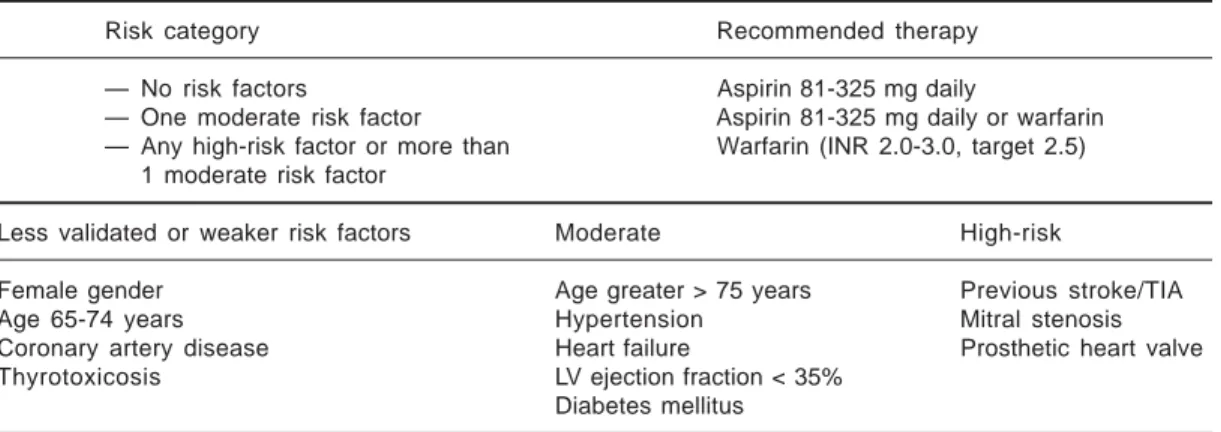
NVAF patients in which cardioembolism has been occurred already or in whom stasis in the left atrium is more likely to occur (heart failure, hypertension causing increased end-diastolic left ventricular pressure, etc) are considered to be at highest risk (Table 1).5
The second relationship of NVAF with ischemic stroke is given by the fact that both clinical en-tities in the elderly are often expression of the same underlying atherothrombotic disease. It has been shown that 70% of all NVAF patients abo-ve 65 years haabo-ve carotid artery sclerosis,7 which
gi-www.medigraphic.com
ven as prophylactic therapy against ischemic cerebrovascular events in NVAF patients above 60 years without presence of any risk factor.5
This second non-causal relationship of NVAF with ischemic stroke points at the important is-sue, that NVAF in the elderly as such is a marker of the presence of atherosclerosis in these pa-tients. NVAF in elderly patients may often be even a marker of advanced atherosclerosis, gi-ven the strong correlation of both with factors such as advanced age, inflammation, etc.
Non-valvular atrial fibrillation and inflammation
Until the 1970s the link between lipids and athe-rosclerosis dominated our thinking. In the past 2 decennia atherosclerosis has more and more been considered as a chronic inflammatory di-sorder and inflammatory markers have shown to herald myocardial infarction, stroke and peri-pheral arterial disease.8-10
Recently also for NVAF a strong correlation has been found with inflammation, as being expres-sed by the level of (hs-)CRP and IL-6.11-13
Pa-tients with higher (hs-)CRP have more recurren-ces of paroxystic AF and the anti-inflammatory effect of statins reduce the AF recurrences.12,13 It
seems logical that signs of more active inflam-mation will induce more atherosclerotic altera-tions in the atrial wall; hence more fibrotic de-generation will occur and this will affect the normal atrial electrical pathways, giving rise to chaotic atrial depolarization waves, so typical for atrial fibrillation. However, another pheno-menon that is related with inflammation could also give rise to the appearance of AF. Increased inflammatory activity produces higher levels of acute-phase proteins, of which (hs-)CRP and fi-brinogen are well-known exponents. The com-mon effect of all the different acute-phase pro-teins is, that they increase blood aggregation, leading to higher blood viscosity.14 In the
law of Hagen-Poisseuille (total blood flow Q= [(ΔP.π.r4)/8.l] x 1/η and blood flow
resistan-ce R = [(8.l)/(π.r4)] x η (η = viscosity and r =
vessel radius) ) higher blood viscosity will in-crease total blood resistance. No studies so far have been performed to determine the influence of increased blood resistance by higher viscosi-ty on the occurrence of atrial fibrillation. In this aspect should be mentioned, that the presence of left ventricular hypertrophy in hypertensive disease is not correlated so much with the level of arterial hypertension or with the duration of arterial hypertension, but is closely related with the level of blood viscosity in these patients
(Fig. 3).15 Blood viscosity has been found to be
an important risk factor for atherosclerosis besi-des well-known risk factors as hypercholestero-lemia, hypertension and smoking.16,17 A recent
clinical study showed that statins reduce the in-cidence of atrial fibrillation after coronary bypass surgery.12 This effect of statins cannot be
ex-Fig. 1. In the holistic view not the separate parts as such of the organism are investigated, but especially their interrelationship as part of a whole.
www.medigraphic.com
plained by improved systolic or diastolic per-formance of the heart or by rapid amelioration of electrical properties of the atrial wall. Howe-ver, it might be explained by the proven reduc-tion of inflammatory proteins in the blood after statin therapy, which causes lower blood visco-sity and alters the hemodynamic conditions for atrial contraction beneficially. Blood flow rate in the atrium is lower and due to the non-Newto-nian characteristics of blood, viscosity rises shar-ply at lower flow rates, increasing the influence of viscosity (η) in the Poisseuille law for atrial performance.18,19 This concept of inflammation
in the blood focuses on inflammation as a who-le; inflammation is not only more or less present in the atherosclerotic plaques of the arterial wall.
It is concordant with the thinking, that we should focus on the “vulnerable” patient in stead of the “vulnerable” plaque (Fig. 4).20
Atrial fibrillation and cognitive impairment
The incidence of cognitive impairment increa-ses sharply with age. Ample evidence is now available that generalized atherosclerotic disea-se contributes to cognitive decline and demen-tia. The rate of cognitive decline and the inci-dence of dementia is higher when systemic athe-rosclerosis and inflammation are both present. We described previously the high prevalence of atherosclerosis and inflammation in NVAF pa-tients. Therefore, it is understandable why NVAF patients compared to individuals of the same age show more cognitive impairment.21 This
cognitive impairment is also reflected in the pre-sence of more white matter lesions and more si-lent brain infarcts on the cerebral MRI-images of NVAF patients.22,23 The strong correlation
between NVAF and cognitive impairment beco-mes even present in the more acute appearance of cognitive decline after cardiac surgery, that is significantly higher in those patients who deve-lop atrial fibrillation post-operatively.24
Al-though the pathogenetic link between atrial fi-brillation and cognitive impairment is still un-clear, the correlation might be explained by the increased blood viscosity. High blood viscosity is detrimental for the atrial hemodynamics as discussed before and also affects significantly the cerebral perfusion. The cerebral perfusion is highly dependent on blood viscosity.25
Further-more, atrial fibrillation will diminish cardiac output, which again will reduce flow rate in
ce-Table I. Classification of risk for cerebrovascular events in NVAF patients and the corresponding recommenda-tions for antithrombotic therapy. (From: Task Force AHA Circulation 2006;114).
Risk category Recommended therapy
— No risk factors Aspirin 81-325 mg daily
— One moderate risk factor Aspirin 81-325 mg daily or warfarin — Any high-risk factor or more than Warfarin (INR 2.0-3.0, target 2.5)
1 moderate risk factor
Less validated or weaker risk factors Moderate High-risk
Female gender Age greater > 75 years Previous stroke/TIA
Age 65-74 years Hypertension Mitral stenosis
Coronary artery disease Heart failure Prosthetic heart valve
Thyrotoxicosis LV ejection fraction < 35%
Diabetes mellitus
Fig. 3. A strong correlation exists between whole blood viscosity and the occurrence of left ventricular hypertrophy, as detected by echocardiogra-phy (From: Am J Cardiol 1984;54)
400
300
200
100
0 3.5 4.0 4.5 5.0 5.5
Left
ventricular
mass/gL
www.medigraphic.com
ESTE DOCUMENTO ES ELABORADO POR MEDIGRAPHIC
rebrum and hence augment blood viscosity even more.26
The finding of increased inflammation with ri-sing blood viscosity in atrial fibrillation sug-gests that anti-inflammatory agents should be added to the usual therapy of antiplatelets or oral anticoagulants. It has been shown, that the presence of spontaneous echo contrast in the left atrium is correlated with an increased risk of cardioembolic stroke;27 this spontaneous echo
contrast is the reflection of rouleaux formation
Fig. 4. Not only the vulnerable plaque will determine the occurrence of an acute atherothrombotic event, but also the vulnerable blood and (in case of coro-nary events) the vulnerable myocardium; together they determine the vulnerable patient (From: Am J Cardiol 2006;98)
between the red blood cells, being the expres-sion of higher blood viscosity at low flow ra-tes.28 Treatment with oral anticoagulants did not
reduce the presence of spontaneous echo con-trast in the left atrium.29 Preliminary studies with
statins did show a beneficial effect on cognitive function in the elderly, which effect could not be explained by the lipid lowering effect.30 This
pleiotropic effect might even be more beneficial in NVAF patients.
Epilogue
In the previous considerations we have tried to describe NVAF in the elderly not as a simple rhythm disturbance due to a circumscript local atrial electrical defect, but as part of a complex process in which atherosclerosis plays a pivotal role. Therefore, treatment of atrial fibrillation in the elderly should not focus on antiarrhythmic therapy. This has clearly been confirmed by the large AFFIRM and RACE trials, in which rate-control therapy and rhythm rate-control therapy in NVAF patients over 60 years old showed no sig-nificant difference in clinical outcome.31,32 On
the other hand, patients with paroxystic NVAF who were treated with AII-antagonists or statins, both of which have shown to have an anti-athe-rosclerotic effect by reduction of inflammation, showed lower recurrences of atrial fibrillation and better clinical outcome.33 More clinical studies
will appear to demonstrate the beneficial effect of these non-antiarrhythmic agents not only on atrial fibrillation itself, but also on cerebral func-tion, as heart and brain are so closely linked in non-valvular atrial fibrillation in the elderly.
1. KANNEL WB, WOLF PA, BENJAMIN EJ, LEVY D:
Prevalence, incidence, prognosis, and predispo-sing conditions for atrial fibrillation: population-based estimates. Am J Cardiol 1998; 82: 2N-9N. 2. GO AS, HYLEK EM, PHILIPS KA, CHANG Y, HENAULT
LE, SELBY JV, SINGER DE: Prevalence of diagnosed
atrial fibrillation in adults: national implications for rhythm management and stroke prevention: the an-ticoagulation and risk factors in atrial fibrillation (ATRIA) study. JAMA 2001; 285: 2370-2375. 3. WATTIGNEY WA, MENSAH GA, CROFT JB:
Increa-sing trends in hospitalization for atrial fibrillation in the United States., 1985 through 1998: implica-tions for primary prevention. Circulation 2003; 108: 711-716.
References
4. MOVAHED M, HASHEMZADEH M, MAZEN JM:
Dia-betes mellitus is a strong, independent risk for atrial fibrillation in addition to other cardiovas-cular disease. Int J Cardiol 2005; 105: 315-318. 5. FUSTER V, ETAL: Guidelines for the Management
of Patients with Atrial Fibrillation: a report of the American College of Cardiology/American Heart Association Task Force on Practice Guidelines and the European Society of Cardiology Committee for Practice Guidelines. Circulation 2006; 114(7): 257-354.
6. HART RG, BENAVENTE O, MCBRIDE R:
www.medigraphic.com
7. CHANG YJ, RYU SJ, LIN SK: Carotid artery stenosisin ischemic stroke patients with nonvalvular atrial fibrillation. Cerebrovasc Dis 2002; 13: 16-20. 8. ROSS R: Atherosclerosis: an inflammatory
disea-se. N Engl J Med 1999; 340: 115-126.
9. LIBBY P: Inflammation in atherosclerosis. Nature
2002; 420: 868-874.
10. LIBBY P, RIDKER P, MASERI A: Inflammation and
atherosclerosis. Circulation 2002; 105: 1135-1143. 11. BOOS CJ, ANDERSON RA, LIP GYH: Is atrial
fibri-llation an inflammatory disorder? Eur Heart J 2006; 27: 136-149.
12. PATTI G, CHELLO M, CANDURA D: Randomized trial
of atorvastatin for reduction of Postoperative Atrial Fibrillation in patients undergoing cardiac sur-gery. Results of the ARMYDA-3. Circulation 2006; 114: 1455-1461.
13. YOUNG-XU Y, JABBOUR S, GOLDBERG R:
Useful-ness of statin drugs in protecting against atrial fibrillation in patients with coronary artery disea-se. Am J Cardiol 2003; 92: 1379-1383.
14. WENG X, CLOUTIER G, BEAULIEU R, ROEDERER GO:
Influence of acute-phase proteins on erythrocyte aggregation. Am J Physiol 1996; 271: H2346-2352. 15. DEVEREUX RB, DRAYER JIM, CHIEN S: Whole blood
viscosity as a determinant of cardiac hypertrophy in systemic hypertension. Am J Cardiol 1984; 54: 592-596.
16. GOLDSMITH HL, TURITTO VT: Rheological aspects
of thrombosis and haemostasis: Basic principles and applications. Thromb and Haemost 1986; 55: 415-435.
17. KOENIG W, ERNST E: The possible role of
hemor-heology in atherothrombogenesis. Review Article. Atherosclerosis 1992; 94: 93-107.
18. CHIEN S, USAMI S, DELLENBACK RJ, GREGERSEN MI:
Blood viscosity: influence of erythrocyte aggrega-tion. Science 1967; 157: 829-831.
19. SCHMID-SCHONBEIN H, GAETHGENS P, HIRSCH H: On
the shear rate dependence of red cell aggregation
in vitro. J Clin Invest 1968; 47: 1447-1454. 20. Task Force American Heart Association. From
vulnerable plaque to vulnerable patient. Circula-tion 2003; 108: 1664-1698.
21. LEFEBVRE C, DEPLANQUE D, TOUZE E: Prestroke
dementia in patients with atrial fibrillation. Fre-quency and associated factors. J Neurol 2005; 252: 1504-1509.
22. DE LEEUW FE, DE GROOT JC, OUDKERK M: Atrial
fibrillation and the risk of cerebral white matter lesions. Neurology 2000; 54(9): 1795-1801. 23. EAFT Study Group. Silent brain infarction in
nonrheumatic atrial fibrillation. European Atrial Fibrillation Trial. Neurology 1996; 46: 159-165.
24. STANLEY T, MACKENSEN GB, GROCOTT H: The
im-pact of postoperative atrial fibrillation on neuro-cognitive outcome after coronary artery bypass surgery. Anesth Analg 2002; 94: 290-295. 25. GROTTA J, ACKERMAN R, CORREJA, FALLICK G,
CHANG J: Whole blood viscosity parameters and
cerebral blood flow. Stroke 1982; 13: 296-302. 26. ACKERMAN RH: Cerebral blood flow and
neurolo-gical change in chronic heart failure. Stroke 2001; 32: 2462-4.
27. BLACK IW, CHESTERMAN CN, HOPKINS AP, LEE LC,
CHONG BH, WALSH WF: Hematologic correlates
of left atrial spontaneous echo contrast and throm-boembolism in nonvalvular atrial fibrillation. J Am Coll Cardiol 1993; 21: 451-457.
28. SIGEL B, MACHI J, BEITLER JC, JUSTIN JR: Red cell
aggregation as a cause of blood-flow echogenici-ty. Radiology 1983; 148: 799-802.
29. ITO T, SUWA M, NAKAMURA T, MIYAZAKI S, HIRO -TA Y, KAWAMURA K: Influence of Warfarin
thera-py on left atrial spontaneous echo contrast in non-valvular atrial fibrillation. Am J Cardiol 1999; 84:857-9.
30. BERNICK C, KATZ R, SMITH NL: Statins and
cogni-tive function in the elderly: the Cardiovascular Health Study. Neurology 2005; 8: 1388-1394. 31. HAGENS VE, RANCHOR AV, VAN SONDEREN E:
Effect of rate or rhythm control on quality of life in persistent atrial fibrillation. Results from the Rate Control Versus Electrical Cardiover-sion (RACE) Study. J Am Coll Cardiol 2004; 43(2): 241-247.
32. WYSE DG, WALDO AL, DIMARCO: A
compari-son of rate control and rhythm control in patients with atrial fibrillation. N Engl J Med 2002; 347 (23):1825-1833.
33. LOZANO HF, CONDE CA, LAMAS GA: Treatment