Annals of Hepatology 5(4) 2006: 276-280
276
edigraphic.com
Annals of Hepatology 2006; 5(4): October-December: 276-280
Annals of Hepatology
Original Article
Risk factors and prevalence of hepatitis virus B
and C serum markers among nurses at a tertiary-care
hospital in Mexico City, Mexico: a descriptive study
Nahum Méndez-Sánchez;1 Daniel Motola-Kuba;1 Daniel Zamora-Valdés;1 Karla Sánchez-Lara;1 Guadalupe
Ponciano-Rodríguez;2 Martha H. Uribe-Ramos;1 Francisco Vásquez-Fernández;1 Jezer Lezama-Mora;1 Julio A.
Pérez-Sosa;1 Héctor A. Baptista-González;1 Misael Uribe1
Abstract
Background & aim: Alcohol consumption and viral
in-fection with hepatitis B virus (HBV) and hepatitis C vi-rus (HCV) are the first causes of chronic hepatopathy in Mexico. Medical personnel are at high risk of devel-oping HBV and HCV infection because both viruses are transmitted parenteraly. The aim of this study was to determine the prevalence of HCV and HBV infec-tion as well as risk factors in nurses working at Medica Sur Clinic and Foundation. Methods: The complete nurse staff personal from our hospital was included; a questionnaire of risk factors for HCV and HBV infec-tion was assessed. HBV and HCV infecinfec-tion (anti-HCV anti-HBc, and HBsAg) was determined to all of them. In anti-HCV positive persons HCV genotype and viral load was assessed. Results: Three hundred seventy six nurses where studied, Anti-HBc was positive in 1.6% of all participants, none were positive for HBsAg. 0.8% of all studied population was positive for anti-HCV. Major risk factors for HBV infection where tat-tooing and having more than 4 sexual partners previ-ously, and for HCV infection transfusions before 1992 and age. Only one person was anti-HCV positive with
1Research Liver Unit, Biomedical Research Department, Medica Sur
Clinic & Foundation, Mexico City, Mexico.
2Faculty of Medicine. National Autonomous University of Mexico,
Mexico City, Mexico.
List of abbreviations: HBV, hepatitis B virus; HCV, hepatitis C
virus; HCC, hepatocellular carcinoma; RNA, ribonucleic acid; PCR, polymerase chain reaction; HBsAg, hepatitis B surface antigen; HBeAg, hepatitis B e antigen; ALT, alanine aminotransferase.
Address for correspondence:
Nahum Méndez-Sánchez, M.D.,Ph.D. Departments of Biomedical Research, Gastroenterology & Research Liver Unit, Medica Sur Clinic & Foundation, Puente de Piedra 150, Col. Toriello Guerra, México City, México. Phone: (+525) 55606-6222, ext. 4215. Fax: (+525) 55666-4031 and 55606-1651; e-mail:
Manuscript received 18 August and accepted 22 September, 2006
a viral charge of 5 X 10⁶ copies, genotype 2b.
Conclu-sions: HCV seropositivity in people with high risk was
lower than general population. None was positive for HBV infection.
Key words: Viral hepatitis, hepatitis B virus, hepatitis C virus, risk factors, prevalence, Mexico.
Background
Chronic liver diseases represent the fourth leading cause of death in the Mexican population and the second among productive-aged population;1 based on mortality
trends analysis, chronic liver disease-related mortality will continue to rise beyond the year 2050.2 Along with
alco-hol, chronic viral infections, like hepatitis B (HBV) and C (HCV) viruses represent the leading causes of liver cirrho-sis in our country.3 HCV is a member of flavivirus, with 6
major genotypes and more than 50 subtypes.4 According
to blood banks reports, in our country 1.2% of the general population is infected.5,6 In a previous study, we found a
2% prevalence among asymptomatic population in a check-up unit (confirmed though HCV-RNA studies).2
Risk factors for HCV transmission are blood transfu-sions and surgeries before 1992, intravenous drug use, contaminated parenteral drugs and other invasive non-medical procedures (tattooing, piercing).7 Based on these
risk factors, high-risk groups are: multitransfused patients (i.e. hemophiliacs), health personnel, intravenous drug us-ers, inmates, individuals with high-risk sexual behaviors (early sex life, high number of sexual partners and prosti-tution).8 Other populations at risk are patients on
extracor-poreal circulation system, such as end-stage kidney dis-ease patients on hemodialysis programs.9
Twenty percent of HCV chronically infected pa-tients develop liver cirrhosis after 20 years, while 1-4% will develop hepatocellular carcinoma (HCC), even in the absence of cirrhosis.10 The relation between HCV
and HCC has risen especially in developed countries like Japan, Spain, France and Italy, where the propor-tion of HCV-related HCC is 50-70%.11 Antiviral
thera-py based on pegylated alfa-2b or alfa-2a interferon and
Artemisa
N Méndez-Sánchez et al. Viral hepatitis among Mexican nurses
edigraphic.com
SUSTRAÍDODE-M.E.D.I.G.R.A.P.H.I.C
:ROP ODAROBALE FDP
VC ED AS, CIDEMIHPARG
ARAP
ACIDÉMOIB ARUTARETIL :CIHPARGIDEM
ribavirin results in sustained viral response in 50% of patients with genotype 1 (which correspond to 70% of infected Mexican population) and 80% in patients with genotype 2 or 3; however, in more advanced stages of the disease, there is a lessen response to therapy, em-phasizing early detection as a major tool in control-ling HCV infection.12
Four hundred million people in the world are infected with HBV; in high-prevalence areas, such as sub-Saharan Africa, the most important form of dissemination is vertical transmission and in low-prevalence areas, such as Mexico (0.2% of the general population) the most important form of dissemination is sexual transmission, intravenous drug use, tattooing and piercing.13,14 After primary infection,
5-10% of patients will develop chronic hepatitis and depend-ing on viral antigen e status, 8-30% (positive HBeAg) or 3-8% (negative HBeAg) will develop HCC annually.15
HBV and HCV infections exhibit parenteral transmis-sion. Health personnel frequent contact with organic ma-terial and disposal places this population at high-risk of infection. According to an interview performed by our team in our hospital in 2003, only 10% of nursing person-nel is vaccinated against HBV. The aim of this study is to determine the prevalence of risk factors and prevalence of hepatitis virus B and C serum markers among nurses in a tertiary-care hospital in Mexico City.
Methods
Design and sample
We performed a descriptive study for which the entire Medica Sur Clinic & Foundation nursing personnel were invited to participate. This hospital provides medical care for middle or high income individuals living in Mexico City and the surroundings. The study was approved by the Human Subjects Committee of the Medica Sur Clinic and Foundation, conforming to the ethical guidelines of the 1983 Declaration of Helsinki, and written informed con-sent was obtained from all participants before entry into the study. Every participant filled a risk factor question-naire which included blood transfusions, surgeries or den-tal procedures before 1992, tattooing, piercing, manicure or pedicure in non-personal equipment, history of more than 4 sexual partners, family history of HBV or HCV in-fection, acupuncture and intravenous drug use.
Physical exam
Body weight was measured, in light clothing and with-out shoes, to the nearest 0.10 kg. Height was measured to the nearest 0.5 cm. Body mass index was calculated as weight (kg) divided by height squared (m2). Waist
cir-cumference to the nearest 0.1 cm was measured at the midpoint between the lower border of the rib cage and the iliac crest, and hip circumference was similarly obtained
at the widest point between hip and buttock. Body fat percentage was measured by bioelectrical impedance (Omron body fat analyzer model HBF-306INT). Blood pressure was assessed using a mercury sphygmomanome-ter according to the American Heart Association guide-lines.16
Analytical procedures
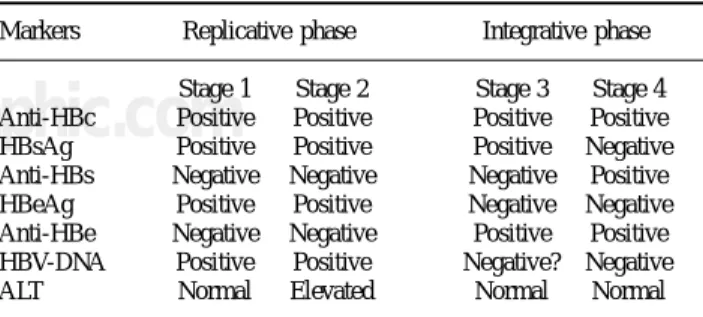
Liver function tests was performed in every sample, and included aspartate aminotransferase, alanine ami-notransferase (ALT), alkaline phosphatase, gamma-glutamyl transpeptidase, total, direct and indirect biliru-bin, total protein, albumin, globulin and prothrombin time. Serums were analyzed for detection of IgG antibod-ies anti-VHC with Axsyum HCV system version 3.0 (Ab-bott Laboratories Ltd., Wiesbaden, Germany). In positive cases, qualitative and quantitative viral load and genotype were assessed through polymerase chain reaction (PCR) for RNA-VHC. HBV surface antigen (HBsAg) and IgG antibodies anti-HB core antigen (anti-HBc) were assessed using Vitros Eci Device (Johnson and Johnson), follow-ing the diagnostic criteria shown in Table I. In positive cases, HB antigen e (HBeAg), qualitative and quantitative viral load and genotype were assessed through poly-merase chain reaction (PCR) for RNA-VHC.
Statistical analysis
To identify statistically significant risk factors to be a HBV or HCV positive case, we performed a statistical analysis using Fisher exact test (two-tailed) for continu-ous variables and Mann-Whitney U-test for categorical variables. A logistic regression analysis was performed to study the independent impact of significant risk factors in univariate analysis, controlling for confusing variables. Odds ratios (OR) were derived for the exponential of the regression coefficient, and 95% CI were calculated. All statistical analyses were carried out with the statistics pro-gram, SPSS/PC v12.0 (Chicago, IL).
Results
From 485 nurses, 379 agreed to participate. We elimi-nated three subjects because of insufficient serum
materi-Table I. Interpretation of HBV serum tests.
Markers Replicative phase Integrative phase
Stage 1 Stage 2 Stage 3 Stage 4
Anti-HBc Positive Positive Positive Positive
HBsAg Positive Positive Positive Negative
Anti-HBs Negative Negative Negative Positive
HBeAg Positive Positive Negative Negative
Anti-HBe Negative Negative Positive Positive
HBV-DNA Positive Positive Negative? Negative
edigraphic.com
al, with a total of 376 subjects, 368 females and 8 males,with a mean age of 30.8 ± 7 years.
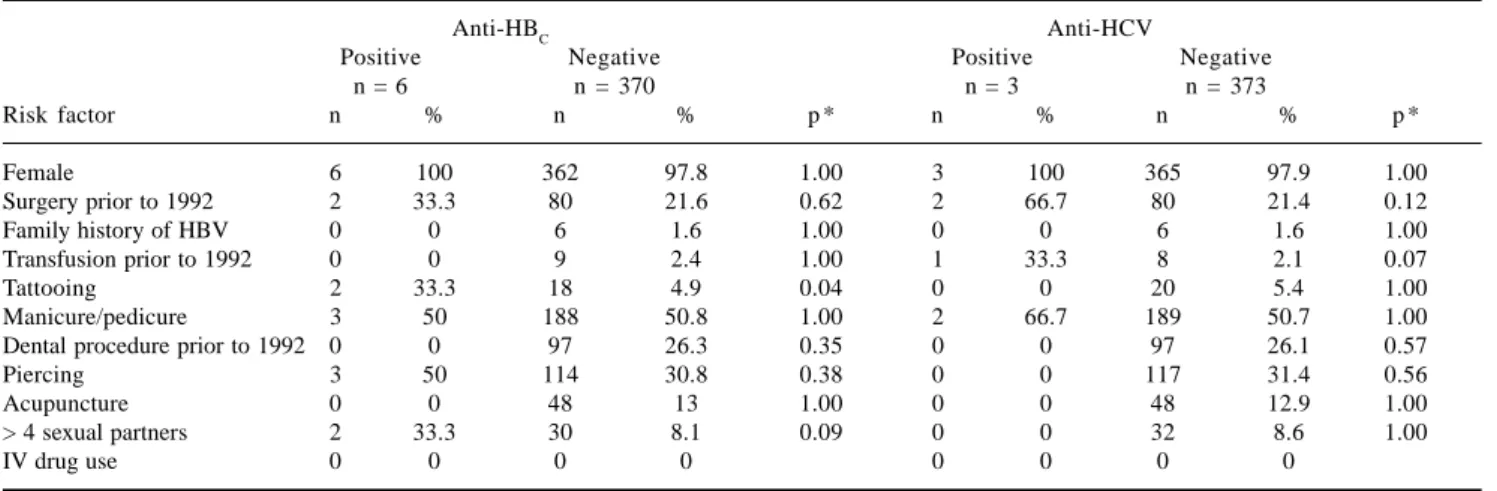
Anti-HBc was detected in 1.6% (n = 6) of participants and there were no HBsAg positive cases; for this reason, we classified all these patients as late integrative phase HBV without viral activity, therefore no further testing was performed. In Table II, the results from the risk factor questionnaire is shown, from which the most important are tattooing and more than 4 sexual partners (p < 0.05 y p < 0.1, respectively).
HCV serological analysis showed that 0.8% (n = 3) of the population studied were positive to IgG anti-HCV. From these three participants, only one showed positive viral load (5 x 10⁶ copies) of HCV genotype 2b and
nor-mal ALT levels. In Table II, the results from the risk fac-tor questionnaire is shown, from which the most impor-tant is transfusion prior to 1992 with borderline statistical significance (p = 0.07).
In the multivariate study controlled for confusing fac-tors, tattooing (OR = 10, p < 0.01) and a history of more than 4 sexual partners (OR = 5.8, p = 0.06) remained sta-tistically significant to be a positive case of anti-HBc. Anti-HCV was associated with blood transfusions prior to 1992 (OR = 29.6, p < 0.05) and age (OR = 1.15, p < 0.05).
Discussion
In endemical areas, seroprevalence of HBV infection is as high as 8%, while in low-prevalent areas such as North America, it is 2% or less.14 In Mexico, the seroprevalence
of HBsAg is just 0.23%.17 In a study performed in Nepal,
the prevalence of HBV infection was studied in several categories of health personnel, 19.2% of nurses studied had evidence of previous or current HBV infection.18 It is
estimated that 6-30% of subjects suffering a laboral acci-dent with HBV contaminated material acquire the infec-tion. In the present study, only 1.6% of subjects were
posi-tive to anti-HBc and non-to HBsAg, a fact that was inter-preted as immunity to the virus due to previous contact but with no viral activity. Even though, the author believe that it is important to remark the fact that only 10% of nurse staff is self-reported as vaccinated against HBV.
In North America, the main risk factors for HBV infec-tion are IV drug use, sexual transmission, nosocomial in-fection and immigration to endemic areas.15 In this study,
the more common risk factors to be anti-HBc positive were tattooing and having a history of more than 4 sexual partners.
The estimated prevalence of HCV infection varies from 1% in Europe, 1.7% in America, and up to 5.3% in Africa.7 The projected number of HCV infected persons
in 2020 is 2,861,556.6 Jindal et al. determinated an
anti-HCV seroprevalence of 4% in a health-related working population in New Delhi. In our study, anti-VHC sero-prevalence was 0.8%, a slightly minor sero-prevalence than re-ported in the general population in our country, despite being a high-risk group.
In 1994, the health authorities in our country dictated that all blood bank samples must be valuated for anti-HCV, a fact that reduced the risk of transmission in blood transfu-sion to 1:1,600,000.19 In the present study, we considered
blood transfusions prior to 1992 as a risk factor, because effective technology for HCV detection was available since that year in our country, despite not being mandatory.
There is enough evidence to show that percutaneous exposure to blood is the main transmission bias of HCV infection among the health personnel. In the United States, health workers represent almost 2% of the total in-cidence of new cases of HCV; however, the prevalence of anti-VHC in this population is similar to the general pop-ulation. The probability of transmission through a con-taminated needle-stick is 3-10%.20
Rischitelli et al. evaluated the risk of HCV occupa-tional infection in a 30-year career. The estimated an-nual needle-stick accidents per capita are 0.12 (IC 95%
Table II. Prevalence of risk factors for HBV and HCV in our population.
Anti-HBC Anti-HCV
Positive Negative Positive Negative
n = 6 n = 370 n = 3 n = 373
Risk factor n % n % p * n % n % p *
Female 6 100 362 97.8 1.00 3 100 365 97.9 1.00
Surgery prior to 1992 2 33.3 80 21.6 0.62 2 66.7 80 21.4 0.12
Family history of HBV 0 0 6 1.6 1.00 0 0 6 1.6 1.00
Transfusion prior to 1992 0 0 9 2.4 1.00 1 33.3 8 2.1 0.07
Tattooing 2 33.3 18 4.9 0.04 0 0 20 5.4 1.00
Manicure/pedicure 3 50 188 50.8 1.00 2 66.7 189 50.7 1.00
Dental procedure prior to 1992 0 0 97 26.3 0.35 0 0 97 26.1 0.57
Piercing 3 50 114 30.8 0.38 0 0 117 31.4 0.56
Acupuncture 0 0 48 13 1.00 0 0 48 12.9 1.00
> 4 sexual partners 2 33.3 30 8.1 0.09 0 0 32 8.6 1.00
IV drug use 0 0 0 0 0 0 0 0
N Méndez-Sánchez et al. Viral hepatitis among Mexican nurses
edigraphic.com
SUSTRAÍDODE-M.E.D.I.G.R.A.P.H.I.C
:ROP ODAROBALE FDP
VC ED AS, CIDEMIHPARG
ARAP
ACIDÉMOIB ARUTARETIL :CIHPARGIDEM
0.026-2.0), with a HCV prevalence of 1.8% in their population (IC 95% 1.2-2.3) and an annual risk of se-roconversion of 0.01%.21 It is estimated that 3-10% of
the exposed to these accidents will acquire HCV infec-tion.22
Other potential HCV transmission biases in health workers have been proposed. HCV-RNA has been de-tected in saliva and gingival crevicular fluid; there is even a case report that sustains HCV transmission through a human bite.23,24 HCV transmission through a
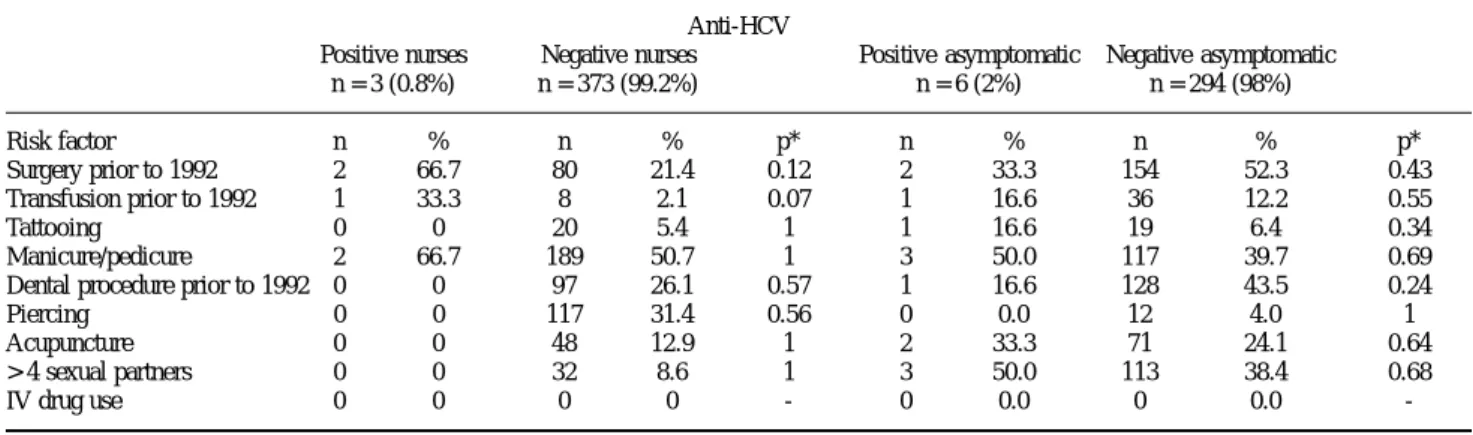
blood splash into conjunctiva in a nurse has also been reported.25 In Table III, differences among risk factors
prevalence in the nurses studied in this report and an as-ymptomatic population in a check-up unit studied in a previous report are compared.26 Blood transfusion and/
or surgery prior to 1992 is the main risk factor for HCV in nurses (33.3% in HCV positive vs 2% in HCV nega-tive), while in the asymptomatic population tattooing (16.6% in HCV positive vs 6.4% in HCV negative) and manicure/pedicure with non-personal instruments (50% in HCV positive vs 39.7% in HCV negative) are the main risk factors.
In the current report, we found that age was an inde-pendent risk factor to be a case of HCV, which sug-gests that the longer the exposure to occupational haz-ards the greater the probability to be acquire HCV. A possible explanation for the low HCV prevalence in this report is the mean age of the population studied, mainly fourth decade female with a decade or less of laboral experience.
In conclusion, our results show that the prevalence of HCV in our nurse staff is lower than the general popula-tion, despite being a high-risk group. We did not identify a case of HBV chronic infection; however, we detected the need to develop massive vaccination campaigns in our nursing staff.
Acknowledgements: This study was supported partly
by Laboratorios Roche de Mexico and a Grant from Medica Sur Clinic and Foundation.
References
1. Principales causas de mortalidad general 2003. http://
sinais.salud.gob.mx/mortalidad/mortalidad.htm
2. Mendez-Sanchez N, Villa AR, Chavez-Tapia NC, Ponciano-Rodriguez G, Almeda-Valdes P, Gonzalez D, Uribe M. Trends in liver disease prevalence in Mexico from 2005 to 2050 through mortality data. Ann
Hepatol 2005; 4: 52-5.
3. Mendez-Sanchez N, Aguilar-Ramirez JR, Reyes A, Dehesa M, Juarez A, Castañeda B, Sanchez-Avila F, Poo JL, Guevara Gonzalez L, Lizardi J, et al. Etiology of liver cirrhosis in Mexico. Ann Hepatol 2004; 3: 30-3.
4. Simmonds P, Bukh J, Combet C, Deleage G, Enomoto N, Feinstone S, Halfon P, Inchauspe G, Kuiken C, Maertens G, et al. Consensus proposals for a unified system of nomenclature of hepatitis C virus genotypes. Hepatology 2005; 42: 962-73.
5. National Consensus of Hepatitis C. In: Ann Hepatol; 2002; Asociación Mexicana de Hepatología. 148-54.
6. Mendez-Sanchez N, Baptista-Gonzalez H, Sanchez-Gomez RH, Bordes-Aznar J, Uribe-Esquivel M. The prevalence of hepatitis B and C in blood donors in a 3rd-level hospital of Mexico City. Salud
Publica Mex 1999; 41: 475-8.
7. Shepard CW, Finelli L, Alter MJ. Global epidemiology of hepatitis C virus infection. Lancet Infect Dis 2005; 5: 558-67.
8 . Esteban JI, Esteban R, Viladomiu L, Lopez-Talavera JC, Gonzalez A, Hernandez JM, Roget M, Vargas V, Genesca J, Buti M, et al. Hepatitis C virus antibodies among risk groups in Spain. Lancet 1989; 2: 294-7.
9. Mendez-Sanchez N, Motola-Kuba D, Chavez-Tapia NC, Bahena J, Correa-Rotter R, Uribe M: Prevalence of hepatitis C virus infection among hemodialysis patients at a tertiary-care hospital in Mexico City, Mexico. J Clin Microbiol 2004; 42: 4321-2.
10. Seeff LB: Natural history of chronic hepatitis C. Hepatology 2002; 36: S35-46.
11. el-Serag HB. Epidemiology of hepatocellular carcinoma. Clin Liver Dis 2001; 5: 87-107, vi.
12. Liang TJ, Rehermann B, Seeff LB, Hoofnagle JH. Pathogenesis, natural history, treatment, and prevention of hepatitis C. Ann
Intern Med 2000; 132: 296-305.
13. Silveira TR, Da Fonseca JC, Rivera L, Fay OH, Tapia R, Santos JI, Urdeneta E, Clemens SA. Hepatitis B seroprevalence in Latin America.
Rev Panam Salud Publica 1999; 6: 378-83.
14. Tran TT, Martin P. Hepatitis B: epidemiology and natural history.
Clin Liver Dis 2004; 8: 255-66.
15. Ocama P, Opio CK, Lee WM. Hepatitis B virus infection: current status. Am J Med 2005; 118: 1413.
16. Pickering TG, Hall JE, Appel LJ, Falkner BE, Graves J, Hill MN, Jones DW, Kurtz T, Sheps SG, Roccella EJ. Recommendations for blood pressure measurement in humans and experimental
ani-Table III. Risk factors for HCV in nursing personnel and an asymptomatic population in a check-up unit.
Anti-HCV
Positive nurses Negative nurses Positive asymptomatic Negative asymptomatic
n = 3 (0.8%) n = 373 (99.2%) n = 6 (2%) n = 294 (98%)
Risk factor n % n % p* n % n % p*
Surgery prior to 1992 2 66.7 80 21.4 0.12 2 33.3 154 52.3 0.43
Transfusion prior to 1992 1 33.3 8 2.1 0.07 1 16.6 36 12.2 0.55
Tattooing 0 0 20 5.4 1 1 16.6 19 6.4 0.34
Manicure/pedicure 2 66.7 189 50.7 1 3 50.0 117 39.7 0.69
Dental procedure prior to 1992 0 0 97 26.1 0.57 1 16.6 128 43.5 0.24
Piercing 0 0 117 31.4 0.56 0 0.0 12 4.0 1
Acupuncture 0 0 48 12.9 1 2 33.3 71 24.1 0.64
> 4 sexual partners 0 0 32 8.6 1 3 50.0 113 38.4 0.68
IV drug use 0 0 0 0 - 0 0.0 0 0.0
edigraphic.com
mals: Part 1: blood pressure measurement in humans: a statement for professionals from the Subcommittee of Professional and Public Education of the American Heart Association Council on High Blood Pressure Research. Hypertension 2005; 45: 142-61. 17. Chiquete E, Sanchez LV, Becerra G, Quintero A, Maldonado M, Panduro A. Performance of the serologic and molecular screening of blood donations for the hepatitis B and C viruses in a Mexican Trans-fusion Center. Ann Hepatol 2005; 4: 275-8.
18. Shrestha SK, Bhattarai MD. Study of hepatitis B among different categories of health care workers. J Coll Physicians Surg Pak 2006; 16: 108-11.
19. Wong T, Lee SS. Hepatitis C: a review for primary care physi-cians. CMAJ 2006; 174: 649-659.
20. Berry AJ. Needle stick and other safety issues. Anesthesiol Clin North
America 2004; 22: 493-508, vii.
21. Rischitelli G, Lasarev M, McCauley L. Career risk of hepatitis C virus infection among U.S. emergency medical and public safety
workers. J Occup Environ Med 2005; 47: 1174-81.
22. Sulkowski MS, Ray SC, Thomas DL. Needlestick transmission of hepatitis C. JAMA 2002; 287: 2406-13.
23. Suzuki T, Omata K, Satoh, Miyasaka T, Arai C, Maeda M, Matsuno T, Miyamura T. Quantitative detection of hepatitis C virus (HCV) RNA in saliva and gingival crevicular fluid of HCV-infected patients. J Clin Microbiol 2005; 43: 4413-7.
24. Dusheiko GM, Smith M, Scheuer PJ. Hepatitis C virus transmitted by human bite. Lancet 1990; 336: 503-4.
25. Mattner F, Tillmann HL. Proof of alleged transmission of hepati-tis C virus by a conjunctival blood splash. Am J Infect Control 2004; 32: 375-6.
26. Mendez-Sanchez N, Ponciano-Radriguez G, Chavez-Tapia NC, Motola-Kuba D, Almeda-Valdes P, Sanchez-Lara K, Ramos MH, Uribe M. Prevalence of Hepatitis C Infection in a Population of Asymptomatic People in a Checkup Unit in Mexico City. Dig Dis