
Study of the perception of open data by Colombian public entities
10
0
0
Texto completo
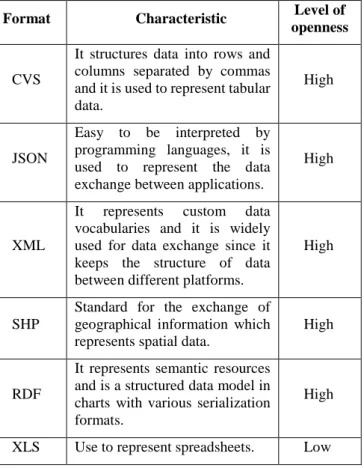
(2) International Journal of Applied Engineering Research ISSN 0973-4562 Volume 13, Number 22 (2018) pp. 15662-15671 © Research India Publications. http://www.ripublication.com open data [12]. In order for a format to be deemed open (not owned) it must have a publicly-known specification and be approved by organizations that work with standards, i.e., their structure must enable harnessing the data and be interpreted by most computing systems (read, processed and used by machines) [13] [14]. Some of the most used open data formats are detailed.. most commonly used platform options in open data publishing in this situation are: Table 2. Open data platforms Source. Elaborated by author Platform. Table 1. Open data formats sources: [15] [16] [17] Format. Characteristic. Level of openness. CVS. It structures data into rows and columns separated by commas and it is used to represent tabular data.. High. JSON. Easy to be interpreted by programming languages, it is used to represent the data exchange between applications.. High. XML. It represents custom data vocabularies and it is widely used for data exchange since it keeps the structure of data between different platforms.. High. SHP. Standard for the exchange of geographical information which represents spatial data.. High. It represents semantic resources and is a structured data model in charts with various serialization formats.. High. Use to represent spreadsheets.. Low. RDF. XLS. CKAN. SOCRATA. The documents presented in formats such as Word, PDF, ODF are useful to display certain types of data, but these formats are not structured and, therefore, cannot be read by machines, which inhibits them from being used in the context of open data [18]. Additionally, the openness in data over different websites must be supported by technologies that allow the correct management, publishing, storage and visualization of data; hence, it is crucial to choose a platform that adapts to specific needs and offers services which are universally approved for the consumption of available information, complying with open data principles. These platforms must also be focused on the consumer, since they are the ones who develop new resources and make relevant decisions, guaranteeing a design that reduces of digital access gaps and understand the open information to offer the same opportunities to the users and facilitate use of datasets [19]. Nonetheless, those who pretend to carry out a data opening process do not have the necessary resources to develop their own platform, which fits their specific needs, so they must use platforms from specialized organizations[20]. Some of the. DKAN. Description. Characteristics. It is a data management system, developed by the Open Data Foundation that optimizes the publishing, exchange, search and use of data. It is designed for any data editor that wish to turn their data open and accessible [21].. It offers open code available as free software, which can be downloaded or stored in the cloud.. It is a cloud-based platform developed by the Socrata company to publish, browse, compare and visualize different datasets. Users can download or access the datasets via an API (Application Programming Interface) [23].. It incorporates tools to obtain data in real time from spreadsheets, file systems, transactional databases and sources. [24]. It is a free tool dedicated to the storage and publishing of databases and their contents to the public in general [26]. It is totally Open Source, which speeds up development, reduces costs and eliminates the dependence on suppliers and companies.. It offers the capacity of uploading, editing and organizing metadata from the other available repositories.. It can display previews of structured data through dynamic tables or basic charts [21]. It is a wide set of metadata available by default, including geospatial metadata according to the INSPIRE directive, and the possibility to incorporate new custom metadata [22].. It offers an open source version of its API, to facilitate the transition for clients that migrate to the SaaS model [25]. It adds datasets easily into the contents of other portals for their dissemination.. Data preview now supporting the following data formats: JSON, XML, ArcGIS, REST, WMS, image, PDF and ZIP. DKAN incorporates integrated graphics and chart tools and can move and release control boards. [27]. The mentioned platforms are widely used by national web portals which are open worldwide, showing a preference towards tools offered by these technologies to meet the existing needs in data presentation.. 15663.
(3) International Journal of Applied Engineering Research ISSN 0973-4562 Volume 13, Number 22 (2018) pp. 15662-15671 © Research India Publications. http://www.ripublication.com There are some factors that affect the choice between platforms; this is the case of the UK where the use of CKAN for its national open data website is based on being the first open data platform that entered the market. Furthermore, the developers of data.gov.uk (UK national open data web portal) were also the developers of CKAN. Other countries such as Colombia state the decision of choosing the SOCRATA platform as a consequence of a study on the recommendation performed by the World Bank, who carried out a study in 2015 on the preparation degree of open data in Colombia [28]; this research included a comparative analysis of the most commonly used open data platforms on a global scale and recommended such platform (Socrata) given the technical features and the experience on the market regarding worldwide open data initiatives. Although the described platforms are the most used, some countries have chosen to develop their own platform for posting datasets; these platforms are specifically designed to adapt to the needs of their governments. This is the case of Canada who aimed efforts at harnessing open code solutions that can be reused and shared with other open government initiatives in all of Canada and the world. The source code can be found in GitHub. Other well-known platform of this type is ETAlab, created in 2011 as the action of France for the Alliance of Open Government (PGO) and supervision of the National Action Plan for a transparent and cooperative public policy developed in the PGO, improved administrative operation, thanks to new organization methods and working processes.[29]. METHODOLOGY This research begins by searching the concept of Open Data, its characteristics and relevant aspects through research articles about open data, as well as official websites from governments and organizations with the purpose of building the state of the art. Afterwards, a comparison between the state of open data in different countries based on the results of the Open Data Barometer. By using this barometer, the countries with the best worldwide ranking were identified as well as the countries in Latin America and the Caribbean in terms of posting open data. The reasons that lead to such rankings are also researched. After identifying the countries with highly developed government open data, the National Portal of Open Data of each country was visited to identify which platform is being used to post and manipulate datasets on each portal and the amount of data that is available to anyone who is interested. Finally, a survey on open data was performed on public entities in Colombia that can determine the real state of open data in the country, the knowledge and expertise of public officials on the utility of open data and the inconsistencies discovered between the theoretical results and the factual information on open data.. OPEN DATA IN THE WORLD ACCORDING TO THE “OPEN DATA BAROMETER” The Open Data Barometer is an indicator produced by the World Wide Foundation, whose main goal is to measure the prevalence and impact of open data initiatives all over the world [30] [31]. This indicator assesses such countries under the following criteria: 1. 2. 3.. Level of preparation of the countries in terms of government initiatives and policies of open data. The implementation by governments in terms of the proposed initiatives. The impact of the practical benefits offered through the use of open data [32].. According to the results obtained in the fourth edition of the Open Data Barometer from 2016, the United Kingdom maintains the first position worldwide regarding open data. The country had a total score of 100 where it stands out with its preparation in government and business policies and the actions of the government for the contribution and improvement of open data on a national level. Aside from being a benchmark point in terms of open data implementation, it complies with many of the characteristics that consider data as open, such as the online availability of data in any form, the presentation of datasets in formats that can be interpreted by machines and reused as well as free data, the periodical update on them and the constant effort to give data under open licenses.. The use of tools that can verify which datasets are easier to access was also factored with the purpose of quantifying their level of usage when displayed in national websites as well as the development of new guidelines [33] directed to portal administrators, editors and users to instruct the conditions in which data must be supplied to be considered open; although editors often post under the Open Government License, which is free-of-charge. There is a frequent assistance to events and lectures of the members of the national open data portal for the communication and promotion of dataset reuse by citizens and interested parties. These efforts are reflected on the impact that open data has had in the UK; especially in the political and economic sectors. Another example is Canada, which has achieved considerable progress in open data through constant and committed actions of the government that have allowed it not only to become a leader in America, but also to rank in second place globally (after the UK) according to the last version of this measure. In Canada, it is worth pinpointing not only the existence of data, but also the online availability offered by the government and the growing efforts to post datasets in free and machinereadable formats, which has had a significant social impact. Furthermore, courses and materials have been developed that are shared and given to the posting departments which are available in open data websites. Through the “School of Public Service of Canada”, the government offers training to open data suppliers in terms of the correct way in which data must be posted. However, it still has several license-related restrictions in some of the datasets.. 15664.
(4) International Journal of Applied Engineering Research ISSN 0973-4562 Volume 13, Number 22 (2018) pp. 15662-15671 © Research India Publications. http://www.ripublication.com Currently, the government of this country is drafting a guideline for the quantification of the level of dataset usage by interested parties where the factors are considered in the assessment of datasets with high value, which includes aspects such information and data that will grant benefits to the Canadian people like improving services or. allowing the innovation and economic growth, data that have been frequently demanded through information access or open government portal, information and data that will allow the public to better understand the priorities and commitments of the Government of Canada to offer more effective services.. Table 3. Worldwide ranking of barometer 2016 Source. Elaborated by author Ranking (2016) 1. Variation in ranking Country United Kingdom. Description Total implementation of open data, that can be read by anyone, free-of-charge. It is easy-to- use, constantly updated and reusable. [33]. 2015. 2014. 2013. 1. 1. 1. 4. 7. 8. 3. 4. 10. 2. 2. 2. 8. 17. 12. It has significant political and economic impact, but social impact is still lacking. 2. Canada. Strong implementation of open data that can be read by anyone, free-of-charge. It is easy-to- use, constantly updated and reusable, although it has some flaws in keyword-based search within the dataset. Significant social impact, low economic and political impact.[34]. 3. France. Strong preparation for obtaining positive results of government data, which helps citizens, business and companies. Solid data implementation, with flaws in showing and updating data from budget and expenses of the government and land ownership data. It also has flaws in in keyword-based search features.[35]. 4. United States. The dataset on census, land ownership and government expenses is not open to the public, as well as criminal statistics, environmental information and election results. There is moderate social impact and low political and economic impact .[36]. 5. South Korea. The dataset is freely available in most of the categories so that users can use them without restrictions. The impact of open data in the country is relevant in political and social matters while it is moderate in economic aspects.. In Latin America and the Caribbean Islands there has been eagerly on behalf of the governments to the opening process of data which reflects on concrete political and legal actions. These have allowed positive progress in open data management accompanied by the efforts to promote the openness culture and put at the citizen’s disposal high-quality open data. However, the efforts of this countries are still deficient to reach the level of European and North American regions.. When observing the results given by the open barometer, the countries of this region have in common a difficulty to supply data, which is easy to find, free-of-charge, openly-licensed and that can be interpreted by machines, which are all fundamental aspects for the correct and timely reuse of available data in the portals.. 15665.
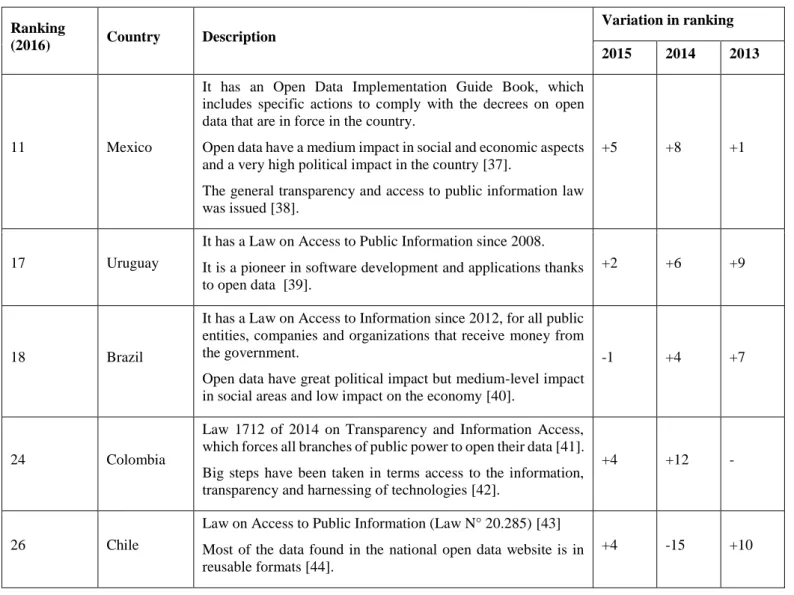
(5) International Journal of Applied Engineering Research ISSN 0973-4562 Volume 13, Number 22 (2018) pp. 15662-15671 © Research India Publications. http://www.ripublication.com Table 4. Latin American and Caribbean ranking of barometer from 2016 Source. Elaborated by author Ranking (2016). Variation in ranking Country. Description 2015. 2014. 2013. +5. +8. +1. +2. +6. +9. -1. +4. +7. +4. +12. -. +4. -15. +10. It has an Open Data Implementation Guide Book, which includes specific actions to comply with the decrees on open data that are in force in the country. 11. Mexico. Open data have a medium impact in social and economic aspects and a very high political impact in the country [37]. The general transparency and access to public information law was issued [38]. It has a Law on Access to Public Information since 2008.. 17. 18. Uruguay. Brazil. It is a pioneer in software development and applications thanks to open data [39]. It has a Law on Access to Information since 2012, for all public entities, companies and organizations that receive money from the government. Open data have great political impact but medium-level impact in social areas and low impact on the economy [40].. 24. Colombia. Law 1712 of 2014 on Transparency and Information Access, which forces all branches of public power to open their data [41]. Big steps have been taken in terms access to the information, transparency and harnessing of technologies [42]. Law on Access to Public Information (Law N° 20.285) [43]. 26. Chile. Most of the data found in the national open data website is in reusable formats [44].. With the purpose of determining the possible causes of deficient open data management in this region, a survey was carried out directed to the Colombian public entities regarding open data. It also gives a clearer overview on the condition of open data in this country.. ENTITIES. Colombia. Being an attempt made in the country to collect a real perception of various officials of public entities.. The Organization for Economic Co-operation and Development (OECD-IDB) in 2016 conducted a survey on open government data at the international level, which reflected the efforts of governments to make available their data, the degree of accessibility and support for the reuse of said data. This survey was completed by high ranking executives from each country belonging to the OECD and in the particular case of Colombia, it obtained the fourth place, ranking above pioneer countries such as the United Kingdom and Spain.. Through random sampling techniques, a simple form was sent through e-mail to 624 entities spread throughout the national territory. This sample corresponds to the directory of public entities given by the National Accounting Office, valid until June 2017.. SURVEY ON COLOMBIAN SURROUNDING OPEN DATA. PUBLIC. The survey presented below is aimed at public entities from different economic sectors of the Colombian territory and allows for responses from officials from different areas of knowledge and not only from experts or directly involved with the open data, giving a broader view of the open data in. The survey has four sections that include open and closed answers (with one or multiple choices) it considers the following aspects: a) Expertise on the law of transparency and access to the information. b) Knowledge on open data and posting process on the official platform. c) Contribution to open data. d) Actions taken by the government and their impact. Out of 206 answered surveys, 155 (75.5%) were thoroughly filled. With a confidence level of 95% and an error margin of 7.7%. The characterization of public entities responded can be seen in Figure 1.. 15666.
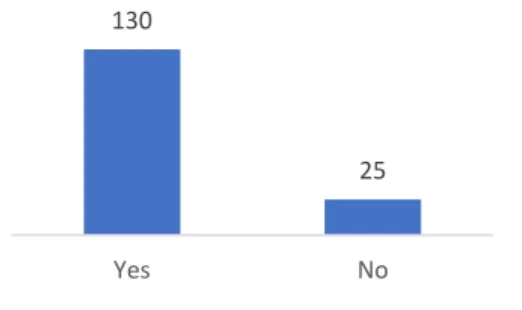
(6) International Journal of Applied Engineering Research ISSN 0973-4562 Volume 13, Number 22 (2018) pp. 15662-15671 © Research India Publications. http://www.ripublication.com 3% 2%. 95% Yes. Fig. 1. Characterization of surveyed Colombian entities source: Elaborated by author. Does not know. Fig. 4. Knowledge the principles of transparency and access to public information source: Elaborated by author. Among the 155 public officials who answered the survey, 39 are accountant, followed of 34 system engineers or computation and 21 business administrators; the total results observe in the figure 2. Additionally, 84% of these 130 public entities have management program while 12% did not. 4% said it did not apply.. 39. Accountant. No. 34 21. M.B.A. 15 Technician Electronic engineer Economist Other engineer Other. 5 4 4 3 3 2 2 2. NO 12%. YES 84%. 21. Fig. 2. Jobs from surveyed public officials source: Elaborated by author. Fig. 5. Does the entity have a document management program? source: Elaborated by author. Of these 155 public officials, 83.8% surveyed know the Law 1712 of 2014 (Transparency law and access rights to Nacional Public Information) while 16, 2% was not aware of its content. 130. Regarding the knowledge on the ninimum information that must be published by state entities, 84% of the entities that know Law 1712 admit that they know suchinformation, while only 5% do not know these requirements.. 5% 1%. 25. Yes. Does not know 4%. No. 94%. Fig. 3. Knowledge of the Law 1712 of 2014 source: Elaborated by author. Yes. No. Does not know. Fig. 6. Do you know the minimum mandatory information that must be published by state entities? source: Elaborated by author. Out of the 130 surveyed that they know Law 1712 of 2014, 95% know the principles of transparency and access to public information that exposees this law, while 3% was not aware of its content and 2% did not respond. Out of the 155 public entities included on the survey, 75% says that they know what open data is while 19% do not know and 6% do not respond.. 15667.
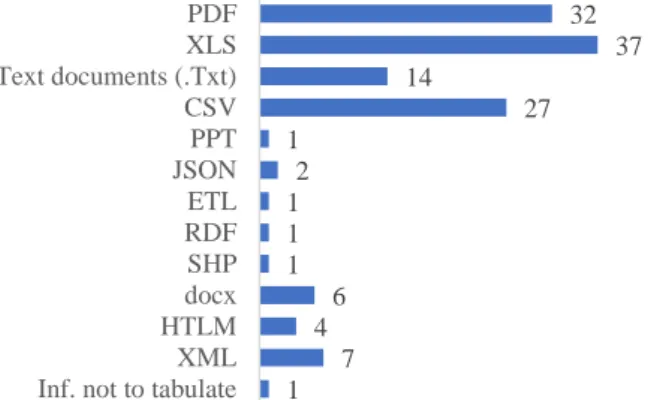
(7) International Journal of Applied Engineering Research ISSN 0973-4562 Volume 13, Number 22 (2018) pp. 15662-15671 © Research India Publications. http://www.ripublication.com. Does not know. PDF XLS Text documents (.Txt) CSV PPT JSON ETL RDF SHP docx HTLM XML Inf. not to tabulate. 10. NO. 29. YES. 116. Fig. 7. Do you know what open data is? source: Elaborated by author. Out of the 155 surveyed entities 46% admitted having posted some type of information in the open data national website while 34% has not and 20% does not give an answer.. 32 37 14 27 1 2 1 1 1 6 4 7 1. Fig. 10. Formats used to post information on the open data website source: Elaborated by author. 71. 80. 83.7% of the people surveyed recognize that open data are a contribution to the generation of knowledge and citizen participation. 0.13% does not agree and 15% does not respond.. 53. 60. 31. 40 20. 150 0 Yes. No. 129. 100. Does not know. 50. 2. 23. 0 YES. Fig. 8. As an entity, have you posted information on the open data national website? source: Elaborated by author. Among the entities that indicate posted information in the open data national portal, 29% do it yearly basis and 43% monthly basis 40 30. 31. NO. Does not know. Fig. 11. Do you consider that open data contribute to the generation of knowledge and citizen participation? source: Elaborated by author. Close to 87.6% of the 129 entities consider that open data contribute to the generation of knowledge with the main reason being the democratization of information.. 21. 20. 13. 10. 113. 4. 3. 0 Annual. Monthly. Weekly. Biannual. 40. 32. Development of web and mobile apps. Creation new business models. Other Democratization of information. Fig. 9. How often do you post public data? source: Elaborated by author. Fig. 12. Why does open data contribute to the generation of knowledge?. It is observed that most of the entities prefer to post information on the open data website in PDF, XLS and CSV formats.. source: Elaborated by author. The lack of training from companies is one of the main hardships considered by the people surveyed when posting information as well as a lack of technological infrastructure and interest from the public.. 15668.
(8) International Journal of Applied Engineering Research ISSN 0973-4562 Volume 13, Number 22 (2018) pp. 15662-15671 © Research India Publications. http://www.ripublication.com. Interporability Fear of transfer information Investment Lack of public interest Lack of techonological… Training to public officials Data confidentiality Other Does not know. Finally, 43% of the people surveyed considers that the government has not taken pertinent action on the matter and only 30% thinks it has.. 36 33 22. YES. 42 45. 15. 43%. 9. Using formats free and… Providing information of free… Publishing data of public… Updating data constantly Training to public officials Increasing the investment Other Does not know. 25 40 95 72 89 20 5 4. Fig. 14. How could the entity contribute to the publishing of open data in the country? source: Elaborated by author. Among the areas considered by public entities where open data has had more impact are public hiring, education and economics. 74 46. 4. 3 Other. Does not know. 1 Formulation…. 11 1 Agricultural. 1 Legislation. Transparency. Public hiring. Environment. Health. Education. Economics. Political. 1 Social. 12 1. Any. 24. Mobility. 17. NO. Fig. 15. Areas with more impact from open data according to public officials. source: Elaborated by author. Does not know. Fig. 16. Do you consider that the actions of the government to promote open data have been satisfying? source: Elaborated by author. The best options considered by public entities are related to publishing data which is of public interest, training public officials and updating data constantly.. 41. 30%. 35. Fig. 13. Which are the main difficulties for posting information in the Open Data National Website? source: Elaborated by author. 33. 27%. 75. DISCUSSION This study analyzed the expertise of a sample of public entities in Colombia regarding knowledge and data publishing on the open data national website. In general, the people representing the entities state that they know the transparency law 1712 of 2015 (83.87%), the principles of this law (95%) and minimum information that must be disseminated by public entities (94%) in addition to having a document management program (84%). This is possible thanks to the different strategies that were implemented such as the Government Online (GEL) to divulge and communicate the legislations in favor of a transparent, responsible, participative and open government [45]. 75% of the entities included in the survey said that they know what open data is. However, when answering the question of whether the entity published data in the national portal, 46% said that it did and 34% did not. This is interesting since most of them know about the laws and information required for data publishing but there is no empowerment on the advantages of giving information to the citizens and there is a low participation that can contribute with the generation of datasets on the portal. This leads to answering the question: What is lacking to motivate the use and publishing of data? 43% does not consider that the actions of the government are sufficient for the promotion of open data posting and use and another large percentage refrain from answering this question. According to the people surveyed, the deficient actions of the government are mainly related to a lack of training (48.4%) of public officials to teach them how to post data. However, there are efforts carried out by the Ministry of Information and Communication Technologies (MINTIC) through national and international events of initiatives and training seminars regarding open data in Colombia [46] [47] along with the support offered by the GEL strategy [48] for public officials and citizens. The latter offers a series of video-based tutorials [49] that teach didactically and meticulously topics related to the publishing, update and elimination of datasets in the portal as well as other aspects on consulting, consuming and reusing them. Additionally, in 2015 the Open Data Guide Book was developed in Colombia [50] directed exclusively to. 15669.
(9) International Journal of Applied Engineering Research ISSN 0973-4562 Volume 13, Number 22 (2018) pp. 15662-15671 © Research India Publications. http://www.ripublication.com government entities for a greater openness of public data subjected to law 1712 of 2014 on transparency and access to public information. In other aspects, there is a lack of technological infrastructure along with a lack of interest of the public in general; this reveals that there are not only flaws on behalf of the public entities and the government but that there is also weak participation of citizens and their interest on the discussed topics. The formats commonly used by public entities do not have a clear structure and are not easy to access, hence they cannot be treated analytically. In terms of the question: How could the entity contribute to posting open data in the country? it is important to train public officials but also to create interest in the public and constantly update the information. In terms of periodicity, public entities post 29% of the data on a yearly basis and a small percentage on a daily or weekly basis. This gives us an idea on why datasets are not constantly updated in the portal and as subsequently lose their validity at the time of being reused. A high percentage of the people surveyed (87.6%) consider that the biggest contribution of open data in the country is oriented to the democratization of information. Nonetheless, their biggest contribution lies in the development of mobile applications, with a current total of 27 applications. Finally, the surveyed institutions considered that the area that was most affected in terms of data management was the hiring process of public procurement, followed by education and economic affairs. However, according to the last report of the open data barometer not only in Colombia but on a global scale, the main impact of open data is seen in political matters [51], with a 73% share of the surveyed country.. CONCLUSIONS The platform chosen for data publishing directly affects the effectiveness of the governments’ efforts to publish high quality and easy-to-use information. The governments of each country put their efforts on assuring that the data is used correctly and is available on open formats while being updated as needed. Open data is a concept that has gained popularity over the recent years and has forced governments to share information (which is a powerful and active asset) with the citizens and everyone interested. This is supported by a context of equality which has translated into making policies that give the necessary guidelines so that data openness encompasses open data principles. However, these laws are hard to implement regarding deficient efforts in training data suppliers, a lack of investment in technology and an infrastructure that can close gaps up to the creation of better tools to elaborate, display and communicate information, as well as driving an appropriation culture. This leads to actions from the government and citizens concerning innovative ideas, services and knowledge that drive development in all areas, specially the social sector which requires the inclusion of everyone for the efficient and enduring harnessing of open data.. The knowledge of the meaning of open data theory is known because we live in a world where it is increasingly necessary to talk about these issues; What the survey finds disquieting is that even with the efforts and progress made in a few years by the Colombian government, these have not been sufficient for open data to cease to be just a definition that everyone knows and starts to be implemented so that public organizations and especially citizens, make innovative use and give value to open data. The survey on public entities shows the discontent and lack of efforts from the government to teach and train its staff on posting data in the national data portal so it is effective, periodically updated and accessible to the public.. REFERENCES [1]. Naser, A., and Rosales, D., 2016, “Panorama Regional de Los Datos Abiertos: Avances y Desafios En América Latina y El Caribe,” Com. Económica para América Lat. y el Caribe.. [2]. Silahtaroğlu, G., and Alayoglu, N., 2016, “Using or Not Using Business Intelligence and Big Data for Strategic Management : An Empirical Study Based on Interviews with Executives in Various Sectors,” Procedia - Soc. Behav. Sci., 235(October), pp. 208– 215.. [3]. Davies, T., 2010, “Open Data , Democracy and Public Sector Reform. A Look at Open Government Data Use from Data.Gov.Uk,” University of Oxford.. [4]. Tutunea, M. F., 2015, “Business Intelligence Solutions for Mobile Devices – An Overview,” Procedia Econ. Financ., 27(15), pp. 160–169.. [5]. Zuiderwijk, A., Janssen, M., Choenni, S., Meijer, R., and Alibaks, R. S., 2012, “Socio-Technical Impediments of Open Data,” Electron. J. eGovernment, 10(2), pp. 156–172.. [6]. Open Data HandBook, 2005, “¿Qué Son Los Datos Abiertos?,” ¿que significa Abierto?. [7]. Ministerio de Industria Energía y Turismo, 2014, “Tendencias Actuales En Iniciativas Open Data,” pp. 1–24.. [8]. Concha, G., and Naser, A., 2012, “Instituto Latinoamericano y Del Caribe de Planificación Económica y Social (ILPES) Datos Abiertos: Un Nuevo Desafío Para Los Gobiernos de La Región,” CEPAL - Ser. Gestión pública, 74, pp. 5–21.. [9]. International Open Data Charter, 2015, “Principios.”. [10]. Garriga-Portolà, M., 2011, “¿Datos Abiertos? Sí, Pero de Forma Sostenible,” El Prof. la Inf., 20(3), pp. 298– 303.. [11]. Open Government Working Group, 2007, “8 Principles of Open Government Data - OpenGovData.Org.”. [12]. 2017, “Paquete de Apertura de Datos de La República Argentina.”. 15670.
(10) International Journal of Applied Engineering Research ISSN 0973-4562 Volume 13, Number 22 (2018) pp. 15662-15671 © Research India Publications. http://www.ripublication.com [13]. González Serna, C., Leceta, J. M., Magro Pedroviejo, R., Crespo Díaz-Alejo, H. E., and Moreno Bonilla, V., 2017, DATOS ABIERTOS Guía Estratégica Para Su Puesta En Marcha Conjuntos de Datos Mínimos a Publicar.. [33]. GOVERNMENT UK, “Data.Gov.Uk Guidance.”. [34]. 2016, “Open Government” [Online]. Available: https://www.canada.ca/en.html.. [35]. “Open Data Government of France” [Online]. Available: https://asociacionempresarialesports.es/.. [14]. Diario Oficial de la Federación, 2015, “Guía de Implementacion de La Política de Datos Abiertos.”. [36]. [15]. Proyecto Aragon Open Data, Iglesias, C., Subero, J. M., and Portolés, D., 2014, “Guía de Catalogación de Datos Abiertos,” p. 23.. United States government, “Official Guide to Government Information and Services | USAGov” [Online]. Available: https://www.usa.gov/.. [37]. Gob.mx, 2017, “Datos Abiertos de México - Volcanes Activos.”. [38]. Congreso, E. L., Estados, G. D. E. L. O. S., and Mexicanos, U., 2015, Ley General de Transparencia y Acceso a La Información Pública, México.. [39]. “Datos Abierto Gobierno de Uruguay” [Online]. Available: http://datos.gub.uy.. [40]. “Bem Vindo - Portal Brasileiro de Dados Abertos” [Online]. Available: http://dados.gov.br/.. [41]. CONGRESO DE LA REPUBLICA, 2014, “LEY 1712 2014.”. [42]. Ministerio de Tecnologías de la Información y las Comunicaciones, 2014, “Lineamientos Para La Implementación de Datos Abiertos En Colombia.,” (1450), p. 13.. [43]. MINISTERIO SECRETARÍA GENERAL DE LA PRESIDENCIA, 2008, LEY NÚM. 20.285Sobre Acceso a La Información Pública, Chile.. [44]. GOBIERNO DE CHILE, “Portal de Datos Abiertos.”. [45]. 2015, “Políticas e Iniciativas de Gobierno Abierto En Colombia,” pp. 143–188.. [46]. Datos Abiertos Colombia, “Eventos Nacionales e Internacionales de La Iniciativa Datos Abiertos Colombia.”. [47]. Datos Abiertos Colombia, “Capacitaciones Iniciativa Datos Abiertos de Colombia.”. [48]. Gobierno en Línea, 2015, “Manual 3.1,” p. 94.. [49]. “Aprender Sobre Datos | Datos Abiertos Colombia.”. [50]. Telecomunicaciones, M. de la I. y las, 2015, “Guía de Datos Abiertos En Colombia,” p. 35.. [51]. World Wide WEb Foundation, 2017, “Informe Global Cuarta Edición.”. [16]. Open Knowledge International, 2005, “File Formats,” Professional Content Management Systems, pp. 121– 132.. [17]. Ayuntamiento de Valencia, “Formatos.”. [18]. Secretaria de Logística e Tecnologia da Informação (SLTI), and Ministério do Planejamento Orçamento e Gestão (MPOG), 2012, “Cartilha Técnica Para Publicação de Dados Abertos No Brasil v1.0.”. [19]. [20]. [21]. Millette, C., and Hosein, P., 2016, “A Consumer Focused Open Data Platform,” 2016 3rd MEC Int. Conf. Big Data Smart City, ICBDSC 2016, pp. 101– 106. Ministerio-de-Industria-Energía-y-Turismo, red.es, Ministerio-de-Hacienda-y-Administraciones-Públicas, and aporta.es, 2015, “Plataformas de Publicación de Datos Abiertos,” pp. 1–16. “CKAN, Una Herramienta Para Sacar Partido Al Open Data” [Online]. Available: https://www.beeva.com/beeva-view/tecnologia/ckanuna-herramienta-para-sacar-partido-al-open-data/.. [22]. Manuela, A. J., Andrés, F., Irene, G., Francisco, M., Norberto, M. J., Llorenc, V., and Jacobo, Z. J., 2015, Ecosistema de Datos Abiertos de La Universidad de Alicante.. [23]. “What Is Socrata? Learn All About the Company.”. [24]. Muirragui Irrazábal, V., Pacheco Olea, F., León Plúas, E., and Guevara Viejó, F., 2016, “Plataformas de Datos Abiertos: Disponibilidadde Mercado,” Rev. Científica y Tecnológica UPSE, III(3), pp. 137–142.. [25]. Mundial, B., 2015, “Comparativo Plataformas de Datos Abiertos.”. [26]. Digitalizaci, C., and Conocimiento, D. E. L., “Consorcio Digitalización Del Conocimiento.”. [27]. Data, O., Principales, S., Plataformas, D. E. L. A. S., and El, L. D. E. D., 2015, Plataformas de Publicación de Datos Abiertos.. [28]. World Bank, 2015, “Open Data Readiness Assessment Tool,” World Bank’s Open Gov. Data Work. Gr., p. 35.. [29]. “La Mission Etalab _ Le Blog d’Etalab.”. [30]. World Wide WEb Foundation, “El Barómetro Open Data.”. [31]. datos.gob.es, 2017, “Índices Internacionales de Datos Abiertos.”. [32]. Ríos, R. D. L., 2012, “Reporte Regional.”. 15671.
(11)
Figure

+3

Documento similar
H I is the incident wave height, T z is the mean wave period, Ir is the Iribarren number or surf similarity parameter, h is the water depth at the toe of the structure, Ru is the
The main consequences of the mediation exercised by the sense of localness in the public communication and the social perception of science occurred in such areas as the
Since such powers frequently exist outside the institutional framework, and/or exercise their influence through channels exempt (or simply out of reach) from any political
• An overview of the metadata management and exchange approach implemented by Open Data Support through the Open Data Interoperability Platform...
50 The goal is to help people to reach an optimum level in the dimensions of psychological well- being: environmental mastery, personal growth, purpose in life,
In the previous sections we have shown how astronomical alignments and solar hierophanies – with a common interest in the solstices − were substantiated in the
By distinguishing between the quality and quantity of access to information and communication technologies, together with institutional and geographical factors, and using a sample
The analysis of the status of training in Oncology dur- ing undergraduate education in medicine was carried out by analyzing the study plans and teaching guidelines of the
