Virtual Learning Object to Strengthen Educative Inclusion through Students’ Sensorial Learning
Styles
Lizeth Yolima Soto Herrera
Wendy Catherine Barbosa Aguilar
Universidad Distrital Francisco José de Caldas
Facultad de Ciencias y Educación
Licenciatura en Educación Básica con Énfasis en Inglés
Bogotá, D.C., Colombia
Virtual Learning Object to Strengthen Educative Inclusion through Students’ Sensorial Learning
Styles
Lizeth Yolima Soto Herrera
Wendy Catherine Barbosa Aguilar
Director: Mauro Jordán Baquero Rodríguez
Documento elaborado bajo la modalidad de Creación o Interpretación para obtener el título de
Licenciado en Educación Básica con Énfasis en Inglés
Universidad Distrital Francisco José de Caldas
Facultad de Ciencias y Educación
Licenciatura en Educación Básica con Énfasis en Inglés
Bogotá, D.C., Colombia
Acuerdo 019 de 1988 del Consejo Superior Universitario. Artículo177: “La Universidad Distrital
Acknowledgements
We are really pleased since we managed to complete our project with which we learned to work
cooperatively and to be inclusive. During the fulfillment of this project we could not forget those
who encouraged us to continue throughout our process. For this reason, we would like to express
our sincere gratitude to Professor Mauro Baquero who guided us throughout our process with
patience and commitment. We would also like to thank our evaluators, Professor Ximena Bonilla
and Professor Fabio Bonilla, for their useful critiques which motivated us to conclude our work.
Our grateful thanks are also extended to the educational community of the school where we made
the implementation of our creation for allowing us to understand more about our main concern,
inclusion, in its facilities and its constant support. Finally, we wish to thank to our colleagues and
friends for their suggestions and for always being willing to help us. And, our families for their
Abstract
In recent decades, the countries that are part of the United Nations, including our country,
Colombia, have worked to ensure access and quality of education for all learners within the
paradigm of Inclusion. However, we observed a lack of EFL didactic materials aimed at
exploring the students’ capacities from the different learning styles. The purpose of this project
was then to develop and analyze the effectiveness of a learning material focused on students’
capacities and likes, to strengthen the Educative Inclusion through the sensorial learning styles.
We assumed that with a Virtual Learning Object, the relationship between voice, image, text and
sound promotes the understanding of English as a foreign language since students can access the
language from more than one communication channel. The development of the project was done
in two stages: planning and creating the Virtual Learning Object, and implementing and assessing
the material. Data came from questionnaires, formats and interviews addressed to 63 third graders
in a co-educated school in Bogotá. Besides it came from feedback cards and from the
researchers’ field notes to identify students’ perceptions about the effectiveness, and scope and
limitations of the material. We found that implementing the Virtual Learning Object as a
technological device strengthened the Educative Inclusion process inasmuch as it was adapted to
the characteristics, rhythms and learning styles of each learner.
Resumen
En las últimas décadas, los países que hacen parte de las Naciones Unidas incluido nuestro país,
Colombia, han trabajado por asegurar el acceso y la calidad de educación para todos los
aprendices dentro del paradigma de la Inclusión. Sin embargo, observamos la falta de materiales
didácticos de Inglés como Lengua Extranjera dirigidos a explorar las capacidades de los alumnos
a partir de los diferentes estilos de aprendizaje. El propósito de esta investigación fue entonces
desarrollar y analizar la efectividad de un material de aprendizaje centrado en las capacidades y
gustos de los estudiantes, para fortalecer sus estilos de aprendizaje sensoriales. Asumimos que,
con un objeto de aprendizaje virtual, la relación entre voz, imagen, texto y sonido promueve la
comprensión del inglés como lengua extranjera ya que los estudiantes pueden acceder al idioma
desde más de un canal de comunicación. Este desarrollo se realizó en dos etapas: planificar y
crear el Objeto Virtual de Aprendizaje, e implementar y valorar el material. Los datos provenían
de cuestionarios, formatos y entrevistas dirigidos a 63 estudiantes de grado tercero en un colegio
mixto de Bogotá. Además, provenían de tarjetas de comentarios y de notas de campo de las
investigadoras para identificar las percepciones de los estudiantes sobre la efectividad y conocer
los alcances y limitaciones del material. Descubrimos que la implementación del Objeto Virtual
de Aprendizaje como un dispositivo tecnológico fortaleció el proceso de Inclusión Educativa en
la medida en que se adaptó a las características, ritmos y estilos de aprendizaje de cada alumno.
Résumé
Dans les dernières décennies, les pays qui font partie des Nations Unies, y compris la Colombie,
notre pays, ont œuvré pour assurer l'accès et une éducation de qualité à tous les apprentis dans le
cadre du paradigme Inclusion. Cependant, nous avons observé le manque de matériel didactique
d'anglais comme langue étrangère visant à explorer les capacités d'élèves de différents styles
d'apprentissage. Le but de cette recherche était alors de développer et d’analyser l’efficacité d’un
matériel d’apprentissage axé sur les capacités et les goûts des étudiants, afin de renforcer leurs
styles d’apprentissage sensoriel. Nous supposons qu'avec un objet d'apprentissage virtuel, la
relation entre voix, image, texte et son favorise la compréhension de l'anglais en tant que langue
étrangère, car les étudiants peuvent accéder à la langue à partir de plusieurs canaux de
communication. Ce développement a été réalisé en deux étapes : planification et création de
l’objet d’apprentissage virtuel, et implémentation et évaluation du matériel. Les données
provenaient de questionnaires et d'entretiens avec 63 étudiants de troisième année d'une école
mixte de Bogotá. En outre, ils proviennent de cartes de commentaires et de notes de terrain des
chercheurs pour identifier les perceptions d'efficacité des étudiants et pour connaître la portée et
les limites du matériel. Nous avons découvert que la mise en œuvre de l'objet virtuel
d'apprentissage en tant que dispositif technologique renforçait le processus d'inclusion éducative
dans la mesure où il était adapté aux caractéristiques, aux rythmes et aux styles d'apprentissage de
chaque élève.
Table of Contents
Introduction 13
Problem Statement 15
General Objective 22
Specific Objectives 22
Justification 23
Literature review 25
Research studies 25
Policies about Inclusive Education. 25
Practices and methods in the curriculum. 27
Epistemological field issues. 30
Use of Interactive and Digital Resources for Inclusion. 31
State of Policies about Inclusion 35
International Policies. 35
National Policies. 37
UDL (Universal Design of Learning). 39
Admission, Permanence, Evaluation and Promotion Criteria for Population with Permanent
Educational Needs in an Inclusive Program (School document) 40
Theoretical Framework 45
Inclusive Classroom. 50
Sensory Learning Styles 51
Virtual Learning Object 53
Materials’ Pedagogical Foundation 55
Perspective of Learning 55
Perspective of Language 56
Perspective of Teaching 57
Inclusive Pedagogical Approach. 57
Teacher’s role. 58
Students’ role. 58
Content-based Instruction 58
Materials development 59
Materials. 60
Materials evaluation. 60
Report Design 62
Setting 62
Participants 63
Data Collection Techniques and Instruments 63
Staging 65
Description 67
The Curriculum Platform 70
Innovative Pedagogical Intervention oriented in Content-based Instruction 70
Approach 72
Priming. 72
Interactive presentation. 73
Practicing. 74
Reading and listening. 75
Closing. 76
Piloting. 77
Implementation 81
First session 81
Second session 83
Third session 84
Fourth session 85
Fifth session 87
Data Analysis and Findings 89
Data Organization and Analysis 89
Findings 90
VLO which focuses on students’ capacities through sensorial learning styles. 91
VLO which respects rhythm and equal participation. 93
VLO as a resource of Motivation. 94
VLO to encourage autonomy. 96
VLO as a means to support Incidental Language Learning. 97
Limitations. 98
Lack of resources to work with VLO. 98
Implementing VLO considering technical issues. 98
Working with the VLO with a lack of computer knowledge. 100
Students’ perceptions. 100
Conclusions and Recommendations 103
Conclusions 103
Recommendations 105
Further Research 106
References 107
Annexes 115
Annex 1: Questionnaire 115
Annex 2: Answers questionnaire 116
Annex 4: Admission, Permanence, Evaluation and Promotion Criteria for Population with
Permanent Educational Needs in an Inclusive Program of those students 129
Annex 5: Consent form 137
Annex 6: Field notes (Implementation) 138
Annex 7: Answers forms “Evalúo mi progreso” 165
Annex 8: Group interview 173
Annex 9: Interview with the home teachers 179
Annex 10: Checklist 181
List of Tables
Table 1Normogram related to the education of children with disabilities in Colombia during 1994
to 2013 (Quintallina, 2014, pp. 35-37) ... 38
Table 2 Comparative table between what the inclusion is and is not about. (UNESCO, 2005, p.15) ... 47
Table 3 Comparative table of the general characteristics of the State in Inclusive Education and the teacher from, by and for diversity, in Educative and Social Inclusion. (Flórez, 2015, cited in Flórez, 2016, pp.281-283) ... 49
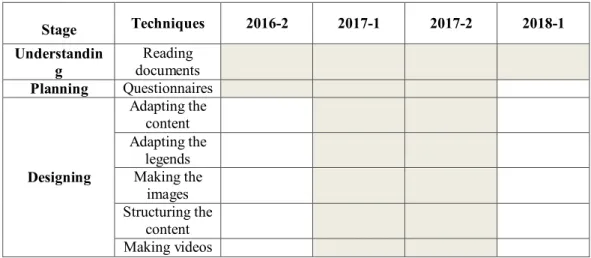
Table 4 Chronogram ... 66
Table 5 View of the Innovative Pedagogical Intervention. ... 72
Table 6 Piloting Field Note 1 ... 78
Table 7 Piloting Field Note 2 ... 79
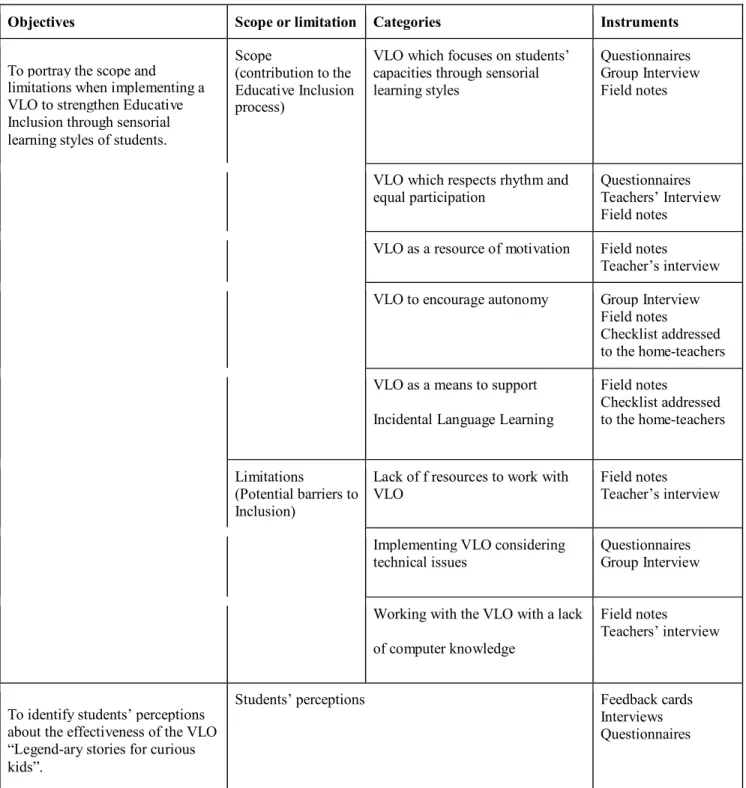
Table 9 Objectives and Categories... 90
List of Graphics Graphic 1 Questionnaire results about the presence of students with SEN in the school. ... 16
Graphic 2 Questionnaire results on whether the school PEI considers students with SEN. ... 17
Graphic 3 Questionnaire results on how students with SEN are evaluated in school. ... 18
Graphic 4 Results on which elements the students can use at home to do their homework. ... 20
Graphic 5 Results on how students think that they learn easier. ... 21
Graphic 6 Results on students' perspective about the work of the teacher. ... 21
Introduction
In order to move towards a more inclusive school culture that responds to the diversity of
students, it is necessary to strengthen the conditions that favor the educational processes; for
instance, the creation of materials that contribute to the most important factor in the process of
inclusion that is the quality of education. For that reason, this proposal looked into Educative
Inclusion area. As teachers we consider we need to know how to develop strategies that allow
Educative Inclusion to be carried out in its entirety. That is why, we aimed to develop and to
analyze the effectiveness of a VLO to strengthen Educative Inclusion through sensorial learning
styles responding to the diversity of needs, capacities and preferences of all learners.
This decision emerged from our experience as pre-service teachers working in an inclusive
classroom where learners were very motivated in the English class, but we did not have enough
knowledge on how to include all of them having different characteristics. Despite this, they
showed progress with the audiovisual resources that we used in the classes. This situation
demonstrated us that the purpose of Inclusion, as it is described by UNESCO (2005) is to provide
opportunities for equal participation of human beings who have been segregated, as the people
with disabilities (physical, intellectual, sensory, etc.).
This proposal is organized in nine chapters. Chapter 1 describes the problem statement which
explains the concern for which the project arose, the leading question and the objectives focused
on the designing and the analysis of the effectiveness of a VLO to strengthen the Inclusion
process, and the justification aimed at pointing out the relevance of the project to the educational
community. Chapter 2 discusses the literature review which we divided into four main aspects
that were important in our project related to Inclusion: issues about the policies in this field, the
Interactive and Digital Resources as a strategy to contribute to Inclusion; also, we included in this
chapter a summary of current international and national policies regarding inclusion and an
analysis of the document that the school where we implemented the material, gave us, which
guides its inclusion policy and offered us some principles for the development of the VLO.
Chapter 3 focuses on the theoretical framework, including the main constructs considered,
among which are Educative Inclusion, Sensorial Learning Styles and Virtual Learning Object;
Chapter 4 introduces the Material’s Pedagogical Foundation which explains our perspective of
learning, language, teaching (Inclusive pedagogical approach and Content-Based Instruction),
and materials development; it is the theory that underpins this project. Chapter 5 illustrates the
report design including the setting, the participants, data collection techniques and instruments,
and the staging of the implementation of the VLO; Chapter 6 shows the process and the
description of the creation; Chapter 7 describes the implementation; Chapter 8 addresses the data
analysis and findings characterizing the categories that emerged of our project; and Chapter 9
Chapter 1
Problem Statement
Over the last few years, Colombia has been implementing the inclusion paradigm that
responds to the diversity of the students in the classroom. According to UNESCO (2005),
inclusion has its origins in Special Education, hence the “educational systems have explored
different ways of responding to children with disabilities, and to students who experience
difficulties in learning” (p. 9). Special Education started with the “integration” paradigm, in
which students with “special needs” were present in the classroom; however, they still had
learning barriers.
Accordingly, this organization proposed Inclusion as a new paradigm that respond positively
to learner diversity, considering the individual differences as opportunities for enriching learning
more than problems to be fixed. That is why, Colombia has created policies and guidelines that
enable the Inclusion (See Chapter 2). Despite this fact; there was a lack of didactic materials
aimed at exploring students’ special needs as potential resource from the different sensorial
learning styles.
Thus, there was a need to create English as a Foreign Language (EFL) didactic materials
which cover all children of a specific age range and develop their learning potential and
capacities through the implementation of the sensorial learning styles. Nussbaum (2011) for the
Capability Approach provided a definition of capabilities focused on the strengths and potential
of students. The author stated that capacities are all possible combinations of functions that are
feasible to a person, depending on the environment in which he/she is. Therefore, she clarified
created by the combination of personal abilities and the political, social and economic
environment” (p. 20).
Consequently, we designed and carried out a needs analysis through a questionnaire (See
Annex 1), that we applied with ten home-teachers, one administrator and the specialized teacher
of Special Educational Needs (SEN) in a mixed school in Bogotá D.C.; in order to identify their
familiarity with the policies within the school that support inclusion processes and with how to
teach EFL to students with diverse characteristics.
The questionnaires (See Annex 2) revealed that in this school, among the educational
community, it is recognized that indeed there are students with SEN (Graphic 1). Teachers
affirmed these students are diagnosed with language problems, motor and intellectual disability.
Also, the 84% participants ensured that this school counts with inclusion policies contemplated in
PEI, 17% did not know or did not answer if the PEI of the institution considered students with
special educational needs, and 50% of teachers of the institution knew about it deeply (Graphic
2). In fact, some of them argued that many improvements are needed in the PEI on this issue.
However, the PEI of this institution (See Annex 3 Extract PEI) does not show those
considerations as the teachers mentioned.
Graphic 2 Questionnaire results on whether the school PEI considers students with SEN.
For that reason, it was necessary to search for more information about it and in an informal
conversation with the specialized teacher of SEN from the school. She mentioned that in the PEI
the parameters of the inclusion have not yet been formally contemplated but there is a document
on the modifications that will be made to it. This document considers the Admission,
Permanence, Evaluation and Promotion Criteria for Population with Permanent Educational
Needs in an Inclusive Program of those students (See Chapter 2). It clarifies that its main
objective is to include those children to the classrooms of all the levels of education, in order to
favor and develop their capacities according to their potential, so that they can adapt effectively
to their social group, taking as a framework reference, the mission, institutional vision and the
emphasis of the PEI.
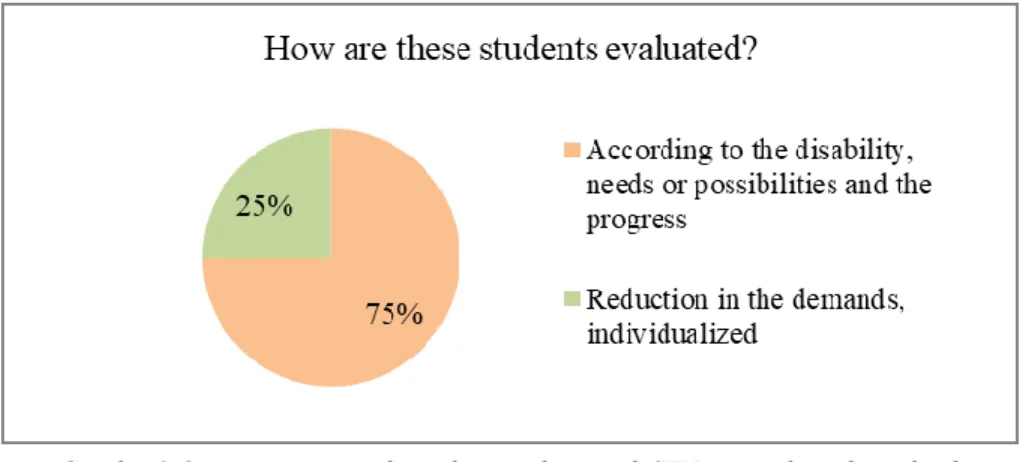
Additionally, regarding the evaluation in the questionnaire we posed a question to know how
teachers assess students with SEN (Graphic 3); to which 75% affirmed they evaluate according to
the disability, needs or possibilities and the progress of each student and the other 25% do it in a
Graphic 3 Questionnaire results on how students with SEN are evaluated in school.
By its part, in the document mentioned above, about the evaluation of those students as with
all the students; the institution states that it must be adapted to the characteristics, rhythms and
learning styles of each learner. That is why, it proposes that for the design and application of the
evaluation, it is necessary to use different strategies that favor the appropriation of learning, and
that the use of different means for input and output of information must be considered. Thus, this
establishes that technological devices constitute a great didactic resource for inclusion processes.
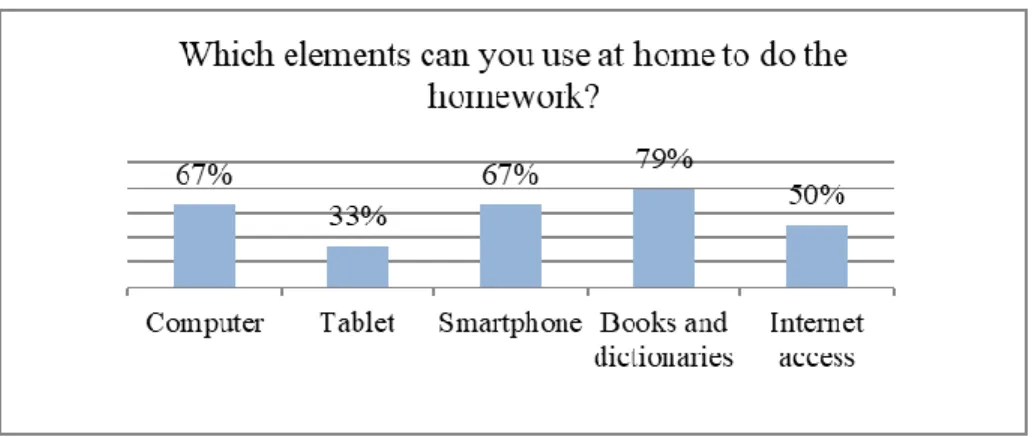
Therefore, wanting to create a virtual didactic material for educative inclusion, we applied a
second questionnaire aimed to 24 students from that school, to know about the facilities that they
had of using technological devices, including internet access (Image 1) and about their learning
Image 1 Question of the questionnaire about the elements that students can use to do the homework
Image 2 Questions of the questionnaire about students' learning preferences.
With this instrument we discovered that 67% of the learners have access to a computer, 33%
have internet access (Graphic 4). Moreover, in the computer room of the school there are 33
computers (Image 3), a touch TV (Image 4) and internet access.
Graphic 4 Results on which elements the students can use at home to do their homework.
Image 3 Computer room in the school.
Image 4 Touch TV at the computer room.
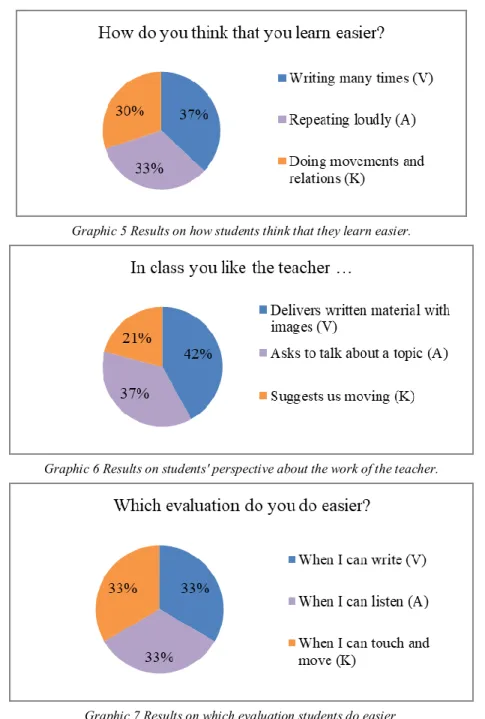
By the other hand, about the learning styles, we discovered a nearly proportional relationship
between the three sensorial learning styles: auditory, visual and kinesthetic. Thus, when asking
how they think they learn easier, 37% do it writing many times (visual), 33% repeating loudly
(auditory) and 30% doing movements and relations (kinesthetic) (Graphic 5). Also, 42% like the
teacher delivers written material with images and graphics (visual), 37% like the teacher asks
(Graphic 6). And, when asking about evaluation, 33% prefer evaluations when they can write
(visual), 33% when they can listen and the other 33% when they can touch and move
(kinesthetic) (Graphic 7). Based on that, we determined to work with these learning styles.
Graphic 5 Results on how students think that they learn easier.
Graphic 6 Results on students' perspective about the work of the teacher.
Graphic 7 Results on which evaluation students do easier.
In short, it is fundamental to develop a material to work with children in inclusive classrooms
in the English area that facilitates the development of the capacities of all students through the
the school has access to internet and enough computers to work with the learners, the digital
environment could be used to create this type of material. Hence, we planned the following
leading question: How does the implementation of a Virtual Learning Object strengthen
Educative Inclusion through students’ sensorial learning styles?
General Objective
To analyze the effectiveness of a Virtual Learning Object (VLO) when strengthening Educative
Inclusion through students’ sensorial learning styles.
Specific Objectives
• To describe the process of creation and the implementation of the VLO “Legend-ary stories for
curious kids” in an inclusive classroom.
• To portray the scope and limitations when implementing a VLO to strengthen Educative
Inclusion through students’ sensorial learning styles.
• To identify students’ perceptions about the effectiveness of the VLO “Legend-ary stories for
Justification
This proposal contributes firstly, to the area of Educative Inclusion because this helps us to
understand the issue of diversity from an approach of capacities and the significance of values
such as respect for the rhythm of learning, and the promotion of autonomy and active
participation in the inclusion process. Secondly, to our personal development because as teachers
we can learn to work considering the diversity that we find in our classes giving students
different options that promote the participation of each student.
Thirdly, to members of the educational community because its outcome will benefit students
who will see an improvement in the quality of education, reflected in better conditions in the
classroom, better and more targeted to their capabilities and an enabling environment for integral
development and care of their integrity. Likewise, it will benefit administrators because it offers a
learning material which is applicable in an inclusive environment where teachers and learners
take advantage of it. Since, based on the capability approach, we made a material that offers
several options to students who can choose autonomously the one that is most related to their
likes and capabilities to reach a common objective with their other classmates. For this, we chose
to differentiate the options according to the sensory learning styles which are related to the way
in which we assimilate the received information and express it from the sense that we have
developed the most.
To the rest of the educational community who will be in charge of specific functions and tasks
in order to be participants in the improvement process; and in general, both public and private
educational institutions, which have already begun or will begin the process of inclusion and
Finally, this proposal contributes to the TEFL community because through the material and its
interactive resources, it can contextualize strategies to plan a lesson based on students’ learning
styles and preferences. Also, with the implementation of this material we confirmed that the
students are more motivated and more involved in EFL classes when the topics are associated
with their context and they can relate the topics to previous experiences, in this way the material
promotes a teaching perspective based on the recognition of the cultural aspects of the student's
Chapter 2
Literature review
We made a review of research-based literature mainly about inclusive education policies,
practices and methods including in the curriculum for inclusion, issues in the epistemological
field, and the use of audio visual and digital aids for teaching comprehension, pronunciation and
reading with students with special educational needs (SEN). Also, here we present a short
overview of the state of the policies in relation to Educative Inclusion both international and
national, and the school document which describes how the inclusion process is carried out in the
institution.
Research studies
Policies about Inclusive Education. Based on the studies that we have looked into, we
would point out that regard to the policies that allow and may possible the Inclusive Education;
Ciyer (2010) conducted a qualitative case study to better understand the processes of local
adaptation and modification of UNESCO’s inclusive education policies and local educators’
understanding and interpretations of UNESCO’s inclusive education policy statements,
underlying principles, and practices in Turkey. In this study, the participants were 6 teachers, 4
administrators, 2 policy makers from the Ministry of National Education (MONE)’s Special
Education Department, and 4 academic advisors. This research lasted 8 weeks, and its results
were that while there was plenty evidence of good intentions and occasional examples of
inclusive education being implemented in Turkey, practices did not always match the promises.
In the Colombian case happens a similar situation, according to Rodríguez (2016), in this
school practice, because although it is regulated by Colombian laws, teaching methodologies do
not evince in schools, that correspond to the individual differences of students with SEN, or
teacher training and there are no awareness processes that promote the appreciation of the
difference. This is how the author establishes that Colombia’s greatest challenge to inclusive
education is to put into practice what is written in the standards through the participation of all
the actors involved. The author draws this conclusion after carrying out a qualitative research
carried out in a school in the city of Bogotá with the participation of twelve teachers from the
institution and a focus group of five teachers, whose objective was to identify the points of
approximations and disagreement between the normative political framework of Colombia in
relation to the inclusive education of children with disabilities, and the school practices present
within the aforementioned school.
However, a study performed by Quintanilla (2014) found that Colombia presented
international influences, such as those proposed by the Convention on the Rights of Persons with
Disabilities, the normative advance from 1994 to 2013 was notorious but the problem was that in
terms of equality and justice since 1994 great progress has been made, but in the matter of
freedom the study showed that there existed still failures in freedom of expression, and the
capacity to choose between different educational options and in the privacy and Confidentiality
that the educational service must provide. This was a qualitative study which had as goal to
identify the conceptualizations within the Law 1618, 2013.
Therefore, our project considers this breach between the policies and the practices in our
context in matters of inclusion taking the current international and our country's policies in this
regard (See State of Policies about Inclusion) and putting them into practice. First, guaranteeing
Second, considering what Decree 1421, the latest national policy, stipulates designing products
and environments that can be used by everyone without the need for adaptation to design,
recognizing and valuing the particularities of each learner by making the learning experiences
more meaningful.
Practices and methods in the curriculum. On the other hand, we discovered several
investigations that focus more on the practices and methods to achieve inclusion. An example is
one carried out by Lozano, Quintero, Zambrano, Espitia and Sánchez (2012), aimed at designing
and implementing pedagogical-didactic strategies in relation to inclusive practices, strengthening
the diverse abilities and potential of students in a garden, their research objectives were “to
contrast the indicators of the index of inclusion referred to the practices with the teaching
pedagogical interventions of the teachers within the classroom in the garden” (p.21). In addition to
analyzing the models of meaningful learning and active pedagogy, and the cooperative learning
strategy, pointing out its strengths for inclusive education.
This research was carried out in a garden with the students of the levels: kindergarten,
pre-garden and pre-garden, “where children in a condition of disability and / or some alteration of the
development were placed” (Lozano et al, 2012, p.76), and with the collaboration of six teachers
related to early childhood education and workers of the garden. It was concluded that inclusion
was about “understanding, listening, and responding to the needs, characteristics, capacities and
potential of each and every one of the students” (p. 114) and that it required the participation, will
and determination of all educational agents, and not only must use pedagogical training and
guidance from teachers. In addition, they found that a persistent creation of inclusive
environments was necessary to strengthen the students’ ability to be amazed at every stage of
thus they had experiences from different perspectives and had more responsibility for their
learning.
Another research carried out by Niño (2016) focused, in the same way, on the didactic
component, whose objective was to generate inclusive strategies and a pedagogical route that
reduces the cognitive difficulties of children in the cycle two of basic education in the framework
of diversity. This qualitative research was a case study carried out with students with learning
difficulties (among which are dyslexia, dysgraphia, disortography and dyscalculia), of this cycle,
which concluded, as the study mentioned above, that it was necessary a joint work between the
school and the family to mitigate the difficulties that the students had in the classroom. The
author also stated that a “change of attitude of values, the commitment to improve daily practice,
constant observation in the classroom, inclusive strategies and different techniques” (p.93) was
needed to achieve an ideal scenario to “improve” the learning difficulties of the students.
Now, we discovered researchers that combined both the normative and curricular components,
as in the case of Montañez, Rojas and Vásquez (2014). They aimed to “design a support material
to guide the educational management of teachers in the inclusion processes of cycles II and III of
the basic (education)”. Among its conclusions, it was the lack of a detailed route for the
implementation of inclusive education programs in the classroom in a real context. The authors
added that to carry out the inclusion “requires a series of changes and adaptations at the level of
physical, architectural, technological and especially in the curricular and human part where
quality and dignified education is offered” (p.79).
Another difficulty with Inclusive Education was analyzed by Ogadho, Ajowi and Otienoh
(2015); they examined suitability of the regular school curriculum to learners with disabilities in
25 schools, 25 Head teachers, 8 County Quality Assurance and standards Officers and 6
Educational Assessment and resource coordinators. This scope study used descriptive survey
design which utilized more direct methods like questionnaires, interviews, observation and focus
group discussion to collect data. Findings of the study showed that the regular primary school
curriculum presented serious challenges to teachers in the process of implementation and
recommended a review of the pre-service teachers’ curriculum to equip them with skills and
knowledge to lucidly respond to the challenges appropriately.
Just as it exists curricula that do not work in their entirety, there are others that had a positive
impact on the cognitive development of students. Relojo and Pilao carried out a case study in
2017 about inclusion programs, which New Era University (NEU) in the Philippines, since its
objective was to identify what makes the inclusive education programs of this university an
example of proactive education and including life skills. For this research, the parents helped,
who received a series of observations, interviews, surveys and a documentary analysis. The
results obtained showed that through an inclusive program, the performance of children with
special educational needs (Children with Special Educational Needs, CSEN) improved, as well as
the educational objectives of this program have been met, since according to the participants,
their children have been encouraged to greater autonomy and academic performance and have
being trained to participate in competitive jobs.
Considering these investigations, we consider as a pedagogical strategy that in the
implementation of the VLO should focus on cooperative rather than competitive work, in the
development of the autonomy of all students and in strengthening the potential of students. On
participation and a change of attitude of the entire educational community who should be
constant throughout the students' learning process.
Epistemological field issues. Regarding the epistemological aspect, Vélez (2013), conducted
an Action Research aimed at determining the epistemological, theoretical-didactic and attitudinal
components that, according to the author, must teacher training have in the relationship to
inclusive education. For this objective, she did a documented investigation of four bachelor’s
degrees from a university in Bogotá D.C. focused on initial education and inclusive education,
and she criticized the challenges they present in relation to these components. Concluding, among
other things, that:
The challenge for higher education is to offer in the initial teacher training, in addition to a
problematizing view of the new discourses and social and educational practices, curricular
changes in the programs, in which inclusive education as a common core, addresses
components epistemological, theoretical, didactic and attitudinal that prepare the teacher to
assume inclusive practices for attention to diversity” (Vélez, 2013, p.VIII).
Precisely the challenge presented by Vélez suggested new perspectives in the process of
inclusion carried out by educational establishments; however, it is quite paradoxical to think of
new epistemological components when a large part of the teaching staff does not feel prepared to
assume the inclusion of students with some type of disability within the classroom. In a study
conducted by Casas (2017), it was evidenced that teachers were neither trained about the way in
which they should teach students with any type of disability nor they were educated in the subject
during their undergraduate process, which was why the knowledge acquired was mostly a
knowledge of some other teachers was probably due to the constant changes and variations that
occurred in the policies, which produced greater difficulty when implementing them.
The author carried out a qualitative research that aimed to analyze the configuration of the
professional subjectivities of EFL teachers within the framework of the Colombian inclusion
policy. To this end, it had the participation of four English teachers. As a data collection tool, she
used a narrative of professional stories and interviews, the result of those instruments showed that
“the teachers of the study have a common tendency to build their professional identity based on
subjective practices” (Casas, 2017: p. 40).
Likewise, Fernández (2017) was in charge of developing a similar investigation but her
approach was based on undergraduate students; therefore, her objective was “to establish the
opinions and attitudes to the Inclusive Education of several (undergraduate) students (…) and the
practical consequences of these attitudes during their internships at schools” (p.1184). The study
had the participation of 44 senior students of different degrees from the University of Zaragoza
during the academic period 2013 - 2014. The results showed that 100% of the participants
considered it very important or moderately important to have a positive attitude towards the
Inclusive Education, as well as regular training in Inclusive Education, support for other teachers,
students, collective support networks, innovation in the classrooms, etc. Although the only
attitude that was put into practice, by the participants during their teaching internship was to
support other teachers, because although it was notable that they had general knowledge of the
subject; it was difficult for them to put the theory into practice.
Use of Interactive and Digital Resources for Inclusion. Regarding the epistemological field,
we find that putting into practice the theoretical concepts on inclusion is complicated but to
towards Inclusion, have constant training in this regard and look for innovative strategies. In
addition, due to the constant change in the policies on inclusion in our country, the project was
based on macro-level concepts that are developed at the international level.
On the other hand, we found several inquiries about the benefits of using interactive and
digital resources as audio-visual aids in the frame of inclusive education. For instance, Noori &
Farvardin (2015) conducted a study aimed to examine the effect of using audio-visual aids and
pictures on foreign language vocabulary learning of individuals with mild intellectual disability.
This was a comparison group quasi-experimental study conducted along with a pre-test and a
post-test with 16 mild intellectual disable men living in a center for mentally disabled individuals
in Dezfoul, Iran. Their mother tongue was Persian, and they did not have any English
background, it had a length of four weeks, 20 sessions on aggregate. Mainly, the findings of the
study revealed that using audio-visual aids was more effective than pictures in foreign language
vocabulary learning of individuals with mild intellectual disability.
Similarity, Van, Kraayenoord, Miller, and Moni (2009) performed an analysis with a
comparable purpose but in terms of writing. This research reported on a case study of an
exemplary teacher who was a participant in a professional learning project; the teacher provided
instructional support in writing to a targeted student with learning difficulties in an inclusive Year
8 English classroom. The findings were that case studies from exemplary teachers, such as this
one of Tim, may be valuable as pedagogical devices in teacher preparation and professional
learning programs.
Now then, a Doctoral thesis conducted by Esteves (2007) with 20 students from five different
schools in a Midwestern suburban school district during a period of eight weeks, concluded that
fluency rates when assisted reading with digital audiobooks, was utilized as compared to the
control group that participated in SSR. We could infer it was a mixed research although it was
not mentioned in the study.
Another research directed by Reichenberg (2014) focused on reading skill, but it highlighted
that the potential of those students has been underestimated. This was a quantitative study and
involved a pre-test phase, an intervention phase, and a post-test phase which was carried out with
21 boys and 10 girls aged from 12 to 16 years. All of them were diagnosed as intellectually
disabled, and all had additional diagnoses. The training included 16 sessions over 8 weeks. The
findings suggested that reading comprehension instruction was efficient even in students with ID.
Also, that there were reasons to believe that the cognitive potential of students with ID was often
seriously underestimated and that the students may have a capacity to understand written texts if
they are given proper stimulation and instruction.
These studies have not only been piloted in classrooms, one of these was done in a library; this
mixed research was conducted to determine the impact of the use of audiobooks with struggling
readers in a school library audiobook club. The participants were 21 students in grades 4 and 5
participated in the study. This study revealed that the use of audiobooks embedded within a book
club that was a school library program made a difference in the lives of the student involved in
the study.
Finally, we found two investigations which emphasized the benefits of interactive books in the
oral part: comprehension, production and pronunciation. One of them, a quantitative study by
Saka (2015) mainly explored the effectiveness of interactive books on pronunciation skills of
university level EFL students at different proficiency levels. It was conducted with the
University School of Foreign Languages. It was concluded that the listening material was
effective on both recognition and production aspects of pronunciation skills of university EFL
students, and it appeared to have a greater effect on pre-intermediate level students than it did on
elementary and intermediate level students.
The second one was a quantitative study directed by Taghinezhad, Khalifah, Nabizadeh, and
Shahab (2015). They administered two tests to the 90 students from three English language
institutes in Shiraz, Iran, as pretest and posttest. The main finding was that there were reasons to
believe that the audiobooks can contribute to the improvement of pronunciation skill.
Accordingly, the reports reviewed here indicate us first, that digital and interactive resources
could have positive effects with the different skills of the language, due to the use of audio-visual
aids could be effective in foreign language with students present in an inclusive classroom, more
than the use of merely pictures as a in a textbook. Even though, the studies mentioned before
worked mainly with adults we found that works also in children.
Secondly, we realized that there is a gap between theory and practice in the Inclusive
Education. Though there are policies that support the procedures, the challenge for us as teachers,
it is to implement them to the regular curriculum. In our experience to gain with this aim it is
necessary to clarify concepts, to capacitate the educational community to integrate students, and
to develop adapted materials corresponding to students’ needs and capacities.
Thirdly, a contribution from one of the reports was that the abilities of students with
intellectual disabilities have been underestimated, this research clarify us that with the proper
instruction or stimulation those students can have a capacity to understand written texts, so we
could think our learning object can even develop reading skills at the same time with listening
create strategies that are routed to the creation of materials for listening comprehension, that is
the first skill that children should develop who are dabbling in learning a foreign language.
State of Policies about Inclusion
International Policies. The education as a human right is a concern since Universal
Declaration of Human Rights, due to the fact that in its Article 16 declared “Everyone has the
right to education… Education shall be directed to the full development of the human personality
and to the strengthening of respect for human rights and fundamental freedoms.” (UN, 1948, p.
54) And these rights must be extended to everybody “without distinction of any kind, such as
race, colour, sex, language, religion, political or other opinion, national or social origin, property,
birth or other status” (p.6). Consequently, many regulations began to emerge towards this right as
the Convention against Discrimination in Education 1960 which recognized “the United Nations
Educational, Scientific and Cultural Organization … has the duty not only to proscribe any form
of discrimination in education but also to promote equality of opportunity and treatment for all in
education” (UNESCO, 1960, p.3).
In the same way, the Convention on the Rights of the Child of 1989 ratified the non-discrimination to all children regardless of their condition, or that of their parents or legal
guardians, and in one of its article it expressed that the child with disabilities “should enjoy a full
and decent life, in conditions which ensure dignity, promote self-reliance and facilitate the child's
active participation in the community” (Art. 23) but this in the framework of integration.
Later the World Declaration on Education for All (1990) in Jomtien, Thailand, clarified that despite the effort of many countries around the world to ensure the right of education for all,
Dakar, Senegal, the UNESCO (2000) recognized that many countries were far to achieve the
goals set in Jomtien so it proposes six key measurable education goals to meet the learning need
of all children.
Based on UNESCO (2005), “Inclusion as we know it today has its origins in Special
Education…. which education systems have explored different ways of responding to children
with disabilities, and to students who experience difficulties in learning” (p. 9). As a
consequence, many policies were created to protect the rights of these students. Some of them are
the adoption of the Standard Rules on the Equalization of Opportunities for Persons with
Disabilities by the General Assembly in 1993 whose purpose is “to ensure that girls, boys,
women and men with disabilities, as members of their societies, may exercise the same rights and
obligations as others” (para. 15). The next year, The Salamanca Statement and Framework for
Action on Special Needs Education (1994) was adopted by the World Conference on Special
Needs Education: Access and Quality, this declaration clarified that are the schools that have to
respond to the needs of their students and not in the opposite way.
Another relevant policy is the Convention on The Rights of Persons with Disabilities approved
in 2006, since it recognized that the disability exists when a person with impairments finds with
some barriers in the environment and attitudinal, and it obstructs his/her full and effective
participation in the society. It means, the disability is not in the person but in the barriers that
society creates.
There are many other regulations that UNESCO has offered so far, however, over the years
one of the current documents with which member states rely on to carry out their national
policies accordingly to the same principles.
National Policies. Colombia, being a member of the United Nations since 1945, has tried to
follow the principles of the same, being one of the countries in Latin America with more policies
related to the protection of the rights of people with disabilities. Although it is at a critical point
of transition from integration to inclusion, in reality these policies are not reflected.
Among the norms that support inclusion, the one that had greater validity is the Constitution of
Colombia of 1991 which declared that “the State will protect specially the people that due to their
economic, physical or mental condition, are in circumstances of manifest weakness and will
sanction abuses or mistreatments that they commit against them” (Art. 13) and “the eradication of
illiteracy and the education of people with physical or mental limitations, or with exceptional
capacities are special obligations of the State” (Art. 68)1. Then, in 1994 the General Law of
Education, Law 115, in the Chapter I of the Title III established how the education will be in
these cases and it clarifies that education for this population is an integral part of the public
educational service. With them, it exists a great variety of laws, decrees and resolutions in favor
of the protection of rights, which Quintanilla (2014) summarized after his investigation on the
Colombian Normativity (See Table 3).
Finally, in 2017 Decree 1421 was published; the most recent norm in this regard. It regulates
the attention to the population with disabilities within the framework of inclusive education,
which will be valid for 5 years, and it tries to comply with the suggestions of UNESCO. This
decree highlights the need to implement PIAR (Individual Plan for Reasonable Adjustments) in
educational institutions, according to this decree, the PIAR is “the pedagogical and social
assessment that includes the supports and reasonable adjustments required, including curriculum,
infrastructure and all the others necessary to guarantee learning, participation, permanence and
promotion” (Art. 2.3.3.5.1.4). This assessment would replace the PEP (Personalized Education
Plan) that has been carried out in recent years in the institutions.
UDL (Universal Design of Learning). Moreover, the decree clarified that complementary to
the PIAR, they will be made transformations based on the UDL (Universal Design of Learning).
It defined the UDL as the:
Design of products, environments, programs and services that can be used by all people, to
the greatest extent possible, without the need for adaptation or specialized design. In
education, it includes environments, programs, curricula and educational services designed
to make accessible and meaningful learning experiences for all students from recognizing
and valuing individuality” (Art. 2.3.3.5.1.4).
This refers to a pedagogical proposal that is based on the formulation of objectives, methods,
materials, supports and evaluations based on the abilities and realities of the students. Based on
the official website of the National Center on Universal Design for Learning (2014) there are
three principles that guide it:
Principle I: Provide Multiple Means of Representation (the “what” of learning): This is based on
For example, those with sensory disabilities (e.g., blindness or deafness); learning disabilities
(e.g., dyslexia); language or cultural differences, and so forth may all require different ways of
approaching content. Others may simply grasp information quicker or more efficiently through
visual or auditory means rather than printed text. (par. 1)
· Principle II: Provide Multiple Means of Action and Expression (the “how” of learning):
This means that the environment or material should have different ways of navigating and
expressing what learners know
· Principle III: Provide Multiple Means of Engagement (the “why” of learning): This refers
to having several ways to motivate students since children, for example, can be very spontaneous
or very structured; or they may want to work in a group or individual, the essential thing is to
offer multiple engagement opportunities that call their attention.
Admission, Permanence, Evaluation and Promotion Criteria for Population with
Permanent Educational Needs in an Inclusive Program (School document)
This is a document provided by the school in which the implementation of the VLO was
carried out, and it is part of the materials worked to be implemented in the PEI of the institution
in order to involve the criteria contemplated by the recent inclusion project. It presents the
regulations that underline the project of Inclusive Education in the school; the
conceptual-philosophical framework of inclusion; the justification of the project; the general and specific
objectives, and finally the criteria for admission, permanence, evaluation and promotion of
First of all, the document mentions seven regulations that order inclusive education in
Colombia, starting with the Political Constitution of 1991 that advocates equal treatment for all
people and special care for people who find themselves in a circumstance of manifest weakness;
Law 115, General Education Law, which includes a chapter on “Education for people with
limitations, or exceptional capacities”. In the same way, it mentions the Decree 2082 of 1996;
The United Nations Convention on the Rights of Persons with Disabilities; The Public Policy on
Disability, decree 470 of 2007; Decree 366 of 2009 of the MEN, and The Statutory Law 1618 of
2013. In this regard, the school’s SEN specialist said that some modifications are needed in this
document including the new regulations in relation to Inclusive Education.
However, as we mentioned in the section above (State of Policies about Inclusion), Colombia
has many policies that protect the rights of people with disabilities even in 2017, a new decree
was published focused on promoting individualized teaching to respond to the different
characteristics of individuals. But as much as the policies and the school document focus on the
difficulties rather than the capabilities. Therefore, this project focused on changing this
perspective starting from the classrooms.
Secondly, about the conceptualization of inclusion, the institution “understands inclusion as an
educational action relevant to the particular conditions of students, even those with mild
cognitive impairment, borderline and low normal intellectual capacity, in situations of
vulnerability, to achieve their admission and permanence in the educational system” (p. 2)2. It
adds that inclusive education recognizes that all students have particular characteristics, interests,
abilities and learning needs, so that conditions and strategies are generated that respond to
personal, family and academic particularities, considering individual differences as opportunities
to enrich education for all.
Considering that, we agree with the statement that inclusion considers individual differences
as opportunities. But we disagree that only some types of disability are mentioned at the
beginning of the statement, as this contradicts its inclusion policy and it would be about
integration and even exclusion for students who have other types of characteristics that are not
mentioned in the definition. That should only refer to education for all without making any
distinction.
On the other hand, it justifies the project because of the need to move from an integration
process that has been developed in the institution since 2004, which evidences the lack of
support, the lack of adequate prior preparation, and the few strategies for work in the classroom;
to a process that values the potential and real possibilities of integral development of its students
and create the conditions and opportunities for its adequate performance, attending to the
diversity. Consequently, the project proposes:
to include children with Special Permanent Educational Needs generated by a condition of
mild cognitive impairment (without associated factors), to preschool, basic and middle
classrooms, in order to favor and develop their abilities according to their potential, so that can
adapt effectively to their social group, having as a frame of reference, the institutional mission
(and) vision and the emphasis of the PEI “Communication, core stone for the values education
and knowledge construction” (p.3).
Of that section, we rescue the way in which the school seeks to move from the paradigm of
distinction. From here the project is positioned to offer a material that can strengthen this process
of change.
Finally, about the admission criteria, the institution displays a list of requirements based on a
diagnosis of the child before being accepted the institution to ensure that it has basic coexistence
skills that allow him/her to adapt to school, however, that mentions that will not be admitted to
students with psychosocial or sensory disabilities without first making an analysis by the teachers
determining the inclusion requirements. Regarding permanence, it is mentioned that there will be
a process of curricular flexibility but the student and his/her family must follow certain
requirements, which includes that the student must show cognitive and social progress and
demonstrate adaptation and sense of belonging to the school.
As for the evaluation, it must be adapted to the characteristics, rhythms and learning styles of
the student; it must be integral, systematic, flexible, formative, participatory, permanent and
continuous, observing the processes and not only the final results. In addition, the adaptations
must be in terms of time, extension and volume, complexity, design and strategy. On the latter,
the document suggests that since students with SEN present different learning styles as well as
regular students, all the learners would benefit from the use of different strategies that favor the
appropriation of learning, so we must consider the use of different media for input and output of
information, in this sense the technological devices are a great teaching resource for it. And on
the promotion that says it will be based on the curricular flexibility and analyzing the process in
the evaluation and promotion commission.
To sum up, this document offered by the school supports our project as it focuses on the
transition from an integration process to one of inclusion in which students' differences are seen
advantage of the capabilities that all students can have and develop. Also, that suggests that
digital resources are a great advantage to promote it. However, in the conceptual part it is not
necessary to name these students who will be admitted because it would no longer be an
Chapter 3
Theoretical Framework
This chapter presents the main constructs that addressed our project: Educative Inclusion,
Inclusive Classroom, Sensorial Learning styles and Virtual Learning Object (VLO).
Educative Inclusion
The term inclusion is defined by multiple ways without having a concrete and unique
meaning. Nowadays, this fact obstructs the implementation of this process since it can be used in
different situations and with different purposes: economic, social, political, cultural or educative.
Escribano and Martínez (2013) did a wide research on the concept and they concluded the
inclusion is a process of equal participation of all the members of a society in the economic,
legal, political, cultural and educational areas. For them, it is linked to cohesion, integration and
social justice; and it assures that all people have the same opportunities and the necessary
resources to participate thoroughly in the community in which they belong to. In this way, it
demands a new way of thinking about the differences and the diversity as a valuable issue that
requires an adequate educative and social treatment.
Additionally, UNESCO (2005) determined four key elements to consider in the
conceptualization of inclusion:
● Inclusion is a process. Based on this organization, it “has to be seen as a never-ending search to find better ways of responding to diversity. It is about learning how to live with
● Inclusion is concerned with the identification and removal of barriers. To recognize the obstacles that the person could find in the process in order to improve the policies and
practices.
● Inclusion is about the presence, participation and achievement of all students. It is more than to be integrated, it is to consider the opinions and perspectives of everyone; and to
triumph in the goals that each person proposes, in education it goes beyond the
quantitative results of tests.
● Inclusion involves a particular emphasis on those groups of learners who may be at risk of marginalization, exclusion or underachievement. Inclusion looks after those groups that are statistically most “at risk”, and the adoption of measurements to ensure their
presence, participation and achievement in the system.
These last key elements are already addressed to the education, area in which this project
focuses on. About this aspect, authors as Flórez (2016), Escribano and Martínez (2013), and
others, made a distinction in this area between Inclusive Education and Educative Inclusion
(Inclusión Educativa).
Based on that differentiation, Flórez (2016) considered Inclusive Education as a process,
defender of Human Rights, in which the State is directly responsible for the fulfillment of these
rights of the population in conditions of diversity and that allows the development of emotional,
analytical, creative and practical intelligence. In this order of ideas, UNESCO (2009) claimed
Inclusive Education is “a process of strengthening the capacity of an education system to reach
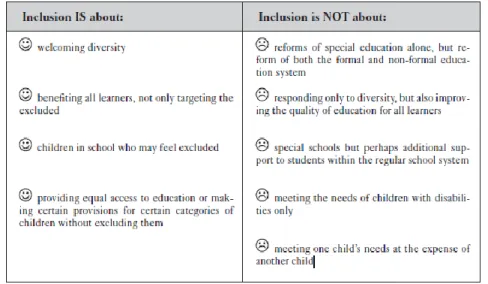
Table 2 Comparative table between what the inclusion is and is not about. (UNESCO, 2005, p.15)
On the other hand, The Australian Research Alliance for Children and Youth, ARACY (2013)
added that inclusive education should not refer only to students with SEN but inclusive education
should “come from outside of the mainstream; from those who have been traditionally excluded”
(p. 9), criticizing perspectives of some authors as Ainscow, Booth and Dyson, who saw this “as a
concern of students with disability having special educational needs; as a response to disciplinary
exclusion” (Ainscow, et al., 2006, cited in ARACY, 2013, p.7). However, Shaddock,
MacDonald, Hook, Giorcelli, and Arthur-Kelly (2009), claimed it should consider inclusion arise
from disability, gender, behavior, poverty, culture, refugee status or any other reason.
Moreover, ARACY (2013) included that the definition of inclusive education could be broadly
grouped into two categories: conceptualizing inclusive education based on key features (these
features includes: all children attend their neighborhood school and learn in regular,
heterogeneous classrooms with same-age peers) and conceptualizing inclusive education as the
removal of that which excludes and marginalizes (that includes potential barriers to inclusion as a
those categories are not adequate providing a good conceptual definition of the term isolated but,
together they could describe effectively what an inclusive setting might actually be.
Finally, concerning the concept of Educative Inclusion, Flórez (2016), considered it as a social
process that emerges from dynamic result of a society that recognizes the diversity or human
plurality considering condition of life, inability and capacities of all learners to potentiate their
respective rhythm. She added it must include the transcendent values of tolerance, dialogue and
respect. From this perspective the teachers are responsible for the Inclusion being carried out. On
Table 2, Flórez (2015) displayed the differences between the Educative Inclusion and the
Inclusive Education.
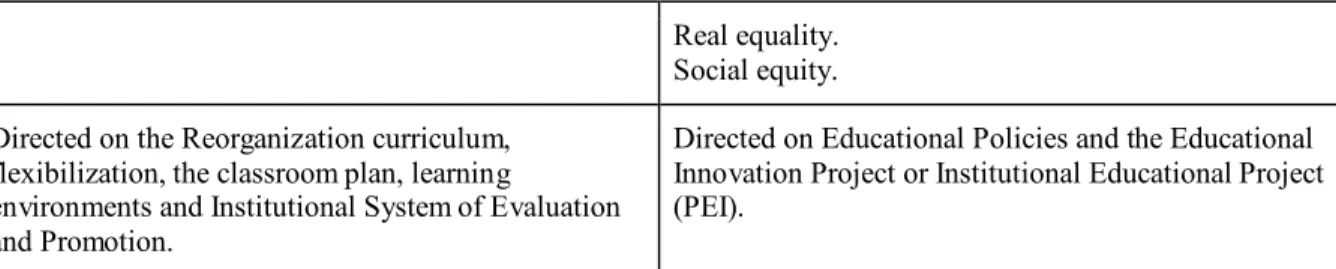
EDUCATIVE INCLUSION INCLUSIVE EDUCATION
Systematic process that allows to accept, value, welcome and celebrate the diversity of those children, adolescents and young adults who need to be
included.
It is a process of State and educational institutions based on the inclusion of learners.
Responds to the diversity of children, adolescents and young adults taking into account its rhythm, learning style and family.
It responds to the context, restructuring the social and cultural environment under an educational inclusive policy.
It implies modifications of content, approaches and pedagogical structures with a vision towards the diversity of the children, adolescents and young adults between a range of biological age,
responding to the conditions: Socio-affective.
Cognitive-metacognitive. Physical-creative.
It implies the sensitization of each of the school and institutional actors. From a School Institutional Reorganization to a School Reorganization based on the Community for the benefit of society.
These changes involve children, adolescents and young adults with diverse human conditions, regular learners and teachers from, by and for diversity.
They involve the State that enforces the right to Education to achieve Inclusive Education towards Educative Inclusion, with the support of Educational Institutions.
It goes beyond accepting the difference, it requires tolerance, dialogue, respect and solidarity. Thinking about diversity from regularity and equity.
It is committed to a diverse educational institution, independent of the opportunities offered by the regular, individualized or personalized school.
It perceives diversity and promotes equity among learners
Real equality. Social equity.
Directed on the Reorganization curriculum, flexibilization, the classroom plan, learning
environments and Institutional System of Evaluation and Promotion.
Directed on Educational Policies and the Educational Innovation Project or Institutional Educational Project (PEI).
Table 3 Comparative table of the general characteristics of the State in Inclusive Education and the teacher from, by and for diversity, in Educative and Social Inclusion. (Flórez, 2015, cited in Flórez, 2016, pp.281-283)3
According with UNESCO (2005) this inclusion (called for it: Inclusion in Education), is “a
dynamic approach of responding positively to pupil diversity and of seeing individual differences
not as problems, but as opportunities for enriching learning” (pg. 12). It added that for inclusion
the countries need to transform the policies (part of the Inclusive Education) to practical ideas
(part of Educative Inclusion).
However, MEN (2017) did not consider the definition of the UNESCO and it used the terms
Inclusive Education and Educative Inclusion as a whole. It declared:
The Inclusive Education is an ongoing process which recognizes, values and responds in an
appropriate way to the diversity of the characteristics, needs, interests, possibilities and
expectations of all children, teenagers and adults, with peers of the same age, through
practices, policies and cultures that remove barriers to learning and participation; ensuring in
the framework of human rights changes in the content, approaches, structures and strategies.
(p. 4-5)4
Considering that analysis, this proposal adopted the term Educative Inclusion and considered it as a process that teachers carry out in formal, informal and non-formal education settings,
responding to human diversity and from an approach of capabilities which enrich the learning
environment rather than individual difficulties. For the creation, in the process of Educative