R E V I E W A N D
S Y N T H E S I S
A quantitative review of pollination syndromes: do floral traits
predict effective pollinators?
Vıctor Rosas-Guerrero,1,2
Ramiro Aguilar,3Silvana Mart
en-Rodrıguez,4,5Lorena Ashworth,3
Martha Lopezaraiza-Mikel,1,2
Jesus M. Bastida1and Mauricio
Quesada1*
Abstract
The idea of pollination syndromes has been largely discussed but no formal quantitative evaluation has yet been conducted across angiosperms. We present the first systematic review of pollination syndromes that quantitatively tests whether the most effective pollinators for a species can be inferred from suites of floral traits for 417 plant species. Our results support the syndrome concept, indicating that convergent floral evolution is driven by adaptation to the most effective pollinator group. The predictability of pollination syndromes is greater in pollinator-dependent species and in plants from tropical regions. Many plant species also have secondary pollinators that generally correspond to the ancestral pollinators documented in evolutionary studies. We discuss the utility and limitations of pollination syndromes and the role of secondary pollinators to understand floral ecology and evolution.
Keywords
Floral evolution, floral syndromes, meta-analysis, plant breeding systems, plant reproduction, pol-lination efficiency, polpol-lination networks, specialisation, tropical ecology.
Ecology Letters(2014)
INTRODUCTION
Since Darwin (1862), pollinator-mediated selection on floral traits has been considered an important evolutionary force underlying the diversification of flowering plants. Different pollinators may drive floral divergence, whereas similar pollin-ators shared by different plant species might drive conver-gence of floral traits (Fenster et al. 2004). These integrated sets of floral traits (e.g. morphology, colour, odour, size, rewards, phenology) associated with particular pollinator groups are known as floral or pollination syndromes (Faegri & van der Pijl 1979). The pollination syndrome concept implies that plants specialise on particular functional groups of pollinators that exert similar selective pressures on floral traits (Fensteret al.2004). However, the association of partic-ular sets of floral traits with specific pollinators has been ques-tioned given the apparent widespread generalisation in pollination systems found in various studies (Waser et al. 1996; Petanidouet al.2008).
It has long been documented that flowers of particular plant species are often visited by various taxonomic groups of pollin-ators (Robertson 1928). However, pollination ability differs among floral visitors and interactions may span from mutualis-tic to antagonismutualis-tic (Thomson 2003). Stebbins (1970) proposed that floral traits reflect selection mediated by the pollinators
that visit flowers most frequently and effectively. Thus, while pollination syndromes are expected to reflect adaptation to pri-mary pollinators, syndrome traits may not preclude visits by less efficient floral visitors, i.e. secondary pollinators (sensu Stebbins 1970), which may also play a role in floral evolution. Particular floral traits may exclude only certain groups of sec-ondary pollinators, while allowing pollination by other groups. For example, bat flowers with highly exerted stamens may allow pollination by birds but not by bees (e.g.Gesneria pedunculosa; Marten-Rodrıguez & Fenster 2008). Therefore, we may expect pollination syndromes to be non-randomly associated with cer-tain groups of secondary pollinators. For a thorough under-standing of the role of plant–pollinator interactions on floral syndrome evolution, it is important to consider the entire polli-nator assemblages and to assess the relative efficiency of all flo-ral visitors.
Several studies based on pollination efficiency data have found support for pollination syndromes (e.g. Lazaro et al. 2008; Marten-Rodrıguez et al. 2009; Reynolds et al. 2009; Armbruster et al.2011; Danieli-Silva et al. 2012); others have found the opposite, concluding that pollination syndromes are an unreliable tool for predicting the effective pollinators of flowering plants (e.g. Waser et al.1996; Valdivia & Niemeyer 2006; Smithet al.2008; Li & Huang 2009; Ollertonet al.2009). One of the few global evaluations of pollination syndromes,
1Centro de Investigaciones en Ecosistemas, Universidad Nacional Autonoma
de Mexico, Apartado Postal 27-3 (Xangari), 58089, Morelia, Michoacan,
Mexico
2Unidad Academica en Desarrollo Sustentable, Campus Costa Grande,
Uni-versidad Autonoma de Guerrero, Carretera Nacional Acapulco Zihuatanejo
Km 106 + 900, Colonia Las Tunas, Tecpan de Galeana, Guerrero, 40900, Mexico
3Instituto Multidisciplinario de Biologıa Vegetal, Universidad Nacional de
Cordoba - CONICET, C.C. 495 (5000), C ordoba, Argentina
4Departamento de Biologı´a Evolutiva, Instituto de Ecologıa A. C., Carretera
Antigua a Coatepec No. 351, El Haya, Xalapa, Veracruz 91070, Mexico
5Centro Regional del Bajıo, Instituto de Ecologıa, A. C., Patzcuaro, Michoacan
61600, Mexico
using several communities around the world, found support for pollination syndromes only for around 30% of the species in the communities (Ollertonet al.2009). A few studies have eval-uated syndromes by differentiating ineffective floral visitors from effective pollinators using phylogenetically independent statistical analyses (i.e. Smith et al. 2008; Marten-Rodrıguez
et al.2010). Without the empirical determination of floral
visi-tor effectiveness, generalisation in plant–pollinator interactions is likely to be overestimated (Rosas-Guerreroet al.2011). Fur-thermore, for a general understanding of the role of pollinators as selective agents on floral traits, the influence of shared evolu-tionary history and ecological factors on floral traits needs to be clearly established.
Despite the strong debate about the reliability of pollination syndromes, several authors have used them to infer floral evo-lution or pollination systems of plant species in the absence of empirical evidence of pollinators (e.g. Machado & Lopes 2004; Knapp 2010). As valuable as these approaches are, it is crucial to know the strengths and limitations of pollination syndromes, particularly when these are used to address ques-tions of community ecology, comparative biology and floral evolution. Even when many studies of individual species have tested the validity of pollination syndromes, a quantitative lit-erature review of pollination syndromes across species and world regions has not been conducted. Such an approach would allow synthesising the results of detailed pollination studies that have quantified the efficiency of the entire pollina-tor assemblages of plant species throughout the world.
In the context of pollination syndromes various traits might influence the association between pollinators and floral traits. For example, reproductive systems are directly associated to pollination and plant fitness. Thus, dioecious, monoecious and self-incompatible hermaphrodite animal-pollinated plants, which are highly dependent on pollinators, should experience more consistent selection on floral traits and greater predict-ability of pollination syndromes than self-compatible species. Geographical distribution may also influence the relationship between plants and pollinators. The latitudinal gradient in species diversity has been associated with a greater strength of biotic interactions at lower than at higher latitudes (Schemske
et al. 2009). Under this scenario, stronger biotic interactions
should lead to increased niche space and greater species diver-sification and coexistence in tropical regions (Schemske et al. 2009; Moya-Lara~no 2010). In the tropics the frequency of ani-mal-pollinated plants is greater than in temperate regions (Schemske et al. 2009). Therefore, the predictability of polli-nation systems should be greater in the tropics than in extra-tropical regions.
Here, by means of phylogenetic meta-analysis, we assess whether floral traits predict the most effective pollinators of plants and whether the predictability of pollination syndromes is associated with breeding system, geographic distribution, and pollinator functional group. We further explore the rela-tionships between plants and their primary and secondary pollinators by looking at current patterns of interactions through plant–pollinator networks. We also document poten-tial evolutionary relationships between plants and pollinators by synthesising the current information available on pollinator evolutionary transitions and appearance of plant and
pollina-tor groups along the evolutionary hispollina-tory of life on earth. Finally, we discuss the several implications of pollination syn-dromes on the ecology and conservation of plant–pollinator interactions.
MATERIALS AND METHODS
Literature search and effect size estimation
We carried out an extensive literature search in the ISI Web of Knowledge database from 1900 to 2013 using the following keyword combinations: ‘pollinat*effic*’ or ‘effic*pollinat*’ or ‘pollinat*effectiv*’ or ‘effectiv* pollinat*’ or ‘pollination syn-drom*’ or ‘floral synsyn-drom*’ in the topic field. We also included our own published and unpublished data. Pollinator efficiency or effectiveness has been evaluated by many different methods, which may not be all equally good at measuring the perfor-mance of pollinators and their influence on plant reproductive success (Ne’emanet al.2010). We only considered studies con-ducted under natural conditions that quantitatively assessed pollination effectiveness of all floral visitors of plants by at least one of the following methodologies: (1) pollen on pollina-tor’s body, (2) contact of pollinator with the flower’s reproduc-tive organs, (3) pollen deposited on stigmas, (4) pollen removed from anthers, (5) fruit and (6) seed production by specific functional groups. Since pollination effectiveness may vary depending on the method (Ne’eman et al.2010), we sta-tistically compared effect sizes among these measures of effec-tiveness.
We followed mainly the descriptions of Faegri & van der Pijl (1979), Proctor et al. (1996), Ollerton et al. (2009) and Willmer (2011) to characterise 11 pollination syndromes (Table S1). We assigned pollination syndromes to each plant species based exclusively on the presence or absence of each character state for each floral trait (Table S2).
By means of both ordinary and phylogenetic meta-analysis, we tested whether pollination syndromes can predict the most effective pollinator of plants. All the analyses were conducted using the standardised unbiased mean difference (Hedges′ d) as a measure of effect size (Appendix S1 in supporting infor-mation for formulas). This effect size expresses the difference in pollination effectiveness between pollinator species or gen-era belonging to the functional group expected by the floral syndrome and the species or genera not expected by the floral syndrome of the plant species. To calculate Hedges′ d, each study had to provide mean values, standard deviations and sample sizes of any measure of pollination effectiveness. These parameters were obtained from text, tables and figures. Data from graphs were obtained using Datathief II software (B. Tummers, available online: http://www.nikhef.nl/~keeshu/da-tathief/). When any of these parameters were not provided, we contacted the authors to obtain them.
corre-sponding to effective or ineffective pollination (Appendix S1). Odds Ratios (OR) were then transformed to Log (OR). Previ-ous to running the analyses, we converted all Log (OR) and its variance into Hedges′ d and its corresponding variance to unify the effect size metric for all studies (Cooperet al. 2009, formula not shown). Positive values of effect sizes d implied that pollinators expected by the syndrome were more efficient (i.e. support for the pollination syndrome hypothesis), whereas negativedvalues mean that pollinators not matching the syndrome were more efficient.
Traditional and phylogenetic meta-analyses
When a plant species was effectively pollinated by more than two pollinator functional groups, we included separated calcu-lations of effect size for each alternative group of the same plant species for the traditional meta-analysis. As a result, the traditional meta-analysis was performed on a total of 517 data points. However, for the phylogenetic meta-analysis we pooled these multiple effect sizes per species using a tradi-tional meta-analysis with a fixed effects model (Koricheva
et al.2013). Phylogenetic meta-analysis was performed on 417
unique plant species.
We used MetaWin 2.0 (Rosenberg et al. 2000) and Phylo-Meta 1.3 (Lajeunesse 2009) to run ordinal and phylogenetic meta-analyses respectively. Confidence intervals of effect sizes were calculated using bootstrap re-sampling procedures (Adams et al. 1997). An effect was considered significant (either in positive or negative direction indicating support or rejection of the pollination syndrome hypothesis respectively) if the 95% biased-corrected bootstrap confidence intervals (CI) of the effect size (d) did not overlap zero. Data were analysed using random-effect models, which assume that stud-ies differ not only by sampling error (as fixed-effects models do) but also by a random component in effect sizes (Rauden-bush 2009). Random-effect models are preferable in ecological data syntheses because their assumptions are more likely to be satisfied (Gurevitch & Hedges 1999).
We additionally analysed whether the following moderator or predictor variables influenced effect sizes: breeding system (self-compatible or self-incompatible/monoeciuos/dioecious) and geographical region (tropical or extra-tropical). To exam-ine the heterogeneity of effect sizes, we usedQstatistics, which are weighted sums of squares that follow an approximately asymptotic chi-square distribution. These statistics allow cate-gorical comparisons of moderator variables that may explain structure in the variation of effect sizes. We examined the P-values associated with Q-between categories, which describe the variation in effect sizes that can be ascribed to differences between the categories (Cooperet al.2009). Information about each of the moderator variables for each of the species included in this review were obtained either from the same study or from other publications of the same plant species.
To run phylogenetic meta-analyses, we incorporated the phylogenetic relatedness of the species from our dataset fol-lowing Lajeunesse′s method (Lajeunesse 2009; Koricheva
et al. 2013). To accomplish this, we constructed a
phyloge-netic hypothesis of the 417 unique plant species included in our meta-analysis from a modified megatree of all major
plant groups based on Angiosperm Phylogeny Group III (2009) using PHYLOMATIC (Webb & Donoghue 2005). Relationships at family and species level of several genera were resolved with the help of published phylogenetic studies (Figure S1). Species lacking phylogenetic information were placed as polytomies at the root of their family or genus (Koricheva et al. 2013) and all branch lengths were trans-formed to one (Verdu & Traveset 2004). In addition, the branch lengths of our phylogenetic tree were adjusted with the Bladj algorithm of Phylocom 3.34b program (www.phy-lodiversity.net/phylocom), while calibration points were based on the estimated divergence times of major plant groups (Hedges et al. 2006). This ultrametric tree was converted into a phylogenetic correlation matrix (P) that has the standar-dised shared branch length distance of each species in off-diagonals and ones in the main diagonal (Lajeunesse 2009; Koricheva et al. 2013). Phylogenetic tree edition was per-formed in R (R Development Core Team 2011) and Mes-quite v. 2.75 (Maddison & Maddison 2011). To analyse each predictor or moderator variable, we constructed a subset tree to estimate P for each category, which contains only the spe-cies present in that particular comparison and retains all the branch length information found in the hypothesised tree (Fig. S1). Because results were similar between traditional and phylogenetic meta-analyses, we interpreted and discussed results of the latter. Results of traditional meta-analysis are provided in Table S3.
Publication bias
An intrinsic problem when conducting quantitative reviews of published studies is the potential of publication bias; i.e. studies showing significant results may have a greater possi-bility of publication than those showing non-significant results. To explore such possibility, we conducted a Spear-man rank correlation test, which examines the relationship between the standardised effect size and the sample size across studies (Cooper et al. 2009). A significant correlation indicates a publication bias where larger effect sizes are more likely to be published than smaller effect sizes. We also used the fail-safe number calculator to estimate the number of non-significant, unpublished or missing studies that would need to be added to a meta-analysis to nullify its overall effect size (available online: http://lsweb.la.asu. edu/rosenberg) (Rosenberg 2005). If the fail-safe number is larger than 5n+10, where n is the number of studies, then publication bias, may be safely ignored (i.e. the results are robust regardless of publication bias) (Rosenberg 2005).
Association of floral syndromes with primary and secondary pollinator functional groups
of each plant species. With this information, we constructed a pollination network for each syndrome, whose nodes are plant species and pollinator groups that are joined by weighted links that show the relative efficiency of each pollinator func-tional group.
In order to understand the potential evolutionary transi-tions between plants and pollinator functional groups we built an evolutionary history table across geological eras. Table 1 indicates the estimated time of origin and diversification of main plant and main animal groups known to transfer plant sperm and pollen. To accomplish this, we conducted literature searches of studies with molecular and fossil evidence on the origin of these groups. We also compiled a list of all studies conducted to date that assessed pollination syndrome transi-tions within a phylogenetic framework. We used studies that had resolved phylogenies and inferences of ancestral pollina-tion systems. With this informapollina-tion, we constructed a network of evolutionary transitions that allowed us to determine the most common ancestral pollinator groups recorded for each pollination syndrome.
RESULTS
Characteristics of cumulated research
From an original set of 1990 studies found in the literature search, we found 213 suitable publications involving 370 plant species, which together with 47 species from our pub-lished and unpubpub-lished data completed a total of 417 unique plant species (Table S2). The rule to include a species was that the pollination efficiency of the entire pollinator assem-blage was determined. After systematically assigning flower trait variables to each plant species corresponding to a par-ticular pollination syndrome from Table S1, we observed that 68% of the species corresponded to bee (35%), bird (20%), and bat (11%) syndromes, while fly (9%), wasp (9%), moth (7%), long-tongued fly (2%), beetle (2%), but-terfly (2%) carrion fly (1%) and non-flying mammal (1%) syndromes altogether comprised the remaining 32% of all plant species included in our review (Table S2). The vast majority of plant species studied are herbs (52%). Shrubs and trees comprise 19 and 12% respectively. The remaining 17% belong to epiphyte, lianas, vines and woody cacti (Table S2). In general, breeding systems were fairly evenly represented within each syndrome (Table S2). There were, however, some particular associations between pollination syndromes and geographical regions that are worth mention-ing. Plant species with bat syndrome were almost exclusive to tropical regions, while species with fly, carrion fly, long-tongued fly, wasp and non-flying mammal syndromes were mostly found in species from extratropical regions. The majority of species with bee and bat syndromes were herbs and woody species (shrubs and trees) respectively.
Spearman rank correlation test between sample size and Hedges′d effect sizes was non-significant (rs=0.026, d.f. =418, P =0.590), indicating absence of publication bias in our meta-data. Furthermore, the weighted fail-safe number calculated was much larger than 5n+10 (2105<47837), sug-gesting that results are robust despite any publication bias.
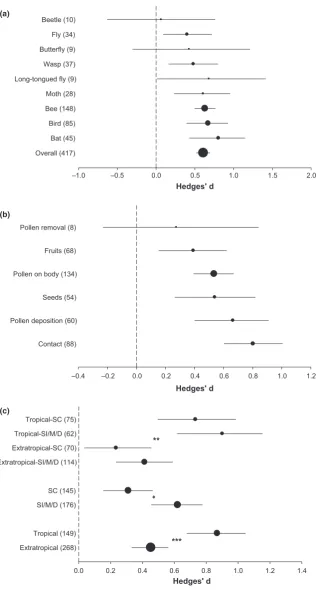
Hedges' d
–1.0 –0.5 0.0 0.5 1.0 1.5 2.0
Overall (417) Bat (45) Bird (85) Bee (148) Moth (28) Long-tongued fly (9) Wasp (37) Butterfly (9) Fly (34) Beetle (10)
Hedges' d
–0.4 –0.2 0.0 0.2 0.4 0.6 0.8 1.0 1.2
Contact (88) Pollen deposition (60) Seeds (54) Pollen on body (134) Fruits (68) Pollen removal (8)
Hedges' d
0.0 0.2 0.4 0.6 0.8 1.0 1.2 1.4
*
Extratropical (268) Tropical (149)
SI/M/D (176) SC (145) Extratropical-SI/M/D (114) Extratropical-SC (70) Tropical-SI/M/D (62) Tropical-SC (75)
*** ** (a)
(b)
[image:6.595.142.461.51.642.2](c)
Quantification of pollination syndrome effects
Both traditional and phylogenetic meta-analyses showed support for pollination syndromes (Fig. 1a, Table S3), indicat-ing that floral syndromes of plants predict the most effective pollinators regardless of breeding system or region. The overall effect after accounting for the phylogenetic history across the species was positive (0.609) and statistically different from zero (Fig. 1a). Pollinators that matched the floral syndrome were significantly more efficient than pollinators that did not match the syndrome. The only exceptions were the beetle, butterfly and carrion fly syndromes, whose effect sizes were not different from zero (Fig. 1a, Table S3). Although all of them had positive mean effect sizes, their relatively small sample sizes pre-cluded powerful testing of their effects. In any case, the lack of significant effects would indicate that expected pollinators of these three syndromes were not more efficient than non-expected pollinators. The rest of the syndromes were all positive and significantly different from zero (Fig. 1a, Table S3), validating the pollination syndrome concept. Effect sizes ranged from 1.25 in non-flying mammals (but very small sam-ple size, Table S3) to 0.065 in beetle (also with small samsam-ple size). For pollination syndromes with large sample sizes and better estimations, the bat syndrome had the largest effect size (0.805), followed by bird and bee syndromes, and wasp had the lowest (0.482; Fig. 1a). Pollination effectiveness measures did not significantly differ in their ability to detect differences in pollination syndromes accuracy to predict the effective pollinator functional groups (Qbetween =4.21; P =0.102; Fig. 1b). That is, any of the methods used by the authors was successful at discriminating the most effective pollinator. The only exception was pollen removal, which was underrepre-sented (n =8 species) and was not significantly different from zero (Fig. 1b). Regarding the external moderator variables, the effective pollinators were more strongly predicted by floral syndromes in plants from tropical regions and in plants with dioecious, monoecious or self-incompatible systems (Fig. 1c). Accordingly, when comparing species with both of these traits combined, pollination syndromes of pollinator-dependent spe-cies from tropical regions were significantly more predictable than any other plant group (Fig. 1c).
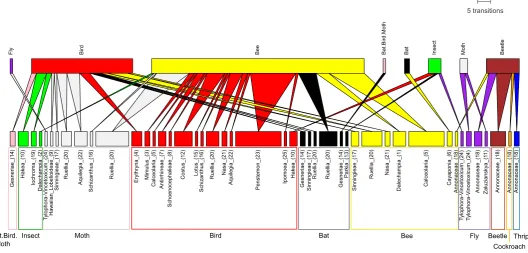
The predictability of pollination syndromes was also evident in the pollination networks: the most effective pollinator func-tional group of plant species was in most cases the expected by their syndrome (Fig. 2). The networks also showed that for all syndromes there was variation in the level of specialisation; there was a group of plant species pollinated exclusively by the expected functional group (to the left of the networks), and another group of plants pollinated by up to three (bat, bird, moth and wasp syndromes), five or six (fly and bee respectively) alternative functional groups of pollinators (Fig. 2). Associa-tions between secondary pollinators and particular pollination syndromes showed a systematic pattern, where the main sec-ondary pollinators were: birds for bat flowers, butterflies and flies for bee flowers, bees for bird and moth flowers, and bees and beetles for fly and wasp flowers (Fig. 2). Most long-ton-gued fly flowers did not have secondary pollinators (Fig. 2).
Evidence on animal-mediated plant sperm transfer across evolutionary time on earth suggests that plant fertilisation by
animals may have occurred as early as the Silurian period (Rosenstiel et al. 2012). Evidence from the fossil record and phylogenetic analyses suggests that scorpionflies, beetles and flies might have been the first animal pollinator groups in the Jurassic period. The origin of bees and the diversification of Coleoptera, Diptera, and Lepidoptera occurred in the Creta-ceous. Finally, nectar feeding birds and bats originated in the Oligocene and the Miocene respectively; paralleling the origin and diversification of some plant groups, e.g. Bromeliaceae and Cactaceae (Table 1). The pollination network built in our study (Fig. 2) revealed that the main secondary pollinator often corresponds to an evolutionary younger pollinator group. Secondary pollinators generally corresponded to the ancestral pollinators documented in evolutionary studies. The most common evolutionary transitions of pollination systems that have been documented involving 23 plant taxa (Fig. 3) included: bee to bird (43 transitions in 12 studies), bee to other bee group (19 transitions in two studies), bee to moth (14 transitions in two studies), bird to bee (13 transitions in three studies), bird to moth (11 transitions in four studies), bird to generalist insects (six transitions in two studies) and bird to bat (four transitions in three studies).
DISCUSSION
This is the first study that quantitatively synthesises and tests the universal character of pollination syndromes based on empirical evidence obtained from cumulated research through-out the world. Particular suites of floral traits correlated with particular effective functional groups of pollinators across a set of taxonomically widespread angiosperm species. Our find-ings support Stebbins’ principle (Stebbins 1970), suggesting that convergent evolution of floral traits is driven mainly by adaptation to the most effective pollinator functional group. However, secondary pollinators were common and they may play an important role in plant reproduction. We argue that the concept of pollination syndromes does not necessarily imply the absence of other secondary pollinators. Our study also showed that geographical location and plant reproductive system influence the predictive accuracy of pollination syn-dromes. Interestingly, beyond the syndrome characterisation, we found a non-random association between primary and sec-ondary pollinators, and the latter may often correspond to the ancestral pollinator group.
Traits associated with predictability of pollination syndromes
As we initially expected, pollinators predicted by the syn-drome were more effective in dioecious, monoecious and self-incompatible hermaphrodite species than in species less depen-dent on pollinators; thus, pollinator-mediated selection on suites of floral traits may be stronger in these outcrossing groups of species, where fitness is highly dependent on pollin-ators. In self-compatible hermaphroditic species, however, autogamy may compensate reproduction in the absence of pollinators and we might expect more relaxed selection by pollinators on floral traits.
Stronger biotic interactions in the tropics may generate more and narrower niches (Schemske et al. 2009). Tropical plants typically have narrower niches, which are reflected in their non-overlapping flowering phenology patterns. Although indi-vidual species have restricted flowering times, flowering at the community level occurs throughout the year (Frankie et al. 1974). On the other hand, many pollinator species are present all year round in the tropics, requiring continuous food resources (Lobo et al. 2003). A steady supply of floral resources for pollinators can be achieved by the sequential flowering phenologies of plant species constituting a particular resource guild. Some examples are provided by the staggered flowering phenologies of hummingbird-pollinated Heliconia species in Costa Rica (Stiles 1975) and bat-pollinated Bom-bacaceae species in Mesoamerica (Lobo et al. 2003). Such phenological patterns may contribute to the selection of suites of floral traits that signal particular resources to particular functional groups of pollinators. The higher predictability of pollination syndromes in the tropics may also be related to the lower population densities of plants and pollinators, asso-ciated with high diversity levels (Gentry 1988). If lower densi-ties lead to lower visitation rates and higher pollen limitation in the tropics, we would expect strong selection on floral traits that increase efficiency and precision in pollen transfer. These
hypotheses certainly deserve further exploration. Previous studies that have assessed latitudinal patterns using communi-ties of floral visitors and plants have found no differences in pollination specialisation between geographical regions (Oller-ton & Cranmer 2002; Schleuning et al. 2012). However, equating floral visitation with effective pollination may be misleading (King et al.2013), since frequent floral visitors are often poor pollinators (reviewed in Fensteret al.2004); there-fore, studies based on visitor assemblages are not directly comparable with our review. Our study is the first quantitative review that makes a comparison of tropical and extratropical plant–pollinator interactions using pollinator efficiency data and a phylogenetically corrected statistical analysis, suggesting that interactions with effective pollinators generate strong selection on floral traits in the tropics.
Floral syndromes and the role of secondary pollinators
Pollination networks built across published evidence show that certain functional groups are more commonly found as sec-ondary pollinators of particular syndromes (Fig. 2). Interest-ingly, some of the most common transitions of pollination systems documented in the literature concur with our observed trends: from bee to moth, from bee to bird and from bird to
Fly Bird Bee Bat.Bird.Moth Bat Insect Moth Beetle
Gesneriae_(14)
Hakea_(10)
Iochroma_(19)
Dalechampia_(2)
T
y
lophora-V
incetoxicum_(24)
Hawaiian_Lobelioideae_(9)
Sinningieae_(17)
Ruellia_(20)
Aquilegia_(22)
Schizanthus_(16)
Ruellia_(20)
Erythryna_(4) Mimulus_(3) Calceolaria_(5) Antirrhineae_(7)
Schoenocephalieae_(8)
Costus_(12) Lotus_(15)
Schizanthus_(16)
Ruellia_(20) Nasa_(21)
Aquilegia_(22)
Penstemon_(23)
Ipomoea_(25) Hakea_(10)
Gesneriae_(14)
Sinningieae_(17)
Ruellia_(20) Ruellia_(20)
Gesneriae_(14)
Parkia_(13)
Sinningieae_(17)
Ruellia_(20) Nasa_(21)
Dalechampia_(1) Calceolaria_(5)
Cayaponia_(6)
Annonaceae_(18)
T
y
lophora-V
incetoxicum_(24)
T
y
lophora-V
incetoxicum_(24) Annonaceae_(18) Zaluzianskya_(1
1)
Annonaceae_(18) Annonaceae_(18) Annonaceae_(18)
Bird Bat Bee Fly Beetle Thrip Moth
Insect Bat.Bird. Moth
5 transitions
[image:9.595.37.566.58.311.2]Cockroach
Figure 3Network of evolutionary transitions of pollination systems. Transitions from ancestral (upper rectangles) to current (lower rectangles) pollination systems are indicated by triangles. The width of the upper rectangles indicates the total number of transitions reported from an ancestral pollination system. The width of the lower rectangles and of the links indicate the number of transitions to a particular pollination system per plant taxa (range: 1–18). Numbers following the plant taxa correspond to references given in Appendix S2.
bat pollination (Fig. 3, van der Niet & Johnson 2012). There-fore, important secondary pollinator groups in our pollination networks may correspond to the ancestral pollinator groups of plant lineages. Whether evolutionary transitions from bee to fly, bee or beetle to wasp and from fly to bee pollination exist, as the networks suggest, is worth exploring.
In some cases, secondary pollinators of plants belong to pollinator groups that originated earlier in evolutionary his-tory than the primary pollinator group predicted by the syn-drome (Fig. 2, Table 1). For example, the main secondary pollinator group of bird-pollinated plants were bees (Fig. 2), whose origin is dated before the diversification of the hum-mingbirds (mid Cretaceous and Oligocene respectively). Simi-larly, the diversification of hummingbirds (birds are the main secondary pollinators of bat flowers) precedes the origin of nectar-feeding bats in the late Miocene. These patterns suggest that transitions from historically older to younger pollinator groups could be a common pattern in the evolutionary history of angiosperms (Table 1, Fig. 3).
It is noteworthy that for most of the plant species where syndromes failed to predict the most effective pollinator, the pollinator predicted by the syndrome was still present within the pollinator assemblage (Fig. 2). In these cases, the most effective pollinator is often the main secondary pollinator of the syndrome and may represent the ancestral pollination sys-tem of the plant lineage (e.g. where bees are the most effective pollinators of bird flowers). Transitions to ancestral groups may be promoted if the quantity or quality of visits by con-temporary pollinators is reduced and if ancestral pollinator groups perform more efficiently. Whether cases where pollina-tion syndromes did not predict the most effective pollinator imply transitions, either back to their ancestral state or to a novel pollination system, should be further explored.
None of the pollination syndromes was entirely effective at filtering secondary functional groups of pollinators. These results suggest that current suites of floral traits in most plant species have the potential for adapting to new conditions under changing selective pollination environments (Kay et al. 2005; Whittall & Hodges 2007). Such shifts in pollination sys-tems may occur quite rapidly through novel floral mutations. For instance, Bradshaw & Schemske (2003), demonstrated that a single allele substitution resulted in flower colour change and generated an adaptive shift in pollinator prefer-ence. However, without an increase in the frequency of visita-tion of the secondary pollinator, the new mutavisita-tion cannot be fixed by selection (Thomson & Wilson 2008). In the current changing world, a decrease in primary pollinators due to human disturbance (Aguilar et al. 2006) may result in an increase in the relative frequency of less vulnerable alternative secondary pollinators with potential evolutionary conse-quences to the plants. Reliable pollen transfer by secondary pollinators could provide a potential venue to driving novel evolutionary changes in floral traits, and eventually, lead to modified floral syndromes in novel environments.
Conclusions and future directions
Our results support the view that pollination syndromes reflect patterns of convergent evolution and adaptation to the
most efficient pollinator functional group. While our results are robust and support the pollination syndrome theory, we stress the current scarcity of studies on syndromes such as beetle, butterfly, carrion fly, long-tongued fly and non-flying mammal across different regions of the world to better deter-mine their predictability. Our results also suggest that second-ary pollinators may play an important role on plant reproduction, acting as antagonists or ensuring reproduction when primary pollinators are absent or scarce. Thus, second-ary pollinators may provide a potential venue for evolutionsecond-ary shifts in pollination syndromes.
Future studies of pollinator-mediated selection should consider potential sources of selection, both antagonistic and mutualistic, to understand how convergence of specia-lised floral phenotypes is maintained even in plants that currently show generalised pollination systems. Experimental work that integrates knowledge of the genetic basis of floral trait variation with studies of pollination biology and polli-nator-mediated selection will also provide important insights about the mechanisms underlying the evolution of floral diversity. Moreover, studies of plant–pollinator interactions should explore the role of primary and secondary pollina-tors across space and time, quantifying the respective role of each floral visitor on plant reproductive success. Studies that assess pollination systems and floral traits in a phylo-genetic context will allow determining the importance of secondary pollinators as drivers of evolutionary change. Last, assessing the importance of all pollinator functional groups under different levels of habitat disturbance will be very useful in understanding potential changes in pollination services and floral evolution in our rapidly changing envi-ronment.
ACKNOWLEDGEMENTS
We thank S. Barrett, A. Stephenson, J. Ollerton, P. Wilmer, R. Irwin and an anonymous reviewer for insightful com-ments that significantly improved this manuscript. We thank Gumersindo Sanchez-Montoya, M.H. de Santiago Hern an-dez, F. Balvino for help developing the databases. This study was performed in partial fulfilment of the require-ments of the Ph.D. degree of V.R.-G. at the Universidad Nacional Autonoma de Mexico. This study was supported by grants from Universidad Nacional Autonoma de Mexico (UNAM: PAPIIT project IN201011 to M.Q.), the Consejo Nacional de Ciencia y Tecnologıa (CONACyT projects INFR-2011-174071, 2009–131008 to M.Q. and 2010–155016 to S.M-R. and M.Q), IAI (CRNIII-021 to M.Q.), INECOL to S.M-R., NAPPC (HBH Grant to M.L. and M.Q.), CON-ICET (PIP 790) and FONCyT (PICT 1606) to R.A. and L.A., UNAM and CONACyT postdoctoral position to M.L. and Programa de Posgrado en Ciencias Biologicas, UNAM and a CONACyT scholarship to V.R.-G.
AUTHORSHIP
REFERENCES
Adams, D.C., Gurevitch, J. & Rosenberg, M.S. (1997). Resampling tests for meta-analysis of ecological data.Ecology, 78, 1277–1283.
Aguilar, R., Ashworth, L., Galetto, L. & Aizen, M.A. (2006). Plant reproductive susceptibility to habitat fragmentation: review and synthesis through a meta-analysis.Ecol. Lett., 9, 968–980.
Angiosperm Phylogeny Group III (2009). An update of the Angiosperm Phylogeny Group classification for the orders and families of flowering plants: APG II.Bot. J. Linn. Soc., 161, 105–121.
Arakaki, M., Christin, P.A., Nyffeler, R., Lendel, A., Eggli, U., Ogburn, R.M., et al. (2011). Contemporaneous and recent radiations of the world’s major succulent plant lineages.PNAS, 108, 8379–8384. Armbruster, W.S., Gong, Y.B. & Huang, S.Q. (2011). Are pollination
“syndromes” predictive? Asian dalechampia fit neotropical models
Am. Nat., 178, 135–143.
Bell, C.D., Soltis, D.E. & Soltis, P.S. (2010). The age and diversification of the Angiosperms re-revisited.Am. J. Bot., 97, 1296–1303.
Bloch, G., Francoy, T.M., Wachtel, I., Panitz-Cohen, N., Fuchs, S. & Mazar, A. (2010). Industrial apiculture in the Jordan valley during Biblical times with Anatolian honeybees. Proc. Natl Acad. Sci. USA, 107, 11240–11244.
Bradshaw, H.D. Jr & Schemske, D.W. (2003). Allele substitution at a flower color locus produces a pollinator shift in monkeyflowers.Nature, 426, 176–178.
Cameron, S.A., Lozier, J.D., Strange, J.P., Koch, J.B., Cordes, N., Solter,
L.F. et al. (2011). Patterns of widespread decline in North American
bumble bees.Proc. Natl Acad. Sci. USA, 108, 662–667.
Chaw, S.M., Chang, C.C., Chen, H.L. & Li, W.H. (2004). Dating the monocot-dicot divergence and the origin of core eudicots using whole chloroplast genomes.J. Mol. Evol., 58, 424–441.
Cooper, H.M., Hedges, L.V. & Valentine, J.C. (2009).The Handbook of
Research Synthesis and Meta-Analysis. Russell Sage Foundation
Publications, NY, USA.
Crepet, W.L., Nixon, K.C. & Gandolfo, M.A. (2004). Fossil evidence and phylogeny: the age of major angiosperm clades based on mesofossil and macrofossil evidence from Cretaceous deposits.Am. J. Bot., 91, 1666–1682. Danforth, B.N., Sipes, S., Fang, J. & Brady, S.G. (2006). The history of early bee diversification based on five genes plus morphology. Proc.
Natl Acad. Sci. USA, 103, 15118–15123.
Danieli-Silva, A., de Souza, J.M.T., Donatti, A.J., Campos, R.P., Vicente-Silva, J., Freitas, L. et al. (2012). Do pollination syndromes cause modularity and predict interactions in a pollination network in tropical high-altitude grasslands?Oikos, 121, 35–43.
Darwin, C. (1862). On the Various Contrivances by Which British and
Foreign Orchids are Fertilized. Murray, London.
Doebley, J.F., Gaut, B.S. & Smith, B.D. (2006). The molecular genetics of crop domestication.Cell, 127, 1309–1321.
Dormann, C.F., Gruber, B. & Fr€und, J. (2008). Introducing the bipartite Package: analysing ecological networks.R news, 8, 8–11.
Edwards, D., Selden, P.A., Richardson, J.B. & Axe, L. (1995). Coprolites as evidence for plant-animal interaction in Siluro-Devonian terrestrial ecosystems.Nature, 377, 329–331.
Engel, M.S. (1998). Fossil honey bees and evolution in the genusApis
(Hymenoptera: Apidae).Apidologie, 29, 265–281.
Faegri, K. & van der Pijl, L. (1979). Principles of Pollination Ecology. Pergamon Press, Oxford.
Fenster, C.B., Armbruster, W.S., Wilson, P., Dudash, M.R. & Thomson, J.D. (2004). Pollination syndromes and floral specialization.Annu. Rev.
Ecol. Evol. Syst., 35, 375–403.
Fiz-Palacios, O., Schneider, H., Heinrichs, J. & Savolainen, V. (2011). Diversification of land plants: insights from a family-level phylogenetic analysis.BMC Evol. Biol., 11, 341.
Fleming, T.H., Geiselman, C. & Kress, W.J. (2009). The evolution of bat pollination: a phylogenetic perspective.Ann. Bot., 104, 1017–1043. Frankie, G.W., Baker, H.G. & Opler, P.A. (1974). Comparative
phenological studies of trees in tropical wet and dry forests in the lowlands of Costa Rica.J. Ecol., 62, 881–919.
Gentry, A.H. (1988). Tree species richness of upper Amazonian forests.
Proc. Natl Acad. Sci. USA, 85, 156–159.
Givnish, T.J., Barfuss, M.H.J., Van Ee, B., Riina, R., Schulte, K., Horres, R. et al.(2011). Phylogeny, adaptive radiation, and historical biogeography in Bromeliaceae: Insights from an eight-locus plastid phylogeny.Am. J. Bot., 98, 872–895.
Good-Avila, S.V., Souza, V., Gaut, B.S. & Eguiarte, L.E. (2006). Timing and rate of speciation in Agave (Agavaceae). Proc. Natl Acad. Sci. USA, 103, 9124–9129.
Grimaldi, D.A. (2010). 400 million years on six legs: On the origin and early evolution of Hexapoda.Arth. Struct. Dev., 39, 191–203.
Gurevitch, J. & Hedges, L.V. (1999). Statistical issues in conducting ecological meta-analyses.Ecology, 80, 1142–1149.
Hedges, S.B., Dudley, J. & Kumar, S. (2006). TimeTree: a public knowledge-base of divergence times among organisms. Bioinformatics, 22, 2971–2972.
Hines, H.M. (2008). Historical biogeography, divergence times, and diversification patterns of bumble bees (Hymenoptera: Apidae:
Bombus).Syst. Biol., 57, 58–75.
Hu, S., Dilcher, D.L., Jarzen, D.M. & Winship Taylor, D. (2008). Early steps of angiosperm–pollinator coevolution.Proc. Natl Acad. Sci. USA, 105, 240–245.
Hughes, C. & Eastwood, R. (2006). Island radiation on a continental scale: exceptional rates of plant diversification after uplift of the Andes.
Proc. Natl Acad. Sci. USA, 103, 10334–10339.
Kawakita, A. & Kato, M. (2009). Repeated independent evolution of obligate pollination mutualism in the Phyllantheae-Epicephala
association.Proc. R. Soc. B, 276, 417–426.
Kay, K.M., Reeves, P.A., Olmstead, R.G. & Schemske, D.W. (2005). Rapid speciation and the evolution of hummingbird pollination in neotropicalCostussubgenusCostus(Costaceae): evidence from nrDNA ITS and ETS sequences.Am. J. Bot., 92, 1899–1910.
King, C., Ballantyne, G. & Willmer, P. (2013). Why flower visitation is a poor proxy for pollination: measuring single-visit pollen deposition, with implications for pollination networks and conservation. Methods
Ecol. Evol., 4, 811–818.
Knapp, S. (2010). On ‘various contrivances’: pollination, phylogeny and flower form in the Solanaceae. Philos. Trans. R. Soc. Lond. Ser. B:
Biol. Sci., 365, 449–460.
Koricheva, J., Gurevitch, J. & Mengerson, K. (2013).Handbook of
Meta-Analysis in Ecology and Evolution. Princeton University Press, Princeton.
Krassilov, V.A. & Rasnitsyn, A.P. (1996). Pollen in the guts of Permian insects: first evidence of pollinivory and its evolutionary significance.
Lethaia, 29, 369–372.
Labandeira, C.C. (1998). How old is the flower and the fly?Science, 280, 57–59.
Labandeira, C.C. (2010). The pollination of mid Mesozoic seed plants and the early history of long-proboscid insects.Ann. Mo. Bot. Gard., 96, 469–513. Labandeira, C.C., Kvacek, J. & Mostovski, M.B. (2007). Pollination
drops, pollen, and insect pollination of Mesozoic gymnosperms.Taxon, 56, 663–695.
Lajeunesse, M.J. (2009). Meta-analysis and the comparative phylogenetic method.Am. Nat., 174, 369–381.
Langenheim, J.H. (2003).Plant Resins. Timber Press, Oregon, USA. Lazaro, A., Hegland, S.J. & Totland, O. (2008). The relationships
between floral traits and specificity of pollination systems in three Scandinavian plant communities.Oecologia, 157, 249–257.
Li, J.K. & Huang, S.Q. (2009). Effective pollinators of Asian sacred lotus
(Nelumbo nucifera): contemporary pollinators may not reflect the
historical pollination syndrome.Ann. Bot., 104, 845–851.
Lobo, J.A., Quesada, M., Stoner, K.E., Fuchs, E.J., Herrerias-Diego, Y., Rojas, J. et al. (2003). Factors affecting phenological patterns of bombacaceous trees in seasonal forests in Costa Rica and Mexico.
Am. J. Bot., 90, 1054–1063.
Machado, I.C. & Lopes, A.V. (2004). Floral traits and pollination systems in the Caatinga, a brazilian tropical dry forest.Ann. Bot., 94, 365–376.
Maddison, W.P. & Maddison, D.R. (2001). Mesquite: a modular system for evolutionary analysis. Available at: http://mesquiteproject.org. Last accessed 17 November 2013.
Marten-Rodrıguez, S. & Fenster, C.B. (2008). Pollination ecology and breeding systems of fiveGesneriaspecies from Puerto Rico.Ann. Bot., 102, 23–30.
Marten-Rodrıguez, S., Almarales-Castro, A. & Fenster, C.B. (2009). Evaluation of pollination syndromes in Antillean Gesneriaceae: evidence for bat, hummingbird and generalized flowers. J. Ecol., 97, 348–359.
Marten-Rodrıguez, S., Fenster, C.B., Agnarsson, I., Skog, L.E. & Zimmer, E.A. (2010). Evolutionary breakdown of pollination specialization in a Caribbean plant radiation.New Phytol., 188, 403–417.
Mayr, G. (2004). Old world fossil record of modern-type hummingbirds.
Science, 304, 861–864.
Michener, C.D. & Poinar, G. (1996). The known bee fauna of the Dominican amber.J. Kans. Entomol. Soc., 69, 353–361.
Moore, M.J., Soltis, P.S., Bell, C.D., Burleigh, J.G. & Soltis, D.E. (2010). Phylogenetic analysis of 83 plastid genes further resolves the early diversification of eudicots.Proc. Natl Acad. Sci. USA, 107, 4623–4628. Moya-Larano,~ J. (2010). Can temperature and water availability
contribute to the maintenance of latitudinal diversity by increasing the rate of biotic interactions?Open Ecol. J., 3, 1–13.
Murphy, C.M. & Breed, M.D. (2008). Nectar and resin robbing in stingless bees.Am. Entomol., 54, 36–44.
Ne’eman, G., J€urgens, A., Newstrom-Lloyd, L., Potts, S.G. & Dafni, A. (2010). A framework for comparing pollinator performance: effectiveness and efficiency.Biol. Rev., 85, 435–451.
Nepi, M., von Aderkas, P., Wagner, R., Mugnaini, S., Coulter, A. & Pacini, E. (2009). Nectar and pollination drops: how different are they?
Ann. Bot., 104, 205–219.
van der Niet, T.~A. & Johnson, S.D. (2012). Phylogenetic evidence for pollinator-driven diversification of angiosperms.Trends Ecol. Evol., 27, 353–361.
Ollerton, J. & Cranmer, L. (2002). Latitudinal trends in plant-pollinator interactions: are tropical plants more specialized?Oikos, 98, 340–350. Ollerton, J., Alarcon, R., Waser, N.M., Price, M.V., Watts, S., Cranmer,
L.et al. (2009). A global test of the pollination syndrome hypothesis.
Ann. Bot., 103, 1471–1480.
Pellmyr, O. & Leebens-Mack, J. (1999). Forty million years of mutualism: evidence for Eocene origin of the yucca-yucca moth association.Proc.
Natl Acad. Sci. USA, 96, 9178–9183.
Pe~nalver, E., Labandeira, C.C., Barron, E., Delclos, X., Nel, P., Nel, A.
et al.(2012). Thrips pollination of Mesozoic gymnosperms.Proc. Natl
Acad. Sci. USA, 109, 8623–8628.
Petanidou, T., Kallimanis, A.S., Tzanopoulos, J., Sgardelis, S.P. & Pantis, J.D. (2008). Long term observation of a pollination network: fluctuation in species and interactions, relative invariance of network structure and implications for estimates of specialization.Ecol. Lett., 11, 564–575.
Poinar, G. Jr & Danforth, B. (2006). A fossil bee from Early Cretaceous Burmese amber.Science, 314, 614.
Proctor, M., Yeo, P. & Lack, A. (1996). The Natural History of
Pollination. Harper Collins, London.
R Development Core Team (2011). R: A language and environment for statistical computing. R Foundation for Statistical Computing Vienna
Austria. Available at: http://www.R-project.org/. Last accessed 17
November 2013.
Ramirez, S.R., Eltz, T., Fujiwara, M.K., Gerlach, G., Goldman-Huertas, B., Tsutsui, N.D. et al. (2011). Asynchronous diversification in a specialized plant-pollinator mutualism.Science, 333, 1742–1746. Ramırez, S.R., Gravendeel, B., Singer, R.B., Marshall, C.R. & Pierce,
N.E. (2007). Dating the origin of the Orchidaceae from a fossil orchid with its pollinator.Nature, 448, 1042–1045.
Raudenbush, S.W. (2009). Analyzing effect sizes: random-effects models.
In The Handbook of Research Synthesis and Meta-Analysis. (eds
Cooper, H.M., Hedges, L.V., Valentine, J.C.). Russell Sage Foundation, New, York, pp. 295–317.
Ren, D., Labandeira, C.C., Santiago-Blay, J.A., Rasnitsyn, A., Shih, C.K., Bashkuev, A. et al.(2009). A probable pollination mode before angiosperms: Eurasian, long-proboscid scorpionflies. Science, 326, 840– 847.
Renner, S.S. & Schaefer, H. (2010). The evolution and loss of oil-offering flowers: new insights from dated phylogenies for angiosperms and bees.
Philos. Trans. R. Soc. Lond., Ser. B: Biol. Sci., 365, 423–435.
Reynolds, R.J., Westbrook, M.J., Rohde, A.S., Cridland, J.M., Fenster, C.B. & Dudash, M.R. (2009). Pollinator specialization and pollination syndromes of three related North AmericanSilene.Ecology, 90, 2077– 2087.
Robertson, C. (1928). Flowers and Insects: Lists of Visitors to Four
Hundred and Fifty-Three Flowers. Robertson, C., Carlinville, Illinois.
Rosas-Guerrero, V., Quesada, M., Armbruster, W.S., Perez-Barrales, R. & Smith, S.D. (2011). Influence of pollination specialization and breeding system on floral integration and phenotypic variation in
Ipomoea.Evolution, 65, 350–364.
Rosenberg, M.S. (2005). The file-drawer problem revisited: a general weighted method for calculating fail-safe numbers in meta-analysis.
Evolution, 59, 464–468.
Rosenberg, M.S., Adams, D.C. & Gurevitch, J. (2000). MetaWin:
Statistical Software for Meta-Analysis: Version 2.1.5. Sinauer
Associates, Sunderland, Massachusetts, USA.
Rosenstiel, T.N., Shortlidge, E.E., Melnychenko, A.N., Pankow, J.F. & Eppley, S.M. (2012). Sex-specific volatile compounds influence microarthropod-mediated fertilization of moss.Nature, 489, 431–433. Schemske, D.W., Mittelbach, G.G., Cornell, H.V., Sobel, J.M. & Roy, K.
(2009). Is there a latitudinal gradient in the importance of biotic interactions?Annu. Rev. Ecol. Evol. Syst., 40, 245–269.
Schleuning, M., Frund, J., Klein, A.-M., Abrahamczyk, S., Alarc€ on, R., Albrecht, M. et al. (2012). Specialization of mutualistic interaction networks decreases toward tropical latitudes. Curr. Biol., 22, 1925– 1931.
Smith, S.D., Ane, C. & Baum, D.A. (2008). The role of pollinator shifts in the floral diversification of Iochroma (Solanaceae). Evolution, 62, 793–806.
Stebbins, G.L. (1970). Adaptive radiation of reproductive characteristics in angiosperms. I: pollination mechanisms.Annu. Rev. Ecol. Evol. Syst., 1, 307–326.
Steemans, P., Le Herisse, A., Melvin, J., Miller, M.A., Paris, F., Verniers,
J.et al.(2009). Origin and radiation of the earliest vascular land plants.
Science, 324, 353.
Stiles, F.G. (1975). Ecology, flowering phenology, and hummingbird pollination of some Costa Rican Heliconia species.Ecology, 56, 285– 301.
Thomson, J.D. (2003). When is it mutualism?Am. Nat., 162, S1–S9. Thomson, J.D. & Wilson, P. (2008). Explaining evolutionary shifts
between bee and hummingbird pollination: convergence, divergence, and directionality.Int. J. Plant Sci., 169, 23–38.
Valdivia, C.E. & Niemeyer, H.M. (2006). Do floral syndromes predict specialisation in plant pollination systems? Assessment of diurnal and nocturnal pollination of Escallonia myrtoidea. N. Z. J. Bot., 44, 135– 141.
Verdu, M. & Traveset, A. (2004). Bridging meta-analysis and the comparative method: a test of seed size effect on germination after frugivores’ gut passage.Oecologia, 138, 414–418.
Waser, N.M., Chittka, L., Price, M.V., Williams, N.M. & Ollerton, J. (1996). Generalization in pollination systems, and why it matters.
Ecology, 77, 1043–1060.
Webb, C.O. & Donoghue, M.J. (2005). Phylomatic: tree assembly for applied phylogenetics.Mol. Ecol. Notes, 5, 181–183.
Whittall, J.B. & Hodges, S.A. (2007). Pollinator shifts drive increasingly long nectar spurs in columbine flowers.Nature, 447, 706–709.
Wiegmann, B.M., Trautwein, M.D., Kim, J.-W., Cassel, B.K., Bertone, M.A., Winterton, S.L.et al. (2009). Single-copy nuclear genes resolve the phylogeny of the holometabolous insects.BMC Biol., 7, 1–16. Wiegmann, B.M., Trautwein, M.D., Winkler, I.S., Barr, N.B., Kim, J.W.,
Lambkin, C. et al. (2011). Episodic radiations in the fly tree of life.
Proc. Natl Acad. Sci. USA, 108, 5690–5695.
Willmer, P. (2011).Pollination and Floral Ecology. Princeton University Press, NJ, USA.
Zhou, Z.Y. (2009). An overview of fossil Ginkgoales. Palaeoworld, 18, 1–22.
SUPPORTING INFORMATION
Additional Supporting Information may be downloaded via the online version of this article at Wiley Online Library (www.ecologyletters.com).
Editor, Rebecca Irwin