Elsevier, and the attached copy is provided by Elsevier for the author’s benefit and for the benefit of the author’s institution, for non-commercial research and educational use including without limitation use in instruction at your institution, sending it to specific colleagues that you know, and providing a copy to your institution’s
administrator.
All other uses, reproduction and distribution, including without limitation commercial reprints, selling or licensing copies or access,
or posting on open internet sites, your personal or institution’s website or repository, are prohibited. For exceptions, permission may be sought for such use through Elsevier’s permissions site at:
Author's personal copy
Physica A 372 (2006) 326–332
Small-world topology and memory effects on decision time
in opinion dynamics
L. Guzma´n-Vargas
a,, R. Herna´ndez-Pe´rez
b,1 aUnidad Profesional Interdisciplinaria en Ingenierı´a y Tecnologı´as Avanzadas, Instituto Polite´cnico Nacional, Av. IPN No. 2580, Col. Ticoma´n, Me´xico D.F. 07340, Mexico
b
Departamento de Fı´sica, Escuela Superior de Fı´sica y Matema´ticas, Instituto Polite´cnico Nacional, Edif. No. 9 U.P. Zacatenco, Me´xico D.F., 07738, Mexico
Available online 5 September 2006
Abstract
Using the Sznajd-Weron model as a starting point, we analyzed the effect on the statistical properties of this model under changes in the connectivity of the network and under the introduction of memory to the units, as well as by introducing a communication error that influences the way a unit adopts its state: whether from the model rules or at random. We used the synchronous update to analyze and discuss the effects of the above mentioned changes on the statistical properties of the model, such as both distributions of relaxation times and decision times.
r2006 Elsevier B.V. All rights reserved.
Keywords:Opinion dynamics; Sznajd model; Structures and organization in complex systems; Decision time; Small-world network
1. Introduction
Recently, the problem of opinion formation has attracted the attention of several research groups who have followed different approaches [1–3]. In particular, methods and concepts from Statistical Physics have been used to develop models of opinion dynamics. It is well known that many natural and social systems are composed of a large number of elements, which interact with each other in a nontrivial form. One form of this interaction is the transmission of information from one element to another. Emergence of consensus or divided opinions is related to the local interactions in the dynamical convincing process. In 2000, the Sznajd-Weron model (SM) was introduced to study the opinion formation in a closed community[4]. This model was based on an Ising model considered as a one-dimensional chain with free boundary conditions, using asynchronous updating for the state of the units. Moreover, the SM model has been modified and applied in marketing, finance and politics [5]. Later, the SM was used to explain the vote distribution in elections [6]. Application of SM to a small-world network was performed in Refs.[8,9]. More detailed revisions of the SM have been presented in recent years [7,10,11].
www.elsevier.com/locate/physa
0378-4371/$ - see front matterr2006 Elsevier B.V. All rights reserved. doi:10.1016/j.physa.2006.08.010
Corresponding author. Tel.: +52 55 5729 6000x56846; fax: +52 55 5752 9318.
E-mail address:[email protected] (L. Guzma´n-Vargas).
1
Author's personal copy
It is well known that a social network structure shows the small-world property [12]. This property is represented by a small value of the average shortest path length and a high clustering coefficient[12]. The most representative small-world model is the well-known Watts-Strogatz (WS) network[12]. In this case, the small-world topology is created by applying a rewiring procedure in a small fraction of nodes. A variant of the
original WS model considers just adding shortcuts between pairs of nodes instead of rewiring [13]. This
particular model has the advantage that every node is always connected to the rest of the network [13]. In this work we are mainly interested in evaluating the effect that network connectivity has on opinion formation, using synchronous updating. Also, we explore the contribution that would have the introduction of memory for each unit. The effect of network topology is studied by introducing a small-world topology, whereas, the effect of memory is studied by introducing a vector of previous states for each unit, which are used to determine the present state of a unit once the SM rule has been evaluated. Moreover, we consider the possibility of noise error in the communication between units, but not in the sense as in Ref.[4], where asocial
temperature is introduced.
The present paper is organized as follows: in Section 2 we describe the methods and models; simulations and results are presented and discussed in Section 3, and, finally, in Section 4 some final discussions and conclusions are given.
2. Methods and models
The original SM considers a one-dimensional spin array with periodic boundary conditions. Each site or spin can be found in one of two states þ1;1. For each pair of adjacent sites their nearest neighbors are affected according to the following SM updating rules: (i) if the pair of adjacent sites have the same opinion, then the nearest neighbors will adopt the opinion of the pair; (ii) if the pair of adjacent sites have different opinion, the nearest neighbors will adopt their opinion from the second nearest neighbors located in the pair. These rules consider the influence of a given pair of sites on the state election of its nearest neighbors [4].
As it is discussed in Ref.[11], the SM can be considered as a particular case of the voter model (VM). In the typical VM, the rule is quite simple: one site adopts an opinion depending on the local frequency of this opinion in its immediate neighborhood. Usually, only the nearest neighbors are considered. For example, in a regular network with units in a one-dimensional ring which are connected to its two nearest neighbors, a given unitiwill adopt the state of the more frequent state of its four neighbors. According to Behera et al.[11], the two rules of the original SM [4] can be simply combined into one rule, which states just follow your second
nearest neighbor. By means of extensive simulations, these authors showed that the main statistical properties
of the SM are recovered, such as the power law distribution of decision times.
Our objective is to evaluate the dynamics of SM model, considering that the SM is a particular case of the VM as well as taking into account the effects of different factors, such as changes in network connectivity and the introduction of memory in the units. First, we consider the network topology, and we assume that the units or sites are located in nodes of a one-dimensional array and that each unit is connected to its four nearest neighbors. To generate the small-world topology, we connect pairs of randomly selected nodes with certain probabilityp. Note that this small-world topology is slightly different from the original WS model[12]. In our case, no edges are rewired andNkpis the mean excess connectivity, whereNis the number of units andkis the number of neighbors in the original setup. With these assumptions, we perform simulations to explore the effects of small-world topology on the distribution of times to reach the steady state as well as on the decision times. Another factor we consider in the model is the noise error in the communication between nodes and how it affects the distribution of decision times. The noise error is introduced to influence the way a unit determines its state, whether from the SM rules or at random. Second, we assume that each unit has a finite memory array of random length mwith m 2 ½0;mmax, that is, each unit has a finite memory vector whose
length is in the interval between 0 (units do not have memory of their past states), and a maximum valuemmax
(which represents the maximum number of memorized past states that each unit takes into account to determine its next state). Moreover, the length of the memory array is taken to be randomly distributed according to different laws: uniform and power-law. This allows us to discuss the effects the distribution of memory lengths has on the distribution of decision times.
Author's personal copy
3. Simulations and results
As mentioned above, we use the original SM as a starting point. As reported in Ref.[11], when synchronous update is considered, six independent attractors or steady states appear. The time to reach these attractors starting with a random initial configuration is defined as the relaxation time,m. In order to evaluate the effects that network structure has on the relaxation times, we introduce the small-world topology by manipulating
the parameter p associated to the probability of connection between pairs of random nodes. We perform
simulations to evaluate the relaxation times of the system as a function of the probability pof adding extra-connections to the original SM setup. For all the simulations we performed, we consideredN ¼512 units, 104 time steps and our results are averaged over 100 independent realizations.
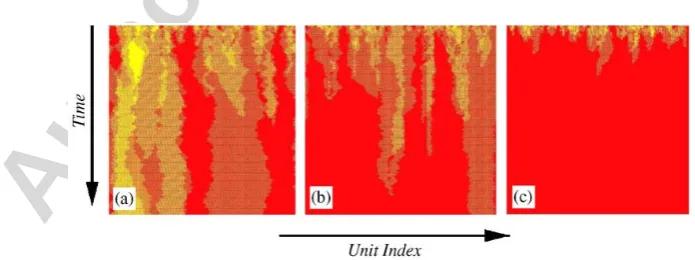
Fig. 1 shows the time evolution of the system for three different values of the connectivity added by the
shortcuts (excess connectivity), k. As can be seen in Fig. 1a, when k¼0, the original SM dynamics is
recovered as no shortcuts were added. Moreover, when k is increased (Figs. 1b and c), we observe that the system evolves rapidly towards the steady state, which in Fig. 1c is towards consensus.
In order to quantify the statistical properties of the system evolution, we obtained both the survival cumulative distribution of relaxation times and the number of realizations that have not reached the fixed points yet. The statistics of these two quantities are shown in Fig. 2. As can be seen in the cumulative distribution, the relaxation time decreases as the excess connectivity increases. For low values of the connectivity, the system evolves toward attractors with a broader distribution of relaxation times, including large values (m104). In contrast, for large connectivity, the tail of the distribution is shorter and it decays rapidly. Moreover, in the inset we describe the statistics of the number of realizations which were active at certain time t, that is, the number of realizations which had not reached the attractor at time t. From these observations, we can conclude that the relaxation time decreases as the connectivity increases. This result is expected because as the connectivity increases the information flows easily from one unit to another. One important characteristic of the model on a small-world topology is that an increment of the excess connectivity implies the reduction of the number of fixed points. For instance, six different domains are observed in the original SM with synchronous update, whereas when extra connections are considered, the number of fixed points is lower than six[11]. For a high connectivity the system always evolves toward a consensus state, that is, all units either down or up. A similar situation was observed in the original SM under the WS model[8]. Additionally, we evaluate the effects of the small-world topology on the decision time, defined as the time a unit stays in a state before it switches to the opposite state. In this case, we consider the effect of noise as the error in the communication between units with certain intensity,s. As expected, in presence of noise, no fixed points are observed in the evolution of the system. The system evolves showing non-periodic fluctuations in the magnetization which is defined in Ref.[4] and with a non-clear mean value.
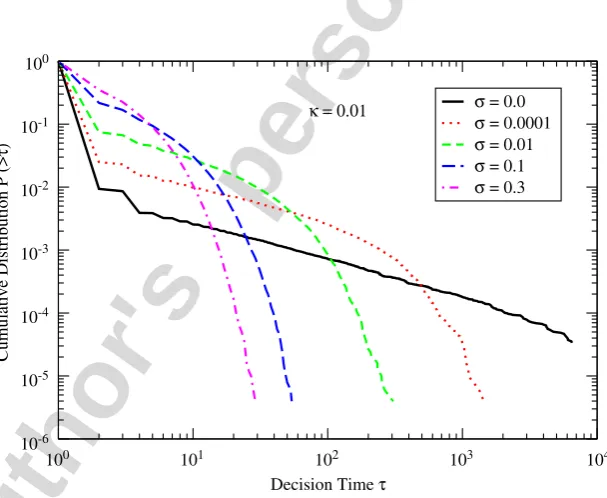
[image:4.595.110.458.573.703.2]InFigs. 3and 4 we show the survival cumulative distribution of decision times for several values of noise and connectivity,k. In particular,Fig. 3shows the log–log plot of the cumulative distribution of decision times
Fig. 1. Spatio-temporal evolution of the opinion distribution for systems with 512 units, 500 time steps and three values of connectivity (a)
Author's personal copy
for a fixed value of k¼0:01 and several values of noise intensity. For a small value of noise intensity, the cumulative distribution of decision times is quite similar to the distribution reported for the original SM with synchronous update[11]. The quick drop observed for very low noise intensity is related to the coexistence of six different domains even for intermediate dynamics, forcing the units to change their state during every time step [11]. As the noise intensity increases the distribution shows a rapid decay indicating that the system evolution is strongly influenced by the noise as units switch between states faster. In contrast, for a fixed value
100 101 102 103 104 Time Steps 101
102
Number of Realizations
100 101 102 103 104
Relaxation Times (µ) 0.1
1
Cumulative Distribution P (>
µ)
κ = 0.0
κ = 0.1
κ = 0.3
κ = 0.5
κ = 0.7
[image:5.595.144.483.86.319.2]κ = 0.9
Fig. 2. Cumulative distribution of relaxation times averaged over 100 simulations and 512 units according to Sznajd rules and synchronous update for different values of connectivity. For very small values of connectivity the distribution of relaxation times shows a large tail whereas for high connectivity the distribution falls quickly. In the inset, we show the statistics of the number of realizations which were active at timet. We observe a similar behavior as in the cumulative distribution of relaxation times.
100 101 102 103 104
Decision Time τ 10-6
10-5 10-4 10-3 10-2 10-1 100
Cumulative Distribution P (>
τ)
σ = 0.0
σ = 0.0001
σ = 0.01
σ = 0.1
σ = 0.3
κ = 0.01
Fig. 3. Cumulative distribution for the decision time for a fix value of excess connectivity, k¼0:01, and for different values of communication noise intensity. As noise intensity increases, the distribution tail drops rapidly, which indicates that the units switch states faster.
[image:5.595.145.449.378.627.2]Author's personal copy
of noise intensity, s¼0:01, when the connectivity increases the distribution has a larger tail, indicating that the time of residency in one state is larger, as shown in Fig. 4.
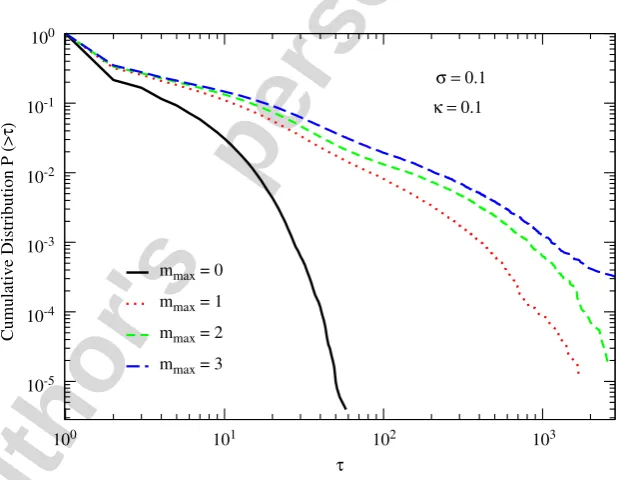
Finally, we consider the memory effects on the global dynamics of the SM under small-world topology. In this case, we assign to each unit a finite memory array of length m 2 ½0;mmax. The value of m is taken
randomly from two different distributions: uniform and power law. Fig. 5shows the cumulative distribution of decision times for a fixed value of both noise and connectivity as well as for several values ofmmaxfrom a
100 101 102 103
Decision Time τ 10-4
10-2
Cumulative Distribution (P>
τ)
κ = 0.01
κ = 0.1
κ = 0.3
κ = 0.5
κ = 0.9
[image:6.595.149.484.79.348.2]σ = 0.01
Fig. 4. Cumulative distribution for the decision time for a fix value of communication noise intensity,s¼0:01, and for different values of excess connectivity. As the connectivity increases the distribution has a larger tail, indicating that the time of residency in one state is larger.
100 101 102 103
τ
10-5 10-4 10-3 10-2 10-1 100
Cumulative Distribution P (>
τ)
mmax = 0
mmax = 1
mmax = 2
mmax = 3
σ = 0.1 κ = 0.1
[image:6.595.147.459.391.631.2]Author's personal copy
uniform distribution. One can observe that introduction of memory leads to a quite different distribution of decision times. Whenmmax¼0 (no memory), and fixed values of s¼0:1 andk¼0:1, we get a distribution
with a rapid decay, whereas, whenmmaxincreases, the tail of the distribution is larger, indicating that presence
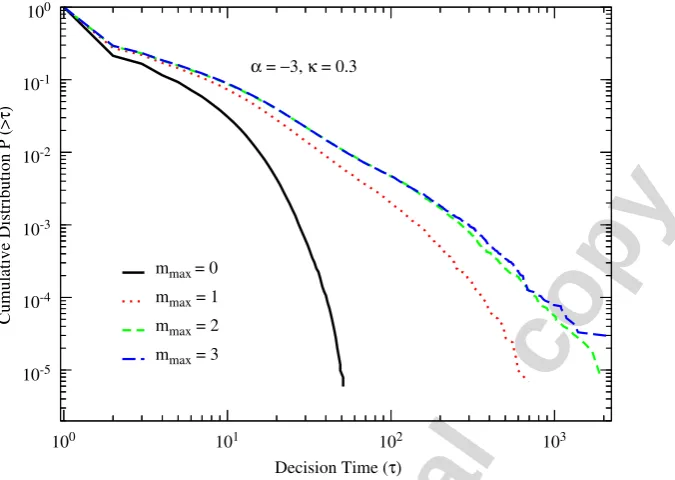
of memory allows the units to stay longer in their present state, that is, state switching rates are lower. Finally, inFig. 6the cumulative distribution of decision times is presented for the case of power law distributed length of memory arrays with exponenta¼ 3. A similar behavior is observed as inFig. 5where the memory length comes from a random distribution.
4. Conclusions
We have investigated the effects of the small-world topology and memory on the distribution of decision times of units under SM rules, as well as by introducing a communication error that influences the way a unit adopts its state: whether from the model rules or at random. We used the synchronous update to explore the distribution of relaxation times for different values of connectivity. We observed that as the connectivity increases, the relaxation time reduces. The distribution of decision times is different when the value of connectivity and noise error is changed. In particular, for a fixed value of connectivity, the distribution of decision time shows a rapid decay as the noise increases. In contrast, for a fixed value of noise, the distribution shows a larger tail when the connectivity increases. Finally, if memory is considered, the distribution of decision times is strongly influenced by the immediate past history despite the distribution of lengths of memory arrays (either random or power law).
Acknowledgments
We thank to Dr. H. Herna´ndez-Saldan˜a for the invitation to participate in the Symposium to honor Professor Robledo. This work was partially supported by EDI-IPN, COFAA-IPN and CONACYT, Me´xico.
100 101 102 103
Decision Time (τ) 10-5
10-4 10-3 10-2 10-1 100
Cumulative Distribution P (>
τ)
mmax = 0
mmax = 1
mmax = 2
mmax = 3
[image:7.595.144.482.90.330.2]α = −3, κ = 0.3
Fig. 6. Cumulative distribution of decision times for the power law distribution of memory lengths. As can be seen, the behavior is similar to the random distribution one. This suggests that introducing a memory array of at least one time step significantly changes the distribution of decision times.
Author's personal copy
References
[1] D. Stauffer, Introduction to statistical physics outside physics, Physica A 336 (2004) 1.
[2] R. Hegselmann, U. Krause, Opinion dynamics and bounded confidence: models, analysis and simulation, J. Artif. Soc. Soc. Simulation 5(3) paper 2 (2002)hjasss.soc.surrey.ac.uki.
[3] A. Pluchino, V. Latora, A. Rapisarda, Changing opinions in a changing world: a new perspective in sociophysics, Int. J. Mod. Phys. C 16 (4) (2005) 515.
[4] K. Sznajd-Weron, J. Sznajd, Opinion evolution in closed community, Int. J. Mod. Phys. C 11 (6) (2000) 1157. [5] K. Sznajd-Weron, Sznajd model and its applications, Acta Phys. Pol. B 36 (2005) 1001.
[6] A.T. Bernardes, D. Stauffer, J. Kertesz, Election results and the Sznajd model on Barabasi network, Eur. Phys. J. B 25 (2002) 123. [7] F. Slanina, H. Lavicka, Analytical results for the Sznajd model of opinion formation, Eur. Phys. J. B 35 (2003) 279.
[8] A.S. Elgazzar, Application of the Sznajd sociophysics model to small-world networks, Int. J. Mod. Phys. C 12 (2001) 1537. [9] A.S. Elgazzar, Applications of small-world networks to some socio-economic systems, Physica A 324 (2003) 402.
[10] D. Stauffer, Sociophysics: the Sznajd model and its applications, Comput. Phys. Commun. 146 (2002) 93.
[11] L. Behera, F. Schweitzer, On spatial consensus formation: Is the Sznajd model different from a voter model?, Int. J. Mod. Phys. C 14 (2003) 1331.