Otras secciones de este sitio:
☞ ☞ ☞ ☞
☞ Índice de este número
☞ ☞ ☞ ☞
☞ Más revistas
Others sections in this web site:
☞ ☞ ☞ ☞
☞ Contents of this number
☞ ☞ ☞ ☞
☞ More journals
Artículo:
La presencia del macho en un grupo de cabras anéstricas no impide su respuesta estral a la introducción de un nuevo macho
Derechos reservados, Copyright © 2004: Facultad de Medicina Veterinaria y Zootecnia, UNAM
Veterinaria México
Número
Number3
Julio-Septiembre
July-September 2 0 0 4
Volumen
La presencia del macho en un grupo de cabras anéstricas no
impide su respuesta estral a la introducción de un nuevo macho
Previous segregation between sexes is not a requisite to
succesful male effect in anestrous goats
Francisco Gerardo Véliz Deras*,** Leonardo Iván Vélez Monroy* José Alfredo Flores Cabrera* Gerardo Duarte Moreno* Pascal Poindron Massot* Benoît Malpaux* José Alberto Delgadillo Sánchez*
Recibido para su publicación el 23 de mayo de 2003 y aceptado el 21 de octubre 2003.
* Facultad de Medicina Veterinaria y Zootecnia, Universidad Nacional Autónoma de México, 04510, México, D.F ** Physiologie de la Reproduction et des, UMR 6173 INRA-CNRS- Université de Tours, 37380, Francia Nouzilly.
Responsable para correspondencia y envío de sobretiros: José Alberto Delgadillo Sánchez, CIRCA, Departamento de Ciencias Médico Veterinarias, Universidad Autónoma Agraria Antonio Narro, Periférico y Carretera a Santa Fe, A.P. 940, Torreón, Coahuila, México. Teléfono y Fax: 52 871 733 12 10. E mail: [email protected]
Abstract
This study was performed to determine whether previous separation between sexes is necessary to stim-ulate the sexual activity of anestrus female goats by the male effect. Fifty Creole female goats from subtropical Mexico (26°23’ N and 104°47’ W) in permanent contact with two male goats from December were used. On March 15th, does were allocated in two groups (n = 25 each, one male per group). On March 16th, the males in contact with females were removed, and immediately, one group of does was put in contact with another three bucks in rest season, while the other group was exposed to three bucks previously treated with 2.5 months of long days to stimulate their sexual activity. The frequency of self urination, ano-genital sniffing, nudging, mounting attempts and mounts of the males during the first five days following their introduction was lower in control than in treated males (P < 0.05). In the first 10 days, more than 95% of females in contact with control and treated bucks showed at least one estrus behavior (P > 0.05). These results indicate that the previous isolation of the two sexes is not necessary to stimulate the sexual activity of the anestrous female goats by the male effect, at least when the anestrous condition of the females is moderately expressed.
Key words: GOATS, MALE EFFECT, PREVIOUS ISOLATION, SEXUAL BEHAVIOR, ESTRUS INDUCTION, SUBTROPICS.
Resumen
Este estudio se efectuó para determinar si la separación previa de los dos sexos es necesaria para esti-mular la actividad sexual de las cabras anéstricas mediante el efecto macho. Se utilizaron 50 hembras Criollas del subtrópico mexicano (26°23’ N y 104°47’ O), que estuvieron en contacto permanente con dos machos cabríos desde diciembre. El 15 de marzo se formaron dos grupos (n = 25 cada uno, un macho por grupo). El 16 de marzo los dos machos fueron retirados e inmediatamente un grupo de cabras fue puesto en contacto con otros tres machos en reposo sexual, mientras que el otro fue expuesto a tres machos tratados con 2.5 meses de días largos para estimular su actividad sexual. Las frecuencias de automarcajes con orina, olfateos ano-genitales, aproximaciones, intentos de montas y montas de los machos testigo durante los primeros cinco días después de su introducción, fueron inferiores que las de
Introduction
I
n anovulatory female sheep and goats, sexualactivity can be induced by the male effect.1-3 The
intensity of libido in males influences the response
of females.4 In local goats of the Comarca Lagunera
region in subtropical northern Mexico (26°23’ North latitude and 104° 47’ West longitude), more than 80% of females show at least one behavioral estrus during the first 12 days following the introduction of bucks which sexual activity has been induced by exposure to 2.5 months of long days, followed or not by the
insertion of subcutaneous melatonin implants.4 In
contrast, less than 10% of goats exposed to control
bucks in sexual rest, show estrus in this same period.
5-7 The sexual motivation in Cashmere goats in
Austra-lia is stimulated during the annual period of sexual rest by high quality feeding. Such males stimulate the sexual activity of a larger number of anovulatory females through the male effect than bucks in sexual
rest.8 The separation between males and females
(odor, sound, sight and tactile stimulation) before the male effect is considered indispensable to obtain a
good stimulation of sexual activity in the females.4,9,10
However, in ewes maintained in permanent contact with rams, the introduction of other males induces ovulation in the females (85%), as it does in ewes which had been previously totally separated from
rams (86%).11 This and other studies carried out in
sheep,12,13 suggest that, at least in some breeds of this
species, the preliminary separation of sexes is not
an absolute requisite for the male effect.12,14 In goats
also, it has been suggested that sexual separation for at least three weeks is necessary to obtain a response
to the introduction of bucks.3,10 However, in goats
there is no study that demonstrates that anovulatory females require a preliminary separation from bucks to respond to their introduction. Therefore the objec-tive of the present study was to determine whether a complete isolation from males before the male effect is necessary for their stimulation by the buck, or if this response depends on the libido intensity of the males introduced in the group of females.
Introducción
L
a actividad sexual de las cabras y ovejasanés-tricas puede ser inducida a través del efecto
macho.1-3 La intensidad de la líbido de los
machos influye en la respuesta de las hembras.4 En
las cabras locales de la Comarca Lagunera (latitud, 26°23’ N y longitud, 104° 47’ O), en el norte subtro-pical de México, más de 80% muestran al menos un comportamiento estral durante los primeros 12 días después de la introducción de los machos, cuya acti-vidad sexual es inducida con 2.5 meses de días largos, seguidos o no de la inserción subcutánea de dos
implantes de melatonina.4 En cambio, menos de 10%
de las cabras expuestas a machos testigo, en reposo
sexual, muestran estro en ese mismo periodo.5-7
La líbido de los machos Cashmere en Australia es estimulada durante el periodo de reposo sexual al ofrecerles una dieta alimentaria de buena calidad. Estos machos estimulan la actividad ovulatoria de un mayor número de cabras anovulatorias expuestas al
efecto macho que los machos en reposo sexual.8 La
separación (olor, sonido, vista, tacto) de los dos sexos previa al efecto macho, se considera indispensable para obtener una buena estimulación de la actividad
sexual de las hembras.4,9,10 Sin embargo, en las ovejas
mantenidas en contacto permanente con carneros, la introducción de otros machos estimula la ovulación de las hembras (85%) al igual que en aquellas
some-tidas a una previa separación (86%).11 Este último
estudio y otros efectuados en las ovejas,12,13 sugieren
que al menos en algunas razas de la especie ovina, la separación de los dos sexos no es necesaria antes del
efecto macho.12,14 En las cabras también se sugirió la
necesidad de separar los dos sexos, de por lo menos
tres semanas antes del efecto macho.3,10 Sin embargo,
en las cabras no existe ningún estudio que demuestre si las hembras anovulatorias requieren un previo ais-lamiento para responder a la introducción de otros machos. Por tanto, el objetivo del presente estudio fue determinar si es necesaria la completa separación de los dos sexos para estimular la actividad sexual de las cabras sometidas al efecto macho, o si esta respuesta
los tratados (P < 0.05). En los primeros diez días de estimulación, más de 95% de las hembras en con-tacto con los machos testigo y tratados, mostraron al menos un estro (P > 0.05). Estos resultados indican que la separación previa de los dos sexos no es necesaria para estimular la actividad sexual de las cabras sometidas al efecto macho, al menos cuando el anestro es moderado.
Material and methods
Inductive males
Nine local males from the Comarca Lagunera in Coa-huila were used, which are known as Mexican creole goats or “Criollos”. The Comarca Lagunera is located in subtropical Mexico (26°23’ N; 104°47’ W). The males were 4 years old at the beginning of the study and belonged to the Research Centre for Goat Repro-duction (CIRCA) of the Autonomous Agrarian Univer-sity Antonio Narro. The reproductive characteristics of males submitted to natural photoperiodic varia-tion in the Comarca Lagunera have been described
previously.15 On November 1st 2000, these males were
divided into two homogeneous groups, according to their body and testicular weights. Both groups were maintained in 5 × 7 m open pens. One control group, in sexual rest (n = 4), was submitted to the natural variations of the Comarca Lagunera photoperiod (13h 41m of light at the summer solstice and 10h 19 m at the winter solstice). The treated group, sexually active (n = 5), was submitted to long days (16h light/8
h dark), from November 1st 2000 to January 15th 2001.
To this end the corral of the treated group was illu-minated with lights providing a luminous intensity of 250 to 350 Lx at the level of the animals’ eyes. Turning on and off of the lights was controlled automatically
by programmable automatic clocks*. Long days were
obtained by the combination of artificial and natural light. The lights were turned on from 6 to 10 a.m. and
17 to 22 p.m. On January 16th, the light treatment was
stopped and the males were exposed only to the natu-ral photoperiodic variations until the end of the study. This treatment stimulates the secretion of testosterone and the sexual behavior of males during the normal
period of sexual rest.6 Animals were fed with alfalfa
hay ad libitum and 300 g of commercial concentrate (14% crude protein, 2.5 Mkcal/kg) per day and per
animal. Water and minerals were also ad libitum.
Females
Seventy-six adult and multiparous local Creole goats were used in this study. They had given birth in November and December 2000. All the females were identified with a plastic eartag in the left ear. The kids were weaned at day 30 of lactation and the goats were hand-milked once a day until the end of the study. These females were kept in permanent contact with two adult bucks during three months, starting on
December 15th 2000. The males were fitted with an
apron to prevent the fecundation of the females. The animals of both sexes were kept under extensive man-agement before the beginning of the study. On
Febru-depende de la intensidad de la líbido de los machos introducidos en los grupos de hembras.
Material y métodos
Machos cabríos inductores
Se utilizaron nueve machos cabríos, Criollos, locales de la Comarca Lagunera de Coahuila, México. Esta Comarca se localiza en el subtrópico mexicano (latitud, 26°23’ N y longitud, 104°47’ O). Los machos tenían cuatro años de edad al inicio del estudio, pertenecían al Centro de Investigación en Reproducción Caprina (CIRCA) de la Universidad Autónoma Agraria Antonio Narro de ese estado. Las características reproductivas de los machos sometidos a las variaciones naturales del fotoperiodo de la
Comarca Lagunera se describieron previamente.15
El 1 de noviembre de 2000 se formaron dos grupos homogéneos con estos machos, de acuerdo con su peso corporal y testicular. Los dos grupos se mantuvieron estabulados en instalaciones abiertas de 5 × 7 m. Un grupo testigo, en reposo sexual (n = 4), se sometió a las variaciones naturales del fotoperiodo de la Comarca Lagunera (13 h 41 min de luz durante el solsticio de verano y 10 h 19 min en el solsticio de invierno); el grupo tratado, sexualmente activo (n = 5), se sometió a días largos (16 h luz y 8 h de oscuridad) del 1 de noviembre de 2000 al 15 de enero de 2001. Para esto, el corral del grupo tratado fue equipado con cuatro lámparas fluorescentes con una intensidad luminosa entre 250 y 350 Lx al nivel de los ojos de los animales. El encendido y apagado de las lámparas se
efectuó con relojes automáticos y programables.* Los
días largos se lograron combinando la luz artificial y natural. Las lámparas se encendían de seis a diez de la mañana y de 17 a 22 h. El 16 de enero se suspendió el tratamiento fotoperiódico y los machos fueron expuestos únicamente a las variaciones naturales del fotoperiodo hasta el fin del estudio. Este tratamiento estimula la secreción de testosterona y el comportamiento sexual de los machos durante
el periodo natural de reposo.6 Los animales se
alimentaron con heno de alfalfa a libre acceso y 300 g de concentrado comercial (14% de proteína cruda, 2.5 Mkcal/kg) por día y por animal. El agua y los minerales se proporcionaron también a libre acceso.
Cabras
Se utilizaron 76 cabras locales adultas multíparas, Criollas, que parieron de noviembre a diciembre de 2000. Todas fueron identificadas con un arete de plástico en la oreja izquierda. Las crías fueron
ary 23rd 2001, the females were placed in a 15 × 20 m
pen, together with the 2 males, where they were fed with alfalfa hay ad libitum and 200 g of commercial concentrate (14% of crude protein, 2.5 Mkcal/kg) per day and per animal. Animals had also free access to
water and minerals. On February 24th and March 5th,
blood samples were taken from each female to deter-mine the plasma levels of progesterone by RIA, using
the technique described by Terqui and Thimonier,16
That allows to discriminate between cyclic and non cyclic females. Twenty-six females were diagnosed as cyclic and excluded from the experiment on March
15th. Immediately after, the remaining females were
divided into two anovulatory groups balanced by body weight, body condition and milk production, with one of the two bucks previously kept with them in each group. Each group was placed in a 10 × 5 m pen, separated from each other by more than 120 meters,
to prevent any interference between groups.8,17
Male effect
On March 16th, at 8:00 in the morning (day 0), the
two bucks in sexual rest that had been kept with the females, were removed. Immediately after, three control bucks in sexual rest were introduced in one group of females (n=25). In the other group, three treated, sexually active bucks were put in contact with the females (n = 25). The males remained with the females for 36 days.
Evaluated variables
The individual sexual activity of the inductive bucks was studied during the first 5 days following their introduction to the females. The observations were carried out in the morning (from 8:00 to 10:00), before the daily feeding. The variables recorded for male sexual behavior were frequencies of self marking with urine, ano-genital nasal inspection,
approaching, mounting attempts and mounts.5,18,19
In the females, estrus detection was carried out in the morning (from 8:00 to 10:00) and in the after-noon (from 17:00 to 19:00), from day 0 to day 36 fol-lowing the introduction of the bucks. To this end the bucks were fitted with a marking harness of a
differ-ent color for each male.8,20 During the observations
of sexual behavior, females which stood immobile
when mounted by a buck were considered in estrus.21
From day 6 to 36, females with a colored wax mark on the rump were observed to verify whether they accepted the mount by the buck and could be con-sidered in estrus. If a females did not accept being mounted at that time, she was not considered to be in estrus. The percentage of pregnant females was
tetadas a los 30 días posparto, y las cabras fueron ordeñadas manualmente una vez por día, hasta el final del estudio. Estas hembras estuvieron en con-tacto permanente con dos machos adultos durante tres meses a partir del 15 de diciembre de 2000. Los machos portaban un peto para impedir que efectuaran montas con penetración. Las hembras y los machos eran explotados de manera exten-siva antes de empezar el estudio. El 23 de febrero de 2001, las cabras se estabularon en un corral de 15 × 20 m junto con los dos machos, y fueron ali-mentadas con heno de alfalfa a libre acceso y 200 g de concentrado comercial (14% de proteína cruda, 2.5 Mkcal/kg) por día y por animal. El agua y los minerales se proporcionaron a libre acceso. El 24 de febrero y 5 de marzo se obtuvieron muestras san-guíneas para determinar los niveles plasmáticos de progesterona por RIA mediante la técnica descrita
por Terqui y Thimonier.16 Este procedimiento
per-mite distinguir las hembras anovulatorias y las cícli-cas. Se detectaron 26 cabras con actividad ovárica, por lo que fueron retiradas del experimento el 15 de marzo. Inmediatamente después se formaron dos grupos homogéneos con las hembras anovulatorias, de acuerdo con el peso corporal, condición corpo-ral y producción láctea. A cada uno de los grupos de hembras se agregó uno de los machos que se encon-traban previamente con ellas. Cada grupo de cabras fue alojado en un corral de 10 × 5 m a una distancia mayor de 120 m entre corrales, para evitar cualquier
interferencia entre los grupos.8,17
Efecto macho
El 16 de marzo de 2001 a las ocho de la mañana (día 0), se retiraron los dos machos en reposo sexual que se encontraban en contacto con las hembras. Inmediatamente después, un grupo de hembras (n = 25) fue puesto en contacto con tres machos testigo, en reposo sexual. El otro grupo de hembras (n = 25) se contactó con tres machos tratados, sexualmente activos. Los machos permanecieron con las hembras 36 días.
Variables evaluadas
Durante los primeros cinco días después de haber puesto los machos en contacto con las hembras, se registró la actividad sexual de cada uno de ellos. Las observaciones se realizaron en la mañana (de 8 a 10 h) antes de proporcionarles el alimento. Como variables del comportamiento sexual se registraron las frecuencias de automarcajes con orina, olfateos ano-genitales, aproximaciones, intentos de montas y
determined by abdominal echography 50 days after the last registered estrus. In addition, fertility and prolificity were determined in both groups.
Statistical analyses
To compare the sexual behavior of the bucks in the two groups, the total frequency of each variable for each group was calculated. The frequencies of self marking with urine, ano-genital nasal inspections, approaches, mounting attempts and mounts, were compared using the Chi-square test. The propor-tions of females which showed estrus activity in each group, of females diagnosed pregnant, as well as fer-tility, were compared using the exact probability test of Fisher. The interval between the introduction of the bucks and the beginning of the estrus, the dura-tion of the estrous cycle and the prolificity, were com-pared with a Student t test. All the statistical analyses
were carried out with the Systat 5.03* program.
Results
Sexual behavior of the bucks
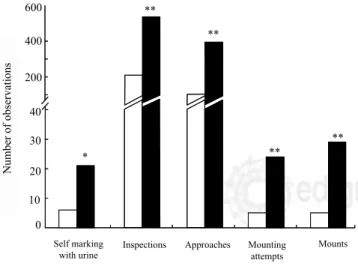
The sexual behavior recorded in the control bucks was lower than that of the treated males (Figure 1). In total, 27 self marking with urine were observed, of which only 6 (22%) were performed by the control bucks (P < 0.05). Amongst the 746 anogenital nasal inspections, only 210 (28%) were performed by the control bucks (P < 0.001). One hundred and one approaches out of 495 (20%), were performed in the control group by the bucks in sexual rest (P < 0.001). Similarly, only 5 out of 29 mounting attempts (17%) were done by the males in sexual rest (P < 0.001). Finally, 5/34 mounts (15%) were performed by the males of the control group (P < 0.01).
En las hembras se detectó el estro en la mañana (de 8 a 10 h) y en la tarde (de 17 a 19 h) desde el día 0 hasta el día 36 posintroducción de los machos. Para ello, los machos fueron provistos de un arnés con un
marcador de cera de diferentes colores.8,20 Durante
las observaciones del comportamiento sexual, las hembras que se inmovilizaban al ser montadas por
los machos, fueron consideradas en estro.21 Del día
6 al 36, las hembras con marcas de cera en la parte pélvica se observaron para verificar si aceptaban la monta del macho y ser consideradas en estro. Si la hembra no aceptaba la monta, no se consideraba en estro. El porcentaje de hembras gestantes se deter-minó mediante una ecografía abdominal a los 50 días después de la presentación del último compor-tamiento estral. También se determinó la fertilidad y la prolificidad de las cabras de los dos grupos.
Análisis de datos
Para comparar el comportamiento sexual de los machos tratados y no tratados, se calculó la fre-cuencia total de cada variable para cada grupo. Las frecuencias de automarcajes con orina, olfateos ano-genitales, aproximaciones, los intentos de montas y las montas, se compararon mediante la prueba de Ji-cuadrada. Las proporciones de hembras que manifes-taron actividad estral en los grupos, las proporciones de hembras detectadas gestantes y la fertilidad se compararon mediante una prueba exacta de proba-bilidades de Fisher. El intervalo entre la introducción de los machos y el inicio del estro, la duración del ciclo estral, así como la prolificidad, se compararon mediante una prueba t de Student. Todos los análisis estadísticos se efectuaron mediante el paquete
esta-dístico SYSTAT 5.03.*
Figura 1. Número de conductas sexuales de los machos del grupo testigo (cuadros blancos; n = 3) y tratado (cuadros negros; n = 3), registrado durante dos horas en los primeros cinco días después de introducidos en los dos grupos de hem-bras. *P < 0.05; **P < 0.01.
Number of obdervations of each sexual behavior in males of the control group (empty histograms, n = 3) and in treated males (black histograms, n = 3), recorded during 2 h in the first five days following their introduction in the two groups of females. *P < 0.05; **P < 0.01.
* Evenston, ILL, USA, 1990-1992.
Self marking
with urine Inspections Approaches Mountingattempts Mounts
Kinds of behavior
Number of observations *
**
**
** **
Response of the females to the male
effect
Estrus behavior
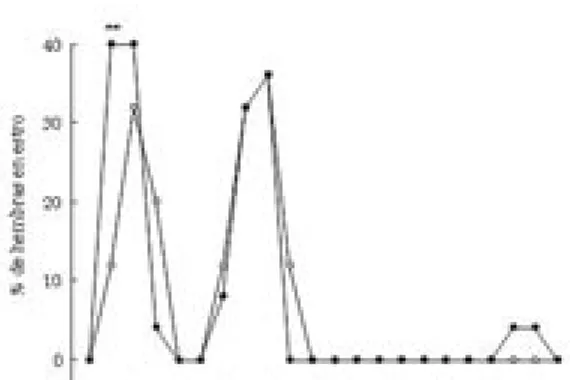
All the females exposed to the control bucks (25/25, 100%) and the majority of the females in contact with the treated bucks (24/25, 96%), showed at least one estrus behavior during the first ten days following the introduction of the new males (P > 0.05; Figure 2). The interval between the introduction of the males and the beginning of the estrus activity was longer in females exposed to control bucks (2.3 ± 0.2 days) than in females exposed to treated bucks (1.8 ± 0.1 days; P < 0.01). The accumulated percentage of females in estrus on days 1 and 2 after the intro-duction of the new bucks was higher in the treated group (40% and 80%) than in the control group (12% and 44% respectively, P < 0.01). The proportion of estrous cycles of short duration did not differ signifi-cantly between groups (56% and 64% of goats in con-tact with control and treated bucks, respectively; P > 0.05). The duration of the short cycles in females with control bucks and in females with treated bucks
did not differ significantly (4.8 ± 0.2 days versus 5.1
± 0.1 days, respectively; P > 0.05).
Pregnancy at 50 days, fertility and prolificity
The number of pregnant goats at 50 days, the fer-tility and the prolificacy did not differ between the two groups (P > 0.05). 88% (22/25) of the females exposed to control males were diagnosed pregnant. Eighty-six percent of these (19/22) gave birth, with a prolificacy of 2.0 ± 0.2 kids. The 3 other females
Resultados
Comportamiento sexual de los machos
El comportamiento sexual registrado en los machos testigo fue inferior al de los machos tratados (Figura 1). En total se observaron 27 automarcajes con orina, de los cuales únicamente seis (22%) fueron realizados por los machos del grupo testigo (P < 0.05). De los 746 olfateos ano-genitales, sólo 210 (28%) fueron efectuados por los machos en reposo sexual (P < 0.001). De las 495 aproximaciones registradas, 101 (20%) fueron realizadas por el grupo de machos testigo (P < 0.001). De igual manera, de los 29 intentos de monta observados, sólo cinco (17%) fueron realizados por el grupo en reposo sexual (P < 0.001). Finalmente, cinco de las 34 montas observadas (15%) fueron efectuadas por el grupo testigo (P < 0.01).
Respuesta de las hembras al efecto macho
Comportamiento estral
Todas las cabras expuestas a los machos testigos (25/25, 100%), y la mayoría de las hembras (24/25, 96%) en contacto con los machos tratados, mostra-ron al menos un comportamiento de estro durante los primeros diez días después de la introducción de los nuevos machos (P > 0.05; Figura 2). El intervalo entre la introducción de los machos y el inicio del estro fue más prolongado en las hembras expuestas a los machos testigo (2.3 ± 0.2 días) que a los tratados (1.8 ± 0.1 días; P < 0.01). El porcentaje acumulado de hembras en estro los días uno y dos después de la
Figura 2. Porcentaje de hembras que presentaron una actividad estral después de la introducción de machos del grupo testigo (círculos abiertos) y del grupo tratado (círculos negros). D0 es el día de la introducción de los nuevos machos. **P < 0.01
(14%) aborted in the second third of pregnancy. Eighty percent (20/25) of the goats exposed to males of the treated group were diagnosed pregnant, of which 85% (17/20) gave birth, with a prolificacy of 1.8 ± 0.2 kids. The remaining 15% (3/20) aborted during the second third of pregnancy.
Discussion
In the goat, a total separation between sexes before the male effect has been considered a crucial condi-tion to stimulate the sexual activity of anovulatory females. However, in contrast with the results of
others,3,10 the results of the present study
demon-strate that the lack of separation did not prevent the goats to show a good response to the introduction of new bucks, either sexually active or in sexual rest. In both groups of females, more than 95% of the goats responded, showing at least one estrus.
The response found in females exposed to treated
bucks coincides with results reported by others.4,7 On
the other hand, the response of the females in con-tact with males in sexual rest was unexpected, given that it had been found previously that the sexual activity of females of this genotype could be stimu-lated only when using bucks exposed for two months to long days, followed or not by the insertion of two
subcutaneous implants of 18 mg of melatonin each.5-7
At least three non exclusive factors may account for this discrepancy:
1) It is likely that the continuous presence of the males in the two groups of females delayed the ending of the breeding season. If so, the females may have been anovulatory, but weakly inhibited. Indeed, Cashmere goats maintained in continuous presence of males extend their period of sexual activity, which ends later than in females isolated from males.
2) The introduction of the same males every month or two in a group of females, allows these females to extend the period of time during which
they respond to the male.22 In this case, the period
of ovulatory activity of goats exposed intermittently to males is longer than that of fully isolated females
or of females in permanent contact with males.22 In
the present study, the presence of the bucks may have extended the period during which the females respond to the introduction of other males,
indepen-dently of their physiological condition.22
3) Although the sexual behavior of the males undergoing a photoperiodic treatment was higher than that of control males, these control males were sexually more active than the ones recorded in pre-vious studies, in which control bucks did not
stimu-late any sexual activity in the females.5,7 The males
of the control group in the present study did more
introducción de los machos fue superior en el grupo tratado (40% y 80%) que en el grupo testigo (12% y 44%, respectivamente; P < 0.01). La proporción de ciclos estrales de corta duración no se diferenció sig-nificativamente entre grupos (56% y 64% de hembras en contacto con machos testigo y tratados, respectiva-mente; P > 0.05). La duración del ciclo estral corto no fue diferente en las hembras en contacto con machos del grupo testigo (4.8 ± 0.2 días) y tratados (5.1 ± 0.1 días; P > 0.05).
Gestación a los 50 días, fertilidad
y prolificidad
El número de cabras gestantes a los 50 días, la fertilidad y prolificidad no fue diferente entre los dos grupos de hembras (P > 0.05). El 88% (22/25) de las hembras expuestas a machos del grupo testigo fueron diagnosticadas gestantes. El 86% de ellas (19/22) parió y tuvo una prolificidad de 2.0 ± 0.2 crías. El 14% (3/22) abortó en el segundo tercio de la gestación. El 80% (20/25) de las hembras expuestas a los machos del grupo tratado fueron diagnosticadas gestantes, de éstas 85% (17/20) de ellas parieron y la prolificidad fue de 1.8 ± 0.2 crías. El 15% (3/20) abortó en el segundo tercio de la gestación.
Discusión
La separación total de los dos sexos antes del efecto macho se ha considerado como condición indispensa-ble para estimular la actividad sexual de las cabras. Sin embargo, contrariamente a lo registrado por algunos
investigadores,3,10 los resultados del presente estudio
demuestran que la falta de separación no impidió a las cabras responder adecuadamente a la introduc-ción de los nuevos machos, unos sexualmente activos y otros en reposo sexual. En los dos grupos de hem-bras, más de 95% de las cabras respondieron mani-festando al menos un estro.
La respuesta observada en las hembras expuestas a los machos tratados coincide con lo registrado por
otros autores.4,7 En cambio, la respuesta de las
hem-bras en contacto con machos en reposo sexual fue inesperada, ya que anteriormente se había demos-trado que la actividad sexual de las cabras de este genotipo era estimulada sólo utilizando machos sexualmente activos por ser tratados con 2.5 meses de días largos, seguidos o no de la inserción de dos implantes subcutáneos de melatonina con 18 mg
cada uno.5-7 La explicación de este fenómeno podría
atribuirse al menos a tres factores que no son exclu-yentes:
than twice as many ano-genital nasal inspections and approaches (P < 0.01) than control bucks of other experiments carried out in the same zone, with ani-mals of the same genotype and at the same time of
the year.5-7
This suggests that the end of the breeding season of Mexican Creole bucks like those used in the pres-ent study, varies between years and coincides with
what has been reported in Alpine bucks.23
There-fore it is possible that the sexual activity shown by the control bucks was the factor responsible for the sexual response of the females in this group. It has been reported that at some times of the year, females
do not respond to the male effect.5,22 This is not due
to the insensitivity of the females to the presence of the males, but rather to the low stimulatory quality
of the males, which are in sexual rest.6,7 Since sexual
activity initiates earlier in males than in females,4,22,24
goats respond to the male effect a few weeks before the beginning of their annual reproductive cycle, probably because of the improvement of male sexual behavior and pheromone production at that time. Nevertheless, the differences between the two groups, regarding the latency of the response and the proportion of females which showed estrus in the first two days, indicate that sexually active males are more efficient to induce a response. This difference may have been due to the level of sexual activity shown by control and treated males. Indeed, the quality of the stimulus, determined by the intensity of the sexual behavior of males, influences the response of females. Males which show a higher libido induce sexual
activ-ity in a larger number of females.8,25
Finally, it is interesting to mention that in spite of the lower libido in the control than in the treated bucks, the results of fertility and prolificacy suggest that the spermatic production was similar, quantita-tively and qualitaquantita-tively, in the two groups of males. A reduction of the quantity of spermatozoids, and even more so of their progressive motility during the period of sexual rest, causes a reduction of fertility in
the females.26
The results of the present study suggest that in March the control males had not yet reached sexual rest, that takes place normally between January and
April.15 The results obtained here allow to conclude
that in the goats of the Comarca Lagunera in subtrop-ical Mexico, the separation of sexes is not necessary to stimulate the reproductive activity in females with the male effect. It is possible that this positive response without previous separation, was due to the fact that the females, although anestrous, were only weakly inhibited. It would be important to determine if a similar response can be obtained in deeply inhibited anestrous females. This would allow defining more
el final de la estación sexual. En estas circunstancias, las cabras estarían anovulatorias, pero débilmente inhibidas. En efecto, las cabras de la raza Cashmere mantenidas en presencia continua de machos, pro-longan su actividad ovulatoria, que termina después que en las hembras aisladas.
2) La introducción de los mismos machos cada mes o dos meses en un grupo de cabras, permite que éstas prolonguen el periodo que responden
a la introducción de los machos.22 En estas
circunstancias, el periodo de actividad ovulatoria de las cabras expuestas intermitentemente a los machos es más prolongada que la observada en las hembras aisladas o mantenidas en contacto continuo
con machos.22 En el presente estudio, la presencia de
los machos pudo haber prolongado el periodo en el cual las hembras responden a la introducción de otros machos, independientemente de su condición
fisiológica.22
3) Aunque el comportamiento sexual de los machos sometidos al tratamiento fotoperiódico fue superior que el de los machos del grupo testigo, éstos tuvieron un comportamiento sexual más intenso que el registrado en estudios anteriores, en que los machos testigo no estimularon la actividad sexual
de las cabras.5,7 Los machos en el grupo testigo del
presente estudio efectuaron más del doble de olfateos ano-genitales y aproximaciones que los registrados en machos testigo de otros experimentos (P < 0.01) efectuados en la misma región, con animales del
mismo genotipo y en la misma época del año.5-7
Esto último sugiere que el final de la actividad sexual de los machos Criollos del presente estudio varía de un año a otro, y coincide con lo descrito en
machos cabríos de la raza Alpina.23 Por consiguiente,
es posible que el comportamiento sexual desplegado por los machos testigo fuese el factor responsable de la respuesta sexual del grupo de cabras al que fueron introducidos. Se ha mencionado que en algunas épocas del año, las hembras no responden al efecto
macho.5,22 Lo anterior no se debe a la
insensibili-dad de las hembras ante la presencia de los machos, sino a la débil calidad estimulatoria de éstos, que se
encuentran en reposo sexual.6,7 Como la actividad
sexual de los machos cabríos inicia antes que el de
las hembras,4,22,24 éstas responden al efecto macho
precisely the importance of previous sexual segrega-tion for the success of the male effect in the goat.
Acknowledgments
We are grateful to Crescencio Sandoval for providing the goats used in this study; to all the members of the Research Center for Goat Reproduction (CIRCA) of the Autonomous Agrarian University Antonio Narro, for their technical assistance; to Norma Serafin for the echographies; to Dolores Lopez for her excellent administrative and secretary help; to Conacyt for the PhD scholarship to Francisco Gerardo Veliz; to the scientific cooperation program between Mexico (Conacyt, SEP, ANUIES) and France (ECOS), to have made posible the collaboration between the PRC of INRA and the CIRCA of the UAAAN (M02-A04).
Referencias
1. 2. 3. 4. 5.
6. 7. 8.
9. Chemineau P. Possibilities for using bucks to stimulate ovarian and oestrous cycles in anovulatory goats. A review. Livest Prod Sci 1987;17:135-147.
Cushwa WT, Bradford GE, Stabenfeldt GH, Berger YM, Dally MR. Ram influence on ovarian and sexual 10.
11. Shelton, M. Influence of the presence of a male goat
on the initiation of estrous cycling and ovulation of Angora does. J Anim Sci 1960;19:368-375.
Walkden-Brown SW, Martin GB, Restall BJ. Role of male-female interaction in regulating reproduction in sheep and goats. J Reprod Fertil Suppl 1999;52: 243-257.
Álvarez L, Zarco LA. Los fenómenos de bioestimulación sexual en ovejas y cabras. Vet Méx 2001;32:117-129.
Delgadillo JA, Flores JA, Véliz FG, Duarte G, Vielma J, Poindron P, et al. Control de la reproducción de los caprinos del subtrópico mexicano utilizando trata-mientos fotoperiódicos y efecto macho. Revisión. Vet Méx 2003;34:69-79.
Flores JA, Véliz FG, Pérez-Villanueva JA, Martínez de la Escalera G, Chemineau P, Poindron P, et al. Male reproductive condition is the limiting factor of effi-ciency in the male effect during seasonal anestrus in females goats. Biol Reprod 2000;62:1409-1414. Delgadillo JA, Flores JA, Véliz FG, Hernández HF, Duarte G, Vielma J, et al. Induction of sexual acti-vity of lactating anovulatory female goats using male goats treated only with artificially long days. J Anim Sci 2002;80:2780-2786.
Véliz FG, Moreno S, Duarte G, Vielma J, Chemineau P, Poin-dron P, et al. Male effect in seasonally anovulatory lactating goats depends on the presence of sexually active bucks, but not estrous females. Anim Reprod Sci 2002;72:197-207. Walkden-Brown SW, Restall BJ, Henniawati. The male effect in Australian cashmere goats. 3. Enhancement with buck nutrition and use of oestrous females. Anim Reprod Sci 1993;32:69-84.
Martin GB, Oldham CM, Cognié Y, Pearce DT. The physiological responses of anovulatory ewes to the introduction of rams. A review. Livest Prod Sci 1986;15:219-247.
estimular la actividad sexual de las hembras. Esta diferencia pudo deberse al nivel de actividad sexual mostrado por los machos tratados y testigos. En efecto, la calidad del estímulo, determinada por la intensidad del comportamiento sexual de los machos, influye en la respuesta de las hembras. Los machos que muestran una mayor líbido estimulan la
activi-dad sexual de un mayor número de hembras.8,25
Finalmente, es interesante señalar que a pesar de que los machos testigo mostraron una líbido inferior a la de los machos tratados, los resultados de fertilidad y prolificidad sugieren que la producción espermática fue similar cuantitativa y cualitativamente en los dos grupos de machos. Una reducción de la cantidad de espermatozoides por eyaculado, sobre todo de la motilidad progresiva de los espermatozoides durante el periodo de reposo sexual, provoca reducción de la
fertilidad de las hembras.26
Los resultados del presente estudio sugieren que en marzo, los machos testigo no habían iniciado el periodo de reposo, que se desarrolla normalmente
de enero a abril.15 Los resultados concluyen que en
las cabras de la Comarca Lagunera en el subtrópico mexicano, la separación de los dos sexos no es necesaria para estimular la actividad reproductiva de las hembras al someterlas al efecto macho. Es posible que esa respuesta positiva, sin necesidad de una previa separación, se deba a que las hembras, aunque anéstricas, estaban débilmente inhibidas. Sería importante determinar si una respuesta similar a la del presente experimento se puede obtener en hembras en anestro, fuertemente inhibidas, lo cual permitiría definir en la especie caprina la importancia de la separación previa de los dos sexos antes del efecto macho.
Agradecimientos
19. 20. 21. 22. 23. 24.
25. 26. activity in anestrous ewes: effects of isolation of ewes
from rams before joining and date of ram introduc-tion. J Anim Sci 1992;70:1195-1200.
Pearce GP, Oldham CM. Importance of non-olfactory ram stimuli in mediating ram-induced ovulation in the ewe. J Reprod Fertil 1988;84:333-339.
Bartlewski PM, Beard AP, Cook SJ, Rawlings NC. Ovarian activity during sexual maturation and following introduction of the ram to ewe lambs. Small Ruminant Res 2002;43:37-44.
Rosa HJD, Bryant MJ. The “ram effect” as a way of modifying the reproductive activity in the ewe. A review. Small Ruminant Res 2002;45:1-16.
Delgadillo JA, Canedo GA, Chemineau P, Guillaume D, Malpaux B. Evidence for an annual reproductive rhythm independent of food availability in male creole goats in subtropical northern Mexico. Theriogenology 1999;52:727-737.
Terqui M, Thimonier J. Nouvelle méthode radio-immulogique rapide pour l’estimation du niveau de porgestérone plasmatique. Application pour le diagnostic précoce de la gestation chez la brebis et la chèvre. CR Acad Sc Paris 1974;D279:1109-1112. Shelton, M. Goats: influence of various exteroceptive factors on initiation of estrus and ovulation. Int. Goat Sheep Res 1980;1:156-162.
Gonzalez R, Poindron P, Signoret JP. Temporal variation in LH and testosterone responses of rams after the introduction of oestrous females during the 12.
13. 14. 15.
16. 17. 18.
breeding season. J Reprod Fertil 1988;83:201-208. Fabre-Nys C. Le comportement sexuel des caprins: contrôle hormonal et facteurs sociaux. INRA Prod Anim 2000;13:11-23.
Radford HM, Watson RH, Wood GF. A crayon and associated harness for the detection of mating under field conditions. Austr Vet J 1960;36:57-66.
Chemineau P, Daveau A, Maurice F, Delgadillo JA. Seasonality of estrus and ovulation is not modified by subjecting female Alpine goats to a tropical photoperiod. Small Ruminant Res 1992;8:299-312. Restall BJ. Seasonal variation in reproductive activity in Australian goats. Anim Reprod Sci 1992;27:305-318. Delgadillo JA, Lebouef B, Chemineau P. Decrease in the seasonality of sexual behavior and sperm pro-duction in bucks by exposure to short photoperiodic cycles. Theriogenology 1991;36:755-768.
Walkden-Brown SW, Restall BJ, Norton BW, Scaramuzzi RJ, Martin GB. Effect of nutrition on seasonal patterns of LH, FSH and testosterone concentration, testicular masss, sebaceous gland volume and odour in Australian cashmere goats. J Reprod Fertil 1994;102:351-360. Perkins A, Fitzgerald JA. The behavioral component of the ram effect: the influence of ram sexual beha-vior on the induction of estrus in anovulatory ewes. J Anim Sci 1994;72:51-55.