PONTIFICIA UNIVERSIDAD CATÓLICA DEL ECUADOR
FACULTAD DE CIENCIAS EXACTAS Y NATURALES
ESCUELA DE CIENCIAS BIOLÓGICAS
Proximate Analysis and Amino Acid Profile of the Ecuadorian Andean
Lupin (Fabaceae:
Lupinus mutabilis)
Protein Isolate
Disertación previa a la obtención del título de Licenciado en Ciencias
Biológicas
GUERRA FREIRE DANIELA
Certifico que la disertación de Licenciatura en Ciencias Biológicas de la candidata Daniela
Guerra Freire ha sido concluida de conformidad con las normas establecidas; por lo tanto,
puede ser presentada para la calificación correspondiente.
Mtr. Pablo Pozo Director de la disertación
TABLA DE CONTENIDOS
1. RESUMEN ... 6
2. ABSTRACT ... 7
3. INTRODUCTION ... 7
4. MATERIALS AND METHODS ... 10
4.1 Sampling ... 10
4.2 Extraction and isolation ... 10
4.2.1. Obtaining Whole Lupin Flour ... 10
4.2.2. Obtaining Deffated Lupin Flour ... 11
4.2.3. Obtaining the Protein Isolate ... 11
4.3 Lupin Protein Isolate Proximate Analysis ... 11
4.3.1. Determination of Total Protein Content ... 11
4.3.2. Determination of Fat Content ... 12
4.3.3. Determination of Ash Content ... 12
4.3.4. Determination of Moisture Content ... 12
4.3.5. Determination of Carbohydrate Content ... 12
4.4 Preparation and TLC Analysis of Amino Acid Content in Lupin Protein Isolate . 13 4.4.1. Sample preparation ... 13
4.4.2. TLC Analysis ... 13
4.5 Statistical Analysis ... 14
5. RESULTS AND DISCUSSION ... 14
5.1 Lupin Protein Isolate Proximate Analysis ... 14
5.3 Possible Applications of the Protein Isolate in Sport’s Food Industry ... 18
6. CONCLUSIONS ... 19
7. ACKNOWLEDGEMENTS ... 20
8. REFERENCES ... 21
9. FIGURES ... 24
10. TABLES ... 25
11. SUPPLEMENTARY MATERIAL ... 27
LISTA DE FIGURAS
Figure 1. Amino Acid Chromatogram………21
LISTA DE TABLAS
Table 1. Proximate Composition of the Lupin Protein Isolate……….22
Table 2. Comparison Between Lupin Protein Isolate and Commercially Available Protein
Isolates………...………...22
Proximate Analysis and Amino Acid Profile of the Ecuadorian Andean
Lupin (Fabaceae:
Lupinus mutabilis)
Protein Isolate
Daniela Guerra F.
aa
Escuela de Ciencias Biológicas, Pontificia Universidad Católica del Ecuador, Avenida
12 de Octubre y Roca, Apartado 17-01-2184, Quito, ECUADOR; (593) 02 299 17 00; [email protected]
1.
RESUMEN
El propósito de este estudio ha sido aislar contenido proteico total de los granos de
chocho (Fabaceae: Lupinus mutabilis). El contenido de macronutrientes ha sido
evaluado a través de un análisis proximal: proteína total (67.25%), carbohidratos
(18.67%), grasa (5.95%), ceniza (4.12%) y humedad (4.01%). El análisis por
cromatografía de capa fina ha demostrado que habían siete amino ácidos esenciales
presentes en el aislado proteico: ácido glutámico, treonina, valina, isoleucina, leucina,
metionina y triptófano. Además, la presencia de ácido glutámico y de amino ácidos de
cadena ramificada, que son cruciales para potenciar el desempeño deportivo, sugieren
que el aislado proteico de granos de chocho podría ser un posible candidato para el
desarrollo de suplementos nutricionales enfocados a deportistas. Un método diferente de
aislamiento debería ser probado para optimizar el aislamiento del contenido proteico.
Por otra parte, otros estudios de cuantificación de amino ácidos son necesarios para
tener una mejor comprensión sobre el potencial del aislado proteico como suplemento
nutricional.
2.
ABSTRACT
The purpose of the present study was to isolate the total protein content of lupin
beans (Fabaceae: Lupinus mutabilis). The macronutrient content was evaluated through
a proximate analysis: total protein (67.25%), carbohydrates (18.67%), fat (5.95%), ash
(4.12%), and moisture (4.01%). The thin-layer chromatography analysis showed that
seven essential amino acids are present in the protein isolate: glutamic acid, threonine,
valine, isoleucine, leucine, methionine, and tryptophan. Furthermore, the presence of
glutamic acid and branched-chain amino acids −which are crucial for enhancing athletic
performance− suggest that the lupin protein isolate could be a possible candidate for a
development of nutritional supplement intended for athletes. A different protein
isolation procedure should be tested in order to optimize the complete isolation of the
protein content. Moreover, further studies for amino acid quantification are necessary in
order to understand the protein isolate’s true potential as a dietary supplement for
athletes.
Keywords: athletes, exercise, Lupinus, nutrition, protein isolate, proximate analysis
3.
INTRODUCTION
Long before the Inca civilization prospered, Andean crops have been fundamental
for several other cultures. The crops great diversity has allowed the establishment and
success of these societies. One of the most noticeable crops has been the Andean Lupin
(Lupinus mutabilis: Fabaceae). The genus originated in the Ecuadorian, Peruvian and
Bolivian Andean region; this area is characterized by the great variety of species of
Mujica, 2006) Even though lupins have been harvested for centuries, the introduction of
European crops has replaced this legume (Bermejo & León, 1994); this is, probably,
due to the complex processing lupins must undergo before being edible (S. Jacobsen &
Mujica, 2006).
In Ecuador, both the production and consumption of lupin beans has been
circumscribed to the highlands. The province with the greatest production is Cotopaxi;
however, Cañar and Chimborazo are also mass producers (Horton, 2014). The L.
mutabilis beans are grown in temperate climates and at altitudes ranging from 2,500 m
to 3,600 m. This particular crop is prone to diseases and plagues, the insufficient
research and lack of knowledge about lupins has not allowed the production to increase
and the industry to expand. Moreover, it has been estimated that the overall lupin
production is not enough to supply the national demand, it is believed that the current
yield can only cover 60% of the requirement (S.-E. Jacobsen & Sherwood, 2002).
However, recently, several companies have been promoting the production and
consumption of lupin beans by selling ready-to-eat lupins to national supermarket
chains (Horton, 2014); thus, enhancing scientific research about this bean (Peralta, E.,
Mazón, Á., et al., 2012).
In a nutritional aspect, the lupin beans are characterized by having a high protein,
moderate fatty acid, and low carbohydrate content (Bermejo & León, 1994).
Furthermore, this legume contains essential micronutrients (Villacrés, Rubio, et al,
2006), such as: calcium 0.48%, phosphorous 0.43%, potassium 0.02%, iron 120 mg/kg,
and zinc 50 mg/kg (Jaramillo Galarza, 2005). In Ecuador, lupins are one of the most
consumed beans; however, only the whole bean is consumed. Moreover, its
been industrialized (S.-E. Jacobsen & Sherwood, 2002). Regardless their nutritional
value and importance, this crop has not been completely exploited; this underutilization
is, possibly, due to the absence of research about lupins in the food industry.
Within the Fabaceae family, there are several beans that are fundamental to human
nutrition; probably, the most notorious one is the soybean. Soy crops are grown and
harvested worldwide because they are nutritious and versatile. Within the food industry,
soybeans have acquired great popularity among nutritional supplements designed for
athletes. Soybeans are processed into a protein isolate; this isolate is commercialized at
a global scale as post-workout supplement. After an athlete completes a training session
– cardiovascular or strength training – micro-traumas are created in the skeletal muscle
and amino acid catabolism is promoted (Y. Shimomura et al., 2006). In order to repair
these micro-injuries, proper nutrition after exercise is fundamental (Farrell, Joyner, et
al, 2012). This means that, depending the type of exercise that is carried out; the
proportion of macronutrients ingested varies. In activities that require strength or
resistance, like weightlifting, it is essential to consume food rich in protein, such as
protein isolate supplement. Protein intake helps to recover the amino acids that were
lost during training (Farrell et al., 2012). The amino acids in charge of muscle repair
and preservation are leucine, isoleucine, and valine (Børsheim, et al., 2002). The
ingestion of these is fundamental for a proper muscular recovery and growth.
The lupin bean has several advantages over the soybean. For instance, studies made
with L. mutabilis demonstrated that this bean has high protein content; in comparison to
soy, lupin beans contain 10.9% more protein (S. Jacobsen & Mujica, 2006). This means
that, L. mutabilis beans can be a better option for nutritional supplement for athletes.
on imports, which makes them much more expensive. Moreover, the options are quite
limited, most of the supplements come from animal sources (whey protein isolate,
casein protein isolate, and egg albumin protein isolate), and the plant-based options are
limited to soy. Furthermore, another advantage lupins have is that, unlike soybeans,
lupin beans have not been subjected to genetic modification. Nowadays, consumers
prefer to acquire non-GMO (genetically modified organisms) products, due to the health
and environmental issues behind the consumption of these types of crops (FAO,
2003b); this would make lupin beans an excellent option to soybeans.
4.
MATERIALS AND METHODS
5.1 Sampling
Commercially available hydrated lupin beans were acquired. All the samples
came from the same manufacturer, La Verde, which processes lupin beans from
the Machachi region, Ecuador.
5.2 Extraction and isolation
5.2.1Obtaining Whole Lupin Flour
The hydrated lupin beans were dehull, dried, and milled using a cereal
5.2.2 Obtaining Deffated Lupin Flour
The fat content was extracted with a Soxhlet extractor (Provitec)
using hexane as a solvent (Lusas & Riaz, 1995)
5.2.3 Obtaining the Protein Isolate
From the defatted lupin flour, protein was solubilized with 10%
NaOH (6.8-10 pH). The solution was centrifuged (MixtaSel Selecta), at
4,000 rpm during 5 minutes and solids were recovered. The protein
content was precipitated with 10% HCl (4.5 pH), centrifuged at 4,000
rpm during 5 minutes, and the protein precipitated as a curd. The curd
was neutralized with 10% NaOH (6.5-7 pH); distilled water was added to
resuspend the solution. Finally, the solution was centrifuged at 4,000 rpm
during 5 minutes and the curd was recovered. The curd was taken to an
oven (Binder) and dried for 24 h (Lusas & Riaz, 1995).
5.3 Lupin Protein Isolate Proximate Analysis
5.3.1Determination of Total Protein Content
Nitrogen content was determined by using the Kjeldahl method.
Digestion was carried out in a Kjeldahl digester (Velp) using Kjeldahl
finally, titration was done manually with Tashiro’s indicator, according to
the AOAC procedure and standards (AOAC, 2011a).
5.3.2Determination of Fat Content
Fat content was determined with a Mirco-Soxhlet extractor (Provitec),
using hexane as a solvent (AOAC, 2011d).
5.3.3Determination of Ash Content
Ash content was determined by placing the samples in porcelain
crucibles in a furnace (American Snol) at 550º C during 24 h (AOAC,
2011b)
5.3.4Determination of Moisture Content
Moisture content was determined by placing the samples in porcelain
capsules in an oven (Binder) at 130º C during 3 h (AOAC, 2011c).
Carbohydrate content was determined by the mathematical difference
between the sample and sum of protein, fat, ash, and moisture content
(FAO, 2003a).
5.4 Preparation and TLC Analysis of Amino Acid Content in Lupin Protein Isolate
5.4.1Sample preparation
Approximately 0.3 g of protein isolate was placed in 150 ml of HCl 3
N. Another 0.3 g sample was placed in 150 ml of HCl 3 N with 3g of
phenol. Finally, another 0.3 g sample was placed in 150 ml of NaOH 4.2
N. All samples hydrolyzed for 24h at 100º C (Kalman, 2014). After the 24
h had elapsed, all samples were filtered prior to their placement in the TLC
plate. Approximately, 3 µl of sample were applied to the baseline of the
plate (plastic cellulose sheets Art. 5577, 20 x 20cm, without fluorescente
indicator; E.M. Reagents) (Joseph L. Staneck, 1974)
5.4.2TLC Analysis
Ascending TLC was carried out in (Eastman Chromagram Chamber
Plate Set) TLC system with n-Butanol, glacial acetic acid, and distilled
was air dried, spots were visualized by spraying ninhydrin 1% with
acetone, and dried for 15 minutes in an oven (Binder) at 60º C (Haer,
1969). An amino acid mix (Amino Acid Calibration Mixture Type 1;
Beckman) was used as a standard to identify the amino acids in the
sample.
5.5 Statistical Analysis
IBM® SPSS® Statistics Version 21 software was used for the statistical analysis
of the data. The results were expressed as average values and each experiment was
conducted repeatedly until the coefficient of variation was less than 20% (IBM,
2012).
5.
RESULTS AND DISCUSSION
5.1 Lupin Protein Isolate Proximate Analysis
The proximate composition of the lupin protein isolate is shown in Table 1.
The results are given through the average of several replicas to ensure that the CV
was less than 20% in all parameters. The analysis showed that protein was present
in the highest percentage (67.25%), followed by carbohydrate (18.67%), and fat
(5.95%); which means that the protein content was isolated. Furthermore, Table 2
(lupin, soy, pea, and whey). The table shows that both soy and whey protein
isolates have the greatest percentage of protein, followed by pea protein isolate,
and, finally, lupin protein isolate. The low protein content of the lupin isolate can
be due to the isolation procedure; since the method followed (Lusas & Riaz,
1995) was intended and designed for processing soybeans. Even though, soy and
lupin beans both belong to the Faboideae subfamily, they cannot be processed in
the same manner because of their different characteristics. For instance, lupins
must be debittered in order to remove the alkaloids, before human consumption.
During this procedure, the composition of the raw and dry lupin beans is altered,
there can be a loss of macronutrients (carbohydrates and fats) and micronutrients
(minerals) (Carvajal-Larenas, Van Boekel, et al., 2014); soybeans do not need to
go through this procedure to be edible.
Moreover, during the precipitation phase the HCl concentration may have been
too strong and may have led to the denaturation of proteins. In order to optimize
the hydrolysis of proteins, a fractional extraction should be considered. Increasing
gradually the concentration of the acid will allow proteins to be isolated with
minimum structural damage (Sun, Sun, et al., 2004).
5.2Lupin Protein Isolate Amino Acid Profile
Six TLC plates, with different solvents, were done as preliminary essays to
assess the separation efficiency of the samples. Consequently, 20 more TLC
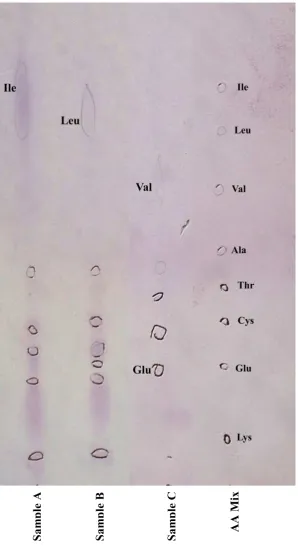
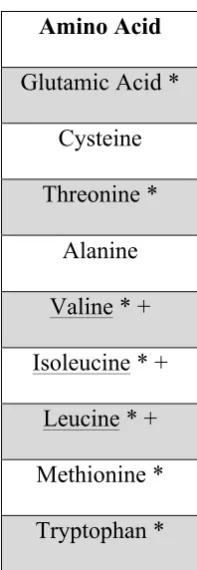
plates were done and analyzed. Table 3 shows the amino acids present in the lupin
acids (BCAAs) present in the protein isolate. The samples were too diluted;
hence, the spots were faint and asymmetrical, making quantification impossible.
Out of the nine essential amino acids, seven were found in the protein isolate
(glutamic acid, threonine, valine, isoleucine, leucine, methionine, and tryptophan).
Furthermore, all of the amino acids necessary to increase the immune system
capacity and muscle repair where also found: glutamic acid and branched-chain
amino acids.
Glutamic acid it is not directly related to the immune system, however, its
amide, glutamine plays an important role in this system’s processes. Glutamine is
synthesized from ammonia and glutamic acid through the action of the enzyme
glutamine synthetase; the major production of glutamine takes place in the
musculoskeletal system. Within the immune system, glutamine enhances T-cell
proliferation and cytokine production, which help assist and regulate the immune
response (Newsholme, P. Lima, et al., 2003). After strenuous physical exercise,
like a marathon, athletes have a decrease in glutamine levels within their bodies.
This reduction may lead to mild infections, such as a cold; therefore, experts
recommend a glutamine supplement to reduce the possibilities of infection
(Ehrlich, 2013). Moreover, in prolonged physical exercise, ammonia levels raise
in the bloodstream, which is a cause for fatigue. Exercise-induced
hyperammonemia is a problem that all athletes encounter, thus, it has been
proposed that supplementation of glutamine can reduce these levels, prevent
Furthermore, the chromatogram (Figure 1) shows the presence of BCAAs
(leucine, isoleucine, and valine). These amino acids are present in skeletal muscle
proteins (14-18%), since muscle mass in humans represents approximately 40%
of the total body weight, the consumption of BCAAs is extremely important (Y.
Shimomura et al., 2006). Even though, BCAAs are essential for all humans, they
are more important for athletes. During and after physical exercise, the human
body is exposed to constant stress and protein metabolism is altered. While
exercising, protein synthesis is decreased and protein degradation is increased.
Amino acids derived from musculoskeletal muscle can be used for
gluconeogenesis during physical activity, which leads to muscle mass loss
(Dohm, G.L., Kasperek, G.J., Tapscott, E.B., Beecher, 1980). In this muscle
tissue, BCAAs are subject to oxidation due to the activation of different enzymes
(Y. Shimomura et al., 2006).
Studies have suggested that the ingestion of BCAAs before and after exercising
can reduce muscle soreness and fatigue (Jackman, S.R., Witard, O.C.,
Jeukendrup, A.E., Tipton, 2010). Furthermore, leucine promotes protein
synthesis and inhibits protein degradation which helps protect muscle mass (Y.
Shimomura et al., 2006). The consumption of BCAAs is beneficial for athletes
since it ameliorates delayed-onset muscle soreness (Yoshiharu Shimomura et al.,
2010) and prevents muscle breakdown by reducing creatine kinase (CK) efflux
(Howatson et al., 2012), which may allow athletes to train at a higher intensity
5.3 Possible Applications of the Protein Isolate in Sport’s Food Industry
The protein, fat, and carbohydrate, ratio in the lupin protein isolate could be
used for the development of foods such as meat alternatives, protein bars, or power
bars. However, functional properties of the protein isolate should be done to
evaluate its potential in the food industry (Lusas & Riaz, 1995).
Since the lupin protein isolate contains these essential amino acids for athletes,
it could be used as a nutritional supplement. This isolate, could be used as a pre and
post-exercise food when combined with other nutritional elements. For instance, for
the protein isolate to work as pre-exercise food, it could be combined with a
stimulant such as caffeine, essential fatty acids such as chia seeds, and carbohydrate
with a low glycaemic index such as rolled oats. This combination could allow the
athlete to receive essential nutrients in order to maximize performance. (Kreider,
R.B., et al., 2009). Caffeine will cause an ergogenic effect in the athlete; this
compound affects directly the athlete’s endurance while exercising (Graham, 2001).
Chia seeds contain a high percentage of polyunsaturated fatty acids such as both
alpha-linoleic acids (omega-3 and omega-6) which are essential for human nutrition
(Peiretti & Gai, 2009). Finally, incorporating a carbohydrate with a low glycaemic
index will provide constant energy throughout the exercise (Sports Dietitians
Australia, 2009).
Furthermore, the protein isolate could also be used for development of a
post-exercise protein bar. For instance, by combining flax seeds, peanut butter, and the
omega-6 fatty acids (McGuire, M., Beerman, 2012). The lupin protein isolate will
provide a substantial amount of protein for muscle repair and it is also a
carbohydrate source to replenish glycogen stores. Athletes, usually, prefer to ingest
a high protein content meal post-exercise; hence, this low carbohydrate, high
protein combination will be appealing. Furthermore, by combining these elements,
the protein bar could deliver an appropriate post-exercise nutrition for athletes.
6.
CONCLUSIONS
The proximate analysis showed that the protein content accounted for 67.25%
of the sample. However, in order to obtain greater protein content another isolation
method should be tested since the one used in this study was adapted from a soy
protein isolation protocol. Furthermore, according to the TLC analysis almost all
essential amino acids were present in the protein isolate. Moreover, branched-chain
amino acids and glutamic acid were present in the protein sample, which makes the
isolate a possible candidate for developing nutritional supplements targeted for
athletes. Nevertheless, amino acid quantification should be done in order to obtain a
7.
ACKNOWLEDGEMENTS
I am extremely grateful with Mrt. Pablo Pozo for his receptivness, helpfulness,
and tuition throughout the whole study. I would also like to thank and acknowledge Dr.
Ramiro Gallegos for his kindness, generosity, and guidance during the analyses. Also, I
would like to acknowledge Engr. Julio Sánchez-Otero who provided statistical advices.
I am very thankful with Carlos Bautista for his support and assistance in the fulfillment
of the present research. I thank the Escuela de Ciencias Químicas (PUCE) for lending
8.
REFERENCES
AOAC. (2011a). Method 2001.11 Protein (Crude) in Animal Feed, Forage (Plant
Tissue), Grain, and Oilseed. In Official Methods of Analysis of AOAC International (18th ed., pp. 34–37). Gaithersburg: AOAC International.
AOAC. (2011b). Method 923.03 Ash of Flour. In Official Methods of Analysis of AOAC International (18th ed., p. 2). Gaithersburg.
AOAC. (2011c). Method 925.10: Solids (Total) and Loss on Drying (Moisture) in Flour. In Official Methods of Analysis of AOAC International (18th ed., p. 1). Gaithersburg.
AOAC. (2011d). Methos 2003.05 Crude Fat in Feeds, Cereal Grains, and Forages. In Official Methods of Analysis of AOAC International (18th ed., pp. 41–43). Gaithersburg.
Bermejo, J., & León, J. (1994). Neglected crops: 1492 from a different perspective. Retrieved from
http://books.google.com/books?hl=en&lr=&id=IS5E7s0mcxgC&oi=fnd&pg=PP17 &dq=NEGLECTED+CROPS+1492+from+a+different+perspective&ots=OBueqf wvbP&sig=d7DiThac5Ajo6QYTsiE-g6EK3g0
Børsheim, E., Tipton, K. D., Wolf, S. E., & Wolfe, R. R. (2002). Essential amino acids and muscle protein recovery from resistance exercise. American Journal of Physiology. Endocrinology and Metabolism, 283(4), E648–57.
doi:10.1152/ajpendo.00466.2001
Carvajal-Larenas, F. E., Van Boekel, M. J. A. S., Koziol, M., Nout, M. J. R., & Linnemann, A. R. (2014). Effect of Processing on the Diffusion of Alkaloids and Quality of Lupinus mutabilis Sweet. Journal of Food Processing and Preservation, 38(4), 1461–1471. doi:10.1111/jfpp.12105
Carvalho-Peixoto, J., Alves, R. C., & Cameron, L.-C. (2007). Glutamine and carbohydrate supplements reduce ammonemia increase during endurance field exercise. Applied Physiology, Nutrition, and Metabolism, 32(6), 1186–1190. doi:10.1139/H07-091
Dohm, G.L., Kasperek, G.J., Tapscott, E.B., Beecher, G. R. (1980). Effect of Exercise on Synthesis and Degradation of Muscle Protein. Biochemical Journal, 188, 255– 262.
Ehrlich, S. D. (2013). Glutamine. Retrieved January 1, 2015, from http://umm.edu/health/medical/altmed/supplement/glutamine
FAO. (2003b). Weighing the GMO arguments: against. Retrieved from http://www.fao.org/english/newsroom/focus/2003/gmo8.htm
Farrell, P. A., Joyner, M. J., & Caiozzo, V. . (2012). Advanced Exercise Physiology (Second Edi). Baltimore: American College of Sports Medicine.
Graham, T. E. (2001). Caffeine and exercise: metabolism, endurance and performance. Sports Medicine, 31(11), 785–807.
Haer, F. C. (1969). An Introduction to Chromatography on Impregnated Glass Fiber. Ann Arbor: Ann Arbor Science Publishers, Inc.
Horton, D. (2014). Investigación Colaborativa de Granos Andinos en Ecuador. Quito: Fundación McKnight & Instituto Nacional Autónomo de Investigaciones
Agropecuarias:
Howatson, G., Hoad, M., Goodall, S., Tallent, J., Bell, P. G., & French, D. N. (2012). Exercise-induced muscle damage is reduced in resistance-trained males by
branched chain amino acids: a randomized, double-blind, placebo controlled study. Journal of the International Society of Sports Nutrition, 9(1), 20.
doi:10.1186/1550-2783-9-20
IBM. (2012). IBM SPSS Statistics.
Jackman, S.R., Witard, O.C., Jeukendrup, A.E., Tipton, K. D. (2010). Branched-Chain Amino Acid Ingestion Can Ameliorate Soreness from Eccentric Exercise.
Medicine & Science in Sports & Exercise, 42(5), 962–970. doi:10.1249/MSS.0b013e3181c1b798
Jacobsen, S., & Mujica, A. (2006). El Tarwi (Lupinus mutabilis Sweet.) y sus parientes silvestres. In Botánica Económica de los Andes Centrales (pp. 458–482).
Retrieved from http://beisa.dk/Publications/BEISA Book pdfer/Capitulo 28.pdf
Jacobsen, S.-E., & Sherwood, S. (2002). La producción de chocho y amaranto. In Cultivo de granos andinos en Ecuador (pp. 34–36). Quito: Abya Ayala. Retrieved from
http://books.google.com.ec/books?id=s73gc3GcptcC&dq=cultivo+chocho+ecuado r&source=gbs_navlinks_s
Jaramillo Galarza, M. G. (2005). Determinación de Plomo en Chocho que se expende en la vía pública por Espectrofotometría de Absorción Atómica. Pontifcia Universidad Católica del Ecuador.
Joseph L. Staneck, G. D. R. (1974). Simplified Approach to Identification of Aerobic Actinomycetes by Thin-Layer Chromatography. Applied Microbiology, 28(2), 226–231.
Kreider, R.B., Leutholtz, B.C., Katch, F. I., Katch, V. L. (2009). Exercise & Sport Nutrition: Principles, Promises, Science & Recommendations. Fitness Technologies Press.
Lusas, E., & Riaz, M. (1995). Soy protein products: processing and use. The Journal of Nutrition, 125(3 Suppl), 573 – 580. Retrieved from
http://europepmc.org/abstract/MED/7884536
McGuire, M., Beerman, K. (2012). Nutritional Sciences: From Fundamentals to Food (3rd ed.). Cengage Learning.
Newsholme, P. Lima, M.M.R., Procopio, J., Pithon-Curi, T.C., Doi, S.Q., Bazotte, R.B. & Curi, R. (2003). Glutamine and glutamate as vital metabolites. Brazilian Journal of Medical and Biological Research, 36(2), 153–163.
Peiretti, P. G., & Gai, F. (2009). Fatty acid and nutritive quality of chia (Salvia
hispanica L.) seeds and plant during growth. Animal Feed Science and Technology, 148(2-4), 267–275. doi:10.1016/j.anifeedsci.2008.04.006
Peralta, E., N. Mazón, Á. Murillo, M. Rivera,D. Rodríguez, L. Lomas, C. M. (2012).
Manual agrícola de granos andinos: Chocho, Quinua, Amaranto y Ataco. Cultivos, variedades y costos de producción. Publicación Miscelánea, (69).
Shimomura, Y., Inaguma, A., Watanabe, S., Yamamoto, Y., Muramatsu, Y., Bajotto, G., … Mawatari, K. (2010). Branched-chain amino acid supplementation before squat exercise and delayed-onset muscle soreness. International Journal of Sport Nutrition and Exercise Metabolism, 20(3), 236–244.
Shimomura, Y., Yamamoto, Y., Bajotto, G., Sato, J., Murakami, T., Shimomura, N., … Mawatari, K. (2006). Nutraceutical effects of branched-chain amino acids on skeletal muscle. The Journal of Nutrition, (1), 529–532. Retrieved from http://www.firstendurance.com/newsletter_aminoacids.html
Sports Dietitians Australia. (2009). Fact Sheet: The Glyceamic Index and Sports Performance. Melbourne: Sports Dietitians Australia. Retrieved from
https://www.sportsdietitians.com.au/resources/upload/GI_and_sports_performance .pdf
Sun, J. ., Sun, X. ., Sun, R. ., & Su, Y. . (2004). Fractional extraction and structural characterization of sugarcane bagasse hemicelluloses. Carbohydrate Polymers, 56(2), 195–204. doi:10.1016/j.carbpol.2004.02.002
9.
FIGURES
Figure 1. Amino Acid Chromatogram
In the chromatogram, branched chain amino acids and glutamic acid are shown. Three
samples are displayed for a clearer view of the different amino acids
S
am
p
le
A
S
am
p
le
B
S
am
p
le
C
AA
M
10.
TABLES
Table 1. Proximate Composition of the Lupin Protein Isolate
Table 2. Comparison Between Lupin Protein Isolate and Commercially Available
Protein Isolates
Parameters Lupin Soy a Pea b Whey c
Protein % 67.25 ± 5.75 83.33 78.94 83.87
Fat % 5.95 ± 1.07 4.16 5.26 1.61
Carbohydrate % 18.67 2.08 5.26 9.68
a
Soy Protein Isolate, NOW® Foods, Bloomingdale, IL, USA; b Pea Protein, Growing
Naturals, Culver City, CA, USA; c 100% Natural Whey Protein Isolate Powder,
Bluebonnet, Sugar Land, TX, USA Parameters Lupin Protein Isolate
Protein % 67.25 ± 5.75
Fat % 5.95 ± 1.07
Ash % 4.12 ± 0.27
Moisture % 4.01 ± 0.29
[image:25.595.82.523.435.542.2]Table 3. Identified Amino Acids Found in the Lupin Protein Isolate
Amino Acid Glutamic Acid *
Cysteine
Threonine *
Alanine
Valine * +
Isoleucine * +
Leucine * +
Methionine *
Tryptophan *
a
Amino acids marked (*) are the essential amino acids found in the protein isolate; b
Amino acids marked (+) are branched-chain amino acids ;c Underlined amino acids are
involved in muscle repair and recovery
11.
SUPPLEMENTARY MATERIAL
Graph 1. Histogram showing the normality curve for protein analysis
Graph 2. Histogram showing the normality curve for fat analysis
Graph 3. Histogram showing the normality curve for ash analysis
Graph 4. Histogram showing the normality curve for moisture analysis
Journal of Food Chemistry and Nutrition Author Guidelines
ESci Journals Publishing provide rapid publication of research article. After 30 days
rapid review process, an accepted paper will be placed under In Press and will be
published in the next issue of the respective journal. A manuscript number will be
provided within 48 hours of the submission. Authors can check the status of their article
online using manuscript number.
Copyright
Submission of a manuscript infers that the work described has not been published
before (except in the form of an abstract or as part of a published lecture, or thesis). It is
also not under consideration for publication elsewhere.
All works published by ESci Journals Publishing is freely available to copy, distribute,
transmit and adapt the work provided the original work and source is appropriately
cited.
Article Submission
In order to reduce delays, authors should assure that the level, length and format of a
manuscript submission conform to ESci Journals requirements at the submission and
each revision stage. Submitted articles should have a summary/abstract, separate from
the main text. This summary does not include references, numbers, abbreviations or
measurements unless essential. The summary should provide an introduction to the
field; a brief account of the background and principle of the work; a statement of the
main conclusions; and 2-3 sentences that place the main findings into a general context.
Formats for ESci Journals contributions: Journals the following: original research
articles, reviews, abstracts and conference proceedings.
Cover Letter:
All submissions should be accompanied by cover letter of up to 350 words briefly
stating the significance of the research, author’s agreement for publication, number of
tables and figures, supporting manuscripts, and supplementary information.
Contact Information
Author must include current telephone and fax numbers, as well as corresponding postal
and E-mail address to maintain communication.
Article Formatting Guidelines
Manuscript title: title should be limited to 25 words or less. The title shouldn’t contain
abbreviations and it should be a brief phrase describing the contents of the manuscript.
Author Information
Full names and affiliation of all authors, including contact details of corresponding
author (Telephone, Fax and E-mail address).
Abstract
Informative, complete and self-explanatory abstract should briefly present the topic and
state the scope of the experiments, indicating significant data. It should point out major
than 300 words. Standard nomenclature should be used and abbreviations should be
avoided in abstracts. The preferable format should accommodate a description of the
study background, methods, results and conclusion.
Keywords
Following the abstract, a list of 3-10 keywords and abbreviations should be included.
Introduction
The introduction should set the nature of the paper by providing a vibrant study
statement. I should include the relevant literature on the study subject and the proposed
approach or solution. The introduction should be general enough to attract a reader’s
attention from a broad range of scientific disciplines.
Materials and Methods
This section should provide a complete overview of the study design. Comprehensive
descriptions of materials or participants, comparisons, interventions and types of
analysis should be mentioned. Previously published procedures should be cited and the
new procedures should be described in detail. Important modifications of published
procedures should be mentioned briefly. Capitalize trade names and include the
manufacturer's name and address also if available.
Results and Discussion
This section should provide complete details of the experiment that are required to
separate section. Speculation and detailed explanation of data should not be included in
the Results but should be put into the Discussion section.
Acknowledgement
This section includes salutation of people, grant and fund details etc.
References
The author should go to the primary source of information. The secondary source of
information may be used in case of unavoidable circumstances or when the original
article is in a language other than English. Only published work or accepted
manuscripts should be included in the reference list. Abstracts, conference proceedings,
or papers that have been submitted but not yet accepted should not be cited. Authors
should provide online link for each reference.
The references should be written in the following format.
Published Papers
Gondal, A.S. 2012. Effect of organic amendments on nematode galling index and egg
mass production in potato inoculated with root knot nematode. Pak. J. Phytopathol. 24:
01-05.
Gondal, A.S. 2012. Stimulated activity of natural enemies of nematodes. Nature 233:
210-217.
Kelley, J. D., J.R. Stavely and P.N. Miklas. 1996. Proposed symbols for rust resistance
genes. Annu. Rep. Bean Improv. Coop. 39: 25-31.
Brown, P.D. and M.J Morra. 1997. Control of soil-home plant pests using
glucosinolate-containing plants. Adv. Agron. 61: 167-231.
Edwards, A.C. and M.S. Cresser. 1992. Freezing and its effect on chemical and
biological properties of the soil. Adv. Soil Sci. 18: 59-79.
Magazine Article
Mulvaney, D.L. and L. Paul. 1984. Rotating Crops and Tillage. Crops Soils. 36: 18-19.
Books
Brown, J. 1996. Soils of the Okpilak River reigon, Alaska. CRREL Res. Rep. 188. U.S.
Army Cold Reg. Res. Eng. Lab, Hanover, NH, USA.
Chemical Abstracts Service. 1989. Chemical Abstracts Service Source index:
1907-1984 cumulative, plus annual supplements. Chem. Abstr. Serv., Columbus, OH, USA.
Workshop / Symposium or Conference Proceedings
Holmes, J.W. (ed.). 1968. Trans. Int. Congr. Soil Sci., Adelaide. Elsevir, New York,
NY, USA.
McGarry, D. 1992. Final report of management training workshop, Dalby. 3-4 July,
1991. Conf. and Workshop. Ser. QC92008. Dept. Primary Industries, Brisbane, QLD,
Australia.
Dissertation or Thesis
Pyle, M.E. 1982. A comparison of determinate and indeterminate soybean lines for
double cropping in Virginia. Ph.D. diss., Virginia Polytechnic Inst. & State Univ.,
Software and Software Documentation
Abacus Concepts. 1991. Super ANOVA users guide. Release 1.11 . Abacus Concepts,
Barkeley, CA, USA.
SAS Institute. 1994. The SAS system for Windows. Release 6.10. SAS. Inst., Gary, NC,
USA.
CD-ROM
Moore, K. and M. Collins (eds.). 1997. Forages, CD-ROM companion [CD-ROM
computer file]. 5 th Ed. Iowa State Univ. Press. Ames, IA, USA.
Tables
Tables used in manuscripts should be designed properly. They should be typed
single-spaced throughout, including headings and footnotes. Each table should be on a separate
page, numbered consecutively and supplied with a heading and a legend. Tables should
be self-explanatory. Details of the methods used in the experiments should be described
in the legend instead of in the text. The same data should not be presented in both table
and graph form or repeated in the text. MS Excel files should not be embedded as
objects. If the submission is in PDF format, the author is requested to retain a copy in
.doc format also to aid in completion of process successfully.
Figures
The preferred file formats for photographic images are .doc and JPEG. If you have
Photoshop files. All images must be at optimal resolutions. Image files must be cropped
as close to the actual image as possible.
Numerals
Arabic numerals must be used to label the figures and upper case letters for their parts
(Figure 1). Each legend must contain title and include sufficient description so that the
figure is understandable without reading the text. Information given in legends should
not be repeated in the text.
Equations
If equations cannot be encoded in MathML, submit them in TIFF or EPS format as
discrete files. Each file should contain data for only one equation.
Additional Information
Discrete items of the Supplementary Information should be submitted in a new file and
must be explained properly.
e-Prints
Electronic prints (PDF) will be sent as an e-mail attachment to the corresponding
author. They are considered to be the final version of the manuscript. With the
exception of typographical or some clerical errors, no changes will be made in the
manuscript afterwards. Authors will have free electronic access to the full text article.
Authors can freely download the PDF file from which they can print unlimited copies of
ESci Journals Publication Fee
ESci Journals are self-supporting journals and do not receive any funding from any
institution/government. The operation of the Journal is only financed by the handling
fees received from authors and some academic / corporate sponsors and paid members.
The handling fees are required to meet maintenance of ESci Journals. Being Open
Access Journals, all articles are freely accessible over the internet. There are no
submission charges however; authors of articles are required to pay a fair handling fee
for processing their articles. Authors are required to make payment only after their
manuscript has been accepted for publication.