Assessment of
World Wetlands Day
Final Report
Meg Gawler
January 2009
Acknowledgements
We owe a great deal to the Ramsar Secretariat for this study. Sandra Hails especially provided
guidance, encouragement and help on every aspect. Nick Davidson contributed a strategic perspective, and Mila Llorens helped with the Spanish translations.
We are extremely grateful to the 155 World Wetlands Day actors from all over the world who took time out of their busy schedules to provide us with their invaluable feedback through the web survey (see list of individuals in Annex 4).
Contents
Acknowledgements ... i
Executive Summary ... iii
Acronyms ... v
1. Context, Purpose and Objectives of the Assessment ... 1
1.1 Context ... 1
1.2 Purpose ... 1
1.3 Objectives ... 2
2. Methodology and Limitations ... 2
2.1 Initial Analysis ... 3
2.2 Web Survey ... 4
3. Findings - Initial Analysis... 7
4. Web Survey Findings ... 20
4.1 Usefulness of the Secretariat Materials... 20
4.2 Reaction to making WWD Materials Available Only through the Internet ... 21
4.3 Other Useful Types of WWD Materials ... 21
4.4 Relevance of WWD Slogans ... 23
4.5 Identification of Target Groups ... 24
4.6 Assessing Impact ... 24
4.7 Diversifying Target Groups and Specific Activities ... 27
4.8 How the Secretariat could Strengthen the Impact of WWD ... 28
4.9 Importance of Posting WWD Reports on the Ramsar Website... 31
5. Conclusions ... 32
5.1 Effectiveness of the Secretariat ... 32
5.2 Diversity of WWD Targets, Actors and Activities ... 32
5.3 Reaching Out to a Broader Range of Actors and Targets ... 33
6. Recommendations ... 33
6.1 Recommendations for the WWD Actors ... 33
6.2 Recommendations for the Ramsar Secretariat ... 35
Annexes ... 37
Annex 1. Assessment Matrix ... 37
Annex 2. Database Design for Initial Analysis ... 38
Annex 3. Web Survey ... 39
Annex 4. Survey Participants by Country ... 46
Annex 5. Distribution of Survey Respondents by Country ... 52
Annex 6. Length of Involvement of Survey Respondents in Planning WWD Activities ... 53
List of Figures
Figure 1. Number of WWD Reports per Year... 3
Figure 2. Regional Distribution of Web Survey Respondents ... 5
Figure 3. Types of Organisations where Web Survey Respondents Work ... 6
Figure 4. How Respondents Found out about WWD ... 7
Figure 5. Percentage of Specific Actors in each Actor Group ... 9
Figure 6. Number of Specific WWD Actors by Region ... 10
Figure 7. Percent WWD for Different Target Groups ... 12
Figure 9. Number of Activities with Specific Targets by Region... 13
Figure 8. Target Diversity by Region ... 13
Figure 10. Most Popular Types of WWD Activities by Region ... 18
Figure 11. Most Popular Types of WWD Activities by Region ... 18
Figure 12. Diversity of WWD Activities in France ... 19
Figure 13. Diversity of WWD Activities in India ... 19
Figure 14. Comparative Usefulness of the Secretariat Materials ... 20
Figure 15. Feedback on Usefulness of the Secretariat Materials ... 20
Figure 16. Reaction to Making WWD Materials Available only through the Internet ... 21
Figure 17. Other Types of Materials that would be Useful for WWD Events ... 22
Figure 18. Relevance of WWD Slogans ... 24
Figure 19. Types of Indicators Used for Measuring Impact of WWD ... 25
Figure 20. Types of Methodologies Used to Assess Impact of WWD ... 26
Figure 21. What could the Ramsar Secretariat Do to Strengthen the Impact of WWD? ... 29
Figure 22. Importance to WWD Actors of Posting WWD Reports on the Ramsar Website ... 31
List of Tables Table 1. WWD Actor Groups ... 8
Table 2. Regional Distribution of WWD Actors... 9
Table 3. Target Groups ... 10
Executive Summary
Purpose
This assessment focuses on the relevance and effectiveness World Wetland Day (WWD) activities from 2003 to 2007. This review of WWD assesses: the effectiveness of the Secretariat in identifying themes and in preparing and disseminating appropriate materials; the diversity of WWD actors and their targets; the needs and expectations of WWD actors; and the potential for further development of WWD to reach out effectively to a broader range of actors and targets.
Methodology
The assessment is based on two exercises: an initial analysis of the extensive database of World Wetlands Day reports available on the website of the Ramsar Convention, and a web survey of some of the key actors carrying out WWD activities. The initial analysis was meant to answer three
questions: 1) Who are the WWD actors? 2) Who are the key targets of the actors? 3) What are the key activities at WWD events? The initial analysis involved analysing all the reports posted on the Ramsar website from 2003 to 2007 inclusive – a total of 1,304 reports, from 125 countries and 14 multi-country groups, were studied and analysed, yielding a database with over 33,000 cells. The web survey (in English, French and Spanish) targeted those people with the most first-hand knowledge of World Wetlands Day. The response to the survey was robust and diverse: 155 WWD actors from all over the world answered the survey. The response rate was phenomenal, clearly demonstrating the genuine enthusiasm of the Ramsar Convention‟s partners for World Wetlands Day.
Findings – Initial Analysis
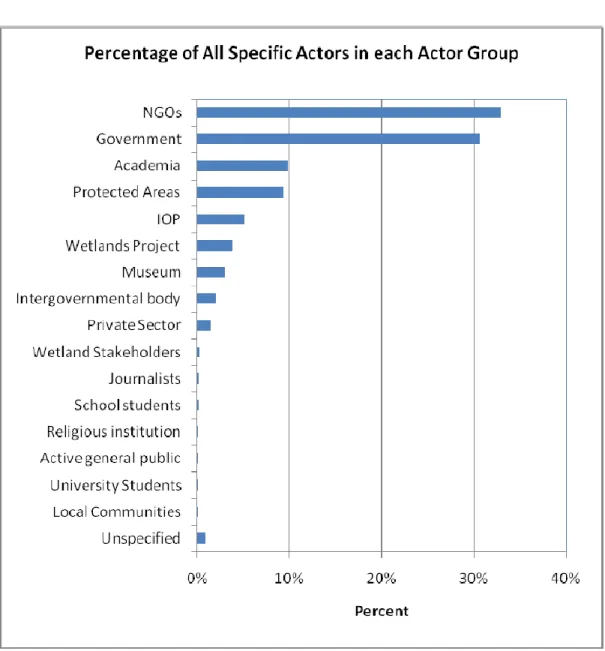
During the five-year period of study, a total of 904 specific actors, categorised into 15 major types of actor groups, carried out World Wetlands Day activities. Surprisingly, in France alone, the number of WWD actors exceeded that of all other regions in the world, with the exception of the rest of Europe.
The initial analysis yielded an astonishing richness of WWD activities. The most popular types of WWD activities were: educational activities, site visits, conferences and workshops, distribution of communications materials, and creative or performance activities.
Probably the single most telling result of the initial analysis is overall reliance on just a few target groups. Of all the WWD activities carried out during these five years, 9% did not define a target group, and 65% aimed at the active general public (interested people and visitors), children, the passive general public (TV viewers, radio listeners, “civil society”), and local communities.
Findings – Web Survey
Actors. For slightly more than half the respondents, if the Secretariat made WWD materials available only on the internet (rather than mailing out hard copies), this would have no effect on the likelihood of their organising a WWD event. Survey respondents contributed suggestions of other types of materials that would be useful for WWD events, particularly videos, hard copy materials, banners and photographs, information and documents related to the WWD theme, etc.
Respondents‟ overall ratings for all of the different WWD slogans for the last five years ranged from relevant to very relevant, with the theme “Healthy Wetlands, Healthy People” given the highest rating, and the theme “In the face of poverty… wetlands are lifelines” to be the least useful.
The web survey revealed contradictions with the initial analysis with respect to the identification of target groups for WWD: 82% of respondents claimed to identify target groups for their WWD
activities; however, in the WWD reports online, these target groups are either vague or not mentioned at all. A number of interesting suggestions emerged from the survey on how to best diversify target groups in order to strengthen the impact of WWD, for example: preparing a clear communications strategy for WWD; improving selection criteria for target groups and designing different materials for different groups; assessing the demographics of a specific community and then designing a
programme to reach the various community groups; involving decision-makers; liaising more strongly with the media; combining WWD with cultural events that would bring in new audiences.
Survey respondents use the following types of indicators for measuring the impact of WWD: number of activities; changes in behaviour / practices; number of follow-up activities; reactions of target groups; changes in awareness, etc. When assessments of WWD were made, written feedback (questionnaires, feedback forms, etc.) was by far the most common methodology used.
Survey participants made a large number of very useful and creative suggestions on how the Secretariat could enhance the impact of World Wetlands Day.
There was strong agreement among most of the survey respondents about the importance to them of having their reports posted on the Ramsar website. However, it should be noted that the survey was sent to the most active WWD actors – those who do produce reports.
Overall, the web survey demonstrated the effectiveness of the Secretariat in meeting the needs and expectations of WWD Actors.
Recommendations
Acronyms
ASLO Advancing the Science of Limnology and Oceanography CBD Convention on Biological Diversity
CBO Community Based Organisation
CEPA Communication, Education, Participation and public Awareness
Comms Communications
COP Conference of the Parties
EC European Commission
GEF Global Environment Facility
gov government
IOP International Organisational Partner
IUCN The World Conservation Union
IWMI International Water Management Institute KAP Knowledge, Attitudes, Practice
NABS North American Benthological Society
NGO Non-Governmental Organisation
PA Protected Area
PRA Participatory Rural Appraisal SIL International Society of Limnology UNDP United Nations Development Programme
WWD World Wetlands Day
Assessment of World Wetlands Day
1. Context, Purpose and Objectives of the Assessment
1.1 Context
February 2nd each year is World Wetlands Day (WWD), marking the date of the adoption of the Convention on Wetlands on 2 February 1971, in the Iranian city of Ramsar. Each year since 1997, government agencies, non-governmental organisations, and groups of citizens at all levels have taken advantage of the opportunity provided by World Wetlands Day to undertake actions aimed at raising public awareness of wetland values and benefits in general, and the Ramsar Convention in particular.
The decision to recognise this day as World Wetlands Day was taken by Standing Committee‟s 19th meeting in 1996; in recent years, the Committee has endorsed the theme for each year. Since its inception the materials produced by the Secretariat for WWD have been funded through the Danone/Evian Fund for Water: there has never been any core budget allocation for this activity.
In the Annex to Resolution X.8, the Convention‟s Programme on Communication, Education, Participation and public Awareness encouraged the Parties, the Secretariat, Ramsar‟s International Organisational Partners (IOPs) and other collaborators to celebrate World Wetlands Day with appropriate national and local events and promotions and the distribution of resource materials, in order to raise awareness of wetland values and functions.
Almost since its inception the Secretariat has played the key role in identifying and proposing a theme, in preparing and disseminating materials to assist Parties and others in launching their own campaign for WWD, and in compiling on the Convention‟s web site the WWD activity reports sent in by WWD actors (http://www.ramsar.org/wwd/wwd_index.htm).
1.2 Purpose
Since its early beginnings, WWD has grown to be a key point of focus for the Convention each year, the only point in the year that unites the whole extended Ramsar family. In response to the evident enthusiasm by the Ramsar family over the years, the Secretariat staff have invested progressively more time in terms of performing its identified role. After 11 years of this investment of time and resources by both the Secretariat and the WWD actors, it is appropriate to have an objective assessment of WWD and its overall impact for three key reasons:
Convention work, it becomes essential to assess the value to WWD actors of the materials produced and to assess their needs and expectations in order to assist the Secretariat, Standing Committee, and the COP in making decisions on the future of WWD and the support for it from the Convention.
2. A quantitative and qualitative assessment would allow the Secretariat to identify any gaps in their contact list of WWD actors and their target groups and activities, and assist in the expansion of the sphere of influence of WWD, if the latter is identified as appropriate.
3. An assessment after 11 years of operation would allow the Secretariat to demonstrate and publicise the growing success and outcomes of WWD as the campaign day in the year for the Ramsar family at the local, national and global level to recognise the value of wetlands, draw attention to wetland issues, and stimulate action for wetland wise use.
1.3 Objectives
This assessment focuses on the relevance and effectiveness WWD activities from 2003 to 2007. In line with its purpose, this review assesses:
the efficiency and effectiveness of the Secretariat in identifying themes, preparing and disseminating appropriate materials, and reporting on WWD activities, within the limitations of the current budget from the Danone/Evian Fund which is the sole source of funding.
the diversity of WWD actors and their targets, and, if possible, the apparent impact of their WWD actions.
the needs and expectations of WWD actors in terms of WWD materials from the Secretariat.
in the light of the above, the need and potential for further development of WWD to reach out effectively to a broader range of WWD actors and targets on key wetland issues, and to assess the financial implications of this.
2. Methodology and Limitations
The assessment is based on two exercises: an initial analysis of the extensive database of World Wetlands Day reports available on the website of the Ramsar Convention on Wetlands, at
http://www.ramsar.org/wwd/wwd_index.htm, and a web survey in English, French and Spanish of those carrying out WWD activities (WWD actors). The design of the overall assessment is
summarised in the Assessment Matrix in Annex 1.
2.1 Initial Analysis
The initial analysis was an enormous task – far bigger than anticipated. It involved analysing all the reports posted on the Ramsar website from 2003 to 2007 inclusive. For this five-year period, a total of 1,304 reports, from 125 countries and 14 multi-country groups, were studied and analysed. As
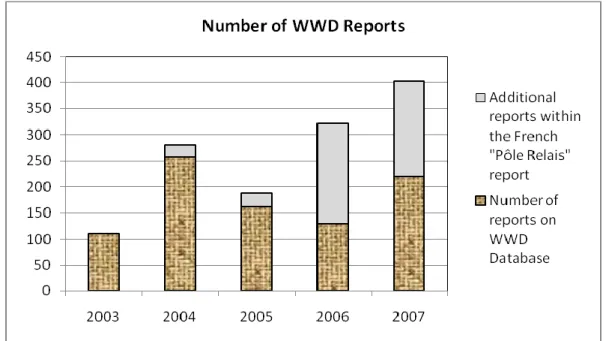
illustrated in the graph below, there were 878 reports on the website; however from 2004 to 2007, the French national protected area system submitted a total of 426 reports from all over the country within a single report “Pôle Relais” report. Thus in 2006, for example, France provided more reports than all other countries in Europe combined!
To create a WWD database (using Excel) each report was analysed, and the results were recorded in the following analysis columns: report number, year, country, region, specific WWD actor, actor group code, specific targets, target group code, specific activities, activity group code, and comments including locations of WWD events. The structure of the database for the initial analysis is illustrated in Annex 2. With 11 columns and 3,012 rows of data, the database contains over 33,000 cells, which were sorted according to different criteria, in order to synthesise the findings of the initial analysis.
The classification of the specific actors, targets and activities into group codes was done very systematically, but inevitably some specific elements of a WWD event were difficult to classify, or overlap was sometimes a problem. These limitations were minimised by triple-checking the entire database once it was completed to ensure consistency of the group codes. The tables of actor groups, target groups and activity groups in the following section on the results of the initial analysis provide documentation of exactly how the specific elements of each WWD event were categorised.
For the sake of creating a manageable data set, for each WWD event, only one actor group was assigned, even though WWD events are often carried out by several specific actors in collaboration.
In the case of collaborations, the principal specific actor was listed; this was often the actor who had prepared and submitted the WWD report.
Thus every WWD event has one main actor. However, if the event included more than one activity group, additional rows were added in to capture the wealth of all the different types of activities.
Regrettably, in many cases the WWD reports do not specify the specific, or even general, targets for the WWD events. However, where multiple, target groups are given in the report, the richness of the targets was captured by adding extra rows, as needed, for the different targets of each different activity. Thus, a report with only one activity and one (or no) target required only one row on the database. On the other hand, when a report described several activities and targets, then extra rows were added to the database for that report. For example a WWD event that included three different activity groups and two target groups for each activity would have six lines in the database for that report.
When no information was given on the target – which was often the case – the researcher, in filling in the database, would sometimes assign a general target, making an educated guess – as long as this was possible to do systematically. For example all activities involving television shows, radio shows and newspapers were considered to target the “passive general public”. In addition another grouping was created for “active general public”, and was assigned when the activity was a site visit, a site
improvement by volunteers, a visit to a museum or exhibit, participation in a conference, visitors to a church, etc. The “active general public” came and participated of their own accord.
The output of the initial analysis is presented in a series of qualitative tables and quantitative graphs in Section 3.
2.2 Web Survey
Survey Design
The respondents targeted for the web survey were those people with the most first-hand knowledge of World Wetlands Day all over the world: the WWD actors from the Secretariat‟s database. Thus the sample population is biased towards those WWD actors who do submit reports – by definition we did not have contact information for those who may carry out WWD activities, but who do not inform the Secretariat.
The survey was then designed by the consultant online using SurveyMonkey, and piloted with two helpful WWD actors, to ensure its user-friendliness.
Despite the piloting, however, there was one qualitative question that was not well formulated, and thus not sufficiently clear to some respondents: Question 9 - How do you assess the impact of your WWD activities on the target groups? We were looking for indicators and methodologies for assessing impacts, whereas some respondents interpreted the question as asking what their assessment was in terms of impact.
When the survey was ready online, the Secretariat sent out email invitations with the link to the survey to 335 WWD actors all over the world; of these, 30 emails bounced. Thus we estimate that 305 WWD actors received the invitation to participate in the survey; 155 completed the survey, resulting in a response rate of 51%. Web survey response rates depend primarily on respondent interest and instrument design. According to the 2008 archives of the listserv of the American Evaluation Association, web survey response rates usually range from less than 5% (poor) to over 20%
(excellent). Thus the 51% response rate for the present survey can be considered phenomenal, and it clearly demonstrates the genuine enthusiasm of the Ramsar Convention‟s partners for World Wetlands Day. The individuals who kindly responded to the survey, contributing their time, feedback and ideas are listed in Annex 4.
Respondent Population
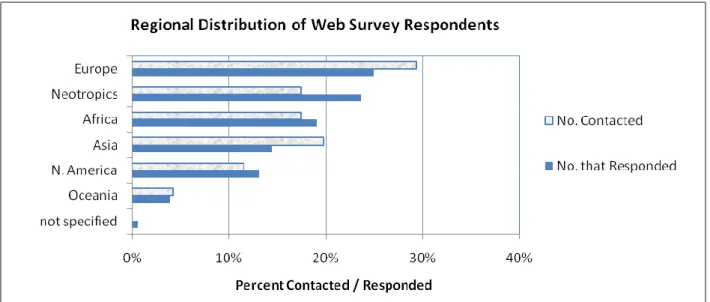
Respondents came from 60 different countries worldwide. The distribution by country of the survey respondents is given in Annex 5, and the distribution by region is shown in Figure 2. The regional distribution of responses was not dissimilar from the regional distribution of WWD actors contacted.
In addition, the population of the survey respondents was – as hoped – highly diverse, contributing greatly to the representativeness of the respondents and thus the credibility of the results. Of the surveys completed, 85% of the respondents preferred English, 28% preferred Spanish, and 15% French. Of the 155 surveys received, 152 respondents answered the respondent identification question: 151 indicated their region, and 149 specified their country.
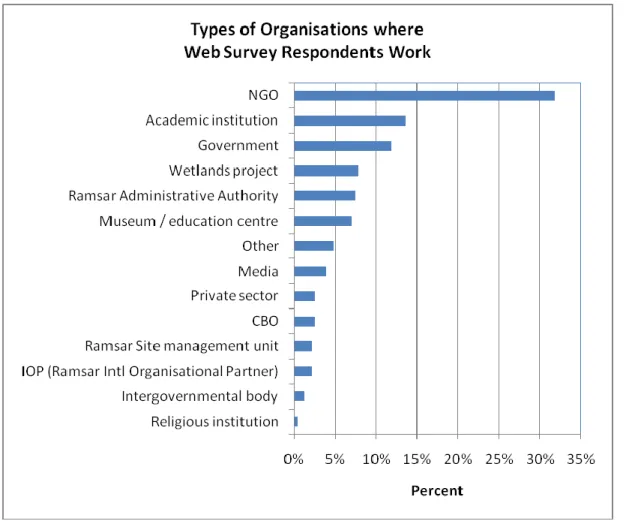
The survey population was also diverse in the types of organisations that the respondents worked for (see graph below). By far, the largest numbers of survey respondents came from NGOs.
We also learned from the survey how many years the respondents had been involved in organising WWD events. Fully 41% of the survey respondents had been involved in planning World Wetlands Day activities for over four years – by far the largest category (see results in Annex 6). This again points to the respondents‟ strong interest in WWD.
Finally, we learned a bit more about our respondent population by asking them how they found out about World Wetlands Day:
3. Findings - Initial Analysis
The initial analysis was meant to answer three questions: 1. Who are the WWD actors?
2. Who are the key targets of the actors? 3. What are the key activities at WWD events?
Actors
The table below presents the 15 major types of WWD actor groups, and gives examples of the types of actors in each group.
Table 1. WWD Actor Groups
Actor Group Examples of Actors
Academia institute university research centre field research centre
library school "pôle relais" scientists
Children 0-18 years school students
Government national federal regional state
provincial municipal local
Intergovernmental intergovernmental body
international convention
Volunteers volunteers
IOP Wetlands Intl. WWF BirdLife Intl. IUCN
IWMI
Journalists journalists press newspapers media
Museums museum environmental education centre
nature centre wetlands centre
marine ecology centre
aquarium botanical garden information centre
NGOs NGOs CBOs local development group
conservation committees
trusts foundations
Protected Areas PA administration Ramsar sites parks reserves
Religious religious institutions churches temples
TV television
Univ. Students university students college students
Wetlands Project wetlands project
Wetland Stakeholders
stakeholders hunters' federations
Unspecified
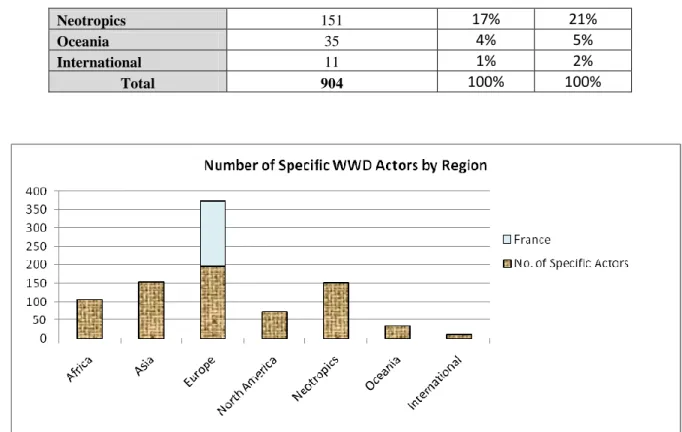
The table and graph below show the differences between regions. Surprisingly, in France alone, the number of WWD actors exceeded that of all other regions in the world, with the exception of the rest of Europe.
Table 2. Regional Distribution of WWD Actors
Region
No Specific WWD Actors 2003-2007
Percentage of Total
Percentage without
France
Africa 106 12% 15%
Asia 153 17% 21%
Rest of Europe + France 197 + 178 = 375 41% 27%
North America 73 8% 10%
Neotropics 151 17% 21%
Oceania 35 4% 5%
International 11 1% 2%
Total 904 100% 100%
Targets
Every serious communications plan begins with the identification of the issue to be solved, and then a study of potential target audiences. Ideally target audiences are not only identified, but are also prioritised, and then selected on the basis of which targets will have the most impact in achieving the communications objectives of a given campaign like WWD. In principle, once the key target
audiences have been identified, then a communications strategy is developed, together with means and messages carefully designed to reach those specific targets. The results of the initial analysis were quite revealing with respect to the identification of target audiences.
The analysis showed that – when targets are identified – WWD actors gear their activities to nine major target groups, given in the table below, in order of how many activities have been targeted to these groups worldwide.
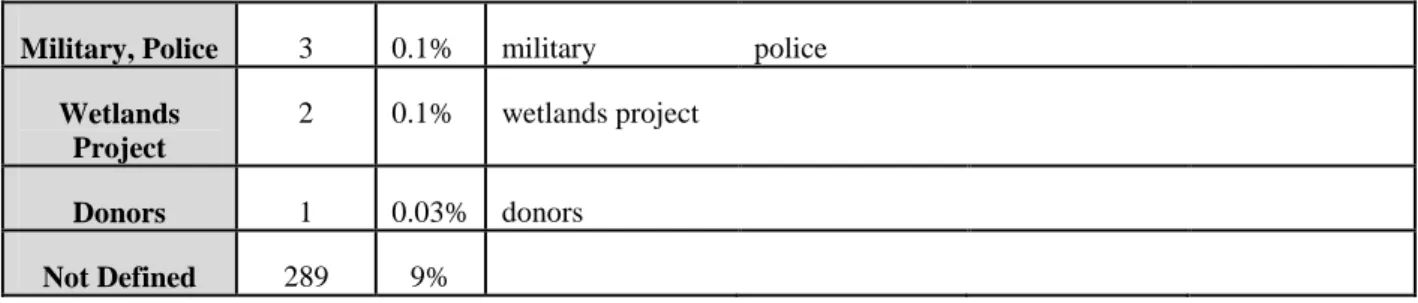
Table 3. Target Groups
Target Group N
o
Activities % Examples of Targets
Active General Public
1,138 34% interested people and organisations
visitors to parks and museums
volunteers visitors to churches
Children 631 19% pre-school primary school secondary school
youth groups
Local Communities
202 6% indigenous peoples community members women's self help groups ethnic minorities
rural people rural workers
Passive General Public
187 6% “general public” TV viewers, radio listeners
newspaper readers
“civil society”
Government 173 5% national federal regional State
provincial municipal local
heritage and environment officers water management authorities
Media 143 4% journalists press radio stations Media
NGOs 138 4% NGOs CBOs cooperatives
Univ. Students 94 3% university students
college students
Teachers 82 2% teachers school boards
Wetland Stakeholders
72 2% stakeholders water users fisherfolk, artisanal fishers
hunters, hunters' federations
pastoralists farmers, agricultural workers
landowners water guides, river guides wetland managers wetlands protectors employees
Academia 62 2% university faculty professors wetland experts Ornithologists
scientists
Private Sector 39 1% businesses companies unions
Intergovernme ntal
18 0.5% intergovernmental organisations and institutions
EC UNDP GEF
Decision Makers
15 0.5% decision makers opinion makers village chiefs
Protected Areas
15 0.5% PA administration park
administrators
park educators
Religious 7 0.2% religious institutions
churches monks spiritual groups
religious community centres
church NGOs
IOP 6 0.2% Wetlands Intl. WWF BirdLife Intl IUCN
Military, Police 3 0.1% military police
Wetlands Project
2 0.1% wetlands project
Donors 1 0.03% donors
Not Defined 289 9%
Probably the single most telling result of the initial analysis is that 49% of all WWD activities were in fact targeted at the active general public, the passive general public or the targets were not defined.
The figure below well illustrates both the diversity of WWD targets worldwide, and also the heavy concentration on the easiest ones to reach: the active general public and children.
As shown in the figures below there were differences between regions with respect to both the diversity of WWD targets, and the number of WWD activities with specific targets. The regions most rigorous in defining target groups for their activities were Asia and Europe.
Figure 9. Number of Activities with Specific Targets by Region
Activities
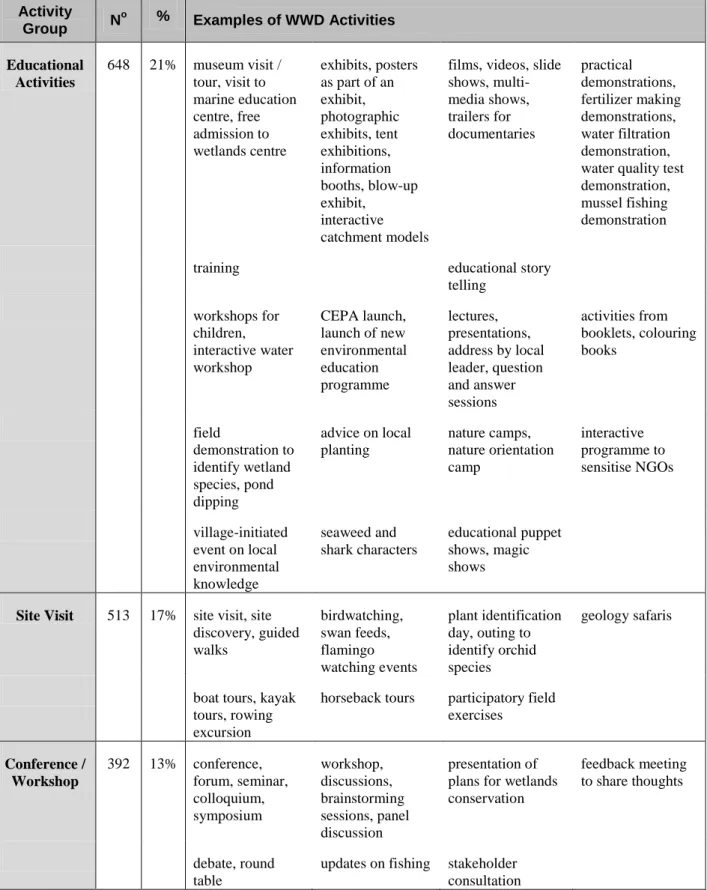
The initial analysis set out to determine what the key activities are at WWD events, and categorised the specific activities into 23 different activity groups. This yielded an astonishing richness of WWD activities, as shown in the two tables below in the most frequent types of activities, and other
interesting types of activities used less often. The most popular types of WWD activities were:
educational activities, site visits, conferences and workshops, distribution of communications materials, and creative or performance activities.
Table 4. Activity Groups
Activity Group N
o %
Examples of WWD Activities
Educational Activities
648 21% museum visit / tour, visit to marine education centre, free admission to wetlands centre
exhibits, posters as part of an exhibit, photographic exhibits, tent exhibitions, information booths, blow-up exhibit, interactive catchment models
films, videos, slide shows, multi-media shows, trailers for documentaries practical demonstrations, fertilizer making demonstrations, water filtration demonstration, water quality test demonstration, mussel fishing demonstration
training educational story telling workshops for children, interactive water workshop CEPA launch, launch of new environmental education programme
lectures, presentations, address by local leader, question and answer sessions activities from booklets, colouring books field demonstration to identify wetland species, pond dipping
advice on local planting nature camps, nature orientation camp interactive programme to sensitise NGOs village-initiated event on local environmental knowledge seaweed and shark characters educational puppet shows, magic shows
Site Visit 513 17% site visit, site discovery, guided walks birdwatching, swan feeds, flamingo watching events plant identification day, outing to identify orchid species
geology safaris
boat tours, kayak tours, rowing excursion
horseback tours participatory field exercises
Conference / Workshop
392 13% conference, forum, seminar, colloquium, symposium workshop, discussions, brainstorming sessions, panel discussion presentation of plans for wetlands conservation
feedback meeting to share thoughts
debate, round table
Communi-cations
321 10% distribution of Ramsar materials information campaigns, launch of Wetlands Status Report launch of communication strategy
website launch / publication / update, blogs
booklets, leaflets, brochures
stickers CD, interactive CD newspapers, magazines banners / streamers for roadside or buildings articles, op-ed article, postcards, greeting card calendars story telling contest / performance exchange of cooking recipes with wetland ingredients face painting resource books, book launch special message from the Ramsar Secretary General
statement issued by CBD Executive Secretary
construction of giant heron costume that held sign reading "You will not die if you don't eat a natural bird"
comics, mini-comics
colouring books bulletin boards
T-shirts blankets publicity
Creativity / Performance
214 7% art, drawings, origami, poster-making, contest to illustrate "what's in water", bird outlines where children made feathers out of coloured paper, wetland -themed brass rubbing, colouring sheets drama, theatre, skits, comedy performance, street play, theatrical thematic performance, puppet making essays, poetry, slogan writing, slogan writing contest crafts, nature crafts, basket weaving.), design of blankets, costume show representing birds, making wetland scenes from paper plates,
jewellery design
dance, ballet photography music, songs, folk songs sand sculpture contest, scale modelling, paper maché classes design competition for eco-tourism site wetland wildlife masks Guruguru Art--writing thank you messages to the wetlands on cloth which then reveals swan picture (Japan)
Site Designation
168 5% site designation, site launch
work to gain site designation
publication of proposed Ramsar site boundaries for consultation
Celebration 146 5% festivals, jamborees, fairs, bird festivals, children‟s water festivals, film festivals, wetland fun fair, fair of local products
building launch project launch management initiative launch
recitals field station launch / opening
billboard / garden inauguration opening ceremony, official ceremony, commemorative plaque parade, procession, rally around the village chanting conservation slogans, rally around lake displaying banners, "March for Fish" reception, meal, barbeque, oyster tasting, wetland themed food in restaurants, wine tasting, evening wine reception, cocktail party donation of equipment recognising traditional fishing culture
dawn ceremony valedictory function
bonfires celebration of cultural diversity
Site Improvement
145 5% site improvement, wetland rehabilitation, habitat protection, nature restoration project tree planting, mangrove planting, reforestation, reforestation with native seedlings, plant-a-thon, planting of commemorative trees improvement of water sources, river re-engineering exotic weed removal, invasive species cleanup
sod turning adopt-a-wetland programme
release of turtles waste collection, clean up
creation of bog garden
fence repair, re-sowing and irrigation of live barriers
installation of amphibian passage
Games, Sports
108 3% Ramsar games treasure hunts, scavenger hunts, wetland treasure chest game
rope pulling, tug of war,
blind walking, sac hopping
competition to guess the food miles of a shopping basket
smart games water pollution games
Who Am I? game Migration Game
frog games kite-flying contests
word searches interactive games
wildlife Pictionary
role playing surfing lessons canoe
boat races / rallies, wind-surfing regattas, rafting races swimming cycle rallies, bicycle race, marathons, nature hike race, "Pedestrian competition", walking race, running race orientation and spelunking fishing, fishing contests, fishing racing games
volleyball game / tournament, baseball game
Press Release
98 3% press conference press release
Awareness Raising
62 2% awareness raising (general) address by government official announcement by government speeches, keynote address stakeholder consultation selling wetlands themed jewellery bracelet campaigns / launch blood donations Radio Programme
55 2% radio programme
Competition (other,
non-sport)
51 2% quiz,
science contests, treasure hunt quiz, peatland knowledge contest beauty contest, Miss Wetlands Contest, Queen of the Wetlands pageant
mangrove race: searching for clues in a mangrove forest
cooking contest using ingredients from the wetland, competition of traditional foods from wetlands debate competition bird-watching race crossword competition fisheries quiz circulated in local newspapers
TV 47 2% television programmes
Awards 26 1% awards presentation of credentials
Agreement Signing
20 1% agreement signing
Wetland Research
20 1%
wetland research bird counting biodiversity monitoring species identification Address to Government / private sector 17 1% petition for Ramsar designation rally/protest against private sector rally/protest against government protest of destruction of wetlands Children's Parliament presents draft legislation to the European Parliament on water management
political rally speeches/pleas to government
memorandum
post card writing campaign
Launch adoption launch the Ramsar Convention
Religious Service
13 0.4 %
religious service traditional ceremony
pilgrimage, ritual walk, Parikrama circumambulation
religious blessing by Buddhist monks
Postage Stamp Issued
5 0.2 %
postage stamp issued
official pre-stamped envelopes with wetland visuals
Fundraising 1 0.03 %
fundraising
Grants 1 0.03 %
offer of grants requests for proposals
The figure below traces the frequency of the most popular WWD activities, broken down by region.
The most active countries within each region over this 5-year period were:
Europe France 386 activities
Asia India 216 activities
North America Mexico 92 activities
Africa Kenya 86 activities
Neotropics Peru 81 activities
Oceania Australia 55 activities
Using the two most active countries, France and India, as case studies, it is interesting to compare the diversity of their activities in WWD events, as shown in the figures below. France, with a total of 386 activities distributed over 14 activity groups, concentrated heavily on site visits, educational activities and conferences /workshops. India, on the other hand, carried out 216 activities, but these were spread out over 19 different activity categories, with more diversity in the most popular types of activities selected.
Figure 12. Diversity of WWD Activities in France
4. Web Survey Findings
4.1 Usefulness of the Secretariat Materials
Survey respondents were asked to rate Ramsar materials (fact sheets and briefing notes, do-it-yourself give-aways, stickers and posters) on a scale of 1 to 5, where: 1 = not at all useful; 2 = slightly useful; 3 = useful; 4 = very useful; and 5 = extremely useful. The feedback on the comparative usefulness of the materials provided by the Ramsar Secretariat is illustrated in the graph below, and the distribution of scores for the different types of materials in the subsequent figure.
Figure 14. Comparative Usefulness of the Secretariat Materials
4.2 Reaction to making WWD Materials Available Only through the Internet
To find out what WWD actors thought about making WWD materials available only through the internet rather than mailing out hard copies, the survey question was formulated as follows:
The Ramsar Secretariat always sends out hard copy of the poster and stickers, and the other materials are sent on CD to WWD actors. Other Conventions only make their posters and other materials available for download from their web sites. If Ramsar only made its materials available for download, would this:
o Make you more likely to organise a WWD event
o Have no effect on your decision to organise a WWD event
o Make you less likely to organise a WWD event
o Make you decide not to organise a WWD event at all
As shown in the figure below, for slightly more than half the respondents this decision would have no effect on the likelihood of their organising a WWD event. However, it would have a negative effect on some 28% of WWD actors – of these actors, 25.5% would be less likely to organise a WWD event, and 2.6% would decide not to organise an event at all.
4.3 Other Useful Types of WWD Materials
The graph below summarises the types of additional materials respondents would find useful for WWD events.
The most frequently requested materials were videos. Suggestions included: videos on the WWD theme, on wetlands in general, to illustrate fact sheets, and videos specially created for children. One respondent suggested videos with images only, without words or text, so that the verbal messages can be added with more attention to issues that are especially important regionally or locally.
Hard copy materials requested included: handbooks, pamphlets, brochures, flyers, books, A4 leaflets folded in 3, calendars, colouring books, more posters, and more stickers. For some WWD actors, printing hard copies from digital files is too expensive.
The most frequently requested visual materials were banners, and in second place photographs and PowerPoint presentations. Other suggestions included: pictures of different types of wetlands, visual messages for the printed press, slide shows, graphics in A1 format, and screensavers.
Requests for more information included: information and documents related to the WWD theme, case studies on how to protect wetlands in different countries, a brief write-up of the WWD theme and its relevance, research articles and publications, general information on wetlands (their uses, threats, importance, and the role of wetlands in climate), COP decisions, fact sheets for children, lists of things people can do to help. Some requested that this be made available in CD format.
A number of respondents requested materials more specific to local and regional issues and conditions, or in their local language. Two specific suggestions might be helpful in making a global World
Wetlands Day more relevant to regional and local issues:
Posters in which WWD actors can write in the name of their Ramsar site
Pre-printed with the Ramsar WWD logo, but without mention of the theme for the year, which is not always appropriate everywhere.
Suggestions for communications materials included: short videos for use on television
humour, jokes and caricatures
jingles, advertisements and billboards feature articles and press releases media tools for awareness raising.
In terms of give-aways, by far the most popular items suggested were WWD T-shirts, caps and pens/pencils. Other suggestions included WWD arm-bands, notebooks, squeeze bottles, umbrellas, necklaces, pins, bags, tattoos, curtains and kites! There were also suggestions for big items such as computers, internet access, cameras, binoculars, night vision apparatus, field materials and tools for wetland restoration work.
Another category was for help with designing activities: books with information on WWD activities, activity sheets, recommendations for activities relative to the theme of the year, and activities appropriate for adults as well as for children.
4.4 Relevance of WWD Slogans
Every year the Ramsar Secretariat decides on a new theme for World Wetlands Day, and develops a slogan and communications materials to communicate the essential issues of that theme. In this question of the survey, respondents were asked:
How relevant have the WWD slogans been to your country's / region's situation?
Using the same scoring system as above, respondents rated the WWD slogans for the last five years, where: 5 = extremely relevant; 4 = very relevant; 3 = relevant; 2 = slightly relevant, and 1 = not at all relevant. As shown in the figure below, the overall ratings for all of the different slogans for the last five years ranged from relevant to very relevant.
4.5 Identification of Target Groups
In this question respondents were simply asked a Yes or No question:
Do you systematically identify your target groups before designing your WWD activities?
In answer to this, 82% of the respondents said yes, and only 18% said no.
4.6 Assessing Impact
There were two major limitations concerning the data collected on the question:
How do you assess the impact of your WWD activities on the target groups?
As discussed above in the methodology section, although we pilot-tested the survey, this question was unclear to some respondents. Many respondents answered as intended by providing the indicators and/or methodologies they use to assess the impact of WWD on target groups. However, some interpreted the question as “What was the impact of your WWD activities on the target groups?” and answered, for example: “very good”, “very positive”, “increased knowledge”, etc. Furthermore, when answered this way, there were often problems of attribution. For example, some respondents reported increased awareness, but it was not clear that this could be directly attributed to WWD activities.
Respondents answered this question in three different ways, by providing: 1) indicators for assessing impact; 2) methodologies; and 3) actually giving their assessment of the impact of WWD in their area. We were looking for information on indicators and methodologies, and will report on those two types of answers.
Indicators
The graph below summarises the types of indicators for assessing the impact of World Wetlands Day events used by the WWD actors responding to the survey. Within some of these indicator types, more specific indicators were reported.
Many respondents used changes in awareness as an indicator. Change in awareness is a bit of a grab- bag; it would be usefully separated into changes in knowledge and changes in attitudes.
Methodologies
The types of assessment methodologies used by survey respondents are summarised in the following figure.
Written feedback – the most common type of methodology among the respondents – was
overwhelmingly based on questionnaires and feedback forms, but surveys are also used. Other specific methods include teachers‟ reports, emails, post-programme reports, and letters of gratitude.
The category “other types of feedback” included: unspecified feedback methods; feedback from organisations, from visitors and participants, from activity leaders, after conferences, after activities; visits to schools and communities; follow-up with target groups, etc. One respondent cited the method of the Greek philosophers (Tales de Mileto) to start dialogue and create awareness.
Oral feedback included: interviews; verbal evaluations; comments; testimonies; and informal and spontaneous feedback.
Creative assessment methodologies included poems, stories, drawings, and essays.
Following are some direct quotes from the survey participants.
"Our target group started becoming aware of the wetlands and its importance when we started a general awareness on the wise use of wetlands during the WWD celebration. Through this we have been able to solve numerous emerging farmer/grazier conflicts and has created wetlands multiple users platform for conflict resolution. Many partner organisations are to assist in this area because of the problems that are usually highlighted during the WWD celebration."
“Ten years ago, the term “wetlands” was not known in my country. Now, articles are published in regional and national newspapers. Nevertheless, more importance has to be given to the wise use principle.”
"The impact has been gradual… Nowadays, the term „wetlands‟ is understood and used by most of the authorities and citizens."
"Our ongoing wetland conservation program… has a very systematic impact assessment program. We assess WWD activities along with this. We do surveys among various stakeholders and target groups for this."
"February is a dreadful time of year in Norway; we use the day for positive publicity."
“A video made by students on WWD served as the basis for discussion with local elected officials on the management of the Ramsar site, resulting in increased motivation of elected officials to act.”
"The impact is positive, but one flower does not bring the springtime. The adults need a permanent education; it seems that they forget very soon last day's actions. Children do not forget so easily."
“There is a need to formulate follow up activities so that WWD is not seen as a one-off."
“Evaluation has always been a concern, as there is no real parameter to measure the impact on the population. The survey is not enough, and I consider that other means should be used.”
“One way, might be to follow up with another activity mid-year or the following year and ask questions related to the previous activity."
“A long term impact is missing because of lack of continuity. The materials you provide are only enough for the activities undertaken during the week of WWD celebrations"
4.7 Diversifying Target Groups and Specific Activities
This survey question, “How could you best diversify target groups and the specific activities for those groups in order to strengthen the impact of your WWD actions?”produced a number of interesting suggestions, for example:
Involve decision-makers, government authorities, elected officials, local government, and local community leaders using wetlands, and develop activities specifically for them. Involve different ministries to celebrate WWD.
Create a global and regional campaign like “An Inconvenient Truth”.
Develop more activities that are not age-specific. Target groups online through websites and e-groups.
It would help to know each year‟s theme far in advance. Enhance participation through more interactive activities.
Look for multiplier effects, using the WWD slogan for other wetland campaigns during the year.
Combine WWD with cultural events that would bring in new audiences. Establish wetland volunteer groups all over the country.
Tailor the information distributed to all strata in society. For example, obtain the
demographics of a specific community and then design a programme to match the various levels of understanding within that community.
Liaise more strongly with the media; provide them with more specific background information.
Direct quotes from respondents:
"In my view outreach activities should be either very specific to a community (for instance) and target driven with local efforts, but intensive, or a full national campaign, which would be very costly. Something in between doesn´t seem very effective. Before deciding on diversifying target groups, we should think of the needs of specific groups, the issues that should be dealt with and then decide on which groups works should be developed."
“A PRA done at the initial phase gives some base to find out the diversity within the target groups. The more diverse the target groups, the more difficult is designing activities. Activities are based on the knowledge and needs of the target groups - -these should be meaningful and practical.”
4.8 How the Secretariat could Strengthen the Impact of WWD
In response to the web survey question “What could the Ramsar Secretariat do (given its limited resources) to strengthen the impact of WWD?” respondents provided many very useful suggestions.
Responses were grouped into categories, as illustrated in the following graph. Details of the responses are provided in Annex 8.
Nine respondents said that the Secretariat was already doing enough. Following is an extract of the other respondents‟ suggestions.
Media / Publicity
Involve the media. WWD activities should be broadcast through the media and the internet. Networks such as Facebook could be useful to publicise WWD.
Provide sample press releases and more international media releases.
Provide short and accurate information that impacts everybody and that WWD actors can send to the press.
Provide videos.
Develop a 15-20 minute (National Geographic type) video.
Do more publicity. Promote WWD more widely. More advertisement on both global and local levels.
Get some free advertising.
Carry out publicity campaigns in massive communications media. Create a special advert like WWF's advert on endangered species.
Appoint a global ambassador for wetlands protection and conservation, using celebrities like Roger Federer or Raphael Nadal.
Announce events through scientific societies (often free) e.g. SIL, ASLO, NABS etc.
Materials
Enhance the lifespan of materials by leaving out the date.
Enhance the relevance of materials by leaving space to add references to local Ramsar sites, issues, etc.
Provide better background materials / fact sheets / briefing notes regarding the respective themes: figures, facts, scenarios, etc. – not just having an emotional appeal.
Provide games for the general public (internet games, videos, giant puzzles, etc.) Send out a brief summary of global WWD activities of the last year to WWD actors and
Contracting Parties, together with materials for WWD of the coming year.
Create materials for different social actors, for example easy-to-read materials (with less text), for communities who have low education levels and cannot understand the terms used. Rely primarily on providing materials solely online, but continue offering hard copy materials
to developing countries upon request.
Provide suggestions for competitions around WWD.
Support to andCommunications with WWD Actors
Provide certificates / souvenirs to the WWD actors. Provide awards / prizes to WWD actors (regionally).
Provide recommendation letters from Ramsar to WWD actors.
Hold stakeholder workshops to train people on how to hold WWD events for increased impact.
Send a representative of Ramsar Secretariat to the most important events in each region, giving priority to the new and to the most active Contracting Parties.
Maintain personal contact and the spirit of helping out all the time. Fluent contacts by e-mail. Early announcement of the theme for the next year, i.e., July to August.
Maintain the network.
Organise regional workshops and seminars.
Partnerships
Get more commitment from national governments to support and undertake WWD activities. Communicate with governments worldwide so that each country's highest governing authority
can pass down information to all of its sectors of local government.
The focal point alone cannot fulfil national needs; there needs to be contacts at the grass-root level.
Strongly recommend to the focal points in the different countries to ensure a genuine collaboration with local NGOs and civil society.
Funding
Mobilise more resources to support WWD. Create a specific fund for WWD. Get sponsorships.
Provide funding to WWD actors especially in developing countries; small grants.
Make Better Use of the Ramsar Website
Ramsar should make its website the ultimate vehicle for reaching out to a maximum number of people.
Make available more specific information on the theme on the Ramsar website.
Provide a space for publishing research papers presented at the seminars organised on the WWD theme.
Propose a blog for students who have questions (with volunteer scientists to answer). Create a forum to exchange experiences and publish news about WWD. Enabling WWD
actors to e-mail/penpal with participants from other areas of the globe. Facilitate connections among interested groups.
Organise and publish on the website an International WWD Quiz competition every year.
Focus / Promote Key Ramsar Sites
Highlight best practice examples. Reward exemplary activities to give ideas to others and incite innovation.
Identify important wetlands and concentrate efforts and resources on them: 5 in each region. Concentrate limited resources for WWD celebrations around key or new RAMSAR sites. Promote new and potential Ramsar site protection and management.
Give stricter follow-up to the Contracting Parties for them to comply with the Ramsar Convention.
Change the Date of WWD
Recommendations came from both the Southern and Northern hemispheres to change the date of WWD (school holiday in the South; freezing winter in the North).
Extend the activities for WWD to a longer period of time.
Monitoring and Evaluation
Ensure that participating organisations state how the materials given to them are distributed, and ask them to get feedback from target groups.
Organise an evaluation session of activities where all actors are represented.
4.9 Importance of Posting WWD Reports on the Ramsar Website
The following graph shows there was strong agreement among most of the survey respondents about the importance to them of having their reports posted on the Ramsar website. As noted above, however, the respondent population was made up of those who sent in WWD reports to the Secretariat.
5. Conclusions
5.1
Effectiveness of the Secretariat
Given the evidence in this review, the amount of enthusiasm for World Wetlands Day is truly astounding. This is largely due to the excellent work of the Ramsar Secretariat in their concerted efforts to select, research, and prepare a different and exciting WWD theme each year. The enthusiasm among WWD Actors did seem to vary from year to year depending on the relevance of the WWD theme to the situation in their country or their particular wetland.
Overall, the web survey demonstrated the effectiveness of the Secretariat in meeting the needs and expectations of WWD Actors.
As shown in Chapter 4.1, the web survey demonstrated that most of the materials produced by the Secretariat were considered to be very useful or extremely useful by most WWD Actors. Likewise, as shown in Chapter 4.4, the overall ratings for all of the different WWD slogans for the last five years ranged from relevant to very relevant.
There was strong agreement among most of the survey respondents about the importance to
them of having their reports posted on the Ramsar website managed by the Secretariat.
5.2 Diversity of WWD Targets, Actors and Activities
We noted that frequently little attention was paid to thinking about target audiences in preparing a WWD programme. Also there has sometimes been a tendency to focus WWD activities on the easiest groups to reach: children, captive audiences, volunteers who love nature, and generally those who are already interested in wetlands, for example, visitors to Ramsar sites and wetland centres, those participating in wetland conferences, etc. More often than not, target groups are not used strategically enough. Much could be done by many WWD Actors to improve the selection of those targets who are likely to have the greatest influence in ensuring the long-term conservation and ecological integrity of the Ramsar sites relevant to each WWD Actor.
The initial analysis revealed an astonishing richness of WWD activities carried out in 125 countries worldwide. By documenting a wealth of examples of activities, this report allows WWD actors to learn from one another and to gain new ideas for their own WWD programmes.
By the sheer quantity of WWD celebrations each year, France provides a striking example of a system which has greatly enhanced the geographic diversity of WWD Actors in the country. Recognising that over half the country‟s wetlands had been lost since 1960, the government adopted in 1995 a National Wetland Action Plan, which aims to: 1) inventory and strengthen wetland monitoring and evaluation tools; 2) ensure a supportive policy environment; 3) re-conquer lost wetlands; 4) launch an
type. The mission of a “pôle-relais” is three-fold: A) to gather and make available knowledge on the many aspects of wetland management and development; B) to promote sustainable management by supporting favourable local policies; C) to evaluate the results of actions taken in the context of the National Wetland Action Plan and propose solutions to problems encountered. The “pôle-relais” for inland wetlands is managed by the Federation of Natural Regional Parks of France, and has long been very active in coordinating WWD activities in France. In 2007, for example, it provided a report of some 190 WWD celebrations all over the country. However, since WWD activities were coordinated by the park federation, the types of WWD Actors were not diverse: they were essentially park
managers. Although geographically diverse, the types of WWD activities in France were considerably less diverse than in other countries like India, as shown above in Chapter 3.
5.3 Reaching Out to a Broader Range of Actors and Targets
Clearly, the impact of WWD could be enhanced by reaching out to a broader range of WWD Actors and Targets. Specific recommendations for diversifying WWD Actors and Targets are given in the following chapter.
6. Recommendations
Some of the recommendations herein are made as a result of the analysis; others draw on some of the many excellent suggestions received through the web survey.
6.1 Recommendations for the WWD Actors
Designing a WWD Event
1. Theory of Change: To get the most out of WWD events and celebrations, they should be intentionally designed for a strategic outcome, i.e., a behavioural change in those people, groups or organisations who are likely to have the greatest influence on the health of the wetlands targeted. To make the Theory of Change explicit, four questions need to be answered at the outset:
Why? What is the vision to which WWD Actors want to contribute?
Who? What target groups or individuals are likely to have the greatest influence? What? What are the specific changes being sought?
How? How will WWD activities contribute to the changes sought?
2. KAP Survey: Know and understand your target group(s). As a prerequisite to designing a WWD event, carry out a survey to document the baseline situation of your target group(s) in terms of their Knowledge, Attitudes and Practice (KAP).
to be solved, the main message or learning to be delivered, and the most suitable vehicle(s) to convey it.
4. Coordination: Set up a nation-wide coordination system based on a National Wetlands Action Plan, such as the “Pôle-Relais” in France, and be sure that it is representative of a wide variety of WWD Actors.
5. Follow-up: Design follow-up activities so that WWD is not just a one-off event. More continuity will enhance the long-term impact of WWD events.
6. Set Indicators and Benchmarks for how progress toward KAP outcomes will be measured.
7. M&E: Prepare a monitoring and evaluation plan for how and when to measure progress towards the KAP outcomes sought.
WWD Targets
8. The most important change that many WWD Actors need to make is to systematically identify their target audiences well in advance. WWD Actors are encouraged to put the emphasis on target groups who are likely to have the greatest impact on the health of wetlands, for example: the media, decision-makers (government, opinion makers, village chiefs…), the private sector, polluters, wetland stakeholders, competitors for water allocations, etc.
9. Liaise more strongly with the media. Provide them with specific background information, and materials produced by the Secretariat specifically for the media.
WWD Activities
10. In addition to WWD programmes based on the most common types of activities (educational activities, site visits, conferences and workshops, distribution of communications materials, and creative or performance activities), Actors could enrich their programmes, and perhaps make them more strategic, by considering activities such as: a policy launch, memoranda to the government, protests against destructive practices, television programmes, religious services, etc. Locally made videos targeting decision-makers have produced good results in motivating local officials to take action.
11. Emphasise interactive activities, which are known to enhance KAP outcomes.
Follow-up
12. Establish wetland volunteer groups in key areas all over the country.
13. New audiences could be engaged by combining WWD with important cultural events.
6.2 Recommendations for the Ramsar Secretariat
Support to WWD Actors
15. Announce the theme for the next year as early as possible.
16. The focal point alone cannot always fulfil national needs; recommend to the focal points in each country to ensure an effective collaboration with local NGOs and civil society.
17. Produce a handbook on identifying target groups, carrying out baseline KAP surveys, designing WWD activities, identifying indicators, and monitoring and evaluation methods. Include illustrated case studies of exemplary WWD events in each region, and examples of different types of activities that have been effective with different target groups.
18. In the interest of strengthening both the impact of WWD activities as well as strengthening the quality of WWD reports, it is strongly recommended that the Secretariat request WWD actors to follow a standard outline for all WWD reports. WWD reports should be as brief as possible and include the following:
A. Organisation(s) carrying out the WWD activities B. Author of the WWD report (with contact information) C. Theme (if any)
D. Theory of Change (Why? Who? What? How?)
E. Specific target groups and explanation of the strategic importance of these specific groups
F. Results of the baseline KAP Survey of the target groups
G. WWD activities and how these were tailored to the target groups H. National coordination mechanism
I. Follow-up activities throughout the year
J. Indicators used for assessing the outcomes of WWD activities (changes in practice) within the target groups
K. Types of assessment methodologies used to measure outcomes; limitations of assessment methodologies
L. Results of monitoring and evaluation of the outcomes sought M. Recommendations on how to strengthen the impact of WWD.
Materials
19. In general, provide WWD materials by posting them on the internet rather than mailing out hard copies, but produce and send hard copies to those WWD Actors who request them.
21. Help WWD Actors to engage the media by providing substantive videos on the annual theme, short TV and radio spots or public service announcements, feature articles, photos, press releases and jingles.
22. Dedicate more resources to producing fact sheets and briefing notes.
23. Create two versions of each poster – one with and one without writing – to allow WWD Actors to add their own, locally-specific text.
24. Produce a brief summary of global WWD activities of the last year to WWD Actors and Contracting Parties, together with materials for WWD of the coming year.
25. Create materials for different social actors, for example easy-to-read materials (with less text), for communities who have low education levels and cannot understand the terms used.
26. Provide suggestions for games, puzzles and competitions around WWD.
Media
27. Make the Ramsar website the ultimate vehicle for reaching out to people. Make more specific information on the theme available on the Ramsar website. Create a forum to exchange experiences and publish news about WWD. Organise and publish on the website an International WWD Quiz competition every year.
28. Promote wetlands in general and WWD specifically more widely. Carry out publicity campaigns in massive communications media. Run more advertisements at the global level.
29. Get free advertising.
30. Facebook has 150 million users worldwide. Use it to spread the word by creating a Facebook page for the Ramsar convention that members can become fans of. As a fan, they will then receive an update on wetland issues every time the Secretariat chooses to send one out.
31. Appoint celebrity (such as Raphael Nadal or Angelina Jolie) as a global ambassador for wetlands protection and conservation.
Funding
32. Mobilise more resources to support WWD: get sponsorships, and create a specific fund for WWD.