Critical literacy development in an EFL classroom
Liliana María Gil Cipagauta
Thesis Director: Álvaro H. Quintero Polo PhD.
A thesis submitted as a requirement to obtain the degree of
M.A. in Applied Linguistics to the Teaching of English as a Foreign Language
Universidad Distrital Francisco José de Caldas
School of Science and Education
M.A. in Applied Lisnguistics to TEFL
Note of acceptance
Thesis Director:
Álvaro H. Quintero Polo PhD.
Juror: ___________________________________________
Name:
Juror: ___________________________________________
Acuerdo 19 de 1998 del Consejo Superior Universitario.
Artículo177: “La Universidad Distrital Francisco José de Caldas no será responsable por las
Acknowledgments
First, I want to thank my children. All my gratitude to them for encouraging me to
pursue my professional dreams, for the endless chattings that made me think deeper, and
for the joyful moments. They are the ones who have given me the strength to carry on. To
my parents for their unconditional love and support, for being with me always.
Thank you to all my professors; for accompany me in this enriching experience.
Because of them, I have grown as a teacher, researcher, and person. Finally, I want to
express my appreciation for the school, the directives and especially my students, for their
Abstract
This qualitative research aims to interpret the students’ statements about what actual
social issues represent for them. The study took place in a private bilingual school where
the development of literacy has been at the core of its academic concerns. Traditional
literacy and critical literacy, and the relation between them are the main theoretical pillars
discussed. The participants were 10 senior students, who got involved in a pedagogical
innovation for eight months, and whose purpose was to make them gain awareness of the
social issues that surround them through the writing of argumentative essays. The
instruments used for data collection were discussions and the students’ papers. The findings
suggest that the students assumed social agency roles as a result of their sensibility and
sensitivity towards issues such as bullying, discrimination, and mistreatment, and reading
and writing helped them fight back and grew personally. Furthermore, they had the
opportunity to experience literacy as an act where they could rediscover themselves and in
turn, make sense of the world around them. The study concludes with the idea that the
development of critical literacy ought to be promoted among students so they can access
the reality beyond the classroom in a dynamic, engaging way, and respond accordingly to
the social present demands.
Table of Contents
Acknowledgments ... 4
Abstract ... 5
Chapter I ... 11
Introduction ... 11
Statement of the problem ... 15
Research Question ... 27
Research Objective ... 28
Rationale ... 28
Chapter II ... 30
Literature Review ... 30
Core definitions ... 30
Traditional and critical literacy: Opposite or complementary? ... 33
Purposes of literacy ... 35
The role of text ... 43
Academic writing ... 45
Chapter III... 54
Research Design ... 54
Type of study ... 55
Instruments ... 60
Class discussions. ... 60
Artifacts - essays ... 61
Participants ... 62
Ethical Issues ... 63
Chapter IV ... 65
Instructional Design ... 65
Curricular Platform ... 65
Curriculum ... 65
Language ... 66
Learning ... 66
Classroom ... 67
Pedagogical Intervention ... 69
Chapter V ... 87
Data Analysis ... 87
Data Analysis Framework ... 88
Procedures for data analysis ... 88
Findings ... 96
Becoming a social agent to change my world ... 97
Chapter VI ... 135
Conclusions and Pedagogical Implications ... 135
Limitations ... 140
Further research ... 142
References ... 143
Appendix ... 150
Appendix 1. Questionnaire ... 150
Appendix 2. Consent form. ... 153
Appendix 3. Webquest. The argumentative essay ... 154
Appendix 4. Kahoot quiz to check comprehension of text ... 156
Appendix 5. Mind maps of the readings assigned. Factsheet and article news ... 159
Appendix 6. Double-entry journal ... 161
Appendix 7. On-board discussion on platform Schoology ... 162
Appendix 8. A student’s draft and peer’s feedback ... 163
List of Figures
Figure 1. Sample of questions of a term exam…..………17
Figure 2. Extract of a letter writing sample………..21
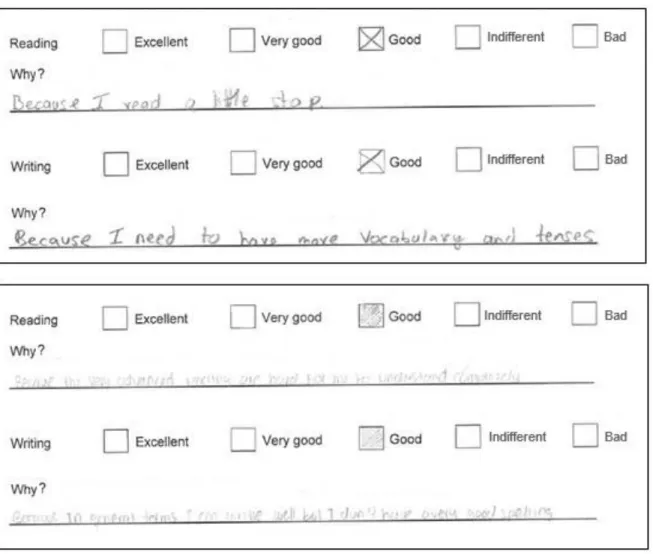
Figure 3. Self-view about reading and writing……….…………....26
Figure 4. The components of a curriculum………..………...….69
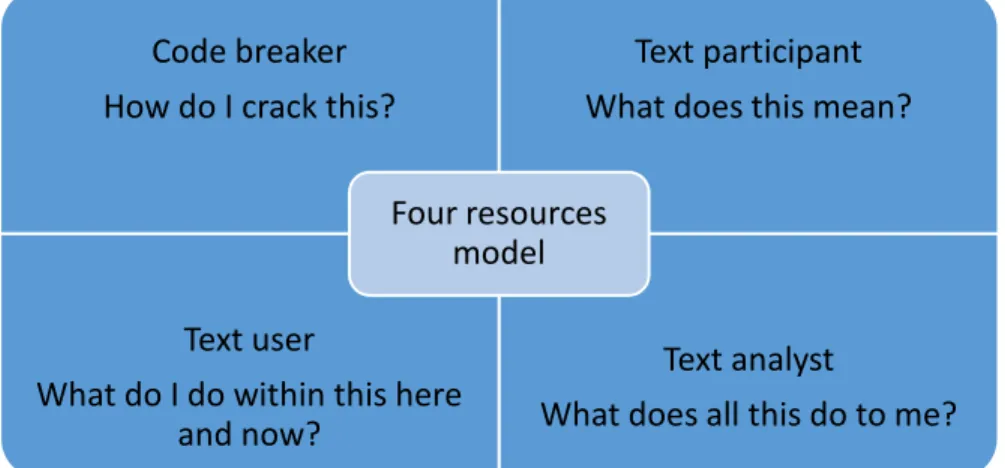
Figure 5. Freebody & Luke four resources model (1990) ...………71
Figure 6. Alternative approach to develop Critical Literacy (Kempe, 2001)..….………....72
Figure 7. What students can do in an argumentative academic writing (Curry & Hewings, 2003) …...……….75
Figure 8. Writing process approach (Curry & Hewings, 2003)..……….76
Figure 9. Composing process model (Hyland, 2003) ………..77
Figure 10. Adapted writing process from Curry & Hewings (2003), and Hyland (2003) ...78
Figure 11 Cycles of the pedagogical intervention……….80
Figure 12. Open coding procedure ……….………..90
Figure 13. List of open codes………91
Figure 14. Quotations linked to codes………...91
Figure 15. List of codes after the merging procedure………...92
Figure 16. Network view of related codes………93
Figure 18. Comments attached to quotations………...….95
Figure 19. Comments attached to codes………...95
Figure 20. Memos attached to codes……….…………...……….96
Figure 21. Categories and subcategories………...98
Figure 22. Standing up for myself……….99
Figure 23. Growing personally………...……108
Figure 24. Acknowledging who I am……….117
Figure 25. Sensing the world……….127
List of Tables Table 1. Short term planning of year 5...………..13
Table 2. Short term planning of year 7...………...13
Table 3. Short term planning of year 10...………....13
Table 4. Annual planning of year 9.………..16
Table 5. Short term planning of year 9……….16
Table 6. A teacher’s comments on the students’ strengths and weaknesses……….18
Table 7. Rubric to assess writing (2014-2015) ……….……...19
Chapter I
Introduction
Nowadays, the complexities of society demand from the students to act knowingly about
issues they might face in their academic, family, or social contexts such as bullying,
mistreatment, or discrimination. Schools should embrace pedagogies that help students
develop the academic, personal, and social skills they need to face the XXI century
challenges. Pedagogies that account for the full development of the individual and whose
contents become relevant to the learners’ situations, inviting them to develop critical
thought and action on various subject matters (Shor, 1999). Students are able to “develop
their knowledge and potential, and to participate fully in their community and wider
society” (UNESCO, 2004, p. 13), which is exactly what critical literacy is about.
As an English teacher and as the Head of the Foreign Languages Department, I am
concerned about my students’ literacy processes, and the way these have been developed.
The present research study is a way to respond to the students’ needs and at the same time
an opportunity to contribute to the advance of the literacy processes carried out in the
Trinidad del Monte - School of the Sacred Heart, since they have been a focus of
permanent discussion among the teachers, with the students and the administrators.
Teachers in the school have stated repeatedly how important is to leave traditional
teaching approaches behind, which are content-based that rely on mechanical tasks that are
seldom related to the students’ lives and contexts. Below I will refer to the way literacy has
been developed, to provide a wider panorama of the practices exercised in the school and
To begin with, reading comprehension goes in many cases around recalling
information provided in the texts. Even though primary and high school teachers know the
existence of the various levels of comprehension, they have found it difficult to make
students go beyond the literal understanding of the contents of the readings. For instance, in
several term exams designed for primary and high school courses, students must show how
much they remember of the texts they read, and the teachers want students to grasp the
information contained in the readings to have the knowledge of the topics set up in the
planning. Teachers ask few questions to students to make their own interpretations. This
makes students assume a passive role in their learning process because they cannot reflect
upon what they are learning.
Another aspect about literacy is the language teachers’ conception of the text. From
direct observation, especially in high school, and after checking some short plannings, I
have noticed that educators work too much with the written text and little with the
interpretation of images or graphs. This means that these ones are undervalued in the
teaching practices. Teachers use images basically to make descriptions in warm-up or
assessment activities to check the kind of vocabulary and grammar structures students can
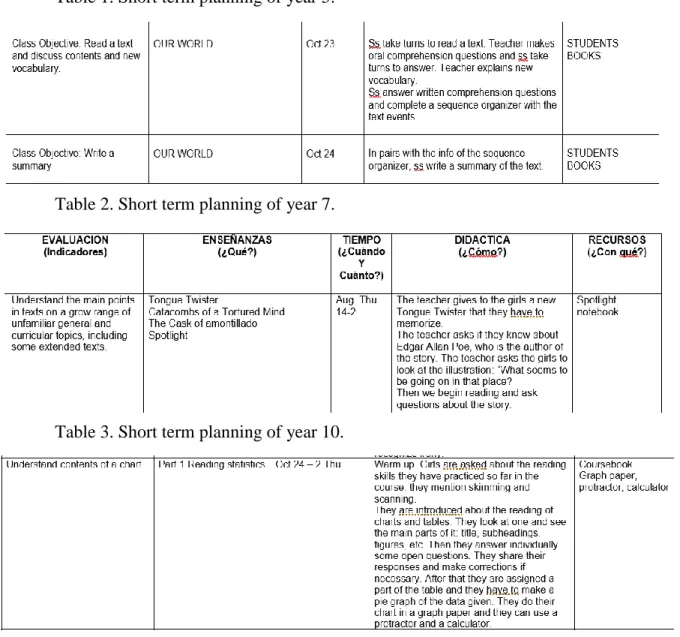
use to refer to the pictures. The tables 1 and 2 show the way pictures including in the
readings are ignored or approached superficially. When teachers use graphics, if used, is to
make students find out data in them, in other words, to develop skimming and scanning
techniques, forgetting about the implications of the figures within the topic they appear.
Sometimes students look at statistics just to extract information from the charts but they do
not discuss what the numbers mean in the context they are presented. The Table 3 illustrate
a lesson where a graph is studied. In any case there is further reference to the pictures or the
Table 1. Short term planning of year 5.
Table 2. Short term planning of year 7.
Table 3. Short term planning of year 10.
Additionally, the incorporation of technology in literacy practices seems sometimes
to be more an obstacle rather than an aid. I have also seen that some teachers lack
knowledge or confidence to work with multimedia texts. Consequently, they prefer to rely
on the physical texts instead of using platforms or online sources. Furthermore, there is a
sense of dread about the effectiveness of working with online texts. Teachers think they do
not have control over what their students are doing, which in turn, makes them believe
students might not be learning enough, despite some of the platforms used in the school
students are willing to work with modern technologies, is the teachers’ fear what prevails,
making the classes go around the textbooks and the board.
Methodologically speaking, teachers from all areas had, in the beginning, the
freedom to deal with students’ writings as they wanted. This allowed teachers to use
diverse pedagogical strategies in the classroom, without forgetting the purposes of the
assignments for the subject. Later, some students complained and affirmed that they were
not sure of what the teachers wanted them to write – referring to the form and the content.
Teachers had different conceptions of what an essay should have, so students felt confused
because they followed the guidelines provided by a teacher but a teacher from a different
subject would not agree with them. Subsequently, the Academic Council agreed to ask the
teachers to model the type of texts they expected from the students.
Regarding assessment, teachers use rubrics when reviewing the students’ writing
assignments. They have changed them over the years. Some years ago, teachers used two
standardized rubrics, one in Spanish and one in English. Even though they adjusted them
for the grades, they affirmed they did not fulfill their needs in their subjects. Therefore, the
Academic Council asked teachers belonging to the different content areas such as, Math,
Social Studies, and Science to design their own rubrics, which they shared and refined.
Nonetheless, when they were shared, several aspects in the rubrics addressed linguistic
features of the texts including the use of capital letters, punctuation, or accurate grammar
rather than the content of their field.
Summing up, literacy is still viewed mainly from a structuralist perspective, which
means that the students’ reading tends to be seen as an individual activity more focused on
Statement of the problem
This study spins around the observation and interpretation of the way students developed
critical literacy in an EFL classroom, paying special attention to the social issues they were
concerned about. To conduct the needs analysis, which I present below, I considered
elements such as, the gathering of school documents, the description of the social context,
and the way assessment was carried out, proposed by Benesch (1996).
The information contained in some documents of the school point to the idea that
reading was focused on the content and writing was a product. For instance, some of the
objectives in 2014-2015 in the English program for year 9 included: ‘To select and
organize material relevant to specific purposes. To recognize, understand and distinguish between facts, ideas and opinions.To employ and control a variety of grammatical structures.To demonstrate knowledge and understanding of a range of appropriate vocabulary.’ Consequently, the goals proposed in the lesson plans might involve, for example, ‘Classifying information of a chapter of Crime and Punishment or Making
descriptions by using compound adjectives’. The tables 4 and 5 are the annual planning and a short-term planning of year 9. In them, it can be seen the strong focus the teaching
Table 4. Annual planning of year 9.
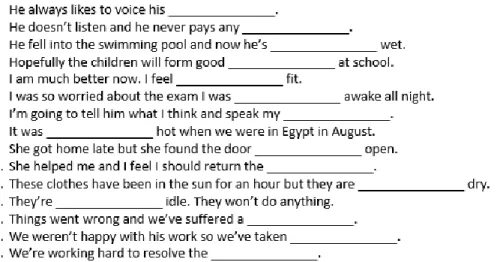
In the same content/product-oriented line, the questions asked in the term exams
had instructions that penalized language errors. These demanded from the students’ limited
responses or answers where they had to care about the way they used the language,
forgetting about the purposes of the texts. A sample of this is shown below.
Figure 1. Sample of questions of a term.
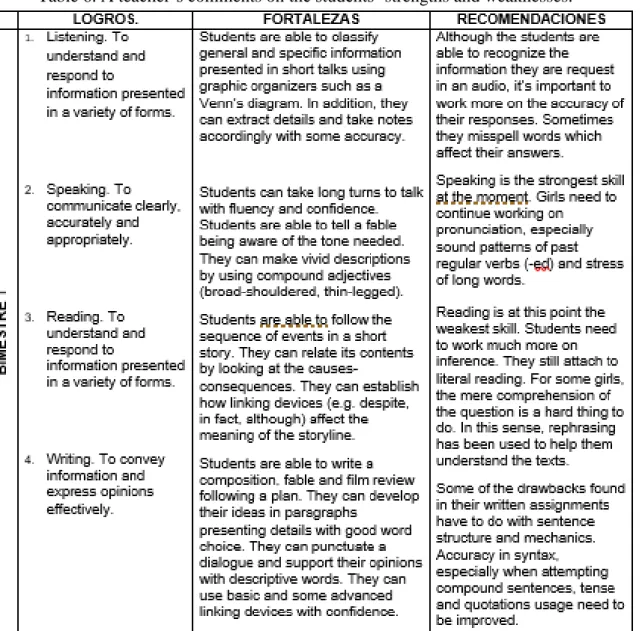
Testing and assessing go hand in hand. That is why the comments teachers made
about the students’ strengths and weaknesses of each term, described up to which point
observations were not intended to be shown to parents but to keep the record of the
students’ processes. The following report shows the little interest teachers had in informing
the quality of the contents of what the students said or wrote, or their perceptions and
opinions of what they listened or read.
Table 6. A teacher’s comments on the students’ strengths and weaknesses.
All this illustrates the fact that literacy was seen as an instrumental skill, where the
unidirectional comprehension of the texts and the accuracy in the use of several aspects of
the language such as syntax, spelling, and punctuation, seemed to be prioritized over the
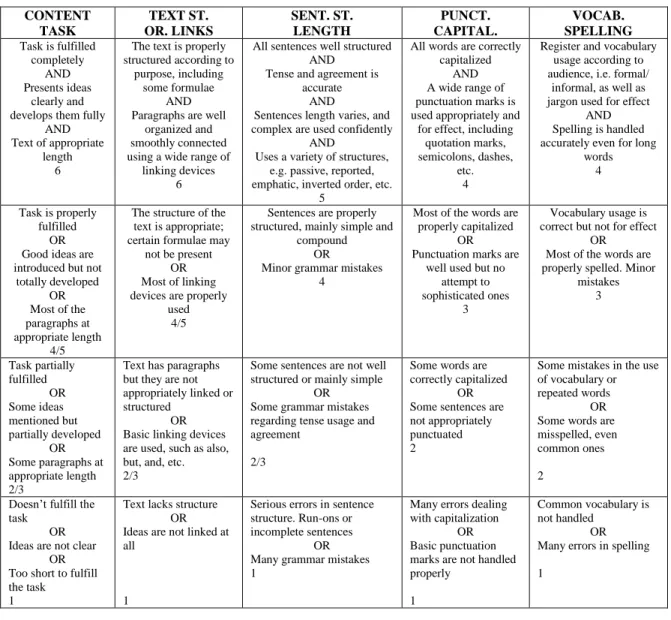
According to the marks obtained by ninth graders, in 2014-2015 two students out of
ten, which was the total number of students in the class, reached 4.0 over 5.0, or more, in
the Writing standard. The rubric below was used to determine their scores.
Table 7. Rubric to assess writing (2014-205).
CONTENT TASK TEXT ST. OR. LINKS SENT. ST. LENGTH PUNCT. CAPITAL. VOCAB. SPELLING
Task is fulfilled completely
AND Presents ideas
clearly and develops them fully
AND Text of appropriate
length 6
The text is properly structured according to
purpose, including some formulae
AND Paragraphs are well
organized and smoothly connected using a wide range of
linking devices 6
All sentences well structured AND
Tense and agreement is accurate
AND
Sentences length varies, and complex are used confidently
AND
Uses a variety of structures, e.g. passive, reported, emphatic, inverted order, etc.
5
All words are correctly capitalized
AND A wide range of punctuation marks is used appropriately and
for effect, including quotation marks, semicolons, dashes,
etc. 4
Register and vocabulary usage according to audience, i.e. formal/
informal, as well as jargon used for effect
AND Spelling is handled accurately even for long
words 4
Task is properly fulfilled
OR Good ideas are introduced but not
totally developed OR Most of the paragraphs at appropriate length
4/5
The structure of the text is appropriate; certain formulae may
not be present OR Most of linking devices are properly
used 4/5
Sentences are properly structured, mainly simple and
compound OR
Minor grammar mistakes 4
Most of the words are properly capitalized
OR Punctuation marks are
well used but no attempt to sophisticated ones
3
Vocabulary usage is correct but not for effect
OR Most of the words are properly spelled. Minor
mistakes 3 Task partially fulfilled OR Some ideas mentioned but partially developed OR Some paragraphs at appropriate length 2/3
Text has paragraphs but they are not appropriately linked or structured
OR Basic linking devices are used, such as also, but, and, etc. 2/3
Some sentences are not well structured or mainly simple
OR Some grammar mistakes regarding tense usage and agreement
2/3
Some words are correctly capitalized
OR Some sentences are not appropriately punctuated 2
Some mistakes in the use of vocabulary or repeated words
OR Some words are misspelled, even common ones
2
Doesn’t fulfill the task
OR Ideas are not clear
OR Too short to fulfill the task
1
Text lacks structure OR Ideas are not linked at all
1
Serious errors in sentence structure. Run-ons or incomplete sentences
OR Many grammar mistakes 1
Many errors dealing with capitalization
OR Basic punctuation marks are not handled properly
1
Common vocabulary is not handled
OR Many errors in spelling
1
Although some importance was given to the students’ ideas, the rubric was mostly
writing assignments the way the students mastered the language was more important than
the quality or relevance of what they wrote in their papers.
At the beginning of the academic year 2015-2016, some changes took place. The
discussions held in the area meetings highlighted the need of changing that instrumental
perspective of the language. Instead, a cognitive view was approached. The Academic
Council agreed about the necessity of making students develop higher-order thinking skills,
and work collaboratively, a fact that had to be evident in the proposal of the objectives in
the different school subjects. There was, and still, there is, a desire of leaving behind
traditional methodologies and embracing modern ones that can make students face and
respond assertively to the challenges of this century. Therefore, words such as, ‘identify or accurately’ were taken off the programs. The objectives stated in the annual planning were related with the development of critical thinking skills, and ‘comparing and contrasting, arguing and developing ideas, and stating own positions’ were introduced to guide the students’ processes.
However, because of a case of malpractice, teachers, especially the language ones,
suffered a sudden setback. At the end of the first semester 2015-2016 the Academic
Council ordered that writing assignments had to be done ‘individually’. In other words,
writing was seen once more as an individual production rather than a social practice, and
that meant going back to the structuralist underpinning position. Although the program
objectives suggested working within a cognitive perspective, the fact of demanding
individual writing tasks seemed contradictory to the methodologies adopted, which were
meant to be active, collaborative, and learner-centered.
Furthermore, the changes in the objectives did not mean a substantial improvement.
out in the classroom remained within the traditional perspective of literacy. Thus, some of
the goals reached by the students about literacy had to do again with the recognition of
information and the creation of texts based on linguistic criteria. Workshops and quizzes
were about identifying main ideas and details in a reading or writing letters having as the
main instruction to use the appropriate formulae as illustrated below in Figure 2.
Figure 2. Extract of a letter writing workshop.
Getting away from exercises like these, required more Teacher Development
Program sessions so teachers could plan, develop their lessons, and assess their students
according to the approach proposed in the Academic Council. The head of areas or
someone outside the school could open a space for these sessions, given the weekly time
teachers had for general or area meetings. Some modifications had to be done in the
annual planning or in the lessons did not necessarily mean that what was done in the
classroom was aligned with the literacy cognitive perspective.
Moving from the institutional documents, the literature about writing shows that
scholars are concerned about the students’ performance in different educational settings.
Two studies illustrate the idea that in some educational contexts writing is conceived
instrumentally and in others, teachers are attempting to see it beyond the linguistic aspect.
First, Ochoa and Medina (2014) report that students’ writing at a private school was
exclusively focused on the linguistic aspects of the language. Learners were asked to write,
for example, a series of sentences using a specific grammar tense without providing a
context or a purpose to write them. Ochoa and Medina (2014) were concerned about their
students’ writing process and proposed the use of a virtual room where they could carry out
authentic communicative activities. They intended to explore the extent to which the use of
the virtual room could shape the students’ writing in a private school. At the end of the
action research, Ochoa and Medina (2014) found firstly that the students widened their
vocabulary (nouns, verbs, and adjectives) to express their ideas, feelings, and opinions.
Secondly, students engaged more in the writing tasks by working cooperatively and by
participating in various interactive exercises. Thirdly, students shaped their writing skills by
giving sense to what they wrote keeping their texts coherent and cohesive, and moved from
the reproduction of grammar rules to the more spontaneous participation in chat rooms,
achieving several communicative goals. This study shows that through the pedagogical
intervention students stopped writing isolated sentences to produce a variety of texts to
reach different communicative objectives. Nonetheless, the findings suggest that the
when Ochoa and Medina (2014) affirm for instance that the students were able to use a
wider range of vocabulary or connectors to give meaning to what they wrote.
Second, Nanwani (2009) detected that her students had difficulties when writing
academically in English in a private university in Bogota. Nanwani (2009) points that the
initial obstacles relied on the fact that the academic writing course followed an
Anglo-American style and additionally, the curriculum had been defined by a small number of
faculty members, who left aside the students’ cognitive and socio-cultural assets. Nanwani
(2009) admits they were developing programs based on a limited view of literacy. The
teacher-researcher affirms, “academic writing requires greater grammatical and
morphological accuracy, a formal tone or register, appropriate rhetorical structure,
knowledge of the audience (readers), critical thinking and a number of principles such as
coherence, concision, cohesiveness and simplicity” (2009, p. 142). Furthermore, Nanwani
(2009) endorses Grab and Kaplan’s idea that members of different cultures use different
rhetoric strategies. This became an important matter since their students were learning
under an Anglo-American style and they felt constrained by the rigid essay structure they
had to follow. The teacher-researcher makes five pedagogical recommendations to help
students deal with their academic writing. Firstly, instructors should see writing as a
process; consequently, the evaluation should look at the students’ work in the various
stages not only the final version of their essays. Secondly, the instructors’ role ought to be
as facilitators rather than authorities of knowledge. Thirdly, instructors should equip
students to convey meaning by using different strategies, including reading academic texts.
Fourthly, academic writing should not be treated as a subject but as a lifetime productive
professionally activity. Fifthly, the feedback provided should be done in a positive way.
remarks (2009) reveal her concern to make students develop their academic literacy in a
more meaningful successful way. Finally, Nanwani demands to not approach academic
writing as the ability to produce essays following a systematic pattern but give the students
the option to find their own way to tackle affairs linked to their academic interests.
Moving to the participants of the present study, I will proceed to profile them from
the literacy point of view. On the one hand, from direct observation, I detected that half the
students enjoyed reading on their own. Between the classes or when a teacher was absent,
some students spent their time reading books. They were fond of stories related to fantasy,
classic and modern novels. The other half was not particularly used to reading, and they did
it for the school assignments.
On the other hand, a questionnaire responded by them shows their interests in
learning English and their opinions about the difficulty and usefulness of some types of
texts. It also shows their learning preferences (See Appendix 1).
Their interests to learn English were related to finding a job and studying abroad,
which in turn could be connected to learning English for specific and academic purposes
correspondingly. Additionally, seven out of ten think writing was the area they had more
trouble with, and although seven believed that reading and writing essays were relatively
difficult or difficult, nine agree on the idea that reading and writing them was relatively
useful or useful.
When they were asked about how they felt about reading and writing, half of them
had a positive view of them, while the other half felt uncomfortable about them.
Nonetheless, interestingly, to the question why they felt that way, some of the students that
felt confident, argued they would feel much better if they handled the language more
These results show that students were aware of the importance of literacy in their
lives. Nevertheless, even though they felt self-assured towards literacy, some of them
related it to the master of language itself. This also shows the way they perceived literacy.
In this case this matches with Ochoa and Medina’s conception described above. The
students seemed concerned about their spelling and vocabulary, as the figure below (Figure
3) illustrates it. In other words, they appeared not to identify themselves as critical
readers/writers in the academic setting.
However, this does not mean they were not concerned about societal problems or
that they were not critical. The school provides other spaces where students develop their
sensitivity towards some social issues. These moments are usually part of the homeroom
teaching or preparation for religious celebrations (See Chapter III). This means that the
students assume a social agent role in a non-academic context. Hence, I urged the need to
provide the students an academic space where they could exercise their agency while
Bearing this problem statement in mind, I intended to develop a pedagogical
intervention where my students could use a series of reading and writing tasks to make
them gain awareness about social issues, something they expressed and cared about in other
entourages.
Simultaneously, it was my duty to cover topics such The Civil War in the US, The
Olympic Games and Essay Writing, as they were included in the annual planning. The
latter was of great importance, as the administrators considered the writing of formal papers
these circumstances, I planned and designed a whole instructional unit to make my students
work with various written and oral texts and write argumentative essays critically.
Working with the students on the writing of argumentative essays was at the core of
the pedagogical intervention. As explained above, the planning demanded that I teach them
how to write an essay. However, that was not the ultimate objective of the present research.
During the implementation of the pedagogical intervention I worked with my students so
they could develop reading and writing tasks using them as a practical dimension of their
own social dimension. One of the challenges I saw ahead was to implement the use of ICT
tools to serve the purpose of the study. Moreover, I followed a writing process model so
that the pedagogical intervention were successful (See Chapter IV).
In sum, the institutional documents and the literature have made me realize that
literacy has been a common interest for students, teachers, and institutions, and yet it has
been approached from a perspective that in many cases has prioritized formal aspects of the
language, as well as the individual production. The school I work at is not an exception and
this phenomenon is present too. Having said that, students might not have been given the
opportunity to be critical when they read and write.
As this study deals with critical literacy, the practices carried out by learners and
educators are necessarily in constant change, seeking for improvement at a personal,
academic, and social level at a specific situated context. Based on the above premises I
pose the following research question and objective:
Research Question
What do students’ critical literacy practices in an EFL classroom inform about their
Research Objective
To interpret the students’ declarations about what constitutes real social concerns for them.
Rationale
I believe that this study can contribute to different instances at various levels. Primarily, I
consider that the students at the school need the opportunity not only to develop high-order
thinking skills as it has been proposed in the program but to assume responsibly stances
about social issues within academic contexts and project them to other contexts as well.
As the social beings they are, I expect them to express openly their social agentic
dimension during the English lessons because as explained above students approach and
respond to diverse social issues in non-academic spaces but within the school context. In
my view they should be equipped to comprehend and react towards their day-by-day
societal problems they might be involved in all sort of contexts. As daughters, friends,
students, and as the global citizens they have become, they are likely to face situations
where they have to make decisions and stand for them, which is what critical literacy is
ultimately about. They should be able to act for the welfare of themselves and the ones
around them.
Critical literacy will help the students be aware and get a deeper understanding of
the different curricular areas, which they can approach from multiple angles. The students
will also benefit in the mid and long run because writing academic papers critically will
certainly help them in their future studies and careers.
As for the teachers, this study will serve as an example that through the
respond to the new challenges of the XXI century, an expectation that has been expressed
in many occasions in different teachers’ meetings. In turn, the Foreign Languages
Department will have a ground where a curriculum can be implemented assuming
language, learning, classroom, and bilingualism from a critical perspective. This will give
us the possibility to develop meaningful and purposeful lessons based on the students’ real
needs and interests sensitizing them about the diverse social issues present in their daily
life. Furthermore, the school will advance in the achievement of its vision of ‘being
recognized for the academic excellence, leadership, and social responsibility of its alumni’. The development of critical literacy practices is essential in a society. Reading and writing done critically opens a window to a wider world, providing the individuals more possibilities to look for alternatives and solutions to social problems. Our country and others in the region need to count on sensible and sensitive citizens who can judge between what is good and what is not. Countries whose populations can make better decisions and leaders with the political will to make the necessary changes that can put a stop to the inequality lived among us. We cannot pretend to have a democracy if our students are not ready in the first place to recognize hidden messages and agendas and if in the second place they do not manage to resist oppressing discourses delivered by people who want to
perpetuate their power.
Finally, the MA research emphasis on Literacy in Two Languages will get some
new insights about the way students perform various social practices at distinct levels to
fulfill academic writing tasks in a second language, unveiling hopefully the complexities of
these and their relationship with the level of criticality reached by students while writing
Chapter II Literature Review
In the previous chapter, I described the statement of the problem. I posed the research
question and stated the objective of the research study. I also explained the justification for
the study. In this chapter, I will compare and contrast two theoretical pillars, traditional
literacy, and critical literacy. Through the literature review and the description of the state
of the art, I will explain the need of developing critical literacy in an EFL classroom,
transcending conventional literacy, and the way this serves as a means to gain sensibility
and sensitivity towards social issues. To achieve this, I will start by pointing to what
literacy refers to. Then, I will present the relation between both approaches of literacy.
Afterwards, I will account for the objectives of conventional and critical literacy. Next, I
will proceed to explain the role of the text in literacy. Finally, I will describe the
development of writing and academic writing.
Core definitions
To begin with, I would like to present the changes in the conception of literacy and its
presence in the society. On the one hand, the traditional literacy approach remains
mainstream. About this phenomenon, Norton (2007) points, “The dominant conception of
literacy among governments, policy-makers, and many members of the general public is
that literacy references the ability, on the part of individuals, to read and write” (p. 6). This
means that traditional literacy continues to be developed in our present society.
Furthermore, Nasution affirms that traditional literacy is “the product of time. It refers to a
traditional because it is rooted in the past and it continues to be unchangeable or with few
changes.
In the 1960s, literacy was conceived from a print-based world as the mere skill to
read, write, and calculate (UNESCO, 2004) without giving second thoughts to the types of
teaching texts nor methods that would be used to achieve such goal. Moreover, traditional
literacy refers to the capacity to handle the different disciplines associated with the
language. These components might include morphology, syntax, semantics, text linguistics,
which tend to perpetuate a focus on printed communication (Young, 2012).
Nonetheless, as any other discipline, literacy has developed since its origins, despite
the strong presence of the traditional approach, turning into a complex, yet note-worthy
practice. It has been defined by the UNESCO as
The ability to identify, understand, interpret, create, communicate and compute,
using printed and written materials associated with varying contexts. Literacy
involves a continuum of learning in enabling individuals to achieve their goals, to
develop their knowledge and potential, and to participate fully in their community
and wider society. (2004, p. 13)
This definition encompasses somehow the complexities of the processes carried out
by the individuals in different scenarios. Its demands in terms of the way people are
expected to handle and interact with the information available in a variety of modes, and its
direct connection with the individuals' personal development, show the new learning
necessities and social dynamics we all are immersed in.
Additionally, literacy is no longer a one-direction passive skill. According to Freire,
reading is more than decoding the written word. “Reading is preceded by and intertwined
understanding attained by critical reading of a text implies perceiving the relationship
between text and context” (Freire, 1983, p. 5). Freire declares that reading and writing does
not consist on merely reciting a text or memorizing the governing rules of a language; on
the contrary, Freire recognizes reading and writing as an act of knowing and creating
(1987), and understanding the underlying significance of the words. Freire’s re-known
words, “Reading the world always precedes reading the word, and reading the word implies
continually reading the world” (1983, p. 10) highlight the vitality of the act of reading and
writing.
The interpretation of reality through the reading of words is permeated by the
individual’s background and experiences. This means that it is not possible to understand a
reading without making sense of it because of what has happened around us. This also
implies the idea that is possible to look at the same phenomena from different angles. Every
time one reads or writes, one is given a ticket to swim and dive in a sea called ‘reality’,
where many other subjects are present and help you live, think, and respond effectively to
that act.
In this train of thought, Menezes de Souza (2007) asserts that
If literacy is no longer seen as a technology or a set of cognitive skills to be
developed in individual minds, but as a socio-situated practice involving the
on-going negotiation of meaning in continuously contested sites of meaning
construction, then all literacy in a certain sense ought to be ‘critical’. (p. 4)
This means that words do not possess single meanings, but they are constructed
permanently, and they challenge the individuals to not take for granted what they read or
On this matter, Rosenblatt (1994) points to the reading process as a mutual
transaction. The meaning of the text is not rooted in the reading itself or in the reader, is the
result of the transaction between them. Additionally, Rosenblatt (1994) states that the
reader can choose the predominant stance he/she wants to take towards the text. An
aesthetic reader, for instance, participates actively in the tensions, conflicts, and resolutions
as they are unfolding. In other words, the reader gets involved in the reading and this
constitutes part of the response and interpretation of the text.
Personally, I feel more identified with the critical approach. I acknowledge the
importance of using the language accurately, especially in the academic world. However, as
I see it, literacy is a transformative act since it moves the affective, cognitive, and more
importantly, the social dimension of the human being, striving the individuals for the better
in settings they usually settle.
As can be seen, literacy has been understood in two ways. Critical literacy goes
beyond the significant-significance of words; farther than the traditional view. In sum,
conventional literacy is focused on the language while critical literacy sees beyond the
system; it goes around the reader/writer as a social individual.
Traditional and critical literacy: Opposite or complementary?
Although traditional literacy and critical literacy have been portrayed as divergent, we have
to admit that critical literacy relies on the conventional approach. Critical literacy would not
be possible to develop if the knowledge of the codes were not mastered in the first place.
This means that when the learners achieve to develop critical literacy, they necessarily
not take place. In other words, students can develop literacy skills, but this does not mean
they are critical literates.
Multiliteracy is understood in the existence of other modes of meaning closely
related to culture and context. The textual element is associated with some others, such as
the visual, the audio, the gestural, the spatial, and the multimodal. The New London Group
invites educators and students to “see themselves as active participants in social change, as
learners and students who can be active designers – makers of social futures” (1996, p. 64).
On the other hand, in the teaching context, the use of new literacies does not necessarily
mean that literacy is becoming critical. At some point, both can be addressed in a learning
environment as I explain below.
Quintero (2008) states
The writing task is much more concerned with the form rather than with the abstract
thinking capacity to construct meaning and put it into words […] writing is a
difficult skill to develop since it requires not only syntactic and lexical knowledge
but also the capacity to generate and organize ideas and thoughts in a way that can
be clearly and coherently communicated to a potential reader. (p. 8)
Nevertheless, Quintero clarifies that
Certainly the focus of this study was not on the accurate use of linguistic features,
but of course, they were tools that clearly helped writers to shape and express their
thoughts. It is often seen that problems with grammar, punctuation, lexical choice
and the like can have a very negative impact on content and general understanding
of a text. (2008, p.13)
In this research study, Quintero’s aim was to “gain insights about the development
shape students’ writing” (2008, p. 9). Students from Canada and Colombia participated
regularly in three types of blogs – a personal one, a group one and a blog for debate. The
findings of this action research suggest that students’ writing is enhanced because they
interact with people who have similar interests and language expectations. Quintero (2008)
also found that students used writing as a self-expression means. Regarding feedback, the
study shows that the teacher’s role is one of a coach, seen as the ‘expert and
knowledgeable’ person in the group. Quintero’s feedback included comments about the
organization and the content of the texts along with the Canadian’s replies to the
Colombian students’ posts, which included some explicit and implicit feedback. Such
comments and observations played a scaffolding role and helped students improve their
writing process. Students moved, according to Quintero (2008), from writing simple short
texts to longer and more complex ones at the end of the pedagogical intervention.
This study portrays that literacy is to some extent addressed from the linguistic
perspective. Students improved while feeling part of a community and could express their
feelings and opinions, and the sort of feedback provided to the students contained language
and content elements.
Purposes of literacy
If literacy is conceived differently, consequently, its goals should be divergent too. As
traditional literacy deals with the ability to, first, identify, and understand the rules under
which the language is structured, and second put into practice these rules, the teaching and
learning of the language become mechanical. Therefore, and giving the fact that such
linguistic rules are limited, drilling and memorizing are essential to guarantee the
innovation. Because the master of the language components is its primary objective, this
type of literacy is also called structuralist. This means that the individuals have to
demonstrate their knowledge of the way the language is structured at the different levels,
e.g. morphological, syntactical, etc.
In addition, in education, the empty vessel theory (Lock, as cited in Rodríguez,
2012) takes part of the learning process. This states that the teacher is the holder of
knowledge while the pupils are passive receptors of it. Again, about literacy, what matters
here is the capability to manage the language as a system, thus the context where it occurs
is irrelevant. The setting, users, and purposes, among other things, are not essential at the
moment of looking at the principles that are the core of the organization of the language.
The learners’ needs and interests are not considered either. Literacy, in other words, is the
end itself.
A study in Colombia suggests the idea that literacy continues to be developed
around the formal aspects of the language. Lizarazo (2012) found that their sixth-grade
students
[…] have difficulties using adjectives when they write a description. It means that
they write the adjective after the noun as we do when we write in Spanish, without
taking into account that some structures are formed differently in English. For this
reason, some activities were designed to take advantage of the use of blogs and
different worksheets, which allowed the students to understand and use the
adjectives in English. (p. 188)
Lizarazo (2012) intended to analyze the way his students used adjectives when they
sentence at the moment of referring to somebody’s characteristics. Hence, Lizarazo (2012)
developed a pedagogical innovation and used the students’ artifacts – their exercises in
their notebooks and in worksheets, and the blog. The categories that emerged from the data
analysis were Exploring the use of adjectives to describe people and Role of the blog. Lizarazo (2012) argues that in the beginning, the students did not know the concept of
adjective and consequently its grammar function. However, after the pedagogical
intervention, most of the students succeeded in using adjectives to describe people’s
appearance. In addition, the blog was a tool that engaged the students in the tasks and
helped them advance in the management of the English syntax.
This study demonstrates the permanent concern for the language itself. Lizarazo’s
main goal was to generate the linguistic awareness among their students in regard to the
syntactic order of words in a sentence, specifically when combining an adjective with a
noun. The activities the teacher-researcher proposed prompted the learners to start
mastering noun phrases that contained adjectives.
On the contrary, among the different conceptions of what critical literacy entails,
other scholars refer to it as a social practice, with common notions about discourse and text.
Let us examine the shared understanding of what literacy is by looking at what is not.
Literacy is not an isolated activity. Although apparently reading and writing is
something the individual does himself without the intervention of anybody else, what he
reads and or writes is permeated by a series of aspects that make his practice take one shape
or another. This means that traits such as, personal backgrounds, cultural ideologies, and
social values, among others, are there to determine the way in which the reading and
Street (2003) defines literacy as
[…] a social practice, not simply a technical and neutral skill; that it is always
embedded in socially constructed epistemological principles. It is about knowledge:
the ways in which people address reading and writing are themselves rooted in
conceptions of knowledge, identity, and being. It is also always embedded in social
practices, such as those of a particular job market or a particular educational context
and the effects of learning that particular literacy will be dependent on those
particular contexts. (p. 77.)
Street’s (2003) conception of literacy focuses on the readers/writers as social
individuals whose practices depend on and derive from the contexts they are immersed in.
That is to say, the reading/writing practice occurs in other multiple places different from the
classroom. The family entourage, the neighborhood and the online communities are, for
instance, spaces – not necessarily physical, where literacy takes place without the direct
intervention of the teacher.
Likewise, Lea & Street (2006) show three different models in the development of
literacy. The first model is the study skills and it approaches writing as an individual
cognitive skill focusing on the features of language and accuracy in the usage of it. The
second model Lea & Street (2006) mention is called academic socialization which "is
concerned with students' acculturation into disciplinary and subject-based discourses and
genres" (p. 369), which means the possibility of using different genres and discourses to
construct knowledge in certain ways. The third one refers to academic literacies model,
which according to Lea & Street (2006) has to do with “meaning making, identity, power,
particular academic context” (p. 369). In the latter, power relationships, authority,
meaning-making, identity construction are privileged over the knowledge of the disciplines.
Shor (1999) concurs with Street (2003) and Lea and Street (2006) when observing
that “critical literacy is language use that questions the social construction of the self. When
we are critically literate, we examine our ongoing development, to reveal the subjective
positions from which we make sense of the world and act in it” (n. p.).
Additionally, Beck (2005) asserts,
Questioning why some constructions of knowledge are legitimated while others are
not encouraging individuals to develop the critical awareness necessary to challenge
the status quo and discover alternatives to existing social inequalities; critical
theorists thus highlight the individual as the agent of social change. (p. 393)
Thus, literacy advocates for social change. However, this change is not exclusively
inserted into big-scale social interventions. Social change refers here to the resistance one
can make to the conformity of the social norms and to the small acts, which by being firm
and sustained can generate over time a change of mind or behavior. As social individuals,
change can occur at all levels, from home to society.
About the educational context, Norton (2007) affirms, “Educators who are
interested in critical literacy are interested in written text, or, indeed, any other kind of
representation of meaning as a site of struggle, negotiation, and change” (p. 6). Norton
recognizes the existence of the inherent component of critical literacy, which is social
change, but she additionally points to the presence of new types of texts. At this point, this
As aforementioned, literacy is a dynamic practice experienced by individuals as part
of a community, along with their partners, not in isolation, as it occurred in the traditional
literacy. Critical literacy becomes a two-way act, where meanings go back and forth and are
co-constructed with others. This allows learners to realize the variety of perceptions and
interpretations a single reading can drive. These, in turn, open a room for reflectivity and
consequently, people become more aware of the diverse opinions others have on the same
text. Some studies suggest all of this.
Firstly, Kuo carried out a study to answer the questions: “1) How did the students
respond to an activity designed from a critical perspective? and 2) How did the students
compare their learning in this activity to their prior experience?” (2014, p. 110). The
pedagogical implementation consisted of the reading of a picture book and the development
of different learning tasks. The tasks included among others, answering questions from
someone else’s point of view, profiling a character and discussing the book. The
participants were 34 students who were taking a General English class and the instruments
for data collection were classroom observations, students’ artifacts and assignments, their
reflection papers, and follow-up interviews.
To the first question, the emerging categories were Forming a critical stance, Investigating multiple perspectives and Re-examining their familiar world. To the second question, Kuo (2014) identified three recurrent themes: Picture books as alternative teaching materials, Relevant materials and issues, and Interactive and learner-centered tasks. Kuo (2014) concludes that his students behaved as social agents when they moved from the personal to the social level. Besides, the researcher affirms they acted as critical
literate because they were able to relate their learning in the class with their own lives. This
their own. To develop critical literacy, the kind of learning tasks proposed to the students
must be purposeful and socially related.
Secondly, Lopez-Robertson (2010), a bilingual Latina teacher, explored how two
second-graders Latinas, responded to a critical literacy curriculum while participating in
literature discussions. The implementation involved the presentation of guest speakers, and
home and class discussions about migrant workers. Through audiotapes, transcriptions,
artifacts, informal interviews and field notes, Lopez-Robertson (2010) found that the
students linked the contents of the books they read with their lives and made meaning of the
readings. The emerging category was Border Issues.The students felt touched by the readings as they looked similar to their own stories. Their narratives illustrate the way they
associated the characters in the readings with their own relatives. Through the discussions
of the readings, the two students were able to contest social inequities and position towards
the others, the ones who were involved in their own stories. As a teacher-researcher
Lopez-Robertson (2010) wished her students feel identified with the curriculum and that is why
she opened up a space where their voices could be heard. In fact, they took an active role in
the construction of the curriculum and more importantly, the discussions they participated
in, helped them turn their own experiences into knowledge.
Thirdly, Pérez (2013) conducted a study in a public school in Bogota. The research
questions he posed were: “What do EFL students´ written reflections reveal about their
social awareness when inquiring about verbal and physical aggression at Tejares Public
School and how do students develop their EFL writing skills when inquiring about verbal
and physical aggression inside their institution?” (p. 185). Pérez decided to carry out this
students faced in the school. The researcher selected 40 tenth graders as participants and
used questionnaires, artifacts, and semi-structured interviews.
Pérez (2013) by means of an inquiry cycle, established two categories. Building consciousness from unpredictable human behaviors in the community context was the first category. This social awareness is tied with four main reflections. In the first place, students
recognized that aggression could arise at any moment derived from apparently unimportant
matters. In the second place, aggression occurred in external settings, not necessarily in the
school and they were not responsible for them. In the third place, at some point aggression
was seen as a liberating act. In the fourth place, aggression was partly generated because of
their lack of control and it should not happen in a learning environment.
The second category was Aggression is a human condition to dominate, subjugate and survive. In this case, the students felt that in a case of aggression they were somehow forced to take sides and assume a role. This implied they became part of the passive,
aggressive, or victims’ groups. In other words, although students knew that being
aggressive was negative, sometimes they needed to behave that way to survive in their
community. If not, they might become victims of the aggressor. Their awareness here is
linked to the students’ emotions and their contexts.
The last emerging category was Writing as a means of growing as citizens. Through writing, students made connections with their own realities and were able to make
propositions to solve their cases of aggression in the school. They became social agents
when they pointed to adults and themselves as the responsible people to reduce the
aggressive behaviors in their institution. All in all, this study evidences the students’ social
Kuo (2014), Lopez-Robertson (2010) and Pérez (2013), illustrate the way critical
literacy advocates for social change within and from learning environments. In these
studies, the position of the individual to the reality that surrounds him is essential, as the
possibility to look for alternatives that might change the kind of experiences they were
facing. The fact of raise awareness about the situations students were immersed in, and
making their voices be heard, allowed them to consider other behaviors and actions as
options in their lives.
The role of text
Texts have been at the core of education for decades; these have been widely used
in literacy teaching and learning. Regarding this, Eaton asserts that “language learning has
emphasized the written forms of the language, focusing on grammar and structure.
Although communicative teaching and learning methods are used today, there is still a
heavy focus on written forms” (2010, p. 15).
Since texts are linked to reading, and in turn, traditional literacy is conceived as the
skill to read, write, and calculate, let us explore what reading is about in this approach.
Reading is focused on the literal comprehension of written texts, leaving aside other types
of interpretations. Through the text, the writer sends the message and the reader receives it.
This makes reading an individual, passive, and unidirectional process. Consequently, the
reader must understand what the text says. In other words, there is only one correct way to
understand the reading, and the reader’s opinion is not considered.
Nonetheless, critical literacy does not rely exclusively on the written form and is not
a single entity. The New London Group (1996) understands multiliteracies as the numerous
Studies (NLS) and multiliteracies are new ways of looking at literacy, to which Gee
explains that “NLS are based on the view that reading and writing only make sense when
studied in the context of social and cultural practices of which they are but a part” (2000,
180).
A study conducted by Vargas (2016) suggests that the way we read and write has
changed dramatically due to the use of digital technologies and social networks. Vargas
carried out the study with two informants, using in-depth interviews and his study reveals
that the participants of the social network Facebook, show an intense literacy activity.
Additionally, they pose as critical individuals fighting back to not being seen as
interchangeable pieces of a hegemonic puzzle. Vargas affirms that their construction of
identity is a strong component of their literacy activity.
This study depicts the way people are using other forms to communicate, to express
themselves and to show who they are and what they want. Vargas (2016) portrays the use
of technology not only as a new means of communication but as an alternative for
individuals to binding with others, to examine the way they are developing as members of
diverse communities and to contest openly to situations they are interested in. Having the
possibility to use language in such a way is what makes literacy critical.
Considering the advances in technology and communication, it can be seen there is
still a gap between the way we communicate and interact with one another by using images
such as emojis, and audiovisual texts, sending audio messages and video chats, for
example. Language learning should include these other ways as they are part of our daily
life and using a language implies the practicality of it in our day-by-day tasks. Nonetheless,
critical literacy. What matters is the way the technology is used, and the purpose behind its
usage.
Academic writing
In conventional literacy, writing deals with the capacity to produce texts making accurate
use of the linguistic structures. The literate person must know how words are spelled, how
verbs are conjugated, how simple, compound, and complex sentences are structured, how a
paragraph is organized and how a longer text, such as an essay is composed, among other
things. Byrne (1988) describes writing as “the production of graphic symbols which have to
be arranged, according to certain conventions to form words, and words have to be
arranged to form sentences” (p. 98).
Nevertheless, the notion of academic writing has evolved. Macedo (2003) explores
the need of working with literacy from a critical view. In dealing with academic writing, he
highlights “A "de-contextualized" language is a figment of our imagination, socially
constructed to present the academic discourse as a superior discourse” (p. 13). Furthermore,
Macedo (2003) stresses that “the mastery of dominant academic discourse through literacy
for cultural production should be understood as a weapon for subordinate students to
defend themselves” (p. 13).
How are the views of academic writing evident in the teaching context? Thoman
(2003) recognizes that literacy “meant having the skill to interpret “squiggles” on a piece of
paper as letters which, when put together, formed words that conveyed meaning” (p. 6).
The main concern seems to be how letters and words are put together to convey meaning
rather than what kind of message is being transmitted. This perception is palpable in two
Robayo and Hernández (2013) observed that at a private university, second
semester students, “showed difficulties in terms of organizing their ideas, identifying
different kinds of texts, providing arguments to support their opinions, as well as
employing a range of basic and complex grammar structures” (p. 131), when facing
academic written production. In this study, Robayo and Hernández (2013) explain that
“when students are not used to reading and writing, we cannot expect that they will produce
texts and master their writing skills without the appropriate instruction” (p.131). And they
continue to define writing “far beyond a skill but rather a means that helps individuals to
communicate according to what influences their lives. Nevertheless, it is expected to be
used formally if we write for academic purposes (at a university level)” (p.131).
Robayo and Hernández intended “to identify the changes (if any) in the formal
aspects of language students have when they develop academic writing through project
work. To identify features of collaboration that are recurrent while writing. To describe the
role of project work in the academic writing process” (2013, p. 134). The participants were
18 EFL students and the instruments for data collection were video recordings and written
papers. The two categories that emerged from the data analysis were Collaboration features in academic writing and Understanding how to write an essay. The first category suggests the role that participants took while working on the project. This involved dissenting and
agreeing and getting external aid to carry out the tasks assigned. The second category refers
to the ability of the students to convey meaning, develop critical thinking and gain
awareness about the mechanics of academic writing, including the use of capital letters,
punctuation marks, and syntax.
Although Robayo and Hernández (2013) acknowledge writing as a means of
academic writing as an ability whose main requirement is the level of formality achieved.
This takes us back to the conception that language accuracy is over content quality. In fact,
the term ‘academic purposes’ reaffirms the need of mastering the language at the desired
level, so it is worth reading and accepted within the academic context.
Rivera (2011) identified fourth-semester students’ poor writing production noting
that their papers had “incomplete, broken, and meaningless sentences” (p. 12). Rivera’s
intention was to make her students develop writing skills so that they could make better
word choices to express moods, emphasis, development, choice of effective words and
word combinations by following Hamp-Lyons and Heasley (1987) stages model. Rivera
(2011) affirms, “This process must be learned and supported by principles to guide that
writing in an effort to increase cognizance of the writing skill and expectations from
repetition” (p. 15). In this case, Rivera needed her students to go through the same process
over several times, so they could write complete meaningful sentences as she expected.
As part of her pedagogical intervention, Rivera (2011) describes,
With the aim of starting the process to improve writing, the participants
uploaded their pre-writing to receive feedback on form and content. Then,
they had to improve their writings based on the comments provided by the
teacher, who emphasized to them the language they needed to master and
content or expressions they wanted to know and to go over the next stage
and, as such, scaffold the students’ process through written feedback.
Finally, their papers were returned so that they could make final adjustments
(re-writing) based on the teacher’s comments, thus completing the cycle of