Viewpoints
Geographical Limits of the Southeastern Distribution of
Aedes aegypti
(Diptera, Culicidae) in Argentina
Leonardo M. Dı´az-Nieto1, Arnaldo Macia´2, M. Alejandra Perotti3, Corina M. Bero´n1*
1Centro de Estudios de Biodiversidad y Biotecnologı´a (CEBB-CIB-FIBA-Mar del Plata) – CONICET, Mar del Plata, Argentina,2Divisio´n Entomologı´a, Facultad de Ciencias Naturales y Museo de La Plata (UNLP), La Plata, Argentina,3School of Biological Sciences, University of Reading, Reading, United Kingdom
Background
Aedes aegypti(Linnaeus) is a human-biting mosquito and the primary vector of human dengue and yellow fever viruses; it is also considered the principal vector of Chikungunya virus in Asia [1,2]. In particular, dengue and dengue hemor-rhagic fever constitute an important bur-den to humankind in terms of morbidity and mortality. About 3.6 billion people in the tropics, mainly in Asia, the Western Pacific region, the Caribbean, and Central and South America, live under risk of infection with one or more of the four dengue virus serotypes (DEN-1 to DEN-4), and recent reports estimate over 230 million infections, over 2 million cases of the severe form of the disease, and 21,000 deaths [3].
It is believed that A. aegypti originally migrated from West Africa to the North and South America in the 15th century aboard slave ships, after which yellow fever appeared in the New World. Pre-sumably the yellow fever virus was intro-duced by travellers on these ships, espe-cially African slaves. The adaptation of this insect to survive in human environ-ments was crucial for colonization and development in water storage containers in the holds of sailing ships [4]. At present,
A. aegyptilives in close proximity to people, in urban areas, breeding in all types of domestic and peridomestic collections of fresh water, including flower vases, water drums, tins, broken coconut shells, old tires, and gutters. A major range of expansion of Aedes mosquitoes into these urban areas is also attributable to the adaptation of the generaAedesto breed in water-holding automobile tires [5].
A. aegypti is a tropical and subtropical species spanning a geographical distribu-tion from 35uN to 35uS. Its lower thermal threshold corresponds to 10uC isotherms during the winter, and although it has been found up to 45uN, its presence in colder regions is due to its ability to colonize new areas during the warm season [6]. In South America, the historic direction of dispersal of Aedes mosquitoes has been towards higher latitudes and from tropical to
sub-tropical areas, in particular in the Southern Cone. We propose that the southeastern movement ofA. aegyptimight be related to human migrations from rural areas to towns lacking in a proper housing policy and essential services like water, and sewage disposal systems (http://www. migraciones.gov.ar/pdf_varios/estadisticas /Patria_Grande.pdf) [7].
Between the 1950s, 1960s, and most of the 1970s, epidemic dengue was rare in Central and South America because A. aegypti had been eliminated from most of the countries. The eradication program organized by the Pan American Health Organization (PAHO) was discontinued in the early 1970s, and consequently the mosquito was reintroduced in countries from which it had been eradicated [6,8]. In Argentina, the earliest records of A. aegypti go back to the 1900s and are concurrent with the dengue-like epidemic of 1916, which affected the coastal areas of the Uruguay River (31u449S, 60u319W) [9]. However, in 1986 re-infestation took place along the northern border with Paraguay, spreading over wide areas of the country. Nowadays, the current geo-graphical distribution of A. aegypti in Argentina is wider than during its eradi-cation in 1967 [10,11]. Recently it has been demonstrated that the threeA. aegypti
main haplogroups identified in Argentina represent different colonization events, probably from neighboring countries: Bolivia, Paraguay, and Brazil (Figure 1A and 1B) [7]. Particularly, in Buenos Aires Province, the most densely populated area
of the country, the records of high abundances of well-established popula-tions ofA. aegypti were taken in La Plata (capital of the province) and in Buenos Aires (capital city of the country), both located on the east coast, and the south-ernmost findings were recorded in Chas-comu´s, 132 km from Buenos Aires city (35u339S, 58u009W, Figure 1) [10–15].
On the other hand, cases of dengue have increased in the last few years in Argentina. From January to June 2012, 2,043 patients with symptoms were reported, and 194 were confirmed with serotypes DEN-1, DEN-2, or DEN-3 (http://www.msal.gov.ar/dengue/ images/stories/partes_dengue/parte74.pdf). In 2011 PAHO released an epidemiological alert due to the introduction of DEN-4 serotype in the Americas (http://new.paho. org), with Brazil, Paraguay, and Bolivia countries at high risk of dengue infection with 57,267 possible cases and 5 deaths (Brazil); 10,827 suspected cases and 30 deaths (Paraguay); and 3,233 notified cases with 28 deaths (Bolivia) (Figure 1B) (http:// www.msal.gov.ar/dengue/images/stories/ partes_dengue/parte74.pdf).
In the United States, the dispersal of
Aedes albopictus Skuse offered an opportu-nity to understand the synanthropic be-havior ofAedesmosquitoes. The mosquito was introduced in 1985 in the continental territory through shipments of used tires from Asia that contained eggs [16]. In subsequent years, the pattern of spread of this container-dwelling species followed the main interstate highways [17], quickly reaching and colonizing several new areas
Citation:Dı´az-Nieto LM, Macia´ A, Perotti MA, Bero´n CM (2013) Geographical Limits of the Southeastern Distribution ofAedes aegypti(Diptera, Culicidae) in Argentina. PLoS Negl Trop Dis 7(1): e1963. doi:10.1371/ journal.pntd.0001963
Editor:Scott L. O’Neill, Monash University, Australia
PublishedJanuary 31, 2013
Copyright: ß2013 Dı´az-Nieto et al. This is an open-access article distributed under the terms of the Creative Commons Attribution License, which permits unrestricted use, distribution, and reproduction in any medium, provided the original author and source are credited.
Funding: This investigation was supported by Agencia Nacional de Promocio´n Cientı´ca y Tecnolo´gica (ANPCyT PICT-2007-02069) and by the Universidad Nacional de Mar del Plata (grant 15E/329 EXA 382/07). The funders had no role in study design, data collection and analysis, decision to publish, or preparation of the manuscript.
Competing Interests:The authors have declared that no competing interests exist.
of the US in a few years. We wondered whetherA. aegyptiwould present a similar behavior, and is making use of human transportation [18]. For this, we investi-gated the occurrence of the mosquito in
major roads connecting densely populated cities with the southeast of Argentina (Table 1).
One of the most important highways in Argentina is Provincial Route Nu2, which
[image:2.612.58.517.68.587.2]connects Buenos Aires and La Plata cities with Mar del Plata city and the most visited beaches of the country, principally in the summer time, representing about 2 million people commuting between those Figure 1.Aedes aegyptiand dengue fever in South America.(A) Historical distribution ofA. aegyptiin Argentina, indicating 1916, the first dengue-like epidemic; 1986, re-infestation locations; and biogeographical records between 1991 and 1999. (B) Current geographic distribution ofA. aegyptiand regions with risk of transmission of dengue in South America. (C) Studied area, showing highways between Buenos Aires and Mar del Plata cities, sampling points, and distances between them. (A and B) adapted from Curto et al., Vezzani and Carbajo [10,15], and http://www. healthmap.org/dengue/index.php.
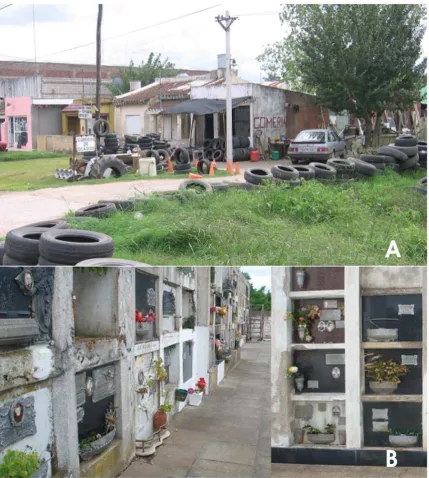
places (Figure 1C and Table 1) (http:// www.indec.mecon.ar). Route Nu2 crosses the most prominent wetland areas of the Pampas, and its construction has definitely reshaped the landscape, making available new humanmanmade wetlands that offer shelter to an increasing diversity of flora and fauna, including mosquitoes [19]. On this artery there are some small towns that offer several travel services such as tire-repair stations, or ‘‘gomerı´as’’, which store used automobile and truck tires for long periods of time; thus these tires accumu-late rainwater (Figures 2 and 3A).
More-over, along this highway many vehicles transport goods from the north of the country to the coastal area without any sanitary control to prevent insect exchange from one region to the other. The latest scientific southernmost record ofA. aegypti
detected in Buenos Aires Province was obtained in Chascomu´s, a town located on Route Nu2 [11]. Route Nu2 takes the bulk of the traffic and people in a southeastern direction. On the other hand, Route Nu11, connecting Buenos Aires and La Plata cities with the Atlantic coast, is a short motorway parallel to the coastline,
and Route Nu226 runs southwest and is mostly used by freight transport (Figure 1C).
Present Distribution of
A.
aegypti
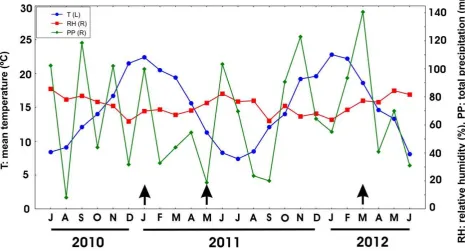
in the Most Populated Areas of Buenos Aires Province [image:3.612.63.555.78.222.2]In order to understand the status of the southern distribution of A. aegypti, we sampled mosquito larvae and pupae during the rainy period, in January and March 2011, and only in March 2012, because rainfall levels were very low in
Table 1.Characteristics of cities connected by Route Nu2 in Buenos Aires Province (http://www.censo2010.indec.gov.ar/).
City Area (km2) Population Size Number of Households
Buenos Aires 2,681 12,801,365 3,147,638
Chascomu´s 3,452 38,477 18,277
Lezama 1,102 4,111 Ndb
Castelli 2,063 8,206 3,448
Dolores 1,973 26,601 10,687
General Guido 2,814 2,814 1,508
Maipu´ 2,641 10,172 4,375
Mar del Plata 1,461 618,989 308,570
MdP, summer timea 1,461 2,000,000 Ndb
aMdP, Mar del Plata. bNo data.
doi:10.1371/journal.pntd.0001963.t001
Figure 2. Weather conditions of the studied area, from July 2010 to June 2012.On the left mean temperature inuC (T), on the right % of relative humidity (RH) and total precipitation in mm (PP). http://www.tutiempo.net/clima. Arrows indicate sampling times.
[image:3.612.60.526.445.696.2]January 2012 (Figure 2). The sampling stations were located in towns situated along Route Nu2 and the other two major arteries that connect Buenos Aires with the south. The sampling stations were ceme-teries that are far from the towns and are infrequently visited, and gomerı´as located in densely populated areas of each town, both at the edge of the roads (Figure 3 and Table 2). Larval specimens were collected and reared until fourth instar or adult stage to facilitate identification using specific keys [13,20]. Voucher specimens,
prepared from all localities, were submit-ted to the local museum, Museo de Ciencias Naturales ‘‘Lorenzo Scaglia’’ (Mar del Plata, Argentina).
Larvae ofA. aegyptiwere found in March 2011 and 2012 in Chascomu´s, agreeing with and confirming previous records [11,13]. Here we report the finding ofA. aegypti in the towns of Lezama, Castelli, and Dolores, to our knowledge for the first time. A population of mosquitoes was found in Lezama in March 2011, 39.2 km southeast of Chascomu´s; both localities are
[image:4.612.62.492.59.538.2]separated by farmland and uniquely connected by Route Nu2. As a high number of larvae of all stages and pupae were found in multiple containers in Lezama, we feel confident that this locality holds a natural, well-established popula-tion. In March 2012, we found a higher number of larvae of all stages and pupae in the same type of containers for a second time in Lezama, and for the first time in Castelli (27.7 km south from Lezama) and Dolores (59.5 km south from Lezama), making Dolores the southernmost limit of Figure 3. Sampling locations in Buenos Aires province.(A) Tire-repair stations showing tires with accumulated rainwater. (B) Flowerpots at cemeteries.
the species’ range within Argentina, now 98.7 km south of Chascomu´s (Figure 1C). In Routes Nu11 and 226,A. aegyptiwas not found in any of the water containers examined.
In the south of Argentina,A. aegypti is very likely to be moving by passive dispersal using the major highway con-necting the north with the southeast of the country. It is noteworthy that this same behavior has been studied and document-ed in a closely relatdocument-ed speciesA. albopictus
in the US. Previous observations on this mosquito in North America are consistent with the hypothesis of mosquito migration facilitated by anthropic action, presumably by transportation of scrapped tires through the interstate highway system [17]. InA. aegypti, egg resistance in the absence of water, a feature shared with A. albopictus, can lead to a similar way of transferring to new places in order to breed. Therefore, passive dispersal of Aedes species using frequented freeways should be considered when designing new A. aegyptimonitoring programs.
According to Shepherd et al. [21], dengue virus transmission follows two general patterns: epidemic dengue and hyperendemic dengue. Epidemic dengue transmission occurs when dengue virus is introduced into a region as an isolated event that involves a single viral strain. If the number of vectors and susceptible hosts are sufficient, explosive transmission can occur with an infection incidence of 25%–50%. Hyperendemic dengue trans-mission is characterized by the circulation of multiple viral serotypes in an area with susceptible hosts and competent vector (with or without seasonal variation) and appears to be a major risk for dengue hemorrhagic fever. Travelers to these areas are more likely to be infected than travelers going to areas that experience only epidemic transmission.
In South America, particularly in Bue-nos Aires Province, it is known that the provincial health ministry has a program of surveillance ofA. aegypti, which involves the monitoring and control of mosquito larvae and eggs. However, this
surveil-lance does not follow a regular pattern, being erratic in terms of time, and each council or municipality decides whether to carry it on or not. In addition, sometimes it is difficult to obtain official data.
The new biogeographical record of central and southern Argentina, reported in this article, is an important fact of the constant expansion of A. aegyptiinto new southernmost areas. Together with the presence of the different dengue serotypes, this expansion indicates that the situation is far more dangerous than previously thought. Urgent and responsible actions must be taken to control the dengue vector and its expansion into new areas.
Acknowledgments
We especially thank Prof. Ana Tassi for critical revision of the manuscript. LMDN is a PhD student at the National University of Mar del Plata. AM is Research Assistant of Comisio´n de Investigaciones Cientı´ficas (CIC), Argentina. CMB is a Research Fellow. This work is part of LMDN’s PhD thesis.
References
1. Becker N, Petric´ D, Zgomba M, Boase C, Dahl C, et al. (2003) Mosquitoes and their control. New York. Kluwer Academic/Plenum Publishers. 498 p.
2. Pialoux G, Gau¨ze`re BA, Jaure´guiberry S, Strobel M (2007) Chikungunya, an epidemic arbovirosis. Lancet Infect Dis 7: 319–327.
3. Gubler DJ (2012) The economic burden of dengue. Am J Trop Med Hyg 86: 743–744. 4. Lounibos LP (2002) Invasions by insect vectors of
human disease. Annu Rev Entomol 47: 233–266. 5. Berry WJ, Craig GB (1984) Bionomics ofAedes atropalpus breeding in scrap tires in northern Indiana. Mosq News 44: 476–484.
6. Pan-American Health Organization (1994) Den-gue and denDen-gue hemorrhagic fever in the Americas: guidelines for prevention and control. Washington: PAHO Scientific Publication Nu
548. 98 p.
7. Albrieu Llina´s G, Gardenal CN (2012) Phyloge-ography of Aedes aegypti in Argentina: long-distance colonization and rapid restoration of fragmented relicts after a continental control campaign. Vector Borne Zoon Dis 12: 254–261. 8. Gubler DJ (1998) Dengue and dengue hemor-rhagic fever. Clin Microbiol Rev 11: 480–496. 9. Gaudino NM (1916) Dengue. Rev San Mil 15:
617–627.
10. Curto SI, Boffi R, Carbajo AE, Plastina R, Schweigmann N (2002) Reinfestacio´n del territorio argentino porAedes aegypti. Distribucio´n geogra´fica (1994–1999). In: Salomo´n OD. Actualizaciones en Artropodologı´a sanitaria Argentina. Buenos Aires: Fundacio´n Mundo Sano. pp. 127–137. 11. Rossi GC, Lestani EA, D’Oria JM (2006) Nuevos
registros y distribucio´n de mosquitos de la Argentina (Diptera: Culicidae). Rev Soc Entomol Argent 65: 51–56.
12. Macia´ A (2006) Differences in performance of
Aedes aegyptilarvae raised at different densities in tires and ovitraps under field conditions in Argentina. J Vector Ecol 31: 371–377. 13. Rossi GC, Mariluis JC, Schnack JA, Spinelli GR
(2002) Dı´pteros vectores (Culicidae y Calliphor-idae) de la provincia de Buenos Aires. La Plata: COBIOBO Nu4. PROBIOTA Nu3. 45 p. 14. Schweigmann N, Orellano P, Kuruc J, Vera TM,
Vezzani D, et al. (2002) Distribucio´n y abundan-cia de Aedes aegypti (Diptera: Culicidae) en la ciudad de Buenos Aires. In: Salomo´n OD. Actualizaciones en Artropodologı´a sanitaria Ar-gentina. Buenos Aires: Fundacio´n Mundo Sano. pp. 155–160.
[image:5.612.64.554.77.222.2]15. Vezzani D, Carbajo AE (2008)Aedes aegypti,Aedes albopictus, and dengue in Argentina: current knowledge and future directions. Mem Inst Oswaldo Cruz 103: 66–74.
Table 2.Sampling stations and species collected in cities along Route Nu2, in the southeast of Argentina.
City 2011 2012
Flowerpotsa Culex sp. A. aegypti Tire-Repair Stationsb Culex sp. A.
aegypti Flowerpotsa
Culex sp. A. aegypti Tire-Repair Stationsb Culex
sp. A. aegypti
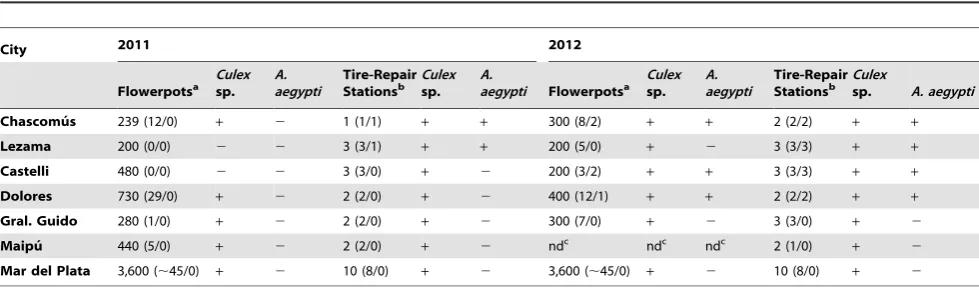
Chascomu´s 239 (12/0) + 2 1 (1/1) + + 300 (8/2) + + 2 (2/2) + +
Lezama 200 (0/0) 2 2 3 (3/1) + + 200 (5/0) + 2 3 (3/3) + +
Castelli 480 (0/0) 2 2 3 (3/0) + 2 200 (3/2) + + 3 (3/3) + +
Dolores 730 (29/0) + 2 2 (2/0) + 2 400 (12/1) + + 2 (2/2) + +
Gral. Guido 280 (1/0) + 2 2 (2/0) + 2 300 (7/0) + 2 3 (3/0) + 2
Maipu´ 440 (5/0) + 2 2 (2/0) + 2 ndc ndc ndc 2 (1/0)
+ 2
Mar del Plata 3,600 (,45/0) + 2 10 (8/0) + 2 3,600 (,45/0) + 2 10 (8/0) + 2
aNumber of flowerpots sampled, in brackets positive ones for
Culexsp. and forA. aegypti, respectively.
bThe number ofA. aegyptiwas 500 larvae or more in each tire-repair station, in brackets positive ones forCulexsp. and forA. aegypti, respectively. cNo data.
16. Sprenger D, Wuithiranyagool T (1986) The discovery and distribution ofAedes albopictus in Harris County, Texas. J Am Mosq Control Assoc 2: 217–219.
17. Moore CG, Mitchell CJ (1997)Aedes albopictusin the United States: ten-year presence and public health implications. Emerg Infec Dis 3: 329–334. 18. Hemme RR, Thomas CL, Chadee DD, Severson DW (2010) Influence of urban landscapes on population dynamics in a short-distance migrant
mosquito: evidence for the dengue vectorAedes aegypti. PLoS Negl Trop Dis 4: e634. doi: 10.1371/journal.pntd.0000634
19. Schnack JA, de Francesco FO, Colado UR, Novoa ML, Schnack EJ (2000) Humedales antro´picos: su contribucio´n para la conservacio´n de la biodiversidad en los dominios subtropical y pampa´sico de la Argentina. Ecologı´a Austral 10: 63–80.
20. Darsie RF, Mitchell CJ (1985) The mosquitoes of Argentina. In: Lewis T. Nielsen. Mosquito systematics. Utah: American Mosquito control Association. pp. 153–253.
![Figure 1. Aedes aegyptiPlata cities, sampling points, and distances between them. (A and B) adapted from Curto et al., Vezzani and Carbajo [10,15], and http://www.healthmap.org/dengue/index.php.dengue-like epidemic; 1986, re-infestation locations; and biog](https://thumb-us.123doks.com/thumbv2/123dok_es/4769690.62280/2.612.58.517.68.587/aegyptiplata-sampling-distances-vezzani-carbajo-healthmap-infestation-locations.webp)