Universitat Pompeu Fabra
Departament d’Economia I Empresa
Doctoral Thesis
Essays on Individual Choice
Rafael López
Supervisor:
Fernando Vega-Redondo
ABSTRACT
This thesis can be divided into two (unrelated) parts. The main part (Chapters 1 and 2)
focus on addiction models that entail departures from the classical discounting utility
model of Individual Intertemporal Choice: Habit-Formation and Self-Control problems.
The other part (Chapter 3) studies the famous p-Beauty Contest Game when we restrict
the individual’s choices to integer numbers.
In the first part, habit formation is the key feature for a product being addictive: a habit
is created when past consumption of the product increases current desire for
consumption. An addiction can be either beneficial (when past consumption increases
current utility, e.g. jogging) or harmful (when past consumption decreases current
utility, e.g. drug consumption). In general one could conceive of harmful addictions as
habit-forming activities that imply an immediate reward but generate future costs
(negative internalities) whereas beneficial addictions imply an immediate cost but
generate future rewards (positive internalities). Self-control problems are understood in
terms of time inconsistency: they arise when the individual cannot keep up with an
intended intertemporal plan of consumption.
In Chapter 1 we analyse a (harmful) addiction model proposed by O'Donoghue and
Rabin (O&R) for which they obtain a counterintuitive result: full awareness of
self-control problems may exacerbate over-consumption. We show that this result arises
from their particular equilibrium selection for the induced intrapersonal game. We
provide dominating Markov Perfect equilibria where the paradox vanishes and that
seem more ''natural'' since they capture behaviours often observed in the realm of
addiction. We also address the issue of why a person could decide to start consuming
and possibly develop an addiction: contrary to O&R, and according to the common
intuition, we show that naiveté is at the essence.
In Chapter 2 we obtain an isomorphism between harmful and beneficial addictions in a
discrete-time binary choice context (the model of the first chapter being a particular
case of this context). The equivalence thus established allows us to study both
phenomena (harmful and beneficial addictions) as two sides of the same coin. Besides
the theoretical insight it provides, this dualism is also useful: in particular, it permits to
readily translate the results obtained in the first chapter to the domain of beneficial
addictions. Once the dualism is established, we analyse addictions under both
time-consistent and time-intime-consistent preferences.
A mis padres y hermanas,
Contents
1 Addiction and Self-Control: an Intrapersonal Game 1
1.1 Introduction . . . 1
1.2 The O&R Model . . . 6
1.2.1 Time Consistent Individuals (TC) . . . 7
1.2.2 Individuals with Time Inconsistent Preferences (TI): Naifs and So-phisticates . . . 9
1.3 The O&R Results . . . 12
1.3.1 ORE and the Inevitability Condition (IC) . . . 14
1.4 MPE in Cuto¤ Strategies (CE) . . . 16
1.5 Non-cuto¤ Equilibria: some examples. . . 20
1.5.1 IC holds: “I won’t hit because if I do it I will do it forever”. . . 20
1.5.2 “Take a walk on the wild side” . . . 21
1.6 Developing an Addiction: kHR > kOR= 0 . . . 24
1.7 Discussion. . . 27
1.8 Appendix - Proofs . . . 30
1.8.1 Proposition 5 . . . 30
1.8.2 Claim used in Lemma 15 . . . 33
1.9 Appendix - Examples . . . 34
1.9.1 An example where wws fails to be an equilibrium. . . 34
1.9.2 An example satisfying kHR< kOR< k < kOR+ 1 + 1 and IC. 35 1.9.3 An example satisfying kHR < kOR< k < kOR+ 1 + 1 but not IC. . . 36
1.9.4 t naiveness: an example where the realized behavior path involves hitting a …nite number of times. . . 36
Bibliography 38 2 Bene…cial and Harmful Addictions: Two sides of the same coin 41 2.1 Introduction . . . 41
2.2 The Model . . . 44
2.2.1 Binary Activity Choice Accumulation Problem (BACAP) . . . 44
2.2.3 Some examples presenting Addiction. . . 50
2.3 Bene…cial Addictions under Time Consistency . . . 53
2.3.1 and convex . . . 53
2.3.2 and concave . . . 55
2.3.3 Assuming Convexity . . . 58
2.4 Bene…cial Addictions under Time Inconsistency . . . 59
2.4.1 Naif behavior . . . 60
2.4.2 Sophisticated behavior . . . 61
2.4.3 Naiveté vs. sophistication . . . 62
2.5 Concluding remarks . . . 65
2.6 Appendix . . . 67
2.6.1 Example 1: a= 0:4;b= 9;c= 10;e= 1; = 0:5; = 0:8 . . . 68
2.6.2 Example 2: a= 0:4;b= 9;c= 10;e= 1; = 0:5; = 0:65. . . 76
Bibliography 80 3 Onp-Beauty Contest Integer Games 81 3.1 Introduction . . . 81
3.2 Nash Equilibria of a p-BCIG . . . 83
3.3 Experimental Implications . . . 90
3.4 Theoretical Predictions for the p-BCIG . . . 91
3.5 Conclusions . . . 95
Acknowledgments
I wish to thank my advisor, Fernando Vega-Redondo for his continuous support and
encour-agement during all these years. I am deeply indebted to him specially for the enthusiasm
and friendship he showed throughout this research.
I would also like to thank Antonio Cabrales and Xavier Calsamiglia for their
en-couragement and suggestions to improve this research as well as for “being there”whenever
needed. I am also grateful to Rosemarie Nagel for her dedicated supervision of the third
chapter of this thesis.
Helpful comments were made by Fabrizio Germano, Sjaak Hurkens, Matthew
Ell-man and seminar participants at Universitat Pompeu Fabra, Universitat d’Alacant and the
Central European University. For the time I spent at Barcelona and Alicante during the
completion of this project, I am grateful to the Economics Department of Universitat
Pom-peu Fabra and the FAE Department of Universitat d’Alacant for making me feel like at
home.
Special mention deserve my friends at Barcelona and Alicante that provided me
with love and shelter whenever needed during all these years. Finally, I would like to thank
my parents and my sisters for their unconditional love without which this simply would
Chapter 1
Addiction and Self-Control: an
Intrapersonal Game
1.1
Introduction
Mr. XY goes to a party where he is o¤ered a pill - call it Panacea - by Miss XX.
He knows for sure that if he takes it he will experience immediate pleasure but he is also
aware that some of his neuronal cells will pay for his decision. Since most humans, and
particularly XY, use but a small fraction of their brain capacity, he might as well give up
those neuronal cells without experiencing a signi…cant loss. However, he is also aware that
pill would lead to some more which altogether will produce a certain brain clash. Should
I stay or should I go? XY asked to himself. As the indecision bothered him, he evaluated
whether the immediate pleasure o¤set the future brain damage and proceeded accordingly.
We may not know whether XY took Panacea or not, but we certainly know that
*
* A revised version of this chapter was published in: Revista Desarrollo y Sociedad, 58, pg 1-35, 2006. Universidad de Los Andes, Bogotá, Colombia.
he is a rational forward-looking person: when adopting his decision he knew the future
con-sequences of his choice. Mr. XY was perfectly aware of the two characteristics constituting
the crux of an addictive substance, namely, thehabit-forming property (present pill raising
future consumption); and the negative internalities induced by consumption (present pill
reducing future well-being, via the brain clash).
In their famous work, Becker and Murphy (1988) modeled consumption of a good
presenting these two features as a rational process where addiction is understood as the
outcome of intended behavior (i.e., intertemporal utility maximization) under perfect
fore-sight. In particular, their Rational Addiction model implies that an addict does not regret
his previous decisions and perfectly forecasts his future consumption; two elements that
have largely been criticized (surveys of these critics are found in Chaloupka and Warner
1998 and Messinis 1999). On psychological grounds, addiction certainly entails planned
behavior but it also involves self-control problems that give rise to regret and misprediction
of future conduct. This is clearly illustrated by Heyman (1996):
Drug consumption is a goal oriented act. The behaviors are learned, not re‡exive or innate. It requires planning, e¤ort, and in some cases artfulness to secure drugs in the amount necessary for maintaining an addiction. Yet, according to the diagnostic manuals (e.g., DSM-III-R and ICD-10), the feature that de…nes addiction is drug use which is ‘out of control’ or ‘compulsive’. By these phrases, the manuals mean that addicts ‘take more drug that they initially intended’, that drug use persists despite a wide array of ensuing legal, medical, and social problems, and that after periods of abstinence, however long, addicts relapse.
As Gruber and Koszegi (2001) point out, “The term ‘rational addiction’obscures
the fact that the Becker and Murphy model imposes two assumptions on consumer
behav-ior. The …rst is that of forward-looking decision-making, which is hard to impugn (...).
documents overwhelmingly that consumers are time inconsistent” (page 16).
Recently and in di¤erent contexts, many economists have studied self-control
prob-lems modeling them in terms of the time inconsistency derived from non-exponential
dis-counting1. Supported by empirical evidence showing that subjects exhibit declining discount
rates (e.g. Thaler (1991); Loewenstein and Prelec (1992)), most of these studies use
hyper-bolic discounting (for an excellent review on hyperhyper-bolic discounting and time preference see
Frederick, Loewenstein and O’Donoghue (2002)).
O’Donoghue and Rabin (2002) (from now on O&R) combine the Becker and
Mur-phy approach with hyperbolic discounting2 in their modeling of addiction. In their
frame-work, an in…nitely lived individual3has to decide at each period whether to consume or not
a free addictive product; i.e. a product presenting the habit-forming and negative
internali-ties features. As in the Becker-Murphy model, the individual is perfectly aware of these two
features. But due to the time inconsistent preferences embodied in hyperbolic discounting
the individual may not be able to follow his optimal consumption path thus giving rise to
self-control problems. Concerning the awareness of these problems, they distinguish two
extreme types of individuals: naifs, who are totally unaware; and sophisticates, who are
1
This approach to model self-control problems derives from the pioneering work by Strotz (1956) who noted that when using a non-exponentional discount function intertemporal utility gives rise to time incon-sistency in the sense that an optimal plan at some particular date may no longer be optimal at further dates. However, self-control problems may also be modeled while maintaining time consistency (i.e. exponential discounting). For instance, Laibson (2001) and Bernheim and Rangel (2003) model self-control problems by introducing cue-conditioned behavior. In their models, environmental cues may trigger a "hot" mode in which the individual consumes the addictive substance disregarding its future consequences (i.e. she "looses control").
2The speci…c discounting functional form they use (which we formally present in Section 2) is not really
hyperbolic but it captures the essence of hyperbolic discounting, namely, present-biased preferences. It was …rst introduced by Phelps and Pollack (1968) and because of its simplicity and tractability, it has been widely used to model self-control problems since the work of Laibson (1994).
3
perfectly aware. A naif believes that his future selves will follow his optimal consumption
path thus choosing his current action accordingly. But because of his time inconsistent
preferences, his future selves will often revise the optimal plan hence yielding a di¤erent
path from the one intended. As a consequence, a naïf usually falls in over-consumption
(note that this result captures Heyman’s description “addicts take more drug that they
initially intended”). A sophisticate knows that the optimal consumption path he is aiming
at may be revised by his future selves and thus may not be followed. Therefore he chooses
his current action according to the best path that can be pursued by his future selves. In
a sense, a sophisticate is playing an intrapersonal game: he plays against his future selves.
The solution concept they propose is that of perception-perfect strategy equilibrium4 (from
now on we will refer to it as the ORE). However, the ORE has the shortcoming of producing
a counterintuitive result: under some circumstances, sophisticates will consume always (i.e.
become addicted) while naifs might not. As they point out, this “contradicts the common
intuition that harmful addictions are caused by people naively slipping into an unplanned
addiction”. Following O&R we will refer to those circumstances as theinevitability condition
(IC from now on).
In the present chapter we show …rst that this conterintuitive result is obtained by
their particular equilibrium selection (ORE) and that there are more “natural”dominating
equilibria where the paradox vanishes; i.e. where sophisticates are less prone to become
addicted than naifs. Since in an intrapersonal game the players are just incarnations of
the same individual, coordination on a dominated equilibrium cannot be supported and
4
therefore we argue that the ORE is not the appropriate selection. Secondly, we address
the issue ofdeveloping an addiction,that is, we analyze the circumstances under which an
unnadicted person could decide to start consuming and whether she could become addicted
or not. In particular, we show that the ORE solution is of no use for studying this issue
since it implies that both naifs and sophisticates will slip into addiction. In contrast, by
considering our results, naifs will become addicted while sophisticates will not which is in
accordance to the common intuition cited above. Finally, we suggest a very clear-cut way
of modeling partial awareness of self-control problems.
The importance of our …ndings can be motivated in terms of policy implications.
Consider for example a public advertising campaign providing information on self-control
problems induced by drug consumption. What such a campaign would normally do is
a shift from naiveness to sophistication given that people become aware of their
time-inconsistency. Under our results such a campaign would be successful in reducing addiction
(since sophisticates are less prone to become addicted than naifs) while under the O&R
result it would produce the opposite e¤ect. Wide existence of such campaigns favors our
results.
The chapter proceeds as follows. In Sections 1.2 and 1.3 we formally present the
O&R model and their results, stating clearly under which circumstances the paradox is
obtained. In Section 1.4 we study equilibria in cuto¤ strategies by providing a complete
characterization: in particular, we state conditions under which the ORE generates the
paradox and yet there is a dominating cuto¤ equilibrium that solves it. But cuto¤ equilibria
dominating equilibria which solve it whenever generated. In Section 1.6 we address the
issue of developing an addiction and argue that the ORE solution fails to explain this issue
while our results prove to be in accordance to the common intuition. Section 1.7 concludes
and suggests a “natural”way of modeling partial awareness of self-control problems, a topic
that so far has received very little attention in the literature.
1.2
The O&R Model
An in…nitely lived individual decides at each periodt, whether to consume (hit) or
not (refrain) a free addictive product. Letatbe the binary variable re‡ecting the individual’s
choice at timet: at= 1meaning he decides to hit whereasat= 0means he decides to refrain.
His period-tinstantaneous utility is given by
8t; u(kt; at) = 8 > > < > > :
x+f(kt) if g(kt) if
at= 1 at= 0
(1.1)
wherektis the individual’s level of addiction which captures all the e¤ects of past
consump-tion on current instantaneous utility. The level of addicconsump-tion is assumed to evolve according
tokt+1 = kt+atwith0< <1. Therefore, there is a maximal addiction levelkmax= 11
. Note that instantaneous utility is stationary in the sense that it depends on the prevailing
level of addiction at period t but not on the particular period t. Addiction is modeled by
making the following assumptions on f; g andx:
Assumption 1: f0; g0<0. This assumption introduces the feature of nega-tive internalities since the more a person has consumed in the past (as captured by his addiction level) the lower his current instantaneous utility. Without loss of generality, it is assumed f(0) =g(0) = 0.
the marginal instantaneous utility of hitting). Then h0(k) > 0 implies that hitting is more desirable the higher the level of addiction; i.e. past consumption of the product (as captured by the addiction level) increases current desire for consumption.
Assumption 3: f00; g00 0. In addition to negative internalities and habit-forming, it is assumed that the more addicted a person becomes the less a given increase in k hurts his instantaneous utility, and therefore less harm hitting induces in future utility.
Assumption 4: x >0. This assumption says that the temptation to hit is positive even for an unaddicted person.
Self-control problems are modeled by assuming present-biased preferences as in
the Phelps and Pollak intertemporal utility function given by:
U(ut; ut+1; :::) =ut+
1
X
=t+1
tu with
2(0;1) (1.2)
where eachu is the period- instantaneous utility given by (1.1). The parameter
intro-duces the present bias.
Before stressing out the implications of (1.2) it is useful to consider the case of a
typical intertemporal utility function with exponential discounting, i.e. (1.2) with = 1.
Following O&R we will refer to a rational forward-looking person having such preferences
as a time consistent individual (TC).
1.2.1 Time Consistent Individuals (TC)
A TC’s preferences are given by
U(ut; ut+1; :::) =ut+
1
X
=t+1
tu (1.3)
De…nition 1 A behavior path A= (a1; a2; :::) is an in…nite sequence of admissible actions;
Three particular behavior paths are of special interest and we will label them as
follows: the hitting path H = (1;1; :::); the refraining path R = (0;0; :::); and the hitting
once path O = (1;0;0; :::) . Let UA
tc(kt) denote the intertemporal utility given in (1.3)
associated to following the behavior pathAfrom an initial addiction levelkt(the stationary
instantaneous utility function implies that the unique payo¤ relevant variable at any date
t is the prevailing addiction level). Being rational forward-looking amounts to saying that
at any given period ta TC solves
max
A2f0;1g1U
A
tc(kt) (1.4)
and then chooses the …rst action corresponding to the solution path . We will refer to
such a solution as a desired behavior path (DBP). For a TC there is time consistency: for
any starting addiction level kt a DBP at some date t is still optimal at any further date.
Therefore a TC has no self-control problems since future selves have no incentives to deviate
from a DBP chosen by a previous self.
O&R show that under stationary instantaneous utility there exists a critical
ad-diction level ktc such that each self solves (1.4) by choosing to hit if and only if kt ktc.
As a consequence, a TC’s DBP is either hitting always or refraining always. We state this
result as a proposition:
Proposition 2 9ktc 2[0; kmax]such that the DBP for a TC with starting addiction levelk
is H if k ktcand R otherwise.
1.2.2 Individuals with Time Inconsistent Preferences (TI): Naifs and
So-phisticates
Let UA(kt) be the intertemporal utility given in (1.2) associated to following the
behavior path A from an initial addiction levelkt . A rational forward-looking individual
with time inconsistent preferences aims at solving
max
A2f0;1g1U
A(k
t) (1.5)
However, in this case there is time-inconsistency: a DBP (a behavior path solving (1.5)) at
datetmay no longer be optimal at a further date, in the sense that future selves may have
incentives to deviate from it thus giving rise to self-control problems. O&R distinguish two
types of individuals with preferences induced by (1.2): Naifs, who are totally unaware of
their time-inconsistency; and Sophisticates who are fully aware of their time-inconsistency.
A Naif believes that he has no self control problems, that is, he believes that any optimal
plan he chooses will be followed by his future selves. Thus, at any given period, a naif simply
chooses his current action according to the path solving (1.5), but the chosen path may be
systematically revised at further periods. A Sophisticate is perfectly aware of his self-control
problems, he knows that the path he is aiming at may be revised by his future selves and
thus may not be followed. Therefore the best he can do is to maximize (1.5) subject to the
condition that the chosen path will be followed by his future selves. A sophisticate is thus
playing an intrapersonal game where his opponents are his future selves.
We turn now to study the DBP for a TI. First notice that a TI would like to
behave like a TC from next period on . Therefore, given Proposition 2, a TI’s DBP (i.e.
period on.
This leaves us with only four possibilities for the DBP, we discard one of them
with the following Lemma.
Lemma 3 A= (0;1;1; :::) cannot be the DBP for a TI.
Proof. Suppose9k such thatA is the respective DBP. Then it must be true that
k > k ktc and therefore UtcH(k)> UtcA(k). But then
UtcH(k) =u(1; k) + UtcH( k+ 1)> u(0; k) + UtcH( k) =UtcA(k)
which implies
u(0; k) u(1; k)< UtcH( k+ 1) UtcH( k) UtcH( k+ 1) UtcH( k)
where the last inequality follows from UtcH( k+ 1) UtcH( k) 0:Therefore
UH(k) =u(1; k) + UtcH( k+ 1)> u(0; k) + UtcH( k) =UA(k)
A contradiction.
Lemma 3 implies the following proposition.
Proposition 4 For any given starting addiction level k, the DBP of a TI admits only one of the following possibilities (we assume he hits when indi¤ erent): H, R or O.
Proposition 5 Let A be any behavior path. Then
1. UA(k) is decreasing.
Part 1 follows directly from negative internalities while part 2 obtains mainly from
the habit-forming assumption (it also requires convexity off and g or at least them being
not too much concave). Note that, in particular, part 2 implies @U@kH(k) @U@kO(k) @U@kR(k) . The formal proofs are given in the appendix.
Following O&R, we will de…ne now three important levels of addiction:
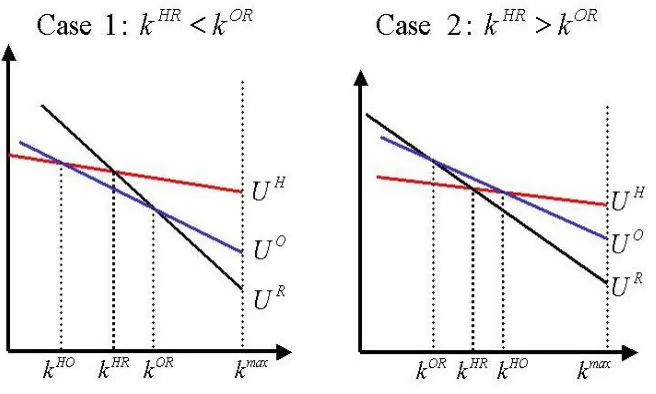
kHR: addiction level such that always hitting is preferred to always refrain if and only if k kHR. Formally, letkebe the solution toUH(k) =UR(k), thenkHR= maxh0;kei
follows from Proposition 5, part 2.
kOR: addiction level such that hitting once is preferred to always refrain if and only if
k kOR. Formally, letkebe the solution toUO(k) =UR(k), thenkOR= max
h
0;ke i
follows from Proposition 5, part 2.
kHO: addiction level such that hitting always is preferred to hitting once if and only if
k kHO. Formally, letkebe the solution toUH(k) =UO(k), thenkHO= maxh0;kei
follows from Proposition 5, part 2
Remember that the law of motion of kimplies a maximum addiction levelkmax=
1
1 . According to the formal de…nitions of k
HR; kOR and kHO it could be the case that
some of them are abovekmax. We will say thatkHR; kOR and kHO exist if all of them are belowkmax. Because of Proposition 5, part 2, existence ofkHR; kOR andkHO is equivalent to requiring UH(kmax) UO(kmax) UR(kmax). We will assume throughout that this condition holds.
Figure 1: kHR and kOR are not rankable
From Propositions 4 and 5 we obtain
Proposition 6 a TI’s DBP is
1. R; for any k <min kHR; kOR
2. H; for any k max kHR; kHO
3. O; for any k2 kOR; kHO
1.3
The O&R Results
In the previous section we established the DBP for both TC and TI individuals.
We are interested now in determining the realized behavior path (RBP), that is, the path
actually followed for each type of individuals. This amounts to specifying the actions to
of utility functions and the in…nite horizon it seems natural to make those actions
time-independent: at a particular date, the action of an individual should depend only on the
prevailing addiction level since this is the only payo¤ relevant variable; the calendar time is
irrelevant. Since both a TC (correctly) and a Naif (wrongly) believe that they are able to
follow their respective DBP, O&R show that they implement cuto¤ actions. We state their
results in the following propositions.
Proposition 7 Let tc(k)be the action taken by a TC when his addiction level isk. Then, 9ktc 2[o; kmax]such that tc(k) = 1()k ktc. Therefore, the RBP of a TC is either H
or R.
Proposition 8 Let n(k)be the action taken by a Naif when his addiction level isk. Then, n(k) = 1
()k min kOR; kHR =kn. Therefore, the RBP of a Naif is eitherH orR.
Proposition 7 comes directly from Proposition 2. Proposition 8 comes from the fact
that a naif, believing that he is going to be able to follow his DBP, will decide to hit if and
only if his DBP is eitherH orO. But this happens if and only ifk min kHR; kOR =kn. O&R also show thatkn ktc, an intuitive result since a naif discounts the future at a higher rate than a TC and therefore the future harm of hitting is lower for a naif than for a TC.
Let’s turn now to the sophisticate case. Because of his awareness of self-control
problems, a sophisticate is involved in strategic considerations. The natural solution concept
to be called upon for the sophisticate’s intrapersonal game is that of Markov Perfect
Equi-librium (MPE). Among the multiple MPE for the in…nite horizon case, O&R only consider
the one corresponding to the limit of the unique …nite-horizon MPE as the horizon becomes
this particular equilibrium selection depends heavily on whether the following condition is
satis…ed or not.
1.3.1 ORE and the Inevitability Condition (IC)
We say that IC holds if and only if UH(0) U(0;1;1;:::)(0). Let s(t; k) denote the strategy played by a sophisticated self-t in the ORE. Notice that we are allowing for
the strategy to depend on the particular period t. This is so because with a …nite horizon
the strategy usually depends on the prevailing period and nothing ensures us that when
taking the limit as the horizon becomes long we obtain a time-independent strategy. O&R
completely characterize the ORE when IC holds and partially when it is not satis…ed. We
state their results in the following proposition.
Proposition 9 Partial Characterization of the ORE.
1. If IC holds then 8t; k; s(t; k) = 1; i.e. the sophisticate’s RBP in the ORE is H.
2. If IC is not satis…ed then
(a) If kOR+ 1 kHR then s(t; k) = 1 if and only if k kHR
(b) If kOR+ 1< kHR then s(t; k) =
8 > > > > > > < > > > > > > :
0 if k < kOR
? if kOR k < kHR
1 if k kHR
Two striking features of the ORE are to be mentioned. Concerning part 1 notice
that when IC holds a sophisticate is more prone to become addicted than a naif since a
hit if and only if k min kHR; kOR ). As O&R point out, this “contradicts the common intuition that harmful addictions are caused by people naively slipping into an unplanned
addiction”. However, we claim that this counterintuitive result is obtained by the particular
equilibrium selection proposed by O&R (i.e. the ORE) and that it vanishes when
consid-ering other type of MPE. Moreover, we claim that there are more “natural” MPE where a
sophisticate, even under IC, will never be more prone than a naif to develop an addiction.
We will address this issue in the following sections.
Concerning part 2, notice that the counterintuitive result vanishes: a sophisticate
will never be more prone than a naif to develop an addiction. However, the ORE is left
uncharacterized for k 2 kOR; kHR . This characterization is a very complicated task: as O&R point out, for this case “sophisticates’behavior can be quite complicated...In fact,
because of these complications sophisticates need not follow a stationary strategy or a cuto¤
strategy”. However, we will provide conditions under which a cuto¤ strategy is a MPE. We
also construct non-cuto¤ equilibria that seem very natural (even under IC).
Since IC plays such an important role in the O&R results, we close this section by
proving part 1 of Proposition 9 which in fact is an immediate consequence of the following
Lemma whose proof is provided in the appendix.
Lemma 10 IC implies 8k; UH(k) U(0;1;1;:::;1)(k) for H and (0;1;1; :::;1) paths of arbi-trary length T .
To see that Lemma 10 implies 8t; k; s(t; k) = 1, consider a …nite horizonT. In
period T a sophisticated will hit independently of his addiction level because the
obviously no future costs of hitting. Self-T 1, knowing that self-T will hit no matter what
he does, only has to choose between paths(1;1)and (0;1). But Lemma 10 says that (1;1)
is preferred for any prevailing addiction level at period T 1 and therefore self-T 1 will
hit independently of his addiction level. Proceeding by backward induction we obtain that
a sophisticate will hit in every period. Since this holds for an arbitrarily path lengthT, in
the limit we obtain that a sophisticate will always hit; i.e. ORE generates pathH.
Since the ORE solution proves to be unsatisfactory, we turn now to study other
sort of MPE. Because TCs and naifs follow cuto¤ actions, we begin by studying MPE in
cuto¤ strategies for sophisticates.
1.4
MPE in Cuto¤ Strategies (CE)
In this section we will characterize CE, i.e. MPE where all selves play the same
cuto¤ strategy
(k) =
8 > > < > > :
0 if k < k
1 if k k
Lemma 11 for k= 0, (k) is a CE if and only if IC holds.
Proof. Suppose (k) is a CE and consider an unaddicted self deviating to some strategy prescribing (0) = 0. The path generated by deviating is (0;1;1; :::) while the
path generated by sticking isH. For the deviation to be non-pro…table we need UH(0)
Lemma 12 if kHR kOR, (k) with k = kHR is a CE and it dominates any other equilibrium.
Proof. First note that 8k < kHR the DBP is R whereas 8k kHRthe DBP is H. Therefore, by sticking to strategy (k) each self follows his DBP which proves that it
is a dominating equilibrium.
Remark 13 Since in an intrapersonal game the players are di¤ erent incarnations of the same individual, we believe that equilibrium selection should be resolved, whenever possible,
by a Pareto criterion. If there is not a Pareto dominant equilibrium, at least it should be
obvious that a dominated equilibrium should not be played. In the case kHR kOR, (k)
with k = kHR pareto-dominates any other equilibrium so it would be quite unnatural to propose any other solution to this game. However, when IC holds, the O&R solution yields
the hitting path : They argue that this is sustainable if each self has the pessimistic beliefs
that his future selves will hit no matter what his current action is, thus choosing to hit since
the path H yields a higher utility than (0;1;1; :::). But why should every self have those
pessimistic beliefs when they can coordinate on a dominating equilibrium? We believe this
is a major drawback of the ORE.
In a sense, Lemma 12 says that whenever kHR kOR the are no self-control
problems since for any addiction level the DBP for a particular self will be followed by his
futures selves. As a consequence, awareness of time-inconsistency is immaterial: the paths
followed by a naif and a sophisticate are the same since the solution to (1.5) at any period
We will now characterize CE whenkHR > kOR(notice that this implieskHR >0). In what follows we will assume that every self is playing the same cuto¤ strategy . We will
denote byV ( (k))the utility obtained by a self with addiction levelkwhen sticking to ,
whereas V ( (k))will denote his utility when deviating to a particular strategy while all
other selves stick to . Throughout we will assumek >0 since the casek= 0has already
been covered in Lemma 11.
Claim 14 If is a CE thenk=kHR.
Proof. Suppose k > kHR and consider an addiction level k 2 kHR; kOR .
Any strategy prescribing (k) = 1 is a pro…table deviation since V ( (k)) = UR(k)
UH(k) = V ( (k)). Now suppose k < kHR and consider an addiction level k such that
k < k < k < kHR (such ak exists sincek >0). Any strategy prescribing (k) = 0is a
pro…table deviation sinceV ( (k)) =UH(k) UR(k) =V( (k)).
Lemma 15 If kHR> kOR, strategy (k) withk=kHR is a CE if and only if kOR+ 1
kHR:
Proof. Take any k kHR and consider deviating to a strategy prescribing
(k) = 0. The path generated by this deviation is eitherRor(0;1;1; :::). If Ris generated,
the deviation is non pro…table since V ( (k)) = UR(k) UH(k) = V ( (k)) . Now consider (0;1;1; :::) being generated. In the appendix we prove thatU(0;1;1;:::)(k) UH(k)
for any k kOR. Since this is the case we have V ( (k)) = U(0;1;1;:::)(k) UH(k) =
V ( (k))and therefore the deviation is non-pro…table.
to any strategy prescribing (k) = 1 generates path H thus being non pro…table since
V ( (k)) =UH(k) UR(k) =V ( (k)). This proves kOR+ 1 kHR implies is a CE. Now suppose kOR+ 1< kHR. Take any k2 kOR; kHR such that k+ 1< kHR
and consider a deviation to a strategy prescribing (k) = 1. The deviation is pro…table
since it generates path O and V ( (k)) =UO(k)> UR(k) =V ( (k)).
Remark 16 Suppose IC does not hold and kOR+ 1< kHR. Under these circumstances O&R claim that for k 2 kOR; kHR ”sophisticates need not follow a cuto¤ strategy” . Here we go further since Lemma 11 and Lemma 15 imply that under these circumstances
sophisticates cannotfollow a cuto¤ strategy because there is no CE. Also notice that if IC
holds and kOR+ 1 kHR> kORthere are exactly two CE : the one with k= 0 and the one with k = kHR. The latter clearly dominates the former so one would expect the di¤ erent selves to coordinate in the second equilibrium while O&R take as solution to the game the
…rst one.
We summarize our results concerning CE in the following Proposition.
Proposition 17 Characterization of CE and comparison with ORE.
1. If IC holds then
(a) If kOR + 1 kHR then (k) with k = kHR and ORE are the only CE.
(k)dominates ORE.
(b) If kOR+ 1< kHRthen ORE is the unique CE.
(a) If kOR+ 1 kHR then (k) withk =kHR is the unique CE. (k) and ORE coincide.
(b) If kOR+ 1< kHRthen there exists no CE.
If we are to restrict our attention to CE, the case kOR+ 1< kHRis a problematic one. If IC holds then we have the ORE solution which proved to be counterintuitive since
sophistication could exacerbate over-consumption. If IC doesn’t hold then we may have
non-existence of CE. This leads us to study non-cuto¤ equilibria which is done in the following
section.
1.5
Non-cuto¤ Equilibria: some examples.
In what follows, we still restrict ourselves to MPE where the strategies involved
are time-independent. We also focus on the case kOR+ 1 < kHR since the opposite has already been covered.
1.5.1 IC holds: “I won’t hit because if I do it I will do it forever”.
Here we go one step further in resolving IC since we provide a MPE that dominates
ORE whenever IC holds.
Lemma 18 strategy b(k) =
8 > > < > > :
0 if k= 0
1 if k >0
is a MPE.
Proof. For k= 0, sticking to b generates path R while deviating generates path
is neither pro…table since it generates path (0;1;1; :::) which is clearly dominated by H
(Lemma 10).
Remark 19 b dominates the ORE though it does it strictly only for k= 0: when sticking tob an unaddicted sophisticate will never develop an addiction, moreover any self is strictly better-o¤ by sticking to b since it generates his DBP. However, b has the shortcoming of being non robust or fragile, since any small deviation by any self develops the addiction.
Nevertheless, we claim that this equilibrium deserves attention since it captures strategic
decisions often observed in the realm of harmful addictive drugs: Decisions of the sort “I
won’t do it because if I do it I will do it forever” (think of drugs such as heroin).
1.5.2 “Take a walk on the wild side”
We already know that a CE fails to exist if IC is not satis…ed and is equal to the
ORE otherwise (thus being dominated by naive behavior).
Let k = kHR 1, so that hitting with any k k drives the addiction level above
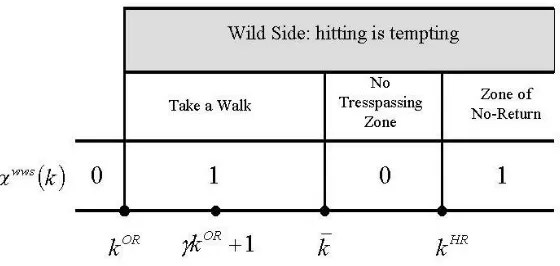
kHR. Consider each self following strategy
wws(k) = 8 > > > > > > > > > > < > > > > > > > > > > :
0 if k < kOR
1 if kOR k < k
0 if k k < kHR
1 if k kHR
Figure 2: The “Take a Walk on the Wild Side” strategy.
There is a wild side ( k kOR) in which hitting is an e¤ective temptation (for k < kORhitting is not e¤ectively tempting because always refrain is the DBP) and therefore
the individual would like to hit (take a walk). In this wild side there is azone of no-return
(k kHR ) since once an individual falls in it he becomes irremediably addicted (he hits forever after). Now notice that hitting leads to the zone of no-return if and only if k k,
therefore k marks the point where a no-trespassing zone (k < k < kHR ) begins. With strategy wwsthe individual hits whenever on the wild side and outside the no-trespassing zone, i.e. he takes a walk but knows when to stop.
Unfortunately, wwsdoes not always constitute an equilibrium. A counterexample is given in the appendix (Example 1.9.1) . However, we will provide some conditions under
which wws happens to be a MPE.
Lemma 20 if kHR< kOR< k < kOR+ 1 + 1 then wws is a MPE. (This Lemma is illustrated in Figure 3. In the appendix we provide examples satisfying the condition stated
with the IC holding, Example 1.9.2, and not holding, Example 1.9.3)
the respective DBP so there is no pro…table deviation. For anyksuch thatkOR k < kHR, by sticking to wws the DBP is generated (and thus there is no pro…table deviation). To see this …rst notice that the DBP is hitting once. Following wws the individual hits and
then drives the addiction level above k but belowkHR, therefore his immediate future self will refrain and, since by doing so he drives the addiction level below kOR, all other future selves will refrain as well. For anyksuch that k k < kHR, wwsgenerates pathR, while
any deviation generates path H. Since R is preferred to H we conclude that there is no
pro…table deviation.
We tackle now the case kHR k < kHO. First notice that necessarily kHO = ktc 1
. Let k0 = kHO, de…ne k1 = k0 1 and suppose the current self has addiction level
k2[k1; k0)\ kHR; k0 . Clearly, by sticking to wwshitting with addiction levelkgenerates pathH . A deviation, i.e. refraining with addiction level k, drives next-period’s addiction
level below k0 = ktc 1 < ktc so from the current self’s perspective the best possible behavior path following restraint is R (because he would like to behave like a TC from
next period on and a TC would like to refrain always for addiction levels belowktc). That is, the best possible behavior path that could be generated by a deviation is R. Since for
addiction level k, H is preferred to R we conclude that there is no pro…table deviation.
But proceeding by induction, the same logic applies for anyk2[ki+1; ki)\ kHR; k0 where
ki+1= ki 1 (i= 0;1; :::) so we …nally conclude that there is no pro…table deviation for any
Figure 3: If kHR< kOR< k < kOR+ 1 + 1 then wws is a MPE.
Remark 21 If IC does not hold (Example 1.9.3) we know that there is no cuto¤ equilibrium, wws proves existence of a non-cuto¤ MPE. If IC holds (Example 1.9.2), we know that the
unique cuto¤ equilibrium is hitting always, then wws constitutes an equilibrium that clearly dominates it, moreover, wws also dominates the fragile equilibrium b given in Lemma 18.
1.6
Developing an Addiction:
k
HR> k
OR= 0
O&R state (page 4) “While Becker and Murphy (1988) argue it can be optimal
for a person tomaintain a severely harmful addiction, their steady-state model provides no
formal analysis of why the person would choose todevelopthis harmful addiction in the …rst
place.” If we are to study why a person could choose to develop an addiction the pertinent
starting addiction level must bek= 0;i.e. we must focus on the behavior of an unaddicted
Figure 4: kHR kOR
In this case the DBP for an unaddicted person is clearlyR, and therefore the addiction will
never be developed since the addictive product is not “tempting”: no incarnation wants to
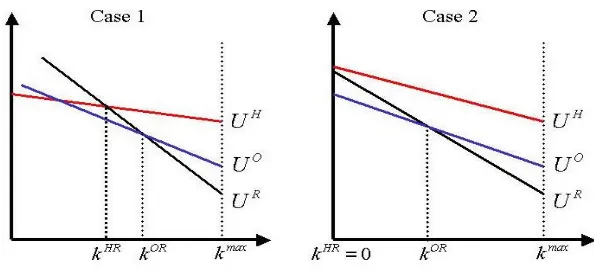
consume it. IfkHR < kOR we should distinguish two cases; kHR >0 and kHR = 0; which are illustrated in Figure 5.
Figure 5: When kHR< kOR we distinguish two cases; kHR>0 and kHR= 0
In Case 1 we also obtain the non-tempting condition that ensures that the addiction will
never be developed. In Case 2, the DBP for an unaddicted person isH and the addiction
[image:31.612.173.470.455.595.2]problems: each self is following his DBP which amounts to saying that the person is a “happy
addict” in the sense that each incarnation behaves precisely as the previous selves desired;
each self wants to consume and wants his future selves to consume as well. Therefore, the
interesting case (the one presenting self-control problems) for studying the development of
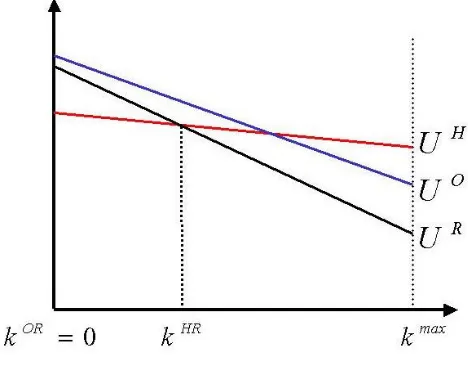
an addiction must involvekHR> kOR= 0as depicted in Figure 6. (the casekHR=kOR= 0
[image:32.612.205.439.278.466.2]is similar to Case 2).
Figure 6: kHR> kOR= 0
In this case the unaddicted person would like to hit just once (his DBP isO). If the person
is a Naif, he will clearly develop the addiction. We turn now to study a sophisticate’s
behavior.
First notice that IC holds which implies that in the ORE a sophisticate will also
develop an addiction. Are there other equilibria in which a sophisticate does not develop
an addiction? The answer is yes since the strategy “I won’t hit because if I do it I will
do it forever” provided in the previous section is clearly a MPE that induces the refraining
dominates the ORE and generates the hitting once path.
Lemma 22 Suppose kHR 1 and consider strategy
(k) =
8 > > > > > > < > > > > > > :
1 if k= 0
0 if k= i for some i2 f0;1;2; :::g
1 if otherwise
This strategy is a MPE that generates path O.
Proof. Whenk= 0, sticking to (k)generates pathOwhich is the DBP, therefore there is no pro…table deviation. For any k = i with i 2 f0;1;2; :::g, sticking to (k)
generates path R. Now …x i and notice that i + 1 > j for any j 2 f0;1;2; :::g, therefore deviating from (k) generates path H which is non-pro…table. For any other k
sticking to (k) generates path H (because for any j 2 f0;1;2; :::g, k+ 1 > j) while deviating generates path (0;1;1; :::) (because ifk6= i for alli2 f0;1;2; :::g, then k6= j
for all j2 f0;1;2; :::g) which is non-pro…table since IC holds.
This equilibrium dominates the ORE, but compared to the strategy “I won’t hit
because if I do it I will do it forever”the initial self (unaddicted person) is strictly better-o¤
while any future self is strictly worse-o¤.
1.7
Discussion.
The O&R set-up seems appropriate for modeling addiction since it incorporates
the two basic features of an addictive substance (habit-formation and negative internalities)
and it allows for self-control problems which have been largely documented in the
rational addiction in which self-control problems were inexistent. However, their particular
equilibrium selection (ORE) for the intrapersonal game induced by sophisticated
behav-ior has the shortcoming of producing a counterintuitive result: awareness of self-control
problems may exacerbate over-consumption.
We have shown that this paradox vanishes when considering other sort of
equi-libria that dominate the ORE and that seem more natural since they capture behaviors
often observed in the realm of addiction. Since in an intrapersonal game the players are
incarnations of the same individual, coordination on a dominated equilibrium is hard to
sustain5. This favors our equilibria over the ORE and therefore we readily obtain that naifs
are more prone to become addicted than sophisticates. The only cases where the ORE is
a dominating equilibrium (and therefore it is the appropriate solution concept to be called
upon) is when the desired behavior path is to consume always or when IC does not hold
and kOR+ 1 kHR:
Another advantage of the O&R set up over the Becker-Murphy model is that it
permits to explain why an unaddicted person could decide to consume and develop an
addiction. We have seen that for this to be possible consumption should be tempting (in
the sense that the desired behavior path cannot be refraining) in which case a naïf will
always become addicted. Regarding sophisticate behavior, we proved that when the DBP
is either hit always or hit once then the inevitability condition must hold and therefore
the ORE implies that a sophisticate will also become addicted. This makes sense only
5Carrillo and Mariotti (2000) obtain a similar conclusion. In their model the consumer is uncertain about
when the DBP is hit always since in this case there are no self-control problems and thus
naïf and sophisticate behavior coincide. But when the DBP is hitting once, we provide
equilibria where a sophisticate will not become addicted which copes with the general view
that addiction is the outcome of naïve behavior.
Naiveness and sophistication are extreme degrees of awareness and one would
ex-pect that real-world behaviors lie somewhere in between. We want to conclude by suggesting
a way to model partial awareness. Very little has been done in this direction: O’Donoghue
and Rabin (2001a) formulate an approach to partial naivete in which a partially naïf agent
is simply a sophisticate who overestimates his present-biased parameter . O’Donoghue and
Rabin (2001b) propose an approach to boundedly rational incomplete awareness in which
agents “don’t do all the rounds of backwards-induction. In other words, instead of starting
the backwards-induction logic in the last period, they might start the process, say, three
periods hence.”. We believe that the …rst approach is somehow ad-hoc while the second is
not applicable to the in…nite horizon case since it relies on the backwards-induction logic.
We suggest a very natural approach: people are initially naïf and as time elapses they
be-come aware of their self-control problems (i.e. they bebe-come sophisticates). This approach
is also suggested by Elster (1999): “reversal experiences can give rise to learning. Once the
person observes himself reversing his decisions time and again, he will come to know that
this is just the way he behaves under these circumstances. In the language of O’Donoghue
and Rabin, he is no longer naive, but sophisticated.”Obviously there would be persons that
become aware more quickly than others; to be more precise, we could de…ne an agent as
formulation, naifs and sophisticates are 1-naifs and0-naifs respectively. This would allow
to observe behaviors which imply hitting for a …nite number of times: an example (Example
1.9.4) is provided in the appendix.
1.8
Appendix - Proofs
1.8.1 Proposition 5
Proof.
1. UA(k) is decreasing. Let kt(A; k) be the addiction level prevailing at time t
con-ditional on following path A with starting addiction level k; i.e. k1(A; k) = k;
kt(A; k) = t 1k+Pti=11 t i 1ai for t= 2;3; :::Then
UA(k) =
2 6 6 4
a1(x+f(k)) +
(1 a1)g(k)
3 7 7 5+ 1 X t=2 t 1 2 6 6 4
at(x+f(kt(A; k))) +
(1 at)g(kt(A; k)) 3 7 7 5
and therefore
@UA(k)
@k =
2 6 6 4
a1f
0 (k) +
(1 a1)g
0 (k)
3 7 7 5+ 1 X t=2 t 1 2 6 6 4
at t 1f
0
(kt(A; k)) +
(1 at) t 1g
0
(kt(A; k)) 3 7 7 5
which is equal to
2 6 6 4
a1f
0 (k) +
(1 a1)g0(k)
3 7 7 5+ 1 X t=1
t 1 t 2 6 6 4
at+1f
0 t
k+Pti=1 t iai +
(1 at+1)g0 tk+Pti=1 t iai 3 7 7
5 (1.6)
and because of negative internalities (Assumption 1: f0; g0 < 0) we readily obtain
2. 8k; @U@kH(k) @U@kA(k) @U@kR(k). Since
UH(k) =x 1 +
1 +f(k) +
1
X t=1
t 1f tk+ t 1 X i=0 i ! we have
@UH(k)
@k =f
0 (k) +
1
X t=1
t 1 tf0 t
k+ t 1 X i=0 i ! (1.7)
from (1.6) and (1.7) we can express @U@kH(k) @U@kA(k) as the sum of the following terms
(1 a1) f
0
(k) g0(k) (1.8)
1
X t=1
t 1 ta t+1
2 6 6 4
f0 tk+Pt 1
i=0 i
f0 tk+Pti=1 t iai 3 7 7 5 (1.9) 1 X t=1
t 1 t(1 a t+1)
2 6 6 4
f0 tk+Pti=01 i
g0 tk+Pt
i=1 t iai 3 7 7
5 (1.10)
(1.8) is positive because of the habit-forming feature (Assumption 2: f0 g0 > 0);
(1.9) is positive because tk+Pti=01 i> tk+Pti=1 t iai andf00 0(Assumption
3) imply
f0 tk+
t 1
X i=0
i !
f0 tk+
t X
i=1
t ia i
!
0 (1.11)
(1.10) is positive because (1.11) and f0 g0 >0 imply
0 < f0 tk+
t X i=1
t ia i
!
g0 tk+
t X
i=1
t ia i
!
f0 tk+
t 1
X i=0
i !
g0 tk+
t X
i=1
t ia i
!
therefore we have
8k;@U H(k) @k
@UA(k)
Since UR(k) =g(k) + P1t=1 t 1g tk we have
@UR(k)
@k =g
0 (k) +
1
X t=1
t 1 tg0 t
k (1.13)
from (1.6) and (1.13) we can express @U@kA(k) @U@kR(k) as the sum of the following terms
a1 f
0
(k) g0(k) (1.14)
1
X t=1
t 1 t(1 a t+1)
2 6 6 4
g0 tk+Pti=1 t iai g0 tk
3 7 7 5 (1.15) 1 X t=1
t 1 ta t+1
2 6 6 4
f0 tk+Pti=1 t iai g0 tk
3 7 7
5 (1.16)
(1.14) is positive by the habit-forming feature; (1.15) is positive because
tk+ t X
i=1
t ia
i tkand g
00
0(Assumption3)
imply
g0 tk+
t X i=1
t ia i
!
g0 tk (1.17)
and (1.16) is positive because (1.17) and f0 g0 >0 imply
0 g0 tk+
t X
i=1
t ia i
!
g0 tk f0 tk+
t X i=1
t ia i
!
g0 tk (1.18)
therefore we have
8k;@U A(k) @k
@UR(k)
@k 0 (1.19)
1.8.2 Claim used in Lemma 15
Claim 23 9k0 such that UH(k) U(0;1;1;:::)(k),k k0. Moreover, k0 kOR.
Proof. If IC holds, we obtain trivially k0 = 0 kOR. So assume that IC doesn’t
hold, that is, UH(0)< U(0;1;1;:::)(0). De…ne (k) =UH(k) U(0;1;1;:::)(k):Simple calcu-lations yield
(k) =x+f(k) g(k) +
1 X n=1 n 1 2 6 6 4
f nk+Pni=01 i
f nk+Pni=02 i
3 7 7 5
Now notice that (k) is continuous and increasing in k (by f0 g0 < 0 and convexity of
f). Since (0)< 0 (because IC doesn’t hold) and (kmax) 0 such ak0 exists, and we
must have k0 = 0which can be rewritten as
x+f k0 g k0 =
1 X n=1 n 1 2 6 6 4
f nk0 +Pni=02 i
f nk0+Pni=01 i
3 7 7
5 (1.20)
Suppose now k0 > kOR: By de…nition of kOR we must have UO k0 > UR k0 which is equivalent to
x+f k0 g k0 >
1 X n=1 n 1 2 6 6 4
g nk0 g nk0+ n 1
3 7 7
5 (1.21)
Substracting (1.20) from (1.21) we obtain
0> 1 X n=1 n 1 2 6 6 4
g nk0 g nk0 + n 1 +
f nk0+Pni=01 i f nk0 +Pni=02 i
3 7 7
5 (1.22)
by convexity ofg we have
g nk0 g nk0+ n 1 g nk0 +
n 2
X i=0
i !
g nk0 +
n 1
X i=0
which together with (1.22) yields 0> 1 X n=1 n 1 2 6 6 4
g nk0+Pni=02 i g nk0 +Pni=01 i +
f nk0+Pni=01 i f nk0 +Pni=02 i
3 7 7 5
which in turn can be rewritten as
0> 1 X n=1 n 1 "
h nk0+
n 1
X i=0
i !
h nk0 +
n 2 X i=0 i !# (1.23)
whereh=f g. But this is a contradiction because his increasing and therefore the RHS
of (1.23) is positive. This completes the proof.
1.9
Appendix - Examples
All the numeric examples that follow use the speci…c instantaneous utility function:
8t; u(kt; at) = 8 > > < > > :
x kt if
( + )kt if
at= 1 at= 0
withx; and positive, which clearly satis…es the conditions given in Section 1.2.
1.9.1 An example where wws fails to be an equilibrium.
In the …rst row we rank the paths R; H and O. In the second row we put the actions
prescribed by the strategy,. The third row establishes the path generated by sticking to the
strategy and the fourth establishes whether this path is the desired behavior path (DBP),
the best possible path (BPP) or none. The …fth row establishes the path generated by
deviating from the strategy proposed in the second row. Finally, the sixth row establishes
whether there is no pro…table deviation (NPD). Consider for example, an addiction level
k 2 hkOR; kHR : For wws to be an equilibrium, the path (0;1;0; :::) must be preferred to H: But this occurs only if U(0;1;0;:::) kHR UH kHR : Parameter values where this doesn’t hold (and therefore wws fails to be an equilibrium), are
= 0:78 = 0:9 = 40:5 = 20 = 0:8 x= 102
1.9.2 An example satisfying kHR < kOR < k < kOR+ 1 + 1 and IC.
1.9.3 An example satisfying kHR< kOR< k < kOR+ 1 + 1 but not IC.
= 0:9 = 0:9 = 40 = 20 = 0:9 x= 101
1.9.4 t naiveness: an example where the realized behavior path involves
hitting a …nite number of times.
Letk0 =kORand de…neki= ki 1+ 1fori= 1;2; :::. Letj= max i:ki kHR
so that j is the maximum number of consecutive hits, starting from kOR, that keep the
addiction level belowkHR. Letk1= k
HR 1
and de…ne ki = ki 1 1 fori= 1;2; :::. Suppose j is odd and UR k2 U1100::: k2 , then the following strategy is a MPE:
(k) =
8 > > > > > > > > > > < > > > > > > > > > > :
0 if k < kOR
1 if kOR k < kj
0 if k2n+1 k < k2n for2n+ 1< j
1 if k2n k < k2n 1 for2n < j
Starting fromkOR, a sophisticate will hit once, a naif will hit forever and: A 1-naif will hit once
A 2-naif and a 3-naif will hit 3 times
A 4-naif and a 5-naif will hit 5 times
...
A j-1-naif and a j-naif will hitj times
An example with j= 5 is given by
Bibliography
[1] Becker, G. S. and K. M. Murphy (1988). “A Theory of Rational Addiction.”Journal
of Political Economy, 96, 675-700.
[2] Bernheim, D. and A. Rangel (2002). “Addiction and Cue-conditioned Cognitive
Processes” Mimeo.
[3] Carrillo, J. and T. Mariotti (2000). “Strategic Ignorance as a Self-Disciplining Device.”
Review of Economic Studies, 67, 529-544.
[4] Chaloupka, F. J. and K. E. Warner (1998). “The economics of smoking.” In Handbook
of Health Economics.
[5] Elster, J. (1999). Introduction in Jon Elster, ed., Addiction: Entries and Exits. New
York: Russell Sage Foundation, ix-xx.
[6] Frederick, S., Loewenstein, G. and O’Donoghue, T. (2002). “Time Discounting and
Time Preference: A Critical Review.”Journal of Economic Literature, 40(2), 351-401.
[7] Gruber, J. and B. Koszegi (2001). “Is Addiction ‘Rational’? Theory and Evidence.”
[8] Heyman, G. M. (1996). “Resolving the Contradictions of Addiction.”Behavioral and
Brain Sciences, 19, 561-610.
[9] Laibson, D. (1994). “Essays in Hyperbolic Discounting.” Economics, MIT.
[10] Laibson, D. (1997). “Golden Eggs and Hyperbolic Discounting.”Quarterly Journal of
Economics, 112, 443-477.
[11] Laibson, D. (2001). “A Cue-Theory of Consumption.”Quarterly Journal of Economics,
116(1): 81-120.
[12] Loewenstein, G. and D. Prelec (1992). “Anomalies in Intertemporal Choice: Evidence
and an Interpretation.”Quarterly Journal of Economics, 107, 573-597.
[13] Messinis, G. (1999). “Habit Formation and the Theory of Addiction.”Journal of
Eco-nomic Surveys, 13, 417-442.
[14] O’Donoghue, T. and M. Rabin (2001a). “Choice and Procrastination.”Quarterly
Jour-nal of Economics, 116(1), 121-160.
[15] O’Donoghue, T. and M. Rabin (2001b). “Self Awareness and Self Control.” To appear
as a chapter inNow or Later: Economic and Psychological Perspectives on
Intertempo-ral Choice, edited by Roy Baumeister, George Loewenstein, and Daniel Read, published
by Russell Sage Foundation Press.
[16] O’Donoghue, T. and M. Rabin (2002). “Addiction and Present-Biased Preferences.”
[17] Phelps, E. S. and R. A. Pollak (1968). “On Second-best National Saving and
Game-equilibrium Growth.”Review of Economic Studies, 35, 185-199.
[18] Strotz, R. H. (1956). “Myopia and Inconsistency in Dynamic Utility Maximization.”
Review of Economic Studies, 23, 165-180.
[19] Thaler, R. (1991). “Some Empirical Evidence on Dynamic Inconsistency.” in Quasi
Chapter 2
Bene…cial and Harmful Addictions:
Two sides of the same coin
2.1
Introduction
Since the seminal work by Becker and Murphy (1988) there has been a
grow-ing body of literature devoted to the study of addiction. Even though the Becker-Murphy
model accounted for both harmful addictions (e.g. drug consumption) and bene…cial
addic-tions (e.g. jogging) most of the recent research has focused solely on the former. However
we believe that there is a variety of economic contexts where bene…cial addictions play an
important role. People might get addicted to sports, living standards, work, high levels of
human capital, etc... As we pointed out in the previous chapter, the key feature for a
prod-uct being addictive is that it generates habit formation1: past consumption of the product
increases current desire for consumption. In general one could conceive of harmful
tions as habit-forming activities that imply an immediate reward but generate future costs
(negative internalities) whereasbene…cial addictions imply an immediate cost but generate
future rewards (positive internalities). In the present chapter we establish an isomorphism
between harmful and bene…cial addictions which allows us to study both phenomena as two
sides of the same coin: any harmful addiction can be thought of as a bene…cial addiction
and vice-versa.
The above dualism holds for a speci…c context to which we refer as a binary
activity choice accumulation problem (BACAP). In a BACAP an individual faces at each
period the binary choice of undertaking or not an activity; and his (instantaneous) payo¤
depends on his current choice as well as on the history of past choices (which is captured
by a state variable)2. To illustrate the dualism consider the following harmful addiction
example. Suppose that the activity is "smoking one cigarette today" and that the history
of past smoking is captured by the individual’s "nicotine level". Negative internalities
are captured by assuming that smoking today produces immediate pleasure but generates
future costs (because it raises the nicotine level and therefore induces detrimental health
e¤ects). Habit formation is captured by assuming that higher nicotine levels induce higher
desire for current smoking. Now consider the choice problem for the same individual where
the activity is de…ned as "avoiding to smoke one cigarette today". This problem presents
positive internalities: by undertaking the activity, the individual renounces to the immediate
pleasure (and thus incurs an immediate cost) but generates future bene…ts by reducing his
addiction level. Moreover, this problem also has the habit-forming feature: the more the
individual has avoided smoking, the lower his nicotine level and therefore the higher the
desire to keep avoiding smoking because its associated cost is lower. Therefore the original
harmful addiction problem may be seen as a bene…cial addiction one; in fact we show that
both problems are equivalent.
Besides the theoretical insight it provides, this equivalence result is appealing
because of its usefulness: it allows to obtain results for both realms of addiction by focusing
just on one. For instance, the results obtained in the previous chapter can be readily
translated to the domain of bene…cial addictions.
Once the dualism is established, we illustrate its attractiveness by analyzing
bene-…cial addictions under two settings: time-consistent preferences (i.e. when the intertemporal
utility presents exponential discounting) and time-inconsistent preferences (i.e.
intertempo-ral utility with hyperbolic discounting). Under the …rst setting we show that the individual’s
behavior depends crucially on the convexity of his instantaneous utility: when convexity
holds the individual either always undertakes the activity or always refrains; when convexity
fails we show that there might be other absorbing states. This result is worth mentioning
because previous research (on harmful addiction) has assumed convexity and yet we believe
that concavity might as well be of interest. Under the second setting, the individual can
either be aware (he is naïf) or not (he is sophisticated) of his time inconsistency. When
he is aware he engages in an intrapersonal game. We show that the isomorphism
pre-serves the equilibria of the induced game and then we analyze the implications of naiveté
vs. sophistication. In particular, we show that the implications are the same whether we
have immediate costs and delayed rewards (bene…cial addictions) or immediate rewards
sophistication in a context where the activity must be performed exactly once in a …nite
number of periods: as O’Donoghue and Rabin (1999) show, in the doing-it-once context
sophistication exacerbates misbehavior under immediate costs while it mitigates it under
immediate rewards. Our analysis shows that it would be misleading to extrapolate this
conclusion to a full-‡edged model of intertemporal decision making, i.e. one where actions
are chosen repeatedly.
The chapter proceeds as follows. In Section 2.2 we formally de…ne a BACAP
and we establish the isomorphism which allows us to show that a BACAP is equivalent
to its dual. In Section 2.3 we consider addictions under time consistency and we show
that concavity of the utility function may yield richer patterns of behavior as opposed to
the cuto¤ rule implied by convexity. In Section 2.4 we consider addictions under time
inconsistency: we show that the isomorphism is equilibria-preserving and therefore the
implications of naiveté vs. sophistication are the same under both realms (bene…cial and
harmful) of addiction. Section 2.5 concludes.
2.2
The Model
We will restrict ourselves to the following class of problems:
2.2.1 Binary Activity Choice Accumulation Problem (BACAP)
In a BACAP an individual has to choose at each period t = 1;2; :::; whether to
undertake (at = 1) or not (at = 0) an activity. The instantaneous per-period payo¤ut
be captured by a state variablekthat evolves according tokt+1 = kt+at;with0< <1:
Notice that there is a maximum value for the state variable kmax = 11 . The per-period
payo¤utis given by
ut=u(kt; at) = 8 > > < > > :
(kt) ifat= 1
(kt) ifat= 0
where : [0; kmax] ! < and : [0; kmax] ! <: At each period t; the individual aims at
maximizing the intertemporal utility given by
Ut=U(ut; ut+1; :::)
where U : <1 ! <: If k1 2 [0; kmax] is the initial condition for the state variable k,
a BACAP is completely characterized by [ ; ; U; ; k1]:The main result of the following
subsection is that for every BACAP B = [ ; ; U; ; k1]; there is an equivalent BACAP
where the activity may be viewed as the negation of the activity inB.
2.2.2 The DUAL of a BACAP.
Given a BACAPB= [ ; ; U; ; k1]de…ne e : [0; kmax]! <ande : [0; kmax]! < as
e ek = kmax ek
e ek = kmax ek