ADVERTIMENT. La consulta d’aquesta tesi queda condicionada a l’acceptació de les següents condicions d'ús: La difusió d’aquesta tesi per mitjà del servei TDX (www.tesisenxarxa.net) ha estat autoritzada pels titulars dels drets de propietat intel·lectual únicament per a usos privats emmarcats en activitats d’investigació i docència. No s’autoritza la seva reproducció amb finalitats de lucre ni la seva difusió i posada a disposició des d’un lloc aliè al servei TDX. No s’autoritza la presentació del seu contingut en una finestra o marc aliè a TDX (framing). Aquesta reserva de drets afecta tant al resum de presentació de la tesi com als seus continguts. En la utilització o cita de parts de la tesi és obligat indicar el nom de la persona autora.
ADVERTENCIA. La consulta de esta tesis queda condicionada a la aceptación de las siguientes condiciones de uso: La difusión de esta tesis por medio del servicio TDR (www.tesisenred.net) ha sido autorizada por los titulares de los derechos de propiedad intelectual únicamente para usos privados enmarcados en actividades de investigación y docencia. No se autoriza su reproducción con finalidades de lucro ni su difusión y puesta a disposición desde un sitio ajeno al servicio TDR. No se autoriza la presentación de su contenido en una ventana o marco ajeno a TDR (framing). Esta reserva de derechos afecta tanto al resumen de presentación de la tesis como a sus contenidos. En la utilización o cita de partes de la tesis es obligado indicar el nombre de la persona autora.
Energy Sharing in Smart Grids: A Game Theory
Approach
a dissertation presented by
Tarek AlSkaif to
The Computer Architecture Department (DAC)
in partial fulfillment of the requirements for the degree of
Doctor of Philosophy in
Computer Architecture
Universitat Politècnica de Catalunya (UPC, BarcelonaTech) Barcelona, Spain
©2016 - Tarek AlSkaif
Thesis advisor: Manel Guerrero Zapata Tarek AlSkaif
Energy Sharing in Smart Grids: A Game Theory Approach
Abstract
The need for energy conservation, grid reliability, and improved operational efficiencies have led to the changes from conventional electricity grids which have ”blind” and manual operations, along with the electromechanical components, to interconnected and flexible ”smart grids” that ensure a bidirectional flow of electricity and information between power plants and appliances, and all points in between. This transformation is necessary to meet environmental targets, to accommo-date a greater emphasis on demand response, and to support distributed generation and storage capabilities.
The smart grid infrastructure can be divided into three main components: i) the smart energy system, ii) the smart information system, and iii) the smart communication system. In this dis-sertation, we start our study by investigating the energy efficiency in Wireless Sensor Networks (WSNs) as key communication enablers in the smart communication system component of the smart grid infrastructure. First of all, we explore how game theory has been used to achieve energy efficiency and maximize network lifetime. The literature is surveyed at different levels: i) Power Control and Medium Access Control (MAC), ii) Routing and Clustering, iii) Coverage and Topol-ogy Control, and iv) Data Aggregation, Security, Task Allocation and Energy Harvesting. Second of all, we investigate the energy efficiency in low-data rate Wireless Multimedia Sensor Networks (WMSNs) by studying the energy consumption of the MAC layer in this kind of networks and its application scenarios in smart grids.
Contents
1 Introduction 1
1.1 Motivation . . . 1
1.2 Research Problem . . . 4
1.3 Contribution . . . 6
1.4 Thesis Roadmap . . . 8
2 Background 10 2.1 Smart Grids . . . 10
2.2 Wireless Sensor Networks . . . 12
2.3 Wireless Multimedia Sensor Networks . . . 13
2.4 Game Theory . . . 18
3 Game Theory for Energy Efficiency in Wireless Sensor Networks 26 3.1 Introduction . . . 26
3.2 Power Control and Medium Access Control . . . 28
3.3 Routing and Clustering . . . 39
3.4 Coverage and Topology Control . . . 52
3.5 Data Aggregation, Security, Task Allocation and Energy Harvesting . . . 65
3.6 Conclusions . . . 78
4.2 System Model and Assumptions . . . 81
4.3 Energy Models for Asynchronous MAC Protocols in WMSNs . . . 87
4.4 Energy Models for Synchronous MAC Protocols in WMSNs . . . 96
4.5 Numerical Evaluation . . . 105
4.6 Conclusions . . . 115
5 A Distributed Energy Sharing Framework among Households in Micro-grids based on a Repeated Game Approach 116 5.1 Introduction . . . 116
5.2 System Model . . . 117
5.3 Repeated Energy Sharing Game . . . 119
5.4 Distributed Algorithm . . . 122
5.5 Simulation Results . . . 124
5.6 Conclusions . . . 130
6 A Reputation-based Energy Sharing Framework for Microgrids with a Shared Energy Storage Unit 131 6.1 Motivation . . . 131
6.2 System Model . . . 133
6.3 Reputation Factor . . . 134
6.4 Household Appliances Power Scheduling Problem . . . 135
6.5 Optimization Model Formulation . . . 136
6.6 Numerical Evaluation . . . 142
6.7 Conclusions . . . 153
7 Conclusions and Future Works 155 7.1 Conclusions . . . 155
7.2 Future Works . . . 158
Author List
• The following authors contributed to Chapter 3: Tarek AlSkaif, Manel Guerrero Zapata and Boris Bellalta.
• The following authors contributed to Chapter 4: Tarek AlSkaif, Boris Bellalta, Manel Guer-rero Zapata and José M. Barceló Ordinas.
• The following authors contributed to Chapter 5: Tarek AlSkaif, Manel Guerrero Zapata, Boris Bellalta and Anders Nilsson.
List of Publications
Published papers:
Journal papers
1. AlSkaif, T.; Guerrero Zapata, M.; Bellalta Jimenez, B. ”Game Theory for Energy Efficiency in Wireless Sensor Networks: Latest Trends”, The Journal of Network and Computer Ap-plications ( JNCA), Elsevier, Volume 54, August 2015, Pages 33-61. [ JCR-2014: 2.229 Q1] (7/104 Q1 COMPUTER SCIENCE, SOFTWARE ENGINEERING). (Puplished) http://www.sciencedirect.com/science/article/pii/S1084804515000806
Conference papers
1. AlSkaif, T.; Guerrero Zapata, M.; Bellalta Jimenez, B. ”Reputation Based Centralized Energy Allocation Mechanism for Microgrids,” in Proc. IEEE Int. Conf. on Smart Grid Communi-cations (SmartGridComm),November 2015, Miami, USA. (Puplished)
2. AlSkaif, T.; Guerrero Zapata, M.; Bellalta Jimenez, B. ”Citizens Collaboration to Minimize Power Costs in Smart Grids: A Game Theoretic Approach,” the 4th International Confer-ence on Smart Cities and Green ICT Systems (SMARTGREENS), 2015, Lisbon, Portugal. (Puplished)
Case of China”, Sino-EU Engineering Education Platform High Level Spring School: ”En-ergy Transition, China CO2 neutral by 2040”, Shanghai and Hangzhou, China, 2015. (Re-port)
Papers under review:
1. Tarek AlSkaif; Adriana C. Luna; Manel M. Guerrero; Josep M. Guerrero. ”Reputation-based Joint Scheduling of Households Appliances and Storage in a Microgrid with a Shared Bat-tery”. Submitted to the IEEE Transactions on Smart Grids. [ JCR-2014: 4.252 Q1] (9/249 Q1 ENGINEERING, ELECTRICAL & ELECTRONIC). (Under review)
2. AlSkaif, T.; Guerrero Zapata, M.; Bellalta Jimenez, B.; Nilsson, A. ”A Distributed Energy Sharing Framework among Households in Microgrids: A Repeated Game Approach.” Sub-mitted to the Special Issue on Smart Cities and Green ICT Systems, Computing Journal, Springer. [ JCR-2014: 0.593 Q4] (COMPUTER SCIENCE, THEORY & METHODS). (Under review)
List of Figures
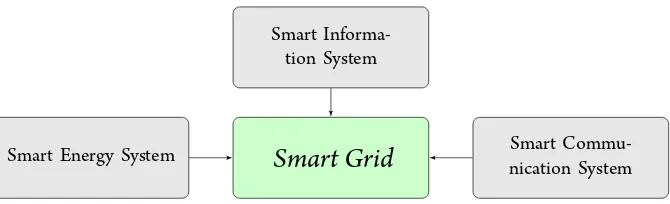
1.1.1 The main components of the smart grid infrastructure. . . 2
1.1.2 A microgrid scenario. . . 3
2.1.1 Microgrid topology. . . 12
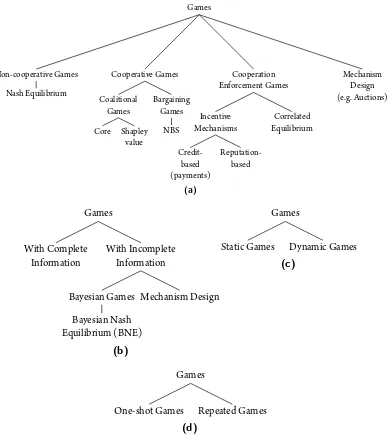
2.4.1 Taxonomy of games and the different methods to solve them, (a) cooperative, non-cooperative or cooperation enforcement games, (b) with complete informa-tion or with incomplete informainforma-tion, (c) static or dynamic games, (d) one-shot or repeated games. . . 21
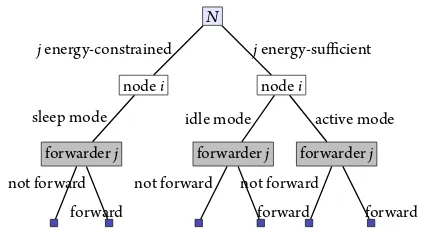
3.3.1 Extensive form of Bayesian game. . . 45
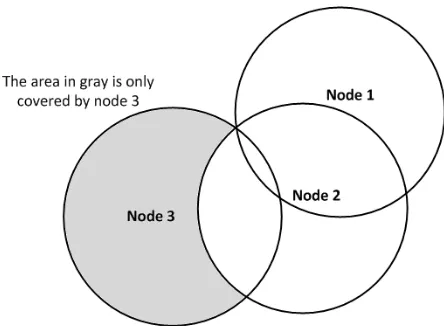
3.4.1 The strategy of node 3 is the area in gray. . . 54
3.4.2 A sample NE topology. . . 62
3.4.3 An example illustrating cooperative topology control. . . 63
3.5.2 Market based architecture for multiple task allocation. . . 75
3.5.3 The percentage of latest proposals in each domain of WSNs. . . 77
3.5.4 The distribution of WSN problems over years. . . 77
3.5.5 The percentage of reviewed game theory proposals of the three main classes. . . . 78
4.2.1 Network Topology and Traffic Model. . . 83
4.2.2 Validation of the mathematical model. . . 85
4.3.1 B-MAC. . . 90
4.3.2 X-MAC. . . 92
4.3.3 RI-MAC. . . 93
4.4.1 T-MAC. . . 97
4.4.2 L-MAC. . . 102
4.4.3 TreeMAC. . . 103
4.5.1 The effect of network parameters and the size of the multimedia sample on the maximum allowed sampling rate of MMSs (Fmms s ). . . 107
4.5.2 The energy consumption of B-MAC, X-MAC, RI-MAC and PW-MAC during Tobs =24(hour) in a WMSNs of 64 Nodes and for different polling periods and densities of MMSs. . . 109
4.5.3 The energy consumption of L-MAC, TreeMAC and T-MAC during an observa-tion timeTobs =24(hour) in a WMSNs of 64 Nodes and for different densities of MMSs. AtFmms s = 2 (images/hour), whenpm=25 % we have in total 3520 (packets/hour) which causes Eq. (88) in TreeMAC, for instance, to be higher than 50%, but whenpm=50 % we have 3200 (packets/hour) and the condition is fulfilled. . . 110
4.5.4 The energy consumption of MAC protocols in the selected indoor and outdoor application scenarios. . . 113
5.2.1 The proposed microgrid scheme (used in Chapter 5). . . 118
5.5.1 Average weekly cost savings of each household in every month. . . 125
5.5.2 Temporal game evolution for different cost savings threshold. . . 126
5.5.3 The fairness in cost savings achieved by all households in the two scenarios. Scenario I: households are allowed to make the decision whether to continue playing the game with the same pair at the end of every week. Scenario II: at the end of every month. . . 127
5.5.4 Histogram of the individual hourly demands of all households in one year before and after the proposed distributed energy sharing framework. . . 128
5.5.5 The CO2 emissions per kWh of electricity demand reduced by the N=12 households in the microgrid in every month. . . 129
6.2.1 The proposed microgrid scheme (used in Chapter 6). . . 134
6.5.1 Power components flow in the main bus (see Eq. 6.4). . . 140 6.6.1 Average appliances demand profile of each considered class of households
(without scheduling). . . 144 6.6.2 Daily amount of power received from the battery based on households reputation
in the first week of July 2015. . . 148 6.6.3 Households average daily cost savings in the first week of July 2015. . . 149 6.6.4 System performance during every month in 2015, (three households of class A,
List of Tables
2.1.1 A brief comparison between conventional electric grids and smart grids [1]. . . . 11
3.2.1 Proposals in WSN Power Control (Section 3.2.1). . . 34
3.2.2 Proposals in WSN MAC (Section 3.2.2). . . 38
3.3.1 Proposals in WSN Routing (Section 3.3.1). . . 45
3.3.2 Proposals in WSN Clustering (Section 3.3.2). . . 51
3.4.1 Proposals in WSN Coverage (Section 3.4.1). . . 57
3.4.2 Proposals in WSN Topology Control (Section 3.4.2). . . 64
3.5.1 Proposals in WSN Data Aggregation, Security, and Task Allocation (Section 3.5). 73 4.2.1 Parameters of the radio used (CC2420) and the traffic model with the corre-sponding values (used in Sections 4.3, 4.4 and 4.5). . . 87
4.3.1 Parameters of the considered sender-initiated asynchronous MAC protocols and their values (used in Sections 4.3 and 4.5). . . 88
4.3.2 The power consumed in each mode and its corresponding values. These values are used in Sections 4.3, 4.4 and 4.5. . . 88
4.3.3 Parameters of the considered reciever-initiated asynchronous MAC protocols and their values (used in Sections 4.3 and 4.5). . . 93
4.4.1 Parameters of the considered locally-synchronized MAC protocol and their values (used in Sections 4.4 and 4.5). . . 97
4.4.2 Parameters of the considered globally-synchronous MAC protocols and their values (used in Sections 4.4 and 4.5). . . 100
4.5.2 The configurations of the WMSN of each scenario (M=20 andTw= 0.1 (s) in all
scenarios). . . 114
5.5.1 The selected groups of households and their corresponding average annual consumption. . . 124
5.5.2 Solar PV system and performance Data. . . 124
6.6.1 The considered classes of households. . . 143
6.6.2 Solar PV system and performance data. . . 145
6.6.3 Household appliances and their average energy consumption: Class A. . . 145
6.6.4 Household appliances and their average energy consumption: Class B. . . 146
6.6.5 Household appliances and their average energy consumption: Class C. . . 147
6.6.6 The values of the problem parameters used in simulations. . . 148
6.6.7 The effect of the number of households on the min and max State of Charge (SoC) and the total absorbed power from the main grid. . . 151
List of Acrynoms
BNE Bayesian Nash equilibrium
CD Clothes Dryer
CDMA Code Division Multiple Access
CPP Critical Peak Pricing
CSMA Carrier Sense Multiple Access
CTS Clear-to-Send
CW Contention Window
CWmin minimum Contention Window
DAP Deferred Acceptance Procedure
DERs Distributed Energy Resources
DG Distributed Generation
DoS Denial of Service
DSM Demand-Side Management
EH-WSNs Energy Harvesting Wireless Sensor Networks
EMS Energy Management System
EPG Exact Potential Game
ESS Energy Sotorage System
FSR Frame Access Rate
ICT Information and Communication Technology
IDS Intrusion Detection System
ILP Integer Linear Programming
IoT Internet of Things
LPL Low Power Listening
MAC Medium Access Control
MER Minimum Energy Routing
MILP Mixed Integer Linear Programming
MMSs Multimedia Sensors
NBS Nash Bargaining Solution
NE Nash Equilibrium
OPG Ordinal Potential Game
P2P Peer-to-Peer
PEV Plug-in Electric Vehicles
QoS Quality of Service
RGB Red-Green-Blue
RTP Real-Time Pricing
RTS Request-to-Send
SINR Signal Interference plus Noise Ratio
SM Smart Meters
SoC State of Charge
SPE Sub-game Perfect Nash Equilibrium
SPF Shortest Path First
SSs Scalar Sensors
TC Topology Control
TDMA Time Division Multiple Access
ToUP Time of Use Pricing
WAMR Wireless Automatic Meter Reading
WLANs Wireless Local Area Networks
WM Washing Machine
WMSNs Wireless Multimedia Sensor Networks
WSLS Win-Stay, Lose-Shift
Acknowledgments
I am profoundly thankful to my advisor, Prof. Manel Guerrero Zapata at UPC, and to Prof. Brois Bellalta at UPF, for their support in this journey, their guidance that helped to continue my research in the right direction, and their friendly mood that makes it enjoyable to work with them.
I would like to thank my co-authors, Prof. Josep Guerrero and PhD candidate Adriana Luna Hernández at Aalborg University, Prof. Jose M. Barcelo at UPC, and PhD candidate Anders Nill-son at KTH, who were a great pleasure to work with. I am also thankful to my colleagues and my labmate, Amin Karami at DAC, UPC, who provided a great work environment and valuable feed-back.
I would like to thank my wonderful family for their endless support and motivation throughout my career.
I thank my lovely wife, Batul Maarouf Rajab. Without her love and devotion, none of these is ever possible.
1
Introduction
1.1 Motivation
Increasing energy demand, diminishing fossil fuels, the devastating risks of climate change, and ambitious emissions’ reduction targets have led to significant changes in the way of producing, dis-tributing, and consuming electricity, and called for the modernization of the power grid, in which Information and Communication Technology (ICT) plays a key role [1].
Smart Informa-tion System
Smart Grid
Smart Commu-nication System [image:21.595.133.468.103.205.2]Smart Energy System
Figure 1.1.1: The main components of the smart grid infrastructure.
the inevitability of this massive transformation [1,2].
The smart grid infrastructure can be divided into three main components: i) thesmart energy sys-tem, which is responsible for advanced electricity generation, transmission, distribution and con-sumption, ii) thesmart information system, which is responsible for information metering, monitor-ing, and management, and iii) thesmart communication system, which is responsible for communi-cation connectivity and data exchange between systems, devices, and applicommuni-cations [2]. Fig. 1.1.1 shows the main components of the smart grid infrastructure.
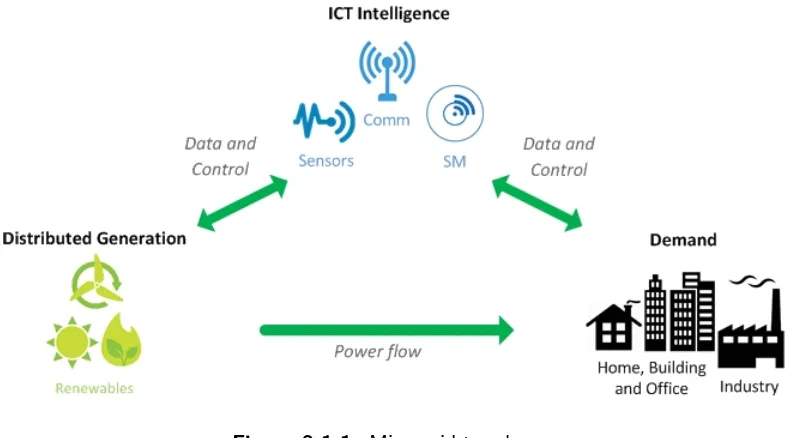
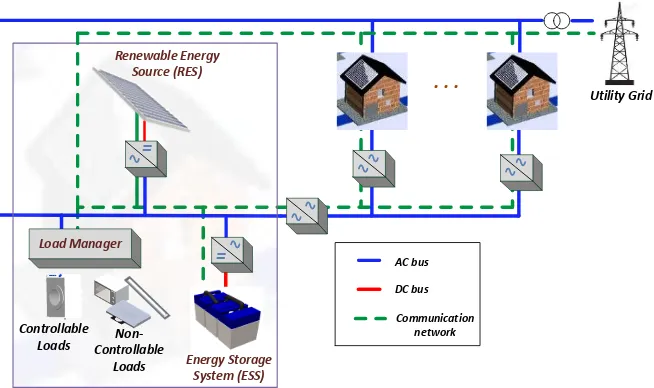
Further developing the architecture of smart grids, the microgrid concept is defined as inter-connected networks of Distributed Energy Resources (DERs) (e.g., solar PV panels), loads (e.g., households), and storage (e.g., batteries) that can function whether they are connected to or sep-arated from the main electricity grid [3]. To the utility, a microgrid can be thought of as a con-trolled cell of the power system. To the customer, the microgrid can be designed to meet their spe-cial needs, such as, to enhance local reliability, to reduce feeder losses, and to increase efficiency, among others [4]. Microgrids are considered as basic structures of the smart grid. An example of a simple microgrid scenario is illustrated in Fig. 1.1.2.
Utility Grid
AC bus DC bus
=
Controllable Loads
=
. . .
Load Manager
Energy Storage System (ESS)
Communication network
Renewable Energy Source (RES)
Non-Controllable
[image:22.595.157.484.115.309.2]Loads
Figure 1.1.2: A microgrid scenario.
consumption intelligently. Besides, Smart Meters (SM) are responsible of data communications between households and the main grid and/or between households themselves. They exchange information about households’ demand and electricity prices at each time slot. Based on the read-ings of SM, each households in RTP programs, for instance, is expected to individually respond to time-varying electricity tariffs by scheduling controllable demand at times when electricity prices are cheap.
The integration of DERs solutions can bring further reduction in power demands in the residen-tial sector. Many households and residenresiden-tial buildings are beginning to adopt small-scale on-site renewable energy production sources, such as solar panels. However, as renewable energy is in-termittent due to its nature, they keep connected to the main grid to secure their power demand during times of the day when renewable energy generation is impossible due to external weather conditions [3].
1.2 Research Problem
Recent advances in Wireless Sensor Networks (WSNs) made it possible to realize low-cost mon-itoring, diagnostic and automation systems for smart grids [6–8]. In these systems, sensor nodes are used to monitor critical smart grid equipment and respond to changing conditions in a proac-tive manner. The opportunities and design challenges of WSNs for smart grid applications have been presented in [9]. Since it is usually difficult and costly to replace faulty sensors once they are deployed, improving energy efficiency and maximizing the network lifetime is of paramount im-portance. This can be achieved at different levels related both to the smart information system, and the smart communication system, of the previously mentioned smart grid’s infrastructure, such as, data management, routing, clustering, Medium Access Control (MAC), coverage and topol-ogy control, among others. Therefore, investigating the energy efficiency at the different levels of WSNs is an important problem to address.
As mentioned before, the smart energy system is responsible for advanced electricity genera-tion, transmission, distribution and consumption. Regarding the consumption side, it has been observed that a large portion of electricity is consumed in the residential sector [10]. Hence, in-volving citizens in the efficient planning and use of electricity is key. Households may have different power demand profiles due to various factors such as occupants’ social grade and employment sta-tus, as well as the number and age of occupants. Assuming that households in microgrids have an on-site small scale DER, the time when renewable energy is harvested and the time of households’ power consumption do not necessarily overlap. As a result, a mismatch occurs between the local generation of renewable energy and power consumption in some households, which reduces the utilization of DERs.
laws in the U.S. that limit the total number of participating households that can inject renewable energy into the grid [11].
Considering the fact that households’ electricity consumption patterns do not necessarily over-lap, an alternative possible solution to maximize the potential of DERs is to allow households to
sharetheir renewable energy among each other in a cooperative fashion. This can be achieved as-suming, as mentioned before, that each household will be equipped with a SM responsible on monitoring, control, and data communications. Recently, energy sharing mechanisms in smart grids and microgrids have received significant attention [16–19]. In [16], a shared energy storage framework is proposed for the cost savings trade-off problem among multiple users in a demand response system using a Markovian model. The work presented in [17] uses a greedy matching al-gorithm to determine which households should share energy in order to reduce energy losses. [18] analyzes the trade-off between the use of storage and the cooperation, represented by exchanging energy among the distributed sources. The problem is formulated as a stochastic optimization problem with the objective of minimizing the cost of energy exchange within the grid. A Peer-to-Peer (P2P) energy sharing framework between multiple neighboring microgrids is proposed in [19]. It extends the work presented in [18], and handles the mismatching problem between lo-cal demand and lolo-cal generation. It proposes an optimization problem that aims at minimizing the P2P energy sharing losses in a distribution network consisting of multiple microgrids, taking power balance and battery’s operational constraints into account.
While interesting, the existing energy sharing frameworks in the literature focus on the optimiza-tion of energy sharing process by reducing the losses accompanied with energy exchange between entities in smart grids (e.g., households or entire microgrids). It is assumed that all entities are al-ways willing to share energy with each other which might not be very practical since some entities are reluctant to cooperate and share energy; others are willing to receive energy more than they contribute. Therefore, flexible and robust energy sharing frameworks, that allows entities to make intelligent decisions about sharing and distributing energy with each other, and dynamically adapt to changes within the system, are required. We believe that such frameworks will greatly increase the efficiency of the smart energy system in smart grids.
and summarized in Chapter 2.
In this dissertation, we start our work in the smart communication system, the third compo-nent of the smart grid infrastructure. We investigate and survey how game theory has been used to increase energy efficiency and prolong network lifetime in WSNs. Then, we study the energy efficiency in low-data rate Wireless Multimedia Sensor Networks (WMSNs), by focusing on the energy consumption models of the MAC layer, since the radio is considered as a major source of energy consumption.
After that, we move to study the problem of maximizing the utilization of local DERs in house-holds, which is related to the consumption side in the smart energy system. To do that, we use a game theory approach in two proposed energy sharing frameworks for microgrids. We aim at in-vestigating how game theory can increase the efficiency of energy sharing frameworks by modeling households’ interaction and providing incentive mechanisms for cooperation in order to punish selfish households that want to receive more energy and save their own resources. These mecha-nisms guarantee that all households will receive energy in proportion to their level of cooperation. To the best of our knowledge, the work presented in this dissertation is the first work to investigate the usability of a game theory approach in the design of energy sharing frameworks for microgrids.
1.3 Contribution
The contributions of this dissertation are summarized as follows: Firs of all, we focus on WSNs as key communication enablers of the smart communication system in smart grids. We explore how game theory has been used to achieve energy efficiency in the sensor network and maximize its life-time. The recent research studies in this area are presented and discussed. The literature is surveyed at four levels: i) Power Control and MAC, ii) Routing and Clustering, iii) Coverage and Topology Control, and iv) Data Aggregation, Security, Task Allocation and Energy Harvesting. Each level is further divided into three parts based on the class of games used. In each level, the papers are sum-marized in a table which illustrates the class of the game used, the game solution strategies, and the energy savings methods applied. The survey is also supported by statistical charts that overview how this research area has evolved in the last few years. This work is presented in Chapter 3. It provides a brief but comprehensive view of the state of the art in all aspects of this research area, and sheds the light on its main current challenges and future trends.
evaluating the energy consumption of the MAC layer. We conduct this study motivated by the fact that some applications can be enhanced by adding Multimedia Sensors (MMSs) able to capture and transmit small multimedia samples such as still images or audio files [22]. These applications vary from objects tracking and monitoring to intruders detection, which could be applied in dis-tributed energy generation farms (i.e., solar and wind farms), ESS, smart houses and buildings, among others. We investigate and compare the energy efficiency of various baseline and recent MAC protocols in this kind of networks and applications. For this purpose, we develop a gen-eral sensor network traffic model which allows integrating different types of sensors with different sampling rates. This model helps to analyze the effects of various parameters of MMSs -such as the sampling rate, the size of multimedia sample and the density of MMSs- on the traffic each node transmits, receives and overhears. The main goal is to evaluate how the considered MAC protocols perform in WMSNs from an energy efficiency point of view, and to recommend the most suitable ones for this kind of networks and its applications. This work is presented in Chapter 4.
After that, we shift our focus to the first component of the smart grid infrastructure, namely the smart energy system. We aim to address the problem of maximizing the utilization of house-holds’ local DERs in microgrids. First of all, we propose a distributed energy sharing framework, where households can cooperate and share their surplus renewable energy in an intelligent and har-monized manner. The interaction between rational households is modeled as a repeated energy sharing game, in which households can reduce their demands from the main grid by exchanging some amount of renewable energy among each other. In repeated games, players interact with each other for multiple rounds, in contrast to one-shot games (see Chapter 2), and each time they play the same game. In such situations, players have opportunities to adapt to their opponents’ behavior (i.e., learn) and try to become more successful, which is very useful in the proposed distributed en-ergy sharing game. The economical and environmental potentials of this proposed framework are assessed. The economical potential is expressed as the cost savings of households’ power demand, and the environmental potential is expressed as CO2emissions’ reduction per kWh of electricity demand. Simulation results presented in this work are based on real pricing data, and real solar energy and demand profiles for households of different sizes and consumption profiles. The work is presented in Chapter 5.
and reallocates the available shared renewable energy in a fair and efficient manner. A reputation-based energy allocation policy is proposed, which belongs to incentive-reputation-based mechanisms in game theory. The basic idea for incentive-based mechanisms [21] is to identify players based on their be-havior. Players that offer resources should be rewarded. On the other hand, selfish players should be gradually isolated from the system. Reputation-based systems are one of the main concepts of incentive mechanisms. A player’s reputation reflect its willingness to cooperate and share its resource. Reputation systems are a good application in energy sharing framework in microgrids, where there exists various classes of households with different power consumption profiles.
According to the proposed policy, the EMS determines the portion of power that will be allo-cated to each household based on its reputation. We apply this framework in an appliances power scheduling optimization system, in which households’ appliances are not only scheduled at times when electricity tariff are cheap, but also are allowed to use the available energy scheduled by the EMS, taking battery’s operational constraints into account. We formulate the appliances power scheduling problem using Mixed Integer Linear Programming (MILP), with an objective of min-imizing the appliances demand costs. The main contribution in this problem is that the benefit of the shared ESS and the reputation-based energy allocation mechanism are taking into account in the objective function. Besides, power balance and battery’s operational constraints are also con-sidered. The fairness and the economical potential of the proposed system are verified via simula-tions in different scenarios and using real data of renewable energy and appliances demand profiles, as well as pricing data. This work is presented in Chapter 6.
1.4 Thesis Roadmap
2
Background
2.1 Smart Grids
The term grid is used to indicate the electric power network, which is responsible on electricity generation, transmission, distribution, and control. Targets like demand response, energy conser-vation, carbon footprint reduction, high penetration of renewable sources, improving efficiency, and enhancing reliability, cannot be addressed using the existing conventional electricity grid, and have called for the modernization of the power grid, in which ICT plays a key role [1].
tech-Table 2.1.1: A brief comparison between conventional electric grids and smart grids [1].
Conventional grid Smart grid
Electromechanical Digital
One-way communication Two-way communication Centralized generation Distributed generation Few sensors Sensors throughout Manual monitoring Self-monitoring Manual restoration Self-healing
Failures and blackouts Adaptive and islanding Limited control Pervasive control Few customer choices Many customer choices
nologies and business models to increase energy efficiency and reduce climate impact. On the other hand, they empower end-consumers to interact with the energy management system to ad-just their power consumption and reduce their demand costs [1]. Many surveys can be found in the literature that focus to a great extent on smart grids architectures, challenges, communications requirements, and potential applications [2,8,23,24]. A comparison between smart grids and conventional grids is provided in Table 2.1.1.
[image:30.595.190.412.130.259.2]Figure 2.1.1: Microgrid topology.
2.2 Wireless Sensor Networks
WSNs have met a growing interest in the last decade due to their applicability to a large class of contexts, such as environment monitoring, object tracking, traffic control, and health applications, among others. Recent advances in WSNs made it possible to realize low-cost monitoring, diagnos-tic and automation systems for smart grids [6–9]. In these systems, sensor nodes are used to moni-tor critical smart grid equipment and respond to changing conditions in a proactive manner. Some existing applications of WSNs in smart grids include load management and control, Wireless Au-tomatic Meter Reading (WAMR), equipment fault diagnostics, remote monitoring, electric fault detection, objects tracking and intruders detection in power plants, distributed energy generation farms and storage units, among others [9].
sometimes in-network data processing and possibly performing specific queries for certain infor-mation.
In some scenarios, when multiple surrounding nodes detect the same event, one of them gen-erates a final report after collaborating with the other nodes. The sink can process that report and possibly send it out through either high-quality wireless, or wired links to external centers for fur-ther processing. Nodes are static most of the time, whereas mobile nodes can be deployed accord-ing to application requirements. A sink can also be either static or mobile, and one or several sinks could be deployed together within the same network.
The topology of sensor networks could be classified as a: (i) flat topology, where all nodes are of the same level and behave according to same rules (i.e., generating and forwarding data), (ii) cluster-based topology, in which there are different categories of sensor nodes (SNs), and cluster heads (CHs). SNs communicate mainly or exclusively to its CH -usually the closest one to itself. The network region is then divided into clusters. Each CH performs all inter-cluster communica-tions, and might aggregate its cluster data before sending it to other CHs or to the sink.
Typically, a flat topology is used in homogeneous networks, where all nodes have the same capabilities. Cluster-based topologies are usually used in heterogeneous networks, as CHs may have more capabilities in terms of energy, communication and processing power. The use of those higher-capacity nodes can greatly increase the network reliability and lifetime but imposes addi-tional cost and challenges like deciding how many CHs should be existed in the network and how they should be deployed, and in most cases require specific routing protocols. The reader can refer to [25–27] for further reading about WSNs.
2.3 Wireless Multimedia Sensor Networks
Different smart grid applications, such as remote monitoring, controlling and intruders detection in power plants, distributed energy generation farms (i.e., solar and wind farms) and storage units, smart houses and buildings, among others, can be enhanced by adding MMSs able to capture and transmit small multimedia samples such as still images or audio files. The potential applications and challenges of employing WMSNs in smart grids have been surveyed in [22].
the shared wireless medium. Doing so in an energy efficient way becomes more complicated when nodes of different sampling rates exist in the network and generate different traffic loads.
Based on applications, WMSNs’ traffic can be classified into two main categories, multimedia streams (e.g., video streaming) and multimedia data (e.g., snapshot multimedia content). Each of these categories can be further classified, according to the level of Quality of Service (QoS) re-quired by the overlying application, into real-time and delay-tolerant [28]. Multimedia streaming applications put a lot of effort on achieving high bandwidth for a steady flow of data while real-time applications require a delay-bounded delivery of packets. In these cases, energy efficiency is of a lower priority. However, these applications are out of the scope of this study. In our dissertation, we focus on non-streaming and delay-tolerant WMSNs that require relatively lower bandwidth de-mands than streaming ones [28]. This includes a wide range of monitoring applications in smart grids, where on the one hand it is essential to keep monitoring the field or grid components, but on the other hand the phenomenons’ observation is delay-tolerant and the generated multimedia traf-fic is lower -compared to multimedia streams. In this kind of applications MMSs can be deployed to sporadically send still-images or audio files (e.g., images about structural health in a territory, crops status in vineyards, pets and children in a house, sounds and noise in bar zones, among oth-ers). This imposes a higher traffic load compared to the typical WSNs where only SSs -which sense scalar data and physical attributes (e.g., temperature and humidity readings)- are deployed, and it directly affects the energy efficiency of the MAC layer.
2.3.1 Medium Access Control
The main categories of MAC protocols in WSNs
MAC protocols for scalar WSNs have been classified in various categories based on when and how nodes decide to transmit data. These categories are: asynchronous (or random access), syn-chronous (locally or globally), and hybrid [29–31]. In general, successful transmission and re-ception, idle listening, collisions, and overhearing are the major sources of energy consumption of MAC protocols in WSNs. Research work have focused on how to improve the performance of MAC protocols in a way the energy wasted in idle listening, collisions, and overhearing is mini-mized. To reduce idle listening, the duty cycling technique has been widely adopted. With duty cycling, nodes switch periodically between active and sleeping states. In the asynchronous cate-gory, each node decides when to wake up autonomously, given the rules defined by the particular MAC protocol, and the duty of the MAC protocol is to establish communication between nodes. Asynchronous MAC protocols for WSNs include: B-MAC [32], X-MAC [33], RI-MAC [34], and PW-MAC [35], among others.
Another category of MAC protocols is the synchronous MAC protocols. This category is fur-ther divided into two main branches: locally synchronized and globally synchronized (i.e. frame-slotted) [29]. Locally synchronized MAC protocols (e.g., S-MAC [36] and T-MAC [37]) also adopt the duty cycling mechanism. To save energy, they allow nodes to turn off their radio when no communication occurs during a certain time period. They differ from asynchronous MACs in the sense that each cluster of neighboring nodes are scheduled to wake up at the same time. Frame-slotted MACs (e.g., L-MAC [38] and TreeMAC [39]) divide time into frames and assign time slots to nodes in a way that no two nodes within the two-hop distance are allocated the same time slot. The problem of synchronous MAC protocols is that they require to keep the network synchronized which implies a high control overhead.
QoS-aware MAC protocols in WSNs
[43], among others. The QoS-aware MAC protocols for WSNs and WMSNs have been surveyed and classified in [44].
MAC protocols for streaming WMSNs
MAC protocols for low data rate WMSNs
After providing an overview of application-specific MAC protocols, it is clearly observed that ex-isting WMSNs’ MAC protocols pay much attention to streaming and real-time applications. How-ever, non-streaming and delay-tolerant traffic class of WMSNs may not require a complex design of MAC protocols like streaming and real-time WMSNs, though they generate higher traffic load than scalar WSNs due to the existence of MMSs. On the other hand, WSNs’ MAC protocols have been originally designed for scalar sensors with low bandwidth demand and with energy efficiency considerations. Since our focus is on non-streaming and delay-tolerant WMSNs applications, we believe that those WSNs MAC protocols are the best candidates for our applications. Therefore, the main purpose of this study is to model and evaluate the energy consumption of those MAC protocols in such scenarios. The MAC protocols are selected to be from different categories, such as receiver-initiated and sender-initiated asynchronous MACs, as well as locally and globally syn-chronized MACs. Then, from each category we choose baseline and recent MAC protocols.
The considered WMSNs include a wide spectrum of applications such as object detection, mon-itoring and tracking applications. In such applications, a WMSN works typically at very low data rates where collisions are of a little concern [27,30]. Nevertheless, this could be safeguarded by bounding the maximum traffic flowing through the network (as we will see later). For instance, in structural health or in crops status in vineyards monitoring applications, MMSs are deployed to send images of buildings/crops. By keeping an archive of images and comparing them with im-ages obtained in different time periods, an improved management/a better productivity could be achieved. However, since the status of these monitored objects is not commonly changing over short periods and does not require a real-time delivery of data, there is no need to sample the en-vironment at high or medium data rates.
Platforms for low data rate WMSNs
im-ager. The ALOHA imager outputs metadata (i.e., Address Event Representation) instead of coded images, minimizing the amount of traffic sent towards the sink.
2.4 Game Theory
Game theory [20], a branch of applied mathematics initiated more than sixty years ago, has been mainly studied and applied in a broad range of areas from economics, politics, sociology, and more recently in communication networks [21,52–54] and smart grid applications [55]. The recent popularity it has been enjoying in engineering has to do with fact that it brings new perspectives to optimization and control of distributed networks. Game theory provides potential analytical tools to model interactions among entities with conflicting interests. The field was born with the book by John von Neumann and Oskar Morgenstern, [56], although the theory was developed extensively in the 1950s by many among whom John Nash, [57,58]. Game theory mathemati-cally describes behavior in strategic situations, in which an individual’s success in making choices depends on the choices of others. It incorporates paradigms such as Nash Equilibrium (NE) and incentive mechanisms, which can help in quantifying individual preferences of decision-making agents. In fact, game theory provides a rigorous mathematical framework for modeling actions of selfish individual or cooperating agents/players. Furthermore, it has an inherently distributed na-ture and provides a foundation for developing distributed algorithms for dynamic resource alloca-tion [54]. The following subsections will provide a brief overview about the various classifications and different concepts of game theory which are illustrated in Fig. 2.4.1.
2.4.1 Main Classification of Games
Non-cooperative Games
This class of games focuses on each player’s individual utility, in response to the actions of all other players, rather than the social outcome. The stable outcomes of non-cooperative selfish agents in-teractions correspond to NE. In non-cooperative games individual players may act selfishly (i.e., deviate alone from a proposed solution if it is not in their interest, and do not coordinate their ac-tions with other players). For instance, a household in a energy sharing framework in a microgrid will probably act selfishly for the following reason: from a household’s point of view, sharing its renewable energy reduces its own resources. Therefore, it may not be of the household’s interest to share all the available renewable energy. In contrast, if it rejects sharing energy with its neighbors, it may not receive any amount of renewable energy in future time periods when it is needed and will negatively affect its cost saving strategy. The technical report presented in [59] explains how situations of this kind can be modeled by using game theory.
In general, a game consists of three components: i) a set of participants, calledplayers,N =
{n1, . . . ,nN}, where N = |N | is the number of players participating in the game (e.g., a set
of households in a microgrid), ii) a set of available actions for each player calledstrategiesS =
{s1, . . . ,sS}(e.g., the decision to share energy or not), and iii) an associated amount of benefit or
gain each player receives at the end of the game, calledpayoff orutilityU = {u1, . . . ,uU}, which is a function that measures the degree of satisfaction from each available strategy in terms of the considered performance metrics (e.g., cost savings of a household, energy efficiency, delay and/or target signal-to-noise ratio of a node in a communication network). Each player tries to choose his best available action (i.e., the one which gives a player the highest payoff, calledbest response). The best action for any given player depends, in general, on other players’ actions. Thus, when choosing an action, a player must take into account actions other players may choose.
NEis a central solution concept in game theory. It captures the notion of a stable solution, from which no single player can individually improve his welfare by deviating [20]. Formally, a strategy vectors ∈ Sis said to be a NE, if for any playeri, and for each of its strategiess′i ∈ S, we have that:
ui(si,s−i)≥ui(s′i,s−i)
NE in apure strategy, when each player deterministically plays his chosen strategy. When players are allowed to randomize and each player picks a certain probability distribution over his set of strategies, such a choice is calledmixed strategy. In the previous example, the strategy profile when each household (player) rejects sharing energy with its opponent is a pure strategy NE.
One method for identifying the desired NE point in a game, and ensuring that the solution maximizes the utilities for both players is to compare strategy profiles using the concept of Pareto-optimality[59]. In a Pareto-optimal strategy profile, the payoff of a given player can not be increased without decreasing the payoff of at least one other player. A game can have several Pareto-optimal strategy profiles, and it is important to note that a Pareto-optimal strategy profile is not necessarily NE. In the previous example, the strategy profile when both household share energy with each other is Pareto-optimal, but not NE.
Potential games[20,60] are games that admit a potential function, which in turn can be used to prove that the best-response dynamics converge to an equilibrium point. Potential games pose many interesting properties. For example, a pure strategy NE always exists. Potential games can be classified intoExact Potential Game (EPG), when a given player switches from an action to another, the change in the potential function equals the change in the utility of that player, and Ordinal Potential Game (OPG), when the changes in the potential function and the changes in the utility of that player are positive.
Cooperative Games
In contrast to non-cooperative games, cooperative games consider the utility of all players with the goal of maximizing the entire social payoff while maintaining fairness. The objective of cooperative game theory is to provide mechanisms to sustain cooperation among agents willing to cooperate. The main question is how the benefits and the costs of a joint effort can be divided among partic-ipants, taking into account individual and group incentives, as well as various fairness properties [20].
Games
Non-cooperative Games
Nash Equilibrium
Cooperative Games
Coalitional Games
Core Shapley value
Bargaining Games
NBS
Cooperation Enforcement Games
Incentive Mechanisms
Credit-based (payments)
Reputation-based
Correlated Equilibrium
Mechanism Design (e.g. Auctions)
(a) Games
With Complete Information
With Incomplete Information
Bayesian Games
Bayesian Nash Equilibrium (BNE)
Mechanism Design
(b)
Games
Static Games Dynamic Games
(c)
Games
One-shot Games Repeated Games
[image:40.595.108.499.112.551.2](d)
Figure 2.4.1: Taxonomy of games and the different methods to solve them, (a) cooperative, non-cooperative or cooperation enforcement games, (b) with complete information or with incomplete information, (c) static or dynamic games, (d) one-shot or repeated games.
difficult to achieve, among others.
The other solution concept for coalitional game theory is theShapley value[61], which is one of the efficient solutions that are used in many studies which we will present later in this chap-ter. However, the complexity of calculating the Shapley value increases as the number of players increases, therefore it is recommended only for coalitions with low number of players.
Another widely applied concept of cooperative games isbargaining games. The bargaining prob-lem studies situations where two or more players need to select one of many possible outcomes of a joint collaboration. For example, players try to come to an agreement on a fair resource sharing inside a cluster. If the individuals reach an agreement, both of them can gain a higher benefit than playing the game without cooperation. The solution of this type of games is calledNash Bargaining Solution (NBS)[20,62], in which no action taken by one of the individuals is imposed without the consent of the other.
The main difficulty of cooperative games is that players require to perform some extra compu-tations and agreements between each other. However, when cooperative games are used, they usually give to the players a fair utility, allowing a noticeable improvement in energy conservation.
Cooperation Enforcement Games
system or at each player individually. Players decide independently the extent of their cooperation with the system, trying to balance their reputation (too little cooperation might lead a player to be-come untrustworthy), and resource considerations (too much cooperation would run out players’ resources faster).
Correlated equilibrium[63] is a solution method in which it is preferable for a player to follow an external correlation device, such as a trusted game coordinator. The traffic light example in [20] il-lustrates this concept. Imagine when two players drive up to the same intersection at the same time. If both attempt to cross, the result is a fatal traffic accident. In NE, players choose their strategies independently. In contrast, in a correlated equilibrium, a coordinator can choose the strategies for both players. For example, the coordinator can randomly let one of the two players cross with a certain probability. The player who is told to stop has a zero payoff, but he knows that attempting to cross will cause a traffic accident. Correlated equilibrium requires joint computation of strate-gies. In general, it is easier to compute those joint strategies, and finding a correlated equilibrium is polynomially solvable. However, finding an ”optimal” correlated equilibrium is computationally hard [20]. Besides, it needs a third party to observe and control the interaction of players.
Mechanism Design
Mechanism design [20,53] is an advanced class of game theory which aims to design games that have dominant strategy solutions leading to a desirable outcome (i.e., either socially desirable, or desirable for the mechanism designer). The idea is to run an algorithm in an environment with multiple owners of resources. This algorithm takes into account the preferences of the different owners. In fact, the larger goal of mechanism design is often to design mechanisms in which the selfish behavior of players leads to such socially optimal outcome. Mechanism design could be with money (e.g., auctions), like Vickery-Clarke-Groves mechanisms [20], or without money, like House Allocation problem [20]. It is analogous to Bayesian games [20] in terms of privacy of owners information, but mechanism design makes the solution of a game much simpler.
2.4.2 Other Classifications
dynamic games, players move their strategy in predetermined order, meaning that the move of one player is conditioned by the move of the previous players (i.e., the second mover knows the move of the first mover before making his decision).
A game could be further classified into one of the following two categories: a game withcomplete informationor a game withincomplete information. In a complete information game, each player has all the knowledge about others’ characteristics, strategy spaces, payoffs, and so forth, but all these informations are not necessarily available in an incomplete information game. In games with incomplete information, the overhead resulting from information exchange is reduced, because each player predicts the strategies of other players. The resulting NE of this class of games is usually calledBayesian Nash equilibrium (BNE)[20].
Furthermore, games could also be classified asone-shot Gamesor asrepeated games. In one-shot games, players interact for only a single round. Thus, in these situations there is no possible way for players to reciprocate (i.e., punishment or rewards) thereafter. In contrast, in repeated games, players interact with each other for multiple rounds and each time they play the same game. In such situations, players have opportunities to adapt to each other’s behaviors (i.e., learn) and try to become more successful. There can be finite-horizon repeated games, where the same game is repeated a fixed number of times by the same players, or infinite-horizon games in which the play is repeated indefinitely.
2.4.3 Game Theory in Smart Grids
compa-nies and end-users is presented in [68]. The goal is to maximize the revenue of each utility company and the payoff of each-user. In [69], demand-side users are interested in minimizing their power costs by owning some kind of distributed energy source and/or energy storage device. A non-cooperative game is introduced to optimize their production/storage strategy. Two models of dy-namic pricing are presented in [70] to solve the profit maximization problem of non-cooperative utility companies in a monopolistic market. In [71], a game theory based real-time load billing scheme is proposed to effectively convince selfish consumers to shift their peak-time consumption and to fairly charge the consumers for their energy consumption. A game theory based match-making solution that harmonizes load demands with the instantaneously available power, as well as the amount of stored renewable energy in smart grids is proposed in [72]. A coalition game is presented in [73] to allow consumers not only to maximize their cost savings (i.e., by scheduling their power consumption), but also to consider the social welfare in the network as well.
3
Game Theory for Energy Efficiency in Wireless
Sensor Networks
3.1 Introduction
main challenge is represented in the trade-off between energy conservation and QoS which makes the problem of energy conservation more challenging.
Game theoryhas been widely used in analyzing modern communication networks [52–54] since it provides analytical tools to model interactions among entities with conflicting interests that com-pete for the limited network resources (i.e., energy and/or bandwidth), such as resource-constrained nodes in a wireless network that might -for instance- decide not to forward packets in order to pre-serve their own battery [59]. In some cases, nodes may seek to optimize the overall network per-formance. In other cases, nodes may behave maliciously, seeking to ruin the network performance for other users [53]. Game theory offers a wide range of formulations and models that can be used to optimize node-level operations, as well as network-wide performance in a flexible manner [75]. In addition, game theory allows us to model scenarios in which there is no centralized entity with a full picture of network conditions.
are not mentioned in previous surveys like Bargaining games, Bayesian Nash Equilibrium, the core, and correlated equilibrium, among others.
In the following sections the recent research studies employing game theory to improve energy conservation and prolong network lifetime in WSNs are presented. The literature is surveyed at four levels: i) Power Control and MAC in Section 3.2, ii) Routing and Clustering in Section 3.3, iii) Coverage and Topology Control in Section 3.4, and iv) Data Aggregation, Security, Task Allocation and Energy Harvesting in Section 3.5. Each level is further divided into three parts based on the applications of non-cooperative, cooperative and cooperation enforcement games. The levels are summarized in tables which illustrate the class of the game used, the game solution strategies and the energy savings methods applied. Besides, the articles in the tables are ordered according to the year of publication. The chapter is completed with conclusions in Section 3.6. The main goal of this chapter is to provide a brief but comprehensive view of the state of the art in all aspects of this research area, and shed the light on its main current challenges and future trends. The work presented in this chapter is published and can be found in [21].
3.2 Power Control and Medium Access Control
3.2.1 Power Control
The main sources of energy consumption in WSNs are sensing, processing and communication. Among them, communication is the one that consumes most energy. Hence transmission at opti-mal power level is of paramount importance. The optiopti-mal transmission power level is the one that reduces interference, increases successful packet transmission and provides a desired QoS. A large variety of schemes for power control issues in WSNs have been proposed and some of which have been surveyed in [78].
be-tween transmission power and link quality. This model employs a feedback-based transmission power control algorithm to dynamically maintain the link quality of individual links over time.
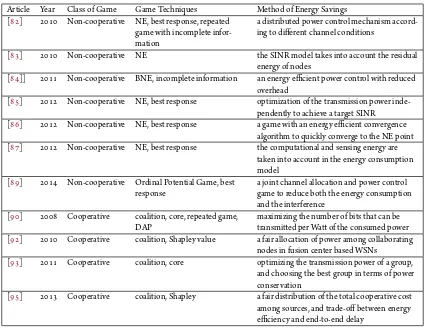
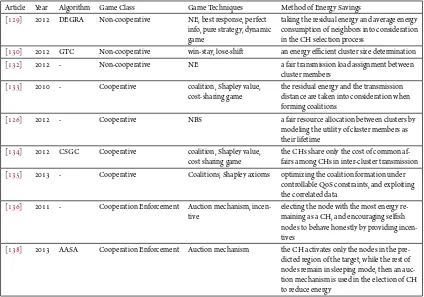
Game theory provides helpful distributed mechanisms that allow every single node to interact with its neighbors, and adjust its transmission power without the need of complete information about them. Table 3.2.1 lists the latest articles that use game theory in this domain. The papers are summarized and discussed in the following subsections.
Non-cooperative Games
In [82], a non-cooperative game with incomplete information is formulated to solve the distributed power control problem in WSNs. This proposal suggests ’not to transmit’ at a certain game iteration when channel conditions are poor. The investigation for the existence of NE is done for two dif-ferent cases: i) fixed channel conditions, and ii) varying channel conditions, using best response dynamics. It is observed that there exists a transmission power threshold and a channel quality threshold that the nodes must comply with in order to achieve a NE. Moreover, using repeated games, nodes follow the transmission strategies to achieve a NE even without presence of any third party enforcement. A system that would allow only finite number of discrete power levels is con-sidered. A metric called distortion factor is defined to investigate the performance of such system and compare it with systems that would allow any continuous power level. This work also pro-poses a technique to find the power levels at which a node should transmit in order to maximize its utility and minimize the distortion. Results show that this algorithm achieves the best possible payoff/utility for sensor nodes by consuming less power.
The power control game proposed in [83] is based on a Code Division Multiple Access (CDMA) communication. It is observed that the CH/members structure in WSNs is similar to the base station/terminal structure of CDMA. The difference here is that the utility function of the game considers the node’s residual energy, and is given by:
ui(pi,p−i) = μlog2(1+SINRi)−c(pi).
Both the pricingc(pi)and the Signal Interference plus Noise Ratio (SINR) depends on the residual energy of node i, as follows:
ui(pi,p−i) =μlog2(1+G
hipiEmaxEi
∑N
j=1j̸=ihipiEEmaxi +δ2
)−λhipi
Emax Ei
whereGis the gain of the spread spectrum,EiandEmaxare the residual energy and the maximum energy of nodei, respectively,∑Nj=1j̸=ihipiis the sum of interferences nodeireceives. δ2denotes
the thermal noise power of the channel, λis a dynamic adjust pricing factor, andμis an income coefficient.
The existence and uniqueness of the NE is proved. Simulation results show that after considering the nodes’ residual energy, path gain, and transmission power factors in the design of the pricing function, the performance of the power control game significantly improves, reducing the total transmission power efficiency, saving node energy and prolonging network lifetime efficiently.
In [84], the sensing nodes are powered solely using renewable energy to replenish its stored energy. Each sensor considers its varying energy state as private information. The existence of BNE is proved. The BNE strategy of each sensor can be implemented using a threshold. If the energy state exceeds the energy threshold, the sensor transmits with a fixed power, otherwise, the sensor waits. This study shows how each sensor determines its threshold to maximize its utility function. The equilibrium of this Bayesian game model is compared with three different models: i) a distributed perfect-information model, ii) a centralized system, and iii) a random-transmission model. Results show that the Bayesian model has a performance similar to the perfect-information model, but with a lower overhead, making the Bayesian model more suitable for real applications. In a scenario with multiple sources and with multiple receiving clusters, all sources send their information simultaneously towards CHs. Simultaneous transmission causes interference at ev-ery receiving cluster which reduces SINR. Higher transmission power results in higher SINR, but increases the energy consumption and the interference to other receiving CHs. Therefore, a non-cooperative power control game is proposed in [85], where each sensor chooses its minimum transmission power independently to minimize its own cost in order to achieve a target SINR at the CH of the receiving cluster. The game can be expressed as a cost minimization problem which is described as follows:
min
Pi Ji(Pi,γi) = minPi biPi+ci(γ
tar−γ
i)
2,
wherePi = [0,Pmax]is the possible range of transmission power (i.e., strategy values) for theith user,Pmaxis the maximum allowed power for transmission, andJiis the cost for playeri.biandci
value at the NE point. Therefore, no player can benefit by deviating from the NE. Bounds on the source power at NE are also proved. Performance analysis illustrates the influence of interference and distance between the source and the target cluster on NE.
The work presented in [86] claims that previous works on power control in WSNs did not focus on the system convergence. From this perspective, this proposal focuses on constructing a non-cooperative game model with a convergence algorithm, called NPC, that guides nodes to converge quickly to a NE point. Power consumption is taken as the cost for the game model. The game is decentralized and nodes have provate information. Therefore, the best response choice is used to achieve NE. Then, the system convergence to the NE point is evaluated and guaranteed using the NPC algorithm. The NPC algorithm shows a remarkable optimization in energy efficiency and convergence speed, without accessing the profile of the others.
In [87], a Game theory based Energy-efficient Power control Strategy (GEPS) is proposed for cognitive sensor networks. In cognitive sensor networks, unlicensed users (secondary) share a common spectrum with licensed users (primary). Each user wants to maximize its utility function under interference temperature constraints as follows:
max pi
Blog(1+SINRi) pi+α
s.t.
n
∑
i=1
hipi ≤M,
wherepiis the power allocation of useri, B is the available wireless spectrum bandwidth, and M is the interference temperature limit, which is described as a threshold of the total received power at a primary user.hiis the link gain between a secondary useriand a primary user. Both the computa-tional and sensing energy,α, are taken into account in the energy consumption model. Simulations are done for testing the energy efficiency of the power control game. It can be found that under some conditions this game is a super-modular game [20], which means it has good convergence properties to a NE point using best response dynamics. GEPS outperforms the Game-based QoS-oriented Power allocation Strategy (GQPS) [88] in terms of energy efficiency and system utility (i.e., the average value of cognitive users’ utilities). However, as the number of users increases, the system utility in GEPS decreases dramatically, while it keeps nearly unchanged in GOPS.
to reduce network interference (generated by other transmitting and receiving nodes). However, selecting different channels affects nodes’ power. Therefore, this paper aims to optimize network performance through collaboratively controlling both techniques. Nodes’ transmission power, network interference, and nodes’ residual energy are the parameters of the model. A node with low residual energy will choose a lower transmission power. The model is proved to be an OPG in order to ensure NE. A best response strategy is considered to improve the convergence speed. Sim-ulation results show that, in JCAPGA the channel allocation is uniform, the network interference is low, and the energy consumption is balanced.
Cooperative Games
A repeated coalitional game is presented in [90]. The motivation is that each node can likely obtain better utility by forming groups and controlling its power cooperatively rather than individually. Nodes compete with the others trying to enhance their own power efficiency subject to QoS con-straints. In this work, it is preferable to maximize the number of bits that can be transmitted per watt of the consumed power with respect to SINR, rather than to maximize the throughput, according to the definition of power efficiency [91]. The problem is modeled as two-sided one-to-one match-ing game, in which an owner is matched with a smatch-ingle non-owner in order to help the non-owner to achieve improved power efficiency. Then, the game is repeated using a Deferred Acceptance Procedure (DAP) [20]. This technique produces a single matching in the core at each repetition until reaching a certain stable state. The optimal power efficiency is computed in each step via a non-linear optimization problem, as the following:
max ui = ∑ ri s∈Spi,s
.
Subject to:
∑
s∈S
pis ≤ Pmaxi for alli∈ N,
Ti ≤ Tmaxi for alli ∈ V, λi ≤ ri/Λifor alli∈ V,
of each sub-carrier. The parameters are: the set of sensors (V), the set of idle sub-carriers (S) that are detected as not allocated to primary users, the transmission power constraint of sensori(Pmax
i ),
and the transmission delay constraint of sensori(Tmax
i ). The variables are: sensori’s transmission
power over sub-carriers(pi,s), and the average transmission delay (Ti), including queueing delay
per packet considering an M/M/1 queue. Simulation results show that the matching in the core improves the total power efficiency more than the social optimal, though it is less fair.
In [92], tools from cooperative game theory are used to develop a formal analytical framework for a fair allocation of power among collaborating nodes in a Fusion Center (FC) based WSNs. The goal is to achieve a sequential estimation task, while at the same time maximizing the over-all network lifetime. The concept of the Shapley value is used to achieve a fair power over-allocation among distributed nodes. Simulation results show that the proposed solution achieves the target estimation quality at the FC, in addition to an increased lifetime of the overall sensor network is increased.
A cooperative game is proposed in [93] in order to optimize data transmission of a group of nodes by forming coalitions. A mobile node may move to a new location to join a desirable group. It requests the group leader first. Then, the group leader evaluates the benefit of group membership for the node using coalitional game theory. If the membership is beneficial, the leader sends an invitation to the node. The node itself may receive many invitations and can choose the best group in their coverage area by comparing its own utility with the offered one. The correctness of the proposed protocol is proved by searching for failures in it, through evaluating all possible behaviors of sensors using the Maude tool [94]. The work proves that the core is not empty and simulation results show that any node could always save more energy by joining a group.
![Table 2.1.1: A brief comparison between conventional electric grids and smart grids [1].](https://thumb-us.123doks.com/thumbv2/123dok_es/5263649.96655/30.595.190.412.130.259/table-brief-comparison-conventional-electric-grids-smart-grids.webp)