
Citizens as the engine of transformations: An investigation of the effects of the new forms of government citizen interaction on the organisational structure and dynamics of public administrations
236
0
0
Texto completo
(2) Abstract The intensification of electronic interactions between governments and citizens through channels such as call centres, online service portals, e-mails, online chats, social media, etc. – what I comprehensively denominate e-Government – generates a vast amount of data about those exchanges. These data may have two distinct natures: they can be the result of direct citizens’ action to voice their opinion about a public service through complaints or suggestions, but they can also refer to the very use of the service available electronically. In other words, this second type of data is actually the electronic record the citizen leaves when using a public service. This thesis questions whether this type of communication with citizens, that before was almost non-existent or of little relevance, may be resulting in changes in the work practices and organizational dynamics in two public administrations. Hence, the thesis aims to answer whether the intensification of ICT-based interaction between government and citizens related to public services, which generate voluminous quantities of information, are leading to organizational transformations in the cities of São Paulo and Rio de Janeiro public administrations - Is citizen efeedback the engine of government transformation? This question unfolds into two others. The first step is to understand how the technology, the ICT-based interaction channels, take form in each case study, as those interaction tools are implemented and used in different institutional and socio-technical conditions. Second, I investigate whether information flows regarding the use of these interaction channels and the data produced are changing the organizational dynamics of public administrations toward more networked forms. Building upon the social constructivist research tradition and considering that public administrations are not merely passive receivers of technology, where it is simply taken out of the shelf, consumed and used, the thesis is heavily inspired by the Technology Enacted Framework (Jane E. Fountain 2001) and constructs the analytical model upon the Technology in Practice Perspective (W. J. Orlikowski 2000). An essential structural element of this analytical approach is the examination of the differences in technologies-in-practice, the conditions associated with their implementation and use, and their consequences. The ways technological 2.
(3) tools are interpreted, adopted, modified, and translated by public organizations in order to develop e-Government strategies rely on the local characteristics of the formal institutions, rules and structures and at the practices and world views shared by the actors in each region that shape behaviour and preferences. Therefore, the model is divided into two interrelated parts: first, it explores how e-Government emerges, associated with the conditions – interpretative, technological and institutional – present in each case; second, it seeks to understand the consequences – processual, technological and structural – of the technologies-in-practice, leading to an understanding of the type of technology enactment – characterized by either inertia (reproducing the existing structures and forms), application (enhancing or making subtle changes to the existing structures and forms) or change (triggering transformations in structures and forms) – in each case study. By putting the two blocks together, the model finally opens the door to conclusions about the relationship between the intensification of ICT-based interactions between governments and citizens and organizational change. This research indicates that a combination of initial conditions lead to different technology enactments but also to different forms and intensities of network dynamics. In the cases studied, interpretive, technological and institutional conditions that give prominence to a centralizing body that coordinates and mandates directives regarding ICT interaction channels and service delivery, such as in Rio, facilitates more guided and coordinated networked forms of government and transformations of the administration, with the integration of back office routines and the constant use of citizen data. Furthermore, this type of technology enactment may translate eGovernment into a permanent state policy. On the other hand, decentralized and uncoordinated conditions, such as those observed in São Paulo, might promote pockets of networks in government that, through more flexible organizational arrangements, may facilitate innovations and some transformations – for instance the Where’s My Bus experience, that involved a municipal Department, citizens and a start-up – although not grouped under a broader and permanent state policy. These types of e-Government-in-practice seem to be complementary – a more coordinated and managerialist strategy for e-Government focused on performance and clusters of decentralized and unrestrained interactions where innovative network forms and transformations in public service may have more freedom to arise.. 3.
(4) In the thesis conclusion, I highlight the two main ideas derived from the analysis of the cases studied. First, albeit having similar interpretive and technological conditions, the institutional conditions of both cases are different and, therefore, can affect differently the interest governments have in the treatment and using of data provided by citizens. It is precisely the particular use of this information that explains in each case the degree of transformation of organizational dynamics and administrative structures. Second, participation of citizens via ICTs requesting services, raising complaints, and proposing improvements, generate data ("big data") that may be of great political importance in implementing public policies.. Resumen La intensificación de las interacciones electrónicas entre los gobiernos y los ciudadanos a través de canales como call centers, portales de servicios on-line, e-mails, chats on-line, redes sociales, etc. - lo que llamo como. e-gobierno - genera una gran cantidad de datos sobre estas. interacciones. Estos datos pueden tener dos distintas naturalezas: pueden ser el resultado de la directa acción de los ciudadanos expresando su opinión sobre un servicio público a través de quejas o sugerencias, o también pueden referirse al uso del servicio disponible electrónicamente. Esta tesis cuestiona si este tipo de comunicación con los ciudadanos, que era antes casi inexistente o poco importante, puede dar lugar a cambios en las prácticas de trabajo y en las dinámicas organizacionales en dos administraciones públicas. De manera que, esta tesis quiere responder si la intensificación de las interacciones basada en las tecnologías de información y comunicación (TICs) entre el gobierno y los ciudadanos relacionada con los servicios públicos, que generan grandes cantidades voluminosas de informaciones, están llevando a transformaciones organizacionales en las alcaldías de Sao Paulo y Rio de Janeiro - los feedbacks electrónicos de los ciudadanos son el motor de transformación del gobierno? El primer paso es entender como la tecnología, los canales de interacción con base en TICs, emergen en cada caso de estudio, ya que estas herramientas de interacción son implementadas y utilizadas en diferentes condiciones institucionales y socio-técnicas. En segundo lugar, la tesis investiga si los flujos de información sobre el uso de estos canales de interacción y los datos producidos están 4.
(5) cambiando la dinámica organizacional de las administraciones públicas con mira a formatos en red. Basándose en la tradición del constructivismo social de investigación y considerando que los administradores públicos no son solamente receptores pasivos de tecnología, en donde esta misma es recibida, consumida y usada, la tesis está inspirada en el framework de Technology Enactment (Jane E. Fountain 2001) y construye un modelo analítico basado en la Perspectiva de Tecnologia-en-Prática (W. J. Orlikowski 2000). Un elemento estructural esencial de este abordaje analítico es el análisis de las diferencias de las tecnologías-en-la-practica, las condiciones asociadas a su implementación y uso, y sus consecuencias. Las formas como las herramientas tecnológicas son interpretadas, adoptadas, modificadas y traducidas por organizaciones públicas, con el objetivo de desarrollar estrategias de gobierno electrónico, se construyen de acuerdo con las características locales de instituciones formales, reglas y estructuras, así como con las prácticas y visiones de mundo compartidas por los actores en cada región, que dan forma a los comportamientos y las preferencias. Por lo tanto, el modelo está dividido en dos partes interconectadas: primero, explora como el gobierno electrónico emerge, asociado a las condiciones interpretativas, tecnológicas e institucionales presentes en cada caso; segundo, busca comprender las consecuencias procesuales, tecnológicas y estructurales de las tecnologías-en-la-practica, llevando a la comprensión sobre el tipo de technology enacment – caracterizada como inercia (reproduciendo las estructuras y las formas existentes), aplicación (reforzando o haciendo cambios sutiles en las estructuras y las formas existentes) o mudanza (provocando transformaciones en las estructuras y las formas) - en cada estudio de caso. Esta investigación indica que la combinación de diferentes condiciones iniciales resulta en diferentes tecnologías-en-la-practica y también en diferentes formas e intensidades de la dinámica en red. En los casos estudiados, las condiciones interpretativas, tecnológicas e institucionales que resultan en un órgano centra que coordina y guía los medios electrónicos de interacción para la prestación de servicios, como en Rio, facilita el surgimiento de organización y transformaciones en la administración de forma coordinada y guiada, con cierta integración de rutinas de back office y el uso constante de los datos de los ciudadanos. Además, este tipo de tecnología-en-la-practica puede hacer tornar las acciones de gobierno electrónico en política de Estado. Por otro lado, las condiciones descentralizadas y 5.
(6) descoordinadas, como las observadas en Sao Paulo, pueden promover pockets of networks en el gobierno que, por medio de acuerdos organizacionales más flexibles, pueden facilitar innovación y algunas transformaciones - por ejemplo, el proyecto Donde está mi bus?, que envolvió la Secretaria Municipal, ciudadanos y una startup - aunque no están agrupados sobre una política de Estado más amplia y permanente. Estos tipos de e-gobierno-en-la-practica parecen ser complementarios - una estrategia más coordinada y gerencial de gobierno electrónico enfocado en el desempeño y clúster de interacciones descentralizadas y libres, en las cuales las dinámicas en red y transformaciones en el servicio público pueden tener más libertad para surgir. En las conclusiones de la tesis, destaco las dos principales ideas derivadas del análisis de los casos estudiados. En primer lugar, a pesar de que tengan condiciones interpretativas y tecnológicas similares, las condiciones institucionales de los casos son diferentes y, por lo tanto, pueden afectar de manera distinta el interés que tengan los gobiernos en el tratamiento y explotación de los datos aportados por los ciudadanos. Es precisamente el uso particular de estos datos lo que explica en cada caso el grado de transformación de las estructuras administrativas. Finalmente, la participación vía TICs de los ciudadanos – las formas no mediadas de participación – solicitando servicios, elevando quejas, proponiendo mejora, genera unos datos (“big data”) de gran importancia política a la hora implementar políticas públicas.. 6.
(7) Index. CHAPTER 1 – INTRODUCTION _______________________________________________________________ 12 CHAPTER 2 – E-GOVERNMENT, PUBLIC SERVICES CO-PRODUCTION AND THE NETWORK ADMINISTRATION _________ 14 1.. INTRODUCTION __________________________________________________________________ 14. 2.. THE STUDY OF ICTS IN THE PUBLIC SECTOR _______________________________________________ 14. 3.. 4.. 2.1.. Computerization and Automation _____________________________________________ 14. 2.2.. Informatization and Transformation ___________________________________________ 17. THE PROMISES OF E-GOVERNMENT ____________________________________________________ 20 3.1.. Better Services with Lower Costs? _____________________________________________ 21. 3.2.. The Involved Citizen? _______________________________________________________ 30. 3.3.. Network Administration: the End of Silo-Government? ____________________________ 45. CONCLUSIONS ___________________________________________________________________ 53. CHAPTER 3 – RESEARCH QUESTIONS AND ANALYTICAL FRAMEWORK ____________________________________ 55 1.. RESEARCH QUESTIONS _____________________________________________________________ 55. 2.. THE ANALYTICAL FRAMEWORK ________________________________________________________ 59. 3.. 2.1.. Social Construction of Technology _____________________________________________ 59. 2.2.. The Situated Technology _____________________________________________________ 60. THE ANALYTICAL MODEL____________________________________________________________ 65 3.1.. Interpretive Conditions ______________________________________________________ 66. 3.2.. Technological conditions_____________________________________________________ 67. 3.3.. Institutional conditions ______________________________________________________ 68. 3.4.. Processual consequences ____________________________________________________ 69. 3.5.. Technological consequences _________________________________________________ 70. 3.6.. Structural consequences _____________________________________________________ 70. CHAPTER 4 – METHODOLOGY ______________________________________________________________ 73 1.. INTRODUCTION __________________________________________________________________ 73. 2.. THE CHOICE OF THE QUALITATIVE METHOD _______________________________________________ 74. 3.. RESEARCH STRATEGY: MULTIPLE CASE STUDY ______________________________________________ 75 3.1.. 4.. THE CASES _________________________________________________________________ 76. RESEARCH TECHNIQUES ____________________________________________________________ 77 4.1.. FIELD WORK ________________________________________________________________ 77. 4.2.. Documentation Analysis _____________________________________________________ 81 7.
(8) 5.. ANALYSIS AND INTERPRETATION _______________________________________________________ 81. CHAPTER 5 – SÃO PAULO E-GOVERNMENT EVOLUTION _____________________________________________ 85 1.. INTRODUCTION __________________________________________________________________ 85. 2.. CONDITIONS ____________________________________________________________________ 85 A.. INTERPRETIVE CONDITION _________________________________________________________ 85. B.. TECHNOLOGICAL CONDITIONS ______________________________________________________ 96. C.. INSTITUTIONAL CONDITIONS ______________________________________________________ 104. 3.. CONSEQUENCES _________________________________________________________________ 115 A.. PROCESSUAL CONSEQUENCES _____________________________________________________ 115. B.. TECHNOLOGICAL CONSEQUENCES___________________________________________________ 123. C.. STRUCTURAL CONSEQUENCES _____________________________________________________ 134. 4.. CONCLUSIONS __________________________________________________________________ 150. CHAPTER 6 – RIO DE JANEIRO’S CITIZEN ATTENTION CENTRE ________________________________________ 156 1.. INTRODUCTION _________________________________________________________________ 156. 2.. CONDITIONS ___________________________________________________________________ 157 A.. INTERPRETIVE CONDITIONS _______________________________________________________ 157. B.. TECHNOLOGICAL CONDITIONS _____________________________________________________ 164. C.. INSTITUTIONAL CONDITIONS ______________________________________________________ 168. 3.. 4.. CONSEQUENCES _________________________________________________________________ 178 A.. PROCESSUAL CONSEQUENCES _____________________________________________________ 178. B.. TECHNOLOGICAL CONSEQUENCES___________________________________________________ 187. C.. STRUCTURAL CONSEQUENCES _____________________________________________________ 197 CONCLUSIONS __________________________________________________________________ 211. CHAPTER 7 – CONCLUSIONS ______________________________________________________________ 216 REFERENCES _________________________________________________________________________ 226. 8.
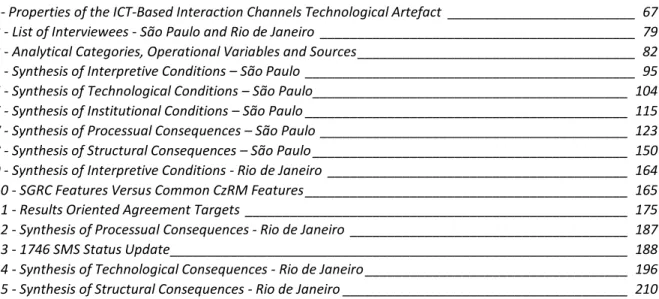
(9) LIST OF TABLES Table 1- Properties of the ICT-Based Interaction Channels Technological Artefact _________________________ 67 Table 2 - List of Interviewees - São Paulo and Rio de Janeiro __________________________________________ 79 Table 3 - Analytical Categories, Operational Variables and Sources _____________________________________ 82 Table 4 - Synthesis of Interpretive Conditions – São Paulo ____________________________________________ 95 Table 5 - Synthesis of Technological Conditions – São Paulo __________________________________________ 104 Table 6 - Synthesis of Institutional Conditions – São Paulo ___________________________________________ 115 Table 7 - Synthesis of Processual Consequences – São Paulo _________________________________________ 123 Table 8 - Synthesis of Structural Consequences – São Paulo __________________________________________ 150 Table 9 - Synthesis of Interpretive Conditions - Rio de Janeiro ________________________________________ 164 Table 10 - SGRC Features Versus Common CzRM Features ___________________________________________ 165 Table 11 - Results Oriented Agreement Targets ___________________________________________________ 175 Table 12 - Synthesis of Processual Consequences - Rio de Janeiro _____________________________________ 187 Table 13 - 1746 SMS Status Update _____________________________________________________________ 188 Table 14 - Synthesis of Technological Consequences - Rio de Janeiro ___________________________________ 196 Table 15 - Synthesis of Structural Consequences - Rio de Janeiro ______________________________________ 210. 9.
(10) LIST OF FIGURES Figure 1 – Latinobarometro: Confidence in Democracy_______________________________________________ 31 Figure 2 – Latinobarometro: Confidence in Institutions ______________________________________________ 31 Figure 3 - Eurobarometer: Trust in European Union Institutions ________________________________________ 32 Figure 4 - Enactment of Technology-in-Practice ____________________________________________________ 62 Figure 5 - SAC Online List of Topics ______________________________________________________________ 98 Figure 6 - SAC Online Service Specification ________________________________________________________ 98 Figure 7 - SAC Online Service Form ______________________________________________________________ 99 Figure 8 - SAC MANAGEMENT SUBPREFECTURES DASHBOARD _______________________________________ 100 Figure 10 - SAC Management Pinheiros Subprefecture: Evolution of Requests ___________________________ 101 Figure 11 - SAC Management Sé Subprefecture: Main Dashboard _____________________________________ 101 Figure 12 – São Paulo Citizen Attention Main Structure: 2003-2005 ___________________________________ 107 Figure 13 - São Paulo Electronic Government Policy Working Structure _________________________________ 109 Figure 14 - Electronic Interactive Channels Legislation ______________________________________________ 111 Figure 15 - São Paulo Citizen Attention Main Structure: 2005-2009 ____________________________________ 112 Figure 16 - São Paulo Citizen Attention Main Structure: 2009-2014 ____________________________________ 112 Figure 17 - São Paulo Citizen Attention Main Structure: 2013-2015 ____________________________________ 113 Figure 18 - Information and Service Request Flows (2003-2007) ______________________________________ 117 Figure 19 - Enacted Information and Service Request Flows (2008-2015) _______________________________ 118 Figure 20 - Initial Feedback and Service Usage Information Flows (2003-2004) ___________________________ 119 Figure 21 - Enacted Feedback and Service Usage Information Flows (2006-2009) _________________________ 120 Figure 22 - Enacted Feedback and Service Usage Information Flows (2010-2013) _________________________ 121 Figure 23 - Enacted Feedback and Service Usage Information Flows (2013-2015) _________________________ 122 Figure 24 - Service Requests Custom-Made Datasheets Reports ______________________________________ 124 Figure 25 - São Paulo City Hall Portal: 2006-2013 __________________________________________________ 126 Figure 26 - São Paulo Online Services Guide ______________________________________________________ 127 Figure 27 - Distribution of Services Requests by Interaction Channels __________________________________ 127 Figure 28 - São Paulo City Hall Portal: 2013-2015 __________________________________________________ 128 Figure 29 - São Paulo City Hall Portal – Services for Citizens: 2013-2015 ________________________________ 129 Figure 30 - Department of Finance Portal and Mobile Application _____________________________________ 130 Figure 31 - São Paulo City Hall Facebook Profile ___________________________________________________ 132 Figure 32 - Synthesis of Technological Conditions – São Paulo ________________________________________ 133 Figure 33 - Health Ombudsman Data by Subprefecture and Type _____________________________________ 137 Figure 34 - Health Ombudsman Data by Suprefecture and Health Facility _______________________________ 137 Figure 35 - Health Ombudsman Data: Health Facilities Ranking _______________________________________ 138 Figure 36 - Manifestations’ Specifications by Health Facility _________________________________________ 139 Figure 37 - Map of Complaints Regarding Unavailability of Medicines _________________________________ 140 Figure 38 - Health Ombudsman Data: Unavailability of Medicines by Type and Location ___________________ 140 Figure 39 - Health Complaints Data: Enhancement of Public Services __________________________________ 141 Figure 40 - São Paulo Maps of Noise Complaints __________________________________________________ 142 Figure 41- Maps of Open Air Parties versus Noise Complaint Data _____________________________________ 143 Figure 42 - Noise Complaint Data – Enhanced and Collaborative Service Delivery _________________________ 143 Figure 43 - Sé Subprefecture: Tree Pruning Planning Map ___________________________________________ 145 Figure 44 - Tree Pruning Requests and Tree Falls, by Subprefecture ____________________________________ 146 Figure 45 - Tree Pruning Request Data: Transformation of Service Delivery _____________________________ 147 Figure 46 - Where’s My Bus Mobile Application ___________________________________________________ 148 Figure 47 - Where’s My Bus Data: Collaboration for Service Delivery Enhancement _______________________ 148 Figure 48 - Mayor Eduard Paes - Technology Enthusiast _____________________________________________ 163 Figure 49 - 1746 Mobile Application ____________________________________________________________ 166. 10.
(11) Figure 50 - Synthesis of Technological Conditions - Rio de Janeiro _____________________________________ 167 Figure 51 - 1746 Matrix Working Structure _______________________________________________________ 169 Figure 52 - 1746 Visual Standards Decree ________________________________________________________ 170 Figure 53 - Initial Conceptualization of the Citizen Attention Structure _________________________________ 173 Figure 54- 1746 Conformity Inspection Cars ______________________________________________________ 176 Figure 55 - Synthesis of Institutional Conditions ___________________________________________________ 177 Figure 56 - 1746 Citizen Attention Center Initial Information/Request Flows _____________________________ 180 Figure 57 - 1746 Citizen attention Center Enacted Information/Request Flows ___________________________ 181 Figure 58 - Executive Monthly 1746 Panel ________________________________________________________ 183 Figure 59 - Map of Requests by Planning Areas and Types of Services __________________________________ 183 Figure 60 - Enacted Feedback and Service Usage Information Flows (2011-2012) _________________________ 184 Figure 61 - 1746 Enacted Feedback and Service Usage Flows (2013-2015) ______________________________ 185 Figure 62 - 1746 Managing Staff Conformity Check Form ____________________________________________ 186 Figure 63 - 1746 Manager Dashboard ___________________________________________________________ 189 Figure 64 - 1746 Manager View of Departments' Performance, Conformity and Citizen Satisfaction __________ 190 Figure 65 - 1746 Manager View of Department Of Public Works' Performance, Conformity and Citizen Satisfaction _________________________________________________________________________________________ 190 Figure 66 - Department of Public Works Dashboard ________________________________________________ 191 Figure 67 - Department of Public Works Dashboard - Street Paving ____________________________________ 192 Figure 68 - Department of Public Works Dashboard - Street Paving by Department Unit ___________________ 192 Figure 69 - Satisfaction Survey by Department Unit ________________________________________________ 193 Figure 70 - 1746 Web Application ______________________________________________________________ 194 Figure 71 - Carioca Digital Entry Screen __________________________________________________________ 195 Figure 72 - Revitalization of Public Squares Program - Enhancement of Public Services ____________________ 199 Figure 73 - Dengue Fever Mosquito Spot Reports __________________________________________________ 200 Figure 74 - Requests for Inspection on Possible Outbreak of Dengue Fever ______________________________ 201 Figure 75 - Dengue Fever Inspections – Enhancement of Public Services ________________________________ 201 Figure 76 - Penalty for Table and Chairs Illegally Occupying a Public Area _______________________________ 202 Figure 77 - Penalty for Table and Chairs Illegally Occupying Public Areas - Frequency of Inspection ___________ 203 Figure 78 - Inspection of Tables and Chairs - Demand and Time _______________________________________ 203 Figure 79 - Inspection of Table and Chairs - Enhancement of Service Delivery ____________________________ 204 Figure 80 - Noise Pollution Joint Inspection Routines _______________________________________________ 205 Figure 81 - Noise Pollution Join Inspection Routines – Transformation in Service Delivery __________________ 206 Figure 82 - Carioca Digital – My School __________________________________________________________ 207 Figure 83 - Carioca Digital – My Vehicle _________________________________________________________ 208 Figure 84 - Services and Information Requests by Channel ___________________________________________ 209 Figure 85 - Services and Information Requests by Channel (%) ________________________________________ 209. 11.
(12) CHAPTER 1 – INTRODUCTION. Since I started working with Information and Communication Technologies (ICTs) in the public sector, first as an assistant at an IT Department at the São Paulo Municipal Government in 2005, I understood that technologies could have a pivotal role in helping governments improve the lives of citizens in many areas – health, education, finances, service delivery, etc. I also understood, by observing in practice, that although new technologies are fascinating and captivating, those benefits are not direct or straightforward. E-Government, as well as e-Administration, eParticipation, and e-Democracy, were terms being highly discussed in both the public sector and the academia: e-Government promised to revamp public administration's efficiency, effectiveness and transparency by facilitating more networked forms of government. Fascinated by these discussions, in late 2006 I embarked on the Information and Knowledge Society PhD program, seeking to understand in what conditions e-Government helps administrations to achieve those promised goals. After getting acquainted with Science and Technology Studies, and the important works of Wanda Orlikowski on ICTs and Organizational Theory and of Jane Fountain on ICTs and Institutional Change in governments, the thesis questions whether the intensification of ICT-based interaction between governments and citizens related to public services, which generate voluminous quantities of information, leads to organizational transformations in public administrations. I chose São Paulo and Rio de Janeiro as case studies in order to answer the thesis question. In the initial period of my research, I did extensive documentation analysis and interviews in three other regional governments – Québec, Catalonia and São Paulo State Governments – between 2008 and 2010, which allowed me to undertake more in depth research in the thesis two cases. In 2010, I had to stop the process of preparing the doctoral thesis in order to work. I sought to work with themes completely related to the thesis topics, aiming to one day finish it. I always had the thesis in mind at work, and often during my activities, I brought experiences of previous analysis and wrote down how, in my daily work routines, those previously studied and systematized categories presented themselves. In fact, the thesis question throughout those years has 12.
(13) remained the same. It is important to note here that between September 2011 and December 2012, I worked as a citizen relationship manager as part of 8-people team who coordinated the 1746 multichannel service at the Chief of Staff Department of the Municipality of Rio de Janeiro. I was responsible for structuring the area of service quality and citizen satisfaction, as well as I actively participated in the modelling of service level agreements with Departments’ representatives, in the improvement of the mobile application and the creation of the web application. Between December 2012 and April 2013, I became manager of the entire multi-platform service 1746. Working in the São Paulo municipal government, between April 2013 and August 2014, I coordinated the Working Group that joined all those responsible for interaction channels (faceto-face, telephone and online) to discuss and plan the future of citizen attention in the municipal government. In August 2014, I became the coordinator of Citizen Attention and Service Innovation Unit, supervising a team of four analysts, in charge of producing strategic and ondemand reports and restructuring public services processes. These professional experiences, intertwined with my academic curiosity and fascination about the theme, helped me gain full and in depth access to informants and documents in both cases studied. The thesis is organized as follows: Chapter 2 offers a comprehensive literature review on eGovernment, its definitions, promises and empirical findings, as well as references about Electronic Participation and Network Administration, raising some important questions that are further developed along the thesis; Chapter 3 presents the Research Questions and the Analytical Framework, based on Wanda Orlikowski Technology-in-Practice lens (W. J. Orlikowski 2000) and Jane Fountain Technology Enactment Framework (Jane E. Fountain 2001); Chapter 4 explains the Methodology and the Operational Variables used in the analysis; Chapters 5 and 6 present the São Paulo and Rio de Janeiro case studies; and finally, Chapter 7 draws comparative conclusions from their analysis.. 13.
(14) CHAPTER 2 – E-GOVERNMENT, PUBLIC SERVICES CO-PRODUCTION AND THE NETWORK ADMINISTRATION. 1.. INTRODUCTION. This chapter aims to introduce the main concepts and the literature review that guide the research presented in the following chapters. After the second section, which gives a brief overview on the study of ICT in the Public Sector, this chapter is divided into three parts. It structures a theoretical analysis on the relationship between e-Government and a) a more efficient and effective delivery of public services, b) citizen participation in public service design, and c) the emergence of the network administration and the network state. In the final remarks, I revisit the main concepts, linking them with the thesis questions, and laying the grounds for the development of the research.. 2.. THE STUDY OF ICTS IN THE PUBLIC SECTOR. 2.1.. Computerization and Automation. The study of technology in the public sector is not a new field. Max Weber already recognized the emergence of the rational-bureaucratic state as a sociotechnical system, based on efficiency, rational calculation and control: “The primary source of the superiority of bureaucratic administration lies in the role of technical knowledge which, through the development of modern technology and business methods in the production of goods, has become completely indispensable.” (Weber 1968, 223) In addition:. 14.
(15) “The decisive reason for the advance of bureaucratic organization has always been its purely technical superiority over any other form of organization. The fully developed bureaucratic apparatus compares with other organizations exactly as does the machine with the non-mechanical modes of production. Precision, speed, unambiguity, knowledge of the files, continuity, discretion, unity, strict subordination, reduction of friction and of material and personal costs – these are raised to the optimum point in the strictly bureaucratic administration, and especially in its monocratic form.” (Weber 1968, 973) Early applications of microelectronics based information and communication technologies, during the 1950s and 1960s, in the internal business processes of governmental organizations meant essentially the employment of large-scale automatic data processing systems, such as databases of employees, financial management systems, inventories databases, among others (Bellamy and Taylor 1998). In general, however, from a public management perspective, technology, when remembered, was taken as a simple tool available off the shelf, which was either neutral or had predictable “impacts” and “effects” in the organization (Waksberg-Guerrini and Aibar 2007). Weber's recognition of organizations as socio-technical systems took decades to feed through into subsequent thinking. Over the following years, the focus of attention was primarily on the human and organizational aspects of social-technical systems, leaving aside the process and relevance of the commissioning, design and implementation of IT systems in government activities 1. Pioneering research that analyzed the interaction and outcomes of the computerization in the public sector in the 1950s and 1960s in organizational power structures date from the 1970s and 1980s (Chadwick 2006). Some researchers started to move away from a perspective that addressed rather simplistically the effects and impacts of technology in governments 2 and began to focus on the multi-way interaction of information and communication technologies with political and institutional characteristics and structures. In general, those studies found that the. 1. For further discussion on the neglect of information systems and information access within public management and the theory of government organizations, see Dunleavy et al. 2006 2. Chapter 3 deals with the technological determinist versus the social shaping of technology debate.. 15.
(16) implementation and use of information technology tended to mimic and reinforce the hierarchical and power structures in place. Laudon (1974), for instance, identified two patterns in the interplay between the use of computers - more specifically the implementation of multi-Agency automated information systems - and the activities and interactions between government bureaucracies: the first conforms to the conventional wisdom that information systems increase central control and are thus resisted by the managers of Agencies and Departments; the second pattern conveys that where there are systems that link homogeneous integrated Agencies, which pursue similar objectives and gain from the pooling of data and information, they are administered in a more decentralized way (Dutton 1975). Danziger et al (1982) were more emphatic in showing that information technology reinforces hierarchical and power structures in place, which are usually centralized and hierarchical, by favoring administrative efficiency, financial accountability and social control, as opposed to innovative and decentralized ways of management or enhancing public service delivery (Benjamin 1982; Danziger et al. 1982). In sum, commentators at that time found that the interplay between the technology available, based on mainframe computing and large databases, and the way it was prevailingly deployed in the public sector – computerization forms which had central, corporate functionality – had the effect of sustaining and strengthening existing bureaucratic features (Bellamy and Taylor 1998). During the 1980s, the evolution of computerization in governments, the advent of client-server computing, and personal computers increasingly making their presence in civil servants desks, brought about the argument that IT in the public sector would bolster the decentralization of activities, thus augmenting the power of Departments, which could in turn more easily meet the needs of citizens: “The advent of minicomputers and PCs tended to decentralize access to information and led to predictions that decision making would likewise be decentralized as lower-level managers took advantage of the opportunities offered by that access” (Kraemer and Dedrick 1997, 100). Some authors argued, however, that more than having the effect of decentralizing activities as predicted, the application of information technology represented a “distributed automation” of 16.
(17) activities. In other words, the tendency was for service delivery to be automated throughout the public sector in a decentralized fashion, whereas managerial control would still be centralized. For this commentators, service delivery and the surrounding activities were aided by the implementation of technology, but respected the hierarchical structure in place and the managerialist agenda3, centralized around large-scale mainframe computer systems (Bellamy and Taylor 1998; Kraemer et al. 1989).. 2.2.. Informatization and Transformation. Contemporary public administrations have become increasingly more complex, having to coordinate actions with emerging actors in the public sphere, such as non-profit organizations and the private sector, and manage and process increasing amounts of information. The silo like, inward-looking, slow decision-making and knowledge diffusion characteristics of the old bureaucratic model seem to be ill-suited to improve flows of information and cooperation, levels of legitimacy and trust as perceived by citizens, and ultimately efficiency and efficacy. In this scenario the modern information and communication technologies4 have, since the middle of the 1990s, begun to be seen as an ideal vehicle to resolve some of the problems of contemporary public administration, such as its lack of flexibility and slow processing times, and its organization in silos, closed to interdepartmental work, coordination and information sharing and feedbacks. Following this trend, several labels have emerged to depict civil society, politicians, and governments relations facilitated by ICTs. Just as it is impossible to box every societal actor into one single category, those labels are useful but tend to overlap in some areas.. 3. More on New Public Management and the new ICTs in section 3.2.2.. 4. “Information and communications technology (ICT) is often used as an extended synonym for information technology (IT), but is a more specific term that stresses the role of unified communications and the integration of telecommunications (telephone lines and wireless signals), computers as well as necessary enterprise software, middleware, storage, and audio-visual systems, which enable users to access, store, transmit, and manipulate information.” (https://en.wikipedia.org/wiki/Information_and_communications_technology, accessed on 21/06/2015).. 17.
(18) The concept of e-Administration is perhaps the easiest to define when we consider the managerial aspect of public administrations: most authors use it when referring to ICTs in support of the management of activities inside the organization – for instance, systems and data processing – for intra and inter-Departmental information flows (Welp 2007). E-Government has been defined in several different ways, from electronic service delivery, in other words, the digitalization and online delivery of public services (Accenture 2003)), to broader definitions, such as the World Bank’s view: “E-Government” refers to the use by government Agencies of information technologies (such as Wide Area Networks, the Internet, and mobile computing) that have the ability to transform relations with citizens, businesses, and other arms of government.”5 In that sense, it encompasses both e-administration, e-democracy and e-participation. Edemocracy, in a broad definition, is usually associated with the efforts to broaden political practices, without the limits of time, space, and other physical conditions, by enabling political actors - citizens/voters, governments, elected officials, political organizations, civil society organizations, and even the media - to connect with one another via new information and communication technologies (Hacker and Dijk 2001; Reddick 2008). It assists to set agendas, establish priorities, make important policies and participate in their implementation in more deliberative ways (such as e-consultation or e-voting). E-participation is often used interchangeably with e-democracy, depending on the range of each definition. Ann MacIntosh's (2004, 2) definition of e-participation as " “e-democracy is concerned with the use of information and communication technologies to engage citizens, support the democratic decision-making processes and strengthen representative democracy" is very close to the broad definition of edemocracy used above. In this work, participation does not happen only during formal political processes (voting, consulting) or those that attempt to influence the decision making-process. 5. http://web.worldbank.org/WBSITE/EXTERNAL/TOPICS/EXTINFORMATIONANDCOMMUNICATIONANDTECHNOLOG IES/EXTE-GOVERNMENT/0,,menuPK:702592~pagePK:149018~piPK:149093~theSitePK:702586,00.html (accessed on 13/07/2015). 18.
(19) (e.g. political activism), but also participation regarding government daily practices (e.g. service quality feedback) that in the medium run can modify public policies6. This work uses the broadest definition of e-Government, i.e., defined as encompassing all uses of ICT within public administrations and government Agencies and units. Some of these uses, particularly those involving the Internet, have more recently been considered catalysts of important transformations in the way governments carry on their activities, promising to bring new levels of rationality to governments and overcoming the strains imposed by Weberian Bureaucracy (Margetts 2003; P. Norris 2001)7: by improving service delivery, simplifying and cheapening administrative procedures (Jane E Fountain 2003), and contributing towards a flatter and more networked environment – both intra government and with civil society - which could strengthen transparency and accountability of government activities (Bhatnagar 2003), citizen participation (Hague and Loader 1999), as well as transparency and accountability of government activities, therefore reinvigorate citizens’ trust in governments. Although in the early 1990s policy makers were at first suspicious of the new technologies, later e-Government also began to be seen as an opportunity to convey an agenda of innovation and modernity. Many policy makers are still attracted to this view of e-Government and, by the late 1990s, many governments had devised e-Government strategies (Mayer-Schönberger and Lazer 2007). Fifteen years later, governments presence online is not just an interesting option for policy makers, but an obligation for “modern governance”. The UK “Digital by Default” strategy – meaning providing digital services that are so easy to use and so convenient that all those who can use them will choose to do so – is a clear example of a method meant to cut costs and to bring government completely to the modern digital era. In March 2015, the UK government ended the Transformation Programme – it gave itself 400 days to transform 25 major services, making them digital by default8, and expecting to save £1.7 and £1.8bn each year if 82%. 6. More about e-participation is explored on session 3.2. of this chapter.. 7. More about Weberian bureaucracy on section 3.3.1.. 8. More about the Digital by Default Strategy and the Transformation Programme can be accessed here: https://www.gov.uk/transformation (accessed on 13/07/2015).. 19.
(20) transactions for those services were done online (UK Cabinet Office and UK Government Digital Service 2012). Nonetheless, contrary to the positive views of new ICTs in government, some academics and political activists were more sceptical. First with the increased possibility of government's power to exert control over citizens, "where massive databanks and the convergence of information technologies are used as instruments of control", an anti-utopian view described by Margetts (Margetts 2003). For instance, Burham (1983), in his book “The Rise of the Computer State”, perhaps did not imagine the power that the US National Security Agency would hold today, but voiced his concern over the computerized State growing invasion of privacy, threatening personal freedom. Webster (Webster 2009), more than twenty five years later, showed similar concerns about the “surveillance revolution” and the widespread use of CCTV. Other authors believe that the positive impacts of ICTs in governments are a naïve view, as they are organizations that are inherently conservative, hierarchical and bureaucratic, incapable to adapt to the new environment (P. Norris 2001). Following this debate, in the following sections, I explore what recent empirical research has revealed about the promises of e-Government and their potential transformative effects on public administrations.. 3.. THE PROMISES OF E-GOVERNMENT. E-Government was first depicted as the use of ICTs in provision of online services; later, a much broader concept was suggested (Dawes, Pardo, and Cresswell 2004), as detailed in the previous section, defined as the extensive use of ICTs in all government functions to support government operations, engage citizens, and provide services.. 20.
(21) 3.1.. Better Services with Lower Costs?. One of the first objectives to appear in the discourse and practice of e-Government was the potential of ICTs to increase efficiency and effectiveness of public services. We see this content early on in the development of the very term "electronic government" on state and local governments’ strategic reports, the academic literature, as well as the media. These are some examples: "More efficient and effective use of resources at a time when there is increased pressure on governments to limit their spending and to reduce the tax burden upon citizens and businesses" (Nixon and Koutrakou 2007, viii) UN E-Government Survey 2003: “Governments are increasingly becoming aware of the importance of employing eGovernment to improve the delivery of public services to the people. This recognition has come about as a result of two recent interrelated phenomena. First, the rapid pace of globalization has interwoven the intra-country trade, investment and finance opportunities of the world into transnational networks, with countries seeking new ways to provide more competitive products and services. Second, recent advances in Information and Communication Technology (ICT) have presented new approaches for the integration of these networks and the improvement of the efficiency of businesses and services worldwide. Led by the private sector, innovative applications have highlighted the potential of using ICT to reduce costs and improve the productivity and efficiency of transactions.” (UNDESA 2003, 4) Al Gore’s introduction to the “Access America” report: "Among the 1,200 recommended actions was a set of imaginative proposals to make government work better and cost less by reengineering through information technology. The idea of reengineering through technology is critical. We didn't want to automate the old, worn processes of government. Information technology (IT) was and is the great 21.
(22) enabler for reinvention. It allows us to rethink, in fundamental ways, how people work and how we serve customers.” (Gore 1997, 1) The question is whether this potential has been verified; therefore, I explore research conducted to understand whether more efficiency and effectiveness have been observed as a result of eGovernment initiatives, also raising the question as to whether those categories should be applied with those definitions in the public sector.. 3.1.1. Efficiency In economic terms, a system is more efficient when the production process proceeds at the lowest possible per-unit cost. In technological terms, a system is efficient when it is not possible to increase output without increasing inputs – which means that sometimes being technologically efficient is not economically efficient, whereas the reverse is always true. Hence, when we say that a system is "efficient", we are describing an equilibrium state where more output cannot be obtained without increasing the amount of inputs at a given state of available financial, human and technological resources. One key point in the definition of efficiency is the assumption that all else remains equal, including the quality of the product. In other words, when we talk about the relationship between government and increased efficiency, we should look at how ICTs help lower costs and/or introduce new ways of "production" that require the use of less input per service delivered, maintaining or increasing the quality of the service provided. E-Government advocates in the media, government officials and researchers claimed that eGovernment would increase the efficiency of service delivery mainly through its rationalizing power: by migrating from paper-based to web-based processing and management of documents and payments, by supplanting some human activities, such as accepting, storing, outputting, or transmitting information (Chadwick 2006; Heeks 1999) and achieving productivity gains in the office work – as more automated service delivery would enable civil servants to handle more cases and/or more extensive amounts of information –, and by increasing managerial control (Danziger and Andersen 2002). Furthermore, by replacing traditional paper-based with webbased procurement systems, efficiency, as advocated, would be gained by reducing the 22.
(23) procedure costs and by expanding the number of buyers, increasing competition and thus reducing prices. Fountain and Osorio-Urzua (2001) concur that digital government reduces costs of transactions; the authors agree that procurement procedures may benefit from a larger set of participating firms who will force a reduction in prices through competition, but there are still few rigorous studies on the subject. By using an Activity-Based Cost Analysis9, (Ferrer and Guerrini 2006) compared the costs of the online versus the offline procedures of the São Paulo Water Supply Company procurement process, concluding that online services were less costly for the administration. Nevertheless, this study is a static analysis in time of the two types of transaction – it does not take into account, for example, subsequent maintenance costs of the installed IT infrastructure. Furthermore, as Heeks (2002) argument runs, in the developing world, automating activities means replacing civil servants that usually have low salaries by IT infrastructure that are usually imported and expensive. Traditionally, studies in the private sector have also been inconclusive about the relationship between the ICTs implementation and increase in productivity. At the firm level, at least at first, we have not witnessed an increase in productivity. This may have had several reasons. First, IT spending increased heavily at the same time where there was a general decrease in productivity growth, particularly in the service sector in the late 1980s. Second, and most importantly, it may have been due to how and why ICTs were implemented. More recently, there has been a shift from focusing on doing the same old things with ICTs but more efficiently (automation of activities), to also trying to innovate in processes and procedures. From this perspective, if we look at the organizational level, ICTs might indeed be linked to firm performance through a transformation of how things are done; furthermore, doing things differently may lead not necessarily to more efficiency, but to more effectiveness, by improving quality, flexibility, and the innovation ability of organizations (Callaghan 2005). Similarly, looking at how e-Government could not only automatize the public sector, but also transform it, commentators see that e9. “Activity-based costing (ABC) is a costing methodology that identifies activities in an organization and assigns the cost of each activity with resources to all products and services according to the actual consumption by each. This model assigns more indirect costs (overhead) into direct costs compared to conventional costing.” (Wikipedia, accessed on 14/07/2015). 23.
(24) Government could catalyse more networked, less bureaucratic, less redundant and more flexible working processes through more collaboration between individual staff, Agencies and Departments (Chadwick 2006)10. Reducing administrative costs has been central to the broader agenda of public sector reform since the early 1990s and, with the technological and Internet crisis in the 2000s, the economic downturn and the need to cut public expenditure, value for money became a powerful criterion for investing in ICTs (Chadwick 2006). Thus, a few studies have shifted their concern from the simplistic availability of web portals and services to focus on, besides efficiency and costeffectiveness, the generation of public value of online services (Accenture 2003; Codagnone, Boccardelli, and Leone 2006; Cresswell, Burke, and Pardo 2003). Although there have been attempts on measuring intangible values11, such as time, travel, and human effort, they are less easily quantifiable in monetary terms (Jane E. Fountain and Osorio-Urzua 2001). Return on Investment in IT (ROI) models are associated with both tangible and intangible benefits, costs and risks; most often intangible benefits (the “effectiveness” of a project, for instance better quality, variety, speed and citizen customer service) is the most important factor for the decision of investing in IT, but they are typically the most difficult to monetize and measure (Dadayan 2006). In trying to quantify – not only, but also on financial terms – some of its impacts and outcomes, the European Commission e-Government Economics Project (Codagnone, Boccardelli, and Leone 2006) developed a measurement framework for the evaluation of e-Government based on existing European impact measurement models. It aggregates 92 indicators built around three value drivers: efficiency (cashable financial gains), democracy (openness, transparency and accountability) and effectiveness (reduced administrative burden, increased user value and satisfaction, more inclusive public services). The eGEP framework gives more weight to the indicators of efficiency, whereas indicators for democracy and effectiveness are mostly selfassessments through surveys and do not truly analyse transformations12. However, the 10. More on network administration on section 3.3.3.. 11. Ferrer and Guerrini equated the time spent on displacement and on waiting online with the average local salary. E.g.: one indicator of political participation is the availability of online channels for citizen interaction, which does not in fact verify transformations towards more participatory decision-making. 12. 24.
(25) framework successfully develops efficiency indicators derived from transformations as consequence of the implementation of e-Government. For instance, the “percentage change in volume of document exchange digitally within public private partnerships” indicates cashable and time economies and integration with other non-public actors of society. On the other hand, this indicator may hide the very fact that if reengineering of processes and working methods were to take place, such transactions might be considered redundant and fully ceased to exist. We might question, nevertheless, the relevance of measuring returns on investment by comparing online versus paper-based service provision. First, as e-Government becomes the norm, governments will eventually have to offer services through all channels available, and comparing their costs might not be pertinent13. Chadwick (2006) raises a fundamental question in this regard: can we talk about cost reduction in the public sector as in the private sector? Greater efficiency might mean job losses (if governments have the discretion staff to fire employees, which is often not the case), de-skilling, and threats to Agency autonomy by, for instance, outsourcing IT. Public sector organizations have different purposes and goals than private ones; they should be concerned with lower costs, but primarily with improving services and access to public services, and fulfilling political goals such as collaborating with other Agencies, governments and other actors of the society. The question is whether efficiency in this more strict definition is compatible with the public sector and public values in general. That is the main reason why the search for a set of appropriate measures of “public value” has become more prominent, with a combination of indicators of efficiency, effectiveness, “enablement” of otherwise unattainable activities that try to focus on citizens' needs (Cresswell, Burke, and Pardo 2003).. 13. Some could argue that multi-channel government could be a transitory phase towards a stronger online government, particularly for services that do not require human contact such as some health-related. The UK government launched in 2014 the “Digital by the Default Service Standard”, “a set of criteria for digital teams building government services to meet”.. 25.
(26) 3.1.2. Effectiveness Effectiveness, on the other hand, in its stricter sense, is simply the ability to produce an effect; in management terms it is a concept that is about the degree to which a purpose is achieved, or "getting the right things done" (Drucker and Maciariello 1967). Efficacy, another term constantly used, is about meeting specific targets, which is about achieving the "right" results and impacts of the actions implemented, although the concept’s usefulness in the public sector is questionable, as there are difficulties in measuring it objectively. It has been often said that eGovernment could bring more effectiveness to the provision of public services by on one hand, facilitating citizens’ ability to gain access to public service providers – improving citizengovernment communication, and reducing the time, the number of documents and the steps necessary to access the service – and by placing public information online and making it available to all, therefore increasing government's transparency and political accountability. E-Government's potential for increasing effectiveness does not only lie in substituting paperbased with online-based services. It could also improve, according to advocates, government's responsiveness to citizens' through facilitating its availability to target public goods to specific citizens, besides being able to offer completely new, beneficial services otherwise unavailable (Danziger and Andersen 2002; Heeks 1999). Much of the literature on e-Government effectiveness until the mid-2000s has been largely focused, although not exclusively, on the “maturity” and sophistication levels of portals and online services (Layne and Lee 2001; Silcock 2001; Stowers 2004; Undesa 2008; West 2007). These models viewed the development of e-Government as an evolutionary process that starts from simple government websites that develops into sophisticated transactional portals. Various assessments have categorized countries according to their stages of development based on the existing models (Accenture 2003, 2009, 2014). For example, using a content analysis of government websites in 198 different nations, West (West 2007) measures the online information and services – such as the availability of e-mail addresses, comments areas, nonnative language translation, disability access, number of public services fully online, etc. - and discuss how e-Government has progressed overtime globally.. 26.
(27) Within this widespread evolutionary view until the late 2000s – often becoming themselves a self-fulfilling prophecy as countries wished to score well in the “modernity” competition – the attention was given to the swift, and inevitable, progression of e-Government through defined stages14, ranging from the information stage – the web presence of public Agencies – to the transaction stage, where public services would be offered online 24x7. This demand driven and technology-fuelled process, with the purpose of facilitating the life of citizens, would in turn supposedly lead to a transformation of the public sector. Some researchers agree that the existing evaluations of e-Government effectiveness methodologies do not support a comprehensive and policy relevant assessment of eGovernment (Bannister 2007; Heeks and Bailur 2007; Kunstelj and Vintar 2004), as they have been too narrowly focused on services delivery and very little attention has been given to the relationship between back-office of processes and organizational structure and the intensive use of ICTs. In e-Government research there has been a tendency to "decouple" electronic or virtual entities from "real entities", best exemplified by those numerous studies based on websites and e-services analysis, and the e-Government maturity level models (Heeks and Bailur 2007; Waksberg-Guerrini and Aibar 2007). The data about the number of services available, their maturity level, the availability and number of e-mail addresses and contact forms, the usability of the websites and even the availability of electronic participatory mechanisms are interesting and in many cases deserve great attention, but in order to analyse changes within an organization it is not wise to limit the empirical data to the website. They are part of an organization, but they are not mirrors of what happens in governments in terms of the usual e-Government achievements. They are best seen a distorted mirrors producing sometimes-impressive mirages. Looking deeper at the nature of these indicators, we notice that transformations may not be captured or perhaps even hidden by them: for example, at first sight, having more transactions performed online is a good indicator of more efficiency in terms of paper used, time spent by citizens queuing, etc., but on the other hand, it may hide the very fact that if re-engineering of processes and working methods were to take place, such transactions might be considered 14. Some authors agree that these stages could overlap, but generally, these models are thought as a progressive path.. 27.
(28) redundant and fully ceased to exist. If we follow this logic, we will continue to see “fully available online services”, however designed to be nearly as complex as their paper-based analogues, showing a simple transfer from the offline disorganized logic to the web (J. Fountain 2005; Waksberg-Guerrini and Aibar 2007). UNDESA may be starting to reflect these changes in measuring e-Government development in their most recent reports. They have published the E-Government Survey report biannually since 2001, assessing websites of all countries that have an online presence, based on a conceptual framework that encompasses three important dimensions: provision of online services, telecommunication connectivity and human capacity. This framework remained consistent across survey periods, while its components have been adjusted to reflect the development of the dimensions. If in the beginning the provision of online services was measured in five stages – “emerging”, which referred to a simple Departmental website with government and contact information; “enhanced”, a stage where dynamic features appeared, such as links to other Agencies, searching facilities, and email addresses; “interactive”, where more sophisticated twoway interactive features were presented; “transactional”, where it became possible to run services completely online; and, finally, “networked”, where services were fully integrated and portals deliver all services irrespective of the Department - in their latest report, they write, reflecting the changes in aims and hopes surrounding e-Government: “The e-Government story may not be new but it is entering a new episode. Lowering costs is still an important consideration in service delivery, but adding public value is gradually taking over as the primary goal of e-Government. The view of an “e-Government maturity model” no longer holds as e-Government goals are constantly evolving to meet emerging challenges and increase public value. Emphasis is now being placed on deploying a portfolio of e-services that spans functions, business units and geographies, at varying local or municipal levels, thus increasing the value of service offerings to citizens by effectively adopting disruptive technologies in an adaptive and scalable manner.” (United Nations Department of Economic and Social Affair 2014, 14) It is important to notice that most studies and reports about e-Government tend to neglect the development of call centres. They evolved from being decentralized Departmental telephone 28.
(29) numbers with no standardized answers and procedures, to being part of multi-channel strategies – where one could call requesting a service and receive an email and/or SMS when it is completed – and most often the preferred mode for getting in touch with public administrations (Klievink et al. 2008). Call centres adopted the emerging Information and communication technologies - to offer consumers easy access, closeness, and personal information – and they frequently gather and process information from citizens in the same systems and databases that are used to offer information and services through the Internet, thus standardizing the contents and quality levels, giving a common look and feel of the whole government interaction experience, and improving the external image of public bodies. Generally speaking, the call centre and its development are one of the most significant tools for the evolution of e-Government. More recently, some attention has been given to the demand side, with assessments interested in the take-up of services and on citizens’ level of satisfaction with digital government: what is the actual use of the existing online services? Are “customers’” needs being met? (Comitê Gestor da Internet no Brasil 2014; Pew Internet Institute 2010; United Nations Department of Economic and Social Affair 2014). For instance, according to a Pew Research Institute report (Pew Internet Institute 2010), in 2010, in the United States of America, 46% of adults have looked up what services a government Agency provides and 33% have renewed a driver’s license or auto registration; in Brazil, of the 51% who used the Internet in 2013, 68% used electronic services. Less frequent are detailed surveys about users' opinions about individual e-Government services. Examples of these are the national survey conducted in Brazil (Comitê Gestor da Internet no Brasil 2014), that ask citizens opinion about specific groups of e-services. The general benchmarks about user take-up may be useful for digital inclusion policies, as they identify the users and nonusers in different analytical strata, whereas the more specific ones – those that encourage feedback about services from citizens – could be helpful in building more responsive and permeable governments. Current e-Government research and evaluation methodologies do not easily capture transitional processes towards a transformed administration because they mostly focus on the availability of the structure of a digital government, and not on its dynamics. These studies show that there is a trend of improvement in service delivery, because the simple fact that they are made available 29.
(30) online raises an awareness about their quality and the digital inclusion of the population. However, an exclusive look at front-office results may cause a kind of theoretical mirage: they may give a false impression that the rest of the organization has already undergone a deep transformation process. The question remains – are Departments working towards a more collaboratively, relational, networked model of government, moving away from the “silo-like” model? In addition, to what extent is this trend based on ICT innovative uses? “The old way of organizing work is patterned on a factory, a hierarchical system. The system has top management, middle management, and workers, who are seen as cogs in a machine, programmed by those at the top of the pyramid to do simple tasks over and over. This approach forfeits the greatest asset of the organization -- the unused brain power, energy, and creativity of the men and women in the organization. The factory model has outlived its usefulness. Today's computers and communications let us organize to work in a new way. Based on the "distributed intelligence" concept in computing, this new model distributes information and the tools to use that information throughout an organization. Decision-making authority can be placed with employees on the front lines, where change is encountered first.” (Gore 1997) Are we moving toward the view Al Gore had in 1997?. 3.2.. The Involved Citizen?. 3.2.1. Representative Democracy Deficits and Participation Much has been written about the alleged present crisis in politics, democracy and representation15. In the last quarter of the 20th century there was a lively debate about the collapse in the confidence and legitimacy in traditional models of democratic governance,. 15. For a synthesis of the discussion, see Lavalle, Houtzager, and Castello 2006; Manin 1997.. 30.
(31) traditional structures and decision-making processes, which was reflected on, for instance, falling voter turnout, lower levels of public participation in civic life, and public cynicism towards political institutions and parties. In Latin America, although levels of confidence in democracy and institutions have recently increased to levels similar to 1996, after a downturn in the beginning of the 2000s, Latin Americans have more trust in the church, the television, the military and the banks than in government and other state institutions. FIGURE 1 – LATINOBAROMETRO: CONFIDENCE IN DEMOCRACY. Source: Latinobarometro. FIGURE 2 – LATINOBAROMETRO: CONFIDENCE IN INSTITUTIONS. Source: Latinobarometro. 31.
(32) Similarly, the Eurobarometer survey asked citizens about their trust in the European Union, their national parliament and their national government. In 2013, trust in political institutions is at a relatively low level and continues to decrease – 25%, minus 10 percentage points since fall 2005 for national parliaments, and 23%, minus 8 percentage points since fall 2005 for national governments. FIGURE 3 - EUROBAROMETER: TRUST IN EUROPEAN UNION INSTITUTIONS. Source: Eurobarometer. Likewise, the Eurobarometer 2001 also asked European citizens whether they would like to take part in a "dialogue on Europe" – 26% said that they would, but 62% said that they would not, with 29% agreeing with the statement "My views would not be taken into account anyway" and 17% agreeing, "It would be a waste of time". In 2006, on average, only 34% of respondents tended to agree that their voice counts in the European Union; in 2013, this number fell to 29%. Worse, in 2008, 60% believed that their voice did not count in their own country. According to Lavalle et al (2006) this crisis is more likely to be a misjudgement of a reconfiguration of representation; however, as the authors question, even if it is an erroneous interpretation of the transformations taking place, we must examine their effects on the quality of democracy. It is noteworthy that the latest generation of institutional innovations, such as participatory budgeting and thematic councils in, for instance, health, LGBTs rights and the environment, go beyond the electoral process and move in the direction of government continuous accountability and representation, especially in areas of public policy design and implementation. 32.
Figure
Documento similar