
Woody species diversity in temperate Andean forests: the need for new conservation strategies
48
0
0
Texto completo
(2) *Manuscript Click here to view linked References. 1. Woody species diversity in temperate Andean forests: the need for new conservation. 2. strategies. 3. Adison Altamiranoa,*, Richard Fieldb, Luis Cayuelac, Paul Aplinb, Antonio Larad, José María. 4. Rey-Benayase. 5. a. 6. Temuco, Chile. E-mail address: [email protected]. 7. b. 8. Kingdom. E-mail address: [email protected] ;. 9. [email protected]. Departamento de Ciencias Forestales, Universidad de La Frontera, P.O. Box 54-D,. School of Geography, University of Nottingham, Nottingham, NG7 2RD, United. 10. c. 11. - Junta de Andalucía, Granada, 18006, España. E-mail address: [email protected]. 12. d. 13. mail address: [email protected]. 14. e. 15. Henares, España. E-mail address: [email protected]. 16. *Corresponding author: Tel +56 45734159, Fax +56 45 325634. Departamento de Ecología, Centro Andaluz de Medio Ambiente, Universidad de Granada. Instituto de Silvicultura, Universidad Austral de Chile, P.O. Box 567, Valdivia, Chile. E-. Departamento de Ecología, Edificio de Ciencias, Universidad de Alcalá , 28871 Alcalá de. 17 18. ABSTRACT. 19. Chile has more than half of the temperate forests in the southern hemisphere. These have. 20. been included among the most threatened eco-regions in the world, because of the high. 21. degree of endemism and presence of monotypic genera. In this study, we develop empirical. 22. models to investigate present and future spatial patterns of woody species richness in. 23. temperate forests in south-central Chile. Our aims are both to increase understanding of. 24. species richness patterns in such forests and to develop recommendations for forest. 25. conservation strategies. Our data were obtained at multiple spatial scales, including field. 1.
(3) 26. sampling, climate, elevation and topography data, and land-cover and spectrally derived. 27. variables from satellite sensor imagery. Climatic and land-cover variables most effectively. 28. accounted for tree species richness variability, while only weak relationships were found. 29. between explanatory variables and shrub species richness. The best models were used to. 30. obtain prediction maps of tree species richness for 2050, using data from the Hadley. 31. Centre’s HadCM3 model. Current protected areas are located far from the areas of highest. 32. tree conservation value and our models suggest this trend will continue. We therefore. 33. suggest that current conservation strategies are insufficient, a trend likely to be repeated. 34. across many other areas. We propose the current network of protected areas should be. 35. increased, prioritizing sites of both current and future importance to increase the. 36. effectiveness of the national protected areas system. In this way, target sites for. 37. conservation can also be chosen to bring other benefits, such as improved water supply to. 38. populated areas.. 39 40. Key words: Biodiversity, Hotspot, Natural Protected Areas, Species Richness, Spatial. 41. modelling.. 42 43. 1. INTRODUCTION. 44. Loss of biodiversity is one of the most serious environmental problems today because of. 45. the associated economic, scientific, amenity and ecosystem service losses and the. 46. irreversible nature of global extinction (Newton, 2007). Threats to biodiversity remain. 47. strong, in large part because of continued increase in the rate of human-mediated. 48. destruction and conversion of habitats (May et al., 1995; Nagendra, 2001; Newton, 2007).. 49. The need to preserve biodiversity is therefore urgent. One of the main actions to protect. 50. biodiversity is to create or expand protected areas (Murphy, 1990; Nagendra, 2001).. 2.
(4) 51. Selection of areas for conservation should take into consideration the representation and. 52. persistence of key attributes within sets of areas (Araújo, 1999). Species diversity is often. 53. used as a target attribute of biological communities to determine areas of high conservation. 54. value (De Vries et al., 1999; Luoto et al., 2002; Armenteras et al., 2006; Cayuela et al.,. 55. 2006a); although it is only one of the important variables, it often correlates with other key. 56. measures. In turn, species richness (by which we mean the number of species in a given. 57. area), which is both the simplest and most easily interpreted measure of species diversity,. 58. tends to correlate strongly with the other measures (Whittaker et al., 2001). Explaining. 59. patterns of species richness is, however, a complex challenge because the diversity results. 60. from many interacting factors that operate at different spatial and temporal scales. 61. (Diamond, 1988; Willis and Whittaker 2002).. 62. At fine scales, a variety of variables typically account for (or at least correlate with) spatial. 63. diversity patterns (Whittaker et al., 2001; Field et al., 2009). These fine-scale correlations are. 64. usually weaker than those at broad scales (Field et al., 2009). Changes in elevation, slope or. 65. exposure can determine the ecological response of individual species and therefore. 66. contribute to overall changes in species richness (Luoto et al., 2002). Human activities also. 67. influence the shape of geographical patterns of diversity in intensively managed regions. 68. (Lawton et al., 1998; Ramírez-Marcial et al., 2001; Cayuela et al., 2006b; Hall et al., 2009).. 69. At broader spatial scales, patterns of species richness are correlated strongly with climatic. 70. variables (Currie, 1991; O'Brien, 1998; O'Brien et al., 2000; González-Espinosa et al., 2004,. 71. Field et al., 2005). If climate directly or indirectly determines patterns of richness, then. 72. when the climatic variables change, richness should change in the manner that spatial. 73. correlations between richness and climate would predict (Acevedo and Currie, 2003;. 74. Venevsky and Veneskaia, 2003; Field et al., 2005). This might have important consequences. 3.
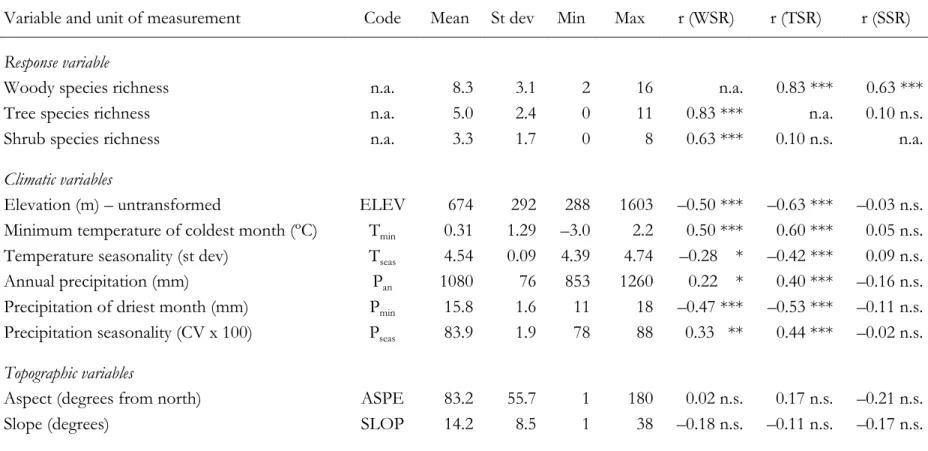
(5) 75. for long-term conservation, since prioritization of highly diverse habitats today might not. 76. be effective in preserving future hotspots of species richness in the face of climate change.. 77. In this study, we develop empirical models to investigate present and future spatial. 78. patterns of woody species richness in temperate forests in south-central Chile. We follow. 79. the lead of Cayuela et al. (2006a), who developed a predictive model using a similar. 80. approach, which allowed identification of high-priority areas for conservation of tropical. 81. forests in areas where the accessibility was limited. Our models include information. 82. obtained at multiple spatial scales, including field sampling, climate, topography and land-. 83. cover variables. The applied goals of this research are to inform attempts to prioritize the. 84. extant forest patches in the region and to provide recommendations for their conservation.. 85. This is of paramount importance as these forests are included in the Global 200 initiative. 86. launched by the World Wildlife Fund and the World Bank (Dinerstein et al., 1995), which. 87. focuses on the most threatened eco-regions in the world. In addition, these forests have. 88. been classified as one of the world's biological hotspots, e.g. by Myers et al. (2000), because. 89. of their high degree of endemism and presence of monotypic genera (Arroyo et al., 1996;. 90. Smith-Ramírez, 2004). The temperate forests of Chile are specifically considered to be. 91. vulnerable to impacts of climate change (IPCC, 2001; Pezoa, 2003). Paradoxically, in Chile,. 92. at broad scales the amount of land dedicated to conservation is inversely correlated with. 93. the number of species and endemism (Armesto et al., 1998). Thus, more than 90% of the. 94. 14 million hectares of protected land (CONAF et al., 1999) is concentrated in high latitudes. 95. (> 43º), leaving unprotected a large proportion of high-biodiversity areas (Armesto et al.,. 96. 1998). Here we investigate whether the inverse relationship between amount of conserved. 97. land and numbers of species is true at a smaller spatial scale. For all these reasons,. 98. establishing guidelines for prioritization of natural protected areas is a crucial step towards. 99. biodiversity conservation in this important eco-region.. 4.
(6) 100. The specific objectives of this study are: (a) to assess the independent and joint. 101. contribution of different groups of variables in describing the variation in woody species. 102. richness in the study area, thereby increasing our knowledge and understanding of Chile’s. 103. temperate Andean forests; (b) to develop a model to estimate present-day, fine-scale woody. 104. species richness across the study area; (c) to develop a model to predict the effects of. 105. climate change on woody species richness; and (d) to use the models to evaluate the. 106. effectiveness of the currently protected areas for maintaining biodiversity both now and in. 107. the face of climate change. The models we develop can also be used to inform future. 108. modification of the protected area network and to facilitate forest restoration programmes.. 109 110. 2. MATERIALS AND METHODS. 111. 2. 1 Study area. 112. Our study was conducted in the Maule region of Chile, which lies mainly in the Andean. 113. area between 35º and 36º latitude south (Fig. 1). The study area covers approximately. 114. 270,000 ha and is between 200 and 3,900 m.a.s.l. The predominant soils are volcanic in. 115. origin, with different degrees of development (Schlatter et al., 1997). The predominant. 116. climate is of the Mediterranean type, with annual precipitation averaging between 700 and. 117. 1,300 mm and concentrated mostly during the winter season, and an average annual. 118. temperature of 9ºC (Pezoa, 2003).. 119. The area is characterized by the presence of secondary and old-growth forests. 120. (dominated by species like Nothofagus obliqua, N. glauca, N. dombeyi and sclerophyllous. 121. species over 2 m high and >50% coverage), shrublands (composed mainly of low-height. 122. sclerophyllous species such as Criptocarya alba, Quillaja saponaria and Lithraea caustica), exotic. 123. plantations (mainly of Pinus radiata), agricultural lands, herbaceous vegetation, grasslands,. 124. and other types of land cover such as bare land, urban areas and water bodies (Appendix 1). 5.
(7) 125. (CONAF et al., 1999; Altamirano et al., 2007). The intensification of land use, particularly. 126. firewood extraction and selective logging, has caused much deforestation and forest. 127. disturbance, which may have a negative impact on biodiversity (Lara et al., 1996, 2003;. 128. Olivares, 1999; Echeverría et al., 2006).. 129. The national protected areas system of Chile comprises 96 sites, totalling. 130. approximately 14 million hectares and representing 19% of the land (CONAF et al., 1999).. 131. The three main types of protected area are National Parks, National Reserves and Natural. 132. Monuments. National Reserves are medium-sized areas that are protected with the aim of. 133. conserving species, soils and hydrological resources; sustainable natural resource use is. 134. allowed. There are two of these reserves in our study area: Altos de Lircay (approx. 12,000. 135. ha) in the north, and Los Bellotos (approx. 400 ha) in the south (Figure 1).. 136 137. 2.2 Field sampling and estimation of woody diversity. 138. The study area was divided into approximately 700 cells, each 2 x 2 km. Of these, 82 were. 139. selected via a random sampling scheme stratified by vegetation structure (see below), to. 140. contain field plots. One field plot was located in each of these 82 cells so that it was as. 141. close to the centre of the plot as possible, given the constraints that it was within the most. 142. representative vegetation structure in terms of percentage cover inside the cells, and was. 143. accessible. The plots provided good coverage of the main vegetation and soil types, and of. 144. the elevational range. In a pilot study, the numbers of species in ten circular plots of 500. 145. m² and 250 m² were compared. No significant differences were found (Student’s paired t-. 146. test, t= 2.3, P= 0.16), so in order to allow greater replication, 250 m² (i.e. 9 m radius) was. 147. set as the plot size. The 82 plots were sampled in 2005 and 2006. In each, all trees and. 148. shrubs with a height greater than 1.4 m were identified to species (see Appendix 1),. 149. counted and measured; from this, we calculated basal area. Fisher’s alpha index, Shannon's. 6.
(8) 150. diversity index and species richness (number of species observed) were calculated for each. 151. sample. Fisher’s alpha and Shannon's indices were, however, highly correlated with species. 152. richness (r = 0.92, P < 0.0001; r = 0.87, P < 0.0001 respectively). Because of this strong. 153. similarity and the ease of interpretability, we only report results for species richness.. 154 155. 2.3 Explanatory variables. 156. To model species richness we focused on six climatic variables, two topographic variables. 157. and three land-cover variables (Table 1). We initially obtained 19 climatic variables from. 158. the WorldClim database (www.worldclim.org). WorldClim is a set of global climate layers. 159. (climate grids) with a spatial resolution of 1 x 1 km (Hijmans et al., 2005). This set includes. 160. 19 temperature, rainfall and bioclimatic variables. The bioclimatic variables were derived. 161. from the monthly temperature and rainfall values in order to be more biologically. 162. meaningful, and represent annual trends in seasonality and extreme or limiting. 163. environmental factors (Hijmans et al., 2005). We carefully examined the correlation matrix. 164. to determine the degree of collinearity and redundancy between these climatic variables. 165. (and the other explanatory variables), as well as their correlations with species richness. We. 166. additionally performed a hierarchical cluster analysis of these variables in order to identify. 167. groupings of correlated explanatory variables. To achieve this, we used the 'Hmisc' library. 168. (Harrel et al., 2009) of the R environment (R Development Core Team, 2009), defining a. 169. threshold of Spearman’s ρ = 0.6. We combined this information with theoretical. 170. considerations to select climatic variables for further analysis that would minimise. 171. multicollinearity, while being expected to account best for species richness, as. 172. recommended by Carsten F. Dormann (pers. comm.). Multicollinearity tends both to. 173. promote statistical artefacts (resulting in false model accuracy) and to cause unstable. 174. parameter estimates, which are particular problems when making predictions of future. 7.
(9) 175. diversity. Thus we chose the following climatic variables for the regression analyses (Table. 176. 1): minimum temperature of the coldest month (Tmin), temperature seasonality (Tseas), mean. 177. annual precipitation (Pan), mean precipitation of the driest month (Pmin) and precipitation. 178. seasonality (Pseas). Mean annual temperature was strongly correlated with Tmin (r = 0.98); we. 179. chose Tmin because it is very similar to minimum monthly potential evapotranspiration. 180. calculated by the Thornthwaite method, which previous empirical and theoretical work has. 181. shown to be a good predictor of woody species richness (e.g. Field et al., 2005). In our. 182. dataset, Tmin correlated more strongly with species richness than Tmean, supporting our. 183. reasoning. Pmin is appropriate in climates where precipitation is lowest during the summer. 184. months, as in our study area, because it represents a strong constraint on growth.. 185. Elevation was derived from a digital elevation model, with a spatial resolution of 90. 186. x 90 m, based on the Shuttle Radar Topography Mission (SRTM). The SRTM data are. 187. available from the Global Land Cover Facility (GLCF) website. 188. (http://www.landcover.org). It was classed as a climate proxy for several reasons.. 189. Elevation is a powerful and very precise determinant of small-scale climatic variation,. 190. particularly temperature; this is because of the close association between temperature and. 191. elevation that results from the effects of the adiabatic lapse rate. The relationship between. 192. elevation and precipitation is less strong, more indirect and more complex. In this study,. 193. elevation, with its resolution of 90 x 90 m, is much more precisely measured than the. 194. WorldClim variables (resolution 1 x 1 km), so it can be expected to model climate. 195. (particularly temperature) well for the field plots. Given the scale of the field plots and the. 196. nature of the study area, elevation was also a poor topographic measure, indicating nothing. 197. about topographic heterogeneity, nor about aspect. This reasoning is backed up by the fact. 198. that, in our dataset, elevation was not correlated with topographic variables (r = 0.035 and -. 199. 0.044 for slope and aspect respectively), but was almost perfectly inversely correlated with. 8.
(10) 200. Tmin and mean annual temperature (r = -0.95 and -0.94) despite the difference in resolution.. 201. The correlation between elevation and precipitation was moderate (r = -0.55 for Pan; r = -. 202. 0.71 between 1/elevation and Pmin). The topographic variables used were aspect and slope (Table 1). Aspect was. 203 204. measured as degrees from north. These variables were derived from the digital elevation. 205. model.. 206. We performed image analysis on remotely sensed imagery, acquired in March 2003. 207. by the Advanced Spaceborne Thermal Emission and Reflection Radiometer (ASTER), to. 208. identify different forest types in relation to their degree of disturbance and to calculate. 209. different vegetation indices. We georeferenced the image using 43 control points derived. 210. from vector maps of roads and rivers, obtained from the Native Vegetation Survey. 211. (CONAF et al., 1999), resulting in an estimated error of less than one pixel. We. 212. atmospherically corrected the image using the dark pixel subtraction method and features. 213. such as water bodies (Mather, 1999).. 214. We performed a supervised land cover classification (Aplin, 2004) of the image. 215. using the maximum likelihood algorithm (Lillesand et al., 2004). Four different types of. 216. vegetation structure (VST) were identified in relation to human disturbance: open. 217. shrubland (VST1), dense shrubland (VST2), arborescent shrubland (VST3) and forest. 218. (VST4), which includes old-growth forest, secondary forest and an intermediate. 219. condition(Altamirano et al., 2010). Other land cover types were excluded from the analyses. 220. and predictions reported herein. Training sites were selected using different sources of. 221. information such as vegetation maps, aerial photographs from 2003 and field visits. 222. conducted between 2004 and 2006. The overall accuracy of the supervised classification. 223. was 92%. The lowest accuracy was obtained for shrubland and secondary forests; this was. 224. because of spectral confusion between these two classes. The pre-processing and. 9.
(11) 225. classification of remotely sensed data were performed using the ERDAS Imagine 8.4®. 226. software (ERDAS 1999).. 227. In addition, we calculated two spectral indices: the normalised difference vegetation. 228. index (NDVI) and the normalised difference infrared index (NDII). The NDVI was. 229. calculated as the difference between the near-infrared and red reflectances divided by their. 230. sum, which represents a measure of vegetation productivity (Turner et al., 2003; Aplin,. 231. 2005). The NDII was calculated as the difference between the near-infrared and mid-. 232. infrared reflectances divided by their sum, which is related to the hydric stress (Bannari et. 233. al., 1995; Gao, 1996). We did not use spectral bands from the ASTER image because they. 234. were both highly correlated with, and less interpretable than, NDVI and NDII (|r| > 0.85,. 235. P < 0.001).. 236 237. 2.4 Statistical analyses. 238. To inform subsequent analysis, we used variance partitioning to explore the independent. 239. and joint contribution of all available explanatory variables, including all 19 WorldClim. 240. variables and elevation (‘climatic’ category), the spectral bands from the ASTER image and. 241. derived land-cover variables (‘land cover’) and slope and aspect (‘topographic’) in. 242. accounting for spatial variation in woody species richness. The partition of the variance is. 243. derived from partial redundancy analyses (RDA) and was used to determine the. 244. proportions that could be attributed to the single and combined effects of explanatory. 245. variables (Legendre and Legendre, 1998), using adjusted R2 ratios (Peres-Neto et al., 2006).. 246. These analyses were computed using the ‘vegan’ library (Oksanen et al., 2008) of the R. 247. environment (R Development Core Team, 2009).. 248. The results of the variance partitioning informed the selection of variables for. 249. modelling, in which we used multiple regression to develop models to predict woody. 10.
(12) 250. species richness in the study area. Most regression analysis was performed with the S-PLUS. 251. 6.0 software (Insightful Corporation, 2001); spatial analysis was conducted using SAM. 252. (Rangel et al., 2006). Before performing multiple regression, we examined the correlation. 253. matrix and the hierarchical cluster analysis. We noted explanatory variables that were highly. 254. correlated (|r| > 0.6) and the clusters of such correlated variables, which might therefore. 255. lead to problems associated with multicollinearity. We used the same mix of theoretical and. 256. statistical considerations as described above for selection of WorldClim variables, to. 257. determine which of all the explanatory variables could be combined in any one model. We. 258. also calculated the variance inflation factor (VIF) for all terms in all multiple regression. 259. models, to quantify any remaining multicollinearity, using a maximum allowable level of. 260. VIF of 4. In addition, we examined the correlations between species richness and all. 261. selected explanatory variables (Table 1). Further, because relationships between species. 262. richness and environmental variables are often curvilinear (Austin, 1980) and interactive. 263. (Francis and Currie, 2003), we included quadratic and cubic terms in the models, as well as. 264. some interactions expected from previous research (e.g. between temperature and water. 265. variables).. 266. Our modelling procedure was step-wise and manual (Murtaugh, 2009), using a. 267. combination of model building and model simplification. We produced the first model by. 268. building from the null model (the mean), adding terms in order of explanatory power,. 269. defined as the change in residual sum of squares resulting from the addition of individual. 270. terms to the current model. Model building finished when no more terms were both. 271. significant and reduced AIC (Akaike Information Criterion) (Venables and Ripley, 2002;. 272. Anderson and Burnham, 1999). We then used a similar procedure, but with different. 273. starting variables (chosen according to variable type and variance accounted for) and. 274. different orders of addition. We also produced a series of models by simplifying from. 11.
(13) 275. various maximal models (Crawley, 2002). It was necessary to simplify from more than one. 276. maximal model because the sample size of 82 did not support highly complex models. We. 277. compared all models obtained statistically using P-values, AIC and the proportion of. 278. variation accounted for (R²). We also used ‘Model Selection and Multi-model Inference’ in. 279. SAM to rank over 16,000 possible models by AICc and AIC-weights and to calculate the. 280. ‘importance’ of each variable across all the models. This combination of model fitting. 281. approaches allowed confidence in the robustness of the results. Selection of the ‘best’. 282. models was based on both theoretical criteria (plausibility, generality, simplicity, parsimony). 283. and statistical strength (O’Brien et al., 2000).. 284. We used Moran’s I to evaluate the spatial autocorrelation of the residuals of the. 285. fitted models. Finding no residual spatial autocorrelation means that we can assume the. 286. significance values to be reliable, and that we do not need to introduce the further. 287. uncertainties (coefficient instability) associated with spatial regression (Bini et al., 2009). We. 288. checked the model residuals for normality using histograms and the Kolmogorov–Smirnov. 289. test. We assessed homoscedasticity via residual plots, and we mapped model residuals to. 290. examine their spatial patterning. To validate the predictive power of the models, we used a. 291. bootstrap approach for each model. This method generates new samples with replacement. 292. from the original sample, allowing a quantification of the error introduced by data. 293. uncertainty as well as model estimation procedure (Quinn and Keough, 2003).. 294. We used the resulting regression models to predict current species richness values. 295. for parts of the study area where there were no field plots. This was done for every pixel in. 296. the ASTER imagery and involved using the coefficients from the models and substituting. 297. the applicable values for the explanatory variables, to calculate predicted current species. 298. richness.. 299. 12.
(14) 300. 2.5 Climate change scenario. 301. We used the coefficients derived from modelling current woody species richness to predict. 302. future species richness across the study area, using climatic data obtained for a climate-. 303. change scenario. Climate scenarios are guesses of future climates, based on assumptions. 304. about future emissions of greenhouse gases and other pollutants, and obtained via general. 305. circulation models, such as CCCMA, HadCM3 and CSIRO. We used projected climate. 306. data for 2050, from the Hadley Centre’s climate model (HadCM3 Worldclim. 307. implementation) under the low (B2a) CO2 emissions scenarios (Zhang and Nearing, 2005),. 308. obtained from WorldClim. We used scenario B2a because it emphasizes more regionalized. 309. solutions to economic, social, and environmental sustainability (Zhang and Nearing, 2005).. 310 311. 2.6 Conservation value. 312. To analyse conservation value we produced categorized maps of the predicted current. 313. woody species richness into three levels: high (> 8 species), medium (5–8 species) and low. 314. (< 5 species). When examining tree species richness, we used > 6, 4–6 and < 4 species. 315. respectively. This was done for all pixels of the ASTER image (with a spatial resolution of. 316. 15 m) that had land cover in one of the categories VST1, VST2, VST3 and VST4. Pixels. 317. classified as other categories were excluded from further consideration. Predicted future. 318. species richness was categorized using the same criteria and results were compared in terms. 319. of: (1) forest area occupied by each conservation value category now and in 2050; (2). 320. overall forest area that will change to a different conservation value category by 2050; and. 321. (3) forest area in current natural protected areas assigned to different conservation value. 322. categories now and in 2050.. 323. 13.
(15) 324. 3. RESULTS. 325. We recorded 67 woody species (28 trees and 39 shrubs) in the field plots (Appendix 1),. 326. with a mean (± S.D.) number of species per plot of 8.3 (± 3.1), ranging from 2 to 16. We. 327. found significantly lower mean tree and overall (tree + shrub) species richness in VST1. 328. (open shrubland) than in the other three categories (ANOVA, P = 0.006 and 0.017. 329. respectively), but no differences between VST2 (dense shrubland), VST3 (arborescent. 330. shrubland) and VST4 (forest). Therefore for regression modelling we re-categorized the. 331. forest structure variable into two categories: VST1 and closed canopy (VST2, VST3 and. 332. VST4 combined) because this is more robust and parsimonious (Crawley, 2002).. 333. Interestingly, there was no significant difference between VST categories in either tree or. 334. shrub abundance.. 335. The strongest single-variable correlates of both tree and overall species richness in. 336. the 82 field plots were Tmin, Pmin and ELEV (Table 1). None of the explanatory variables in. 337. Table 1 correlated with shrub species richness at the 1% significance level. At the 5% level. 338. only NDVI and NDII were significant, both correlating weakly and negatively with shrub. 339. species richness (Table 1); this effect was driven by the open shrubland (r = -0.50 for both. 340. NDVI and NDII) and was not significant for the denser woody vegetation categories. The. 341. difference in shrub diversity between the different VST categories was also not significant.. 342. Basal area of woody plants correlated negatively with shrub species richness (r = –0.31, P =. 343. 0.005) and band 5 of the ASTER image correlated positively (r = 0.36, P = 0.0009). Band 5. 344. and basal area represented the strongest statistical model, with neither NDVI nor NDII. 345. significantly improving it, but this model only accounted for 18% of the variation, had. 346. non-normal residuals and contained potential circularity. Overall, then, we were unable to. 347. produce a satisfactory model of shrub species richness, which also did not correlate. 348. significantly with tree species richness (Table 1). Models of overall woody species richness. 14.
(16) 349. were all qualitatively identical to, but quantitatively weaker than, those for tree species. 350. richness; they were driven by the tree species richness pattern, with shrub species richness. 351. effectively adding noise. We therefore focus on reporting the results for tree species. 352. richness. Minimum temperature (Tmin) correlated positively and ELEV negatively with tree. 353 354. species richness, both consistent with greater energy allowing more species. The correlation. 355. between tree species richness and Pmin, however, was negative, both singly and when. 356. included in multiple-regression models. Both log and inverse transformations of ELEV. 357. improved the linearity of its association with tree species richness, 1/ELEV the more so,. 358. which also improved the normality of regression residuals compared with models using. 359. ln(ELEV). Using 1/ELEV made the relationship with tree species richness positive and. 360. increased the strength of the bivariate correlation to r = 0.66. In variance partitioning, topographic, climatic, and land-cover variables accounted. 361 362. for 2%, 52% and 7%, respectively, of the adjusted variance of woody species richness (Fig.. 363. 2). Overlap between the categories in variance accounted for was minimal (Fig. 2),. 364. supporting our contention that elevation acts as a climatic, not topographic, variable in our. 365. dataset.. 366 367. 3.1 Predictive models of species richness. 368. Tmin correlated strongly with 1/ELEV (r = 0.91), so only one of the two variables could be. 369. used in the same regression model. We developed models independently using both. 370. variables. In all cases, as with simple correlation, 1/ELEV gave a closer fit with woody. 371. species richness (Model 1, Table 2a). However, for predicting species richness for the year. 372. 2050 we preferred models featuring Tmin instead of 1/ELEV (model 2a and b).. 373. Temperature has a direct physiological effect on species performance, while elevation is a. 15.
(17) 374. surrogate variable for a mixture of influences, but driven by temperature (Guisan and. 375. Zimmermann, 2000; Pausas and Austin, 2001), so temperature is preferred on theoretical. 376. grounds. Most of the effect of elevation is related to temperature and precipitation, and. 377. with climatic changes over the next 40 years, the regression coefficients derived from. 378. current conditions for elevation are not applicable to prediction for 2050. Therefore for. 379. prediction of future species richness, and for comparison of the conservation value of. 380. protected areas now and in the future, we used the best models that were based on Tmin. 381. (Models 2a and 2b; Table 2b,c). VST was considered appropriate for 2050 because its main. 382. determinant is human activity (disturbance); its inclusion in Model 2a,b assumes no change. 383. in the disturbance regime during the first half of the 21st century.. 384. The ‘best’ regression models (Models 1 and 2a,b) were selected on the grounds of. 385. theoretical plausibility, simplicity and statistical strength (secondary to the other two).. 386. These best models included two alternative models based on Tmin: Model 2a and Model 2b. 387. (Table 2). These were statistically indistinguishable and both were ecologically plausible.. 388. The strongest effects are the same in both models, and in a reduced model with only VST. 389. and Tmin. The first is a strong increase in tree species richness with increased Tmin, of. 390. approximately 1 species per 1°C. The second is approximately 1.5 fewer species in open. 391. shrubland than the other vegetation types. Thus the core of the models is the same; they. 392. differ in the final variable included, which in each case only accounts for an additional 4%. 393. of the variance (approx.). In Model 2a this is Tseas, with a decrease of approximately 6 tree. 394. species for every 1°C increase in seasonality (measured as the standard deviation; Table 1);. 395. this is ecologically plausible. In Model 2b the third variable is Pmin, with a decrease of. 396. approximately 1 tree species for every 3 mm increase in driest-month precipitation.. 397. Exploring this negative effect further (see also Table 1), we found a negative correlation (r. 398. = –0.40) between Pmin and overall tree abundance, suggesting a competition or crowding. 16.
(18) 399. effect, coupled with a more individuals effect (positive correlation, r = 0.54, between tree. 400. abundance and tree species richness). However, using data for basal area and average tree. 401. diameter for all plots in the dataset, we found no correlation between either variable and. 402. Pmin. Nor did either basal area or average tree diameter correlate with tree species richness.. 403. So, while Pmin could be measuring a competition effect, we are far from certain that it does. 404. indeed do so, or whether it is measuring another biologically meaningful effect such as. 405. inhibition of seed germination or seedling survival (Donoso, 1994), or whether the. 406. apparent effect is due to correlation with other important biological influences. Because. 407. Pmin and Tseas are positively correlated (r = 0.58) and neither is even close to significant. 408. when the other is in the model, Models 2a and 2b are straight alternatives and we are. 409. unable satisfactorily to reject one in favour of the other. Therefore our predictive. 410. modelling was based on average predictions from the two models, hereafter referred to. 411. collectively as Model 2. This averaging of predictions, a form of ensemble forecasting. 412. (Araújo and New, 2007), should also increase the robustness of the predictions.. 413. All models presented in Table 2 are statistically significant (P < 0.0001) and all rely. 414. on few explanatory variables, reducing the likelihood of artefact, which is particularly. 415. important when predicting future species richness. All the models met assumptions of. 416. homoscedasticity and normality of residuals. For all the models, Moran’s I values for. 417. residuals were not significant for any of the short distance classes (Fig. 3), indicating no. 418. inflation of degrees of freedom resulting from spatial autocorrelation, and the absence of. 419. intrinsic autocorrelation that could disturb the Type I error rates and the coefficient. 420. estimates. In other words, the regression models have accounted for the spatial. 421. autocorrelation present in the species richness data. This also means that our predictive. 422. model is of the type considered the best for predicting responses to climate change by. 423. Algar et al. (2009): they concluded that the most accurate predictions of shifts in species. 17.
(19) 424. diversity in response to climate change are obtained via the single best richness–. 425. environment regression model, after accounting for the effects of spatial autocorrelation.. 426. Further, our model has the advantage that the spatial autocorrelation is accounted for via. 427. ordinary least-squares regression, so that there is no chance of real effects being ‘corrected. 428. for’ while removing spatial autocorrelation in spatial regressions.. 429 430. 3.2 Predicted species richness. 431. Present-day woody species richness was predicted for the whole study area using Model 1. 432. (Fig. 4a) and Model 2 (Fig. 4b). Model 2 predicted slightly higher species richness on. 433. average than Model 1, but the spatial patterns were very similar. The areas of higher. 434. predicted richness at this scale (250 m²) are concentrated mainly in the western locations of. 435. the study area and in valleys, at lower elevation and higher temperatures. These areas are. 436. dominated by shrubland and arborescent vegetation. The two protected areas in the study. 437. area have relatively low levels of predicted current species richness (Fig. 4a,b).. 438. Our map predictions for 2050 (Fig. 5a) suggest that the higher ground in the east of. 439. the study area will increase in tree species richness, while the lower ground in the west will. 440. decrease. Thus the species-richness gradient across the study area is expected to persist but. 441. weaken (compare Fig. 5a with Fig. 4b) with climate change. Overall, of the 1296 km² for. 442. which we made predictions, a net loss of species was predicted for 490 km² (38%) and a. 443. net gain for 698 km² (54%), the remainder staying approximately constant. Using our. 444. categories for conservation value, 58% of the pixels (each 225 m²) were predicted by Model. 445. 2 to have present-day woody species richness in the low category (0–3 species), with 31%. 446. having more than six species (Fig. 6a). Of all the pixels, 34% were predicted to change. 447. from low to medium conservation value, while 16% were predicted to change from high to. 448. medium (Fig. 6a).. 18.
(20) 449. Only 29.0 km² of the land currently designated as protected areas is covered by. 450. woody vegetation, as judged by our analysis of the ASTER image. All of this area is. 451. currently in the low conservation priority (value) category, according to Model 2. Our map. 452. predictions suggest that 8.6 km² (30%) of the protected area will improve to the medium. 453. category by 2050, the rest remaining ‘low’ (Fig. 6b).. 454 455. 4. DISCUSSION. 456. We found that the highest tree species richness occurs in low and medium elevation areas,. 457. with the highest minimum temperatures, and where there is relatively dense woody. 458. vegetation cover. The protected areas within the study area contain very low tree species. 459. richness and our modelling suggests that the areas of highest tree conservation value are far. 460. from the currently protected areas. Our predictions for changed climate indicate reduced. 461. tree diversity where it is currently high and increased diversity where it is currently low. The. 462. currently protected areas may therefore slightly increase in tree conservation value over the. 463. next 40 years, but will still be relatively low in diversity. Meanwhile, the areas of greatest. 464. species richness are predicted to suffer losses, thereby degrading in conservation value. The. 465. resulting predominance of areas of relatively average conservation value suggests a need for. 466. the conservation of greater areas of forest. Greater connectivity of patches of woody. 467. vegetation may also be important. Although the protected areas may be important for. 468. species other than woody plants, their continued low value for tree species conservation is. 469. of great conservation concern because Chile has more than half of the temperate forests in. 470. the southern hemisphere (Donoso, 1994), because of the uniqueness of these forests. 471. (Smith-Ramírez, 2004), and because of the high levels of threat to these forests (Dinerstein. 472. et al., 1995).. 19.
(21) 473. These concerns about tree conservation that arise from our species richness. 474. modelling are backed up by our field observations of threatened species within our study. 475. plots. We recorded four threatened species, all of which are trees: Nothofagus glauca,. 476. Austrocedrus chilensis, Beilschmiedia berteroana and Cytronella mucronata. These species have a. 477. restricted distribution and highly specific habitats (Hechenleitner et al., 2005). Migration. 478. capabilities for these species under climate change may well be limited. N. glauca (by far the. 479. most common of the four in our field plots) is restricted largely to the Maule region and is. 480. found mainly in intermediate elevation sites (Hechenleitner et al., 2005), so may not be. 481. much affected by climate change. However, B. berteroana may be negatively affected by. 482. climate change because its habitat is coincident with sites where species richness is. 483. expected to decrease. To aggravate the problem, only 8 sub-populations of this species. 484. have been identified in the country (Hechenleitner et al., 2005). The other two threatened. 485. species have wider distributions and may therefore be less vulnerable to climate change. An. 486. additional consideration is that many mountain plants reproduce vegetatively and grow. 487. slowly; consequently they are likely to take a long time to disperse into new, climatically. 488. suitable areas (Trivedi et al., 2008).. 489. There are continuing threats to temperate Andean forests and their biodiversity,. 490. such as hydroelectric-power projects and the rapid growth of the exotic plantations. 491. industry (Lara et al., 2003). In recent years, exotic plantations have expanded specifically in. 492. the south-central temperate forests of Chile (Echeverría et al., 2006) because of the growth. 493. of the pulp and wood industry (Lara et al., 2003). These developments may facilitate the. 494. establishment and invasion of alien species, which may also be enhanced by predicted rises. 495. in the frequency of natural disturbances (e.g. forest fires), and ultimately reduce the cover. 496. of native vegetation (Pickering et al., 2008). Studies in Chile have shown that alien species. 497. are moving into native forests in national parks in mountain areas (Pauchard and Alaback,. 20.
(22) 498. 2004). Given these various forms of disturbance in the study area, our results suggest that. 499. protected areas are important for conservation: we found that the most disturbed areas of. 500. woody vegetation have the lowest tree species richness, with no accompanying increase in. 501. shrub species richness. This suggests that one way of improving conservation is to. 502. minimize disturbance.. 503. Our predictions, by necessity, assumed no change in protection/disturbance regime. 504. (land-cover type). Nonetheless, our coefficients for the disturbance variable (VST) can be. 505. used to explore future scenarios in which disturbance regimes do change in prescribed. 506. ways. Our assumption of no increase in disturbance may be optimistic, unless the protected. 507. area network is modified, or unless parts of the landscape not in protected areas are. 508. managed for woody plant conservation. We consider that both strategies should be. 509. implemented. New protected areas should be created, and because our prediction maps. 510. indicate that current high-priority sites are coincident with high-priority sites in 2050, we. 511. suggest that sites that have high tree species richness now should be targeted for national. 512. protection. In the study area, these sites include river valleys, and so this should help to. 513. ensure reliable supplies of clean water downstream. Such targeting is important: Babcock et. 514. al. (1997) demonstrated that enrolling land into a conservation programme on the basis of. 515. the lowest cost of purchasing land (as has been the case for many of Chile’s protected. 516. areas) is a far less efficient use of taxpayers’ money than targeting land on the basis of the. 517. cost–benefit ratio of that land. The application of newer approaches to protected area. 518. design could help stakeholders find designs that simultaneously maximize ecological,. 519. societal and industrial goals (Gonzales et al., 2003). Planning tools such as Sites (Davis et. 520. al., 1999) and Marxan (Game and Grantham, 2008) represent good examples. Of high. 521. relevance to areas not formally protected, in 2008 Chile passed a new law that supports. 522. native forest management and biodiversity conservation. This law gives economic. 21.
(23) 523. incentives to landowners to engage in biodiversity conservation. Again, the law can target. 524. high-priority conservation sites, as indicated by our prediction maps, for improved. 525. effectiveness (Macmillan et al., 1998). Subsidies to encourage landowners to manage their. 526. land in ways that increase the provision of non-market benefits may also be appropriate. 527. (Van der Horst, 2007).. 528. Our research represents a starting-point, but more work is needed to inform. 529. conservation in the temperate Andean forests. First, our model should be seen as a tool,. 530. for addressing urgent conservation issues, that should be assessed, discussed and evaluated. 531. further. Also, we have not investigated individual species’ requirements; for example,. 532. species-specific conservation measures for endemic and threatened species, including ex. 533. situ conservation, may be required. Woody species may have differential abilities to cope. 534. with climate change (Parolo and Rossi, 2008), and habitat connectivity may be important in. 535. enabling some to migrate. Species usually differ in their habitat requirements and habitat. 536. mosaics may be appropriate in meeting each species’ needs (Drechsler et al., 2007). In this. 537. context, important future challenges for biodiversity conservation research are to. 538. investigate beta diversity and determine how much habitat heterogeneity is needed to. 539. maintain species diversity at coarser scales than in our study. Furthermore, we used climatic. 540. and topographic data that are widely used for this sort of analysis (WorldClim and SRTM).. 541. However, some environmental data sets may be less useful in some areas (i.e. rugged,. 542. remote and steep terrain) and scales (Peterson and Nakazawa, 2008). Therefore, further. 543. corroboration and testing of other source information will be necessary.. 544. Our study adds to knowledge and understanding of species richness patterns and. 545. their correlates. Tree species richness correlated most strongly with temperature-related. 546. variables (elevation and minimum temperature), which is common at broad scales but less. 547. common at the finer scale of our study (Field et al., 2009). This may be because we. 22.
(24) 548. sampled quite a large altitudinal range, and fits with the findings of Bhattarai & Vetaas. 549. (2003). The closer match, in terms of scale of measurement, between elevation and species. 550. richness, compared with climatic variables, probably explains the stronger correlation of. 551. species richness with elevation. The relatively small amount of variation accounted for by. 552. Pmin and Tseas is probably due, in large part, to the fact that both vary little in the data for. 553. our study plots (Table 1). Despite their coarse scale of measurement, climatic variables. 554. performed well in accounting for tree species richness patterns, relative to the fine-. 555. resolution variables such as slope, aspect and NDVI. This supports the contention. 556. (Cayuela et al., 2006a) that broad-scale patterns (e.g. Hawkins et al., 2003; Field et al., 2005). 557. can be replicated across altitudinal gradients at finer spatial scales. In addition, there was a. 558. positive correlation (r = 0.54) between tree abundance and tree species richness in our field. 559. plots; adding tree abundance to any of the final tree species richness models led to about a. 560. 5% increase in variation accounted for. This suggests a ‘more individuals’ effect, whereby. 561. more individuals tend to be associated with more species (Srivastava & Lawton, 1998;. 562. Currie et al., 2004). However, this was of little use for modelling because our best model of. 563. tree abundance contained only Tmin and only accounted for 26% of the variation.. 564. Our best tree species richness model accounts for approximately 50% of the. 565. variance, which is quite typical for this scale (Field et al., 2009). Small-grain species richness. 566. is hard to predict, as it depends on so many interacting factors and chance events. 567. (Diamond, 1988; Whittaker et al., 2001; Willis and Whittaker 2002), and small-grained. 568. studies typically account for less than 50% of the variation in species richness, even at. 569. geographic extents spanning hundreds of km (Field et al., 2009). Not surprisingly,. 570. therefore, even our best models left much of the variation unaccounted for, suggesting that. 571. other, unmeasured factors also influence woody species richness in the study area.. 572. Hydrological, soil factors and biotic interactions might account for some of the residual. 23.
(25) 573. variation. This is particularly relevant to shrub species richness, which did not correlate. 574. strongly with any of our measured variables, and which we could not model well enough to. 575. allow prediction. The strongest correlation with shrub species richness was a negative one. 576. with basal area, suggesting that shading by trees may reduce shrub diversity. This accords. 577. with the recent findings by Oberle et al. (2009) that understorey plant species richness in. 578. field plots of similar size to ours correlates much less with regional productivity-related. 579. variables than does tree species richness, and that canopy density partly controls shrub. 580. species richness at this scale.. 581. Overall, our research contributes to understanding of globally important temperate. 582. Andean forests, and represents a step towards targeting conservation of the forests more. 583. effectively.. 584 585. ACKNOWLEDGMENTS. 586. This research was made possible by funding from MECESUP project AUS 0103;. 587. BIOCORES (Biodiversity conservation, restoration, and sustainable use in fragmented. 588. forest landscapes) project ICA-CT-2001-10095; and the FORECOS Scientific Nucleus. 589. P04-065-F (MIDEPLAN). We are grateful to Andrés Rivera from Centro de Estudios. 590. Científicos (CECS) for the acquisition of the ASTER image needed to develop the. 591. research. Thanks to Raúl Bertín and Renato Rivera for assistance with the field work, and. 592. Jonathan Barichivich for species identification, all from Universidad Austral of Chile.. 593 594. APPENDIX 1. List of tree species and shrubs sampled in the study area. Nomenclature. 595. follows the Index Kewensis, except for those cases in which no record was found, for. 596. which the Gray Herbarium Card Index (http://www.ipni.org) was used. Species. Family. 24.
(26) Trees Acacia caven (Molina) Molina. Leguminosae. Aextoxicon punctatum Ruiz & Pav.. Aextoxicaceae. Austrocedrus chilensis (D.Don ) Pic.Serm. & M.P.Bizzarri. Cupressaceae. Beilschmiedia berteroana (Gay) Kosterm.. Lauraceae. Crinodendron patagua Molina. Elaeocarpaceae. Cryptocarya alba (Molina) Looser. Lauraceae. Citronella mucronata (Ruiz & Pav.) D.Don. Icacinaceae. Dasyphyllum diacanthoides (Less.) Cabrera. Asteraceae. Drimys winteri J.R.Forst. & G.Forst.. Winteraceae. Embothrium coccineum J.R.Forst. & G.Forst.. Proteaceae. Gevuina avellana Molina. Proteaceae. Kageneckia oblonga Ruiz & Pav.. Rosaceae. Laureliopsis philippiana (Looser) Schodde. Monimiaceae. Laurelia sempervirens (Ruiz & Pav.) Tul.. Monimiaceae. Lithraea caustica Hook. & Arn.. Anacardiaceae. Lomatia dentata R.Br.. Proteaceae. Lomatia hirsuta (Lam.) Diels. Proteaceae. Luma apiculata (DC.) Burret. Myrtaceae. Luma chequen F.Phil.. Myrtaceae. Maytenus boaria Molina. Celastraceae. Nothofagus alpina (Poepp. & Endl.) Oerst.. Fagaceae. Nothofagus dombeyi (Mirb.) Oerst.. Fagaceae. Nothofagus glauca (R.Phil) Krasser. Fagaceae. Nothofagus obliqua (Mirb.) Oerst.. Fagaceae. Nothofagus pumilio (Poepp. & Endl.) Krasser. Fagaceae. Persea lingue (Miers ex Bertero) Nees. Lauraceae. Peumus boldus Molina. Monimiaceae. Quillaja saponaria Molina. Rosaceae. Shrubs Acrisione denticulata (Hook. & Arn.) B.Nord.. Asteraceae. Aristotelia chilensis Stuntz. Elaeocarpaceae. Azara celastrina D. Don. Flacourtiaceae. Azara dentata Ruiz & Pav.. Flacourtiaceae. 25.
(27) Azara petiolaris (D.Don) I.M.Johnst.. Flacourtiaceae. Azara serrata Ruiz & Pav.. Flacourtiaceae. Baccharis concava Pers.. Asteraceae. Baccharis linearis (Ruiz & Pav.) Pers.. Asteraceae. Baccharis salicifolia (Ruiz & Pav.) Pers.. Asteraceae. Berberis chilensis Gill.. Berberidaceae. Berberis grevilleana Gill.. Berberidaceae. Berberis microphylla G.Forst.. Berberidaceae. Buddleja globosa C.Hope. Buddlejaceae. Cestrum parqui L'Hér.. Solanaceae. Colletia spinosissima J.F.Gmel.. Rhamnaceae. Collihuaja sp 1. Euphorbiaceae. Discaria chacaye (G.Don) Tortosa. Rhamnaceae. Ephedra chilensis C.Presl. Ephedraceae. Undetermined sp1. Escalloniaceae. Fabiana imbricata Ruiz & Pav.. Solanaceae. Gochnatia foliolosa D.Don ex Hook. & Arn.. Asteraceae. Maytenus magellanica Hook.f.. Celastraceae. Mutisia spinosa Hook. & Arn.. Asteraceae. Myoschilos oblongum Ruiz & Pav.. Santalaceae. Myrceugenia ovata O.Berg. Myrtaceae. Pernettia mucronata Gaudich. ex G.Don. Ericaceae. Podanthus mitiqui Lindl.. Asteraceae. Proustia cuneifolia D.Don. Asteraceae. Undetermined sp 2. Rhamnaceae. Ribes cucullatum Hook. & Arn.. Grossulariaceae. Ribes magellanicum Poir.. Grossulariaceae. Schinus montanus Engl.. Anacardiaceae. Schinus patagonicus (Phil.) I.M.Johnst. ex Cabrera. Anacardiaceae. Senna sp 1. Fabaceae. Schinus polygamus (Cav.) Cabrera & I.M.Johnst.. Anacardiaceae. Undetermined sp 3. Solanaceae. Sophora macrocarpa Sm.. Leguminosae. 26.
(28) Undetermined sp 4. Undetermined. Undetermined sp 5. Undetermined. 597 598. REFERENCES. 599. Acevedo, D.H., Currie, D., 2003. Does climate determine broad-scale patterns of species. 600. richness? A test of the causal link by natural experiment. Global Ecology and. 601. Biogeography 12, 461-473.. 602. Algar, A.C., Kharouba, H.M., Young, E.R.., Kerr, J.T. 2009. Predicting the future of. 603. species diversity: macroecological theory, climate change, and direct tests of alternative. 604. forecasting methods. Ecography 32, 22-33.. 605. Altamirano, A., Echeverría, C., Lara, A., 2007. Efecto de la fragmentación forestal sobre la. 606. estructura vegetacional de las poblaciones amenazadas de Legrandia concinna. 607. (Myrtaceae) del centro-sur de Chile. Revista Chilena de Historia Natural 80, 27-42.. 608. Altamirano, A., Lara, A., 2010. Deforestación en ecosistemas templados de la precordillera. 609 610 611. andina del centro-sur de Chile. Bosque 31, 53-64. Anderson D.R., Burnham K.P., 1999. Understanding information criteria for selection among capture-recapture or ring recovery models. Bird Study 46: 14-21.. 612. Aplin, P., 2004. Remote sensing: land cover. Progress in Physical Geography 28, 283-293.. 613. Aplin, P., 2005. Remote sensing: ecology. Progress in Physical Geography 29, 104-113.. 614. Araújo, M.B., 1999. Distribution patterns of biodiversity and the design of a representative. 615 616 617 618 619. reserve network in Portugal. Diversity and Distributions 5, 151–163. Araújo, M.B., New, M., 2007. Ensemble forecasting of species distributions. Trends in Ecology and Evolution 22, 42–47. Armenteras, D., Rudas, G., Rodriguez, N., Sua, S., Romero, M., 2006. Patterns and causes of deforestation in the Colombian Amazon. Ecological Indicators 6, 353–368.. 27.
(29) 620 621. Armesto, J.J., Rozzi, R., Smith-Ramírez, C., Arroyo, M.T.K., 1998. Conservation targets in South American temperate forests. Science 282, 1271-1272.. 622. Arroyo, M.T.K., Cavieres, L., Peñazola, A., Riveros, M., Faggi, A.M., 1996. Relaciones. 623. fitogeográficas y patrones regionales de riqueza de especies en la flora del bosque. 624. lluvioso templado de Sudamérica, in: Armesto J, Villagrán, C., Arroyo, & M.T.K.. 625. (Eds). Ecología de los Bosques Nativos de Chile. Editorial Universitaria, Santiago, pp.. 626. 71-99.. 627 628 629 630 631 632. Austin, M.P., 1980. Searching for a model for use in vegetation analysis. Vegetation 42, 1121. Babcock, B.A., Lakshminarayan, P.G., Wu, JJ., Zilberman, D., 1997. Targeting tools for the purchase of environmental amenities. Land Economics 73, 325–339. Bannari, A., Morin, D.,, Bonn, F., Huete, A.R., 1995. A review of vegetation indices. Remote Sensing Reviews 13, 95-120.. 633. Bhattarai, K.R., Vetaas, O.R., 2003. Variation in plant species richness of different life. 634. forms along a subtropical elevation gradient in the Himalayas, east Nepal. Global. 635. Ecology and Biogeography 12, 327–340.. 636. Bini, M., Diniz-Filho, J., Rangel, T., Akre, T., Albaladejo, R., Albuquerque, F., Aparicio, A.,. 637. Araújo, M., Baselga, A., Beck, J., Bellocq, M., Böhning-Gaese, K., Borges, P., Castro-. 638. Parga, I., Chey, V., Chown, S., de Marco, P. Dobkin, D., Ferrer-Castán, D., Field, R.,. 639. Filloy, J., Fleishman, E., Gómez, J., Hortal, J., Iverson, J., Kerr, J., Kissling, W.,. 640. Kitching, I., León-Cortés, J., Lobo, J., Montoya, D., Morales-Castilla, I., Moreno, J.,. 641. Oberdorff, T., Olalla-Tárraga, M., Pausas, J., Qian, H., Rahbek, C., Rodríguez, M.,. 642. Rueda, M., Ruggiero, A. Sackmann, P., Sanders, N., Terribile, L., Vetaas, O., Hawkins,. 643. B., 2009. Coefficient shifts in geographical ecology: an empirical evaluation of spatial. 644. and non-spatial regression. Ecography 32, 193-204.. 28.
(30) 645. Cayuela, L., Rey Benayas, J.M., Justel, A., Salas, J., 2006a. Modelling tree diversity in a. 646. highly fragmented tropical montane landscape. Global Ecology and Biogeography 15,. 647. 602-613.. 648. Cayuela, L., Golicher, D.J., Rey Benayas, J.M., González-Espinosa, M., Ramírez-Marcial,. 649. N., 2006b. Fragmentation, disturbance and tree diversity conservation in tropical. 650. montane forests. Journal of Applied Ecology 43, 1172-1181.. 651. Conaf, Conama, Birf, Universidad Austral de Chile, Pontificia Universidad Católica de. 652. Chile, Universidad Católica de Temuco, 1999. Catastro y Evaluación de los Recursos. 653. Vegetacionales Nativos de Chile. Informe Nacional con Variables Ambientales.. 654. Santiago, Chile.. 655 656 657 658. Crawley, M.J., 2002. Statistical Computing. An introduction to data analysis using S-Plus. John Wiley & Sons, Chichester. Currie, D., 1991. Energy and large-scale patterns of animal and plant species richness. The American Naturalist 137, 27–49.. 659. Currie, D.J., Mittelbach, G.G., Cornell, H.V., Field, R., Guégan, J.-F., Hawkins, B.A.,. 660. Kaufman, D.M., Kerr, J.T., Ooberdorff, T., O’Brien, E.M., Turner, J.R.G., 2004.. 661. Predictions and tests of climate-based hypotheses of broad-scale variation in. 662. taxonomic richness. Ecology Letters 7, 1121–1134.. 663. Davis, F., Andelman, S., Stoms, D., 1999. Sites: An Analytical Toolbox for Ecoregional. 664. Conservation Planning. The Nature Conservancy.. 665. http://www.biogeog.ucsb.edu/projects/tnc/toolbox.html, last accessed 29 December. 666. 2009.. 667. De Vries, P.J., Walla, T., Greney, H., 1999. Species diversity in spatial and temporal. 668. dimensions of fruit-feeding butterflies from two Ecuadorian rainforests. Biological. 669. Journal of the Linnean Society 68, 333–353.. 29.
(31) 670 671. Diamond, J., 1988. Factors controlling species diversity: Overview and synthesis. Annals of the Missouri Botanical Garden 75, 117-129.. 672. Dinerstein, E., Olson, D.M., Graham, D.J., Webster, A.L., Primm, S.A., Bookbinder, M.P.,. 673. 1995. Una evaluación del estado de conservación de las ecoregiones terrestres de. 674. América Latina y el Caribe. Banco Mundial/WWF, Washington, DC.. 675 676. Donoso, C., 1994. Bosques templados de Chile y Argentina. Variación estructura y dinámica. Segunda Edición. Editorial Universitaria, Santiago.. 677. Drechsler, M., Johst, K., Ohl, C., Watzold, F., 2007. Designing cost-effective payments for. 678. conservation measures to generate spatiotemporal habitat heterogeneity. Conservation. 679. Biology 21, 1475-1486.. 680. Echeverría, C., Coomes, D., Salas, J., Rey-Benayas, J.M., Lara, A., Newton, A., 2006. Rapid. 681. deforestation and fragmentation of chilean temperate forests. Biological Conservation. 682. 130, 481-494.. 683. ERDAS, 1999. Erdas Field Guide. Fifth edition, revised and expanded. Erdas Inc., Atlanta.. 684. Field, R., O’Brien, E.M., Whittaker, R., 2005. Global models for predicting woody plant. 685. richness from climate: development and evaluation. Ecology 86, 2263-2277.. 686. Field, R., Hawkins, B.A., Cornell, H.V., Currie, D.J., Diniz-Filho, J.A.F., Guégan, J.-F.,. 687. Kaufman, D.M., Kerr, J.T., Mittelbach, G.G., Ooberdorff, T., O’Brien, E.M., Turner,. 688. J.R.G., 2009. Spatial species-richness gradients across scales: a meta-analysis. Journal of. 689. Biogeography 36, 132–147.. 690 691 692 693. Francis, A.P., Currie, D.J., 2003. A globally consistent richness–climate relationship for angiosperms. The American Naturalist 161, 523–536. Game, E.T., Grantham, H.S., 2008. Manual del Usuario de Marxan: Para la versión Marxan 1.8.10. Universidad de Queensland, St. Lucia, Queensland, Australia, y la Asociación. 30.
(32) 694. para la Investigación y Análisis Marino del Pacífico, Vancouver, British Columbia,. 695. Canadá. http://www.uq.edu.au/marxan/, last accessed 29 December 2009.. 696. Gao, B.C., 1996. NDWI-A normalized difference water index for remote sensing of. 697 698. vegetation liquid water from space. Remote Sensing of Environment 58, 257-266. Gonzales, E., Arcese, P., Schulz, R., Bunnell, F., 2003. Strategic reserve design in the. 699. central coast of British Columbia: integrating ecological and industrial goals. Canadian. 700. Journal of Forest Research 33, 2129–2140.. 701. González-Espinosa, M., Rey-Benayas, J.M., Ramírez-Marcial, N., Huston, M.A., Golicher,. 702. D., 2004. Tree diversity in the northern Neotropics: regional patterns in highly diverse. 703. Chiapas, Mexico. Ecography 27, 741–756.. 704 705 706. Guisan, A., Zimmermann, N.E., 2000. Predictive habitat distribution models in ecology. Ecological Modeling 135, 147-186. Hall, J., Burgess, N.D., Lovett, J., Mbilinyi, B., Gereau, R.E., 2009. Conservation. 707. implications of deforestation across an elevational gradient in the Eastern Arc. 708. Mountains, Tanzania. Biological Conservation 142, 2510–2521.. 709. Harrell Jr, F.E., and with contributions from many other users., 2009. Hmisc: Harrell. 710. Miscellaneous. R package version 3.7-0. http://CRAN.R-. 711. project.org/package=Hmisc. 712. Hawkins, B.A., Field, R., Cornell, H.V., Currie, D.J., Guégan, J.-F., Kaufman, D.M., Kerr,. 713. J.T., Mittelbach, G.G., Ooberdorff, T., O’Brien, E.M., Porter, E.E., Turner, J.R.G.,. 714. 2003. Energy, water, and broad-scale geographic patterns of species richness. Ecology. 715. 84, 3105–3117.. 716. Hechenleitner, P., Gardner, M., Thomas, P, Echeverría, C., Escobar, B., Brownless, P.,. 717. Martínez, C., 2005. Plantas amenazadas del centro-sur de Chile. Distribución,. 718. conservación y propagación. Trama Impresores, Valdivia.. 31.
(33) 719. Hijmans, R.J., Cameron, S.E., Parra, J.L., Jones, P.G., Jarvis, A., 2005. Very high resolution. 720. interpolated climate surfaces for global land areas. International Journal of Climatology. 721. 25, 1965-1978.. 722 723 724 725. Insightful Corporation, 2001. S-PLUS 6 for Windows User’s Guide. Insightful Corporation, Seattle. IPCC, 2001. Climate Change 2001: Synthesis Report (eds. R. Watson, and IPCC core writing team). http://www.grida.no/climate/ipcc_tar/vol4/english/027.htm.. 726. Lara, A., Donoso, C., Aravena, J.C., 1996. La conservación de los bosques nativos en Chile:. 727. problemas y desafíos, in: Armesto, J.J., Villagrán, C., Arroyo, M.K. (Eds.), Ecología de. 728. los bosques nativos de Chile. Editorial Universitaria, Santiago, pp. 335–362.. 729. Lara, A., Soto, D., Armesto, J., Donoso, P., Wernli, C., Nahuelhual, L., Squeo, F. (Eds.),. 730. 2003. Componentes científicos clave para una política nacional sobre usos, servicios y. 731. conservación de los bosques nativos chilenos. Libro resultante de la reunión científica. 732. sobre bosques nativos realizada en Valdivia, los días 17-18 julio de 2003. Universidad. 733. Austral de Chile. Iniciativa Científica Milenio de Mideplan.. 734. Lawton, J.H., Bignell, D.E., Bolton, B., Bloemers, G.F., Eggleton, P., Hammond, P.M.,. 735. Hodda, M., Holt, R.D., Larsen, T.B., Mawdsley, N.A., Stork, N.E., Srivastava, D.S.,. 736. Watt, A.D., 1998. Biodiversity inventories, indicator taxa and effects of habitat. 737. modification in tropical forest. Nature 391, 72–76.. 738. Legendre, P., Legendre, L., 1998. Numerical ecology. Elsevier Science, Amsterdam.. 739. Lillesand, T., Kiefer, R., Chipman, J., 2004. Remote Sensing and image interpretation, 5th. 740. edn. John Wiley & Sons, New York.. 741. Luoto, M., Toivonen, T., Heikkinen, R., 2002. Prediction of total and rare plant species. 742. richness in agricultural landscapes from satellite images and topographic data.. 743. Landscape Ecology 17, 195-217.. 32.
(34) 744 745 746 747. MacMillan, D.C., Harley, D., Morrison, R.A., 1998. Cost-effectiveness analysis of woodland ecosystem restoration. Ecological Economics 27, 313–324. Mather, P., 1999. Computer Processing of Remotely-Sensed images. An introduction, 2nd edn. John Wiley & Sons, Chichester.. 748. May, R.M., Lawton, J.H., Stork, N.E., 1995. Assessing extinction rates, in: Lawton, J.H.,. 749. May, R.M. (Eds), Extinction rates. Oxford University Press, Oxford, pp. 1-24.. 750 751 752 753 754 755 756 757 758 759 760. Murphy, D.D., 1990. Conservation Biology and scientific method. Conservation Biology 4, 203-204. Murtaugh, P.A. (2009) Performance of several variable-selection methods applied to real ecological data. Ecology Letters 12, 1061-1068. Myers, N., Mittermeler, R.A., Mittermeler, C.G., Da Fonseca, G.A., Kent, J., 2000. Biodiversity hotspots for conservation priorities. Nature 403, 853–858. Nagendra, H., 2001. Using remote sensing to assess biodiversity. International Journal of Remote Sensing 22, 2377–2400. Newton, A.C., 2007. Biodiversity Loss and Conservation in Fragmented Forest Landscapes. CABI Publishing, Wallingford, Oxford. O’Brien, E.M., 1998. Water-energy dynamics, climate and prediction of woody plant. 761. species richness: an interim general model. Journal of Biogeography 25, 379-398.. 762. O’Brien, E.M., Field, R., Whittaker, R., 2000. Climatic gradients in woody plant (tree and. 763. shrub) diversity: water energy dynamics, residual variation, and topography. Oikos 89,. 764. 588-600.. 765. Oberle, B., Grace, J.B., Chase, & J.M., 2009. Beneath the veil: plant growth form influences. 766. the strength of species richness-productivity relationships in forests. Global Ecology. 767. and Biogeography 18, 416-425.. 33.
(35) 768. Oksanen, J., Kindt, R., Legendre, P., O'Hara, B., Simpson, G.L., Stevens, M.H.H., 2008.. 769. Vegan: community ecology package version 1.11-0. http://cran.r-project.org/, last. 770. accessed 17 March 2009.. 771. Olivares, P., 1999. Sustitución de bosque nativo por otros usos del suelo en dos sectores de. 772. la precordillera andina de la VII región, entre los años 1987 y 1996. Tesis de grado. 773. Ingeniería Forestal, Facultad de Ciencias Forestales, Universidad Austral de Chile,. 774. Valdivia.. 775 776 777. Parolo, G., Rossi, G., 2008. Upward migration of vascular plants following a climate warming trend in the Alps. Basic and Applied Ecology 9, 100–107. Pauchard, A., Alaback, P., 2004. Influence of elevation, land use and landscape context on. 778. patterns of alien plant invasions along roadsides in protected areas of south-central. 779. Chile. Conservation Biology 18, 238-248.. 780 781 782 783 784. Pausas, J.G., Austin, M.P., 2001. Patterns of plant species richness in relation to different environments: An appraisal. Journal of Vegetation Science 12, 153-166. Peres-Neto, P.R., Legendre, P., Dray, S., Borcard, D., 2006. Variation partitioning of species data matrices: estimation and comparison of fractions. Ecology 87, 2614-2625. Pezoa, L.S., 2003. Recopilación y análisis de la variación de las temperaturas (período. 785. 1965–2001) y las precipitaciones (período 1931–2001) a partir de la información de. 786. estaciones meteorológicas de Chile entre los 33º y 53º de latitud sur. Tesis de grado. 787. Ingeniería Forestal, Facultad de Ciencias Forestales, Universidad Austral de Chile,. 788. Valdivia.. 789. Pickering, C., Hill, W., Green, K., 2008. Vascular plant diversity and climate change in the. 790. alpine zone of the Snowy Mountains, Australia. Biodiversity Conservation 17, 1627–. 791. 1644.. 34.
(36) 792 793. Quinn, G., Keough, M., 2003. Experimental design and data analysis for biologists. Cambridge University Press, Cambridge.. 794. Ramírez-Marcial, N., González-Espinosa, M., Williams-Linera, G., 2001. Anthropogenic. 795. disturbance and tree diversity in montane rain forests in Chiapas, Mexico. Forest. 796. Ecology and Management 154, 311–326.. 797. Rangel, T.F.L.V.B., Diniz-Filho, J.A.F., Bini, L.M., 2006. Towards an integrated. 798. computational tool for spatial analysis in macroecology and biogeography. Global. 799. Ecology and Biogeography 15, 321–327.. 800. R Development Core Team, 2009. R: A language and environment for statistical. 801. computing. R Foundation for Statistical Computing, Vienna, Austria. ISBN 3-. 802. 900051-07-0, URL http://www.R-project.org. 803. Schlatter, J.E., Gerding, V., Adriazola, J., 1997. Sistema de Ordenamiento de la Tierra:. 804. Herramienta para la planificación forestal aplicada a las regiones VII, VIII y IX, 2nd. 805. ed. Universidad Austral de Chile, Facultad de Ciencias Forestales, Valdivia.. 806. Smith-Ramírez, C., 2004. The Chilean coastal range: a vanishing center of biodiversity and. 807. endemism in South American temperate rainforests. Biodiversity and Conservation 13,. 808. 373–393.. 809. Srivastava, D.S., Lawton, J.H., 1998. Why more productive sites have more species: an. 810. experimental test of theory using treehole communities. The American Naturalist 152,. 811. 510–529.. 812. Trivedi, M., Morecroft, M.D., Berrya, P.M., Dawson, T.P., 2008. Potential effects of. 813. climate change on plant communities in three montane nature reserves in Scotland,. 814. UK. Biological Conservation 141, 1665-1675.. 35.
(37) 815. Turner, W., Spector, S., Gardiner, N., Fladeland, M., Sterling, E., Steininger, M., 2003.. 816. Remote sensing for biodiversity science and conservation. Trends in Ecology and. 817. Evolution 18, 306-314.. 818. Van der Horst, D., 2007. Assessing the efficiency gains of improved spatial targeting of. 819. policy interventions; the example of an agri-environmental scheme. Journal of. 820. Environmental Management 85, 1076–1087.. 821 822 823 824. Venables, W.N., Ripley, B.D., 2002. Modern Applied Statistics with S. Springer-Verlag, New York, Venevsky, S., Veneskaia, I., 2003. Large-scale energetic and landscape factors of vegetation diversity. Ecology Letters 6, 1004–1016.. 825. Whittaker, R.J., Willis, K.J., Field, R. 2001. Scale and species richness: towards a general,. 826. hierarchical theory of species diversity. Journal of Biogeography 28, 453–470.. 827. Willis, K.J., Whittaker, R.J., 2002. Species diversity - scale matters. Science 295, 1245-1248.. 828. Zhang, X.C., Nearing, M.A., 2005. Impact of climate change on soil erosion, runoff, and. 829. wheat productivity in central Oklahoma. Catena 61, 185–195.. 830. 36.
(38) 831. FIGURE CAPTIONS. 832 833. Figure 1. Map of the study area in the Andean range.. 834 835. Figure 2. Venn diagram of the partition of the variation of tree species richness for. 836. climatic, topographic and land-cover variables. Table 1 shows which of the key variables. 837. were included in each category; other WorldClim data were included as ‘climatic’ and other. 838. variables derived from ASTER imagery were included as ‘land cover’. The rectangle. 839. represents the total variance of tree species richness while each circle represents a given. 840. group of explanatory variables. The adjusted R² (expressed as % of the variance in tree. 841. species richness) is presented for each part of the Venn diagram. Intersections between. 842. circles represent the fraction of the variance of tree species richness jointly accounted for;. 843. if missing this fraction does not differ significantly from 0.. 844 845. Figure 3. Correlograms for tree species richness, fitted values and residuals of the ‘best’. 846. regression models: (a) Model 1, (b) Model 2a, (c) Model 2b. Equal distance classes; only. 847. classes with n > 100 shown. See Table 2 for model specifications (n=82 cells).. 848 849. Figure 4. Map of predicted current woody species richness in 225 m² pixels. A. current tree. 850. species richness according to Model 1; B. current tree species richness according to Model. 851. 2 (average of predictions from Models 2a and 2b); C. current conservation priority (value). 852. category, as defined by tree species richness predicted by Model 2 (low = <4, medium = 4–. 853. 6, high = >6). No colour means no prediction because the pixel is not currently classed as. 854. any of the land-cover types in our analyses. See Table 2 for model specifications.. 855. 37.
(39) 856. Figure 5. Map of predicted tree species richness in 2050, in 225 m² pixels. A. tree species. 857. richness in 2050 according to Model 2 (average of predictions from Models 2a and 2b); B.. 858. change in tree species richness from now to 2050, according to Model 2; C. uncertainty for. 859. 2050 tree species richness predictions (absolute difference between the predictions of. 860. Models 2a and 2b); D. conservation priority (value) category in 2050, as defined by species. 861. richness predicted by Model 2 (low = <4, medium = 4–6, high = >6). No colour means. 862. no prediction because the pixel is not currently classed as any of the land-cover types in our. 863. analyses. See Table 2 for model specifications.. 864 865. Figure 6. Current forest area by conservation priority (value) category (horizontal axis. 866. labels), and how these conservation priorities will change in the year 2050 (shading),. 867. according to Model 2 (average of predictions from Models 2a and 2b). A) in the study area.. 868. B) in the current protected areas. See Table 2 for model specifications.. 38.
Figure
Documento similar
8-10, are depicted wind speed sequence, the simulated rotor speed and the output power, respectively, for the wind turbine simulated. The characteristics of the wind turbine
The expansionary monetary policy measures have had a negative impact on net interest margins both via the reduction in interest rates and –less powerfully- the flattening of the
Jointly estimate this entry game with several outcome equations (fees/rates, credit limits) for bank accounts, credit cards and lines of credit. Use simulation methods to
In our sample, 2890 deals were issued by less reputable underwriters (i.e. a weighted syndication underwriting reputation share below the share of the 7 th largest underwriter
We first establish that when ω satisfies (2) then even for a tree of depth 3 there is already significant loss of information of the spin at the root. In particular we show that if
It is notable that we recorded a higher number of species when compared to a study of vegetation in public spaces of Xalapa (102 tree species; Arias, 1983); nonethe- less, the
A null model for explain crustacean zooplankton species associations in central and southern Patagonian inland waters.. Anales del Instituto de la
Species richness Increasing number of soil Fungal ß diversity sample pools.. 15
