
Training primary student teachers for CLIL: innovation through collaboration
24
0
0
Texto completo
(2) Gemma Delicado Puerto, Víctor Pavón Vázquez. 1. Introduction The rising number of bilingual schools in Spain in the last years (Sierra and López, 2015a) meets the stipulation for European policies on multilingualism, a priority since the Council of Lisbon (2003, 3). Due to such increase, there has been an unsustainable demand for professionals to cover the necessities of the educational system. As a result, higher education aspires to train bilingual teachers in order to overcome this issue. Following this trend and in response to this novel situation, several universities in Spain have implemented bilingual teacher training bachelor programs. Up to now, there has been no agreement on how to implement these programs of study and each institution develops what they consider to be a bilingual program, offering different percentages of credits in English within the framework of official and non-official undergraduate and graduate degrees. Private institutions are regularly more open to offering complete programs in English, especially at the graduate level. However, state institutions are now struggling to offer bilingual and plurilingual degrees in particular “in social sciences, business and engineering” (Ramos García, 2013, p. 103). The training of prospective educators mainly addresses the needs of these future bilingual teachers from a linguistic perspective, focusing on their abilities to use English sucessfully, which means that in the majority of the cases these projects may not guide student teachers on educational and methodological principles “which promote successful integration of subject and language work” (Dafouz, 2015, p. 22). To solve this problem, a pioneer bilingual program has been launched at the University of Extremadura Teacher Training College (Delicado and Pavón, 2015). The project is based on the premise that the bilingual teacher obviously requires a high command of linguistic skills, but also an adequate knowledge of the specific abilities related to subject-based work, and a solid understanding of the principles for teaching content through a foreign language in real contexts. With the support of the Government of Extremadura, a group of governmental advisors and primary school inservice teachers with a background in bilingual education, including language and content teachers, have worked together with university faculty to delineate what student teachers’ linguistic and methodological professional capacities should be. In this study, conducted during the preparatory stage of the actual training, we aim to analyze a structure of collaboration between university teachers and in-service bilingual teachers. This first experiment will be complemented with other studies where student teachers will be participating. The context of this investigation, which lasted for a year discussed and analyzed, with the help of ICLHE (Integration of Content and Language in Higher Education) experts, the different dimensions that have to be addressed in the preparation of future bilingual teachers. During this period, in-service teachers from bilingual schools also shared their reasons for participating in the project, their concerns about their roles, and their views of the real. 36.
(3) Training primary student teachers for CLIL: innovation through collaboration. requirements that a bilingual teacher should comply with in real contexts. Throughout the process, these external members contributed to the training programme with their input and experience, principally using problem solving, as well as task-based and case study-based pedagogical strategies and evaluation. The data extracted from the cooperation between these groups have resulted in a comprehensive strategy that addresses bilingual education from all educational stages, from nursery to tertiary education. The purpose of the proposal has been to qualify prospective teachers to be successfully incorporated in a bilingual professional context with the idea that we should construct education for bilingual programs on an expanded collaborating philosophy. In doing so, we could try to mend the breach between the different stages of the system, as we believe that there is a need to connect in-service performance with student training (the details of which will be discussed shortly). In this sense, this study will analyze how the resulting experience has not only established a sustainable connection but also become a transferable tool that may be of use to institutions engaged in bilingual teacher training.. 2. Theoretical framework 2.1. The necessity Training teachers to become bilingual instructors is nowadays a demand of society in many countries. In the case of Spain, there has been a flourishing of bilingual education all over the country (Lasagabaster and Ruiz de Zarobe, 2010; Breeze et al., 2014) and the vast majority of regions have some sort of bilingual education program being implemented at the present time (Ramos, 2007; San Isidro, 2008; Lorenzo, Casal and Moore, 2009; Laorden and Peñafiel, 2010; Dobson, Pérez and Johnstone, 2010; Consejería de Educación, 2010; Pladevall-Ballester, 2014). During the last years, experts and analysts in education have warned about the problem of offering bilingual education in a great number of schools without having the necessary number of qualified teachers (El País, 22/01/2012; El Mundo, 11/07/2014). The question is, what is the selection process like? How have they been trained? The increasing number of bilingual schools is forcing educational authorities to set up a series of parameters for the selection of teachers in order to provide qualified professionals for these schools (Olivares and Pena, 2013). Especially during the first years of the rise of bilingual education in Spain, the most serious problem encountered was the linguistic competency. 2015, 39. 35-57. 37.
(4) Gemma Delicado Puerto, Víctor Pavón Vázquez. of teachers, which in numerous cases was noticeably not ideal. Nowadays, the situation is changing gradually, but there are still cases of regulations which only require teachers to exhibit a B2 when the mainstream of experts agree that the minimum linguistic proficiency for teaching in a bilingual program should be C1 (Lasagabaster and Ruiz de Zarobe, 2010, p. 288). The selection procedure, in most of the cases, requests teachers to display a linguistic accreditation, B2 or C1, depending on the area, and after they start teaching they are trained in specific strategies for bilingual education (cooperative learning, project work, task-based teaching, aasessment and evaluation, elaboraton of materials, etc). In some cases, also, teachers receive some kind of linguistic training in parallel and they can even benefit from immersion courses abroad.. 2.2. Bilingual teachers competences All in all, whether in a direct or in an indirect way, the key issue is to equip these teachers with the right competencies through mechanisms aspiring to train these professionals appropriately for instructing in a bilingual education environment. A definition of these competencies as well as of the roles that they will have to perform is essential and a true prerequisite before thinking of the nature of the real training of these teachers (Halbach, 2009; D’Angelo and García, 2012). It is clear that these competencies should be furnished with a balanced combination of linguistic proficiency and methodological skills specific for bilingual education, obviously together with a sound knowledge of the subject content (Pavón and Ellison, 2013). We can find in the literature diverse initiatives to analyze, reflect on and describe in international contexts the competencies that bilingual teachers should exhibit (Hansen-Pauly et al., 2009; Hunt, Neofitou and Redford, 2009; Bertaux, Coonan, Frigols and Mehisto, 2010; Marsh, Mehisto, Wolff and Frigols, 2010; Perez Cañado, 2014; García, 2015), an analysis that can also be found specifically for the Spanish context (Melara 2013; Madrid and Madrid, 2014). Perez Cañado (2015, p. 27) offers a comprehensive and assessed summary of what these competencies should be like, addressing the necessity that bilingual teachers possess several key competences in addition to the linguistic and methodological ones: a scientific knowledge of the theoretical foundations of bilingual education, the capacity to put into practice effective classroom management, the ability to coordinate and collaborate with other colleagues, a commitment to life-long learning, the capacity to reflect on personal practices and to be able to carry out action-research. But are future teachers trained in these competencies properly? Even though there is a clear identification of the competences required by bilingual teachers (Hillyard, 2013; PérezCañado, 2014), another issue that has to be resolved is how educational institutions prepare these future professionals (Pérez-Vidal, 2004; Halbach, 2009; Ball and Lindsay, 2010; Es-. 38.
(5) Training primary student teachers for CLIL: innovation through collaboration. cobar, 2010; Salaberri, 2010; Horrillo, 2011). It seems obvious that this training should be initiated at the university, but unfortunately this is not normally the case (for an exception, see González and Barbero, 2013). The main reason for this situation resides in the lack of collaboration between institutions and the training of student teachers at university level. This then results in an absence of connection between the bilingual programs which are being implemented in primary and secondary education in the last decade and the training of student teachers at university level. This is a crucial point because the regional governments are investing huge quantities of money in many cases to train bilingual teachers, but the problem is not that they should be investing more to propose a more effective model. The issue is that they are not paying attention to the training of these teachers before they graduate. As many experts acknowledge, if the training of student teachers were more connected to the knowledge and skills necessary to perform effectively in bilingual education (Halbach, 2010; Hütner, Dalton-Puffer and Smit, 2013; Banegas, 2015), the cost of training in-service teachers would be dramatically reduced. Furthermore, the qualification of these future bilingual teachers would be much more effective if universities were able to detect the real and tangible necessities of these teachers (Moliner, 2013) and, consequently, design specific degrees and master programs in the area (Madrid and Madrid, 2014).. 2.3. The essence of bilingual teaching Quite likely, another reason for the absence of quality training of bilingual teachers is that there exist a series of misconceptions about what the essence of bilingual education is and the way these programs should be implemented and developed (Lasagabaster and Sierra, 2010; Cammarata and Tedick, 2012; Cenoz, 2013; Cenoz, Genesee and Gorter, 2014; Cenoz, 2015; Mehisto and Genesee, 2015). There is common perception among parents, educational authorities and some teachers that the objective of bilingual education is only to increase the level of linguistic proficiency of students in the foreign language which is being used as the vehicle of instruction (Infante, Benvenuto and Lastrucci, 2009). They do not consider other equally important objectives, such as the consolidation of conceptual knowledge and the development of procedural knowledge, creativity and abstract thinking, all of which is consubstantial to bilingual education when correctly implemented. Given that the situation is also addressed from the perspective of the university in only linguistic terms, it is logical that universities do not take responsibility for providing students with such competencies in general, and even less responsibility in the training for specific competences for bilingual teachers. There is still a long way to go to overcome false myths in bilingual education, for example that the possession of a linguistic competence similar to C1 will automatically enable. 2015, 39. 35-57. 39.
(6) Gemma Delicado Puerto, Víctor Pavón Vázquez. teachers to perform well in a bilingual classroom, as the intricacies of teaching academic content in a foreign language demand closer attention to the pedagogical dimension. In fact, it is applying methodology that helps achieve learning objectives adequately (Meyer, 2010; Bonnet, 2012; Coyle, 2013). For this reason, universities should pay more attention to providing their students with the knowledge, skills, strategies and tools necessary in bilingual education. At the same time, there are challenges that have to be carefully addressed before implementing bilingual programs at the university, whether these be an offer of bilingual education or specific studies to train bilingual teachers (Marsh, Pavón and Frigols, 2013; Pavón and Gaustad, 2013). There are, therefore, some dark areas that have to be probed prior to the real implementation of these studies, as pointed out in a report conducted by the British Council on the challenges of training primary bilingual teachers in Spain (British Council, 2015). For example, in terms of students, it is the case that students do not generally exhibit a minimum entry level in the foreign language that enables them to make the best of university lessons. In terms of the university instructors teaching them, they should be selected on the basis of their methodological qualifications, and not only because they exhibit a minimum linguistic proficiency. Finally, we could add that regional administrations are surprisingly reluctant to sign onto collaborative programs with universities which include the possibility of carrying out scientific research to validate the outcomes of the bilingual education policy. The visible fact is that, in the end, there is quite a bit of distance between the administration, who regulates primary and secondary education, and universities.. 2.4. The proposal In this context, with universities and educational institutions strolling different paths, is where there is a need to find and elaborate innovative and practical solutions so that the student teachers acquire the basic obligatory competencies to become a bilingual teacher (Delicado and Pavón, 2015). For a primary and secondary teacher in general, and even more so necessary for the bilingual teacher, there is a necessity to combine a sound theoretical knowledge with a practical understanding of the real challenges of bilingual education (Escobar, 2013). The methodologies that have to be used in a bilingual class have to be understood and also incorporated by these teachers in a practical way (Sierra and López, 2015b). This model is very similar to what Woodward (1986) calls loop input, by which the trainer is really using the methodology he/she is trying to demonstrate to students. The idea would then be that student bilingual teachers are introduced to the specific strategies that this sort of education entails by using this explicit methodology, and obviously starting with teaching through a foreign language following the principles of bilingual education.. 40.
(7) Training primary student teachers for CLIL: innovation through collaboration. The problem here may be that university teachers are not completely familiar with the prerequisites and intricacies of bilingual education, a potential problem which can be easily solved out should there be a structure of collaboration with experienced bilingual teachers who would be responsible for complementing this necessity through the incorporation of real, evidence-based practices to the training sessions. Such experiences, for example, are aimed at promoting blended learning and a digital connection through online activities between students studying to become primary education teachers and in-service teachers in bilingual schools at the University Rey Juan Carlos in Madrid. Another example is the experience under analysis in this article, which seeks to integrate in-service teachers in the training of future bilingual teachers. These initiatives should also be complemented by linguistic accreditation at the entry level for students (B2 as a minimum) and the offer of incentives to students (such as being given priority in international mobility programs, receiving certification of bilingual studies or language courses related to the content areas, etc.).. 3. Research method 3.1. Objectives The aim of this research focuses on identifying the motivation, worries, issues, and proposals with which in-service bilingual teachers with a solid background in CLIL methodology in primary education can contribute to and enhance teacher training for undergraduate students. The specific aims are: a) To identify primary teachers’ perceptions of and degree of motivation for collaborating with university faculty on the training of student teachers. b) To analyze teachers’ perceptions of the role they should play and the areas where they should focus their contribution. c) To outline the teaching plans, methodologies, strategies, and materials to be used in a collaborative project.. 3.2. Context and participants The study has been conducted at the Teacher Training College at the University of Extremadura as part of a general project involving university teachers who will teach through English. 2015, 39. 35-57. 41.
(8) Gemma Delicado Puerto, Víctor Pavón Vázquez. the following year. This school offers a degree to train student primary teachers where more than 50% of the European Credit Transfer and Accumulation System (ECTs) are carried out in English. The teachers who were interviewed, answered the questionnaires and participated in the discussions were part of the team created of 20 faculty members at the Teacher Training College (professors teaching their subjects through English), 15 primary school teachers from bilingual schools who were selected by the local educational authorities according to years of expertise (a minimun of 5 years of experience) and voluntarily accepted to join the program, 2 governmental consultants, and 1 external advisor. As presented below, 14 of the 15 teachers participating in this project teach in primary education in the areas of literacy, science, Portuguese, sciences, arts, music and English. Regarding their English competencies, both university teachers and primary school teachers range from B2 (14 university teachers and 11 primary school teachers) to C1 (6 university teachers and 4 primary school teachers).. 3.3. Procedure and data gathering The research was carried out during two-hour workshops held throughout the first year of the two-year period devoted to assemble the Bilingual Program at the University of Extremadura (a total of 6 workshops). The survey instruments developed to collect data consisted of: a) a close-ended questionnaire in English designed to collect their profile, opinions, expectations and level of motivation to participate in the experience; b) semi-structured interviews in Spanish in order to gather, in a freer and without the pressure to use a language differet to the mother tongue, their inner views about the competencies that student teachers should acquiere; and c) open comments and discussions produced in an on-line application and during the workshops. The questionnaire, which had been previously validated by a team of experts in CLIL, was administered on-line to primary teachers and faculty members during the training sessions. Interviews were undertaken during the faceto-face working sessions during a six-moth period. Data gathering was completed with comments and discussions, again during the workshops, aimed at elaborating templates and rubrics with which teachers could judge the quality of material resources, outline lesson plans, analyze real teaching practices through observation, evaluate case studies, and assess the collaboration between university and primary school teachers.. 42.
(9) Training primary student teachers for CLIL: innovation through collaboration. 4. Results 4.1. Questionnaire results on teachers’ perceptions of this collaboration Data obtained through the questionnaire revealed teachers’ general concerns about collaborating with the university. Data showed that all the teachers involved had a background in primary teaching in bilingual schools, that most of them (86.7%) were not familiar with university bilingual programs, and that none of the teachers involved in this project had ever participated or collaborated with the university before. These data also indicated that this cooperation was new for teachers in all senses since they did not have previous experience in these kinds of programs in higher education. Regarding two different dimensions: “learning” and “promoting and supporting innovation.” the majority of teachers (80%) stated that the main reason for their collaboration was to learn and also support innovation in the region. According to benefits obtained, less than half of the group expressed an interest in obtaining credits from the regional government and university. This result confirmed their desire to acquire knowledge, as well as to improve, as main motivational factors despite the fact that obtaining credits can mean better positions or help them to work in a preffered school since the regional government will take such collaboration into consideration as positive experience for future employment in their schools. Regarding other causes of interest, data showed that approximately one third of the teachers (33.3%) considered “training provided” and “interaction with the university and also research” as the most frequent reasons, seeing them as motivating reasons to participate in this project. Nevertheless, only half of the teachers interviewed remarked on their interest in continuing education in their field or take in further education at university. This result indicated that the. Problem based learning. Theory. Practce 50% 40%. 33,3%. 33,3% 21,4% 20%. 33,3% 28,6% 13,3%13,3%. 6,7%. 6,7% 0,0% 0,0%. 0,0% 1. 2. 3. 4. 5. Figure 1. Teachers’ concerns. 2016, 39. 35-58. 43.
(10) Gemma Delicado Puerto, Víctor Pavón Vázquez. teachers’ choice was somehow connected to innovation rather than training or research as it has been expressed above. In subsequent interviews, teachers further elaborated on this matter, and among other concerns, they drew attention towards their willingness to participate in the general evaluation of the course as one of these “other” issues perceived. Figure 1 shows teachers’ uncertainties regarding collaboration and identifies the areas where they would require assistance. Half of teachers perceived “Problem-based learning” (which also includes task-based learning) as an issue where some orientation should be offered by the university prior to collaboration since it is not as common at the primary level as it is in the university. Concerning “Theory”, it is significant that 33% of teachers considered this item not very important. This principle was perceived as an awkward issue for collaboration and this result means that teachers probably wrongly assumed that collaboration in university seminars would involve having a theoretical, as well as academic background on their part. Regarding “Practice”, it was clear for most teachers that their role at these university seminars was mostly related to practice. In this sense, half of the group marked this item with a 5 or 4 (40% and 13.3 %), showing their positive perception of developing practical and hands-on cases.. 4.2. Primary teachers’ perceptions of the role they should play in his collaboration 4.2.1. Questionnaire results on role of teachers on university lessons. A second dimension investigated was the role teachers should play in this collaboration. To this light, results indicate their perceptions in this area. To the question “How can university lessons be enriched by teachers? (In theoretical seminars)” Only 6.7% of the primary school teachers weighed the use of theory as an important factor. On the opposite side 46.7% of them contemplated its use. This result again reveals negative perception towards the incorporation of theory during their participation in university seminars. Regarding the question “How can university lessons be enriched by teachers? (Offering school visits)”, results show a truly interest concerning the possibility of visiting real primary school classes outside the official internship period. These visits are intended to analyze concrete issues related to bilingualism and plurilingualism covered throughout collaboration. In this sense, almost all the teachers, both (66.7 %) applauded this approach and seemed to be well aware of the importance of providing student teachers with additional contact with educational authenticity.. 44.
(11) Training primary student teachers for CLIL: innovation through collaboration. In line with the previous analysis, and to the query “offering authentic experience and background” results display that the majority of teachers felt truly comfortable being able to share their experience and background in bilingual matters with university undergraduates. The final question in this section “offering bibliography” presents data regarding the revision of bibliography and the handling of publishing resources in the course of seminars. A majority of teachers (64.3%) expressed positive concerns related to this issue. It showed that teachers viewed this dimension as useful, attractive, innovative and necessary since in general terms students are not usually exposed to books, resources or material during their studies. 4.2.2. Results from the open forum After tracking down precise information from faculty members, a further step was to post data and triangulate information through a forum opened in Moodle to stimulate reflection and dialogue among diverse stakeholders: faculty members, primary school teachers and governmental advisors. The space available in the Moodle platform allowed teachers to post their views and opinions on the cooperation between faculty members and primary teachers. As a faculty member said this “collaboration could revolve around the way teachers design their lesson planning and how they get coordinated to create cycle programming and each center’s Educational Project”. The discussion held on -line revealed a number of topics to be covered at the university seminars by the primary school teacher in order to offer effective instruction in university classes. The issues enquired about were topics related to: 1) general methodology; 2) mentoring plan; 3) sociological strategies; and 4) ICT use for bilingual classes. On the potential areas to be analyzed, methodology was considered a significant matter. Regarding this concern, one primary school teacher suggested covering “CLIL principles, lesson planning, communal living, coordination…the issue of lesson planning can also be interesting since there are plenty of myths about it, too many publishers involved and just cutting and pasting.” In this sense, another teacher highlighted advising strategies for a mentoring plan. He commented that it would be valuable if “a teacher who has acted as a tutor or school supervisor addressed the collaboration in this subject at university.” He also pointed out the fact that “teachers rarely design tutorial plans since this task is the responsibility of the principal’s team. Unfortunately, teachers just review the job done and this is something student teachers ignore.” A third teacher indicated several actions to enrich university subjects through cooperation such as “strategies for a general mentoring plan, individual mentoring, group mentoring, family advising, conflict resolution, the mediator’s role (…), case studies, different types of students (…).” In relation to sociological strategies, a faculty member pointed this out, specifically “how it is [sic] co-education is addressed in bilingual centers” and a teacher advised the group. 2016, 39. 35-58. 45.
(12) Gemma Delicado Puerto, Víctor Pavón Vázquez. “to promote bilingualism with respect to the acceptation of different cultures”. She also mentioned “the benefits of speaking second languages to mingle with other cultures and the European policies on plurilingualism”, and the need “to talk about European projects carried out in bilingual schools (…)”. A second teacher responded and stated that “the European sphere has just changed under the frame of the Erasmus Plus program”. She offered recommendations on whom to ask to join the team to speak about European matters as she said: “I am not the most proper person to talk [sic] about it but in our school there is a European Programs Coordinator who would be adequate to do so.” Regarding ICTs, a faculty member suggested, among other things, that teacher’s collaboration on this matter could rely on the “materials and resources that teachers use to manage classes (diaries, observation, notes…).” In addition, a primary education teacher emphasized the use of Escholarium (a regionally sponsored ICT resource for teachers) and queries a faculty member on a specific issue related to research, an issue where primary teachers do not feel very comfortable with. 4.2.3. Results from workshops After reflection and discussion in the dynamic on-line forum, information obtained was discussed face-to-face at the workshops that were held at the university. In-service external teachers and university teachers participated in the workshops, the relevant comments were noted down but the facilitator according tho the emphasis posited by all the teachers. In the course of these team collaborations, specific topics that came across in the forum were revised, elaborated upon and developed. Again, themes covered general methodology, mentoring plans, sociological strategies and ICTs. Topics debated ranged from general to specific issues aiming to expose university undergraduates to the daily matters in bilingual schools. In short, teachers as well as faculty members found it very crucial to cover these matters within the university degree in order to make undergraduates face an authentic school and its issues. The most significant topics covered and discussed during the sessions are listed below: General methodology: CLIL basic principles, bilingual lesson planning, coordinating different subject areas to enhance bilingualism, publishers and choice of bilingual material, construction of bilingual resources. Mentoring Plan for a bilingual class: steps to design an advising plan (individual, group, family), in and out school conflict resolution strategy (the mediator figure), festivals and pedagogical celebrations, parent-school relationship between family and school, different types of children in a bilingual class, organization of spaces, roles of a bilingual tutor. Sociological strategies: bilingualism and accepting different cultures, importance of language, competences to relate to other cultures, bilingual and multilingual policies in Europe, European projects in bilingual schools, roles assigned to male and female teachers.. 46.
(13) Training primary student teachers for CLIL: innovation through collaboration. ICTS for bilingual classes: how ICTs facilitate bilingualism in class, resources: digital dictionaries, vocabulary word lists, apps, webquests, blogs, wikis, scrapbooks, digital books, bits, podcasts, videos, whiteboards, digital posters, social networks, etc.; building specific ICTs material for bilingual teaching.. 4.3. Planning methodologies, strategies, materials, and evaluation As mentioned above, during the workshops teachers analyzed the topics developed in the forum and reviewed them. At that point, they decided that collaboration for the implementation of these topics implied a number of steps. With this scheme in mind the team group specifically developed 5 steps that would lead external teachers to successfully manage some of the problematic issues expressed in the questionnaires and the on-line forum. These steps revolved around the elaboration of several templates: resources, publishers and bibliography; lesson plans; case studies; lesson observation; evaluation and reflection. The objective was that these templates could be utilized for the training of students and, ultimately, be used by these students while performing as teachers in the future. 4.3.1. Resources, Publishers and Bibliography The first step has been planned to analyze the different resources (traditional resources, ICTs, publisher’s materials, scientific field literature) that can be exploited to enrich content. In order to do so, an analytical template and an evaluation rubric was designed. The template, divided into several phases, would help teachers to expose resources and students to scrutinize them taking a number of issues into account: type of resource, location, subject, content developed, skills/competences and finally discussion. 4.3.2. Lesson Planning The second step has been planned to assist students in anticipating problems and organizing lesson planning from the point of view of real CLIL lessons using teacher’s notes and background. These lessons, based on miscellaneous topics, had been complemented by the teacher with an introduction to Coyle’s 4Cs framework: content, culture, communication and cognition, the four interwined domains operating in the bilingual classroom (Coyle, 2007:551). Some of the strategies primary teachers may cover were: recognizing what real language problems learners have, acknowledging the language demands of specific lessons, and training teacher students to help learners deal with real language problems. This CLIL lesson planning worksheet could be given as homework or be done in class, so teacher students complete a new sheet including one of the topics of the university course.. 2016, 39. 35-58. 47.
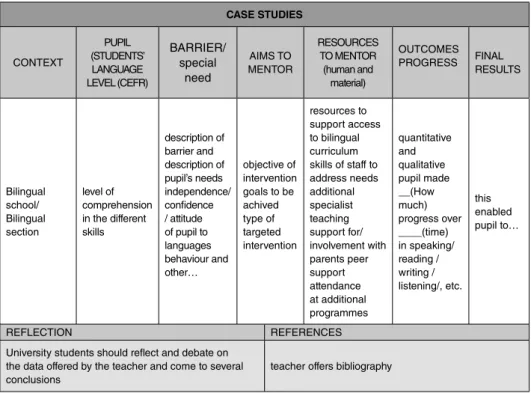
(14) Gemma Delicado Puerto, Víctor Pavón Vázquez. 4.3.3. Case Studies The third step has been to create a useful tool to provide student teachers with knowledge of potential real situations. Through these authentic case studies, primary school teachers show how they approach, evaluate and solve real issues. The case study template generated for this study includes several phases: context, aims, issue, solution/reflection and references. CASE STUDIES. CONTEXT. Bilingual school/ Bilingual section. PUPIL (STUDENTS’ LANGUAGE LEVEL (CEFR). level of comprehension in the different skills. BARRIER/ special need. description of barrier and description of pupil’s needs independence/ confidence / attitude of pupil to languages behaviour and other…. AIMS TO MENTOR. objective of intervention goals to be achived type of targeted intervention. RESOURCES TO MENTOR (human and material) resources to support access to bilingual curriculum skills of staff to address needs additional specialist teaching support for/ involvement with parents peer support attendance at additional programmes. REFLECTION. REFERENCES. University students should reflect and debate on the data offered by the teacher and come to several conclusions. teacher offers bibliography. OUTCOMES PROGRESS. quantitative and qualitative pupil made __(How much) progress over ____(time) in speaking/ reading / writing / listening/, etc.. FINAL RESULTS. this enabled pupil to…. Table 1. Case studies. 4.3.4. Lesson Observation The fourth step has been planned as a guide to help prospective teachers visit genuine classrooms or view authentic video material. The template can be used for interviewing, coaching, mentoring, etc. The worksheet is divided into several items and offers numerous questions to be raised when observing lessons: university subject, primary school subject visited, topic and target focused upon, curricular adaptation, critical incidents and discussion and reflection.. 48.
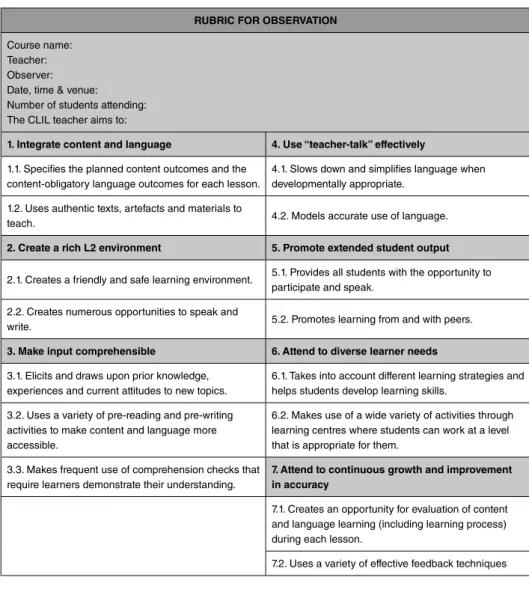
(15) Training primary student teachers for CLIL: innovation through collaboration. RUBRIC FOR OBSERVATION Course name: Teacher: Observer: Date, time & venue: Number of students attending: The CLIL teacher aims to: 1. Integrate content and language. 4. Use “teacher-talk” effectively. 1.1. Specifies the planned content outcomes and the content-obligatory language outcomes for each lesson.. 4.1. Slows down and simplifies language when developmentally appropriate.. 1.2. Uses authentic texts, artefacts and materials to teach.. 4.2. Models accurate use of language.. 2. Create a rich L2 environment. 5. Promote extended student output. 2.1. Creates a friendly and safe learning environment.. 5.1. Provides all students with the opportunity to participate and speak.. 2.2. Creates numerous opportunities to speak and write.. 5.2. Promotes learning from and with peers.. 3. Make input comprehensible. 6. Attend to diverse learner needs. 3.1. Elicits and draws upon prior knowledge, experiences and current attitudes to new topics.. 6.1. Takes into account different learning strategies and helps students develop learning skills.. 3.2. Uses a variety of pre-reading and pre-writing activities to make content and language more accessible.. 6.2. Makes use of a wide variety of activities through learning centres where students can work at a level that is appropriate for them.. 3.3. Makes frequent use of comprehension checks that require learners demonstrate their understanding.. 7. Attend to continuous growth and improvement in accuracy 7.1. Creates an opportunity for evaluation of content and language learning (including learning process) during each lesson. 7.2. Uses a variety of effective feedback techniques. Table 2. Observation rubric. 4.3.5. Evaluation and Reflection The fifth step has been planned as a valuable vehicle to evaluate and reflect upon the teacher contribution following different items: subject, university, subject primary schools, evaluation tool, topic evaluation, analysis of results and conclusions and life-long learning/ sustainable learning and tools. In other words, this final step has been thought as a tool to enhance individual professional growth lying on authentic material and experiences.. 2016, 39. 35-58. 49.
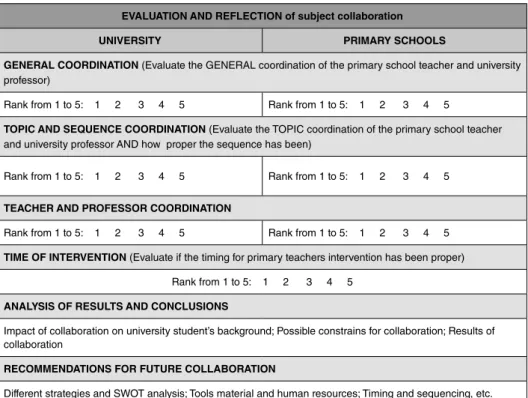
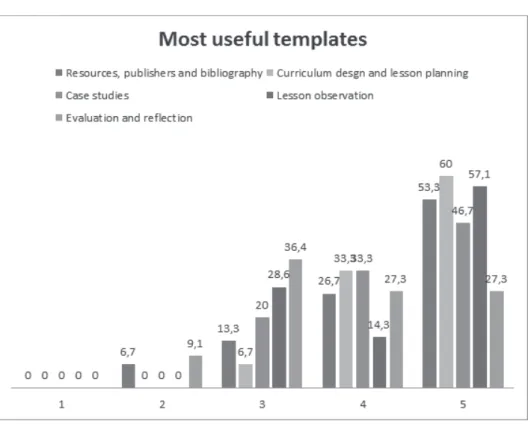
(16) Gemma Delicado Puerto, Víctor Pavón Vázquez. EVALUATION AND REFLECTION of subject collaboration UNIVERSITY. PRIMARY SCHOOLS. GENERAL COORDINATION (Evaluate the GENERAL coordination of the primary school teacher and university professor) Rank from 1 to 5:. 1. 2. 3. 4. 5. Rank from 1 to 5:. 1. 2. 3. 4. 5. TOPIC AND SEQUENCE COORDINATION (Evaluate the TOPIC coordination of the primary school teacher and university professor AND how proper the sequence has been) Rank from 1 to 5:. 1. 2. 3. 4. 5. Rank from 1 to 5:. 1. 2. 3. 4. 5. Rank from 1 to 5:. 1. 2. 3. 4. 5. TEACHER AND PROFESSOR COORDINATION Rank from 1 to 5:. 1. 2. 3. 4. 5. TIME OF INTERVENTION (Evaluate if the timing for primary teachers intervention has been proper) Rank from 1 to 5:. 1. 2. 3. 4. 5. ANALYSIS OF RESULTS AND CONCLUSIONS Impact of collaboration on university student’s background; Possible constrains for collaboration; Results of collaboration RECOMMENDATIONS FOR FUTURE COLLABORATION Different strategies and SWOT analysis; Tools material and human resources; Timing and sequencing, etc.. Table 3. Evaluation and reflection. 4.3.6. Perceptions of using templates As regards perceptions of primary teachers towards the use of the templates, the majority of teachers stated that their use would mean an exceptional way to review initial worries and reservations when cooperating at the university. Teachers reported that working with templates was convenient because it is an excellent tool that provides a clear vision of the structure (57% of teachers marked a 5 in this item). They also stated that it is an outstanding resource that allows them to organize collaboration beforehand (46.7% of teachers marked a 5 in this item) and finally because they are user-friendly (40% marked a 5). In general terms, they perceived that such tools are well-organized and are ways to tailor university seminars in a coordinated way. As it can be seen in Figure 2, among all the templates and on a second round of validation, teachers reevaluated each individual sheet and listed their preferences in the following order: Curriculum design and lesson planning, lesson observation (video and practice session), resources, publishers and bibliography, case studies and evaluation and reflection.. 50.
(17) Training primary student teachers for CLIL: innovation through collaboration. Table 4. Most useful templates. On the other hand, and in the same line, faculty members conveyed that the use of templates would allow coordination and organization between the primary school teacher and the university professor since by operating with them; both could plan seminars in a synchronized way.. 5. Conclusion The research conducted aimed to analyse primary teachers’ contributions to the Bilingual Degree in the BA in Primary Education at the Teacher Training College of the University of Extremadura. Under the frame of such coordinated partnership, the external members, a group of primary school bilingual teachers discussed with faculty members and external members experts in CLIL how to enhance classes with their background and experience. During several sessions and through the completion of a number of activities, the team analyzed the benefits of collaboration between university teacher trainers and real bilin-. 2016, 39. 35-58. 51.
(18) Gemma Delicado Puerto, Víctor Pavón Vázquez. gual teachers, the nature of effective training for future bilingual teachers, and the identification of contents for a potential training program based on problem solving, task-based and case study-based pedagogical strategies to engage students’ reflection on CLIL teaching in each specific subject area. The initial focus of this project was to respond to a necessity in Spanish education as the increasing number of bilingual schools demands the existence of qualified bilingual teachers. The results obtained reveal the benefits of continuous collaboration between primary school teachers and university faculty, which is not particularly common in tertiary education with the exception of individual interventions in specific university courses where teachers are occasionally invited to university classes. In general, all teachers were excited and optimistic about participating in this project, and we can conclude that both faculty members and primary teachers acknowledge the potential for bridging the reality of bilingual education with the training of future bilingual teachers. For the students it was also clear that the creation of a sustainable model of collaboration in the university classes is really beneficial. More precisely, with regard to the first specific objective (“To identify primary teachers’ perceptions of and degree of motivation for collaborating with university faculty”), directed to analyze the results of teachers’ perceptions toward this collaboration, outcomes confirmed that this cooperation meant a highly innovative and productive initiative which had given them the opportunity to learn from a novel experience. In this sense, the majority of teachers’ perceptions were quite positive and enriching as they indicated that the main reason for partnership was their desire to acquire a more informed background. In addition, they also pointed at other motives such as promoting their careers, since the regional Government will positively weigh such collaboration in their future job applications. It is noteworthy that teachers also reported that their motivation was much more connected to a desire for innovation in teaching rather than training or research, probably because they are used to obtaining training at teachers training centers. This may be because unfortunately in Spain it is still not very common for primary school teachers to get involved in research matters via the university. Regarding the teachers’ uncertainties towards collaboration, some areas where assistance would be required were identified, where problem-based learning and theoretical issues were the most difficult ones. However, most teachers clearly described that their role at university seminars would largely consist of mostly hands-on and real world input. In this sense, their perceptions match the expectations that the university leading group had on this point. Regarding the second specific objective (“To analyze teachers’ perceptions of the role they should play and the areas where they should focus their contribution”), results of teachers’s perceptions towards their role in this collaboration were analyzed. It can be. 52.
(19) Training primary student teachers for CLIL: innovation through collaboration. stated that the most uncomfortable and contentious fact was the teachers´ negative perception of the incorporation of theory into their university seminars, which was already pointed out in research question one, since they felt they were not qualified. Instead, they applauded the possibility for students to visit real primary school classes outside the official internship period in order to provide student teachers with supplementary interaction with the educational community. Additionally, a vast majority felt very comfortable and motivated sharing their experience, background, bibliography and resources with university teachers. They found it stimulating to enlighten university seminars not only with their experience but also with daily teaching instruments and tools. Again, here their perceptions matched the expectations that the university leading group had for this phase. As for the identification of the areas where primary teachers should focus their contribution to student teacher training, results show that there were a great number of topics that could be covered at university classes. The most relevant ones were related to general methodology, mentoring plans, sociological strategies and ICTs. Topics discussed oscillated from general to specific in order to show university undergraduates the day-to-day matters and difficulties to be found in bilingual schools. Teachers as well as faculty members found it fundamental to debate these facts within the university degree program. They repeatedly mentioned to governmental authorities present in the team group that these topics should be compulsory discussion in any teacher training college. With reference to the third specific objective (“To outline the teaching plans, methodologies, strategies, and materials to be used in a collaborative project”), the group worked in a number of templates divided into 5 categories: resources, publishers and bibliography; lesson planning; case studies; lesson observation; evaluation and reflection. These templates were created after discussing their relevance by the different stakeholders involved in the project: primary school CLIL teachers, governmental agents, external advisors and university faculty; and topics were chosen on the basis of their potential applicability to real challenges and necessities. To this light, a majority of teachers reported that the usage of the template generated in the workshops would be an exceptional approach to bridge initial worries and reservations when cooperating at university, and would consequently be an excellent strategy to overcome prior anxiety about collaborating with the university. They also mentioned that they would be an efficient organizational instrument to plan and design university seminars in a coordinated fashion, and that by operating with them, both primary teachers and university professors could organize seminars in a synchronized way. In sum, teachers were very confident that these tools (and the whole project) would definitely contribute to enhancing the training of candidate bilingual teachers. Finally, it has to be said that the study, which aimed to establish and analyze a structure of collaboration between university teachers and in-service bilingual teachers, was conducted during the preparatory stage of the real training. A logical further step then would be to com-. 2016, 39. 35-58. 53.
(20) Gemma Delicado Puerto, Víctor Pavón Vázquez. plement the data with an analysis of the real training that started in September 2015, with the opinions of students, and with the outcomes of the training program. Notwithstanding, bearing in mind the results of this study we would like to highlight that the main actors in the training process acknowledged the importance of creating this framework of collaboration, and moreover, that educational authorities and institutions might consider promoting similar experiences with the objective of enriching the training of future bilingual teachers.. 6. References Ball, P., Lindsay, D. (2010). Teacher training for CLIL in the Basque Country: The case of the Ikastolas - An expediency model. In D. Lasagabaster and Y. Ruiz de Zarobe (Eds.). CLIL in Spain: Implementation, Results and Teacher Training (pp. 162-187). Newcastle upon Tyne: Cambridge Scholars Publishing. Banegas, D. L. (2015). Sharing views of CLIL lesson planning in language teacher education. Latin American Journal of Content and Language Integrated Learning, 8 (2), 104-130. DOI:10.5294/laclil.2015.8.2.3. Bertaux, P., C.M. Coonan, M.J. Frigols, Mehisto, P. (2010). The CLIL Teacher’s Competence Grid. Retrieved from: http://lendtrento.eu/convegno/files/mehisto.pdf Bonnet. A. (2012). Language, content and interaction: how to make CLIL classroom work. In D. Marsh and O. Meyer (eds.), Quality Interfaces: Examining Evidence & Exploring Solutions in CLIL (pp. 172-189). Eichstätt: Eichstätt Academic Press. Breeze, R., Llamas, C., Martínez Pasamar, C., Tabernero, C. (2014). Integration of Theory and Practice in CLIL. Amsterdam: Rodopi. British Council (2015). Formación inicial para profesores bilingües en ingles: políticas, practices y recomendaciones. Alcalá de Henares: British Council-Universidad de Alcalá de Henares. Retrieved from: http://www.cardenalcisneros.es/es/articulo/la-universidad-alcalá-y-british-council-publican-las-conclusiones-del-congreso-formación#.V1KMxVd2nqo Cammarata, L., Tedick, D. (2012). Balancing content and language instruction. The experienced immersion teachers. The Modern Language Journal, 96 (2), 251-269. Cenoz, J. (2013). Discussion: towards an educational perspective in CLIL language policy and pedagogical practice. International Journal of Bilingual Education and Bilingualism, 16 (3), 389-394. Cenoz, J. (2015). Content-based instruction and content and language integrated learning: the same or different?. Language, Culture and Curriculum, 28, 8-24. Cenoz, J., F. Genesee, F., Gorter, D. (2013). Critical analysis of CLIL: taking stock and looking forward. Applied Linguistics (advance access), 1-21. Retrieved from: http://applij. oxofrdjournals.org/. Consejería de Educación, Comunidad de Madrid (2010). Los programas de enseñanza bilingüe en la Comunidad de Madrid: un studio comparado. Madrid: Consejería de Educación, Consejo Escolar.. 54.
(21) Training primary student teachers for CLIL: innovation through collaboration. Coyle, D. (2007). Content and Language Integrated Learning: Towards a Connected Research Agenda for CLIL Pedagogies, The International Journal of Bilingual Education and Bilingualism, 10 (5), 543-562. Coyle, D. (2013). Listening to learners: an investigation into ‘successful learning’ across CLIL contexts, in International Journal of Bilingual Education and Bilingualism, 16 (3), 244-266. Dafouz, E. (2015). Más allá del inglés: la competencia lingüística multi-dimensional como estrategia para la enseñanza en la Universidad internacional. Educación y Futuro, 32 (special issue on Bilingualism and Teacher Training), 15-34. Dafouz, E., Guerrini, M. (eds.) (2009). CLIL Across Educational Levels: Experiences from Primary, Secondary and Tertiary Contexts. Madrid: Santillana. Dafouz, E., Núñez, B. (2009). CLIL in higher education: devising a new learning landscape” In E. Dafouz and M. Guerrini (eds.), CLIL Across Educational Levels: Experiences from Primary, Secondary and Tertiary Contexts (pp. 101-112). Madrid: Santillana. Delicado Puerto, G., Pavón, V. (2015). La implantación de titulaciones bilingües en la educación superior: el caso de la formación didáctica del profesorado bilingüe de Primaria en la Universidad de Extremadura. Educación y Futuro, 32, 35-63. Dobson, A., Pérez, M., Johnstone, R. (2010). Bilingual Education Project (Spain): Evaluation Report. Madrid: Ministerio de Educación-British Council. Escobar, C. (2010). Student CLIL teacher education in Catalonia. Expert and novice teachers teaching together. In D. Lasagabaster and Y. Ruiz de Zarobe (Eds.). CLIL in Spain: Implementation, Results and Teacher Training (pp. 188-218). Newcastle upon Tyne: Cambridge Scholars Publishing. Escobar, C. (2013). Learning to become a CLIL teacher: teaching, reflection and professional development. International Journal of Bilingualism and Bilingual Education, 16 (3), 334-353. Escobar, C., Pérez-Vidal, C. (2004). Teacher education for the implementation of a content and language integrated approach (CLIL) in the school system. In R. Wilkinson (ed.), Integrating content and language. Meeting the challenge of a multilingual higher education (pp. 402-415). Maastricht: Maastricht University. García, R. (2015). CLIL teacher training in Europe. Educación y Futuro, 32 (special issue on Bilingualism and Teacher Training), 65-82. González, J.A., Barbero, J. (2013). Building bridges between different levels of education: Methodological proposal for CLIL at university, Language Value 5, 1, 1-23. Halbach, A. (2009). The primary school teacher and the challenges of bilingual education. In E. Dafouz and M. C. Guerrini (Eds.), CLIL across educational levels: experiences from primary, secondary and tertiary contexts (pp. 19-26). Madrid: Richmond Publishing. Halbach, A. (2010). From the classroom to university and back: teacher training for CLIL in Spain at the Universidad de Alcalá. In D. Lasagabaster and Y. Ruiz de Zarobe (Eds.). CLIL in Spain: Implementation, Results and Teacher Training (pp. 243-256). Newcastle upon Tyne: Cambridge Scholars Publishing.. 2016, 39. 35-58. 55.
(22) Gemma Delicado Puerto, Víctor Pavón Vázquez. Hansen-Pauly, M.A., Bentner, G., Jovanovic, V., Zerbato, D., Llinares, A., Dafouz, E., Erades, C, García, M. Carreras, A., Favili, F., Dale, L., Robinson, P, Hoffmanova, M., Novotna, J. (2009). Teacher education for CLIL across contexts: From scaffolding framework to teacher portfolio for content and language integrated learning. Retrieved from http://clil.uni.lu Hillyard, S. (2011). First steps in CLIL: Training the teachers. Latin American Journal of Content & Language Integrated Learning, 4, (2). 1-12. DOI:10.5294/laclil.2011.4.2.1 ISSN 2011-6721 Horrillo, Z. (2011). Formación del profesorado en el enfoque AICLE: apreciaciones informadas de la didáctica de las materias en las que el otro es experto. Un estudio de caso. In C. Escobar, N. Evnitskaya, E. Moore and Patiño, A. (Eds.), AICLE-CLIL-EMILE: Educació plurilingüe (pp. 41-56). Barcelona: Servicio de Publicaciones de la Universidad Autónoma de Barcelona. Hunt, M., Neofitou, A., Redford, J. (2009). Developing CLIL training for modern language teachers trainees. In D. Marsh, P. Mehisto, D. Wolff, R. Aliaga, T. Asikainen, M.J. Frigols and S. Hughes (Eds.), CLIL Practice: Perspectives from the Field (pp. 110-116). Jyväskylä: University of Jyväskylä. Hüttner, J., Dalton-Puffer, C., Smit, U. (2013). The power of beliefs: lay theories and their influence on the implementation of CLIL programmes. International Journal of Bilingual Education and Bilingualism, 16 (3), 267-284. Infante, D., Benvenuto, G., Lastrucci, E. (2009). The effects of CLIL from the perspective of experienced teachers. In D. Marsh, P. Mehisto, D. Wolff, R. Aliaga, T. Asikainen, M.J. Frigols, S. Hughes and G. Langé (Eds.). CLIL Perspectives from the Field (pp. 156163). Jyväskylä: University of Jyväskylä. Laorden, C., Peñafiel, E. (2010). Proyectos bilingües en los centros de la Comunidad de Madrid: percepción de los equipos directivos. Revista de Investigación Educativa, 28 (2). 325-344. Lasagabaster, D., Ruiz de Zarobe, Y. (eds.) (2010). CLIL in Spain. Implementation, Results and Teacher Training. Newcastle upon Tyne: Cambridge Scholars Publishing. Lasagabaster, D., Sierra, J.M. (2010). Immersion and CLIL in English: more differences than similarities. ELT Journal, 64 (4), 367-375. Lorenzo, F. (2002). Stages in content-based instruction course development in English teaching at tertiary level. In A. Bueno, G. Tejada, G. Luque (eds.), Las Lenguas en un Mundo Global. XX Congreso Nacional de AESLA (pp. 179-191). Universidad de Jaén. Lorenzo, F., Casal, S., and Moore, P. (2009). The effects of Content and Language Integrated Learning in European education: key findings from the Andalusian bilingual sections evaluation project. Applied Linguistics, 31 (3), 418–442. Lorenzo, F. (2010). CLIL in Andalusia. In D. Lasagabaster and Y. Ruiz de Zarobe (Eds.), CLIL in Spain. Implementation, Results and Teacher Training (pp. 2-27). Newcastle upon Tyne: Cambridge Scholars Publishing, . Madrid, M., Madrid, D. (2014). La formación inicial del profesorado para la educación bilingüe. Granada: Universidad de Granada.. 56.
(23) Training primary student teachers for CLIL: innovation through collaboration. Marsh, D. (2002). Content and Language Integrated Learning. The European Dimension. Jyväskyla: University of Jyväskyla Press. Marsh, D., Pavón, V., Frigols, M.J. (2013). The Higher Education Languages Landscape: Ensuring Quality in English Language Degree Programmes. Valencia: Valencian International University. Melara, F. (2013). Creating a profile of competences for Primary Education teachers specializing in CLIL. Unpublished Master’s Thesis Dissertation. University of Córdoba. Mehisto, P., Genesee, F. (Eds.) (2015). Building Bilingual Education Systems: Forces, Mechanisms and Counterweights. Cambridge: Cambridge University Press. Meyer, O. (2010). Towards Quality-CLIL: Successful Planning and Teaching Strategies, Pulso, 33, 11-29. Moliner, M. (2013). The effects of CLIL from the perspective of in-service teachers in Salamanca (Castilla y León, Spain). Educaçao y Formaçao, 8, 200-217. Olivares, M., Pena, C. (2013). How do we train our CLIL teachers? A case study from Alcalá University. Porta Linguarum, 19, 87-99. Pavón, V., Gaustad, M. (2013). Designing Bilingual Programmes for Higher Education in Spain: organizational, curricular and methodological decisions. International CLIL Research Journal, 1 (5). 82-94. Pavón, V., Ellison, M. (2013). Examining teacher roles and competences in Content and Language Integrated Learning (CLIL). Linguarum Arena, 4, 65-78. Perez Cañado, M.L. (2014). Teacher training needs for bilingual education: in-service teacher perceptions. International Journal of Bilingual Education and Bilingualism, 1-30 (advance access). DOI: 10.1080/13670050.2014.980778 Perez Cañado, M.L. (2015). La formacion del profesorado para la enseñanza bilingue: pasado, presente y futuro. In Formación inicial para profesores de programas bilingues en ingles: politicas, practicas y recomendaciones, report conducted by the British Council and the University of Alcala. Retrieved from: http://www.cardenalcisneros.es/ sites/default/files/Seminario%20Formación%20Inicial%202015.pdf Pérez Invernón, A. (2012). Evaluación de programas bilingües: análisis de resultados de las secciones experimentales de francés en el marco del Plan de Fomento de Plurilingüismo de la Junta de Andalucía. PhD. Dissertation. University of Córdoba, Spain. Pérez -Vidal, C. Escobar, C. (2004). Teacher education for the implementation of CLIL in the school system. In B. Wilkinson (Ed.), Integrating Content and Language. Meeting the Challenge of a Multilingual Higher Education (pp. 389-402). Netherlands: Maastricht University. Pladevall-Ballester, E. (2014). Exploring primary school CLIL perceptions in Catalonia: students’, teachers’ and parents’ opinions and expectations. International Journal of Bilingual Education and Bilingualism, 1-15 (advance access). DOI: 10.1080/13670050.2013.874972 Ramos, F. (2007). Programas bilingües y formación de profesores en Andalucía. Revista Iberoamericana de Educación, 44, 133-146. Ramos, A.M. (2013). Higher Education Bilingual Programmes in Spain. Porta Linguarum, 19, 101-111.. 2016, 39. 35-58. 57.
(24) Gemma Delicado Puerto, Víctor Pavón Vázquez. Salaberri, M.S. (2010). Teacher Training Programmes for CLIL in Andalusia. In D. Lasagabaster and Y. Ruiz de Zarobe (eds.), CLIL in Spain. Implementation, Results and Teacher Training (pp. 140-159). Newcastle upon Tyne: Cambridge Scholars Publishing, San Isidro, X. (2008). O desenvolvemento da competencia plurilingüe entre as prioridades da Administración educativa galega. EDUGA, 53, 30-31. Sierra, L., López, A. (2015a). Presentación, Educación y Futuro, 32 (special issue on Bilingualism and Teacher Training), 9-12. Sierra, L., López, A. (2015b). CLIL en la formación inicial del profesorado de educación Infantil y primaria, Educación y Futuro, 32 (special issue on Bilingualism and Teacher Training), 83-114. Woodward, T. (1986). Loop input-a process idea. The Teacher Trainer, 1, 6-7.. Sugerencia de cita: Delicado, G. and Pavón, V. (2016). Training primary student teachers for CLIL: innovation through collaboration. Pulso. Revista de educación, 39, 35-58. 58.
(25)
Figure

+2
Documento similar
