UNIVERSIDAD TECNICA PARTICULAR DE LOJA
La Universidad Católica de LojaESCUELA DE CIENCIAS DE LA EDUCACION MENCION INGLES
MODALIDAD ABIERTA Y A DISTANCIA
A DESCRIPTIVE ANALYSIS OF ANGLICISMS USED IN ECUADORIAN MAGAZINES
Research done in order to achieve the Bachelor’s Degree in Teaching English as a Foreign Language
AUTHOR:
ANDRADE VELASQUEZ MARJORIE ROXANA
ADVISOR:
ARIAS CORDOVA MARIA
CENTRO UNIVERSITARIO SANTO DOMINGO DE LOS TSACHILAS, ECUADOR
CERTIFICATION
Doctora María Arias Córdova
Thesis Advisor
CERTIFIES THAT:
This research work has been thoroughly revised by the graduation committee. Therefore, authorizes the presentation of this thesis, which complies with all the norms and internal requirements of the Universidad Técnica Particular de Loja.
Loja, March the 15th, 2011
DRA. MARIA ARIAS CÓRDOVA THESIS ADVISOR
CONTRATO DE CESION DE DERECHOS DE TESIS DE GRADO
“Yo, Marjorie Roxana Andrade Velásquez declaro ser autora del presente
trabajo y eximo expresamente a la Universidad Técnica Particular de Loja y a sus representantes legales de posibles reclamos o acciones legales.
Adicionalmente declaro conocer y aceptar la disposición del Art.67 del Estatuto Orgánico de la Universidad Técnica Particular de Loja que en su parte pertinente textualmente dice: “formar parte del patrimonio de
la Universidad la propiedad intelectual de investigaciones, trabajos científicos o técnicos y tesis de grado que se realicen a través, o que el apoyo financiero, académico o institucional (operativo) de la Universidad”.
--- MARJORIE R. ANDRADE V.
AUTHORSHIP
The thoughts, ideas, opinions and the information obtained through this research are the only responsibility of the author.
Date: March the15th, 2011
________________________________ Marjorie R.Andrade Velásquez
DEDICATION
This study is dedicated to God all powerful for giving me life, intelligence, and force to live every day; to my family who has been my support in bad times, for their comprehension and all the love and support, to my daughters who have been my inspiration for achieving my degree.
MARJORIE
v
ACKNOWLEDGMENT
First, I thank my God who with his permanent presence in my life has given me strength to get until this point my goal.
I want to express my gratitude and deep appreciation for all the people who gave me their support and helped me in each stage of my life to continue working hard in order to achieve my goals, and my mother, who despite all of the difficulties, I am sure that she will be very proud of my achievement.
Let me also thank to “Universidad Técnica Particular de Loja” its teachers in the past and my advisor María Arias Córdova, who opened me the doors in order to grow.
Last, but no least, a special thanks goes to my dear father who is now with the Lord and lives in the loving memory of my heart; thanks dad, I love you.
MARJORIE
CONTENTS
ABSTRACT ---1
INTRODUCTION ---3
METHODOLOGY---8
DISCUSSION ---10
LITERATURE REVIEW---10
RESULTS---31
DESCRIPTION ANALYSIS AND INTERPRETATION OF RESULTS---57
CONCLUSIONS---86
REFERENCES---88 ANNEXES
1 ABSTRACT
The theme of this research is: ―A descriptive analysis of anglicims in Ecuadorian magazines‖. This research took place in Santo Domingo de los Tsáchilas, Ecuador; it focuses on Ecuadorian magazines such as: Cultural, Scholarly and General Interest. The selected magazines that have been chosen are: ―Los museos del Ecuador‖, ―Ecuador Infinito‖, ―Nuestro Mundo‖, ―Criterios‖, ―Vistazo‖ and ―Hogar‖.
The information was tabulated and analyzed, in order to do this work the bibliographic method was used for gathering scientific material to work on the theoretical background, also the interpretation of the data collected through the field research was done by the qualitative and quantitative methods, that allowed the gathering and facilitated the process of the linguistic data, in order to identify and analyze the anglicims presently used in Ecuadorian Magazines; also the interpretation of the data collected through the field research was done by the qualitative and quantitative methods.
2
3
Introduction
The use of anglicisms in the Spanish written language in our country is a topic worth being investigated since it will provide us information about the way English is influencing our native language in terms of anglicims.
The purpose of this study is to carry out a descriptive and linguistic analysis of present written language in Ecuadorian magazines where we will focus on lexical terms regarded as anglicism, in the form they are used in magazines.
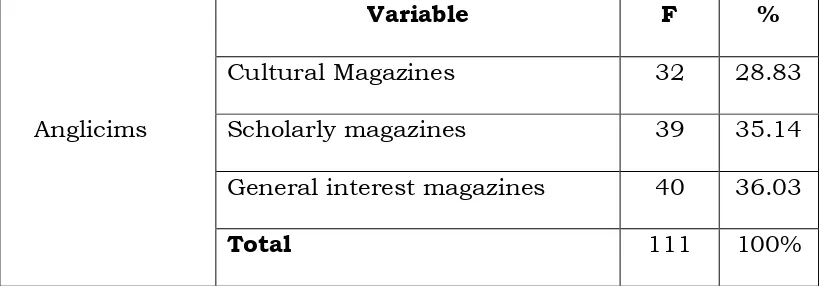
This research focuses specifically on the linguistic phenomenon of anglicims used in Ecuadorian magazines and the aim to identify the syntactic anglicims more commonly used in Ecuadorian magazines. This research is detailing a deep analysis of the anglicims found in Ecuadorian magazines regarding syntactic, semantic, and morphological aspects, and to establish which variable cultural, scholarly or general interest contained the highest number of anglicims and to determine which anglicims are mostly used.
4
All the steps to carry out this work were carefully done using the qualitative and quantitative methods. Furthermore, in order to collect the data for the results 6 Ecuadorian magazines were used such as : ―Los museos del Ecuador‖, ―Ecuador Infinito‖, ―Nuestro Mundo‖, ―Criterios‖, ―Vistazo‖ and ―Hogar‖; papers, computers, dictionaries, pencils, pens were the resource materials used for carrying out this work, this research was carried out in Santo Domingo de los Tsáchila, Ecuador.
The literature review was the result of the bibliographical research and served as scientific base to support and to analyze the obtained results through the investigation of field.
As a guide to develop scientific contents in an organized and sequential manner, the contents revised were the following: Linguistic, branches of linguistics like Morphology, Semantics, Pragmatics, Phonology and Syntax, Contact languages, Language Vice, Barbarism, Anglicism and Magazines, each theory, concept, principle or previous result of an investigation by another author, served to this analysis.
5
This study will form part exclusively of the patrimony of the university, and their students, to future scientific or technical research and thesis of degree that be carried out through this study. Moreover, it is also important to present the limitations that we faced during this process. Some limitations that I encountered were the lack of time I had available with my husband on a project in Santo Domingo and I was teaching English in my home, to prepare some students for their school exams, I have four children and kept me busy with their everyday routines.
Te second limitation was that it was very difficult to find the proper and complete previous investigations needed to carry out my research. Santo Domingo does not have sufficient libraries or universities libraries, so it was necessary to travel to Quito to find the necessary materials.
Finally it is important to emphasize that all the specific objectives were achieved at 80%.
Indeed, regarding to the first objective ―To identify the
syntactic anglicims more commonly used in Ecuadorian magazines‖. It was possible to obtain some magazines and identify the lexical. The lexicon was classified from the point of view of its historical origin and extent of use according to the language of origin, and from the point of view function: Lexical and functional categories.
According to the second objective ―To make a deep analysis of
6
semantic, and morphological aspects‖, it was possible to do a
syntactic analysis, analyzing the words, and determining its grammatical structure. In the semantic analysis detailing its the
meaning, that humans use language to express.
According to the morphological analysis; changes or adaptations were identified in the term once transfered into the Spanish language or the identification, and description of the structure in the words.
In relation to the third objective ―To establish which variable
(cultural, scholarly, and general interest magazines) contains the hightest number of anglicims. After reading all the magazines I found that general interest magazines have the hightest number of anglicims because those magazines as the category suggests, come with general interest stories, culture, science, technology, economics, topics that are suited for everyone of every age that they are loved by people because of the universal appeal they have.
And finally in regards to the last objective, ―To determine which anglicims are mostly used‖, after reading each magazine I found that
7
In areas such as technology we see the following examples: burnout syndrome (syndrome of burned worker), Bluetooth (device wireless data transmission) blog (Web journal). These terms relate to computers and technology.
The study of Angicisms is very important; the amount of English words in the Spanish language has increased and especially since magazines play an important role in our society.
8
METHODOLOGY
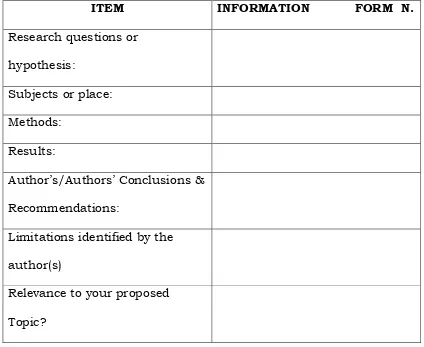
After reading the topic, a deep bibliographical investigation was done using some books, magazines, dictionaries and the internet; interesting definitions about linguistics and its branches were chosen from the mentioned resources.
I selected the most relevant and related information to the subject and included it in some index cards doing one index card for each subject and each study, when the information was collected, all the gathered material was used to build the theoretical background.
Once it was finished, the field research was organized. The first step was to select six magazines; the variables proposed for this research were Cultural, Scholarly and General Interest magazines, to get the sample to analyze.
This investigation was done over a period of five weeks through many different activities to find the nine scientific contents of Linguistic and its branches which include ten studies about Anglicism from these linguistic studies there were 30 anglicims that were investigated and analyzed.
9
In the second week a meticulous investigative analysis was done for each anglicim, and it was carried out, taking into account the grammatical and lexical aspects of the anglicims, such as the syntactic and semantic analysis, detailing the grammatical function of words and their meaning in the context found. And finally a morphological analysis was done including changes or adaptations that each term suffered in Spanish.
The interpretation and analysis of the results were done in the fourth week. Conclusions were based on the general and specific objectives laid out in the guide provided by the university.
This investigation was done with the application of the descriptive and analytic methods. The qualitative tabulation was done based on repetitive anglicims and the qualitative tabulation based on percentages.
10 DISCUSSION
This section has great importance, it is considered as the core of this research. It encloses the theoretical background with many important theories and definitions from some authors about linguistic and its branches, contact languages, language vice, barbarisms, anglicims, borrowings and loans, magazines.
Then, there is a description and analysis of results in which each variable and indicator will be deeply discussed and analyzed.
Finally, conclusions will end this part by giving the most important findings of this investigation.
Literature Review
My intention with this work is to do a study on the factors that increase the existence of anglicisms in our tongue, and this content focuses on the relevance on the study of anglicisms, for this I believe it is convenient to begin giving a brief definition of ―anglicisms‖.
An anglicism is a word or idiom that is recognizably English in its form spelling, pronunciation, morphology, or at least one of the three, but is accepted as an item in the vocabulary of the receptor language.
11
sources are called "lexicons" and these are divided into Americanisms, indigenous voices, neologisms, archaisms, and strangers.
At the end of the 20th century, English was the language with the greatest influence in the world. It can be told that English acts as ―lingua franca‖ in numerous acts of the everyday life of extensive
sectors of the population that are seen conditioned to the use of a tongue that functions like a vehicle of habitual communication.
One of the characteristics in the Spanish language is the flow of loans originating in the English or anglicisms which is a complex process of the contact of tongues, of a mechanism of transculturation that passes the limits that imposes the defense of a tongue set against the penetration of terms and structures of another.
12
all the senses, always and that be utilized of an adequate way and without abusing them. In this section, I’m going to include some content outline and some previous studies about the researched topic that are very important to understand this important topic.
Linguistics
Sapir (1921,p.1) says ―Speech is so familiar a feature of daily life that we rarely pause to define it‖ . It seems as natural to man as
walking, an only less so than breathing.
To have a better comprehension of the concept of Linguistics I am going to provide some deep and important definitions, we found in the Random House Webster’s College Dictionary (2006) which
says: ―Linguistics is the science of language‖.
A concept that extends the previous one comes from Wikipedia. It states that ―Linguistics is the scientific study of natural language,
encompassing a number of sub-fields. An important topical division is between the study of language structure (grammar) and the study of meaning (semantics).‖
13
Branches of Linguistics: Morphology, Semantics, Pragmatics,
Phonology and Syntax.
The Columbia Encyclopedia in its sixth edition shows us an interesting concept about branches of linguistics which it says‖
linguistics, scientific study of language, covering the structure (morphology and syntax, grammar), sounds (phonology), and meaning (semantics), as well as the history of the relations of languages to each other and the cultural place of language in human behavior‖.
Morphology
It is considered as the study of the structure and form of words; as follows, I am going to expand this knowledge taking into account the following definitions.
According to (Arnoff & Kirsten, 2005,p.1) ―Morphology is the study of words structures, the claim that words have structure might come as a surprise because normally speakers think of words as indivisible units of meaning due to the fact that many words are morphologically simple.‖
14
Russian, Latin, Arabic. Isolating languages use grammatical morphemes that are separate words. Agglutinating languages use grammatical morphemes in the form of attached syllables called affixes. Inflexional languages may go one step further and actually change the word at the phonemic level to express grammatical morphemes.
All languages are really mixed systems, English for example, uses all three methods, to make the future tense of a verb, we use the particle will ―I will see you‖; to make the past tense, we usually use the affix -ed (I changed it); but in many words, we change the word for the past ―I see it becomes I saw it‖. Looking at nouns, sometimes we make the plural with a particle ―three head of cattle‖, sometimes with an affix ―three cats‖, and sometimes by changing the word ―three men‖. But, because we still use a lot of nonsyllable affixes (such as -ed, usually pronounced as d or t, and -s, usually pronounced as s or z, dependeing on context), English is still considered an inflexional language by most linguists.
Semantics
15
sentences, and about the meaning of individual words and sentences.‖
Moreover, Richard Nordquist (2009,p.5) in the article ―Semantics‖ states that the word semantics comes ―from the Greek,
―sign‖ ‖ and also defines it as : ―The field of linguistics concerned with
the study of meaning in language‖
Burneo (2007, p.9) said Semantics studies symbols, signs and structures of meaning, and it deals with the meaning of morphological and syntactic units like sentences, words, phrases, morphemes, clauses and discourse.
Pragmatics
This branch of linguistics is concerned with the study of the language use in a social context. ―Dictionary.com‖ states that pragmatics is ―the analysis of language in terms of the situational
context within which utterances are made, including the knowledge and beliefs of the speaker and the relation between speaker and listener.‖ And Wikipedia extends: ―Pragmatics is the study of the
ability of natural language speakers to communicate more than that which is explicitly stated. The ability to understand another speaker’s intended meaning is called pragmatic competence‖. Besides, Kamil
16
words in fact convey when they are used, or with intended speaker meaning as it is sometimes referred to..‖
Syntax
Syntax is another important branch of linguistic; it refers to the study of sentence formation. The Dictionary.com states that ―Syntax is the study of the rules whereby words or other elements of sentences structure are combined to form grammatical sentences.
Burneo (2007, p.9) said that Syntax studies the principles rules necessary to construct phrases, clauses, and sentences, the Syntax of a language is the set of constitutive rules that speakers follow when they combine words into sentences..
Syntax is taken to be the study of the combinatorial properties of words and their parts, and semantics to be the study of meaning so pragmatics is the study of language usage.
Jaworski & Coupland (1999, p.16) says ―…studying the effects
of the speaker`s utterances on the listener derived from Austin´s view of language as a form of action‖, he observed that by saying something we not only communicate ideas, but may also transform the reality.
Phonology
17
Random House (2006, p.96) says that ―Phonology is the study of the distribution and patterning of speech sound in a language and of the tacit rules governing pronunciation‖.
Camilo Espinoza (2005, p,16) says that the most universal experience all of us have of language is Speaking it and Hearing it. Phonology is the science which studies the speech sounds in general and it has two areas: Phonetics and Phonemics. Phonetics refers to articulation and production of sounds, and Phonemics refers to the function and distribution of sounds.
Every language has particular sounds, and each language has sounds divided in two groups: vocals and consonants.
Phonology and Syntax
Inkelas (1990, p.362). The syntax and phonology interface has been viewed mainly from the perspective of syntactic influences on phonological rules. The most universal experience all of us have of language is speaking it and hearing it, Espinoza (2005, p.35) we know that most writing systems do not conform exactly to the sounds people make in speaking, so it is easy to appreciate the need for some accurate method of describing and transcribing the language sounds. Syntax: Lexical Categories
18
Heindinger (1984, p.237) suggested that lexical categories are word-based such as noun, verb, adjective, preposition, etc. These categories are represented by the vocabulary of a language.
Syntax is a set of rules speakers follow to combine words into sentences, focusing on the structure of the language, forming the combination of lexical and phrasal categories when they are combined to have meaningful patterns.
To construct clauses in English and in any other language it follows a hierarchical structure, the clauses are formed of phrases or sentences that they are small structures.
Sentences are constructions formed by smaller syntactic unit called constituents, and sentences have two major constituents’ noun phrase and verb phrase.
Contact Languages
19
Wikipedia, saids Language contact occurs when two or more languages or varieties interact. The study of language contact is called contact linguistics.
Language Vice
Paredes (2005, p.168) says ―we call vices of language to the
words or to the linguistic wrong constructions, the vices but common are the barbarisms, the solecisms, cacophony and the amphibology.‖
(Maqueo 2005, p.85) suggested that the vices of language are forms of construction of employment of vocabulary inadequate, which can complicate the interpretation correct of a writing.
Language Vices are divided in three groups: pragmatic, syntactic, and semantic.
According to Salvador Carreño (2009, p.35) language vices are ―factors that after the normal flow in the communicative verbal experience‖.
Barbarism
Barbarisms are all words taken from a foreign source, which have been established in a short period of time, without taking into account the characteristics of the language, for example: ranking-rango.
20
indicates a misuse of language, but also indicates culturally lacking and they are not the same of anglicism.
Barbarisms are a common phenomenon, producing the lexical increase by ways that dimish the purity of the language, and they are words that are used wrongly because in Spanish there are appropriated words; for instance , ―abstracto‖, ―balance‖ and ―bibidí‖,
these barbarisms are used inappropriately in the Spanish lexicon: ―resúmen‖ (abstract);‖saldo‖(balance);‖camiseta‖(bividí).
Alfaro (1970, p.201) said that barbarisms are rude, offensive, noisy words that mean strange lexical voices used by ignorant people. They are generally created by phonetic Spanish construction of English words, for example: ―parquear‖: parking; ―guachiman‖ : a security man; ―acrede‖ intentionally: ―aeropuerto‖: place for the traffic of airplanes; ―basketball‖ ball play.
Anglicims
The Royal Academy Dictionary of Spanish Language said that anglicims is: Turn or way English language is spoken, and the use of words of English terms in different languages.
Gorlach (2003,p.1) says ―… an anglicism is a word or idiom
21
and the role that performed the United States in the same, the press, the industry, the commerce, the movies, the sport. Penny ( 1991, p.488) says that the increase of the Anglo-Saxon origin masses tourism, the fashion, the music, the influence of the mass media, the boom of the data processing, the development of the international relations of the countries of Spanish speech of the scientific, economic preponderance and politics of the countries of English speech, the English is the tongue that counts with the greatest number of speakers.
Anglicims had many ways of introduction to the Spanish language. For instance: The news agencies, the journalism, and international relationships between Spanish speaking countries and the English speaking ones such us: USA with a great development, economical, scientifically and political status.
Another source to introduce Anglicism in the Spanish language is the industry, the sports and the trade. The economical power of the U.S.A and England determine and exchange of goods, services, and business with the Spanish countries. Sporting events are another way to introduce anglicims because the majority of sports games are introduced to the Spanish speaking audience by the English speakers.
Defining the concept of ―anglicism‖ is no easy matter. As a
22
(DRAE), because, along with the Real Academia itself, it is constantly referred to in discussions regarding anglicisms and the influence of English on Spanish in general, both by linguistic and laymen. The dictionary defines the term anglicism as follows: Anglicism: Word or turn of the language used in another, using English words in different languages.
Wikipedia said an anglicism, is a word borrowed from English into another language. "Anglicism" also describes English syntax, grammar, meaning, and structure used in another language with varying degrees of corruption.
Borrowing and Loans
Wikipedia (2010) refers that Borrowing is something that is borrowed, especially a word borrowed from one language for use in another, and a loanword or loan word is a word borrowed from one language and incorporated into another.
Kemmer (2001) says loanwords are words adopted by the speakers of one language from a different languages, borrowing refers to the process of speakers adopting words from a source language into their native language.
23
Henrich (1991, p.18) suggested that loanwords can also be called borrowings. Although of long- tending usage, neither loanword nor borrowing correctly conveys the meaning, since words cannot be returned to the creditor language.
English also acquires loanwords in which foreign sounds are part of the foreign pronunciation. For example, the Hawaiian word
ʻaʻā is used by geologists to specify lava that is relatively thick,
chunky, and rough.
English has many loanwords. In 1973, a computerised survey of about 80,000 words in the old Shorter Oxford Dictionary (3rd edition) was published in Ordered Profusion by Thomas Finkenstaedt and Dieter Wolff.
Magazines
24
McLaughlin (2000, p. 1) says ―… magazines are such a popular and familiar form that it may seem strange even to ask this question.‖
Nevertheless let’s see what the dictionary says: Magazines is a
periodic paperback publication containing articles, fiction, photographs, etc.
Wikipedia (2001). Magazines are very useful, we can find a variety of articles and are available in the whole of the country in which they are published anglicisms, although some are distributed only in specific regions or cities.
Magazines are more direct, people can read several times, always come with lots of color and through this we get more information.
Previous Studies
I found a study made by María Olivares Baños about The anglicims in the music field in teen people in Spain 2009.
They are not few the tongues that have been affected for the expansion of the English in the last decades, especially after 1945, in the case of Spanish, each time are more numerous the foreign voices originating in the English or anglicisms, whose apparition is owed in great measure to the Anglo-Saxon influence exercised on our country.
25
of the foreign voices or anglicisms. According to her opinion, is one of the most promising fields because, as already she has mentioned before, each time are more the words or foreign expressions that utilize in Spanish and besides the investigations carried out in this field of study are often incomplete as well as deficient as for method.
The methodology that she used was analytical she selected some magazines like Bravo , Vale and Super Pop, teens magazines she found some examples that have seemed her interesting for the investigation.
I found that the author Gunther Haensh did a previous study about Anglicims in the American Spanish, in the University of Augsburg
(2005). The anglicisms which are frequently used in American Spanish and the information or methodology was analytical, he obtained by native informants and lexicographical sources, may shed new light on the differences between European and American Spanish.
The loans and copies dictionaries originating in the English are an important factor of differentiation of the dictionary of the different so much, Latin-American countries set against Spanish peninsular as among the American varieties of Spanish, especially in those cases in which the usual only word to appoint a referring one is an anglicisms, like in the case of cloch and ―clutch of the car'.
26
arbitrary. Therefore, the anglicisms have its own linguistic geography in the extensive Hispanic world.
In the third study about Economic anglicisms: adaptation to the Spanish linguistic system by Paloma López Zurita (2005), the aim of it, is to provide a comparative insight into the semantic study of lexical interference 1 in English and Spanish within the economic terminological field, through the linguistic mechanisms of inter- language adaptation involved.
The methodology that the author used was qualitative quantitative and analytical they got information in some books he read (skim and skan), note taking, and they analyzed in some specialized books, internet pages, etc.
It is clear that the Anglo – Saxon economic supremacy together with its ever expanding market is also exporting an increasing number of linguistic terms into other languages.
Language is defining characteristic in the idiosyncrasy and identity of a country, and the enormous number of anglicims used every day in Spanish language generates lexical interference between both languages.
27
Anglicisms is every word or own way to speak of the employed English tongue in another, at present the use of anglicisms and foreign sounding forms, has taken in Spanish the characteristics of a danger of invasion, the operations of loans, adoption of elements among different tongues are natural in the linguistic dynamics, they obey to commercial, political, cultural, or artistic needs, when they are justified the resultant forms are accepted and they legitimize in the own language, but is not admissible the capricious or abusive use of foreign expressions, because injures the communicability of the code that one or more than three hundred fifty million Spanish- speaking in the world and the bases of our traditional idiosyncrasy.
The uses of foreign expressions should be limited to the indispensable, it agrees that inside Spanish language in the common use the expressive possibilities, when the foreign voices are irreplaceable, is very recommendable to carry out their translation.
28
Irina Khoutyz a student of Kuban State University, Russia New times – new meanings (2008) Anglicisms and their functional characteristics in a Russian discourse of the 21st century.
The contact of cultures in times of globalization and instant information exchange cause rapid transformations of modern languages, the latest developments in the organization and perception of the world are reflected in the creation of new vocabulary or describing new meaning to old words.
The paper views the role of numerous neologisms, English borrowings, in modern Russian discourse, the methodology used is analytical because she analyzed the data base, collected from modern magazines, newspapers and novels, shows that the main function of anglicisms is not to compensate for the language inflation, but to transmit an emphatic pragmatic meaning of newness and belonging to the unique society of the 21st century.
Rabago Tanori, Beatriz A. Romero Noyola, Rafael Saldívar Arreola from the faculty of languages of the Baja California University study The printed media in the transformation of the language in the Border zone between Mexico and United States Mexicali in 2008.
29
establish links among the tongues that facilitate the communication, with a pragmatic.
Is possible that this recognition of the importance of both languages that reflects in the filtrations from one to another language can sensitize the people to learn to be communicated in the other language.
The Spanglish because it has returned a form of identity among the Spanish–speaking that live continue communicating thus among them.
To carry out this study the methodology was analytical they were chosen some newspaper in San Diego, California, in parallel two newspapers of the center were analyzed U.S. and of the center of the country two Worlds, of Arkansas, and Millennium, of Mexico City, this in order to detecting if these linguistic filtrations were presented also out of the frontier stripe and if the cases presented had the same characteristics.
Unlike what happens elsewhere, the Spanish speakers in the area Baja California border appear to be more open to incorporating anglicisms his speech and that somehow identify with American culture not only for its geographical proximity, but because of problems and ways of thinking like, that make them open to the influence of foreign language.
30
31
Results
This work was made in Santo Domingo de los Tsáchilas and Quito,
I investigated the following types of magazines:
Cultural magazines: Los museos del Ecuador and Ecuador Infinito.
Scholarly magazines: Nuestro Mundo and Criterios
General interest magazines: Vistazo and Hogar.
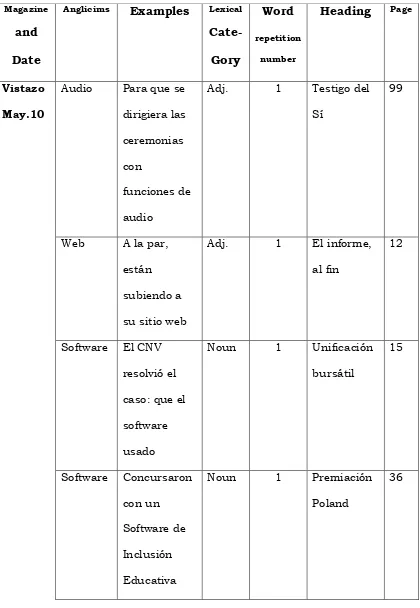
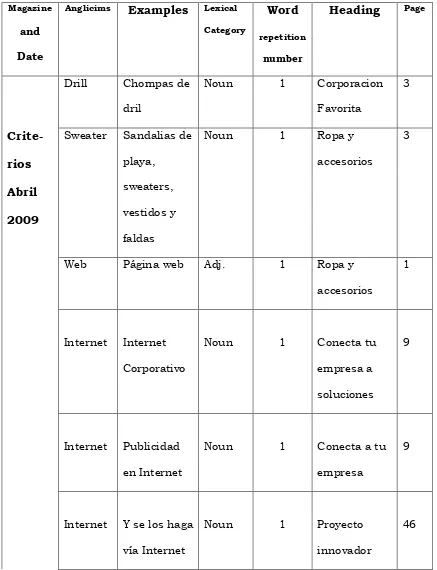
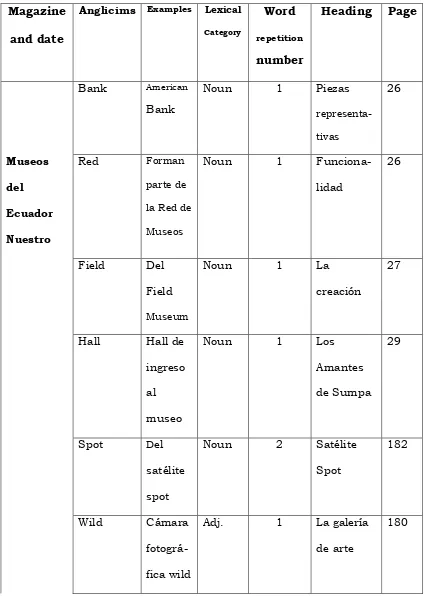
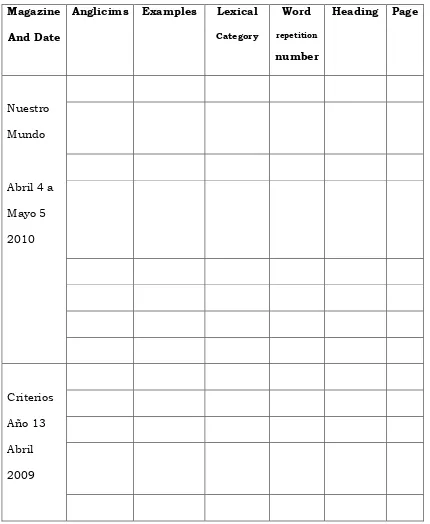
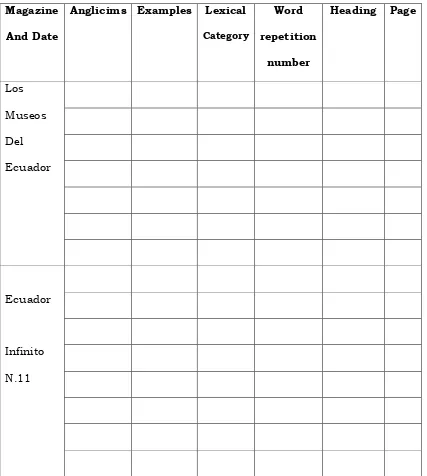
The statistic tables were based on the information founded and obtained in some Ecuadorian magazines, anglicims that all of them were typed, the tables were classified.
The qualitative tabulation has the following data: table one ―General interest magazines‖, table two ―Scholarly magazines‖ Table three ―Variable Cultural magazine‖.
32 Table One
Variable: General interest magazines
Magazine
and
Date
Anglicims Examples Lexical
Cate-
Gory
Word
repetition
number
Heading Page
Vistazo
May.10
Audio Para que se
dirigiera las
ceremonias
con
funciones de
audio
Adj. 1 Testigo del
Sí
99
Web A la par,
están
subiendo a
su sitio web
Adj. 1 El informe,
al fin
12
Software El CNV
resolvió el
caso: que el
software
usado
Noun 1 Unificación
bursátil
15
Software Concursaron
con un
Software de
Inclusión
Educativa
Noun 1 Premiación
Poland
33 Stand by Cuya
permanencia
en el buró de
AP está en
―stand by‖
Adj. 1 ¿Es ella la
Dama de
Hierro?
23
Fútbol Con el
jugador de
fútbol del
club
Noun 1 Perfume
musical
12
Fútbol Envía fútbol
al 1414
Noun 1 Porta 3
Fútbol Ya le picó el
bichito del
fútbol
Noun 2 Envía fútbol
al 1414
3
Scouts Ingresó a los
scouts a los
17 años
Noun 2 Manos
levantan
refugios
88
Swing Este Quiteño
de 17 años se
forja su
futuro a
punte swing
Verb 2 Un swing
por un
sueño
63
Offset Dirigir la
conversión
del linotipo al
offset
Noun 1 Transiciones
Carlos
34 Profit Desprende el
calendario
Profit
mundialista
Noun 3 Organiza tu
agenda
mundialista
con Profit
41
Marketing Geeks
Ecuador
ofrece el
servicio de
marketing
interactivo
Adj. 2 Marketing
interactivo
42
Marketing Un experto
en marketing
Noun 1 La
necesidad
de crédito
81
Link Habrá un
link para el
fanpage
Noun 1 Marketing
interactivo
42
Fan Habrá un fan
en el centro
comercial
Noun 1 Marketing
interactivo
42
Rim Como señaló
Mike
McAndrews
RIM es una
empresa
Noun 1 Blackberry
se toma la
escena
35 Rock Rock por el
Yasuni
Noun 1 Todo el
ritmo de
buen rock
63
Tapping La técnica de
liberación
emocional
más conocida
como tapping
Noun 6 El ―tapping‖
llega al aula
54 y
55
Top Esta foto
incluye a la
nueva
colección que
incluye tops
Noun 1 Aunque
solemos
verla
12
Top Top ten para
decorar
Adj. 1 Guia
Cultural
66
Stop Stop caída
del cabello
Verb 1 Anti- Caída
Vitane
17
Hogar Agosto 2010
Look Con el look al
que nos tiene
acostumbrados
Noun 1 El
maquillaje
ayuda
16
Look Los accesorios
pueden
cambiar
totalmente
el look
Noun 1 La mujer
multifasética
36 Look Para que
ayuden a
acentuar el
look
Noun 1 Moda
Nacional
6G
3
Look Los
prendedores
pueden
cambiar tu
look
Noun 1 La mujer
multifacética
83
Stock Hasta agotar
stock
Adj. 1 Plan ideal 9
Club Del club
Barcelona de
España
Noun 1 Perfume
musical
12
Club un acuerdo
de tres años
con el club
de fútbol
Noun 1 De la moda
al fútbol
18
Pads Algodones
redondos en
pads
Noun 1 En cremas
y cuidado
de la piel
37 Pop El Rey del
pop estuvo
presente
Noun 1 La
empresaria 44
Light La favorita
light puro
aceite
Adj. 3 La soya
aunque pequeña en tamaño es grande en nutrientes 67
Trendy Super trendy Adj. 1 Sofisticados 58
Clutch Las carteras
clutch y los
zapatos
Adj. 1 La mujer
Multifacética
83
Full Pañuelos y
bufandas full
color
Adj. 1 Full Color 60
Short Puedes
combinar con
jean falda,
short o capri
Noun 1 Estilo 65
Stark La
vestimenta
tecnológica
de Stark
Adj. 1 En esta
edición
10
Club Diners Club Noun 1 Plan
acumulación
38 Miss He
representado
al país en
concursos,
como Miss
Universo
Noun 1 Más
transparente
44
Miss Como Miss
Universo
Noun 1 Para ella 43
Post Gisele post
parto
Noun 1 Post parto 14
39 Table Two
Variable: Scholarly magazines
Magazine
and
Date
Anglicims Examples Lexical Category
Word
repetition
number
Heading Page
Drill Chompas de
dril
Noun 1 Corporacion
Favorita 3 Crite- rios Abril 2009
Sweater Sandalias de
playa,
sweaters,
vestidos y
faldas
Noun 1 Ropa y
accesorios
3
Web Página web Adj. 1 Ropa y
accesorios
1
Internet Internet
Corporativo
Noun 1 Conecta tu
empresa a
soluciones
9
Internet Publicidad
en Internet
Noun 1 Conecta a tu
empresa
9
Internet Y se los haga
vía Internet
Noun 1 Proyecto
innovador
40 Internet Más usada
de Internet
Noun 1 Lector de
libros
56
Internet Hoy el
acceso a
Internet es
indispensable
Noun 2 Comunidades
Ecuatorianas 56
Internet Gestiones
para
proporcionar
Internet
Noun 1 Nuevas
versiones del
explorador
56
Red Medicinas
que serán
distribuidas
en una red
Noun 1 Plan Social 17
Red La red de
centros
médicos.
Noun 2 Reunión con
empresarios 58
Redes A cargo de
los
Municipios
y las redes
viales
41 Redes También
plantea la
creación de
redes
peatonales
Noun 1 Agusto
Barrera
44
Staff Staff de
proveedores
calificados
Noun 1 Servicio de
homologación de proveedores 35 Marketing Finanzas, marketing, liderazgo
Noun 1 En educación 41
Club Tu club en
los más alto
de Quito
Noun 1 Club de
Ejecutivos 44 Rain forest Rainforest Alliance.
Noun 1 Turismo
sostenible 51 Smart Screen Las nuevas funciones
como el filtro
Smart
Screen y el
resaltado
Adj. 1 Nuevas
versiones del
explorador
56
Líder Líder
mundial en
inspección
Noun 1 SGS del
Ecuador
42 Club Tu club en
lo más alto
de Quito
Noun 2 Club de
ejecutivos
45
Lunch Lunch Plaza Noun 1 Ya es
mediodia
57
Kindle El kindle 2
es un
aparato
ligero.
Noun 1 Lector de
libros 56 Nues-tro Mundo Best seller Álex Rovira, coautor del best seller
Adj. 1 Viajando 44
Light Guayaquil
―light‖
Adj. 1 Guayaquil
light 41 Abril 04 a Mayo 05 del 2010 Blue-Ray
La venta de
equipos de
grabación en
3D, discos
Blue-Ray
Noun 1 3D en casa 10
Cool Siempre
cálida y
acogedora
―Cool‖,
chévere
Adj. 1 Guayaquil
light
43 Ranking Ranking
anual de
Empresas
Noun 1 Gestión 2
Relax Confort,
relax y
alegría
Adj. 1 Guayaquil:
Cristo del
consuelo y la
fe del pueblo
Guayaquileño
17
Rafting Actividades
de aventura
como
rafting.
Noun 1 Loja
Arquitectura,
devoción y el
Santuario del
Cisne
19
Rafting Allí se
practican
actividades
de rafting y
kayac
Noun 1 Una realidad
latente
51
Flash Después del
último flash
Noun 1 Una realidad
latente
47
House Con house,
no estamos
ante una
serie más
Noun 1 Un personaje
más grande
que la
pantalla
44 House La filosofía
de Doctor
House.
Noun 2 Un personaje
más grande
que la
pantalla
53
Off Si hubiera
sido más
que una voz
en off
Adj. 1 Gregory
House
54
Golf El turismo
del golf
Noun 5 La esencia
del golf en la
tierra del café 62
Nation
wide
El nationwide
tour
Adj. 1 Circuito de
campeones
65
Surf Campeonato
de Surf
Noun 1 Apoyando al
deporte en
Ecuador
68
Direct A través de
Direct Tv.
Noun 1 En el
mundial
Sudáfrica
2010
69
Snacks Produce y
exporta
snacks
45
Mix La línea
gourmet que
ofrece
originales Mix
de productos
Noun 1 Emprendedores 72
46 Table Three
Variable: Cultural Magazines
Magazine
and date
Anglicims Examples Lexical
Category
Word
repetition
number
Heading Page
Bank American
Bank
Noun 1 Piezas
representa-tivas 26 Museos del Ecuador Nuestro
Red Forman
parte de
la Red de
Museos
Noun 1
Funciona-lidad
26
Field Del
Field
Museum
Noun 1 La
creación
27
Hall Hall de
ingreso
al
museo
Noun 1 Los
Amantes
de Sumpa 29
Spot Del
satélite
spot
Noun 2 Satélite
Spot
182
Wild Cámara
fotográ-
fica wild
Adj. 1 La galería
de arte
47 Silver Silver
Star
(1956)
de
fabrica-ción
Noun 1 Parque
estático
158
Jet Primer
avión Jet
en
Ecuador
Noun 1 Parque
estático 158 Ecuador infinito Descubriendo el Ecuador N.11 Printing Industries Premios otorga- dos por Printing Industries
Noun 1 Imprenta
Mariscal 1
River Cuyabeno
River
Lodge
Noun 2 El disfrute
de un viaje
placentero
y seguro
16
Tour
Eco-montes
Tour
Noun 2 El disfrute
de un viaje
placentero
y seguro
48 Tour Depen-
derá el
resulta-do del
tour
Noun 1 El mejor
siempre
tiene todo
más claro 66
Toures Toures
en
bibicleta
Noun 1 En
Ecuador, el turista responsable tiene opciones 92
Tours
Camina-tas, monta-ñismo, toures en bicicleta
Noun 1 En
Ecuador, el turista responsa-ble tiene opciones 92
Tours
Cami-natas,
kayak
tours
Noun 1 Rainforest 93
Scouts Grupos
scouts
Adj. 1 La región
progresa
49 Slow motion La sensa-ción del slow motion
Noun 1 Sentado
en el
corazón de
Cuenta
52
Jazz Hasta el
influjo
de jazz
o la
música
Africana
Noun 1 Parque
Pedro Moncayo 58 Kayak y Surf Depor-tes al aire libre como Kayak y Surf
Noun 1 Más
información
79
Resort Spa &
Resort
Noun 1 En
50 Resort Termas
de
Papallacta
Spa &
Resort
Noun 1 En
Ecuador el turista respon- sable tiene opciones 93
Smart Con el
sello de
certifica-ción
Smart
Voyager
Noun 1 En
Ecuador el turista respon-sable tiene opciones 93 Rain forest Rainforest Alliance
Noun 1 En
Ecuador el turista responsa-ble tiene opciones 92
Bay Como
en
tortuga
Bay
Noun 1 La bella
del
Archipiélago
98
Tennis Zapatos
cómodos
tipo
tennis
Adj. 1 Recomenda-
ciones del
Parque
Nacional
51
Pop Para
armar
un pop
firme
Noun 1 Ecuador
para oír
110
Beats En el
total
encon-tramos
beats
firmes
Noun 1 Ecuador
para oír
110
Internet El
internet
es
usado
Noun 2 Guía
Ecuador
Infinito
112
Net Café
nets
Noun 1 Guía Ecudor
Infinito
112
Net Net
phone
Noun 1 Guía
Ecuador
Infinito
112
Email Con
servicio
de email
Adj. 1 Guía
Ecuador
Infinito
112
Fax Internet
y fax
Noun 1 Guía
Ecuador
Infinito
112
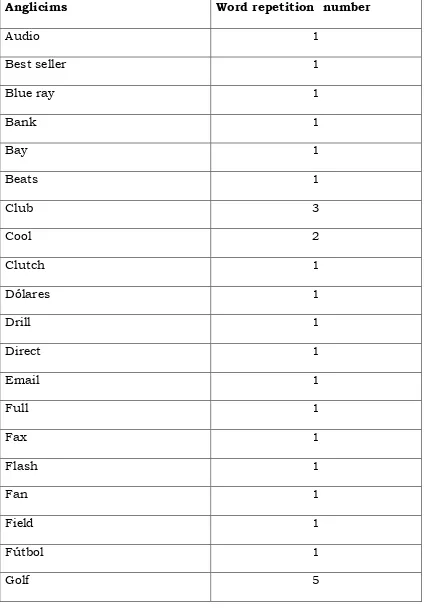
52 Table four
The Most Frequent Anglicisms (in all variables)
Anglicims Word repetition number
Audio 1
Best seller 1
Blue ray 1
Bank 1
Bay 1
Beats 1
Club 3
Cool 2
Clutch 1
Dólares 1
Drill 1
Direct 1
Email 1
Full 1
Fax 1
Flash 1
Fan 1
Field 1
Fútbol 1
53
Hall 1
House 2
Internet 7
Jazz 1
Kindle 1
Líder 1
Link 1
Look 1
Light 1
Lunch 1
Marketing 3
Mix 1
Net 3
Nationwide 2
Offset 1
Off 1
Pop 2
Pads 1
Profit 3
Printing industries 1
Rim 1
Red 5
54
Ranking 2
Rafting 2
River 2
Resort 2
Rain forest 2
Rock 1
Software 2
Stand by 1
Scouts 2
Swing 1
Short 1
Stop 1
Slow motion 1
Silver 1
Spot 2
Surf 1
Snacks 1
Sweaters 1
Smart 1
Star 1
Staff 1
Top 2
55
Trendy 3
Tennis 1
Wild 1
Web 2
Miss 1
TOTAL: 72 anglicims 111
56 Table Five
Comparison between variables
Variable F %
Cultural Magazines 32 28.83 Anglicims Scholarly magazines 39 35.14 General interest magazines 40 36.03
Total 111 100%
Author: Marjorie Andrade Velásquez
57
Description, Interpretation, and Analysis of Results
According to the data collected in three different variables in Ecuadorian magazines we have selected 30 words that are mostly used, we identify the etymological analysis that deals with the origin and evolution of words; the syntactic–semantic analysis that refers to the grammatical function of each word and its meaning in context; and finally, the morphological analysis that explains the changes or adjustments that a word suffered in Spanish language.
The Anglicism most frequently used among the Ecuadorian Magazines will be analyzed in this section, containing two main categories.
Web
The word web comes from Middle English, from Old English
wefan to weave, its first known use was in the 12th century. As a noun this word means a fabric on a loom or in process of being removed from a loom. Related to a web site this word was used for the first time in 1992 according to the Merriam Webstern Dictionary. The word web was found in the example “A la par, están subiendo a
su sitio web”, in this context the word “web” functions as an adjective
in the Spanish language which refers to a ―computer network‖
58
The word web is a singular feminine noun in Spanish, and it suffers morphological changes, the plural form takes the morpheme ―s‖, which is added at the end of the word web – webs and this
pluralization rule is the same in English and Spanish. I think that the word web enriches the Spanish language because there is not an equivalent word in Spanish.
Golf
This word comes from Middle English (Scots), the word golf was used for the first time in the 15th century, according to Merriam Webster Dictionary (2010), as a noun this word means a game in which a player using special clubs attempts to sink a ball with as few strokes as possible into each of the 9 or 18 succesive holes on a course.
In the context found “El turismo de golf es uno de los productos turísticos con mayor proyección y tradición” the word golf is a noun
which refers to a Scottish game, which is to propel with a special stick a small ball to place it in a series of open holes in a large field usually covered with grass, the player who makes the journey with least number of strokes wins.
59 Cool
The word Cool comes from Middle English col, from Old English
ceald cold, more at COLD this word was used before the 12th century.
As a noun this word meansa cool time, place, or situation, the word
cool was used for the first time in the 15th century according to the Merriam Webster dictionary (2010).
The meaning in the context found in the magazine, “Siempre cálida y acogedora cool”, it functions as an adjective and means in Spanish ―chevere‖, the word cool is commonly used in Spanish in
spite of it is not being accepted by the La Real Academia de la Lengua Española, the meaning in Spanish is ―fresco‖ and ―de moda‖.
The word cool has been assimilated with the adjective in to the modern term since 1728 as an adjective and the meaning in English is lacking in warmth, as slang, it means to be fashionable.
Regarding Morphology the word cool has not suffered morphological changes in Spanish language. The word cool enriches the Spanish language because there is not an equivalent word in Spanish, and it does not suffer any morphological changes.
Club
60
secure some advantage. As a verb the word club means: to gather into a club-shaped or mass clubbed her hair.
The example found was: “Tu club en lo más alto de Quito”, in this context the word club is a noun which refers to a group of people by some common characteristic
This term is accepted by La Real Academia de la Lengua Española, as a noun meaning ―a group of people that meets regularly‖, in English club is used as a noun and a verb.
The word club is a singular masculine noun in Spanish, the pluralization rule is to place the morpheme ―s‖ at the end of the word
for instance : club - clubs, or the morpheme ―s‖ or ―es‖, which is added at the end of the word for instance: club – clubes.
The word club does not enrich the Spanish language because we use the word ―asociación‖ that means a group of people with
common interest and a legal entity formed.
Fan
According to the Merriam Webster Dictionary (2010) fan comes from Middle English, from Old English fann, from Latin vannus more
at WINNOW. The word fan was used for the first time in the 12th
century. As a noun fan means an enthusiastic devote usually as spectator; and ardent admirer or enthusiastic.
In the magazine the example found was: “Habrá un fan en el
centro comercial”, the word fan is used as a noun which refers to a
61
sport, art form, or famous person. The word fan is commonly used in Spanish as a noun, in English fan is used as a noun and verb.
The term fan has been accepted by La Real Academia de la Lengua Española. As a noun this word means an apparatus with rotating blades that crates a current of air for cooling o ventilation and an ardent admirer or enthusiastic.
Regarding Morphology, the word fans are the plural form of fan. The plural and the singular form of this word are both used in the Spanish language. This word has not suffered morphological changes in Spanish. Semantically, the word fan in singular or fans in plural have the same meaning in Spanish and English languages depending on the context to be used. In this case the word fans means fanatic in both languages English and Spanish.
The word fan does not enrch the Spanish language because we use the words ―aficionado‖, ―hincha‖, ―admirador‖ that means in Spanish a follower or enthusiastic person of someone or something. E-mail
62
In the context found: “Con servicio de email a precios bastantes
accesibles” the word email is a noun which means a system of
world-wide electronic communication for transmitting messages electronically as between computers on a network.
Syntactically, it is used as a noun in both languages, and additionally as a verb in English. Semantically, the noun has the same meaning. According to its morphology the word email has not had any change as the noun and in Spanish the verb form is not used.
The word e-mail has not been accepted by La Real Academia de la Lengua Española as an anglicism, and the use of this anglicims is not justified in spite of it the fact it is a technical word. The equivalent in Spanish is ―correo electrónico‖.
Hall
The word hall comes from Middle English halle, from Old English heal. The word hall was used for the first time before the 12th century. According to the Merriam Webstern Dictionary (2010) as a noun the meaning is the castle or house of a medieval king or noble and the chief living room in such a structure
The word hall was founded in the following context: “Hall de
ingreso al museo” in this context the word hall is used as a noun. In
63
The word hall has been accepted by La Real Academia de la Lengua Española RAE, the meaning in Spanish is ―vestíbulo, recibidor‖. Syntactically the word hall is used in both Spanish and English as a noun.
Regarding Morphology, the word hall has not suffered morphological changes in the Spanish language.
Fútbol
According to the definition found in the Merriam Webster Dictionary, the anglicism fútbol functions as a noun and means a game between two teams any of several games played between two teams on a usually rectangular field having goalposts or goals at each end and whose object is to get the ball over a goal line, into a goal, or between goalposts by running, passing, or kicking. As a noun its first known use was in the 15’ century.
In the example found in the Vistazo magazine, “ya te picó el bichito del fútbol”, the word fútbol functions as a noun in the Spanish language, and the meaning is ―juego entre dos equipos‖, the word
fútbol is accepted by La Real Academia de la Lengua Española, and comes from the English word ―football‖ ―foot‖ + ―ball‖.
The word fútbol is a singular masculine noun in Spanish, and it suffers some morphological changes, because the English word
football is compound by ―foot‖ + ―ball‖ and in the Spanish language it
has some variations. The word ―foot‖ has the modification of the
64
morpheme ―o‖, and the word ―ball‖ has the modification of the
morpheme ―a‖ by the morpheme ―o‖ and the simplification of the
morpheme ―l‖, this word has a stress symbol in its first syllable
fútbol, this word does not follow a pluralization rule in the Spanish and English languages.
The word fútbol enriches the Spanish Language because we do not use the word ―football‖, it was modified from its original form.
Internet
According to the definition found in the Merriam Webster Dictionary, the anglicism Internet functions as a noun and means an electronic communications network that connects computer networks and organizational computer facilities around the world. The word
internet has been used since 1985.
In the example found in the cultural magazine “El internet es usado”, the word internet only functions as a noun in the Spanish language and it refers to a worldwide system of computer networks or a network of networks in which users at any one computer can, if they have permission, get information from any other computer and sometimes talk directly to users on other computers.
The word Internet is commonly used in Spanish as a noun and in English Internet is used as an adjective and always used before a noun for example, Internet connection or Internet site, the term
65
decentralized, formed by a direct connection between computers through a special communications protocol.
In Spanish it does not have a direct equivalence and therefore, if it is about a scientific advance, we must recpect the language from where this nvention was madethe meaning in Spanish is: ―Red informática mundial‖
The word Internet is a composed noun word shortened from
internetwork inter+network. Link
According to the Merriam Webstern Dictionary the anglicims
link comes from middle English, of Scandinavian origin akin to Old English hlanc lank. The word link as a noun was first used in the 15 century and the meaning is a connecting structure as a single ring or division of a chain. As a transitive verb its first known use was in the 15’ century too, and the meaning is to couple or connect by or as if
by a link. As an intransitive verb to become connected by or as if by a link often used with up, the band linked up with a new record label.
According to the example in the context found in the magazine “habrá un link” the word link is a noun, in spite of it not being
accepted by La Real Academia de la Lengua Española, this word is used in Spanish as a verb and as a noun, and the meaning in Spanish is ―unir, conectar, enlazar¨. In computing, link is a reference
66
a relationship or connection between people or things, and as a verb the meaning is to make, form, or suggest a link with or between. Miss
This anglicims is commonly used in Spanish in everyday life, according to the Merriam Webstern Dictionary (2010) the word miss
comes from Middle English, from Old English missan, as a noun the word miss is used in 1667 short for mistress and the meaning is a title prefixed to the name of an unmarried woman or girl. The word
miss is used before the name of a place or of a line of activity or before some epithet to form a title for a usually young unmarried female who is representative of the thing indicated. As a transitive verb it means to fail to hit, reach, or contact for instance miss the target and as an intransitive verb it means to fail to get, reach, or do something and was used for the first time before 12th century.
The word miss is accepted by La Real Academia de la Lengua española RAE, and in the example found “ganadora de un concurso
de belleza Miss Universo‖ the word miss is a noun
The word miss is a singular feminine noun in Spanish, and it suffers some morphological changes. The morpheme ―es‖ is added at