UNIVERSIDAD DEL ROSARIO
Submitted By: Milton Cesar Giraldo Arias
DEFINITION OF AN IT PROJECT PORTFOLIO MANAGEMENT METHODOLOGY FOR A PHARMACEUTICAL COMPANY
Master Thesis
School Of Administration Universidad Del Rosario
UNIVERSIDAD DEL ROSARIO
Submitted By: Milton Cesar Giraldo Arias
DEFINITION OF AN IT PROJECT PORTFOLIO MANAGEMENT METHODOLOGY FOR A PHARMACEUTICAL COMPANY
Master Thesis
Tutor: Clara Ines Pardo Martinez
Master in Management X - Cohort
School Of Administration Universidad Del Rosario
Acknowledgment
I would like to thank Amanda Bernal Duarte and Professor and Director of the Master Jaime Moreno Escobar for their unconditional help during the process of
the Master, for being always there providing assistance and guiding me for the completion of all steps needed to reach this moment.
I would like thank my tutor Clara Ines Pardo Martinez who provided me assistance for the elaboration of this dissertation, teachers and classmates who contributed
their knowledge and motivation which was fundamental. I also thank my friends who helped me with their advices and wisdom. My most sincere thanks.
Finally, I would like to thank the company and colleagues from work who guided me through the learning process, gave me an enjoyable experience, and because of them, I could continue growing as a professional which together have reached a
Dedication
I dedicate my dissertation especially to my Parents who have been the pillar in my preparation as a professional, for giving me the confidence and resources to achieve such an important goal in life, and because of them, I had the opportunity
to experience new horizons and new cultures that made me get a better perspective of life.
To my classmate and good friend, Giovanni Alberto Rocha Mahecha who provided me wisdom and guidance during my studies, for giving me the strength to look for
challenging objectives and to affront adverse situations.
I also dedicate this work to my relatives that always believed on me, on my commitments, my aspirations, and supported me emotionally during my stay
Table of Contents
Acknowledgment ... i
Dedication ... ii
Table of Contents ... iii
List of Figures ... v
List of Tables... vi
List of Abbreviations ... vii
Abstract ... viii
1. Introduction ... 1
1.1. Aims and Objectives ... 3
2. Literature Review ... 3
2.1. The 5 Phases of Project Portfolio Management ... 8
2.2. IT PPM Implementation ... 16
2.3. The importance of the IT Governance for the IT PPM ... 27
2.4. IT Project Management Office ... 35
2.5. Enterprise Architecture (EA) and IT PPM ... 40
2.6. Criteria for Project Selection and Prioritization ... 45
3. Research Methodology... 56
4. Research Results ... 61
4.1. The Project Management Department ... 61
4.2. The Project Management Department Process ... 62
4.3. The IT Demand Management (ITDM) process ... 65
4.4. ITDM assessments Overview ... 67
4.5.1. Strategic Fit IT Assessment ... 69
4.5.2. IT Risk Management ... 70
4.5.3. Company Relevance ... 71
4.5.4. Business Case ... 72
4.5.5. Decision Memo... 74
5. Recommendations & Conclusions ... 75
5.1. Recommendations ... 75
5.2. Conclusions ... 82
List of Figures
Figure 1 - Project Portfolio Management as a bridge ... 5
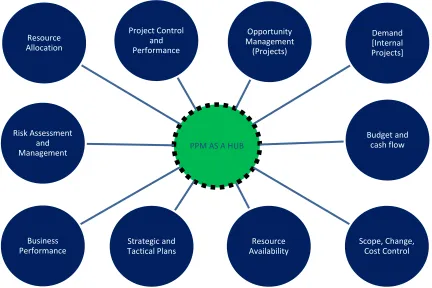
Figure 2 - Project Portfolio Management as a HUB ... 5
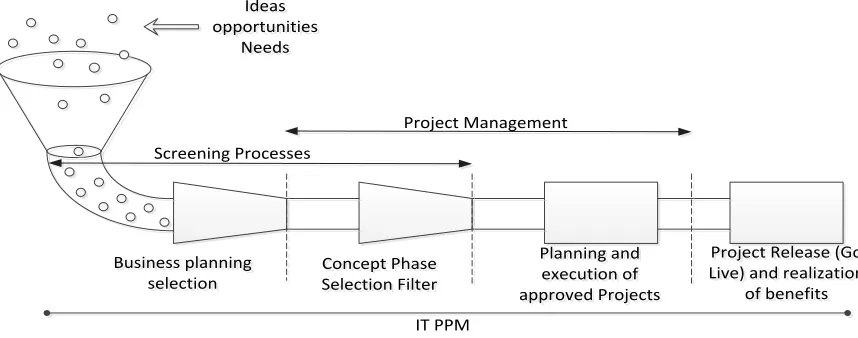
Figure 3 - The 5 steps of IT PPM. ... 9
Figure 4 - Sample IT PPM process steps ... 22
Figure 5 - IT PPM Matures through five stages... 23
Figure 6 - Relation between Enterprise, Corporate, and IT Governance ... 29
Figure 7- COBIT 5 Framework for IT Governance ... 30
Figure 8 - The COBIT 5 Principles ... 31
Figure 9 - IT PMO Implementation ... 39
Figure 10 - Link between IT Organization, IT Systems and Business Organization in EA ... 42
Figure 11 - EA & IT PPM mutual Benefits ... 44
Figure 12 - Initiative review process flow with PMO support ... 47
Figure 13 - Example of audits plan for the project execution ... 55
Figure 14 – Divisions of the Project Management Department ... 62
Figure 15 - IT Requirements categorization ... 63
Figure 16 - IT Demand Management, the ideal case and the practice ... 66
Figure 17 -Categorization of IT Demands ... 67
Figure 18 - Small IT Demands process description ... 67
Figure 19 - Large IT Demands process description ... 68
Figure 20 - BPM Demand process description ... 68
Figure 21 - Assessment Overview ... 69
Figure 22 - Example of Bubble Chart Template for Small IT Demand ... 80
Figure 23 - Example of Bubble Chart Template for Large IT Demand ... 81
List of Tables
Table 1 - Key Differentiators of PM versus PPM ... 7
Table 2 – Classification of Process Models. ... 11
Table 3 - Summary of IT PPM processes phases ... 14
Table 4 - Roles and responsibilities in the IT PPM ... 19
Table 5 - IT Portfolio Management Maturity Model ... 23
Table 6- Comparison of different frameworks for IT Governance ... 32
Table 7 – Roles comparison between IT PMO and IT Governance board in the IT PPM ... 36
Table 8 - IT PMO responsibilities and EA Responsibilities ... 45
Table 9 - Methods for selecting and prioritizing projects ... 54
Table 10 - Definitions of Different Types of Case Studies ... 57
Table 11 - The six sources of evidence, strength and Weaknesses ... 59
List of Abbreviations
AHP Analytic Hierarchy Process BPA Business Process Architect
BPM Business Process Management
CEO Chief Executive Officer CFO Chief Financial Officer CIO Chief Information Officer
COBIT Control Objectives for Information and Related Technology COO Chief Operations Officer
EA Enterprise Architecture
ERP Enterprise Resource Planning FDA Food and Drug Administration GxP Good "and end in" Practice IRR Internal Rate of Return
IT Information Technology
ISACA Information Systems Audit and Control Association ISO International Standards Organization
IT PMO IT Project Management Office IT PPM IT Project Portfolio Management
ITDM IT Demand Management
ITIL Information Technology Infrastructure Library MCDM Multiple Criteria Decision Making
NCTP Novelty, Complexity, Technology, Pace NPV Net Present Value
OGC Office of Government Commerce
PM Program Management
PMI Program Management Body of Knowledge PPLS Project Portfolio Life Spam
PPM Project Portfolio Management PRINCE2 Projects in Controlled Environments ROI Return on Investment
SAP ECC SAP Enterprise Central Component SOX Sarbanes Oxley Act
Abstract
With the increased popularity of IT solutions as key factor for increasing competitiveness and creation of value for companies, the need to invest in IT projects is considerably increased. The limitation of resources as a constraint to invest has forced the companies to look for methodologies to select and prioritize projects, making sure that the decisions made are those aligned with the corporate strategies to assure the creation of value and maximization of benefits. This dissertation provides the fundamentals for the implementation of the IT Project Portfolio Management (IT PPM) as an efficient methodology for managing IT-Based Projects, and a tool for providing transparent criteria to the executive managers for the decision making process. The document provides the information about how to implement the IT PPM in seven steps, analyzing the processes and the roles needed for its successful execution. Additionally, provides different methods and criteria for the project selection and prioritization. After the theoretical part where the IT PPM is described, the dissertation brings an analysis of the study case a Pharmaceutical Company. The company has already a project management department but they find the necessity to implement the IT PPM due to the wider coverage of the end to end IT Projects processes, and the way to assure maximization of benefits. With the theoretical research, and the analysis of the study case, the dissertation ends with a practical definition of an IT PPM rough model as a recommendation for the implementation in the Project Management Department.
1
1.
Introduction
In the last decades, companies have been moving around the world of projects, looking for increasing their efficiency, competitiveness, profitability, and the creation of corporate value (Díaz C. & Castaño, 2013). The most common problem identified in companies for the realization of these objectives resides in that projects are handled isolated to operations management, being the cause of lack of quality in achievement of the objectives for the success of the enterprise (Bonham, 2005). Thus, the companies search for methodologies to create a connection between the world of projects and the world of operations as strategy for improvement in project management. With the implementation of a project portfolio, the companies can find the way to fix the gap existing between the traditional operations management and the project management, getting projects into harmony with the strategies, resources, and executive oversight of the enterprise. (Levine, 2005).
“The emergence of PPM as a recognized set of practices may be considered the biggest leap in project management technology since the development of Program Evaluation and Review Technique and Critical Path Method in the late 1950s” (Levine, 2005, p.1).
2
A clearly defined enterprise blueprint, a competent portfolio governance, standardized metrics and criteria, consistency and logic of organizational strategic objectives are fundamental elements for that as for a successful implementation of the IT PPM (Twiddy, 2013). The different parts that compose the IT PPM have to be aligned to ensure that the methodologies managed follow the requirements of the corporate management, and the information provided for the decision-making is reliable thanks to the transparency of processes. As a result, the projects foster the goals of the corporate strategy and satisfy the expectations of the stakeholders. This dissertation provides the fundamentals for the definition of the IT PPM, giving an overview about how the IT PPM is developed, followed by the steps for the implementation and description of the different components involved (Such as the IT Project Management Office, IT Governance Board and Enterprise architecture).
3
1.1. Aims and Objectives
The aim of this dissertation is to provide methodology of IT Project Portfolio Management that can be implemented by the Project Management Department accordingly with the requirements of the Company analyzed.
More specifically, the dissertation tries to achieve the following objectives:
Recommend a possible model that the Project Management Department can use for the further implementation of an IT PPM for the management of the different projects that are currently executed and the assessment of the new projects required.
Suggest the criteria to be considered for the assessment of the portfolio projects for prioritize them efficiently.
2.
Literature Review
The IT Project Portfolio Management is a practice that most of the companies are implementing on these days. There are several the benefits that IT PPM can provide, but the main reasons that make the companies to look on it is because of the capacity to manage a portfolio of projects enterprise-wide providing criteria for decision-making on IT-initiatives, looking to generate greater returns on the IT investments and contributing with the success of the company. Hervé Lauer1 affirms
that “IT Portfolio management is not rocket science; it’s just good management
discipline" (Gartner, 2007, p.5). When an IT PPM is correctly implemented, the optimization of that practice will easily achieve goals and give benefits to the business.
One important point that has to be clarified before starting reading this literature is the differentiation between the Project Portfolio Management (PPM) and the IT project Portfolio Management (IT PPM). Even when the IT PPM follows the same
4
assumptions as the PPM, and having a first impression that the IT PPM in difference with the PPM works with IT based projects, there is also another point that is important highlight at the moment of compare those two kinds of portfolios management. Bonham (2005, P.xv) provides an explanation about the slight difference existing between PPM and IT PPM:
“A Project Portfolio tends to be filled with projects that best mitigate risk and increase return. If the business climate changes, they tend to cancel projects rather than drastically modify them. The projects in an IT portfolio rest on shifting objectives. IT projects are designed to satisfy business unit needs, which, in turn, are at the
mercy of shifting corporate strategies”.
Although the difference between both kinds of Portfolios exists, they can be implemented using the same method because they are managed under the same processes basis. During the reading of this literature you will find that I refer in some cases to the PPM in order to give an explanation of processes or methods that also apply for the implementation and management of the IT project portfolio.
5
[image:15.612.116.552.133.275.2]explanation about how can the Project Portfolio Management works as a Bridge and as a hub.
Figure 2 - Project Portfolio Management as a HUB
Source: Levine, H. A. (2005). Project Portfolio Management: A Practical Guide to Selecting Projects, Managing Portfolios, and Maximizing Benefits. (1st ed.). San Francisco, CA: Jossey-Bass.
OPERATIONS
Strategies
Objectives
Goals
Business Performance
Stockholder Satisfaction
Project Selection
Resource Availability
Cash Flow
Incomes
PROJECTS
Time Schedule
Project Cost
Project Performance
Stakeholder Satisfaction
Scope
Change Control
Resource use
[image:15.612.113.545.350.638.2] Cash Use
Figure 1 - Project Portfolio Management as a bridge
Source: Levine, H. A. (2005). Project Portfolio Management: A Practical Guide to Selecting Projects, Managing Portfolios, and Maximizing Benefits. (1st ed.). San Francisco, CA: Jossey-Bass.
PPM AS A HUB
6
The definition of PPM as a bridge is acceptable but, as explained before, it works as a connector that can identify Gaps between the two parts and is not be effective to eliminate those gaps. The idea that Levine provide is an assertive approach because he sees the holistic integration of the different operations, eliminating the isolation between the parts and having the capability to identify and fix the existing gaps. The HUB structure allows a strategic flow of information, working in harmony and managing the same language to communicate and assure the alignment of the strategies with the business objectives.
Looking the idea of having the PPM as a HUB creating a holistic structure between the different processes, assures that IT PPM covers all the different phases where a project has to go through from the moment it is conceived as an idea (point when is not yet a project) until the moment that the benefits are realized (After the project is released and is no longer a project). Having an overlook on the IT PPM, we can assert that it can bring big benefits because it covers all the phases that IT project involves, going beyond than the Project Management framework, making it more efficient for the management of Projects, and the framework can be divided in five phases which are defined by Wideman (2004) as the Project Portfolio Life Spam (PPLS). The phases are:
1. Identification of needs and opportunities
2. Selection of best combinations of projects (the portfolios) 3. Planning and execution of the projects (project management) 4. Product Release (acceptance and use of deliverables)
5. Realization of benefits
7
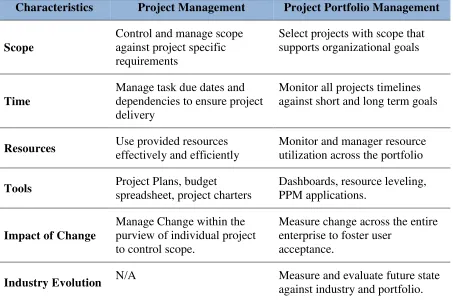
[image:17.612.115.568.212.514.2]PPM. However, IT PPM involving the management of projects can’t be seen as extension of the Project Management; both are important but they are not even similar to each other. The Project Management Institute (2011) gives the explanation of the differences between the characteristics of PM and PPM. The information is provided in the Table 1.
Table 1 - Key Differentiators of PM versus PPM
Characteristics Project Management Project Portfolio Management
Scope
Control and manage scope against project specific requirements
Select projects with scope that supports organizational goals
Time
Manage task due dates and dependencies to ensure project delivery
Monitor all projects timelines against short and long term goals
Resources Use provided resources
effectively and efficiently
Monitor and manager resource utilization across the portfolio
Tools Project Plans, budget
spreadsheet, project charters
Dashboards, resource leveling, PPM applications.
Impact of Change
Manage Change within the purview of individual project to control scope.
Measure change across the entire enterprise to foster user
acceptance.
Industry Evolution N/A Measure and evaluate future state
against industry and portfolio.
Note: Retrieved from the Project Management Institute [PMI] (2001): http://www.pmi.org/knowledge-center/~/media/PDF/Knowledge-Shelf/Systems-Evolution_2011.ashx
8
2.1. The 5 Phases of Project Portfolio Management
The IT PPM is the management of a portfolio of projects enterprise-wide providing criteria for decision-making on IT-initiatives, looking to generate greater returns on the IT investments and contributing with the success of the company. For the achievement of it, the IT PPM considers two parts in a high level design (Levine, 2005): The first part is related with the process of projects selection that are funneled from the set of ideas and strive to be part of the portfolio; the second part is related with the maintenance of the projects that become part of the portfolio and assure that they achieve the objectives of the individual project and the objectives of the portfolio.
With a correct application of this two steps in the IT PPM processes, the company will be sure that the projects will accomplish what the author Bonham (2005) describes as the 5 pillars of the project management: keep on scope being aligned with the business strategies and goals, deliverables are completed on the scheduled time, the project is delivering the expected results, the project is not incurring additional costs that exceed the “costs + buffer2” planned for the project, and to manage the risk of not delivering the project because the previous variances (cost, functionality, and schedule) don’t work as expected.
IT PPM is likewise divided in five phases that explain the processes included in its framework, following the two steps described above but in a detailed level, which include several functions that the IT PPM covers like projects, operations, financial, functional departments and resources, and marketing. For a better understanding of the flow of the five phases, the Figure 3 shows the framework of the IT PPM, named by Wideman (2004) as the Project Portfolio Life Spam (PPLS).
9 Ideas opportunities Needs Ideas opportunities Needs Concept Phase Selection Filter Concept Phase Selection Filter Business planning selection Business planning selection Planning and execution of approved Projects Planning and execution of approved Projects Screening Processes Project Management
Project Release (Go Live) and realization
of benefits
Project Release (Go Live) and realization
of benefits
[image:19.612.116.545.96.265.2]IT PPM
Figure 3 - The 5 steps of IT PPM.
Source: Graphic adapted from Levine, H. A. (2005). Project Portfolio Management: A Practical Guide to Selecting Projects, Managing Portfolios, and Maximizing Benefits. (1st ed.). San Francisco, CA: Jossey-Bass., p. 21.
First Phase
10 Second Phase
On the second phase, all ideas are funneled and filtered, looking for the identification of synergies, the best combination of projects, and definition of priorities of the projects requested. The IT PPM always has to ensure that the ideas that are funneled are created to comply with the long-term interest of the firm. At this stage, the transparency is a key point for the successful decision-making having the IT PPM as a tool for it. A correct filling of information from step one, and the involvement of the senior executives to obtain such transparency in the process. Rivinus (2013) states that giving the justification and approval of projects completely in hands of senior executives oblige the IT projects department to bring the responsibility to a level where the justification is made to one another, not just to the IT projects department.
Third Phase
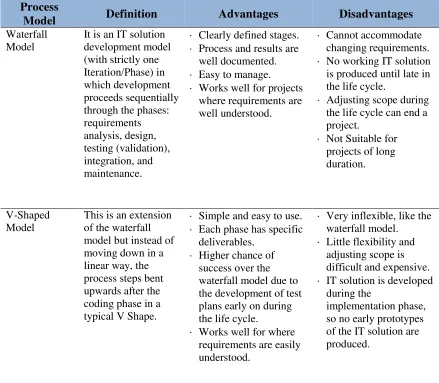
The third Phase starts with the planning and execution of the selected projects after the decision is made, giving the task to the Project office or project management Office. One of the big challenges that the Project Managers have to face is the volatility that the projects can have during its execution. It is in the projects nature to have the volatile condition due to different factors (For example decrease in productivity, reduction of team moral and increase of attrition rate, stakeholder requirements change, etc. (Thakurt, 2012) There are several approaches for modeling the processes of the execution of Projects that facilitate an effective planning, monitoring and control of the IT projects during its execution, reducing the risk of volatility and the risk of affecting the final outcome. The Table 2 shows a list of some process models that can be used for the project execution with the advantages and disadvantages that are identified for each model (Pressman, 2010).
11
[image:21.612.113.552.294.677.2]avoid the idea of cancelling it (IT PPM rest on shifting objectives and tend to modify a project rather than cancel it). The IT PPM is affected with the modification of a project. When that happen, it is necessary to remodel the portfolio with the new modifications to keep it up to date and not distort the output that the portfolio brings for the future identification of synergies and decision making. It is essential to have defined an IT Project Management Office (IT PMO) for the project execution welfare composed of specialized personnel to managing it. I will go in more detail about the Project Management office in section 2.4
Table 2 – Classification of Process Models.
Process
Model Definition Advantages Disadvantages
Waterfall Model
It is an IT solution development model (with strictly one Iteration/Phase) in which development proceeds sequentially through the phases: requirements analysis, design, testing (validation), integration, and maintenance.
Clearly defined stages.
Process and results are well documented.
Easy to manage.
Works well for projects where requirements are well understood.
Cannot accommodate changing requirements.
No working IT solution is produced until late in the life cycle.
Adjusting scope during the life cycle can end a project.
Not Suitable for projects of long duration.
V-Shaped Model
This is an extension of the waterfall model but instead of moving down in a linear way, the process steps bent upwards after the coding phase in a typical V Shape.
Simple and easy to use.
Each phase has specific deliverables.
Higher chance of success over the waterfall model due to the development of test plans early on during the life cycle.
Works well for where requirements are easily understood.
Very inflexible, like the waterfall model.
Little flexibility and adjusting scope is difficult and expensive.
IT solution is developed during the
12
Prototyping Model
It is an IT solution development process that begins with requirements collection, followed by prototyping and user evaluation.
Reduces development time and costs.
Requires user involvement.
Developers receive quantifiable user feedback.
Facilitates
implementation of IT Solutions since users know what to expect.
Exposes developers to potential future IT solutions enhancements.
Can lead to insufficient analysis.
Users expect the performance of the ultimate IT Solution to be the same as the prototype.
Can cause IT Solutions to be left unfinished and/or implemented before they are ready.
Sometimes lead to incomplete documentation.
Incremental– Iterative Model
Here the IT Solution project is divided into mini-projects, each of which is an iteration that results in an increment. Each iteration represents a mini-waterfall model.
Some working functionality can be developed quickly and early in the life-cycle.
Results are obtained early and periodically.
Parallel development can be planned.
Less costly to change the scope/requirements.
Easier to manage risk-high risk part is done first.
More resources may be required.
Although cost of change is lesser but it is not very suitable for changing requirements.
IT Solution architecture or design issues may arise because not all requirements are gathered up front for the entire life cycle.
Does not allow iterations within an increment.
Spiral Model This supposes incremental
development, using the waterfall model for each step, with more emphasis on managing risk.
Changing requirements can be accommodated.
Allows for extensive use of prototypes.
Requirements can be captured more accurately.
Users see the IT solution early.
Development can be divided in to smaller parts and more risky parts can be developed earlier which helps better risk management.
Management is more complex.
End of project may not be known early.
Not suitable for small or low risk projects
(Expensive for small projects).
13 Rapid Application Development (RAD) and Time Box Model.
It is a project
development process that allows usable IT Solutions to be built in as little as 60-90 days, often with some compromises.
Time to deliver is less.
Changing requirements can be accommodated.
Progress can be measured.
Cycle time can be short with use of powerful RAD tools.
Productivity with fewer people in short time.
Use of tools and frameworks.
More Management complexity.
Resource requirements may be more.
Suitable for IT Solutions that are component based and scalable, and only when requirements are well known.
Requires user
involvement throughout the life cycle.
For project with development times.
Agile
Methodologies
Agile is an evolutionary
approach to software and projects
development which is performed in a highly collaborative manner by self-organizing teams with the objective of producing high quality output in a cost effective and timely manner.
Promotes teamwork and cross training.
Functionality can be developed rapidly and demonstrated.
Resource requirements are minimum.
Suitable for fixed or changing requirements.
Delivers early partial working solutions.
Good model for environments that change steadily.
Minimal rules, documentation easily employed.
Not suitable for handling complex dependencies.
More risk of sustainability and extensibility.
An overall plan, an agile leader and agile PM practice is a must without which it will not work.
Strict delivery management dictates the scope, functionality to be delivered, and adjustments to meet the deadlines.
Note: Retrieved from Pressman, R. (2010). Software Engineering: A practitioner's approach. New York, NJ: Mc Graw Hill
Fourth Phase
14
where synergies are identified. The correct functionality of the delivered project can be key performance to identify the good development of the portfolio.
Fifth Phase
With the release of the project to the final customer, the IT PPM does not stop tracking the success of what initially began as an idea, going to the last step that is the moment where the product (released project) realizes the benefits. In that point the life span of the IT PPM for a specific project ends.
Table 3 - Summary of IT PPM processes phases
Phase Description
Phase 1 A great opportunity that benefits the company is identified. The idea is documented and sent for analysis and approval.
Phase 2
The ideas that are aligned with the strategies are funneled and selected to be part of the Portfolio, prioritizing those that have more impact in the creation of value and maximization of benefits.
Phase 3
The selected and approved projects for the execution are taken by the IT PMO. A plan is designed for the execution of the idea (the idea turns to a project), then the project is released for its execution.
Phase 4
The project is launched (Go-live). The deliverables are accepted and used by the stakeholder or costumer. In that moment is considered an IT product or service and no longer a project. Its performance is monitored to see if the planned benefits are being realized.
Phase 5
The benefits are successfully realized and the Project Management Office achieves that information for considering that case as a template for future projects implementation where synergies are identified.
Note: Summary of the five phases made by the author.
15
benefits, transcending the expectations that a company can have with only Project management.
Levine (2005) affirms that when we think about the project portfolio Management, we should not see it fundamentally as the management of multiple projects. IT PPM is the management of the IT-based project portfolio that improves the way projects impact the overall welfare and success of the enterprise, and several components and systems of the company have to be involved to participate on the IT PPM to be effective. It is important to recall that for the successful development of all the steps, it is essential to have well-defined IT governance that assures the correct process management and brings transparency for the good functionality of the IT PPM. Details about the IT Governance are presented in section 2.3.
I have identified in the following list, the different benefits of implementing IT PPM in the company:
The decision making will be done in a transparent manner, not for cases like political power of project sponsors or favoritism.
Identification of failure of projects in an early stage, preventing of having projects that turn into a burden for the company.
Brings tight integration between the business operations and the set of projects.
Executive managers can have a Birdseye view over the different projects that are under their responsibility.
It gives the opportunity to have an oversight on the projects that are already being executed and analyze if the realization of benefits are accomplished.
Assures the fulfillment of the project scope with the business strategies and goals.
Holistic organizational structure that creates ties between the different processes and operations.
Efficient distribution of the limited resources within the different approved projects.
16
The limited resources can be distributed effectively to guarantee the successful Go-live of the projects selected.
The roles are clearly identified determining the functions and responsibilities in the IT PPM process.
Identification of synergies between the projects listed in the Portfolio.
2.2. IT PPM Implementation
When a company decides to go for the implementation of the IT PPM has to consider seven aspects defined by Merkhofer (2007):
1. Embrace the principles: “PPM is not just another project management
process” (Richardson, 2010, P. 526). At the moment of deciding to implement the management of a portfolio for managing IT projects, different parts of the organization will be involved and it is important for them to have a clear understanding about the principles that work as a common language of the portfolio. If all the structure of the IT PPM is not managing these principles, then results will be distorted and the benefits for the company will be so far of being realized. Remember that the implementation of the IT PPM is also a project, and the principles work also as design specifications to create the foundation of it. Merkhofer (2007) quotes the Systems Audit and Control Association (ISACA) (2006) to describe the principles that have to be fully embraced in the IT PPM:
Projects will be managed as a portfolio of investments.
The goal is to create the greatest possible value (considering the resources available and accounting for risk and organizational risk tolerance).
For the purpose of decision making, projects will be defined to include the full scope of activities necessary to generate value.
Because projects produce different types of value in different ways, they must be evaluated and managed differently.
17
Value delivery practices will engage all stakeholders and assign appropriate accountability for the delivery of project benefits and the realization of value.
Value delivery practices will be continually monitored, evaluated, and improved.
2. Choose an approach that fits your situation : Companies that decide to
go for the implementation of the IT PPM generally have a project management department that is already operating and managing the current projects with processes and tools already predefined. Those processes and tools can be reused for the development of the IT PPM, but they will have to get into consideration of the IT PMO or the department in charge of the project definition for the implementation of the IT PPM, to analyze if they bring the necessary support to the new approach or if they have to be modified, cancelled or integrated with new tools designed for the new IT PPM. It is also the option of dividing the IT Portfolio in smaller portfolios with the purpose of support divergent needs that business units can have, making the Portfolio more manageable and flexible with the company IT needs (Handler, 2011), but for doing it the portfolio has to be already in an optimized level to be able to handle a set of sub-portfolios.
3. Secure executive support: The IT PPM works enterprise-wide and different
18
started, considering that the department has the resources to start the project. As a consequence of involving executives and key roles in the IT PPM assures that the favoritism and hierarchical power will not affect the decision-making, getting transparency during this process.
4. Establish governance: The business dictionary (2007) defines Governance
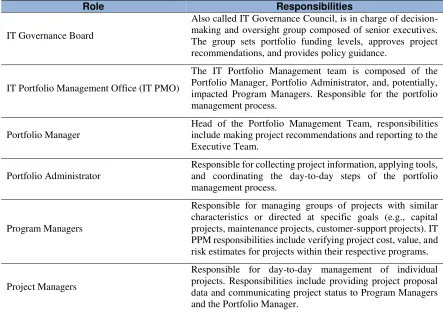
as “Establishment of policies, and continuous monitoring of their proper implementation, by the members of the governing body of an organization”. The constant monitoring and controlling of the organization assures to the company a good performance and a wealthy business future. The governance process covers every process in the company, including the IT PPM, and can be classified in three groups accordingly with Gheorghe (2006): Enterprise Governance, Corporate Governance, and IT Governance. Each group is managed by people of different positions at different levels in the company. This aspect is one of the most important for the IT PPM; therefore I go in more detail about Governance and IT PPM in section 2.3. When you decide to go for the IT PPM, three main organizational components have to be defined for effective governance: executive leadership, the portfolio management team, and program and project managers. In Table 4, Merkhofer (2007), Bonham (2005) and Levine (2005) define some basic roles and responsibilities that may need to be established.
19
[image:29.612.112.555.319.631.2]give it to the IT Governance Board for making decisions on which projects have to be selected, which ones have to be placed in waiting list, and which that are already running have to be redefined or terminated. The IT PPM should not be under total responsibility of the IT PMO because it causes lack of transparency at the moment of decision-making and portfolio structuration. That is the reason for the IT Governance Board to have roles in the IT PPM and direct & review the IT PMO but, as described before, for the initial implementation of IT PPM within a single department, the support and leadership from the department head would be sufficient to get started, considering that the department has the resources to start the project.
Table 4 - Roles and responsibilities in the IT PPM
Role Responsibilities
IT Governance Board
Also called IT Governance Council, is in charge of decision-making and oversight group composed of senior executives. The group sets portfolio funding levels, approves project recommendations, and provides policy guidance.
IT Portfolio Management Office (IT PMO)
The IT Portfolio Management team is composed of the Portfolio Manager, Portfolio Administrator, and, potentially, impacted Program Managers. Responsible for the portfolio management process.
Portfolio Manager
Head of the Portfolio Management Team, responsibilities include making project recommendations and reporting to the Executive Team.
Portfolio Administrator
Responsible for collecting project information, applying tools, and coordinating the day-to-day steps of the portfolio management process.
Program Managers
Responsible for managing groups of projects with similar characteristics or directed at specific goals (e.g., capital projects, maintenance projects, customer-support projects). IT PPM responsibilities include verifying project cost, value, and risk estimates for projects within their respective programs.
Project Managers
Responsible for day-to-day management of individual projects. Responsibilities include providing project proposal data and communicating project status to Program Managers and the Portfolio Manager.
Note: Retrieved from Merkhofer, L. (2007, January 01). Keys to Implementing Project Portfolio Management. Retrieved June 22, 2014, from Lee Merkhofer Consulting:
20
5. Create a value-measurement framework: When a company focuses in IT
21
6. Implement effective processes : Companies are mainly structured by
processes because those are the activities that produce a specific service or product for customers and the success of hose processes depend of how effective hey are implemented. The value measurement framework is a model that defines the logic for choosing projects but as a model doesn’t work alone and processes have to be defined in order to make it work (Merkhofer, 2007). For the definition of processes (Not only for the IT PPM but in general) is important to have well-documented specifications that clarify and make formal how the process is executed and who is involved specifying task and responsibilities. Once again, the governance is key point on the development of the definition of the processes that the value-measurement framework will involve, looking for standardization in order to get excellence in its development.
The well definition and implementation of the IT PPM, defining the processes of each of the five phases guarantee the success of the development and the achievement of its objectives. Remember that the company probably can have already a Project management department operating, and probably should be working for several years at the moment of deciding to go for the IT PPM. The Know-how acquired for that department on the processes that they have managed during its existence in the company is a big advantage for the definition of the processes in the IT PPM; those processes could be relevant and can be reused in the new definition, and the workforce that composed the old project management department are valuable resources for the implementation of the IT PPM project itself and the integration of the PMO.
22
Figure 4 - Sample IT PPM process steps
Source: Merkhofer, L. (2007, January 01). Keys to Implementing Project Portfolio Management. Retrieved June 22, 2014, from Lee Merkhofer Consulting: http://www.prioritysystem.com/PDF/implementingppmcomplete.pdf
23
Figure 5 - IT PPM Matures through five stages
Source: Gartner. (2007). Mastering IT Portfolio Management. Stamford, CT: Gartner.
The following table describes each stage for the IT PPM matures in detail (Gartner, 2007):
Table 5 - IT Portfolio Management Maturity Model
1. Initial 2. Developing 3. Defined 4. Managed 5. Optimizing
Objective Establish initial processes and standards Establish standardized business unit processes and evaluation criteria Establish enterprisewide management processes; review investments against strategic criteria Capture learnings and improve portfolio management and performance Optimize portfolio management and performance Governance
Ad Hoc process only; evaluation of investments does not consider strategic criteria
Initial terms of reference exist; business unit IT decisions committees in place with varying degrees of formality Standardized enterprisewide processes; single oversight IT decisions committee; active management of projects within portfolio for interdependencies
Benefits of earlier investments inform ongoing decisions; portfolio balanced for value Focused on continuous improvement; results benchmarked to identify best practices; fund a greater
proportion of strategic investments
Investment
Prioritization Ad Hoc processes and evaluation criteria; no standards templates; strategic criteria do not form part of investments evaluation Basic process standards and criteria; strategic criteria considered informally; informal assessments of asset life-cycle plans in place
[image:33.612.121.561.326.694.2]24
Resource
Utilization Ad Hoc processes, tracking against financial budgets; projects starts when IT resources become available
Basic processes; IT resource plans sufficiently accurate to specify a start date at approval
Standardized enterprisewide processes; resource plans include IT and other non-critical constraints; portfolio balanced to optimize use of resources Enterprisewide resource management allows optimally dynamic allocation of resources to projects Resource management informed by continuous improvement activities Risk
Management Ad Hoc process; risk management occurs at the level of individual projects or assets
Formal tracking of project and asset risks; risks influence investments priorities
Portfolio balanced for risk; resources reallocated to address shortages as needed
Risk management informed by results of realized benefits Risk management informed by continuous improvement
Note: Retrieved from Gartner. (2007). Mastering IT Portfolio Management. Stamford, CT: Gartner.
Mainly, the process for mastering the IT PPM is focused on the phases three and five where the benefits are realized. That does not mean that the first two steps are not relevant, undoubtedly they are the layers for the foundation of the later stages and provide the administrative accounting processes. When the first two stages are implemented is when the company can make evident the transparency and visibility enterprisewide on the defined stage three. Additional, the stage four works as a feedback instrument to analyze how well the decisions made from the IT PPM are impacting the business.
7. Institutionalize essential capabilities: Merkhofer (2007) defines seven essential capabilities:
25
Capability to evaluate project proposals: This point impacts considerably the strategic decisions. Therefore there are tools that can help to analyze projects proposals in a quantitative way, making the process be quicker and more consistent. With the implementation of software at the beginning, the IT PPM can identify errors on filling formats that are common on the start phase because the people is affronting a new methodology of raising request of IT-based projects and they are not used to new data requirements yet. However, implementation of software could result expensive and premature to manage on the starting phase, so in that case, basic tools like Excel spreadsheets with simple programing codes for filling formats and ERP systems (In case that the company has already one) would be enough to help analyzing project proposals.
Capability to prioritize projects and identify value-maximizing choices: The purpose of the IT PPM is to create value and maximize benefits with projects prioritization. We need to have look on the criteria from the Profitable side (when they will be finished, what they will cost and how much profit will generate), and the non-profitable side (Resource balancing, support of business strategies, and how do they create value to the business). Those criteria need to be reflected on your value-measurement framework model and the tools that help the analysis of it as in the case of use the Excel Spreadsheets.
26
Accellion, Watchdox, Alfresco, Microsoft, IBM, between others (Basso et al., 2014).
Capability to track and report project/portfolio status: As described before, IT PPM is more than project management, it enhance the framework of projects world. The life-spam of the IT PPM ends when the benefits are realized, and from the moment the project is approved and executed, you will have to monitor and know the status of the project at any point in time. There are 5 activities that have to be controlled (Bonham, 2005): Scope, schedule, cost, quality, and risk. Each activity has different approaches to analyze the status of the project and accordingly with the output got, the IT PMO will know if the project is going ok or if a change has to be made to bring the project to the original plan because is not delivering the expected performance. It is recommended that the controlling process of the project should be performed by external experts that are not involved with the project they control; that assures transparency and accurate information that feed the portfolio and is the base for decision-making in ongoing projects. I will go more into detail about the five activities for controlling and the tools that provide collaboration on that process in section 2.6.
Capability to monitor, learn and improve: The experience brings you opportunities to improve. As described on the sixth aspect for the implementation of the IT PPM, the portfolio matures through five stages: initial, development, defined, managed, and optimizing. The major benefits are realized mainly at the defined and optimizing stages. When the IT PPM has mastered its processes and tools, will give the opportunity to manage sophisticated what-if and statistical analysis tools, and also integrated reporting capabilities. It will be the best scenario for planning, simulation and innovation (Gartner, 2007).
27
who will get involved in the implementation process to mitigate the barriers that could be faced and don’t have delays or deviations of the final outcome of IT PPM.
2.3. The importance of the IT Governance for the IT PPM
When you establish a company is important to delineate a structure that defines how it will be managed. It is fundamental to define roles, assign tasks and responsibilities, then define internal policies and laws in order to have control, balance the power at the different levels that are associated with accountability, and assure the prosperity and the viability of the of the company. That’s what we call the corporate governance which is defined as “a method of governing the company like a sovereign state, instating its own customs, policies and laws to its employees from the highest to the lowest levels” (Thomson, 2009).
Additional, the corporate governance as a regulatory method helps to avoid problems that can turn into disasters before they occur. With the connection of the full structure (from the operators level to the board management level), the company managers have a general overview of the business situation and with that they can give a realistic panorama, giving transparency to the business which is the basis to promoting shareholder trust (Norfolk, 2005). As an example, the giant energy company Enron failed to give investors a complete picture of the firm’s operations as well as a fair assessment of the risks involved in Enron’s business model and financing structure, and at the end the shareholders realized the real situation of the company but was too late to take countermeasures and solve the crisis.
28
For the IT PPM, the governance also applies but at the IT level, that’s why it is called IT Governance. First, to understand the governance in the IT level, it is necessary to explain different levels of governance that can be involved in a company depending on the processes implied. Accordingly with Gheorghe (2006), government processes can be lined up in three groups: Enterprise Governance, Corporate Governance & Business Governance, and IT Governance, which are described as follow (See Figure 6 for graphical explanation of their relationship structure):
Enterprise Governance is described by Gheorghe (2006) as the set of responsibilities and practices exercised by the Board and executive management with the goal of providing strategic direction, ensuring that objectives are achieved, ascertaining that risks are managed appropriately and verifying that the enterprise’s resources are used responsibly.
Corporate Governance (as addition of described before) is an ethical corporate behavior by directors or those that are in charge of the company governance, achieving an equitable return for shareholders and uphold the values of fairness, transparency, accountability and honesty (Norfolk, 2005).
Business Governance is described by PNMSOFT (2014) as a set of policies and business processes that set the way that business in the organization are run. Business Governance drive in the methodology of corporate governance and project governance with an emphasis on business process performance using the analysis, monitoring, reporting and optimization of business processes and business activities, including process simulation and optimization of desired business outcomes by using real-time, historical and estimated data values.
29
operation of the business. In addition, the IT Governance assures that the methodologies for selecting IT initiatives have good performance, facilitating the maximization of value created by the IT projects, called the Value creation Performance of the IT Governance.
Henceforth, when we refer to the IT PPM as a method for efficient project management, we can associate it with the IT PMO who is the one in charge of managing and maintain the portfolio. In that case is correct to assert That IT Governance works in association with the IT PMO for the well performance of the IT PPM. But despite the association between the IT Governance and the IT PMO, the purposes that they have are different. On one hand, the IT PMO is in charge of developing standards and practices directed at the effective execution of projects and the realization of schedule, cost, scope, and quality objectives. On the other hand, The IT governance focuses on performing and transforming IT to meet demands of the business and the business’ customers.
The IT Governance as an extension of the Corporate governance has to follow the same principles to be applied in the IT PPM (especially in delivering transparency in the processes defined), having aligned the world of Projects with world of operations. Therefore, the IT Governance should include executive level (As
Figure 6 - Relation between Enterprise, Corporate, and IT Governance
30
explained in section 2.2) to share methods also with the enterprise Governance to ensure the achievement of objectives and verify that the limited resources are properly used, and to facilitate an enterprisewide decision making process for projects investment.
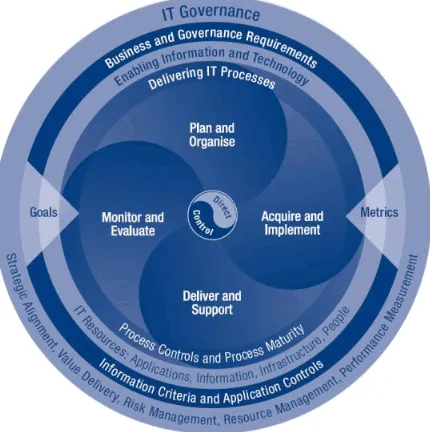
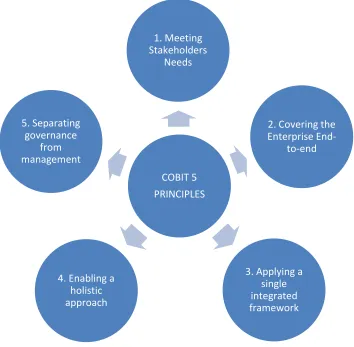
ISACA (2012) provides an innovative and internationally accepted framework for the governance and management of enterprise IT which is called COBIT (Control Objectives for Information and Related Technology). It is described as an IT governance framework and supporting toolset that allows managers to bridge the gap between control requirements, technical issues and business risks. COBIT enables clear policy development and good practice for IT control throughout organizations. COBIT emphasizes regulatory compliance, helps organizations to increase the value attained from IT, enables alignment and simplifies implementation of the enterprises' IT governance and control framework. The Figure 7 shows the description for the composition of the COBIT 53 framework, the last version of COBIT released by ISACA. The Figure 8 shows the principles that COBIT 5 manage.
[image:40.612.216.431.417.633.2]
3 For detailed information about COBIT 5 (Benefits, overview, essential facts, etc.), visit the web page http://www.isaca.org/COBIT/Pages/default.aspx
Figure 7- COBIT 5 Framework for IT Governance
31
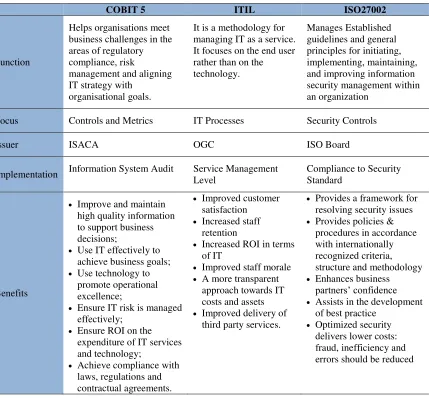
[image:41.612.140.494.279.626.2]IT Governance simplifies the way you manage the implementation of the COBIT 5, but it is not the only option available in the market. There are two more widely recognized third party Frameworks existing in the market designed for the IT Governance, that even when they are not defined in same conditions to develop the same specifications, each has significant strengths for the IT Governance. The Table 6 compares the three different frameworks: Control Objectives for Information and Related Technology (COBIT 5), The Information Technology Infrastructure Library (ITIL), and the ISO27001.
Figure 8 - The COBIT 5 Principles
Source. Source: ISACA. (2012). Information Systems Audit and Control Association (ISACA). Retrieved June 28, 2014, from COBIT 5: A Business Framework for the Governance and Management of Enterprise IT:
http://www.isaca.org/COBIT/Pages/default.aspx
COBIT 5
PRINCIPLES 1. Meeting Stakeholders
Needs
2. Covering the Enterprise
End-to-end
3. Applying a single integrated framework 4. Enabling a
holistic approach 5. Separating
32
[image:42.612.124.553.229.627.2]As we can see in the Table 6, each framework has a specific focus and all of them are created to strengthen the IT Governance. The best approach is the combination of all three, but for the implementation of the IT PPM I suggest to start with the COBIT 5 Framework that provides better support for the assurance of realization of benefits and the risk minimization in IT projects. The IT Governance, with the help of the COBIT 5 should cover five principal domains to achieve that aim:
Table 6- Comparison of different frameworks for IT Governance
COBIT 5 ITIL ISO27002
Function
Helps organisations meet business challenges in the areas of regulatory compliance, risk
management and aligning IT strategy with
organisational goals.
It is a methodology for managing IT as a service. It focuses on the end user rather than on the technology.
Manages Established guidelines and general principles for initiating, implementing, maintaining, and improving information security management within an organization
Focus Controls and Metrics IT Processes Security Controls
Issuer ISACA OGC ISO Board
Implementation Information System Audit Service Management Level
Compliance to Security Standard
Benefits
Improve and maintain high quality information to support business decisions;
Use IT effectively to achieve business goals; Use technology to
promote operational excellence;
Ensure IT risk is managed effectively;
Ensure ROI on the expenditure of IT services and technology;
Achieve compliance with laws, regulations and contractual agreements.
Improved customer satisfaction Increased staff
retention
Increased ROI in terms of IT
Improved staff morale A more transparent
approach towards IT costs and assets Improved delivery of
third party services.
Provides a framework for resolving security issues Provides policies &
procedures in accordance with internationally recognized criteria, structure and methodology Enhances business
partners’ confidence Assists in the development
of best practice Optimized security
delivers lower costs: fraud, inefficiency and errors should be reduced
33
1. IT Strategic alignment: The IT Governance as an extension of the corporate governance has to design strategies for the IT PPM that are aligned with the business strategies (Bridge between Operations and Projects). The alignment of strategies is fundamental for the decision making, finding a balance between the IT projects that better support and those that make the company growth.
2. Value delivery: The IT PPM main purpose is to deliver maximum value distributing efficiently the limited resources. Thus, the IT Governance should assure that the IT projects will add value to organization; it means the project should be delivered on time, within the projected scope, the intended budget and the realization of the expected benefits.
34
business value. It is also a responsibility of the IT Governance to control the correct use of resources in projects that are being executed.
5. Performance measurement: This last point encompasses the fifth phase of the IT PPM where the project is released (Go-live) and is monitored to verify that it achieves the expected goals. The IT Governance in this part has to define methods to measure (with metric and indicators) the objectives and monitor them to verify if the expected goals are achieved. Additional, the IT Governance in collaboration with the EA has to verify that the IT infrastructure managed is up to date, look for innovative projects that enhance IT capabilities, and keep vigil on the development of the technological development to be more competitive, more flexible to fluctuating market and to stakeholders needs.
35
increased reaching a mastering level where you will have the capacity to implement the other two frameworks (ITIL & ISO27002) to get the best approach for the IT PPM.
2.4. IT Project Management Office
The companies that take the decision of implementing the IT PPM have to think about the different options to increase management efficiency and assure transparency. The IT Project Management Office (IT PMO) is one solution for a balanced management structure, incrementing the efficiency of IT PPM cutting costs and improving project delivery in terms of time and budget (Santosus, 2003). The IT PMO is composed by an infrastructure of professional staff in project management that has as a role the set of well-defined processes and tools that help to reduce errors in procedures. Additional, the IT PMO aims to achieve efficient project management by leveraging standards, identification of a solid schema for the distribution of limited resources within the different projects, identification of the good practices for establishing methods for selection and prioritization of projects, consistent performance measures, and avoid the duplication of efforts (Piscopo, 2009). The processes that IT PMO manages usually are repetitive for all projects that come into the IT PPM pipeline, which makes easy to standardize processes that are identified as those who can provide the best performance for the IT PPM, finding the best practices for the maintenance of the projects in the pipeline.
36
the IT Governance Board with reports about the overall status of the Portfolio and projects running. This includes issues identified that would affect the planned benefits of any project because of different factors like poor schedule or cost performance, technical impediments, and reduced technical performance. For a clear understanding of the roles that each part has in the IT PPM, the Table 7 is created based on the criteria defined by Levine (2005).
Table 7 – Roles comparison between IT PMO and IT Governance board in the IT PPM
IT PMO IT GOVERNANCE BOARD
Develops its tasks in the projects side.
Oversight of all projects: monitors projects accomplishments against established criteria.
Evaluation and decision responsibility, escalating to the governance board only in critical situations and prepare recommendations for its consideration.
Make decision of executing small projects.
Get information in a corporate level from IT Governance Board to make decisions based on that data.
Develops its tasks in the operations side.
Oversight of the IT PMO performance and assurance of processes accordingly with company requirements.
Evaluate the critical situations and verify the impact in revenues and cash flow, risk impact, scope deviation, and decide if the affected high impact project should be terminated, delayed, or continued under a revised set of expectations
Makes decision of executing high cost projects or High risk project.
Communicate regularly in Steering Committee Meetings the changes in corporate Governance and corporate strategies.
Note: Retrieved from Levine, H. A. (2005). Project Portfolio Management: A Practical Guide to Selecting Projects, Managing Portfolios, and Maximizing Benefits. (1st ed.). San Francisco, CA: Jossey-Bass.
Additional to the roles described in the Table 7, the IT PMO manages internally the following responsibilities (Kaleshovska, 2014):
Enterprisewide project coordination and consistency.
Set standards and methodologies for all projects in the enterprise.
Do quality audits of the projects.
37
Track the entire portfolio or projects in work by developing metrics and measuring all projects against those metrics.
Identify the resources that are available to work on upcoming projects.
Support the project managers and project teams with training, mentoring and career development.
Collect and archive the documents from completed projects and analyze them for trends.
38
department and wants to create an IT PMO, or has not clear where to start, Piskopo (2009) defines useful steps to identify the critical aspects to build an IT PMO:
1. Enlist Executive and Management Support: For companies that are structuring a new IT PMO from the ground without the existence of a previous Project Management Department will require a big change in the organizational culture. It is a common effect on the staff of a company to resist to changes having the structural and cultural changes will be viewed as negative when employees are not previously sensitized. New procedures means more efforts spent to do what do they do while they get used to do it. That’s why the personal that will be involved has to understand the benefits for the company. It could take some time before the personal to perceive the ease of doing the new processes instead of the old ones, but it will be motivation for optimize the way processes are developed. For high levels staff that has to be involved it is necessary to talk in terms of ROI to attract their attention (how the IT PMO increase the cost value and benefits of projects managing a portfolio need to be shown).
2. Determine the structure and build a team: The structure of the IT PMO defer according to the requirements that the companies have. Therefore, it is crucial to find the correct structure that matches with those specific requirements that the company has for the success of the IT PMO implementation. Kaleshovska (2014) highlights that at the moment of determining the structure; the following cases (As described in Figure 9) should be avoided: “a decentralized structure with highly controlling functions and a centralized structure with responsibility only for status reporting. Instead the structure should be somewhere in the Optimum Balance field”.
39
[image:49.612.231.465.198.391.2]the IT PPM, definition of standards for project selection, definition of methodologies for controlling procedures, criteria for project progress measurement, and good practices for the success of the IT PMO. Those documents are also the basis for the needed training that project managers and staff need for mastering the IT PMO, which is the topic explained on next point.
Figure 9 - IT PMO Implementation
Source: Kaleshovska, N. (2014). Adopting project management offices to exploit the true benefits of project management. Economic Development / Ekonomiski Razvoj, 1(2), 151-165.
4. Identify skills and train the staff: One of the main reasons for the success of the IT PMO implementation and further performance is the staff that makes it up. At the moment of implementation of the IT PMO it is necessary to enroll appropriate skilled people, and they have to be constantly trained to improve their skills. Information from staff’s feedback can be used to train new staff because members of IT PMO come and go from their positions, being ready for integration of new staff, creation of new roles that are identified as needed for improvement, make changes and evolve.
40
right. Because things are working right is not a reason for stop doing measurement, it’s an ongoing process and is the only way to reach a possible mastering in what IT PMO is made for. One way of improving is gathering information from recommendations that staff have from daily tasks, that has to be taken into consideration to improve procedures and practices. Each person is an expert in what he/she does and it is important to get their feedback for constant improvement. Actually, exists several ways for the IT PMO to improve and most of them are identified with the pass of the time. Those ways identified are essentially for improvement of measures, processes and tools, working in favor of increasing efficiency of IT PPM and the existing structure of the company. “An effective PMO is a catalyst for greater efficiency as it allows an organization to do more quality work with fewer resources and less risk” (Piscopo, 2009).
Having a correct manage of the five steps, you will assure the most important aspects for the successful management of the portfolio and projects execution. The resources that are limited will be well distributed efficiently to get the maximum benefit from them, and the projects will be correctly planned avoiding rejection that drives re-planning. The IT Projects will have the support and budget from Board management because decisions will be transparent and projects will have solid fundaments for investing on them. With the help of the EA, the IT PMO will be an effective and efficient way of implementing new ideas for future improvements in technologies advances, not having only impact in the IT PMO but for the collective impact on the company growth.
2.5. Enterprise Architecture (EA) and IT PPM