Effects of a multidisciplinary approach on the
effectiveness of antiviral treatment for chronic hepatitis C
Marta Gallach,* Mercedes Vergara,†,|| Mireia Miquel,†,|| Meritxell Casas,† Jordi Sánchez-Delgado,†,|| Blai Dalmau,† Montserrat Gil,† Núria Rudi,‡ Isabel Parra,§ Maria López,||,¶ Angelina Dosal,¶ Laura Moreno,¶ Oliver Valero,** Xavier Calvet†,||
* Emergency Department. † Hepatology Unit, Digestive Disease Department. ‡ Hospital Pharmacy. § Mental Health Department. Hospital de Sabadell, Universitat Autónoma de Barcelona; Sabadell, Spain. || CIBERehd, Instituto Carlos III; Madrid, Spain. ¶ Nursing, Hepatology Day Hospital. Hospital de Sabadell, Universitat Autónoma de Barcelona; Sabadell, Spain. ** Department of Applied Statistics. Universitat Autónoma de Barcelona. Barcelona. Spain.
A B S T R A C T A B S T R A C T A B S T R A C T A B S T R A C T A B S T R A C T
Background. Background.Background. Background.
Background. Despite the introduction of direct antiviral agents, pegylated interferon remains the mainstay of treatment for chronic hepatitis C. However, pegylated interferon is associated with a high rate of severe adverse events and decreased quality of life. Spe-cific interventions can improve adherence and effectiveness. We aimed to determine whether implementing a multidisciplinary ap-proach improved outcomes in the treatment of chronic hepatitis C. Material and methods.Material and methods.Material and methods.Material and methods.Material and methods. We analyzed consecutive patients treated with pegylated interferon plus ribavirin between August 2001 and December 2011. We compared patients treated before and after the implementation of a multidisciplinary approach in 2007. We compared the baseline demographic and clinical characteristics and laboratory findings between groups, and used bivariate logistic regression models to detect factors involved in attaining a sus-tained virological response, calculating the odds ratios with their respective 95% confidence intervals. To evaluate the effect of the multidisciplinary team, we fitted a multivariate logistic regression model to compare the sustained virological response after adjusting for unbalanced variables and predictive factors. Results.Results.Results.Results.Results. We included 514 patients [228 (44.4%) in the pre-intervention cohort]. Age, viral genotype, previous treatment, aspartate transaminase, ferritin, and triglyceride were prognostic factors of sustained viro-logical response. After adjusting for prognostic factors, sustained viroviro-logical response was higher in the multidisciplinary cohort (58 vs. 48%, p = 0.038). Despite higher psychiatric comorbidity and age in the multidisciplinary cohort, we observed a trend toward a low-er rate of treatment abandonment in this group (2.2 vs. 4.9%, p = 0.107). Conclusion.Conclusion.Conclusion.Conclusion.Conclusion. Multidisciplinary management of chronic hepatitis C improves outcomes.
Key words. Key words.Key words. Key words.
Key words. Adherence. Sustained virological response. Interferon. Ribavirin. Adverse events.
July-August, Vol. 15 No. 4, 2016: 524-531
INTRODUCTION
Hepatitis C virus (HCV) infection is a leading cause of chronic liver disease; HCV infects 130 to 210 million indi-viduals worldwide.1,2 In Spain, where about 800,000
peo-ple are infected, the prevalence ranges from 1.6 to 2.6%, depending on the area.3,4 HCV infection causes chronic
hepatitis (CHC), ultimately leading to cirrhosis and hepa-tocellular carcinoma in many patients. CHC is the most frequent cause of liver transplantation in Spain and in oth-er developed countries.3
A sustained virologic response (SVR) is defined as undetectable HCV RNA 12 weeks or 24 weeks after the
end of therapy, as assessed by a sensitive molecular method with a lower limit of detection ≤ 15 IU/mL.2
An SVR may stop the progression of CHC to cirrhosis. Until recently, the standard treatment for CHC was pegylated interferon plus ribavirin.2 This combination
achieved a SVR in 60% of patients;3,5,6 however, in the
most prevalent (80-85%) genotype in our area (genotype 1), the standard therapy achieved an SVR of only 50%.3,5,7 Moreover, this treatment has drawbacks that
reduce patients’ quality of life: its subcutaneous admin-istration requires frequent trips to the hospital, and its high rate of severe adverse events requires close moni-toring.3,8
The Official Journal of the Mexican Association of Hepatology, the Latin-American Association for Study of the Liver and
the Canadian Association for the Study of the Liver
Manuscript received: Manuscript received: Manuscript received: Manuscript received:
The adverse effects of this treatment may require fur-ther treatments such as epoetin for severe anemia, ome-prazole for dyspepsia, selective serotonin reuptake inhibitors for depression, or benzodiazepine for insom-nia. Adverse effects sometimes make it necessary to re-duce the dose or even to discontinue treatment. All these factors decrease the SVR rate,9,10 so improving adherence
by treating adverse effects promptly might help more pa-tients achieve SVR.
Until 2011, the combination of pegylated interferon and ribavirin was the approved treatment for chronic hepatitis C.1 In 2011, the direct-acting antiviral agents telaprevir and
boceprevir were licensed for use in HCV genotype 1 infec-tion. Both must be administered in combination with pegylated interferon and ribavirin. However, the side-effect profiles of these triple combination therapies and the costs per SVR are high. These treatments should ideally no long-er be used in patients infected with HCV, as more effica-cious and better tolerated options are available. Since 2014, new, highly effective direct-acting antiviral agents with few adverse events have been licensed in Europe for use as part of interferon-free combination therapies for HCV infection (sofosbuvir, daclatasvir, simeprevir, paritaprevir/ombitas-vir/ritonavir and dasabuvir and sofosbuvir/ledipasvir).11,12
These new drugs are easily tolerated, but pose new chal-lenges for hematologists, including comorbidities (e.g., heart disease, psychiatric disorders, or decompensated liver disease) and drug interactions. The complexity of these an-tiviral treatments demands specific interventions in the setting of multidisciplinary approach. Some studies have shown increased adherence and effectiveness with the implementation of these interventions in the setting of multidisciplinary teams (psychiatrist, pharmacist, or derma-tologist) to improve the management of adverse effects.9,13,14
However, there are few data about the impact of a multidis-ciplinary approach on patients with CHC.
In 2007 we initiated a program for the treatment of pa-tients with HCV by a multidisciplinary team comprising hepatologists, nurses, pharmacologists, psychiatrists, and dermatologists.
The aim of this study was to evaluate the effects of this multidisciplinary approach on the effectiveness of treat-ment.
MATERIAL AND METHODS
Patients
From August 2001 to December 2011, we included all consecutive patients with CHC treated with pegylated in-terferon plus ribavirin.
We excluded patients co-infected with human immu-no-deficiency virus or hepatitis B virus.
Our hospital’s ethics committee approved the study (CEIC 2010612), and all patients provided written in-formed consent.
All patients were referred to our hospital by general practitioners to evaluate chronic hepatitis stage and treat-ment. All patients were from the same area with a popula-tion of approximately 400,000 inhabitants.
Multidisciplinary approach
Before the multidisciplinary approach was implement-ed, patients were managed only by their hepatologist and a nurse. They had the option of calling or coming to the day hospital if they had a problem, but the nurse was not spe-cifically trained for this. If adverse effects appeared during treatment, referral to specialists (e.g., psychiatrists) was not protocolized. In 2007, we implemented a multidisci-plinary program in our hepatology unit to standardize the management of patients with CHC treated with pegylated interferon plus ribavirin. We constituted a multidiscipli-nary team in which the following professionals played the following roles.
• Hepatologists attended patients on an outpatient basis. All patients had appointments before starting treat-ment (baseline) and then in the 4th, 12th, and 24th weeks after starting treatment, at the end of treatment, and 24 weeks after the end of treatment. Throughout this period, patients were encouraged to telephone if they had any concerns related with their treatment. • A nurse was responsible for the treatment education
program. This program included an appointment for patients to learn how to
a) Administer subcutaneous pegylated interferon themselves.
b) Manage adverse events.
c) Treat headache, fever or asthenia, and
d) Recognize the signs of some complications of treat-ment.
The nurse also managed phone calls from patients from 7:00 am to 5:00 pm.
• A pharmacist had monthly appointments with patients to provide the medication, to help manage adverse events, and to try to improve adherence.
and 24 weeks after completing treatment. Assessment consisted of two self-administered questionnaires. The Hospital Anxiety and Depression Scale (HADS)15-17 and the General Health Questionnaire
(GHQ-28) Spanish version.18,19 The HADS
compris-es two 7-item scalcompris-es dcompris-esigned to rate deprcompris-ession (HADS-D) and anxiety (HADS-A) in medical pa-tients10,15,16 and is considered a valid measure of the
severity of mood disorders.15,16 Patients scoring 7 or
more points in either the HADS-D or HADS-A were evaluated by the psychiatrist. The GHQ-28 aims to detect patients with a diagnosable psychiatric disor-der.19 Patients scoring over 7 points were evaluated by
the psychiatrist.18 Patients received psychiatric
atten-tion when the quesatten-tionnaires showed any risk of psy-chiatric disease or when referred by their hepatologist. The psychiatrist was also telephoned in psychiatric emergencies. When a suicide risk or psy-chotic episode was detected, treatment was stopped. These patients were followed and treated according to the psychiatrist’s orders. When active psychiatric disease was detected at baseline, treatment was post-poned until the patient’s disease had stabilized. Pa-tients with a history of psychiatric disease were not excluded, but they were administered antiviral treat-ment only if the disease was stable.
• A dermatologist treated skin problems that developed due to antiviral treatment. Patients were referred by the hepatologist; the dermatologist was responsible for treatment and follow-up of the skin lesions until reso-lution.
All the team was from the same hospital. The multidis-ciplinary team had regular meetings to discuss manage-ment issues and results, followed uniform criteria, and discussed doubts in multidisciplinary team meetings.
Groups of analysis
We defined two cohorts:
• Pre-intervention cohort. Patients with CHC treated between August 2001 and December 2006, before the implementation of the multidisciplinary approach, and • Multidisciplinary treatment cohort. Patients with CHC treated between January 2008 and December 2011, after the implementation of the multidisciplinary approach.
Patients, who initiated treatment in 2007, the year the multidisciplinary team was established, were excluded. There were 286 patients in the pre-intervention cohort and 228 in the multidisciplinary treatment cohort.
Variables analyzed
We recorded demographic data, medical history, HCV characteristics, and variables used to monitor treatment such as hemoglobin, aspartate transaminase (AST), alanine transaminase (ALT), platelet count, and viral load (4, 12, 24, and 48 weeks after starting treatment and 24 weeks after finishing treatment). We also recorded adverse events and whether they led to changes in dosage, whether they re-quired additional medications, and whether they rere-quired termination of treatment.
The main outcome variable was SVR, defined as undetectable HCV-RNA 24 weeks after the end of treatment. As patients with genotypes 1 or 4 differ from those with genotypes 2 or 3 in their response to antivi-ral treatment,3,9 we analyzed SVR in these two groups
separately.
Liver biopsy
Pretreatment liver biopsies were obtained before viral treatment when considered necessary. The Knodell His-tology Activity Index (HAI) was used to determine the grade and stage of fibrosis.20,21 Patients who underwent
bi-opsy were divided in two groups according to fibrosis in the HAI score: patients without significant fibrosis (HAI fibrosis score = 0 or 1) and those with significant fibrosis (HAI fibrosis score = 3 or 4).21
Antiviral treatment and dosage
Patients with genotype 1 or 4 received treatment with either pegylated interferon alpha 2a (180 μg/week) plus ribavirin (1,000 mg/day if body weight was < 75 kg or 1,200 mg/day if body weight was ≥ 75 kg) or interferon al-pha 2b (1.5 μg/kg/week) plus ribavirin (10.6 mg/kg/week) for 48 weeks.1,3
Patients with genotype 2 or 3 were treated for 24 weeks with the same regimen of pegylated interferon al-pha 2a or alal-pha 2b plus 800 mg of ribavirin divided in two daily doses.1,3
Two methods were used in for assaying HCV RNA. Until 2006, RNA was measured using the Cobas Am-plicor technique, with manual RNA extraction fol-lowed by amplification and detection in a Cobas Monitor analyzer (Roche Diagnostics) with a detec-tion limit of < 600 IU/mL. After 2006, the Cobas Am-pliprep/Cobas Taqman HCV (Roche Diagnostics) test was used. This is a real-time, in vitro nucleic acid am-plification test for quantitative measurement of HCV RNA in plasma or serum (the Cobas Ampliprep sys-tem was used for automated sample processing and the Cobas Taqman analyzer was used for subsequent auto-mated RNA amplification and detection). The Cobas Ampliprep/Cobas Taqman assay allows for automated sample preparation (RNA isolation), followed by au-tomated reverse transcription, PCR amplification, and RNA detection. The detection limit of this technique is 15 IU/mL.
Statistical analysis
To compare the baseline demographical and clinical characteristics and laboratory findings between groups, we used χ2 tests for categorical variables and t-tests for
quan-titative variables (or the Mann-Whitney test for variables with non-normal distributions).
To detect factors predictive of SVR, we used bivariate logistic regression models, calculating the odds ratios with their respective 95% confidence intervals.
To evaluate the effect of the multidisciplinary team, we fitted a multivariate logistic regression model to compare the SVR after adjusting for unbalanced variables and risk factors.
Statistical significance was set at 0.05 for all tests. We used SAS v9.2 (SAS Institute Inc., Cary, NC, USA) for all analyses.
RESULTS
Baseline findings
Demographic and clinical characteristics
Between 2001 and 2011, a total of 563 patients received pegylated interferon plus ribavirin at our hospital. We ex-cluded the 49 patients who started treatment during 2007; thus, 514 patients were included in the study. Of these, 286 (55.6%) (pre-intervention cohort) initiated treatment prior to the implementation of the multidisciplinary ap-proach and 228 (44.4%) (multidisciplinary treatment co-hort) initiated treatment after the implementation of the multidisciplinary approach.
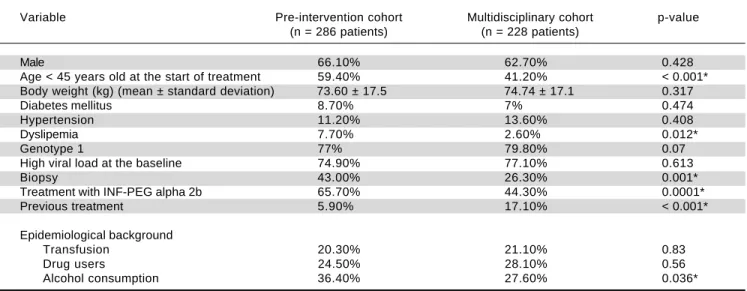
Table 1 reports the demographic and clinical character-istics of patients in the two groups. Both groups had more men than women. Patients from the pre-intervention co-hort were younger than those from the multidisciplinary cohort (43.2 ± 10.8 vs. 48.54 ± 11 years, p < 0.0001). The prevalence of dyslipemia was higher in the pre-interven-tion cohort (7.7 vs. 2.6%, p = 0.0120). Genotypes 1 and 4 were the most frequent in both groups (77% in the pre-in-tervention cohort vs. 80% in the multidisciplinary cohort, p = 0.0696). Liver biopsy was performed more frequently in the pre-intervention cohort (43 vs. 26%, p < 0.0001). In the pre-intervention cohort 51.6% of patients who where biopsied had no significant fibrosis; by contrast, in the multidisciplinary cohort, only 26.7% of patients biopsied
Table 1. Demographical and clinical and virological characteristics of patients in each cohort.
Variable Pre-intervention cohort Multidisciplinary cohort p-value (n = 286 patients) (n = 228 patients)
Male 66.10% 62.70% 0.428
Age < 45 years old at the start of treatment 59.40% 41.20% < 0.001* Body weight (kg) (mean ± standard deviation) 73.60 ± 17.5 74.74 ± 17.1 0.317
Diabetes mellitus 8.70% 7% 0.474
Hypertension 11.20% 13.60% 0.408
Dyslipemia 7.70% 2.60% 0.012*
Genotype 1 77% 79.80% 0.07
High viral load at the baseline 74.90% 77.10% 0.613
Biopsy 43.00% 26.30% 0.001*
Treatment with INF-PEG alpha 2b 65.70% 44.30% 0.0001* Previous treatment 5.90% 17.10% < 0.001*
Epidemiological background
Transfusion 20.30% 21.10% 0.83
Drug users 24.50% 28.10% 0.56
Alcohol consumption 36.40% 27.60% 0.036*
had no significant fibrosis. The percentage of patients who had undergone a previous treatment was higher in the multidisciplinary cohort (17 vs. 6%, p < 0.0001). The per-centage of patients with a history of alcohol consumption (defined as ≥ 60 g/day for men and ≥ 40g/day for women) was higher in the pre-intervention cohort (36.4 vs. 27.6%, p = 0.036). The percentage of patients who received pegylated interferon alpha 2b was higher in the pre-inter-vention cohort (65.7 vs. 44.3%, p < 0.0001). There were no differences regarding SVR among patients treated with pegylated interferon alpha 2a versus alpha 2b (49.8 vs. 48.7%, respectively, p = 0.8042).
Laboratory findings
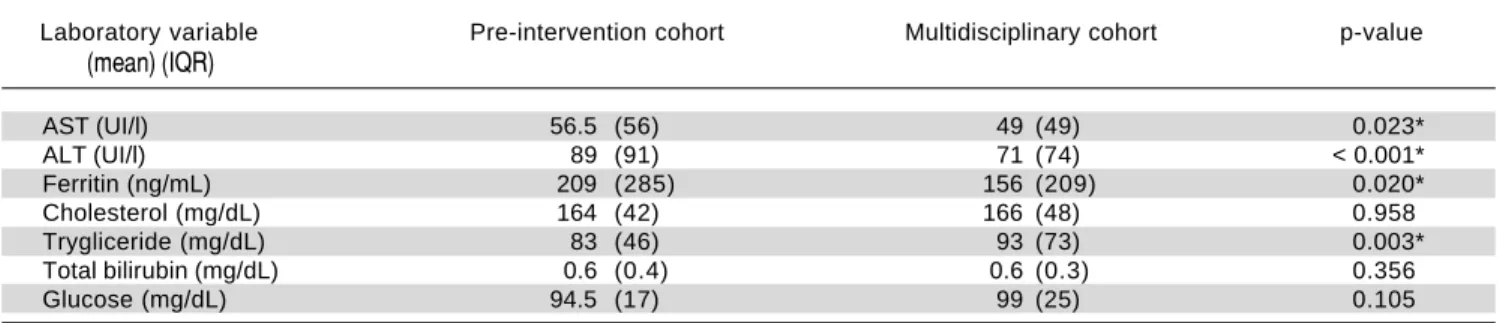
At baseline, ALT, AST, and ferritin were higher in the pre-intervention cohort, and triglycerides were higher in the multidisciplinary cohort; cholesterol, bilirubin, and glucose did not differ between groups (Table 2).
OUTCOME
Dosing modification
Adverse effects requiring a modification of pegylated interferon dose appeared in 7.7% of patients in the pre-intervention cohort and in 3.5% of those in the multidisci-plinary cohort. Ribavirin dosage was changed in 9.1% in the pre-intervention cohort and in 12.3% in the multidisciplinary cohort (p = 0.24). The most frequent adverse effects requiring discontinuation of treatment were hyperthyroidism (8.6% in the pre-intervention co-hort vs. 5.9% in the multidisciplinary coco-hort), general dis-comfort (11.4% in the pre-intervention cohort vs. 0% in the multidisciplinary cohort), anemia (2.9% in the pre-intervention cohort vs. 5.9% in the multidisciplinary co-hort), depression (2.9% in the pre-intervention cohort vs. 5.9% in the multidisciplinary cohort), anxiety crisis (8.6% in the pre-intervention cohort vs. 0% in the multidiscipli-nary cohort), hypothyroidism (2.9% in the pre-interven-tion cohort vs. 0% in the multidisciplinary cohort), psychotic break (2.9% in pre-intervention cohort vs. 0% in
Table 2. Laboratory findings of patients in each cohort.
Laboratory variable Pre-intervention cohort Multidisciplinary cohort p-value
(mean) (IQR)
AST (UI/l) 56.5 (56) 49 (49) 0.023*
ALT (UI/l) 89 (91) 71 (74) < 0.001*
Ferritin (ng/mL) 209 (285) 156 (209) 0.020* Cholesterol (mg/dL) 164 (42) 166 (48) 0.958 Trygliceride (mg/dL) 83 (46) 93 (73) 0.003* Total bilirubin (mg/dL) 0.6 (0.4) 0.6 (0.3) 0.356
Glucose (mg/dL) 94.5 (17) 99 (25) 0.105
Median (interquartile range). AST: aspartate, transaminase. ALT: alanine transaminase. IQR: interquartile range.
Table 3. Predictive factors of sustained virological response.
Variable OR (CI) p-value
Age < 45 2.1 (1.5-2.9) < 0.001* Dyslipemia 1.5 (0.7-3.1) 0.303 Genotype 2 and 3 4.9 (3.1-7.8) < 0.001* No Biopsy 1.3 (0.9-1.8) 0.156 No Previous treatment 2.8 (1.6-5.0) < 0.001* No previous alcohol consumption 1.2 (0.8-1.6) 0.416 log(AST) 0.6 (0.5-0.8) 0.002* log(ALT) 0.8 (0.6-1.1) 0.143 log(Ferritin) 0.7 (0.6-0.9) 0.002* log(Triglyceride) 0.5 (0.3-0.7) < 0.001*
AST: aspartate transaminase. ALT: alanine transaminase. log: logarithm. OR: odds ratio. CI: confidence interval.
Table 4. Bivariate and multivariate model results (OR with 95% confidence intervals for SVR).
Variable OR bivariate OR multivariate
Pre-intervention vs. multidisciplinary 1.20 (0.84-1.70) 1.52 (1.02-2.27)
≥ 45 vs. < 45 years 2.25 (1.57-3.21) 1.86 (1.25-2.76) 2 and 3 vs. 1 and 4 4.80 (2.94-7.83) 4.87 (2.89-8.21) Pre-treatment vs. No pre-treatment 1.65 (1.50-5.21) 2.14 (1.10-4.17) Log AST 0.68 (0.51-0.91) 0.67 (0.48-0.92)
Table 5. Reasons to abandon antiviral treatment.
Reason Pre-intervention Multidisciplinary cohort, n (%) cohort, n (%)
Hyperthyroidism 3 (8.6%) 1 (5.9%) Hypothyroidism 1 (2.9%) 0 General discomfort 4 (11.4%) 0 Depression 1 (2.9%) 1 (5.9%) Anxiety crisis 3 (8.6%) 0 Psychotic break 1 (2.9%) 0 Intense asthenia 5 (14.3%) 0 Severe anemia 1 (2.9%) 1 (5.9%) Severe thrombocytopenia 2 (5.7%) 1 (5.9%) Dermatological disorders 3 (8.6%) 0
Others* 11 (31.4%) 13 (76.5%)
*Loss of medical follow up for medical reasons, cerebral haemorrhage, epi-leptic seizure, heart attack, pancreatitis, nephrotic syndrome, anterior uvei-tis, pulmonary tuberculosis, decompensated liver cirrhosis, outbreak of rheumatoid arthritis.
the multidisciplinary cohort), severe asthenia (14.3% in the pre-intervention cohort vs. 0% in the multidisciplinary cohort), severe thrombocytopenia (5.7% in the pre-inter-vention cohort vs. 5.9% in the multidisciplinary cohort), dermatological disorders (8.6% in the pre-intervention cohort vs. 0% in the multidisciplinary cohort).
Evaluation of SVR
Age, genotype, previous treatment, AST, ferritin, and triglycerides were independent prognostic factors for SVR (Table 3). The mean age of patients who achieved an SVR was 45 years, and the mean age of those who did not was 49 years.
When comparing the SVR without adjusting for covari-ates, we found similar results in the two groups (46.9% in the pre-intervention cohort vs. 50.4% in the multidiscipli-nary cohort, p = 0.42). After adjusting for prognostic fac-tors, the SVR was higher in the multidisciplinary cohort (58 vs. 48%, p = 0.038) (Table 4).
When we analyzed patients with genotypes 1 and 4 sep-arately from those with genotypes 2 and 3, the SVR in pa-tients with genotypes 1 and 4 was higher in the multidisciplinary cohort (41 vs. 30.5%, p = 0.039), but did not differ between groups in those with genotypes 2 and 3 (p = 0.889).
Abandonment rate
A smaller percentage of patients in the multidiscipli-nary cohort abandoned treatment, but this trend did not reach statistical significance (2.2 vs. 4.9%, p = 0.11). Hyper-thyroidism was the most common reason for discontinu-ing treatment (3 patients in the pre-intervention cohort
and 1 in the multidisciplinary cohort). Sometimes the rea-sons for abandoning treatment were directly related to the treatment (e.g., depression, severe anemia, or severe thrombocytopenia) and sometimes they were not (e.g., cerebral hemorrhage, epileptic seizure, heart attack, etc.) (Table 5).
DISCUSSION
Antiviral treatment for CHC is complex and requires careful monitoring and specialized care for the multiple side effects; thus, a multidisciplinary approach to man-agement may improve outcomes. Our results suggest that multidisciplinary management improves the rate of SVR in patients with CHC undergoing antiviral therapy. We found that the SVR rate improved from 46.9% before the implementation of the multidisciplinary approach to 50.4% afterward; however, this difference was not statis-tically significant until after correcting for confounding factors.
The complications that are most likely to affect adher-ence are psychiatric disorders; therefore, strict control of patients’ psychiatric status is necessary.22 Depressive
disorders impair the quality of life and have a profound effect on adherence to treatment.23,24 The
multidiscipli-nary approach helps ensure these psychiatric complica-tions are adequately treated. Before the implementation of multidisciplinary management, our hepatologists treat-ed mild psychiatric disorders themselves with antide-pressants or benzodiazepines, sometimes after delays. Antiviral treatment was discontinued when patients de-veloped severe psychiatric complications. Including a psychiatrist in the multidisciplinary team enabled us to detect and treat psychiatric complications promptly, pre-venting the development of more severe symptoms that would have required us to stop antiviral treatment. Other studies have shown that HCV-infected patients with sta-ble psychiatric disease can be safely treated with pegylat-ed interferon plus ribavirin.22,24,25 Cabré, et al.22 showed
that detecting psychiatric adverse effects early and man-aging them with a multidisciplinary team optimizes treat-ment adherence and efficiency.
Various prognostic factors of SVR have been report-ed.1,3,9,26 Adherence to treatment is one of the most
impor-tant factors for achieving an SVR.8 Severe adverse effects
can reduce adherence, leading to dose modifications and lower virologic response.8 Adherence improves when
ad-verse effects are well controlled.3,9 Moreover, advice and
control from a trained pharmacologist seems to improve treatment adherence.25,27,28 One limitation of this study is
compare the two groups or analyze adherence in subsets of patients such as those referred to psychiatrists or the effect of adherence in achieving an SVR.
To our knowledge, only one published study examined the effects of implementing a multidisciplinary team to manage antiviral therapy. Our results corroborate those reported by Carrion, et al.,9 who showed that a
multidisci-plinary team is cost-effective.
Our study aimed to evaluate the effectiveness of the multidisciplinary approach, not the costs. Our results showed that managing these patients in the setting of multidisciplinary improves the SVR rate.
The study comprises 10 years (from 2001 to 2011) and over this time methods of RNA-HCV detection changed. Nevertheless, these changes are unlikely to affect our measures of the effectiveness of treatment because SVR is measured in the 24th week, and the recurrence of chronic hepatitis C after the 24th week is extremely low, regard-less of the technique used.3 The long duration of the study
also makes it difficult to analyze other factors that could influence SVR that were discovered after the initiation of the study, such as the ILB28 genotype.29,30 Since we did
not store DNA, we are unable to analyze this factor. In our study, multidisciplinary management reduced the number of patients who abandoned antiviral treat-ment, although the reduction did not reach statistical sig-nificance. Several factors might contribute to this failure to reach significance. First, the number of patients who abandoned treatment because of adverse effects were re-markably low in both groups compared to previously published studies,31 probably because prior to the
imple-mentation of the multidisciplinary team, hepatologists and nurses provided specific support to patients receiv-ing antiviral treatment, and patients had access to nurses, to a hotline, and to dedicated emergency care on week-days. Thus, the multidisciplinary approach was imple-mented with the aim of extending and improving the structures already in place. Second, before the initiation of the multidisciplinary team, patients with depression or anxiety disorders were not accepted for antiviral treat-ment; unfortunately, we did not record the number of patients refused care for depression or anxiety, so we cannot quantify the effect of this measure on treatment abandonment. By contrast, after the initiation of multi-disciplinary team, patients with depression or anxiety de-tected on the questionnaires were evaluated by a psychiatrist and could start treatment when their condi-tion stabilized. Thus, the multidisciplinary treatment co-hort included more patients with stable psychiatric disease, and having a similar rate of patients who aban-doned treatment due to psychiatric complications in a group with more psychiatric comorbidities could actual-ly be considered an improvement.
Our study has some limitations. The pre-intervention cohort and the multidisciplinary cohort were not parallel and did not coincide in time; thus, the better response to antiviral therapy in the multidisciplinary cohort may be at least partly due to improvements in care apart from the multidisciplinary team. However, the greater complexity of the multidisciplinary treatment cohort may partly miti-gate this effect: patients in this group were older and were more likely to have received previous antiviral treatments. Another limitation of our study that could influence the rate of SVR is the fact that fibrosis could not be evaluated. The number of patients biopsied differed between groups (Table 1). The criteria for liver biopsy varied over time, and the decision of whether to obtain biopsies was left to the discretion of the attending physicians On the other hand, currently, the most important method to measure fi-brosis is elastography, but this technique was unavailable at our center during the study. The large number of pa-tients who did not undergo liver biopsy precludes an anal-ysis of differences in the fibrosis stage between the two groups. However, it seems that the number of patients with significant fibrosis at liver biopsy was higher in the multidisciplinary group. Significant fibrosis makes it more difficult to achieve an SVR and could also mitigate the effect of the multidisciplinary team.
For ethical and logistical reasons, we did not rand-omize patients to receive treatment with the support of the multidisciplinary team: psychiatric and dermatological adverse events would almost certainly be better managed by specialists other than hepatologists. Another limitation is that we measured quality of life only after implementing the multidisciplinary approach in 2007, so we are unable to compare this important outcome variable between the two groups.
In conclusion, the multidisciplinary management of an-tiviral treatment in CHC improved the rates of SVR, prob-ably by decreasing the percentage of patients who abandon treatment and improving adherence by closer monitoring and more effective management of adverse events.
ABBREVIATIONS
• ALT: alanine transaminase. • AST: aspartate transaminase. • CHC: chronic hepatitis C.
• GHQ-28: general health questionnaire. • HADS: hospital anxiety and depression scale.
• HADS-A: hospital anxiety and depression, rate anxiety. • HADS-D: hospital anxiety and depression, rate
de-pression.
• HAI: Knodell histology activity index. • HCV: hepatitis C virus.
CONFLICT OF
INTEREST AND FINANCIAL SUPPORT
There are no conflicts of interest, no financial support.
ACKNOWLEDGEMENTS
Ariadna Figuerola, Sílvia Rodríguez Cerrillo, Marcos Catalan, and John Giba helped redact the manuscript.
REFERENCES
1. EASL Clinical Practice Guidelines: management of hepatitis C virus infection. J Hepatol 2011; 55: 245-64.
2. EASL Recommendations on Treatment of Hepatitis C 2015. J Hepatol 2015; 63:199-236.
3. Vergara M, Gallach M, Dalmau B, Gil M, Miquel M, Rudi N, Gavarro A, et al. Results of pegylated interferon and riba-virin for the treatment of chronic hepatitis C in clinical prac-tice: a 5-year experience. Gastroenterol Hepatol 2008; 31: 274-9.
4. Bruguera M, Forns X. Hepatitis C in Spain. Med Clin (Barc)
2006; 127: 113-7.
5. Manns MP, McHutchison JG, Gordon SC, Rustgi VK, Shiff-man M, Reindollar R, GoodShiff-man ZD, et al. Peginterferon alfa-2b plus ribavirin compared with interferon alfa-alfa-2b plus ribavirin for initial treatment of chronic hepatitis C: a ran-domised trial. Lancet 2001; 358: 958-65.
6. Hadziyannis SJ, Sette H, Jr., Morgan TR, Balan V, Diago M, Marcellin P, Ramadori G, et al. Peginterferon-alpha2a and rib-avirin combination therapy in chronic hepatitis C: a rand-omized study of treatment duration and ribavirin dose. Ann Intern Med 2004; 140: 346-55.
7. Fried MW, Shiffman ML, Reddy KR, Smith C, Marinos G, Gon-cales FL, Jr., Häussinger D, et al. Peginterferon alfa-2a plus ribavirin for chronic hepatitis C virus infection. N Engl J Med
2002; 347: 975-82.
8. Manns MP, Wedemeyer H, Cornberg M. Treating viral hepati-tis C: efficacy, side effects, and complications. Gut 2006; 55: 1350-9.
9. Carrion JA, Gonzalez-Colominas E, Garcia-Retortillo M, Can-ete N, Cirera I, Coll S, Giménez MD, et al. A multidisciplinary support programme increases the efficiency of pegylated in-terferon alfa-2a and ribavirin in hepatitis C. J Hepatol 2013; 59: 926-33.
10. Navines R, Castellvi P, Moreno-Espana J, Gimenez D, Udina M, Canizares S, Die-Quevedo C, et al. Depressive and anxie-ty disorders in chronic hepatitis C patients: reliabilianxie-ty and va-lidity of the Patient Health Questionnaire. J Affect Disord
2012; 138: 343-51.
11. Charlton M, Everson GT, Flamm SL, Kumar P, Landis C, Brown RS, Jr., Fried MW, et al. Ledipasvir and Sofosbuvir Plus Ribavirin for Treatment of HCV Infection in Patients With Advanced Liver Disease. Gastroenterology 2015; 149: 649-59.
12. Deeks ED. Ombitasvir/Paritaprevir/Ritonavir Plus Dasabuvir: A Review in Chronic HCV Genotype 1 Infection. Drugs
2015; 75: 1027-38.
13. Le Lan C, Guillygomarc’h A, Danielou H, Le Dreau G, Laine F, Vedeilhie C, Deugnier Y, et al. A multi-disciplinary approach to treating hepatitis C with interferon and ribavirin in alcohol-dependent patients with ongoing abuse. J Hepatol 2012; 56: 334-40.
14. De Montjoye BB, Ferrand I, Sogni P, Podevin P. Management of psychological disorders in patients with chronic hepatitis C. Encephale 2006; 32: 198-203.
15. Golden J, Conroy RM, O’Dwyer AM. Reliability and validity of the Hospital Anxiety and Depression Scale and the Beck De-pression Inventory (Full and FastScreen scales) in detecting depression in persons with hepatitis C. J Affect Disord
2007; 100: 265-9.
16. Zigmond AS, Snaith RP. The hospital anxiety and depression scale. Acta Psychiatr Scand 1983; 67: 361-70.
17. Quintana JM, Padierna A, Esteban C, Arostegui I, Bilbao A, Ruiz I. Evaluation of the psychometric characteristics of the Spanish version of the Hospital Anxiety and Depression Scale. Acta Psychiatr Scand 2003; 107: 216-21.
18. Lobo A, Perez-Echeverria MJ, Artal J. Validity of the scaled version of the General Health Questionnaire (GHQ-28) in a Spanish population. Psychol Med 1986; 16: 135-40. 19. Goldberg DP, Hillier VF. A scaled version of the General
Health Questionnaire. Psychol Med 1979; 9: 139-45. 20. Knodell RG, Ishak KG, Black WC, Chen TS, Craig R, Kaplowitz
N, Kiernan TW, et al. Formulation and application of a numerical scoring system for assessing histological activity in asympto-matic chronic active hepatitis. Hepatology 1981; 1: 431-5. 21. Brunt EM. Grading and staging the histopathological lesions
of chronic hepatitis: the Knodell histology activity index and beyond. Hepatology 2000; 31: 241-6.
22. Cabre Serres M, Rudi Sola N, Pontes Garcia C, Vergara Gomez M, Parra Uribe I, Gorgas Torner MQ. Multidisciplinary approach as a model for detection and monitoring of psichi-atric morbidity in patients treated with interferon and ribavi-rin. Farm Hosp 2014; 38: 162-8.
23. Guadagnino V, Trotta MP, Carioti J, Caroleo B, Antinori A. Does depression symptomatology affect medication compli-ance during the first weeks of anti-HCV therapy in intrave-nous drug users? Dig Liver Dis 2006; 38: 119-24.
24. Bini EJ. Singin’ the blues: the downside of hepatitis C virus treatment. Am J Gastroenterol 2007; 102: 2434-6.
25. Marino EL, Alvarez-Rubio L, Miro S, Modamio P, Banos F, Lastra CF, Alberdi-Leniz A. Pharmacist intervention in treat-ment of patients with genotype 1 chronic hepatitis C. J Man-ag Care Pharm 2009; 15: 147-50.
26. Di Bisceglie AM, Hoofnagle JH. Optimal therapy of hepatitis C. Hepatology 2002; 36: S121-7.
27. Spooner LM. The critical need for pharmacist involvement in the management of patients with hepatitis C. J Manag Care Pharm 2009; 15: 151-3.
28. Walters-Smith N, Marshall SM. Opportunities and considerations for pharmacist intervention in the management of the chronic hepatitis C patient. J Manag Care Pharm 2009; 15: 417-9. 29. Pearlman BL. The IL-28 genotype: how it will affect the care
of patients with hepatitis C virus infection. Curr Gastroen-terol Rep 2011; 13: 78-86.
30. Lange CM, Zeuzem S. IL28B single nucleotide polymor-phisms in the treatment of hepatitis C. J Hepatol 2011; 55: 692-701.
31. Marcellin P, Cheinquer H, Curescu M, Dusheiko GM, Ferenci P, Horban A, Jensen D, et al. High sustained virologic re-sponse rates in rapid virologic rere-sponse patients in the large real-world PROPHESYS cohort confirm results from rand-omized clinical trials. Hepatology 2012; 56: 2039-50.
Correspondence and reprint request:
Marta Gallach, M.D.
Emergency Department, Hospital de Sabadell Parc Taulí, 1, 08208 Sabadell, Spain Tel: +34937231010. Fax: +34 937160646