Prognostic markers in cirrhotic patients
requiring intensive care: a comparative prospective study
Sehmus Ölmez,*Yüksel Gümürdülü,† Adnan Tas,‡ Emre Karakoc,§ Banu Kara,|| Adem Kidik¶* MD, Gastroenterology, Research Fellow, Ankara Numune Education and Research Hospital, Ankara, Turkey.
† MD, Gastroenterology, Associate professor, Çukurova University Medical School, Adana, Turkey. ‡ MD, Gastroenterology, Specialist, Osmaniye Public Hospital, Osmaniye, Turkey. § MD, Critical Care Medicine, Specialist, Çukurova University Medical School, Adana, Turkey. || MD, Gastroenterology, Specialist, Adana Numune Education and Research Hospital, Adana, Turkey.
¶ MD, Internal Medicine, Specialist, Osmaniye Public Hospital, Osmaniye, Turkey.
ABSTRACT
Introduction. The use of prognostic models for cirrhotic patients admitted to the medical intensive care unit (ICU) is of great importance, since they provide an objective evaluation for a group of patients with high mortality rates and high resource utilization. Objective. To evaluate the validity and to compare the prognostic predictive value of the CTP, MELD, SOFA and APACHE II scoring systems in cirrhotic patients ad-mitted to the ICU, the CTP and MELD models being exclusive for patients with liver disease. Material and methods. Commonly used predictors of mortality such as age, sex, CTP, MELD, APACHE II and SOFA were evaluated, and their prognostic value was investigated. Results. A total of 201 patients were included in this study. Patients who survived had mean CTP score of 9.5 ± 2.4, MELD score 18.1 ± 7.1, APACHE II score of 13.4 ± 4.8 and SOFA score of 4.2 ± 2.6, compared to respective scores of 11.4 ± 2.8, 28.0 ± 11.2, 24.6 ± 10.4 and 8.7 ± 4.0 in patients who died. The difference between groups was statistically significant for each of one of the scoring systems (p < 0.001). Conclusion. In this study, SOFA was found to be the most powerful predictor of prognosis for cirrhotic patients admitted to the ICU. This was followed by APACHE II, MELD and CTP models, in descending order of strength (AUROC values of 0.847, 0.821, 0.790 and 0.724, respectively).
Key words. Intensive care patients. Cirrhosis. APACHE II. MELD. CTP. SOFA. AUROC. Mortality.
Correspondence and reprint request: Adnan Tas, MD Raufbey Mah.
Atatürk caddesi No. 432 A-2 blok ev no:14 Merkez/ Osmaniye Tel: +90-530-540-5979
E mail: [email protected]
Manuscript received: December 10, 2011. Manuscript accepted: February 23, 2012.
INTRODUCTION
The use of prognostic models for patients admit-ted to the intensive care unit (ICU) is of great im-portance, since they provide an objective evaluation for a group of patients with potentially high morta-lity rates and cost. The advanced stage of liver failu-re and the pfailu-resence of cirrhotic complications contribute to the poor prognosis of cirrhotic pa-tients admitted to the ICU. Mortality rates are also affected by the severity of liver disease and concu-rrent dysfunction of other organ systems.
Many prognostic models have been developed to determine prognoses of hospitalized patients and
thus help intelligently guide management. Of the models in use, the CTP and MELD scores have been designed exclusively for patients with liver di-sease, while the APACHE II and SOFA scores are valid for use in different patient groups admitted to the ICU.1
AIM
The aim of this study was to determine the best prognostic model for cirrhotic patients admitted to the ICU by comparing the four most relevant mo-dels; Child-Pugh, MELD, APACHE II and SOFA.
MATERIAL AND METHODS
This prospective study was undertaken in the Medical Intensive Care Unit of the Faculty of Medi-cine at Çukurova University between January 2007 and January 2010, and included cirrhotic patients who were admitted during the study period. In all of the patients enrolled a diagnosis of cirrhosis was
confirmed either histologically or by resorting to cli-nical and laboratory findings.
Etiology of cirrhosis, presence of cirrhotic compli-cations (esophagus variceal bleeding, hepatic ence-phalopathy, spontaneous bacterial peritonitis, and hepatorenal syndrome) and duration of ICU stay were recorded for each patient.
CTP, MELD, APACHE II and SOFA scores, as well as the Glasgow coma scale, were calculated for all patients taking into consideration the worst value for each parameter within the first 24 h after admis-sion to the ICU. The MELD score was obtained using the UNOS formula, where bilirubin and creatinine (Cr) values of < 1 were still input as 1. The maximal Cr value was set as 4, even for patients on dialysis.2
The statistical prognostic values of patients’ age and sex, as well as SOFA, APACHE II, MELD and CTP scores were compared.
The area under the Receiver Operating Charac-teristic curve (AUROC) was calculated for each of the prognostic models, which was used to determi-ne the model with the most significant prognostic power.
Statistical analysis
Data analysis was performed using Statistical Package for social sciences (SPSS) version 15. Com-parison of non-continuous variables between groups was done using the Chi-square test, while continuo-us variables were compared continuo-using the Mann-Whit-ney U test was used for comparison continuous variables, followed by ROC analysis. Bonferroni co-rrection was applied in cases of multiple testing and p-value of < 0.017 (0.05/3) was considered statisti-cally significant.
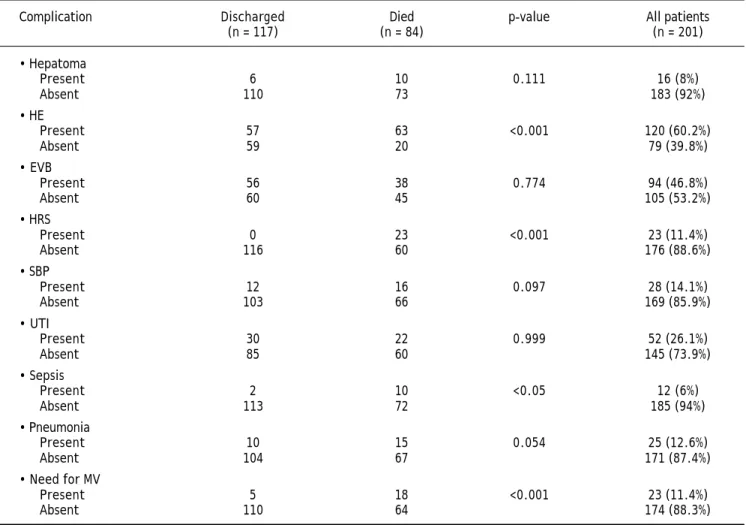
Table 1. Comparison of complication rates in patients who died or were discharged from the intensive care unit (Chi-square test is used).
Complication Discharged Died p-value All patients
(n = 117) (n = 84) (n = 201)
• Hepatoma
Present 6 10 0.111 16 (8%)
Absent 110 73 183 (92%)
• HE
Present 57 63 <0.001 120 (60.2%)
Absent 59 20 79 (39.8%)
• EVB
Present 56 38 0.774 94 (46.8%)
Absent 60 45 105 (53.2%)
• HRS
Present 0 23 <0.001 23 (11.4%)
Absent 116 60 176 (88.6%)
• SBP
Present 12 16 0.097 28 (14.1%)
Absent 103 66 169 (85.9%)
• UTI
Present 30 22 0.999 52 (26.1%)
Absent 85 60 145 (73.9%)
• Sepsis
Present 2 10 <0.05 12 (6%)
Absent 113 72 185 (94%)
• Pneumonia
Present 10 15 0.054 25 (12.6%)
Absent 104 67 171 (87.4%)
• Need for MV
Present 5 18 <0.001 23 (11.4%)
Absent 110 64 174 (88.3%)
Table 2. Comparison of prognostic model scores and duration of ICU stay in patients who died or were discharged from the ICU (Mann-Whitney U test is used).
Prognostic models All patients Discharged Died U p-value
CTP score 10.3 ± 2.7 9.5 ± 2.4 11.4 ± 2.8 2738.000 < 0.001
MELD score 22.3 ± 10.3 18.1 ± 7.1 28.0 ± 11.2 2215.500 < 0.001
APACHE II score 18.1 ± 9.4 13.4 ± 4.8 24.6 ± 10.4 1273.500 < 0.001
SOFA score 6.1 ± 3.9 4.2 ± 2.6 8.7 ± 4.0 1756.000 < 0.001
Duration of ICU (hour) 148.8 ± 100.8 134.4 ± 110.4 160.8 ± 153.6 4495.500 0.802
ICU: Intensive Care Unit. CTP: Child-Turcot-Pugh. MELD: model for end-stage liver disease. APACHE II: acute pysiology and chronic health evaluation II. SOFA: sequential organ failure assesment.
Figure1. Graphical depiction of CTP, MELD, APACHE II and
SOFA scores of patients who died and those who were discharged from the ICU.
a a aaaaa aaaaa a a aaaaa
aaaa aaaaa aaaaa aaaaa aaaaa aaaaa
a a aaaaa aaaaa aaaaa aaaaa aaaaa aaaaa
aaaa aaaaaaaaa
60
50
40
30
20
10
0
CTP MELD APACHE SOFA
Discharged Died
Score
RESULTS
A total of 201 patients with a mean age of 56.8 ± 14.1 were enrolled in the study, 130 (64.7%) of which were male. The mean age of patients who were dis-charged was 56.7 ± 14.7, compared to a mean age of 57.1 ± 13.3 in patients who died. There was no di-fference between patients who were discharged and those who died with regard to age or sex (p > 0.05).
The causes of cirrhosis in decreasing order of fre-quency were HBV (35.8%), cryptogenic (22.2%), HCV (18.2%) and alcohol (11.1%). No link was esta-blished between etiology of cirrhosis and prognosis (p > 0.05).
Hepatic encephalopathy and esophageal bleeding were the most commonly encountered cirrhotic complications at 60.2 and 46.8%, respectively. The-se were followed by HRS at 11.4% and hepatoma at 8%. The most frequently encountered infections were urinary tract infections (26.1%), SBP (14.1%), lung infections (12.6%) and sepsis (6%). Of all the patients followed in the ICU, 11.4%
required mechanical ventilation, and overall morta-lity was 41.8%.
The presence of HE, HRS, sepsis and respiratory failure requiring mechanical ventilation were each independently found to be associated with poor prog-nosis (p < 0.005). A similar correlation could not be established in association with the presence esopha-geal variceal bleeding (EVB), hepatoma or an infec-tion (p > 0.05). All patients who developed HRS during the study period died (Table 1). The mean duration of ICU stay for all patients, as well as mean CTP, MELD, APACHE II and SOFA scores have been summarized in table 2.
Stage stratification according to CTP score revealed 9.7% of the patients being in CTP stage A, 30.1% in CTP stage B and 60.2% in CTP sta-ge C, with respective mortality rates of 15.8, 30.5 and 50.8%. A statistically significant link between CTP score and prognosis was establis-hed (p < 0.001).
The CTP, MELD, SOFA and APACHE II scores of patients who died were compared with those who
CTP MELD APACHE SOFA
1.0
0.8
0.6
0.4
0.2
0.0
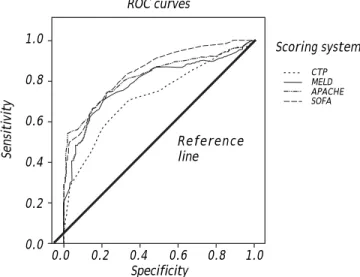
Figure 2. Comparison of ROC curves and ROC values of CTP,
MELD, APACHE II and SOFA scoring systems.
Sensitivity
ROC curves
0.0 0.2 0.4 0.6 0.8 1.0 Specificity
Reference line
were discharged from the ICU (Table 2; Figure 1). Patients who survived had mean scores of 9.5 ± 2.4 for CTP, 18.1 ± 7.1 for MELD, 13.4 ± 4.8 for APACHE II and 4.2 ± 2.6 for SOFA, compared to respective scores of 11.4 ± 2.8, 28.0 ± 11.2, 24.6 ± 10.4 and 8.7 ± 4.0 in those who died. The difference was statistically significant for each of the prognos-tic models (p < 0.001).
AUROC values for the SOFA, APACHE II, MELD and CTP scores were 0.84, 0.82, 0.78 and 0.72, in descending order (Table 3 and Figure 2). Sensitivity, specificity and accuracy of each scoring system in predicting mortality was calculated (Table 4).
DISCUSSION
With this study we managed to demonstrate that the SOFA model is the best prognostic indicator for cirrhotic patients requiring admission into the ICU. This was followed by the APACHE II, MELD and CTP models in descending order (AUROC values: 0.847, 0.821, 0.790 and 0.724).
CTP score, which was initially termed Child-Tur-cotte score, originally designed for predicting the outcome after surgery for portal hypertension (por-tocaval shunting and trans-section of the esopha-gus) in patients with cirrhosis, has been used for more than two decades for determining prognosis in cirrhotic patients.3 According to the CTP
classifica-tion, 9.7% of our patients were in CTP stage A,
30.1% were in CTP stage B and 60.2% were in CTP stage C. Most of the cirrhotic patients (82.1%) had decompensated disease admission to the ICU. Morta-lity rates for each of the three stages were 15.8, 30.5 and 50.8%, respectively. The relationship between a higher CTP score and mortality was statistically significant, while also conveying a higher rate of ci-rrhotic complications.
Despite involving numerous subjective parame-ters and its limited scope of definition, CTP is still the most commonly used scoring system in the de-termination of prognosis in cirrhotic patients. In one such study by Botta, et al., 1-year mortality rates of patients with CTP A, B and C were 12, 25 and 44%, respectively.4 Ho, et al. reported on
mortality rates of 20, 41.9 and 81.6% in ascending order of CTP class.5 Similar findings were also
re-ported by Wehler, et al.6 Furthermore, a
metaa-nalysis on 118 studies clearly established that higher CTP scores and the presence of more com-plications were associated with higher mortality rates.3
On the other hand, some investigators have sug-gested that the CTP score had many short-comings when used to determine post-operative mortality in cirrhotic patients.7,8 This has been attributed to the
use of subjective parameters such as the presence of ascites and encephalopathy as well as it being defi-cient with regard to other conditions that may be encountered in ICU patients, unrelated to cirrhosis. Table 4. Sensitivity, specificity and accuracy of prognostic models based on cut-off values determined by receiver operating characteristic (ROC) curve analysis.
Prognostic model Cut-off value Sensitivity (%) Specificity (%) Accuracy
CTP 10.5 69 67 0.68
MELD 19.5 79.5 64 0.79
APACHE II 15.5 76 74 0.75
SOFA 5.5 81 65 0.74
CTP: Child-Turcot-Pugh. MELD: model for end-stage liver disease. APACHE II: acute pysiology and chronic healt evaluation II. SOFA: sequential organ failure assesment.
Table 3. Area under the curve of prognostic model scores.
Test result variable Area P value 95% Confidence Interval
APACHE II 0.82 < 0.001 0.750 – 0.872
SOFA 0.84 < 0.001 0.778 – 0.894
MELD 0.78 < 0.001 0.714 – 0.843
CHILD 0.72 < 0.001 0.704 – 0.810
Although CTP scores may correctly indicate severi-ty of disease, CTP remains a poor prognostic model in cirrhotic patients with multiorgan failure as well as a poor predictor of mortality.7,9,10
MELD score was superior to CTP score. The MELD score includes parameters such was biliru-bin, creatinine and INR, making it more objective and easily reproducible.4,11,12 Previous studies have
demonstrated the accuracy of the MELD score in predicting prognosis.4,13 In a study by
Papeatheodo-ridis, et al., on decompensated cirrhotic patients, while both the MELD and CTP scores accurately predicted survival at 3 and 6 months, MELD score was found to be slightly superior at predicting sur-vival at 12 and 24 months.14 Sumskiene, et al., also
demonstrated that MELD score was better than CTP score at predicting short-term prognosis. However, for the long term, both models had simi-lar predictive value for survival.15 Similarly, Botta,
et al. demonstrated that as a prognostic model, the
MELD score was superior to the CTP score at pre-dicting 1-year survival in cirrhotic patients, while also establishing a correlation between MELD score and declining liver function.4
Despite being superior to CTP score in predicting prognosis, the MELD score involves many different variables and requires several logarithmic calcula-tions, thus making it more complex and difficult to calculate at the bedside.16 Furthermore, although
the MELD score utilizes objective data, creatinine in particular may be affected by several conditions (in-fection, hydration, and drugs), and any variations in creatinine levels may result in dramatic changes in MELD score. A major drawback of the MELD score is that it does not include a parameter related to portal hypertension, which may result in a decei-vingly low score in patients with complications of hypertension and decompensated cirrhosis.15 In a
study by Yoo, et al., a correlation between MELD score and cirrhotic complications such as hepatic en-cephalopathy and ascites could not be established.16
In our study, hepatic encephalopathy, GI bleeding and infections were the most common reasons for admission to the ICU in cirrhotic patients with com-plicated advanced liver disease. In what might be considered another disadvantage of the MELD sco-re, this model is clearly insufficient at predicting outcome in cirrhotic patients who develop esopha-gus variceal bleeding, spontaneous bacterial perito-nitis and hepatic encephalopathy.17,18
APACHE II score is one of the most widely used prognostic models in ICU patients. The validity of the APACHE II model in predicting prognosis in
cri-tical cirrhotic patients admitted to the ICU has been demonstrated in several studies.5,6,19,20 In a study by
Ho, et al., on 135 patients with complicated
cirrho-sis who required intensive care, higher CTP and APACHE II scores were both found to be correlated with increased mortality, the APACHE II score be-ing of better prognostic value (AUROC values 0.833 vs. 0.75).5 In another study by Arabi, et al., a
sta-tistically significant relationship between APACHE II score and prognosis was established in 129 cirr-hotic patients admitted to the ICU.21
Results of our study have shown the SOFA score to be the best prognostic model, among the scoring systems studied, at predicting prognosis in cirrhotic patients admitted to the ICU. Other studies have de-monstrated that the SOFA score is not only useful in grading organ dysfunction in cases with sepsis, trauma or after surgery, but that it is also the best prognostic indicator that could be used for cirrhotic patients.6,12,22 In a study on 160 patients with
cirr-hosis admitted to the ICU, Tsai, et al. demonstrated that the SOFA score was better than the CTP score in predicting mortality.22 Chen, et al. reported a
mortality rate of 68.6% among 102 cirrhotic pa-tients admitted to the ICU. They also reported the SOFA score to be an excellent predictor of prognosis in comparison to the CTP score.7 In another study,
Cholongitas, et al. compared the prognostic value of SOFA, APACHE II, MELD and CTP scores while evaluating 6-week mortality of 312 cirrhotic pa-tients admitted to the ICU. They reported the SOFA model to be the best, and the CTP score the worst indicator. Furthermore, the MELD score was found to be superior to the APACHE scores (AUROC va-lues for SOFA, MELD, APACHE II and CTP were 0.83, 0.81, 0.78 and 0.72, respectively). Six-week mortality rate was calculated at 65.1%.12 In yet
ano-ther study, Wehler, et al. enrolled 143 cirrhotic pa-tients who were admitted to the ICU. They demonstrated that the SOFA score had an excellent predictive value in determining short-term progno-sis, and was superior to both the APACHE II and CTP scores (AUROC values for SOFA, APACHE II and CTP were 0.94, 0.79 and 0.74, respectively). They also reported on an ICU mortality rate of 36%, overall hospital mortality rate of 46% and 6-month mortality rate of 56%.6
SOFA score is not without its limitations. It utilizes variables from the Glasgow coma scale used to eva-luate neurological dysfunction, and the subjective nature of these parameters may result in random errors of evaluation, particularly since cognitive abi-lities of ICU patients are frequently altered by used of sedatives and analgesics.6
In conclusion, all of the scoring systems in use today may be helpful in determining prognosis of ci-rrhotic patients admitted to the intensive care unit. In terms of prognostic value, the SOFA and APA-CHE II score are superior to the MELD and CTP scores. As such, the SOFA and APACHE II scales should perhaps be the preferred model of choice and have shown the SOFA score to be the best prognos-tic model.
CONFLICT OF INTEREST
There is no financial support.
Authors declare no conflict of interest related to this article.
REFERENCES
1. Cholongitas E, Senzolo M, Patch D, et al. Review article: scoring systems for assessing prognosis in critically ill adult cirrhotics. Aliment Pharmacol Ther 2004; 24: 453-64.
2. Northup PG, Wanamaker RC, Lee VD, et al. Model for End-Stage Liver Disease (MELD) predicts nontransplant surgi-cal mortality in patients with cirrhosis. Ann Surg 2005; 242: 244-51.
3. Pugh RN, Murray-Lyon IM, Dawson JL, et al. Transection of the oesophagus for bleeding oesophageal varices. Br J Surg Aug 1973; 60: 646-9.
4. Botta F, Giannini E, Romagnoli P, et al. MELD scoring sys-tem is useful for predicting prognosis in patients with liver cirrhosis and is correlated with residual liver function: a European study. Gut 2003; 52: 134-9.
5. Ho YP, Chen YC, Yang C, et al. Outcome prediction for critically ill cirrhotic patients: A comparison of APACHE II and Child-Pugh scoring systems. J Intensive Care Medicine 2004; 19: 105-10.
6. Wehler M, Kokoska J, Reulbach U, et al. Short-term prog-nosis in critically ill patients with cirrhosis assessed by prognostic scoring systems. Hepatology 2001; 34: 255-61. 7. Chen YC, Tian YC, Liu NJ, et al. Prospective cohort study comparing sequential organ failure assessment and acute physiology, age, chronic health evaluation III scoring sys-tems for hospital mortality prediction in critically ill cirr-hotic patients. J Clin Pract 2006; 60: 160-6.
8. Rice HE, O’Keefe GE, Helton WS, et al. Morbid prognos-tic features in patients with chronic liver failure
un-dergoing nonhepatic surgery. Arch Surg 1997; 132: 880-4.
9. Tsai MH, Chen YC, Ho YP, et al. Organ system failure scoring system can predict hospital mortality in criti-cally ill cirrhotic patients. J Clin Gastroenterol 2003; 37: 251-7.
10. Zimmerman JE, Wagner DP, Seneff MG, et al. Intensive care unit admissions with cirrhosis: risk-stratifying pa-tient groups and predicting individual survival. Hepatolo-gy 1996; 23: 1393-401.
11. Kamath PS, Wiesner RH, Malinchoc M, et al. A model to pre-dict survival in patients with end-stage liver disease. He-patology 2001; 33: 464-70.
12. Cholongýtas E, Senzolo M, Patch D, et al. Risk factors, se-quential organ failure assessment and model for end-stage liver disease scores for predicting short term mortality in cirrhotic patients admitted to intensive care unit. Ali-ment Pharmacol Ther 2006; 23: 883-93.
13. Huo TI, Wu JC, Lin HC, et al. Evaluation of the increase in model for end-stage liver disease (DMELD) score over time as a prognostic predictor in patients with advanced cirr-hosis: risk factor analysis and comparison with initial MELD and Child-Turcotte-Pugh score. J Hepatology 2005; 42: 826-32.
14. Papatheodoridis GV, Cholongitas E, Dimitriadou E, et al. MELD vs Child-Pugh and creatinine-modified Child-Pugh score for predicting survival in patients with decom-pensated cirrhosis. World J Gastroenterol 2005; 11: 3099-104.
15. Sumskiene J, Kupcinskas L, Pundzius J, et al. Prognostic factors for short and long-term survival in patients selec-ted for liver transplantation. Medicina (Kaunas) 2005; 41: 39-46.
16. Kamath PS, Wiesner RH, Malinchoc M, et al. A model to pre-dict survival in patients with end-stage liver disease [Comment]. Hepatology 2001; 33: 464-70.
17. Yoo HY, Edwin D, Thuluvath PJ. Relationship of the model for end-stage liver disease (MELD) scale to hepatic ence-phalopathy, as defined by electroencephalography and neuropsychometric testing, and ascites. Am J Gastroen-terol 2003; 98: 1395-9.
18. Huo TI, Lin HC, Wu JC, et al. Limitation of the model for end-stage liver disease for outcome prediction in patients with cirrhosis-related complications. Clin Transplant 2006; 20: 188-94.
19. Singh N, Gayowski T, Wagener MM, et al. Outcome of pa-tients with cirrhosis requiring intensive care unit su-pport: prospective assessment of predictors of mortality. J Gastroenterol 1998; 33: 73-9.
20. Zauner CA, Apsner RC, Kranz A, et al. Outcome prediction for patients with cirrhosis of the liver in a medical ICU: a comparison of the APACHE scores and liver-specific sco-ring systems. Intensive Care Med 1996; 22: 559-63. 21. Arabi Y, Ahmed QA, Haddad S, et al. Outcome predictors
of cirrhosis patients admitted to the intensive care unit. Eur J Gastroenterol Hepatol 2004; 16: 333-9.