G Cabrera Álvarez et al.Effect of danazol, polyethylene glycol-interferon, and ribavirin in fibrosis 233
medigraphic.com
Annals of Hepatology 2007; 6(4): October-December: 233-241Annals of Hepatology
Original Article
Combined therapy with danazol, pegilated
interferon, and ribavirin improves
thrombocytopenia and liver injury in rats with fibrosis
Guillermo Cabrera Álvarez;1 Vicente Madrid-Marina;2 Ricardo Jimenez-Mendez;3 Angel Leon Buitimea;4
Margarita Bahena Román;2 Rudyard Cortez-Gomez;5 Jorge Reyes Esparza;4 Lourdes Rodríguez-Fragoso4
1Internal Medicine Division, Gastroenterology and Hepatology
Department, Hospital General Regional con UMF # 1, Instituto Mexicano del Seguro Social, Cuernavaca, Morelos, México
2Chronic Infections and Cancer Division, Center for Research on
Infectious Diseases, Cuernavaca, Morelos, México
3External Section of Pharmacology, Center for Research and
Advanced Studies, IPN, México City, México
4Faculty of Pharmacy, Universidad Autónoma del Estado de
Morelos, Cuernavaca, Morelos, México.
5Clinical Laboratory, Hospital General Regional con UMF # 1,
Instituto Mexicano del Seguro Social, Cuernavaca, Morelos, México
Address for correspondence: Lourdes Rodríguez Fragoso Ph.D Flavio García Núm. 32
Presidentes Ejidales 04470 México D.F.
Tel/fax 777 329-708
E-mail: [email protected]
Manuscript received and accepted: 8 September and 22 October 2007 Abstract
The aim of this study was to investigate the effects of combinations of pegilated–interferon (PEG–IFN), rib-avirin, and danazol on thrombocytopenia and liver in-jury in rats with fibrosis. Male adult Wistar rats were treated with either mineral oil, danazol (0.83 mg/kg per day), PEG–interferon ααααα-2a (PEG–IFN, 0.3 μμμμμg/ week) + ribavirin (12 mg/kg per day), PEG–IFN + rib-avirin + danazol, CCl4 (4 g/kg for eight weeks), CCl4 + PEG–IFN + ribavirin, or CCl4 + PEG–IFN + ribavirin + danazol. The following assays were conducted: he-matology, clinical chemistry, liver function, liver fi-brosis, lymphocyte cytokine mRNA expression, and bone-marrow DNA content. Platelet counts were low in sham-treated animals and animals treated with PEG– IFN + ribavirin (30% and 25% respectively; P < 0.05). PEG–IFN + ribavirin + danazol reduced platelet counts of fibrotic animals by only 9% (P < 0.05). PEG– IFN+ribavirin reduced hepatic collagen content by 50%, whereas danazol + PEG–IFN+ribavirin reduced hepatic collagen content by 60% (P < 0.05). PEG–IFN
+ ribavirin reduced the total bilirubin concentration by 27%, alanine amino transferase (ALT) activity by 75% and γγγγγ-glutamyl transpeptidase (γγγγγ-GTP) activity by 74% (P < 0.05). In contrast, danazol + PEG–IFN + ribavirin reduced total bilirubin levels by 61%, alka-line phosphatase activity by 45%, ALT activity by 76%, and γγγγγ-GTP activity by 74% (P < 0.05). The only treatment that increased interleukin 10 (IL-10) mRNA in fibrotic rats was PEG–IFN + ribavirin. However, danazol + PEG–IFN + ribavirin reduced the expression of IL-6, IL-10, tumor necrosis factor ααααα and transform-ing growth factor βββββ. Bone-marrow DNA content was not altered by any treatment. In conclusion, PEG–IFN + ribavirin + danazol could be a new therapeutic op-tion for patients with liver injury, fibrosis, and thromb-ocytopenia.
Key words: Danazol, thrombocytopenia, fibrosis, col-lagen, PEG–interferon, ribavirin.
Hepatitis C virus (HCV) infection affects about 170 million people worldwide. Chronic hepatitis develops in up to 80% of individuals who contract acute infections and may cause liver fibrosis and cirrhosis.1,2
HCV infection is an inflammatory disease character-ized by the enhanced expression of various pro- and anti-inflammatory cytokines in the liver. The initiation of several intracellular signal pathways that involve apop-tosis, proliferation, and extracellular matrix synthesis constitutes the major impetus for the development of he-patic injury, fibrosis, and cirrhosis.3-5 During the past de-cade, HCV infection has also been associated with many extrahepatic manifestations. In large studies that assessed the prevalence of extrahepatic manifestations, at least one clinical manifestation was exhibited by 38% of patients,6 and up to 74% of patients exhibited at least one serologi-cal manifestation.7 Autoimmune thrombocytopenia may be an extrahepatic manifestation of HCV infection.8-10 Sev-eral theories have been proposed to explain the presence of thrombocytopenia in chronic liver injury.11
Pegilated–interferon α-2a (PEG–IFN) and ribavirin combination therapy is the gold standard in the treatment
Artemisa
medigraphic.com
of chronic hepatitis C and is associated with a high rate ofsustained virological response. However, a high incidence of adverse hematological side effects is associated with this therapeutic regimen. Adverse hematological effects are particularly common, and the bone-marrow suppres-sion caused by interferon may result in neutropenia and thrombocytopenia.12-14 Previous studies have suggested that HCV induces immune thrombocytopenia, and that in-terferon itself induces autoimmune thrombocytopenia.15-17
Danazol is a synthetic attenuated androgen and has been used for the treatment of several unrelated immune-mediated diseases.18-20 Danazol has also been used suc-cessfully to treat various diseases associated with au-toimmune thrombocytopenia. This drug has a corticos-teroid-sparing effect and increases platelet counts, even in patients who are refractory to other therapeutic ap-proaches. Recent studies have indicated that danazol modifies the level of antiplatelet antibodies, inhibits the mononuclear phagocyte system, and reduces the GPIIb– IIIa complex in patients with refractory autoimmune thrombocytopenia.21-23
The aim of this study was to investigate the effects of combinations of danazol, PEG–IFN α-2a, and ribavirin on hematological, biochemical, and functional liver indi-ces in rats with fibrosis.
Research methods and procedures
Animal model and experimental protocol
Seventy male Wistar rats weighing 200 g each were used. The animals were housed in a temperature- and hu-midity-controlled environment and were given food (Standard Purina Chow Diet, Purina, St Louis, MO, USA) and water ad libitum. The body weights and health of the rats were monitored throughout the study. This investi-gation was conducted in accordance with the U.S. Na-tional Institutes of Health Guide for the Care and Use of Laboratory Animals.24 The rats were randomly divided into seven groups (10 rats per group). The animals were treated as follows: group 1, animals received only miner-al oil (control); group 2, animminer-als received danazol at a dose of 0.83 mg/kg for 5 d per week for four weeks; group 3, animals received PEG–IFN at a dose of 0.3 μg/ week by intraperitoneal injection plus ribavirin at a dose of 12 mg/kg for 5 d per week for four weeks; group 4, ani-mals received danazol, PEG–IFN, and ribavirin for four weeks; group 5, animals were treated with CCl4 to induce liver injury and fibrosis; group 6, animals received CCl4 alone for four weeks, after which they received CCl4 plus PEG–IFN and ribavirin for four weeks; group 7, animals were treated with CCl4 plus PEG–IFN, ribavirin, and dan-azol at the doses described for the other treatments. Rib-avirin and danazol were administered by gavage. Liver injury and fibrosis were induced with intraperitoneal in-jections of 0.15 mL of a 1:7 (v/v) solution of CCl4 (4 g/
kg) in mineral oil, three times a week for eight weeks. Two days after they had received the last treatment dose, the animals were deprived of food but not water for 12 h, and were killed under light ether anesthesia. Serum and liver tissue samples were collected from each animal and stored at -4 °C and -20 °C, respectively, until analysis.
Collagen analysis
Collagen concentrations were determined by measur-ing the hydroxyproline content of fresh liver samples af-ter their digestion with acid.25 The procedure was as fol-lows: fresh liver samples (100 mg) were placed in am-poules, 2 mL of 6 N HCl was added, the ampoules were sealed, and the samples were hydrolyzed at 100 °C for 48 h. The water in the samples was then evaporated at 50 °C for 24 h and the samples were resuspended in 3 mL of so-dium acetate–citric acid buffer (pH 6.0); 0.5 g of activat-ed charcoal was addactivat-ed, and the mixture was stirractivat-ed vigor-ously and then centrifuged at 5000 ×g for 10 min. The mixture was kept for 20 min at room temperature, and the reaction was stopped by the addition of 2 M sodium thio-sulfate and 1 N sodium hydroxide. The aqueous layer was transferred to test tubes. The oxidation product of hydroxyproline was converted to pyrrole by boiling. The pyrrole-containing samples were incubated with Ehrli-ch’s reagent for 30 min, and their absorbance was mea-sured at 560 nm. The recovery of known amounts of standards from similar liver samples was used to calibrate the assay.
Hematological and biochemical analyses
Blood samples were collected from each animal for the quantification of white cells, red blood cells, plate-lets, hemoglobin concentrations, and hematocrit. The plasma was separated and used for biochemical assays of hepatic function. Serum alkaline phosphatase (AP) activ-ity, alanine amino transferase (ALT) activactiv-ity, γ-glutamyl transpeptidase (γ-GTP) activity, and bilirubin content were evaluated using a kit (Merck Naucalpan, Estado de Mexico, Mexico) Biochemical evaluation of the serum samples was conducted using an automated system (Cell Dyn 3700, Abbot Laboratories, USA; Synchron CX7, Beckman Coulter, USA).
Lymphocyte isolation
Lymphocytes were isolated from heparinized whole blood by density gradient centrifugation using Lym-phoprep (Axis-shield, Oslo, Norway).
RNA extraction
medigraphic.com
method of Chomzynski and Sacchi.26 Briefly, cells werehomogenized in 1 mL of TRIzol Reagent and incubated for 5 min at room temperature. Then, 200 μL of chloro-form was added to the mixture. After vigorous mixing and centrifugation at 10,000 ×g for 15 min, the aqueous phase was harvested and the RNA was precipitated with an equal volume of isopropanol. The RNA was washed in 70% ethanol and dissolved in DEPC-treated water. The RNA was quantified using a DU-40 spectrophotometer; 3 μg of the sample was used to analyze the integrity of the RNA on a 1% agarose gel.
cDNA synthesis
First-strand cDNA was synthesized using 1 μg of total RNA obtained from a suspension of lymphocytes in DEPC-treated water. Briefly, 1 μL of primer dT12–18 (Invit-rogen Life Technologies) was added, and the volume was made up to 11 μL with DEPC-treated H2O. Each sample was incubated at 70 °C for 10 min and was then incubat-ed on ice for 1 min. To each RNA primer mixture were added 9 μL of reaction mixture, containing 4 μL of 5  RT buffer (250 mM Tris-HCl [pH 8.3], 375 mM KCl, 50 mM dithiothreitol, 15 mM MgCl2), 40 U of RNAsin (Invitrogen Life Technologies), 4 μL of dNTP mix (10 mM each of dATP, dCTP, dGTP, and dTTP), and 200 U of Moloney Murine Leukemia Virus reverse tran-scriptase (Invitrogen Life Technologies). The mixture was mixed gently, incubated at 37 °C for 50 min, and then quickly chilled on ice.
RT–PCR for cytokines
PCR amplification was carried out in 25 μL of amplifi-cation buffer containing 200 mM Tris-HCl (pH 8.4), 500 mM KCl, 1.5 mM MgCl2, 200 μM dNTPs, 10 pmol each of the 5´ and 3´ primers, 2.0 U of Taq DNA polymerase (Invitrogen Life Technologies, Brazil), and 2.0 μL of cDNA. The samples were then amplified in a PCR System 2700 (Applied Biosystems) as follows: denaturation at 94 °C for 5 min and 30 cycles of 94 °C for 1 min, 55 °C for 1 min, and 72 °C for 1 min, followed by 5 min at 72 °C. A 10 μL aliquot of the PCR product was then separated electrophoretically on a 6% polyacrylamide gel and visu-alized under UV by ethidium bromide staining. The mRNA bands were quantified using Bioimaging Systems software (LabWorks 4.0) and normalized to glyceralde-hyde 3-phosphate dehydrogenase (G3PDH) bands. The sequences of the primer pairs used to amplify specific cy-tokines of the rat were as follows. G3PDH: sense 5´-AC-CACAGTCCATGCCATCAC-3´ and antisense 5´-TC-CACCACCCTGTTGCTGTA-3´, amplifying a fragment of 452 bp (39); transforming growth factor β (TGF-β1): sense GGCTTCTAGTGCTGACG-3´ and antisense 5´-GGGTGCTGTTGTACAAAG-3´,203 bp;27 tumor necro-sis factor α (TNF-α): sense
5´-CACCACGCTCTTCT-GTCTACTGAAC-3´ and antisense 5´-CCGGACTCCGT-GATGTCTAAGTACT-3´, 545 bp;28 interleukin 2 (IL-2): sense 5´-CATGTACAGCATGCAGCTCGCATCC-3´ and antisense 5´-CCACCACAGTTGCTGGCTCATCATC-3´, 410 bp; IL-6: sense 5´-GACTGATGTTGTTGACAGC-CACTGC-3´ and antisense 5´-TAGCCACTCCTTCTGT-GACTCTAACT-3´, 509 bp;28 IL-10: sense ACCTGG-TAGAAGTGATGCCCCAGGCA-3´ and antisense
5´-CTATGCAGTTGATGAAGATGTCAAA-3´, 237 bp.29
The sequences of the primer pairs used to amplify specific cytokines for humans were as follows.
TGF-β1: sense 5´-GCCCTGGACACCAACTATTGCT-3´
and antisense 5´-GGGTGCTGTTGTACAAAG-3´, am-plifying a fragment of 161 bp; IL-6: sense 5´-ATG-TAGCCGCCCCACACAGA-3´ and antisense
5´-CATC-CATCTTTTTCAGCCAT-3´, 190 bp; TNF-α sense
5´-GAGTGACAAGCCTGTAGCCCATGTTGTAGCA-3´ and antisense 5´-GCAATGATCCCAAAGTAGACCT-GCCCAGACT-3´, 444 bp; IL-2 sense 5´-CATTGCAC-TAAGTCTTGCACTTGTCA-3´ and antisense 5´-CGT-TGATATTGCTGATTAAGTCCCTG-3´, 305 bp; IL-10 sense 5´-ATGCCCCAAGCTGAGAACCAAGACCCA-3´ and antisense 5´-TCTCAAGGGGCTGGGGCTGGGT-CAGCTATCCCA-3´, 351 bp. The PCR conditions were: denaturation at 95 °C for 5 min followed by 35 cycles of 95 °C for 30 s, 60 °C for 30 s, and 72 °C for 1 min, and a final extension at 72 °C for 5 min. For IL-2, the PCR conditions were: denaturation at 95 °C for 5 min followed by 35 cycles of 94 °C for 1 min, 68 °C for 1 min, and 72 °C for 1 min, with a final extension at 72 °C for 10 min.
The amplification of G3PDH was performed separately to compare the expression of a constitutively expressed gene and to normalize the cDNA input in each cytokine mRNA–cDNA amplification. Repeated PCR analyses of the samples yielded reproducible results and indicated that no inhibitory factors were present in the samples. Several precautions were taken to avoid PCR artifacts. Negative controls, consisting of buffer alone or nonre-verse-transcribed sample RNA, were included in each ex-periment.
Cell-cycle analysis of bone-marrow cells
medigraphic.com
Other assays
Small liver sections fixed in Bouin’s medium were used for trichromic staining and histological examina-tion under light microscopy.
Statistical analysis
Data are reported as the means ± standard deviations of three independent experiments conducted in quadru-plicate. Statistical analysis was performed using paramet-ric ANOVA. Individual differences between treatments were analyzed using Tukey’s test. Significant differences were established at P < 0.05.
Results
Effect of CCl4 treatment
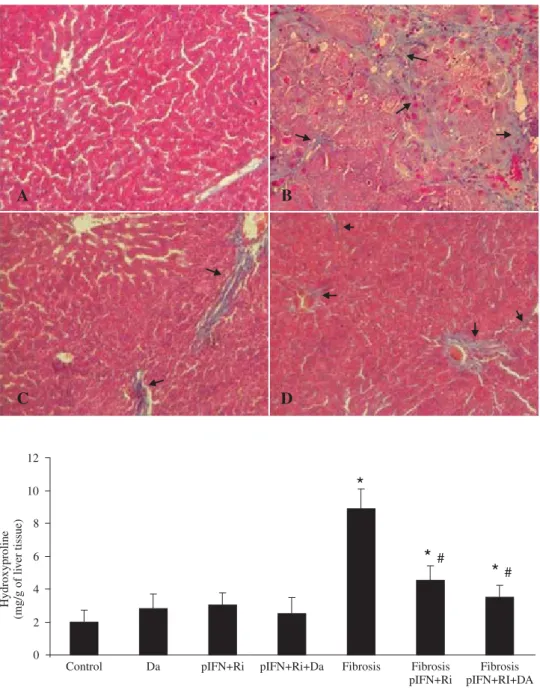
The onset of fibrosis was determined by measuring changes in the collagen content of the livers of CCl4 -treated rats. Liver injury was characterized by an increase in bilirubin content and serum AP, ALT, and γ-GTP ac-tivities relative to those of untreated rats (P < 0.05; Table I). Histological analysis of the liver samples from the ani-mals treated with CCl4 revealed an increase in the amount of collagen fibers and changes in the liver architecture compared with those of liver samples from untreated ani-mals (Figure 1).
Hepatic collagen content
The collagen content of the liver samples was estimat-ed from the hydroxyproline content. CCl4 treatment in-duced a fivefold increase in liver collagen content
(Fig-ure 2). Animals with fibrosis that were treated with PEG–
IFN + ribavirin had lower liver collagen contents (50%) than those of CCl4-treated rats (P < 0.05). However, ani-mals with fibrosis that were treated with danazol plus PEG–IFN and ribavirin had a 60% reduction in liver
col-lagen content (P < 0.05) compared with that of rats with fibrosis. Treatment with PEG–IFN, ribavirin, or danazol alone or ribavirin plus danazol produced no change in liver collagen contents.
Analysis of liver architecture
Figure 1 shows the histology of liver samples from all
treatment groups. Animals with CCl4-induced fibrosis ex-hibited the degeneration of hepatocytes and increased in-flammatory infiltrate in the necrotic areas. These animals also developed severe fibrosis, with complete distortion of the lobular architecture (Figure 1B). Histological sections of livers from animals with fibrosis that were treated with PEG–IFN plus ribavirin showed a signifi-cant improvement in the liver architecture, as well as re-ductions in the amount of collagen fibers and the extent of the necrotic area (Figure 1C). A significant reduction in the amount of collagen fibers and a reduction in liver damage were also observed in animals with fibrosis that were treated with danazol or PEG–IFN plus ribavirin (Figure 1D).
Hematological and biochemical analyses
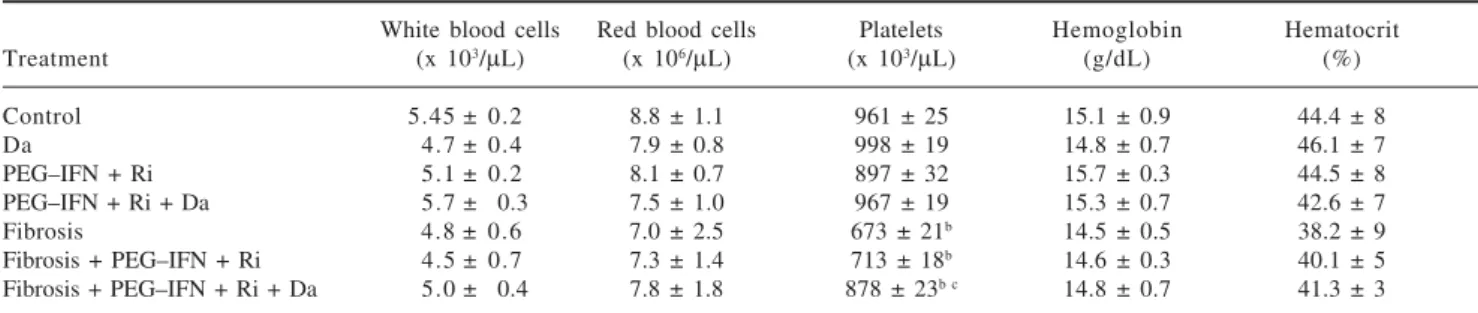
Hematological analysis showed that animals with liv-er fibrosis had a 30% reduction in platelet counts (P < 0.05), a 30% reduction in albumin levels, and a twofold increase in cholesterol concentrations (P < 0.05) com-pared with those of the control group. Animals with fi-brosis that were treated with PEG–IFN and ribavirin also had reductions in their platelet numbers (by 25%; P < 0.05) and albumin levels (by 23%; P < 0.05%), and a 1.2-fold increase in their cholesterol levels (P < 0.05%). However, animals with fibrosis that were treated with danazol plus PEG–IFN and ribavirin had a reduction of 9% in their platelet counts (P < 0.05) compared with those of untreated animals with fibrosis. Although plate-let counts did not differ between groups, animals with fi-brosis that were treated with danazol plus PEG–IFN and
Table I. Liver function analysis.a
Treatment Total bilirubin (μmol/L) AP (IU) ALT (IU) γ-GTP (IU)
Control 2.5 ± 0.8 204 ± 2 4 55.7 ± 5.1 101 ± 1 3
Da 3.9 ± 0.9 201 ± 5 9 52.2 ± 2.2 135 ± 2 0
PEG–IFN + Ri 5.1 ± 0.3 229 ± 3 7 65.7 ± 1 9 158 ± 4 4
PEG–IFN + Ri + Da 1.9 ± 1.0 184 ± 5 1 60.2 ± 2 1 149 ± 6 6
Fibrosis 6 5 ± 26b 617 ± 13b 3264 ± 161b 5913 ± 112b
Fibrosis + PEG–IFN + Ri 4 7 ± 19b 608 ± 57b 798 ± 237b c 1494 ± 263b c
Fibrosis + PEG–IFN + Ri + Da 2 5 ± 12b c 338 ± 56b c 759 ± 254b c 1487 ± 462b c a Results are expressed as the means ± Standard Deviation of experiments performed with duplicate assays of samples from six animals. Alkaline
phosphatase (AP), alanine amino transferase (ALT), γ-glutamyl transpeptidase (γ-GTP), international units (IU), PEG–interferon (PEG–IFN), ribavirin (Ri), danazol (Da).
medigraphic.com
ribavirin had lower levels of albumin (40%) than theoth-er groups (Tables I and II).
Analysis of liver function
Animals with fibrosis had a significant increase in to-tal bilirubin levels (26-fold) and threefold, 5.8-fold, and 58.5-fold increases in the serum activities of AP, ALT, and γ-GTP, respectively (P < 0.05). Animals with fibrosis that received PEG–IFN and ribavirin had lower levels of total bilirubin (27%) and lower serum activities of ALT (by 75%) and γ-GTP (by 74%) than those of animals with fibrosis (P < 0.05). In contrast, significant reductions rel-ative to those of fibrotic rats were observed in the level of total bilirubin (61%) and the activities of AP (45%), ALT (76%), and γ-GTP (74%) in animals with fibrosis that
were treated with danazol plus PEG–IFN and ribavirin (P < 0.05; Table III).
Expression of IL and growth factor mRNAs in lymphocytes
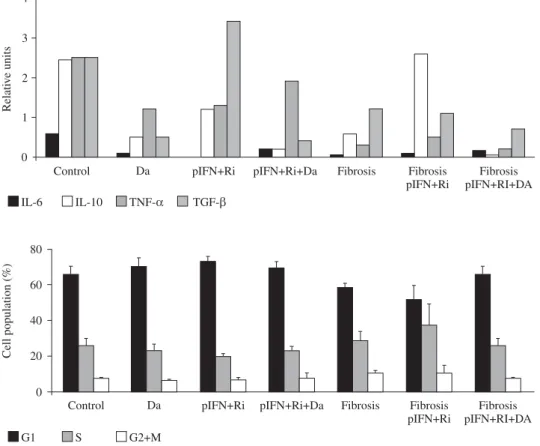
There is increasing evidence that several cytokines play major roles in various aspects of inflammatory liver diseases and liver tissue repair. Therefore, in this study, we evaluated the expression of IL-6, IL-10, TNF-α, and TGF-β in blood lymphocytes (Figure 3). The expression of cytokines in lymphocytes was modified by the treat-ments. Animals with fibrosis had a reduction in the mRNA levels of all cytokines compared with those of the control animals. Animals with fibrosis that were treated with PEG–IFN and ribavirin only showed an increase in
Figure 1. Histological study of li-ver sections from rats treated with danazol and the conventional the-rapy. (A) Control (untreated rats); (B) CCl4-induced liver fibrosis;
(C) animals with fibrosis treated with PEG–interferon α-2a and ri-bavirin; (D) animals with fibrosis treated with danazol plus PEG–in-terferon α-2a and ribavirin. Liver tissues were stained with Masson trichrome. Collagen is indicated by blue staining (arrows; 100x). All treatments were administered for eight weeks.
Figure 2. Hepatic collagen con-tent. Collagen was measured as the hydroxyproline content of li-ver slices. Each bar represents the mean ± SD of experiments per-formed in duplicate. All groups consisted of 10 animals. PEG–in-terferon α-2a (PEG–IFN), ribavi-rin (Ri), danazol (Da).
* different from that of the con-trol group (P < 0.001).
medigraphic.com
the mRNA levels of the anti-inflammatory cytokine,IL-10, relative to that of animals with fibrosis. However, ani-mals with fibrosis that were treated with danazol plus PEG–IFN and ribavirin had reductions in the blood lev-els of all cytokines (IL-6, IL-10, TNF-α, and TGF-β) com-pared with those of untreated animals with fibrosis. It is noteworthy that treatment with PEG–IFN, ribavirin, or danazol alone reduced the mRNA levels of IL-6, IL-10, and TNF-α. Ribavirin plus danazol increased TGF-β mRNA levels, whereas PEG–IFN, ribavirin, or danazol alone reduced TGF-β mRNA levels.
Cell-cycle analysis of bone-marrow cells
Cell-cycle analysis was performed to determine whether the treatments affected bone-marrow cells and, as a consequence, the levels of blood cells. The DNA of bone-marrow cells was not altered by any of the treat-ments (Figure 4). Therefore, there was no correlation be-tween the changes in blood platelet levels and the cell cycle in bone-marrow cells.
Discussion
HCV infection is a frequent cause of chronic hepatitis. Persistent HCV infection can produce disorders not only
of the liver, but also of other organs.31-33 Recently, HCV has been implicated in the development of many extra-hepatic manifestations.6,7,34
Thrombocytopenia is a common finding in advanced liver cirrhosis and is usually related to the congestive splenomegaly of portal hypertension and possibly to in-adequate thrombopoietin synthesis by the failing liv-er.35,36 In adult patients, IFN-α and pegylated interferons are effective in decreasing abnormal levels of transami-nases and levels of HCV viremia, but are associated with many adverse effects. IFN-α induces and exacerbates sev-eral autoimmune abnormalities, including thrombocy-topenia. The presence of severe thrombocytopenia can prompt dose reduction and treatment discontinuation.37 HCV-associated thrombocytopenia is an important and unresolved problem, particularly because the mechanism responsible for the occurrence of thrombocytopenia in these individuals is unclear. This study shows that thera-py with PEG–IFN plus ribavirin and danazol increases platelet counts and ameliorates liver injury and fibrosis in rats.
Danazol has been used successfully for the treatment of various diseases associated with autoimmune thromb-ocytopenia. The main mechanism responsible for the thrombocytopenia of immune diseases involves an in-crease in platelet destruction by platelet-bound
antibod-Table II. Hematological analysis.a
White blood cells Red blood cells Platelets Hemoglobin Hematocrit
Treatment (x 103/μL) (x 106/μL) (x 103/μL) (g/dL) (%)
Control 5.45 ± 0.2 8.8 ± 1.1 961 ± 25 15.1 ± 0.9 44.4 ± 8
Da 4.7 ± 0.4 7.9 ± 0.8 998 ± 19 14.8 ± 0.7 46.1 ± 7
PEG–IFN + Ri 5.1 ± 0.2 8.1 ± 0.7 897 ± 32 15.7 ± 0.3 44.5 ± 8
PEG–IFN + Ri + Da 5.7 ± 0.3 7.5 ± 1.0 967 ± 19 15.3 ± 0.7 42.6 ± 7
Fibrosis 4.8 ± 0.6 7.0 ± 2.5 673 ± 21b 14.5 ± 0.5 38.2 ± 9
Fibrosis + PEG–IFN + Ri 4.5 ± 0.7 7.3 ± 1.4 713 ± 18b 14.6 ± 0.3 40.1 ± 5
Fibrosis + PEG–IFN + Ri + Da 5.0 ± 0.4 7.8 ± 1.8 878 ± 23b c 14.8 ± 0.7 41.3 ± 3 a Results are expressed as the means ± SD of experiments performed with duplicate assays of samples from six animals. PEG–interferon (PEG–
IFN), ribavirin (Ri), danazol (Da).
bP < 0.05 vs the control group. cP < 0.05 vs the fibrosis group.
Table III. Biochemical analyses.a
Treatment Glucose (mg/dL) Total protein (g/dL) Albumin (g/dL) Cholesterol (IU)
Control 99 ± 31 5.82 ± 1.25 3.32 ± 0.05 62 ± 7
Da 104 ± 37 5.60 ± 0.22 3.17 ± 0.22 61 ± 2.1
PEG–IFN + Ri 94 ± 29 6.10 ± 0.14 3.40 ± 0.16 60 ± 4.2
Fibrosis 96 ± 24 5.70 ± 0.92 3.17 ± 0.43 63 ± 5.6
PEG–IFN + Ri + Da 136 ± 27 4.32 ± 0.78 2.32 ± 0.61b 135 ± 12b
Fibrosis + PEG–IFN + Ri 142 ± 35 4.62 ± 0.35 2.55 ± 0.55b 78 ± 17c
Fibrosis + PEG–IFN + Ri + Da 128 ± 28 3.47 ± 0.85 1.97 ± 0.53b 82 ± 15c
a Results are expressed as the means ± SD of experiments performed with duplicate assays of samples from six animals. International units (IU),
PEG–interferon (PEG–IFN), ribavirin (Ri), Danazol (DA).
medigraphic.com
ESTE DOCUMENTO ES ELABORADO PORMEDI-GRAPHIC
ies and/or the altered function of splenic macrophage Fc (IgG) receptors. Recently, it was demonstrated that dana-zol increases thrombopoietin production.38 However, it is possible that, in some cases, the predominant cause of thrombocytopenia is ineffective bone-marrow platelet production rather than accelerated platelet removal. In our study, danazol did not change the phase of the cell cycle in the bone marrow of normal or fibrotic animals, indicating that danazol does not have any effect on he-matopoiesis in bone-marrow cells and that another mech-anism is responsible for CCl4-induced liver fibrosis.
It has been known for more than two decades that the use of danazol for the treatment of hematological diseas-es, cystic disease of the breast, endometriosis, and heredi-tary angioneurotic edema causes hepatic damage.39-41 Re-cently, danazol was implicated in the development of cholestatic jaundice, hepatic peliosis, and liver tumor. 42-44 The mechanism of danazol-induced liver injury is
un-clear. However, massive zone 3 necrosis of the liver has been demonstrated. This striking zonal liver necrosis is consistent with liver damage caused by other drugs or toxins.41,44 Three aspects of the use of danazol in these studies are worthy of mention: (1) in most reports, the schedule of danazol therapy varied between 3.0 mg/kg per day and 8.5 mg/kg per day; (2) danazol was adminis-tered for long periods of time (months to years); and (3) most authors indicated that the cholestasis and liver inju-ry resolved completely after the withdrawal of danazol therapy.45-47 Taken together, these facts suggest that
hepatotoxicity may develop at various times during ther-apy with high doses of danazol.
This study demonstrates that animals with fibrosis that received conventional therapy and danazol had in-creased platelet counts, improved liver function, and ameliorated fibrosis. We treated the animals with 0.83 mg/kg per day of danazol for four weeks and did not ob-serve any changes in liver function or liver morphology. In contrast, animals with fibrosis that were treated with danazol plus PEG–IFN and ribavirin showed an improve-ment in liver function and a reduction in liver fibrosis. Cicardi et al. previously reported that long-term treat-ment15-47 months) with low doses of danazol did not in-duce significant hepatic damage detectable by laborato-ry tests or liver biopsies in 13 patients with hereditalaborato-ry an-gioedema.48 Conversely, it has recently been shown that there is an association between danazol therapy and hepatocellular carcinoma and hepatitis, but only in pa-tients with a functional deficiency of C1 inhibitor pro-tein.43,49 These data suggest that low doses of danazol could be used to treat liver injury and fibrosis without adverse effects.
Hepatic fibrosis is a pathological condition character-ized by a marked deposition of collagen and other com-ponents of the extracellular matrix in the liver. This eventually results in cirrhosis, because the excessive dep-osition of extracellular matrix proteins causes hepatic failure resulting from the malfunction of hepatocytes and hemodynamic changes that induce portal
hyperten-Figure 3. Cytokine mRNA expres-sion in blood lymphocytes. Expre-ssion of cytokine mRNA was mea-sured by RT–PCR. Densitometric analysis of PCR products on Southern blots was used for the se-miquantitative analysis of cytokine mRNA expression. Relative mRNA levels are expressed as a percentage of the control value. Tumor necro-sis factor α (TNF-α), transforming growth factor β (TGF-β), PEG–in-terferon α-2a (PEG–IFN), ribavirin (Ri), danazol (Da). All groups con-sisted of six animals.
medigraphic.com
sion.50,51 It has been reported that therapy with PEG–IFNand ribavirin results in the improvement of serum levels of fibrotic markers both in patients who respond to thera-py and in those who do not.52,53 Moreover, quantitative histopathological analyses of paired liver biopsy speci-mens showed some improvement in the degree of fibrosis after therapy, irrespective of the initial virological re-sponse.12,13 Our results are consistent with those of previ-ous reports.
Most acute and chronic liver diseases are character-ized by inflammatory processes and the enhanced ex-pression of various pro- and anti-inflammatory cytokines in the liver. These cytokines are the driving forces be-hind many inflammatory liver disorders and often induce fibrosis and cirrhosis4 because they have synergistic and sometimes antagonistic effects on the immunological and inflammatory processes in the liver.5 The combined administration of PEG–IFN and ribavirin leads to HCV elimination and the inhibition of the inflammatory reac-tion and liver fibrosis in some patients.54 Low levels of TNF-α and TGF-β are predictors of sustained responses to therapy with IFN α-2a, alone or in combination with ribavirin.55 In contrast, the level of IL-6, which is a mark-er for reparative livmark-er processes, increases as the inflam-matory process abates. Thus, a gradual increase in IL-6 levels is accompanied by lower ALT activity during sus-tained responses to therapy with PEG–IFN and ribavi-rin.56 The treatment of chronic hepatitis also modulates cytokine levels, inducing an increase in the anti-inflam-matory cytokine, IL-10.57
In this context, our results contrast with those of pre-vious reports. We observed an increase in IL-10 mRNA levels, but no significant changes in the mRNA levels of IL-6, TNF-α, or TGF-β in the lymphocytes of fibrotic rats that were treated with PEG–IFN plus ribavirin. This dis-parity may have been caused by the induction of liver in-jury and fibrosis with a toxic agent in our model. Howev-er, an important finding of our study is that combined therapy with danazol plus PEG–IFN and ribavirin altered the pattern of cytokine mRNA expression in animals with fibrosis. There was a substantial reduction in IL-10 mRNA expression and smaller reductions in TNF-α and TGF-β mRNA expression. Previous reports have suggest-ed that danazol can improve some diseases by influenc-ing the function of the immune system.18-20,58 Danazol suppresses both spontaneous and activated human lym-phocyte-mediated cytotoxicity and decreases the levels of TNF-α and IL-6 in the peritoneal macrophages of in-fertile patients with endometriosis.59,60
There have been no reports of the use of danazol plus conventional therapy for the treatment of chronic HCV infection or other liver diseases. Our results show that danazol in association with PEG–IFN and ribavirin im-proves thrombocytopenia and liver injury in rats with fi-brosis. According to previous reports, danazol modulates the production and secretion of cytokines in hepatic and
blood cells during liver injury and increases platelet lev-els by modulating the immune system. In conclusion, the combination of PEG–IFN plus ribavirin and danazol ap-pears to be a new therapeutic option for the treatment of patients with liver injury and fibrosis who display throm-bocytopenia.
References
1. Wong JB. Hepatitis C: cost of illness and considerations for the economic evaluation of antiviral therapies. Pharmacoeconomics
2006; 24: 661-72.
2. Wong T, Lee SS. Hepatitis C: a review for primary care physi-cians. CMAJ 2006; 174: 649-59.
3. Rockey DC. The cell and molecular biology of hepatic fibrogenesis. Clinical and therapeutic implications. Clin Liver Dis
2000; 4: 319-55.
4. Marra F. Chemokines in liver inflammation and fibrosis. Front
Biosci 2002; 7: 1899-1914.
5. Tilg H, Kaser A, Moschen AR. How to modulate inflammatory cytokines in liver diseases. Liver Int 2006; 26: 1029-39. 6. Cacoub P, Renou C, Rosenthal E, Cohen P, Loury I,
Loustaud-Ratti Yamamoto, A, et al. Extrahepatic manifestations associated with hepatitis C virus infection. Medicine 2000; 79: 47-56. 7. Séne D, Limal N, Cacoub P. Hepatitis C virus-associated
extrahe-patic manifestations: a review. Metab Brain Dis 2004; 19: 357-80. 8. Wang C-S, Yao W-J, Wang S-T, Chang T-T, Chou P. Strong association of hepatitis C virus (HCV) infection and thrombocy-topenia: implications from a survey of a community with hyper-endemic HCV infection. Clin Infect Dis 2004; 39: 790-6. 9. Rajan SK, Espina BM, Liebman HA. Hepatitis C virus-related
thrombocytopenia: clinical and laboratory characteristics com-pared with chronic immune thrombocytopenic purpura. Br J
Hematol 2005; 129: 818-24.
10. Kajihara M, Kato S, Okazaki Y, Kawakami Y, Ishii H, Ikeda Y, Kuwana M. A role of autoantibody-mediated platelet destruction in thrombocytopenia in patients with cirrhosis. Hepatology 2003; 37: 1267-76.
11. Vyzantiadis T, Theodoridou S, Giouleme O, Evgenidis N, Vyzantiadis A, Garipidou V. Serum thrombopoietin levels in thrombocytopenic patients with liver cirrhosis. Haematologica
2002; 87: 890-1.
12. Mangia A, Santoro R, Minerva N, Ricci GL, Carretta V, Persico M, Vinelli F, et al. Peginterferon alfa-2b and ribavirin for 12 vs
24 weeks in HCV genotype 2 or 3. N Engl J Med 2005; 352: 2609-17.
13. Anatol P, Robert F, Danuta P. Effect of interferon alpha2b plus ribavirin treatment on selected growth factors in respect to in-flammation and fibrosis in chronic hepatitis C. World J
Gastroenterol 2005; 11: 1854-8.
14. Sporea I, Popescu A, ªirli R, Golea O, Totolici C, Dãnilã M, Vernic C. Pegylated-interferon alpha 2a treatment for chronic hepatitis C in patients on chronic haemodialysis. World J
Gastroenterol 2006; 12: 4191-94.
15. Garcia-Suarez J, Burgaleta C, Hernanz N, Albarran F, Tobaruela P, varez-Mon M. HCV-associated thrombocytopenia: clinical characteristics and platelet response after recombinant α2b-inter-feron therapy. Br J Haematol 2000; 110: 90-103.
16. Dimitroulopoulos D, Dourakis SP, Xinopoulos D, Tsamakidis K, Paraskevas E. Immune thrombocytopenic purpura in a patient treated with interferon alfacon-1. J Viral Hepatitis 2004; 11: 477-8.
17. Sevastianos VA, Deutsch M, Dourakis SP, Manesis EK. Pegylated interferon-2b-associated autoimmune thrombocytopenia in a pa-tient with chronic hepatitis C. Am J Gastroenterol 2003; 98: 706-7. 18. Mylvaganam R, Ahn Y, Harrington W, Kim CI. Immune modu-lation by danazol in autoimmune thrombocytopenia. Clin Immunol
medigraphic.com
19. Mylvaganam R, Ahn Y, Garcia R, Kim C, Harrington W. Very low-dose danazol in idiopathic thrombocytopenic purpura and its role as an immune modulator. Am J Med Sci 1989; 298: 215-20. 20. Blanco R, Martinez-Taboada VM, Rodriguez-Valverde V, Sanchez-Andrade A, Gonzalez-Gay MA. Successful therapy with danazol in refractory autoimmune thrombocytopenia associated with rheumatic diseases. Br J Rheumatol 1997; 36: 1095-9. 21. Nakhoul IN, Kozuch P, Varma M. Management of adult
idio-pathic thrombocytopenic purpura. Clin Adv Hematol Oncol 2006; 4: 136-153.
22. Stasi R, Pravan D. Management of thrombocytopenic purpura in adults. Mayo Clin Proc 2004; 79: 504-22.
23. Cines DB, McKenzie SE, Siegel DL. Mechanisms of action of therapeutics in idiopathic thrombocytopenic purpura. J
Pediat-ric Hematol Oncol 2003; 25: S52-S56.
24. Committee on Care and Use of Laboratory Animals of the Insti-tute for Laboratory Animal Resources, Commission on Life Sci-ences, National Research Council: Guide for the Care and Use of Laboratory Animals. Publication 86-23, revised. National
Acad-emy of Sciences, Washington DC, EEUU.
25. Rojkind M, Gonzalez E. An improved method for determining specific radioactivities of proline-14C and hydroxyproline-14C in
collagen and noncollagenous protein. Anal Biochem 1974; 57: 1-7 [PMID: 4817495].
26. Chomozynski P, Sacchi N. Single-step method of RNA isolation by acid guanidinium thiocyanate–phenol–chloroform extraction.
Anal Biochem 1987; 162: 157-63.
27. Derynck R, Jarrett J, Chen E, Goeddel D. The murine transforming growth factor-beta precursor. J Biol Chem 1986; 261: 4377-9. 28. Sun J, Wang XD, Liu H, Xu JG. Ketamine suppresses intestinal
NF-kappa B activation and proinflammatory cytokine in endot-oxic rat. World J Gastroenterol 2004; 10: 1028-31.
29. Pietsch K, Ehlers S, Jacobs E. Cytokine gene expression in the lungs of BALB/c mice during primary and secondary intranasal infection with Mycoplasma pneumoniae. Microbiology 1994; 140: 2043-8. 30. Méndez-Herrera MC, Támez L, Candido A, Reyes-Esparza J,
Pedernera E. Follicle stimulating hormone increases somatic and germ cell number in the ovary during chick embryo develop-ment. Gen Comp Endocrinol 1998; 111: 207-15.
31. Poynard T, Imbert-Bismut F, Ratziu V, Chevret S, Jardel C, Moussalli J, Messous D, et al. GERMED cyt04 group. Biochemical markers of liver fibrosis in patients infected by hepatitis C virus: Longitudi-nal validation in a randomized trial. J Viral Hepat 2002; 9: 128-33. 32. Poynard T, Ratziu V, Charlotte F, Goodman Z, McHutchison J, Albrecht J. Rates and risk factors of liver fibrosis progression in patients with chronic hepatitis C. J Hepatol 2001; 34: 730-9. 33. Shimotohno K. Hepatitis C virus and its pathogenesis. Semin
Cancer Biol 2000; 10: 233-40.
34. Paleka NA, Harrison SA. Extrahepatic manifestations of hepatitis
C. South Med J 2005; 98: 1019-23.
35. Giannini EG. Review article: thrombocytopenia in chronic liver disease and pharmacologic treatment options. Aliment Pharmacol Ther 2006; 23: 1055-1065.
36. Cines DB, Lanchette VS. Immune thrombocytopenia purpura. N
Engl J Med 2002; 346: 995-1008.
37. Demirturk N, Cevik F, Demirdal T, Aykin N, Aslan V. Autoim-mune thrombocytopenia induced by PEG–IFN-alpha plus ribavirin in hepatitis C. Platelets 2006; 17: 340-3.
38. Maloisel F, Andres E, Zimmer J, Noel E, Zamfir A, Koumarianou, A, Dufour P. Danazol therapy in patients with chronic idiopathic thrombocytopenic purpura: long-term results. Am J Med 2004; 116: 590-4.
39. Lancia A, Colella F, Nicolella U, Grandioso P, Di Virgilio D. Hepatic damage after danazol treatment. Ital J Gastroenterol 1991; 23: 15-16. 40. Yaginuma T, Okamura T, Takeuchi T, Nishii O, Fujimori R. Preventive effect of traditional herbal medicine, shosaiko-to, on danazol-induced hepatic damage. Int J Gynaecol Obstet 1989; 29: 337-4.
41. Silva MO, Reddy KR, McDonald T, Jeffers LJ, Schiff ER. Danazol-induced cholestasis. Am J Gastroenterol 1989; 84: 426-8.
42. Alvaro D, Piat C, Francia C, Franchitto A, Furfaro S, Valente C, Capocaccia L, et al. Ultrastructural features of danazol-induced cholestasis: a case study. Ultrastruct Pathol 1996; 20: 491-5. 43. Estrada Rodríguez JL, Jorquera Plaza, Gozalo Reques F, Álvarez
Puebla MJ. Hepatitis por danazol en paciente con déficit funcional de C1 inhibidor. Anales de Medicina Interna 2001; 18: 605-6. 44. Confavreux C, Se‘ve P, Broussolle C. Danazol-induced
hepato-cellular carcinoma. Q J Med 2003; 96: 315-8.
45. Alvaro D, Piat C, Francia C, Franchitto A, Furfaro S, Valente C, Capocaccia L, et al. Ultrastructural features of danazol-induced cholestasis: a case study. Ultrastruct Pathol 1996; 20: 491-5. 46. Bartley J, Loddenkemper C, Lange J, Mechsner S, Radke C,
Neuhaus P, Ebert AD. Hepatocellular adenoma and focal nodu-lar hyperplasia after long-term use of danazol for endometriosis: a case report. Arch Gynecol Obstet 2004; 269: 290-3.
47. Hayashi T, Takahashi T, Minami T, Akaike J, Kasahara K, Adachi M, Hinoda Y, et al. Fatal acute hepatic failure induced by danazol in a patient with endometriosis and aplastic anemia. J Gastroenterol
2001; 36: 783-6.
48. Cicardi M, Bergamaschini L, Tucci A, Agostoni A, Tornaghi G, Coggi G, Colombi R, et al. Morphologic evaluation of the liver in hereditary angioedema patients on long-term treatment with an-drogen derivatives. J Allergy Clin Immunol 1983; 72: 294-8. 49. Monnier N, Ponard D, Duponchel C, Csopaki F, Bouillet L, Tosi
M, Lunardi J, et al. Characterisation of a new C1 inhibitor mutant in a patient with hepatocellular carcinoma. Mol Immunol 2006; 43: 2161-8.
50. Friedman SL. Mechanisms of disease: Mechanisms of hepatic fibrosis and therapeutic implications. Nat Clin Pract Gastroenterol
Hepatol 2004; 1: 98-105.
51. Pinzani M, Rombouts K, Colagrande S. Fibrosis in chronic liver diseases: diagnosis and management. J Hepatol 2005; 42: S22-S36. 52. Castet V, Fournier C, Soulier A, Brillet R, Coste J, Larrey D, Dhumeaux D. Alpha interferon inhibits hepatitis C virus replication in primary human hepatocytes infected in vitro. J Virol 2002; 76: 8189-99. 53. Poynard T, McHutchison J, Manns M, Trepo C, Lindsay K,
Goodman Z, Ling MH, et al. Impact of pegylated interferon alfa-2b and ribavirin on liver fibrosis in patients with chronic hepatitis
C. Gastroenterology 2002; 122: 1303-13.
54. Horie S, Harada T, Mitsunari M, Taniguchi F, Iwabe T, Terakawa N. Progesterone and progestational compounds attenuate tumor necrosis factor alpha–induced interleukin-8 production via nuclear factor kappaB inactivation in endometriotic stromal cells.
Fertil Steril 2005; 83: 1530-5.
55. Neuman MG, Benhamou J, Malkiewicz IM, Akremi R, Shear NH, Asselah T, et al. Cytokines as predictors for sustained re-sponse and as markers for immunomodulation in patients with chronic hepatitis C. Clin Biochem 2001; 34: 173-82.
56. Kowala-Piaskowska A, Mozer-Lisewska I, Figlerowicz M, Machowska L, S³uzewski1 W. Interleukin 6 and 12, alanine ami-notransferase activity, and HCV viral load in children with chronic hepatitis C treated with interferon and ribavirin. Inflammation
2004; 28: 320-4.
57. Marýn-Serrano E, Rodrýiguez-Ramos C, Diaz F, Martín-Herrera L, Giron-Gonzalez JA. Modulation of the anti-inflammatory interleukin 10 and of proapoptotic IL-18 in patients with chronic hepatitis C treated with interferon alpha and ribavirin. J Viral
Hepat 2006; 13: 230-34.
58. Vigano P, Di Blasio AM, Busacca M, Sabbadini MG, Vignali M. Danazol suppresses both spontaneous and activated human lympho-cyte-mediated cytotoxicity. Am J Reprod Immunol 1992; 28: 38-42. 59. Matalliotakis I, Neonaki M, Zolindaki A, Hassan E, Georgoulias V, Koumantakis E. Changes in immunologic variables (TNF-a, sCD8 and sCD4) during danazol treatment in patients with en-dometriosis. Int J Fertil Womens Med 1997; 42: 211-4. 60. Liu Y, Luo L, Zhao H. In vitro effect of danazol on cytokine