Annals of Hepatology 8(1) 2009: 32-37
32
www.medigraphic.com
Annals of Hepatology 2009; 8(1): January-March: 32-37
Annals of Hepatology
Original Article
Human leukocyte antigens among primary biliary
cirrhosis patients born in Mexico
Genaro Vázquez-Elizondo;
1Guadalupe Ponciano-Rodríguez;
2Misael Uribe;
1Nahum Méndez-Sánchez;
11Departments of Biomedical Research, Gastroenterology and Liver Unit, Medica Sur Clinic & Foundation. Mexico City, Mexico.
2Faculty of Medicine, National Autonomous University of Mexico, Mexico City, Mexico.
Manuscript disclosure
Authors do not have any financial or other relationship to disclose.
Grants
This study was supported by Medica Sur Clinic & Foundation.
Address for correspondence: Nahum Méndez-Sánchez, MD, PhD
Department of Biomedical Research and Liver Unit, Medica Sur Clinic & Foundation. Mexico City, Mexico.
Puente de Piedra 150, Col. Toriello Guerra, Mexico City, Mexico. Telephone: (+52) 55606-6222. Ext. 4215 Fax: (+525) 55666-4031 y 55606-1651;
E-mail: [email protected]
Manuscript received and accepted: 12 September and 11 December 2008
Abstract
Background and aim
: Primary biliary cirrhosis (PBC)
is a chronic cholestatic disease of autoimmune origin
and has a genetic component. Although it has been
re-ported that the prevalence of the HLA-DRB1*08 allele
is high in various populations, the prevalence of HLA
alleles in Mexican PBC patients has not been
de-scribed. The aim of this study was to quantify the
prev-alence of HLA-B/-DR alleles in Mexican PBC patients.
Materials and methods
: A case-control transversal
study was performed during January and July 2008
with adult patients diagnosed with PBC. Cases were
de-fined as subjects with PBC and controls were obtained
from healthy subjects evaluated for bone marrow
transplantation. Laboratory was performed at the
mo-ment of diagnosis. HLA-B/-DR allele frequency was
ob-tained by gene counting and allele presence was
deter-mined by PCR-SSP procedure. Descriptive statistics
be-tween groups was evaluated by Chi-square with Yates
correction.
Results
: Nine patients (seven females and
two males, mean ± SD age = 57.5 ± 10.5 years) were
studied. The most prevalent alleles were
HLA-DRB1*01 (
n
= 4), DRB1*04 (
n
= 4), B*39 (
n
= 34),
B*14 (
n
= 3), and B*51 (
n
= 2). Linkage disequilibrium
was detected for alleles HLA-B*39/DRB1*04 (
n
= 3),
HLA-B*14/HLA-DRB1*01 (
n
= 2), and B*51-DRB1*04
(
n
= 1).
In conclusion
: Mexican PBC patients express
genes of native and Mediterranean origin.
Key words: Human leukocyte antigen, primary biliary
cirrhosis, Mexico.
Introduction
Primary biliary cirrhosis (PBC) is a chronic
nonsuppu-rative cholestatic liver disease with a genetic component
and is induced by ambient factors that are not well
de-fined.
1First described by Ahrens et al,
2it is characterized
by immunologically mediated biliary duct destruction
that causes liver fibrosis and, eventually, cirrhosis. The
disease usually affects Caucasian women aged 40–60
years
3and has an incidence of 2.7 cases per 100,000
per-son years.
4Most patients are asymptomatic at the early
stage of the disease.
5,6About 20% of cases develop
fa-tigue, jaundice, and pruritus.
6-8Patients with PBC present
with antimitochondrial antibodies (AMAs) and
antinu-clear antibodies (95% and 70% of cases, respectively),
which can be detected years before the onset of
symp-toms.
9PBC is also associated with autoimmune diseases
such as rheumatoid arthritis,
10autoimmune thyroiditis,
11Sjögren syndrome,
12scleroderma, and CREST
syn-drome.
13Although its pathophysiology has not been
ful-ly elucidated, PBC is a chronic autoimmune disease in
which certain ambient
14-17and infectious agents
17-19dis-rupt immune responses and perpetuate autoimmunity by
molecular mimetism.
20PBC appears to have a genetic
component because there is a 6% incidence of PBC
among first-line relatives of index patients
18,21and a high
concordance rate between monozygotic and dizygotic
twins.
22As PBC is associated with other diseases of the
immune system,
23the genes responsible for PBC may be
located in the class II major histocompatibility complex
(MHC), a very polymorphic and dense region. This
re-gion occurs on chromosome 6p21, which also contains
other genes that affect the immune response. It’s
be-lieved that CD4+ and CD8+ T cell receptors are involved
in certain autoimmune diseases and that they react
spe-Artemisa
G Vázquez-Elizondo et al. Human leukocyte antigens among primary biliary cirrhosis patients born in Mexico
www.medigraphic.com
cifically with pyruvate dehydrogenase complex E2
(PDC-E2).
24-26As CD4+ and CD8+ T cell receptors are
present in the portal triads of patients with PBC and
infil-trate the necrotic biliary ducts,
27the PDC-E2 reaction
probably also occurs in PBC. PDC-E2 is normally present
inside the mitochondrial membrane. It has been proposed
that it is aberrantly expressed in the biliary epithelium of
PBC patients via molecular mimetism.
28Autoimmunity
is thus caused by an immune response triggered by
mon-oclonal antibodies against the mitochondrial lipoyl
do-main of PDC-E2.
PBC is genetically complex and is characterized by
incomplete penetrance, low Mendelian heritability, and a
variable phenotype.
29Although there is evidence for a
genetic component to the pathophysiology of PBC, its
role has not been fully determined. As the male to female
ratio among PBC patients is 8–10:1
18,30and the
frequen-cy of X monosomy in the peripheral leukofrequen-cytes of
wom-en with PBC is high,
18it is believed that female sex and
genetics play important roles in the pathophysiology of
PBC. The genes involved occur on chromosome 2q and
include the cytotoxic lymphocytic antigen 4 (CTL 4)
gene, the aggregating interleukin 1 gene, the caspase 8
gene, and natural macrophage associated antigen 1.
29,31Evidence of autoimmune phenomena, familial
aggrega-tion, female predominance, and monozygotic twin
con-cordance in PBC patients indicates that the MHC and its
immune regulatory genes, the human leukocyte antigens
(HLAs), play important roles.
Of the frequencies of HLA alleles in PBC, only that of
the HLA-DR8 (DRB1*08) allele family has been
con-firmed in cohort studies conducted in the United States
(14.9%
vs
6.5%, OR = 3.3,
p
< 0.01; 19.4%
vs
8.7%, OR
= 2.55,
p
< 0.01),
32-34Japan (35.5%
vs
7.4%, OR = 6.84,
p
< 0.0001),
35Sweden (29.3%
vs
11.4%, OR = 3.22,
p
<
0.001),
36and Italy and the United Kingdom (18%
vs
6%,
OR = 3.15, p < 0.02 and 12%
vs
4%, OR = 3.05,
p
<
0.0008, respectively).
31Information on the frequencies of
other alleles is scarce. An association between HLA-DR2
and PBC has been reported for Japan (68% vs 30%,
OR = 5.0,
p
< 0.007)
37,38and associations between PBC
and HLA-DRB1*0701 and HLA-DRB1*03 have been
reported for China (29.2%
vs13.9%, OR = 2.55,
p
< 0.05
and 18.4%
vs
7.2%,
p
< 0.05, respectively).
39A study
conducted among Brazilians did not observe any
asso-ciation between PBC and the HLA-DR or HLA-DQ
al-lele loci, which suggests that the background factors
responsible for PBC in this mestizo population
(Cau-casoid, Black, and Amerindian) differ from those in
oth-er populations.
40Although a study performed in Italy
found that the DRB1*11
(10.7%
vs
27.6%,
OR = 0.03,
p
< 0.05)
41and DRB1*13
42alleles were protective
against PBC, a study conducted in the United
King-dom failed to reproduce these findings.
41Further-more, a study conducted in the United States
suggest-ed that diminution of the
DRB1*1501-DQA1*0102-DQB1*0602 and DRB1*1302-DQA1*0102-DQB1*0604
alleles protects against PBC.
34The Mexican cirrhosis mortality rate is one of the
highest in the world and constitutes the third highest
cause of death among the general population of Mexico
(27,566 deaths in 2005) and the second highest cause of
death among adults aged between 15 and 64 years
(17,872 deaths in 2005).
43,44The number of cirrhosis cases
in Mexico is predicted to increase until the year 2050.
45Although PBC is the fourth highest cause of cirrhosis in
Mexico,
46the genetic background of this disease has not
been studied among the Mexican population, which
characterized by a mestizo ethnicity.
47Material and methods
Patients
Adult subjects (> 18 years of age) with clinical,
labo-ratory and biopsy criteria of PBC
3without other
autoim-mune diseases were included and designated as cases. All
patients were born in Mexico and their ancestry was
ob-tained. Controls were obtained from an study in healthy
Mexican population evaluated for bone marrow
trans-plantation performed by Barquera
et al
.
47The study
pro-tocol was approved by the Ethics Committee of Medica
Sur Clinic & Foundation, and all patients gave informed
consent before participating in the study.
Laboratory analyses
Serum concentrations of albumin, bilirubin (total,
di-rect, and indirect), alkaline phosphatase (AlkP) and
gam-maglutamyl transpeptidase (GGT) were determined. We
also determined immunological profiles by measuring
levels of antinuclear antibodies (ANA),
antimitochondri-al antibodies (AMA), anti-smooth muscle antibodies, and
liver/kidney antimitochondrial antibodies.
HLA typing
Samples of peripheral blood (4.5 mL) were obtained
for DNA isolation.
48HLA class I (HLA-B) and HLA class
II (HLA-DRB1) were then typed using a PCR-SSP
proce-dure (Pel-Freez HLA-A/B/DR/DQ SSP Unitray®, Brown
Deer, Wisconsin, USA). A chemiluminescence method
was used to detect hybridization.
49Statistical analysis
www.medigraphic.com
frequencies between patients and controls were analyzed
using the Chi-square method with Yates’ correction and
significance was declared at
p
<
0.05
.
ORs and 95% CIs
were determined to establish associations between
vari-ables. Statistical analyses were performed using SPSS PC/
v16.0 software (SPSS, Chicago, Illinois, USA).
Results
Nine patients were enrolled in the study (seven
wom-en and two mwom-en, mean age = 57.5 ± 10.5 years). The
re-sults of laboratory and immunological analyses are
shown in
table I
.
Table II
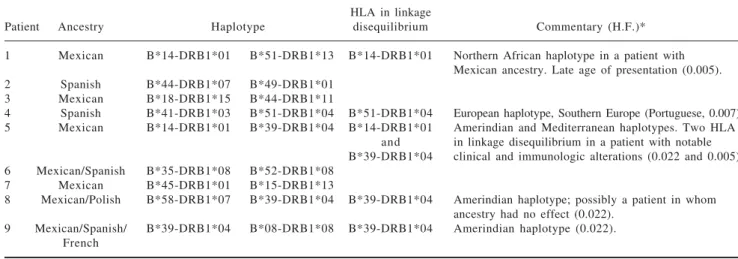
shows the ancestry and HLA
al-leles of the patients. The haplotype frequencies of
pa-tients are presented in
table III
and alleles in linkage
dis-equilibrium are presented in
table IV
.
Discussion
Comparison of the HLA haplotypes of nine Mexican
mestizo PBC cases with those of healthy controls showed
that the PBC patients had haplotypes of Caucasian
ori-gin, particularly Mediterranean, and of Amerindian and
Black origin. The most frequent alleles of the HLA-B
lo-cus were HLA-B*39, HLA-B*14, and HLA-B*51 and the
most frequent alleles of the DR locus were
HLA-DRB1*04 and HLA-DRB1*01. Linkage disequilibrium
of HLA-B/-DRB1 was detected for B*14/DRB1*01,
B*51/DRB1*04, and B*39/DRB1*04, which occurs in
populations in Southern Europe, Northern Africa, and
Central and South America.
These results indicate that the HLA-B*14/DRB1*01
haplotype is a marker for genetic susceptibility to PBC
and that its origin is probably Mediterranean. In contrast,
other studies have reported that haplotypes associated
with PBC belong to the HLA-DRB1*08 allele
fami-ly.
31,33,35,36,41It is noteworthy that this allele and those
found in the Mexican population have similar
geograph-ical origins (Southern Europe). This suggests that the
ge-netic background of PBC in Mexican mestizos is similar
to that in other populations,
1,41but involves a novel
link-age disequilibrium susceptibility marker. The possible
participation of the HLA-B*39/HLA-DRB1*04
haplo-type as an autochthonous marker in Mexicans is
indicat-ed because its frequency is relatively high in the mestizo
and indigenous populations and it is associated with
au-Table I. Blood metabolite levels and HLA alleles for PBC patients.
Glo-Pa- Sex Age Albumin bulin TB DB IB GGT AlkP
tient M/F (years) (g/dL) (g/dL) (mg/dL) (mg/dL)(mg/dL) (U/L) (U/L) ANA Titer Pattern AMA ASMA LKMA
1 F 8 1 3.71 3.6 3.18 1.98 1.2 302 453 – <1:40 * * – < 1:40 < 20.1
2 F 5 2 3.56 3.3 0.61 0.13 0.48 1008 369 + 1:640 Spotted + < 1:40 < 20.1 3 F 5 7 2.82 3.1 0.51 0.1 0.41 127 348 + >1:640 Spotted – < 1:40 <20.1
4 F 4 6 4.2 3.1 2.8 0.7 2.1 446 247 – <1:40 * * + < 1:20 < 20.1
5 F 5 8 3.52 3.2 1.77 0.81 0.96 1344 372 + 1:5120 Spotted – < 1:40 <20.1 6 F 5 9 3.75 3.9 1.09 0.31 0.78 284 239 – <1:40 * * + < 1:40 < 20.1
7 F 5 1 4.3 4.2 0.79 0.07 0.72 239 440 – <1:40 * * + < 1:40 < 20.1
8 M 6 5 3.38 3.2 1.24 0.3 0.94 2 0 9 4 – <1:40 * * + < 1:40 < 20.1
9 M 4 9 3.36 5.3 2.32 1.23 1.09 1247 565 + >1:640 Periphery + < 1:40 <20.1
Mean 57.5 3.6 3.6 1.59 0.62 0.96 557 347
± SD * * ± 10.5 ± 0.44 ± 0.72 ± 0.98 ± 0.63 ± 0.49 ± 503 ± 139
M – male, F – female, TB – total bilirubin, DB – direct bilirubin, IB – indirect bilirubin, AlkP – alkaline phosphatase, GGT – gammaglutamyl transpeptidase, ANA – antinuclear antibody, AMA – antimitochondrial antibody, ASMA – anti-smooth muscle antibody, LKMA – liver/kidney microsomal antibody, SD – standard deviation.
Table II. Ancestry and HLA alleles of patients.
Maternal Maternal Paternal Paternal Patient Maternal Paternal grandmother grandfather grandfather grandmother
origin origin origin origin origin origin HLA-B HLA-DR
1 Mexico Mexico Mexico Mexico Mexico Mexico B*14, B*51 *01, *13
2 Spain Spain Spain Spain Spain Spain B*44, B*49 *01, *07
3 Mexico Mexico Mexico Mexico Mexico Mexico B*18, B*44 *15, *11
4 Spain Spain Spain Spain Spain Spain B*41, B*51 *03, *04
5 Mexico Mexico Mexico Mexico Mexico Mexico B*14, B*39 *01, *04
6 Mexico Mexico Spain Spain Spain Spain B*35, B*52 *08, *08
7 Mexico Mexico Mexico Mexico Mexico Mexico B*15, B*45 *01, *13
8 Mexico Mexico Mexico Mexico Poland Poland B*39, B*58 *04, *07
9 Mexico Mexico Spain France Spain Spain B*08, B*39 *04, *08
G Vázquez-Elizondo et al. Human leukocyte antigens among primary biliary cirrhosis patients born in Mexico
www.medigraphic.com
toimmune diseases such as rheumatoid arthritis,
50-52rhu-pus,
53spondyloathropathies,
54Takayasu arthritis,
55and
systemic lupus erithrematosus.
56This haplotype is also
associated with nonautoimmune diseases such as
gall-stone disease,
57Chagas’ disease,
58and extrapulmonary
tuberculosis.
55The results of this study suggest that an autoimmune
mechanism is present in PBC. Molecular mimetism of
certain nuclear and mitochondrial proteins may be
re-sponsible for the development of autoimmunity and may
involve reactive cytotoxic T cells that express CD4 and
CD8 receptors and T cells that express the
αβ
receptor,
18which is directed against the lipoyl domain of the
pyru-vate dehydrogenase-complex family.
59-61PBC has a wide spectrum of manifestations, from
as-ymptomatic to cirrhosis. Few studies have addressed this
issue and have found several genes that could affect PBC
progression to late-stage cirrhosis, principally those
in-Table IV. Haplotypes in linkage disequilibrium among PBC patients.
HLA in linkage
Patient Ancestry Haplotype disequilibrium Commentary (H.F.)*
1 Mexican B*14-DRB1*01 B*51-DRB1*13 B*14-DRB1*01 Northern African haplotype in a patient with Mexican ancestry. Late age of presentation (0.005). 2 Spanish B*44-DRB1*07 B*49-DRB1*01
3 Mexican B*18-DRB1*15 B*44-DRB1*11
4 Spanish B*41-DRB1*03 B*51-DRB1*04 B*51-DRB1*04 European haplotype, Southern Europe (Portuguese, 0.007). 5 Mexican B*14-DRB1*01 B*39-DRB1*04 B*14-DRB1*01 Amerindian and Mediterranean haplotypes. Two HLA
and in linkage disequilibrium in a patient with notable B*39-DRB1*04 clinical and immunologic alterations (0.022 and 0.005). 6 Mexican/Spanish B*35-DRB1*08 B*52-DRB1*08
7 Mexican B*45-DRB1*01 B*15-DRB1*13
8 Mexican/Polish B*58-DRB1*07 B*39-DRB1*04 B*39-DRB1*04 Amerindian haplotype; possibly a patient in whom ancestry had no effect (0.022).
9 Mexican/Spanish/ B*39-DRB1*04 B*08-DRB1*08 B*39-DRB1*04 Amerindian haplotype (0.022). French
HF: haplotype frequency.
* Genetic frequency reported by Barquera et al.47
Table III. HLA-B and DRB1 frequencies in PBC patients and controls. Patients with
PBC Controls
n = 18 n = 762
n g.f. n g.f. p OR CI 95%
HLA-B
B*39 3 0.166 7 8 0.102 0.62 1.7 0.5–6.1
B*14 3 0.166 4 6 0.060 0.18 3.1 0.9–11.1
B*51 2 0.111 6 0 0.078 0.95 1.4 0.3–6.5
B*44 1 0.055 5 2 0.068 0.79 0.8 0.8–6.1
B*49 1 0.055 1 7 0.022 0.89 2.5 0.3–20.4
B*18 1 0.055 2 5 0.032 0.89 1.7 0.2–13.5
B*41 1 0.055 1 5 0.018 0.82 2.9 0.3–23.4
B*35 1 0.055 128 0.168 0.34 0.2 0.1–2.2
B*52 1 0.055 1 3 0.017 0.74 3.3 0.4–27.4
B*15 1 0.055 1 4 0.018 0.78 3.1 0.4–25.2
B*45 1 0.055 9 0.011 0.56 4.9 0.6–41
B*58 1 0.055 8 0.010 0.51 5.5 0.6–46.8
B*08 1 0.055 2 8 0.036 0.83 1.5 0.2–12
HLA-DRB1
*04 4 0.222 196 0.257 0.95 0.9 0.3–2.5
*01 4 0.222 6 2 0.081 0.09 3.2 1.1–10.1
*08 3 0.166 9 3 0.122 0.83 1.4 0.4–5.1
*07 2 0.111 6 9 0.090 0.90 1.3 0.3–5.5
*13 2 0.111 6 6 0.086 0.95 1.3 0.3–5.8
*15 1 0.055 4 5 0.059 0.65 0.9 0.1–7.2
*11 1 0.055 4 6 0.060 0.67 0.9 0.1–7
*03 1 0.055 5 5 0.072 0.85 0.8 0.1–5.7
www.medigraphic.com
ESTE DOCUMENTO ES ELABORADO POR
MEDI-GRAPHIC
volved in immune-response modulation.
31Furthermore, a
recent elegant study performed by
Pupon
et al
62has
dem-onstrated variations in genes involved in detoxification
processes via MDR1 transporter, such as ABCB1/ MDR1
and NR1L2/PXR could influence the severity of liver
disease and other affecting the response to
ursodeoxy-cholic acid, such as SLC4A2/AE2. In our study, one
pa-tient had elevated GGT and AlkP levels and a high
anti-nuclear antibody titer. This patient had two alleles in
linkage disequilibrium, one of Amerindian origin
(B*39-DRB1*04) and one of Southern European origin
(B*14-DRB1*01), and both contributed to the development of
PBC. This finding suggests that the amount of alleles in
disequilibrium in a patient constitutes a risk factor for
major clinical manifestations such as a high
concentra-tion of autoantibodies and an aggressive disease course.
This finding should be confirmed by studies involving
large numbers of patients.
In conclusion, Mexican patients with PBC are
geneti-cally susceptible to autoimmunity. Mexican mestizo
pa-tients with PBC are particularly prone to autoimmunity
because of autochthonous alleles (B39 and
HLA-B14) in combination with other alleles of Mediterranean
origin (HLA-DR1 and HLA-DR4). The genetic
heteroneity of PBC patients in this series suggests that their
ge-netic background is similar to that of other
popula-tions.
31,33,35,36,41,42,63Therefore, although these results were
obtained using Mexican mestizo patients, they may be
applicable to patients with Caucasoid ancestry.
References
1. Juran BD, Lazaridis KN. Genetics and genomics of primary bil-iary cirrhosis. Clin Liver Dis 2008; 12: 349-65; ix.
2. Ahrens EH, Jr., Payne MA, Kunkel HG, Eisenmenger WJ, Blondheim SH. Primary biliary cirrhosis. Medicine (Baltimore) 1950; 29: 299-364.
3. Kaplan MM, Gershwin ME. Primary biliary cirrhosis. N Engl J Med 2005; 353: 1261-73.
4. Kim WR, Lindor KD, Locke GR, 3rd, Therneau TM, Homburger HA, Batts KP, Yawn BP, Petz JL, Melton LJ, 3rd, Dickson ER. Epidemiology and natural history of primary biliary cirrhosis in a US community. Gastroenterology 2000; 119: 1631-6. 5. Mayo MJ. Natural history of primary biliary cirrhosis. Clin Liver
Dis 2008; 12: 277-88; viii.
6. Prince MI, Chetwynd A, Craig WL, Metcalf JV, James OF. As-ymptomatic primary biliary cirrhosis: clinical features, progno-sis, and symptom progression in a large population based cohort. Gut 2004; 53: 865-70.
7. Pares A, Rodes J. Natural history of primary biliary cirrhosis. Clin Liver Dis 2003; 7: 779-94.
8. Bergasa NV. Pruritus and fatigue in primary biliary cirrhosis. Clin Liver Dis 2003; 7: 879-900.
9. Muratori P, Muratori L, Ferrari R, Cassani F, Bianchi G, Lenzi M, Rodrigo L, Linares A, Fuentes D, Bianchi FB. Characterization and clinical impact of antinuclear antibodies in primary biliary cirrhosis. Am J Gastroenterol 2003; 98: 431-7.
10. Uddenfeldt P, Danielsson A. Evaluation of rheumatic disorders in patients with primary biliary cirrhosis. Ann Clin Res 1986; 18: 148-53.
11. Weetman AP. Non-thyroid autoantibodies in autoimmune thyroid disease. Best Pract Res Clin Endocrinol Metab 2005; 19: 17-32.
12. Tsianos EV, Hoofnagle JH, Fox PC, Alspaugh M, Jones EA, Schafer DF, Moutsopoulos HM. Sjogren’s syndrome in patients with primary biliary cirrhosis. Hepatology 1990; 11: 730-4. 13. Mayo MJ, Jenkins RN, Combes B, Lipsky PE. Association of clonally
expanded T cells with the syndrome of primary biliary cirrhosis and limited scleroderma. Hepatology 1999; 29: 1635-42. 14. Selmi C, Cocchi CA, Zuin M, Gershwin ME. The Chemical
Path-way to Primary Biliary Cirrhosis. Clin Rev Allergy Immunol. 2008 May 29; [Epub ahead of print].
15. Amano K, Leung PS, Rieger R, Quan C, Wang X, Marik J, Suen YF, Kurth MJ, Nantz MH, Ansari AA, Lam KS, Zeniya M, Matsuura E, Coppel RL, Gershwin ME. Chemical xenobiotics and mitochondrial autoantigens in primary biliary cirrhosis: iden-tification of antibodies against a common environmental, cos-metic, and food additive, 2-octynoic acid. J Immunol 2005; 174: 5874-83.
16. Costenbader KH, Karlson EW. Cigarette smoking and autoim-mune disease: what can we learn from epidemiology? Lupus 2006; 15: 737-45.
17. Gross RG, Odin JA. Recent advances in the epidemiology of primary biliary cirrhosis. Clin Liver Dis 2008; 12: 289-303; viii. 18. Lleo A, Invernizzi P, Mackay IR, Prince H, Zhong RQ, Gershwin ME. Etiopathogenesis of primary biliary cirrhosis. World J Gastroenterol 2008; 14: 3328-37.
19. Neuberger J. Antibodies and primary biliary cirrhosis-piecing together the jigsaw. J Hepatol 2002; 36: 126-9.
20. Lindor K. Ursodeoxycholic acid for the treatment of primary biliary cirrhosis. N Engl J Med 2007; 357: 1524-9.
21. Tanaka A, Borchers AT, Ishibashi H, Ansari AA, Keen CL, Gershwin ME. Genetic and familial considerations of primary biliary cirrhosis. Am J Gastroenterol 2001; 96: 8-15.
22. Selmi C, Mayo MJ, Bach N, Ishibashi H, Invernizzi P, Gish RG, Gordon SC, Wright HI, Zweiban B, Podda M, Gershwin ME. Primary biliary cirrhosis in monozygotic and dizygotic twins: genetics, epigenetics, and environment. Gastroenterology 2004; 127: 485-92.
23. Trowsdale J. HLA genomics in the third millennium. Curr Opin Immunol 2005; 17: 498-504.
24. Sundberg EJ, Deng L, Mariuzza RA. TCR recognition of pep-tide/MHC class II complexes and superantigens. Semin Immunol 2007; 19: 262-71.
25. Shimoda S, Nakamura M, Ishibashi H, Hayashida K, Niho Y. HLA DRB4 0101-restricted immunodominant T cell autoepitope of pyruvate dehydrogenase complex in primary biliary cirrhosis: evidence of molecular mimicry in human autoimmune diseases. J Exp Med 1995; 181: 1835-45.
26. Kita H, Matsumura S, He XS, Ansari AA, Lian ZX, Van de Water J, Coppel RL, Kaplan MM, Gershwin ME. Quantitative and func-tional analysis of PDC-E2-specific autoreactive cytotoxic T lym-phocytes in primary biliary cirrhosis. J Clin Invest 2002; 109: 1231-40.
27. Kita H, Naidenko OV, Kronenberg M, Ansari AA, Rogers P, He XS, Koning F, Mikayama T, Van De Water J, Coppel RL, Kaplan M, Gershwin ME. Quantitation and phenotypic analysis of natu-ral killer T cells in primary biliary cirrhosis using a human CD1d tetramer. Gastroenterology 2002; 123: 1031-43.
28. Migliaccio C, Van de Water J, Ansari AA, Kaplan MM, Coppel RL, Lam KS, Thompson RK, Stevenson F, Gershwin ME. Het-erogeneous response of antimitochondrial autoantibodies and bile duct apical staining monoclonal antibodies to pyruvate de-hydrogenase complex E2: the molecule versus the mimic. Hepatology 2001; 33: 792-801.
29. Charatcharoenwitthaya P, Lindor KD. Current concepts in the pathogenesis of primary biliary cirrhosis. Ann Hepatol 2005; 4: 161-75.
30. Talwalkar JA, Lindor KD. Primary biliary cirrhosis. Lancet 2003; 362: 53-61.
pri-G Vázquez-Elizondo et al. Human leukocyte antigens among primary biliary cirrhosis patients born in Mexico
www.medigraphic.com
mary biliary cirrhosis: a large-scale study. Hepatology 2006;44: 667-74.
32. Stone J, Wade JA, Cauch-Dudek K, Ng C, Lindor KD, Heathcote EJ. Human leukocyte antigen Class II associations in serum antimitochondrial antibodies (AMA)-positive and AMA-nega-tive primary biliary cirrhosis. J Hepatol 2002; 36: 8-13. 33. Mullarkey ME, Stevens AM, McDonnell WM, Loubiere LS,
Brackensick JA, Pang JM, Porter AJ, Galloway DA, Nelson JL. Human leukocyte antigen class II alleles in Caucasian women with primary biliary cirrhosis. Tissue Antigens 2005; 65: 199-205.
34. Begovich AB, Klitz W, Moonsamy PV, Van de Water J, Peltz G, Gershwin ME. Genes within the HLA class II region confer both predisposition and resistance to primary biliary cirrhosis. Tissue Antigens 1994; 43: 71-7.
35. Onishi S, Sakamaki T, Maeda T, Iwamura S, Tomita A, Saibara T, Yamamoto Y. DNA typing of HLA class II genes; DRB1*0803 increases the susceptibility of Japanese to primary biliary cirrho-sis. J Hepatol 1994; 21: 1053-60.
36. Wassmuth R, Depner F, Danielsson A, Hultcrantz R, Loof L, Olson R, Prytz H, Sandberg-Gertzen H, Wallerstedt S, Lindgren S. HLA class II markers and clinical heterogeneity in Swedish patients with primary biliary cirrhosis. Tissue Antigens 2002; 59: 381-7.
37. Miyamori H, Kato Y, Kobayashi K, Hattori N. HLA antigens in Japanese patients with primary biliary cirrhosis and autoimmune hepatitis. Digestion 1983; 26: 213-7.
38. Seki T, Kiyosawa K, Ota M, Furuta S, Fukushima H, Tanaka E, Yoshizawa K, Kumagai T, Mizuki N, Ando A, et al. Association of primary biliary cirrhosis with human leukocyte antigen DPB1*0501 in Japanese patients. Hepatology 1993; 18: 73-8. 39. Liu HY, Deng AM, Zhou Y, Yao DK, Xu DX, Zhong RQ.
Analy-sis of HLA alleles polymorphism in Chinese patients with pri-mary biliary cirrhosis. Hepatobiliary Pancreat Dis Int 2006; 5: 129-32.
40. Bittencourt PL, Palacios SA, Farias AQ, Abrantes-Lemos CP, Cancado EL, Carrilho FJ, Laudanna AA, Kalil J, Goldberg AC. Analysis of major histocompatibility complex and CTLA-4 alle-les in Brazilian patients with primary biliary cirrhosis. J Gastroenterol Hepatol 2003; 18: 1061-6.
41. Invernizzi P, Battezzati PM, Crosignani A, Perego F, Poli F, Morabito A, De Arias AE, Scalamogna M, Zuin M, Podda M. Peculiar HLA polymorphisms in Italian patients with primary biliary cirrhosis. J Hepatol 2003; 38: 401-6.
42. Invernizzi P SC, Poly F, et al. HLA DRB1 polymorphisms in 676 Italian patients with primary biliary cirrhosis and 2028 matched healthy controls. A nation-wide population based case-control study. Hepatology 2005; 42: 462A.
43. Méndez-Sánchez N, Villa AR, Zamora-Valdes D, Morales-Espinosa D, Uribe M. Worldwide mortality from cirrhosis. Ann Hepatol 2007; 6: 194-5.
44. SSA. Estadísticas de Mortalidad: Información Tabular. Volume 2008. Secretaría de Salud ed. Ciudad de México: Secretaría de Salud, 2005.
45. Méndez-Sánchez N, Villa AR, Chavez-Tapia NC, Ponciano-Rodriguez G, Almeda-Valdes P, Gonzalez D, Uribe M. Trends in liver disease prevalence in Mexico from 2005 to 2050 through mortality data. Ann Hepatol 2005; 4: 52-5.
46. Méndez-Sánchez N, Aguilar-Ramirez JR, Reyes A, Dehesa M, Juorez A, Castneda B, Sanchez-Avila F, Poo JL, Guevara Gonzalez L, Lizardi J, Valdovinos MA, Uribe M, Contreras AM, Tirado P, Aguirre J, Rivera-Benitez C, Santiago-Santiago R, Bosques-Padilla F, Munoz L, Guerroro A, Ramos M, Rodriguez-Hernandez H, Jacobo-Karam J. Etiology of liver cirrhosis in Mexico. Ann Hepatol 2004; 3: 30-3.
47. Barquera R, Zuniga J, Hernandez-Diaz R, Acuna-Alonzo V, Montoya-Gama K, Moscoso J, Torres-Garcia D, Garcia-Salas C,
Silva B, Cruz-Robles D, Arnaiz-Villena A, Vargas-Alarcon G, Granados J. HLA class I and class II haplotypes in admixed families from several regions of Mexico. Mol Immunol 2008; 45: 1171-8.
48. Davis RW, Thomas M, Cameron J, St John TP, Scherer S, Padgett RA. Rapid DNA isolations for enzymatic and hybridization analy-sis. Methods Enzymol 1980; 65: 404-11.
49. Bignon JD F-VM. International Histocompatibility Workshop for typing of HLA class II alleles by DNA amplification by poly-merase chain reaction (PCR) and hybridization with sequence specific oligonucleotide probes (SSOP). In: Charron D, ed. Ge-netic Diversity of HLA: Functional and Medical Implications. Volume 1. Paris, France: EDK, 1997: 584-95.
50. Delgado-Vega AM, Martin J, Granados J, Anaya JM. [Genetic epidemiology of rheumatoid arthritis: what to expect from Latin America?]. Biomedica 2006; 26: 562-84.
51. Delgado-Vega AM, Anaya JM. Meta-analysis of HLA-DRB1 polymorphism in Latin American patients with rheumatoid ar-thritis. Autoimmun Rev 2007; 6: 402-8.
52. Ruiz-Morales JA, Vargas-Alarcon G, Flores-Villanueva PO, Villarreal-Garza C, Hernandez-Pacheco G, Yamamoto-Furusho JK, Rodriguez-Perez JM, Perez-Hernandez N, Rull M, Cardiel MH, Granados J. HLA-DRB1 alleles encoding the «shared epitope» are associated with susceptibility to developing rheu-matoid arthritis whereas HLA-DRB1 alleles encoding an aspartic acid at position 70 of the beta-chain are protective in Mexican Mestizos. Hum Immunol 2004; 65: 262-9.
53. Simon JA, Granados J, Cabiedes J, Morales JR, Varela JA. Clini-cal and immunogenetic characterization of Mexican patients with ‘rhupus’. Lupus 2002; 11: 287-92.
54. Vargas-Alarcon G, Londono JD, Hernandez-Pacheco G, Pacheco-Tena C, Castillo E, Cardiel MH, Granados J, Burgos-Vargas R. Effect of HLA-B and HLA-DR genes on susceptibility to and severity of spondyloarthropathies in Mexican patients. Ann Rheum Dis 2002; 61: 714-7.
55. Soto ME, Vargas-Alarcon G, Cicero-Sabido R, Ramirez E, Alvarez-Leon E, Reyes PA. Comparison distribution of HLA-B alleles in mexican patients with Takayasu arteritis and tuberculo-sis. Hum Immunol 2007; 68: 449-53.
56. Granados J, Zuniga J, Acuna-Alonzo V, Rosetti F, Vargas-Alarcon G. [Influence of alleles and haplotypes of the main histocompat-ibility complex on the suscepthistocompat-ibility to systemic lupus erythemato-sus in the Mexican population]. Gac Med Mex 2006; 142: 195-9. 57. Méndez-Sánchez N, King-Martinez AC, Ramos MH, Pichardo-Bahena R, Uribe M. The Amerindian’s genes in the Mexican population are associated with development of gallstone disease. Am J Gastroenterol 2004; 99: 2166-70.
58. Cruz-Robles D, Reyes PA, Monteon-Padilla VM, Ortiz-Muniz AR, Vargas-Alarcon G. MHC class I and class II genes in Mexi-can patients with Chagas disease. Hum Immunol 2004; 65: 60-5. 59. Gershwin ME, Mackay IR, Sturgess A, Coppel RL. Identification and specificity of a cDNA encoding the 70 kd mitochondrial antigen recognized in primary biliary cirrhosis. J Immunol 1987; 138: 3525-31.
60. Yeaman SJ, Fussey SP, Danner DJ, James OF, Mutimer DJ, Bassendine MF. Primary biliary cirrhosis: identification of two major M2 mitochondrial autoantigens. Lancet 1988; 1: 1067-70. 61. Gershwin ME, Mackay IR. The causes of primary biliary cirrho-sis: Convenient and inconvenient truths. Hepatology 2008; 47: 737-45.
62. Poupon R, Ping C, Chretien Y, Corpechot C, Chazouilleres O, Simon T, Heath SC, Matsuda F, Poupon RE, Housset C, Barbu V. Genetic factors of susceptibility and of severity in primary biliary cirrhosis. J Hepatol 2008; 49: 1038-45.