Interaction of Gender and Hepatitis C
in Risk of Chronic Renal Failure After Liver Transplantation
Stephen Ip,* Trana Hussaini,** Aliya Daulat,** Nilufar Partovi,** Siegfried R. Erb,* Eric M. Yoshida,* Vladimir Marquez*
* Division of Gastroenterology, Department of Medicine, University of British Columbia, Vancouver, BC, Canada. ** Faculty of Pharmaceutical Sciences, University of British Columbia, Vancouver, BC, Canada.
March-April, Vol. 16 No. 2, 2017: 230-235
INTRODUCTION
Chronic renal failure (CRF) is a significant cause of morbidity and mortality in post-liver transplantation (LT) recipients, affecting graft function and survival. In one study, the 13-year survival rate in patients with end-stage renal disease after liver transplantation was 28.2% vs. 54.6% in those without kidney disease.1 In another study,
the risk of death increased by 4.55 in patients with occur-rence of CRF.2 The mechanisms causing this CRF may
relate to the development of diabetes mellitus (DM) post-transplantation3,4 and calcineurin-induced
nephro-toxicity.5,6 Previous studies have identified hepatitis C
(HCV) infection,2,7,8 pre-LT serum creatinine (CR),7,9
pre-LT diabetes mellitus (DM),2,7,8 pre-LT hypertension
(HTN),2 female gender,2,8,9 and age2,9 as risk factors. The
relationships of these factors are not clearly defined. Furthermore, Canadian data is lacking. The main objec-tive of this study was to examine the risk factors for the development of CRF in post-LT recipients of a major Canadian city.
MATERIAL AND METHODS
This study was approved by the Clinical Research Eth-ics Board of the University of British Columbia. Cases were identified from a cohort of all LT recipients at a sin-gle tertiary center (Vancouver General Hospital) from Jan-uary 2005 to December 2013. Those who were over the age of 18, with a first liver transplant, who survived 90 days post-LT and had an estimated glomerular filtration rate (eGFR) equal to or above 60 mL/min at the time of dis-charge were included in the study. The MDRD formula was used to calculate the eGFR. We excluded patients who had a prior liver transplant or more than one organ trans-planted, intrinsic renal disease (e.g. diabetic nephropathy or acute tubular necrosis), hepatorenal syndrome prior to liver transplant and acute kidney injury. The presence of intrinsic renal disease was based on the clinical history identified at the time of transplant assessment. CRF was defined as a sustained decrease in eGFR below 50 mL/min over 3 months. This eGFR value was selected as this is the value that is used in our center to substitute CNI based
The Official Journal of the Mexican Association of Hepatology, the Latin-American Association for Study of the Liver and
the Canadian Association for the Study of the Liver
Manuscript received: Manuscript received: Manuscript received: Manuscript received:
Manuscript received: April 27, 2016. Manuscript accepted:Manuscript accepted:Manuscript accepted:Manuscript accepted:Manuscript accepted: July 18, 2016.
DOI:10.5604/16652681.1231581. A B S T R A C T A B S T R A C T A B S T R A C T A B S T R A C T A B S T R A C T
Background. Background.Background. Background.
Background. Chronic renal failure (CRF) is a significant cause of morbidity and mortality in post-liver transplantation (LT) recipi-ents. The risk factors associated with the development of renal dysfunction are not clearly elucidated. Objectives. To examine the risk factors in the development of CRF in these patients. Material and methods.Material and methods.Material and methods.Material and methods.Material and methods. Retrospective case-cohort of liver transplant patients without baseline kidney dysfunction who developed chronic renal failure during their follow-up. Results. Results. Results. Results. Of 370 patients,Results. 254 met the inclusion criteria. 30% (76) of these patients had CRF of which 57% (43) were male. Age, estimated glomerular filtration rate (eGFR) at discharge, and HCV infection were found to be risk factors for CRF post-LT. The odds ratio of developing CRF was 1.4 (0.6-3.3) in males with HCV, 1.6 (0.7-3.9) in females without HCV and 4.4 (1.5-13.2) among females with HCV when compared to men without HCV. Conclusions. Conclusions. Conclusions. Conclusions. Conclusions. In this cohort of LT receipients of a major Canadian city, age, eGFR, and HCV infection were risk factors for CRF. Female gender and HCV increased this odds by a factor of more than 4.
Key words Key wordsKey words Key words
immunosuppression to sirolimus and it represents the stage 3 of chronic kidney disease according to the K/ DOQI guidelines.10 All our patients with progressive
CKD after transplant were assessed for possibility of pre-renal disease and proteinuria. They were also referred to a nephrologist for evaluation and it was based on their indi-vidual assessment that a diagnosis of CNI induced kidney injury was concluded.
Clinical information including age, gender, reason for LT, donor type, comorbidities (diabetes mellitus and hy-pertension), type of immunosuppression (CNI, myco-phenolate mofetil, azathioprine) as well as average CNI levels during follow-up were recorded. Diabetes melli-tus was defined as use of insulin or any other hypoglyc-emic agent during follow-up. Hypertension was defined as use of an anti-hypertensive agent during follow-up.
Patients in the cohort were followed until they reached the pre-defined outcome of chronic renal failure or the end of follow-up period which was set at May 1, 2014.
Cases were patients who developed CRF and controls were all the other patients in the cohort who have not de-veloped CRF at the end of the study. Potential pre-de-fined exposures that would increase the risk of CRF were analyzed and included age, gender, presence of diabetes, presence of hypertension, hepatitis C infection as an un-derlying disease, mean CNI levels during follow-up and the eGFR at the time of discharge. Only a minority of pa-tients with hepatitis C in this cohort were treated after their transplant.
Statistical analysis
Continuous variables were presented as means with standard deviations or medians with IQR when appropri-ate. Categorical variables were presented as proportions. Student t-test for was used for comparison of normally distributed variables and the Mann-Whitney U test for non-parametric data. Categorical variables were compared using Pearson's χ2 test or Fisher's exact test when
appro-priate.
A logistic regression model was performed to identify independent predictors of CRF adjusting for pre-set varia-bles that included patient age, history of hypertension, his-tory of diabetes, nephrotoxic medications, maintenance immunosuppression and average trough CNI levels. Re-sults are presented as odds-ratios with their 95% confi-dence interval. All statistical analyses were performed using Stata 11.2 (StataCorp, College Station, Texas).
RESULTS
Of 370 patients identified that were transplanted during the study period, 254 met the inclusion criteria.
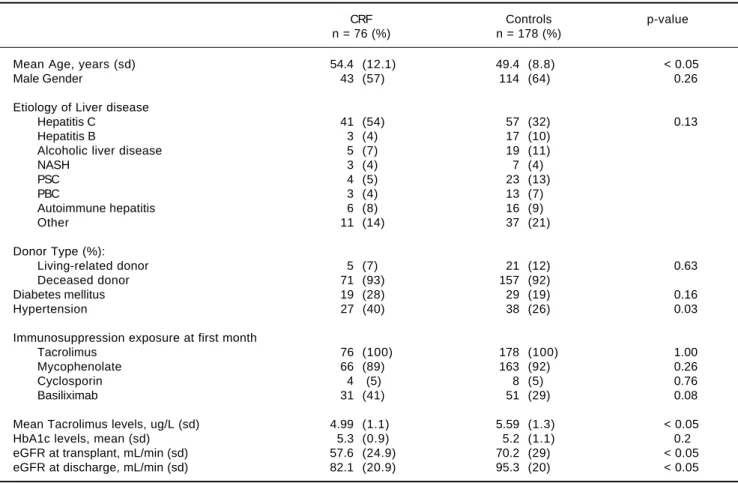
Seventy-six (30%) patients developed post-LT CRF during their follow-up. Table 1 shows the demographic characteristics of the post-LT CRF patients as well as the control popula-tion. The median age at transplant was 54.4 years in the CRF group compared to 49.4 years in the control group. Gender was similar to in both groups. HCV was the most common reason for LT in both groups, but HCV was more common in the CRF group when compared to the control group (54% vs. 32%, p < 0.01). No differences were found when the type of donor was compared (de-ceased vs. living donor). Prevalence of diabetes mellitus was similar in both groups as well, but hypertension was more prevalent in the CRF group (40% vs. 26%, p = 0.03). During the first month after transplant all patients were exposed to tacrolimus, 5.2% of CRF patients vs 4.5% were exposed to cyclosporine; 86.8% of CRF patients vs. 92.1% were exposed to mycophenolate, all patients except for one in the CRF group received steroids. There was a non-statistical significant difference in the exposure to basilixi-mab (40.1% in CRF group vs. 28.8% in controls). Finally, both groups had similar exposure to antithymocyte-globu-lin (3.4% in CRF vs. 5.2% in controls) in the first month after transplant.
Maintenance immunosuppression consisted mainly of a combination of tacrolimus and mycophenolate mofetil. Patients in the CRF group had lower mean through levels of tacrolimus (5 ng/mL vs. 5.59 ng/mL, mean difference 0.6, 95% CI 0.26-0.93). No differences in the mean hemo-globin A1c between two groups was identified (5.3% in CRF vs. 5.2% in controls).
On the day of transplant, the eGFR was lower in the CRF cases (57.6 mL/min) than in the controls (70.2 mL/ min) with a mean difference of 12.4 mL/min (95% CI 5.04-20.03). Despite an improvement at the day of discharge, CRF patients continued to have a lower eGFR (82.1 mL/ min) than controls (95.3 mL/min) with a mean difference of 13.2 mL/min (95% CI 7.5-18.9).
Predictors of CRF
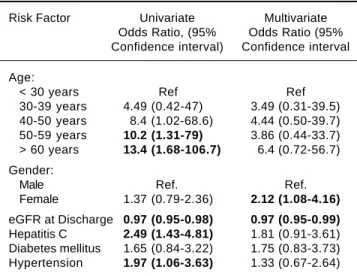
were associated with an increased odds of developing CRF. The odds of CRF also increased for each age group when compared to the younger group. Gender and diabe-tes were not associated with increased odds of CRF. The results are summarized in table 2.
We ran a multivariate analysis using the same variables, except for mean tacrolimus levels and including an inter-action term between gender and diagnosis of HCV. In this model, the higher eGFR at discharge was still associ-ated with a decreased odds of CRF (0.97, 95% CI 0.95-0.98). Interestingly, while the effect remained stable on most variables, we noted a change in the strength and di-rection of the effect for HCV and gender suggesting an in-teraction between the two variables or effect modification (Table 2). There was no difference in the eGFR at dis-charge between men and women (91.6 vs. 91.0 mL/min re-spectively) or HCV infected an non-infected patients (88.1 vs. 93.4 mL/min, difference 5.3; 95% CI -0.04-10.71). Therefore, we proceeded to a repeat analysis introducing an interaction term between gender and HCV infection. When compared to males without HCV infection, males with HCV infection (OR 1.4, 95% CI 0.6-3.31) and
fe-males without HCV infection (OR 1.6, 95% CI 0.66-3.86) had an increased, but statistically not-significant odds of developing CRF. However, females with HCV infection, compared to males without HCV infection had a higher odds of CRF (OR 4.42, 95% CI-1.48-13.2). The expected joint effect of HCV and gender in a multiplicative scale was 2.25 (1.6 multiplied by 1.4), therefore at 4.42 the inter-action between gender and HCV was supermultiplicative. In this model, increasing age groups, diabetes and hyper-tension were not statistically significant. The results are summarized in table 3.
DISCUSSION
In this cohort of LT recipients in a major Canadian city, we found that gender, lower eGFR at discharge, and HCV infection were risk factors for developing post-LT CRF. To our knowledge, this is the first study to report a multi-plicative effect of female gender and HCV for post-LT CRF.
The risk factors we found in our study were compara-ble to previous studies. Ojo and colleagues studied nearly Table 1. Demographic characteristics of post-liver transplantation chronic renal failure (CRF) and control populations.
CRF Controls p-value
n = 76 (%) n = 178 (%)
Mean Age, years (sd) 54.4 (12.1) 49.4 (8.8) < 0.05
Male Gender 43 (57) 114 (64) 0.26
Etiology of Liver disease
Hepatitis C 41 (54) 57 (32) 0.13
Hepatitis B 3 (4) 17 (10)
Alcoholic liver disease 5 (7) 19 (11)
NASH 3 (4) 7 (4)
PSC 4 (5) 23 (13)
PBC 3 (4) 13 (7)
Autoimmune hepatitis 6 (8) 16 (9)
Other 11 (14) 37 (21)
Donor Type (%):
Living-related donor 5 (7) 21 (12) 0.63
Deceased donor 71 (93) 157 (92)
Diabetes mellitus 19 (28) 29 (19) 0.16
Hypertension 27 (40) 38 (26) 0.03
Immunosuppression exposure at first month
Tacrolimus 76 (100) 178 (100) 1.00
Mycophenolate 66 (89) 163 (92) 0.26
Cyclosporin 4 (5) 8 (5) 0.76
Basiliximab 31 (41) 51 (29) 0.08
Mean Tacrolimus levels, ug/L (sd) 4.99 (1.1) 5.59 (1.3) < 0.05
HbA1c levels, mean (sd) 5.3 (0.9) 5.2 (1.1) 0.2
eGFR at transplant, mL/min (sd) 57.6 (24.9) 70.2 (29) < 0.05
eGFR at discharge, mL/min (sd) 82.1 (20.9) 95.3 (20) < 0.05
70,000 patients with nonrenal transplantation of which 36,489 received a LT. These investigators found that age, female gender, HCV, pre-LT HTN, and pre-LT DM were risk factors for the development of CRF.2 Similarly,
a Swiss study of 406 patients with LT found that HCV and pre-LT CR were independent risk factors for CRF7while
an Australian study of 130 patients with LT showed that HCV, female gender, and pre-LT DM were risk factors.8
A recent German study by Weismuller and colleagues pro-posed a “pocket guide” to identify patients at risk of CRF post-LT.11 They demonstrated that pre-LT eGFR, age,
pre-LT DM, HCV, and PSC as risk factors.
In our study, we did not find that presence of hyper-tension or diabetes were risk factors as other studies when adjusted for age, gender, liver disease and eGFR at the time of discharge. Diabetes and hypertension were defined in this study as the use of any medication to treat these condi-tions. It is possible that this definition may not have been enough sensitive leading to misclassification of exposure. We did look at average HbA1c levels during follow-up and we did not find a difference in average levels between.
In the univariate analysis, mean tacrolimus levels were associated with risk of CRF. Patients with CRF had lower average tacrolimus levels during the length of follow-up. This likely reflects that patients in which a declining kid-ney function was observed were given lower doses of tac-rolimus to preserve their kidney function and not due to a protective effect of tacrolimus. For this reason, we did not include tacrolimus levels in our final multivariate model.
Interestingly, we found a multiplicative effect of female gender and HCV on post-LT CRF. Female patients with HCV had higher odds of developing CRF than males without HCV, females without HCV and males with HCV. The observed combined effect was greater than the individual effects of gender and hepatitis C. This was not explained by a lower eGFR in women with HCV or by differences in kidney function or MELD score in women within our cohort at the time of transplant. The exact mechanism for this is unclear. It has been suggested that renal injury due to HCV is related to deposition of im-mune complexes containing HCV proteins, anti-HCV an-tibodies, and rheumatoid factor immunoglobulin M with anti-immunoglobulin G activity.12 Perhaps, gender plays a
role in the interaction of these factors. Further studies would be necessary to examine this relationship.
The relevance of our study may be challenged in the era of highly effective therapy for HCV. However, in our study we did not assess the association of fibrosis stage on the progression of CKD. It is possible, however, that the observed findings are reflective of the presence of HCV, irrespectively of the severity of the fibrosis especially giv-en that few, if any, of our patigiv-ents would have had decom-pensated cirrhosis that is often associated with renal dysfunction (ie. acute kidney injury, hepatorenal syn-drome etc.). The significance of renal dysfunction second-ary to HCV post transplant is potentially clinically important as the traditional surrogate markers for the initi-ation of treatment are liver fibrosis and not renal function. Access to DAA remains challenging and many programs (and third party payers), including ours, will not reim-burse these treatments unless some degree of fibrosis is present given the high acquisition costs of the current anti-viral drugs. Our findings, suggest that HCV post-trans-plant affects renal function, especially in women, and therefore may be a clinical indication for anti-HCV thera-Table 3. Multivariate logistic regression of factors associated
with CRF, including an interaction term between gender and hep-atitis C infection.
Risk Factor Odds Ratio,
(95% Confidence Interval)
Age
< 30 years Ref.
30-39 years 3.16 (0.28-35.9)
40-50 years 4.32 (0.49-38.4)
50-59 years 3.67 (0.42-31.9)
> 60 years 6.14 (0.70-54.2)
Gender with HCV interaction term
Males without HCV Ref.
Males with HCV 1.37 (0.79-2.36)
Females without HCV 1.60 (0.66-3.86)
Females with HCV 4.42 (1.48-13.2)
eGFR at Discharge 0.97 (0.95-0.99)
Diabetes Mellitus 1.67 (0.78-3.57)
Hypertension 1.34 (0.67-2.67)
eGFR: estimated glomerular filtration rate. HCV: hepatitis C virus.
Table 2. Univariate logistic regression analysis of risk factors for post-liver transplantation chronic renal failure.
Risk Factor Univariate Multivariate
Odds Ratio, (95% Odds Ratio (95% Confidence interval) Confidence interval
Age:
< 30 years Ref Ref
30-39 years 4.49 (0.42-47) 3.49 (0.31-39.5)
40-50 years 8.4 (1.02-68.6) 4.44 (0.50-39.7)
50-59 years 10.2 (1.31-79) 3.86 (0.44-33.7)
> 60 years 13.4 (1.68-106.7) 6.4 (0.72-56.7)
Gender:
Male Ref. Ref.
Female 1.37 (0.79-2.36) 2.12 (1.08-4.16)
eGFR at Discharge 0.97 (0.95-0.98) 0.97 (0.95-0.99)
Hepatitis C 2.49 (1.43-4.81) 1.81 (0.91-3.61)
Diabetes mellitus 1.65 (0.84-3.22) 1.75 (0.83-3.73)
Hypertension 1.97 (1.06-3.63) 1.33 (0.67-2.64)
py with the expensive new agents. Indeed, a recent na-tional Canadian post-liver transplant study has reported that renal function improved in the majority of patients who successfully eradicated HCV with the new direct act-ing antiviral agents.13 Therefore, hypothetically, women
with HCV and F1 fibrosis may not be treated and still have the increased odds of progression of CKD, an unfortunate clinical circumstance that is potentially avoidable. It is therefore important to recognize this possibility and adapt target levels of CNI to minimize risk and consider early antiviral therapy.
A strength of this study was the relatively large sample study of Canadian patients. Cases and controls were taken from the same study base and selection bias was limited. There were no patients excluded from the study because of missing data. We used a pre-defined set of variables in our analysis to minimize the risk of spurious findings from over-testing. We were able to demonstrate a multi-plicative effect of gender and HCV that, to our knowl-edge, has not been previously reported.
Our study has several limitations that should be noted. It is a retrospective case-cohort study and as such we can only show association and not causation. Our study does not provide an a priori hypothesis for a biological mecha-nism to explain our findings. However, like all clinical studies that investigate associations between disease enti-ties and clinical variables, our study was not designed to provide a definitive pathophysiologic answer and further future studies, based on our hypothesis generation, will be needed. We do note that other database studies have hint-ed at similar associations also without providing a biologi-cal mechanism. This suggests to us that our findings are not spurious. The majority of our patients were on a cal-cineurin inhibitor, thus it is unknown if the same effect will be observed in patients under a different imunosu-pression regimen. We did not have data on eradication of HCV after transplant and it is therefore possible that pa-tients continued to be labeled as HCV when in fact they were no longer infected, introducing information bias from misclassification of exposure. However, the study period is set at an era where only a small minority of pa-tients were able to achieve post-transplant sustained viral response because effective medications were lacking (ie. interferon-free direct acting antiviral agents). Finally, it is possible that the observed effect is a spurious finding al-though given the strength of the association, we feel that this is less likely.
The results of this study should be validated with larger cohorts and if confirmed a search for a biological explana-tion should follow. Minimizaexplana-tion of CNI doses in at-risk individuals would preserve renal function, improve graft survival, and decrease mortality. Our findings do suggest that patients with HCV infection post-liver transplant,
es-pecially females, should be given consideration for antivi-ral treatment, regardless of liver fibrosis score, that is the traditional determinant of the need for therapy.
CONCLUSIONS
In this cohort of LT recipients of a major Canadian city, age, eGFR, and HCV infection were risk factors for cal-cineurin inhibitor related CRF. Female gender and HCV increased these odds by a factor of more than 4.
REFERENCES
1. Bahirwani R, Reddy KR. Outcomes after liver transplanta-tion: chronic kidney disease. Liver Transpl 2009: 15 Suppl. 2: S70-4. doi: 10.1002/lt.21900.
2. Ojo AO, Held PJ, Port FK, Wolfe RA, Leichtman AB, Young EW, Ardonfer J, et al. Chronic renal failure after transplanta-tion of a nonrenal organ. N Engl J Med 2003:349:931-40. doi: 10.1056/NEJMoa021744.
3. Khalili M, Lim JW, Bass N, Ascher NL, Roberts JP, Terrault NA. New onset diabetes mellitus after liver transplantation: the critical role of hepatitis C infection. Liver Transpl
2004:10:349-55. doi: 10.1002/lt.20092.
4. Mehta SH, Brancati FL, Sulkowski MS, Strathdee SA, Szklo M, Thomas DL. Prevalence of type 2 diabetes mellitus among persons with hepatitis C virus infection in the United States.
Ann Intern Med 2000: 133: 592-9.
5. Campbell MS, Rai J, Kozin E, Bloom RD, Markmann JF, Olthoff KM, Saked A, et al. Effects of sirolimus vs. calcineurin inhibi-tors on renal dysfunction after orthotopic liver transplanta-tion. Clin Transplant 2007: 21: 377-84. doi: 10.1111/ j.1399-0012.2006.00653.x.
6. Farkas SA, Schnitzbauer AA, Kirchner G, Obed A, Banas B, Schlitt HJ. Calcineurin inhibitor minimization protocols in liver transplantation. Transpl Int 2009: 22: 49-60. doi: 10.1111/ j.1432-2277.2008.00796.x.
7. Burra P, Senzolo M, Masier A, Prestete H, Jones R, Samuel D, Villamil F. Factors influencing renal function after liver transplantation. Results from the MOST, an international ob-servational study. Dig Liver Dis 2009: 41: 350-6. doi: 10.1016/j.dld.2008.09.018.
8. Ramachandran J, Juneja R, John L, Dutta AK, Chen JW, Woodman RJ, Wigg AJ. Chronic kidney disease following liv-er transplantation: a South Australian expliv-erience. Trans-plant Proc 2010: 42: 3644-6. doi: 10.1016/j.transproceed. 2010.06.022.
9. O'Riordan A, Wong V, McCormick PA, Hegarty JE, Watson AJ. Chronic kidney disease post-liver transplantation. Nephrol Dial Transplant 2006: 21: 2630-6. doi: 10.1093/ndt/gfl247. 10. K/DOQI clinical practice guidelines for chronic kidney
dis-ease: evaluation, classification, and stratification. Am J Kid-ney Dis 2002: 39: S1-266.
11. Weismuller TJ, Lerch C, Evangelidou E, Strassburg CP, Leh-ner F, Schrem H, Klempnauer J, et al. A pocket guide to identify patients at risk for chronic kidney disease after liver transplantation. Transpl Int 2015: 28: 519-28. doi: 10.1111/ tri.12522.
13. Faisal N, Renner, EL, Bilodeau M, Aljudaibi B, Hirsch G, Yoshida EM, Hussaini T, et al. Impact of Sofosbuvir-Based Regimens on Renal Function in Liver Transplant Recipients: Results of a Multicenter Study. Hepatology 2015: 62 (Sup-pl.): 312-313A (abstract).
Correspondence and reprint request: Vladimir Marquez, MDCM, M.Sc.
Division of Gastroenterology, Diamond Health Care Center 5153-2775 Laurel Street