Anuario de Psicología/The UB Journal of Psychology
2013, vol. 43, nº 1, 53-66 © 2013, Facultat de Psicologia Universitat de Barcelona
The role of pointing in the immediate and displaced
references in early mother-child communication
*Mercedes Amparo Muñetón Ayala
1María José Rodrigo López
21
Universidad de Antioquía, Colombia
2Universidad de La Laguna
This study longitudinally explores how mothers and children use and combine pointing and verbal references to objects that are either present or absent in space. Over one year of observations and in five separate sessions, eight Spanish mothers and their 1- and 2-year-old babies were observed while perfor-ming daily routines at home. Overall, both mothers and children used the imme-diate reference more than the displaced reference. Children were less likely to pair pointing with speech in displaced situations than in present situations; in-stead, they seemed more likely to refer to absent objects using only speech. Mo-thers, while still are more likely to point in present situations rather than in dis-placed ones, did use pointing + speech combinations more often than their chil-dren in displaced situations. Overall, mother and child production of immediate and displaced references across ages were strongly correlated suggesting a new facet of ‘motherese’ for the early development of referential production.
Keywords: Pointing, immediate and displaced reference, mother-child multimodal communication.
El rol del gesto del señalamiento en referencias inmediatas y
desplazadas en la comunicación temprana entre madre e hijo/a
En este estudio se examinó longitudinalmente cómo las madres y los niños usan y combinan el gesto de señalamiento con las referencias verbales para indicar objetos presentes y ausentes en el espacio. Durante un año se observaron
*
Acknowledgements: This research was supported by funding from the Spanish Ministry of Science and Innovation (TRA2009_0145) to the second author. We thank the families for their kind cooperation and ongoing support during the data collection.
54 Pointing in referential communication
Anuario de Psicología/The UB Journal of Psychology, vol. 43, nº 1, abril 2013, pp. 53-66 © 2013, Universitat de Barcelona, Facultat de Psicologia cuatro niños de 1 año y cuatro niños de 2 años de edad en situaciones interac-tivas con sus madres en el hogar. En general, las madres y los niños usaron más la referencia inmediata que la aplazada. Los niños mostraron una menor probabilidad de combinar el gesto de señalamiento con referencias verbales hacia objetos ausentes que a los presentes; parece que tienden más a referirse a los objetos ausentes mediante solo las producciones verbales. Las madres aunque también tienden a señalar más a los objetos presentes que a los ausen-tes, combinaron el gesto de señalamiento con producciones verbales en más ocasiones que sus niños para referirse a objetos ausentes. En general la estre-cha correspondencia en la producción de referencias immediates y desplaza-das en la madre y el niño en las diferentes edades sugiere una nueva faceta de “maternés” para el desarrollo temprano de la producción referencial.
Palabras clave: gesto de señalamiento, referencia inmediata y despla-zada, comunicación multimodal madre-hijo.
Introduction
In this study we focussed on the role of pointing plus speech combinations in an important linguistic transition: From the use of immediate to displaced refer-ence during the second and third years of life. The ability to refer to and convey information about absent objects and events is an essential feature of the human language that helps to enlarge the representational space (Hockett, 1960). Another important related question addressed in this study was to what extent the mother developmentally adapts to the child’s combined use of gestural and verbal means to refer to immediate or absent entities.
M.A. Muñetón Ayala y M.J. Rodrigo López 55
Anuario de Psicología/The UB Journal of Psychology, vol. 43, nº 1, abril 2013, pp. 53-66 © 2013, Universitat de Barcelona, Facultat de Psicologia
studies have shown that children begin to use words to refer to absent objects and people at about 18 months of age (Veneziano & Sinclair, 1995). Nevertheless, there is no direct evidence of a child’s spontaneous production of pointing plus speech combinations in the use of displaced referents.
Mothers would appear to actively support their child’s immediate gestural and verbal references, a facet of ‘motherese’ or child-directed speech that has received little attention (Gallaway & Richards, 1994). Thus, the child’s pointing to present objects is supported by verbal input from the mother (e.g., where is it?) as well as by verbal responses in which the mother names the object (Butterworth & Morissette, 1996; Harris, Barlow-Brown, & Chasin, 1995). Mother and child speech was also found to be related to the production of pointing gestures in mothers and children, indicating a clear co-evolution in the production of verbal and gestural means (Iverson, Capirci, Longobardi, & Caselli, 1999; Rodrigo et al.,
2005). The presence and manipulation of the referred object also matters in mothers’ verbal referencing of objects (Gogate, Bahrick, & Watson, 2000). Thus, the naming of objects that are under infants’ manipulation would seem to facilitate the learning of new words (Tamis-Lemonda & Bornstein, 1989). In addition, mothers would appear to play an important role in supporting their child’s displaced reference by naming objects outside their immediate temporal and spatial context (Harris, Jones, & Grant, 1983). Parents initiated displaced communication more often when talking about distal events (Morford & Goldin-Meadow, 1997). However, none of the reviewed studies have provided direct evidence of the mother’s spon-taneous production of pointing plus speech combinations in the use of displaced referents in natural environments.
In this study we undertake a longitudinal comparison of the use by mothers and children from 1 year to 3 years old of verbal and gestural references to objects that are either present or absent during the performing of everyday routines. A comparison was made of the percentage of utterances produced corresponding to the following four categories of verbal reference: To an object currently under action, to an object not currently under action, to a partially absent object and to a totally absent object. Based on these comparisons, we examined whether the dis-tribution of these categories of verbal reference was similar for mothers and chil-dren. We also examined the developmental trends in the child’s use of immediate and displaced references. We expected that younger children aged 1 to 2 would be less able to use the displaced reference than older children aged 2 to 3. As for the mothers, we expected to find a similar developmental trend as a signal of a mother-child co-development of verbal reference.
56 Pointing in referential communication
Anuario de Psicología/The UB Journal of Psychology, vol. 43, nº 1, abril 2013, pp. 53-66 © 2013, Universitat de Barcelona, Facultat de Psicologia reference, given the early emergence of pointing + speech combinations and the early presence of pointing to absent entities. According to the second hypothesis, children would be less inclined to use pointing + speech combinations in situa-tions involving displaced objects because it is more difficult to them to under-stand how to refer to something that is not present using combined means. In both cases, we expected that the mother would developmentally adapt to the child’s combined use of gestural and verbal means to refer to immediate or absent enti-ties, mirroring or preceding the child’s referential production giving their support-ive role. Finally, the referential acts were studied during naturalistic observations of everyday routines performed at home where the likelihood is great to observe both combined and single uses of verbal references and pointing gestures across many instances of mother-child communication.
Method
Participants and Procedure
Four 1-year-old infants and their mothers (the younger group) and four 2- year-old children and their mothers (the older group) were followed for 12 months. The mean age of the children in Group 1 was 12.4 months (SD = 0.2) and the mean age of children in Group 2 was 24.3 months (SD = 0.1) at the time of first observation session. None of the children exhibited any abnormalities in cognitive development. All children were first-born, and all had mothers (Mage= 29, range: 26–34 years, for both groups) with a university education and socioec-onomic status ranging from medium to high. Four children had mothers who worked outside the home, and four children had mothers working at home (half in each age group). Table 1 gives each child’s gender, the age period studied, the number of home sessions, the total number of videotaped minutes and the number of utterances produced containing verbal references, whether accompanied or not by a pointing gesture. The total observation time was 14.3 hours for Group 1 and 14.2 hours for Group 2.
TABLE 1.COMPARATIVE DATA ON THE CHILDREN AND THE MOTHERS.
Note. Abreviations refers to the names of the children.
Child Mother
Age period Sex Number of sessions
Total time
Utterances with pointing
Utterances without pointing
Utterances with pointing
Utterances without pointing Child
PA 12 to 24 F 5 220’ 18 147 161 354
LA 12 to 24 F 5 186’ 5 89 137 1274
JP 12 to 24 M 5 185’ 7 54 77 900
CA 12 to 24 M 5 271’ 5 120 185 1418
PC 24 to 36 F 5 141’ 60 1271 1343 3906
CR 24 to 36 M 5 271’ 88 464 547 1051
58 Pointing in referential communication
Anuario de Psicología/The UB Journal of Psychology, vol. 43, nº 1, abril 2013, pp. 53-66 © 2013, Universitat de Barcelona, Facultat de Psicologia
Data Coding
A transcription was made from the videotapes of the flow of verbal and ges-tural interactions observed during play, bath and dinner routines for each dyad and at each age-point. The transcriptions preserved the sequence of production of utterances by mother and child and included information about the speaker who had initiated the interaction, any vocalizations or speech, the occurrence of a pointing gesture, the occurrence of a manipulative action involving an object or person being referred to, and the occurrence of a manipulative action involving an object or person not being referred to. We did not classify the utterances for grammatical complexity, as we were only interested in the referential production, but utterances varied from simple utterances (child says child says “agua, agua” [`water, water´] while bathing) to complex utterances including more than one verb (mother says “mientras se llena el baño con agua, quédate aquí y quítate la camisa” [`While the bath is being filled with water, stay here and take off your shirt’]). In the case of complex utterances, we subdivided the utterances into several clauses, with each one including a subject, a main verb, and a referred object/ person/event. When the utterance was not comprehensible, brackets were placed around it in the transcription.
For the gestural reference, the production of pointing gestures was recorded in the transcription. A pointing gesture was defined as an outstretched arm with the index finger extended toward an object or a person. As part of the flow of interactions, an indication that a pointing gesture had been produced was inserted into the transcription within the corresponding utterance; this enabled us to further analyze the mother and child utterances accompanied or not by a pointing gesture.
Coding of references
We classified all utterances searching for instances of immediate and dis-placed reference. A disdis-placed reference was defined as any utterance that directed the interlocutor’s attention toward some information that was not perceptible in the environment of the communicators (Hockett, 1960). Four categories, two im-mediate and two displaced, were created to classify utterances according to their spatial reference to objects or persons:
M.A. Muñetón Ayala y M.J. Rodrigo López 59
Anuario de Psicología/The UB Journal of Psychology, vol. 43, nº 1, abril 2013, pp. 53-66 © 2013, Universitat de Barcelona, Facultat de Psicologia
2. Reference to an object/person that was not currently under manipulation (not currently under action); that is, the object being referred to was present, but the speaker was manipulating another object/person (the mother says “te gusta el coche?” [‘do you like the car?’], while she is bathing the baby; the child says “hay gallinas” [‘there are hens’] while he/she is holding a car).
3. Reference to an object/person that was partially absent; that is, it was not present but was partially perceptible (the mother says “escucha los pájaros can-tando” [‘listen to the birds singing’], while the bird was not present but the sin-ging could be heard; the child says, looking at a picture of the father “papi” [‘Daddy’]).
4. Reference to an object/person that was totally absent, that is, it was not present (the mother says “el señor del supermercado fue muy amable” [‘the man in the supermarket was very nice’] and he was not present; the child says “dame la chupa” [‘give me the pacifier’] though it was not present).
Reliability
Two independent coders rated all the home sessions for each dyad and the utterances with and without pointing across the different ages. Inter-rater reliabili-ties (Kappa coefficient) for all utterances were: .89 (Group 1) and .90 (Group 2). Inter-rater reliabilities for the four categories of reference were: .89 (objects cur-rently under action), .84 (objects not curcur-rently under action), .83 (partially absent objects), .85 (totally absent objects), respectively.
Results
TABLE 2.NUMBER OF OCCURRENCES AND PERCENTAGE (IN BRACKETS) FOR THE FOUR TYPES OF REFERENCE, BY GROUP, SESSION, CHILD AND MOTHER.
With Pointing Without pointing
Current action Non-current action Partially absent Absent Current action Non-current action Partially absent Absent
Group1
Child
Session 1 0 0 0 0 4 (0.89) 3 (0.67) 0 0
Session 2 3 (0.67) 0 0 0 12 (2.69) 3 (0.67) 2 (0.44) 0
Session 3 2 (0.45) 3 (0.67) 0 0 27 (6.06) 20 (4.50) 3 (0.67) 6 (1.34)
Session 4 13 (2.92) 2 (0.45) 0 1 (0.22) 63 (14.16) 35 (7.86) 1 (0.22) 21 (4.72)
Session 5 7 (1.57) 2 (0.45) 0 2 (0.45) 99 (22.24) 78 (17.52) 3 (0.67) 30 (6.74)
Mother
Session 1 23 (0.51) 6 (0.13) 0 0 392 (8.70) 299 (6.63) 19 (0.42) 57 (1.26)
Session 2 22 (0.48) 4 (0.08) 2 (0.04) 0 210 (4.66) 104 (2.30) 6 (0.13) 26 (0.58)
Session 3 45 (1.0) 32 (0.71) 7 (0.15) 6 (0.13) 358 (7.94) 352 (7.81) 18 (0.39) 49 (1.09)
Session 4 88 (1.95) 49 (1.08) 2 (0.04) 22 (0.49) 583 (12.94) 413 (9.16) 23 (0.51) 71 (1.57)
Session 5 127 (2.81) 87 (1.93) 8 (0.18) 30 (0.66) 466 (10.34) 353 (7.83) 55 (1.22) 92 (2.04)
Group2
Child
Session 1 26 (0.53) 30 (0.61) 5 (0.10) 0 458 (9.31) 715 (14.54) 36 (0.73) 52 (1.06)
Session 2 21 (0.42) 32 (0.65) 3 (0.06) 1 (0.02) 245 (4.98) 601 (12.22) 23 (0.47) 60 (1.22)
Session 3 30 (0.61) 23 (0.47) 4 (0.08) 0 193 (3.92) 253 (5.14) 36 (0.73) 40 (0.81)
Session 4 48 (0.97) 29 (0.58) 0 1 (0.02) 332 (6.75) 420 (8.54) 7 (0.14) 29 (0.59)
Session 5 54 (1.10) 26 (0.53) 22 (0.45) 0 534 (10.86) 432 (8.78) 82 (1.66) 14 (0.28)
Mother
Session 1 477 (2.92) 742 (4.55) 36 (0.22) 53 (0.32) 950 (5.83) 1723 (10.58) 76 (0.46) 108 (0.66)
Session 2 281 (1.72) 643 (3.94) 29 (0.17) 62 (0.38) 615 (3.77) 1320 (8.10) 67 (0.41) 201 (1.23)
Session 3 231 (1.41) 302 (1.85) 44 (0.27) 40 (0.24) 411 (2.52) 855 (5.25) 69 (0.42) 172 (1.05)
Session 4 379 (2.32) 468 (2.87) 7 (0.04) 32 (0.19) 710 (4.35) 1160 (7.12) 16 (0.09) 103 (0.63)
M.A. Muñetón Ayala y M.J. Rodrigo López 61
Anuario de Psicología/The UB Journal of Psychology, vol. 43, nº 1, abril 2013, pp. 53-66 © 2013, Universitat de Barcelona, Facultat de Psicologia
Concerning the emergence of immediate references, when pointing was pre-sent the child’s first reference to an object currently under action was in session 2 (15 months), whereas the child’s first reference to an object not currently under action was in session 3 (18 months). When pointing was not present, younger children were also able to produce immediate references to objects (whether they were being manipulated or not by the speaker) from session 1 (12 months). Moth-ers produced immediate references from the first session under both conditions (pointing and not pointing). The use of immediate references to objects was very robust, as it appeared to be stable or gradually increased throughout the following sessions (from 2 onward) in both mothers and children, under the two conditions.
Concerning the emergence of displaced spatial references in utterances with pointing, children did not refer in this way to partially absent objects at any ses-sion from 12 to 24 months, and there were only three occases-sions in total of this form of reference to totally absent objects, in sessions 4 and 5 (21 and 24 months). For example, at 21 months the child said “papi” (daddy) and pointed outward. Mothers started to use utterances with pointing to refer to partially absent objects in session 2 at 15 months and to totally absent objects in session 3 at month 18, increasing their use at 21 and 24 months. When pointing was not present, younger children started to refer to partially absent objects in session 2 at 15 months and to totally absent objects in session 3 at 18 months of age, whereas mothers used this form of displaced reference starting from the first session. Thus, there was a delay in the child’s onset of displaced reference with respect of that of the mother’s under both conditions (with and without pointing). From 24 months onward, the child’s use of displaced reference in utterances with pointing remained at a very low level (with the exception of the last session at 36 months where they produced 22 instances for partially absent objects), whereas it steadily increased throughout the sessions when a pointing gesture was not present. In the following example, at 27 months the child said “amon” (he wanted to say “jamón” [ham]) and the child pointed the refrigerator. During the same time period, mothers’ use of displaced reference remained quite stable, with some variations across sessions under both conditions, indicating that the mother was able to use pointing + speech combinations when referred to displaced objects. For example, at 21 months mother said “Paco se enfada porque lo gritas” (“Paco is angry because you shout him out”), mother pointed outward and Paco was not present.
Group comparisons
62 Pointing in referential communication
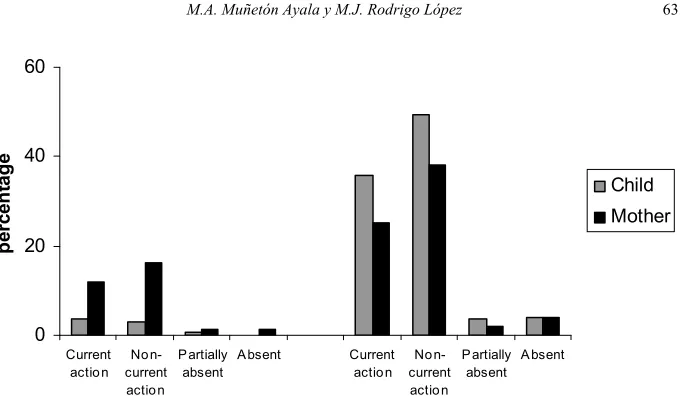
Anuario de Psicología/The UB Journal of Psychology, vol. 43, nº 1, abril 2013, pp. 53-66 © 2013, Universitat de Barcelona, Facultat de Psicologia independently of the age groups and mother/child variables. The results showed that participants usually referred more often to objects that were present than to objects that were out of sight spatially as well as to partially absent objects, re-gardless of the presence or not of a pointing gesture. In the utterances with point-ing, objects currently under action were more frequently referred to than partially absent objects, t(15) = 5.28, p = .001 ; and totally absent objects, t(15) = 5.37, p <
.001. Likewise, objects not currently under action were more frequently referred to than partially absent objects, t(15) = 2.98, p = .009; and totally absent objects,
t(15) = 2.83, p = .013. In the utterances without pointing, objects currently under action were more frequently referred to than partially absent objects, t(15) = 5.60, p = .001; and totally absent objects , t(15) = 5.33, p = .001. Objects not currently under action were more frequently referred to than partially absent objects, t(15) = 6.24, p = .001; and totally absent objects, t(15) = 5.26, p = .001.
Second, mother and child production of the four categories of reference for both groups were compared for Group 1 and Group 2 separately. In Group 1, mothers referred to partially absentobjects significantly more often than children,
[image:10.468.50.416.346.548.2]t(6) = -2.5, p = .042; in utterances with pointing. In Group 2, mothers referred to objects currently under actionsignificantly more often than children, t(6) = -3.52, p = .012; in utterances with pointing. Therefore the pattern of spatial reference was remarkably similar in mothers and children.
Figure 1. Percentage of categories of references included in utterances with and without point-ing in Group 1 (percentages are calculated with respect to the total number of utterances).
0 20 40 60
Current actio n
No n-current actio n
P artially absent
A bsent Current actio n
No n-current actio n
P artially absent
A bsent
pe
rc
e
n
ta
ge
Child
Mother Without pointing
M.A. Muñetón Ayala y M.J. Rodrigo López 63
[image:11.468.76.418.61.266.2]Anuario de Psicología/The UB Journal of Psychology, vol. 43, nº 1, abril 2013, pp. 53-66 © 2013, Universitat de Barcelona, Facultat de Psicologia
Figure 2. Percentage of categories of spatial references included in utterances with and without pointing in Group 2 (percentages are calculated with respect to the total number of utterances).
Mother/child correlation of category of reference
A set of Spearman rank-order correlations was computed across the ten ob-servation points spanning the two age groups (data from the percentages of the four mothers and the four children at each observation point were accumulated). Mother and child production of categories of reference were significantly corre-lated across all observation points, indicating that the use of immediate and dis-placed spatial references follows a similar trend for mother and child (table 3). In addition, mothers’ references to partially absent objects were significantly corre-lated to children’s references to objects not currently under action.
TABLE 3. SPEARMAN RANK-ORDER CORRELATIONS BETWEEN MOTHER AND CHILD CATEGORIES OF REFERENCE IN THE TOTAL AMOUNT OF UTTERANCES.
Note .*p< .05. **p< .01.
Child
Mother Current action Non-current action Partially absent Totally Absent
Current action .68** .267 -.49 .43
Non-current action .61 .77** .33 .47
Partially absent .52 .65* .80** .44
Totally Absent .25 .27 -.19 .74**
0 20 40 60
Current actio n
No n-current actio n
P artially absent
A bsent Current
actio n No n-current actio n
P artially absent
A bsent
p
er
cen
ta
g
e
Child
[image:11.468.51.426.475.587.2]64 Pointing in referential communication
Anuario de Psicología/The UB Journal of Psychology, vol. 43, nº 1, abril 2013, pp. 53-66 © 2013, Universitat de Barcelona, Facultat de Psicologia Discussion
The present study longitudinally compared mothers and their children from 12 to 36 months of age with respect to their use of verbal and gestural references to objects, during the performing of everyday routines. Overall, children and mothers showed a sustained level of communication (26.153 utterances in 28.5 hours of recording). Mothers and children produced fewer utterances accompa-nied by a pointing gesture than utterances without pointing (26.8% and 7.3%, respectively), indicating that pointing + speech combinations represented 34.1% of all mother-child communication recorded in this study. This is congruent with previous research showing the presence of these combinations in the early stages of language development (e.g., Capirci et al., 1996; Rodrigo et al., 2004).
Both mothers and children used the immediate reference more than the dis-placed reference, as could be expected in communicative acts that take place during the realization of routines with objects. Children started to produce immediate reference from very early on either accompanied or not by a pointing. Mothers started referring verbally to objects that were present from the first session (12 months) either with or without pointing. In children’s utterances accompanied by a pointing gesture, verbal reference to an object currently under action was ob-served earlier (at 15 months) than reference to an object not currently under action (which appeared at 18 months), indicating a facilitation effect of concurrent action with the pointing + speech combination at the younger ages. Mothers also tended to refer relatively more often to objects under manipulation at 12 and 15 months in utterances with pointing, suggesting that the child’s ability to manipulate ob-jects increases the likelihood of this object being referred to (Gogate et al., 2000; Iverson, 2010).
M.A. Muñetón Ayala y M.J. Rodrigo López 65
Anuario de Psicología/The UB Journal of Psychology, vol. 43, nº 1, abril 2013, pp. 53-66 © 2013, Universitat de Barcelona, Facultat de Psicologia
scaffolding this developmental trend. This is congruent with our second hypothe-sis that proposes that children would be less inclined to use pointing + speech combinations in situations involving displaced objects because it is more difficult to them to understand how to refer to something that is not present using com-bined means.
Although mothers could easily refer to absent objects, group comparisons indicated that their pattern of reference was remarkably to that of children, sug-gesting that mothers did not exceed the child’s capacities in using displaced spa-tial references. Results from correlational analyses also showed the mother-child developmental correspondence in the production of immediate and displaced ref-erences, indicating that mothers systematically engage their children in talking about both the immediate and absent objects.
In conclusion, the child’s use of pointing + speech combinations from very early on was associated to the specification of the reference to those objects at the immediate surroundings, as suggested in previous studies (e.g., Rodrigo et al.,
2004). Our results also show that the child’s use of pointing for displaced refer-ence from 12 months of age reported by Liszkowski et al. (2007) in laboratory conditions is not observed in natural situations where there are many visible tar-gets to select and there is a need to coordinate the use of gestural and verbal means to converge to the same absent target. Finally, the present results support the idea that ‘motherese’ includes not only specific ways to address children, but also a dynamic mother-child alignment of referential processes performed during gestural and verbal mother-child communication, which facilitates the joint grounding of meaning either to present or absent entities.
REFERENCES
Butterworth, G., & Morissette, P. (1996). Onset of pointing and the acquisition of language in infancy.
Journal of Reproductive and Infant Psychology, 14, 219–231.
Capirci, O., Iverson, J. M., Pizzuto, E., & Volterra, V. (1996). Gestures and words during the transi-tion to two-word speech. Journal of Child Language, 23, 645–673.
Gallaway, C., & Richards, B. J. (1994). Input and interaction in language acquisition. Cambridge, UK: Cambridge University Press.
Ganea, P.A. (2005). Contextual factors affect absent reference comprehension in 14-month-olds.
Child Development, 76, 989 – 998.
Gogate, L. J., Bahrick, L. E., & Watson, J. D. (2000). A study of multimodal motherese: The role of temporal synchrony between verbal labels and gestures. Child Development, 71, 878–894. Harris, M., Barlow-Brown, F., & Chasin, J. (1995). The emergence of referential understanding:
Pointing and the comprehension of object names. First Language, 15, 19–34.
Harris, M., Jones, D., & Grant, J. (1983). The nonverbal context of mothers’ speech to infants. First Language, 4, 21-30.
66 Pointing in referential communication
Anuario de Psicología/The UB Journal of Psychology, vol. 43, nº 1, abril 2013, pp. 53-66 © 2013, Universitat de Barcelona, Facultat de Psicologia
Iverson, J.M. (2010). Developing language in a developing body: The relationship between motor development and language development. Journal of Child Language, 37, 229-261.
Iverson J.M, Capirci O., Longobardi E., & Caselli M.C. (1999). Gesturing in mother–child interac-tions. Cognitive Development,14, 57–75.
Liszkowski, U., Schäfer, M., Carpenter, M., & Tomasello, M. (2009). Prelinguistic infants, but not chimpanzees, communicate about absent entities. Psychological Science, 20, 654–660. Liszkowski, U., Carpenter, M., & Tomasello, M. (2007). Pointing out new news, old news, and
absent referents at 12 months of age. Developmental Science, 10, 1–7.
Morford, M., & Goldin-Meadow, S. (1992). Comprehension and production of gesture in combina-tion with speech in one-word speakers. Journal of Child Language, 19, 559–580. http://dx.doi.org/10.1017/S0305000900011569
Morford, J.P., & Goldin-Meadow, S. (1997). From here and now to now and then: The development of displaced reference in homesign and English. Child Development, 68, 420–435. http://dx.doi.org/10.1111%2Fj.1467-8624.1997.tb01949.x
Rodrigo, M. J., González, A., de Vega, M., Muñeton-Ayala M., & Rodríguez, G. (2004). From gestural to verbal deixis: A longitudinal study with Spanish infants and toddlers. First Lan-guage, 24, 71-90.
Rodrigo, M. J., González, A., Ato, M., Rodríguez, G., de Vega, M., & Muñeton-Ayala, M. (2005). Co-development of child–mother gestures over the second and the third years. Infant and Child Development, 14, 1-17.
Sachs, J. (1983). Talking about the there and then: The emergence of displaced reference in parent-child discourse. In K. E. Nelson (Ed.), Children’s Language. Hillsdale, NJ: Erlbaum. Tamis-LeMonda C.S., & Bornstein M.H. (1989). Habituation and maternal encouragement of
atten-tion in infancy as predictors of toddler language, play, and representaatten-tional competence. Child Development, 60, 738–751.
P.V.P.: 14€ (I.V.A. incluido)
Artículos
M. Rus-Calafell, J. Gutiérrez-Maldonado y N. Frerich
Schizotypy, Alexithymia and Affect as predictors of Facial Emotion Recognition Capability using static and dynamic images
Raquel Surià Martínez Análisis comparativo de la fortaleza en padres de hijos con discapacidad en función de la tipología y la etapa en la que se adquiere la discapacidad
María Jesús Carrera-Fernández, Joan Guàrdia-Olmos
y Maribel Peró-Cebollero Psicología y lenguaje en política: los candidatos a la Presidencia del Gobierno y su estilo lingüístico
Mercedes Amparo Muñetón Ayala y María José Rodrigo López
The role of pointing in the
immediate and displaced references in early mother-child communication
Antoni Hernández-Fernández y Faustino Diéguez-Vide
La ley de Zipf y la detección de la evolución verbal en la enfermedad de Alzheimer
José Cabrera Sánchez y René Gallardo Vergara
Psicopatía y apego en los reclusos de una cárcel chilena
Laia Mas-Expósito, Juan Antonio Amador-Campos, Juana Gómez- Benito y Lluís Lalucat-Jo
Review of psychotherapeutic interventions for persons with schizophrenia
Marcos López Hernández-Ardieta
Tratamiento psicológico de la impulsividad desde la perspectiva de las terapias de conducta de tercera generación. A propósito de un caso