Optimization
Alina Orellana - Gabriela Minetti
Laboratorio de Investigaci´on en Sistemas Inteligentes Universidad Nacional de La Pampa
Rep´ublica Argentina
[email protected] - [email protected]
No Institute Given
Abstract. Metaheuristics based on swarm intelligence simulate the be-havior of a biological social system like as a flock of birds or a swarm of bees, and they have achieved important advances for solving optimiza-tion problems. In this paper, we propose a variant for a particular kind of those metaheurisitcs: Particle Swarm Optimization (PSO). This mod-ification arises after discovering a low rate of convergence produced by a high level of dispersal at the swarm. Finally, we analyzed and compared the results obtained by an original PSO algorithm and our proposal. From those, we can see the improvement obtained by our variant since it allows to explore more the search space.
1
Introduction
Metaheuristics are high level strategies that use different methods for exploring search spaces and solving problems. Some metaheuristics are known as trajectory methods, since they perform a trajectory in the search space and their main char-acteristic is they work with only one solution by iteration. Other metaheuristics are based on population (a set of solutions at time), they are inspired in differ-ent social or biological processes. Particularly we work with the Particle Swarm Optimization (PSO) metaheuristic which is an important area of the Swarm Intelligence, [1, 2].
Those methods reproduce the behavior of real swarms or insect colonies, that is they act as intelligent social organizations. In other words, the richness of these models is accentuated on the high level of social organization, the structural composition of individuals, the ability to adapt to environmental changes and provide operational continuity when one or more elements fail individually. Such social behavior defines movements of the decision variables in the search space and guiding to optimal solutions.
movement, which alters the particle throughout the process, instead of evolu-tionary operators.
The particles need to maintain a minimum distance between them throughout the process. Besides, each individual should avoid an excessive distance to the rest of the group. In this way, the individual particle will be attracted to others, thus avoiding being alone and giving rise to different neighborhoods depending on the strength of attraction.
Like most metaheuristics based on population, PSO presents some drawbacks in their original version. That led to researchers to propose small changes to the configuration of its different parameters, giving rise to several alternative models of PSO [4]. Furthermore, noteworthy several hybrid versions of PSO have been developed. In order to do that different functions for updating position and ve-locity vectors, different procedure of particle selection to retrieve information for the social component, dynamic updates of parameters, incorporation of opera-tors and different procedures of swarm initialization have been evaluated and used [5, 6, 7].
Since the mid ’90s to the present, PSO has been used to solve a wide range of problems. For example: single-objective, multi-objective, engineering problems, among others [8, 9, 10].
In this paper, we show the behavior of an original binary PSO to optimize functions. After to study the strengths and weaknesses of PSO, we propose a new version which incorporates features from other metaheuristics. Particularly we use characteristics of GAs and CHC (Cross generational elitist selection, Het-erogeneous recombination, and Cataclysmic mutation)a special kind of GAs [11]. Both PSO versions are evaluated considering four optimization functions, which represent many optimization problems. We try to provide empirical evidence for the practical usefulness of this metaheuristic.
The rest of this article is organized as follows. The next describes the original PSOs. Section 3 introduces and explains our proposal. The section 4 introduces the optimization functions used to test the PSO algorithms. In section 5 the experiments and discussions of their results are shown. Finally, the last section concludes and provides hints on further research.
2
Particle Swarm Optimization and binary codification
As we said above, for PSO, each individual is a particle (pi) and the population is
a swarm of particles (S). For each particle, the following attributes are identified: a current position (Xi), a current velocity (Vi), the best position achieved so far
by each particle (pBesti), and the best solution found so far by its neighbors
(gBesti).
The PSO algorithm starts generating random position and velocity vectors for each particle. After that, those vectors are updated according to the following functions:
Vi=W∗Vi+ϑ1∗r1∗(pBesti−Xi) +ϑ2∗r2∗(gBesti−Xi) (1)
Algorithm 1PSOo
S←initializeSwarm() whilenot stop conditiondo
fori= 0; i< size(S);i+ +do
iff itness(Xi) is better thanf itness(pBesti)then
pBesti←Xi
f itness(pBesti)←f itness(Xi)
end if
iff itness(pBesti) is better thanf itness(gBesti)then
gBesti←pBesti
f itness(gBesti)←f itness(pBesti);
end if end for
//derivation0
fori= 0;i < size(S);i+ +do
Vi←W∗Vi+ϑ1∗r1∗(pBesti−Xi) +ϑ2∗r2∗(gBesti−Xi)
Xi←Xi+Vi
Xi←(4 +Xi)mod2
Vi←(3 +Vi)mod3−1
end for end while
Where W is the inertia weight [12] that regulates the impact of previous ve-locity vector on the new vector. ϑ1 is a coefficient that controls the knowledge component (ϑ1 ∗r1∗(pBesti −Xi). This component measures the influence
of the knowledge obtained by a particle (its best position) for calculating its new velocity vector. While the ϑ2 coefficient controls to the social component (ϑ2∗r2∗(gBesti−Xi) which measures the influence of the best position obtained
by all particles for calculating the new velocity vector of a given particle. r1 y r2 are random values in the range [0..1].
The origins of PSO are based on a continuous codification, due to its nature for using operations on gradients. However, there are adjustments to the binary encoding and permutations of integers [1, 13, 14]. In [14] the authors present a first adaptation for a binary PSO. Where the position vector is encoded as a binary string; meanwhile the velocity vector is real. This new version of PSO uses the same functions to update the velocity vector than the basic algorithm (see Eq. 1). In order to determine the probabilities for the computation of the position vector, a sigmoid function is used that maps a velocity value onto the interval [0,1]. With this adaptation a lot of information is lost and the binary PSO performance is low in many cases. Clerc in [13] achieves a better performance to incorporate a new method for computing the position vector:derivation 0. Where the normalization is done using the modular arithmetic; thus less information is lost. We use the Clerc’s implementation to develop this work. In the Algorithm 1 a PSO pseudo code with binary codification and derivation 0 is shown, henceforth we call this version PSOo.
3
Our proposal
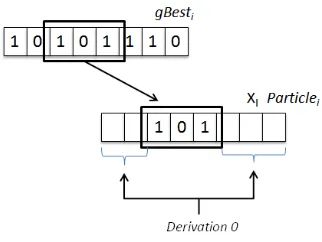
Fig. 1.Social Crossover Operator
and an elitist restart operator that allows to explore new regions of the search space. The idea behind this adaptation is to achieve a balance between ex-ploration and exploitation of the search process since the PSOo shows a very disperse swarm at the end obtaining low quality results.
The crossover operator is one of the main operators of the Genetic Algorithms [3]. It combines genetic material from two or more individuals (called parents) to produce new individuals (called children). Particularly for PSOh, we propose a new crossover operator which is called Social Crossover (SX). SX copies a position vector fragment from the current global best solution (gBesti) into the
position vector of a given particle. Such fragment is copied in the same place from which is extracted and its size is random (see Fig. 1). For generating the rest of the particle, we use the derivation 0 method. In this way significant information is transferred from the best particle during the search process. This allows: the exploitation of promising regions of the search space, an important social influence on a new particle and a faster convergence to the optimum.
While the restart procedure arises from CHC [11] where the population is restarted keeping the best individual when a population stagnation is detected. Note that, for CHC, this procedure replaced the mutation operator to provide a further exploration of the search space. Particularly for PSOh, we propose an elitist restart operator which, restarts a population proportion (20%) keeping the best particle. The idea behind this operator is to avoid: the particle swarm becomes homogeneous and convergence to be local optimum.
For each iteration, PSOh executes the following actions (see Algorithm 2):
1. Update the components of position and velocity vectors using derivation 0
Algorithm 2PSOh
S←initializeSwarm() whilenot stop conditiondo
fori= 0; i< size(S);i+ +do
iff itness(Xi) is better than fitness(pBesti)then
pBesti←Xi
end if
iff itness(pBesti) is better thanf itness(gBesti)then
gBesti←pBesti
f itness(gBesti)←f itness(pBesti)
end if end for
fori= 0; i< size(S);i+ +do ifrand(0,1)<0.8then
pos1←rand(0, size(Xi)−1)
pos2←rand(0, size(Xi)−1)
ifpos1> pos2then
toExchange(pos1, pos2) end if
j←0
while(j >= 0 &&j <=pos1)||(j >=pos2 &&j < size(Xi))do
ifj==pos1then
j←pos2 end if
//Derivation0
Vi←W∗Vi+ϑ1∗r1∗(pBesti−Xi) +ϑ2∗r2∗(gBesti−Xi)
Xi←Xi+Vi
Xi←(4 +Xi)mod2
Vi←(3 +Vi)mod3−1
j←j+ 1 end while
//CrossoverOperator
forj=pos1;pos1< pos2;j+ +do
Xi←gBesti
end for else
//ElitistRestartOperator
ifXi6=gBestthen
forj= 0;j < size(S);j+ +do
Xi←rand(0,1)
end for end if end if end for end while
4
Test Functions
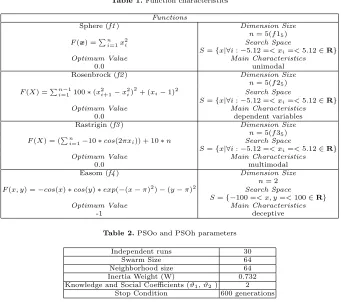
In this paper, we use four different optimization functions to analyze the above mentioned metaheuristic; they are: Sphere function (f1), Rosenbrock function (f2), Rastrigin function (f3), Easom function (f4). Those functions have been chosen since they represent real problems and belong to a function set which is used to study many optimization methods. All these functions are mapped in Rn→R. The characteristics of each function are shown in Table 1.
5
Computational Experiments
differ-Table 1.Function characteristics
Functions
Sphere (f1) Dimension Size
n= 5(f15)
F(x) =Pni
=1x 2
i Search Space
S={x|∀i:−5.12 =< xi=<5.12∈R}
Optimum Value Main Characteristics
0.0 unimodal
Rosenbrock (f2) Dimension Size
n= 5(f25)
F(X) =Pn−1
i=1 100∗(x 2
i+1−x 2
i)
2
+ (xi−1)2 Search Space
S={x|∀i:−5.12 =< xi=<5.12∈R}
Optimum Value Main Characteristics
0.0 dependent variables
Rastrigin (f3) Dimension Size
n= 5(f35)
F(X) = (Pni=1−10∗cos(2πxi)) + 10∗n Search Space
S={x|∀i:−5.12 =< xi=<5.12∈R}
Optimum Value Main Characteristics
0.0 multimodal
Easom (f4) Dimension Size
n= 2
F(x, y) =−cos(x)∗cos(y)∗exp(−(x−π)2
)−(y−π)2
Search Space
S={−100 =< x, y=<100∈R}
Optimum Value Main Characteristics
-1 deceptive
Table 2.PSOo and PSOh parameters
Independent runs 30
Swarm Size 64
Neighborhood size 64 Inertia Weight (W) 0.732 Knowledge and Social Coefficients (ϑ1,ϑ2) 2
Stop Condition 600 generations
ent complexity degrees due to their characteristics (unimodal, multimodal and deceptive) and dimensions (2D and 5D). These functions are:f15,f25,f35,f42. PSOo and PSOh algorithms were executed using the MALLBA software [15], which was created by research group from Malaga, La Laguna and Barcelona Universities. For each algorithmic setting we have performed 30 independent runs per function and we use an Intel Centrino duo processor with 1.73 Ghz and 1 GB of RAM.
As we said in previous sections, the position vector is a binary string where 24 bits encode a real value. Therefore, for a search space of 5 dimensions, the position vector of each particle has 120 bits and for 2 dimensions it has 56 bits. Some parametric values (swarm size, neighborhood size, stop condition) have been optimized through hand-tuning comparing different values and others pa-rameters (inertia weight, knowledge and social coefficients) are taken from the literature. In Table 2 are summarized those values.
We use the following relevant performance variables to analyze the behavior of each algorithm:
– ABest (Average Best).This value is the average of the best solutions found by each algorithmic version in each run.
[image:6.612.138.479.118.420.2]Table 3.PSOo and PSOh Results
PSOo
Functions Abest Best AbestI Apop AbestT
f15 0.709±0.23 0.116 280.067 42.906±17.25 569.959
f25 48.572±25.06 20.055 281.300 58687.08±39657.66 551.941
f35 12.323±2.32 7.809 337.733 92.862±22.67 682.738
f42 −0.622±0.25 -0.974 306.567 0±0 135.459
PSOh
f15 0.157±0.08 0.039 304.80 43.274±43 291.390
f25 22.471±27.21 3.533 367.23 58941.776±133857.79 293.817
f35 6.853±4.43 1.905 285.23 93.149±33.99 214.105
[image:7.612.136.479.111.376.2]f42 −0.973±0.04 -1.000 316.67 0±0.01 64.613
[image:7.612.255.358.402.457.2]Fig. 2.PSOo and PSOh AbestT values Fig. 3. PSOo and PSOh average entropy values every 20 iterations
Table 4.PSOo and PSOh average entropy values
Average Entropy Funci´on PSOo PSOh
f15 0.904 0.856
f25 0.900 0.850
f35 0.896 0.835
f42 0.909 0.851
– ABestI (Average Best Iteration).It is an average of the iterations which were necessary to find the Best value.
– ABestT (Average Best Time).It is the average time (in seconds) that the algorithm takes to find the best value.
– Entropy.The entropy measure is used to understand how the particles are different from each other. This measure is in the interval [0,1]. If the swarm entropy is close to 1, then the particles will be different. Otherwise if it is close to 0, particles will be similar, i.e., the genotypic diversity will be null or almost null.
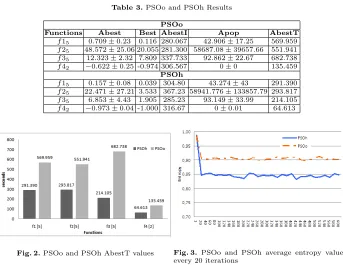
In Table 3 the results obtained by PSOo and PSOh are detailed. In Figure 2, PSOo and PSOh performances are compared taking into account the four different search spaces that were used for testing. While in Table 4 the average entropy values corresponding to final populations are summarized.
From an analysis of Tables 3 and Figure 2, we can observe:
Noteworthy PSOo only is closed to the optimum when it solvesf42. While PSOh is closed to the optimum when it solvesf15, f25 and f34 functions and it reaches the optimum forf42.
– In average our proposed algorithm reduces the execution time to find the best solution in a 54%. Although both algorithmic approaches need approx-imately 310 iterations to find their best solution. This difference is also cor-roborated using at−studentTest where ap−value= 0.0003 is lesser than α= 0.05.
– The final populations obtained by PSOo and PSOh algorithms have diverse solutions when these algorithms solvef15,f25andf35functions. In Evolu-tionary Computation this kind of diversity is calledphenotypic diversity.
From Table 4, we can analyze if the particle composition in the final popu-lation is diverse or not. That is calledgenotypic diversity and it is measured for the entropy variable. This diversity is almost total (0.9 in average) when PSOo solves every function. This means that the particles in the final swarm are very dispersing and PSOo algorithm has many difficulties to converge. While PSOh obtains final swarms with lesser genotypic diversity (0.8) converging to better solutions faster. This improvement is achieved by applying social crossover and elitist restart operators. This crossover operator guides the search towards better solutions i.e., it helps the exploitation. While the elitist restart operator allows to explore the search space keeping the diversity in a swarm whose size is rela-tively small. In this way, PSOh presents a better balance between exploitation and exploration than PSOo.
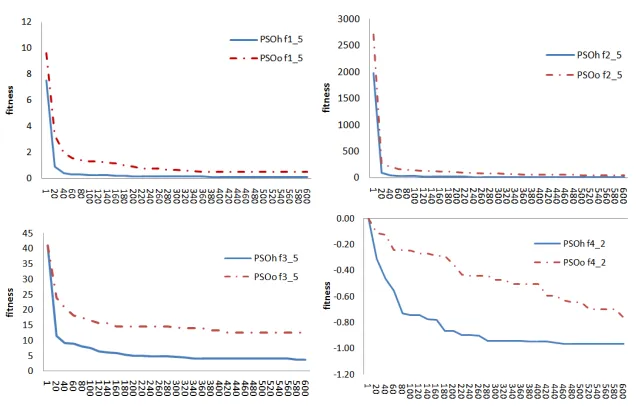
In order to analyze more exhaustively the behavior of PSOo and PSOh, we have carried out a survey every 20 iterations from each execution. In this survey, the considered variables are Best and Entropy. Figures 3 and 4 summarize these data.
In Figure 4, we can see the best solution found by PSOo and PSOh every 20 iterations during the search process. The PSOo and PSOh behaviors if we consider the result quality. In this regard, for each search space tested both algorithms present a similar behavior. They start with high fitness values, these values drop sharply at the first 80 iterations approximately. From this point, the improvements continue but with a fewer intensity and an important difference between these two algorithms appears. PSOo decreases the best fitness value keeping the same best fitness over long intervals of iterations; while PSOh shows a slow but steady decline of the best fitness for the rest of the iterations. Another important difference is that during all iterations, PSOh always obtains better fitness values than PSOo.
In Figure 3, we can see that both algorithms start with a very high genotypic diversity, which fall quickly at the first 40 iterations. But for PSOh the drop is more significant than for PSOo (0.8 vs. 0.9). In average those values are maintained on the rest of the run by each algorithm.
Fig. 4.PSOo and PSOh Abest values taken every 20 iterations for each tested function.
other words, PSOh reduces the swarm dispersion without losing the necessary exploration to avoid local optimum.
6
Conclusions
Two different algorithmic versions for Particle swarm optimization have been presented, studied and analyzed in this job. One of this version is a classical binary PSO which use the derivation 0 method to compute the values of the position vector. The other version is proposed for us, it is ahybrid binary PSO which use thederivation 0 method.
This hybridization arises because the first algorithm (the classical binary PSO) cannot converge to the optimum since the high degree of dispersion in the swarm during the search process. In order for solving this problem a social crossover and an elitist restart operators are incorporated into the binary PSO. In this way, we can exploit the search space using this crossover operator and explore it using the elitist restart operator. The idea behind this hybridization is to balance the exploitation and exploration in the search process. That means, the particles should be sufficiently separated from one another without being too dispersed.
Both versions of the Particle Swarm Optimization were tested for a set of selected functions which have different characteristics and complexity degrees. At the light of these results we can conclude that:
– Concerning the genotypic diversity, the hybrid approach losses a minimum of diversity on the search process to achieve a better balance between explo-ration and exploitation.
Due to these promissory results, this research will be continued solving com-plex combinatorial optimization problems. For example, problems in the area of antenna designs will be studied. Furthermore, an analysis about parameters will be performed.
References
[1] Kennedy, J., Eberhart, R., Shi, Y.: Swarm intelligence. (2001)
[2] Shi, Y.: Particle swarm optimization. IEEE Neural Networks Society ,Electronic Data Systems, Kokomo, IN 46902, USA (2004)
[3] Holland, J.H.: Adaptation in Natural and Artificial Systems. First edn. The MIT Press, Cambridge, Massachusetts (1975)
[4] Kennedy, J.: The particle swarm: Social adaptation of knowledge. International Conference on Evolutionary Computation IEEE (1997) 303 – 308
[5] Liang, J.J., Suganthan, P.N.: Dynamic multiswarm particle swarm opti-mizer (dms-pso). Proceedings of the IEEE swarm intelligence symposium (SIS).Piscataway: IEE (2005) 124129
[6] Clerc, M.: Stagnation analysis in particle swarm optimization or what happens when nothing happens. Technical Report CSM-460, Department of Computer Science, University of Essex (august 2006)
[7] K.E. PARSOPOULOS, M.V.: Initializing the particle swarm optimizer using the nonlinear simplex method. Technical report, Department of Mathematics Univer-sity of Patras (2002)
[8] Ai, T.J., Kachitvichyanukul, V.: Particle swarm optimization and two solution representations for solving the capacitated vehicle routing problem. Computers & Operations Research36(5) (May 2009) 1693–1702
[9] Moore, J., Chapman, R.: Application of particle swarm to multiobjective opti-mization. Technical report, Department of Computer Science and Software Engi-neering, Auburn University (1999)
[10] Millie, P., Radha, T., Ajith, A.: Particle swarm based meta-heuristics for function optimization and engineering applications. 7th Computer Information Systems and Industrial Management Applications (2008)
[11] Eshelman, L.J.: The CHC adaptive search algorithm: How to have safe search when engaging in nontraditional genetic recombination. In: Foundations of Genetic Algorithms, Morgan Kaufmann (1991) 265– 283
[12] Eberhart, R., Shi, Y.: Comparing inertia weights and constriction factors in parti-cle swarm optimization. In: International Congress on Evolutionary Computation. Volume 1. (2000) 84–88
[13] Clerc, M.: Binary particle swarm optimisers: Toolbox, derivations, and mathe-matical insights. (febrero 2005)
[14] Kennedy, J., Eberhart, R.C.: A discrete bynary version of the particle swarm algorithm. In Proceedings of the IEEE International Conference on Systems, Man and Cybernetics5(0-78034053-1) (1997) 4104 – 4109